Part Nine The Bandit Bird
Reading edition

I hope the fact that Hector was a chicken hawk will not prejudice you against him unduly. There are brigands, you know, who have gentlemanly instincts, and I am sure that if Hector had been a bandit chief, he would have spared women and children and given part of his plunderings to charity. After all, he was not to blame for being a hawk or for having a natural liking for live poultry. There was at times a mournful dignity about him, as if he resented the unfair workings of a fate which had made him a robber bird, a trespasser on the lives of other creatures, and at enmity with every living thing.
169
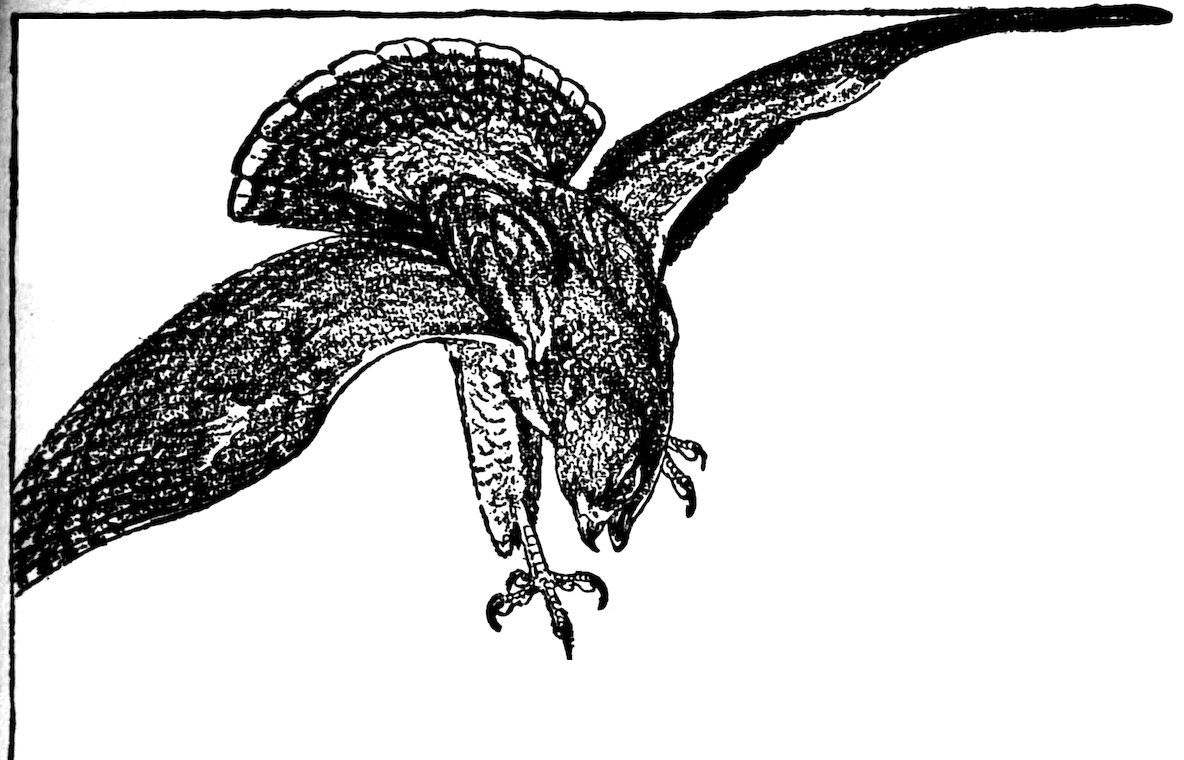
Sometimes the bandit birds swooped down
He was a beautiful hawk with gray-brown plumage, wing tips that turned slightly upward when he flew, and a fierce and royal beak curved like a scimitar. His eyes were very black, very bright, and very knowing. Most of the time they were superbly disdainful. But Brother and I have seen them when they actually seemed to smile.
It was Brother who named him, for the alliterative privilege, I suspect, of calling him “Hector, the Horrible Hawk.” But that was only in fun. For 170he was not horrible at all when we got to know him. Lazarus thinks otherwise, very probably. But then his experience with Hector was a trying one, and to this day—if he still lives—he carries the marks of his eventful meeting with our friend, the robber chief.
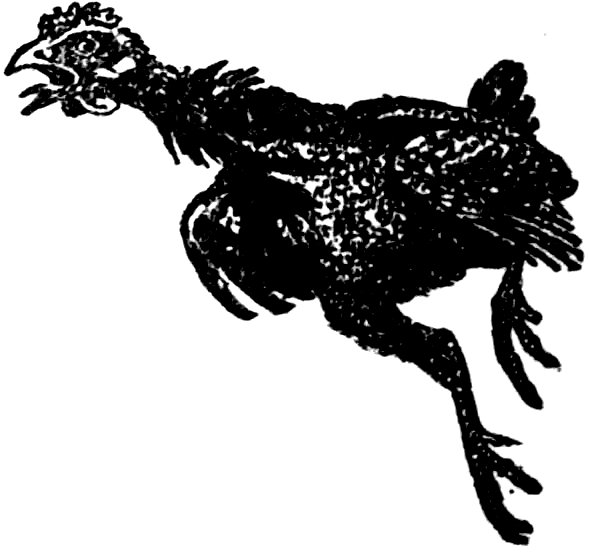
Lazarus was a pet chicken, son of Sironda, the black minorca hen. We gave him his curious name because he had a talent for venturing very near death’s door, and the fact that we always saved him lent appropriateness to his name. Once when very young, no more than five days out of his shell, he was all but scalped by a rival mother hen, and when we answered his frantic baby peeps for help his head was bleeding profusely, and his eyes were closed as if in death. We sprinkled water on his tiny bill and salved his lacerated head. And he, having a strong constitution, came back from the tomb, as it 171were, and lived a long and eventful life. In order to care for him better, we kept him in the back-yard, tucking him at night into a small box under flannel coverings. He thrived and grew from chickhood very sturdily, and the only ill effect that remained from his early mishap was that he was quite bald. No feathers ever came on the spot where the lady hen had scalped him, and we could have distinguished him from every cockerel of his size and color in the world by that little bare place on the top of his head.
Now, when Lazarus lost his first baby down and was in that shorn and untidy condition which always precedes the growth of real feathers, he suddenly became lonesome for the other members of the poultry yard. He would run the length of the wire fence, poking his head through the small meshes, and more than once he nearly 172strangled to death by getting it caught. We always rescued him just in time to save his life. So finally we allowed him to go into the barnyard with the rest of his kindred. It was then that Lazarus had the big adventure of his already crowded career. His meeting with Hector lifted him to dizzy heights—and I am not speaking figuratively. It really did. At that, it wasn’t so much a meeting as an abduction. At least Hector intended it to be such.
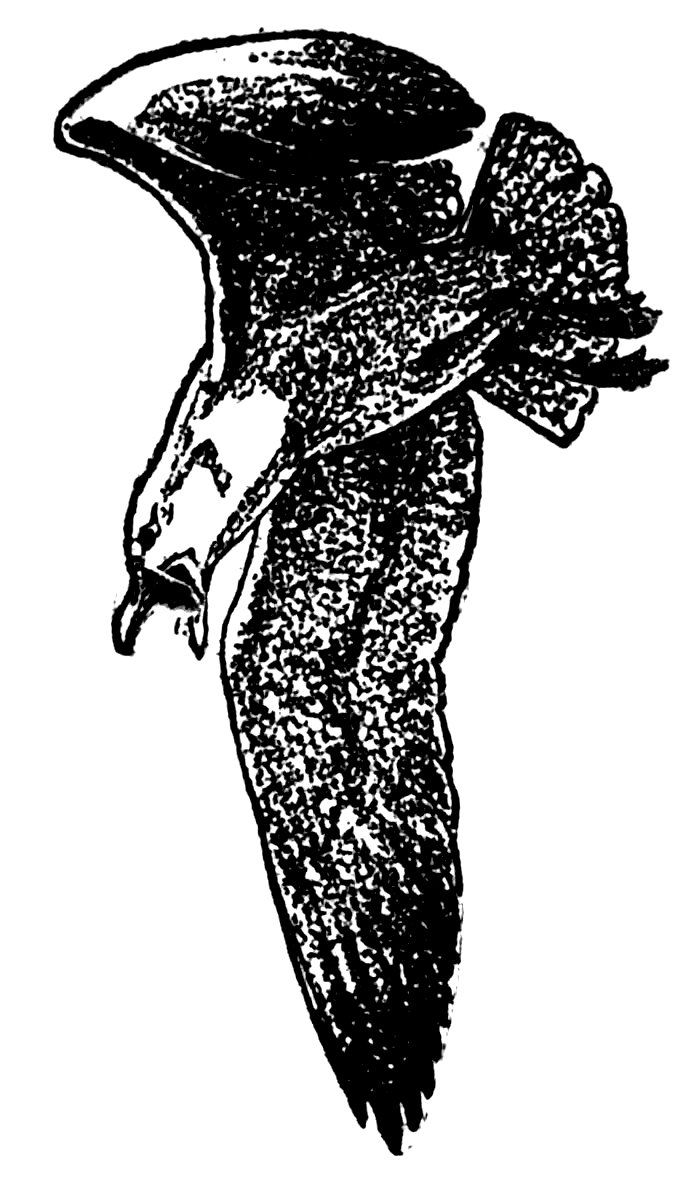
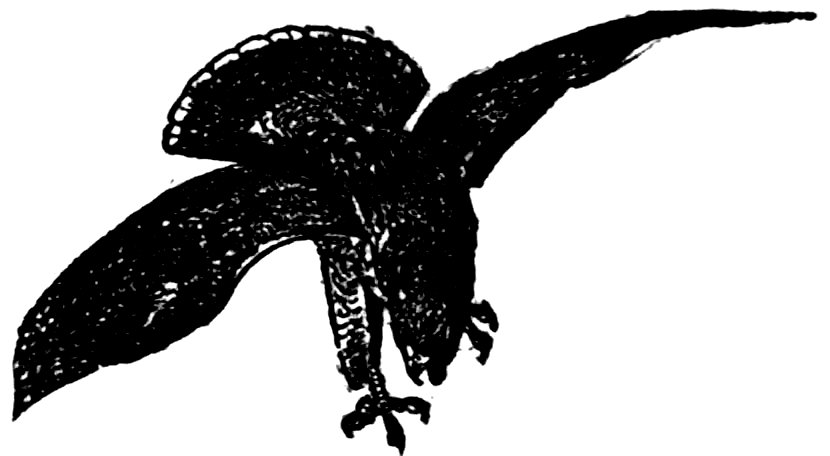
We were constantly on guard to keep hawks away from the ranch. They waged merciless warfare on our chickens, pigeons, and guinea-pigs, and there was always a loaded, double-barreled shotgun behind the kitchen door ready for action in case of an air raid. When we heard the frightened flapping of the pigeons as they flew in aimless circles around the cabin and barn, we knew a hawk was somewhere overhead, hovering 173with curved-up wings and cruel, bright eyes, seeking his prey, choosing it calmly, waiting patiently the proper moment to swoop down upon it.
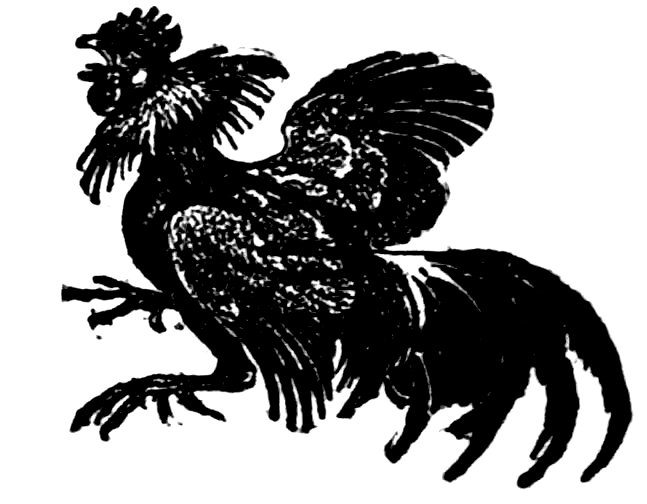
The chickens, too, always told us when such danger was near. Prince, the great white Plymouth Rock rooster, would set up a long-drawn cry of warning, and the hens would burst into frenzied cackling. The whole poultry yard would cock its head on one side to get a better view of the air robber, then would scoot to cover of the barn or hen-houses, every neck ruff distended. Sometimes it was a false alarm. A crow would be flying peaceably on his business, or a sea-gull would have swerved inland a bit. Prince took no chances. It was his duty to guard the poultry yard, and he believed firmly in the policy of safety first.
But many times the warning was one 174of real danger. A hawk would indeed be circling slowly above the barnyard, his bright eyes fixed calculatingly on the scurrying fowls below. Then one of the grown-ups would snatch the double-barreled shotgun from behind the kitchen door and fire at the winged plunderer. The shot, though it did not usually kill, always frightened the air robber away, and we would watch him fly lazily, almost contemptuously, off toward the hill and the thick woods, his powerful wings moving steadily and easily.
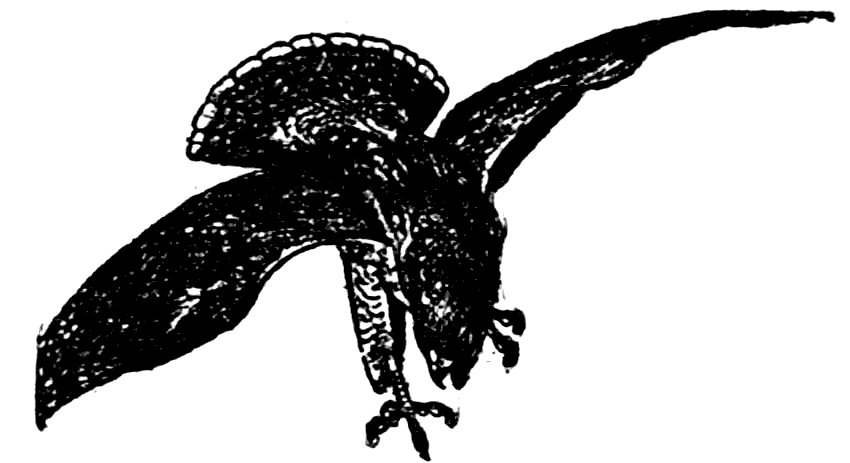
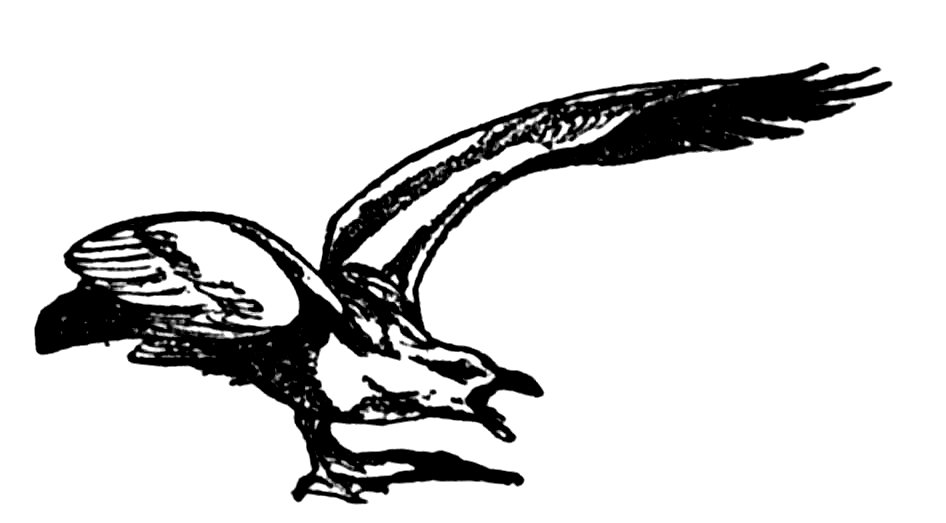
Sometimes, though, the bandit birds came and swooped down on their prey—a small chick or a baby guinea-pig—before we could prevent it. And often a bloody bunch of feathers near the rookery would testify to the murderous skill of a hawk and the sad fate of a hapless pigeon.
It was on a day when the grown-ups 175had gone to town. The Old Fisherman was mending his nets down on the float in front of the cabin. It was a lazy summer day, and Brother and I were sitting on the porch steps reading—the steps that were made of roughly-hewn logs.
All at once we heard the familiar danger signal of Prince, the white rooster, and then the hens began to cackle in a very panic of fear. We dropped our books, but before we could even start for the back-yard, we heard another sound which seemed so impossible and so out of place that we listened paralyzed with astonishment. It was the shrill and frenzied peeping of a half-grown chicken in terrible distress—and the sound came from above us!
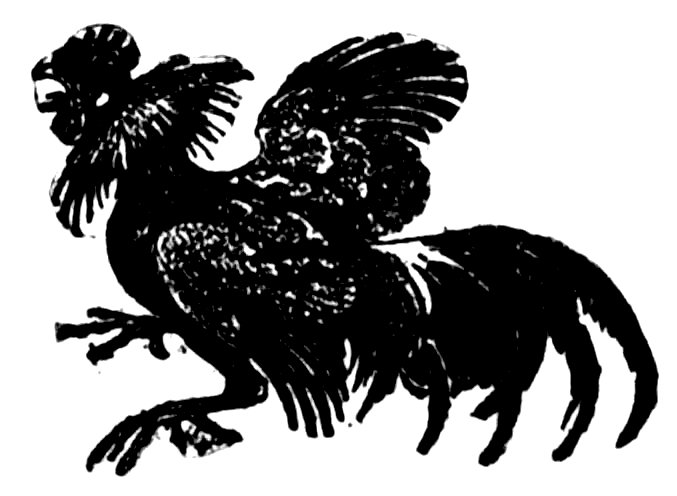
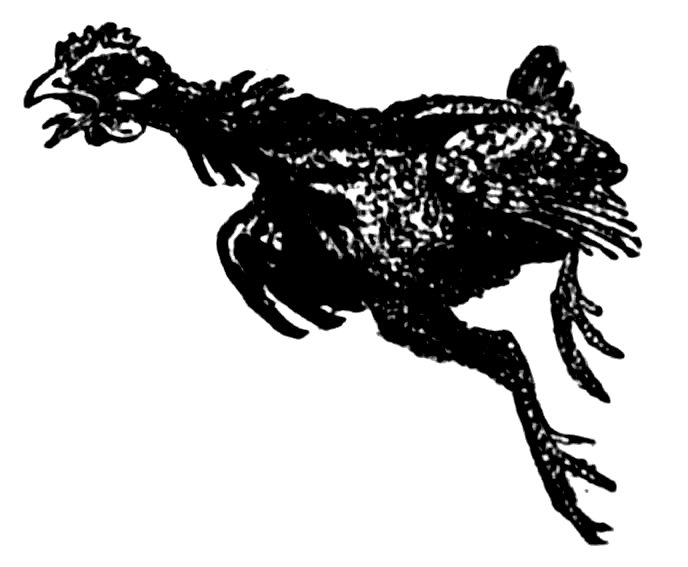
The next instant, as we stood staring, hardly crediting what our eyes told us, we saw a large chicken hawk fly slowly past the cabin, no higher 176than the roof of the porch. He flew so slowly and at such a short distance from the earth because he was weighted down with a live and struggling young cockerel, which he held grimly in his sharp talons! There was a shout that came from our throats simultaneously, “Lazarus!”
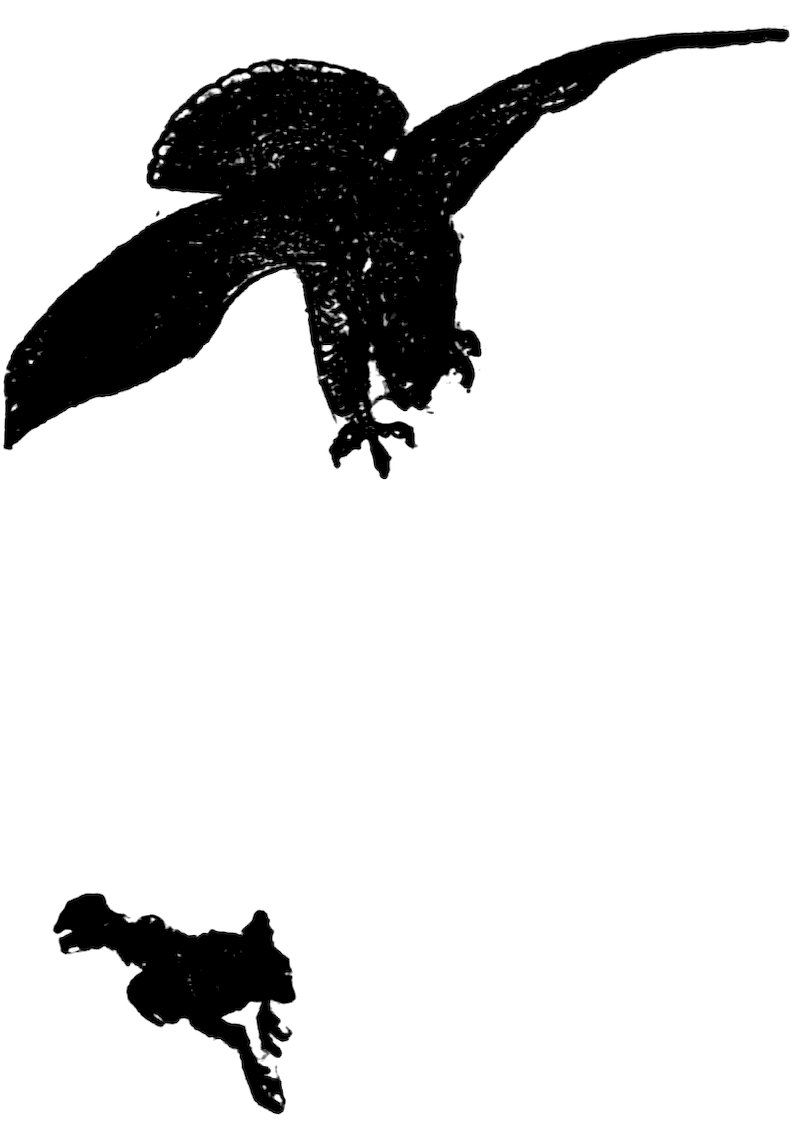
For the struggling, shrilly-peeping victim was no other than our bald-headed friend whom we had saved from death half a dozen times before. His bare, gangling legs hung limply beneath him; his neck jerked spasmodically with his frantic appeals for help. His wings, with their absurd tufts of feathers, stuck out at right angles from his body, for the hawk’s talons were buried in the flesh beneath them.
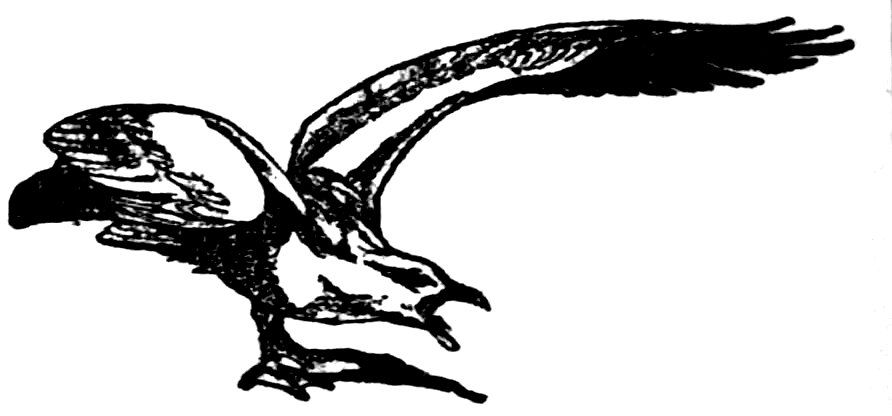
At the time, you may be sure, we did not wait to make any remarks on all these observations. With one thought Brother and I plunged through the 177front door, back into the kitchen, and bumped into each other in our eagerness to get the gun. It was Brother who seized it first, and through the two rooms we dashed again and out into the front yard. The hawk was flying slowly and with evident difficulty—for Lazarus was a healthy, heavy youngster—across the open space that lay between the yard of the cabin and the old brickyard shed which adjoined it.
Brother, bent back almost double by the weight of the heavy weapon, pressed it against his shoulder, took careful aim, and fired. I screamed, for there were three falls. Brother tumbled backward from the kick of the shotgun. Lazarus hurtled to earth in a sprawl of legs and wings and lay there, uttering feeble, choking sounds. The hawk rocketed down, a flutter of gray-brown feathers; there was blood upon the grass where he dropped.
178The Old Fisherman, hearing the commotion, came running up the float, the wooden shuttle with which he mended nets still grasped tightly in his hand.
Brother scrambled to his feet, blinking dazedly at the result of his marksmanship. Our first thought was that Lazarus was killed at last. But he was apparently only severely shaken by his fall, for presently he walked off a little dizzily, his tender skin bleeding where the hawk’s talons had sunk in.
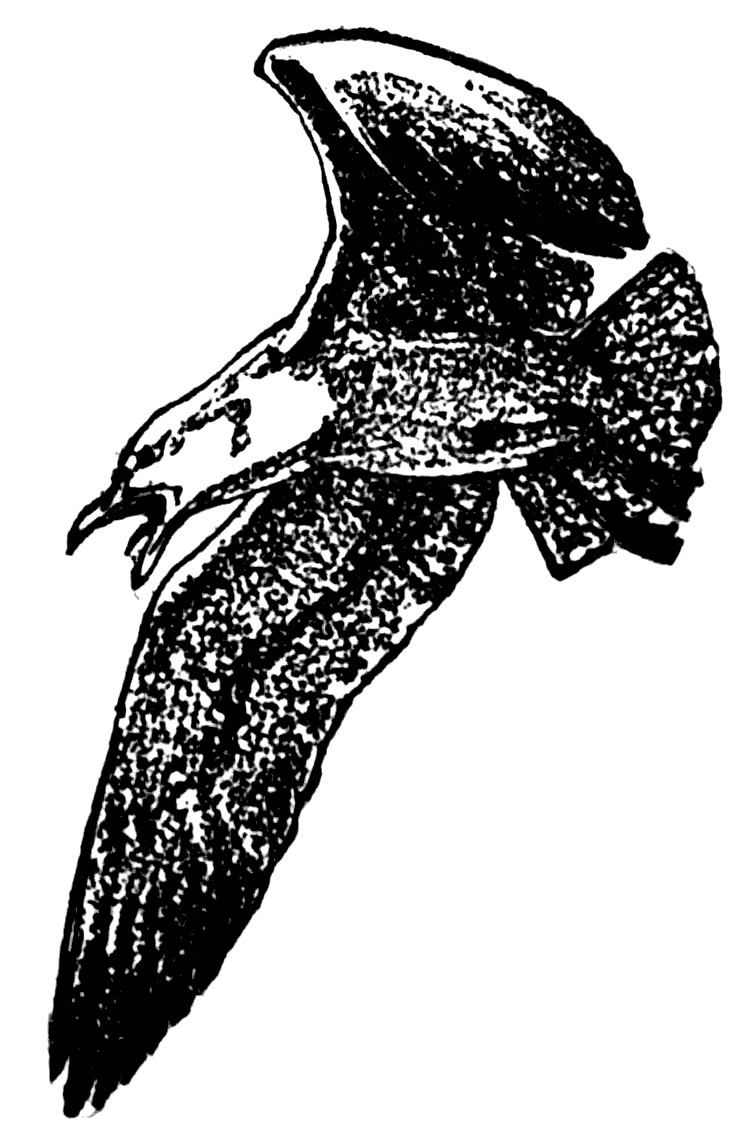
The hawk was our next consideration. Now that we had wounded him—I say “we,” because I felt that the responsibility was half mine—we were sorry for his plight. He was thrashing about helplessly on the grass, one wing dragging at his side. He was trying desperately to fly, but could not so much as lift himself above the ground. His fierce, dark eyes blazed 179at us, and his powerful, curved beak snapped menacingly when we approached him. But at last his strength failed him, the bleeding wing spread itself out in a fan, and he sank over on one side, his talons jerking spasmodically. As we came nearer he regarded us with eyes that were unafraid. They even seemed dull with apathy, as if he knew that the end had come and that he, like the robber aristocrat that he was, must accept it philosophically.
The Old Fisherman was for ending his life then and there. But Brother and I could not bear to have him killed, for he was at our mercy, hurt and helpless. For the first time in our lives we had deliberately wounded something that lived and had feelings even as we. The knowledge that we had fired upon him to save our friend’s life was not sufficient excuse for us to allow the Old Fisherman to kill him.
180So together we caught him, tied his fierce beak so he could not snap at us, bound his powerful legs so that his talons should not tear our hands, then the Old Fisherman, grumblingly, but gently, bathed and salved the injured wing. In time it would be as good as new, he told us, but he didn’t know what our folks would say to our saving the life of a “pesterin’, low-lived hawk.”
As he anticipated, the grown-ups were not at all pleased when they returned from town and found Hector—he had been named by that time—tied by one leg to a stake in the back-yard, his right wing sadly out of focus and smeared with a clot of blood. But it was not in their kindly hearts to kill in cold blood, so they let the hawk live.
For the first few days that Hector was in our midst he did little except to tug at the chain which bound him to the stake, slowly and automatically, like a 181man taking morning exercises with rubber ropes. He hated us and repulsed our attentions fiercely and scornfully. He refused to eat the tempting bits of raw meat that we spread before him; he sulked all day with his curved beak hidden in the ruffled feathers of his breast. He was indeed like a robber chieftain in captivity. We were patient, however, for we knew that according to Hector’s viewpoint we had injured him without reason. He had been in search of his dinner—a perfectly legitimate occupation for any one—and as he was carrying it off we had not only robbed him of it, but wounded him grievously. You can see that he had a great deal of logic on his side.
But little by little his haughty antagonism melted before our daily overtures. He no longer snapped at us when we came near, and began to take an active interest in the food we 182brought him. There came a day when he allowed me to put my hand on the soft, smooth feathers of his head and back, and when I gently massaged his wounded wing with vaseline he opened his beak as if to bite my hand but closed it without doing me harm.
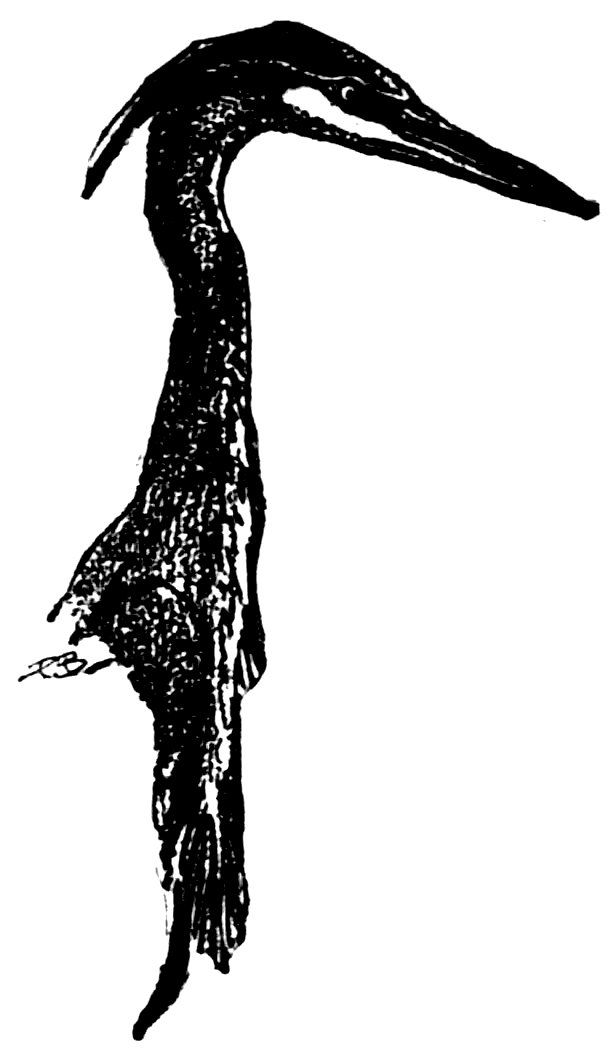
Then, wonder of wonders, Hector began to like us. When he saw us coming into the back-yard he would set up a sort of dancing, jumping up and down stiff-legged, spreading out his dark wings, and straining at the chain. His beak would snap open and shut, and his bright, black eyes seemed actually to have a smile in them. He would allow me to salve his injury with only the faintest suggestion of nervousness in his half-open beak, and on the day when we unchained his leg from the stake he sat on my hand with all the dignity of an emperor receiving his court after a long illness.
183From that time on we gave Hector his liberty for a few hours each day. And always, before releasing him, we would take the precaution to feed him well. We did not intend to have any fatalities among the poultry if we could help it. But even with a full stomach, he worried the barnyard into a daily spasm of fear. For as he regained the use of his wing, he would fly slowly, majestically, over the poultry pens, turning his head from side to side as hawks do when they are picking their prey and calculating the time for the swoop to earth. Brother and I believed firmly that Hector had no intention of snatching up a chick or a pigeon, that his daily flight was merely by way of exercise and for the dramatic satisfaction it gave him to see the feathered crew below him so disturbed.
At any rate, he never once attempted to harm any of our live stock. Perhaps 184it was because we fed him so well, but Brother and I preferred to think it was because he was a gentleman, and that he would not betray our confidence when we trusted him to do the right thing.
This daily flight of Hector’s was most annoying to the grown-ups, however. In the first place, the hens were not laying so well as they had. They were frightened out of all nesting desire by Hector’s calm aërial promenades, and were in a continual state of nervous excitement. Then, too, when Prince gave the danger signal and all the hens ran for cover with their chicks, the grown-ups would dash out of the house each time ready to fire upon a strange marauder, only to be confronted with Hector making peaceable spirals above the hen-houses. He would come to us when we whistled shrilly, and would sit quietly on my wrist to nibble 185at a piece of cooky as if he had never had a carnivorous thought in his life.
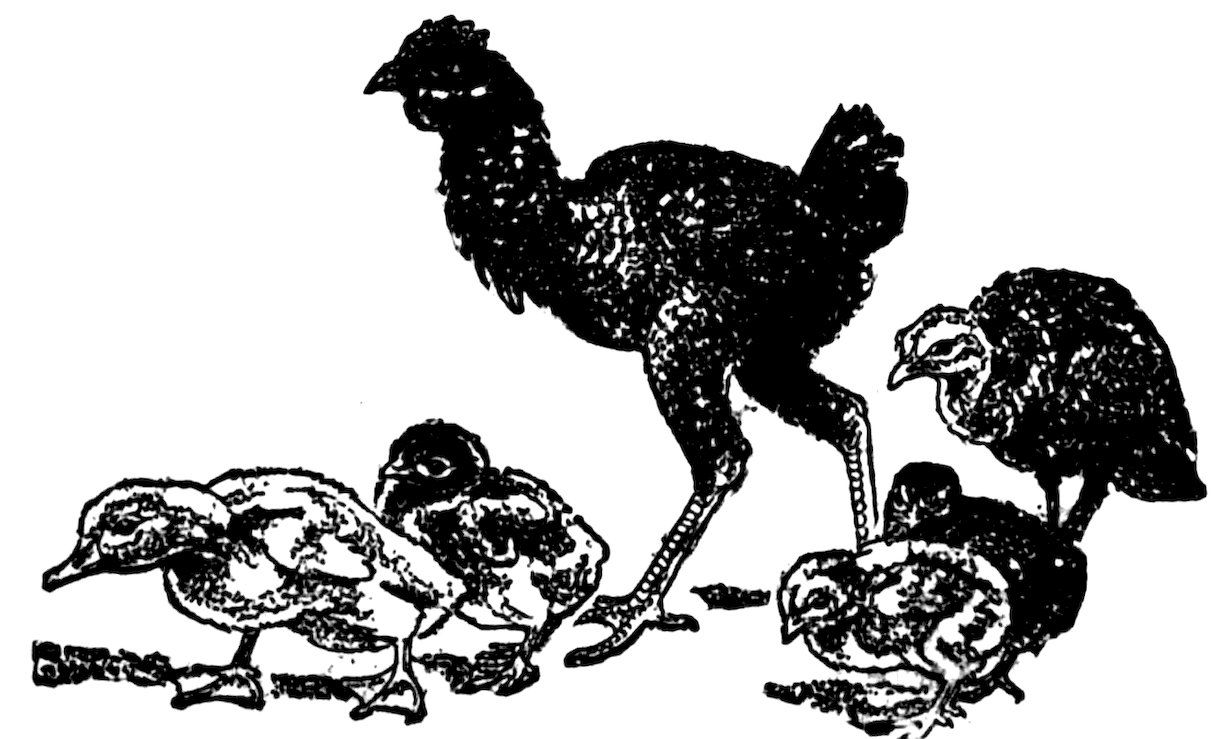
I should like to tell you that he and Lazarus became friends after the hawk had become partially domesticated, but such was never the case. Lazarus used to come stalking into the back-yard, his legs much too long for the rest of him, and a tiny, serrated, red comb sticking up from the bald spot on his head. His body was still almost bare, though a generous tuft of feathers on his tail showed where he might in time expect some real plumage. He still carried the scars of his aërial adventure under his wings. He would approach Hector cautiously, craning his neck in and out with a curious rubberized effect, and would stop at a safe distance, turning his head on one side, giving Hector a timorous inspection from the broadside of one amber eye. And Hector would return the look 186scornfully, his curved beak giving him a morose, sneering expression. His whole attitude seemed to say, “Never mind, I’ll get you next time!”
As Hector grew stronger and could fly better, the grown-ups gave the ultimatum that we must dispose of him in some way. It was too dangerous, they said, to have a chicken hawk around the ranch. In vain we argued that Hector was a gentleman, that he would not bother any of our poultry. But to our sorrow, they said that he should be taken to the city and presented to the zoölogical gardens there.
Brother and I told Hector what was going to happen to him, and that it was not in our power to prevent his going, and it seemed to us that he was very thoughtful afterward. We shall always believe that what happened was the direct result of the grown-ups’ decision to send him into captivity, 187although, you understand, we could not blame them. They had been more than kind to our somewhat dangerous guest.
The next day when we released our robber chieftain from his stake, he flew up over the cabin roof, circled once around it, then flew northward along the beach and was soon out of sight. When night came Hector did not return. And though Brother and I stood in the yard whistling until we were breathless, there was no sudden swoop of a gray-brown bird from the air, no Hector to curve sharp talons gently around my wrist.
The next morning, when we went for milk at the neighboring ranch, we knew why our friend had not come back to us. On the fence outside the barn, hung limply over the pickets just as he had fallen, was a draggled bunch of gray-brown feathers that had once been our 188beautiful Hector, the Robber Chief. The wide wings were powerless now, the body was riddled with fine shot, the once proud head with its curved beak drooped pitifully. The fierce dark eyes were closed. Never again would Hector perform his dance of joy at our coming, never again would he stare appraisingly at Lazarus, or frighten the hens and pigeons with his lazy circles above their heads.
The rancher told us he had shot the hawk the day before. And he could not understand why we wept over the blood-stained bunch of feathers. He did not know that Hector was a friend of ours—and a gentleman.
Brother and I always thought that Hector deliberately courted death rather than spend his life in yearning captivity. And I, for one, am glad he did. For no one else would have understood him and loved him as we did.
189
Her nostrils dilated at the hated human scent.