Part Eight Timothy, the Dirty Bear
Reading edition

Perhaps it is unjust to the memory of our friend Timothy that we should think of him as “the Dirty Bear.” I wouldn’t prejudice you against him for the world. “Dirty” has such a reprehensible sound. But Timothy was dirty in a 146perfectly legitimate way. He had a primitive soul that found delight in grubbing in rotten stumps for maggots and in burrowing into the soft earth for Indian potato roots. You can see that under such circumstances he could not keep his face and paws scrupulously clean, any more than a child can who makes mud pies. He hated water—but then, so did we, unless we could take our baths in the Bay—and he had an almost fanatical fear of soap. Brother, who was then reading “A Connecticut Yankee in King Arthur’s Court,” thought Timothy might have been a reincarnation of some eccentric hermit who had vowed never to wash himself for the rest of his life.
We knew Timothy long before he knew us. We did not know him by name, but we knew where he lived, and we had what you might call 147a speaking acquaintance with his mother. It happened thus:
One day, in our explorations along the creek bed at the end of the Hill Trail, we came suddenly upon a hole in the bank. It was almost covered by long, overhanging ferns, and had not a puff of wind stirred the fronds just as we were passing, we should never have known about the hole at all. It was on the opposite side of the creek, but we found a place where a fallen log bridged the little stream, and the next moment we were standing on the opposite side at the foot of the embankment, pushing the ferns aside and peering into the depths of a black and wonderfully inviting hole.
Had we thought to look, we might have seen in the sandy slope that led up to the hidden entrance the imprints of a foot almost human in shape, although not nearly so large. Footprints 148that turned in toward each other—and we should have known. But our minds were filled with the fascinating possibilities of the miniature cave we had discovered. Perhaps it was a pirate den; perhaps gnomes lived there; or perhaps we were on the track of buried treasure.
On hands and knees I led the way into the inky blackness with Brother close behind me. The daylight behind was blotted out. For several yards the passageway went straight ahead, then it turned suddenly to the right; and I, turning with it, stopped so abruptly that Brother coming behind bumped into me. A curious, powerful odor enveloped us, as of darkness made odorous by furry bodies and warm by living things. Then from ahead of me not more than two yards away flashed the savage gleam of two blue-green eyes.
There was a menacing growl which 149set our spines to tingling, and at the same instant came the sound of whines and a movement as of baby things disturbed in their sleep. I was conscious of a sickish, fainting feeling, for I realized suddenly that we were in the house of a mother bear.
Brother needed no urging to make his exit. He was backing out on hands and knees far more quickly than he had come in, and I was prodding him along, followed by those menacing, hair-raising growls.
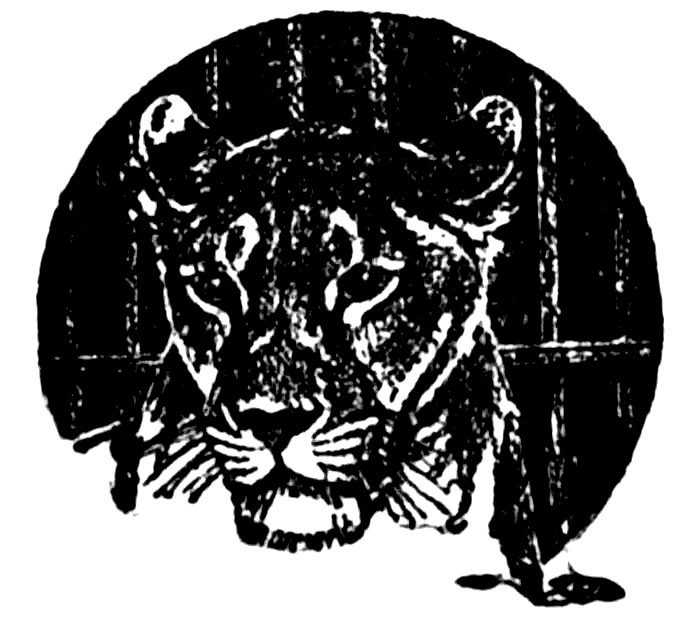
Why the lady bear did not attack us is more than I can tell. The brown bears of the northwestern woods are harmless and even friendly little persons, but the mother when protecting her young is more ferocious than a wildcat or a mountain lion. Perhaps Mrs. Timothy knew that our visit was unintentional and that we meditated no harm toward her or her children. 150At any rate we gained the entrance of the cave untouched and unharmed, but we were breathing heavily and our knees were wobbling sadly.
Perhaps you think we should have stayed away from the house of the lady bear; but we did not. We were interested, you see, in knowing how much of a family she had, and we never went along the creek bed without leaving some offering in the shape of food at the mouth of the hole.
Sometimes it was an apple or a leaf of lettuce, and if nothing else availed, we broke off licorice root or fern and placed it there for her. It was our method of apologizing for our intrusion and of expressing our interest in the family.
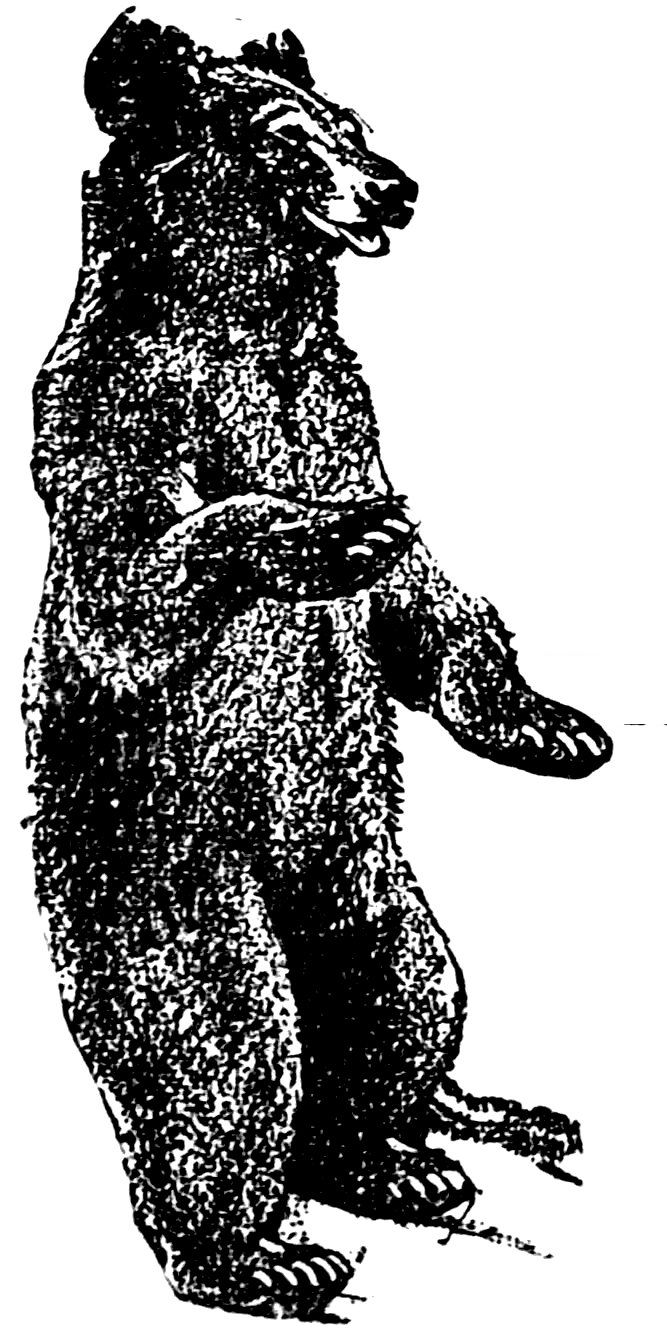
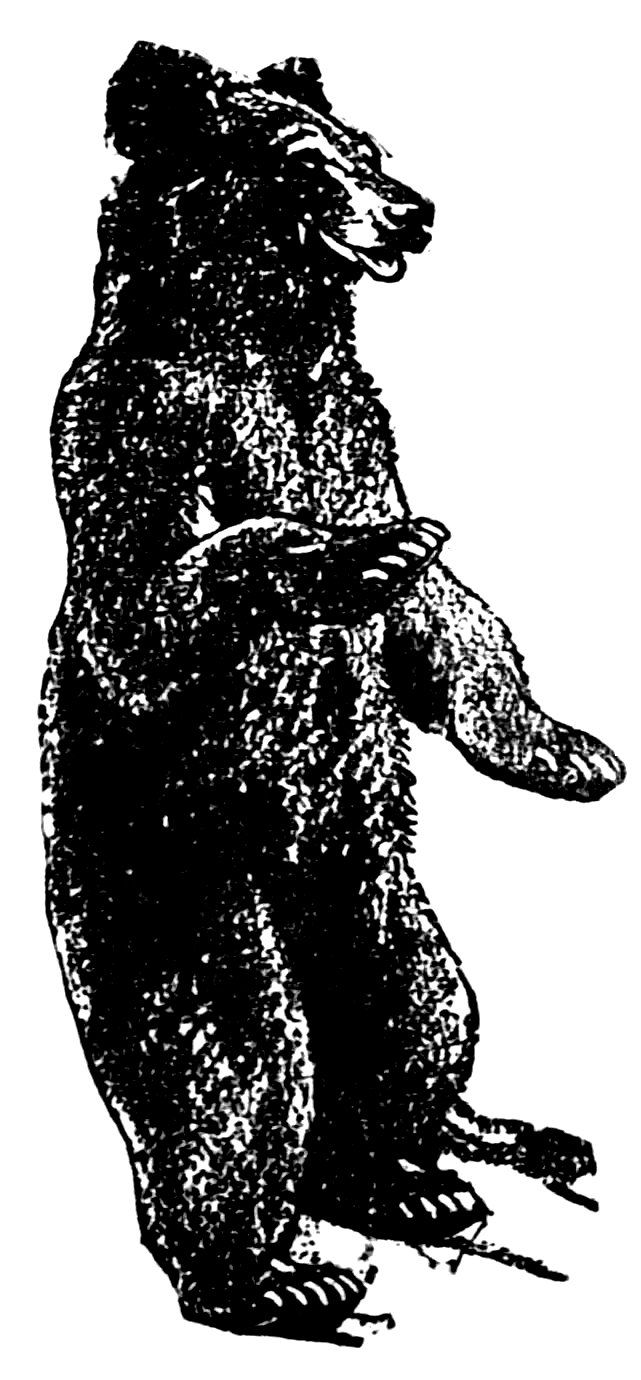
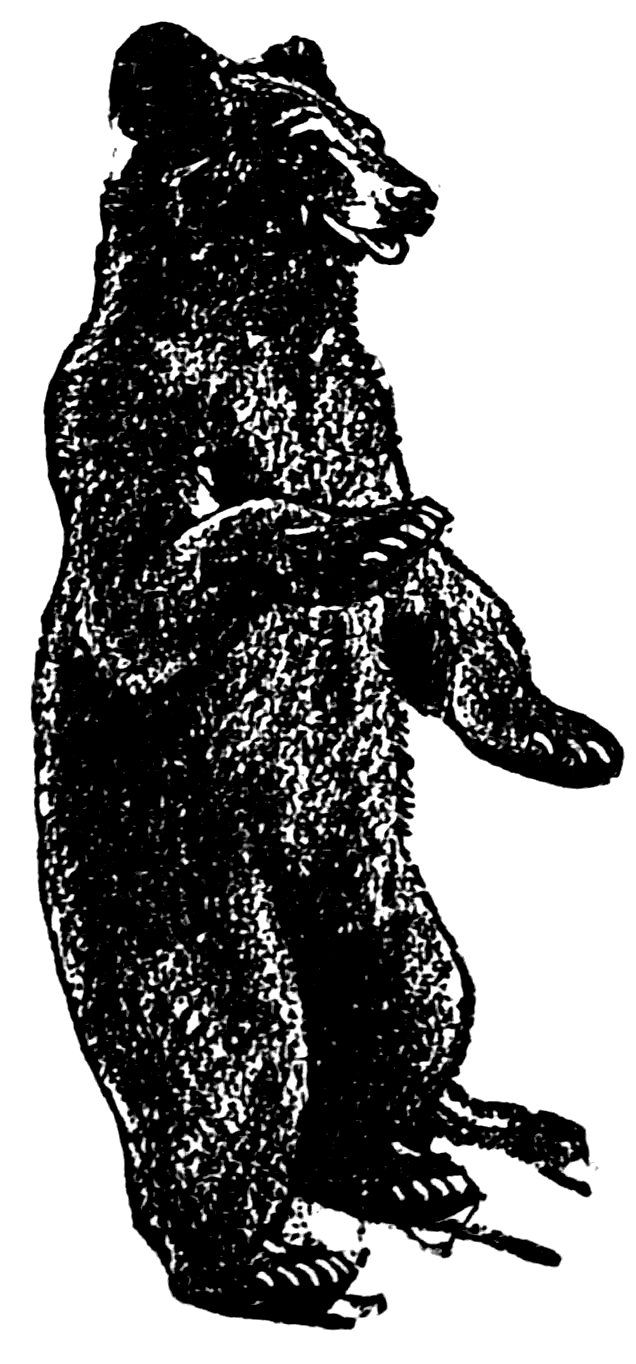
One day we saw the mother bear with her children, and that is how we came to name Timothy. She was at the mouth of the cave, half asleep in the 151warm sunshine, and four cubs were rolling over each other like gridiron heroes in a football scrimmage. They were squealing like young pigs, and from time to time she remonstrated against their noise by a sleepy grunt. Then, as we watched, the bear cub at the bottom of the furry pile squeezed out and stood on his hind legs. His face was covered with brown, sandy loam, and his squinty black eyes peered out as through a mask. I knew a boy who lived at the head of the Bay whose face always looked so. His name was Timothy, and that was why on the spot we so christened the bear baby.
152
Our next meeting with Timothy was in the nature of a near-tragedy. We were hunting for trilliums in Trillium Gulch, a hidden valley to which we ourselves had cut a path from the Hill Trail. The white, lily-like flowers starred the hillside there in the spring, and it was our fond belief that no one came there but ourselves. Hunters and trappers go everywhere, however, violating even such a woodland paradise as ours. As we went down the narrow trail, pushing aside the light branches of the alders and the firtrees, we heard a plaintive, whining cry almost human in its poignancy. We stopped for an instant, listening, wondering. Then we slipped softly down the path, thrust aside the interlacing ferns, and found ourselves beside the little stream which ran like a silver ribbon through Trillium Gulch. The sounds came from the left, and following their lead we rounded a boulder in the trail and came upon a sight which filled us with gasping indignation. A little brown bear with a fleck of white on his furry throat was tugging frantically and futilely at the jaws of a steel trap which held his two front 153paws in a cruel, biting grip. There was blood upon the jagged clamps, and the face which the little fellow turned to us was piteous in its baby misery, a little brown face covered with loam. It was Timothy, the Dirty Bear.
I do not like even now to think of the half-hour which followed. So strong was the steel trap that the combined efforts of Brother and myself could only pry the cruel jaws apart the fraction of an inch. We were hampered, too, in our work of mercy by poor little Timothy, who, not realizing that we were trying to help him, shrieked and bit at us and scratched with his hind feet. Our hands were soon covered with blood, and there was a long, jagged line of red on Brother’s face where the baby bear had clawed him. But we did not pause in our efforts. Finally, by the aid of a stout stick, we managed to open the jaws of the vicious 154trap, and the poor little fellow, his front paws cruelly torn and bleeding, whimpering like a baby, sat down on his haunches and began to lick his wounded paws, stopping at intervals to hold them out in front of him like a child whose finger is hurt and wants it made well by a kiss.
Strangely enough, he was not afraid of us now, and when I took him in my arms his plaintive whimpering gradually ceased, and he licked at his paws solicitously.
No doubt we should have taken Timothy back to his mother and trusted to nature to heal his grievous hurts. But nature would take too long, and in the meantime he would suffer cruelly. He was such a little bear, you know, and had not yet achieved the stoicism which makes the older woods creatures almost indifferent to pain. So even at the cost of causing his mother a great 155deal of worry at his prolonged absence, we took him down the hill with us to the log cabin to receive first aid treatment for his wounds.
That is how Timothy, the Dirty Bear, became a friend of ours. Fate in the form of a hunter prevented us from taking him back to his home in the creek bank. The poor lady bear was shot the next day. One of her cubs was captured and the other two children escaped to the woods to live as best they could. So Timothy belonged to us, and he was the merriest of playmates.
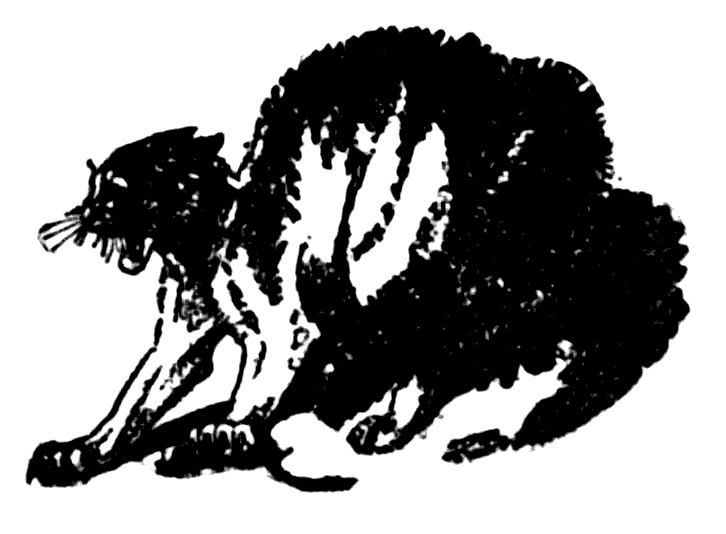
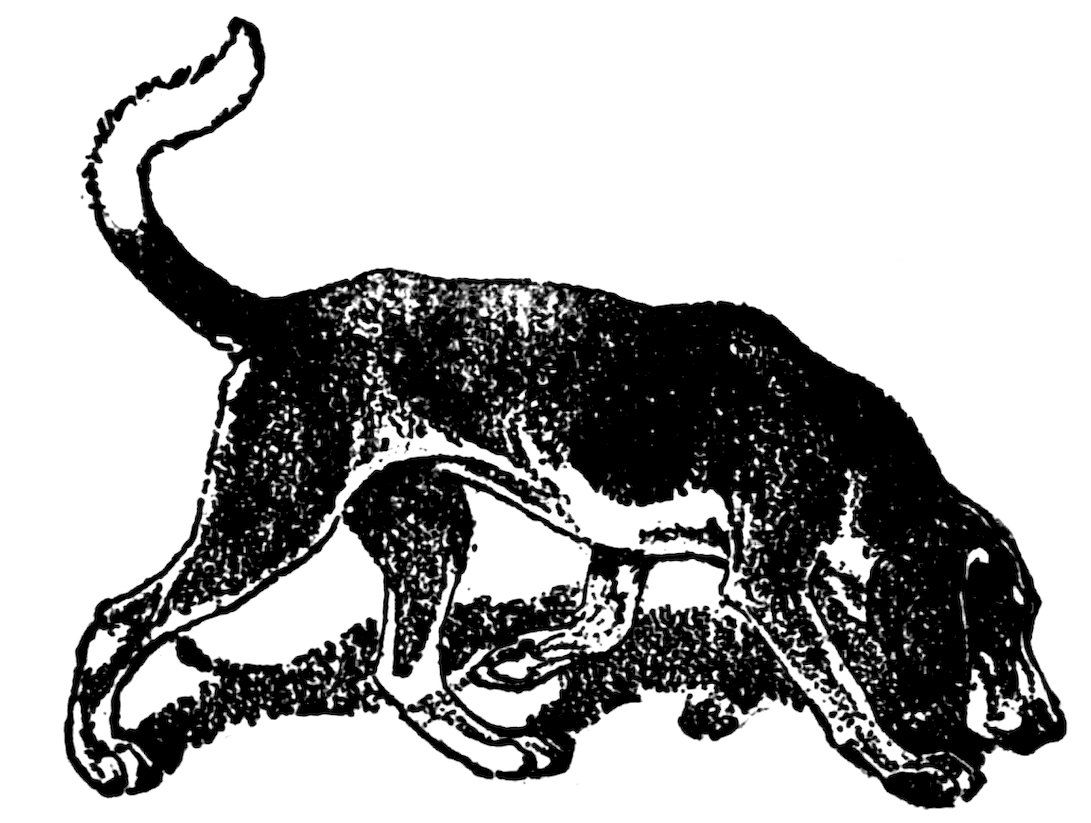
When we rescued him from the trap he was a very tiny bear, being no larger than Tinker, our black and tan rat terrier. He slept in a clothes-basket on the back porch, sometimes having for a bedfellow Three-Spot, the mottled black and white cat. Three-Spot at first had been greatly alarmed by Timothy’s 156rough and sportive overtures of friendship. But when she found that by boxing his ears she could correct his manners and set him to yelping with fright, she took to imposing upon his good nature by making him serve at night for a mattress. In the morning we would find the two of them curled up together, Timothy snoring gently and Three-Spot digging her paws into his soft, thick fur with a purr that was a monotone of content.
Brother and I did not know whether Timothy’s mother had weaned him from a milk diet, but we felt that we would be safeguarding his digestion if we brought him up on liquid food for a time at least, so we rowed into town especially to purchase a bottle with a strong rubber nipple attached. The druggist asked if there was a baby at our house, and we told him yes—what kind of baby, we did not state.
157
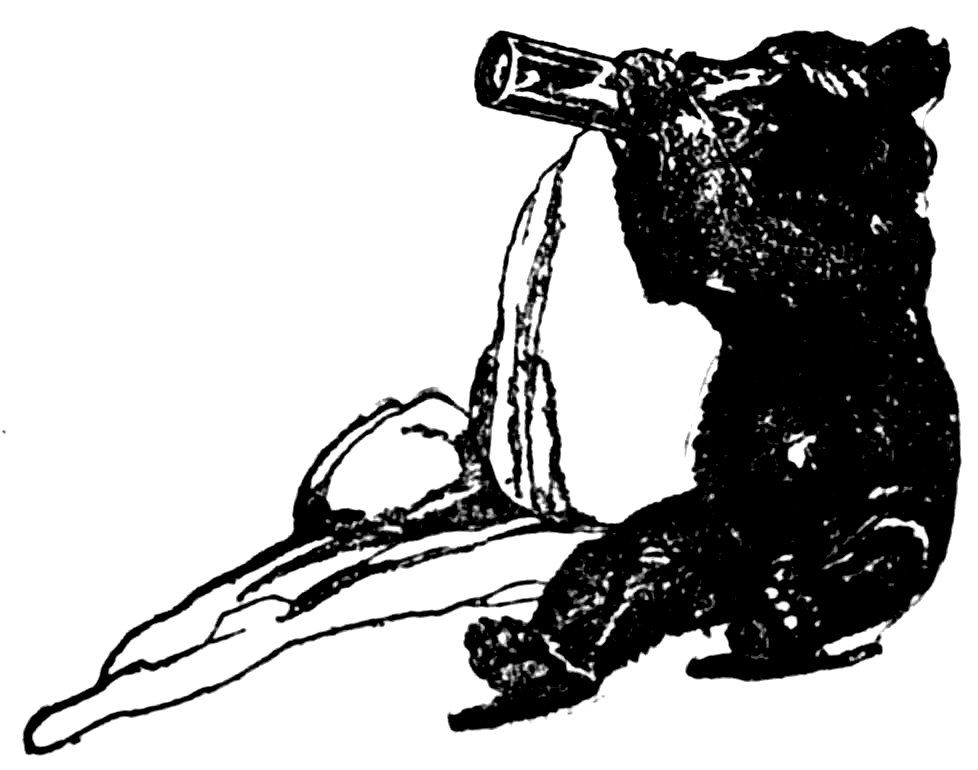
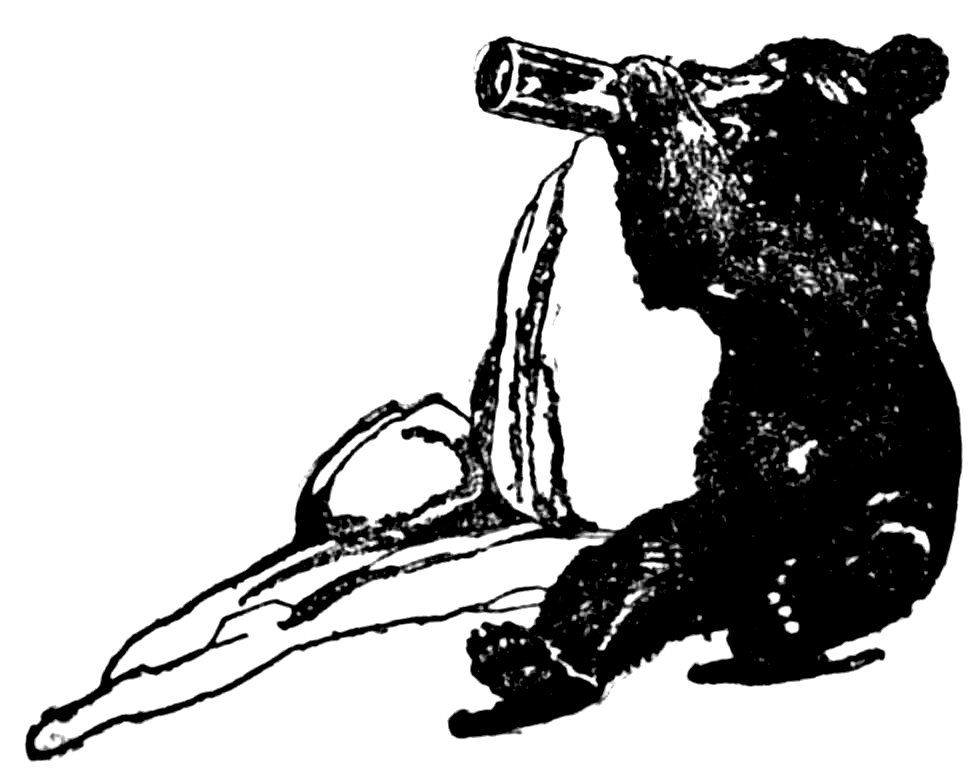
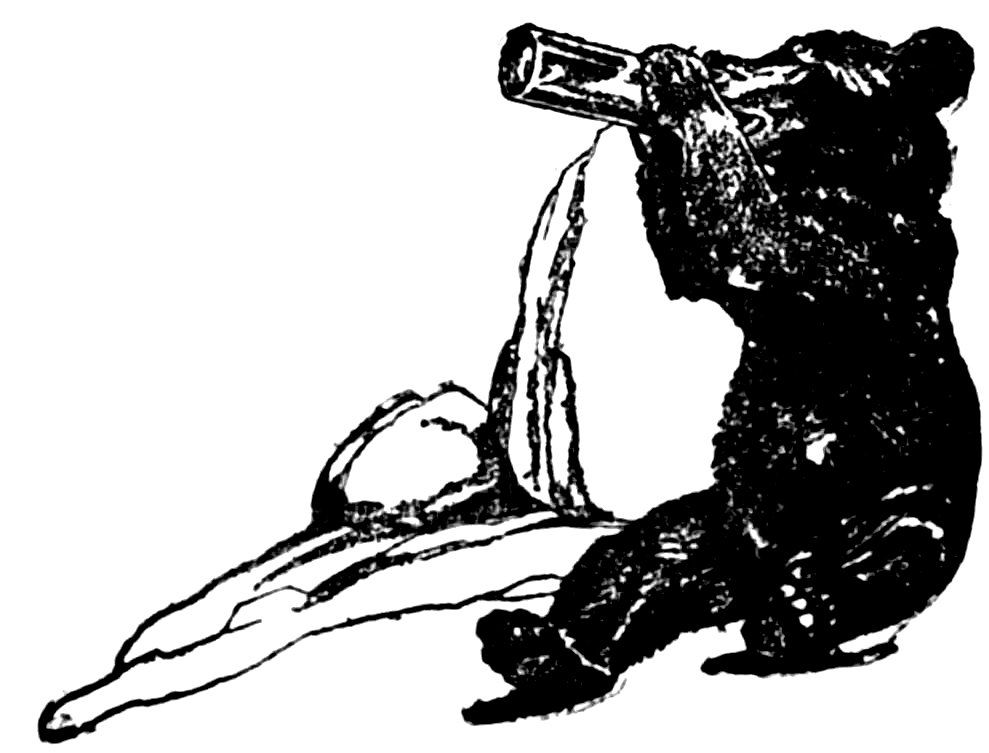
Whether or not we were following the same system of dietetics that Mrs. Bear would have employed in bringing up her child, Timothy really did thrive on his liquid menu. Even after he outgrew the necessity for milk, he clung to the bottle habit and would sample the contents of any bottle he found. We used to bring him ginger ale from town and soda pop of all flavors. If nothing else was handy, we filled a battered old canteen with sweetened water, and he would tilt back on his hind legs, hold the canteen perpendicularly aloft, close his eyes, and drink it slowly, making funny little rumbling noises deep in his throat which, Brother maintained, were imitations of Three-Spot’s purring. Once he got hold of a bottle of kerosene and had closed his eyes in anticipatory ecstasy before the taste of the first terrible mouthful reached his throat. I shall never forget the look of pained 158disillusion on Timothy’s face. He threw the bottle from him, coughed and sputtered, gagged once or twice as if deathly sick, and then waddled off to the spring, walking pigeon-toed, and with uncomprehending anguish in the very tilt of his furry hind quarters. That should have cured him of his liking for promiscuous bottles, but it did not—as you shall see.
We worried a little at first as to what else we should give him besides milk, but we need not have concerned ourselves. Timothy’s appetite was without limits, and he could eat anything—bread, meat scraps, griddle cakes, or cold potatoes. On top of the civilized food we fed him he hunted on his own account for certain roots he liked, clawed the bark from fallen logs to get the white grubs underneath, and buried his head at the foot of hollow stumps where the red ants had made their hills. 159After an hour or two of such foraging, he would return to us, his face and paws besmeared with loam and covered with cobwebs, his furry coat rusty with sand and tagged by twigs and strands of blackberry vine. He would blink at us questioningly, a trifle shamefacedly, running his small red tongue along the sides of his mouth, and we would shake our heads and say mournfully, “Oh, Timothy, you dirty, dirty bear!”
After such excursions we always gave him a bath in the big washtub, and though he knew there was no escaping it, he always squealed and struggled while we lathered him and only ceased his whining when we had rinsed him and put him in the sun to dry, giving him the canteen filled with sugared water to keep him quiet.
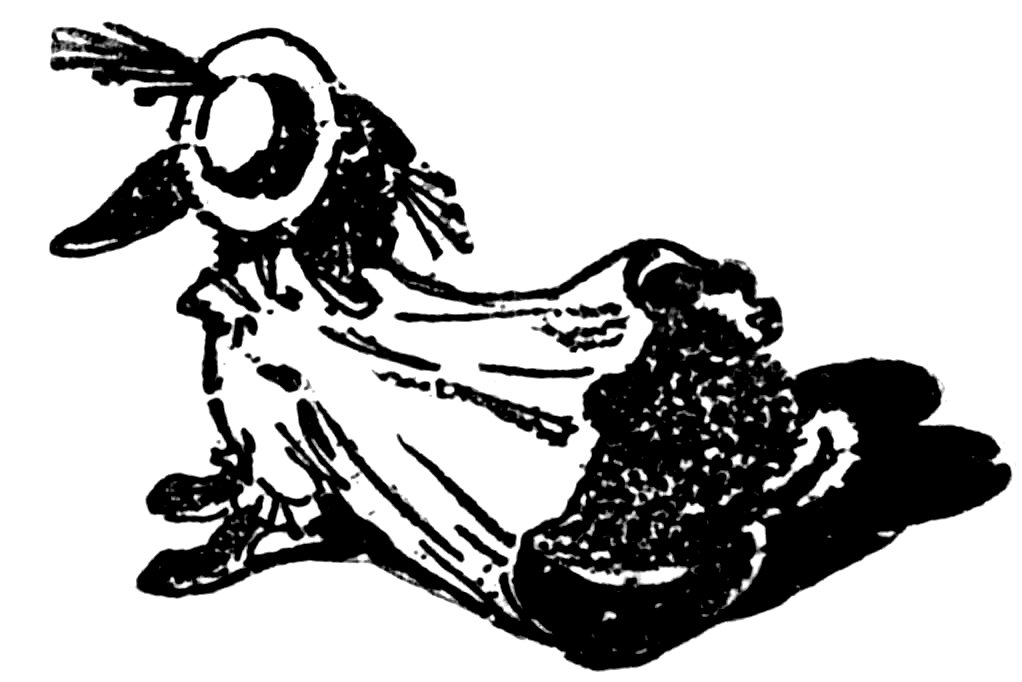
He was the merriest playfellow we ever had. He went with us everywhere—up 160the Hill Trail, into the orchard, and out on the bay when we sailed our little boat and played that we were pirates. Timothy never objected to anything except a bath. We dressed him in outlandish costumes, sometimes with a red bandanna tied around his head, a shawl looped about his fat and furry body, and a wooden knife stuck in his belt. He was always ready to wrestle with us, to climb hills with us, or to be a pillow for our heads as Brother and I lay through the long, drowsy, summer afternoons and read fairy-tales aloud to each other, or described the shapes we saw in the clouds.
When the late fall came, Timothy remembered he was a bear long enough to have a desire to go to bed for the winter, but what chance had a tired bear for a seasonal sleep when living in the same house with Tinker, Three-Spot, Brother, and myself? We 161would drag him from his clothes-basket while he whimpered with half-closed eyes, and Tinker would badger him into wakefulness and a game of tag. Then the four of us would go through the orchard up to the Hill Trail, pushing each other into the drifts of dead leaves and playing hide and seek around the stumps and logs.
Of course Timothy could not stay with us always; that was too much to expect. He belonged to the woods, and sooner or later he must obey their call. He had belonged to us for almost a year, and it was only right that the out-of-doors should at last claim her child. But when the call of the wild did come, we were sorry in spite of ourselves, and when Timothy’s absences came more and more frequently and the intervals of time he spent with us lessened, we missed him sorely. We knew that soon our playmate would be with us no 162more, that he would go back to the forest whence he came, and take up the serious business of finding a wife and of locating a tree or a hole in which to spend the next winter.
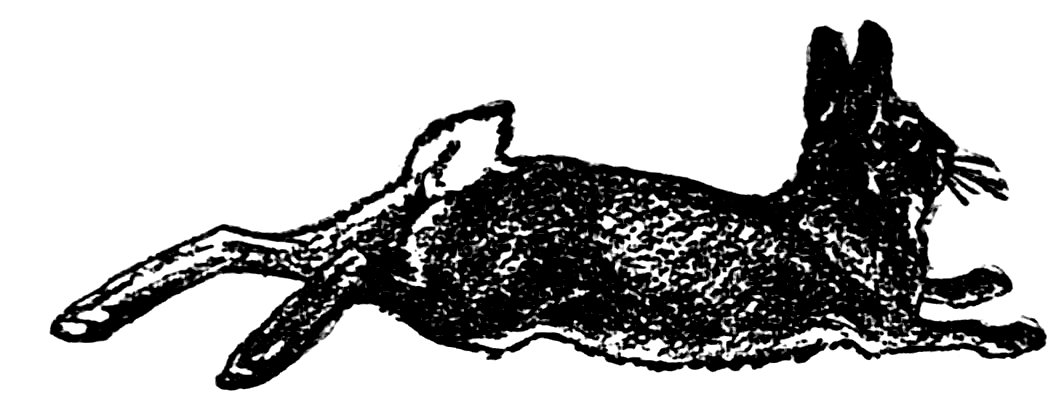
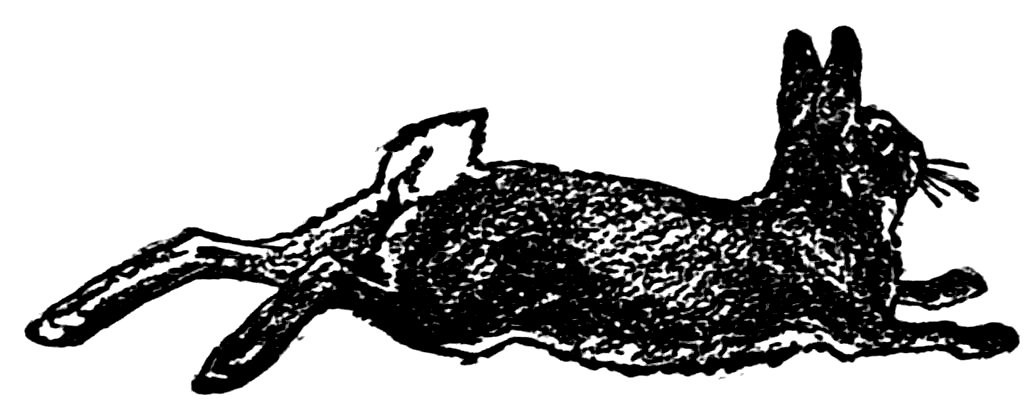
The manner of his departure was dramatic, even as was his advent into our lives. We were up on the Hill Trail, Brother and I, and we had, as we supposed, left Timothy on the back porch sleeping in his clothes-basket, for which he was now much too big, but to which he had become attached through habit. On the open trail with its sound-deadening mat of hard, brown earth we did not hear the soft, padding feet that followed us and were not aware that our friend was near at hand until we met a hunter, brown-faced and with a gun in hand, near the bend in the path that we called “U-Chu-Ka’s Corner,” in memory of our little rabbit friend.
163The man had a red band around his hat, I remember, and a canteen was slung at his side. He had put it to his lips to drink when he caught sight of us, and suddenly his eyes widened, and the hand that held the canteen became rigid.
“Run, you kids!” he gasped out, “there’s a bear behind you!”
We turned to confront Timothy, who was standing pigeon-toed in the middle of the trail, his face covered with loam from a rotten stump where he had been digging for ants, his eyes blinking at us sleepily and a trifle reproachfully for having gone off without him. But before we could explain to the hunter that the bear behind us was a friend of ours, the man had raised his gun and leveled it at our playfellow. I screamed aloud and Brother, heedless of the danger flung himself in front of the rifle.
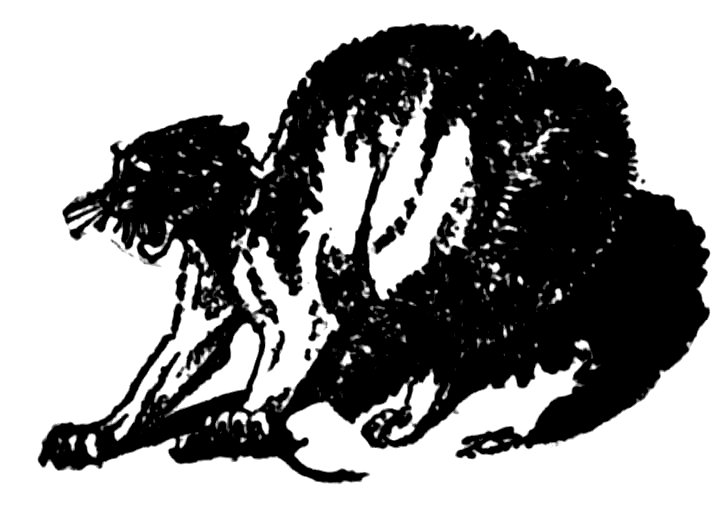
164Now Timothy knew nothing of guns, but he had long and satisfactory acquaintance with bottles and canteens. He had seen the man drink. There was something contained therein that he, Timothy, would like. The man would not mind sharing it—I’m sure he reasoned thus to himself—and in that instant when the gun was pointed straight at him, he rose on his hind feet, his furry arms outstretched, and started toward the hunter.
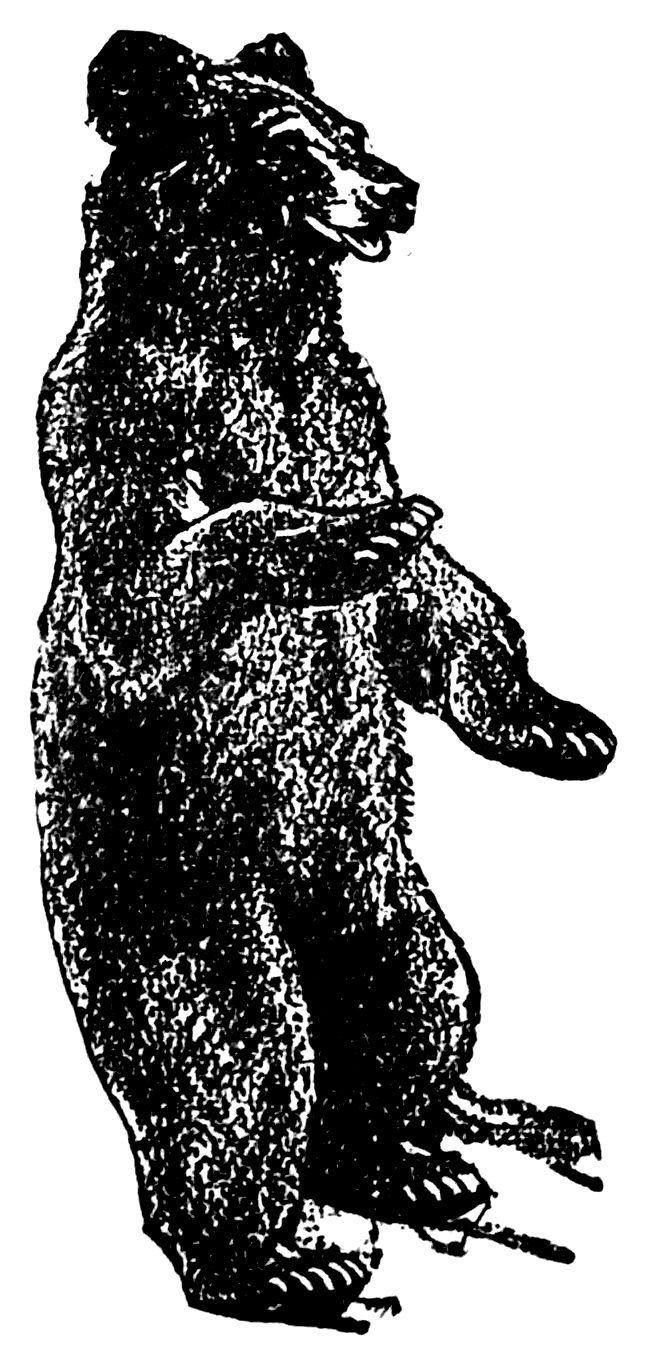
The man with the gun forgot to pull the trigger; he forgot everything except that a dark brown body with gleaming black eyes was advancing upon him. He gave a little squeal of terror, and the rifle dropped from his hands. He turned and fled down the trail with Timothy galloping on all fours close at his heels. In spite of our breathless calls he would not return to us, and though we ran and called and laughed 165at the same time, he soon outdistanced us. When last we saw the hunter he was disappearing over the crest of a little hillock in the trail with the canteen bobbing behind him, and the hat with the red band made a dot of scarlet against the underbrush where it had fallen.
We heard afterward that the man had not stopped running until he reached the little town. Timothy by that time was nowhere in sight, having given up the pursuit of the canteen in disgust.
But we never saw him again. Perhaps returning home he met a comely lady bear and they decided to set up housekeeping together. Perhaps she even won his heart by telling him that she knew where there was a nice bottle full of sweetened water.
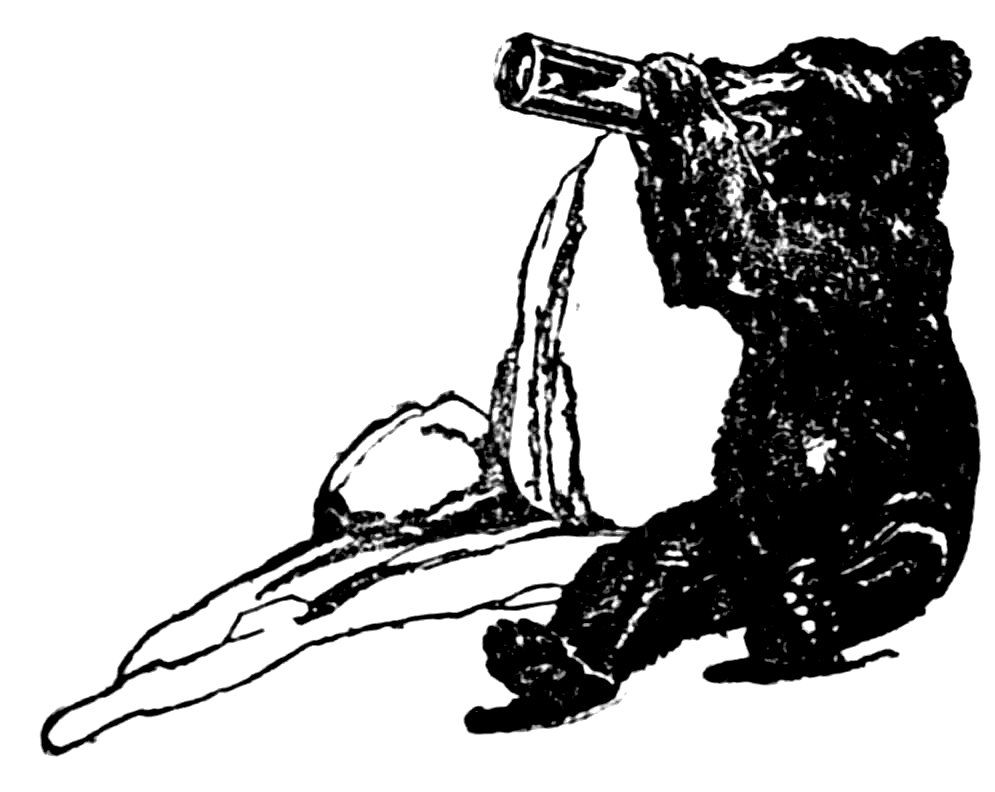
Long afterward we found one day by the creek bed a ginger ale bottle 166dropped there by some picknickers. It was empty, and on the gravel near by we saw footprints almost human in shape, only smaller and toeing in toward each other.
We knew somehow that Timothy had been there. It was almost as if he had known we would pass that way, and had left the bottle and his footprints where we would see them to tell us that we were not forgotten, nor were the things we had taught him.
167
Part Nine
The Bandit Bird
168