Volume 2 — G
Reading edition
Traditions of origin. 3. The Western Gadariyas call themselves Marhattas and describe themselves as emigrants from Gwâlior. Some of them still visit Gwâlior to worship the goddess Kâli Devi, and they employ a colony of Gwâlior Bhâts who have come from Gwâlior and settled at Anupshahr in the Bulandshahr District. The Gadariyas fix their emigration from Gwâlior in the time of the Dor or Tomar Râja Buddh Sen.
Marriage rules. 4. The Gadariyas usually marry their girls at the age of from seven to twelve. To the west it is a rule among them after marriage to lodge the bride first on her arrival with her husband in a separate room, and then she is not admitted into the house until she pays a sum of money to the men or persons connected with her husband by marriage with women of his family. In the course of this function a mimic struggle goes on between the two parties. Next morning after she is thus received into her husband’s family, the women of the house fill an iron pan with water and place in it two silver rings and some blades of grass. The married couple then struggle to see which of them will secure the rings. The bridegroom’s female relations do their best to help him. Whichever of the pair secures the rings will have the mastery during married life. When the mock struggle is over, the winner pours the contents of the vessel over the loser. There are no marriage brokers; matches are arranged by a member of the caste. He receives a rupee and a turban from the father of the bridegroom; but if he commit any fraud in arranging the match, the council have one side of his moustache shaved in the presence of the brethren, and also impose a fine. A man may discard his wife for infidelity, but such women are not allowed to remarry in the caste. Widow-marriage and the levirate are permitted, and the children by any form of recognised marriage are equal heirs. Illegitimate children are not allowed to intermarry or even smoke with those of pure blood. A man who marries a widow has generally to pay something to her relations, and in any case he has to pay any debts she may have contracted during widowhood.
Birth customs. 5. The woman during delivery sits on a stool facing the Ganges. She is attended by a sweeper or Koli midwife for at least three days. When the birth of a male child is announced, one of the mother’s female relations hurries out of the house, and draws all round the walls a line of cowdung as a magic circle to keep off evil spirits. She also makes a rude cowdung figure at each side of the door, and fixes up seven pieces of broomstick near it. When a girl is born, only a piece of a broken earthen pot is put up over the door. On the second day the mother is given a condiment which is supposed to consist of thirty-two drugs boiled together. On the tenth day the mother and child are taken to the nearest well with singing, and she worships the well by marking the platform with turmeric, and placing upon it the cowdung figures which had been fixed up near the house door. They all return, and soaked gram and sweets are distributed.
Marriage customs. 6. The marriage ceremonies are of the normal type. There are some observances which may be survivals of marriage by capture. Thus, while the marriage is going on, the women of the bride’s family carry on a mock fight with the relations of the bridegroom, and are allowed to strike them with the kneading roller (belan). If a girl has a particular curl of the hair which is supposed to resemble a female snake (sânpin), she is first married to a camel-thorn bush (jhar beri). If a bachelor in the same way marry a widow, and she bear him a daughter, in order to overcome the evil influence which is supposed to arise from the dhareja form of marriage, he gets himself married to a tree before he gives away the daughter in marriage to another.
Death customs. 7. Gadariyas cremate their adult dead, except those who have died of snake-bite or small-pox. If such corpses are cremated, they believe that at the burning a steam arises from them which strikes the mourners blind. On the way to the burning ground a ball (pinda) is offered in the name of the deceased. The son of the deceased fires the pyre, and each of the mourners throws in five cakes of cowdung fuel. Some ashes are sifted and placed the following day on the spot where the death occurred, and next morning from the marks on the ashes they speculate as to the form which the soul will assume in the next birth. They perform the usual srâddha.
Religion. 8. Gadariyas are orthodox Hindus, the Musalmân branch of the caste being very inconsiderable. Their chief deity is Kâli. They also worship a local deity known as Châmar. This is more especially done in the Naudurga of Chait and Kuâr and when cholera or other epidemic disease is about. The offerings consist of cakes (pûri), coarse sugar, and sometimes a goat. The last is taken by the Chamâr priest and the former by the local Brâhman priest or Kherapati. Another spirit named Jakhaiya or Jokhaiya is largely worshipped by Gadariyas in the Western Districts. He is said to be the ghost of a Muhammadan Ghosi. His priest is a sweeper, and his offering a young pig. The chief shrine of Jokhaiya, who, according to the last Census, was worshipped by 87,061 persons, is at Pendhat, in the Mainpuri District. He is there said to have been a Bhangi, who was killed during the war between Prithivi Râja of Delhi and Jaychand of Kanauj. His offering is a pig, which is presented by women who long for children and pray for easy delivery. The fair is said also to bring timely winter rain. To the west of the Province they are served by Sanâdh Brâhmans; to the east by low class Brâhmans of various tribes.
Social status. 9. In Bihâr, according to Mr. Risley, the Gadariya ranks higher than the Ahîr; but this does not seem to be the case in these Provinces. They are, however, careful about food and drink, and maintain a fairly high standard of personal purity. Their original occupation is keeping and selling sheep and goats and making blankets; but besides this they cultivate and practice various forms of trading. The women have a reputation for untidy habits, as the common proverb runs,—Ek to Garerin, dusrê lahsan khâê—“a shepherdess and eating garlic in the bargain.”
Distribution of Gadariyas according to the Census of 1891.
Districts. Hindus. Muhammadans. Total.
Baghel. Bamhaniya. Chandel. Dhîngar. Haranwâl. Kachhwâha. Nikhar. Phulsinghiya. Rautela. Râthaur. Sâgar. Saraswâr. Others.
Dehra Dûn … … … 399 103 … 311 … … … … … 590 … 1,403
Sahâranpur … … … 400 585 … 278 7 … … … 92 10,088 … 11,450
Muzaffarnagar … 50 483 489 1,226 … 422 455 … … … 324 12,104 … 15,553
Meerut … … … 473 34 … 9,088 50 … … … … 6,717 … 16,362
Bulandshahr … … 129 453 … … … 37 … … … … 15,480 … 16,099
Aligarh … … 398 12,281 3,109 … 1,060 … … … … … 18,831 … 35,678
Mathura 47 … 177 11,726 … 92 227 10 145 616 160 160 4,485 … 17,847
Agra 431 … 164 30,616 … 352 335 … 78 … 776 13 4,448 … 37,113
Farrukhâbâd … … … 2,009 329 … 26,130 24 5 … … … 1,692 1 30,190
Mainpuri … 172 31 9,545 … … 13,809 4,385 33 145 … 180 1,794 … 30,094
Etâwah 52 … 224 15,535 … 407 4,178 367 92 162 223 233 6,597 … 26,070
Etah … 277 17 14,459 250 47 8,807 … 370 … 69 26 3,082 … 27,404
Bareilly … … … 7,943 … … 5,202 390 91 … … … 2,309 … 15,935
Bijnor … 12,851 … 4,272 65 … … … … … … … 407 … 17,595
Budâun … … 52 12,914 40 … 12,729 … … … … … 2,659 … 28,394
Morâdâbâd … … 209 5,171 59 … 7,882 13 81 … … 38 11,879 … 25,332
Shâhjahânpur … … … 1,091 … … 7,483 70 … … … … 787 … 19,431
Pilibhît … … … 112 16 … 6,699 1 6 … … … 384 6 7,224
Cawnpur … 141 354 6,732 … … 27,872 … 28 … … 531 10,036 3 45,697
Fatehpur … 372 886 4,136 … … 13,267 … … … … 291 5,650 1 24,603
Bânda … 5 508 294 … … 7,428 … … … … 35 3,593 … 11,863
Hamîrpur … … 202 2,254 … … 3,215 25 … … … 30 4,983 9 10,718
Allahâbâd … … 50 11,108 … … 28,950 … … … … … 1,356 20 41,484
Jhânsi … … 189 2,168 … … 7,097 25 82 … … … 963 … 10,524
Jâlaun … 86 178 9,492 … … 578 6 16 … … … 2,823 … 13,179
Lalitpur … … 5 247 96 … 4,218 26 39 … … … 1,431 … 6,062
Benares … … … 223 … … 9,898 … 2,583 … … … 1,266 … 13,970
Mirzapur … … … … … … 20,187 285 … … … … 3,163 … 23,635
Jaunpur … … … 94 … … 21,660 … … … … … 3,241 32 25,027
Ghâzipur … … 25 … 40 … 5,382 … … … … … 4,370 … 9,817
Basti … … … 174 … … 10,499 … … … … … 199 … 10,872
Ballia … … … … … … 2,152 … … … … … 1,314 … 3,467
Gorakhpur … … … 5,732 … … 7,749 … … … … … 2,686 … 16,167
Azamgarh … … 18 243 … … 7,715 … … … … 28 1,484 … 9,488
Kumâun … … … … … … … … … … … … 4 … 4
Garhwâl … … … … … … … … … … … … 20 … 20
Tarâi … … … 440 14 … 1,030 … … … … … 1,780 … 3,264
Lucknow … … 4 3,868 … … 6,822 … … … … 4 1,516 72 12,286
Unâo … 507 479 13,444 … … 4,430 … 415 … … 317 5,663 … 25,255
Râê Bareli … … 81 25,069 … … 4,233 … … … … … 391 … 29,774
Sîtapur … 50 … 16,083 329 … 617 … … … … … 1,685 … 18,435
Hardoi … 2,641 … 310 … … 34,610 24 … … … 711 4,356 … 42,981
Kheri … … … 15,726 … … 299 … … … … … 520 … 16,545
Faizâbâd … … … 2,658 … … 13,743 … … … … … 119 … 16,520
Gonda … … … 6,128 … … 12,274 … … … … … 451 234 19,087
Bahrâich … … … 15,586 … … 2,215 … … … … … 530 … 18,331
Sultânpur … … … 7,948 … … 14,970 … … … … … 2,158 … 25,076
Partâbgarh … … … 15,311 … … 15,790 … … … … … 638 … 31,739
Bârabanki … … … 10,824 … … 2,795 … … … … … 754 … 14,373
Total 530 17,152 4,763 304,180 6,295 898 406,337 6,200 4,064 923 1,228 3,013 173,476 378 929,437
Total Hindus 929,059
Total Muhammadans 378
Grand Total 929,437
2. The complete returns of the last Census show 255 sections of the tribe. These are of the usual type: some territorial, such as Aharwâr, Audhiya, Bahrâichi, Balapura, Gorakhpuri, Kanaujiya, Mathuriya, Purbiya, Saksena, Sarwariya, and Shâhpuri. Others are derived from the names of well-known castes or septs, as Ahîr, Bâchhar, Bais, Bhadauriya, Bhangi, Bhatti, Bisen, Chamarbans, Chandela, Chauhân, Chhatri, Domar, Ghosi, Gûjar, Hurakiya, Jât, Kamboh, Kori, Mewâti, Pathân, Râthaur, Sayyid, Shaikh, Tânk, Teli, Tomar, and Turkiya.
Distribution of the Gaddi according to the Census of 1891.
Districts. Number.
Sahâranpur 360
Muzaffarnagar 5
Meerut 3,421
Bulandshahr 1,201
Aligarh 1,292
Mathura 7
Agra 79
Etah 386
Bareilly 1,354
Budâun 4,381
Morâdâbâd 237
Shâhjahânpur 1,079
Pilibhît 446
Cawnpur 3
Fatehpur 20
Bânda 8
Allahâbâd 48
Benares 1
Ghâzipur 178
Gorakhpur 2,394
Basti 3,424
Azamgarh 479
Tarâi 363
Lucknow 3,581
Unâo 1,198
Râê Bareli 353
Sîtapur 4,164
Hardoi 10,598
Kheri 7,347
Gonda 65
Bahrâich 2,098
Sultânpur 59
Bârabanki 1,340
Total 51,970
Tribal tradition. 2. The tribal tradition, as told by the family bards of the head of the sept, the Râja of Kantit, in the Mirzapur District, is as follows:—From Chandrama the moon came Buddh, and from Buddh came Pururavas. Some generations later was born Yayâti, who, when he reached an old age, longed to recover his youthful vigour. With this view he called his sons, born of his two wives, Devayâni and Sarmishtha, and asked them to make over their youth to him. They all refused except the youngest, the son of Sarmishtha. So Yayâti cursed them all, and prayed that they might never enjoy royal power. One of them, Yadu, was the ancestor of the Yaduvansis, none of whom have ever gained sovereignty. Yayâti reigned many years, and finally abdicated the throne and crowned his youngest son in his room and became an ascetic. After many generations in his line Deva Dâsa reigned at Kâshi or Benares. He was famous for his good works, and hence incurred the envy of the malignant deity Sani or Saturn. He endeavoured to divert Deva Dâsa from his life of piety, but he failed, and the good king gained the title of graha-vâra or “overcomer of the planet,” of which Gaharwâr is a corruption. He worshipped Mahâdeva so fervently that the deity abandoned Kâshi and retired to the summit of Kailâsa. But he became tired of his life of seclusion, and incited the other gods to mislead Deva Dâsa. All failed, but the Dhundhê Râja Ganesa, who overcame the piety of Deva Dâsa, who was obliged to retire to Kanauj, which was then called Râshtradesa, and becoming lord of that land, his descendants were known as Râthaur. His descendant was the famous Râja Jaya Chandra, whose dominions are recorded in the Hindi verse:—
Kara, Kâlpi, Kamaru, Kashmîr lawa desa:
Khud, Kâshi, Kanauj dhani Sri Jaya Chandra naresa.
4. The Gaharwârs hold a high rank among Râjput septs. They give daughters to the Baghel, Chandel, and Bisen, and take brides of the Bais, Râjkumâr, Maunas, Gautam, Palwâr, Chauhân, Parihâr, Sombansi, Sirnet, and Dikshit.
In Farrukhâbâd they give brides to the Chauhân, Râthaur, Bhadauriya, and Kachhwâha, and take girls from the Nikumbh, Chandel, Raikwâr, Solankhi, Gaur, Chamar-Gaur, Parihâr, and Ujjaini. They claim to belong to the Bharadwâja gotra. In Unâo they receive brides from the Dhâkrê, Janwâr, and Parihâr; and give their girls to the Gaur, Bais, Chandel, and Sombansi.
Distribution of the Gaharwâr Râjputs according to the Census of 1891.
Districts. Number.
Mathura 12
Agra 46
Farrukhâbâd 3,326
Mainpuri 578
Etâwah 389
Etah 1,900
Budâun 105
Morâdâbâd 8
Shâhjahânpur 269
Pilibhît 164
Cawnpur 2,162
Fatehpur 118
Bânda 433
Hamîrpur 317
Allahâbâd 4,013
Jhânsi 17
Jâlaun 219
Lalitpur 19
Benares 846
Mirzapur 20,249
Jaunpur 1,901
Ghâzipur 6,583
Ballia 693
Gorakhpur 892
Basti 369
Azamgarh 260
Lucknow 1,065
Unâo 1,176
Râê Bareli 509
Sîtapur 360
Hardoi 2,429
Kheri 178
Faizâbâd 2
Gonda 120
Bahrâich 32
Sultânpur 1,076
Partâbgarh 611
Bâra Banki 131
Total 53,477
Gahlot.—A sept of Râjputs also known as Sisodiya and Ahariya. One derivation of the name Gahlot is from Sanskrit guha, “a cave.” It is said that when the ancestors of the Râna of Mewâr were expelled from Gujarât, one of the queens named Pushpavati found refuge among the Brâhmans of the Maliya mountains: she was shortly after delivered of a son, whom she called from the cave (guha) in which he was born, by the name of Gahlot. Others derive the name from gahla, “a slave girl,” in allusion to their supposed descent. One derivation of the name Sisodiya is Siva sudhiya, “a devotee of the god Siva;” another is from sîsa, “lead” as one of the tribe once drank melted lead with impunity. A third is from sasa or sussa “a hare,” which is supposed to have been the tribal totem. But it seems safer to regard the name as a local appellation, derived from the town of Sisodha, the first home of the sept, as Ahariya is taken from the town of Anandpur Ahâr, near Udaypur. The name Gahlot was changed to Ahariya when the sept migrated to Nagindra. The throne of Chithor was recovered in 1201 A.D. by Bharat, who was succeeded by Rakûp. Two great changes were introduced by this prince—the first in the title of the sept to Sisodiya; the other in that of its prince from Râwal to Râna.
4. In Sultânpur they are reported to take brides from the Bilkhariya, Tashaiya, Chandauriya, Kath Bais, Bhâlê Sultân, Raghubansi, Gargbansi, Râjkumâr, Bachgoti, and Bandhalgoti; to receive brides from Tilokchandi Bais, Mainpuri Chauhâns, Sûrajbansis of Mahul, Gautams of Nagar, and Bisens of Majhauli. In Bulandshahr they receive brides from the Chauhân, Bargûjar, Pundîr, Panwâr, Solankhi, Tomar, Bhatti, and Râthaur, and give brides to the Dhâkrê, Chauhân, Bâchhal, Kachhwâha, Bargûjar, and Tomar. They call their gotra Sûrajbansi Sanoha of Chithor and Udaypur. In Unâo they usually marry their daughters to the Kachhwâha, Râthaur, Chandel, and Panwâr; and select wives from the Chauhân, Dikhit, Parihâr, Chandel, and Sengar septs. In Ballia they take brides from the Donwâr, Sengar, Karchhuliya, Banâphar, Raghubansi, Kâkan, Bhrigubansi, Barhauliya, Ujjaini, Sombansi, and Kinwâr. They give brides to the Raghubansi, Nikumbh, Kausik, Sûrajbansi, Gautam, Drigbansi, Maunas, Sirnet, Râjkumâr, Jâdon, and Baghel septs. In Agra they claim to belong to the Kasyapa gotra.
Distribution of the Gahlot Râjputs according to the Census of 1891.
Districts. Hindus. Muhammadans. Total.
Sahâranpur 173 8 181
Muzaffarnagar 401 165 566
Meerut 10,189 … 10,189
Bulandshahr 3,140 1,200 4,340
Aligarh 2,827 … 2,827
Mathura 2,177 173 2,350
Agra 3,056 26 3,082
Farrukhâbâd 1,699 6 1,702
Mainpuri 669 … 669
Etâwah 1,456 14 1,470
Etah 2,070 32 2,102
Bareilly 40 … 40
Budâun 399 63 462
Morâdâbâd 234 13 247
Shâhjahânpur 346 15 361
Pilibhît 27 … 27
Cawnpur 2,536 6 2,542
Fatehpur 25 … 25
Bânda 38 … 38
Hamîrpur 150 … 150
Allahâbâd 5 3 8
Jhânsi 73 … 73
Jâlaun 353 4 357
Benares 103 … 103
Jaunpur 150 115 265
Ghâzipur 349 99 448
Ballia 766 … 766
Gorakhpur 167 … 167
Basti 87 … 87
Azamgarh 457 7 464
Lucknow 112 … 112
Unâo 921 … 921
Râê Bareli 552 … 552
Sîtapur 81 5 86
Hardoi 69 … 69
Kheri 174 … 174
Bahrâich 22 … 22
Sultânpur 37 19 56
Partâbgarh 21 … 21
Bârabanki 97 … 97
Total 36,245 1,973 38,218
Gahoi.—A sub-caste of Banyas, found chiefly in Bundelkhand and Morâdâbâd.
2. The Gahois of Mirzapur, who do not appear in the Census lists, say that they are emigrants from Bundelkhand in the commencement of this century, whence they were driven by the pressure of the Pindâri raids. One Biya Pânrê Brâhman protected their families in their misfortunes, and divided them into twelve gotras and seventy-two als. He is said to have been a schoolmaster and their tribal priest; after marriages his services to them are commemorated by the bridegroom pouring some butter and laying flowers and consecrated rice before a rude image of him painted on the house wall. The twelve gotras as given by them in Mirzapur are—Basil, Gol or Goil, Gangal, Bandal, Jaital, Kaunthil, Kâchhil, Bâchhal, Kassab or Kasyapa, Bharal, and Patiya. The last or Patiyas act as a sort of Bhâts or genealogists to the others, and are feasted and rewarded at marriages and other entertainments. They eat and drink on equal terms with their constituents. None of them can give any trustworthy list of their als.
3. Their rule of exogamy is that they do not marry within their own gotra or the al of the maternal uncle, father’s maternal uncle and mother’s maternal uncle. Widow-marriage is prohibited.
4. The Gahois are Vaishnavas; none have adopted the tenets of the Sarâogi or Jaina faith. Their tribal deity is Srikrishna, whom they worship under the name of Bihâri Lâl. They rank high among Banyas, and are said to be considered as respectable as Agarwâlas and Parwâls. They abstain from meat and spirits. Their priests are Bhârgava Brâhmans from Bundelkhand. They will eat pakki cooked by their clients. The Gahois will eat kachchi cooked by their clansmen and priests.
5. They are traders in country produce, commission agents, money-changers, and bankers.
Distribution of Gahoi Banyas according to the Census of 1891.
Districts. Number.
Mathura 7
Agra 248
Farrukhâbâd 100
Etâwah 256
Etah 1
Bareilly 20
Bijnor 295
Morâdâbâd 3,510
Shâhjahânpur 13
Pilibhît 6
Cawnpur 342
Fatehpur 87
Bânda 1,140
Hamîrpur 1,614
Allahâbâd 8
Jhânsi 8,239
Jâlaun 8,580
Lalitpur 1,470
Tarâi 235
Lucknow 16
Sîtapur 1,182
Kheri 1,192
Total 29,361
Marriage rules. 2. The Gandharbs of these provinces are found in small numbers only in Benares, Allahâbâd and Ghâzipur. They address themselves by the title of Râê. They name seven exogamous gotras—Arakh, Sîtal, Ramsi, Shâhimal, Hîwan, Pachbhaiya, and Udhomana. The detailed Census Returns give the gotras as Anrukh, Arakh, Bacha, Bahajbana, Bajbhân, Banal, Baturha, Bhakwa, Chhatri, Gandwâr, Kanaujiya, Kashmîri, Khodari, Manho, Namahrin, Namin, Rabisi, Ramsan, Râwat, Sahmal, Saliyâli, Shâhi, and Somal. A man must marry outside his own gotra, that of his father, mother, and their ancestors, to the fifth degree. He, moreover, cannot marry in the gotra of his sister’s and brother’s father-in-law. He cannot marry two sisters at the same time; but if he marry the elder of two sisters and she die, he can marry her younger sister.
The rules of prostitution. 3. Beautiful girls or those who show from their childhood a taste for music are selected for prostitution and not allowed to marry in the caste. A meeting of the brotherhood is held before the girl comes to maturity, and it is settled that she is to be allowed to have intercourse with no one but a Hindu of high caste. If she does not abide by this rule, she is at once expelled from the caste. When the matter is thus settled, some sweets are distributed, and she is formally declared to be a prostitute. The first man who engages her services is regarded as her quasi-husband. On such an occasion all the ordinary ceremonies of a Hindu marriage are performed at the house of the girl, except the walking round the fire (phera). Other girls not selected for prostitution are married in the tribe in the ordinary way. But if a man take to any low or degrading occupation, not sanctioned by tribal usage, he is not allowed to marry.
5. Doman Deo continued to hold the office of Wazîr for some time, and at last had a quarrel with his master, because he bought a horse which his master was anxious to secure. So he was banished and had to return to Chandrâvati, and with him came a Gandharb, named Nandu, with his wife Arjuni, the former of the Ramsi and the latter of Arakh gotra, and from them were descended the present Gandharbs.
Marriage. 6. They do not admit outsiders into their caste. In most cases marriage is infant; but there have been occasional instances of the marriage of adults. Sexual license before marriage of these girls selected for a respectable life is strictly prohibited. The prostituted girls are never allowed to marry. Polyandry is totally forbidden, and polygamy is allowed only when the first wife is barren or suffering from some loathsome or contagious disease. A man can marry as many wives as he can afford to keep; but they never have more than two or three. Their marriage ritual is of the usual high class type. Widow-marriage is strictly forbidden; but it appears that the keeping of widows as concubines is not unknown; such are known as Suraitin; they have no rights, and their children are illegitimate and not admitted to caste privileges. If a man suspect his wife of adultery, he brings the matter before the tribal council (Panchâyat) which, if the case be proved, permits a divorce, though in some cases a stipend is assigned to the woman. A divorced woman cannot be remarried, but she often lives with some one as a concubine.
Occupation. 9. The Gandharbs believe dancing and singing to be their tribal occupation. A few have settled down in the Benares District as agriculturists. Some live with their dancing girls and accompany them to entertainments, where they play on the sâz, which consists of the tambourine (tabla) and fiddle (sârangi). Half of the dancing fees are received by these men and distributed in the following way:—Two tambourine men get two annas each; the drummer three annas; one tuner of the instruments one anna. Some, again, act as trainers of dancing girls in music and dancing. Those in the villages are often tenants; but it is a peculiarity among them that they will never sublet their land to a person of their own caste. In Benares the sowing of poppy is one of their favourite occupations.
Social rules. 10. They will eat the flesh of goats and sheep and scaly fish and drink spirits. A good many who consider themselves specially pious abstain from the use of meat and spirits. They will not eat kachchi from the hands of any but Brâhmans and clansmen; and they will smoke with no other caste but their own. The lowest caste that they can take pakki from or drink with is the Ahîr. Another peculiarity of them is that they will not eat pakki with any Hindu landlord of their village.
Distribution of the Gandharbs according to the Census of 1891.
Districts. Number.
Allahâbâd 21
Benares 590
Ghâzipur 53
Total 664
Religion. 2. They principally venerate Imâm Husain, ‘Ali and Ghâzi Miyân. To these are offered sweetmeats, cakes (malîda), and a special kind of prepared rice called tinchâwali. On the ‘Îd, Shab-i-barât, and Baqar ‘Îd they make offerings of food to the spirits of their dead ancestors.
Distribution of the
Gandhis
according to the Census of 1891.
Districts. Number.
Sahâranpur 25
Muzaffarnagar 124
Meerut 300
Farrukhâbâd 3
Etâwah 2
Etah 1
Bijnor 8
Morâdâbâd 56
Shâhjahânpur 42
Cawnpur 1
Fatehpur 2
Jaunpur 2
Ghâzipur 27
Ballia 11
Gorakhpur 29
Azamgarh 33
Tarâi 1
Lucknow 8
Unâo 2
Bahrâich 22
Bârabanki 79
Total 778
3. They call themselves Hindus; but they worship none of the ordinary Hindu gods, except Parameswar, who is worshipped by the women and children in times of sickness or trouble. All their other ceremonies are performed by the Dhiyâna above described. They do not perform the srâddha; but they lay out a little food for the ghosts of the dead and then eat it themselves. They eat any kind of carrion and vermin of all kinds which they catch. They live by begging and prostituting their women, and have only the most elementary industries, such as plaiting straw into baskets, sieves, and the like; but of this they do little. No other caste will eat with them; but it is said that some of them eat food from the hands of Kanjars, Sânsiyas, and similar vagrants.
Distribution of the Gandhîlas according to the Census of 1891.
Districts. Number.
Sahâranpur 71
Muzaffarnagar 63
Total 134
1. Gangâputra, “son of the Ganges.”—A class of Brâhmans who preside over the bathing, srâddha, and other ceremonies which are performed on the banks of the Ganges at Benares and elsewhere along its course. They say themselves that when Bhagîratha brought the Ganges from heaven, he worshipped certain Brâhmans, and gave them the right in future to receive all offerings made to the sacred river. They are also known as Ghatiya, because they occupy ghâts or bathing-places along the Ganges bank. The right to seats at such places is very valuable, and disputes about them often come before the Courts. The Gangâputras belong to no special tribe of Brâhman. They may be Gaur, Sarwariya, or Kanaujiya, and though their profession is very lucrative, they have an evil reputation for roguery and rapacity, and not finding it easy to intermarry with respectable Brâhmans, there is a tendency among them towards endogamy.
2. His principal business is to act as the cicerone of pilgrims who come to bathe. He keeps a book in which he records the name and address of pilgrims who have accepted his ministrations, and about the time of bathing festivals, he and his emissaries beset the roads leading to the holy places and endeavour to attract visitors, whom he entertains for a consideration, and personally conducts round the various shrines and sacred bathing places. At his ghât he keeps a cow which the pilgrim touches as he goes to bathe, and he provides the worshipper with a little kusa grass and the materials for the pinda, which he usually offers up to his deceased relations. In his occupation the Gangâputra closely resembles the Gayawâl who acts as an emissary for the owners of the shrines at Gaya, and wanders about the country inducing villagers to undertake the pilgrimage, and personally conducting his constituents. A similar functionary is the Prayâgwâl, who officiates at the bathing festivals at Prayâgji or Allahâbâd and the Mathuriya Chaubê of Mathura.
Sravanriya Gangâputras used formerly to go about begging and singing from about 2 o’clock in the morning. They acquired an evil reputation for snatching nose-rings and other jewelry from pious women who got up to minister to their wants: they now usually defer their visits to a later hour. It is considered meritorious among Hindus to listen to the songs of the dutiful Sravana early in the morning, and on such occasions, the singers are given alms, which usually consist of uncooked grain, but seldom of money. Formerly they were, it is said, in the habit of sitting dharna at the doors of people who refused to give them alms. They find it dangerous to carry on such practices at present. It is needless to say that they bear a most indifferent reputation.
Distribution of Gangâputras according to the Census of 1891.
Districts. Number.
Farrukhâbâd 131
Mainpuri 1
Etâwah 4
Bareilly 80
Budâun 112
Morâdâbâd 411
Pilibhît 2
Cawnpur 179
Fatehpur 179
Hamîrpur 4
Allahâbâd 47
Lalitpur 1
Benares 45
Gorakhpur 139
Lucknow 6
Unâo 103
Râê Bareli 706
Sîtapur 2
Hardoi 46
Faizâbâd 17
Bahrâich 3
Bârabanki 10
Total 2,228
2. The Gâras are good cultivators, but very quarrelsome and litigious. This is recorded in the native proverb that a Gâra is as great a nuisance in a village as thorns in a field—Gânw men Gâra; Khet men jhâra.
Distribution of the Gâras according to the Census of 1891.
Districts. Number.
Dehra Dûn 203
Sahâranpur 45,768
Muzaffarnagar 5,053
Meerut 60
Mathura 1
Agra 2
Partâbgarh 1
Total 51,088
2. In Sultânpur they are reported to marry girls of Bilkhariya, Tashaiya, Chandauriya, Kath Bais, and Bhâlê Sultân, Panwâr, Chandel, Palwâr; and to give brides to the Tilokchandi Bais, Mainpuri Chauhâns, Sûrajbansi of Mahul, Bisens of Majhauli, Râjkumâr, and Bachgoti. In Faizâbâd they marry Palwâr, Raghubansi and Chandel brides, and give girls to the Bachgoti, Sombansi, and Bais septs.
Distribution of the Gargbansi Râjputs according to the Census of 1895.
Districts. Number.
Sahâranpur 4
Agra 5
Etah 1
Morâdâbâd 46
Cawnpur 5
Fatehpur 1
Allahâbâd 54
Lalitpur 4
Benares 82
Jaunpur 113
Ghâzipur 5
Ballia 74
Gorakhpur 183
Basti 524
Azamgarh 3,462
Lucknow 32
Râê Bareli 1
Sîtapur 3
Faizâbâd 3,193
Gonda 132
Bahrâich 6
Sultânpur 3,216
Partâbgarh 7
Bârabanki 25
Total 11,178
(1) The Gaudas or Kevala Gaudas, who are said to be Yajur Vedis, and to have their head-quarters at Hardwâr.
(2) The Adi Gaudas or “original” Gaudas, who follow the white Yajur Veda, and are by sect Smârttas, Sâktas, or Vallabhachâryas.
(3) The Suklwâla, who are a branch of the Adi Gaudas and come from Jaypur. Of these there are two sections—Ojha and Joshi.
(4) The Sanâdhya, who have been separately enumerated at the last Census and form the subject of a special article.
(5) The Sri Gaudas or “honourable” Gaudas, of which one division is called Tamboli, and deals in betel leaf, and another Adi Sri Gauda, found at Delhi, Mathura, and Brindaban.
(6) The Gûjar or Gûrjjara Gaudas.
(7) The Tekbâra Gaudas.
(8) The Chamar Gaudas, who serve the Chamârs as priests.
(9) The Hariyâna Gaudas, who take their name from the country of Hariyâna, in the Hissâr and Rohtak Districts of the Panjâb.
(10) The Kirtâniya Gaudas, who wander about these Provinces and Râjputâna as singers, reciters, and players upon instruments.
(11) The Sukal Gaudas, who live by mendicity, accepting alms from Brâhmans, but not from Kshatriyas, Banyas, or people of other castes.
The Dadhicha. 4. Adopting this classification, it may be noted that the Dadhicha of these provinces claim descent from Dadhicha, the son of Atharvan, who was son of Brahma. The story runs that Dadhyang or Dadhicha had a wife, Satya Prabha, who was left pregnant when her husband died. She tore her womb open, and taking out the child, which she laid at the foot of a pîpal tree, joined her husband in heaven. After some time she remembered her child and prayed to Mûl Devi or Sâkti, who promised that the child should be incarnated out of a human skull. From being laid beside the pîpal tree he came to be known as Pippalayana, and begot twelve sons, who were the ancestors of the twelve gotras of the tribe. Each of these sons had twelve sons, and from these one hundred and forty-four persons are named the sections (al). The following are the gotras and als as far as it has been possible to ascertain their names:—
(1) Gautama gotra with sections—Patodya; Palod; Nahawâl; Kumbhya; Kanth; Badâdhara; Khatod; Badsaran; Bagadya; Bedwant; Banrasidara; Ledodya; Kakarah; Gagwâri; Bhuwâl; Disiyel; Masya; Mang.
(2) Vatsa gotra with sections—Ratâwa; Koliwâl; Baldawa; Rolaryân; Cholankhya; Jopat; Ithodya; Polgala; Nasara; Namawâl; Ajmera; Kukarân; Tararâyân; Abdig; Didiyil; Musya; Maug.
(3) Bharadwâja gotra with sections—Pedwâl; Sukl; Malodya; Asopadyaki; Barmota; Indokhwâl; Halsara; Bhatalya; Godiya; Solyarin.
(4) Bhârgava gotra with sections—Inaryân; Patharyân; Kasalya; Silrondya; Kurarawa; Jagodya; Khewar; Bisâwa; Ladrawân; Baragarân; Kadalawa; Kaprodya.
(5) Kavacha gotra with sections—Didwâryân; Malodya; Ghawarodya; Jatalya; Dobha; Murel; Maurjawâl; Sosi; Gotecha; Kudâl; Tretawâl.
(6) Kasyapa gotra with sections—Choraida; Dirolya; Jamawâl; Shergota; Rajthala; Barawa; Balaya; Chaulankhya.
(7) Sândilya gotra with sections—Rarawa; Bediya; Bed; Gotharawâl; Dahwâl.
(8) Asraya gotra with sections—Sulwâl; Yajrodya; Dubarya; Sukalya.
(9) Parâsara gotra with sections—Bhera; Parâsara.
(10) Kavala gotra with section—Chipara.
(11) Gorga gotra, with section—Talachhya.
(12) Mamraka gotra of which the sections have disappeared.
The Gûjar Gaur. 5. A list from Mirzapur gives the gotras and sections (al) of the Gûjar Gaur as follows:—
(1) Kausika gotra with sections—Jakhimo; Kurakyo; Tadukyo; Karadolya; Surolya; Modharyân; Sarsu; Guhadra; Katasala; Jirawalya.
(2) Kausika gotra with sections—Chahadhota; Gobalya; Nagavalya; Kaitha; Kalaitha; Tetrawa; Nilsanda; Kethuryân; Dudu.
(3) Vasishtha gotra with sections—Paghlida; Dughahasya; Khuraryân; Akodra; Jhujhrodyân; Rihdoliya; Pandurya; Sankhwat; Achraundya; Laiwâl; Poparudyân; Rachhtinari; Khiyaryân; Phaguryân.
(4) Sândilya gotra with sections—Nausalya; Pachaswa; Gâlswa; Jajpura; Nanera; Kathoriwâl; Sânpa; Jhamkolya; Karauriwâl; Kusumbhiwâl.
(5) Kausika gotra with sections—Bhairjwâl; Kânoilya; Naugra; Dughdolya; Gumtaryân; Adharûpa; Jodha; Harkhahi; Jastaryân.
(6) Bharadwâja gotra with sections—Pisa; Gauryân; Jagala; Raurinja; Bapraundya; Lâd; Kalbadra; Silaura; Jigaryân; Chitaryân; Gugauryân; Pijuryân; Kajaura; Gauhandya; Bagda.
(7) Gautama gotra with sections—Bhawânlya; Jajada; Bijaryân; Thinksara; Bilovaryân; Pandaita; Dikhat; Bilu; Umtaryân; Mandovasya.
(8) Kasyapa gotra with sections—Bararaila; Rewal; Gunwâl; Sanbharya; Bajagya; Thariwâl; Lohdolya; Aimalya; Sajiganwa; Dewalya; Jâjandya; Matâryân; Rajdolya; Rihdolya.
(9) Vatsa gotra with sections—Kântra; Bachh; Kaimalya; Chatsuwa; Dodwadra; Vyâs; Ghil; Gutaradya; Paiwâl; Chanwadra; Didwaryân; Chhichhâwata; Palhat; Chulhat; Suraulya; Rainhata; Sarsuda; Khinwasara; Chhadak; Bagada.
(10) Atrima gotra with sections—Bardundhya; Bagherwâl; Akodra; Karaudiwâl; Priyalauja; Babherwâl; Dabhadra; Kunjaudra; Ichharmarua.
(11) Muhrila gotra with sections—Surtaryân; Bhutâryan; Dhamauntya; Thâwalya; Lohawa; Bamhaurya; Kundera; Gadaryân; Raiswâl; Kunjodra; Muth; Pipalya.
(12) Parâsara gotra with sections—Khataud; Daigya; Pahadra; Narâryân; Kuchila; Baresura; Kachraudya; Dewalya; Dobarhatta; Gumataryân.
(13) Garga gotra with sections—Gudnâda; Kacharya; Ladaryân; Laiwâl; Bhangdolya; Ukhairwâl.
Marriage. 6. Gaur Brâhmans are, as a rule, endogamous, but they are singularly liberal in their views as contrasted with the Kanaujiya, and as in Bihâr, where the groups consist of limited numbers, they have commenced to intermarry with the Sâraswata. In other respects they practise the ordinary rule of exogamy common to other Brâhmans. When the bride is introduced into the house of her husband there is a solemn confarreatio rite known as dûdhabhâti. Their domestic ceremonies are of the usual orthodox type.
Distribution of the Gaur Brâhmans according to the Census of 1891.
Districts. Number.
Dehra Dûn 1,904
Sahâranpur 40,821
Muzaffarnagar 37,786
Meerut 94,723
Bulandshahr 77,132
Aligarh 25,179
Mathura 24,630
Agra 3,792
Farrukhâbâd 1,613
Mainpuri 1,559
Etâwah 1,313
Etah 1,485
Bareilly 7,289
Bijnor 24,969
Budâun 7,174
Morâdâbâd 28,024
Shâhjahânpur 1,150
Pilibhît 2,625
Cawnpur 4,473
Fatehpur 377
Bânda 183
Hamîrpur 817
Allahâbâd 1,236
Jhânsi 486
Jâlaun 94
Lalitpur 199
Benares 3,179
Mirzapur 2,267
Jaunpur 463
Ghâzipur 245
Ballia 1,224
Gorakhpur 672
Basti 876
Kumâun 40
Garhwâl 1,987
Tarâi 2,567
Lucknow 1,062
Unâo 377
Râê Bareli 117
Sîtapur 1,452
Hardoi 332
Kheri 2,235
Faizâbâd 802
Gonda 328
Bahrâich 2,146
Sultânpur 112
Partâbgarh 83
Bârabanki 346
Total 414,082
5. In Sîtapur they appear usually to give brides to the Tomar and Ahban septs, and to take brides from the Bâchhal, Janwâr, and occasionally from the Ahban. In Farrukhâbâd the Katheriya Gaur give their daughters to the Sombansi, Bais, and Bamtelê, and receive girls from the Chandel and Kaithiya septs. In Hamîrpur they give brides to the Chauhân, Bhadauriya, Kachhwâha, Parihâr, Chandel, Râthaur, and Chamar Gaur, and take wives from the Dikhit, Nandwâni, and Bais. In Hardoi they claim to belong to the Bharadwâja gotra, marry girls of the Raikwâr, Chandel, Dhâkrê, Janwâr, Kachhwâha, and Gaharwâr septs, while they give wives to the Sombansi, Chauhân, Pramâr, Râthaur, Dhâkrê, Nikumbh, and Raikwâr.
Distribution of the Gaur Râjputs according to the Census of 1891.
Districts. Number.
Sahâranpur 102
Muzaffarnagar 132
Meerut 958
Bulandshahr 3,063
Aligarh 147
Mathura 1,053
Agra 465
Farrukhâbâd 4,741
Mainpuri 1,908
Etâwah 3,224
Etah 2,804
Bijnor 65
Budâun 6,123
Morâdâbâd 2,442
Shâhjahânpur 2,531
Pilibhît 323
Cawnpur 13,246
Fatehpur 1,663
Bânda 1,477
Hamîrpur 1,770
Allahâbâd 197
Jhânsi 1,083
Jâlaun 1,816
Lalitpur 565
Benares 12
Jaunpur 31
Ghâzipur 1
Ballia 7
Gorakhpur 184
Azamgarh 1
Tarâi 29
Lucknow 269
Unâo 1,847
Râê Bareli 472
Sîtapur 4,536
Hardoi 11,687
Kheri 1,145
Faizâbâd 23
Bahrâich 39
Sultânpur 86
Partâbgarh 385
Bârabanki 216
Total 72,850
2. The order takes its name from the city of Gaur, the ancient capital of Bengal, which now lies a mass of ruins in the Mâlda District.
Distribution of the Gauriya Gusâîns according to the Census of 1891.
Districts. Number.
Bulandshahr 9
Cawnpur 2
Kheri 283
Gonda 34
Bahrâich 70
Bârabanki 34
Total 432
Males 246
Females 186
Distribution of the Gautam Râjputs according to the Census of 1891.
Districts. Hindus. Muhammadans.
Dehra Dûn 1 …
Sahâranpur 8 …
Muzaffarnagar 5 …
Meerut 13 …
Bulandshahr 73 2
Aligarh 26 …
Mathura 3 …
Agra 30 …
Farrukhâbâd 75 …
Mainpuri 217 5
Etâwah 16 …
Etah 57 …
Bareilly 755 4
Budâun 7,730 2
Morâdâbâd 1,377 12
Shâhjahânpur 843 …
Pilibhît 178 43
Cawnpur 4,964 1
Fatehpur 11,513 1,833
Bânda 2,880 45
Hamîrpur 2,129 …
Allahâbâd 854 …
Jhânsi 21 1
Jâlaun 110 …
Lalitpur 4 …
Benares 2,293 92
Mirzapur 2,772 …
Jaunpur 3,694 19
Ghâzipur 7,777 238
Ballia 8,467 …
Gorakhpur 2,610 411
Basti 5,204 778
Azamgarh 6,248 223
Tarâi 3 …
Lucknow 1,785 8
Unâo 2,691 7
Râê Bareli 3,348 23
Sîtapur 151 361
Hardoi 235 …
Kheri 534 714
Faizâbâd 849 …
Gonda 530 129
Bahrâich 240 20
Sultânpur 1,192 84
Partâbgarh 990 10
Bârabanki 430 5
Total 85,925 5,070
GRAND TOTAL 90,995
Gharûk.—A sub-caste of Kahârs, but they have now so completely separated from the parent stock that they may be most conveniently treated as an absolutely distinct group. Their only vague tradition is that they are the descendants of the Pândavas, and they allege that there is a temple at Hastinapur dedicated to Kâli Durga, at which they worship. They have a tribal council (Panchâyat) presided over by a chairman (mahant) who is elected by the members of the caste. They do not marry in the families of their maternal uncle, father’s sister, and mother’s sister. They can marry two sisters, but not at the same time. Polygamy is permitted to an unlimited extent. Incontinence before marriage is seriously dealt with, and the girl’s parents have to pay a fine to the tribal council, and so has the man who subsequently marries her. Divorce is allowed, and divorced women may remarry by the lower form: such wives are called urhari. Widows can marry again, and the levirate is allowed under the usual restrictions.
2. Their domestic ceremonies are of the normal type. They live much in fear of ghosts, demons, and the Evil Eye, the effects of which are removed by the sorcerer. Their oath is by the Ganges. Their chief object of worship is Kâli Durga. They drink spirits, but will not eat pork, beef, fowls, or vermin. They abstain from meat and wine during the fortnight in the month of Kuâr sacred to the sainted dead. They will not eat from the hands of low castes, like the Chamâr, Bhangi, or Pâsi; but they can eat from the hands of Brâhmans, Râjputs, and Bhurjis. Their chief occupation is fishing; some do a little cultivation; and they supply many of the bearers in the service of Europeans.
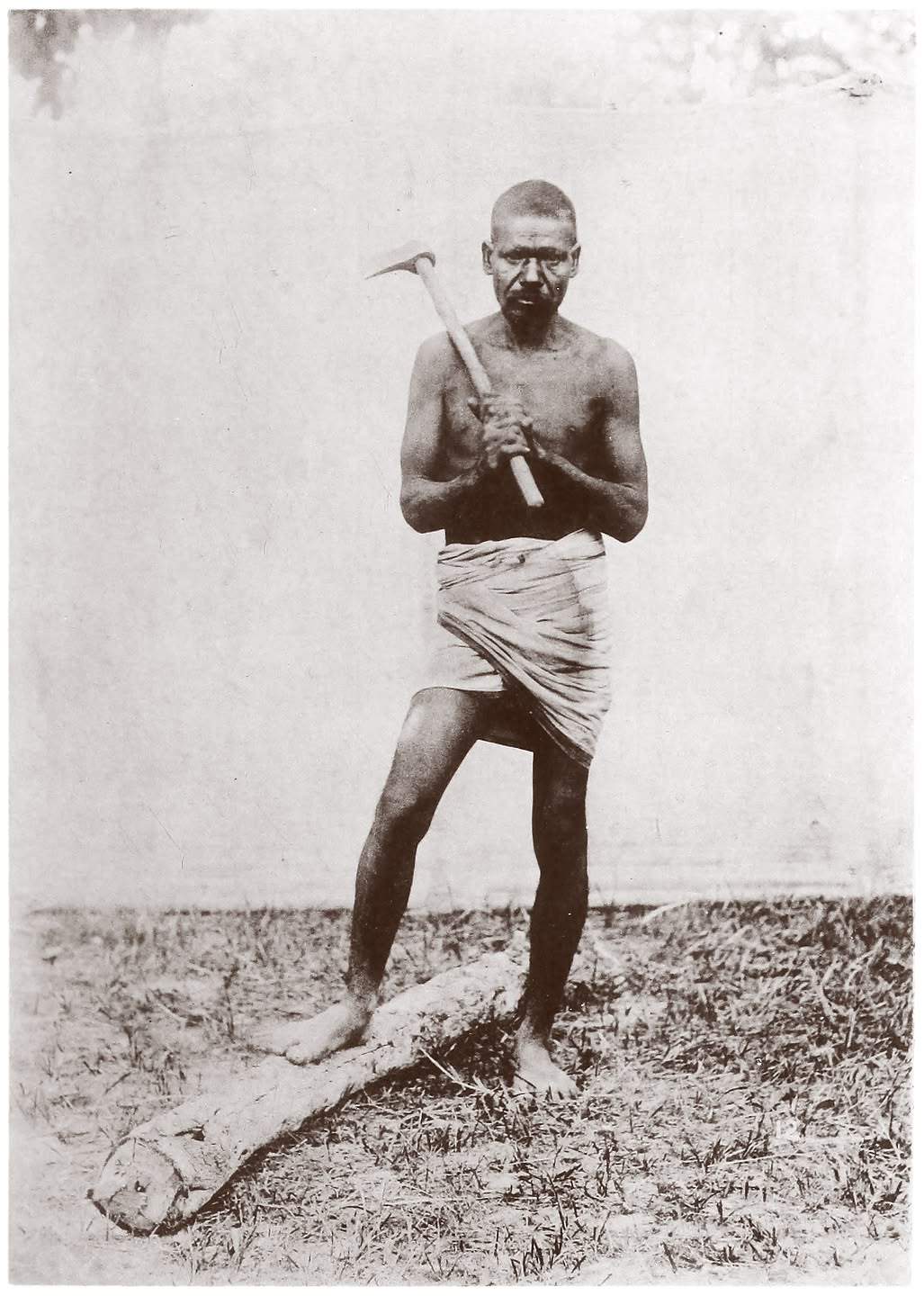
GHASIYA.
The tribal council. 3. The Ghasiyas have a very powerful tribal council (panchâyat). The president (mahto) is always a member of the Sunwân sept. The post is hereditary; but if there is any dispute about it, a reference is made to the Râja of Sarguja. The council deals with three classes of cases—Kankati, Phûlpari, and Zinakâri. Kankati or “ear cutting” is when any woman in a squabble gets the lobe of her ear, in which thick palm-leaf ornaments (tarki) are worn, torn. It is believed that any woman who gets into a mêlée of this kind is a shrew, and if it is proved before the council that her ear was torn, she is put out of caste. She is not restored till her friends give a three days’ feast of goat’s meat and rice and a fourth of butter cakes (pûri) and liquor. Phûlpari is when any one gets on his body any white mark or scab of the nature of leprosy, or has a wound or sore which breeds maggots. Such persons are put out of caste, because it is believed that such diseases are a punishment for serious crimes committed in a previous life. In such cases the fine is five goats and two days’ rice for the clansmen. After this the Sonwân Mahto purifies the offender as already described. Zinakâri embraces all offences against morality. In adultery or incest cases the fine consists of a certain number of goats and rations of rice according to the means of the offender; and, in addition, he has to give, as a special fee, to the Mahto, a water vessel (lota), tray (thâli), turban (pagri), jacket (kurta), and loin cloth (dhoti).
Exogamy. 4. As already stated, the septs are exogamous, but the only additional provision is that the children of a sister are barred, while marriage with the children of the mother’s brother (mâmu), and father’s sister are allowed.
Widow-marriage and the levirate. 7. Women married in the regular way and those taken in sagâi rank equally, and both are known as Suâsin. Though there is a rule against concubinage, the children of a concubine are recognised as children of the father, and admitted to caste. When a man wants to take a widow, he goes to her father with a set of glass bangles (chûri), some red lead, a sheet, a boddice (jhula), and a set of ear-ornaments (tarki). The father says:—“All right! Put on the things.” Then she touches them all, and takes them inside the house, where the other women decorate her with them. Next morning the father makes a pretence of pushing her out of the house as a disgrace to her family, and then she goes off with her husband. When he comes home, he feasts a few clansmen, and returns to her younger brother-in-law the bride-price. A widow can marry an outsider only if the levir refuse to have her. She leaves behind her all the children by her first husband save a child at the breast. If she takes a young child away with her, her first husband’s brother gives her a cloth every year for her trouble in taking care of it. There is no pretence of attributing the children of the levir to his elder brother.
Adoption. 8. They have some vague adoption rules in imitation of their Hindu neighbours. There is no religious sentiment in the matter, and when a man does adopt, he takes his brother’s son, the son of the elder brother being preferred. An adopted son does not lose his rights in the estate of his natural father.
Beena marriage. 9. Beena marriage known as gharjaiyân is common; in this case the period of probation is one year, during which the son-in-law works for his father-in-law, and is entitled to maintenance; but has no right to inherit from his estate.
Succession. 10. Tribal offices are hereditary. When an old Baiga is giving up office he goes with his son to the village shrine (deohâr) with two fowls, which he makes his son sacrifice. Then he is considered to have abdicated his functions. The sons are a man’s heirs, and primogeniture so far prevails that the eldest son gets a tenth more than the others. In a joint family the sons can claim partition inter vivos: the sons get each the same share as their father, and his share is divided at his death. A widow, if she remain unmarried, which is unusual, is entitled to maintenance; but can be expelled for unchastity. A daughter has no rights; but if she becomes a widow or leaves her husband she is entitled to maintenance in her father’s house until she remarries and as long as she remains chaste. A sonless mother, too, has a life interest in her husband’s estate. She may spend something in charity, but not waste the inheritance. If there are no sons, the associated brothers succeed; a sister or her sons never succeed.
Relationship. 11. The system of relationship is the same as among the Kols. They remember the names of male and female ancestors for three or four generations.
Puberty ceremonies. 13. As usual among these tribes the ear-boring (kanchhedan), which is done for boys and girls at the age of eight or nine on a lucky day fixed by the Mahto, represents their introduction into caste and their abstention from food cooked by a stranger.
Marriage ceremonies. 14. The father of the boy inspects the girl, and when he is satisfied, he sends the Mahto, who completes the negotiations. The girl is produced before him and her father says:—“I intend giving you to the son of so-and-so. Are you satisfied?” Generally the girl agrees, but sometimes she refuses. In the latter case the affair ends. If she agrees a date is fixed for the betrothal (sukhdan), when the boy’s father, accompanied by the Mahto, makes over to the girl’s father seven rupees in cash, ten bottles of liquor, a set of glass bangles (chûri), some red lead, a set of ear ornaments (tarki), some oil, and five sers of butter cakes (pûri). Then the fathers exchange platters of liquor as described among Bhuiyas (para. 13). A marriage shed is erected at both houses containing nine bamboos on the sides and a pole of siddh wood (Hardwickia binata) in the centre. Near this is placed a jar (kalsa) full of water covered with a lamp saucer with a burning wick surrounded with some urad pulse. Then follows the matmangara ceremony as described among Bhuiyas (para. 14). The mother of the bride or bridegroom, as the case may be, stands near the Baiga and throws the border of her sheet over him as he digs the earth. He passes five handfuls to her over his shoulder, and some maiden of the tribe brings it in the corner of her sheet and places it in the marriage shed, and lays the sacred water jar over it. On that day the anointing begins (hardi uthna). It is begun by the Brâhman, who takes up a little turmeric and oil with a bunch of the holy dûb grass and sprinkles it over the bride and bridegroom. Then the women relatives anoint them vigorously, and this is done five times a day for three days. On the day the procession starts, the mother does the imli ghotna or “mixing of the tamarind,” as described among Bhuiyas (para. 14). Then she warns her son to behave nicely to the relatives of the bride, not to take it ill if they play jokes on him. “If you lose your temper your marriage will not come off.” After this she kisses him on the head and sends him off accompanied by music. As they approach the bride’s village, her friends come out to meet them (agwâni), and at the bride’s door her mother waves over his head for good luck a rice pounder (mûsar), some cowdung and seed of the cotton tree (semal). After this they retire to the place arranged for them (janwânsa), and the bride’s father goes there and washes their feet and invites them to dinner with the words aiyas! aiyas! Then the marriage is done. The bridegroom comes, and, in the form of marriage by capture, drags out the faintly resisting bride into the courtyard. They walk seven times round the branch of the siddh tree, and each time as they pass, her brother pours a handful of parched rice into the fold (khoinchha) of the bride’s sheet, then the Brâhman puts five pinches of red lead (sendur) into the hand of the boy, who rubs it on the parting of the bride’s hair. After this her sister-in-law (bhaujai) comes and wipes off as much of the dust as she can into her own sheet, and gets a present of four annas. They then go into the retiring room (kohabar), and there each of them fills with rice a little earthen pot. If after filling it once the rice overflows the second time, it is an omen of good luck. The rice, it is needless to say, is pressed down the first time and then filled in loosely. After this, in direct opposition to the customs of the kindred tribes, the bridegroom at once carries off the bride to the janwânsa, where his clansmen are staying, and passes the night with her in a shed arranged for the purpose. Next day he takes her home. The day after they arrive, they go through the ceremony of drowning the water jar (kalsa dubâna) as already described among the Bhuiyas (para. 16). The binding part of this marriage ceremony (charhauwa) is the payment of the bride-price and the marking of the parting of the bride’s hair with red lead.
Various superstitions. 19. They are greatly in fear of evil spirits, which particularly infest rivers, wells, or tanks, where a person has been drowned, or trees, by a fall from which a man has been accidently killed. They are propitiated by a burnt offering (hom) and by pouring liquor on the ground. They have the usual omens and lucky days. They commence sowing on a Friday, when the Baiga sets the example to the village. They swear by the Ganges, and by placing their hands on their sons’ heads. If they forswear themselves, they believe they die and contract leprosy. They do not practice sorcery or witchcraft themselves, but they believe in the evil influence of witches. This is relieved by passes (jhârna) done by the Baiga.
Ghasiyâra, Ghasyâra—(Sanskrit ghâsa, “grass,” kâraka “occupied with”).—Grass-cutters, merely an occupation. But a few Muhammadans so entered themselves at the last Census as a separate caste. They have, of course, no connection with the Dravidian Ghasiyas.
Distribution of the Ghasyâras according to the Census of 1891.
Districts. Number.
Shâhjahânpur 66
Gonda 38
Bahrâich 94
Total 198
Manners and customs. 2. The Ghosi conforms to the rules of Islâm, but retains, like many of these lower Muhammadan tribes, some Hindu beliefs and practices. To the east of the Province they say that the ancestor of the race was one Daya Râm Gûjar, who was in high favour with one of the Muhammadan Emperors, and was by him induced to accept the faith of Islâm. He was settled in the neighbourhood of Karra Mânikpur, which they regard as their head-quarters. They profess to follow the Sunni sect, and to the east worship as their tribal deities the Pânchonpîr, Imâm Sâhib, and Ghâzi Miyân. To these they offer sugar and water and cream. Like all Muhammadans they bury their dead and worship the spirits of the sainted dead at the Shab-i-barât and ‘Id. On the former feast they offer the halwa sweetmeat and cakes of wheaten flour; at the latter vermicelli (siwaiyân), milk, and dates. In North Oudh they worship Gorakh, Shâh Madâr, Sayyid Sâlâr, and Bhairon, besides various saints and martyrs (pîr, shahîd). They employ Brâhmans to fix the auspicious times for marriage and other observances. To the east of the Province they will not eat beef nor will they eat with any Muhammadans who consume it. This is said not to be the case in North Oudh. They rank rather low in the social scale, and are proverbial for their stupidity and for never taking to any other occupation, but the care of cattle and dealing in milk, butter, curds, etc.
Distribution of the Ghosis according to the Census of 1891.
Districts. Number.
Dehra Dûn 71
Sahâranpur 2,086
Muzaffarnagar 217
Meerut 753
Bulandshahr 9
Aligarh 482
Mathura 127
Agra 119
Farrukhâbâd 5
Etah 33
Bareilly 63
Bijnor 1,398
Morâdâbâd 4,199
Pilibhît 48
Cawnpur 281
Fatehpur 190
Bânda 218
Allahâbâd 286
Jhânsi 274
Benares 2
Mirzapur 119
Ballia 10
Gorakhpur 1,541
Basti 230
Azamgarh 53
Tarâi 1,812
Lucknow 966
Unâo 8
Râê Bareli 1,108
Kheri 866
Faizâbâd 2,065
Gonda 746
Bahrâich 1,270
Sultânpur 5,192
Partâbgarh 545
Bârabanki 358
Total 27,760
Gindauriya—(Sellers of gindaura, a cake of sugar distributed at marriages, etc.).—A small sub-caste of Banyas, most numerous in Meerut. They worship Devi, Mahâdeva, Sûraj Nârâyan, the Sun-godling, and Pârvati, the snake, and the Ganges, and have a special respect for the cow and the Pîpal tree. Some of them now hold land as landlords or tenants, and live by Government or private service.
Distribution of Gindauriya Banyas according to the Census of 1891.
District. Number.
Muzaffarnagar 211
Meerut 5,974
Bulandshahr 17
Bijnor 686
Morâdâbâd 15
Allahâbâd 100
Total 7,003
Golahrê—(gola, “a grain mart”).—A small sub-caste of Banyas found only in Jhânsi, numbering 608. They are all Jainas.
Connection with Sanâdh Brâhmans. 2. Râja Lachhman Sinh gives various reasons for believing that the Golapûrabs are a spurious branch of the Sanâdhya Brâhmans. His argument is first that the villages occupied by the two tribes are closely intermixed; secondly, that the names of the gotras of both are derived from the names of villages occupied by their ancestor, and not, as among other Brâhmans, from the names of their ancestors or their titles. Several gotras, again, notably Birthariya, are common to both. Thirdly, the customs and ceremonials of Golapûrabs closely resemble those of the Sanâdhyas. Both wear the sacred cord (janeû) and do not permit widow-marriage. Unlike the Sanâdhyas, however, they employ family priests (purohit), which implies that they are not pure Brâhmans. Fourthly, they will eat kachchi from the hands of Sanâdhyas alone, and from no other caste or even tribe of Brâhmans. Some of the Ihtimâdpur families attribute their origin to the village of Chitora, which is said to lie somewhere south of Agra. They perform the tonsure (mûnran) ceremony under a nîm tree, which they consider as sacred as the pîpal. Of this custom they can give no explanation; but there are some Râjput clans which reverence the nîm tree, and will, on no account, cut even the smallest branch of it. In Agra the names of the chief gotras of the caste are derived from those of villages situated immediately round Birthara, such as Birthariya, Pairiha, Khosariya, Madheriya, and Badhiya. Their connection with the Sanâdhya Brâhmans is also shown by the fact that their priests are all drawn from that sub-division of Brâhmans.
3. At the same time their sections, as given in the detailed Census lists to the number of 76, do not tend to establish their Brâhmanical origin, and we find no trace of even the stock names such as Bharadwâja, Kasyapa, and the like. On the contrary are found local terms such as Jaiswâr, Mathuriya, or titles derived from Râjput or other tribes such as Chauhân, Kachhwâya, Panwâr, Râjput, Thâkur, or occupational as Ghaskata, “grass cutters.” All this decidedly weakens their claim to Brâhmanical origin.
Birth ceremonies. 5. There are no ceremonies performed during pregnancy. During parturition neither the mother nor the midwife must face the south. Some elderly woman of the family, or in default of such a person, a hired woman acts as midwife, and after delivery the mother is attended by the women of her own family. On the fifth or sixth day after the child is born is the Chhathi worship, and on the twelfth day the Dashtaun. On the former the women of the family and their neighbours sing songs, eat rice and sugar, and worship the goddess, Shashthi, the protectress of children. On the Dashtaun food and presents are given to Brâhmans. The child-birth impurity rests on the family until it is removed by the Dashtaun feast. There are no special ceremonies in connection with twins.
Adoption, initiation. 6. The adoption ceremonies are of the normal type, as laid down in the Dattaka Mimânsa and the Dattaka Chandrika. The regular initiation ceremony or investiture ceremony (yajnopavîta) is performed as among all “twice-born” castes.
Marriage. 7. The marriage ceremonies vary little, if at all, from those current among the higher castes. The bride’s father or guardian sends a cocoanut and a rupee or a gold muhar to the bridegroom. If these are accepted, the barber who carries them puts a mark of sandal (roli) on the boy’s forehead, and places a sweetmeat (batâsha) and a betel leaf in his mouth. This ceremony is known as tîka, sikka, or jaima. The first name is derived from the red forehead mark, the second from the coin used as a pledge of betrothal, and the third is the feast given to the barber at the house of the bridegroom. While the negotiations for the betrothal are going on the barber may visit the bridegroom’s house several times, but he will not eat there until the match is finally settled. The betrothal is not complete before the tîka ceremony, and after this ceremony it can be annulled, first, if either of the parties is found to be suffering from some serious disease; secondly, if it comes to light that they are within the prohibited degrees; thirdly, when a doubt is raised as to the purity of descent of either party. Betrothal takes place any time before marriage, generally when the girl is seven years of age. If the betrothal is annulled the presents are usually returned.
8. The actual marriage ceremony is of the normal type. The binding portion of it is the saptapadi or walking seven times round the sacred fire. In most cases now-a-days only six perambulations are performed. The only apparent survival of marriage by capture is what is known as the “door” or “vestibule ceremony” (darwâza, barothi) in which a mock fight is carried on by the relations of the bride and bridegroom. It is performed at the door of the bride’s house, and the bridegroom is always girt with a sword while it is going on.
Disposal of the dead. 9. The dead are cremated. Customs vary in different places, as to the position in which the corpse is laid for cremation. In some places it is laid face downwards, in others on the back. The latter is the more general. The head is in some place laid in the direction of the north, in other towards the south. The latter is in accordance with the rules of the Shâstra. If there be a river close by the ashes are consigned to it, while any fragments of bone which remain are reserved to be thrown into the Ganges when a convenient opportunity occurs. The fire is lit and the skull broken by the nearest relation of the deceased. After disposing of the ashes if there be a river close by the mourners return home.
Ceremonial impurity. 11. The parents and the nearest relations in the direct line are impure for ten days after the birth of a child. The death impurity lasts for twelve or thirteen days, and a woman in her menses is impure for four days. In the first two cases the impurity is removed by a regular ceremony in which Brâhmans are feasted; in the third case the woman purifies herself by bathing on the fifth day.
Oaths. 13. The common forms of oath are—swearing in a temple, by holding Ganges water in the hand or touching the idol, by the leaf of a pîpal tree, by the sacred cord of a Brâhman, by going seven paces in the direction of the Ganges, by touching the forehead of a Brâhman, by swearing with son or grandson in the arms. The last oath, if taken falsely, is supposed to cause the death of the child in a few days. Violation of the other oaths brings sickness of men and cattle, plague and pestilence, loss of crops, and so on.
Demonology. 14. The control of witches and other forms of demoniacal agency is in the hands of the Syâna or “cunning man.” He is called in in cases of sickness and smokes some tobacco which has been touched by the sick man since the attack began. This causes him to fall into a state of ecstacy, in which he mutters the name of the evil spirit which is attacking the patient, and suggests the proper means of propitiation. The Syâna generally has a private devil or two of his own, which he lets loose to pursue the evil spirit which is afflicting his patient. The office of Syâna is not confined to any special caste: any one may undertake the duty if he learns the appropriate spell (mantra) from some teacher (guru), or by intensity of devotion reduces an evil spirit into his power. Some people learn the interpretation of dreams from the special printed manuals on the subject. Anything valuable is liable to the Evil Eye, because malignant people covet its possession. The best means of obviating it is to throw grains of the small mustard (râi), salt and bran into the fire. Great care is taken of substances, such as clippings of the hair, fragments of the nails, etc. These if allowed to lie about may get into the hands of some witch and enable her to obtain influence over the original owner.
Social rules. 15. Meat of all kinds is prohibited food, and so are onions, garlic, and turnips. They will eat with no caste which they consider lower than their own, and will not touch a Bhangi, Dhobi, or Chamâr: Khatîks and Kanjars are also held in abhorrence. A man should not mention by name his Râja, his Guru, his father, elder brother, eldest son, or father-in-law. Similarly women should not name their husbands, mother-in-law, or the wife of the husband’s elder brother. If a Râja is mentioned it is as Râjaji, the Guru as Guruji, the father as Kâkaji, the elder brother as Bhaiyyaji, the eldest son as Lallu or Nanhê. For other senior relations they use a periphrasis, calling them “the son of so-and-so” or “the father of so-and-so.”
Agricultural beliefs. 16. A Brâhman is always consulted as to the most propitious day for beginning to plough, sow, or reap. The most important operation is the first ploughing after the first fall of rain. This is known as halaita lena. The time is fixed by the Pandit, who also names the member of the family who should drive it, and in which direction it should be worked. A shower is unlucky if it fall on the first day of the light half of Jeth (May–June), and at midnight on the fifth of Sâwan (July–August). These indicate a bad rainy season. Rain on the seventh of Sâwan is lucky, and thunder on the seventeenth of Jeth is considered propitious. Vegetables and other more valuable crops are protected from the Evil Eye by suspending a black pot in the field.
Food. 17. There is no special kind of food allowed to men and prohibited to women. When a person is initiated into any of the Vaishnava sects (guru-dakhsha lena, gurumukh hona) he is obliged to abandon the use of one particular kind of food or fruit. Women do not eat with men, and young children, who are regarded as impure because they touch dirt and eat without regard to caste rules, are not allowed to enter the cooking place (chauka) of the adult males of the family. All the men eat together or apart as is found most convenient. At the commencement of meals offerings are made to the deities, and those who are strict and in a position to observe the religious rules, perform what is known as the vaiswadeva yajya, which consists in casting a little of the food as an offering to the deities at the commencement of a meal. Others merely repeat the words Lîjiye Thakurji Mahârâj, “Be pleased Great Lord to accept our offering.” The smoking of gânja is considered disreputable; against bhang and opium there is no prohibition; any one drinking spirits is excommunicated.
Salutation. 18. Elders, Brâhmans, and men of rank are entitled to a salute from all males. The salute to a Brâhman is the word Pâlagan “I touch thy feet”; to a Râjput Juhâr or Mujra, and to others Râm! Râm! or the name of the particular deity worshipped by the person making the salute. Persons of rank are given the highest place at a feast or social meeting. If a superior and inferior happen to sit on the same cot, the former sits at the head and the latter at the feet. They will eat kachchi roti or food cooked without ghi, with no one but a Sanâdh Brâhman, and they will eat pakki roti with no one lower than a barber.
Occupation. 19. The Golapûrabs are a purely agricultural caste, and are one of the most industrious peoples of the province, and the women are particularly noted for their excellence in domestic work.
Distribution of the Golapûrabs according to the Census of 1891.
District. Number.
Agra 9,717
Etah 6
Total 9,723
Males 5,315
Females 4,408
Goli.—A caste shown at the last Census only to the number of 21 in the Muzaffarnagar District. As far as can be ascertained they are really only a sub-caste of Luniyas. The detailed Census Returns give only one section, Kaprahti.
GOND.
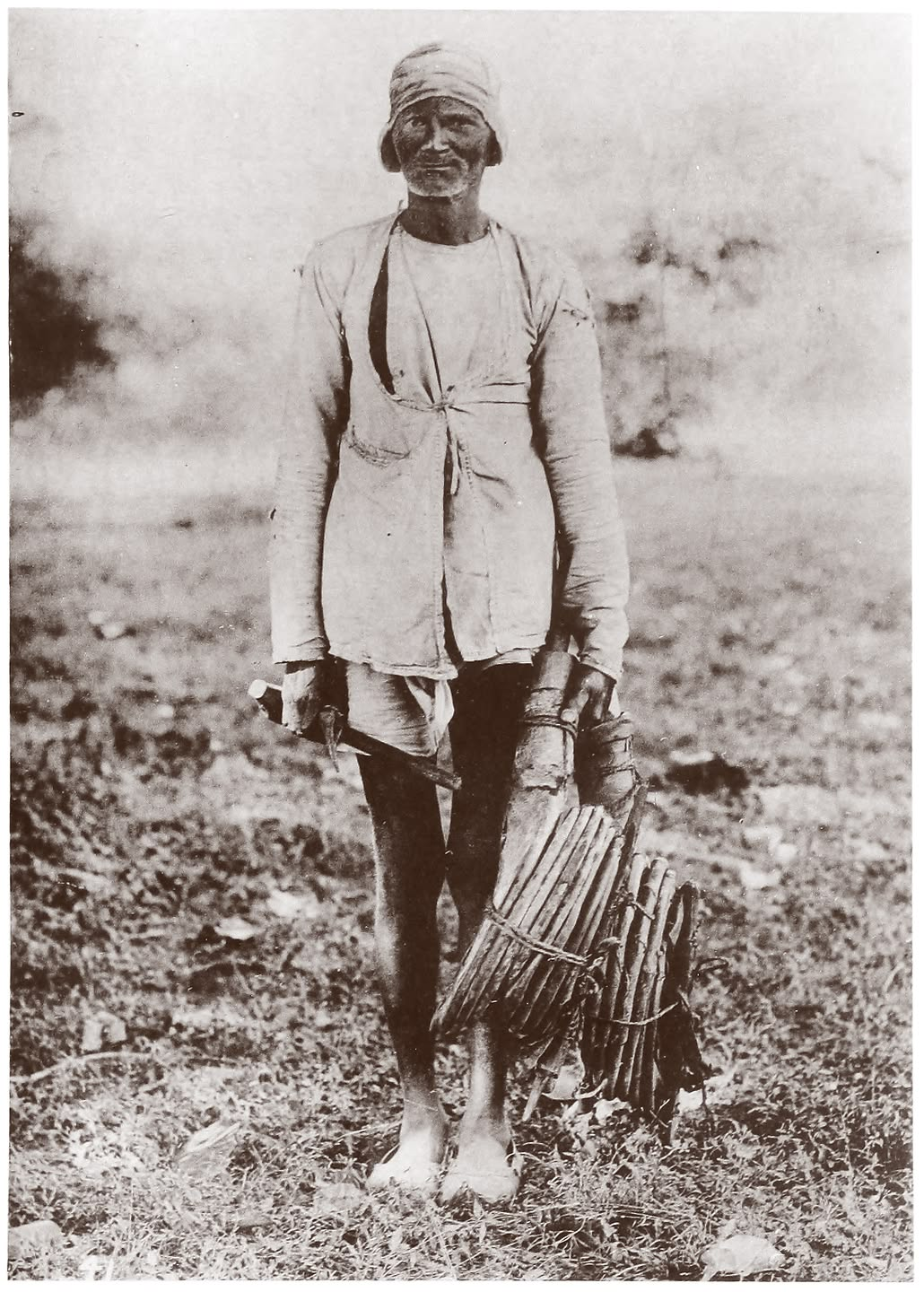
The Râj Gonds. 3. The only branch of the tribe which seems to exist under this name in these Provinces is the Râj Gond, some of whom are reported to exist in the Jhânsi District. They are divided into the following sections (gotra):—Sohâm; Chagâba; Markâm; Posâm; Korâm; Dewar, which are exogamous. Of the Râj Gonds Mr. Hislop writes:—“The Râj Gonds are so called because they have furnished from their number most of the families who have attained to royal power. They are widely spread over the plains and mountains of the Province of Nâgpur, and are found in Berâr and the jungle south of the Wârda, as well as those north of the Narbada. The Raghuwâl and Dadavê are more limited in their range, being confined principally to the District of Chhindwâra. These three classes generally devote themselves to agriculture. They eat with each other, but do not intermarry. The Katulya, though not a very numerous class in regard to individuals, is extensively scattered. It includes all those who, originally belonging to one or other of the preceding Koitor classes, have begun to conform to the Hindu religion and to ape Hindu manners. Professing to be Kshatriyas, they have invested themselves with a sacred thread, and make great efforts to get the claim allowed by contracting marriage with needy Râjput brides. With scrupulous exactness they perform the prescribed ablutions of their adopted faith, and carry their passion for purification so far as to have their faggots duly sprinkled with water before they are used for cooking. At the time of dinner if a stranger or a crow come near them the food is thrown away as polluted. These practices, which other Koitors regard with profound contempt, are gaining ground among the rich. It was only one or two generations ago that the Zamîndâr or petty Râja of Khairagarh, the present bearer of which title still carries in his features unmistakeable traces of his Gond origin, was received within the pale of Hinduism; and similar transformations, though at a more distant date, seem to have been undergone, by the royal dynasties of Bastar, Mandla, and various smaller principalities. The tendency to claim connection with Râjputs is not peculiar to ambitious Gonds: it prevails among the Bhîls of Mâlwa, and is not unknown to the wandering Kaikâdis of the Dakkhin, both of whom boast of being Yadavas or Panwârs, or some equally highborn section of the Kshatriyas.” Exactly the same is the case with the Kharwârs of Mirzapur, one of whom has in quite recent times blossomed into a Râjput and invented a clan, the Benbans, for himself. He has succeeded in marrying into a clan as respectable as that of the Chandel.
6. “Another description of marriage is when the woman makes her own match, and declining the husband provided for her by her relatives, runs away with the man of her choice. A case of this sort seldom happens. It is, however, quite recognised among the Gonds that the women have the right to take their own way if they have the courage; and the elders of the village in which the man resides generally endeavour to arrange matters to the satisfaction of both parties. Connected with this is compulsory marriage. Even after the girl has run away from her father’s house, and taken up her residence in the house of the man of her choice, it is quite allowable for the man she has deserted to assert his rights to her person by carrying her off by force; in fact not only is this right allowed to the deserted lover, but any one of the girl’s first cousins may forcibly abduct her and keep her for himself, if he has the power. Once carried off, she is kept in the house of her captor, carefully watched, until she finds it useless to attempt to resist, and gives in. Occasionally where the girl has made what is considered an objectionable match with a poor man, who has few friends, abductions of this sort are successfully carried out; but, as a rule, they are not attempted. The last form is for very poor people, or girls with no relations. In the latter case she selects some man of her acquaintance, and going to his house takes up her abode there. He signifies his acceptance by putting on her arms bangles (chûri) and giving a small feast to the village elders. Sometimes he objects, if the woman is useless or of bad character; but he gets little redress from the elders; and unless he can induce some other man to take her off his hands he is generally supposed to be bound to keep the woman. As, however, the women are usually good labourers, and well worthy of their hire, a man of property seldom raises any objection, and the women, too, are usually sufficiently worldly-wise to choose for their keepers men fairly well-to-do.”
Widow-marriage. 7. “Widows are expected to re-marry, and the Gond customs provide for their re-marriage in two ways. The first consists simply in the woman proceeding to the house of the man she has agreed to live with after her husband’s death. The other is where the younger brother marries his elder brother’s widow, which he is expected to do by the custom of the tribe, unless the widow should insist on making some other arrangement for herself. The ceremony in both the cases consists simply of a presentation of bangles by the husband to the wife, and a feast to the village elders. Elder brothers are not allowed to marry the widows of their younger brothers. The only limit to the number of wives a Gond may have is his means of supporting them.
Death rites. 8. “Cremation is considered the most honourable mode of disposing of the dead, but being expensive is very seldom resorted to, except in the case of elders of the tribe. The rule is that, if possible, men over fifty should be burned; but as these wild tribes have no means of telling the ages of their friends, it results that all old men are burnt. Women are always buried. Formerly the Gonds used to bury their dead in the houses in which they died, just deep enough to prevent their being dug up again by the dogs; now they have generally some place, set apart as a burial-ground near the village. Their funeral ceremonies are very few; the grave is dug so that the head shall lie to the south and the feet to the north; the idea being that the deceased has gone to the home of the deities, which is supposed to be somewhere in the north; but the Gonds do not appear to have any real theory as regards an after-life, or the immortality of the soul. They seem to consider that man is born to live a certain number of years on the earth, and, having fulfilled his time, to disappear. When the father of a family dies, his spirit is supposed to haunt the house in which he lived until it is laid. The ceremony for this purpose may be gone through apparently at any time after death, from one month to a year and-a-half, or even to two years. During that period the spirit of the deceased is the only object of worship in the house. A share of the family food is set aside for him, and he is supposed to remain in the house and watch over its inmates. After his funeral, when, if the relatives can afford it, they clothe the corpse in a new dress, a little turmeric and a pice is tied up in a cloth, and suspended by the Baiga to one of the beams of the house; there it remains till the time comes to lay the spirit, which is done by the Baiga removing the cloth and offering it, with a portion of the flesh of a goat or a pig, to the god of the village; a feast is given to the relations and elders, and the ceremony is complete.”
Religion. 9. In Jhânsi they worship all the ordinary Hindu gods, Mahâdeva, Bhawâni, Râma, Krishna, Mahâbîr, and Hardaul; but their special tribal deity is Gonr Bâba, who is apparently one of the deified worthies of the tribe. They seem to have become completely Hinduised: cremate their dead, throw the ashes into the Ganges or one of its tributaries, and employ the ordinary village Brâhmans in their domestic ceremonies.
10. In their real home the number of their deities seems everywhere to differ. Mr. Hislop says that he could never get any one man to name more than seven. The best known are Dulha Deo, Nârâyan Deo, Sûraj Deo, Mâta, Devi, Bara Deo, Khair Mâta, Thâkur Deo and Gansyâm Deo. Besides these, the Gond peoples the forests in which he lives with spirits of all kinds, most of them vested with the power of inflicting evil, and quite inclined to use their power. To propitiate these he sets up a shrine (pâl) in spots selected either by himself or by his ancestors, and there performs certain rites, generally consisting of small offerings on certain days. These shrines are sometimes merely a bamboo with a piece of rag tied to the end, a heap of stones, or perhaps only a few pieces of rag tied to the branches of a tree. However, the spirit is supposed to have taken up its abode there, and, in consequence, on the occasion of any event of importance happening in the Gond’s family, the spirit has his share of the good things going, in the shape of a little spirit and possibly a fowl sacrificed to him. In Mandla Thâkur Deo is supposed to represent especially the household deity, and to preside over the wellbeing of the house and farmyard; he has no special residence, but has the credit of being omnipresent, and is consequently not represented by any image. In Râmgarh, too, this deity is held in great reverence; but there he is supposed to occupy more than one shape. One village in the Shahpur Ta’aluqa is said to be very highly favoured as one of the residences of their deity. Captain Ward was shown there a few links of a roughly forged chain which the superstition of the people had gifted with the power of voluntary motion; this chain looked very old, and no one could say how long it had been at Jata; it was occasionally found hanging on a ber tree, sometimes on a stone under the tree, at others in the bed of a neighbouring stream. At the time of Captain Ward’s visit it was on a stone under the tree, from which it was said to have descended four days before. Each of these movements is made the occasion for some petty sacrifice, of which the attendant Baiga reaps the benefit, so that it is, of course, his advantage to work on the credulity of the Gonds; he does not appear, however, to abuse his power, as these movements only occur about once in four months; so that the Gonds can hardly complain of being priest-ridden to any extent.
Distribution of the Gonds according to the Census of 1891.
Districts. Dhuriya. Jetwant. Others. Total.
Cawnpur … … 7 7
Bânda … … 166 166
Allahâbâd 15 … 6 21
Jhânsi … … 8 8
Jâlaun … … 10 10
Lalitpur … … 525 525
Benares 11,363 9 1,407 12,779
Mirzapur 8,368 … 493 8,861
Jaunpur 2,171 … … 2,171
Ghâzipur 5,976 6,407 1,926 14,309
Ballia 1,227 23,358 4,200 28,785
Gorakhpur 7,431 38,503 1,950 47,884
Azamgarh 4,585 … 4,387 8,972
Unâo 2 … … 2
Bahrâich … 1 3 4
Total 41,138 68,278 15,088 124,504
Marriage. 8. Girls are allowed no freedom before marriage, and an unmarried girl detected in immorality is expelled from the community. It is only if her lover be a member of the tribe that she can be restored and remarried in the tribe if her parents feed the clansmen. Marriage usually takes place between the age of nine and sixteen. A wife may procure a separation if her husband be impotent, and he can put her away for infidelity proved to the satisfaction of the brethren. Widow-marriage and the levirate under the usual restriction are permitted. Betrothal consists in the acceptance of a sum of money in the presence of the brethren, and then the girl’s barber, who acts as envoy, makes a knot in the boy’s sheet, which clenches the engagement. The marriage is of the usual respectable form, and the binding part of the ceremony is the giving away of the bride (kanyâdân), and the usual procession of the pair (bhanwari) round the marriage shed.
Birth. 9. There are no ceremonies during pregnancy except an occasional vow to do some act if the delivery be easy. The mother is secluded for ten days, but is not allowed to cook or enter the cooking room for thirty days more. If the first child be a boy the women of the clan assemble daily and sing songs of rejoicing as long as the seclusion of the mother lasts. The family priest offers some dûb grass to the father as a sign of congratulation, and receives a present in return. On the third day the bed of the mother is moved with a rite known as “the coming out” (bâhar nikalna). On the tenth day the confinement room is purified by being plastered with cowdung, and Ganges water is sprinkled on the clothes and utensils of the household. A Brâhman is called in, who recites some verses and does a fire sacrifice (hom), casts the horoscope of the child, after which some Brâhmans are fed.
Death. 10. Gûjars cremate their dead, and all the rites are of normal type. They perform the srâddha, and some even go on pilgrimages to Gaya for that purpose.
Kutta billi do; Gûjar Rânghar do,
Yê char na ho to khulê kiwâré so.
“The dog and the cat, the Gûjar and the Rânghar, if these four were out of the world a man might sleep with his doors open.”
Yâr Dom ne kîna Gûjar,
Chura chura ghar kardiya ûjar.
“When the Dom made friends with the Gûjar he was robbed of house and home.”
The Gûjar though in popular estimation very closely connected with the Jât is yet much inferior to him in every way. The proverb runs,—
Huqqa, sukka, hurkani, Gûjar aur Jât,
In men atak kaha, Jagannâth ka bhât.
“Pipe, tobacco, courtesan, the Gûjar and the Jât are all one like the rice of Jagannâth’s temple which all castes may eat together.”
Musalmân Gûjars. 18. The Musalmân Gûjars are most numerous in Oudh and the Meerut Division. They were apparently converted to Islâm at various times; but their tradition in Oudh attributes this to the compulsion of Timur when he attacked Delhi and converted all the people in the neighbourhood by force. Some of them still maintain their Hindu sections and regulate their marriages by them as their Hindu brethren do; but in some places this is being replaced by the Muhammadan law of prohibited degrees. They are mostly Sunnis, and Sunni will not intermarry with Shiah families. In spite of their conversion they retain a number of their old tribal practices. When the bride arrives at the house of her husband her mother-in-law does the wave ceremony (parachhan) over her head to scare evil spirits, and then takes her into the household chapel (deoghar), where she worships the guardian deities of the family, for whom they still retain respect. After this the husband’s mother is allowed to see the face of the bride for the first time, and gives her a present. Widows marry by the nikâh rite, and the levirate is allowed. Some families retain the rule that the elder brother cannot marry the widow of his younger brother, but this is violated by some of the tribe in Oudh.
14. When a baby is born the Chamârin is called in and bathes the child in a broken earthen pot (khapra): in this the father puts two pice (khaprê ka taka), which are the fee of the midwife. Then the Pandit is asked to fix a lucky time for the first bathing (nahân) of the mother, and he again has to fix a time, generally on the twelfth day, when she leaves her room. When a boy is four or five years of age he is circumcised in the usual way.
15. Betrothal is done on a lucky day fixed by the Pandit, and the only rite is that the fathers exchange cups of spirits. When the procession arrives at the house of the bride the usual door rite (duâr ka châr) is performed, and after the document fixing the dower (mahr) payable on divorce is drawn up, the Qâzi reads the nikâh in the ordinary way.
16. They bury their dead. When the burial is over they make a fire offering (agyâri) by burning incense in the name of the dead, and after waiting a short time they upset a pitcher of water near the grave.
17. They visit the shrine of Ghâzi Miyân at Bahrâich, and offer there sweet cakes (malîda). They also venerate various local saints and martyrs, such as Alâ-ud-dîn Shahîd, Madâr Shâh, and Buddhi Chandra Bâba. They employ Sarwariya and Sanâdh Brâhmans to give them omens and propitiate the family gods. They so far observe the Holi and Nâgpanchami festivals that on those days they do not work. On Fridays they make offerings of food to their deceased ancestors, and when a death occurs in their family they feed beggars in the hope that the food will through them reach the dead man in the world of the dead.
18. They observe the ordinary Muhammadan rules about food, and will eat with any Musalmân except a Dhobi, Dhuniya, or Mehtar.
Gûjar Sections.
Sultânpur. Bulandshahr. Sir H. M. Elliot.
Adhâna. Adhâna.
Akiya.
Amota. Anbauta.
Awâna.
Badhurê. Badkâna.
Bâgri. Bahla.
Bajâr. Bahrana.
Baisâho.
Banya. Baislo. Baisle.
Barakat. Bâsakta. Balesar.
Bharaila. Barsoi.
Bokan. Bhâti. Bhatâr.
Bukar. Bhatti.
Chauhân. Chandela. Chamâyan.
Chhânchhi. Chaprâna. Chechi.
Chhokar. Chhâchhi. Chhokar.
Chhâorê. Chotkanê.
Chhokar.
Dhandhar. Dahariya. Dedê.
Dhangs.
Dhatrewa.
Dohla.
Dorauta.
Ghorarûp.
Gursi. Gorsi.
Hun.
Jângar. Jâtli.
Jauhar. Jauhar. Jindhar.
Jhahangha. Jawâra.
Joya.
Kahâri. Kahârê. Kadâhan.
Kâras. Kaitheriya. Kalsiyân.
Katariya. Kalyâna. Kanâna.
Kapâsiya.
Karahina.
Kasâna. Kasauni.
Kharsâna. Kharê.
Khatâna. Khatâna. Khatâna.
Khokar. Khogar.
Kori. Khûbar.
Kusânê.
Lohmaurê.
Mâvi. Mahainsi.
Mewâti. Modâr. Motê.
Mûdan. Mudhan. Mûndan.
Munrera.
Nâgarê. Nâgarê.
Pandêpûta.
Pasuâr. Patâo. Pîlwân.
Phagna. Phagna. Pûrbar.
Phular. Puswâr.
Râthi. Râthi. Râthi.
Raunso. Rausê.
Râwal.
Sakarwâr.
Sardawa. Sarândhina. Sukul.
Sarwan. Surâdnê.
Tomar. Tauhar.
Tungar.
Untwâr.
Distribution of Gûjars according to the Census of 1891.
Districts. Hindus. Muhammadans. Total.
Dehra Dûn 527 439 966
Sahâranpur 57,053 18,454 75,507
Muzaffarnagar 27,856 13,239 41,065
Meerut 69,387 65 69,452
Bulandshahr 46,632 … 46,632
Aligarh 11,397 11 11,408
Mathura 7,430 23 7,453
Agra 13,238 1 13,239
Farrukhâbâd 83 28 111
Mainpuri 111 … 111
Etâwah 3,113 … 3,113
Etah 9 22 31
Bareilly 7,361 … 7,361
Bijnor 6,265 360 6,625
Budâun 2,821 38 2,859
Morâdâbâd 11,499 339 11,838
Shâhjahânpur 3,255 … 3,255
Pilibhît 3,460 … 3,460
Cawnpur 278 10 288
Fatehpur 2 … 2
Bânda 135 … 135
Hamîrpur 12 … 12
Allahâbâd 39 55 94
Jhânsi 747 4 751
Jâlaun 5,696 8 5,704
Lalitpur 229 … 229
Benares … 37 37
Mirzapur 368 … 368
Jaunpur … 41 41
Ghâzipur … 2 2
Gorakhpur 24 2,248 2,272
Basti … 705 705
Azamgarh 2 675 677
Garhwâl … 145 145
Tarâi 973 22 995
Lucknow 7 280 287
Unâo … 10 10
Râê Bareli … 11,959 11,959
Sîtapur 1 … 1
Hardoi 110 … 110
Faizâbâd … 229 229
Bahrâich 23 1,884 1,907
Sultânpur … 8,108 8,108
Partâbgarh … 344 344
Bârabanki … 4,639 4,639
Total 280,113 64,424 344,537
Distribution of the Gujarâti Banyas according to the Census of 1891.
Districts. Number.
Dehra Dûn 3
Sahâranpur 12
Aligarh 6
Mathura 72
Agra 46
Etâwah 5
Morâdâbâd 92
Shâhjahânpur 3
Hamîrpur 1
Allahâbâd 4
Jâlaun 1
Benares 469
Jaunpur 1
Ghâzipur 3
Basti 1
Azamgarh 1
Lucknow 11
Sîtapur 1
Bahrâich 1
Total 723
3. “Their home tongue is Gujarâti, but out-of-doors they speak Hindustâni or Marâthi mixed with Gujarâti. They do not own houses, but live in houses of the middle sort, one story high with mud and stone walls and flat roofs. Their house goods consist of a wooden box or two, one or two cotton bags, a carpet, some pieces of sack-cloth, woollen waistcloths, and a few metal vessels. They keep neither servants nor domestic animals. They are vegetarians, and their staple food is rice, wheat-bread, pulse, butter, sugar or molasses. Their favourite spices are black pepper, cloves, and cinnamon. They generally eat once in the afternoon. They avoid onions, garlic, and masûr pulse, and use no intoxicating drinks. Many drink hemp water at midday and in the afternoon, but eat opium often twice a day—in the morning after bathing and in the afternoon. They neither chew nor smoke tobacco.
3. “The men dress in an irregular, carelessly folded turban, with the end left dangling a foot or a foot and-a-half from the head. It is shorter and not half so broad as the Deccan turban, and is called batti or “the lamp,” because if twisted it would be no thicker than an ordinary lampwick. They wear a fine, white coat reaching to the knees, with creases at the waist; the waistcloth, which is twelve feet long, is worn doubled as Kunbis wear it; the shoulder-cloth is an old waistcloth doubled to make it look short; and their shoes are not double-toed like the Deccan shoes, and have a top to the heel. They generally wear a rudrâksha rosary round their neck. Their women wear the hair in a braid, which they afterwards either twist into a knot, or leave hanging down the waist. They do not wear false hair, or deck their heads either with ornaments or flowers. Their dress includes a petticoat or a short robe, whose skirt they do not pass between the feet; they draw a cloak (orhni) over the head, and wear a short-sleeved, open-backed boddice. The robe is twelve feet long, or only half as long as a Deccan woman’s robe. They sometimes buy a Deccan robe, cut it in two and wear the cut end inside, and the bordered or ornamental end outside, drawn from the left over the head, leaving the left arm bare. The left arm is loaded with ornaments, while the right has no ornaments. Their ornaments are worth Rs. 200–1,000, or more.
4. “These Gujarâti Brâhmans are extremely careful and frugal; they are neither neat nor clean, but sober, thrifty and orderly. They are beggars, astrologers, family priests, and cooks. They are well paid by their Banya patrons, and are free from debt, and generally carry back considerable sums to their native country. They are a religious people. Their family deities are Amba Bâi and Bâlaji, and they worship all Brâhman gods and goddesses, and keep all fasts and festivals. Their priests belong to their own caste, and they go on pilgrimage to Benares, Nâsik, Pândharpur, and Tuljapur. They believe in sorcery, witchcraft, soothsaying, omens and lucky and unlucky days, and consult oracles. They are bound together by a strong caste feeling, and settle social disputes at meetings of caste men, and punish breaches of caste rules by fines varying from one to fifty rupees, which are spent on sweetmeats or in the repairs of their temples. They send their boys to school, but do not keep them long there. They take to no new pursuits, and are in easy circumstances.”
The Gujarâti Brâhmans of the North-Western Provinces and Oudh. 7. The Gujarâti Brâhmans of these Provinces are most numerous according to the last Census in the Upper and Central Ganges-Jumna Duâb. They trace their origin to a sacrifice said to have been performed by Râja Mûla Deva or Mûl Râj Solankhi, who reigned early in the 10th century A.D. For this rite he is said to have collected one thousand Brâhmans, of whom two hundred were Kanaujiya, one hundred from Benares, one hundred and five from the Duâb, one hundred from Mathura, one hundred Sarwariya, sixty-nine from Kurukshetra, one hundred from Ajudhya, and one hundred and thirty-two from Pushkar. He worshipped their feet and settled them in his kingdom. To some he gave Sihor, and their descendants form the Sihoriya branch; a few rejected his gifts for a time; but he persuaded them at last and gave them Cambay and twelve dependent villages. They were called Tolakiya and form a separate division. Some others he settled at Sidhpur, and they are hence called Sidhpuriya. The following is a list of the gotras of the Sidhpuriya Gujarâtis as far as it has been possible to ascertain them in these Provinces—Bhrigu, with the title Dûbê; Bhârgava, Dûbê; Kausika, Pânrê; Daribhya, Tivâri; Gautam, Dûbê; Vatsa, Thâkur; Parâsara, Dûbê; Bharadwâja, Dûbê; Sândilya, Thâkur; Saunaka, Pânrê; Vasishtha, Tivâri; Maunas, Thâkur; Jani, Garggotra; Katasas, Dûbê; Udvah, Dûbê; Krishnâtri, Dûbê; Kaudinya, Dûbê; Mandavya, Pânrê or Pandit; Upamanyu, Pânrê; Svetatreya, Dûbê. This, it will be seen, differs considerably from Mr. Sherring’s Benares lists, and illustrates the difficulty of obtaining precise information on such points.
8. The Sihoriya Gujarâtis are again divided into the following gotras:—Krishnâtri, Garga, Bharadwâja, Svetatri.
9. It is also said that after their emigration into these provinces they fell into two groups, the Bara Samudaya, or superior group, and the Chhota Samudaya, or inferior group. One colony of them, settled at Anupshahr, in the Bulandshahr District, are said to use arms like Kshatriyas, and to devote most of their time to athletic exercises, which is not the case with the ordinary Gujarâtis.
12. The Benares Nâgar Brâhmans are said to be divided into two distinct classes, the Bhikhshu or “mendicants,” and the Mahta. The latter opposed Mahmûd of Ghazni when he attacked Vadanagara, and thus lost the peaceful habits of life which still characterise the Bhikhshu class.
Domestic ceremonies of the Gujarâti Brâhmans. Birth. 13. The following account of the domestic rites of the Gujarâti Brâhmans was given by a member of the tribe resident at Mirzapur:—“When a bride after joining her husband menstruates, she becomes pure by bathing on the fourth day. At the same time she worships Ganesa and the patron goddesses of the tribe. Ganesa is worshipped with an offering of water, washed rice, sandalwood, flowers, incense, and lamps. The worship of the goddesses is more intricate. A red cloth is spread over a wooden seat (pîrha), and on it sixteen compartments are marked out with powdered rice. In each compartment is placed some rice dyed with red (rori), and on the top of each pile of rice a betel-nut. The seat is placed beside the wall of the room. On the wall a set of spots of red are made in the form of a triangle, of which the base has seven marks, diminishing by one at a time up to the apex. On these marks the woman pours an oblation of ghi. This is known as basodhara. Next the betel-nuts on the seat are worshipped with an offering of incense, lights, sandalwood, curds, sugar, and rice. This done the woman is pure and is allowed to return to her house work.
14. “When a woman becomes pregnant for the first time, and when the eighth month of pregnancy arrives, the srimant rite is performed. This is accompanied by the nandi mukh srâddha and the graha sânti—rites intended to guard the embryo from injury. Some fruit of the Dhâk and Anwla trees, millet, curd, washed rice and saffron are pounded and mixed in a ball. Then twelve betel-nuts are placed on twelve betel-leaves, and a portion of the mixture is offered to each. These twelve betel-nuts are supposed to represent the twelve relations of the unborn child, that is, six generations on the side of the father and six on that of the mother. After this a fire sacrifice (homa) is performed, and two Brâhmans are fed in the name of each of the twelve ancestors. This constitutes the nandimukh srâddha.