Volume II. (continued 2)
Reading edition
24. They dig a hole in the ground five or six cubits deep and one or two cubits long. They burn fire in it, and walk on it bare foot. They say that the man who is possessed of the Bîr does not feel any sensation of burning by walking on fire. They also scatter thorny branches of ber and kankor on the ground, and roll on them. They say that the thorns become blunt when a man possessed of Lahang Bîr rolls on them. Those who are possessed of the Bîr pronounce blessings on the Bhuiyas, and they believe that these blessings turn out true. Bhuiyas offer him sacrifices of goats, fowls, and hogs.
Various superstitions, omens, oaths, exorcisms. 27. Friday is their lucky day, and Saturday is unlucky. The numbers three and five are lucky. The note of the Suiya bird singing on the left is a favourable meeting omen. The East is the lucky direction. They swear on the head of their sons, and by holding the tail of a cow. These oaths are used for the decision of private disputes concerning tribal discipline. They believe in magic and witchcraft. Only special sorcerers (ojha) and witches (tonahi) have this power. They attack their victims by throwing dust on them, and making them eat some special food, which brings the victim under their influence. The Ojha prescribes in cases of witch or ghost possession. He names the particular bhût which is at the root of the mischief, and directs an offering of a fowl or a young pig, which he sacrifices and eats himself. Ojhas also pretend to be able to foretell the future. They do not believe much in dreams, except as an indication that the deceased ancestors are displeased with them. They believe in the Evil Eye, which is a power residing principally in persons born on Saturday. There are special spells (mantra) to obviate it. Any member of the tribe can learn and use these.
Social observances. 28. The women tattoo themselves in the way common to all the allied tribes. They will not touch a Dom, Dharkâr, Dhobi, or Chamâr; nor the wife of the wife’s elder brother, the wife of the younger brother, or the mother of the wife or husband of their son or daughter. In the morning they will not mention a monkey or a tiger. They do not eat the flesh of the cow, buffalo, monkey, crocodile, snake, lizard, or jackal. They eat pork, fowl, fish, and rats. Women do not eat with men; the men eat first and women afterwards. They use tobacco and liquor freely, and the latter is considered to ward off malaria. But habitual drunkenness is discreditable. Younger people salute their elders in the pâêlagi form, and the elders give the blessing, nîkê raho, “may you be happy.” Old men are cared for, and women, who are much used in outdoor and domestic work, appear to be treated with a tolerable amount of consideration. But if they are disobedient, wives are beaten by their husbands. Doms and Dharkârs will eat their leavings. They will eat food cooked by Brâhmans, Râjputs, or Banyas, and Ahîrs. Among the aboriginal tribes the only ones from whose hands they will eat food are the Kharwârs.
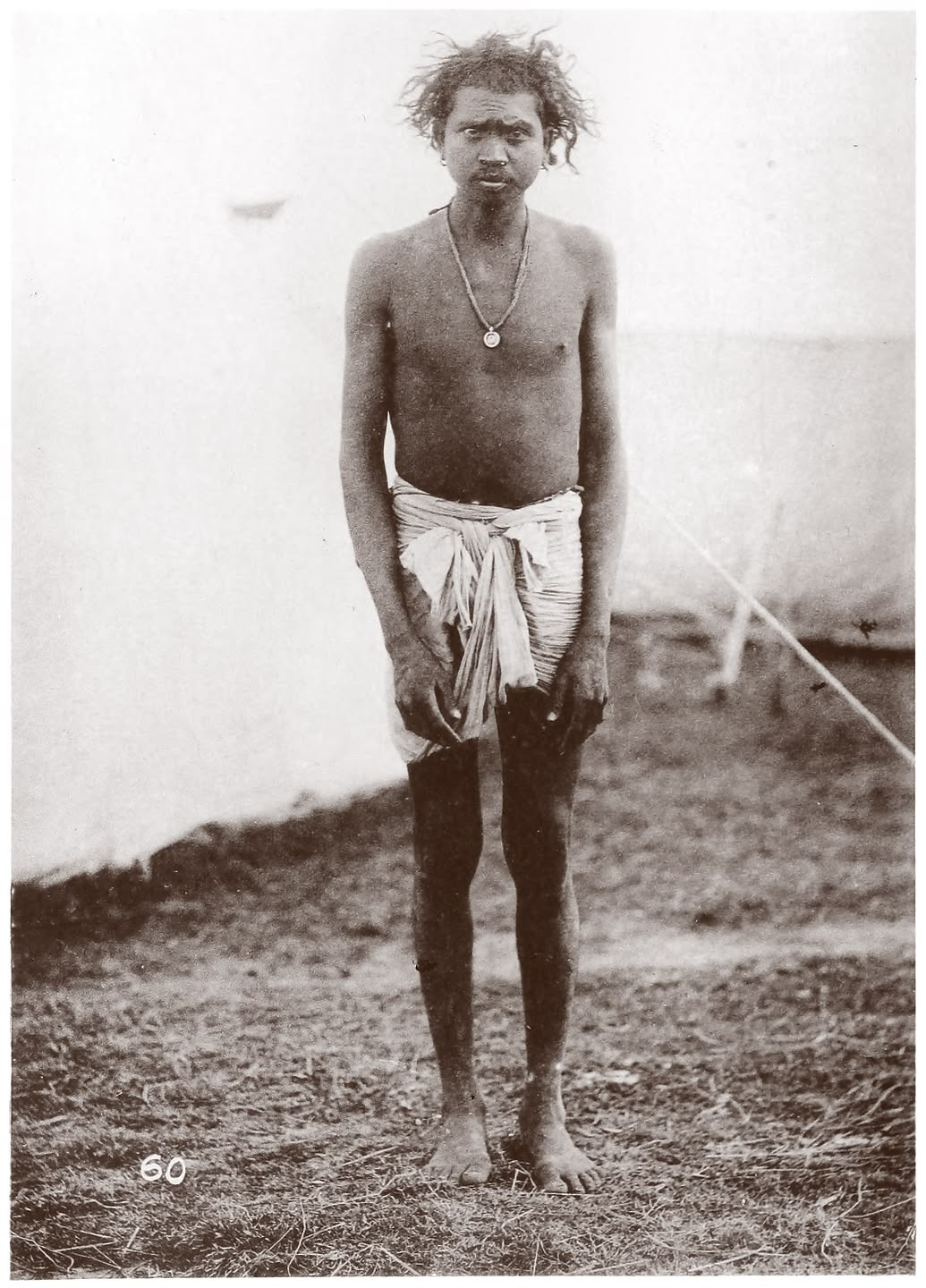
BHUIYÂR.
Occupation. 29. Most of them are hereditary serf ploughmen (harwâha). The usual wages are three sers of coarse grain per diem and ten annas in cash per mensem. In winter they get a blanket, and in the rains a palm leaf umbrella hat (khumari): at the beginning and ending of the sowing season they get a special dinner from their masters. Some have risen in the social scale, cultivate on their own account, and keep cattle and sheep. Some of the Mirzapur Bhuiyas are makers of catechu (khair), and are hence known as Khairaha. They are quiet, industrious, simple, confiding people.
Local organization. 30. They have a local organization called “the unity” (eka) embracing a group of villages. When any one encroaches on their rights they meet and discuss the matter.
Clothes and jewelry. 31. The women are tolerably decently dressed. The men’s dress is sometimes terribly scanty. Women wear no ornament in the nose: in the ears they wear palm leaf ornaments (tarki); on the neck beads (guriya), and necklaces; on the hands mattiya, and rings on the fingers. The men wear brass earrings and bead necklaces.
Tribal constitution. 2. The Mirzapur Bhuiyârs can name fifteen exogamous septs (kuri). Five of these, the Khagoriha, Suidaha, Khatkariha, Deohariya, Chargoriha, are admittedly local septs, deriving their names from the villages in which they originated. They have branched off in comparatively recent times. The original ten septs are probably in a large degree of totemistic origin. These are Bhuînhâr or “land-holder;” Nâpan, “the measurer;” Bhûsar, “the chaff men;” Bhall, “arrow men;” Sisi; Bunbun, the bumble bee; Karwa, “bitter;” Râê, “leader;” Daspût, son of a slave; Bhaniha, “he that has the rays of the sun,” many of which are possibly nicknames. If any of these titles were originally totemistic their significance has now been lost.
Rule of exogamy. 3. These septs (kuri) are all exogamous, and marriage within the septs is absolutely forbidden. This rule, which obviously permits very close intermarriage, is not supplemented by the complete formula mamera, chachera, phuphera and mausera, which bars the line of the paternal and maternal uncle and aunt. Here only the line of the paternal and maternal uncle within one generation is excluded; and after this intermarriage between their descendants is allowed.
Traditions of origin. 4. Their traditions of origin are very vague. They speak of a place called Bhaunradah as their original head-quarters, but of this they know nothing more than that it is somewhere to the south.
Tribal council. 5. They have a tribal council (panchâyat) which meets occasionally. There is no permanent president (mahto), but the oldest or most competent person is appointed at each meeting. If a man is convicted of adultery or fornication he is generally put out of caste for a year or two. He is then restored on providing a feast for the clansmen. The penalty is particularly high in the cases of incestuous connection with women within the prohibited degrees. If proved guilty of such conduct he has to provide five goats and as much liquor as can be made in one distillation from a single still (bhatti). If the woman with whom he is detected in an intrigue belongs to another caste, the fine is one still of liquor and two goats. He must obey the order of the council. If he is contumacious the fine is increased: if he submits and pleads poverty, it is often reduced.
Widow marriage and the levirate. 8. Widows can many again by the form known as sagâi, and women are so valuable that every young widow if not taken over by her brother-in-law is married to some one else. If a man wishes to marry a widow he must secure her consent and that of her relations. When this is granted he takes for her a set of palm-leaf earrings (tarki), brass arm rings (churla), and glass bangles (chûri). These he puts on the widow, takes her home, and gives a feast to the clansmen of goat’s flesh and rice. This feast is called after the earrings tarki bhât. The levirate prevails under the usual restriction that it is only the younger brother of the husband who can claim the widow of his elder brother. If he resigns his claim she can marry an outsider: she takes with her to her new home only infant children of her first husband. The others are taken care of by the brother of their father. The widow has no right to succeed her late husband: his heirs are his sons, or, in default of sons, his brother. In the case of the levirate there is no fiction that the children of the second marriage are affiliated to the first husband. As a rule all marriageable widows are taken either in the levirate or remarried by sagâi.
Adoption. 9. The tribe profess to have elaborate rules of adoption, which are, however, clearly derived from an imitation of the practice of their Hindu neighbours. There is no religious idea about adoption. All that is certain is that only a sonless man can adopt, that he must adopt in his own sept, and that almost as a matter of course he adopts his brother’s son. The uncertainty of the conception of adoption is shown in the fact that the adopted son is allowed to retain his right of succession in the property of his natural father.
Beena marriage. 10. Beena marriages by the custom known as gharjaiyân or ghardamâda, when the bridegroom serves a period of probation for his bride are usual. In such a case the son-in-law has no right of inheriting from his father-in-law, but retains the right of inheritance from the estate of his father.
Succession. 11. The sons are the sole heirs to the estate of their father. Primogeniture is so far observed that while the children of all wives share equally, the eldest son of the senior wife gets what is called tikaiti, or one in excess of each thing—cattle, cooking vessels, etc.; but if the father die in debt, this right ceases, and all the sons have to contribute equally to discharge the debt. The father during his lifetime cannot nominate one of his sons to get a share superior to that of the others.
Marriage ceremonies. 13. Until children are married it does not matter from whose hand they take food: after marriage they are obliged to conform to caste regulations. The marriage negotiations commence by some old man of the tribe or the boy’s father going to inspect the girl. Then the husband of the bridegroom’s sister goes to her with five sers of liquor and two rupees, thus concluding the betrothal, which is known among them as puchhâwat or “the asking.” If the bride’s father accepts the proposal, he summons his clansmen and distributes the liquor among them. At the same time they are given a dinner of goat’s flesh and rice, which is provided by the boy’s father. After this, on a day fixed by the girl’s father, the boy’s paternal uncle goes again with two vessels, each containing five sers of liquor, and takes with him three rupees in cash. This finally concludes the betrothal, which is known as bajarâwat or “strengthening,” and barrekhi, or “the marking down of the bridegroom.” This liquor and money are used in entertaining the clansmen of the bride and the envoy of the bridegroom. Next the bride’s father presses some oil with his own hands and sends it to the boy’s house. This is mixed with turmeric, and the bridegroom is daily anointed with it by his female relations. In the same way the boy’s father presses some oil and sends it for the use of the bride. After this a suitable date is fixed by mutual arrangement, and the bridegroom comes with his procession to the door of the bride. Outside the door the bride’s mother stands with her feet in a basket, and holds in one hand a rice pestle (mûsal), and in the other a brass tray (thâli), containing some cotton with the seed and a lighted lamp. She moves the pestle five times round the boy’s head from left to right and five times again from right to left, and pours the cotton over his head. Next she warms her hands twice over the lamp and presses them on the boy’s cheeks, and kisses his lips. After this the boy does salutation (pâêlagi) to her. She then leads the bridegroom into the inner room, where the girl sits in a corner. He sits there silent for some time. At last some women friends who are also sitting there say,—“Give the boy what he has come for.” Then her mother makes the bride stand up and seats her to the left of the bridegroom. This done, the boy returns to his friends, and the bride again retires into her corner. A couple of hours after the pair are seated on two leaf-mats in the courtyard, facing east. Both are stripped by the women, well rubbed with a mixture of oil and turmeric, and dressed in new clothes. After this the boy’s party are fed, and liquor is distributed. That night they spend in singing and dancing the karama or national dance. Next day they meet again, the friends of bride and bridegroom sitting in a line opposite each other. The boy’s father produces the bridegroom before the bride’s people; and says,—“Look! has he any physical defect?” The bride’s father replies,—“No! there is nothing wrong with him.” In the same way the bride’s father produces the bride for examination, and the bridegroom’s father admits that she has no physical defect. All this is done in the courtyard outside the nuptial pavilion (mânro). Then a mock struggle commences between the bride and bridegroom. He tries to put a bracelet on her wrist, and she clenches her hand, so that he is unable to get it on. Her friends shout out,—“Her hand can never be opened until you swear that you will take care of her and never give her trouble.” Finally, when the bridegroom makes the necessary promise, the girl opens her hand, and allows the bracelet to be put on her wrist. Then the boy pours a little liquor on her feet, and after another mock struggle marks the parting of her hair with red lead. There are no revolutions in the pavilion, and this constitutes the marriage. The bridegroom then brings the bride home. When they reach his house his mother receives the bride in the same way in which the bridegroom was received by the bride’s mother, and takes her inside the house, where, after feeding the clansmen, the clothes of the pair are fastened in a knot, and they dance together in the courtyard. The binding part of the ceremony is putting on the marriage bracelet, and applying red lead to the parting of the bride’s hair. Even after the ceremonies already described of puchhâwat, bajarâwat, or barrekhi, the marriage can be stopped. If the bride’s people break off the marriage they are compelled to return the bride-price. The form of marriage already described is known as charhauwa or “the offering,” as the bride is offered to the bridegroom. This is the respectable form; but besides this, the form known as sagâi is in force. In this case the lover sends a friend to procure the consent of the bride’s father. When this is granted, he goes to her house with ten rupees in cash, and five sers of liquor. The girl’s friends drink the liquor, and the money is given to her father, or if her father be dead, to her elder brother. Then the man spreads out his hands over that of the woman, and her brother pours some water over the hands of both. This constitutes the marriage ceremony, and the bridegroom goes home at once, followed by the bride. When they reach his house his mother comes out with a vessel (lota) of water, washes the bridegroom’s feet, and blesses him with long life. Then she washes the feet of the bride, who puts her forehead on the feet of her mother-in-law. The old woman tries to raise her up, but she will not get up until she receives a present known as “the sacrifice” (baldân). Then the old woman says,—“I make over the house and all it contains to you.” On this the bride releases her feet, and her mother-in-law takes her into the house, and makes everything over to her. That day the young wife cooks for the family and friends. This sagâi form is something like the dola of low class Hindus, and is practised by people who cannot afford a regular marriage.
Ancestor worship. 15. The souls of the dead, that is to say those of a dead father and mother, for more distant progenitors are hardly ever recognized, are feared and require propitiation. If not duly worshipped they appear in dreams, frighten the sleeper, and sit on his chest and throat like the nightmare. Most diseases and misfortunes are due to their displeasure. The annual sacrifice of a goat and fowl is made to them by the house master in the month of Aghan (November—December). Poor people who cannot afford a victim wash some rice and pulse and scatter it in the courtyard in the name of the dead.
Festivals. 17. They have two special holidays on the tenth of the light half of Kuâr, and the Phagua or Holi at the full moon of Phâlgun, but they do not burn the Holi fire, although they will attend if Hindus in the neighbourhood celebrate the festival. On both these festivals they offer a fire sacrifice (hom), and worship the sainted dead with an offering of fowls and liquor, which they drink freely on these occasions. In order to provide for the dead in the next world they throw on the pyre with the corpse some iron implement, usually an axe, and when they bury the dead, they throw it into the grave. It is not broken; with women they place a sickle (hansua) and when they collect the ashes they throw some kodo and sâwân millet over the place as food for the dead. They so far follow Hindu practice as to have a ceremony (barsi) on the anniversary of a death. In the house worship a mud platform or stone is the dwelling place of the ghosts of the dead. Sewanriya is regarded as a jungle deity, and abides in any tree which is selected for the purpose. They never go on pilgrimages to Gaya, and have nothing analogous to the Hindu srâddha.
Omens, oaths, witchcraft, Evil Eye. 20. Their lucky omens are the tiger and the elephant. They have not the Hindu prejudice against the south as an unlucky quarter. They swear on their sons’ heads, and if they forswear themselves their sons die. These oaths are used in enquiries into tribal matters. They are much witch-ridden. The Baigas hate people with a reputation for witchcraft (tonaya), and expel them, if possible, from their villages. Disease is usually caused by the attacks of ghosts (bhût): these are identified by the Ojha, who places some rice (achhat) before him. Then he and the patient get into an ecstacy, and the Ojha asks the bhût:—“What worship (pûja) do you require to let this man go?” Whatever he announces must be done. Dreams never mean anything except that one of the sainted dead needs propitiation. The meaning is interpreted by some old woman in the family. They believe in the Evil Eye. Anyone born on a Saturday has the power of casting it. Cases of this kind are made over to the Baiga, who sacrifices a victim and secures relief.
Salutation and social status. 22. Among themselves they salute in the form known as pâêlagi. If the husband is any time absent, on his return his wife touches his feet with her hands. Chamârs are the highest caste who will eat food touched by them. They carry their contempt for Brâhmans so far that they will not eat food touched by them, and if a Brâhman handle one of their water vessels they will pitch it out of the house. Their usual business is cutting wood and bamboos, and collecting silk cocoons, lac, dyes, and other jungle produce. It is only quite recently that they have taken to eating anything but jungle fruits. Now some of them cultivate, and as their name shows they are fond of the dahya form of cultivation, cutting and burning the jungle. They have a field goddess, Khetiyâr Devi, whom they propitiate with the offering of goat or a fowl. The women are reputed chaste in married life as far as intercourse with strangers to the caste is concerned, but there is certainly a very considerable amount of intertribal immorality. They have a fairly strong local organization which embraces some three or four villages, and is known as “the unity” (eka). The members meet occasionally to discuss matters of general interest. Its influence is said now to be decreasing. They are notorious for their laziness in field work, and for their readiness to abscond and leave their village on the first signs of scarcity.
23. The Bhuiyârs do not appear to have been separately recorded at the last Census. They have apparently been confused with the Brâhman Râjput Bhuînhârs of the Gangetic valley.
Bhurtiya.—A small tribe found, according to the last Census, only in Allahâbâd, but there are some certainly in the hill country of Mirzapur. The origin of the name is very uncertain. Mr. Nesfield without much probability derives it from bharti karna, “to lend money for short periods.” They say themselves that it comes from bhurti, which is the same as phurti, “quickness,” because one of their ancestors was once in such a hurry to go to an entertainment that she put her ornaments on all awry, and her descendants have been called Bhurtiya ever since. They claim to be an offshoot of the Ahîrs, whom they closely resemble in appearance and customs. They are very respectable, industrious people, and make their livelihood by cultivation and rearing cattle.
Distribution of the Bhurtiyas according to the Census of 1891.
District. Number.
Allahâbâd 423
Marriage. 2. Their marriages are regulated by the standard Muhammadan exogamic formula, and performed by the regular ritual. The levirate is permitted, but is not compulsory. Divorce is permitted in the cause of proved infidelity on the part of the wife, established to the satisfaction of the tribal council.
Religion. 3. To the east of the Province they worship the Pânchonpîr with a sacrifice of a fowl, gram pulse, and ordinary food. They bury their dead according to the standard Muhammadan rules, and offer food to the spirits of ancestors at the festival of the Shab-i-barât. They are Musalmâns of the Sunni sect. They worship their leathern water bag (mashk) as a sort of fetish, and burn incense (ubân) before it on Fridays. They conform to Muhammadan rules regarding food. They will eat food prepared by high class Hindus, but not by menials like Chamârs or Mehtars.
Distribution of Bihishtis according to the Census of 1891.
District. Number.
Dehra Dûn 127
Sahâranpur 4,203
Muzaffarnagar 4,920
Meerut 10,224
Bulandshahr 7,977
Aligarh 12,278
Mathura 6,263
Agra 10,573
Farrukhâbâd 291
Mainpuri 1,111
Etâwah 573
Etah 4,265
Bareilly 1,996
Bijnor 3,476
Budâun 2,107
Morâdâbâd 3,380
Shâhjahânpur 350
Pilibhît 595
Cawnpur 418
Fatehpur 297
Bânda 63
Hamîrpur 78
Allahâbâd 370
Jhânsi 442
Jâlaun 99
Lalitpur 6
Benares 46
Ghâzipur 25
Ballia 265
Gorakhpur 6
Azamgarh 2
Tarâi 664
Lucknow 1,405
Unâo 20
Râê Bareli 55
Sîtapur 219
Hardoi 18
Kheri 211
Faizâbâd 62
Gonda 17
Bahrâich 244
Sultânpur 95
Partâbgarh 9
Bârabanki 272
Total 80,147
“This paper is mainly concerned with the Rind, one of the tribes or clans inhabiting Balochistân. Their name signifies ‘a turbulent, reckless, daring man.’ They have never acknowledged the authority of any ruler in the country. They claim to be the true Baloch, and assert that they originally came from ‘Alaf,’ which is supposed by themselves and most other people to be Haleb or Aleppo, in Syria. They say that they are Arabs of the tribe of Quraish, and were driven out from Alaf by Yezîd I., for assisting Husain, the martyr nephew of the Prophet Muhammad in 61 Hijrah. The author shows, however, from some Arab authorities that the Baloch were established in Makran more than a century before the commencement of the Muhammadan era, certainly so if, as Firdusi relates, Naushirwân punished them in Makran in 550 A.D., and still more certainly that they were located there within 22 years after its commencement, and that therefore, if the Rinds left Aleppo in the time of Yezîd I., about 61 H., the Baloch were in Makran before that date. But it is doubtful whether the Rinds ever came from Aleppo, or that they are Baloch at all. It is much more probable that they are the descendants of a certain Al Harith Al ‘Alafi, that is of Harith of the ‘Alafi tribe, and of the Kahtanic stock of Arabs. He was the father of two men, who, according to Tabary, in a blood feud killed an officer who had been appointed by Al Hajjâj, the Governor of Irâq, to the charge of Makran, in 65 Hijrah. They had come from ‘Uman, and after the murder took possession of Makran. Subsequently, about 86 Hijrah, they retired before a punitive force of Al Hajjâj into Sindh, where their name is conspicuous in the annals of the country for the next 200 years or so. This, and other facts, show that the Rinds really are of Arab descent, but that they did not come from Aleppo, but are descended from a man of the ‘Alafi tribe who came from ‘Uman; and that they are not of the Quraish but the Kahtan stock. On account of their undoubted Arab descent, the Rinds are held in very high respect by the other clans of Baluchistân who, therefore, all claim to be related to them, through one Jalâl Khân, an ancestor of the Rinds. Among the sons of this Jalâl, Makran is said to have been divided after the death of Al Hajjâj. With regard to the name Baloch, Colonel Möckler suggests its identity with the Gedrosii of the Greeks. He says that the Baloch themselves explain their name by the phrase ‘Baloch Badroch’ (or Badrosh). Here bad means ‘evil,’ and roch or rosh means ‘day.’ In Pahlavi or Zend gad is synonymous with bad; therefore Badrosh = gadrosh or gadros, whence the Greek Gedrosii. By the interchange of the liquids r and l, badroch would become badloch, out of which the d must naturally drop leaving the Baloch = the Gadrosii, or on the other hand, the proverbial expression (Badroch Baloch) may have been current in the time of the Greeks in the form of Baloch Gadrosh, and the Greeks confused the epithet with the name.
“The latter would then be derived from Belus, King of Babylon, a derivation which is adopted by Professor Rawlinson.”
3. “His face is long and oval, his features finely cut, and his nose aquiline; he wears his hair long and usually in oily curls, and lets his beard and whiskers grow, and he is very filthy in person, considering cleanliness as a mark of effeminacy. He usually carries a sword, knife and shield, he wears a smock frock reaching to his heels and pleated about the waist, loose drawers and a long cotton scarf: and all these must be as white or as near it as dirt will allow of, insomuch that he will not enter our army because he would there be obliged to wear a coloured uniform. His wife wears a sheet over her head, a long sort of nightgown reaching to her ankles, and wide drawers; her clothes may be red or white; and she plaits her hair in a long queue. As the true Biloch is nomad in his habits, he does not seclude his women, but he is extremely jealous of female honour. In cases of detected adultery the man is killed, and the woman hangs herself by order. Even on the war trail the women and children of his enemy are safe from him. The Biloch of the Hills lives in huts or temporary camps, and wanders with his herds from place to place. In the plains he has settled in small villages; but the houses are of the poorest possible description. When a male child is born to him, ass’s dung in water, symbolical of pertinacity, is dropped from the point of a sword into his mouth before he is given the breast. A tally of lives is kept between the various tribes or families; but when the account grows complicated it can be settled by betrothals, or even by payment of cattle. The rules of inheritance do not follow the Islâmic law, but tend to keep the property in the family by confining succession to agnates; though some of the more leading and educated men are said to be trying to introduce the Muhammadan laws of inheritance into their tribes. The Biloch are nominally Musalmân, but singularly ignorant of their religion and neglectful of its rites and observances; and though they once called themselves, and were called by old historians ‘friends of Ali,’ and though, if their account of their rejection from Arabia be true, they must have been originally Shiahs, they now belong, almost without exception, to the Sunni sect. Like many other Musalmân tribes of the frontier they claim to be Quraishi Arabs by origin, while some hold them to be of Turkomân stock: their customs are said to support the latter theory; their features certainly favour the former.”
Distribution of the Biloch according to the Census of 1891.
District. Number.
Dehra Dûn 41
Sahâranpur 577
Muzaffarnagar 1,072
Meerut 2,016
Bulandshahr 1,945
Aligarh 512
Mathura 987
Agra 231
Farrukhâbâd 50
Mainpuri 73
Etâwah 67
Etah 98
Bareilly 11
Bijnor 815
Budâun 434
Morâdâbâd 490
Shâhjahânpur 425
Pilibhît 231
Cawnpur 87
Bânda 12
Hamîrpur 7
Allahâbâd 113
Jhânsi 4
Jâlaun 59
Benares 153
Mirzapur 22
Jaunpur 314
Ghâzipur 31
Ballia 216
Gorakhpur 809
Basti 116
Azamgarh 325
Tarâi 223
Lucknow 222
Unâo 26
Sîtapur 173
Hardoi 170
Kheri 308
Gonda 95
Bahrâich 79
Sultânpur 12
Partâbgarh 11
Bârabanki 10
Total 13,672
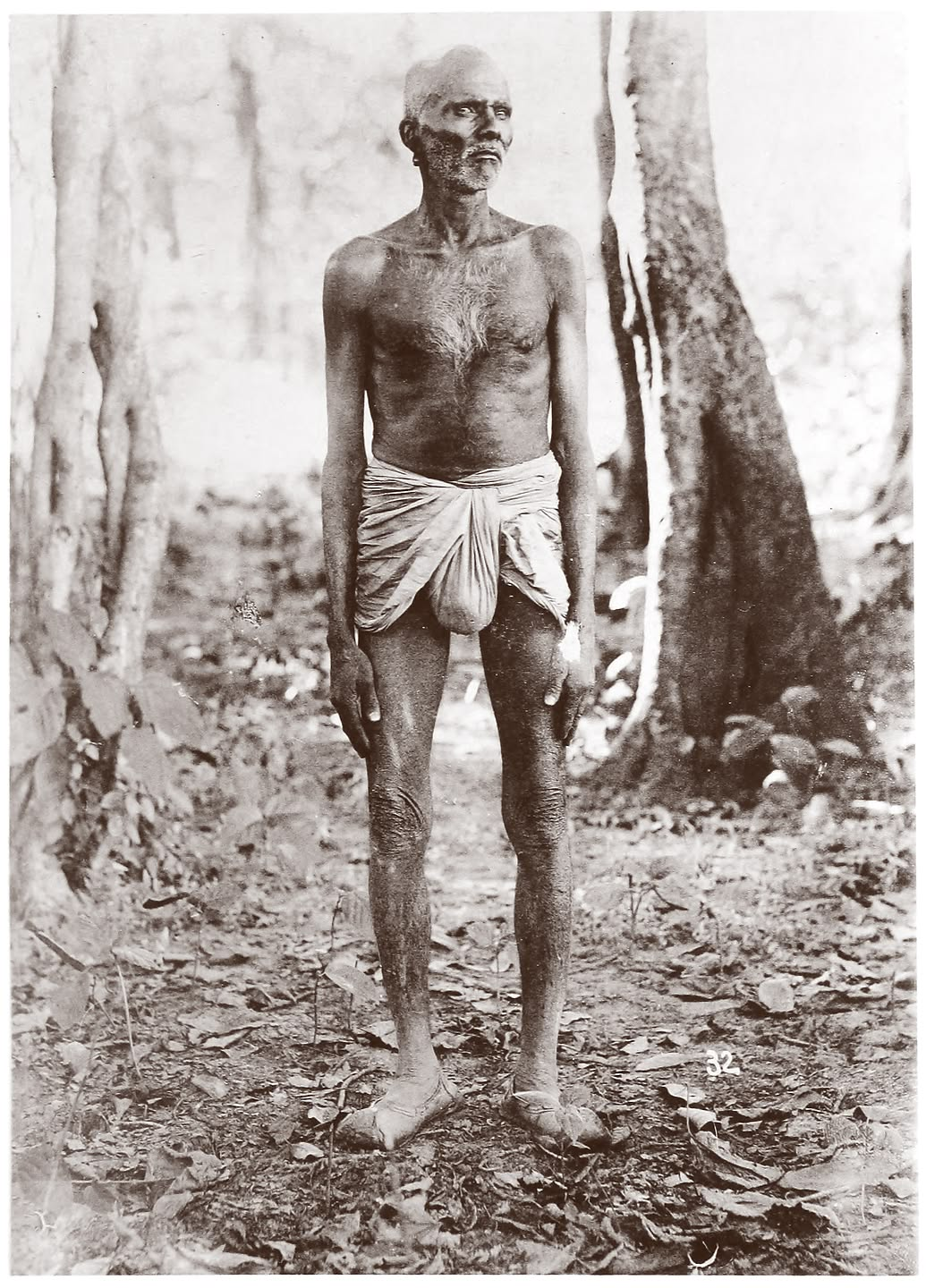
BIND.
Internal structure. 2. The last Census Returns show sixty-seven sub-castes. The progress attained in the Hinduising of the tribe is shown by the use of Brâhmanical terms, like Garga, Kasipgotra, and Joshi. Chain, Kewat, Mallâh and Kharwâr are side by side with Chauhân, Gûjara, Jât, Maunas, and Râwat. The most numerous sub-castes are the Jethwant or “Senior,” and the Kasipgotra. The Kharê Binds are very strong in Benares, Mirzapur, and Ghâzipur; while the Kharwâr, Kanaujiya, and Maunas are found in some strength in Ghâzipur, Ballia, and Gorakhpur, respectively.
Tribal organisation. 3. They have a tribal council (panchâyat) which may be summoned by any man with whom his castemen refuse to eat on the ground of adultery, prostitution, or eating with a prohibited tribesman. It is presided over by a permanent president (mukhiya) who consults the members as assessors, but has the sole right of giving the final order, which consists, in case of conviction, of a sentence to give a certain number of feasts to the brethren. When a man seduces an unmarried girl, he and the father of his mistress give a joint feast, and the parties are then married. If a man commit adultery with a woman of a caste so respectable that high caste Hindus will drink water from their hands, he is not excommunicated, but has to give a feast. If his mistress be of a caste from whose hands high caste Hindus will not drink, he is permanently expelled.
Birth ceremonies. 5 There is no ceremony during pregnancy. The woman is delivered sitting on the ground facing any direction except the south, the region of death. She is attended by a Chamâin midwife, who cuts the cord, buries it in the room, and lights a fire over the place, which is kept burning till the twelfth day. They have the usual extreme fear of pollution from the secretions after delivery or menstruation. The midwife attends till the sixth day, when the usual chhathi ceremony is done, and the woman is kept secluded till the twelfth day (barahi) in charge of the barber’s wife, when mother and child are bathed, all the family clothes washed, the house plastered, and the earthen vessels replaced. The mother then cooks for the family, and is pure. Her husband does not cohabit with her again for two months after her confinement.
Puberty ceremony. 6. The ceremony which marks the reception of the child into caste after which he or she must conform to tribal rules of eating and drinking is the ear-boring, which is done in the fifth or sixth year. The occasion is marked by the use of choice food.
7. Marriage is conducted with some pretence of observing the orthodox Hindu ritual. The girl’s father commences the negotiations, and when the question of prohibited degrees is settled, then comes what corresponds to the Hindu tilak, which is called “the day for drinking water” (pânî pînê kâ din). The bride’s father visits the house of the bridegroom, and sitting on a square (chauk) in the court-yard, eats curds and treacle, which settles the match. All present are then feasted. Five days before the wedding day the ceremony of “the lucky earth” (matmangara) is done in both families in the usual way. The drum of the Chamâr, who leads the procession, is worshipped, marked with red lead and oil, and on it are placed some betel nuts and a quarter ser of poppy-seed, which are the Chamâr’s perquisite. The earth is dug by some old female relative, who brings it home and places it in the marriage shed (mânro), in the centre of which is a ploughshare (haris), and a water jar (kalsa). After this commences the anointing of the bride and bridegroom with oil and turmeric, which is started by the Pandit sprinkling it over them five times with a bunch of dûb grass. The anointing should, if possible, be done by five unmarried girls. A day previous to the wedding is the bhatwân, when the clansmen are feasted. As the procession starts the boy’s mother waves (parachhan karna) over his head a rice pounder (mûsar), or a water jar (kalsa), for good luck. When the procession arrives at the bride’s house the women of the neighbourhood receive them with a shower of rice. The bridegroom then worships Gauri and Ganesa; and the bride meanwhile bathes and puts on the clothes which the father of her future husband sends her. She then retires into an inner room, into which the bridegroom forces his way after a mimic struggle, a survival of marriage by capture, and brings her under the shed, where her father washes the feet of the bridegroom. He then marks the ploughshare with red lead, while the Pandit recites texts (mantra), and the father taking some kusa grass in his hand solemnly makes over his daughter to her husband. Then follow the usual five perambulations round the ploughshare, while at each revolution the bride’s brother pours parched rice into a winnowing fan (sûp) held by the bridegroom, who scatters it on the ground. Bride and bridegroom then go into the retiring room (kohabar), where the women play jokes on the bridegroom, and he seizes the garment of his mother-in-law and refuses to release her till she gives him a present. The wedding feast follows, and the bridegroom takes his bride home next day, after his father has first shaken one of the poles of the marriage shed, for which he receives a present (mânro hilâi) from the bride’s father. This done, the friends embrace all round and the procession starts for home. Four days after the wedding festoons (bandanwâr), and the water jug (kalsa), are taken to a neighbouring stream. The festoons are thrown into the water by the married pair, and the jar is filled with water, which is used by the bridegroom in plastering a place in front of the shrine of the local gods (dih), where he offers a fire offering (hom) with treacle and butter.
Death ceremonies. 8. The dead are cremated in the usual way. After the burning the relatives chew leaves of the bitter nîm tree, and then eat some treacle; next day the widow goes to a stream and washes the red lead out of the parting of her hair. Poorer people merely throw the body into a stream (prabâh), and young children are buried. For persons who die at a distance they do the nârâyani bal. They make an image of wheat flour, with a cocoanut representing his head; seeds of safflower (kusum) represent the nails and teeth; the hair of a blanket represents the hairs on the body; cowries for the eyes; some ground drug the blood, birch bark (bhojpâtra) for the skin. These are covered with three hundred and sixty palâsa leaves, and all is burnt. On the third day they shave and are pure. The Mahâpâtra is dismissed on the eleventh day, and on the twelfth the soul is admitted to the company of the sainted dead. In the case of a person dying at home, on the tenth day the chief mourner offers the balls (pinda), ten in number, in honour of the dead, and daily, during the period of death pollution, lays out a platter (dauna) filled with food along the road by which the corpse was taken to the burning ground. On the tenth day the ceremony of pouring water (tarpan) on the ground in honour of the sun is done, and the clothes of the deceased, with his other personal effects, are given to the Mahâbrâhman, who passes them on for his use in the world of the dead. The funeral feast is known as dûdh ka bhât, because on this occasion milk is mixed with the pulse, and the rice is eaten unwashed. It is only on this occasion that milk is ever cooked with pulse. The Mirzapur Binds perform a ceremony of propitiation for the dead at the village of Râmgaya, near Bindhâchal, in the month of Kuâr.
Festivals. 10. In Mirzapur the Bind festivals are the Pachainiyân, Tîj, and Kajari. The last is the women’s saturnalia in the rainy season, when women get drunk, dance, sing obscene songs, and indulge in rude debauchery, which on this occasion only is condoned by their husbands.
Distribution of Binds according to the Census of 1891.
District. Sub-castes. Total.
Jethwant. Kasipgotra. Others.
Mathura 24 24
Hamîrpur 1 1
Allahâbâd 25 25
Benares 12,499 12,499
Mirzapur 10,807 10,807
Ghâzipur 2,242 53 30,178 32,473
Ballia 5,910 30 465 6,405
Gorakhpur 10,317 957 2,767 14,041
Basti 552 552
Azamgarh 8 8
Lucknow 13 13
Faizâbâd 1 1
Sultânpur 137 137
Total 18,469 1,040 57,477 76,986
Bisâti—(Bisât “goods spread out for sale”; Sanskrit, visrita “extended”).—A small pedlar, hawker, or huckster, who sells petty goods of European manufacture, such as needles and pins, tape, buttons, stationery, hardware, etc. They are a purely occupational caste, and nearly all Muhammadans. According to the Census Returns they have a curious list of sectional names—Banjâra, Mughal, Râjput, and Shaikh. The Bisâti sells much the same class of goods as the Boxwâla (“the man of the box”), who hawks small ware at European houses.
Distribution of the Bisâtis according to the Census of 1891.
District. Hindus. Muhammadans. Total.
Sahâranpur 7 233 240
Muzaffarnagar 33 33
Meerut 34 134 168
Bulandshahr 3 3
Aligarh 6 6
Mathura 7 7
Agra 11 11
Farrukhâbâd 11 11
Mainpuri 6 6
Bareilly 1 1
Bijnor 54 54
Budâun 37 37
Morâdâbâd 66 26 92
Shâhjahânpur 2 2
Pilibhît 17 17
Cawnpur 7 7
Fatehpur 6 6
Hamîrpur 10 10
Allahâbâd 10 10
Jâlaun 32 32
Ballia 29 29
Gorakhpur 6 6
Tarâi 112 112
Lucknow 1 1
Râê Bareli 17 17
Sîtapur 1 1
Sultânpur 13 13
Bârabanki 27 27
Total 107 852 959
Bisen.—A powerful sept of Râjputs found in considerable numbers in the Allahâbâd, Benares, Gorakhpur, and Faizâbâd Divisions. The head of the sept is the Râja of Majhauli, in Pargana Salempur Majhauli, of Gorakhpur. They as well as the Donwâr (q.v.) claim descent from one Mayûra Bhatta, who is said to have been a descendant of Jamadagni Rishi of the race of Bhrigu. Regarding this personage the local tradition is very vague. Some say he came from Hastinapur and was the son of one Aswathâma; others that he was an emigrant from Mahârâshtra or the Marhatta country. He read Sanskrit for a while at Benares, and became a proficient in astrology. Quitting that city at last under a divine impulse he settled at Kakradih, a village in Pargana Sikandarpur, of Azamgarh. The whole of that Pargana came gradually under his authority. His domestic arrangements illustrate a period when the bonds of caste, as we know them, were unknown. He is said to have had three wives,—first a Brâhmani named Nâgseni; the second Sûrajprabha, a Sûrajbans Râjputni; the third Haikumâri, a Gautam Bhuînhârin. By his wife Sûrajprabha he had a son, Biswa or Bissu Sen, who was the ancestor of the Bisen sept of Chhatris; by Haikumâri, Balkal or Bagmar Sahi, the ancestor of the Bhuînhâr families of Kuwâri and Tamkûhi; by Nâgseni, Nages, Nagesar or Nâgsen; and by a Kurmin concubine Indradawwan Mal, from whom sprang the Mals of Azamgarh, of whom a separate account will be given. He expelled the Bhars, and finally went on a pilgrimage to the Himâlaya, where he died. There are thus a family of Misr Brâhmans, and a large half Kurmi clan which claim common descent with the Majhauli Bisen family.
The Partâbgarh branch. 3. Of the Faizâbâd branch Mr. Carnegy writes:—“What their claim may be to being placed under the Sombansi line is not clear. Their avowed chief is the Râja of Majhauli, in Gorakhpur. In Oudh we have no less than thirteen chiefs of this clan, and their colonies are principally to be found in the Partâbgarh District, but also in Bahrâich, Gonda, Daryâbâd, and Sultânpur. The local heads are the Râja of Kâlakânkar, and the Râjas of Manikpur and Bhinga. Sir H. M. Elliot affirms that the present Râja of Majhauli is in the one hundred and fifteenth generation from Mayûra Bhatta, the devotee. The Oudh branch state that they broke off from the parent stem in the person of Râê Hûm, and settled in the Province under the wing of Mânik Chand, the then powerful Gaharwâr Râja of Manikpur, he who so happily picked up the foundling mother of all the Kânhpuriya clan. Within the last few years the Râja of Majhauli took to himself a wife from the Râjkumâr house of Dera,—a sure indication that the Bisens (indigenous devotee Chhatris of Gorakhpur though they be) are higher in the social scale than the Râjkumâr offshoot of the Mainpuri ex-convert Chauhâns.”
The Gorakhpur branch. 4. From Gorakhpur it is now reported that they intermarry with the septs of the Sirnet, Hayobans, Baghel, Chauhân, Chandel, Gaharwâr, Sûrajbansi, Râjkumâr, Chandrabansi, Sombansi, Gautam, Kausik, Gandhwariya, Hâra, Kachhwâha, Râna, Nâgbansi and Jâdon. In Jaunpur they take brides from the Bais, Nikumbh, Chaupat Khambh, and Kharagbâns, and give girls to the Nikumbh, Raghubansi, Bachgoti, Râjkumâr, and Sombansi. In Gonda they are reported to give brides to the Sirnet, Raikwâr, Janwâr, Chauhân, Kalhans, Bhadauriya, and Kachhwâha, while they receive girls from the Bandhalgoti, Râjkumâr, Palwâr, Sûrajbans, Bais, Chauhân, Kalhans, and other high class Râjputs.
Distribution of the Bisen Râjputs by the Census of 1891.
District. Hindus. Muhammadans. Total.
Sahâranpur 4 3 7
Meerut 1 … 1
Mathura 7 … 7
Agra 6 … 6
Farrukhâbâd 2 … 2
Etah … 5 5
Etâwah 17 … 17
Budâun 34 … 34
Morâdâbâd 31 … 31
Shâhjahânpur 1 8 9
Pilibhît 1 … 1
Cawnpur 348 … 348
Fatehpur 1,070 … 1,070
Bânda 815 8 823
Hamîrpur 199 … 199
Allahâbâd 7,809 25 7,834
Benares 3,363 … 3,363
Mirzapur 3,374 … 3,374
Jaunpur 4,356 49 4,405
Ghâzipur 2,486 2 2,488
Ballia 5,558 … 5,558
Gorakhpur 9,623 207 9,830
Basti 959 2,308 3,267
Azamgarh 8,864 1,096 9,960
Lucknow 368 36 404
Unâo 1,102 22 1,124
Râê Bareli 925 158 1,083
Sîtapur 481 1,028 1,509
Hardoi 74 … 74
Kheri 275 1,001 1,276
Faizâbâd 7,212 1,272 8,484
Gonda 27,697 … 27,697
Bahrâich 1,611 1,301 2,912
Sultânpur 1,586 658 2,244
Partâbgarh 4,778 … 4,778
Bârabanki 2,455 640 3,095
Total 97,492 9,827 107,319
Legend of Jhâmbaji. 2. “Another account of Jhâmbaji says that when a lad of five years old he used to take his father’s herds to water at the well, and had for each head of cattle a peculiar whistle: the cows and bullocks would come one by one to the well, drink, and go away. One day a man named Udaji happened to witness this scene, and struck with astonishment, attempted to follow the boy when he left the well. He was on horseback and the boy on foot, but gallop as fast as he would he could not keep up with the walking pace of the boy. At last in amazement he dismounted and threw himself at his feet; the boy at once welcomed him by name, though he then saw him for the first time. The bewildered Udaji exclaimed,—“Jhâmbaji!” (omniscient), and henceforth the boy was known by this name. On attaining manhood Jhâmbaji left his home, and becoming a faqîr or religious mendicant, is said to have remained sitting on a sandhill called Samrathal in Bikâner for a space of fifty-one years. In 1485 A.D. a fearful famine desolated the country, and Jhâmbaji gained an enormous number of disciples by providing food for all who would declare their belief in him. He is said to have died on his sandhill at the good old age of eighty-four, and to have been buried at a spot about a mile distant from it. A further account says that his body remained suspended for six months in the bier without decomposing.
The name of the sect. 3. “The name Bishnoi is, of course, connected with that of Vishnu, the deity to whom the Bishnois give most prominence in their creed, though they sometimes derive it from the twenty-nine (bîs-nau) articles of faith inculcated by their founder. In fact, in our returns it was very difficult to distinguish the Bishnoi from the Vaishnava, who was often entered as a Baishnav or Bishno. The Bishnois sometimes call themselves Prahlâdbansi, or Prahlâdpanthi, on the ground that it was to please Prahlâda Bhagat that Vishnu became incarnate in the person of Jhâmbaji. The legend is that thirty-three crores of beings were killed by the wicked Hiranya-Kasipu, and when Vishnu, as the Narasinha Avatâra, saved the life of Prahlâda and asked Prahlâda his dearest wish, the latter requested that Vishnu would effect the salvation (mukti) of the remaining twenty-eight crores. To do this required a further incarnation, and Jhâmbaji was the result.”
Tenets of the Bishnois. 4. “Regarding the doctrines of the sect Mr. J. Wilson writes:—‘The sayings (shabd) of Jhâmbaji to the number of one hundred and twenty were written down by his disciples, and have been handed down in a book (pothi) which is written in the Nâgari character, and in a Hindu dialect, similar to Bâgri, seemingly a Mârwâri dialect. The ‘twenty-nine’ precepts given by him for the guidance of his followers are as follows:—
Tîs din sûtak pânch roz ratwanti nâri,
Sera karo shnân sil santokh suchh pyâri.
Pâni bâni îdhni itna lîjo chhân.
Daya dharm hirdê dharo guru batâi jân.
Chori nindya jûth barjya bâd na kariyo koê.
Amal tamâku bhang lil dûr hi tyâgo.
Mad mâs se dekh ke dûr hi bhâgo.
Amar rakhâo thât bail tani na bâho.
Amâshya barat rûnkh lîlo na ghâo.
Hom, jap samâdh pûja bâsh baikunthi pâo.
Untîs dharm ki âkhri guru batâi soê,
Pâhul doê par châvya jis ko nâm Bishnoi hoê.
Which is thus interpreted: ‘For thirty days after child-birth and five days after a menstrual discharge a woman must not cook food. Bathe in the morning. Commit not adultery. Be content. Be abstemious and pure. Strain your drinking water. Be careful of your speech. Examine your fuel in case any living creature be burnt with it. Show pity to living creatures. Keep duty present to your mind as the Teacher bade. Do not steal. Do not speak evil of others. Do not tell lies. Never quarrel. Avoid opium, tobacco, bhang, and blue clothing. Flee from spirits and flesh. See that your goats are kept alive (not sold to Musalmâns, who will kill them for food). Do not plough with bullocks. Keep a fast on the day before the new moon. Do not cut green trees. Sacrifice with fire. Say prayers. Meditate. Perform worship and attain heaven. And the last of the twenty-nine duties prescribed by the Teacher—‘Baptize your children, if you would be called a true Bishnoi.’ ”
Social life. 5. “Some of these precepts are not strictly obeyed; for instance, though ordinarily they allow no blue in their clothing, yet a Bishnoi, if he is a servant of the British Government, is allowed to wear a blue uniform; and Bishnois do use bullocks, though most of their farming is done with camels. They also seem to be unusually quarrelsome (in words) and given to use bad language. But they abstain from tobacco, drugs, and spirits, and are noted for their regard for animal life, which is such that not only will they not themselves kill any living creature, but they do their utmost to prevent others from doing so. Consequently their villages are generally swarming with antelope and other animals, and they forbid their Musalmân neighbours to kill them, and try to dissuade European sportsmen from interfering with them. They wanted to make it a condition of their settlement that no one should be allowed to shoot on their land, but at the same time they asked that they might be assessed at lower rates than their neighbours on the ground that the antelope being thus left undisturbed do more damage to their crops; but I told them that this would lessen the merit (pun) of their good actions in protecting the animals, and they must be treated just as the surrounding villages were. They consider it a good deed to scatter grain to pigeons and other birds, and often have a large number of half-tame birds about their villages. The day before the new moon they observe as a Sabbath and fast-day, doing no work in the fields or in the house. They bathe and pray three times a day, in the morning, afternoon, and in the evening, saying Bishno! Bishno! instead of the ordinary Hindu Râm! Râm! Their clothing is the same as of other Bâgris, except that their women do not allow the waist to be seen, and are fond of wearing black woollen clothing. They are more particular about ceremonial purity than ordinary Hindus are, and it is a common saying that if a Bishnoi’s food is on the first of a string of twenty camels and a man of another caste touches the last camel of the string, the Bishnoi would consider his food defiled and throw it away.
Ceremony of initiation. 6. “A number of representative Bishnois assemble, and before them a Sâdh or Bishnoi priest, after lighting a sacrificial fire (hom), instructs the novice in the duties of the faith. He then takes some water in a new earthen vessel, over which he prays in a set form (Bishno gâyatri), stirring it the while with his string of beads (mâla), and after asking the consent of the assembled Bishnois he pours the water three times into the hands of the novice, who drinks it off. The novice’s scalp-lock (choti) is then cut off and his head shaved, for the Bishnois shave the whole head and do not leave a scalp-lock like the Hindus; but they allow the beard to grow, only shaving the chin on the father’s death. Infant baptism is also practised, and thirty days after birth, the child, whether boy or girl, is baptized by the priest (Sâdh) in much the same way as an adult; only the set form of prayer is different (garbh gâyatri), and the priest pours a few drops of water into the child’s mouth, and gives the child’s relatives each three handfuls of the consecrated water to drink; at the same time the barber clips off the child’s hair. The baptismal ceremony has the effect of purifying the house, which has been made impure by the birth (sûtak).
Customs of the Bishnois. 7. “The Bishnois intermarry among themselves only, and by a ceremony of their own, in which it seems the circumambulation of the sacred fire, which is the binding ceremony among the Hindus generally, is omitted. They do not revere Brâhmans, but have priests (Sâdh) of their own chosen from among the laity. They do not burn their dead, but bury them below the cattle-stall or in a place frequented by cattle, such as a cattle pen. They observe the Holi in a different way from other Hindus. After sunset, on that day, they fast till the next forenoon, when, after hearing read the account of how Prahlâda was tortured by his infidel father, Hiranya Kasipu, for believing in the god Vishnu, until he was delivered by the god himself in his incarnation of the Lion-Man (Nara-Sinha), and mourning over Prahlâda’s sufferings, they light a sacrificial fire and partake of consecrated water, and after distributing unpurified sugar (gur) in commemoration of Prahlâda’s delivery from the fire into which he was thrown, they break their fast.
“Bishnois go on pilgrimage where Jhâmbaji is buried, south of Bikâner, where there is a tomb (math) over his remains, and a temple (mandir) with regular attendants (pujâri). A festival takes place here every six months in Asauj and Phâlgun, when the pilgrims go to the sandhill on which Jhâmbaji lived, and there light sacrificial fires (hom) of jandi wood in vessels of stone, and offer a burnt offering of barley, sesamum (til), butter, and sugar, at the same time muttering set prayers. They also make presents to the attendants of the temple, and distribute grain for the peacocks and pigeons, which live there in numbers. Should any one have committed an offence, such as having killed an animal, or sold a cow or goat to a Musalmân, or allowed an animal to be killed when he could have prevented it, he is fined by the assembled Bishnois for the good of the temple, and the animals kept there. Another place of pilgrimage is a tomb called Chhambola, in the Jodhpur country, where a festival is held every year in Chait. There the pilgrims bathe in the tank and help to deepen it, and sing and play musical instruments and scatter grain to peacocks and pigeons. The Bishnois look with special attention to the fire sacrifice (hom); it is only the rich who perform this daily; the poor meet together to carry out the rite on the Amâwas day only. The Gâenas or Sâdhs, who are their priests and are fed by them like Brâhmans, are a hereditary class and do not intermarry with other Bishnois; nor do they take offerings from any but Bishnois. The Bishnois are a regular caste and have been shown as such in our tables; and the returns of the caste are much more to be relied on than those of the sect, for the reason given above that many Bishnois by sect must have been shown in our tables as Vaishnavas, and vice versâ.
Organization. 8. “It is said that a member of any of the higher Hindu castes may become a Bishnoi; but as a matter of fact they are almost entirely Jâts or carpenters (Khâti), or less frequently, Râjputs or Banyas, and the Banya Bishnois are apparently not found in the Panjâb, their chief seat being Morâdâbâd, in the North-West Provinces. The man who becomes a Bishnoi is still bound by his caste restrictions; he no longer calls himself a Jât, but he can marry only Jât Bishnois, or he is no longer a Khâti, and yet cannot many any one who is not a Khâti; and further than this the Bishnoi retains the gotra of his original tribe and may not marry within this. Karewa is practised among them, but an elder brother cannot marry a younger brother’s widow.
Connection with Vaishnavism. 9. “There is not perhaps very much in the teaching of Jhâmbaji to distinguish him from the orthodox pattern of Hindu saints, and in some points his doctrine, more especially with regard to the preservation of life, is only an intensification of the ordinary Vaishnava tenets. But in the omission of the circumambulation (phera) at marriage, the cutting off of the scalp-lock, the special ceremony of initiation, and the disregard for the Brâhmanical priesthood, we find indications of the same spirit as that which moved the other Hindu reformers of the period.”
The Bishnois of the North-Western Provinces. 10. Mahant Âtma Râm, known as Mahârâj or Mahant, the present leader of the Morâdâbâd Bishnois, gives an account of them which, as far as the legends connected with Jhâmbaji, agrees exactly with the Panjâb legend. He names nine endogamous sub-divisions of them—Jât; Bishnoi; Banya Bishnoi; Brâhman Bishnoi; Ahîr Bishnoi; Sunâr Bishnoi; Nâi Bishnoi; Chauhân Bishnoi; Bayhar Bishnoi. The rule of exogamy is that they do not intermarry in their own gotra or in that of their relatives as long as any tie of relationship is remembered.
Customs. 11. The Morâdâbâd branch settled there when the District was in the hands of the Nawâb Wazîr of Oudh, about one hundred and fifty years ago. They do not admit outsiders except into their special sub-division as given above. Polygamy is allowed; polyandry repudiated. The marriage ceremonies are performed in the orthodox Hindu fashion. Widows can re-marry by the sagâi form. Besides the special worship of Jhâmbaji, they have, now following the example of their Hindu neighbours, adopted also the worship of Siva and Bhawâni. When a child is born the mother is secluded for forty days, when the Mahant sends one of his disciples who makes her throw some butter into the fire. This ceremony is known as basandar chhûna or “fire touching.” When a man dies the nearest male relative of the deceased draws water from the well in an unused earthen vessel, and places it at the door of the house with the opening at the top covered with a piece of new cloth. Upon this are placed some cakes (pûri). Just as the sun is setting some of the clansmen assemble, and each takes a handful of water and pours it on the ground in the name of the dead man. This is repeated on the third, tenth, twentieth, and fortieth day, and after three, six, and twelve months. The corpse is thrown into the Ganges with a pitcher full of sand tied round the neck. They perform the srâddha in honour of the sainted dead in the month of Kuâr, as ordinary Hindus do. Those who die without issue have the srâddha performed by other relations, and on this occasion clothes, etc., are given to Brâhmans. They will eat from the hands of none but their own clansmen.
Social life. 12. They strictly abstain from spirits, meat, and tobacco. Wherever they are numerous they erect by subscription a shed which is known as a Vishnu temple (Vishnu mandir). There they assemble on the fifteenth of every Hindu month, and the songs of Jhâmbaji are chanted by the Mahant or some other Sâdh or priest. This meeting is known as jumala. In the months of Kuâr and Chait they assemble in large numbers and offer sweetmeats and money. Part of the offerings is taken by the Mahant and the rest is divided among the worshippers present. The Mahant and his Sâdhs practise celibacy. The Bishnois of Bijnor appear to differ from those of the Panjâb in using the Musalmân form of salutation, salâm alaikum, and the title of Shaikhji. They account for this by saying that they murdered a Muhammadan Qâzi who prevented them from burning a widow and were glad to compound the offence by pretending to adopt Islâm.
Biyâr, Biâr.—A tribe of labourers and cultivators in the Eastern Districts.
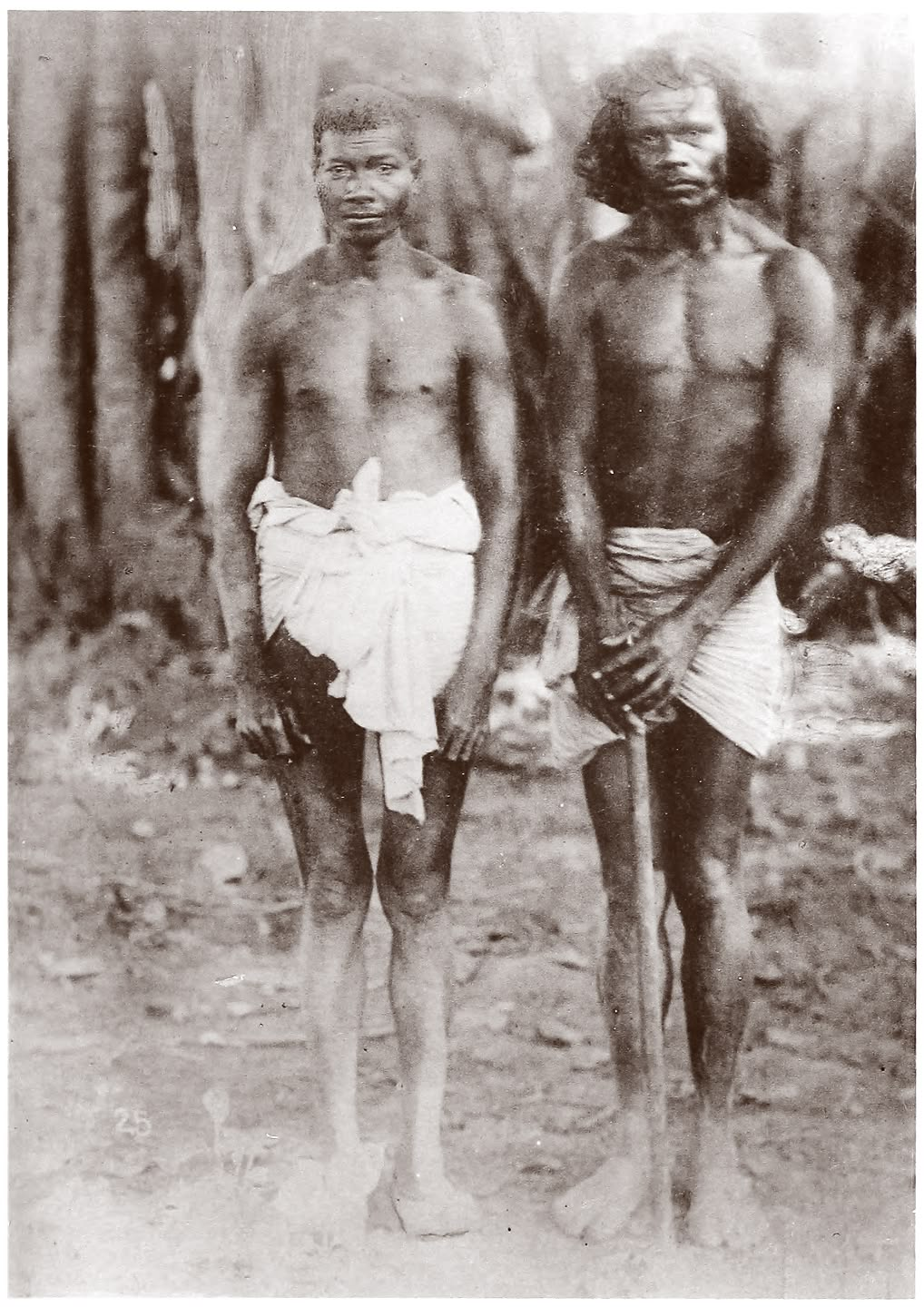
BIYÂR.
Tribal organisation. 2. They have a caste council (panchâyat) which meets on occasions of marriages and funerals, and disposes of tribal business. The president (Mukhiya) is a hereditary officer, and he has an assistant known as Chaudhari. Offences against morality are punished by fine or castigation. The castigation is in the form of a shoe-beating, which is administered by two strong young men at the orders of the president. The fine takes the form of two or four days feeding of the clansmen. When the offender agrees to do this he is restored to caste privileges. If a man marries into a family already excommunicated he has to give a two days’ feast of goat flesh and liquor to the clan. If a poor man pleads poverty, the fine is sometimes reduced, but if he disregards the sentence he is excommunicated for two, four, or even ten years. If the Mukhiya or Chaudhari is a minor, the council select some relative to act for him. The Chaudhari is always appointed by the council.
Rules of marriage. 3. Difference in wealth or social station is no bar to marriage. A man may marry as many wives as he can support. The senior wife is mistress of the house, is respected among the relations, and joins in the family worship. If a man marries a second time, and he or she annoy or ill-treat the first wife, the council interferes in her favour. As a matter of fact the senior wife generally selects the junior wives, and urges her husband to polygamy, as their labour saves her trouble. If there are more wives than one they live in separate huts in the same enclosure, but, as a rule, they get on well together and live in common. Concubinage, if the concubine (rakhui) is a member of the tribe, is permitted. The abhorrence with which they regard even the idea of polyandry is sufficient to show that it could never have been an institution of the tribe. Women have considerable freedom both before and after marriage. If a woman is caught in an intrigue with a stranger to the tribe she is expelled. If her lover be a member of the tribe, the fathers of both have to feed the clansmen: but it is a peculiarity of this tribe that they will not allow the lovers to marry. The reason is because such cases give rise to a feud between the girl’s family and that of her lover, which is usually so serious that a marriage alliance between them is out of the question. In such cases of incontinence the girl’s father has to feed the tribesmen on pakki rasoi, that is to say, butter cakes (pûri) and goat’s flesh, and the next day on kachchi rasoi, that is, boiled rice and pulse (dâl, bhât). The tribal punishment for the lover used to be fifty stripes with a cane, but British law has put a stop to this, and he now gets fifty blows of a shoe. After the beating is over he has, in addition, to give the same feast as the girl’s father.
Marriage and divorce. 4. The marriage age for boys and girls is from six to twelve. The headman arranges the match: the consent of the parents is essential, and the parties have no right of choice. The bride-price fixed by invariable custom is four rupees in cash, two cloths (dhoti), four sers coarse sugar (gur), and a little turmeric. No physical defect which appears in either party after marriage is sufficient to break the tie; but this is not the case if fraud is established against the parents of either party: and it is understood that a woman may refuse to live with her husband if he is unable to support her, or is impotent. A man can divorce his wife for adultery: in fact, if after adultery is established, a man does not discard his wife, he is punished by the council. But all separations must be by the sanction of the headman, and he will not give leave until he has enquired and heard evidence in the case. If a man marries a woman who has been divorced for adultery he is put out of caste. The sons of the senior wife are called jethri or superior: those of the second lauhri or inferior. These two sets of children succeed equally, while the children of a concubine have no rights, and receive only whatever their father may please to give them during his lifetime. If the concubine was a woman of the tribe, the children receive full caste rights and can be married in the tribe: not so, if the mother was of another tribe. Her children are called Biyâr after their father, but have no rights of marriage or commensality.
Widow marriage. 5. A man may take a widow to live with him without any ceremony. For a while the clansmen will not eat with him, but when he feeds them he is generally restored to caste on condition that he goes to bathe at Benares or Gaya. The levirate is allowed under the usual restriction that the younger brother can marry his elder brother’s widow, and not vice versâ. If the levir abandon his claim to her she may marry an outsider. She takes with her only children at the breast; the others remain with her late husband’s brother. Once she marries again she loses all rights in her husband’s estate. Their uncle manages the property for his nephews, and they succeed when they come of age. So in the case of the levirate the mother manages the property for her sons by the first marriage. Her second family has no claim to share. There is no fiction by which the sons of the levir are attributed to the first husband.
Adoption. 6. Only a sonless man can adopt, and that only with the consent of his brethren and the council. A man usually adopts his brother’s son, though occasionally the adoption of a daughter’s son is allowed. A man may adopt if his only son is a permanent outcast. During the life of one adopted son a second cannot be adopted. Curiously enough a bachelor can adopt, but not a blind man, or a cripple, or an impotent man, or a Jogi, or a woman, except a widow following distinct instructions from her late husband given before witnesses. But in any case she can adopt only one of her husband’s brother’s sons. A man cannot give his only or eldest son or only brother in adoption. A boy once married cannot be adopted: nor can a girl be adopted: nor a sister’s son: nor a daughter’s son except in most exceptional circumstances. As a rule a son adopted by another loses all rights to his father’s estate, but cases are quoted to the contrary. If he be his father’s only son he inherits in both houses. If a natural son be born after adoption he and the adopted son share equally.
Beena marriage. 7. The custom of Beena marriage or gharjaiyân does not prevail.
Succession. 8. In all cases the sons of a man are his heirs. Primogeniture is so far observed that the eldest gets a tenth in excess of everything, and the children of the first or senior wife get something more than the others. The shares go by the sons, not by the mothers. A man cannot select a special son in his lifetime to be heir in excess of the others. Even if one son be better off than the others by self-acquired property, dowry, etc., he gets his usual share. Grandsons get their proportionate share in the inheritance of their fathers. If there are no sons the associated brothers inherit equally. The widow has a right to maintenance so long as she continue chaste: if she becomes unchaste her husband’s brothers can expel her. A daughter has no rights, but it seems to be usual for the brothers to give her some of the family jewelry, etc., and if she is badly treated by her husband or his friends she has a right to come back to her original home and claim maintenance there. If a man die without a son or widow his associated brothers succeed. If a widow marries while pregnant, and a son is born, he will succeed to his real not to his step-father. If the widow on remarriage takes little children with her the step-father is bound to support them until they grow up and get them married. If a man become an ascetic his sons get his estate: but a remarkable rule prevails that in such case the sons get only the acquired property of their father, while the ancestral property goes to his brothers. Village and tribal offices such as that of mahto are ancestral: but if the eldest son of the deceased proves unfit, the duty is made over to one of his elder brothers.
Relationship. 9. Families in which sons are married or from which sons-in-law come are considered relations. There is nothing peculiar in the general system of relationship. They do not, as a rule, remember the names of ancestors beyond the grandfather.
Birth ceremonies. 10. When a woman is being delivered she sits on the ground facing east. She is attended by the Chamâin midwife, who cuts the cord with a sickle and buries it in the place where the child was born, lighting a fire on the spot, which is kept burning while the woman remains in seclusion. After birth the child is rubbed with a mixture of barley flour and oil. The first day the mother is fed on halwa, which is made of wheat flour, coarse sugar (gur), and ghi. After this she is given butter cakes (pûri), but in poor families only rice and pulse. Every morning and evening she is given a mixture of gur, ghi, and turmeric, which is known as kâra. On the sixth day the Chamâin bathes mother and child, the Dhobi takes her clothes to the wash, the barber’s wife cuts her finger and toe nails and colours her feet with lac dye (mahâwar). On that day the men of the family shave and put on clean clothes, and the woman’s husband’s sister (nanad) cleans the delivery room (saur), for which she receives a present in cash, clothes, or jewelry. The wives of the barber and Dhobi get four annas each, and the Chamâin the same with her food for the days she has been in attendance. That evening the clanspeople, male and female, are fed. From that date the attendance of the Chamâin ceases. On the twelfth day (barahi) the mother bathes in warm water, and the barber’s wife cuts her nails and those of all the other women of the family. From that time the mother is considered pure, and cooks for the family. On this day the old earthen vessels of the family are replaced. The couvade so far prevails that on the day the child is born the father does no work, and has to take the first sip of the draught given to his wife. The husband does not cohabit with his wife till the child is six months old, and is first fed on grain (annaprâsana).
Adoption ceremony. 11. No adoption is valid unless the adoptive father and the boy appear before the Mukhiya, Chaudhari and council and make mutual engagements.
Ancestor worship. 15. At the period sacred to the dead (pitra paksha) in the month of Kuâr they plaster a little space under the eaves of the house, spread there a little rice and flowers, and a vessel (lota) full of water and a toothbrush (datwan) for the use of the dead. On the 15th day of Kuâr they give some dry grain (sîdha) to a Brâhman, and feed a few of the kinsfolk in the name of the dead. If this is not done, their spirits beset them in dreams, cause the nightmare, and bring disease and death.
Various superstitions, omens, oaths, witchcraft, etc. 20. The lucky days are Sunday and Monday and Friday; Tuesday and Saturday are unlucky. Among numbers 5 and 3 are lucky, 13 unlucky. They take omens from the kurli bird, whose song on commencing a journey or business is lucky. A jackal crossing the road is inauspicious. The house door may face the North, East, or West, but not the South. Every one has two names, that fixed by astrology (râs), and that in ordinary use. They swear by putting the hand on their son’s head or touching a Brâhman’s feet. In the first place if they tell a lie the son dies, in the second they lose their property or life. They are much in dread of witchcraft (tona). Such cases are treated by the Ojha, who has power to drive off or summon Bhûts, and can thus revenge himself on an enemy. Dreams only mean the displeasure of the sainted dead at inattention, and are not specially interpreted. Some women, particularly those born on a Saturday, can cast the Evil Eye. When a child is thus affected its eyelashes stand out straight, and when babies are struck they refuse the mother’s breast. Even big children are affected. The sign of the arrival of a person with this power is that the person affected if eating immediately vomits. All disease is due to demoniacal influence. It is only Ojhas who can recognise the particular Bhût which is at the bottom of the mischief, and having marked him down they are able to prescribe the appropriate offering or expel the evil spirit by bringing the victim into a state of ecstacy (abhuâna).
Occupation. 22. Their business is ploughing (halwâhi) and doing earthwork on embankments and tanks, in which men, women, and children join. When they take service as ploughmen they get on the first day a pot (hânri) full of grain and a rupee in cash, and the same when sowing is over. Their daily wages are three sers of barley or sâwân millet. The Biyârs are a very quiet, respectable tribe, and are very seldom seen in our Courts.
23. They have a sort of local organisation (eka) in which three or four villages join, but it is weak and ineffective, and as a tribe they are little more than serfs, ascripti glebæ; a few are now beginning to cultivate as sub-tenants.
Distribution of the Biyârs according to the Census of 1891.
District. Number.
Benares 3,214
Mirzapur 14,398
Ghâzipur 537
Ballia 579
Tarâi 93
Total 18,821
4. Their exogamous sections would lead to the conclusion that their origin is mixed. The Kâchhi and Khangâr seem to represent a non-Aryan element. Besides these are the Bachguâr, Balâi, Bâtham (from Srâvasti), Bhatiya, Charwâr, Dasâti, Deswâl, Kama, Kâsib, Kundal, Maheswari, Nâgar, Samel, Syâmi, and Sundi.
Distribution of the Bohras according to the Census of 1891.
District. Number.
Sahâranpur 622
Muzaffarnagar 13
Meerut 2
Bulandshahr 75
Aligarh 386
Etah 32
Hardoi 1
Total 1,131
Boriya.—A tribe of village servants and cultivators found chiefly in the Cawnpur and Hardoi Districts. Their sub-castes show that they are closely connected with, if not an offshoot of, the great Pâsi tribe. Thus we find among their sub-divisions Arakh, Baheliya, Gûjar, Khangâr, Kisân, Luniya, Pâsi, Râjpâsi, Rakhpâsi. Some, again, are local sections, such as Ajudhyabâsi, Antarbedi, Baiswâr, Banârasi, Brijbâsi, Kanaujiya, Mahobiya; others imply some connection with other tribes as Bhurtiya, Chauhân, Ghosi, Hâra, Kaithiya, Kathwâns, and Sombansi. Others are occupational, as Ghurcharha, “horsemen;” Khetwâl, “field men.”
Distribution of the Boriyas according to the Census of 1891.
District. Kaithwâns. Pârasrâmi. Pâsi. Others. Total.
Cawnpur 2,990 6,831 4,739 3,591 18,151
Fatehpur 985 232 349 86 1,652
Hamîrpur … … … 2 2
Hardoi … … 7,031 69 7,100
Bahrâich … … … 4 4
Total 3,975 7,063 12,119 3,752 26,909
Legendary origin of Brâhmans. 6. The legends throw little light on the origin of Brâhmans as a caste except to establish the substantial unity of the Aryan peoples. By one account the Brâhman was produced from the mouth of the Supreme Being, the Kshatriya from his arms, the Vaisya from his thigh, and the Sûdra from his foot. In the Purusha Sukta hymn of the Rig Veda the primæval man is hewed by the gods into four parts, which form the four great divisions of the race. A later legend bases the division on purely moral grounds, and degraded those Brâhmans who gave themselves up to anger and pride into Kshatriyas; those who lived by agriculture and flock tending, the yellow Vaisyas; and those who gave way to lying and immorality, the black Sûdras.
Division of Brâhmans. 7. The usual division of Brâhmans is into ten great orders. First the five Drâvidas south of the Vindhyan range, consisting of the Mahârâshtras who dwell in the country where Marâthi is spoken; the Andras or Tailangas of the Telugu country; the Karnâtas of the Canarese country; and the Gurjaras of Gurjarâshtra or Gujarât. Secondly, the five Gauda or Gaur, north of the Vindhyas, consisting of the Sarasvatas, who take their name from the Sarasvati river; the Kanyakubjas or Kanaujiyas, from Kanyakubja or Kanauj; the Gaudas or Gaurs who are said to take their name either from Gaur in Bengal or Gonda in Oudh; the Utkalas of Orissa, and the Maithilas of Mithila, the modern Bihâr and its neighbourhood.
8. At the last Census the Brâhmans of these Provinces were recorded under twenty-one main sub-castes,—Bangâli, Chaubê, Drâvira, Gangaputra, Gaur, Gujarâti, Jhijhautiya, Kanaujiya, Karnâtak, Kashmîri, Khandelwâl, Mahârâshtra, Maithila, Ojha, Palliwâl, Sakaldîpi, Sanâdh, Saraswata, Sarwariya, and Utkal. Besides these divisions, which are in a large degree territorial, there are others, such as Achârya, Hotri, etc., which are occupational. The Brâhmanic sub-castes will, for the sake of convenience, be discussed in separate articles. The complete lists give no less than nine hundred and two Brâhmanical divisions, but here tribes and gotras are inextricably compounded.
9. Among the sub-divisions of local importance, we find in Dehra Dûn the Gangâri; in Muzaffarnagar, the Achârya, Dakaut, and Taga; in Meerut, the Achârya, Bohra, Chaurasiya, Dakaut, Dasa, and Gautam; in Aligarh, the Abhinâshi, Agnihotri, Barwâna, Gautam, Parâsara, Pâthak, and Upâdhya; in Mathura, the Gautam and Nâgar; in Agra, the Chaurasiya and Gautam; in Farrukhâbâd, the Mahâbrâhman; in Etah, the Dichhit, Gautam, Rajauriya, and Upâdhya; in Budâun, the Parâsara, Pâthak, Tiwâri, and Upâdhya; in Morâdâbâd, the Gautam and Mahâbrâhman; in Hamîrpur, the Bhagorê and Sanaurhiya; in Allahâbâd, the Mâlawi and Râthi; in Jhânsi, the Bhagorê, Dakkhini, Karâri, and Sagarmodi; in Jâlaun, the Aiwâsi; in Lalitpur, the Bhagor and Singirekh or Sringirishi; in Benares, the Audich, Bhâradwâja, Nâgar, and Vedi; in Mirzapur, the Sândil; in Jaunpur, the Kantil and Rajbhât; in Ghâzipur, the Bhâradwâja, Chhatri, Gautam, Pachhaiyân, Parâsaragotra, Sândil, Vedi, and Yajurvedi; in Ballia, the Gautam; in Basti, the Sândil; in Bahrâich, the Belwâr; and in the Hills, the Bais, Bhal, Bhât, Gangâri, Joshi, Khas, Lakhpâl, Lohni, Pânrê, Panth, Pâthak, Sarola, Tripâthi, Tiwâri, Upâdhya, Upreti. Of many of these some account will be found in other articles.
11. There is again another Brâhmanical division, that of the charana or sâkha and the pravara. The sâkha or charana is usually applied to the body of persons who follow one of the various schools of Vedic teaching, which are said to be as many as 1,130, of which there are 1,000 for the Sama Veda, 100 for the Yajur Veda, 21 for the Rig Veda, and 9 for the Atharva Veda. The institution of the pravara is, again, purely religious. The pravara or arsheya, which are generally regarded as synonymous terms are those sacrificial fires which several gotras had in common. It was left to their own choice to which they wished to repair.
Domestic ceremonies. 12. Under the articles dealing with the separate Brâhmanical tribes an account of some of the domestic ceremonies has been given. A few points may here be noticed, principally derived from the customs of the Sarwariya Brâhmans of the Eastern Districts of the Province.
Sîmanta pum savana. 14. Next follows, in the sixth month of pregnancy, the sîmanta pum savana, or the rite of male production, done with the object of securing a male heir, the desire of every Hindu mother. The expectant mother is bathed, dressed in red clothes which are sent from her father’s house, and some fruit, the emblem of prolificacy, is placed in her lap. She then goes to the family shrine and worships the household god.
Nandimukh srâddha. 15. When the child is born, and before the cord is cut, the head of the family does the nandimukh srâddha. He lays some kusa grass on the ground and offers a pinda over it. After this the cord is cut and it is buried in the room in which the delivery took place. Over it a fire (pasanghi) is lighted, and wood of the tendu tree is burnt. For twelve days the lamp is fed with nîm oil. During this time the mother is fed with cakes (pûri, halwa), caudle (achhwâni), and ginger (sonth). Bread and pulse cannot be given to her, because during the period of pollution only substances cooked with ghi, milk, or parched grain, can be taken from the family cookhouse. The members of the family are impure for twelve days after a confinement in the house; during this time no Deota can be worshipped, nor can any one drink water from their hands. After the sixth day the Chamâr midwife is dismissed, the mother and child are bathed, and after that the Nâin or barber’s wife attends on her. But it is not absolutely necessary that this rite should take place on the sixth day in case the omens are adverse. In that case it is postponed for one or two days. At this rite one of the women of the house waves some barley in a sieve or basket over the mother and child, and this grain is given to the midwife. If the first child die, the next born is usually put in a sieve, or it is weighed in a scale against barley, which is given to the midwife. The general rule appears to be that if a child die within six days after birth the corpse is buried; if it die between that time and the investiture with the sacred cord (janeû) it is thrown into a river (jal pravâh); after investiture the dead are cremated. The corpses of girls up to the age of seven are thrown into running water; if over that age or married they are cremated.
Barahi. 16. On the twelfth day after birth is the barahi, when the mother and child are bathed and the baby is shown to its male relations, who are expected to put a money present in its hand. The maternal grandmother sends a yellow sheet (pîari dhoti) for the mother, and for the child a little coat (jhola), and a cap (topi). On that day all the women friends collect and have their nails cut, while a barber woman rubs them with a mixture of oil and turmeric (ubtan). If the baby be a boy, the lady friends give the wife’s mother, or in her absence the father, two annas each; in the case of a girl, the contribution is half that amount. This is known as “the nail cutting” (nakh katiya, nakh tarâshi). A list of these donations is made at the time, so that the receiver may reciprocate them when a similar occasion occurs in the family of the donor. The women also give a pice or two to the barber’s wife, who does the anointing. All the women then sit down and sing the birth song (sohar, Sans.: sobha). This is the only song (râg) which can be sung at any time of the day; for the others appropriate times are fixed.
Mûla sânti. 17. If the child be born in the asterism of Mûla, the mûla sânti rite is performed to obviate the ill-luck attaching to this period. In this case the woman and child are kept in the delivery room for twenty-seven days from the date of birth, and during that period the father is not allowed to see the face of the baby; he is also not allowed to shave or change his clothes. There are two kinds of the Mûla asterism, “the light” (halka, lâg); the other “heavy” (bhâri, drik). If the birth occur in the latter, he must not see his child for twelve years, and in that interval can neither shave nor change his clothes. Many persons, under such unfortunate circumstances, become Jogis. On the day of the mûla sânti rite everything follows the number twenty-seven, the number of the asterisms (Nakshatra); water is drawn from twenty-seven wells, the wood of twenty-seven varieties of trees, sieves made with twenty-seven kinds of knots, blankets of twenty-seven breadths, earth from both banks of the Ganges, clay that has been pressed by the foot of a horse or elephant, and from the King’s gateway, which at Chunâr is the main gate of the fort, are collected. The child’s father bathes and goes into the courtyard. There a barber woman makes a square of flour, and in it places a stool for him to sit on. Near him is placed a jar (kalsa) filled with Ganges water. The Purohit or family priest then worships Gauri and Ganesa. The earth and blankets are put into the sieves and laid on the father’s head, while over him is poured the water drawn from twenty-seven wells. After this the barber’s wife receives the blankets as her perquisite, and a small money present. This done, the father is considered pure, and he is allowed to come out, shave, and bathe. Then he returns to the square, where he worships a small brass or gold image of Vishnu. Near him is placed a brass saucer (katori) which is filled with ghi from a black cow. The ghi is melted until it becomes quite thin. The saucer is placed before the father, who keeps his eyes fixed upon it. The mother comes up from behind with the child in her arms, and she holds the baby so that the father may see its image reflected in the ghi. After this the child is seated in his lap, and he makes it a present in money. In case the child is born in Mûl, the twelfth day rite is postponed, and carried out with the observance on the twenty-seventh day. The ceremony ends with the feeding of twenty-seven Brâhmans, and the presenting of gifts to the friends and relatives who have attended the ceremony.
Dolarohana. 18. In the families of learned Brâhmans, such as Pandits, when the child is two months old it is dressed in a new cap and coat and placed in a swing (hindola). Up to that time it remains on a bed. This rite is known as dola rohana. On that day the family god is worshipped, and rich food (pûri, bakhîr) is cooked for the household.
Vâhir nisarana. 19. Pandits have also another rite known as “the bringing out,” vâhirnisarana. The usual custom is that the child is not brought out of the house until “the grain feeding,” annaprâsana. But if it is desired to bring the child out before it is fed on grain, he performs this rite. The baby is dressed in a new coat and cap of blue cloth, the colour of the sky. These clothes are first dedicated at the house shrine (diukari), and then the child’s forehead is marked with lamp-black (kâjal) and a necklace of holy seeds (bajarbatta) and tiger’s claws (baghnaha) tied round its throat. All these are devices to repel the Evil Eye. It is then brought out; but as an additional precaution a black piece of cloth, a colour which frightens evil spirits, is hung round its neck, or at any rate the coat is bound with black braid. In former times this bringing of the child into the open air was known as the nishkramana.
The Pâthana rite. 22. The rites of childhood close usually with the Pâthana or commencement of learning. A lucky day is selected, and with earth and water from the Ganges a little platform (chabûtra) is made. When it is ready some dry earth is sprinkled over it. Below the platform the child is seated facing east, while the family priest faces west. Ganesa, the deity of good luck, is first worshipped. Then a cowry shell is placed on the platform and worshipped. Next the priest puts the shell in the boy’s hand and makes him write with it five times the words Sri Ganesa namah. This he has to obliterate with his right hand. Some Brâhmans are fed if the family can afford it; and from that day the boy’s education begins.
The Upanayana rite. 23. After this comes the important rite of initiation known as upanayana. A Brâhman should be initiated when he comes to be eight years old, dating from the time of conception. A time should be selected when the stars are auspicious, and it should not be performed in the evening or during a thunder-storm. First of all a shed (mânro) is erected with bamboo supports. In the centre a ploughshare is placed, and near it a jar (kalsa) filled with water. Under the thatch a square (chauk) is marked out with flour, and on this two leaf mats (patari) are laid, and under them some grains of barley are sprinkled. On these mats the parents of the boy sit with the corners of their garments knotted together and facing the east. The father wears a yellow loin-cloth, and has a handkerchief (angochha) over his left shoulder. The mother wears a yellow sheet. Then the officiating Purohit places in the father’s right hand some holy rice (achhat) and flowers, repeating at the same time some texts and directing him to pour the contents of his hand on the ground. Next the Purohit puts some gold or copper coins in his hands, and reads the sankalpa or formula of dedication. Then he invokes Dharitri Mâta or Mother Earth, and the father puts the money on the ground, which he touches reverently. He then sprinkles the earth with water from a bunch of kusa grass, and offers Malayagir or Malabar sandal-wood and incense to Mother Earth. Then Ganesa is worshipped in the form of a representation of an elephant which is made on the water jar (kalsa). The picture is drawn with red lead or turmeric. Then an image of Gauri is made of cow-dung and placed near the water jar. Some make seven images of cow-dung to represent Gauri and her sisters.
24. Next the jar is filled with water by the father of the boy, and over the mouth is placed a saucer containing some of the sacred grains, the sâwân millet, unhusked rice or barley. This is followed by the worship of the nine planets (navagraha). To the north-east of the jar is made an altar (vedi), and on it a square is marked out with flour, in which images of the planets are made in various ways. That of the Sun is made of flour; Mangal or Mars of red lead; that of the Moon of rice-flour; that of Vrihaspati or Jupiter of turmeric; that of Budha or Mercury of turmeric; that of Venus or Sukra of rice-flour; that of Sanischara or Saturn and Râhu and Ketu, the ascending and descending nodes, of til or sesamum. Then with the recital of appropriate texts offerings are made to each,—to the Sun, a cow, copper, wheat, red sandal, and red cloth; to the Moon, a conch shell, Malabar sandal, white cloth, a white cow, and rice; to Mangal, a red ox, red cloth, copper, treacle, and rice; to Budha, camphor, mûng pulse, green cloth, a black cow, and gold; to Vrihaspati, a yellow cow, yellow cloth, gram, and turmeric; to Sukra, Malabar sandal, white cloth, rice, and a white horse; to Sanischara, oil, sesamum, black cloth, a black cow, and iron; to Râhu, a buffalo, or goat, a blanket, cotton and its seed, urad pulse, and sesamum; to Ketu, cloth of various colours, grain, iron, sesamum, and urad pulse.
25. All these offerings, except those made to the last three deities, are taken by ordinary Brâhmans; those to Sanischara by the Bhanderiya or Dakaut.
26. When the offerings are complete, the parents are dismissed, and the boy who desires initiation is called. All his hair is shaved, and he is invested with a waist-string (kardhana) of mûnj fibre, a small loin cloth (kopin), and he is given a dand or bamboo stick, to the end of which is tied a cloth containing some rice and pulse. This signifies that he has adopted the role of the Sannyâsi. The Purohit repeats texts, and five other Brâhmans sprinkle the eight parts of his body with a mixture of rice and turmeric. Then another square is made, and seven lamps and twigs of mango are tied together and placed within it. Beside them are laid seven images of Gauri made of cow-dung, and he worships the lights and the images of the goddess. Next he worships the water jar, and goes to the house door, on each side of which seven images of Gauri are made. These he worships with an offering of cakes (pûri), red lead, sacred grass, incense, lamps and naivedya or a mixture of treacle, curds, ghi, honey, and water. After this he returns to the house, and in the inner room (kohabar) worships ten images of Gauri in the same way. Next he pours ghi on the images of all the deities whom he has up to this time worshipped. Then his parents are recalled, the corners of their garments are knotted together, and they are made to sit in a square facing the south. All the ancestors are invited to appear and sit on leaf mats placed close by for their reception. When their spirits are supposed to have taken their places, some rice, ber fruit, treacle, ghi, honey, and sesamum are mixed together and formed into a lump. This is offered to the sainted dead, and afterwards placed in the shed. Again the parents are dismissed, and the boy is called in. Eight Brâhmans are called in and fed on pakki under the shed. The boy sits in the midst of them, and each Brâhman gives him a morsel of his food, which he eats. On this occasion the boy is not allowed to eat salt. When the meal is finished, the floor is again plastered.
27. Next three altars are made in the shed. Each altar should be the length of the distance of the point of the thumb from that of the ring finger. The father entrusts his son to a priest of the Achârya grade, and humbly requests him to instruct the lad and make him a full Brâhman. The Achârya signifies his consent by taking the boy by the arm, and the lad has to make an offering of eight Brâhmanical threads (janeû). One is offered to the sacred water jar, one to Ganesa, five to five Brâhmans, and one the lad keeps himself. Further, the lad presents a full suit of clothes to the Purohit, Guru and Achârya, and one to another Brâhman, who is regarded as the representation of Brahma. Then beginning from the north-east he spreads kusa grass evenly on the three altars, and the Achârya calls for fire, which is brought in a vessel made of bell metal (kânsa). Upon this is heaped up wood of the madâr (asclepias gigantea), palâsa (butea frondosa), khair (acacia catechu), chirchiri (achyranthus aspera), pîpal, gûlar, sami, and some dûb grass. This collection of wood is technically known as samidh. When this is ready the lad makes a present to the Brâhman who represents Brahma, and asks him to watch over the sacrifice and prevent any interruption of it. Then the Achârya repeats the appropriate text one hundred and eight times, and all the time keeps pouring ghi on the wood. This oblation of ghi is known as ahuti, and is done with a leaf or twig of mango. Pieces of dry cow-dung (goitha) and three sticks of palâsa wood are also thrown on the fire, and so with all the kusa grass which had been spread on the altars. On the top are placed some betel and cocoanuts. On this five Brâhmans hold a Brâhmanical thread and invest the lad with it, repeating the appropriate text.