Volume II.
Reading edition
Internal structure. 4. The last Census classes the Bhars under the main sub-castes of Bhâradwâj, Kanaujiya, and Râjbhar. We find among the locally more important sub-castes the Hela of Benares, the Goriya of Jaunpur; in Ghâzipur, the Baltent, Dhelphor, Dhongiya, Kharwâra, Khutant, Kinwâr, Kuntel, Maunas, Pataun, Sarpos; in Ballia, the Dhelphor and Kulwant; in Faizâbâd, the Bhagta, Gangoha, and Râêdâs; and in Bahrâich, the Patolbans. The Bhars of Mirzapur name three endogamous sub-divisions—Bhar Bhuînhâr, Râjbhar, and Dusâdha. The local Pâsis represent the Bhars as merely a sub-caste of their tribe; but this is denied by the Bhars themselves. The Bhar Bhuînhâr assert that they are the remnant of the ruling race among the Bhars. In support of this they wear the sacred thread, and have begun generally to call themselves Sûrajbansi Râjputs. The other Bhars, they say, are the descendants of a single pregnant woman who escaped the general massacre of the tribe by the Turks or Muhammadans. The Dusâdha Bhars are not acknowledged by the Dusâdhs themselves, but the Bhars claim them as a regular sub-caste.
Rules of marriage. 6. In the marriage of a widow by sagâi the bridegroom, accompanied by his friends, goes to the house of the widow, where he pays a nominal sum as the bride-price. They are all entertained on pork, boiled rice, and pulse. The bride is dressed in ornaments and clothes provided by her suitor. Next morning he brings her home and announces the union by feeding his clansmen. If he be not a widower he has to perform a special ceremony. The bride and bridegroom sit opposite each other, and a silver ring is placed between them. The Pandit repeats some verses, during the recital of which the bridegroom marks the ring five times with red lead. He then puts on the ring, and never takes it off during his life. Girls are usually married at the age of five or seven. In Azamgarh marriages are reported to take place usually when the girl is nine years of age. A girl above ten is known as rajaswâli, and it is a disgrace not to have her married. The bride-price payable by the friends of the bridegroom is two-and-a-half rupees and a sheet for the bride. In Azamgarh no bride-price is paid, and if the bridegroom’s family is poor his friends contribute something to the marriage expenses, which is known as tilak. Any serious physical defect appearing in either party after marriage is recognised as a valid ground for divorce. A wife cannot be divorced except for adultery with a stranger to the caste. The divorce must be with the leave of the tribal council, who will accept no evidence short of that of actual eye-witnesses. Marriage negotiations are carried on by the maternal uncle of the boy. When the match is settled the bride’s father goes to the boy’s house and gives him a rupee. Then on a fixed day he returns with some of his clansmen “to drink water” (pâni pîni kâ din). A square (chauk) is formed in the court-yard, in which the boy and his future father-in-law sit opposite each other. The bride’s father marks the boy’s forehead with rice and curds, and he and his party are entertained on rice, pork, goat’s flesh, and wine. On this day, with the approval of the Pandit, the wedding day is fixed. The ritual is of the usual type. It begins with the matmangar, or collection of earth, as practised by allied castes. Then the pavilion (mânro) is set up at both houses, in which a plough-share and plantain stems are fixed, near which the family rice-pounder and corn-mill are placed. That day the Pandit makes the boy wear an amulet to keep off evil spirits. This contains some mango leaves, an iron ring, and some mustard seed. Next follows the anointing (ubtauni), and the sacrifice of a young pig to Agwân Deva, the Pânchonpîr, and Phûlmati Devi. At the last Census 25,069 people recorded themselves as worshippers of Agwân Deva. According to Mr. Baillie the word means “a leader and may be the priest (pujâri) in any temple. One District note states that Agwân is a disease godling, the son of Râja Ben, and, therefore, brother to the seven small-pox sisters.” With many of the lower castes to the east of the province he seems to be connected with the worship of fire (agni) in the form of the homa. The higher class Bhars sacrifice a goat instead of a pig to the Pânchonpîr. As the procession starts the usual incantation ceremony (parachhan) is done by the boy’s mother. The rest of the ritual is of the usual type. At the bride’s door the Pandit worships Gauri and Ganesa, and the pair, with their clothes knotted together, move five times round the centre pole of the shed. Next follows the ceremony in the retiring room (kohabar), where jokes are played on the boy by the bride’s father’s sister, who will not desist until she gets a present. The rest of the ceremonial is of the customary type.
Death ceremonies. 8. The dead, except those who are unmarried or those dying of cholera or small-pox, are cremated. The others are buried or their corpses thrown into running water. Within six months they are cremated in effigy with the usual ritual. The death pollution lasts ten days, during which, daily, the chief mourner pours water on a bunch of kusa grass fixed in the ground on the edge of a tank as a dwelling place for the disembodied spirit. He also daily lays out a little food for the ghost. They shave on the tenth day and offer sacred balls (pinda) in the usual way. On that day uncooked grain (sîdha) is given to Brâhmans, and the clansmen are fed on pork, boiled rice, and wine.
Social customs. 10. Women are tattooed on the arms. A pig or an ass is regarded as a lucky meeting omen. Women wear glass bangles (chûri) on the wrist, bead necklaces, nose rings (nathiya), ear ornaments (karanphûl), and anklets (pairi). Men wear a gold coin (mohar) round the neck. Children have two names, one given by the Pandit, which is kept secret, and the other, for ordinary use, selected by the parents. They swear on Ganges water, on the head of a son, and standing in water, and in the phrases Râma kriya, Râma duhâi, Ganga mâi kriya, Bhawâni kriya. They believe in magic and witchcraft, but do not practice these arts themselves. They believe in demoniacal possession and the Evil-eye, and in such cases call in an Ojha to treat the patient. They will not kill the cow. They will not touch a Dhobi, Hela, Dom, or Dharkâr, nor the younger brother’s wife, nor the wife of the senior brother-in-law. They will not call their wives by their name. They drink liquor freely and eat the flesh of goats, sheep, deer, etc., but they will not eat the meat of the cow, crocodile, monkey, horse, jackal, or fowls. During the fortnight in Kuâr sacred to the worship of the sainted dead (pitra paksha), they abstain from meat. Among themselves they use the salutation salâm, and address other low castes in the form Râm! Râm! which is also used to the father-in-law of their daughters. Women who assist the men in work are treated fairly well. They eat kachchi and pakki cooked by Brâhmans. Like all Hindus they eat pakki cooked by Halwâis or Chhatris, and, in fact, all Vaisyas, except Kalwârs, Doms, Dharkârs, and similar menials, eat kachchi cooked by them.
Distribution of the Bhars according to the Census of 1891.
District. Bhâradwâj. Kanaujiya. Râjbhar. Others. Total.
Sahâranpur … … 7 68 75
Muzaffarnagar … … 8 118 126
Morâdâbâd … … … 15 15
Pilibhît … … … 4 4
Allahâbâd … … 5 11 16
Benares … … 28,141 14,490 42,631
Mirzapur … … 2,284 858 3,142
Jaunpur … 38 16,048 7,732 23,818
Ghâzipur … … 1,965 58,021 59,986
Ballia 86 1,258 47,608 9,908 58,860
Gorakhpur 1,498 14 19,094 53,338 73,944
Basti … … 15,820 6,789 22,609
Azamgarh 2,562 990 25,094 62,711 91,357
Lucknow … … … 8 8
Unâo … … 7 7
Râê Bareli … … 11 11
Hardoi … … 4 4
Kheri … … 4 5 9
Faizâbâd … 20,014 6,855 26,869
Gonda … 714 9,820 10,538
Bahrâich … … 2 608 610
Sultânpur … … 1,041 2,063 3,104
Partâbgarh … … 1 1 2
Total 4,146 2,300 1,77,858 2,33,441 4,17,745
Bhâradwâj.—(Sanskrit, Bhâradwâja, Bharadwâja, bringing or bearing food; a skylark.)—A small sept of Râjputs. It is a common appellation for Brâhmanical and other gotras.
Distribution of the Bhâradwâj Râjputs according to the Census of 1891.
District. Number.
Sahâranpur 12
Meerut 5
Bulandshahr 10
Agra 35
Etah 7
Morâdâbâd 5
Cawnpur 2
Bânda 27
Jâlaun 11
Lalitpur 6
Benares 14
Ghâzipur 9
Gorakhpur 1
Basti 97
Azamgarh 22
Lucknow 35
Râê Bareli 1
Total 299
Marriage customs. 2. The sections are, as has been said, almost certainly all endogamous, and they seem generally to practise the ordinary rule of exogamy which bars the line of the paternal and maternal uncle and aunt. Widow marriage by the forms known as sagâi, kâj, or karâo, and the levirate prevail.
Religion. 3. To the east of the Province they are usually of the Vaishnava sect and worship the Pânchon Pîr and Hardiya Deva or Hardaur Lâla, the cholera godling, whose worshippers at the last Census amounted to 5,034 persons; and worshippers of these two different deities are said usually not to intermarry. In Bareilly their tribal godling is Chanda Kartâl, of whom nothing appears to be known. In Bânda and Fatehpur they are said to be generally Sâktas and worshippers of Devi, Mahâdeva, and Mahâbîr. The offerings consist of rice, goats, spirits, flowers, and money. Devi and Mahâdeva are worshipped on Mondays, and Mahâbîr on Tuesdays.
Distribution of Bharbhûnjas and their sections according to the Census of 1891.
District. Bhatnâgar. Jagjâdon. Kaithiya. Kanaujiya. Kându. Râthaur. Saksena. Sribâstab. Others. Musalmâns. Total.
Dehra Dûn … … … 281 … … … … 72 … 353
Sahâranpur 58 … 30 48 … … … … 1,211 1,103 2,450
Muzaffarnagar 451 690 632 18 … … … … 71 188 2,050
Meerut … 85 2,040 … … … … … 1,123 126 3,374
Bulandshahr … 144 … … … … … 54 520 1,881 2,599
Aligarh … … 104 … … 24 … … 1,407 670 2,205
Mathura 1 38 … … … 6 10 … 510 10 575
Agra … 41 503 … … 2 321 102 1,163 328 2,460
Farrukhâbâd … … 4,228 195 … … 5,169 252 220 113 10,177
Mainpuri … … 2,269 365 … … 2,210 252 76 67 5,239
Etâwah … … 2,859 128 … … 1,348 427 181 7 4,950
Etah … … 874 … … … 1,055 7 273 227 2,436
Bareilly … 320 288 362 … … 7,591 … 1,127 … 9,688
Bijnor … 602 … … … … … … 440 901 1,943
Budâun … 18 528 … … … 4,481 47 210 746 6,030
Morâdâbâd 179 1,329 448 … … … 1,461 5 1,143 499 5,064
Shâhjahânpur … … 2,152 240 … 3 12,517 357 453 … 15,722
Pilibhît … 11 442 70 30 2 4,198 33 380 83 5,249
Cawnpur … … 338 8,362 142 166 435 55 645 1 10,144
Fatehpur … … … 6,934 … 32 … … 705 … 7,671
Bânda … … … 5,683 … … … 71 1,609 … 7,363
Hamîrpur … … 90 2,526 … … 14 293 96 … 3,019
Allahâbâd … … … 13,631 … … 16 21 613 … 14,281
Jhânsi … … 39 14 8 … 32 168 139 23 423
Jâlaun … … 597 187 … 2 129 169 91 300 1,475
Lalitpur … … … 8 … … … 26 18 … 52
Benares … … … 1,509 50 … … … 703 … 2,262
Mirzapur … … … 4,901 53 … … … 309 … 5,263
Jaunpur … … … 11,324 … … … … 383 … 11,707
Ghâzipur … … … 80 … … … … 70 … 150
Gorakhpur … … … 5,816 204 … … … 792 … 6,812
Basti … … … 9,845 … … … … 96 … 9,941
Azamgarh … … … 142 … … … … … … 142
Tarâi … 261 … … … … 755 … 43 22 1,081
Lucknow … … … 5,013 159 1,745 3 … 1,266 4 8,190
Unâo … … 251 3,209 … 400 48 11 3,204 … 7,123
Râê Bareli … … 73 10,018 103 584 … … 1,099 … 11,877
Sîtapur … … 3 8,159 147 … 884 2,365 1,801 193 13,552
Hardoi … … 1,080 30 25 … 13,855 … 426 … 15,416
Kheri … … 186 4,476 … 3,300 1,805 948 87 10,802
Faizâbâd … … … 8,040 … … … … 222 … 8,262
Gonda … … … 16,539 … 168 … … 18 41 16,766
Bahrâich … … … 10,317 235 1,227 … 2 50 327 12,158
Sultânpur … … … 14,082 460 … … … 576 15 15,133
Partâbgarh … … … 8,240 … … … … 312 … 8,552
Bârabanki … … … 10,894 1,413 … … … 4,670 1,047 18,024
Total 689 3,539 20,054 171,686 3,029 4,361 59,832 6,522 31,484 9,009 310,205
2. Again, according to Mr. Nesfield, the Bhâts are an “offshoot from those secularised Brâhmans who frequented the courts of princes and the camps of warriors, recited their praises in public, and kept records of their genealogies. Such without much variation is the function of the Bhât at the present day. The ancient epic known as the Mahâbhârata speaks of a band of bards and eulogists marching in front of Yudhishthira as he made his progress from the field of Kurukshetra towards Hastinapur. But these very men are spoken of in the same poem as Brâhmans. Nothing could be more natural than that, as time went on, these courtier-priests should have become hereditary bards, who receded from the parent stem and founded a new caste bound together by mutual interests and sympathies. There are several facts in support of this theory, that one of the sub-castes is called Baram or Biram Bhât; that some Gaur Brâhmans still act as bards and genealogists; that the Bhât still wears the sacred thread, and is addressed by the lower caste by the Brâhman title of Mahârâja; and lastly, that by an obvious survival of Brâhmanical titles, the Bhât’s employer is called jajmân, “he who gives the sacrifice,” while the Bhât himself is jagwa jâjak or jâchak, “the priest by whom the sacrifice is performed.” To this Mr. Risley objects that “if the Bhâts of the present day are descended solely from a class of degraded Brâhmans, if, in other words, they are a homogeneous offshoot from the priestly class, how do they come to have a number of sections which are certainly not Brâhmanical, and which appear rather to resemble the territorial exogamous groups common among the Râjputs? Brâhmans, however degraded, hold fast to their characteristic series of eponymous sections, and I know of no case in which it can be shown that they have adopted section names of a different type. On the other hand, there is nothing specially improbable in the conjecture that Râjputs may have taken up the profession of bard to the chiefs of their tribe, and thus may, in course of time, have become incorporated in the Bhât caste. It will be seen that this solution of the difficulty in no way conflicts with Mr. Nesfield’s view, but merely modifies it by introducing a second factor into the formation of the caste. Mr. Nesfield regards the Bhâts as a homogeneous functional group thrown off by the Brâhmans. I look upon them as a heterogeneous group made up of Brâhmans and Râjputs welded together into one caste by virtue of their exercising similar functions. I may add, however, that the inviolability of the Bhât’s person, which was admitted in Western India towards the end of the last century, makes rather for Mr. Nesfield’s view than for mine; while the theory of Roth and Zimmer, that the first germ of the Brâhman caste is to be sought in the singers of Vedic times, may perhaps be deemed to tell in the same direction.” At the last Census the Bhâts were recorded under no less than nine hundred and sixty-eight sub-castes for the Hindu and one hundred and sixty-one for the Muhammadan branch. The analysis of the sub-castes goes on the whole to support Mr. Risley’s theory. We find very few distinctively Brâhmanical titles, such as Achârya, Bhâradwâja, Dikshit, Gangaputra, Gaur, Sândilya, Sâraswata, or Sarwariya, but many either of purely local origin, such as Bhatnâgar, Dakkhinwâr, Dalpuriya, Dilliwâl, Hamîrpuri, Hastinapuri, Jaiswâr, Jaunpuriya, Mathuriya, and the like; and many derived from the names of existing Râjput or other tribes, such as Bargûjar, Bargyân, Bhadauriya, Bundel, Chandrabansi, Kachhwâha, Râthaur, Sakarwâr, and so on.
Internal structure. 3. The structural division of the caste is not very well defined. At the last Census in these Provinces they were recorded under nine main endogamous sub-castes: Bhâradwâja, “the lark, the bringer of food,” which is a gotra title common to Brâhmans and other castes; Biram or Brâhman Bhâts; Dasaundhi, of which there are at least two derivations, either from the Hindi dasaundh, or “receiver of tithes,” or Sanskrit dasa-vandika, in the sense of “reader of the stars,” “an astrologer,” which is more probable; Gajbhîm; Jâga (Sanskrit yakshya, “to be sacrificed or worshipped”); Keliya; Mahâpâtra; Râê; and Râjbhât. Among the sub-castes locally important we find in Bulandshahr the Sapahar; in Mathura, the Barwâr; in Etâwah, the Athsaila and Barwa; in Cawnpur, the Lâhauri; in Allahâbâd, the Gangwâr; in Ghâzipur, the Bandijan; in Azamgarh, the Lakhauriya; in Unâo and Sîtapur, the Kanaujiya; in Râê Bareli, the Amlakhiya; in Faizâbâd, the Athsaila, Bandijan Dakkhinwâr, and Gangwâr; in Gonda, the Basoriya; in Sultânpur, the Gadh, Gangwâr, Madhuriya, and Râna; in Partâbgarh, the Gadhwa, Gangwâr, and Jujhaina; in Bârabanki, the Basodhiya. Sir H. M. Elliot has given a very complete account of the Bhâts in these provinces:—“By some tribes the Bhât and Jâga are considered synonymous, but those who pretend to greater accuracy distinguish them by calling the former Birmbhât or Bâdi, and the latter Jâgabhât. The former recite the deeds of ancestors at weddings and other festive occasions; the latter keep the family records, particularly of Râjputs, and are entitled by right of succession to retain the office, whereas the Birmbhâts are hired and paid for the particular occasion. Jâgabhâts pay visits to their constituents every two or three years, and receive perquisites to which they are entitled. After recording all the births which have taken place since their last tour, they are remunerated with rupees, cattle, or clothes, according to the ability of the registering party. Those of the North-Western Râjputs generally reside between the borders of Râjputâna and the Delhi territory. Many also live at Dâranagar on the Ganges, and travel to the remote East to collect their fees; whereas the Birmbhâts are resident in towns and do not emigrate periodically. Both of these classes are held in the same dread for their exactions, which are satisfied by their constituents for fear of being lampooned and paraded in effigy before the other members of the family. Several communities of Bhâts reside in the north of Oudh, and a few are scattered over these Provinces. In Rohilkhand the occupation of Bhâts as bards is frequently usurped by Gaur Brâhmans. There are several sub-divisions of the Bhâts of these provinces, and an attempt is sometimes made, as with many other classes, to reduce them to the definite number of seven, viz.—Athsaila, Mahâpâtra, Keliya, Mainpuriwâla, Jangira, Bhatara, and Dasaundhi. But there are several which are not included under these heads, as Chaurâsi, Gajbhîm, Chungelê, Gujariwâla, Sikatpuriya, Nagauri, Barua, etc., which shows that the classification into seven is not correct.
4. This, however, does not exhaust the sub-divisions of the Bhâts. Thus, in Mirzapur, they are divided into the Jagawa or Jâga, Barpagwa, “those who wear a large turban,” Phulwariya, “of the flower garden,” Dasaundhi, Kavirâj, or poets, Kewat kê Bhât, or those attached to the Kewat caste, and the Musalmâni. The Hindu Bhâts have, besides, a number of gotras or sections which are identical with those of Brâhmans. The Dasaundhi, again, who call themselves Jasaundhi, and derive their name from the Hindi jas, Sanskrit, yasas, “glory,” are sub-divided into Kalsa, Pâtha, and Kulîn. In Hardoi they give their sub-divisions as Keliya, Mahâpâtra or “prime minister,” Athsaila, Bhâradwâja, Mohanmûrat, Bhatara, Changelê, and Brahmbhât. In Râê Bareli they give their sub-divisions as Banswariya, Mahâpâtra, Keliya, Athsaila, Gajbhîm, Gohorwâriwâl, Jaisari kâ Bhatra, Pihâniwâl, Mainpuri kâ Bhâtra, Pitarpuri Rauwa, Senbasiya, Kuttaha, Dospuriya, Pipariha, Dukanha, Gangwâr, Bhagtaha, Majhgânwiya, Sirohiwâl, Lahariwâl, Nagrauiyân, Ghoraha, Nabinagar kâ langota, Garhwapâri, Chaurasiya, and Katiha. These are said to be exogamous sections, many of which are of the territorial type. Among these the Keliya, Mahâpâtra, Banswariya, Athsaila, Gajbhîm, Gohorwariwâl, and Jaisari kâ Bhâtra are regarded as superior and practise a form of hypergamy, taking brides from the other sections, but not giving them their daughters in return. In Bareilly, again, there are two sub-divisions of the Jâga sub-caste who are Muhammadans—the Sârhê tîn ghar or “three and a half houses,” and the Das ghar or “ten houses,” of whom the former practise hypergamy with the latter.
Marriage rules. 5. Where there are exogamous sections or gotras the rule of exogamy follows the standard formula as in the case of the higher castes; in other places, as in Mirzapur, they will not marry their sister’s daughter, father’s sister’s daughter, brother-in-law’s daughter, maternal uncle’s daughter, or any member of their own family (kul). They can marry a sister-in-law, but not if she be older than the first wife, because, by virtue of the giving away of the bride (kanyâdân), the younger sister is considered daughter of the elder. Marriage is carried out in infancy, and it is only when the parents are very poor that the marriage of a daughter is deferred until puberty, and then it involves social discredit. It is usual for parents to give a dowry with the bride, which becomes the property of the bridegroom’s parents. Some of the poorer Bhâts take a bride-price; but this is considered disgraceful. This payment, however, appears to be generally given by old men or widowers who would otherwise find it difficult to marry. Widow marriage and the levirate are both prohibited.
Domestic ceremonies. 6. All the domestic ceremonies are of the orthodox type. When a son is born the Nandi mukh srâddha is performed, and in marriage the giving away of the bride (kanyâdân) is the binding part of the ceremony. They follow the ordinary Hindu law of inheritance.
The Muhammadan Bhâts. 7. Those in the Eastern Districts have an absurd story that they were in the service of Chait Sinh and were forcibly converted to Islâm by Mr. Jonathan Duncan in revenge for some advice they gave to their master. Others to the West say that they were converted by the orders of Shahâb-ud-dîn Ghori. They practise a curious mixture of Hindu and Muhammadan rites. At marriage they call in a Pandit, collect the sacred earth (matmangar), erect a marriage shed, give away the bride, and make the pair perform the usual circumambulations. When this is all over they send for the Qâzi, and the nikâh is read in the usual Muhammadan fashion. They are a miserable sort of people, who wander about singing at respectable houses. They are more violent and abusive in their language if not suitably rewarded than their Hindu brethren. In Mirzapur they have exogamous sub-divisions, such as Jâga, Kanjriwâl, or those attached to the Kanjar vagrants, Khawâni, Râjbhât, and Bandijan. In some places the title of Jâga seems to be appropriated to them. They circumcise their boys and bury their dead in the usual Muhammadan fashion, but they do a sort of srâddha and pay annual worship to the spirits of the dead as Hindus do.
The religion of the Hindu Bhâts. 8. The Hindu Bhâts are orthodox Hindus. They are usually either Vaishnavas or Sâktas. In Mirzapur, they worship, in addition to the ordinary gods, of whom the most venerated is Siva in the form of Gauripati, Barê Bîr, Mahâbîr, and Sârda. Barê Bîr, who appears to be the deified ghost of some worthy of the tribe, is honoured by making a plastered square in the court-yard and placing within it a lighted lamp. To Gauripati they offer a burnt sacrifice (hom) and some sweets (laddu) on the last day of Baisâkh in the family kitchen. Mahâbîr is worshipped on a Tuesday in the month of Baisâkh by painting a representation of him on the back of a brass tray with red lead. This is placed on a stool, and the eldest male or female member of the family bathes, marks his or her forehead with sandal, and offers to the god sweet cakes (rot), laddu sweetmeats, a Brâhmanical thread (janeû), garlands of flowers, a small loin cloth (langoti), and a head-dress (pâta). Then a fire sacrifice (hom) is made, and the articles offered are distributed among the members of the family. By the Census Returns only 381 persons have recorded themselves as exclusive worshippers of Mahâbîr; but this is made up for by 937,493 worshippers of Hanumân. Sârda is a corruption of the name of the goddess Saraswati, the patroness of learning; she is not worshipped in any systematic way, but is invoked whenever they commence their recitations. The Census shows that Saraswati has 5,311 exclusive worshippers. In common with many of the lower castes, they also worship Birtiya on a Wednesday in the month of Aghan. A Chamâr Ojha is selected, and he in front of the house makes a sacrifice of a young pig and some turmeric. The head of the victim is buried deep in the ground, and the rest of the meat is taken by the Ojha, who also gets some uncooked grain and a few pice. Their other domestic ceremonies are done by Sarwariya Brâhmans. In other parts of the Eastern Districts they worship Bhawâni and Devi, particularly when epidemic disease prevails.
11. In social position the Bhât ranks fairly high, and is as particular in eating and drinking as a Brâhman: but he bears an indifferent reputation for volubility and abusive language. One proverb about them is,—
Bhât, Bhatiyâri, Beswa, tînon jât kujât:
Âtê kâ âdar karen; jât na pûchhen bât.
“The bard, the inn-keeper, and the harlot are a bad lot: when you come they are civil; when you go they care nothing.”
Banyak dâta, Thakurak hîn,
Baidaka pût byâdh na chînh,
Bhâtak chup, beswak mail,
Kahen Ghâgh—pânchon ghar gail.
“A generous Banya, a mean Râjput, a physician’s son who cannot diagnose disease, a silent Bhât, and an unclean courtesan—all five, says Ghâgh, are on the road to ruin.”
Distribution of Bhâts according to the Census of 1891.
District. Bhâradwâj. Biram. Dasaundhi. Gajbhîm. Jâga. Keliya. Mahâpâtra. Râê. Râjbhât. Others. Muhammadans. Total.
Dehra Dûn … 211 … … … … … … … 119 40 370
Sahâranpur … 431 … … 117 … … … 80 1,003 227 1,858
Muzaffarnagar … 911 … … 549 … … … … 214 119 1,793
Meerut … 1,771 … … 300 … … 58 … 382 364 2,875
Bulandshahr … 1,173 … … 62 100 … 1 … 2,480 223 4,039
Aligarh … 799 … … … … 14 203 … 2,193 50 3,259
Mathura … 237 907 29 20 43 … 347 8 386 2 1,979
Agra 5 2,151 13 … 10 20 … 14 … 811 8 3,032
Farrukhâbâd 5 640 7 17 175 877 … 8 2 455 189 2,375
Mainpuri 24 1,263 15 … 44 42 … 23 … 796 54 2,261
Etâwah 14 637 36 101 21 852 22 … … 1,601 130 3,414
Etah 3 2,313 … … … … … … … 625 46 2,987
Bareilly … 832 … 90 14 … 44 9 151 1,180
Bijnor 4 447 … … 203 … … … 210 121 985
Budâun 3 1,133 … … … 16 … 252 213 1,617
Morâdâbâd 2 396 … 66 … … … 739 241 1,444
Shâhjahânpur 9 1,224 3 … … 157 … 7 49 295 196 1,940
Pilibhît 2 396 … … 2 15 … 31 89 535
Cawnpur … 367 11 13 58 3,883 8 4 … 2,421 121 6,886
Fatehpur … 15 57 109 1 1,290 109 5 2,030 138 3,754
Bânda … 85 137 197 … 1,542 20 … 25 940 16 2,961
Hamîrpur 8 254 78 69 12 1,384 42 … … 1,079 … 2,926
Allahâbâd 25 21 83 24 2 218 6 18 911 3,947 1,592 6,847
Jhânsi 55 416 91 13 3 33 … … 809 … 1,420
Jâlaun 4 979 125 58 … 114 … 702 3 1,985
Lalitpur … 344 24 29 3 12 26 … … 469 2 909
Benares … … 392 … 2 8 … … 713 848 479 2,442
Mirzapur … … 244 … … 3 … … 1,397 322 657 2,623
Jaunpur … … 2,177 … … 185 … … 1,363 558 1,383 5,666
Ghâzipur 53 … 65 … … … … … 873 560 1,086 2,637
Ballia … … 1 … … … … … 272 179 832 1,284
Gorakhpur 9 7 1,316 … … … … 19 1,583 1,115 2,146 6,195
Basti 245 559 1,982 47 … … … 2 … 32 2,974 5,841
Azamgarh 6 … 153 … … … … 7 756 1,354 1,631 3,907
Tarâi … 1 … … 2 … … 7 … 279 20 309
Lucknow … 53 27 … … 1,223 38 … … 649 577 2,567
Unâo 19 266 … 46 … 2,854 94 … … 2,224 657 6,160
Râê Bareli 38 11 46 9 … 1,230 348 10 31 3,111 165 4,999
Sîtapur 4 162 19 … … 1,817 4 … … 1,312 2,152 5,470
Hardoi … 1,257 … … … 2,185 … 2 … 128 900 4,472
Kheri … 869 22 … … 590 … 22 … 293 1,046 2,842
Faizâbâd 7 … 64 … … 103 113 … 1,067 3,696 2,040 7,090
Gonda … 2,556 … … … 21 52 103 1,490 320 4,542
Bahrâich … 1 666 53 … 255 28 19 1 1,585 2,737 5,345
Sultânpur … … 257 … 304 … 316 732 4,491 942 7,042
Partâbgarh … … 100 14 … … … 184 155 5,482 1,194 7,129
Bârabanki 61 … 148 56 … 1,262 116 65 1,000 2,842 1,190 6,740
Total 605 22,631 11,822 884 1,742 22,615 1,009 1,448 11,126 57,588 29,463 160,933
Tribal organisation. 2. In memory of their traditional origin they have two sub-divisions known as the Shîrshâhi and Salîmshâhi, who are distinguished by the women of the former wearing petticoats and the latter drawers. Another tradition, which is apparently based merely on the similarity of name, makes them out to be in some way connected with the Bhatti tribe. In the east of the Province there are two sub-divisions—Bhathiyâra and Hariyâra—which differ only in this, that the women of the former wear metal bangles (mâthi), and the latter those made of glass or lac. The Census Returns classify them under fifty-two clans, none of which are of much local importance, and display a curious mixture of Hindu and Muhammadan names, such as Bahlîm, Bhîl, Chauhân, Chiryamâr, Jalkhatri, Madariya, Mukeri, Sadîqi, Nânbâi, Shirâzi, and Sulaimâni.
Religion. 4. They are Muhammadans of the Sunni sect. To the east of the Province they reverence Ghâzi Miyân and the Pânchon Pîr, to whom sweetmeats and garlands of flowers are offered on the first Sunday in the month of Jeth. They bury their dead and offer to the spirits of deceased ancestors vermicelli (siwaiyân), and bread on the ‘Id and the halwa sweetmeat on the Shab-i-barât. In former times, it is said, they used to consult Brâhmans in fixing an auspicious day for marriages—a practice which appears now to be abandoned. They do the usual third day (tîja) and fortieth day (chehlam) ceremony for the repose of the spirits of the dead.
Distribution of the
Bhathiyâras
according to the Census of 1891.
District. Number.
Dera Dûn 10
Sahâranpur 280
Muzaffarnagar 396
Meerut 802
Bulandshahr 884
Aligarh 1,984
Mathura 658
Agra 1,588
Farrukhâbâd 851
Mainpuri 1,136
Etâwah 947
Etah 1,244
Bareilly 4,488
Bijnor 729
Budâun 2,607
Morâdâbâd 1,147
Shâhjahânpur 1,601
Pilibhît 660
Cawnpur 750
Fatehpur 634
Bânda 56
Hamîrpur 57
Allahâbâd 1,542
Jhânsi 24
Jâlaun 38
Benares 793
Mirzapur 248
Jaunpur 450
Ghâzipur 254
Ballia 78
Gorakhpur 112
Basti 160
Azamgarh 401
Tarâi 51
Lucknow 548
Unâo 311
Râê Bareli 136
Sîtapur 215
Hardoi 493
Kheri 126
Faizâbâd 228
Gonda 135
Bahrâich 84
Sultânpur 284
Partâbgarh 34
Bârabanki 404
Total 30,658
Tribal tradition of the Mathura Bhatiyas. 2. The Bhatiyas of Mathura claim to be descended from a personage called Bhâti Sinh, from whom they take their name. He was the founder of the city and kingdom of Jaysalmer. It is related that the Yaduvansis, or descendants of Yadu, engaged in a deadly intestine quarrel, and of them only two escaped the general destruction—Odhu and Bajarnâbh. The latter lived at the time at the house of his maternal grandfather, Râja Bânâsura. In return for the services which Sri Krishna, himself a Yaduvansi, had once rendered to Râja Parikshit, in protecting him while still in his mother’s womb, the latter brought Bajarnâbh from Bânâsura’s house and delivered to him the kingdom of Mathura and Indraprastha. Bajarnâbh ruled wisely and protected his subjects, and raised a temple in honor of Sri Krishna at Dwârika. Eighty of his successors ruled in succession at Mathura; but during the reign of the last, Râja Jay Sinh, Râja Ajaypâl of Biyâna invaded Mathura, and, in the battle which ensued, Jay Sinh was killed, and his three sons, Bijaypâl, Ajây Râj, and Bijay Râj, fled to Karauli. Bijaypâl, the eldest of the three, gained the kingdom of Karauli, but he quarrelled with his brothers, and they retired to a forest in the neighbourhood of Karauli, where they devoted themselves to the worship of Ambâmâna Devi. At the end of a year of devotion, when they failed to propitiate the goddess they determined to gain her favour by offering their heads to her in a furnace (bhatti). Pleased with this final act of piety the deity appeared to them and desired them to crave a boon from her. They answered that as Kshatriyas they needed a kingdom. Whereupon the Devi ordered Ajay Râj to go towards the West and found a kingdom in the Râjputâna Desert, and henceforth to call himself Bhâti Sinh, as he had been saved from the burning fiery furnace. He followed her orders and founded the kingdom of Jaysalmer, and there established his tribe under the name of Bhattis or Bhatiyas.
Internal organisation. 4. The Mathura story runs that when the Bhatiyas left their Western home and came to Mathura they had considerable difficulty in finding alliances for their children, because having by this time taken to trade the Râjputs of the neighbourhood were unwilling to intermarry with them. They accordingly convened a meeting of the caste at Multân, and there consulted learned Brâhmans and the books of the law, and it was after great discussion decided that a man might marry within his own tribe in a family removed from himself by forty-nine degrees, and that the families thus removed should each form a nukh or exogamous group. These nukhs were designated after some person, village, or occupation, such as the nukh Râêhariya was named after Râê Hari Singh; Râê Gajariya after the village Gajariya, and Râê Tâmbol after a Tâmboli or seller of betel. This story describes in a very interesting way the manner in which new exogamous and endogamous groups are formed.
5. The following are the names of the Mathura gotras with the nukhs which each includes:—
(1) Parâsara gotra including twenty-three nukhs:—Râê Gajariya; Râê Panchloriya; Râê Palîja; Râê Gagla; Râê Sarâki; Râê Soni; Râê Suphla; Râê Jiya; Râê Mogaya; Râê Ghaga; Râê Rîka; Râê Jaydhan; Râê Korhaiya; Râê Kova; Râê Rariya; Râê Kajariya; Râê Sijballa; Râê Jiyâla; Râê Malan; Râê Dhava; Râê Dhîran; Râê Jagta; Râê Nisât.
(2) Sanras gotra containing eleven nukhs as follows:—Râê Dutaya; Râê Jabba; Râê Nâgobabla; Râê Suâra; Râê Dhawan; Râê Danda; Râê Dhaga; Râê Kandhiya; Râê Udesi; Râê Bâdhûcha; Râê Balâyê.
(3) Bhâradwâj gotra with the following eighteen nukhs:—Râê Hariya; Râê Padamshi; Râê Maidaya; Râê Chandan; Râê Khiyâra; Râê Thula; Râê Sodhiya; Râê Bora; Râê Mochha; Râê Tâmbol; Râê Lakhanbanta; Râê Dhakkar; Râê Bhudariya; Râê Mota; Râê Anghar; Râê Dhadhâl; Râê Degchanda; Râê Asar.
(4) Sudharvans gotra with the following eight nukhs:—Râê Sapta; Râê Chhachhaiya; Râê Nagara; Râê Gâthababla; Râê Parmala; Râê Potha; Râê Ponrdhagga; Râê Mathura.
(5) Madhobadhas gotra including the following eleven nukhs:—Râê Ved; Râê Surya; Râê Gugalgandhi; Râê Nâêgandhi; Râê Panchal; Râê Phurâsgândhi; Râê Parêgândhi; Râê Jujargândhi; Râê Praima; Râê Bibal; Râê Povar.
(6) Devdâs gotra including the following nine nukhs:—Râê Ramaiya; Râê Pawâr; Râê Râja; Râê Parijiya; Râê Kapûr; Râê Gurugulâb; Râê Dhâdhar; Râê Kartari; Râê Kukaur.
(7) Rishivans gotra consisting of the following four nukhs:—Râê Multâni; Râê Chamuja; Râê Daiya; Râê Karangona.
6. The Census Returns supply them with a set of sections most of which are of the Banya type, such as Agarwâla, Belwâr, Bhâlê, Bhorâr, Bhudi, Bohra, Gaur, Jaysalmer, Kain, Madkul, Maheswari, Mârwâri, Oswâl, Palliwâl, Râhtu, Sahasri.
Marriage rules. 7. Marriages may take place between members of the same gotra, but not of the same nukh. There is no exact formula or exogamy; but a man cannot marry among his near relations on the father’s or mother’s side, and the same rule applies to women. Differences of religion, provided both parties are followers of some form of Hinduism, and changes of occupation, are not a bar to intermarriage; but differences of local or geographical position are a bar. Thus intermarriages between Bhatiyas of Bombay, Kachh, and Gujarât, and those of the Panjâb, Sindh, and the North-Western Provinces, are not permitted. Thus Bhatiyas may be divided into the following two endogamous groups based on geographical position:—The first group consists of Kâchhis, Halâis, Prijas, Kathiâwâris, Gujarâtis and Bhatiyas of Dhârangânw. The second group consists of Bhatiyas of Jaysalmer, Sindh, the Panjâb, and the North-Western Provinces. As a rule no Bhatiya can take a second wife in the lifetime of the first, unless she be barren or unfaithful to her husband, in which case she will be expelled from caste. In no case can the number exceed two, and that limit is seldom reached. When a Bhatiya happens to have two wives they live under the same roof and enjoy the same privileges in every respect. In the case of girls marriage must be performed before the age of twelve: there is no time fixed in the case of males. Marriage is arranged by the friends in both sides, and there are no marriage brokers. The children of both marriages, should a man have two wives, rank equally for purposes of inheritance. Widow marriage is not allowed, and the offspring of an illicit connection are not admitted into the caste, and do not rank as heirs to the estate of their father. An unfaithful wife is excommunicated, and so is a man who openly keeps a concubine.
Marriage ceremonies. 8. At the betrothal the father of the girl sends what is called the sagun, consisting of one rupee, a cocoanut, and some coarse sugar, for the boy, which is given to him in the presence of the brethren, who are invited to be in attendance, and the betrothal is thus complete. The ceremony presupposes the mutual consent of the parents of the parties. Betrothal is generally not reversible, and is not annulled except on the discovery of some very serious physical defect in either bride or bridegroom, and, if annulled, the expenses are repaid by the party breaking the engagement, though there is no distinct rule on the subject. Betrothal may take place any time before marriage. The marriage ceremony is of the orthodox type, and the binding part of it is the giving away of the bride (kanyâdân) and the perambulation (pheron phirna) round the sacred fire. The marriage is complete and irreversible when the fourth circuit is finished. Pokharnê Brâhmans act as priests at marriage and other ceremonies.
Occupation. 9. The chief occupation of the Bhatiyas is money-lending, and to this they add trade of all kinds—agriculture, landholding, and Government service. Many of them go on expeditions to Arabia, Kâbul, Bokhâra, and other distant places on business. Many in Bombay carry on trade with Zanzibar, Java, and the Malay Peninsula. Their religion continues to be mainly Vedic; but some have become followers of Vallabhachârya. The Bhatiyas of these Provinces in appearance, customs, and dress, strongly resemble Khatris; but between the two castes there seems to be no real connection.
Distribution of the Bhatiyas according to the Census of 1891.
District. Number.
Mathura 264
Cawnpur 1
Total 265
2. “The Bhatti is still by far the largest and most widely distributed of the Râjput tribes of the Panjâb. It is found in immense numbers along the lower Satlaj and Indus, though on the former often, and on the latter always classed as Jât. It is hardly less numerous on the Chanâb, the Upper Satlaj, and on the Biyâs; it is naturally strong in Bhatiyâna; there is a large colony in the Delhi District, while it is perhaps most numerous of all in the seats of its ancient power—in Siâlkot, Gujarât, and the Salt Range country. And if we reckon as Bhatti the Sidhu and Barar Jâts of the Mâlwa, we shall leave no portion of the Panjâb in which a large Bhatti population is not to be found.
3. “Yet it is strange if the Bhatti did hold so large a portion of the Panjâb, as General Cunningham alleges, how almost universally they trace their origin to Bhatner in Bhatiyâna, or at least to its neighbourhood. Either they were expelled wholly from the Upper Panjâb, and have since returned to their ancient seats, or else the glory of their later has overshadowed that of their earlier dynasties, and Bhatner and Bhatiyâna have become the city and country of the Bhatti from which all good Bhatti trace their origin. The subject population of Bikâner is largely composed of Bhatti, while Jaysalmer is a Bhatti State; and it seems impossible that if the Bhatti of the higher Satlaj are immigrants, and not the descendants of the old Bhatti who escaped expulsion, they should not have come largely from both these States, and moreover, should not have followed the river valleys in their advance. Yet the tradition almost always skips all intermediate steps, and carries as straight back to that ancient city of Bhatner on the banks of the long, dry Ghaggar, in the Bikâner territory bordering on Sirsa. The Wattu Bhatti of Montgomery, while tracing their origin from Râja Sâlivâhana, the father of Râja Rasâlu of Siâlkot, say that their more immediate ancestors came from Bhatner; the Nûn Bhatti of Multân trace their origin to the Delhi country, while the Bhatti of Muzaffargarh, Jhang, Gujrânwâla, Siâlkot, Jahlam, and Pindi, all look back to Bhatner as the home of their ancestors. It is possible either that Bhatner is used merely as a traditional expression, or that when the Ghaggar dried up or the Râthaur conquered Bikâner, the Bhatti were driven to find new homes in the plains of the Punjâb. Indeed, Mr. Wilson states that in Sirsa or the old Bhatiyâna, the term Bhatti is commonly applied to any Musalmân Jât or Râjput from the direction of the Satlaj as a generic term almost synonymous with Rath or Pachhâda.”
5. In the Upper Duâb they are reported to give brides to the Chauhân, Gahlot, Tomar, Panwâr, Kachhwâha, and other high class Râjputs, and to marry their sons in the Bargûjar, Chauhân, Kachhwâha, Pundîr, and other high and middle class septs.
Distribution of the Bhatti Râjputs according to the Census of 1891.
District. Hindus. Muhammadans. Total.
Dehra Dûn 39 39
Sahâranpur 37 443 480
Muzaffarnagar 80 343 423
Meerut 180 180
Bulandshahr 3,482 2,455 5,937
Aligarh 5 576 581
Mathura 49 49
Agra 1 1
Farrukhâbâd 10 1,177 1,187
Mainpuri 8 8
Etah 80 2,671 2,751
Bareilly 3,762 3,762
Budâun 587 587
Morâdâbâd 514 514
Shâhjahânpur 33 33
Cawnpur 25 25
Allahâbâd 41 41
Ghâzipur 854 854
Gorakhpur 125 66 191
Azamgarh 25 25
Tarâi 86 86
Lucknow 75 75
Unâo 112 112
Sîtapur 10 10
Hardoi 198 198
Kher 195 195
Faizâbâd 2 2
Gonda 34 34
Bahrâich 267 267
Sultânpur 137 137
Partâbgarh 1,652 1,652
Bârabanki 1,353 1,353
Total 4,619 17,170 21,789
Bhikha Sâhib.—A sect among the Râjputs of Ballia, of which the following account is given in the District Gazetteer:—“There was a devotee in Delhi whose name was Shâh Muhammad Yâri. In his time a certain zamîndâr of Bhirkura, named Mardan Sinh, was arrested for default of payment of revenue, and sent by the Viceroy (Sûbahdâr) to Delhi, where he was imprisoned. A servant, who had attended Mardan Sinh, paid visits in his leisure hours to Muhammad Yâri Shâh. One day the devotee enquired what he was and where he lived. On this the servant narrated the circumstances of his master’s imprisonment and of his own presence there.
“‘Go and tell your master,’ said the devotee, ‘that he will be set free to-morrow by the order of the Minister of State, and that he should then present himself to me.’ Mardan Sinh was actually released the next day, and, as directed, attended on Muhammad Yâri Shâh. After several days’ attendance and devotion, the devotee expressed himself satisfied, and directed Mardan Sinh to proceed to his own country, and there worship the Âtma, and show mercy to the poor and hungry.
2. “He also gave him a seli or necklace of black silk, worn as a distinguishing mark by the Chief, who sits on the cushion (gaddi) when he has occasion to go to his disciples. Mardan Sinh was further instructed by Muhammad Yâri Shâh to observe the following ceremony. At the time of making a disciple, a kanthi, or sacred garland, is to be put round his neck, and the disciple is enjoined to repeat constantly the invocation Râm! Râm! and never to take life or tyrannize over any one. Mardan Sinh on his return to Bhirkura made one Bhikha his disciple, and the latter finally settled in Baragâon. This happened some four hundred years ago, and the Bhikha Sâhib gaddi or seat was thus founded. It may be noticed in regard to the above account that a Muhammadan Faqîr is represented as enjoining the repetition of the strictly Hindu formula Râm! Râm! If the legend is a correct statement of fact, the circumstance is an interesting illustration of the partial amalgamation of Muhammadan and Hindu forms, which we know is the aim of some of the Vaishnava reformers.”
3. At the last Census the sect of Bhikha Sâhib included 1,227 votaries.
Marriage. 3. “Bhîl children are not betrothed by their parents in their childhood. A Bhîl girl is often unmarried up to the age of twenty or twenty-five. Her father can take no steps of his own accord for his daughter’s marriage; were he to do so, suspicion would be aroused that there was something wrong with the girl. His friends can take steps on his behalf, but he himself must wait for a proposal from the father of some eligible lad, which he can entertain or not as he pleases. Should he accept the proposal, the lad’s father, having provided himself with a couple of pots of liquor, will return to complete the ceremony of betrothal (sagari), sitting down under some large tree or other cool spot in the village. The girl’s father and his friends join them, and the question as to the amount of money to be paid by the father of the lad to the father of the girl is there and then disposed of. This amount varies according to the means and status of the parties concerned from thirty to sixty rupees. When this is settled, the father of the boy makes a cup of leaves of the Dhâk tree (Butea frondosa), and placing it on the top of the pot of liquor, puts inside it two annas worth of copper coins. The girl’s brother or some other boy among her relations then takes the coin and turns the cup of leaves upside down. The betrothal is then complete; and nothing remains but to drink the liquor, which is done on the spot. The girl’s father then kills a goat and gives a feast to his future son-in-law and his father, after which the latter return home.
4. “Some four or six months after the betrothal arrangements for the wedding are set on foot. The boy’s father takes a present of clothes, a sheet (sâri), a petticoat, and a corset for the girl, who at once puts them on. Her father, if well off, kills a buffalo, if poor, a goat, and gives a feast to all the village, and to the boy’s father and all his friends. On this occasion a Brâhman is called in, and on receipt of four annas from each father, fixes some auspicious day for the wedding. Half the amount previously fixed upon is now paid to the girl’s father in cash, and the remainder in kind, in the shape of a bullock, etc. On the day fixed by the Brâhman for the wedding, the boy, after being well anointed with pît, a mixture of turmeric, flour, etc., proceeds to the girl’s house, accompanied by all his friends and relations. They halt at the borders of the village, whither the girl’s father, with all his friends, and accompanied by drummers and women singing, proceeds to meet them; and after performing the ceremony of tilak, that is marking the boy on the forehead with saffron, escorts them into the village, and settles them down under some large tree or in some other convenient spot. The girl’s father then returns to his house, and the boy’s father pays certain customary dues.
5. “On the evening of the wedding day a great feast is given by the bride’s father; and the bride and bridegroom are provided with a separate hut for the night, while their friends get drunk. Next morning the bride’s father presents his daughter with a bullock or a cow, or with any other worldly goods with which he may wish to endow her, and after presenting the boy’s father with a turban gives him leave to depart.
Funeral rites. 6. “The following are the ceremonies said to be performed by the Bhîls on occasions of death. When a man dies a natural death, his corpse is covered with white cloths, and a supply of food in the shape of flour, clarified butter and sugar, uncooked (called sâra), is placed by his side for use on his journey to the next world. They are afterwards thrown into the water by the side of which he is burnt. A small copper coin is also thrown on the ground when the corpse is burnt, apparently as a sort of fee for the use of the ground for the purpose. Three days after the body has been burnt, the ashes are thrown into the water, and a cairn is raised on the spot by the people present, who wring out their clothes over the stones after bathing. On the twelfth day after death, all friends, far and near, assemble for the kâta or mortuary feast, for which the heir of the deceased, if well-to-do in the world, will have provided some two hundred rupees worth of spirits. In the morning the ceremony of the arad is commenced, and lasts generally throughout the day.
7. “The Bhopa, or witch-finder of the village, is seated on a wooden platform, and places near him a big earthen pot with a brass dish over the mouth of it. A couple of Bhîls beat this with drum sticks, at the same time singing funeral dirges. The spirit of the deceased is now supposed to enter the heart of the Bhopa, and through him to demand whatever it may want. Should the man have died a natural death, the spirit will call for milk, ghi, etc., and will repeat through the Bhopa the words he said just before his death. Whatever is demanded is at once supplied to the Bhopa, who smells the articles given to him and puts them down by his side. Should the deceased have died a violent death, the Bhopa generally calls for a bow and arrows, or for a gun, whichever the deceased was killed with, and works himself up into much excitement, going through the motions of firing, shouting the war cry, etc. The spirits of the ancestors of the deceased are also called up by the Bhopa, and the same ceremonies are gone through with them. In the evening the Bhîl Jogi appears on the scene and goes through various ceremonies. He is first of all provided with twelve sers of wheat flour and five sers maize flour, which he places in front of the bier of the deceased. The Jogi then plants his brass image of a horse on the top of the flour and sticks an arrow in front of it, and also some small copper coins. Two empty jars, the mouths tied up, one with red and the other with white cloth, are also placed by him in front of the horse. A rope is next tied round the horse’s neck. The Jogi then calls out the names of the ancestors of the deceased, at the same time signifying to the heir that now is the time for him to give alms or religious grants to the memory of his father or ancestors, which appeal is generally responded to; and a cow is given to the Jogi. The heir after this directs the Jogi to provide the deceased with food. The Jogi cooks some rice and milk and pours it into a hole he has dug in the ground. He also pours in an ewer full of liquor and drops in a copper coin and then fills up the hole again with earth. Other mystic rites follow; the heir makes presents to the Jogi, and the family friends give presents to the heir. The ceremonies conclude with some hard drinking. The next day the relatives of the deceased give a feast to the village, each relation providing something towards this feast,—one rice, another ghi, and so forth. The honour of providing a buffalo belongs to the son-in-law of the deceased, and failing him, the brother-in-law and the brother.
Widow marriage. 8. “The widow of the deceased, if young, is now asked by all the relatives whether she wishes to remain in her late husband’s house or to be married again—a ceremony called nâtra. If she, as she generally does, wishes to be married again, she replies that she will return to her father’s house. If the deceased has a younger brother, he will at once step forward and assert that he will not allow her to go away to any other man’s house; and going up to her he throws his cloak over the widow, who thus becomes his wife, and is taken away by him to his house there and then. Eight days afterwards, when she is supposed to have done mourning for her late husband, her new husband supplies her with a set of armlets in the place of those given by her former lord, which are taken off. The nâtra is then complete. The younger brother is not, however, compelled to keep his brother’s widow should he not wish to do so, but it is such a point of honour that a boy even will claim and exercise the right. Should the deceased have no younger brother, then the widow is taken away by her father or relations eight days after the kâta. She will remain at her father’s house for a month or two, when either she will be given away in nâtra to some man with her father’s consent or she will run off and take up her quarters in some man’s house without his consent. The man she flies to may not wish her to come, and may have no idea of her intention to do so; but nevertheless, once she has placed herself under his protection he is in honour bound to keep her, and she remains as his wife. The widow can go to any man she pleases provided he be of a different section to that of her father.
9. “Should the father have given his widowed daughter away in nâtra, her late husband’s heir will at once pick a quarrel and demand satisfaction from him. As a preliminary step the heir generally attacks the widow’s father and burns down his house, after which, in course of time, a committee (panchâyat) is generally appointed to settle the dispute, when a sum of money, varying from fifty to two hundred rupees, according to the means of the parties, is awarded to the heir in compensation. The father will then in his turn demand repayment from his son-in-law, and should the latter refuse to pay up, he proceeds to burn down his house and make himself otherwise objectionable till his claim is satisfied. Should the widow run off, as she generally does, without her father’s or relatives’ consent, her deceased husband’s heir will at once attack the man to whose protection she has gone.
10. “Should some unmarried and unbetrothed girl take a fancy to and run off with some young man, her father and brothers, as soon as they have found out where she has gone to, at once attack and burn his house, or in the event of their being unable to do that they burn any house in the village which comes handy. This most probably is resented and retaliated, and the quarrel may be prolonged for some time, but, as a rule, a panchâyat is sooner or later appointed to settle the dispute. The compensation awarded to the girl’s father never exceeds one hundred rupees. A hole is dug in the ground and filled with water. The girl’s father and his son-in-law then each drop a stone into it, and their quarrel is finally settled. The panchâyat and party then consume some liquor at the son-in-law’s expense, and depart in peace.
11. “Should an unmarried and unbetrothed girl refuse to run off with a man when asked to do so, the man will generally shout out in the village that he has taken so-and-so’s daughter’s hand, and woe to him who dares to marry her. A panchâyat is then assembled, and the father generally gives his daughter to the man, receiving double the compensation that would have been awarded had the girl consented to marry him in the first instance. Should a girl unmarried, but who has been betrothed, run off with somebody else, the man to whom she was betrothed at once attacks and possibly kills the man whom she has run off with, and burns both his and the girl’s father’s huts. The quarrel often goes on for years, and leads to retaliation, till the entire village community on either side are drawn into the quarrel and turn out and attack each other.
12. “Should a wife run away from her husband to somebody else, the injured husband and his friends often burn the whole of the village in which the recipient of the faithless wife’s favours lives. Eventually, when a panchâyat is formed, the wife is often given up and taken back by her husband, any children that she may have borne in the meantime being left with their father. Should the man refuse to give her up, then some two hundred rupees is awarded to the husband in compensation by the panchâyat, not to mention the liquor required by the latter during their consultation.
Death customs. 13. “The Bhîls erect stone tablets in memory of their male dead (never to deceased women) and, as a rule, the figure of the deceased is carved on the stone. He is often represented on horseback with sword, lance, or shield, sometimes on foot, but invariably clothed in the best of long clothes and armed with a sword and shield,—a style of dress he was quite unaccustomed to in the flesh. Tablets are also erected to boys who have died while still minors; but instead of a figure of the deceased, a large hooded snake is carved on the stone.
Distribution of the Bhîls according to the Census of 1891.
District. Number.
Muzaffarnagar 1
Agra 17
Farrukhâbâd 1
Mainpuri 5
Etâwah 1
Etah 37
Morâdâbâd 5
Jhânsi 109
Tarâi 14
Total 190
Males 117
Females 73
Tribal organisation. 4. The last Census returns give the septs of the Bhoksas, as Jâdubansi, Panwâr, Partuja, Râjbansi, and Tunwar. Sir H. M. Elliot describes them as having fifteen septs (gotra), of which twelve are of superior and three of inferior rank. The superior, according to his list, are Bargûjar, Tabâri, Barhaniya, Jalwar, Adhoi, Dugugiya, Râthaur, Negauriya, Jalâl, Upâdhya, Chauhân, Dunwariya. The three inferior are the Dîmar-Râthaur (descended from a Teli woman), Dhangra (from a hill woman), and Goli from a woman of the barber caste. “The names of these tribes indicate considerable mixture with other classes, both Râjput and Brâhman. Bhoksas are prohibited marrying in their own gotra; but may select any other gotra they choose. Those who reside in Kilpuri and Sabna are said occasionally to intermarry with the Thârus. The Bhâts of the Bhoksas, who are descended from a follower of Udayjît, reside still at Banbasa, and pay occasional visits to their constituents. The priests (purohit) of the Bhoksas are Kanaujiya Brâhmans, who are also descended from one of the followers of Udayjît.”
The Mahra Bhoksas. 5. The meaning of the word Mahra is not certain. The same title is applied to Kahârs when it means “a confidential person who enters the inner apartments” (Sanskrit mahilla, “a woman”). This name is applied only to the Dehra Dûn section, and fresh immigrants are known as Bhoksa. Marriage in a man’s gotra and in the family of the maternal uncle for two generations is prohibited. They may marry as many wives as they please, but two is usually the limit. If a girl, prior to marriage, is detected in an intrigue with a man of her own tribe, her parents have to pay a fine, which generally amounts to five rupees, to the tribal council, and then she is restored and allowed to marry in the tribe; but if her lover be a man of lower caste than herself she is permanently excommunicated. If her lover be a man of higher caste than herself the offence is condoned on payment of a fine of ten rupees. Boys are generally married at the age of twelve. No money is paid by either side. If the marriage be subsequently annulled and the girl marries again, her second husband has to refund the expenses of the first marriage. The only valid grounds for annulling a marriage are infidelity on the part of the wife or the impotence of the husband. If either leave the other for any reason other than the above they will be fined by the council. When a man divorces his wife all he does is to turn her out of his house and inform the council. Widows can marry again by the form known as karâo. Children, the fruit of such union, are regarded as legitimate, and inherit on the same footing as the offspring of a regular marriage. It is asserted that the widow may marry the elder as well as the younger brother of her late husband; but this is so much opposed to the usual custom regulating such cases that it must be received with caution. When the widow marries outside the family of her late husband the guardianship of the children of the first marriage passes to her husband’s brothers. There is no trace of the fiction by which the children of the second marriage are attributed to the late husband.
Mahra Bhoksas—Birth ceremonies. 7. There is no ceremony during pregnancy. The caste supplies midwives to the higher castes; so they attend each other at their confinements. On the sixth day is the worship of Bihâi, who causes children to laugh or cry in their sleep. A ball of cowdung is made and wrapped up in a cloth. The midwife brings this ball to the mother and she worships it. On that day the entire house is plastered, and a dish of curry and rice is made and distributed among the clansmen and friends. The next day the mother gets some Ganges water from a Brâhman, and, mixing it with ordinary water, takes a bath. This is the only purification. After a month the shaving (mûndan) is performed, and on this occasion the clansmen are fed. There is no adoption ceremony. When a man marries a widow and has no issue it is very common for him to adopt one of his stepsons.
Mahra Bhoksas—Marriage. 8. The betrothal is done in the usual way. At the marriage a shed (mânro) is erected in the courtyard, and beneath it the nine planets are worshipped. After this the sacred fire is lighted, and the pair walk five times round it.
Mahra Bhoksas—Disposal of the dead. 9. The dead are cremated, if possible, at the Ganges, and in any case the ashes are deposited in the sacred river. The corpse is shrouded in a piece of white cloth, five yards long, to which a yard of red cloth is attached. There is no ceremony at the cremation, but thirteen days after they give some grain, cloth, and vessels to a Brâhman, and this purifies them. On every day up to the thirteenth the mourners give a cake to the cow before they eat themselves. Every year, in the month of Kuâr, they feed the relatives of their daughters in order to propitiate the ghosts of the dead—possibly a survival of the matriarchate.
Distribution of the Bhoksas according to the Census of 1891.
District. Mahra. Bhoksa. Total.
Dehra Dûn 599 599
Morâdâbâd 8 8
Allahâbâd 92 92
Tarâi 1,208 1,208
Total 699 1,208 1,907
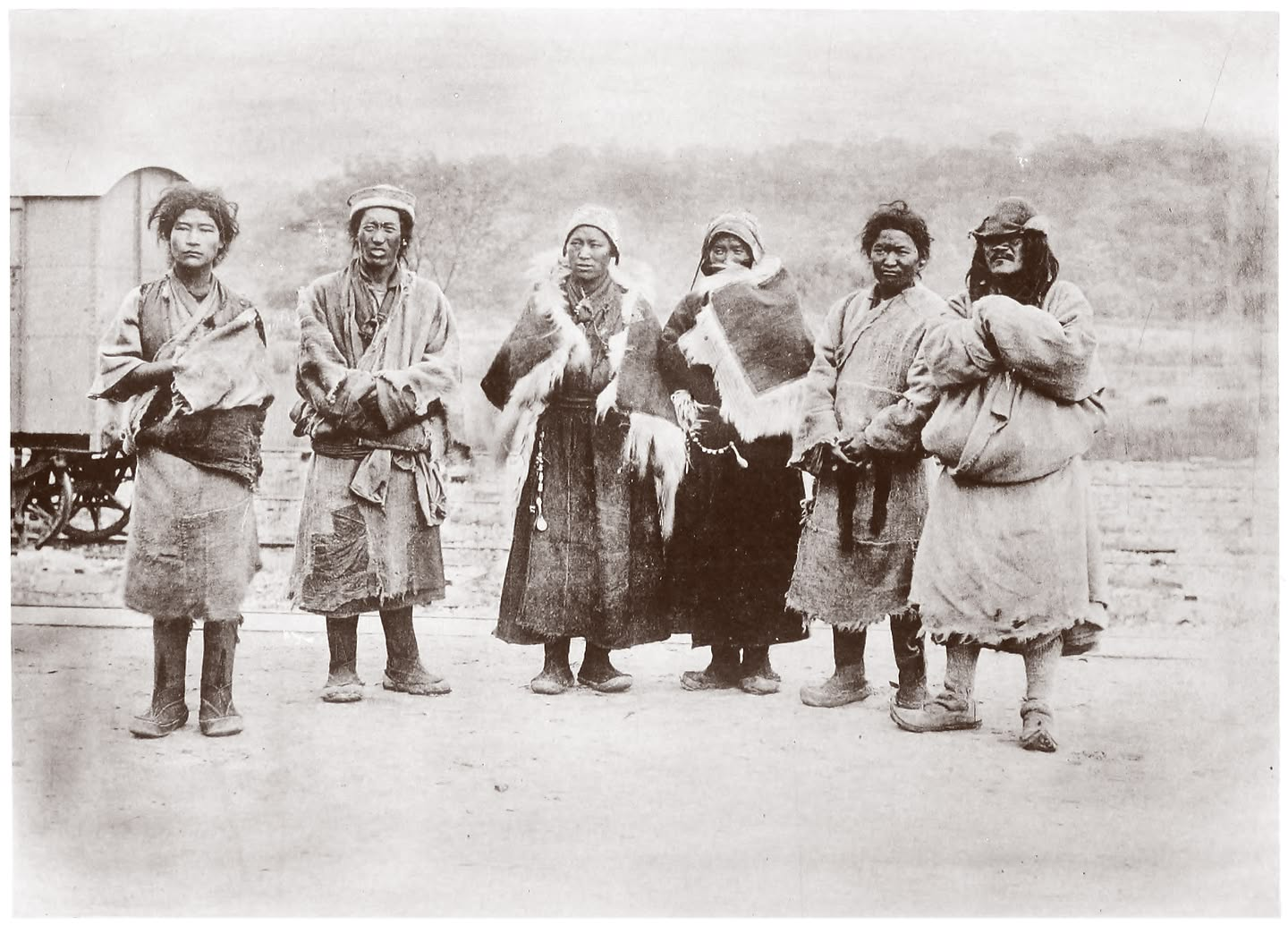
BHOT.
Marriage ceremonies. 2. These are of the usual Hindu type. When the bride’s palanquin arrives at the house of her husband the gods are worshipped, and then she is admitted into the house. Some rice, silver, or gold, is put in the hands of the bridegroom, which he passes on to the bride. She places them in a winnowing fan, and makes them over as a present to the wife of the barber. This ceremony is known as Karja bharna. A man can have three wives and no more. The wife of the first marriage is the head wife, and she receives by inheritance a share one-tenth in excess of that given to the other wives. Marriage is generally performed under the age of fifteen, but no special age is fixed. No price is paid on either side. Concubinage and the levirate are allowed. There is no form of divorce, and though a man or woman is excommunicated if detected in illicit intercourse, they can be restored to caste on giving a tribal feast.
Marriage ceremonies. 3. The marriage ceremonies are in the standard form. Respectable people marry by the common charhana ritual, which begins with the ceremonies at the door of the bride’s house (darwâza châr or duâr châr). When they come to the marriage shed (mânro), the officiating Brâhman does the usual worship. The bride’s younger brother sprinkles parched grain over the pair, and receives from the father of the bride a sheet, which is known as lâi bhujua, or the remuneration for parching rice. Then the bridegroom rolls a stone over the parched rice on the ground, and this is known as the “line of the stone” (patthar kî lakîr), which is the binding part of the ceremony. Then follows the tying of the clothes (ganth bandhan), and the circumambulation of the fire (bhanwari). Next comes the pâsa sâr, where the bride and bridegroom exchange jewels—a survival of the gambling custom which appears in the standard ritual. Then follows the feeding of the bridegroom (bâsi khilâna), and the usual feast to the clansmen. After the marriage is over, on an auspicious day, the grass used as thatch for the wedding shed and other things are thrown into a river or tank by the women. This is called maur serwâna, “the setting afloat of the marriage crown.” The lower kind of marriage is called pair pûjna, in which all the ceremonies are done at the house of the husband. The last form, dharaua, is simple concubinage. Persons who have not been married till they are of advanced years very often keep a woman in this way.
Disposal of the dead. 4. Those who die of cholera or snake-bite, and young children, are buried; others are cremated. There is no fixed burial-ground, and no ceremonies are performed at the time of burial. Richer people keep the ashes for removal to some sacred stream; others bury them. After the cremation a stalk of kusa grass is fixed in the ground near a tank, and water and sesamum is poured upon it for ten days so as to convert it into a refuge for the spirit until the rites are completed.
Religion. 5. They employ Brâhmans as priests. Their chief object of worship is Devi, to whom goats are sacrificed. Young pigs are also occasionally offered to her.
The worshippers make the sacrifice and consume the meat themselves. They observe the usual festivals. On the Barsâti Amâwas, on the fifteenth of Jeth, women worship a banyan tree by walking round it and tying a thread round the trunk. This they do to increase the life of their husbands. Women fast on the Tîja, or third day of Bhâdon. At the Godiya, on the fifth of Kârttik, they worship the dragon, Nâg Deota, and girls offer dolls to Devi and Mahâdeva. The care of malignant spirits is the business of the exorcisor (nâwat). Women reverence the bargad or banyan tree, because its name (bargad) is supposed to be connected with their husbands (bar).
Social customs. 6. They do not eat the turnip (shalgham). They will not touch a Dhobi, Bhangi, Chamâr, or Kori. They eat the flesh of goats, sheep, hare, deer, water-birds, and fish; they will not eat the monkey, cow, pig, fowl, crocodile, snake, lizard, rat, or other vermin. Intoxicating liquors are forbidden; bhang and gânja are used, but excess is reprobated.
Occupation. 7. Their occupation is agriculture; they do not hold land as zamîndârs but as tenants, and some work as field labourers. They practice no handicraft.
Distribution of the Bhotiyas according to the Census of 1891.
District. Number.
Muzaffarnagar 1
Gorakhpur 6
Kumâun 7,270
Garhwâl 174
Tarâi 6
Total 7,457
Bhuînhâr—(Sanskrit Bhûmi, “land,” kâra, “maker”).—An important tribe of landowners and agriculturists in the Eastern Districts. They are also known as Bâbhan, Zamîndâr Brâhman, Grihasth Brâhman, or Pachhima, or “Western” Brâhmans. They must, of course, be very carefully distinguished from the Dravidian Bhuînhâr or Bhuiyâr tribe, of whom some account has been given in a separate article.
Nadi kai bhânwak,
Bhuînhâr kai ghânwak.
Sabse chatur Banya, tese chatur Sunâr;
Lasê lûse lâike tehi thâgê Bhuînhâr.
“The Bhuînhâr is as uncertain as the current of the rivulet. Cutest of all is the Banya; cuter than him is the goldsmith; but the Bhuînhâr with his wiles tricks them both.”
“Brâhmans do not eat with them, nor do Râjputs. Possibly the existence of the Bhuînhâr class is also evidence of the time when the bonds of caste, as we know them, had not been forged, or, if forged, were not worn by those who pushed forward into new settlements beyond the old. It has been pointed out that to the non-Aryan inhabitants of the country all Aryans were of one caste,—all Brâhmans. Within the Aryan body the exchange of priestly for military employment was not impossible, and did not involve degradation. It is unnecessary, therefore, to believe that all Bhuînhârs are Brâhmans of inferior, because illegitimate stock. They may be as true born as the Brâhmans or Chhatris who surround them, and many of whom they possibly preceded in the occupation of the land. Further, it seems probable that many so called Kshatriya tribes are Brâhmans who have fallen from their former status.”
7. The theory that they are a mixed race, derived from a congeries of low caste people accidentally brought together, is disproved by the high and uniform type of physiognomy and personal appearance which prevails among them. This, as Mr. Risley says, would not be the case “if they were descended from a crowd of low caste men promoted by the exigencies of a particular occasion, for brevet rank thus acquired would, in no case, carry with it the right of intermarriage with pure Brâhmans or Râjputs, and the artificially formed group, being compelled to marry within its own limits, would necessarily perpetuate the low caste type of features and complexion. As a matter-of-fact, this is what happens with the sham Râjputs whom we find in most of the outlying Districts of Bengal. They marry among themselves, never among the true Râjputs, and their features reproduce those of the particular aboriginal tribe from which they may happen to be sprung.”
8. The next supposition is that they may be Brâhmans who for some cause (in this case it is said to have been because they took to agriculture) have been degraded. There are, of course, many so-called Brâhmans, like the Mahâbrâhman, Ojha, or Dakaut, who are of a degraded type; but many of these are almost certainly derived from the lower races, and have little or no Aryan blood in their veins. Further, many true Brâhmans hold land and cultivate, and are not necessarily degraded by so doing.
9. Further, Mr. Risley seems to be certainly right in dwelling on the fact that while they have sections both of the territorial and eponymous class, the former regulate the exogamy of the tribe, and not the latter. Many lower castes have adopted Brâhmanical gotras; but it is unreasonable to suppose that if the Bhuînhârs were originally Brâhmans, and as such necessarily provided with a set of real Brâhmanical gotras, they would deliberately have discarded them and adopted a tribal organization of the territorial type. On this ground he regards them as more probably a branch of the Râjputs.
10. The question then of the origin of the Bhuînhârs is not capable of exact determination. Their traditions, customs, and appearance point all to a Brâhmanical origin; their tribal organization seems to show that they are not, as is asserted by some, Brâhmans, who for a reason obviously inadequate, have been degraded from their original position. They may be a real branch of the Aryan stock, who in very remote ages colonised the part of the country which they occupy at present, and being reduced by the exigencies of their position to abrogate their sacerdotal functions, took to a life of war and agriculture, and in consequence of this organized their tribe in a manner analogous to those of the early Kshatriya settlers.
Tribal organisation. 11. As has been already said, the tribal divisions of the Bhuînhârs are organised on both the territorial and eponymous systems. Of the former the chief sub-divisions in the eastern part of these Provinces are the Kinwâr, Donwâr, Sakarwâr, Baghochhiya, Bemuwâr, Karenawa, Kotraha, Karmâi, Kolhaniyân, Athariya, Jaithariya, Chaudhari, Kotaha, Sobraniyân, Belhariya, Domkatâr, Baksariya, Eksariya, Gautamiya, Titiha, Bhaiwadh, Kolaha, Sorhaniya, Biruâr, Surohau, Birramiya, Kahatwâr, Mirzapuri, Raikwâr and Parasiya. Besides these are a number of sub-divisions of the Brâhmanical type, such as Dikshit, Garga, Gautam, Sândilya, Pânrê, Dûbê, Tiwâri, Upâdhya, Pâthak, Shukl, Kapilgotri, Kausik, Bhâradwâja, and Payâsi Misr. They further enumerate eighty-four of the regular Brâhmanical gotras, such as Kasyapa, Vasishtha, Parâsara, Bhârgava, Vatsya, Katyâyana, Gargya, Gobhila, Angiras, and so on. But in carrying out the rules of exogamy the mûl or territorial section is alone taken account of, and not the Brâhmanical gotra. With this exception the prohibited degrees follow the standard Brâhmanical formula. Some of these sections are possibly totemistic, such as the Baghochhiya or “tiger” (bâgh); Domkatâr, “Dom’s knife,” Belhariya, from the bel tree; and these sections carry with them some degree of inferiority, which results in a form of hypergamy. The Census returns give no less than four hundred and fifty-eight Bhuînhâr sections: but here the territorial sections and the Brâhmanical gotras are mixed up together. The most important local sections according to these returns are the Chaudhari, Gautam, and Kolaha, in Benares: the Gautam in Mirzapur: the Bhâradwâja, Bhrigubansi, Dichhit, Donwâr, Gautam, Kausik, Kinwâr, Kistwâr, Sakarwâr, Sonwâr, in Ghâzipur: the Asuriya, Bhagata, Domkatâr, Kinwâr, Manchaura, Nanauliya, and Bemwâr, of Ballia: the Baghochhiya, Baksariya, Gautam, Kausik, and Sakarwâr, of Gorakhpur: the Barasi, Birhariya, and Kausik, of Basti: and the Barwâr, Bhâradwâja, Bhrigubans, Denwâr, Gargbans, Gautam, Purwâr, Sakarwâr, and Sândil, of Azamgarh.
Domestic ceremonies. 12. The Bhuînhârs of this part of the country follow in every respect the standard Brâhmanical rules.
Religion. 13. Bhuînhârs are usually Saivas or Sâktas, and worship the deohâr or community of village godlings and local demons or ghosts such as Goraiya, Hardiya, Bandi Mâi, and the like.
The Kinwâr. 15. The Kinwâr Bhuînhârs claim an origin from Padampur, in the Carnâtic, like the Kinwâr Râjputs. They have in Ghâzipur three sub-sections—Rajdhar, Makund, and Pithaur Râê.
Bemwâr. 16. The Bemwâr Bhuînhârs say they came from Bempur and settled in Narwan in Benares. They are respectable, well-to-do people.
The Sakarwâr. 17. The Sakarwâr Bhuînhârs are closely connected with the Râjput sept of the same name, and like them their legends connect them and their name with Fatehpur-Sikri. In Ghâzipur they are generally rich, and have retained the greater part of their ancestral property.
The Donwâr. 18. The Donwâr sub-division say that their original home was near Fatehpur-Sikri. When they settled in Azamgarh they were known as Bhath. They derive their name from their parent village Donauli, which took its name from Dona Achârya, a Pânrê Brâhman. Dr. Oldham says that they are frugal and industrious. The ancestor of the Donwârs of two or three villages was in the military service of one of the Delhi Emperors, and received from him for his valour the title of Khân, which is borne to the present day by all his descendants.
Occupation and social status. 20. The Bhuînhârs of these Provinces claim to observe a high standard of personal purity and carry out all the rules of the Brâhmanical ritual. They are in the villages at least quarrelsome and litigious; but they are, on the whole, a fine body of sturdy yeomen, and turn out excellent crops, though they will not plough with their own hands. To agriculture they very generally add dealing in grain and money-lending.
Tribal council. 5. They have a tribal council which is known as Bhayyâri, or “the assemblage of the brethren.” The meetings for tribal business take place when the members collect for marriages or funerals. They have a permanent hereditary president called Mahto. The principal cases which come before the council are charges of not feeding the brotherhood at marriages and deaths, eating or drinking with outsiders, and fornication or adultery. The usual punishment when an offence is proved is that the offender is condemned to feed the brotherhood for one or two days on goat’s flesh, rice, and liquor. If the hereditary president happens to be a minor, his duties are undertaken, till he grows up, by some other person appointed by the council.
Marriage. 6. Marriages are strictly local, and, as a rule, a Bhuiya never goes to a distance to find a wife for his son. Difference of occupation, provided other conditions are fulfilled, is not a bar to marriage. All the sub-divisions are equal as far as marriage is concerned, and the custom of hypergamy is unknown. They may have as many wives as they can buy and support. There is no rule of precedence among the wives, and all, if possible, live in different rooms in the same house. Concubinage is not permitted. Women are allowed considerable freedom both before and after marriage. If an unmarried girl is detected in an intrigue with a man of her own caste her father has to give a feast to the brethren, and the girl is married to her lover. But apparently nothing short of actual detection in the act or the pregnancy of the girl is sufficient to compel the council to take action against her. If she is detected in an intrigue with a person not of her own caste she is permanently expelled. The usual marriage age for both boys and girls is twelve. The consent of the parents is essential, except in the case of prenuptial immorality, and by this means couples very often make up their own matches. The permanent bride-price prescribed for the whole tribe, whether rich or poor, is five rupees in cash, a cloth for the bride, four sers of rice, two sers of sugar, and one ser of turmeric. If after marriage either bride or bridegroom becomes idiotical, mad, leprous, impotent, or mutilated, the marriage is annulled. But this is conditional on the other party being ignorant before the marriage was carried out of such a defect.
Divorce. 7. Habitual infidelity on the part of either husband or wife is a ground for divorce, but the fact must be proved to the satisfaction of the tribal council, which scrutinizes the evidence very closely. Divorced women can remarry, but the feeling is against it, and only widowers or men who cannot afford the recognised bride-price for a virgin will take such women.
Widow marriage and the levirate. 8. Widows are remarried in the sagâi form. When a man marries a widow he has to repay the bride-price to the relations of her late husband. There is no ceremony. All the man does is to give the woman a sheet (sâri), and then takes her home, where he has to give a feast to the brethren. The levirate is strictly enforced. It is only when the younger brother of her late husband abandons his claim on the widow that she can marry an outsider. The elder brother can, under no circumstances, marry the widow of his younger brother. If she marries an outsider her brother-in-law has a right to the custody of all her children by the first marriage. If she marries an outsider she loses all right to the goods of her first husband. Her sons by her first husband are his heirs. In the case of the levirate the levir takes over the goods and children of his late brother: if, when they come of age, they wish to separate, they are considered entitled to an equal share in the joint property with their step brothers. There is no fiction that the children of the levir are affiliated to his late brother.
Adoption. 9. They assert that a sonless man can adopt and pretend to have some elaborate rules on the subject which are in imitation of their Hindu neighbours. At any rate it is clear that there is no religious motive for adoption, and if a man does adopt an heir it is one of his brother’s sons. A man may not adopt his sister’s son, but he may adopt his daughter’s son. A bachelor, a blind, impotent, or lame man may adopt, but not an ascetic. The rule that the person adopted should be unmarried is not enforced. Girls are never adopted.
Succession. 10. The rules of succession do not differ from those of the cognate Dravidian tribes. Genealogies are not carefully kept. They remember generally the names of four or five ancestors both in the male and female line.
Birth ceremonies. 11. There is no ceremony at pregnancy. The Chamâin midwife officiates. She cuts the cord (nâr) and buries it in the exact place where the child was born, and lights a fire there. On the day of her confinement the mother gets a decoction of flour, ginger, coarse sugar, and turmeric, mixed up and boiled in water. She then gets nothing to eat for three days, when she is fed on rice and pulse. She remains secluded in the delivery room (saur) for six days, during which time the Chamâin attends. On the sixth day is the chhathi ceremony. All the men and women of the family have their dirty clothes washed by the Dhobi. The men have their heads shaved, the women get the barber’s wife to cut their finger and toe nails, and dye their feet with lac dye (mahâwar). The house is replastered, and the old earthen vessels replaced. The Chamâin bathes mother and infant. The delivery room is first plastered by the Chamâin and then by the sister of the child’s father (nanad), for which she gets a present in money, clothes or cattle. If a son is born the Chamâin receive four annas and her food, and two annas for a daughter. The washerman and the barber’s wife get the same. The husband does not cohabit with his wife for two and-a-half months after her delivery.
Adoption ceremony. 12. Adoption is made in presence of the brethren, who are entertained. He acknowledges the boy as his son, and the boy acknowledges him as his father. If this is not done the adoption is not recognised.
Puberty ceremony. 13. There is no special ceremony when boys or girls attain puberty, but at the age of five or six their ears are bored (kanchhedana). The boring is done by a goldsmith, who gets one pice and a ration of uncooked grain (sîdha). No tribal feast is given, but the members of the household wear their best clothes and eat specially good food that day. Up to that time it does not matter what the child eats, but after the ear-boring he must conform to the rules of the caste.
The preliminary marriage ceremonies. 15. After the betrothal the wedding day is fixed by the father of the bridegroom. Notice is sent through his brother-in-law to the bride’s father. Three days before the wedding the matmangara or “lucky earth” ceremony is performed in both families. The women of the village go in procession to the village clay-pit. At the head of them goes a Chamâr playing on his drum. This drum is first worshipped by the women, and a mark (tîka) made on it with red lead. The village Baiga then digs three spadesful of earth, which the mother of the bride or bridegroom, as the case may be, takes in her loin cloth, she standing behind him with her face veiled in her sheet, while he passes the earth to her over his left shoulder. This earth is placed in the marriage shed (mânro) which is erected in the courtyard of the house, and on it is placed an earthen jar (kalsa) full of water, into which some mango leaves and rice stalks are thrown. Next comes the anointing (tel hardi) of the pair, which is done at their respective houses by five women of the family (the number five is selected as it is lucky) who rub them with oil and turmeric. A day before the wedding day the brethren are entertained at a feast (Bhatwân). They are also fed on the morning when the procession starts. Before the procession starts the mother of the bridegroom seats herself on the rice mortar (okhari). The bridegroom walks towards her and turns back four times. The fifth time he comes close to her, when she seizes him by the handkerchief which he wears over his shoulders, and will not let him go until he promises a present. Next comes the imlighotna or “mixing of the tamarind.” The bridegroom’s mother sits on the ground with him in her lap. Her brother gives him a sip of tamarind mixed with sugar and water. He spits it out on the palm of his mother, who licks it up, and receives a present for doing so from her brother. Then comes the parachhan ceremony as described among Majhwârs (para. 16). The bridegroom then starts in procession for the bride’s house accompanied by his relatives and clansmen.
Ceremonies on the return of the bride. 17. That same day the bridegroom brings his bride home in procession. When they reach his house two baskets are placed on the ground near the door, and they both step in these as they enter. That day the relatives and clansmen are entertained; and next morning disperse. A week after, the water jars (kalsa) which have been brought in the return procession are taken by the bride and bridegroom to an adjoining stream. The bridegroom first, not letting the bride see him, plunges his jar into the stream. She searches for it and fishes it out, and the bride plunges her jar in, which the bridegroom recovers. Both bathe and return to the house bearing the jars full of water, doing worship as they pass it to the shrine of the village gods (deohâr). When the bride brings her jar into the house she pours the contents of her jar over her mother-in-law and asks if she is satisfied with the match. The old woman gives her some trifling present.
Binding portion of marriage ceremony. 18. The binding portion of the ceremony is the rubbing of red lead on the parting of the bride’s hair by the bridegroom. If a betrothal is annulled the bride-price is returned: but after the marking with red lead the marriage is final until the parties are regularly divorced.
Nâdu Bîr. 22. They have a special tribal hero named Nâdu Bîr, of whom the following legend is told:—“Once upon a time there lived in Magadha or Vihâra a Bhuiya woman of exquisite loveliness. She had a son named Nâdu, who surpassed his mother in beauty. He was accustomed to roam in the forest and hunt any animal that fell in his way. One day he went out a-hunting equipped with a bow and arrows. When he got into the forest he happened to see a deer, which he pursued. He chased it till nightfall with no success. As he had gone far into the forest he lost his way, and was quite at a loss to know what to do and where to go. Thirsty and tired, he wandered about till he reached fortunately the Kuti or hermitage of an inspired ascetic, Koela Rishi by name. Seeing the ascetic he bowed down to the earth before him and begged for water, of which he stood badly in want. Koela Rishi took pity on him, and calling his wife and daughter told them to give him what he wanted. The daughter, in obedience to her father’s bidding, brought out a gourd full of water, and her mother gave him fruits and roots, the only food of the ascetic. The Bhuiya fed on the fruits and roots, and quenched his thirst with water. He passed the night there. But since he saw the daughter of the ascetic he was so much enamoured of her beauty that he became beside himself. In the morning he got up and went to take leave of the ascetic to go home. The ascetic saw through his mental eyes that the Bhuiya was enamoured of his daughter’s beauty, and also that his daughter was in love with him. He consulted his wife on the subject, and with her permission he married his daughter to the Bhuiya. Nâdu with his sweetheart returned to his mother, who was named Kamala. Kamala was exceedingly glad to see the wife of her son so beautiful and good. Nâdu loved his wife so much that he could never bear to leave her. For a long time they lived together, but the union was unhappily not blessed with a child. Discouraged and disheartened, Nâdu ran away from home without giving any notice to his wife or mother. After many days’ journey he reached Kamaru Kamachcha. One day as he was taking a walk in the streets of the city the eyes of the daughter of the King of that city fell on him. She invited Nâdu to dinner, and made love to him. Her name was Naina Jogini. After some time she began to dread that some other King’s daughter would appropriate her lover. To avoid this she turned Nâdu during the day into an ox through her magical powers, and at night changed him into a man, and lived with him. In this way some days were passed. After some time Nâdu remembered his wife and home, and begged Naina to allow him to visit his native land. Naina at first refused permission, but at last finding that Nâdu could not live long unless he was given leave, she granted him leave for a fortnight, and caused him through her magical powers to reach home within a couple of hours. He met his wife, stayed with her, and she became in child. Nâdu, true to his promise, left home and reached Kamaru Kamachcha on the fixed day. But when he left home he wrote his address on the gate of the door. He also told his wife that the child, when born, would search him out. In nine months Kausalya was delivered of a child most beautiful, and he was named Tulasi Bîr. Tulasi Bîr was so powerful, even on the day of his birth, that when he saw the light he at once proceeded to the fields and brought to the house a very heavy log that was lying there to be burnt in the saur, or room in which his mother was secluded. At the age of five he made a gulli of lead, 25 maunds in weight, and a danda, 52 maunds in weight, of iron. With these he used to play tipcat. When he attained his seventh year he read the writing on the gate, and having come to know that his father was a prisoner in Kamaru Kamachcha, in the hands of Naina Jogini, he flew into a passion, and started immediately for Kamaru Kamachcha. Reaching there, he commenced fighting with the forces of Naina Jogini. He set fire to the fort, and it was in a moment turned into a heap of ashes. The whole army was killed, driven back, or burnt by Tulasi Bîr. Naina used all her magical powers to defeat Tulasi, but in vain. Tulasi rescued his father and brought him home.”
23. Another bold adventure of a Bhuiya hero is thus described:—In the city of Marang there lived two brothers, Ganga Râm and Gajâdhar. They had a sister, Bârij Somati by name, who was very beautiful, and for whose love many men from distant quarters fought with her brothers, were defeated, and returned home heart-broken. When Tulasi was informed of it he fell in love with her without seeing her. He started for Marang, taking leave of his mother and father. He first sent word to Ganga Râm and Gajâdhar to give their sister to him in marriage. But they paid no attention to the message. Tulasi then fought a duel with the two brothers, defeated them, and took their sister by force, and brought her home and married her. Lahang Bîr was born of Bârij Somati. He was a very powerful man. Bhuiyas still speak of his boldness and bravery in very high terms, and worship him with prayers and sacrifices after every two years outside the village or in the family kitchen. They worship him in this way:—