Volume 2 — D. (continued 2)
Reading edition
Domestic rites. The non-celibate members of the order marry according to the regular Musalmân formula. The dowry (mahr) is generally fixed at fifty-one thousand rupees. Women in child-birth are secluded for forty days; a fire is kept lighting in the room—and she is watched by her female friends, a custom known as Qâzi Sâhib ki chauki. In their death customs they conform to the usual Muhammadan ritual.
4. The Diwânas are a useless set of beggars and not held in much estimation by any one.
“The Dogars are supposed to be converted Chauhân Râjputs from the neighbourhood of Delhi. They migrated first to the neighbourhood of Pâk Pattan, whence they spread gradually along the banks of the Sutlej, and entered the Fîrozpur district about one hundred years ago. The Fîrozpur Dogars are all descended from a common ancestor named Bahlol, but they are called Mâhu Dogars, from Mâhu, the grandfather of Bahlol. Bahlol had three sons, Bambu, Langar, and Sammu. The Dogars of Fîrozpur and Mullanwâla are the descendants of Bambu; those of Khai the descendants of Langar; the descendants of Sammu live in the Qasûr territory. There are many other sub-castes of the Dogars in other districts along the banks of the Sutlej, as the Parchat, the Topara, the Chopara, etc. The Chopara Dogars occupy Mandot. The Fîrozpur Dogars consider themselves superior in rank and descent to the other sub-castes. They are very particular to whom they give their daughters in marriage, though they take wives from all the other families. At one time infanticide is said to have prevailed among them, but I do not think there is much trace of it at the present day.
2. Sir H. Lawrence, who knew the Dogars well, writes of them that they are “tall, handsome, and sinewy, and are remarkable for having almost without exception, large, aquiline noses; they are fanciful and violent, and tenacious of what they consider their rights, though susceptible to kindness, and not wanting in courage, they appear to have been always troublesome subjects, and too fond of their own free form of life to willingly take service as soldiers. The Jewish face which is found among the Dogars, and in which they resemble the Afghâns, is very remarkable, and makes it probable that there is very little Chauhân blood in their veins, notwithstanding the fondness with which they attempt to trace their connection with that ancient family of Râjputs. Like the Gûjars and Naipâlis they are great thieves, and prefer pasturing cattle to cultivating. Their favourite crime is cattle-stealing. There are, however, some respectable persons among them, especially in the Fîrozpur Ilâqa. It is only within the last few years that the principal Dogars have begun to wear any covering for the head; formerly the whole population, as is the case with the poor classes still, wore their long hair over their shoulders without any covering either of sheet or turban. Notwithstanding the difference of physiognomy, however, the Dogars preserve evident traces of some connection with the Hindus in most of their family customs, in which they resemble the Hindus much more than the orthodox Muhammadans.”
3. Mr. Ibbetson adds:—“The Râjput origin of the Dogars is probably very doubtful, and is strenuously denied by their Râjput neighbours, though I believe that Dogar or perhaps Doghar (doghla, probably Persian daghol, dagh, “a stain”) is used in some parts of the Province to denote one of mixed blood. Another derivation of the name is doghgar or “milkman.” The Dogars seem to be originally a pastoral rather than an agricultural tribe, and still to retain a strong liking for cattle, whether their own or other people’s. They are often classed with Gûjars, whom they much resemble in their habits. In Lahore and Fîrozpur they are notorious cattle thieves, but further north they seem to have settled down and become peaceful husbandmen. They are not good cultivators. Their social standing seems to be about that of a low class Râjput; they are practically all Musalmâns. Their chief clans in the Panjâb are Mattar; China; Tagra; Mâhu, and Chokra.” In these Provinces they are all Musalmâns.
Distribution of the Dogars according to the Census of 1891.
Districts. Number.
Sahâranpur 1
Muzaffarnagar 338
Total 339
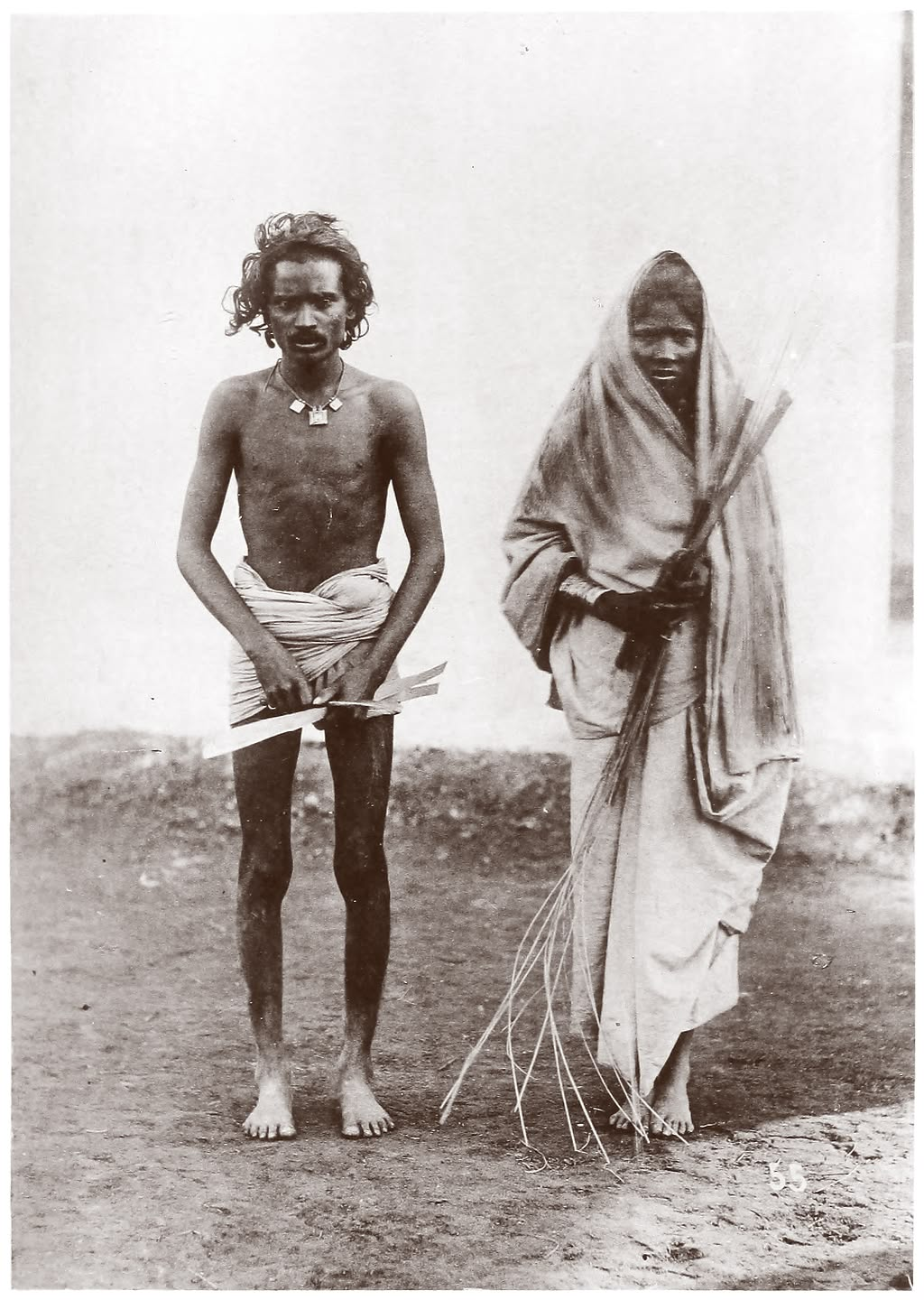
DOM.
2. To this must be added another point which cannot be left out of consideration in dealing with these menial races. The tribes of scavengers, such as the Bhangi and Dom, have for many generations formed a sort of Cave of Adullam for the outcastes of the higher races, and the notorious immoral character of the women of these tribes must have had a powerful effect in modifying the physique and appearance of castes such as these. If the Dom varies in physical character from one part of the Province to another, it is only what might naturally be expected. On the whole it may perhaps be safer to regard the Doms, not as a single, individual aggregate, but as a more or less mixed body of menials, who have been for ages in a state of the utmost degradation, and whose appearance and physique have been largely modified by the rigour of their occupation and environment.
Tradition of origin—Eastern Doms. 3. The origin of the Dom to the east of the Province is thus told by themselves. In the good old times all people were equally well-to-do and happy. The Brâhmans had no property and built no houses for themselves. When Parameswar desired to appear in the world he took the form of a Brâhman. Then intending to divide men into castes, he went about begging as a Brâhman, wishing to ascertain what occupation each family followed. As he begged for alms no man gave him aught but silver and gold. At last he reached the house of a man who had killed a cow and was preparing to feed on the beef. He begged for alms, and the cow-killer brought from his house a handful of gold coins. Parameswar refused the money and asked for a little barley. The Domin, or woman of the house, went inside and found a place in the courtyard which had been trampled into mud by the feet of the cow in her death struggle, and there a few ears of barley had suddenly sprouted up. The woman plucked the grain and offered it to Parameswar, who asked her where she had found it. She told him how the grain had sprouted in her courtyard. Parameswar asked where was the cow which had prepared the ground in which the grain had grown. She replied that it had been killed by her husband. Then Parameswar was wroth and cursed her husband: “Thou and thy posterity shall kill animals and remain beggars for ever.” Then the Domin cursed Parameswar in the form of a Brâhman—
Jahân Brâhman jâwê,
Châr dhakka khâwê,
Ek pichhâri, chhattîs gantha.
“Wherever the Brâhman goes he shall receive four pushes. Thirty-six knots in a single sheet.” So ever since Doms are beggars and slayers of animals, and Brâhmans are poor and live on alms. This legend, of course, cannot be of any great antiquity, as the feeling of respect for the cow is of comparatively modern origin.
4. According to the Panjâb legend the ancestor of the Doms was a Brâhman named Malludant. He was the youngest of the family, and his elder brothers expelled him. One day the calf of their cow died, and they asked Malludant to take away the carcass and bury it. When he did so he was treated as an outcast, and was obliged ever after to make his living by skinning and burying dead animals. This legend, under a slightly different form, is told also in connection with the Bhangis.
5. Another story, again, makes the Doms the descendants of Râja Ben or Vena, and from him one of their sub-castes has taken the name Benbansi. The legend of this king suggests that he was some early reformer who made himself obnoxious to Brâhmans. When he became king he issued a proclamation,—“Men must not sacrifice nor give gifts nor present oblations. Who else but myself is the object of sacrifice? I am for ever the lord of offerings.” The sages remonstrated respectfully with him, but in vain. They admonished him in sterner terms, and when he persisted in his piety they slew him with blades of the sacred kusa grass. After his death the sages beheld clouds of dust, and on inquiry found that they arose from the bands of men who had taken to plundering because the land was left without a king. As Vena was childless, the sages rubbed his thigh, and from it there came a man “like a charred log, with flat face and extremely short.” The sages told him to sit down (nishâda). He did so, and hence was called Nishâda, from whom sprang the “Nishâdas dwelling in the Vindhyan mountains, distinguished by their wicked deeds.” It may be noted that Benbans is the title of a modern Râjput sept which is of obvious Kharwâr origin. By another account the name is derived by the Doms from their trade in making fans (bena, Sans. vyajana).
Internal structure. 6. As might have been expected in the case of a tribe which is obviously composed of various elements their internal structure is most intricate. Under the general term Dom there are in these Provinces at least three distinct classes of people. There are, first, the wandering race of houseless thieves and vagrants who infest Bihâr and the eastern districts of the North-Western Provinces. Some of these have gradually raised themselves above the degraded status of their vagabond brethren. Some of them have settled down on the outskirts of towns and villages, and have taken to scavengering or industries connected with cane-work and basket-making. Such are the Dharkâr and Bânsphor or Basor, whom it is more convenient to discuss separately. Next come the Doms of the Himalayan districts, who deny all connection with the eastern branch of the tribe, and have gained a fairly respectable position as husbandmen and artisans. Lastly come the Dom or Dûm Mirâsi, who are singers and musicians, and are treated of under the head Mirâsi.
The Doms of the Eastern districts. 7. Like so many of the lower castes the Eastern Doms profess to have seven endogamous sub-castes. According to the Mirzapur enumeration these are,—Magahiya; Bânsphor; Litta; Domra or Domahra; Jallâd or Hatyâra; Dharkâr; and Harchanni; which last take their name from the famous Râja Harischandra, whose legend is given in connection with the Bhangis. Again, in Bânda, we have a list of so-called exogamous sections or gotras inasmuch as they will not give a bride to a section from which within memory they have taken a bride. These sections are Tarkiya; Gepar; Gemar or Gaymar; Pesadeli, Barhel; Hazâriya; Usarbarsa; Kundahor; Dharkâl or Dharkâr; Chamrel; Chureliya; Satchuliha; Samand; Asrent; Mahtama; Naharkârei; Mungariya; Nanet; Kaithel; Suador; Jugin; Nagarband; Dhaunsiya; Birha; Sarkhiya; Baksariya; Gujariya; Lungtaya or Langotiya. Some of these names probably denote some connection with other tribes, as the Chamrel with Chamârs, Kaithel with Kâyasths, and Gujariya with Gûjrat. Others are perhaps occupational or totemistic; but we know at present too little of the origin or metamorphosis of these section names to make any speculations as to their meaning of any value.
8. From Gorakhpur, again, we have another enumeration which is thus described by Mr. J. Kennedy:—“The Doms say that they formerly cultivated and owned the land, but when pressure came the Magahiyas divided into two great sub-divisions—the Magahiyas and the Bânsphors. The Magahiyas took to thieving, while the Bânsphors were content to weave baskets and cultivate what land they could. These two sub-divisions do not intermarry, and it must be remembered that my notes relate to the thieving class alone, Magahiyas proper, who count themselves the true, original stock. They always describe themselves as sub-divided into seven distinct families; but excluding the Bânsphors, of whom I have spoken, there are really six—Sâwant; Balgai; Chaudhari; Chauhân; Bihâri, and Hazâri. The most of these names are taken from the Hindus, and as Hazâri is a Muhammadan title of honour, this division into families is probably of a comparatively recent date. Chaudhari and Chauhân are evidently also meant as honorific titles, and at the time the division was first made it must have been purely artificial. The families have no recollection of any common ancestor, nor have they any cult in memory of the founder. The Bânsphors, I am told, have no such sub-divisions. The recent and artificial origin of the six sub-divisions is, therefore, tolerably certain; they are imitations of Hinduism, and the only use to which they are put is to regulate marriage. Neither Magahiyas nor Bânsphors can marry their first cousins by blood, and this was probably the original rule. Besides this no Sâwant can marry a Sâwant or a Balgai, but any of the six families can intermarry with any other. The wandering gangs of Magahiyas are composed indiscriminately of men belonging to each clan family; but each gang has its own leader and the office is hereditary in the leader’s family. An outsider is never selected unless the family stock has failed.” At the same time it may be urged that this form of sectional exogamy is probably much more primitive than Mr. Kennedy is disposed to believe. It is, of course, possible that the names of the exogamous sections may have been changed under Hindu or Muhammadan influence, but it seems also certain that this form of exogamy is one of the primitive institutions of the caste.
10. Various attempts have been made to reform this branch of the tribe. To quote a note by Mr. D. T. Roberts, prepared for the last Police Commission:—“In Gorakhpur almost every scheme possible to think of has been considered over and over again and rejected as hopeless, the prevailing opinion being that nothing short of confinement between four walls would do any good. In 1873, and again in 1880, the question of bringing them under the Criminal Tribes Act was considered, and the conclusion come to in 1880 was that no special measures for the reclamation of this tribe seem likely to be successful, and there was no use proclaiming them under the Act, because they have no means of earning their livelihood honestly, and the only thing to be done was to keep them under unceasing surveillance, and to punish with severity on commission of crime.
11. “In 1884, Mr. Kennedy, the Magistrate of Gorakhpur, again applied himself to the task. Some of the Doms were collected in the city and employed as sweepers, taught brick-making, and made to work on the roads, and others were settled in larger or smaller groups in different villages, and received assignments of land, and up to date this scheme, supported by an annual grant of Rs. 1,500, is being carried on. Some Doms do regular work as sweepers; none of them have as yet acquired any handicraft, even the simple one of brick-making. No work can be got out of them except under incessant supervision. Their fields are cultivated only when some one is standing over them, and when assistance is rendered by other cultivators.
12. “Nevertheless, on a comparison of the earlier with the later reports, a certain advance is observable. The Doms no longer skulk in fields and forests. They are all settled in some village or another which they recognise as their home. Whereas formerly Doms said that they could not sleep under a roof because ghosts troubled them, they now take kindly enough to living in houses, and will complain, not of ghosts, but of the roof leaking. It is something to have restrained their wandering propensities to this extent, and to have given them some appreciation of a settled and civilised life.”
Eastern Doms; tribal traditions. 13. According to one story Mahâdeva and Pârvati invited all the castes to a feast. Supach Bhagat, the ancestor of the tribe, came late; and being very hungry ate the leavings of the others. Since that time they have been degraded, and eat the leavings of the other people.
14. Another legend connects them with Râja Râmchandra, in whose camp one of their ancestors committed theft; hence the deity cursed them with a life of begging and stealing.
15. A third legend tells that once upon a time the gods held a council for the distribution of the nectar among themselves. A demon came and stole some of the nectar and was detected by Vishnu, who severed his head from his body; but as the demon had eaten the nectar he had become immortal, the two pieces of his body became the demons, Râhu and Ketu, who periodically devour the moon and cause eclipses. As the Doms, who worship these demons are able to induce them to release the moon, pious people give alms to this caste at eclipses in order to secure their good offices to release the moon.
16. By another story Râmchandra once blessed Supach Bhagat, and said that if any one were cremated with fire, received from him or any of his descendants he would go straight to heaven. Since then the descendants of Supach Bhagat supply fire at cremation grounds.
17. Lastly, a story explains the hatred of the Magahiya Doms for Dhobis. Supach Bhagat once put up at the house of a Dhobi who, when he was drunk, fed his guest on the dung of his ass. Supach Bhagat cursed him and his kin for ever, and since that time no Dom will touch an ass or a Dhobi. In the Bihâr form of the legend, as told by Mr. Risley, Supach Bhagat had a quarrel with a Dhobi and killed and ate his ass. He subsequently cursed the Dhobi. Mr. Risley suggests that the legend may perhaps be a distorted version of some primitive taboo in which Dhobis and donkeys somehow played a part, but it is perhaps equally possible that the story may have been invented to explain why the general Hindu taboo against the Dhobi and his ass is followed by a caste so little scrupulous as the Doms.
The Bânsphor Doms. 18. The Bânsphor branch of the Eastern Doms forms the subject of a special article, and they need not be discussed more specially here.
The Litta Doms. 19. The Litta branch of the Doms are said to derive their name from some word which means “wanderer.” They may perhaps be connected with the Let sub-caste of the Bengal Bâgdis, who are probably akin to the Doms. These people have no home and live by begging.
The Domra branch of the Eastern Doms. 20. The term Domra or Domahra, which is applied to the whole tribe, is also apparently sometimes used in the more restricted sense as designating those Doms who supply fire at cremation grounds.
The Jallâd or Hatyâra branch of the Eastern Doms. 21. The term Jallâd, which is an Arabic term for “a public flogger,” and Hatyâra (Sans. hatya, “murder”) is more specially applied to those Doms who are employed in cities to kill ownerless dogs and to act as public executioners.
The Dharkâr branch of the Eastern Doms. 22. The Dharkâr branch of the Eastern Doms has been treated of in a separate article.
The Harchanni branch of the Eastern Doms. 23. The Harchanni branch of the Eastern Doms claim their name and descent from the celebrated Râja Harischandra who, as told in connection with the Bhangis, gave away all his wealth in charity and was reduced to become the slave of a Dom. In return for the kindness of his master the Râja converted the whole tribe to his religion, which they followed ever since.
The tribal council of the Eastern Doms. 24. Writing of the Magahiyas of Gorakhpur Mr. Kennedy says:—“All disputes are settled by the panchâyat, but the longest term of exclusion from the brotherhood is twelve years. During that period no companionship can be held with the outlaw even in a theft. Outlawry is, however, redeemable by a fine and feast. The abduction of a Domra girl by force and the introduction of foreign women into the camp are a frequent cause of panchâyats. I am told that murder of any human being or of a cow is also severely punished; but this is about the boundary line of Domra morality with regard to outsiders. Strangers are occasionally adopted by the Magahiyas. Two or three Chamârs, a Muhammadan, an Ahîr, and a Teli, who had turned Domras, were lately among the inmates of the jail. It is the women who chiefly attract these recruits.” Another frequent cause of meetings of the Domra council is interference with the begging beat of one camp. These beats are carefully recognised, and are sometimes given as a dowry at marriage. Any strange Domra who begs or steals in the beat of another is liable to excommunication, and the Domra of that beat will have no hesitation in giving up to the Police a stranger of the tribe who steals within his jurisdiction.
Marriage rules. 25. Among the Doms of Mirzapur the endogamous sub-castes have exogamous sections, some of which are territorial or titular, and some apparently totemistic; but no Dom can give even an approximately correct list of his sections. If he is asked all he says is,—“The Panch know.” This rule of exogamy is reinforced by the prohibition of marriage in the family of the maternal uncle, the father’s sister, or their own sisters, as long as there is any remembrance of relationship, which is usually about three or perhaps four generations. Polygamy is prohibited except the first wife be barren, in which case a man, with the previous sanction of the council, may take a second wife. But there seems no restriction in regard to concubinage. Sahây, the famous Dom executioner at Gorakhpur, used to keep four women. In Mirzapur if an unmarried girl is detected in an intrigue with a member of the tribe, her lover has to pay a fine of five rupees and a sheet to her father, and he then takes her over as his recognised wife with the sanction of the council. They practise adult marriage, the usual age for the marriage of a girl being eleven or twelve. The marriage is arranged by the Chharidâr or “wandsman,” who is the assistant of the Chaudhari or headman. The consent of the parents is said to be necessary, but runaway matches appear not to be uncommon. The bride-price among the settled Doms of Mirzapur is five rupees, five sers of treacle, a sheet, five lumps of tobacco, and five packets of betel leaf. The persons of both bride and bridegroom are carefully examined, and any physical defects which may subsequently appear are not sufficient grounds for annulling the marriage. After betrothal if the bride’s friends refuse to make her over they are obliged to refund the bride-price, and if the man fail to perform the engagement he is severely punished by the council. Divorce is allowed when habitual adultery is proved to the satisfaction of the council, but, as a rule, only the direct evidence of eye-witnesses is considered sufficient. Divorced women can marry again by the lower or Sagâi form. Bastard children follow the caste of the father; but a man who intrigues with a woman not a member of the tribe, if the union has not been recognised, must pay a fine of two-and-a-half rupees and give a feast of pork and rice to the clansmen. Widows can marry by the Sagâi form, and are generally married to widowers. The bridegroom has to make over eight rupees and one hundred cakes (pûri) to the father of the woman. He then gives a feast to the clansmen, in the course of which the relatives of the deceased husband come forward and claim the woman. Then the assembled clansmen direct the woman’s father to make over the compensation he has received to the relatives of her first husband. When this is done the man takes the woman home, puts red lead on the parting of her hair and palm leaf ornaments (tarki) in her ears. After he does this and feeds the clansmen on rice and pork the marriage is considered valid.
The levirate under the usual restrictions is admitted; but there is no fiction that the children of the levir are attributed to the deceased brother. Adoption is, of course, unusual; but if a man adopts, he generally adopts the son of his brother.
26. In Gorakhpur it appears that the bride-price is always spent on the marriage, and it is alleged that if either party after marriage become blind, crippled, or leprous, the marriage may be annulled.
Eastern Doms: birth ceremonies. 27. Among the Doms of Mirzapur the mother is attended by the Chamârin midwife and the ceremonies of purification common to the menial castes are performed. On the twelfth day after birth the hair of the baby is shaved to remove that last taint of the birth pollution. The child is named by the senior man in the family a year after birth. When a man’s children have died in succession the next baby is sold to some one for a nominal sum; and then is called Pachkauri, Chhakauri, “he that was sold for five or six cowries,” or by some other opprobrious epithet. In Gorakhpur the services of the Chamârin midwife are dispensed with on the sixth day.
The Barahi or twelfth-day ceremony is done on the tenth day. The mother and child are bathed; her hair is smeared with vermilion, and the relatives are feasted, then a little liquor is sprinkled over the woman, and after that she is considered pure.
28. Of the Magahiyas of Gorakhpur Mr. Kennedy writes:—“The birth of a Domra is always celebrated by a sacrifice to Gandak and Samaiya. Marriages are contracted when the boy is about ten years old. The matter is settled by a go-between. The boy’s father pays for the marriage feast and gives presents to the father of the girl; but the Magahiyas deny that there is any idea of purchase. No religious ceremony accompanies the marriage. A panchâyat is assembled, a feast held, and the girl henceforth resides with her father-in-law. A man is not restricted in the number of his wives, and concubinage is also permitted, but the concubine is held in somewhat less esteem than the wife. A woman is apparently allowed to leave her husband and transfer herself to another; but in that case she becomes a concubine. The panchâyat will not restore a wife who has decamped, but they will give back any property she took away. The frequent residence of the Magahiyas in jail often obliges women to transfer themselves to other husbands for support, and makes polygamy advantageous. Polyandry is unknown.”
Marriage ceremonies: Eastern Doms. 29. In Mirzapur the marriage is arranged by the sister’s husband of the boy’s father. The betrothal (barrekhi) is done in the usual way by the interchange of two leaf platters full of liquor, into one of which the boy’s father puts a couple of rupees, which he passes on to the representative of the bride. They have the ordinary matmangara ceremony, with the difference that the lucky earth brought from the village claypit is used for constructing a large fireplace with a single opening on which the women of the family cook a mess of rice and pulse, which is placed on a leaf mat in the place where the marriage is performed. This is an offering to the Manes, and the phrase used is pitr charhâna. The usual anointing of bride and bridegroom follows, which is begun by the two fathers, who sprinkle a little turmeric and oil on the ground and invoke the sainted dead to assist them in bringing the marriage to a successful conclusion. It is a peculiarity of the tribe that both men and women join in the marriage procession. No Brâhman is employed. The boy’s father repeats the names of his ancestors for five generations, and the father of the bride does the same for her. Then the pair are seated close together on a mat made of leaves. The husband of the sister of the bride’s father drops water on her hands and says:—”Bar kanya chiranjîva rahen”—“May the bride and bridegroom live long.” This is done five times. The prominent part taken by the sister’s husband is possibly a survival of the matriarchate. Then the garments of the pair are knotted together, and they walk round a branch of the cotton tree (semal), planted in the middle of the company, five times. After this the boy puts red lead on the parting of the bride’s hair, and this constitutes the binding part of the ceremony. They then go into a retiring room (kohabar) or behind some bushes close by, and there a good deal of coarse merriment goes on—an obvious survival of the habit of immediate consummation of the marriage. Besides this, the respectable form of marriage among the settled Doms, which is known as charhauwa, there is another form called gurâwat, where two persons exchange sisters, and a still lower form of the dola type, where the girl is merely taken by her father to the house of her husband and lives with him as his wife after a dinner has been given to the brethren. The temporary connections of women whose husbands are in jail with other men are also fully recognised. In addition to this almost any kind of runaway match is allowed; in fact it would be hard to say what form of sexual intercourse is not recognised as a marriage.
Religion: Eastern Doms. 31. The religious practices of the tribe vary with the social status of the sub-castes, and there is no standard type of worship because they are not controlled by Brâhmans. Of the Magahiya Doms of Gorakhpur Mr. Kennedy writes:—“The Magahiya Domras have two special divinities of their own; the chief is Gandak, whose grave is to be found at Karmaini Garhi, two days’ journey to the east of Motihâri, in Bengal. According to their traditions Gandak was hanged for theft a long time ago, and when dying he promised always to help the Magahiyas in trouble. He is worshipped by the whole tribe and is invoked on all important occasions; but he is pre-eminently the patron god of thefts. A successful theft is always celebrated by a sacrifice and feast in his honour. They also worship Samaiya, a female divinity. She is without any special history, and there is no sharp distinction between her sphere and Gandak’s. Her functions apparently relate chiefly to birth and illness, etc.
32. “The Magahiyas sacrifice young pigs and wine with sugar and spices to these two deities. Every Magahiya is capable of performing the sacrifice, and the remains are divided among the company, when a vow is made to Samaiya, e.g., on the birth of a child or when it is teething, or on the occasion of an illness a special pig is chosen and devoted to her, and is sacrificed in the fulfilment of the vow. The Magahiyas have neither altars nor idols, nor do they erect any platform (chabûtra) for worship. A spot is cleared and plastered in the middle of a field, and the sacrifice is then offered.
33. “The Magahiyas naturally believe in ghosts and spirits. When a man dies, my informant told me, he turns into an evil spirit (shaitân). The godlings (deota) also, he added, were innumerable. In most villages of this district there is a special altar for all the local ghosts and deities, which may reside within the village boundaries, and the Magahiyas are always ready to share in the sacrifices of the villagers to them. They also reverence trees and platforms consecrated by Hindus in passing, but pay no further homage. They acknowledge the village Kâli and sometimes sacrifice to her; but the sacrifices do not differ from those of the Hindus. They do not acknowledge Mahâdeva or any other divinity, but they share the general Hindu belief in Parameswar, the giver and destroyer of life and the author of good and evil. He created the Magahiyas, they say, and ordered them to be filth and outcasts among the Hindus. They somehow resort to a Brâhman for the reading of the Vedas (katha). My informant had given a katha in this way on the last occasion of his release from jail. In these cases the Magahiyas go to the Brâhman’s house, but I could not find any other trace of special reverence for the Brâhmans, nor have they any necessity for them.”
34. In Mirzapur Doms of the better class worship Bhawâni, to whom at the Naurâtra of Chait they make an offering of hogs, cakes (pûri), gruel (lapsi), and wreaths of flowers. The Bhawâni, if appeased, keeps off illness from her votaries. They have a vague idea of an all-powerful deity, Parameswar, who punishes the guilty, and of a hell, but what it is and how sinners are punished they know not. The scavenger Doms, like the Jallâd, have a special female deity called Kukarmari, “the killer of dogs,” to whom a sacrifice of a young pig and some spirits is offered outside the village as a propitiation for the death of these animals. In the same way when a Dom hangman is tying the rope round the neck of a criminal, he shouts out Dohâi Mahârâni, Dohâi Sarkâr, Dohâi Judge Sâhib. “Help O great Queen! Help O Government! Help Mr. Judge!” in order to free himself from any guilt attaching to the death. They worship the collective local gods (deohâr) at marriages; but the wandering, vagrant habits of the tribe prevent them possessing any real respect for the village deities. Women have no worship special to themselves. On the last day of the first fortnight of Kuâr they make ten lumps (pinda) of flour and throw them into a river, and when they come home they put some cakes and sweetened rice on a leaf-platter, and lay it in a field to propitiate the dead. Some fast on Sunday in the name of the Sun god Sûraj Nârâyan, but these practises prevail only among the more Hinduised Doms in the neighbourhood of towns.
35. In Gorakhpur, besides the worship described above, they also venerate their Guru who is said to have had his head-quarters at Bhojpur, in the Ballia District, and to his shrine they make occasional pilgrimages and make an offering of a pig at least four years old, wine, and flowers. To a goddess named Juthaiya Bhawâni, of whose functions they can give no account, they offer a young pig and some red lead, with a lock of their hair, a forehead spangle, and a cake of flour boiled with pulse.
Demonology. 36. Their demonology is much of the usual type common to the lower castes by whom they are surrounded. They believe that trees are inhabited by evil spirits, and unless they bow down to trees of this kind, their ghosts revenge themselves by bringing disease and death upon them. To such malignant ghosts they offer a young pig, which is eaten by the worshippers. In Mirzapur the chief Dom festivals are the Kajari and Phagua or Holi. At the Kajari in the month of Sâwan they get drunk, dance, and sing. It is the regular woman’s saturnalia, and on this occasion gross sexual license is tolerated. At the Phagua or Holi the same is the case. In Gorakhpur, besides the Holi, they observe the Jiutiya on the eighth of the dark half of Kuâr, and the Khichari on the day the sun enters the sign of Makar. On the Jiutiya the women fast in order to ensure long life to their husbands, and the Khichari they beg boiled rice and pulse from door to door.
40. Of the Gorakhpur Magahiyas Mr. Kennedy writes:—“They eat cow’s flesh readily, but they will not kill the cow. They also offer milk, like Hindus, to snakes at the Nâgpanchami, but have no reverence for tigers or other animals. They express some reverence for the great rivers, Ganga and Nârâyani, etc. This, I think, nearly marks the extent to which they have been Hinduised. The pîpal is the only sacred tree, and no Magahiya will pluck its leaves. They hold this superstition so firmly that I suspect it is aboriginal. No reverence is paid to the banyan or any other sacred Hindu tree or plant. They have a special superstition about iron, and will not use it for certain purposes. A Magahiya who commits burglary with an iron instrument will not only be excluded from the brotherhood, but his eyes will some day start out of his head. Their most solemn oath is celebrated after the following fashion: A piece of ground is cleared and plastered as if for sacrifice. A piece of iron, a dish of water, some leaves of the pîpal, and a particular kind of Tarâi grass with some lighted charcoal are all put separately on the ground. On the top a pice is placed, and the oath is taken over it. An oath by the Dhobi is also particularly binding.”
Other oaths of the Eastern Doms are on the altar of the deities they worship, on a pîpal leaf, on a knife stuck in the ground, with the fingers of the right hand resting on a vessel full of spirits, or with some cow-dung fixed on the horn of a dead cow. They use none of the ordinary forms of salutation, but simply join their hands as a mark of respect.
43. The fourth class includes the professional beggars and vagrant musicians of the Hills—the Bâdi, Hurkiya, Darzi, and Dholi. The Bâdi is the village musician; in the plains he is considered to be a Nat. He plays on various instruments and sings at festivals. He goes from village to village begging from door to door, and belongs to the class of sturdy beggars who, if they do not get what they expect, lampoon the people of the house and abuse them. For these reasons they are, to some extent, feared, and are able to maintain themselves at the expense of their neighbours. They also snare fowl and fish. The Hurkiya are so called from the small double drum (huruk, huruka) shaped like an hourglass which he carries. This is an archaic musical instrument like the damaru, which is one of Siva’s emblems. They never take to agriculture, and wander about with their women, who dance and sing. The Darzi, also called Auji and Suji, lives by tailoring, though often solely by agriculture. To the Darzi class belongs the Dholi so called from beating the drum (dholak). This is done by way of incantation to cause sprites and ghosts to enter or leave the person of any one, and so induce that person to give money to the performer. The Darya, Bâdi, Hurkiya, and Dholi are all Doms, and “are in the hills the recognised priests of the malignant spirits of the hill and glen, whose aid is always sought after before anything serious is undertaken or any difficult task is attempted. It is the Doms who preserve to the present day the pure demonism of the aborigines, while the Khasiyas temper it with the worship of the village deities, the named and localised divine entities, and furnish from their ranks the priests. Most of the Barhais belong to the Orh division of the Doms, and the Chunapaz or lime-burners belong to the Agari and Lohâr branches of the Doms. Finally there is a class known as Domjogi, who are beggars. The portion of the village site assigned to Doms is in the hills known as Domaura or Domtola, like the Chamrauti where the Chamârs of the plains congregate.”
44. Most of these divisions of the Doms of the hills are thus purely occupational, and, as might have been expected, the enumeration varies. Thus Pandit Juâla Dat Joshi writing of the Doms of Kumâun says that Doms usually do not use the term Dom in speaking of themselves, but call themselves Bairsawa, or Tallijâti or Bâbarjâti, “outcasts,” or they call themselves by their occupation Orh, Lohâr, and so on. He enumerates the Kumâun Doms under the heads of Sarki Dotiwâla, who work in leather; Tamta, workers in brass; Lohâr, workers in iron; Orh and Bârele masons; Tirua, who do tinning and making of horse shoes; Bhûl, oilmen; Mochi, workers in leather; Koli, cloth-weavers; Bâruri, makers of bamboo baskets, Dhuni, Dhuni Dom, and ordinary Doms who are said to be a mixed race of men from the plains and ordinary Hill Doms who work as ploughmen and day labourers; Dholi, who play on drums at festivals; Hurkiya, who play and sing and prostitute their women; Chamâr, who skin animals; Bâdi, who play on drums and work as tailors. He adds that the reason of the increase of this caste is that they admit outcasts from the superior tribes. The Baura are separate from the Dom, and say that they were originally Jâts.
46. Girls, he goes on to say, are married between the age of eight and ten. When the parties are of that age, their relatives arrange the marriage for them; but when a girl has passed the age of puberty she may choose a husband for herself. There are two recognised forms of marriage, the superior, in which the father of the bride gives her away with a dowry, and the less respectable form in which the relatives of the bridegroom pay one-third of the expenses of the marriage.
47. They put away a woman when she is attacked with leprosy, becomes a lunatic or loses caste. A divorced woman, provided she has not been divorced on account of disease, may be taken on as a concubine, but she cannot be married again by any of the regular forms. The levirate and widow-marriage are recognised, and the children of a widow regularly married and of a widow rank equally; but the children of a concubine hold a lower rank, as they cannot join in the worship of deceased ancestors. A widow taken over by a man is known as rakhui, and it is said to be the custom for widows not to live with a man unless they have no one to support them.
Domestic ceremonies: Himalayan Doms. 48. When a woman comes to the seventh month of pregnancy she is forbidden to cook for her family or to perform the domestic worship. When the child is born, a lump of coarse sugar is distributed to those present; the child is bathed, and red powder (rori) applied to its head and to that of the mother and all the women of the house. For eleven days the male members of the family are considered impure. In the case of the birth of twins, they perform a propitiatory ceremony.
49. The marriage ceremony is in the form usual among the lower castes. No Brâhman officiates, and his place is taken by the sister’s son who receives a fee for his services. The binding portion of the ceremony is the feeding of the brethren.
50. They burn their dead and dispose of the ashes into a neighbouring stream. In this case also the sister’s son or the son-in-law of the dead man officiates and is given a loin cloth and some money. The death impurity lasts for eleven days. At her first menstruation a girl is impure for eleven days, and only for four days at each subsequent occurrence of the menses.
53. “The demon Masân is usually found at burning grounds. He is supposed to be of black colour and hideous appearance. He comes from the remains of a funeral pyre and chases people passing by who sometimes die of fright, others linger for a few days and some even go mad. When a person becomes possessed by Masân, the people invoke the beneficent spirit of the house to come and take possession of some member of the family, and all begin to dance. At length some one works himself into a state of frenzy and commences to torture and belabour the body of the person possessed by Masân, until at length a cure is effected or the patient perishes under this drastic treatment.
54. “Khabîsh resembles Masân in his malignant nature and fondness for charnel grounds. He is also met with in dark glens and forests in various shapes. Sometimes he imitates the bellow of a buffalo, or the cry of a goat-herd or neat-herd, and sometimes he grunts like a wild pig. At other times he assumes the guise of a religious mendicant and joins travellers on their way, but his conversation (like that of all the Indian bhûts who speak through their nose) is always unintelligible. Like Masân he often frightens people and sometimes possesses unfortunate travellers who get benighted.”
55. Goril, Goriya, Gwel, Gwâll or Gol is another deified mortal of whom the legend is given by Mr. Atkinson. He was beaten out of Garhwâl by Sudarsan Sâh. The idea that a bhût can be driven out by beating is embodied in two well-known Hindi proverbs—Mâr kê âge bhût bhâgta hai, “A thrashing makes a bhût run;” and Lâton kê bhût bâton sê nahîn mântê, “Goblins that want kicking won’t mind words.”
56. Khetrpâl is the same as Bhûmiya, the protector of field and homestead, extensively worshipped in the western districts. Saim or Sayam, “the black one” (Sans. shyâma) is another form of the same deity. He sometimes possesses people, and his sign is that the hair of the scalp-lock becomes hopelessly entangled.
57. Kalbisht or Kaluwa is said to have been a neat-herd who lived some two hundred years ago. His enemies persuaded his brother-in-law Himmat to drive a peg into the hoof of one of Kalbisht’s buffaloes, intending that he should be killed in attempting to extract it, but no harm ensued. Himmat next attacked him from behind with an axe, and so wounded him on the neck that he died, but not before he had torn the treacherous Himmat limb from limb. He has now become a benevolent sprite, and his name is used by herdsmen as a charm against wild beasts, and oppressed persons resort to his temple for justice against their oppressors.
58. Chaumu is also a deified mortal and a god of cattle; so is Badhân. On the eleventh day after the birth of a calf his linga is washed first with water and then milk and cakes, rice and milk are offered at his temples. Hâru is the deified Haris Chandra, Râja of Champawat who built the sacred bathing place at Hardwâr. Lâtu was his brother. The Katyûri Râjas are the defied last independent Râjas of Katyûr. Rûniya is a malignant bhût who wanders from village to village on coursers formed of huge boulders, and at night especially exercises his noisy steeds. He attacks only females, and should any woman attract his attentions she invariably wastes away, haunted by her ghostly lover and joins him in the spirit land. Bâlchan, Kâlchan, Bhasni, and Chhurmal are malignant bhûts of the same kind.
Religious and social customs of the Himalayan Doms. 59. To quote again Mr. Atkinson’s excellent account of this caste—“Doms do not wear the sacred thread or the bracelet (râkhi) nor do they have caste marks or wear, as a rule, the top-knot (sikha), and in a rough way they imitate the customs of the better classes, especially those who have made money in their contracts with Government. Their offerings to deceased ancestors (srâddha), when made at all, are performed at the Amâwas or last day of the Kanyâgat of Kuâr. The sister’s son, younger sister’s husband or son-in-law act as Brâhmans on the occasion and receive gifts as such. Doms eat the flesh of all animals, use their skins, and eat food from all classes except the Bhangi, Musalmân, and Christian. There is no fixed time for marriage. When an elder brother dies the younger takes the widow to wife whether she has children or not; hence the proverb Mal bhîr adhari ber, talai chîr men onchhi “When the upper walls fall they come on the lower wall.” When the elder brother dies, the burden falls upon the younger. The elder brother cannot, however, take to wife the widow of a deceased younger brother, and contracts a stain if even her shadow crosses his path. He transfers her to some other of the brotherhood, but if during the lifetime of her second husband he or she be dissatisfied, another may take her by paying the cost of her marriage. This may be repeated several times. The prohibited degrees are only a daughter, sister, uncle, aunt, brother, and these they cannot eat or smoke with.”
60. To this may be added from the notes of Pandit Juâla Dat Joshi that their greatest oath is to place the hand on the head of their son; others say: “If I swear falsely may I eat your flesh.” They also swear by placing their hands on the grain mortar (okhli), flour mill (chakki), or on a bell. When there is a dispute about boundaries they write a curse (bunda) on a piece of paper and holding it on the head of a son recite the words which run as follows—“If the land in dispute be mine may I and my children enjoy it, if it be not mine may Parameswar prevent me from enjoying it.” They believe in the Evil Eye and remove it by waving some mustard over the patient and then burning it near him in a pan. They fully believe in the demoniacal theory of disease, and patients are treated by an exorcisor known as Gannua. They salute one another by the term pâlâgan; Brâhmans by the word seva and English and Musalmâns by salâm. Many of them in addition cultivate and some practise a kind of nomadic cultivation by burning down patches of jungle.
Distribution of the Doms according to the Census of 1891.
Districts. Benbansi. Dhânuk. Others. Muhammadans. Total.
Dehra Dûn … … 18,438 210 18,648
Sahâranpur … … 59 2,482 2,541
Muzaffarnagar … … 254 2,299 2,553
Meerut … … … 4,257 4,257
Bulandshahr … … … 5,663 5,663
Aligarh … … 21 995 1,016
Mathura … … 8 873 881
Agra … … 15 869 884
Farrukhâbâd … … 3 117 120
Mainpuri … … … 152 152
Etâwah 6 … 20 143 169
Etah … … … 95 95
Bareilly … … … 538 538
Bijnor … … … 2,929 2,929
Budâun … … … 603 603
Morâdâbâd … … 4 3,488 3,492
Shâhjahânpur … … … 307 307
Pilibhît … … … 295 295
Cawnpur … … 26 96 122
Fatehpur … … … 58 58
Bânda … … … 8 8
Hamîrpur … … 20 27 47
Allahâbâd … … 205 108 313
Jhânsi … … 8 4 12
Jâlaun … … 18 20 38
Lalitpur … … 26 … 26
Benares … … 1,078 76 1,154
Mirzapur … … 8,039 3 8,042
Jaunpur … … 3,157 135 3,292
Ghâzipur 158 11 2,968 37 3,174
Ballia 36 … 1,671 … 1,707
Gorakhpur … … 7,817 72 7,889
Basti … … 82 101 183
Azamgarh 3 … 1,234 135 1,372
Kumâun … … 137,760 … 137,760
Garhwâl … … 66,529 … 66,529
Tarâi … … 4,996 519 5,515
Lucknow … 751 908 12 1,671
Unâo … 1,285 1,904 30 3,219
Râê Bareli … 1,411 4,084 51 5,546
Sîtapur … … 12 21 33
Hardoi … … 3 24 27
Gonda … 129 1,790 27 1,946
Bahrâich 8 17 327 109 461
Sultânpur … … … 102 102
Partâbgarh … 16 24 1 41
Bârabanki … 780 2,441 272 3,493
Total 211 4,400 265,949 28,363 298,923
Domar.—A caste recorded at the last Census in Allahâbâd Division. The Census returns show their sections as Lod in Fatehpur; in Bânda, Bânsphor, Basor, Benbansi, Janwâr, Malik, Saijâd, Sûpabhagat, Thail, and Tharkâri. This shows that they are really only a sub-caste of the great Dom race.
Distribution of the Domar according to the Census of 1891.
Districts. Turaiha. Others. Total.
Cawnpur 18 141 159
Fatehpur 349 1,745 2,094
Bânda … 10,371 10,371
Hamîrpur … 2,308 2,308
Allahâbâd … 19 197
Total 367 14,762 15,129
Distribution of the Drâvira Brâhmans according to the Census of 1891.
Districts. Number.
Sahâranpur 1
Mathura 61
Bareilly 1
Morâdâbâd 7
Cawnpur 2
Fatehpur 1
Bânda 5
Jâlaun 1
Ghâzipur 7
Garhwâl 22
Unâo 181
Faizâbâd 1
Bahrâich 7
Total 297
3. “The Brâhman was astonished and seeing her as lovely as she was wise proposed marriage. She referred him to her father who refused, saying he could not presume to ally his daughter of low caste to a high caste Brâhman. The Brâhman thereupon threatened to kill himself, and the Dusâdh fearful of incurring the guilt of Brahmahatya, consented after consulting his friends; the marriage was duly solemnised, and the girl then taught her husband to ask no dowry of her father except a particular cow, a particular pig, and a particular parrot. The Dusâdh, on bidding his daughter good-bye and Godspeed when they were departing, desired his son-in-law to ask for any gift she chose. The Brâhman refused, but being pressed, he bound the Dusâdh by a promise to grant his request, and then asked for the cow, the pig and the parrot, as he had been taught. The Dusâdh being taken aback was bound by his promise to give them up.
4. “The parrot was an extraordinary one, as he would daily go to Indra’s palace and bring the news of what took place there to his mistress; the pig was the leader of all the pigs in the country, and the cow was no other than the famous Surabhi. One day the parrot told his mistress that Indra had given orders that during the approaching rainy season, it should rain nowhere in the district except on the sterile valleys and stony slopes of Râjgir. The girl on hearing this immediately called her pig and directed him to dig up the whole of the stony valleys and hill slopes of Râjgir; the pig with the aid of his subject pigs did as she desired. She then directed her husband to go and scatter paddy in all these places, explaining the object to her husband. He did as desired. When it rained the paddy seed sprouted and the whole of stony Râjgir was full of paddy, while outside not a blade of paddy was to be found owing to want of rain. It being reported to Indra that within Râjgir enough of paddy had been grown to stave off famine, he ordered an army of mice and rats to be sent to destroy the crops; but the girl informed of this order by her parrot, got her husband to procure an army of cats as guard; when it was reported to Indra that this plan of destroying the crops had failed, he directed that when cut, each load of the paddy sheaves should produce only one-and-a-quarter ser of clean paddy. The girl informed by her parrot of this order, directed her husband to make bundles of only two stalks of paddy each tied end to end. The order of Indra having gone forth and become irrevocable, each of these bundles produced one-and-a-quarter sers of paddy. Indra informed of this and seeing himself outwitted, ordered a furious storm to blow and scatter all the paddy which had been threshed out ready for storing. The girl informed of this and aware that no wattle hut would resist the storm should he store it in such, directed her husband to dig the deep moat now seen round Râjgir. When the storm blew it naturally carried all the paddy into these trenches where it lay safe till the storm had blown over, and thus was the country saved from famine through the cleverness of this girl, in memory of whom the pool where her pigs used to wallow was named Bâwan Ganga or the fifty-two Ganges.” This story is interesting as it marks the custom which still prevails among the Dusâdhs of introducing men of higher caste than their own into their tribe, and this is one of the reasons why it is so difficult to fix their position ethnologically, and to lay down with certainty whether they are a degraded Aryan race or of genuine Dravidian stock. The tribe is clearly very much mixed and is probably a compound of many different races.
Tribal organisation. 5. At the last Census the Dusâdhs entered themselves under seven sub-castes beside others whose numbers were not sufficient to warrant their inclusion in the returns. These sub-castes are Bharsiya, Dhârhi, Gondar, Kanaujiya, Madhesiya, Magahiya and Rajar. Of these we have the Dhârhi separately noticed and the Gondar perhaps mark a Dravidian branch akin to the Gonds and Mânjhis. Another Mirzapur enumeration gives the sub-castes, which as usual are supposed to amount to the mystical number seven, as Magahiya or “residents of Magadha”; Kanaujiya from Kanauj; Dârhi, Dhârh or Dhârhi which may correspond to the drummers and singers of that name; Baheliya who have been separately described as a tribe of hunters and fowlers; Tirhûtiya or those of Tirabhukti or Tirhût; Palwâr which is also the name of a sept of Râjputs, and Gondar. A third Mirzapur list supplied by a member of the tribe gives the sub-castes as Dusâdh, Khatîk, Pâsi, Pahri, Kuchaniya, Kujra, and Dharkâr, where we have a mixture of various well known tribes. The detailed Census lists show the sub-castes of local importance as the Gujahua and Panwâr of Mirzapur; the Barwâr and Belwâr of Ballia and the Bangariya, Gauriya, Katoraha, Khariya, and Kotiya of Gorakhpur. All this goes to corroborate the theory of the mixed character of the tribe. These sub-castes are now endogamous, but there is some reason to believe that this process of fission into endogamous groups may, in some instances at least, be of comparatively recent origin. Thus in Mirzapur they assert that up to modern times the Magahiya and Kanaujiya Dusâdhs used to intermarry; but now they have ceased to do so because when the Kanaujiyas gave their daughters to the Magahiyas, they would not allow them to return home with their husbands, but insisted on their sons-in-law coming to live with their fathers-in-law; in other words beena marriage was the rule in these two groups. The result of this is said to have been that marriage ceased between them and the groups became endogamous. The Mirzapur Dusâdhs fix their original home in Magadha or Bihâr, and left it when their ancestor Râhu, of whom more will be said later on, who used to live in a place called Kedallean in Bengal was shut up in the temple of Jagannâth at Puri. He sometimes comes out, and only ten years ago, he appeared to a Dusâdh lad in Mirzapur who was ploughing in the field for his master. The godling took pity upon him and showed him where a pot of gold was buried, wherewith he purchased his freedom from slavery. Another of their revered ancestors was one Churla of whom many stories are told. He fell in love with the daughter of a Râja and was killed by him; since then he has become a tribal godling.
Tribal council. 6. The Dusâdhs have a tribal council known as Panchâyat, of which the Chairman is known as Sardâr or Mâjan, a corruption of Mahâjan or “great man.” Under him a summoner or wand bearer, the Chharidâr, who summons the members to the meetings of the council. All adult members of the tribe have a seat on the council; but minors are not allowed to attend. The council deals with theft, adultery, eating and drinking with a stranger, keeping a daughter unmarried or not allowing her to join her husband or seducing another man’s wife. The case is decided by the votes of all the members present. The usual punishment is a fine which varies from five to twenty rupees. Besides this the culprit has to give a feast to the members of the council. Money realised by fines is spent in providing spirits for the entertainment of the council. Those members who are too poor to pay a fine, are punished with a shoe-beating which is administered by one of the members. The council, as in all these tribes, act as compurgators and use the knowledge they themselves have obtained in deciding a case. When the Chairman whose office is hereditary is a minor, his duties are discharged by one of his adult relations.
Marriage rules. 7. They do not marry in the family of their maternal uncle, of their father’s sister, of their sister, till three generations have expired since the last connection by marriage, and in their own family (kul) as long as any recollection of a marriage relationship exists. They can marry a second wife in the lifetime of the first if she be barren. The second wife is known as adheli or only half a wife, and her position is very much inferior to that of the first wife. They are not allowed to keep a concubine of a tribe lower in the scale than their own; but a man can keep a woman of a higher caste, and she and her children are admitted to full caste privileges when the man who cohabits with her gives a tribal feast. Marriage is, as a rule, adult, and if a girl has long passed the age of puberty, she is usually treated as a widow and married by the inferior sagâi form. The parents of the bridegroom in Mirzapur pay a bride-price which is fixed by established caste custom at five rupees in cash, three sheets, and four rupees worth of sweetmeats. The consent of the parents is in all cases necessary to make a marriage valid. The occurrence of any physical defect after marriage is a valid ground for repudiating the woman; but such conduct is discouraged, and in all cases such proceedings must have the sanction of the council. A man can expel a wife who is detected in adultery, and such women may marry again by the sagâi form; but before this is allowed, the parents of the guilty pair have to feed the brethren. It is remarkable among them that the offspring of the adheli or second wife are excluded from inheritance in the estate of their father.
Widow marriage. 8. Widows and divorced women, if the fine have been discharged, are married by the sagâi form. Usually a widow is married to a widower. The match is arranged by a member of the tribe. A Pandit is called in to announce a lucky date. Then the man with a few friends goes to the house of the widow and gives her parents some clothes and sweetmeats. Then the friends on both sides are entertained and at night the bride is taken into a dark room where the bridegroom goes and gropes about until he catches her and smears some red lead on her forehead. It is the etiquette for her to avoid him for some time. This smearing of powder is usually done in the Deoghar or room devoted to the worship of the tribal godling. Next morning the bridegroom takes the bride home and when he has feasted the clansmen the marriage is recognised as valid.
Birth ceremonies. 9. The umbilical cord is cut by a Chamârin, and if a woman of the caste were to perform this duty, she would be turned out of caste. She puts it in an earthen pot, the mouth of which she closes tightly and carries it to the bank of a tank where she buries it secretly in the ground. In the confinement room a fire is lighted in which a piece of iron is placed. At the door of the room a branch of a thorny shrub called senhar is tied, and some hang a bunch of onions. All these precautions are taken to bar the entrance of the evil spirit Jamhua, which clutches, in the form of an owl, the throat of the child and chokes it. Jamhua appears to take its name from Yama, the god of death. The disease is really infantile tetanus, which is caused by the careless cutting of the cord with a blunt instrument and the neglect of all antiseptic precautions. The disease runs a course of about twelve days, and this accounts among this and the allied castes for the selection of the twelfth day (barahi) for the performance of ceremonies to ward off the evil spirit. The Chamârin attends for six days and for twelve days the mother is daily rubbed with the condiment called ubtan. On the sixth day is the Chhathi, when the women of the tribe are provided with oil to rub their heads and red lead to smear on the parting of their hair. On this occasion some treacle is distributed among them. The mother and child are bathed while the women sing the sohar or birth song. The Chamârin receives as her perquisite the old clothes of the mother. The ceremonies of the sixth day are repeated on the twelfth day, and the house is purified in the usual way. On both these occasions, they worship the clan deities Parameswari and Bandi-Bhawâni in the family oratory (Deoghar) and offer to them balls of ground rice mixed with sugar and water. Some add a burnt offering (hom) with flowers and betel. In the same way they worship Gangaji and all rivers generally in connection with marriage. The women go in procession to the river side, and there are met by the Dafâli who sings songs in honour of the Ganges, and the women offer sweets (laddu), flowers, betel leaves, and make a burnt offering. All these things are the perquisite of the Dafâli. On their return home the women of the tribe are entertained on cakes (pûri) and rice boiled with sugar (mîtha bhât).
Adoption. 10. Adoption is common among Dusâdhs. Usually the boy adopted is the son of a brother or other near relative. All the members of the caste resident in the villages are invited, and after the adoption has been announced, they are entertained on spirits, boiled rice, and pork. They say that the ceremonies on the sixth and twelfth day after birth amount to an initiation into the caste equivalent to the Brâhmanical investiture with the sacred thread (janeû), and they have a great contempt for any one in whose case these ceremonies have not been duly performed. When a boy is two years old, they get a goldsmith to pierce his ears at the Khichari festival. The child is seated facing the east, and is given some sweets during the operation. The goldsmith receives as his remuneration one anna and a ration of uncooked grain.
Death ceremonies. 13. The infant or unmarried dead are buried. Adults are cremated in the usual way. After the cremation is over the mourners chew leaves of the bitter nîm tree as a sign of sorrow, and touch water, their feet and head with a piece of iron to keep off the Bhût. Then the man who fired the pyre pours a little spirit on the ground in the name of the deceased, and takes a drink himself, which is also distributed to the other mourners. Next day the chief mourner goes to the cremation ground and pours some milk on the ground in the name of the dead man. In the evening the clansmen assemble. A pit is dug in the ground and over it they hold a leaf of the pîpal tree on which they first pour a little milk and a little water, and let it drop into the pit. The death impurity lasts for seven days. On the tenth day, there is a ceremonial shaving of the mourners and clansmen; grain is given to Brâhmans, and the brethren are feasted. They perform the usual srâddha, and some even go from Mirzapur to Gaya for this purpose.
Songs in honour of Râhu. 15. As a further illustration of this very primitive form of worship it may be worth quoting the song sung on this occasion by the Dusâdhs in the Mirzapur District:—
1. Kai hâth bhagata tuiri khanawalê? kai man chailawa bojhai ho?
2. Kai man bhagata ghiu dharkâwalê? Uthelê aginiyân kai dhâr ho?
3. Sâtê hâth bhagata tuiri khanawalê; man das chailwa bojhan ho.
4. Sawa man bhagata ghiu dharkâwalê; uthela aginiyân kai dhâr ho.
“O devotee! How many cubits long is the ditch which thou hast dug? How much wood hast thou laid therein? How many maunds of butter hast thou poured therein that the billows of fire rise in the air? O devotee! seven cubits long is the trench which thou hast dug. Ten maunds of firewood hast thou piled therein. One maund and a quarter of butter hast thou poured thereon that the billows of fire arise.”
1. Beriyânhi heri tonhi barajon maliniyân batiyân dawanawân mati lâo.
2. Yahi bâten aihen mâlin Râhu kai khatolawa Ketu kai macholawa dawanawân jani lâo.
3. Awê dehu Râhu kai khatolawa Ketu kai macholwa; ham debê anchara pasâr.
4. Ghorawa ta bandhâwalê asoka ki dariyân; dhapasi kai paithalen phulwâr.
5. Kethuen sinchâwali mâlin dawana menrawa, kethuen sinchâwali mâli arabul kai phûl.
6. Dudhawon sinchâwalon mâlin dawana menrawa Ganga nire arabul ke phul.
7. Dawana menrawa mâlin benchi khochi khaiha arabul kai phûl, mâlin rakhiye pratipâl.
Worship of Chhath, etc. 16. They worship Chhath or Chhathi, the sixth, on the sixth lunar day of Kuâr. All the previous day they fast and before sunrise go singing to the river side. They strip and walk into the water where they stand facing the east till the sun rises, when they stand with folded hands and bow in reverence to him, and make an offering of various kinds of cakes (thokwa, gulgula) and any other kind of wood which they can procure. Some offer in addition grain, rice, and sweetmeats. These are afterwards distributed among the friends of the family. The other tribal deities, Bandi and Manukh Deva, who is the “man spirit,” the Bhût of some dead worthy of the tribe, are worshipped on the tenth day of Kuâr in the house temple (deoghar) with a sacrifice of fowls and a young pig and an oblation of spirits. They also offer seven cups of milk and seven pairs of cakes which they range round the earthen mound which is the common abiding place of the tribal gods. They observe most of the ordinary Hindu festivals and take advantage of the Phagua or Holi and the Kajari to indulge in a good deal of drinking and gross sensuality. In fact, on these occasions, the rules of modesty and decency are allowed to fall into abeyance.
Social rules. 17. Their oaths are done by standing in water, or on a pîpal tree, or by touching the head of one of their sons. They will not eat beef; but use freely mutton, goat’s flesh, and venison. They are now beginning to abandon the use of fowls. Before eating they put a little food on the ground in honour of Dharti Mâta, the Earth goddess. The women wear the ordinary Hindu dress with thick bangles (mâthi) on the wrist and heavy anklets (pairi). They eat kachchi and pakki cooked by all Brâhmans, Vaisyas, and Kshatriyas, and also by the more respectable lower castes, as the Ahîr. They will not eat anything touched by a Dom, Chamâr or Dharkâr.
Occupation. 18. It is said that most of Lord Clive’s army which fought at Plassey consisted of Dusâdhs. Now they do not take military service. Their drunken lazy habits prevent them from rising to the position of occupancy tenants and most of them are ploughmen in the service of other tenants or landlords or they serve as village watchmen (gorait, chaukidâr). They practise no handicraft and some of them live by wood cutting or collecting jungle produce.
Distribution of Dusâdhs according to the Census of 1891.
Districts. Bharsiya. Dhârhi. Gondar. Kanaujiya. Madhesiya. Magahiya. Rajar. Others. Total.
Sahâranpur … … … … … … … 12 12
Agra … … … … … … … 82 82
Bareilly … … … … … … … 81 81
Budâun … … … … … … … 560 560
Morâdâbâd … … … … … … … 10 10
Cawnpur … … … … … … … 23 23
Allahâbâd … … … … … … … 64 64
Benares … … 3,265 21 … … … 1,471 4,757
Mirzapur … … 3,444 … … … … 4,090 7,534
Ghâzipur … … 11,779 … … … … 356 12,135
Ballia … 5,615 2,474 3,307 … … 26 9,578 21,000
Gorakhpur 291 7,692 3,001 17,293 1,714 719 1,729 2,815 35,254
Basti … … … … … … … 8 8
Azamgarh … 337 204 80 645 14 … 109 1,389
Hardoi … … … … … … … 1 1
Kheri … … … … … … … 1 1
Partâbgarh … … … … … … … 2 2
Total 291 13,644 24,167 20,701 2,359 733 1,755 19,263 82,913
Dûsar (dûsra, “second”), a sub-caste of Banyas numerous in parts of the Allahâbâd and Lucknow Divisions. In the returns of the Census of 1881 great confusion was caused by the amalgamation of the Dûsar Banyas with the Dhûsar or Bhârgava, who claim Brâhmanical origin. Even in the returns of 1891 it is not certain that this error has been completely eliminated. The Dûsars rank low among Banyas, admit widow marriage, and are said to be a branch of the Ummar sub-caste descended from a second wife, whence their name. From Cawnpur the curious rule is reported that the parents of the bride pay a dowry, the maximum of which is Rs. 211 of the pice current in Râê Bareli, which are worth about eleven annas. From this it is assumed that Râê Bareli was an early settlement of the Dûsars.
Distribution of the Dûsar Banyas according to the Census of 1891.
Districts. Number.
Bulandshahr 7
Mathura 6
Farrukhâbâd 488
Etâwah 138
Pilibhît 2
Cawnpur 10,001
Fatehpur 6,566
Hamîrpur 5
Allahâbâd 9
Benares 2
Lucknow 2,925
Unâo 14,368
Râê Bareli 2,945
Sîtapur 8
Hardoi 6,817
Kheri 138
Faizâbâd 748
Bârabanki 428
Total 45,601