Volume 1 — CHILDREN’S GAMES
Reading edition
Oats and Beans and Barley
[Play version 1, version 2]
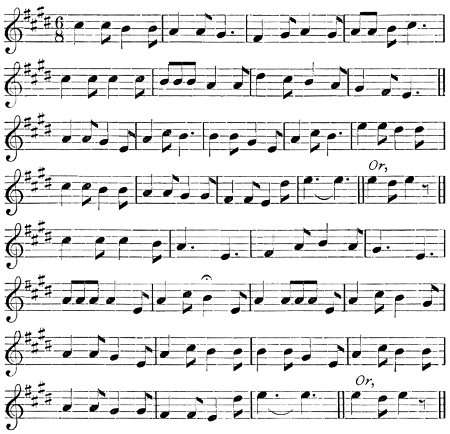
—Madeley, Shropshire (Miss Burne).
[Play]
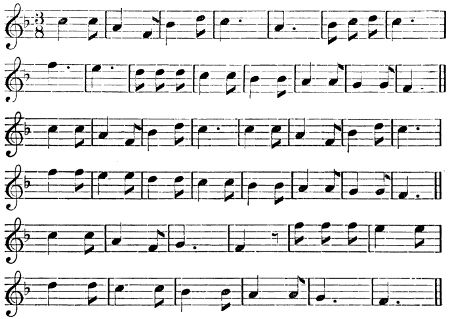
—Northants Notes and Queries, ii. 161 (R. S. Baker)
[Play]
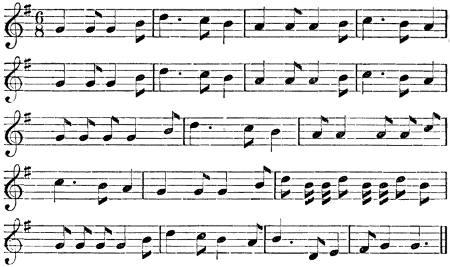
—Sporle, Norfolk (Miss Matthews).
I.
Oats and beans and barley grow! Oats and beans and barley grow! Do you or I or any one know How oats and beans and barley grow? First the farmer sows his seed, Then he stands and takes his ease, Stamps his foot, and claps his hands, Then turns round to view the land. Waiting for a partner, waiting for a partner! Open the ring and take one in! Now you are married you must obey, You must be true to all you say, You must be kind, you must be good, And help your wife to chop the wood!
—Much Wenlock (Burne’s Shropshire Folklore, p. 508).
II.
Oats and beans and barley grow! Does you or I or any one know Where oats and beans and barley grow? So the farmer sows his seed; So he stands and takes his ease; Stamps his foot and claps his hands, And turns him round to view the lands. Waiting for a partner! waiting for a partner! Now young couple you must obey, You must be true in all you say, You must be wise and very good, And help your wife to chop the wood.
—Monton, Lancashire (Miss Dendy).
III.
Does you or I, or anie one knowe Where oates and beanes and barlie growe? Where oates and beanes and barlie growe? The farmer comes and sowes ye seede, Then he standes and takes hys ease, Stamps hys foote, and slappes hys hand, And turnes hym rounde to viewe ye land. Waiting for a partner, Waiting for a partner, Open the ringe and take mee in, Make haste and choose youre partner. Now you’re married you must obey, Must bee true to alle you saye, Must bee kinde and verie goode, And helpe your wyfe to choppe ye woode.
—Raunds (Northants Notes and Queries, i. 163).
IV.
Oats and beans and barley grows, You or I or any one knows, You or I or any one knows, Where oats and beans and barley grows. Thus the farmer sows his seed, Stamps his feet and claps his hands, And turns around to view the land. Waiting for a partner, Waiting for a partner, Now you are married, &c. [same as Much Wenlock.]
—East Kirkby, Lincolnshire (Miss K. Maughan).
V.
Oats, beans, and barley grows, You or I or any one knows. Thus the farmer sows his seed, Thus he stands and takes his ease, Stamps his feet and folds his hands, And turns him round to view the lands. Oh! waitin’ for a partner, Waitin’ for a partner. Now you’re married, &c. [same as Much Wenlock.]
—Winterton (Miss Fowler).
VI.
Oats and wheat and barley grows, You and I and every one knows Where oats and wheat and barley grows. As the farmer sows his seed, Folds his arms and takes his ease, Stamps his feet and claps his hands, And turns him round to view the land. Waiting for a partner, Waiting for a partner, Waiting for a partner, To open the ring And take one in. Now you’re married, &c. [same as Much Wenlock.]
—Tean, North Staffs. (Miss Keary).
VII.
Oats and beans and barley grow, You and I and every one know; You and I and every one know That oats and beans and barley grow. Thus the farmer sows his seed, Thus he stands and takes his ease, Stamps his foot and claps his hands, And turns him round to view the land. Waiting for a partner, Waiting for a partner. Now you’re married you must obey, &c. [same as Much Wenlock.]
—Brigg, Lincolnshire (Miss Barker).
VIII.
Oats and beans and barley-corns, you or I or any one else, You or I or any one else, oats or beans or barley-corns; Thus the farmer sows his seed, Thus he stands and takes his ease, Stamps his foot, and claps his hands, And turns him round to view the land. Waiting for a partner, waiting for a partner; Open the ring and take one in, Waiting for a partner. Now you’re married, &c. [same as Much Wenlock.]
—Nottingham (Miss E. A. Winfield).
IX.
Oats and beans, barley and groats, Oats and beans, barley and groats; You, nor I, nor anybody knows How oats and beans and barley grows. Thus the farmer sows his seed, Thus he stands and takes his feed, Stamps his foot and claps his hand, And turns around to view the land. Waiting for a partner, waiting for a partner. Slip the ring, and take one in, And kiss her when you get her in; Now that you’re married you must agree, You must be kind to all you see; You must be kind, you must be good, And help your man [wife] to chop the wood.
—Isle of Man (A. W. Moore).
X.
Wuts and beäns and barley graws, As you and I and every one knaws. ....... Waätin’ for a pardner. Fust the farmer saws his seäds, Then he stands and taäke his eäse, Stomps his feät and clops his hands, And turns him round to view his lands. Waätin’ for a pardner. Now you’re married you must obaäy; Must be trewe to all you saäy; Must be kind and must be good, And help your wife to chop the wood. Waätin’ for a pardner.
—Spilsby, N. Lincs. (Rev. R. Cracroft).
XI.
Oats and beans and barley corn, Oats and beans and barley corn; You and I and nobody else, But oats and beans and barley corn. As the farmer sows his seed, As he stands to take us in, Stamps his feet and claps his hands, Turns around to field and lands. Waiting for a partner, Waiting for a partner, Open the gate and let her come out, And see the one you love the best. Now we’re merry and wish you joy, First the girl, and then the boy, Seven years after, seven years past, Kiss one another and go to your class.
—Hampshire (Miss Mendham).
XII.
Where the wheat and barley grows, You and I and nobody knows, Where the wheat and barley grows, You and I and nobody knows. As the farmer sows his seed, As he stands and takes his ease, Stamps his foot and claps his hand, Turns around to view the land. Waiting for a partner, Waiting for a partner. Open the ring, take her in, Kiss her when you get her in. Now you’re married you must be good, To make your husband chop the wood.
—Cowes, Isle of Wight (Miss E. Smith).
XIII.
Oats and beans and barley corns, You nor I nor any one knows; You nor I nor any one knows How oats and beans and barley grows. As the sower sows his seed, As he stands he takes his ease, Stamps his foot and claps his hands, And turns him round to view the land. Waiting for a partner, Open the ring and take one in. Now you’re married, &c. [same as Much Wenlock.]
—Long Eaton, Nottinghamshire (Miss Youngman).
XIV.
Hop or beans or barley corn, You or I or any one all: First the farmer sows his seed, Then he stands and takes his ease; He stamped his foot and he clapped his hand, And turned around the bugle land, Waiting for a partner, a partner, a partner, He opened the ring and called one in, And now he’s got a partner. Now you’re married we wish you good joy, First the girl and then the boy; Love one another like sister and brother, And pray each couple to kiss together.
—Sporle, Norfolk (Miss Matthews).
XV.
See the farmer sow his seed, See he stands and takes them in, Stamps his foot and claps his hand, And turns him round to view the land. O! waiting for a partner, O! waiting for a partner, Open the ring and take one in. Now you’re married, &c. [same as Much Wenlock.]
—Earls Heaton, Yorks. (H. Hardy).
XVI.
A waitin’ fur a pardner, A waitin’ fur a pardner, You an’ I an’ ev’ry one knows How whoats an’ beans an’ barley grows. Fost tha farmer saws ’is seeds, Then he stans’ an’ teks ’is ease, Stamps ’is feet an’ claps ’is ’ands, And turns him round to view tha lands. A waitin’ fur a pardner, A waitin’ fur a pardner, You an’ I an’ iv’ry one knows How whoats an’ beans an’ barley grows. Now you’re married, &c. [same as Much Wenlock.]
—Boston, Lincs. (Notes and Queries, 7th series, xii. 493).
XVII.
Oats and beans and barley grows Not so fine as the farmer sows, You nor I nor nobody knows Oats and beans and barley grows. This is the way the farmer sows, The farmer sows, the farmer sows, This is the way the farmer sows. Here he stands and takes his ease, Stamps his foot and claps his hands, And turns around to view the land, Waiting for a partner, waiting for a partner, Open the ring and take one in, And kiss him (or her) as he (or she) enters.
—Aberdeen Training College (Rev. W. Gregor).
XVIII.
Waitin’ for a partner, Waitin’ for a partner, Open the ring and take one in, And now you’ve got your partner. Now you’re married, &c. [same as Much Wenlock.]
—Wakefield, Yorks. (Miss Fowler).
(c) The players form a ring by joining hands, with one child, usually a boy, standing in the centre. The ring walks round, singing the first four lines. At the fifth line the ring stands still, and each child suits her actions to the words sung. At “the farmer sows his seed,” each player pretends to scatter seed, then they all fold their arms and “stand at ease,” “stamp their feet,” and “clap their hands” together in order, and finally each child turns herself round. Then they again clasp hands and move round the centre child, who at the words “open the ring and take one in” chooses and takes into the ring with him one player from it. These two stand together while the ring sings the marriage formula. At the end the child first in the centre joins the ring; the second child remaining in the centre, and in her turn choosing another from the ring.
This is the (Much Wenlock) way of playing. Among the variants there are some slight differences. In the Wakefield version (Miss Fowler), a little boy is placed in the centre of the ring first, he chooses a girl out of the ring at the singing of the third line and kisses her. They stand hand in hand while the others sing the next verse. In the Tean version (Miss Keary), the children turn round with their backs to the one in the centre, and stand still when singing “Waiting for a partner.” In the Hampshire (Miss Mendham), Brigg (Miss Barker), and Winterton (Miss Peacock) versions, the children dance round instead of walking. The Rev. Mr. Roberts, in a version from Kirkby-on-the-Bain (N.W. Lincolnshire), says: “There is no proper commencement of this song. The children begin with ‘A waitin’ fur a pardner,’ or ‘Oats and beans,’ just as the spirit moves them, but I think ‘A waitin’’ is the usual beginning here.” In a Sheffield version sent by Mr. S. O. Addy, four young men stand in the middle of the ring with their hands joined. These four dance round singing the first lines. After “views his lands” these four choose sweethearts, or partners, from the ring. The eight join hands and sing the remaining four lines. The four young men then join the larger ring, and the four girls remain in the centre and choose partners next time. The words of this version are almost identical with those of Shropshire. In the Isle of Man version (A. W. Moore), when the kiss is given all the children forming the ring clap their hands. There is no kissing in the Shropshire and many other versions of this game, and the centre child does not in all cases sing the words.
(d) Other versions have been sent from Winterton, Leadenham, and Lincoln, by Miss Peacock, and from Brigg, while the Northamptonshire Notes and Queries, ii. 161, gives another by Mr. R. S. Baker. The words are practically the same as the versions printed above from Lincolnshire and Northants. The words of the Madeley version are the same as the Much Wenlock (No. 1). The Nottingham tune (Miss Youngman), and three others sent with the words, are the same as the Madeley tune printed above.
(e) This interesting game is essentially of rural origin, and probably it is for this reason that Mr. Newell did not obtain any version from England for his Games and Songs of American Children, but his note that it “seems, strangely enough, to be unknown in Great Britain” (p. 80), is effectually disproved by the examples I have collected. There is no need in this case for an analysis of the rhymes. The variants fall into three categories: (1) the questioning form of the words, (2) the affirming form, and (3) the indiscriminate form, as in Nos. xvi. to xviii., and of these I am disposed to consider the first to represent the earliest idea of the game.
If the crops mentioned in the verses be considered, it will be found that the following table represents the different localities:—
North- ants. Lanca- shire. Lin- coln- shire. Shrop- shire. Staf- ford- shire. Not- ting- ham. Isle of Man. Hants. Isle of Wight. Nor- folk.
Oats + + + + + + + + ... ...
Beans + + + + ... + + + ... +
Barley + + + + + + + + + +
Wheat ... ... ... ... + ... ... ... + ...
Groats ... ... ... ... ... ... ... ... ... ...
Hop ... ... ... ... ... ... + ... ... +
The first three are the more constant words, but it is curious that Norfolk, not a hop county, should have adopted that grain into the game. Hops are grown there on rare occasions, and it is probable that the game may have been introduced from a hop county.
In Northants Notes and Queries, i. 163-164, Mr. R. S. Baker gives a most interesting account of the game (No. iii.) as follows:—“Having been recently invited to join the Annual Christmas Entertainment of the Raunds Church Choir, I noticed that a very favourite pastime of the evening was one which I shall call ‘Choosing Partners.’ The game is played thus: The young men and maidens join hands indiscriminately, and form a ring; within the ring stand a lad and a lass; then they all step round the way the sun goes, to a plain tune. During the singing of the two last lines [of the first part] they all disjoin hands, stop and stamp their feet and clap their hands and turn right round . . . then join hands [while singing the second verse]. The two in the middle at [‘Open the ring’] choose each of them a partner of the opposite sex, which they do by pointing to the one chosen; then they continue round, to the words [sang in next verse], the two pairs of partners crossing hands, first right and then left, and revolving opposite ways alternately. The march round is temporarily suspended for choosing partners. The partners salute [at ‘Now you’re married’], or, rather, each lad kisses his chosen lass; the first two partners go out, the game continues as before, and every one in the ring has chosen and been chosen, and every lad has saluted every lass. The antiquity of the pastime is evidenced by its not mentioning wheat; wheat was in remote times an exceptional crop—the village people lived on oatmeal and barley bread. It also points, possibly, to a period when most of the land lay in grass. Portions of the open fields were cultivated, and after a few years of merciless cropping were laid down again to recuperate. ‘Helping to chop the wood’ recalls the time when coal was not known as fuel. I am indebted for the correct words of the above to a Raunds maiden, Miss B. Finding, a native of the village, who kindly wrote them down for me.” Mr. Baker does not say how Miss Finding got the peculiar spelling of this version. It would be interesting to know whether this form of spelling was used as indicative of the pronunciation of the children, or of the supposed antiquity of the game. The Rev. W. D. Sweeting, also writes at the same reference, “The same game is played at the school feast at Maxey; but the words, as I have taken them down, vary from those given above. We have no mention of any crop except barley, which is largely grown in the district; and the refrain, repeated after the second and sixth lines, is ‘waiting for the harvest.’ A lady suggested to me that the two first lines of the conclusion are addressed to the bride of the game, and the two last, which in our version run, ‘You must be kind and very good,’ apply to the happy swain.”
This interesting note not only suggests, as Mr. Baker and Mr. Sweeting say, the antiquity of the game and its connection with harvest at a time when the farms were all laid in open fields, but it points further to the custom of courtship and marriage being the outcome of village festivals and dances held after spring sowing and harvest gatherings. It seems in Northamptonshire not to have quite reached the stage of the pure children’s game before it was taken note of by Mr. Baker, and this is an important illustration of the descent of children’s games from customs. As soon as it has become a child’s game, however, the process of decadence sets in. Thus, besides verbal alterations, the lines relating to farming have dropped out of the Wakefield version. It is abundantly clear from the more perfect game-rhymes that the waiting for a partner is an episode in the harvest customs, as if, when the outdoor business of the season was finished, the domestic element becomes the next important transaction in the year’s proceedings. The curious four-lined formula applicable to the duties of married life may indeed be a relic of those rhythmical formulæ which are found throughout all early legal ceremonies. A reference to Mr. Ralston’s section on marriage songs, in his Songs of the Russian People, makes it clear that marriages in Russia were contracted at the gatherings called Besyedas (p. 264), which were social gatherings held during October after the completion of the harvest; and the practice is, of course, not confined to Russia.
It is also probable that this game may have preserved the tradition of a formula sung at the sowing of grain, in order to propitiate the earth goddess to promote and quicken the growth of the crops. Turning around or bowing to fields and lands and pantomimic actions in imitation of those actually required, are very general in the history of sympathetic magic among primitive peoples, as reference to Mr. Frazer’s Golden Bough will prove; and taking the rhyming formula together with the imitative action, I am inclined to believe that in this game we may have the last relics of a very ancient agricultural rite.
Obadiah
The players stand in a row. The child at the head of the row says, “My son Obadiah is going to be married, twiddle your thumbs,” suiting the action to the word by clasping the fingers of both hands together, and rapidly “twiddling” the thumbs. The next child repeats both words and actions, and so on all along the row, all the players continuing the “twiddling.” The top child repeats the words, adding (very gravely), “Fall on one knee,” the whole row follows suit as before (still twiddling their thumbs). The top child repeats from the beginning, adding, “Do as you see me,” and the rest of the children follow suit, as before. Just as the last child repeats the words, the top child falls on the child next to her, and all go down like a row of ninepins. The whole is said in a sing-song way. This game was, so far as I can ascertain, truly East Anglian. I have never been able to hear of it in other parts of England or Wales.—Bexley Heath (Miss Morris). Also played in London.
See “Solomon.”
Odd or Even
A boys’ game, played with buttons, marbles, and halfpence. Peacock’s Manley and Corringham Glossary; also mentioned in Brogden’s Provincial Words (Lincolnshire). Mr. Patterson says (Antrim and Down Glossary)—A boy shuts up a few small objects, such as marbles, in one hand, and asks his opponent to guess if the number is odd or even. He then either pays or receives one, according as the guess is right or wrong. Strutt describes this game in the same way, and says it was played in ancient Greece and Rome. Newell (Games, p. 147) also mentions it.
See “Prickie and Jockie.”
Odd-man
A game played with coins. Brogden’s Provincial Words, Lincolnshire.
Old Dame
I.
I’ll away to t’beck to wash my neck, When I get there, I’ll ask t’ould dame what o’clock it is? It’s one, and you’ll be hanged at two. I’ll away to t’beck to wash my neck, When I get there, I’ll ask t’ould dame what o’clock it is? It’s two, and you’ll be hanged at three.
[This is repeated until the old woman says, “It’s eleven, and you’ll be hanged at twelve.”]
—Yorkshire (Miss E. Cadman).
II.
To Beccles, to Beccles, To buy a bunch of nettles, Pray, old dame, what’s o’clock? One, going for two. To Beccles, to Beccles, To buy a bunch of nettles, Pray, old dame, what’s o’clock? Two, going for three, &c.
[And so on until “eleven going for twelve” is said, then the following:—]
Where have you been? To the wood. What for? To pick up sticks. What for? To light my fire. What for? To boil my kettle. What for? To cook some of your chickens.
—Halliwell, Nursery Rhymes, p. 229.
(b) One child sits upon a little stool. The others march round her in single file, taking hold of each other’s frocks. They say in a sing-song manner the first two lines, and the old woman answers by telling them the hour. The questions and answers are repeated until the old woman says, “It’s eleven, and you’ll be hanged at twelve.” Then the children all run off in different directions and the old woman runs after them. Whoever she catches becomes old woman, and the game is continued.—Yorkshire (Miss E. Cadman). In the version given from Halliwell there is a further dialogue, it will be seen, before the old woman chases.
(c) The use of the Yorkshire word “beck” (“stream”) in the first variant suggests that this may be the original version from which the “Beccles” version has been adapted, a particular place being substituted for the general. The game somewhat resembles “Fox and Goose.”
Old Roger is Dead
[Play]
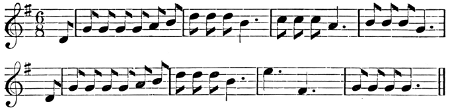
—Earls Heaton (H. Hardy).
[Play]
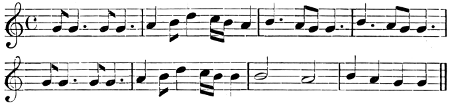
—Sporle, Norfolk (Miss Matthews).
[Play]

—Bath (A. B. Gomme).
I.
Old Rogers is dead and is laid in his grave, Laid in his grave, Laid in his grave; Old Rogers is dead and is laid in his grave, He, hi! laid in his grave. There grew an old apple tree over his head, Over his head, Over his head; There grew an old apple tree over his head, He, hi! over his head. The apples grew ripe, and they all fell off, They all fell off, They all fell off; The apples grew ripe, and they all fell off, He, hi! they all fell off. There came an old woman a-picking them up, Picking them up, Picking them up; There came an old woman a-picking them up, He, hi! picking them up. Old Rogers jumps up and he gives her a knock, Gives her a knock, Gives her a knock; Old Rogers jumps up and he gives her a knock, He, hi! gives her a knock. He makes the old woman go hipperty hop, Hipperty hop, Hipperty hop; He makes the old woman go hipperty hop, He, hi! hipperty hop.
—Earls Heaton, Yorks. (Herbert Hardy).
II.
Old Roger is dead, and lies in his grave, um, ah! lies in his grave; There grew an old apple tree over his head, um, ah! over his head. The apples are ripe and ready to drop, um, ah! ready to drop; There came an old woman, picking them up.
—Hanbury, Staffs. (Miss Edith Hollis).
III.
Sir Roger is dead and is low in his grave, Is low in his grave, is low in his grave; Sir Roger is dead and is low in his grave, Hey hie! is low in his grave. They planted an apple tree over his head, Over his head, over his head; They planted an apple tree over his head, Hey hie! over his head. When they grew ripe they all fell off, All fell off, all fell off; When they grew ripe they all fell off, Hey hie! all fell off. There came an old woman and gathered them up, Gathered them up, gathered them up; There came an old woman and gathered them up, Hey hie! gathered them up. Sir Roger got up and gave her a nudge, Gave her a nudge, gave her a nudge; Sir Roger got up and gave her a nudge, Hey hie! gave her a nudge. Which made her go off with a skip and a hop, With a skip and a hop, with a skip and a hop; Which made her go off with a skip and a hop, Hey hie! with a skip and a hop.
—Ordsall, Nottinghamshire (Miss Matthews).
IV.
Sir Roger is dead and he’s laid in his grave, Laid in his grave, laid in his grave; Sir Roger is dead and he’s laid in his grave, Heigh-ho! laid in his grave. There grew a fine apple tree over his head, Over his head, over his head; There grew a fine apple tree over his head, Heigh-ho! over his head. The apples were ripe and they all fell off, All fell off, all fell off; The apples were ripe and they all fell off, Heigh-ho! all fell off. There came an old woman and picked them all up, Picked them all up, picked them all up; There came an old woman and picked them all up, Heigh-ho! picked them all up. Sir Roger jumped up and he gave her a push, Gave her a push, gave her a push; Sir Roger jumped up and he gave her a push, Heigh-ho! gave her a push. Which made the old woman go hickety-hock, Hickety-hock, hickety-hock; Which made the old woman go hickety-hock, Heigh-ho! hickety-hock.
—Brigg, Lincolnshire (Miss J. Barker).
V.
Sir Roger is dead and laid in his grave, Hee, haw! laid in his grave. They planted an apple tree over his head, Hee, haw! over his head. The apples are ripe and ready to fall, Hee, haw! ready to fall. There came a high wind and blew them all off, Hee, haw! blew them all off. There came an old woman to pick them all up, Hee, haw! pick them all up. There came a little bird and gave her a tap, Hee, haw! gave her a tap. Which made the old woman go hipperty hop, Hee, haw! hipperty hop.
—Tong, Shropshire (Miss Burne).
VI.
Poor Johnnie is dead and he lies in his grave, Lies in his grave, lies in his grave; Poor Johnnie is dead and he lies in his grave, He-ho! lies in his grave. They planted an apple tree over his head, Over his head, over his head; They planted an apple tree over his head, He-ho! over his head. The apples got ripe and they all fell off, All fell off, all fell off; The apples got ripe and they all fell off, He-ho! all fell off. Here comes an old woman a-picking them up, A-picking them up, a-picking them up; Here comes an old woman a-picking them up, He-ho! a-picking them up. Poor Johnnie got up and gave her a thump, And gave her a thump, and gave her a thump; Poor Johnnie got up and gave her a thump, He-ho! gave her a thump. He made the old woman go hippity-hop, Hippity-hop, hippity-hop! He made the old woman go hippity-hop, He-ho! hippity-hop!
—Sporle, Norfolk (Miss Matthews).
VII.
Cock Robin is dead and has gone to his grave; There grew on old apple tree over his head; The apples were ripe and ready to drop, O my, flippity flop! There came an old woman to pick them all up, Cock Robin rose up and gave her a knock, And made the old woman go flippity flop! O my, flippity flop!
—Deptford, Kent (Miss Chase).
VIII.
Old Roger is dead and gone to his grave, H’m ha! gone to his grave. They planted an apple tree over his head, H’m ha! over his head. The apples were ripe and ready to fall, H’m ha! ready to fall. There came an old woman and picked them all up, H’m ha! picked them all up. Old Roger jumped up and gave her a knock, H’m ha! gave her a knock. Which made the old woman go hippity hop, H’m ha! hippity hop!
—Bath, from a Nursemaid (A. B. Gomme).
IX.
Cock Robin is dead and lies in his grave, Hum-ha! lies in his grave. Place an old apple tree over his head, Hum-ha! over his head. When they were ripe and ready to fall, Hum-ha! ready to fall. There comes an old woman a-picking them up, Hum-ha! a-picking them up. Cock Robin jumps up and gives her a good knock, Hum-ha! gives her a good knock.
—Derbyshire (Folk-lore Journal, i. 385).
X.
Poor Roger is dead and lies low in his grave, Low in his grave, low in his grave, E. I. low in his grave. There grew an old apple tree over his head, Over his head, over his head, E. I. over his head. When the apples were ripe they all fell off, All fell off, all fell off, E. I. all fell off. There was an old woman came picking them up, Picking them up, picking them up, E. I. picking them up. Poor Roger jumped up and gave her a nudge, Gave her a nudge, gave her a nudge, E. I. gave her a nudge. Which made the old woman go lippety lop, Lippety lop, lippety lop, E. I. lippety lop.
—Newark, Nottinghamshire (S. O. Addy).
XI.
Poor Toby is dead and he lies in his grave, He lies in his grave, he lies in his grave; They planted an apple tree over his head, Over his head, over his head. The apples grew ripe and beginning to fall, Beginning to fall, beginning to fall; The apples grew ripe and beginning to fall, Beginning to fall, beginning to fall. There came an old woman picking them up, Picking them up, picking them up; Poor Toby rose up and he gave her a kick, Gave her a kick, gave her a kick. And the poor old woman went hipperty hop, Hipperty hop, hipperty hop; And the poor old woman went hipperty hop, Hipperty hop along.
—Belfast (W. H. Patterson).
XII.
There was an old woman we buried her here, Buried her here, buried her here; There was an old woman we buried her here, He—ho! buried her here.
—Sporle, Norfolk (Miss Matthews).
(b) A ring is formed by children joining hands; one child, who represents Sir Roger, lays down on the ground in the centre of the ring with his head covered with a handkerchief. The ring stands still and sings the verses. When the second verse is begun, a child from the ring goes into the centre and stands by Sir Roger, to represent the apple tree. At the fourth verse another child goes into the ring, and pretends to pick up the fallen apples. Then the child personating Sir Roger jumps up and knocks the child personating the old woman, beating her out of the ring. She goes off hobbling on one foot, and pretending to be hurt. In the Ordsall game the children dance round when singing the verses instead of standing still, the action of the game being the same. In the Tong version, the action seems to be done by the ring. Miss Burne says the children go through various movements, finally all limping round. The Newark (Notts), and Bath versions are played as first described, Poor Roger being covered with a cloak, or an apron, and laying down in the middle of the ring. A Southampton version has additional features—the ring of children keep their arms crossed, and lay their hands on their chests, bending their heads and bodies backwards and forwards, in a mourning attitude, while they sing; in addition to which, in the Bath version, the child who personates the apple tree during the singing of the third verse raises her arms above her head, and then lets them drop to her sides to show the falling apples.
(c) Various as the game-rhymes are in word detail, they are practically the same in incident. One remarkable feature stands out particularly, namely, the planting a tree over the head of the dead, and the spirit-connection which this tree has with the dead. The robbery of the fruit brings back the dead Sir Roger to protect it, and this must be his ghost or spirit. In popular superstition this incident is not uncommon. Thus Aubrey in his Remains of Gentilisme, notes that “in the parish of Ockley some graves have rose trees planted at the head and feet,” and then proceeds to say, “They planted a tree or a flower on the grave of their friend, and they thought the soule of the party deceased went into the tree or plant” (p. 155). In Scotland a branch falling from an oak, the Edgewell tree, standing near Dalhousie Castle, portended mortality to the family (Dalyell, Darker Superstitions, p. 504). Compare with this a similar superstition noted in Carew’s History of Cornwall, p. 325, and Mr. Keary’s treatment of this cult in his Outlines of Primitive Belief, pp. 66-67. In folk-tales this incident also appears; the spirit of the dead enters the tree and resents robbery of its fruit, possession of which gives power over the soul or spirit of the dead.
The game is, therefore, not merely the acting of a funeral, but more particularly shows the belief that a dead person is cognisant of actions done by the living, and capable of resenting personal wrongs and desecration of the grave. It shows clearly the sacredness of the grave; but what, perhaps to us, is the most interesting feature, is the way in which the game is played. This clearly shows a survival of the method of portraying old plays. The ring of children act the part of “chorus,” and relate the incidents of the play. The three actors say nothing, only act their several parts in dumb show. The raising and lowering of the arms on the part of the child who plays “apple tree,” the quiet of “Old Roger” until he has to jump up, certainly show the early method of actors when details were presented by action instead of words. Children see no absurdity in being a “tree,” or a “wall,” “apple,” or animal. They simply are these things if the game demands it, and they think nothing of incongruities.
I do not, of course, suggest that children have preserved in this game an old play, but I consider that in this and similar games they have preserved methods of acting and detail (now styled traditional), as given in an early or childish period of the drama, as for example in the mumming plays. Traditional methods of acting are discussed by Mr. Ordish, Folk-lore, ii. 334.
Old Soldier
One player personates an old soldier, and begs of all the other players in turn for left-off garments, or anything else he chooses. The formula still used at Barnes by children is, “Here comes an old soldier from the wars [or from town], pray what can you give him?” Another version is—
Here comes an old soldier from Botany Bay, Have you got anything to give him to-day.
—Liverpool (C. C. Bell).
The questioned child replying must be careful to avoid using the words, Yes! No! Nay! and Black, White, or Grey. These words are tabooed, and a forfeit is exacted every time one or other is used. The old soldier walks lame, and carries a stick. He is allowed to ask as many questions, talk as much as he pleases, and to account for his destitute condition.
(c) Some years ago when colours were more limited in number, it was difficult to promise garments for a man’s wear which were neither of these colours tabooed. Miss Burne (Shropshire Folk-lore, p. 526), in describing this game says, “The words Red or Blue are sometimes forbidden, as well as Yes or No,” and adds that “This favourite old game gives scope for great ingenuity on the part of the beggar, and ‘it seems not improbable’ (to use a time-honoured antiquarian phrase!) that the expression ‘To come the old soldier over a person’ may allude to it.” Halliwell (Nursery Rhymes, p. 224) describes the game as above.
Oliver, Oliver, follow the King!
Oliver, Oliver, follow the King! Oliver, Oliver, last in the ring! Jim Burguin wants a wife, and a wife he shall have, Nelly he kissed at the back-cellar door, Nelly made a pudding, she made it over sweet, She never stuck a knife in till he came home at night, So next Monday morning is our wedding-day, The bells they shall ring, and the music shall play! Oliver, Oliver, follow the King! (da capo).
—Berrington (Burne’s Shropshire Folk-lore, p. 508).
(b) The children form a ring and move round, singing the first two lines. Then they curtsey, or “douk down,” all together; the one who is last has to tell her sweetheart’s name. The other lines are then sung and the game is continued. The children’s names are mentioned as each one names his or her sweetheart.
This is apparently the game of which “All the Boys,” “Down in the Valley,” and “Mary Mixed a Pudding up,” are also portions.
One Catch-all
The words “Cowardy, cowardy custard” are repeated by children playing at this game when they advance towards the one who is selected to catch them, and dare or provoke her to capture them. Ray, Localisms, gives Costard, the head; a kind of opprobrious word used by way of contempt. Bailey gives Costead-head, a blockhead; thus elucidating this exclamation which may be interpreted, “You cowardly blockhead, catch me if you dare” (Baker’s Northamptonshire Glossary).
The words used were, as far as I remember,
Cowardy, cowardy custard, eat your father’s mustard, Catch me if you can.
To compel a person to “eat” something disagreeable is a well-known form of expressing contempt. The rhyme was supposed to be very efficacious in rousing an indifferent or lazy player when playing “touch” (A. B. Gomme).
Oranges and Lemons
[Play]
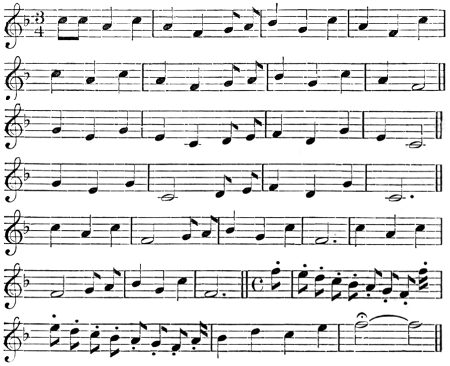
An older and more general version of the last five bars (the tail piece) is as follows:—
[Play]

—London (A. B. Gomme).
[Play]
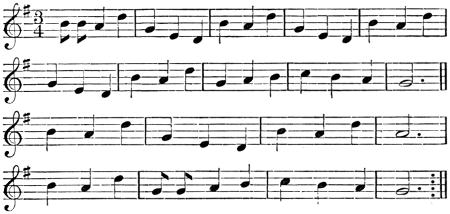
—Yorkshire (H. Hardy).
[Play]

—Sporle, Norfolk (Miss Matthews).
I.
Oranges and lemons, Say the bells of St. Clement’s; You owe me five farthings, Say the bells of St. Martin’s; When will you pay me, Say the bells of Old Bailey; When I grow rich, Say the bells of Shoreditch; When will that be? Say the bells of Stepney; I’m sure I don’t know, Says the Great Bell of Bow. Here comes a light to light you to bed; Here comes a chopper to chop off your head; The last, last, last, last man’s head.
—London (A. B. Gomme).
II.
Oranges and lemons, Say the bells of St. Clement’s; You owe me four farthings, Say the bells of St. Martin’s; When will you pay me? Say the bells of Old Bailey; When I grow rich, Say the bells of Shoreditch; When will that be? Say the bells of Stepney; I’m sure I don’t know, Says the Great Bell of Bow. Here comes a candle to light you to bed; Here comes a chopper to chop off your head; Last, last, last, last, last man’s head.
—Winterton and Leadenham, Lincolnshire; also Nottinghamshire (Miss M. Peacock).
III.
Oranges and lemons, Says the bells of S. Clemen’s. Brickdust and tiles, Says the bells of S. Giles. You owe me five farthings, Says the bells of S. Martin’s. I do not know you, Says the bells of S. Bow. When will you pay me? Says the bells of Old Bailey. When I get rich, Says the bells of Shoreditch. Here comes a candle to light you to bed, Here comes a chopper to chop off your head.
—Derbyshire (Folk-lore Journal, i. 386).
IV.
Oranges and lemons, The bells of St. Clemen’s; You owe me five farthings, The bells of St. Martin’s; When will you pay me? Say the bells of Old Bailey; When I grow rich, Say the bells of Shoreditch; When will that be? Say the bells of Shorlea; I don’t know, Says the Great Bell Bow. Here comes the candle to light you to bed, Here comes the chop to chop off your head. Chop, chop, chop, &c.
—Middlesex (Miss Winfield).
V.
Orange or lemon, The bells of St. Clement’s [or the bells are a clemming]. I owe you five farthings, And when shall I pay you, To-day or to-morrow? To-morrow will do. Here come some great candles To light you to bed, Here come some great choppers To chop off your head. Come under, come under, Come run as you ought; Come under, come under, Until you are caught; Then stand just behind us And pull either way; Which side pulls the strongest That side wins the day.
—Sporle, Norfolk (Miss Matthews).
VI.
Oranges and lemons, The bells of St. Clement’s. I owe you three farthings, When shall I pay you? When I get rich. Here comes a candle to light you to bed, Here comes a hatchet to chop off your head.
—Brigg (from a Lincolnshire friend of Miss Barker).
VII.
Oranges and lemons, Say the bells of St. Clemen’s. I owe you five farthins, Say the bells of St. Martin’s. When shall I pay you? Monday, Tuesday, Wednesday, Thursday, Friday, Saturday, Or Sunday?
—Symondsbury, Dorset (Folk-lore Journal, vii. 216).
VIII.
I owe you five farthings. When will you pay me, To-day or to-morrow? Here comes a candle to light you to bed, Here comes a chopper to chop off your head.
—Broadwinsor, Dorset (Folk-lore Journal, vii. 217).
IX.
Oranges and lemons, the bells of St. Clement’s [or St. Helen’s]. I owe you five farthings. And when will you pay me? I’m sure I don’t know. Here comes a candle to light you to bed, Here comes a chop’n bill to chop off your head— Chop—chop—chop—chop. [Or Here comes a chop’n bill to chop off the last man’s head.]
—Earls Heaton, Yorks. (Herbert Hardy).
X.
Lend me five shillings, Said the bells of St. Helen’s. When will you pay me? Said the bells of St. Philip’s. I do not know, Said the Great Bell of Bold. Ring a ding, ding, Ring a ding, ding, Ring a ding, ding, ding, ding.
—Earls Heaton (Herbert Hardy, as told him by A. K.).
XI.
Oranges and lemons, say the bells of St. Clement’s; You owe me five farthings, and when will you pay me? Say the bells of Old Bailey. When I grow rich, say the bells of Shoreditch. And the last one that comes shall be chop, chop.
—Hersham, Surrey (Folk-lore Record, v. 86).
XII.
Orange and lemon, Say the bells of St. Martin (or the bells of Sweet Lemon); I owe you five farthings, But when shall I pay you? Here comes a candle To light you to bed, Here comes a hatchet To chop off your head.
—Eckington, Derbyshire (S. O. Addy).
XIII.
Oranges and lemons, The bells of St. Clement’s; I owe you five farthings, And when will you pay me? Oh, that I can’t tell you; Sim, Bim, bim, bow, bay.
—Settle, Yorks. (Rev. W. E. Sykes).
XIV.
Oranges or lemons, The bells of St. Clement’s; You owe me five farthings, Pray, when will you pay me? Here come the clappers to knock you down backwards, carwoo!
—Suffolk (Mrs. Haddon).
XV.
Oranges and lemons, say the bells of St. Clement’s; Brick dust and tiles, say the bells of St. Giles; You owe me three farthings, say the bells of St. Martin’s; When will you pay me? say the bells of Old Bailey; When I grow rich, say the bells of Shoreditch; When will that be? say the bells of Stepney; I’m sure I don’t know, says the Great Bell of Bow.
—Perth (Rev. W. Gregor).
XVI.
Pancakes and fritters, Says the bells of St. Peter’s; Where must we fry ’em? Says the bells of Cold Higham; In yonder land thurrow (furrow), Says the bells of Wellingborough; You owe me a shilling, Says the bells of Great Billing; When will you pay me? Says the bells of Widdleton Cheney; When I am able, Say the bells at Dunstable; That will never be, Says the bells at Coventry; Oh, yes, it will, Says Northampton Great Bell; White bread and sop, Says the bells at Kingsthorp; Trundle a lantern, Says the bells at Northampton.
—Northamptonshire (Baker’s Words and Phrases).
(c) This game is generally played as follows:—
Two of the taller children stand facing each other, holding up their clasped hands. One is named Orange and the other Lemon. The other players, grasping one another’s dresses, run underneath the raised arms and round Orange, and then under the arms again and round Lemon, while singing the verses. The three concluding lines are sung by “Orange” and “Lemon” in a slow emphatic manner, and at the word “head” they drop their arms over one of the children passing between them, and ask her secretly whether she will be orange or lemon. The captive chooses her side, and stands behind whichever leader she selects, placing her arms round her waist. The game continues till every one engaged in it has ranged herself behind one or other of the chiefs. When the two parties are ranged a “tug of war” takes place until one of the parties breaks down, or is pulled over a given mark.
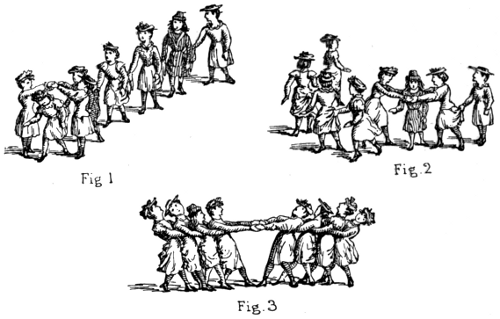
In the Middlesex version (Miss Winfield) the children form a ring and go round singing the verses, and apparently there is neither catching the “last man” nor the “tug.” Mr. Emslie says he has seen and played the game in Middlesex, and it always terminated with the cutting off the last man’s head. In the Symondsbury version the players drop their hands when they say “Sunday.” No tug is mentioned in the first Earls Heaton version of the game (Mr. Hardy). In the second version he says bells are represented by children. They should have in their hands, bells, or some article to represent them. All stand in a row. First, second, and third bells stand out in turn to sing. All rush for bells to sing chorus. Miss Barclay writes: The children of the Fernham and Longcot choir, playing on Christmas Eve, 1891, pulled across a handkerchief. In Monton, Lancashire, Miss Dendy says the game is played as elsewhere, but without words. In a Swaffham version (Miss Matthews), the girls sometimes call themselves “Plum pudding and roast beef,” or whatever fancy may suggest, instead of oranges and lemons. They join hands high enough for the others to pass under, which they do to a call of “Ducky, Ducky,” presently the hands come down and catch one, who is asked in confidence which she likes best. The game then proceeds in the usual way, one side trying to pull the other over a marked line. Oranges and lemons at Bocking, Essex, is an abbreviated variant of the rhyme printed by Halliwell (Folk-lore Record, iii., part II., 171). In Nottinghamshire, Miss Peacock says it is sometimes called “Tarts and Cheesecakes.” Moor (Suffolk Words) mentions “Oranges and Lemons” as played by both girls and boys, and adds, “I believe it is nearly the same as ‘Plum Pudding and Roast Beef.’” In the Suffolk version sent by Mrs. Haddon a new word is introduced, “carwoo.” This is the signal for one of the line to be caught. Miss Eddleston, Gainford, Durham, says this game is called—
Through and through the shally go, The last shall be taken.
Mr. Halliwell (Nursery Rhymes, No. cclxxxi.) adopts the verses entitled, “The Merry Bells of London,” from Gammer Gurton’s Garland, 1783, as the origin of this game. In Aberdeen, Mr. M. L. Rouse tells me he has heard Scotch children apparently playing the same game, “Oranges and Lemons, ask, Which would you have, ‘A sack of corn or a sack of coals?’”
(d) This game indicates a contest between two opposing parties, and a punishment, and although in the game the sequence of events is not at all clear, the contest taking place after the supposed execution, these two events stand out very clearly as the chief factors. In the endeavour to ascertain who the contending parties were, one cannot but be struck with the significance of the bells having different saint’s names. Now the only places where it would be probable for bells to be associated with more than one saint’s name within the circuit of a small area are the old parish units of cities and boroughs. Bells were rung on occasions when it was necessary or advisable to call the people together. At the ringing of the “alarm bell” the market places were quickly filled by crowds of citizens; and by turning to the customs of these places in England, it will be found that contest games between parishes, and between the wards of parishes, were very frequent (see Gomme’s Village Community, pp. 241-243). These contests were generally conducted by the aid of the football, and in one or two cases, such as at Ludlow, the contest was with a rope, and, in the case of Derby, it is specially stated that the victors were announced by the joyful ringing of their parish bells. Indeed, Halliwell has preserved the “song on the bells of Derby on football morning” (No. clxix.) as follows:—
Pancake and fritters, Say All Saints and St. Peter’s; When will the ball come, Say the bells of St. Alkmun; At two they will throw, Says Saint Werabo; O! very well, Says little Michel.
This custom is quite sufficient to have originated the game, and the parallel which it supplies is evidence of the connection between the two. Oranges and lemons were, in all probability, originally intended to mean the colours of the two contesting parties, and not fruits of those names. In contests between the people of a town and the authority of baron or earl, the adherents of each side ranged themselves under and wore the colours of their chiefs, as is now done by political partizans.
The rhymes are probably corrupted, but whether from some early cries or calls of the different parishes, or from sentences which the bells were supposed to have said or sung when tolled, it is impossible to say. The “clemming” of the bells in the Norfolk version (No. 5) may have originated “St. Clements,” and the other saints have been added at different times. On the other hand, the general similarity of the rhymes indicates the influence of some particular place, and, judging by the parish names, London seems to be that place. If this is so, the main incident of the rhymes may perhaps be due to the too frequent distribution of a traitor’s head and limbs among different towns who had taken up his cause. The exhibitions of this nature at London were more frequent than at any other place. The procession of a criminal to execution was generally accompanied by the tolling of bells, and by torches. It is not unlikely that the monotonous chant of the last lines, “Here comes a light to light you to bed,” &c., indicates this.[Addendum]
’Otmillo
A boy (A) kneels with his face in another’s (B) lap; the other players standing in the background. They step forward one by one at a signal from B, who says to each in turn—
’Otmillo, ’Otmillo, Where is this poor man to go?
A then designates a place for each one. When all are despatched A removes his face from B’s knees, and standing up exclaims, “Hot! Hot! Hot!” The others then run to him, and the laggard is blinded instead of A.—Warwickshire (Northall’s Folk Rhymes, p. 402).
This is probably the same game as “Hot Cockles,” although it apparently lacks the hitting or buffeting the blinded wizard.
Over Clover
The name for the game of “Warner” in Oxfordshire. They have a song used in the game commencing—
Over clover, Nine times over.
—Halliwell’s Dictionary.
See “Stag Warning.”
Paddy from Home
[Play]
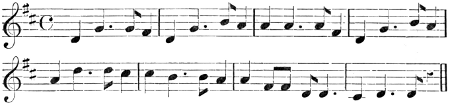
—Long Eaton, Notts. (Miss Youngman).
Paddy from home has never been, A railway train he’s never seen, He longs to see the great machine That travels along the railway.
—Long Eaton, Nottinghamshire and Derbyshire borders (Miss Youngman).
(c) The children form a ring, and hold in their hands a string tied at the ends, and on which a ring is strung. They pass the ring from one to another, backwards and forwards. One child stands in the centre, who tries to find the holder of the ring. Whoever is discovered holding it takes the place of the child in the centre.
(d) This game is similar to “Find the Ring.” The verse is, no doubt, modern, though the action and the string and ring are borrowed from an older game. Another verse used for the same game at Earl’s Heaton (Mr. Hardy) is—
The ring it is going; Oh where? oh where? I don’t care where, I can’t tell where.
Paip
Three cherry stones are placed together, and another above them. These are all called a castle. The player takes aim with a cherry stone, and when he overturns the castle he claims the spoil.—Jamieson. See “Cob Nut.”
Pallall
A Scottish name for “Hop Scotch.”—Jamieson.
Pally Ully
See “Hop Scotch.”
Pat-ball
A child’s name for the simple game of throwing a ball from one to another.—Lowsley’s Berkshire Glossary.
Pay-swad
A boys’ game, somewhat similar to “Duckstone.” Each boy, when he threw his stone, had to say “Pay-swad,” or he had to go down himself.—Holland’s Cheshire Glossary.
See “Duckstone.”
Pednameny
A game played with pins: also called “Pinny Ninny,” “Pedna-a mean,” “Heads and Tails,” a game of pins.—Courtenay’s West Cornwall Glossary.
Peesie Weet
The game of “Hide and Seek.” When the object is hidden the word “Peesie-weet” is called out.—Fraserburgh, Aberdeenshire (Rev. W. Gregor).
See “Hide and Seek (2).”
Peg and Stick
The players provide themselves with short, stout sticks, and a peg (a piece of wood sharpened at one or both ends). A ring is made, and the peg is placed on the ground so as to balance. One boy then strikes it with his stick to make it spring or bounce up into the air; while in the air he strikes it with his stick, and sends it as far as he possibly can. His opponent declares the number of leaps in which the striker is to cover the distance the peg has gone. If successful, he counts the number of leaps to his score. If he fails, his opponent leaps, and, if successful, the number of leaps count to his score. He strikes the next time, and the same process is gone through.—Earls Heaton, Yorks. (Herbert Hardy).
See “Tip-cat.”
Peg-fiched
A west country game. The performers in this game are each furnished with a sharp-pointed stake. One of them then strikes it into the ground, and the others, throwing their sticks across it, endeavour to dislodge it. When a stick falls, the owner has to run to a prescribed distance and back, while the rest, placing the stick upright, endeavour to beat it into the ground up to the very top.—Halliwell’s Dictionary.
Peggy Nut
A boyish game with nuts.—Dickinson’s Cumberland Glossary.
Peg-in-the-Ring
A game of “Peg-top.” The object of this game is to spin the top within a certain circle marked out, in which the top is to exhaust itself without once overstepping the bounds prescribed (Halliwell’s Dict. Provincialisms). Holloway (Dictionary) says, “When boys play at ‘Peg-top,’ a ring is formed on the ground, within which each boy is to spin his top. If the top, when it has ceased spinning, does not roll without the circle, it must remain in the ring to be pegged at by the other boys, or he redeems it by putting in an inferior one, which is called a ‘Mull.’ When the top does not roll out, it is said to be ‘mulled.’” Mr. Emslie writes: “When the top fell within the ring the boys cried, ‘One a penny!’ When two had fallen within the ring it was, ‘Two a penny!’ When three, ‘Three a penny, good as any!’ The aim of each spinner was to do what was called ‘drawing,’ i.e., bring his top down into the ring, and at the same time draw the string so as to make the top spin within the ring, and yet come towards the player and out of the ring so as to fall without.”
See “Tops.”
Peg-top
One of the players, chosen by lot, spins his top. The other players endeavour to strike this top with the pegs of their own tops as they fling them down to spin. If any one fails to spin his top in due form, he has to lay his top on the ground for the others to strike at when spinning. The object of each spinner is to split the top which is being aimed at, so as to release the peg, and the boy whose top has succeeded in splitting the other top obtains the peg as his trophy of victory. It is a matter of ambition to obtain as many pegs in this manner as possible.—London (G. L. Gomme).
See “Peg-in-the-Ring,” “Tops.”
Penny Cast
A game played with round flat stones, about four or six inches across, being similar to the game of quoits; sometimes played with pennies when the hobs are a deal higher. It was not played with pennies in 1810.—Easther’s Almondbury Glossary. In an article in Blackwood’s Magazine, August 1821, p. 35, dealing with children’s games, the writer says, Pennystanes are played much in the same manner as the quoits or discus of the ancient Romans, to which warlike people the idle tradesmen of Edinburgh probably owe this favourite game.
See “Penny Prick.”
Penny Hop
A rude dance, which formerly took place in the common taverns of Sheffield, usually held after the bull-baiting.—Wilson’s Notes to Mather’s Songs, p. 74, cited by Addy, Sheffield Glossary.
Penny Prick
“A game consisting of casting oblong pieces of iron at a mark.”—Hunter’s Hallamsh. Gloss., p. 71. Grose explains it, “Throwing at halfpence placed on sticks which are called hobs.”
Their idle houres, I meane all houres beside Their houres to eate, to drinke, drab, sleepe, and ride, They spend at shove-boord, or at pennie-pricke.
—Scots’ Philomythie, 1616.
Halliwell gives these references in his Dictionary; Addy, Sheffield Glossary, describes it as above; adding, “An old game once played by people of fashion.”
See “Penny Cast.”
Penny Stanes
See “Penny Cast.”
Phœbe
The name of a dance mentioned in an old nursery rhyme. A correspondent gave Halliwell the following lines of a very old song, the only ones he recollected:—
Cannot you dance the Phœbe? Don’t you see what pains I take; Don’t you see how my shoulders shake? Cannot you dance the Phœbe?
—Halliwell’s Dictionary.
These words are somewhat of the same character as those of “Auntie Loomie,” and are evidently the accompaniment of an old dance.
See “Lubin.”
Pick and Hotch
The game of “Pitch and Toss.”—Brogden’s Provincial Words, Lincolnshire. It is called Pickenhotch in Peacock’s Manley and Corringham Glossary.
Pi-cow
A game in which one half of the players are supposed to keep a castle, while the others go out as a foraging or marauding party. When the latter are all gone out, one of them cries Pee-ku, which is a signal to those within to be on the alert. Then those who are without attempt to get in. If any one of them gets in without being seized by the holders of the castle, he cries to his companions, The hole’s won; and those who are within must yield the fortress. If one of the assailants be taken before getting in he is obliged to change sides and to guard the castle. Sometimes the guards are successful in making prisoners of all the assailants. Also the name given to the game of Hide and Seek.—Jamieson.
Pigeon Walk
A boy’s game [undescribed].—Patterson’s Antrim and Down Glossary.
Pig-ring
A game at marbles where a ring is made about four feet in diameter, and boys “shoot” in turn from any point in the circumference, keeping such marbles as they may knock out of the ring, but loosing their own “taw” if it should stop within.—Lowsley’s Berkshire Glossary. See “Ring Taw.”
Pillie-Winkie
A sport among children in Fife. An egg, an unfledged bird, or a whole nest is placed on a convenient spot. He who has what is called the first pill, retires a few paces, and being provided with a cowt or rung, is blindfolded, or gives his promise to wink hard (whence he is called Winkie), and moves forward in the direction of the object, as he supposes, striking the ground with the stick all the way. He must not shuffle the stick along the ground, but always strike perpendicularly. If he touches the nest without destroying it, or the egg without breaking it, he loses his vice or turn. The same mode is observed by those who succeed him. When one of the party breaks an egg he is entitled to all the rest as his property, or to some other reward that has been previously agreed on. Every art is employed, without removing the nest or egg, to mislead the blindfolded player, who is also called the Pinkie.—Jamieson. See “Blind Man’s Stan.”
Pinch
The game of “Pitch-Halfpenny,” or “Pitch and Hustle.”—Halliwell’s Dictionary. Addy (Sheffield Glossary) says this game consists of pitching halfpence at a mark.
See “Penny Cast,” “Penny Prick.”
Pinny Show
A child’s peep-show. The charge for a peep is a pin, and, under extraordinary circumstances of novelty, two pins.
I remember well being shown how to make a peep or poppet-show. It was made by arranging combinations of colours from flowers under a piece of glass, and then framing it with paper in such a way that a cover was left over the front, which could be raised when any one paid a pin to peep. The following words were said, or rather sung, in a sing-song manner:—
A pin to see the poppet-show, All manner of colours oh! See the ladies all below.
—(A. B. Gomme).
Pansies or other flowers are pressed beneath a piece of glass, which is laid upon a piece of paper, a hole or opening, which can be shut at pleasure, being cut in the paper. The charge for looking at the show is a pin. The children say, “A pin to look at a pippy-show.” They also say—
A pinnet a piece to look at a show, All the fine ladies sat in a row. Blackbirds with blue feet Walking up a new street; One behind and one before, And one beknocking at t’barber’s door.
—Addy’s Sheffield Glossary.
In Perth (Rev. W. Gregor) the rhyme is—
A pin to see a poppy show, A pin to see a die, A pin to see an old man Sitting in the sky.
Described also in Holland’s Cheshire Glossary, and Lowsley’s Berkshire Glossary. Atkinson’s Cleveland Glossary describes it as having coloured pictures pasted inside, and an eye-hole at one of the ends. The Leed’s Glossary gives the rhyme as—
A pin to look in, A very fine thing.
Northall (English Folk-rhymes, p. 357), also gives a rhyme.
Pins
On the 1st of January the children beg for some pins, using the words, “Please pay Nab’s New Year’s gift.” They then play “a very childish game,” but I have not succeeded in getting a description of it.—Yorkshire.
See “Prickie and Jockie.”
Pirley Pease-weep
A game played by boys, “and the name demonstrates that it is a native one, for it would require a page of close writing to make it intelligible to an Englishman.” The rhyme used at this play is—
Scotsman, Scotsman, lo! Where shall this poor Scotsman go? Send him east, or send him west, Send him to the craw’s nest.
—Blackwood’s Magazine, August 1821, p. 37.
The rhyme suggests comparison with the game of “Hot Cockles.”
Pitch
A game played with pennies, or other round discs. The object is to pitch the penny into a hole in the ground from a certain point.—Elworthy, West Somerset Words.
Probably “Pick and Hotch,” mentioned in an article in Blackwood’s Mag., Aug. 1821, p. 35. Common in London streets.
Pitch and Hustle
“Chuck-Farthing.” The game of “Pitch and Toss” is very common, being merely the throwing up of halfpence, the result depending on a guess of heads or tails.—Halliwell’s Dictionary.
Pitch and Toss
This game was played by two or more players with “pitchers”—the stakes being buttons. The ordinary bone button, or “scroggy,” being the unit of value. The “pitcher” was made of lead, circular in form, from one and a half inch to two inches in diameter, and about a quarter of an inch thick, with an “H” to stand for “Heads” cut on one side, and a “T” for “Tails” on the other side. An old-fashioned penny was sometimes used, and an old “two-penny” piece I have by me bears the marks of much service in the same cause. A mark having been set up—generally a stone—and the order of play having been fixed, the first player, A, threw his “pitcher” to the mark, from a point six or seven yards distant. If he thought he lay sufficiently near the mark to make it probable that he would be the nearest after the others had thrown, he said he would “lie.” The effect of that was that the players who followed had to lie also, whatever the character of their throw. If A’s throw was a poor one he took up his “pitcher.” B then threw, if he threw well he “lay,” if not he took up his pitcher, in hope of making a better throw, as A had done. C then played in the same manner. D followed and “lay.” E played his pitcher, and had no choice but to lie. F followed in the same way. These being all the players, A threw again, and though his second might have been worse than his first, he has to lie like the others. B and C followed. All the pitchers have been thrown, and are lying round the mark, in the following order of proximity—for that regulates the subsequent play—B’s is nearest, then D’s follows, in order by A, C, F, E. B takes the pitchers, and piles them up one above the other, and tosses them into the air. Three (let us say) fall head up, D’s, A’s, and F’s. These three B keeps in his hand. D, who was next nearest the mark, takes the three remaining pitchers, and in the same manner tosses them into the air. B’s and C’s fall head up, and are retained by D. A, who comes third, takes the remaining pitcher, E’s, and throws it up. If it falls a head he keeps it, and the game is finished except the reckoning; if it falls a tail it passes on to the next player, C, who throws it up. If it falls a head he keeps it, if a tail, it is passed on to F, and from him to E, and on to B, till it turns up a head. Let us suppose that happens when F throws it up. The game is now finished, and the reckoning takes place—
B has three pitchers, D’s, A’s, and F’s.
D „ two „ B’s and C’s.
F „ one „ E’s.
A, C, and E have none.
Strictly speaking, D, A, and F should each pay a button to B. B and C should each pay one to D. E should pay one to F. But in practice it was simpler, F holding one pitcher had, in the language of the game, “freed himself.” D had “freed himself,” and was in addition one to the good. B had “freed himself,” and was two to the good. A, C, and E, not having “freed themselves,” were liable for the one D had won and the two B had won, and settled with D and B, without regard to the actual hand that held the respective pitchers. It simplified the reckoning, though theoretically the reckoning should have followed the more roundabout method. Afterwards the game was begun de novo. E, who was last, having first pitch—the advantage of that place being meant to compensate him in a measure for his ill luck in the former game. The stakes were the plain horn or bone buttons—buttons with nicks were more valuable—a plain one being valued at two “scroggies,” or “scrogs,” the fancy ones, and especially livery buttons, commanding a higher price.—Rev. W. Gregor. See “Buttons.”
Pit-counter
A game played by boys, who roll counters in a small hole. The exact description I have not been able to get.—Halliwell’s Dictionary.
Pits
A game at marbles. The favourite recreation with the young fishermen in West Cornwall. Forty years ago “Pits” and “Towns” were the common games, but the latter only is now played. Boys who hit their nails are looked on with great contempt, and are said “to fire Kibby.” When two are partners, and one in playing accidentally hits the other’s marble, he cries out, “No custance,” meaning that he has a right to put back the marble struck; should he fail to do so, he would be considered “out.”—Folk-lore Journal, v. 60. There is no description of the method of playing. It may be the same as “Cherry Pits,” played with marbles instead of cherry stones (vol. i. p. 66). Mr. Newell, Games and Songs of American Children, p. 187, says “The pits are thrown over the palm; they must fall so far apart that the fingers can be passed between them. Then with a fillip of the thumb the player makes his pit strike the enemy’s and wins both.”
Pize Ball
Sides are picked; as, for example, six on one side and six on the other, and three or four marks or tuts are fixed in a field. Six go out to field, as in cricket, and one of these throws the ball to one of those who remain “at home,” and the one “at home” strikes or pizes it with his hand. After pizing it he runs to one of the “tuts,” but if before he can get to the “tut” he is struck with the ball by one of those in the field, he is said to be burnt, or out. In that case the other side go out to field.—Addy’s Sheffield Glossary.
See “Rounders.”
Plum Pudding
A game at marbles of two or more boys. Each puts an equal number of marbles in a row close together, a mark is made at some little distance called taw; the distance is varied according to the number of marbles in a row. The first boy tosses at the row in such a way as to pitch just on the marbles, and so strike as many as he can out of the line; all that he strikes out he takes; the rest are put close together again, and two other players take their turn in the same manner, till all the marbles are struck out of the line, when they all stake afresh and the game begins again.—Baker’s Northamptonshire Glossary.
Plum Pudding and Roast Beef
Mentioned by Moor, Suffolk Words and Phrases, as the name of a game. Undescribed, but nearly the same as French and English.
Pointing out a Point
A small mark is made on the wall. The one to point out the point, who must not know what is intended, is blindfolded, and is then sent to put the finger on the point or mark. Another player has taken a place in front of the point, and bites the finger of the blindfolded pointer.—Fraserburgh, Aberdeenshire (Rev. W. Gregor).
Poncake
Name of a girl’s game the same as Cheeses.—Holland’s Cheshire Glossary. See “Turn Cheeses, Turn.”
Poor and Rich
An old game mentioned in Taylor’s Motto, sig. D, iv. London, 1622.
Poor Mary sits a-weeping
[Play part 1, part 2]
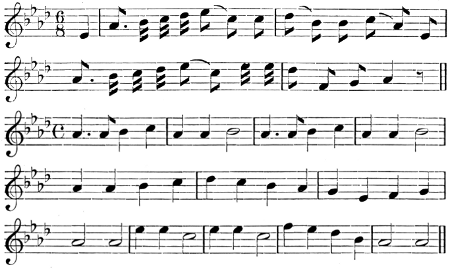
—Barnes (A. B. Gomme).
I.
Poor Mary sits a-weepin’, A-weepin’, a-weepin’; Poor Mary sits a-weepin’ On a bright summer’s day. Pray, Mary, what’re you weepin’ for, A-weepin’ for, a-weepin’ for? Pray, Mary, what’re you weepin’ for? On a bright summer’s day. I’m weepin’ for a sweetheart, A sweetheart, a sweetheart; I’m weepin’ for a sweetheart, On a bright summer’s day. Pray, Mary, choose your lover, Your lover, your lover; Pray, Mary, choose your lover On a bright summer’s day. Now you’re married, I wish you joy; First a girl, and then a boy; Seven years after, son and daughter; Pray, young couple, come kiss together. Kiss her once, kiss her twice, Kiss her three times over.
—Barnes, Surrey (A. B. Gomme).
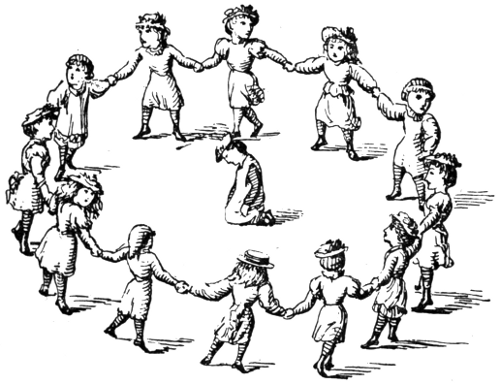
“Poor Mary sits a-weeping.”
II.
Poor Mary is weeping, is weeping, is weeping, Poor Mary is weeping on a bright summer’s day. Pray tell me what you’re weeping for, weeping for, weeping for, Pray tell me what you’re weeping for, on a bright summer’s day? I’m weeping for my true love, my true love, my true love, I’m weeping for my true love, on a bright summer’s day. Stand up and choose your lover, your lover, your lover, Stand up and choose your lover, on a bright summer’s day. Go to church with your lover, your lover, your lover, Go to church with your lover, on a bright summer’s day. Be happy in a ring, love; a ring, love; a ring, love. Kiss both together, love, on this bright summer’s day.
—Upton-on-Severn, Worcestershire (Miss Broadwood).
III.
Pray, Sally, what are you weeping for— Weeping for—weeping for? Pray, Sally, what are you weeping for, On a bright shiny day? I am weeping for a sweetheart— A sweetheart—a sweetheart; I am weeping for a sweetheart, On a bright shiny day. Pray, Sally, go and get one— Go and get one—get one; Pray, Sally, go and get one, On a bright shiny day. Pray, Sally, now you’ve got one— You’ve got one—got one; Pray, Sally, now you’ve got one, On a bright sunny day. One kiss will never part you— Never part you—part you; One kiss will never part you, On a bright sunny day.
—Dorsetshire (Folk-lore Journal, vii. 209).
IV.
Poor —— sat a-weeping, A-weeping, a-weeping; Poor —— sat a-weeping, On a bright summer’s day. I’m weeping for a sweetheart, A sweetheart, a sweetheart; I’m weeping for a sweetheart, On a bright summer’s day. Oh, pray get up and choose one, And choose one, and choose one; Oh, pray get up and choose one, On a bright summer’s day. Now you’re married, you must obey; You must be true to all you say. You must be kind, you must be good, And help your wife to chop the wood.
—Sporle, Norfolk (Miss Matthews).
V.
Poor Mary sat a-weeping, a-weeping, a-weeping, Poor Mary sat a-weeping, down by the sea-side. By the side of the river, by the side of the river, She sat down and cried. Oh, pray get up and choose one, and choose one, and choose one, Oh, pray get up and choose one, down by the sea-side. Now you’re married, I wish you joy; Father and mother you must obey; Love one another like sister and brother, And pray, young couple, come kiss one another.
—Colchester (Miss G. M. Frances).
VI.
Poor Mary is a-weeping, a-weeping, a-weeping, Poor Mary is a-weeping on a fine summer’s day. What is she weeping for, weeping for, weeping for, What is she weeping for on a fine summer’s day? She’s weeping for her sweetheart, her sweetheart, her sweetheart, She’s weeping for her sweetheart on a fine summer’s day. Pray get up and choose one, choose one, choose one, Pray get up and choose one on a fine summer’s day. Pray go to church, love; church, love; church, love; Pray go to church, love, on a fine summer’s day. Pray put the ring on, ring on, ring on, Pray put the ring on, on a fine summer’s day. Pray come back, love; back, love; back, love; Pray come back, love, on a fine summer’s day. Now you’re married, we wish you joy; Your father and mother you must obey; Love one another like sister and brother; And now it’s time to go away.
—(Suffolk County Folk-lore, pp. 66, 67.)
VII.
Poor Mary sits a-weeping, a-weeping, a-weeping, Poor Mary sits a-weeping on a bright summer’s day. Pray tell me what you are weeping for, weeping for, weeping for, Pray tell me what you are weeping for on a bright summer’s day? I’m weeping for a sweetheart, a sweetheart, a sweetheart, I’m weeping for a sweetheart on a bright summer’s day. Poor Mary’s got a shepherd’s cross, a shepherd’s cross, a shepherd’s cross, Poor Mary’s got a shepherd’s cross on a bright summer’s day.
—Berkshire (Miss Thoyts, Antiquary, xxvii. 254).
VIII.
Mary sits a-weeping, a-weeping, a-weeping, Mary sits a-weeping, close by the sea-side. Mary, what are you weeping for, weeping for, weeping for, Mary, what are you weeping for, close by the sea-side? I’m a-weeping for my sweetheart, my sweetheart, my sweetheart, I’m a-weeping for my sweetheart, close by the sea-side. Pray get up and choose one, and choose one, and choose one, Pray get up and choose one, close by the sea-side.
—Winterton and Lincoln (Miss M. Peacock).
IX.
Poor Mary sits a-weeping, a-weeping, Poor Mary sits a-weeping, on a bright summer’s day. She is weeping for her lover, her lover, She is weeping for her lover on a bright summer’s day. Stand up and choose your lover, your lover, Stand up and choose your lover, on a bright summer’s day. And now she’s got a lover, a lover, And now she’s got a lover, on a bright summer’s day.
—Hanbury, Staffs. (Miss E. Hollis).
X.
Oh, what is Nellie weeping for, A-weeping for, a-weeping for? Oh, what is Nellie weeping for, On a cold and sunshine day? I’m weeping for my sweetheart, My sweetheart, my sweetheart; I’m weeping for my sweetheart On a cold and sunshine day. So now stand up and choose the one, And choose the one, and choose the one; So now stand up and choose the one, On a cold and sunshine day.
—Forest of Dean, Gloucestershire (Miss Matthews).
XI.
Poor Mary sits a-weeping, a-weeping, a-weeping, Poor Mary sits a-weeping, on a bright summer’s day. Pray what are you a-weeping for, a-weeping for, a-weeping for, Pray what are you a-weeping for on a bright summer’s day? She’s weeping for a lover, a lover, a lover, She’s weeping for a lover, this bright summer’s day. Rise up and choose your lover, your lover, your lover, Rise up and choose your lover, this bright summer’s day. Now Mary she is married, is married, is married, Now Mary she is married this bright summer’s day.
—Enborne School, Newbury, Berks. (Miss M. Kimber).
XII.
Poor Sarah’s a-weeping, A-weeping, a-weeping; Oh, what is she a-weeping for, A-weeping for, a-weeping for? I’m weeping for a sweetheart, A sweetheart, a sweetheart; I’m weeping for a sweetheart This bright summer day. Oh, she shall have a sweetheart, A sweetheart, a sweetheart; Oh, she shall have a sweetheart This bright summer day. Go to church, loves, Go to church, loves. Say your prayers, loves, Say your prayers, loves. Kiss your lovers, Kiss your lovers; Rise up and choose your love.
—Liphook, Hants. (Miss Fowler).
XIII.
Poor Mary sits weeping, weeping, weeping, Poor Mary sits weeping on a bright summer’s day; On the carpet she must kneel till the grass grows on the field. Stand up straight upon your feet, And show me the one you love so sweet. Now you’re married, I wish you joy; First a girl, and second a boy; If one don’t kiss, the other must, So kiss, kiss, kiss.
—Cambridge (Mrs. Haddon).
XIV.
Poor Mary is a-weeping, a-weeping, a-weeping, Poor Mary is a-weeping on a bright summer’s day; Pray what is she a-weeping for, a-weeping for, a-weeping for, Pray what is she a-weeping for, on a bright summer’s day? I’m weeping for my true love, my true love, my true love, I’m weeping for my true love, on a bright summer’s day. Stand up and choose your true love, your true love, your true love, Stand up and choose your true love, on a bright summer’s day. Ring a ring o’ roses, o’ roses, o’ roses, Ring a ring o’ roses; a pocketful of posies.
—Ogbourne, Wilts. (H. S. May).
XV.
Poor Sally is a-weeping, a-weeping, a-weeping, Poor Sally is a-weeping, down by the sea-side. Pray tell me what you’re weeping for, you’re weeping for, you’re weeping for, Pray tell me what you’re weeping for, down by the sea-side? I’m weeping for my sweetheart, my sweetheart, my sweetheart, I’m weeping for my sweetheart, down by the sea-side. A ring o’ roses, A pocketful of posies; Isham! Isham! We all tumble down.
—Manton, Marlborough, Wilts. (H. S. May).
XVI.
Poor Mary is a-weeping, a-weeping, a-weeping, On a fine summer’s day; What is she weeping for, weeping for, weeping for? She is weeping for her lover, her lover, her lover; And who is her love, who is her lover? Johnny Baxter is her lover, Johnny Baxter is her lover; And where is her lover, where is her lover? Her lover is a-sleeping, her lover is a-sleeping, Is a-sleeping at the bottom of the sea.
—South Devon (Notes and Queries, 8th Series, i. 249, Miss R. H. Busk).
XVII.
Poor Mary, what are you weeping for? You weeping for? You weeping for? Poor Mary, what are you weeping for, On a bright summer’s day? Pray tell us what you are weeping for? You are weeping for? You are weeping for? Pray tell us what you are weeping for, On a bright summer’s day. My father he is dead, sir; Is dead, sir; Is dead, sir. My father he is dead, sir, On a bright summer’s day.
—Earls Heaton (Herbert Hardy).
XVIII.
Poor Mary is a-weeping, a-weeping, a-weeping, Poor Mary is a-weeping, on a fine summer’s day. Pray tell me what you’re weeping for? &c. Because my father’s dead and gone, is dead and gone, is dead and gone; Because my father’s dead and gone, on a fine summer’s day. She is kneeling by her father’s grave, her father’s grave, her father’s grave; She is kneeling by her father’s grave, on a fine summer’s day. Stand up and choose your love, choose your love, choose your love; Stand up and choose your love, on a bright summer’s day.
—(Rev. W. Gregor).
XIX.
Oh, what is Jennie weeping for, A-weeping for, a-weeping for? Oh, what is Jennie weeping for, All on this summer’s day? I’m weeping for my own true love, My own true love, my own true love; I’m weeping for my own true love, All on this summer’s day. Rise up and choose another love, Another love, another love; Rise up and choose another love, All on this summer’s day.
—Berwickshire (A. M. Bell, Antiquary, xxx. 16).
No. Barnes. En- borne. Dorset- shire. Upton. Sporle. Col- chester. Winter- ton. Forest of Dean. Lip- hook. Earls Heaton. Suf- folk. Berk- shire. Staf- ford- shire. New- bury. South Devon. Cam- bridge. Og- bourne. Manton. Ber- wick- shire. Scot- land.
1. Poor Mary sits a-weeping. Poor Mary sits a-weeping. — Poor Mary is weeping. Poor [ ] sat a-weeping. Poor Mary sat a-weeping. Mary sits a-weeping. — Poor Sarah’s a-weeping. — Poor Mary sits a-weeping. Poor Mary sits a-weeping. Poor Mary sits a-weeping. Poor Mary sits a-weeping. Poor Mary is a-weeping. Poor Mary is a-weeping. Poor Mary is a-weeping. Poor Sally is a-weeping. What is Jennie weeping for? Poor Mary is a-weeping.
2. Pray, Mary, what are you weeping for? Pray, what are you a-weeping for? Pray, Sally, what are you weeping for? Pray, tell me what you’re weeping for. — — Mary, what are you weep’ng for? Oh! what is Nellie weeping for? Oh, what is she a-weeping for? Poor Mary, what are you weeping for? What is she weeping for? — — Pray what are you weeping for? What is she weeping for? — Pray what is she weeping for? Pray tell me what you’re weeping for. — Pray tell me what you’re weeping for.
3. — — — — — — — — — Pray tell us what you are weeping for? — Pray tell me what she is weeping for? — — — — — — — —
4. I’m weeping for a sweetheart. She’s weeping for a lover. I’m weeping for a sweetheart. I am weeping for my true love. I’m weeping for a sweetheart. — I’m weeping for a sweetheart. I’m weeping for my sweetheart. I’m weeping for a sweetheart. — She’s weeping for a sweetheart. I’m weeping for a sweetheart. She’s weeping for her lover. She’s weeping for a lover. She’s weeping for her lover. — I’m weeping for my true love. I’m weeping for my sweetheart. I’m weeping for my own true love. —
5. On a bright summer’s day. This bright summer’s day. On a bright shiny day. On a bright summer’s day. On a bright summer’s day. — — — This bright summer’s day. On a bright summer’s day. On a fine summer’s day. On a bright summer’s day. On a bright summer’s day. This bright summer’s day. On a fine summer’s day. — On a bright summer’s day. — All on this summer’s day. On a fine summer’s day.
6. — — — — — By the side of the river. — — — — — — — — — — — — — —
7. — — — — — She sat down and cried. — — — — — — — — — — — — — —
8. — — — — — — Close by the sea side. — — — — — — — [See No. 41.] — — Down by the seaside. — —
9. — — — — — — — On a cold and sunshine day. — — — — — — — — — — — —
10. Pray, Mary, choose your lover. Rise up and choose your lover. — Stand up and choose your lover. Pray, get up and choose one. Pray, get up and choose one. Pray, get up and choose one. Now stand up and choose one. Rise up and choose your lover. — Pray get up and choose one. — Stand up and choose your lover. Rise up and choose your lover. — Stand up upon your feet and show the one you love so sweet. Stand up and choose your true love. — — Stand up and choose your love.
11. — — Pray, Sally, go and get one. — — — — — — — — — — — — — — — — —
12. — — — — — — — — She shall have a sweetheart. — — — — — — — — — Rise up and choose another love. —
13. — — — — — — — — — — — — — — — On the carpet she shall kneel till the grass grows on the field. — — — —
14. Now you’re married, I wish you joy. Now Mary she is married. — — — Now you’re married, I wish you joy. — — — — Now you’re married, we wish you joy. — — Now Mary she is married. — Now you’re married I wish you joy. — — — —
15. First a girl, then a boy. — — — — — — — — — — — — — — First a girl and second a boy. — — — —
16. Seven years after, son and daughter. — — — — — — — — — — — — — — — — — — —
17. — — Pray, Sally, now you’ve got one. — — — — — — — — — — — — — — — — —
18. — — — — Now you’re married you must obey. — — — — — — — — — — — — — — —
19. — — — — You must be true to all you say. — — — — — — — — — — — — — — —
20. — — — — You must be kind and good. — — — — — — — — — — — — — — —
21. — — — — Help wife to chop wood. — — — — — — — — — — — — — — —
22. — — — — — Father and mother you must obey. — — — — Father and mother you must obey. — — — — — — — — —
23. — — — — — Love one another like sister and brother. — — — — Love one another like brother and sister. — — — — — — — — —
24. Pray, young couple, come kiss together. — — — — Pray, young couple, come kiss together. — — — — — — — — — — — — — —
25. — — One kiss will never part you. — — — — — — — — — — — — — — — — —
26. — — — Go to church with your lover. — — — — Go to church, love. — Pray go to church, love. — — — — — — — — —
27. — — — Be happy in a ring, love. — — — — — — — — — — — — — — — —
28. — — — — — — — — Say your prayers, love. — — — — — — — — — — —
29. Kiss her once, twice, kiss three times over. — — Kiss both together, love. — — — — Kiss your lovers. — — — — — — If one don’t kiss, the other must. — — — —
30. — — — — — — — — — My father he is dead, sir. — — — — — — — — — Because my father’s dead and gone.
31. — — — — — — — — — — — — — — — — — — — She’s kneeling by her father’s grave.
32. — — — — — — — — — — Pray put the ring on. — — — — — — — — —
33. — — — — — — — — — — Pray come back, love. — — — — — — — — —
34. — — — — — — — — — — Now it’s time to go away. — — — — — — — — —
35. — — — — — — — — — — — Mary’s got a shepherd’s cross. — — — — — — — —
36. — — — — — — — — — — — — Now she’s got a lover. — — — — — — —
37. — — — — — — — — — — — — — — Who is her lover? — — — — —
38. — — — — — — — — — — — — — — I. O. is her lover. — — — — —
39. — — — — — — — — — — — — — — Where is her lover? — — — — —
40. — — — — — — — — — — — — — — Her lover is sleeping. — — — — —
41. — — — — — — — — — — — — — — At the bottom of the sea. — — — — —
42. — — — — — — — — — — — — — — — — Ring a ring o’ roses a pocketful of posies. A ring of roses a pocketful of posies. — —
43. — — — — — — — — — — — — — — — — — We all tumble down. — —
No. Barnes. Enborne. Dorsetshire. Upton. Sporle. Colchester. Winterton.
1. Poor Mary sits a-weeping. Poor Mary sits a-weeping. — Poor Mary is weeping. Poor [ ] sat a-weeping. Poor Mary sat a-weeping. Mary sits a-weeping.
2. Pray, Mary, what are you weeping for? Pray, what are you a-weeping for? Pray, Sally, what are you weeping for? Pray, tell me what you’re weeping for. — — Mary, what are you weep’ng for?
3. — — — — — — —
4. I’m weeping for a sweetheart. She’s weeping for a lover. I’m weeping for a sweetheart. I am weeping for my true love. I’m weeping for a sweetheart. — I’m weeping for a sweetheart.
5. On a bright summer’s day. This bright summer’s day. On a bright shiny day. On a bright summer’s day. On a bright summer’s day. — —
6. — — — — — By the side of the river. —
7. — — — — — She sat down and cried. —
8. — — — — — — Close by the sea side.
9. — — — — — — —
10. Pray, Mary, choose your lover. Rise up and choose your lover. — Stand up and choose your lover. Pray, get up and choose one. Pray, get up and choose one. Pray, get up and choose one.
11. — — Pray, Sally, go and get one. — — — —
12. — — — — — — —
13. — — — — — — —