Volume 1 — CHILDREN’S GAMES (continued 3)
Reading edition
Guess who stands behind you?
If the first girl guesses right she keeps her old place, and they begin again. If she is wrong the child who has come from the row takes her place, and a new game is begun. Of course the child who asks the last question alters its voice as much as possible, so as not to be recognised.—Liphook, Hants. (Miss Fowler).
Rigs
A game of children in Aberdeenshire, said to be the same as Scotch and English, and also called Rockety Row.—Jamieson’s Dictionary.
Ring
See “Ring-taw.”
Ring a Ring o’ Roses
[Play]

—Marlborough (H. S. May).
[Play]

—Yorkshire (H. Hardy).
[Play version 1, version 2]
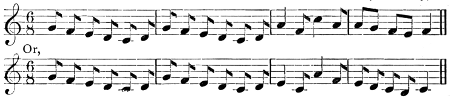
—Sporle (Miss Matthews).
I.
Ring a ring o’ roses, A pocket-full o’ posies; One for me, and one for you, And one for little Moses— Hasher, Hasher, Hasher, all fall down.
—Winterton, Lincoln, and Leadenham (Miss M. Peacock).
II.
A ring, a ring o’ roses, A pocket-full o’ posies; One for Jack, and one for Jim, and one for little Moses— A-tisha! a-tisha! a-tisha!
—Shropshire (Burne’s Shropshire Folk-lore, p. 511).
III.
A ring, a ring o’ roses, A pocket-full o’ posies; A curchey in, and a curchey out, And a curchey all together.
—Edgmond (Burne’s Shropshire Folk-lore, p. 571).
IV.
Ring, a ring o’ roses, A pocket full o’ posies; Up-stairs and down-stairs, In my lady’s chamber— Husher! Husher! Cuckoo!
—Wakefield, Yorks. (Miss Fowler).
V.
Ring, a ring of roses, Basket full of posies— Tisha! Tisha! all fall down.
—Penzance, Cornwall (Mrs. Mabbott).
VI.
Ring, a ring a roses, A pocketful of posies; Hush, oh! hush, oh! All fall down!
—Colchester, Essex (Miss G. M. Frances).
VII.
Ring, a ring a rosy, A pocket full of posies; One for you, and one for me, And one for little Moses— Atishm! Atishm!
—Beddgelert (Mrs. Williams).
VIII.
A ring, a ring of roses, A pocket full of posies— Hist! hush! last down dead!
—Gainford, Durham (Miss A. Eddleston).
IX.
Ring, a ring a row-o, See the children go-o, Sit below the goose-berry bush; Hark! they all cry Hush! hush! hush! Sitty down, sit down. Duzzy, duzzy gander, Sugar, milk, and candy; Hatch-u, hatch-u, all fall down together.
—South Shields (Miss Blair, aged 9).
X.
Ringey, ringey rosies, A pocketful of posies— Hach-ho, hach-ho, all fall down.
Another version—
Hash-ho! Tzhu-ho! all fall down.
—Sporle, Norfolk (Miss Matthews).
XI.
Windy, windy weather, Cold and frosty weather, When the wind blows We all blow together. I saw Peter! When did you meet him? Merrily, cherrily [so pronounced] All fall down. A ring, a ring of roses, A pocketful of posies— Ashem, ashem, all fall down.
—Sheffield (S. O. Addy).
(b) A ring is formed by the children joining hands. They all dance round, singing the lines. At the word “Hasher” or “Atcha” they all raise their hands [still clasped] up and down, and at “all fall down” they sit suddenly down on the ground. In Lancashire (Morton) they pause and curtsey deeply. The imitation of sneezing is common to all. Miss Peacock says, in Nottinghamshire they say “Hashem! Hashem!” and shake their heads. In the Sheffield version the children sing the first eight lines going round, and all fall down when the eighth is sang. They then form a ring by holding hands, and move round singing the next three lines, and then they all fall either on their knees or flat on their faces.
(c) Versions of this game, identical with the Winterton one, have been sent me by Miss Winfield, Nottingham; others, almost identical with the second Norfolk version, from Monton, Lancashire (Miss Dendy), North Staffs. Potteries, Norbury, Staffs., (Miss A. Keary), Earls Heaton, Yorks. (H. Hardy). Addy, Sheffield Glossary, gives a version almost identical with the last Sporle version.
Addy, Sheffield Glossary, compares the old stories about rose-laughing in Grimm’s Teut. Myth. iii. 1101. “Gifted children of fortune have the power to laugh roses, as Treyja wept gold. Probably in the first instance they were Pagan beings of light, who spread their brightness in the sky over the earth—‘rose children,’ ‘sun children.’” This seems to me to be a very apposite explanation of the game, the rhymes of which are fairly well preserved, though showing in some of the variants that decay towards a practical interpretation which will soon abolish all traces of the mythical origin of game-rhyme. It may, however, simply be the making, or “ringing,” a ring or circle of roses or other flowers and bowing to this. Mr. Addy’s suggestion does not account for the imitation of sneezing, evidently an important incident, which runs through all versions. Sneezing has always been regarded as an important or supernatural event in every-day life, and many superstitious beliefs and practices are connected with it both in savage and civilised life. Newell (Games and Songs of American Children, p. 127) describes “Ring around the Rosie,” apparently this game, but the imitation of sneezing has been lost.
Ring by Ring
Here we go round by ring, by ring, As ladies do in Yorkshire; A curtsey here, a curtsey there, A curtsey to the ground, sir.
—Hersham, Surrey (Folk-lore Record, v. 86).
There is no description of the way this game is played, but it is evidently a similar game to “Ring-a-Ring o’ Roses.”
Ringie, Ringie, Red Belt
Take a small splint of wood, kindle it, and when it is burning turn it rapidly round in a circle, repeating the words—
Ringie, ringie, Red Belt, rides wi’ the king, Nae a penny in’s purse t’buy a gold ring. Bow—ow—ow, fat dog art thou, Tam Tinker’s dog, bow—ow—ow.
—Corgarff (Rev. W. Gregor).
This goes by the name of “Willie Wogie” at Keith, but no words are repeated as the splint is whirled.
See “Jack’s Alive.”
Ring-me-rary
I.
Ring me (1), ring me (2), ring me rary (3), As I go round (4) ring by ring (5), A virgin (6) goes a-maying (7); Here’s a flower (8), and there’s a flower (9), Growing in my lady’s garden (10). If you set your foot awry (11), Gentle John will make you cry (12); If you set your foot amiss (13), Gentle John (14) will give you a kiss. This [lady or gentleman] is none of ours, Has put [him or her] self in [child’s name] power; So clap all hands and ring all bells, and make the wedding o’er.
—Halliwell’s Nursery Rhymes, p. 67.
II.
As I go round ring by ring, A maiden goes a-maying; And here’s a flower, and there’s a flower, As red as any daisy. If you set your foot amiss, Gentle John will give you a kiss.
—Halliwell’s Nursery Rhymes, p. 125.
(b) A number of boys and girls stand round one in the middle, who repeats the lines, counting the children until one is counted out by the end of the verse. The child upon whom (14) falls is then taken out and forced to select one of the other sex. The middle child then proceeds to say the three last lines. All the children clap hands during the saying (or singing) of the last line. If the child taken by lot joins in the clapping, the selected child is rejected, and, I believe, takes the middle place. Otherwise, I think there is a salute.—Halliwell.
(c) This game is recorded by no authority except Halliwell, and no version has reached me, so that I suppose it is now obsolete. It is a very good example of the oldest kind of game, choosing partners or lovers by the “lot,” and may be a relic of the May-day festival, when the worship of Flora was accompanied by rites of marriage not in accord with later ideas.
Ring-taw
A rough ring is made on the ground, and the players each place in it an equal share in “stonies,” or alleys. They each bowl to the ring with another marble from a distance. The boy whose marble is nearest has the first chance to “taw;” if he misses a shot the second boy, whose marble was next nearest to the ring, follows, and if he misses, the next, and so on. If one player knocks out a marble, he is entitled to “taw” at the rest in the ring until he misses; and if a sure “tawer” not one of the others may have the chance to taw. Any one’s “taw” staying within the ring after being tawn at the “shots,” is said to be “fat,” and the owner of the “taw” must then replace any marbles he has knocked out in the ring.—Earls Heaton, Yorks. (Herbert Hardy). Halliwell (Dictionary) describes this game very much as above, except that a fine is imposed on those who leave the taw in the ring. Ross and Stead (Holderness Glossary) give this game as follows:—“Two boys place an equal number of marbles in the form of a circle, which are then shot at alternately, each boy pocketing the marbles he hits.” Addy (Sheffield Glossary) says, “Ring-taw” is a marble marked with a red ring used in the game of marbles. This is commonly called “ring” for short. Evans (Leicestershire Glossary) describes the game much the same as above, but adds some further details of interest. “If the game be knuckle-up the player stands and shoots in that position. If the game be knuckle-down he must stoop and shoot with the knuckle of the first finger touching the ground at taw. In both cases, however, the player’s toe must be on taw. The line was thus called taw as marking the place for the toe of the player, and the marble a taw as being the one shot from the taw-line, in contradistinction to those placed passively in the ring-‘line’ in the one case, and ‘marble’ in the other being dropped as superfluous.”—Strutt (Sports and Pastimes, p. 384) alludes to the game.
In Ireland this game is also called “Ring,” and is played with marbles and buttons. A ring is marked out on a level hard place, and every boy puts down a button. The buttons are lightly struck in the centre of the ring, and all play their marbles to the buttons. The nearest to them play first. The line from which they play is generally about eight feet away, and everybody does his best to strike the buttons. Any put out are kept by the boy putting them out, and if a boy strikes a button, or buttons, out, he can play on until he misses.—Waterville, Cos. Kerry and Cork, T. J. Dennachy (through Mrs. B. B. Green of Dublin).
Rin-im-o’er
A game among children, in which one stands in the middle of a street, road, or lane, while others run across it within a certain given distance from the person so placed, and whose business it is to catch one in passing, when he is released, and the captive takes his place.—Teviotdale (Jamieson’s Dictionary).
It nearly resembles “Willie Wastle.”
Robbing the Parson’s Hen-Roost
This game is played by every player, except one (the questioner), choosing a word, and introducing it into his phrase whenever he gives an answer. For example, X, Y, and Z have chosen the words elephant, key-hole, and mouse-trap.
Questioner. “What did you steal from the parson’s hen-roost?”
X. “An elephant.”
Q. “How did you get into the hen-roost?”
Y. “Through the key-hole.”
Q. “Where did you put what was stolen?”
Z. “Into a mouse-trap.”
And so on with the other players.—Lincoln [generally known] (Miss M. Peacock).
The players choose a name, and another player asks them questions, beginning with, “The Parson’s hen-roost was robbed last night, were you there?” To all questions each player must answer by repeating his own name only: if he forgets and says, “Yes” or “No,” he has to take the questioner’s place.—Haxey, Lincolnshire (Mr. C. C. Bell).
Rockety Row
A play in which two persons stand with their backs to each other, one passing his arms under the shoulders of the other, they alternately lift each other from the ground.—Jamieson’s Dictionary.
See “Bag o’ Malt,” “Weigh the Butter.”
Roll up Tobacco
See “Bulliheisle,” “Eller Tree,” “Wind up the Bush Faggot.”
Roly-poly
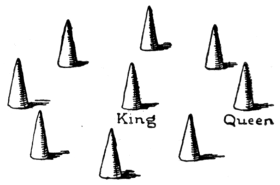
A game played with a certain number of pins and a ball, resembling half a cricket ball. One pin is placed in the centre, the rest (with the exception of one called the Jack) are placed in a circle round it; the Jack is placed about a foot or so from the circle, in a line with the one in the circle and the one in the centre. The centre one is called the King, the one between that and the Jack, the Queen. The King counts for three, the Queen two, and each of the other pins for one each, except Jack. The art of the game lies in bowling down all the pins except Jack, for if Jack is bowled down, the player has just so many deducted from his former score as would have been added if he had not struck the Jack (Holloway’s Dict. Provincialisms). This game was formerly called “Half-bowl,” and was prohibited by a statute of Edward IV. (Halliwell’s Dictionary). Brockett (North Country Words and Phrases) says it is a game played at fairs and races. It is, under the name of “Kayles,” well described and illustrated by Strutt (Sports and Pastimes, p. 270, 271), which is reproduced here. It will be seen that Jamieson describes it as played with a pole or cudgel. He says this game no doubt gave origin to the modern one of “Nine-pins;” though primitively the Kayle-pins do not appear to have been confined to any certain number nor shape. . . . The Kayle-pins appear to have been placed in one row only. He also says that “Half-bowl,” played in Hertfordshire, was called “Roly-poly.”
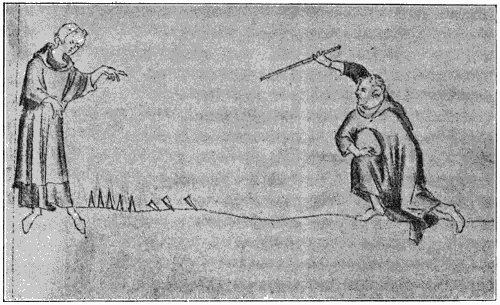
Jamieson (Dictionary) gives this as “Rollie-poly,” a game of nine-pins, called also Kayles. The name “Rollie-poly” was given to it because it was played with a pole, or cudgel, by which the pins were knocked over. In the West of Scotland, where this game was in great repute in olden times, it formed one of the chief sports of Fastern’s-e’en, and was a favourite amusement at fairs and races. The awards for successful throwing were generally in the form of small cakes of gingerbread, which were powerful incentives to the game, and never failed to attract players in response to the cry, “Wha’ll try the lucky Kayles?”
Ronin the Bee
A rude game. A cazzie, or cassie, is unexpectedly thrown over the head of a person. When thus blindfolded he is pressed down, and buckets of water are thrown upon the cassie till the victim is thoroughly saturated.—Jamieson’s Dictionary.
See “Carrying the Queen a Letter,” “Ezzeka.”
Rosy Apple, Lemon and Pear
[Play]
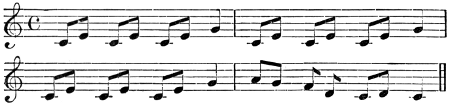
—Sporle, Norfolk (Miss Matthews).
I.
Rosy apple, lemon, or pear, Bunch of roses she shall wear; Gold and silver by her side, I know who will be the bride. Take her by her lily-white hand, Lead her to the altar; Give her kisses,—one, two, three,— Mrs. (child’s name) daughter.
—Hersham, Surrey (Folk-lore Record, v. 58).
II.
Rosy apple, lemon, and pear, A bunch of roses she shall wear; Gold and silver by her side, Choose the one shall be her bride. Take her by her lily-white hand, Lead her to the altar; Give her kisses,—one, two, three,— To old mother’s runaway daughter.
—Symondsbury, Dorsetshire (Folk-lore Journal, vii. 210).
III.
Rosy apple, lemon, and a pear, A bunch of ribbons she shall wear; Gold and silver by her side, I know who will be her bride. Take her by the lily-white hand, Lead her over the water; Give her kisses,—one, two, three,— For Mrs. —— daughter.
—Maxey, Northants. (Rev. W. D. Sweeting).
IV.
Rosy apple, lemon, and a pear, Bunch of roses you shall wear; Gold and silver by your side, I know who shall be a bride. Take her by the lily-white hand, Lead her ’cross the water; Give her kisses,—one, two, three,— For Mrs. (So-and-so’s) daughter.
—Deptford, Kent (Miss Chase).
V.
Rosie had an apple and a pear, A bunch of roses she shall wear; Gold and silver by her side, I knows who shall be her bride. Take her by the lily-white hand, Lead her across the water; Give her a kiss, and one, two, three, Old Mother Sack-a-biddy’s daughter!
—Ogbourne, Wilts. (H. S. May).
VI.
Rosy apples, mellow pears, Bunch of roses she shall wear; Gold and silver by her side, Tell me who shall be her bride. Take her by her lily-white hand, Lead her across the ocean; Give her a kiss, and one, two, three, Mrs. —— daughter.
—Sporle, Norfolk (Miss Matthews).
VII.
A rosy apple, lemon, and a pear, A bunch of roses she shall wear; Gold and silver by your side, Choose the one to be your bride. Take her by her lily-white hand, Lead her to the altar; Give her a kiss by one, two, three, Mrs. —— daughter.
—Cowes, I. of Wight (Miss E. Smith).
VIII.
Roses up, and roses down, Roses in the garden; I wadna gie ye a bunch o’ flowers For tenpence halfpenny farden. Take her by the lily-white hand, Lead her across the water; Gie her a kiss, and one, two, three, For she’s a lady’s daughter.
—Berwickshire (A. M. Bell) Antiquary, xxx. 16.
IX.
Maggie Littlejohn, fresh and fair, A bunch of roses in her hair; Gold and silver by her side, I know who is her bride. Take her by the lily-white hand, Lead her over the water; Give her kisses,—one, two, three,— For she’s a lady’s daughter. Roses up, and roses down, And roses in the garden; I widna give a bunch of roses For twopence ha’penny farthing.
—Rev. W. Gregor.
X.
Roses up, and roses down, And roses in the garden; I widna gie a bunch o’ roses For tippence ha’penny farden. So and so, fresh and fair, A bunch o’ roses she shall wear; Gold and silver by her side, Crying out, “Cheese and bride” (bread). Take her by the lily-white hand, Lead her on the water; Give her kisses,—one, two, three,— For she’s her mother’s daughter.
—Fraserburgh (Rev. W. Gregor).
XI.
Roses up, and roses down, And roses in the garden; I wadna gie a bunch o’ roses For twopence ha’penny farthin’. ——, fresh and fair, A bunch of roses she shall wear; Gold and silver by her side, I know who’s her bride. Take her by the lily-white hand, And lead her o’er the water; And give her kisses,—one, two, three,— For she’s the princess’ daughter.
—Cullen (Rev. W. Gregor).
XII.
Maggie Black, fresh and fair, A bunch of roses she shall wear; I know who I’ll take. Give her kisses,—one, two, three,— For she’s a lady’s daughter. Roses in, and roses out, Roses in a garden; I would not give a bunch of roses For twopence halfpenny “farden.”
—Nairn (Rev. W. Gregor).
(c) The players form a ring, one child stands in the centre, who chooses a sweetheart from the ring when the fifth line is sung; the two kiss, the first child takes her place in the ring, the second child remains in the centre, and the game begins again. This is the method adopted in most of the versions. The Symondsbury game is slightly different; the first part is the same, but when the last line is sung the child who was first in the middle must run away and take a place in the ring as soon as she can. The second one remains in the centre. The Maxey (Northants.) version is altogether different. All the children but one stand in a row. The one stands in front of them and sings the lines by herself; at the last line she selects one from the line by naming her. These two then sing the lines, “swinging round,” so described by Mr. Sweeting’s informant. They then select a third when singing the last line, and the three then swing round. This is repeated till all the children from the line come into the ring.
In the Scotch versions the players all stand in a line, with one in front, and sing. At the end of the fourth line the one in front chooses one from the line, and all again sing, mentioning the name of the one chosen (Fraserburgh). At Cullen, one child stands out of the line and goes backwards and forwards singing, then chooses her partner, and the two go round the line singing.
(d) A version which I collected in Barnes is not so perfect as those given here, only the four first lines being sung. A Kentish version sent me by Miss Broadwood is almost identical with the Deptford game. Miss Broadwood’s version commences—
Rosy apple, miller, miller, pear.
An Ipswich version is almost identical with that of Hersham, Surrey (Lady C. Gurdon’s Suffolk County Folk-lore, p. 64), except that it begins “Golden apple” and ends with the marriage formula—
Now you’re married, I wish you joy, Father and mother you must obey; Love one another like sister and brother, And now’s the time to kiss away.
(e) This game is probably derived from the mode of dressing the bride in the marriage ceremony, and is not very ancient. The line “Lead her to the altar” probably indicates the earliest version, corrupted later into “Lead her across the water,” and this would prove a comparatively modern origin. If, however, the “altar” version is a corruption of the “water” version, the game may go back to the pre-Christian marriage ceremony, but of this there is little evidence.
Roundabout, or Cheshire Round
This is danced by two only, one of each sex; after leading off into the middle of an imaginary circle, and dancing a short time opposite to each other, the one strives by celerity of steps in the circumference of the circle to overtake and chase the other round it; the other in the meantime endeavouring to maintain an opposite situation by equal celerity in receding.—Roberts’ Cambrian Popular Antiquities, p. 46.
Halliwell gives Round, a kind of dance. “The round dance, or the dancing of the rounds.”—Nomenclator, 1585, p. 299. There was a sort of song or ballad also so called.—Dict. Provincialisms.
Round and Round the Village
[Play]
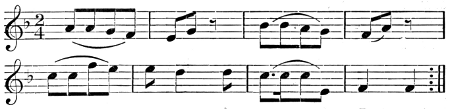
—Barnes, Surrey (A. B. Gomme).
[Play]
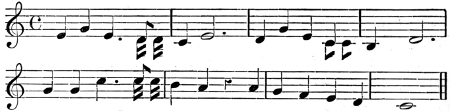
—Hanbury, Staff. (Edith Hollis).
I.
Round and round the village, Round and round the village; Round and round the village, As we have done before. In and out the windows, In and out the windows; In and out the windows, As we have done before. Stand and face your lover, Stand and face your lover; Stand and face your lover, As we have done before. Follow her to London, Follow her to London; Follow her to London, As we have done before. Kiss her before you leave her, Kiss her before you leave her; Kiss her before you leave her, As we have done before.
—Barnes, Surrey (taken down from children of village school—A. B. Gomme).
II.
Round and round the village, Round and round the village; Round and round the village, As you have done before. In and out the window, In and out the window; In and out the window, As you have done before. Stand and face your lover, Stand and face your lover; Stand and face your lover, As you have done before.
—Deptford, Kent (Miss Chase).
III.
Round and round the village, In and out of the window; Stand and face your lover, As you have done before. Stand and face your lover, Stand and face your lover; Oh, stand and face your lover, As you have done before. Follow me to London, Follow me to London; Oh, follow me to London, As you have done before.
—Wakefield, Yorks. (Miss Fowler).
IV.
Round and round the village, In and out of the window; Stand and face your lover, As you have done before; Oh, stand and face your lover, As you have done before, O. Follow me to London, Follow me to London; Follow me to London, As you have done before.
—Winterton and Bottesford, Lincolnshire (Miss M. Peacock).
V.
Round and round the village, Round and round the village; Round and round the village, As you have done before. In and out the windows, In and out the windows; In and out the windows, As you have done before. Stand and face your lover, Stand and face your lover; Stand and face your lover, As you have done before. Shake hands with your lover, Shake hands with your lover; Shake hands with your lover, As you have done before.
—From girls of Clapham High School (Miss F. D. Richardson).
VI.
Out and in the villages, Out and in the villages; Out and in the villages, As you have done before. Out and in the windows, Out and in the windows; Out and in the windows, As you have done before. Stand before your lover, Stand before your lover; Stand before your lover, As you have done before.
—Cullen (Rev. W. Gregor).
VII.
Go round and round the village, Go round and round the village, As we have done before. Go in and out the window, Go in and out the window, As we have done before. Come in and face your lover, Come in and face your lover, As we have done before. I measure my love to show you, I measure my love to show you, As we have done before. I kneel because I love you, I kneel because I love you, As we have done before. Follow me to London, Follow me to London, As we have done before. Back again to Westerham, Back again to Westerham, As we have done before.
—Crockham Hill, Kent (Miss Chase).
VIII.
Walking round the village, Walking round the village; Walking round the village, As we have done before. In and out the windows, In and out the windows; In and out the windows, As you have done before. Stand and face your lover, Stand and face your lover; Stand and face your lover, As you have done before. Now they go off courting, Now they go off courting; Now they go off courting, As they have done before. Chase her back to Scotland, Chase her back to Scotland; Chase her back to Scotland, As you have done before.
—Penzance, Cornwall (Mrs. Mabbott).
IX.
Round about the village, Round about the village; Round about the village, As you have done before. In and out of the windows, In and out of the windows; In and out of the windows, As you have done before. I stand before my lover, I stand before my lover; I stand before my lover, As I have done before. Follow me to London, Follow me to London; Follow me to London, As you have done before. Dance away to Fairyland, Dance away to Fairyland; Dance away to Fairyland, As we have done before.
—Stevenage, Herts. (Mrs. Lloyd, taught to a friend’s children by a nurse from Stevenage).
X.
All round the village, All round the village; All round the village, As we have done before. In and out of the window, In and out of the window; In and out of the window, As we have done before. Stand and face your lover, Stand and face your lover; Stand and face your lover, As we have done before. Kiss her if you love her, Kiss her if you love her; Kiss her if you love her, As we have done before. Take her off to London, Take her off to London; Take her off to London, As we have done before.
—Earls Heaton, Yorks. (Herbert Hardy).
XI.
All round the village, All round the village; All round the village, As you have done before. In and out the windows, In and out the windows; In and out the windows, As you have done before. Stand and face your lover, Stand and face your lover; Stand and face your lover, As you have done before. Follow her to London, Follow her to London; Follow her to London, As you have done before.
—Tean, North Staffs, (from a Monitor in the School).
XII.
Round and round the village, &c., As you have done before. In and out the windows, as you have done before. Stand and face your lover, &c. Follow me to London, &c.
—Roxton, St. Neots (Miss E. Lumley).
XIII.
Out and in the windows, Out and in the windows; Out and in the windows, As you have done before. Stand before your lover, Stand before your lover; Stand before your lover, As you have done before. Follow her to London, Follow her to London; Follow her to London, Before the break of day.
—Fraserburgh (Rev. W. Gregor).
XIV.
In and out of the window, In and out of the window; In and out of the window, As you have done before. Stand and face your lover, Stand and face your lover; Stand and face your lover, As you have done before. Give me a kiss, my darling, Give me a kiss, my darling; Give me a kiss, my darling, As you have done before. Follow me to London, Follow me to London; Follow me to London, As you have done before.
—Hanbury, Staffordshire (Miss E. Hollis).
XV.
Marching round the ladies, Marching round the ladies, as you have done before. In and out the windows, In and out the windows, as you have done before. Stand and face your lover, Stand and face your lover, as you have done before. Follow me to London, Follow me to London, as you have done before. Bring me back to Belfast, Bring me back to Belfast, as you have done before.
—Belfast, Ireland (W. R. Patterson).
XVI.
Come gather again on the old village green, Come young and come old, who once children have been. Such frolics and games as ne’er before were seen, We join in riots and play [? riotous]. Take her off to London, Take her off to London, Take her off to London. In and out the windows, In and out the windows; In and out the windows, As you have gone before. Round about the village, Round about the village; Round about the village, As you have gone before. Soon we will get married, Soon we will get married; Soon we will get married, And never more depart.
—Sporle, Norfolk (Miss Matthews).
XVII.
Three jolly sailor boys Lately come ashore, Spend their time in drinking lager wine, As they have done before. We go round, and round, and round, As we have done before; And this is a girl, and a very pretty girl, A kiss for kneeling there. Go in and out the window, Go in and out the window; Go in and out the window, As we have done before. Follow me to London, Follow me to London; Follow me to London, As we have done before. Go back and face your lover, Go back and face your lover; Go back and face your lover, As we have done before.
—Brigg (from a Lincolnshire friend of Miss J. Barker).
XVIII.
Up and down the valley, Up and down the valley; Up and down the valley, As I have done before. In and out the window, In and out the window; In and out the window, As I have done before. Stand and face your lover, Stand and face your lover; Stand and face your lover, As I have done before. Follow me to London, Follow me to London; Follow me to London, As I have done before.
—Settle, Yorks. (Rev. W. S. Sykes).
XIX.
XIX. In and out the willows, In and out the willows; In and out the willows, As you have done before. Stand and face your lover, Stand and face your lover; Stand and face your lover, As you have done before. Follow me to London, Follow me to London; Follow me to London, As you have done before.
—West Grinstead, Sussex (Notes and Queries, 8th Series, i. 249, Miss Busk).
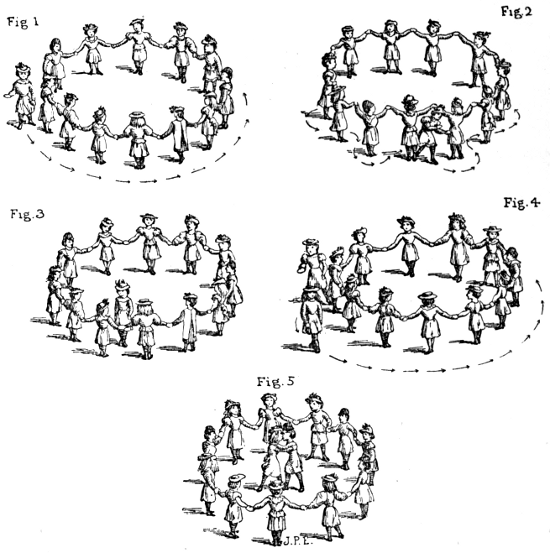
(c) The children join hands and form a ring with one child standing outside. The ring stands perfectly still throughout this game and sings the verses, the action being confined to at first one child, and then to two together. During the singing of the first verse the outside child dances round the ring on the outside. When the ring commences to sing the second verse the children hold up their arms to form arches, and the child who has been running round outside runs into the ring under one pair of joined hands, and out again under the next pair of arms, continuing this “in and out” movement until the third verse is commenced. The child should try and run in and out under all the joined hands. At the third verse the child stops in the ring and stands facing one, whom she chooses for her lover, until the end of the verse; the chosen child then leaves the ring, followed by the first child, and they walk round the ring, or they walk away a little distance, returning at the commencement of next verse. In the first three versions the second child is chased back and caught by the first child. In the Clapham version the two shake hands in the last verse. The Barnes version has kissing for its finale. The Hanbury also has kissing, but it precedes the following to London. In the Brigg, Lincolnshire (Miss Barker), a child stands in the middle and points with her finger to each one she passes; finally selects one, who leaves the ring and kneels in front of the girl in the middle. At the end of the second verse the kneeling child gets up and the first child goes in and out under the arms of the players, followed by the other. At the fourth they reverse and go back under the arms in the opposite direction, finally stopping in the middle of the ring, when another child is chosen and the first one in goes out. In the Winterton and Bottesford versions (Miss Peacock), at the words “Stand and face your lover,” the child who has been going “in and out” stands before the one she chooses, beckons to her, and sings the next verse. Then the chosen one chases her until she can catch her. In the Crockham Hill version (Miss Chase) the love is measured out with a handkerchief three times, and after kneeling in the road, the chosen partner follows round the ring and reverses for the return.
(d) The analysis of the game-rhymes is on pp. 134-39. This shows that we are dealing with a game which represents a village, and also the houses in it. The village only disappears in six out of the twenty versions. In three of these (Hanbury, Fraserburgh, and West Grinstead) the line has gone altogether. In the fourth (Lincolnshire) it becomes “Round and round and round,” no mention being made of the village. In the fifth (Belfast) the line has become “Marching round the ladies.” In the sixth (Settle) it has become “Up and down the valley,” which also occurs in another imperfect version, of which a note was sent me by Miss Matthews from the Forest of Dean, where the line has become “Round and round the valley.” The substitution of “ladies” for “village” is very significant as evidence that the game, like all its compeers, is in a declining stage, and is, therefore, not the invention of modern times. The idea of a circle of children representing a village would necessarily be the first to die out if the game was no longer supported by the influence of any custom it might represent. The line of decadence becomes in this way an important argument for the discovery of the original form.
No. Corn- wall, Pen- zance. Kent, Crock- ham Hill. Herts, Steven- age. Yorks, Earls Heaton. N. Stafford- shire, Tean. Surrey, Clapham. Lincoln- shire. Surrey, Barnes. Nor- folk, Sporle. Staf- ford- shire, Han- bury. Belfast. Wake- field. Lin- coln- shire, Winter- ton. Dept- ford. Cullen. Roxton. Fraser- burgh. Settle. West Grin- stead.
1. — — — — — — Three jolly sailor boys. — Come gather again on the old village green. — — — — — — — — — —
2. Walking round the village. Go round and round the village. Round about the village. All round the village. All round the village. Round and round the village. — Round and round the village. Round about the village. — — Round and round the village. Round and round the village. Round and round the village. — Round and round the village. — — —
3. — — — — — — — — — — — — — — — — — Up and down the valley. —
4. — — — — — — — — — — — — — — Out and in the villages. — — — —
5. — — — — — — We go round and round and round. — — — — — — — — — — — —
6. — — — — — — — — — — Marching round the ladies. — — — — — — — —
7. As we have done before. As we have done before. As you have done before. As we have done before. As you have done before. As you have done before. As we have done before. As we have done before. As you have done before. — As you have done before. — — As you have done before. As you have done before. As you have done before. — As I have done before. —
8. — — — — — — And this a girl and a very pretty girl. — — — — — — — — — — — —
9. — — — — — — A kiss for kneeling here. — — — — — — — — — — — —
10. In and out the windows. Go in and out the windows. In and out of the windows. In and out of the window. In and out the window. In and out the window. Go in and out the window. In and out the windows. In and out the windows. In and out of the windows. In and out the windows. In and out of the window. In and out of the window. In and out the windows. Out and in the windows. In and out the windows. Out and in the windows. In and out the window. In and out the windows.
11. — — — — — — — — — — — — — — — — — — —
12. As you have done before. As we have done before. As you have done before. As we have done before. As you have done before. As you have done before. As we have done before. As we have done before. As you have done before. As you have done before. As you have done before. — — As you have done before. As you have done before. As you have done before. As you have done before. As I have done before. As you have done before.
13. Stand and face your lover. — Stand before my lover. Stand and face your lover. Stand and face your lover. Stand and face your lover. — Stand and face your lover. — Stand and face your lover. Stand and face your lover. Stand and face your lover. Stand and face your lover. Stand and face your lover. Stand before your lover. Stand and face your lover. Stand before your lover. Stand and face your lover. Stand and face your lover.
14. — Come in and face your lover. — — — — — — — — — — — — — — — — —
15. — — — — — — Go back and face your lover. — — — — — — — — — — — —
16. As you have done before. As we have done before. As I have done before. As we have done before. As you have done before. As you have done before. As we have done before. As we have done before. — As you have done before. As you have done before. As you have done before. As you have done before. As you have done before. — — As you have done before. As I have done before. As you have done before.
17. Now they go off courting. — — — — — — — — — — — — — — — — — —
18. — I measure my love to show you. — — — — — — — — — — — — — — — — —
19. — — — Kiss her if you love her. — — — Kiss her before you leave her. — — — — — — — — — — —
20. — — — — — Shake hands with your lover. — — — — — — — — — — — — —
21. — — — — — — — — Soon we will get married. — — — — — — — — — —
22. — — — — — — — — — Give me a kiss, my darling. — — — — — — — — —
23. As they have done before. As we have done before. — As we have done before. — As you have done before. — As we have done before. — As you have done before. — — — — — — — — —
24. — I kneel because I love you. — — — — — — — — — — — — — — — — —
25. — As we have done before. — — — — — — — — — — — — — — — — —
26. Chase her back to Scotland. — — — — — — — — — — — — — — — — — —
27. — Follow me to London. Follow me to London. — Follow her to London. — Follow me to London. Follow her to London. — Follow me to London. Follow me to London. Follow me to London. Follow me to London. — — Follow me to London. Follow her to London. Follow me to London. Follow me to London.
28. — — — Take her off to London. — — — — Take her off to London. — — — — — — — — — —
29. As you have done before. As we have done before. As you have done before. As we have done before. As you have done before. — As we have done before. As we have done before. — As you have done before. As you have done before. As you have done before. As you have done before. — — — — As I have done before. As you have done before.
30. — — — — — — — — — — — — — — — — Before the break of day. — —
31. — Back again to Westerham. — — — — — — — — — — — — — — — — —
32. — — Dance away to fairyland. — — — — — — — — — — — — — — — —
33. — — — — — — — — — — Bring me back to Belfast. — — — — — — — —
34. — As we have done before. As we have done before. — — — — — — — As you have done before. — — — — — — — —
No. Cornwall, Penzance. Kent, Crockham Hill. Herts, Stevenage. Yorks, Earls Heaton. N. Staffordshire, Tean. Surrey, Clapham. Lincolnshire.
1. — — — — — — Three jolly sailor boys.
2. Walking round the village. Go round and round the village. Round about the village. All round the village. All round the village. Round and round the village. —
3. — — — — — — —
4. — — — — — — —
5. — — — — — — We go round and round and round.
6. — — — — — — —
7. As we have done before. As we have done before. As you have done before. As we have done before. As you have done before. As you have done before. As we have done before.
8. — — — — — — And this a girl and a very pretty girl.
9. — — — — — — A kiss for kneeling here.
10. In and out the windows. Go in and out the windows. In and out of the windows. In and out of the window. In and out the window. In and out the window. Go in and out the window.
11. — — — — — — —
12. As you have done before. As we have done before. As you have done before. As we have done before. As you have done before. As you have done before. As we have done before.
13. Stand and face your lover. — Stand before my lover. Stand and face your lover. Stand and face your lover. Stand and face your lover. —
14. — Come in and face your lover. — — — — —
15. — — — — — — Go back and face your lover.
16. As you have done before. As we have done before. As I have done before. As we have done before. As you have done before. As you have done before. As we have done before.
17. Now they go off courting. — — — — — —
18. — I measure my love to show you. — — — — —
19. — — — Kiss her if you love her. — — —
20. — — — — — Shake hands with your lover. —
21. — — — — — — —
22. — — — — — — —
23. As they have done before. As we have done before. — As we have done before. — As you have done before. —
24. — I kneel because I love you. — — — — —
25. — As we have done before. — — — — —
26. Chase her back to Scotland. — — — — — —
27. — Follow me to London. Follow me to London. — Follow her to London. — Follow me to London.
28. — — — Take her off to London. — — —
29. As you have done before. As we have done before. As you have done before. As we have done before. As you have done before. — As we have done before.
30. — — — — — — —
31. — Back again to Westerham. — — — — —
32. — — Dance away to fairyland. — — — —
33. — — — — — — —
34. — As we have done before. As we have done before. — — — —
No. Surrey, Barnes. Norfolk, Sporle. Staffordshire, Hanbury. Belfast. Wakefield. Lincolnshire, Winterton.
1. — Come gather again on the old village green. — — — —
2. Round and round the village. Round about the village. — — Round and round the village. Round and round the village.
3. — — — — — —
4. — — — — — —
5. — — — — — —
6. — — — Marching round the ladies. — —
7. As we have done before. As you have done before. — As you have done before. — —
8. — — — — — —
9. — — — — — —
10. In and out the windows. In and out the windows. In and out of the windows. In and out the windows. In and out of the window. In and out of the window.
11. — — — — — —
12. As we have done before. As you have done before. As you have done before. As you have done before. — —
13. Stand and face your lover. — Stand and face your lover. Stand and face your lover. Stand and face your lover. Stand and face your lover.
14. — — — — — —
15. — — — — — —
16. As we have done before. — As you have done before. As you have done before. As you have done before. As you have done before.
17. — — — — — —
18. — — — — — —
19. Kiss her before you leave her. — — — — —
20. — — — — — —
21. — Soon we will get married. — — — —
22. — — Give me a kiss, my darling. — — —
23. As we have done before. — As you have done before. — — —
24. — — — — — —
25. — — — — — —
26. — — — — — —
27. Follow her to London. — Follow me to London. Follow me to London. Follow me to London. Follow me to London.
28. — Take her off to London. — — — —
29. As we have done before. — As you have done before. As you have done before. As you have done before. As you have done before.
30. — — — — — —
31. — — — — — —
32. — — — — — —
33. — — — Bring me back to Belfast. — —
34. — — — As you have done before. — —
No. Deptford. Cullen. Roxton. Fraserburgh. Settle. West Grinstead.
1. — — — — — —
2. Round and round the village. — Round and round the village. — — —
3. — — — — Up and down the valley. —
4. — Out and in the villages. — — — —
5. — — — — — —
6. — — — — — —
7. As you have done before. As you have done before. As you have done before. — As I have done before. —
8. — — — — — —
9. — — — — — —
10. In and out the windows. Out and in the windows. In and out the windows. Out and in the windows. In and out the window. In and out the windows.
11. — — — — — —
12. As you have done before. As you have done before. As you have done before. As you have done before. As I have done before. As you have done before.
13. Stand and face your lover. Stand before your lover. Stand and face your lover. Stand before your lover. Stand and face your lover. Stand and face your lover.
14. — — — — — —
15. — — — — — —
16. As you have done before. — — As you have done before. As I have done before. As you have done before.
17. — — — — — —
18. — — — — — —
19. — — — — — —
20. — — — — — —
21. — — — — — —
22. — — — — — —
23. — — — — — —
24. — — — — — —
25. — — — — — —
26. — — — — — —
27. — — Follow me to London. Follow her to London. Follow me to London. Follow me to London.
28. — — — — — —
29. — — — — As I have done before. As you have done before.
30. — — — Before the break of day. — —
31. — — — — — —
32. — — — — — —
33. — — — — — —
34. — — — — — —
The next incident, No. 10 of the analysis, goes through all the games except one (West Grinstead), where the very obvious corruption of “willows” for “windows” occurs. This incident takes us to the houses of the village; and thus the two lines show us a procession, first, going round outside the boundary of the village, and, secondly, proceeding in serpentine fashion through the houses. Incident 13 has a few variations which do not point to anything more than verbal alteration, due to the changes which have occurred in the conception of the game. Incidents 17 to 22 are not constant to all the versions, and their variations are of an unimportant character. Incident 27 is an important element in the game. The prevalence of London as the place of assignation is probably due to the influence of that city in the popular mind; but the real significance seems to be that the lover-husband follows his bride to her own village. In only two versions is this incident varied (No. 28) to indicate that the husband took his wife with him, and only three versions have dropped out the incident altogether.
Abnormal incidents occur in only seven versions, and they are not of great significance. The Lincolnshire and Sporle versions have a line of general introduction (No. 1) before the game proper begins. Incidents 8 and 9 occur only in the Lincolnshire version, and do not disturb the general movement beyond indicating that the game has become, or is becoming, an indoor game. Incident 21 is obviously a modern line. Nos. 26 and 31 suggest a chase after a fugitive pair which, as they do not occur in other versions, must be considered as later introductions, belonging, however, to the period when runaway marriages were more frequent than they are now, and thus taking us back to, at least, the beginning of this century; while the significant and pretty variant No. 32 shows that the game has lost touch with the actual life of the people. No. 30 in the Fraserburgh version has a suspicious likeness to a line in the American song “I’m off to Charlestown,” but as it occurs only in this one version it cannot count as an important element in the history of the game.
(e) Miss Matthews notes a Forest of Dean version. The children form a ring, singing, “Round and round the valley, where we have been before,” while one child walks round the outside. Then they stand with uplifted hands, joined together, and sing, “In and out of the windows, as we have done before,” while the child threads her way in and out of the ring. Then they sing, “Stand and face your lover, as we have done before;” the child then stands in the centre of the ring and faces some one, whom she afterwards touches, and who succeeds her. A version from North Derbyshire (Mr. S. O. Addy) is practically the same as the Tean, North Staffs. version, except that the third verse is “Run to meet your lover,” instead of “Stand and face your lover.” The first child, during the singing of the third verse, walks round outside the ring, and touches one she chooses, who then runs away. While the fourth verse is being sung she is chased and caught, and the game begins again with the second child walking round the village. So far as Lancashire is concerned, Miss Dendy says, “I have no good evidence as yet that it is a Lancashire play. I think it has been imported here by board-school mistresses from other counties.”
(f) The burden of this game-rhyme is undoubtedly the oldest part that has been preserved to modern times. It runs through all the versions without exception, though variations in the other lines is shown by the analysis to occur. The words of the line, “As we have done before,” convey the idea of a recurring event, and inasmuch as that event is undoubtedly marriage, it seems possible to suggest that we have here a survival of the periodical village festival at which marriages took place. If the incidents in the game compare closely with incidents in village custom, the necessary proof will be supplied, and we will first examine how far the words of the rhyme and the action of the game supply us with incidents; and, secondly, how far these incidents have been kept up in the village custom.
There is nothing in the words to suggest that the incidents which the game depicts belong to a fixed time, but it is an important fact that they are alluded to as having previously taken place. If, then, we have eventually to compare the game with a fixed periodical custom, we can at least say that the rhymes, though not suggesting this, do not oppose it.
This game belongs to the group of “custom games.” The first characteristic which suggests this is that the children, who join hands and form a circle, are always stationary, and do not move about as in dance games. To the minds of the children who play the game, each child in the circle represents something other than human beings, and this “something” is indicated in the first and second verses, which speak of the “windows,” of houses, and a journey round “a village.” In this game, too, the children, who thus represent a village, also act as “chorus,” for they describe in the words they sing the various actions of those who are performing their parts, as in the game of “Old Roger.”
With this evidence from the game itself, without reference to anything outside, it is possible to turn to custom to ascertain if there is anything still extant which might explain the origin of the game. Children copy the manners and customs of their elders. If they saw a custom periodically and often practised with some degree of ceremonial and importance, they would in their own way act in play what their elders do seriously.
Such a custom is the perambulation of boundaries, often associated with festive dances, courtship, and marriage. More particularly indicative of the origin of the game is the Helston Furry Dance—“About the middle of the day the people collect together to dance hand-in-hand round the streets, to the sound of the fiddler playing a particular tune, which they continue to do till it is dark. This is called a ‘Faddy.’ In the afternoon the gentility go to some farmhouse in the neighbourhood to drink tea, syllabab, &c., and return in a morrice-dance to the town, where they form a Faddy and dance through the streets till it is dark, claiming a right of going through any person’s house, in at one door and out at the other.”—Gent. Mag. Lib. Manners and Customs, p. 217. “In one, if not more, of the villages,” says Mr. Gregor (Folk-lore N.E. Scotland, p. 98), “when the marriage takes place in the home of the bride the whole of the marriage party makes the circuit of the village.” In South-Eastern Russia, on the eve of marriage the bride goes the round of the village, throwing herself on her knees before the head of each house. In an Indian custom the bride and bridegroom are conveyed in a particular “car” around the village.—Gomme, Folk-lore Relics, pp. 214, 215. According to Valle, a sixteenth century traveller, “At night the married couples passed by, and, according to their mode, went round about the city with a numerous company.”—Valle’s Travels in India (Hakluyt Soc.), p. 31.[6]
In these marriage customs there is ample evidence to suggest that the Indo-European marriage-rite contained just such features as are represented in this game, and the changes from rite to popular custom, from popular custom to children’s game, do much to suggest consideration of the evidence that folk-lore supplies.
This game is not mentioned by Halliwell or Chambers, nor, so far as I am aware, has it been previously printed or recorded in collections of English games. It appears in America as “Go round and round the Valley” (Newell, Games, p. 128).
See “Thread the Needle.”
Round and Round went the Gallant Ship
I.
Round and round went the gallant, gallant ship, And round and round went she; Round and round went the gallant, gallant ship, Till she sank to the bottom of the sea, the sea, the sea, Till she sank to the bottom of the sea.
All go down as the ship sinks.
—Cullen (Rev. W. Gregor).
II.
Three times round goes our gallant ship, And three times round went she; Three times round went our gallant ship, Then she sank to the bottom of the sea.
As the players all “bob” down they cry out “the sea, the sea, the sea.”
—Aberdeen Training College (Rev. W. Gregor).
[Addendum]
Round Tag
A large ring is formed, two deep, with wide right and left hand intervals between each couple, and one child stands in the ring and another outside. When the play begins the child in the middle runs and places herself in front of one of the groups of two, thus forming a group of three. Thereupon the third child, that is, the one standing on the outer ring, has to run and try to get a place in front of another two before the one outside the ring can catch her. Then she who is at the back of this newly-formed three must be on the alert not to be caught, and must try in her turn to gain a front place. The one catching has all along to keep outside the ring, but those trying to escape her may run in and out and anywhere; whoever is caught has to take the catcher’s place.—Sporle, Norfolk (Miss Matthews).
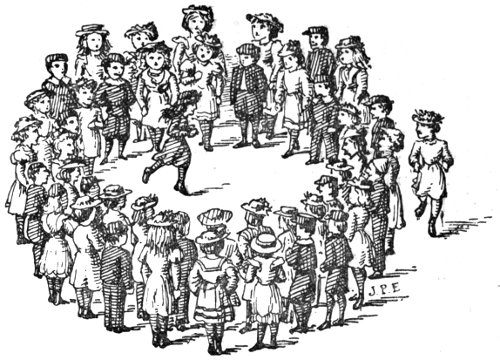
This game, called “Short Terrace” at East Kirkby, is played in the same way as that described from Sporle, with the exception that three players stand together instead of one in the centre to start the game. The player who stands immediately outside the circle is called the “clapper;” it is his object to hit the player who stands behind two others.—East Kirkby, Lincolnshire (Miss K. Maughan).
“Twos and Threes” is the name by which this game is known in Hampshire, Monton in Lancashire (Miss Dendy), and other places. It is played in precisely the same manner as at Sporle.
Halliwell’s Dictionary says of this game as played in Devon, “A round game, in which they all stand in a ring.”
See “Tag.”[Addendum] [Addendum]
Rounders
This is a boys’ game. A round area is marked out by boundary sticks, and at a chosen point of the boundary the base is fixed. This is marked out independently of the boundary, but inside it. Sides are then chosen. One side are the “ins,” and strike the ball; the other side are the “outs,” and deliver the ball, scout, and endeavour to get their opponents, the “ins,” out as soon as possible. The ball (an indiarubber one) is delivered by the “feeder,” by pitching it to a player, who stands inside the base armed with a short stick. The player endeavours to strike the ball as far away as possible from the fielders or scouts. As soon as the ball is struck away he runs from the base to the first boundary stick, then to the second, and so on. His opponents in the meantime secure the ball and endeavour to hit him with it as he is running from stage to stage. If he succeeds in running completely round the boundary before the ball is returned it counts as one rounder. If he is hit he is out of the game. He can stay at any stage in the boundary as soon as the ball is in hand, getting home again when the next player of his own side has in turn hit the ball away. When a ball is returned the feeder can bounce it within the base, and the player cannot then run to any new stage of the boundary until after the ball has again been hit away by another player. If a player misses a ball when endeavouring to strike at it he has two more chances, but at the third failure he is bound to run to the first boundary stick and take his chance of being hit with the ball. If a ball is caught the whole side is out at once; otherwise, the side keeps in until either all the players have been hit out with the ball or until the base is crowned. This can be done by bouncing the ball in the base whenever there is no player there to receive the delivery from the feeder. When a complete rounder is obtained, the player has the privilege either of counting the rounder to the credit of his side, or of ransoming one of the players who have been hit out, who then takes his part in the game as before. When all but one of the players are “out,” this last player in hitting the ball must hit it away so as to be able to make a rounder, and return to the base before his opponents get back the ball to crown the base.
An elaborate form of this game has become the national game of the United States.
Rounds
See “Roundabout.”
Row-chow-Tobacco
See “Bulliheisle,” “Eller Tree,” “Snail Creep,” “Wind up the Bush Faggot.”
Rowland-Ho
A Christmas game.—Halliwell’s Dictionary.
Rumps
A game with marbles [undescribed].—Dickinson’s Cumberland Glossary.
Rusty
A boys’ game, exactly the same as “Ships.”—Addy’s Sheffield Glossary.
Sacks
A number of children place their closed fists on top of one another in a pile. The leader asks, pointing to the topmost fist, “What’s in that sack?” Answer, Potatoes, or anything the child chooses. The leader tips it off with her finger, saying, “Knock it away,” and so to the very undermost fist, when she asks, “What’s in this sack?” The answer must be, “Bread and cheese;” and then the following dialogue takes place:—
Where’s my share? The mouse eat it. Where’s the mouse? The cat killed it. Where’s the cat? The dog worried it. Where’s the dog? The cow tossed it. Where’s the cow? The butcher killed it. Where’s the butcher? Behind the door.
And who ever speaks the first word shall get a sound round box on the ear.—Co. Cork (Mrs. B. B. Green).
Saddle the Nag
An equal number of players is chosen on each side. Two chiefs are chosen by lot. One of the chiefs takes his stand by a wall, and all his party bend their backs, joined in a line. One of the opposite side leaps on the back of the one farthest from the one standing at the wall, and tries to make his way over the backs of all the stooping boys, up to the one standing. Those stooping move and wriggle to cast him off, and if they succeed in doing so, he stands aside till all his side have tried. When all have tried and none succeed in crowning the one standing, the sides change. If one or more succeed, then each such has a second chance before the sides change. Each side commonly has six chances. The side that succeeds in oftenest touching the chief’s head wins the game.—Dyke (Rev. W. Gregor).
See “Skin the Goatie.”
Saggy
A game with marbles [undescribed].—Dickinson’s Cumberland Glossary.
Sailor Lad
A sailor lad and a tailor lad, And they were baith for me; I wid raither tack the sailor lad, And lat the tailor be. What can a tailor laddie dee Bit sit and sew a cloot, When the bonnie sailor laddie Can turn the ship aboot. He can turn her east, and he can turn her west, He can turn her far awa’; He aye tells me t’ keep up my hairt For the time that he’s awa’. I saw ’im lower his anchor, I saw ’im as he sailed; I saw ’im cast his jacket To try and catch a whale. He skips upon the planestanes, He sails upon the sea; A fancy man wi’ a curly pow Is aye the boy for me, Is aye the boy for me; A fancy man wi’ a curly pow Is aye the boy for me. He daurna brack a biscuit, He daurna smoke a pipe; He daurna kiss a bonnie lass At ten o’clock at night. I can wash a sailor’s shirt, And I can wash it clean; I can wash a sailor’s shirt, And bleach it on the green. Come a-rinkle-tinkle, fal-a-la, fal-a-la, Aboun a man-o’-war.
—Rosehearty (Rev. W. Gregor).
A circle is formed by joining hands. They dance round and sing. Sometimes at Rosehearty two play the game by the one taking hold of the other’s left hand with her right.
Sally go Round the Moon
Sally go round the moon, Sally go round the stars; Sally go round the moon On a Sunday afternoon.
—Deptford, Kent (Miss E. Chase).
Three or more girls take hold of hands, forming a ring; as they spin round they sing the lines. They then reverse and run round in the other direction with an O! or repeat over again.
This game is mentioned in the Church Reformer, by the Rev. S. D. Headlam, as one being played at Hoxton, but no account of how the game is played is given.
Sally Water
[Play]

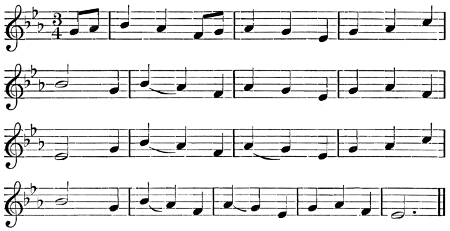
—Yorkshire (Mr. H. Hardy).
[Play]
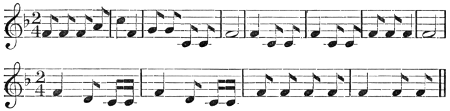
—Lancashire (Miss Dendy).
[Play]
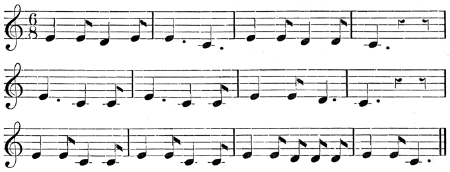
—Enborne (Miss Kimber).
[Play]
—Welford (Mrs. Stephen Batson).
[Play part 1, part 2]
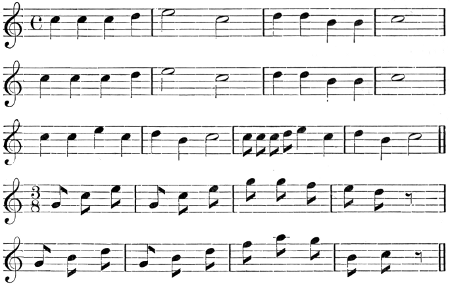
—Liverpool (Mr. C. C. Bell).
[Play]
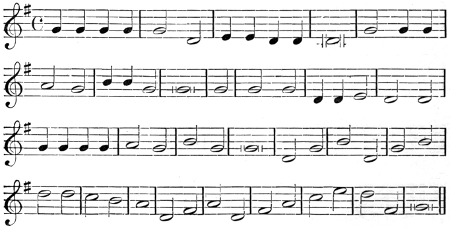
—Beddgelert, Wales (Mrs. Williams).
[Play part 1, part 2]
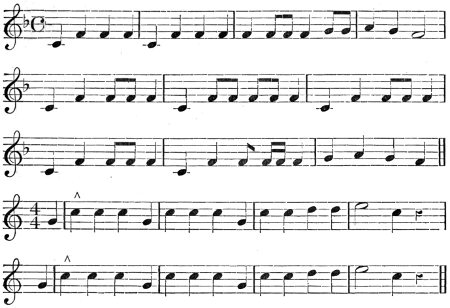
—Nottingham (Miss Youngman).
I.
Sally, Sally Water, Sprinkle in the pan; Rise, Sally, rise, Sally, And choose a young man. Choose [or bow] to the east, Choose [or bow] to the west, And choose [or bow to] the pretty girl [or young man] That you love best.
[Another version has:
Choose for the best one, Choose for the worst one, Choose for the pretty girl That you love best.] And now you’re married I wish you joy; First a girl and then a boy; Seven years after son and daughter; And now, young people, jump over the water.
—Symondsbury, Dorsetshire (Folk-lore Journal, vii. 207).
II.
Sally, Sally Walker, sprinkle water in the pan; Rise, Sally, rise, Sally, and seek your young man; Turn to the east and turn to the west, And choose the one that you love best. Now you’re married we wish you joy, First a girl and then a boy, Seven years after a son and a daughter, So young lovers kiss together.
—Chudleigh Knighton, Devon (Henderson’s Folk-lore of the Northern Counties, p. 27).
III.
Sally, Sally Water, Sprinkle in the pan; Hi! Sally; Ho! Sally, Choose a young man; Choose for the best, Choose for the worst, Choose for the very one you love best. Now you’re married we wish you joy, First a girl and then a boy, Seven years after sister and brother; Kiss each other and come out of the water.
—Somersetshire, Notes and Queries, 8th series, i. 249 (Miss R. H. Busk).
IV.
Sally Waters, Sally Waters, come sprinkle in the pan; Rise, Sally; rise, Sally, for a young man! Choose for the best, choose for the worst, Choose for the very one you love the best. Now you are married, we wish you joy; First a girl and then a boy, Seven years afterwards son and daughter; Pray, young couple, kiss together.
—London version (Miss Dendy).
V.
Sally, Sally Walker, Sprinkling in a pan; Rise, Sally; rise, Sally, For a young man. Come, choose from the east, Come, choose from the west, Come, choose out the very one That you love best. Now there’s a couple Married in joy; First a girl, And then a boy. Now you’re married; You must obey Every word Your husband says. Take a kiss And walk away, And remember the promise You’ve made to-day.
—Fochabers (Rev. W. M’Gregor).
VI.
Sally, Sally Waters, Sprinkled in the pan; Rise, Sally, rise, Sally, For a young man, Choose the best and choose the worst, And choose the prettiest you love best.
—Welford, Berks (Mrs. Stephen Batson).
VII.
Sally, Sally Wallflower, Sprinkled in the pan, &c., Now you’re married, &c., On the carpet you shall kneel, &c.
—Notes and Queries, 5th series, iii.
VIII.
Sallie, Sallie Waters, Sprinkled in a pan; Rise, Sallie, rise, Sallie, Choose a young man. Choose the best, and Choose the worst, and Choose the one that you love best. Now that you are married, I’m sure we wish you joy, First a girl, then a boy; Seven years after, Son and daughter, Pray, young couple, come kiss together.
—Enborne, Berks; Marlborough, Wilts; Lewes, Sussex (Miss Kimber).
IX.
Sally, Sally Waters, Sprinkle in a pan; Cry, Sally, cry, Sally, For a young man. Come choose the worst, Come choose the best, Come choose the young man That you like the best. And now you’re married I wish yer good joy, Every year a girl and a boy. Come love one another Like sister and brother, And kiss together for joy. Clash the bells, Clash the bells.
—Maxey, Northants; and Suffolk (Rev. W. D. Sweeting).
X.
Sally, Sally Water, sprinkle in the pan; Rise, Sally, rise, Sally, for a young man. Pick and choose, but choose not me, Choose the fairest you can see. Now Sally is married, we wish her much joy, First a girl and then a boy; Seven years after a son and a daughter, Please to come and kiss together.
—Summertown, Oxford (A. H. Franklin in Midland Garner, N. S. ii. 32).
XI.
Sally, Sally Waters, sprinkle in the pan; Rise, Sally, rise, Sally, for a young man. Choose for the worst, choose for the best,[7] Choose for the prettiest that you loves best. Now you are married, &c.
—Longcot, Berkshire, (Miss J. Barclay).
XII.
Sally, Sally Waters, Sprinkle in a pan; Cry, Sally, cry, Sally, For a young man. Rise up, Sally, Dry your tears; Choose the one you love the best, Sally, my dear.
—Earls Heaton, Yorks. (Herbert Hardy).
XIII.
Sally, Sally Water, sprinkle in the pan, Is not —— a nice young man? and Is not (girl’s name) as good as he? They shall be married if they can agree. I went to her house and I dropped a pin, I asked if Mrs. ——- was in. She is not within, she is not without, She is up in the garret walking about. Down she comes as white as milk, With a rose in her bosom as soft as silk. She off with her glove and showed me her ring, To-morrow, to-morrow the wedding begins.
—Surrey (Folk-lore Record, v. 88).
XIV.
Sally, Sally Walker, come sprinkle your pan, For down in the meadows there’s a nice young man; Rise up, Sally, don’t look sad, For you shall have a husband, good or bad. On the carpet you shall kneel Till the grass grows round your feet; Stand up straightly on your feet, And choose the one you love so sweet. Now Sally’s married, we wish her joy, First a girl, then a boy; If it’s a boy, we’ll buy him a cap, If it’s a girl, we will buy her a hat. If one won’t do, will buy you two, If two won’t do, will buy you three, If three won’t do, will get you four, If four won’t do, will get no more, So kiss and shake hands, and come out.
—Tong, Shropshire (Miss C. F. Keary).
XV.
Sally, Sally Water, come sprinkle your pan (or plants), For down in the meadows there lies a young man. Rise, Sally, rise, and don’t you look sad, For you shall have a husband, good or bad. Choose you one, choose you two, Choose the fairest you can see! The fairest one as I can see, Is Jenny Wood, pray come to me! Now you are married, I wish you good joy, First a girl and then a boy; Seven years now, and seven to come, Take her and kiss her, and send her off home.
—Shropshire Folk-lore, p. 509.
XVI.
Sally, Sally Water (or Slauter), Come sprinkle in your can, Why do you get married To a foolish young man? Pick the worst, and pick the best, And pick the one that you love best. .......... To a nice young man .......... So kiss and say good-bye.
[My informant forgets the rest.]
—Nottinghamshire (Miss M. Peacock).
XVII.
Sally Water, Sally Water, Come sprinkle your can, Why don’t you rise, Sally, And choose a young man? Come choose of the wisest, Come choose of the best, Come choose of the young man That lies in your breast.
—Gloucestershire and Warwickshire (Northall, 378).
XVIII.
Sally Water, Sally Water, Come, sprinkle your can; Who do you lie mourning, All for a young man? Come, choose of the wisest, Come, choose of the best, Come, choose of the young men The one you love best.
—Addy’s Sheffield Glossary.
XIX.
Sally, Sally Salter, Sprinkle in some water; Knock it in a mortar, And send it in a silver saucer To —— door.
—Stixwould, Lincolnshire, seventy years ago (Miss M. Peacock).
XX,
Sally Water, Sally Water, Springin’ in a pan; Cry, Sally, cry, Sally, For a young man; Choose for the worst ’un, Choose for the best ’un, Choose the little gell ’at you love the best. Now you’re married I wish you joy; First a girl, and then a boy; Seven years after Son and daughter. Pray, young couple, come kiss together.
—Wakefield, Yorkshire (Miss Fowler).
XXI.
Sally, Sally Water, Come, water your can, Such a young lady before a young man; Rise, Sally Water, Don’t look so sad, For you shall have a husband, good or bad. Now you’re married we wish you joy; Father and mother, you need not cry; Kiss and kiss each other again; Now we’re happy, let’s part again.
—Long Itchington, Warwickshire (Northamptonshire Notes and Queries, ii. 105).
XXII.
Sally, Sally Slarter, Sitting by the water, Crying out and weeping For a young man. Rise, Sally, rise, Dry up your eyes; Turn to the east, Turn to the west, Turn to the young man That you love the best. So now you’ve got married I hope you’ll enjoy Your sons and your daughters, So kiss and good-bye.
—Addy’s Sheffield Glossary.
XXIII.
Sally, Sally Walker, sprinkled in a pan; What did she sprinkle for? for a young man; Sprinkle, sprinkle, daughter, and you shall have a cow; I cannot sprinkle, mother, because I don’t know how. Sprinkle, sprinkle, daughter, and you shall have a man; I cannot sprinkle, mother, but I’ll do the best I can. Pick and choose, but don’t you pick me; Pick the fairest you can see. The fairest one that I can see is ——. Come to me. Now you’re married I wish you much joy; Your father and mother you must obey; Seven long years a girl and a boy; So hush, a bush, bush, get out of the way.
—Buckingham (Thos. Baker in Midland Garner, New Series, ii. 31).
XXIV.
Little Sally Walker sitting in a sigh, Weeping and waiting for a young man. Come choose you east, come choose you west, The very one that you love best.
—Nairn (Rev. W. Gregor).
XXV.
Little Sally Walker sitting on the sand, Crying and weeping for a young man. Rise, Sally, rise, Sally, wipe away your tears, Try for the east, and try for the west, Try for the (little) very one you love best. Now they’re married I wish them joy, Every year a girl and boy, Loving each other like sister and brother, I hope to see them meet again.
—Fraserburgh (Rev. W. Gregor).
XXVI.
Little Sally Sander Sitting in the sander, Weeping and crying for her young man. Rise, Sally, rise And wipe away your tears; Choose to the east, Choose to the west, And choose to the very one that you love best. Now you’re married we wish you joy, First a girl and then a boy; Twelve months after son and daughter, All join hands and kiss together.
—Penzance, Cornwall (Mrs. Mabbott).
XXVII.
Sally, Sally Walker, tinkle in a can; Rise up, Sally, and choose a young man. Look to the east, and look to the west, Choose the one that you love the best.
—Settle, Yorkshire (Rev. W. S. Sykes).
XXVIII.
Sally Water, Sally Water, Come sprinkle your fan; Sally, Sally Waters, sprinkle in a pan; Rise, Sally, rise, Sally, for a young man. Choose to the east, and choose to the west, And choose the dearest one that you love best. Now you’re married, we wish you joy, First a girl and then a boy; Love one another like sister and brother, And never lose time by kissing one another.
—West Haddon (Northamptonshire Notes and Queries, ii. 104).
XXIX.
Little Sally Waters, sitting in the sun, Crying and weeping for her young man. Rise, Sally, rise, wipe up your tears, Fly to the east, fly to the west, Fly to the one that you love the best.
—Brigg, Lincolnshire (Miss Barker).
XXX.
Hie Sally Walker, hie Sally Ken, Hie Sally Walker, follow young men. Choose to the east, and choose to the west, Choose to the very one you love best. Marriage comfort and marriage joy, First a girl and then a boy. Seven years after, seven years to come, Fire on the mountain, kiss and run.
—Belfast, Ireland (W. H. Patterson).
XXXI.
Little Alice Sander Sat upon a cinder, Weeping and crying for her young man. Rise up, Alice, dry your tears, Choose the one that you love best, Alice my dear. Now they have got married I hope they will joy, Seven years afterwards, seven years ago, Now is the time to kiss and go.
—Earls Heaton, Yorks. (Herbert Hardy).
XXXII.
Rise, Sally Walker, Rise if you can, Rise, Sally Walker, and follow your good man; Choose to the east, and choose to the west, Choose to the one you love best. There is a couple married in joy, Past a girl and then a boy, Seven years after, seven years to come, Kiss you couple, kiss and be done. A’ the many hours to us a happy life, Except —— and he wants a wife. A wife shall he have, And a widower shall he be, Except —— that sits on his knee, A guid fauld hoose and a blacket fireside, Draw up your gartens and show all your bride.
—(Rev. W. Gregor).
XXXIII.
Arise, Sally Walker, arise, if you can, Arise, Sally Walker, and follow your good man; Come choose to the east, come choose to the west, Come choose to the very one you love best. This is a couple married with joy; First a girl and then a boy, Seven years after and seven years to come, This young couple married and begun. [The Christian name of a girl] made a pudding so nice and sweet, [Boy’s Christian name] took a knife and tasted it. Taste love, taste love, don’t say No, The next Sunday morning To church we shall go. Clean the brazen candlesticks, And clean the fireside, Draw back the curtains. And lat’s see the bride. A’ the men in oor toon leads a happy life, Except [a boy’s full name], and he wants a wife. A wife shall he hae, and a widow she shall be; For look at [a girl’s full name] diddling on’s knee. He paints her cheeks and he curls her hair, And he kisses the lass at the foot o’ the stair.
—Tyrie (Rev. W. Gregor).
[The form of words at Cullen is the same for the first seven lines, and then the words are:—]
XXXIV.
This young couple be married and be done, A’ the men in oor toon leads a happy life, Except —— and he wants a wife. A wife he shall have, and a widow she shall be, Except [a girl’s name] that sits on his knee, Painting her face and curling her hair, Kissing [a girl’s name] at the foot o’ the stair.
—Cullen (Rev. W. Gregor).
XXXV.
Rise, Sally Walker, rise if you can, Rise, Sally Walker, follow your gudeman. Come choose to the east, come choose to the west, Come choose to the very one that you love best. Now they’re married I wish them joy, Every year a girl or boy, Loving each other like sister and brother, And so they may be kissed together. Cheese and bread for gentlemen, And corn and hay for horses, A cup of tea for a’ good wives, And bonnie lads and lassies. When are we to meet again? And when are we to marry? Raffles up, and raffles down, and raffles a’ a dancin’, The bonniest lassie that ever I saw, Was [child in the centre] dancin’.
—Aberdeen Training College (Rev. W. Gregor.)
XXXVI.
Sally, Sally Walker, sitting in the sun, Weeping and wailing for a young man, Rise, Sally, rise, and wipe away your tears, Fly to the east, fly to the west, And fly to the very one that you love best. Uncle John is very sick, He goes a courting night and day; Sword and pistol by his side, Little Sally is his bride. He takes her by the lily white hand, He leads her over the water; Now they kiss and now they clap, Mrs. Molly’s daughter.
—Nairn, Perth, Forfar (Rev. W. Gregor).
XXXVII.
Sally, Sally Waters, why are you so sad? You shall have a husband, either good or bad; Then rise, Sally Waters, and sprinkle your pan, For you’re just the young woman to get a nice man. Now you’re married, we wish you joy, Father and mother and little boy, Love one another like sister and brother, And now, good people, kiss each other.
—Halliwell, Popular Rhymer, p. 229.
XXXVIII.
Rise, Sally Walker, Rise if you can (Northumberland), Sprinkle in the pan (Yorks. and Midlands), Rise, Sally Walker, For a young man. Choose to the east, Choose to the west, Choose to the - very one (Northumberland), pretty girl (Yorks., &c). You love best.
Now you’re married, I wish you joy, First a girl, And then a boy.
Seven years after, - (Northumberland). Seven years over, Now’s the time to Kiss and give over.
Five years after - (Yorks., &c.) A son and daughter, Pray, young couple, Kiss away.
—Hexham (Miss J. Barker).
XXXIX.
Sally Waters, Sally Waters, come rise if you can, Come rise in the morning, all for a young man; Come choose, come choose, come choose if you can, Come choose a good one or let it alone.
—Monton, Lancashire (Miss Dendy).
XL.
Sally Waters, Sally Waters, Come rise if you can, Come rise in the morning, All for a young man. First to the east, then to the west, Then to the bonny lass that you love best. Now, Sally, you are married, I hope you’ll agree, Seven years at afterwards, seven years ago, And now they are parted with a kiss and a blow.
—Monton, Lancashire (Miss Dendy).
The last two lines were supplied by a girl in a very poor district of Manchester (note by Miss Dendy).
XLI.
Rise, Sally Walker, rise, if you can, Rise, Sally Walker, and follow your gueedman, Choose to the east, and choose to the west, Choose to the one that you love best. There is a couple married in joy, First a girl and then a boy, Seven years after, seven years to come.
—Rosehearty (Rev. W. Gregor).
XLII.
Little Polly Sanders sits on the sand, Weeping and crying for her young man; Rise up, Polly, wipe your tears, Pick the one you love so sweet. Now Polly’s got married, we hope she’ll have joy, For ever and ever a girl or a boy. If one won’t do, she must have two, So I pray you, young damsels, to kiss two and two.
—Liverpool (C. C. Bell).
XLIII.
Here sits poor Sally on the ground, Sighing and sobbing for her young man. Arise, Sally, rise, and wipe your weeping eyes, And turn to the east, and turn to the west, And show the little boys that you love best. A bogie in, a bogie out, A bogie in the garden, I wouldn’t part with my young man For fourpence ha’penny farthing.
—Long Eaton, Nottingham (Miss Youngman).
[In London the above is:]—
XLIV.
A beau in front and a beau behind, And a bogie in the garden oh! I wouldn’t part with my sweetheart For tuppence (two) ha’penny farthing.
—London (Mrs. Merck).
XLV.
Sally Walker, Sally Walker, Come spring time and love, She’s lamenting, she’s lamenting, All for her young man. Come choose to the east, come choose to the west, Come choose the one that you love best. Here’s a couple got married together, Father and mother they must agree, Love each other like sister and brother, I pray this couple to kiss together.
—Morpeth (Henderson’s Folk-lore of Northern Counties, p. 26).
XLVI.
Rise, Sally Walker, rise if you can, Rise, Sally Walker, and choose your good man, Choose to the east, and choose to the west, And choose the very one you love best. Now they’re married, wish them joy, First a girl, and then a boy, Seven years after, seven years to come, Now’s the time to kiss and be done.
—Gainford, Durham (Miss A. Edleston).
XLVII.
Little Alexander sitting on the sand, Weeping and crying for a young man; Rise up, Sally, and wipe your tears, Pick the very one that you like best. Now, Sally, now married, I hope she’ll (or you’ll) enjoy, For ever and ever with that little boy (or with her or your young boy).
—Beddgelert, Wales (Mrs. Williams).
XLVIII.
Rice, Sally Water, rice if you can, Rice, Sally Water, and choose your young man; Choose to the east, choose to the west, Choose to the prettiest that you love. Now you’re married, we wish you good joy, First a little girl, and then a little boy; Seven years after, seven years to come, Seven years of plenty, and kiss when you done.
—Norfolk (Mrs. Haddon).
(c) A ring is formed by the children joining hands. One girl kneels or sits down in the centre, and covers her face with her hands as if weeping. The ring dances round and sings the words. The child in the centre rises when the command is given, and chooses a boy or girl from the ring, who goes into the centre with her. These two kiss together when the words are said. The child who was first in the centre then joins the ring, the second remaining in the centre, and the game continues.
All versions of this game are played in the same way, except slight variations in a few instances. Kissing does not prevail in all the versions. In the Earls Heaton game, the child who kneels in the centre also pretends to weep and dries her tears before choosing a partner. Miss Burne, in Shropshire Folklore, says the girl kneels disconsolately in the middle of the ring. In the Stixwould version, the child stands in the centre holding in her hands something resembling a saucer; she then pretends to “knock it in a mortar,” and gives the saucer to the one whom she chooses. This one exchanges places with her. In the Northants version, at the words “clash the bells,” the children dash down their joined hands to imitate ringing bells. Addy, Sheffield Glossary, says one girl sits in the middle weeping. When the girl has chosen, the young man remains in the centre, and the word “Sally” is changed to “Billy,” or some other name, and “man” to “girl.” In the Beddgelert version, the centre child wipes her eyes with a handkerchief in the beginning of the game. Several other versions have been sent me, all being the same as those printed here, or varying so slightly, it is unnecessary to repeat them.
(d) The analysis of the game-rhymes is as follows:—
No. Dorset- shire. Devon- shire. Somer- set- shire. London. Foch- abers. Berk- shire. Crock- ham Hill, Kent. Wilt- shire. Nort- hants. Oxford. York- shire. Surrey. Shrop- shire (1). Shrop- shire (2). Notts. Glouces- ter- shire. Shef- field. Lin- coln- shire. Wake- field. War- wick- shire. Shef- field. Bucks. Nairn. Fraser- burgh. Corn- wall. Settle. Nort- hants. Brigg. Belfast. Earls Heaton. Scot- land. Tyrie. Aber- deen. Nairn. Halli- well. Hexham. Lanca- shire. Rose- hearty. Notts. Morpeth. Gainford. Norfolk. Bedd- gelert.
1. Sally Water. — Sally Water. Sally Waters. — Sally Waters. — Sally Waters. Sally Waters. Sally Water. Sally Waters. Sally Water. — Sally Water. Sally Water. Sally Water. Sally Water. — Sally Water. Sally Water. — — — — — — Sally Water. Sally Waters. — — — — — — Sally Water. — Sally Waters. — Sallie [ ]. — — Sallie [ ]. Sallie [ ].
2. — Sally Walker. — — Sally Walker. — — — — — — — Sally Walker. — — — — — — — — Sally Walker. Sally Walker. Sally Walker. — Sally Walker. — — Sally Walker. — Sally Walker. Sally Walker. Sally Walker. Sally Walker. — Sally Walker. — Sally Walker. — Sally Walker. Sally Walker. — —
3. — — — — — — Sally Wallflowers. — — — — — — — — — — — — — — — — — — — — — — — — — — — — — — — — — — — —
4. — — — — — — — — — — — — — — — — — Sally Salter. — — Sally Slarter. — — — — — — — — — — — — — — — — — — — — — —
5. — — — — — — — — — — — — — — — — — — — — — — — — Sally Sander. — — — — Alice Sander. — — — — — — — — — — — — —
6. Sprinkle in pan. Sprinkle water in the pan. Sprinkle in the pan. Sprinkle in the pan. Sprinkling in a pan. Sprinkled in the pan. Sprinkled in the pan. Sprinkled in a pan. Sprinkle in a pan. Sprinkle in the pan. Sprinkle in a pan. Sprinkle in the pan. Sprinkle in your pan. Sprinkle in your pan. Sprinkle in your can. Sprinkle your can. Sprinkle your can. — — — — Sprinkled in a pan. — — — — Sprinkle in a pan. — — — — — — — — Sprinkle in the pan. — — — — — — —
7. — — — — — — — — — — — — — — — — — Sprinkle in some water. — Water your can. Sitting by the water. — — — — — — — — — — — — — — — — — — — — — —