Volume 1 — CHILDREN’S GAMES (continued 5)
Reading edition
Stag aloney, My long poney, Kick the bucket over.
Halliwell (Dictionary) also describes the game, and indicates its origin. The boy chosen for the game clasps his hands together, and, holding them out, threatens his companions as though pursuing them with horns, and a chase ensues in which the Stag endeavours to strike one of them, who then becomes Stag in his turn. Unfortunately, Halliwell does not, in this instance, give his authority, but if it is taken from the players themselves, it is a sufficient account of the origin of the game, apart from the evidence of the name. All this group of games is evidently to be traced to one original, though in different places the detail of the game has developed somewhat differently. It evidently comes down from the time when stags were hunted not so much for sport as for food.
See “Chickidy Hand,” “Hornie,” “Hunt the Stagie,” “Shepherds,” “Warney.”[Addendum]
Stagging
A man’s game. Two men have their ankles tied together and their wrists tied behind their backs. They then try to knock each other down.—Patterson’s Antrim Glossary.
See “Hirtschin Hairy.”
Steal the Pigs
The game represents the stealing of a woman’s children and the recovery of them. The mother, before beginning to wash, disposes of her children in a safe place. She proceeds to do her washing. While she is busy a child-snatcher comes and takes away one. The others begin to cry. The mother hears them crying. She goes and asks the reason of their crying, and is told that a woman came and took away one of them. She scolds and beats them all; tells them to be more careful for the time to come, and returns to her washing. Again the children cry, and the mother goes to see what is the matter with them, and is told the same thing. She repeats her admonition and bodily correction, and returns to her work. This process is repeated till all the children are stolen. After finishing her washing, she goes to her children and finds the last one gone. She sets out in search of them, and meets a woman whom she questions if she had seen her children. She denies all knowledge of them. The mother persists, and at last discovers all her stolen children. She demands them back. The stealer refuses, and puts them behind her and stands on her defence. A tussel takes place. The mother in the long run rescues her children.—Fraserburgh (Rev. W. Gregor).
See “Mother, Mother, Pot boils over,” “Witch.”
Stealy Clothes
See “Scots and English.”
Steik and Hide
The game of Hide and Seek.—Aberdeen (Jamieson).
Sticky-stack
A game among young people in running up the face or cut part of a hay-stack to try who can put in a stick the highest.—Brockett’s North Country Words.
Sticky Toffey
Name of a game (undescribed) recorded by the Rev. S. D. Headlam, as played by Hoxton School children at Hoxton.—Church Reformer, 1894.
Stiff Police
A game (undescribed) recorded by the Rev. S. D. Headlam, as played by Hoxton School children.—Church Reformer, 1894.
Stik-n Snael (Stick and Snell)
Game of cat.—Elworthy, West Somerset Words. The short stick, pointed at both ends, is called a snell.
Stocks
A schoolboys’ game. Two boys pick a side, and there is one den only, and they toss to see which side shall keep it. The side which wins the toss then goes out, and when two boys have got a good distance off they cry “Stocks.” The boys who keep the den run after them to catch them. When one is caught his capturer counts ten while he holds him (in a more primitive but less refined state, spat over his head) and cries Stocks. This prisoner is taken into the den. If they are all caught the other side turns out. But if one of the outer side can manage to run through the den and cry “Stocks,” all the prisoners are relieved, and can go out again.—Easther’s Almondbury Glossary. See “Stacks.”
Stones
A circle of stones is formed according to the number of players, generally five or seven each side. One of the out party stands in the centre of the circle, and lobs at the different stones in rotation; each hit a player gives all his side must change stations, in some places going round to the left and in others to the right. The stones are defended by the hand or a stick, according as a ball or stick is lobbed. All the players are out if the stone is hit, or the ball or stick caught, or one of the players is hit while running. In different counties or places these games are more or less modified.—Dublin, Folk-lore Journal, ii. 264-265.
Mr. Kinahan, who describes this game, adds a very instructive note, which is worth quoting:—
“These games I have seen played over half a century ago, with a lob-stick, but of later years with a ball, long before a cricket club existed, in Trinity College, Dublin, and when the game was quite unknown in a great part of Ireland. At the same time, they may have been introduced by some of the earlier settlers, and afterwards degenerated into the games mentioned above; but I would be inclined to suspect that the Irish are the primitive games, they having since been improved into cricket. At the present day these games nearly everywhere are succeeded by cricket, but often of a very primitive form, the wickets being stones set on end, or a pillar of stones; while the ball is often wooden, and very rudely formed.”
Stool-ball
The first mention of this game is by Smyth in his Berkeley Manuscripts. In the reign of Elizabeth, the Earl of Leicester, with an extraordinary number of attendants and multitudes of country people, and “whom my neighbours parallel to Bartholomew faire in London, came to Wotton, and thence to Michaelwood Lodge, castinge down part of the pales, which like a little park then enclosed the Lodge (for the gates were too narrow to let in his Trayne), and thence went to Wotton Hill, where hee plaid a match at stoball.”—Gloucestershire County Folk-lore, p. 26.
The earliest description of the game, however, is by Aubrey. He says “it is peculiar to North Wilts, North Gloucestershire, and a little part of Somerset near Bath. They smite a ball, stuffed very hard with quills and covered with soale leather, with a staffe, commonly made of withy, about three feet and a half long. Colerne down is the place so famous and so frequented for stobball playing. The turfe is very fine and the rock (freestone) is within an inch and a halfe of the surface which gives the ball so quick a rebound. A stobball ball is of about four inches diameter and as hard as a stone. I do not heare that this game is used anywhere in England but in this part of Wiltshire and Gloucestershire adjoining.” (Aubrey’s Natural History of Wiltshire, p. 117; Collections for North Wilts, p. 77). It is no doubt the same game as Stool-ball, which is alluded to by Herrick in 1648 (Hesperides), and in Poor Robin’s Almanack for 1677 (see Halliwell’s Dictionary). D’Urfey’s Don Quixote, written in 1694, alludes to it as follows:—
“Down in a vale, on a summer’s day, All the lads and lasses met to be merry; A match for kisses at stool-ball to play, And for cakes and ale, and cider and perry.” Chorus; “Come all, great, small, short, tall— Away to stool-ball.”
It is also alluded to in Poor Robin’s Almanack for 1740:
“Now milkmaids pails are deckt with flowers, And men begin to drink in bowers, The mackarels come up in shoals, To fill the mouths of hungry souls; Sweet sillabubs, and lip-lov’d tansey, For William is prepared by Nancy. Much time is wasted now away, At pigeon-holes, and nine-pin play, Whilst hob-nail Dick, and simpring Frances, Trip it away in country dances; At stool-ball and at barley-break, Wherewith they harmless pastime make.”
It is described by Strutt in Sports and Pastimes, p. 103, as a variety of game more commonly known as “goff” or “bandy ball,” the paganica of the Romans, who also stuffed their balls with feathers. According to Dr. Johnson, the balls are driven from stool to stool, hence the name.
In spite of Aubrey’s opinion as to the limited range of this game, it appears to have been pretty generally played. Thus, Roberts’ Cambrian Antiquities says, “Stool-ball, resembling cricket, except that no bats are used and that a stool was substituted for the wicket, was in my memory also a favourite game on holydays, but it is now seldom or ever played. It generally began on Easter Eve” (p. 123). It was also an old Sussex game. Mr. Parish’s account is that it was “similar in many respects to cricket, played by females. It has lately been revived in East Sussex by the establishment of stool-ball clubs in many villages. The elevens go long distances to play their matches; they practise regularly and frequently, display such perfection of fielding and wicket-keeping as would put most amateur cricketers to shame. The rules are printed and implicitly obeyed.”—Parish’s Dictionary of Sussex Dialect.
Miss Edith Mendham says of the Sussex game, it is supposed to derive its name from being played by milkmaids when they returned from milking. Their stools were (I think) used as wickets, and the rules were as follows:—
1. The wickets to be boards one foot square, mounted on a stake, which, when fixed in the ground, must be four feet nine inches from the ground.
2. The wickets to be sixteen yards apart, the bowling crease to be eight yards from the wicket.
3. The bowler to stand with one foot behind the crease, and in bowling must neither jerk nor throw the ball.
4. The ball to be of that kind known as “Best Tennis,” No. 3.
5. The bats to be of wood, and made the same size and shape as battledores.
6. The striker to be out if the ball when bowled hits the wicket, or if the ball be caught in the hands of any of the opposing side, or if in running, preparing to run, or pretending to run, the ball be thrown or touch the wicket before the striker reaches it, and the ball in all cases must strike the face of the wicket, and in running the striker must at each run strike the wicket with her bat.
7. There should be eleven players on each side.
8. Overs to consist of eight balls.
Miss F. Hagden, in her short History of Alfriston, Sussex, says, “In the Jubilee year the game of stool-ball was revived and played in the Tye field. The rules resemble those of cricket, but the wickets are square boards on posts; the bowler stands in the centre of the pitch, the bats used are round boards with a handle. The game in Alfriston seems now to have died out again, but in many villages there are regular clubs for the girls,” p. 43. It also appears to be a game among Lancashire children to this day. A stool is used as a wicket, at which it is attempted to throw the ball; a player stands near the stool, and using his or her hand as a bat, wards off the blow. If the ball hits the stool the thrower takes the place at wicket; or if the ball is caught the catcher becomes the guardian of the stool. Stool-ball, like all ball games, was usually played at Easter for tansy cakes. Mr. Newell (Games and Songs) says this game is recorded by the second governor of Massachusetts as being played under date of the second Christmas of the colony.
See “Bittle-battle,” “Cricket,” “Stool-ball.”
Strik a Licht
A version of hide and seek. One player is chosen to be “it.” The other players go away to a distance and “show a light,” to let “it” understand they are ready. They then hide, and the first one found has to be “it” in place of the previous seeker.—Aberdeen (Rev. W. Gregor).
See “Hide and Seek.”
Stroke
A game at marbles, where each player places a certain number on a line and plays in turns from a distance mark called “scratch,” keeping such as he may knock off.—Lowsley’s Berkshire Glossary.
Stroke Bias
Brome, in his Travels over England, 1700, p. 264, says: “The Kentish men have a peculiar exercise, especially in the eastern parts, which is nowhere else used in any other country, I believe, but their own; it is called ‘Stroke Bias,’ and the manner of it is thus. In the summer time one or two parishes convening make choice of twenty, and sometimes more, of the best runners which they can cull out in their precincts, who send a challenge to an equal number of racers within the liberties of two other parishes, to meet them at a set day upon some neighbouring plain; which challenge, if accepted, they repair to the place appointed, whither also the county resort in great numbers to behold the match, when having stripped themselves at the goal to their shirts and drawers, they begin the course, every one bearing in his eye a particular man at which he aims; but after several traverses and courses on both sides, that side, whose legs are the nimblest to gain the first seven strokes from their antagonists, carry the day and win the prize. Nor is this game only appropriated to the men, but in some places the maids have their set matches too, and are as vigorous and active to obtain a victory.”
Sun and Moon
“A kinde of play wherein two companies of boyes holding hands all on a rowe, doe pull with hard hold one another, till one be overcome.”—Quoted by Halliwell (Dictionary), from Thomasii Dictionarium, London, 1644.
Sunday Night
I.
Sunday night an’ Nancy, oh! My delight and fancy, oh! All the world that I should know If I had a Katey, oh! “He! ho! my Katey, oh! My bonny, bonny Katey, oh! All the world that I should keep If I had a Katey, oh!”
—Liphook, Hants (Miss Fowler).
II.
Sunday night and brandy, O! My life and saying so, My life and saying so, Call upon me Annie, O! I Annie, O! Bonnie, bonnie Annie, O! She’s the girl that I should like If I had an Annie, O!
—Earls Heaton, Yorks. (H. Hardy).
(b) The children stand in a row with backs against a wall or fence, whilst one stands out and stepping backwards and forwards to the tune sings the first verse. Then she rushes to pick out one, taking her by the hands and standing face to face with her, sings the other verse. Then the two separate their hands, and standing side by side sing the first verse over again, taking another girl from the row, and so on again.
“Monday night,” or “Pimlico,” is the name of a singing game mentioned by the Rev. S. D. Headlam, in The Church Reformer, as played by children in the schools at Hoxton, which he says was accompanied by a kind of chaunt of a very fascinating kind.[Addendum]
Sun Shines
The sun shines above and the sun shines below, And a’ the lasses in this school is dying in love I know, Especially (girl’s name) she’s beautiful and fair; She’s awa wi’ (a boy’s name) for the curl o’s hair. In comes (girl’s name) mother with the glass in her han’, Says—My dearest daughter, I’m glad you’re gettin a man, I’m glad you’re gettin a man and a cooper to trade, And let a’ the world say he is a rovin’ blade.
—Fraserburgh (Rev. W. Gregor).
All sing to “especially,” boy chooses girl, and then the two whirl round, and all sing to the end.
Sweer Tree
Two persons sit down feet to feet and catch a stick with their hands; then whoever lifteth the other is the strongest.—Mactaggart’s Gallovidian Encyclopædia.
Compare “Honey pots.”
Swinging
Rhymes were said or sung by children and young people when swinging. They were of the same character, and in many instances the same as those given in “See-saw” and “Shuttlefeather,” and were used formerly for purposes of divination. The following extract, from the Pall Mall Gazette of Sept. 19th, 1895, seems to indicate an early notion connected with swinging. It is taken from one of the articles in that paper upon Jabez Balfour’s diary during his residence in the Argentine Republic:—“On the 2nd November he (Balfour) mentions a curious Bolivian custom on All Souls’ Day, when ‘they erect high swings, and old and young swing all day long, in the hope that while they swing they may approach the spirits of their departed friends as they fly from Purgatory to Paradise.’ Two days later he adds: ‘I have to-day heard another explanation of the Bolivian practice of swinging on All Souls’ Day. They swing as high as they can so as to reach the topmost branches of the trees, and whenever they are thereby able to pull off a branch they release a soul from Purgatory.’”—Notes and Queries, 8th series, vi. 345. With this may be compared one of the methods and words used while swinging which I remember playing, namely, that while swinging, either in a room or garden, the object was to endeavour to touch either a beam in the ceiling or the top branches of a tree, singing at the same time a rhyme of which I only recollect this fragment:
One to earth and one to heaven, And this to carry my soul to heaven.
The last was said when the effort was made to touch the ceiling or tree with the feet.—(A. B. Gomme.)
Miss Chase has sent me the following rhymes:
I went down the garden And there I found a farth’ng; I gave it to my mother To buy a little brother; The brother was so cross I sat him on the horse; The horse was so bandy I gave him a drop (or glass) of brandy; The brandy was so strong I set him on the pond; The pond was so deep I sent him off to sleep; The sleep was so sound I set him on the ground; The ground was so flat I set him on the cat; The cat ran away With the boy on his back; And a good bounce [A great push here] Over the high gate wall.
Said while swing stops itself:—
Die, pussy, die, Shut your little eye, When you wake, Find a cake; Die, pussy, die.
—Deptford.
Wingy, wongy, Days are longy, Cuckoo and the sparrow; Little dog has lost his tail, And he shall be hung to-morrow.
—Marylebone.
The Deptford version is practically the same as known in several parts of the country, and Mr. Gerish has printed a Norfolk version in Folk-lore (vi. 202), which agrees down to the line “sent him off to sleep,” and then finishes with—
With a heigh-ho! Over the bowling green.
When they came to the “heigh-ho” a more energetic push than usual was given to the occupant of the swing, who was then expected to vacate the swing and allow another child a turn. Thus the rhyme served as an allowance of time to each child.
An amusement of boys in Galloway is described as on the slack rope, riding and shoving one another on the curve of the rope: they recite this to the swings—
Shuggie show, druggie draw, Haud the grip, ye canna fa’; Haud the grup or down ye come, And danceth on your braid bum.
—Mactaggart’s Gallovidian Encyclopædia.
Brockett (North Country Words) describes as a swing: a long rope fastened at each end, and thrown over a beam, on which young persons seat themselves and are swung backwards and forwards in the manner of a pendulum.
See “Merritot.”
Tait
The Dorset game of “See-saw.”—Halliwell’s Dictionary.
Teesty-Tosty
The blossoms of cowslips collected together tied in a globular form, and used to toss to and fro for an amusement called “Teesty-Tosty,” or simply sometimes “Tosty.”—Somerset (Holloway’s Dict. of Provincialisms).
A writer in Byegones for July 1890, p. 142, says, “Tuswball” means a bunch. He gives the following rhyme, used when tossing the ball:—
Tuswball, tuswball, tell unto me What my sweetheart’s name shall be.
Then repeating letters of the alphabet until the ball falls, and the letter last called will indicate the sweetheart’s name.
See “Ball,” “Shuttlefeather,” “Trip Trout.”
Teter-cum-Tawter
The East Anglian game of “See-saw.”—Halliwell’s Dictionary.
Tee-to-tum.
See “Totum.”
Thimble Ring
I come with my ringle jingles Under my lady’s apron strings. First comes summer, and then comes May, The queen’s to be married on midsummer day. Here she sits and here she stands, As fair as a lily, as white as a swan; A pair of green gloves to draw on her hands, As ladies wear in Cumberland. I’ve brought you three letters, so pray you read one, I can’t read one unless I read all, So pray, Miss Nancy, deliver them all.
—Sheffield (S. O. Addy).
A number of young men and women form themselves into an oval ring, and one stands in the centre. A thimble is given to one of those who form the ring, and it is passed round from one to another, so that nobody knows who has it. Then the one who stands in the centre goes to the man at the top of the oval ring and says, “My lady’s lost her gold ring. Have you got it?” He answers “Me, sir? no, sir.” The one in the middle says, “I think you lie, sir, but tell me who has got it.” Then he points out the one who has the thimble, of which he takes possession, and then says the above lines. Then the one who was found to have had the thimble takes the place of the one inside the ring, and the game is repeated.
Halliwell gives a version of this game under the name of Diamond Ring (Nursery Rhymes, p. 223), but the words used consist only of the following lines:—
My lady’s lost her diamond ring, I pitch upon you to find it.
In the two following games from Yorkshire and Lincolnshire there are no words used in rhymes or couplets.
One child stands in the centre of a ring, which is formed by each member clasping the wrist of his or her left hand neighbour with the left hand, thus leaving the right hand free. A thimble is provided, and is held by one of the players in the right hand. No circular movement is necessary, but as the tune is sung, the right hand of each member is placed alternately in that of their right and left hand neighbour, each performing the action in a swinging style, as if they had to pass the ring on, and in such a manner, that the one standing in the centre cannot detect it. The thimble may be detained or passed on just as the players think fit. The words are the following:—
The thimble is going, I don’t know where.
Varied with
It’s first over here,
Or
It’s over there,
as the case may be, or rather may not be, in order to throw the victim in the centre off the scent.—West Riding of Yorkshire (Miss Bush).
The players sit in a row or circle, with their hands held palm to palm in their laps. The leader of the game takes a thimble, and going to every member of the company in turn, pretends to slip it between their fingers, or to hide it in their pinafores, saying as she does so—“I bring you my lady’s thimble, you must hold it fast, and very fast indeed.” Whereon each child thus addressed should assume an air of triumph suitable to the possession of such a treasure. After the whole party have gone through the farce of receiving the thimble, the girl who carried it round calls a player from the circle to discover who holds it. For every wrong guess a fine must be paid. When the searcher discovers the thimble she begins a new round of the game by taking the place of leader; and so on, till the accumulation of forfeits is sufficient to afford amusement in “loosing the tines.” The game is called “Lady’s Thimble.”—Lincoln, Scawby and Stixwould 76 years ago (Miss M. Peacock).
The rhyme used in the Sheffield game is that used in “Queen Anne,” but it appears to have no relevance to this game.
Thing done
A game described by Ben Jonson in his play of Cynthia’s Revels (act iv. scene 1). The passage is as follows:—
“Phantaste. Nay, we have another sport afore this, of ‘A thing done, and who did it,’ &c.
“Philantia. Ay, good Phantaste, let’s have that: distribute the places.
“Phantaste. Why, I imagine A thing done; Hedon thinks who did it; Maria, with what it was done; Anaides, where it was done; Argurion, when it was done; Amorphus, for what cause was it done; you, Philantia, what followed upon the doing of it; and this gentleman, who would have done it better. . . .”
Gifford thinks that this sport was probably the diversion of the age, and of the same stamp with our modern “Cross Purposes,” “Questions,” and “Commands,” &c.
Thread the Needle
[Play]
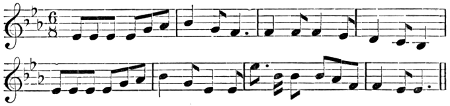
—Miss Dendy.
[Play]
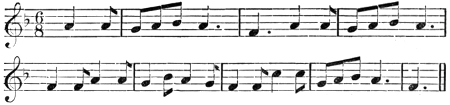
—Harpenden (Miss Lloyd).
I.
Thread my grandmother’s needle! Thread my grandmother’s needle! Thread my grandmother’s needle! Open your gates as wide as high, And let King George and me go by. It is so dark I cannot see To thread my grandmother’s needle! Who stole the money-box?
—London (Miss Dendy).
II.
Open your gates as wide as I, [high?] And let King George’s horses by; For the night is dark and we cannot see, But thread your long needle and sew.
—Belfast (W. H. Patterson).
III.
Thread the tailor’s needle, The tailor’s blind, so he can’t see; So open the gates as wide as wide, And let King George and his lady pass by.
—Bocking, Essex (Folk-lore Record, iii. 170).
IV.
Thread my grandmother’s needle, Thread my grandmother’s needle; It is too dark we cannot see To thread my grandmother’s needle.
—Harpenden (Mrs. Lloyd).
V.
Thread the needle, Thread the needle, Nine, nine, nine, Let King George and I pass by.
—Liphook, Hants (Miss Fowler).
VI.
Open the gates as wide as wide, And let King George go through with his bride; It is so dark, we cannot see To threaddle the tailor’s needle.
—Parish Dictionary of the Sussex Dialect.
VII.
Brother Jack, if ye were mine, I would give you claret wine; Claret wine’s gude and fine— Through the needle-e’e, boys!
—Blackwood’s Magazine, August 1821.
VIII.
Through the needle-e’e, boys, One, two, three, boys.
—Ross-shire (Rev. W. Gregor).
IX.
Hop my needle, burn my thread, Come thread my needle, Jo-hey.
—Lincoln (C. C. Bell).
X.
Come thread a long needle, come thread, The eye is too little, the needle’s too big.
—Hanbury, Staffs. (Miss Edith Hollis).
XI.
Thread the needle thro’ the skin, Sometimes out and sometimes in.
—Warwickshire, Northall’s Folk Rhymes, 397.
XII.
Open the gates as wide as the sky, And let King George and his lady go by.
—Ellesmere, Burne’s Shropshire Folk-lore, p. 321.
(b.) The children stand in two long rows, each holding the hands of the opposite child, the two last forming an arch. They sing the lines, and while doing so the other children run under the raised arms. When all have passed under, the first two hold up their hands, and so on again and again, each pair in turn becoming the arch. Mrs. Lloyd (Harpenden version) says the two first hold up a handkerchief, and the children all run under, beginning with the last couple. In the London version (Miss Dendy) the “last line is called out in quite different tones from the rest of the rhyme. It is reported to have a most startling effect.” The Warwickshire version is played differently. The players, after passing under the clasped hands, all circle or wind round one of their number, who stands still.
(c.) In some cases the verse, “How many miles to Babylon?” is sung before the verses for “Thread the needle,” and the reference made (ante, vol. i., p. 238) to an old version seems to suggest the origin of the game. This, at all events, goes far to prove that the central idea of the game is not connected with the sewing needle, but with an interesting dance movement, which is called by analogy, Thread the needle. It is, however, impossible to say whether the verses of this game are the fragments of an older and more lengthy original, which included both the words of “How many miles to Babylon” and “Thread the needle,” or whether these two were independent games, which have become joined; but, on the whole, I am inclined to think that “Thread the needle,” at all events, is an independent game, or the central idea of an independent game, and one of some antiquity.
This game is well illustrated by custom. At Trowbridge, in Wilts, a game, known as “Thread the needle,” used to be the favourite sport with the lads and lasses on the evening of Shrove Tuesday festival. The vocal accompaniment was always the following:—
Shrove Tuesday, Shrove Tuesday, when Jack went to plough, His mother made pancakes, she didn’t know how; She tipped them, she tossed them, she made them so black, She put so much pepper she poisoned poor Jack.
—Notes and Queries, 5th series, xi. p. 227.
At Bradford-on-Avon, as soon as the “pancake bell” rang at eleven A.M., the school children had holiday for the remainder of the day, and when the factories closed for the night, at dusk the boys and girls of the town would run through the streets in long strings playing “Thread the needle,” and whooping and hallooing their best as they ran, and so collecting all they could together by seven or eight o’clock, when they would adjourn to the churchyard, where the old sexton had opened the churchyard gates for them; the children would then join hands in a long line until they encompassed the church; they then, with hands still joined, would walk round the church three times; and when dismissed by the old sexton, would return to their homes much pleased that they “Clipped the Church,” and shouting similar lines to those said at Trowbridge.
At South Petherton, in South Somerset, sixty or seventy years ago, it was the practice of the young folk of both sexes to meet in or near the market-place, and there commence “Threading the needle” through the streets, collecting numbers as they went. When this method of recruiting ceased to add to their ranks, they proceeded, still threading the needle, to the church, which they tried to encircle with joined hands; and then, whether successful or not, they returned to their respective homes. Old people, who remember having taken part in the game, say that it always commenced in the afternoon or evening of Shrove Tuesday, “after having eaten of their pancakes.” In Leicestershire County Folk-lore, p. 114, Mr. Billson records that it was formerly the custom on Shrove Tuesday for the lads and lasses to meet in the gallery of the Women’s Ward in Trinity Hospital to play at “Thread the Needle” and similar games.
At Evesham the custom is still more distinctly connected with the game, as the following quotation shows:—“One custom of the town is connected with a sport called ‘Thread my needle,’ a game played here by the children of the town throughout the various streets at sunset upon Easter Monday, and at no other period throughout the year. The players cry while elevating their arms arch-wise—
Open the gates as high as the sky, And let Victoria’s troops pass by.”
—May’s History of Evesham, p. 319.
As all these customs occur in the early spring of the year, there is reason to think that in this game we have a relic of the oldest sacred dances, and it is at least a curious point that in two versions (Bocking and Ellesmere) the Anglo-Saxon title of “Lady” is applied to the Queen.
The writer in Blackwood’s Magazine, who quotes the rhymes as “immemorial,” says: “Another game played by a number of children, with a hold of one another, or ‘tickle tails,’ as it is technically called in Scotland, is ‘Through the needle-e’e.’” Moor (Suffolk Words and Phrases) mentions the game. Patterson (Antrim and Down Glossary) gives it as “Thread the needle and sew.” Barnes (Dorset Glossary) calls it “Dred the wold woman’s needle,” in which two children join hands, and the last leads the train under the lifted arms of the first two. Holloway (Dictionary of Provincialisms) says the children form a ring, holding each other’s hands; then one lets go and passes under the arms of two who still join hands, and the others all follow, holding either by each other’s hands or by a part of their dress. “At Ellesmere,” Miss Burne says, “this game was formerly called ‘Crew Duck.’ It now only survives among little girls, and is only played on a special day.” It is alluded to in Poor Robin’s Almanack for 1738: “The summer quarter follows spring as close as girls do one another when playing at Thread my needle; they tread upon each other’s heels.” Strutt calls this “Threading the Taylor’s needle.” Newell (Games of American Children) gives some verses, and describes it as played in America.
See “How many miles to Babylon,” “Through the Needle ’ee.”
Three Days’ Holidays
Two players hold up their joined hands, the rest pass under one by one, repeating, “Three days’ holidays, three days’ holidays!” They pass under a second time, all repeating, “Bumping day, bumping day!” when the two leaders strike each player on the back in passing. The third time they say, “Catch, catch, catch!” and the leaders catch the last in the train between their arms. He has the choice of “strawberries or grapes,” and is placed behind one of the leaders, according to his answer. When all have been “caught,” the two parties pull against each other.—Berrington (Burne’s Shropshire Folk-lore, p. 522).
“Holidays,” says Miss Burne, “anciently consisted of three days, as at Easter and Whitsuntide, which explains the words of this game;” and the manorial work days were formerly three a week. See “Currants and Raisins.”
Three Dukes
[Play]
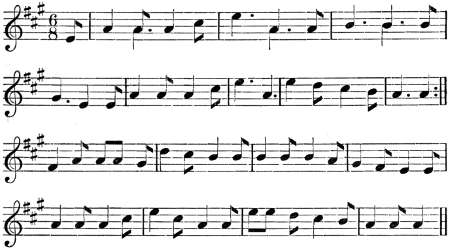
—Madeley, Shropshire (Miss Burne).
[Play]
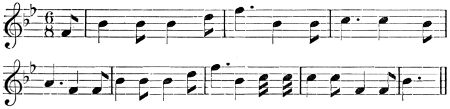
—Biggar, Lanarkshire (W. Ballantyne).
[Play]
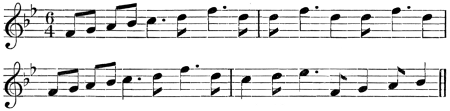
—Sporle, Norfolk (Miss Matthews).
[Play]
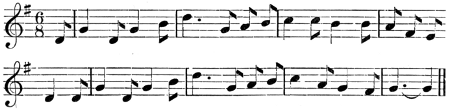
—Isle of Man (A. W. Moore).
I.
Here come three dukes a-riding, A-riding, a-riding; Here come three dukes a-riding, With a rancy, tancy, tay! What is your good will, sirs? Will, sirs? will, sirs? What is your good will, sirs? With a rancy, tancy, tay! Our good will is to marry, To marry, to marry; Our good will is to marry, With a rancy, tancy, tay! Marry one of us, sirs, Us, sirs, us, sirs; Marry one of us, sirs, With a rancy, tancy, tay! You’re all too black and greasy [or dirty], Greasy, greasy; You’re all too black and greasy, With a rancy, tancy, tay! We’re good enough for you, sirs, You, sirs, you, sirs; We’re good enough for you, sirs, With a rancy, tancy, tay! You’re all as stiff as pokers, Pokers, pokers; You’re all as stiff as pokers, With a rancy, tancy, tay! We can bend as much as you, sirs, You, sirs, you, sirs; We can bend as much as you, sirs, With a rancy, tancy, tay! Through the kitchen and down the hall, I choose the fairest of you all; The fairest one that I can see Is pretty Miss ——, walk with me.
—Madeley, Salop (Miss Burne), 1891.
[Another Shropshire version has for the fourth verse—
Which of us will you choose, sirs?
Or,
Will you marry one of my daughters?]
II.
Here comes three dukes a-riding, a-riding, With a ransome dansome day! Pray what is your intent, sirs, intent, sirs? With a ransome dansome day! My intent is to marry, to marry! Will you marry one of my daughters, my daughters? You are as stiff as pokers, as pokers! We can bend like you, sir, like you, sir! You’re all too black and too blowsy, too blowsy, For a dilly-dally officer! Good enough for you, sir! for you, sir! If I must have any, I will have this, So come along, my pretty miss!
—Chirbury (Shropshire Folk-lore, p. 517).
III.
Here come three dukes a-riding, A-riding, a-riding; Here come three dukes a-riding, With a rancy, tancy, tee! Pray what is your good will, sirs? Will, sirs, will, sirs? Pray what is your good will, sirs? With a rancy, tancy, tee! My will is for to marry you, To marry you, to marry you; My will is for to marry you, With a rancy, tancy, tee! You’re all so black and blousey (blowsy?), Sitting in the sun so drowsy; With silver chains about ye, With a rancy, tancy, tee!
Or,
[With golden chains about your necks, Which makes you look so frowsy.] Walk through the kitchen, and through the hall, And pick the fairest of them all. This is the fairest I can see, So pray, Miss ——, walk with me.
—Leicester (Miss Ellis).
IV.
Here come three dukes a-riding, a-riding, a-riding, Here come three dukes riding, riding, riding; Ransam, tansam, tisum ma tea (sic). Pray what is your good will, sir, will, sir, will, sir? Pray what is your good will, sir? Ransam, tansam, tisum ma tea! My will is for to marry, to marry, to marry, My will is for to marry; Ransam, tansam, tisum ma tea! Pray who will you marry, you marry, you marry? Pray who will you marry? Ransam, tansam, tisum ma tea! You’re all too black and too brown for me, You’re all too black and too brown for me, Ransam, tansam, tisum ma tea! We’re quite as white as you, sir; as you, sir; as you, sir; We’re quite as white as you, sir; Ransam, tansam, tisum ma tea! You are all as stiff as pokers, as pokers, as pokers, You are all, &c., Ransam, tansam, tisum ma tea! We can bend as well as you, sir; as you, sir; as you, sir; We can bend as well as you, sir; Ransam, tansam, tisum ma tea! Go through the kitchen, and through the hall, And take the fairest of them all; The fairest one that I can see is “——,” So come to me.
—Oxfordshire version, brought into Worcestershire (Miss Broadwood).
V.
Here come three dukes a-riding, a-riding, a-riding; With a ransom, tansom, titty foll-la! With a ransom, tansom, tay! And pray what do you want, sirs? want, sirs? want, sirs? With a ransom, tansom, titty foll-la! With a ransom, tansom, tay! I want a handsome wife, sir; wife, sir; wife, sir; With a ransom, tansom, titty foll-la! With a ransom, tansom, tay! I have three daughters fair, sir; fair, sir; fair, sir; With a ransom, tansom, titty foll-la! With a ransom, tansom, tay! They are all too black and too browny, They sit in the sun so cloudy; With a ransom, tansom, titty foll-la! With a ransom, tansom, tay! Go through my kitchen and my hall, And find the fairest of them all; With a ransom, tansom, titty foll-la! With a ransom, tansom, tay! The fairest one that I can see, Is little —— ——, so come to me.
—Monton, Lancashire (Miss Dendy).
VI.
Here come three dukes a-riding, a-riding, a-riding; Here come three dukes a-riding, with a ransom, tansom, te! Pray what is your intention, sir [repeat as above]. My intention is to marry, &c. Which of us will you choose, sir, &c. You’re all too black and too browsy, &c. We’re good enough for you, sir, &c. Through the kitchen and over the wall, Pick the fairest of us all. The fairest is that I can see, pretty Miss ——, come to me.
—East Kirkby, Lincolnshire (Miss K. Maughan).
VII.
Here come three dukes a-riding, A-riding, a-riding; Here come three dukes a-riding, With a dusty, dusty, die! What do you want with us, sirs? [repeat as above]. We’ve come to choose a wife, Miss, &c. Which one of us will you have, sirs? &c. You’re all too black and too browsy, You sit in the sun so drowsy; With a golden chain about your neck, You’re all too black and too browsy. Quite good enough for you, sirs, &c. We walk in our chamber, We sit in our hall, We choose the fairest of you all; The fairest one that we can see Is little —— ——, come to me.
—Wakefield, Yorks. (Miss Fowler).
VIII.
Here come three dukes a-riding, a-riding, a-riding, Here come three dukes a-riding; A randy, dandy, very fine day! And pray what is your will, sirs? &c. [as above]. We come for one of your daughters, &c. Which one will you have, sir? &c. They are all as black as a browsie, browsie, browsie, &c. One can knit, and one can sew, One can make a lily-white bow; One can make a bed for a king, Please take one of my daughters in. The fairest one that I can see Is [ ], come to me.
—Gainford, co. Durham (Miss A. Edleston).
IX.
Here comes a poor duke a-riding, a-riding, Here comes a poor duke a-riding; With the ransom, tansom, tee! Pray who will you have to marry, sir? &c. You’re all so black and so dirty, &c. We are quite as clean as you, sir, &c. Through the kitchen, and through the hall, Pick the fairest one of all. The fairest one that I can see Is ——, The fairest one that I can see, With a ransom, tansom, tee!
—Sporle, Norfolk (Miss Matthews).
X.
Here comes one duke a-riding, A-riding, a-riding; Here comes one duke a-riding, With a ransom, tansom, terrimus, hey! What is your intention, sir? &c. [as above]. My intention is to marry, &c. Marry one of us, sir? &c. You’re all too black and dirty (or greasy), &c. We’re good enough for you, sir, &c. You’re all as stiff as pokers, &c. We can bend as much as you, sir, &c. Through the kitchen and through the hall, I choose the fairest of you all; The fairest one as I can see Is pretty —— ——, come to me. Now I’ve got my bonny lass, Bonny lass, bonny lass; Now I’ve got my bonny lass To help us with our dancing.
—Barnes, Surrey (A. B. Gomme).
XI.
Here comes one duke a-riding, a-riding, a-riding; Here comes one duke a-riding On a ransom, dansom bay! You’re all so black and dirty, &c. Pray which of us will you choose, sir, &c. Up in the kitchen, down in the hall, And choose the fairest one of all. The fairest one that I can see Is pretty Miss ——, so come to me.
—Bocking, Essex (Folk-lore Record, vol. iii., pt. ii., pp. 170-171).
XII.
Here comes one duke a-riding, a-riding, a-riding, Here comes one duke a-riding, with a ransom, tansom, ta! Pray which of us will you choose, sir? &c. You’re all so black and so blousey, &c. We’re quite as white as you, sir, &c. Up of the kitchen, down of the hall, Pick the fairest girl of all; The fairest one that I can see Is —— ——, come to me.
—Suffolk (Mrs. Haddon).
XIII.
Here comes the Duke of Rideo, Of Rideo, of Rideo; Here comes the Duke of Rideo, Of a cold and frosty morning. My will is for to get married, &c. Will any of my fair daughters do? &c. [The word “do” must be said in a drawling way.] They are all too black or too proudy, They sit in the sun so cloudy; With golden chains around their necks, That makes them look so proudy. They’re good enough for you, sir! &c. I’ll walk the kitchen and the hall, And take the fairest of them all; The fairest one that I can see Is Miss —— So Miss ——, come to me. Now we’ve got this pretty girl, This pretty girl, this pretty girl; Now we’ve got this pretty girl, Of a cold and frosty morning.
—Symondsbury, Dorsetshire (Folk-lore Journal, vii. 222-223).
XIV.
Here come three dukes a-riding, a-riding, a-riding, Here come three dukes a-riding; With a ransom, tansom, tisamy, tea! What is your good will, sirs? &c. My good will is to marry, &c. One of my fair daughters? &c. You’re all too black and browsy, &c. Quite as good as you, sirs, &c. [The dukes select a girl who refuses to go to them.] O, naughty maid! O, naughty maid! You won’t come out to me! You shall see a blackbird, A blackbird and a swan; You should see a nice young man Persuading you to come.
—Wrotham, Kent (Miss Dora Kimball).
XV.
Here comes a duke a-riding, a-riding, a-riding; Here comes a duke a-riding, to my nancy, pancy, disimi, oh! Which of us will you have, sir? &c. You’re all so fat and greasy, &c. We’re all as clean as you, sir, &c. Come down to my kitchen, come down to my hall, I’ll pick the finest of you all. The fairest is that girl I shall say, “Come to me.” I will buy a silk and satin dress, to trail a yard as we go to church, Madam, will you walk? madam, will you talk? Madam, will you marry me? I will buy you a gold watch and chain, to hang by your side as we go to church; Madam, will you walk? madam, will you talk? Madam, will you marry me? I will buy you the key of the house, to enter in when my son’s out; Madam, will you walk? madam, will you talk? Madam, will you marry me?
—Earls Heaton, Yorks. (H. Hardy).
XVI.
Here comes one duke a-riding, With a rancey, tancey, tiddy boys, O! Rancey, tancey, tay! Pray which will you take of us, sir? &c. You’re all as dark as gipsies, &c. Quite good enough for you, &c. Then we’ll take this one, &c.
[After all are taken, the dukes say]—
Now we’ve got this bonny bunch, &c.
—Hurstmonceux, Sussex, about 1880 (Miss E. Chase).
[A Devon variant gives for the third verse—
You are all too black and ugly, and ugly, and ugly.
And—
You are all too black and browsie, &c.
With the additional verse—
I walked through the kitchen, I walked through the hall, For the prettiest and fairest Of you all.
Ending with—
Now I have got my bonny lass, &c.
And something like—
Will you come and dance with me?
—Devon (Miss E. Chase)].
XVII.
Here comes a duke a-riding, a-riding, a-riding; Here comes a duke a-riding to the ransy, tansy, tay! Pray what do you come riding for? &c. For one of your fairy [? fair] daughters, &c. Will either one of these do? &c. They’re all too black and too dirty, &c. They’re quite as clean as you, sir, &c. Suppose, then, I take you, Miss, &c.
—Clapham, London (Mrs. Herbertson).
[Another version is played by the duke announcing that he wants a wife. The circle of maids and duke then reply to each other as follows:—
Open the door and let him in. They’re all as stiff as pokers. Quite as good as you, sir. I suppose I must take one of them? Not unless you like, sir. I choose the fairest of you all, The fairest one that I can see Is ——, come to me.
—Clapham Middle-class Girls School (Mrs. Herbertson)].
XVIII.
Here comes the duke a-riding, With my rantum, tantum, tantum, tee! Here comes the duke a-riding, With my rantum, tantum, tee! What does the duke a-riding want? With his rantum, tantum, tantum, tee, &c. The youngest and fairest daughter you’ve got, &c.
—Dublin (Mrs. Coffey).
XIX.
Here comes a duke a-riding, a-riding, a-riding; Here comes a duke a-riding, a ransom, tansom, tee! What is your good will, sir, &c. My will is for to marry, &c. Will ever a one of us do? &c. You’re all so black and so browsy. You sit in the sun and get frowsy, With golden chains about your necks, You’re all so black and so browsy. Quite as good as you, sir, &c.
[There is more of this, but it has been forgotten by my authority.]
—Thos. Baker, junr. (Midland Garner, N. S., ii. 32).
XX.
Here comes a duke a-riding, With a ransom, tansom, titta passee! Here comes a duke a-riding, With a ransom, tansom, tee! Pray what is your good will, sir? With a ransom, tansom, titta passee! Pray what is your good will, sir? With a ransom, tansom, tee! My will is for to marry you (as above). Pray which of us will you have, sir? &c. Through the gardens and through the hall, With a ransom, tansom, titta passee! I choose the fairest of you all, With a ransom, tansom, tee!
—Settle, Yorks. (Rev. W. G. Sykes).
XXI.
There came three dukes a-riding, ride, ride, riding; There came three dukes a-riding, With a tinsy, tinsy, tee! Come away, fair lady, there is no time to spare; Let us dance, let us sing, Let us join the wedding ring.
—West of Scotland (Folk-lore Record, iv. 174).
XXII.
Here come three dukes a-riding, A-riding, a-riding. ..... They will give you pots and pans, They will give you brass; They will give you pots and pans For a pretty lass.
—Penzance, Cornwall (Mrs. Mabbott).
XXIII.
Here come four dukes a-riding, Ring a me, ding a me, ding. What is your good will, sirs? Ring a me, ding a me, ding. Our good will’s to marry, &c. Marry one of us then, &c. You’re too poor and shabby, &c. We’re quite as good as you are, &c. Suppose we have one of you then, &c. Which one will you have, &c. We’ll have —— to marry, &c. Who will you send to fetch her, &c. We’ll send —— to fetch her.
—Roxton, St. Neots (Miss E. Lumley).
XXIV.
Here come three dukes a-riding, With me rancy, tansy, tissimy tee, Here come three dukes a-riding, With a ransom, tansom, tissimy tee. Here come three dukes a-riding, With a ransom, tansom, tissimy tee. Pray which of us will you have, sir (repeat as above). I think I will have this one (repeat). ......
[Forgotten, but the girls evidently decline to part with one of their number.]
You are all too black and too blousy (repeat). We’re far too good for you, sir (repeat).
—Isle of Man (A. W. Moore). Played at a Manx Vicarage nearly sixty years ago (Rev. T. G. Brown).
XXV.
Here comes a Jew a riding, With the ransom, tansom, tissimi, O! And pray what is your will, sir? (as above). Then pray take one of my daughters, &c. They are all too black and too browsy, &c. They are good enough for you, sir, &c. My house is lined with silver, &c. But ours is lined with gold, sir, &c. Then I’ll take one of your daughters, &c.
—Forest of Dean, Gloucester (Miss Matthews).
XXVI.
The Campsie dukes a-riding, a-riding, a-riding; The Campsie dukes a riding, come a rincey, dincey, dee.
—Biggar (Wm. Ballantyne).
XXVII.
Five dukes comes here a-ridin’, A-ridin’ fast one day; Five dukes comes here a-riding, With a hansom, dansom day. What do you want with us, sirs, With us, sirs, &c. We want some wives to marry us, To marry us, to marry us, &c. Will you marry us, Miss Nancy, Miss Nancy, Miss Nancy, &c. We won’t marry you to-day, sirs, &c. Will you marry us to-day, Miss? &c. (to another girl). We will marry you to-day, sirs, &c.
—London, Regent’s Park (A. B. Gomme).
XXVIII.
There’s three dukes a-riding, a-riding, There’s three dukes a-riding, Come a ransin, tansin, my gude wife. Come a ransin, tansin te-dee, Before I take my evening walk, I’ll have a handsome lady, The fairest one that I do see.
—Rosehearty, Pitsligo (Rev. W. Gregor).
XXIX.
One duck comes a-ridin’, sir, a-ridin’, sir, A-ridin’ to marry you. And what do you want with me, sir? I come to marry you two. There’s some of us ready to dance, sir; Ready to dance and sing; There’s some of us ready to dance, sir, And ready to marry you. Then come to me, my darlin’, my darlin’, darlin’ day, With a ransom, tansom, tansom, tansom tay.
—London, Regent’s Park (A. B. Gomme).
XXX.
There’s a young man that wants a sweetheart— Wants a sweetheart—wants a sweetheart— There’s a young man that wants a sweetheart, To the ransom tansom tidi-de-o. Let him come out and choose his own, Choose his own, choose his own; Let him come out and choose his own, To the ransom tansom tidi-de-o. Will any of my fine daughters do, &c. They are all too black and brawny, They sit in the sun uncloudy, With golden chains around their necks, They are too black and brawny. Quite good enough for you, sir! &c. I’ll walk in the kitchen, and walk in the hall, I’ll take the fairest among you all; The fairest of all that I can see, Is pretty Miss Watts, come out to me. Will you come out? Oh, no! oh, no! Naughty Miss Watts she won’t come out, She won’t come out, she won’t come out; Naughty Miss Watts she won’t come out, To help us in our dancing. Won’t you come out? Oh, yes! oh, yes!
—Dorsetshire (Folk-lore Journal, vii. 223-224).
(c.) Three children, generally boys, are chosen to represent the three dukes. The rest of the players represent maidens. The three dukes stand in line facing the maidens, who hold hands, and also stand in line. Sufficient space is left between the two lines to admit of each line in turn advancing and retiring. The three dukes commence by singing the first verse, advancing and retiring in line while doing so. The line of maidens then advances singing the second verse. The alternate verses demanding and answering are thus sung. The maidens make curtseys and look coquettishly at the dukes when singing the fourth verse, and draw themselves up stiffly and indignantly when singing the sixth, bending and bowing lowly at the eighth. The dukes look contemptuously and criticisingly at the girls while singing the fifth and seventh verses; at the ninth or last verse they “name” one of the girls, who then crosses over and joins hands with them. The game then continues by all four singing “Here come four dukes a-riding,” and goes on until all the maidens are ranged on the dukes’ side.
This method of playing obtains in most versions of the game, though there are variations and additions in some places. In the Bocking, Barnes, Dublin, Hurstmonceux, Settle, Symondsbury, Sporle, Earls Heaton, and Clapham versions, where the verses begin with “Here comes one Duke a-riding,” one boy stands facing the girls, and sings the first verse advancing and retiring with a dancing step, or with a step to imitate riding. In some instances the “three Dukes” advance in this way. In the Barnes version, when the chosen girl has walked over to the duke, he takes her hands and dances round with her, while singing the tenth verse. In the Symondsbury (Dorset) version the players stand in a group, the duke standing opposite, and when singing the sixth verse, advances to choose the girl. When there is only one player left on the maidens’ side the dukes all sing the seventh verse; they then come forward and claim the last girl, and embrace her as soon as they get her over to their side. In the Hurstmonceux version, when the girls are all on the dukes’ side, they sing the last verse. Miss Chase does not say whether this is accompanied by dancing round, but it probably would be. In the Dublin version, after the third verse, the duke tries to carry off the youngest girl, and her side try to save her. In the Wrotham version, after the girls’ retort, “Quite as good, as you, sir,” the dukes select a girl, who refuses to go to them: they then sing the last six lines when the girl goes over. In the second Dorset version (which appeared in the Yarmouth Register, Mass., 1874) the players consisted of a dozen boys standing in line in the usual way, and a dozen girls on the opposite side facing them. The boys sing the first two verses alternately; the girl at first refuses and then consents to go. Dancing round probably accompanies this, but there is no mention of it. In Roxton, St. Neots, after the verses are sung, the duke and the selected girl clasp hands, and he pulls her across to the opposite side, as in “Nuts in May.” In Settle (Yorks.) the game is called “The Dukes of York and Lancaster.” The first duke advances with a dancing step. The game is then played in the usual way until all the players are ranged on the dukes’ side; then the two original dukes, one of whom is “red” and the other “white,” join hands, and the other players pass under their raised hands. The dukes ask each of them, in a whisper, “red?” or “white?” The player then goes behind the one he or she has chosen, clasping the duke’s waist. When all the players have chosen, a tug-of-war ensues between the two sides. In the Earls Heaton version, the duke sings the verses, offering gifts to the girl when she has been selected. In the Oxfordshire version (Miss Broadwood) one player sings the words of the verse, and all join in the refrain as chorus. In the Monton (Lancashire) version the duke sings the last verse, and then takes a girl from the opposite side; and in another version from Barnes, in which the words of the last verse are the same as these, one of the dukes’ side crosses over and fetches the girl. The duke bows lowly before the chosen girl in the Liphook version before she joins his side. In the East Kirkby, Lincolnshire, version, when the dukes sing the last verse, they advance towards the opposite side, who, when they see the direction in which they are coming, form two arches, by three of the players holding up their arms, the dukes’ side going through one arch and returning through the other, bringing the chosen girl with them. One Clapham version is played in a totally different manner: the maidens form a circle instead of a line, and the duke stands outside this until he is admitted at the line which says, “let him in.” At the conclusion of the dialogue he breaks in and carries one player off. This is an unusual form; I have only met with one other instance of it.
(d.) The action in many of these versions is described as very spirited: coquetry, contempt, and annoyance being all expressed in action as the words of the game demands. The dancing movement of the boys in the first verse to imitate riding, though belonging to the earlier forms, is, with the exception of two or three versions, only retained in those which are commenced by one player, partly, perhaps, because of the difficulty three or more players experience in “riding” or “prancing” while holding each other’s hands in line form. I have seen the game played when the “prancing” of the dukes (in a game where there were a dozen or more players on each side at starting, as in the Dorset version) was as important a feature as the maidens’ actions in the other verses. I think the oldest form of the game is that played by a fairly equal number of players on each side, boys on one side and girls on the other, rather than that of “one” or “three” players on the dukes’ side, and all the others opposite. The game then began with the present words, “Here come three dukes;” these three each chose a girl at the same time, and when these three were wived, another three “dukes” would pair with three more of the girls, and after that another three, and so on. This form would account for the modern idea that the number of dukes increases on every occasion that the verses are sung, after the first wife has been taken over, and until all the girls have been thus chosen. This idea is expressed in some versions by the change of words: “Here’s a fourth [or fifth, and so on] duke come a riding” to take a wife, the chosen maiden becoming a duke as soon as she has passed over on to the dukes’ side. The process of innovation may be traced by the methods of playing. Thus, in one version played at Barnes (similar in other respects to No. 10), beginning “three dukes a riding,” three girls were chosen by the three first dukes, one by each, at the same time, and all three girls walked across with the three dukes to the boys’ line, and stood next their respective partners. In two imperfect versions I have obtained in Regent’s Park, London, the same principle occurs. One girl began—“One duck comes a ridin’,” and two girls from the opposite side walked across; the other “Five dukes come here a ridin’” was played by five players on each side, and this was continued throughout. When the verses were said, each of the five dukes took a player from the opposite side and danced round with her. Again, in those versions (Symondsbury and Barnes), where when one player is left on the maidens’ side without a partner, and all the dukes are mated, the additional verse is sung, and this player is taken over too. Beyond these versions are the large number beginning with three or more children singing the formula of “three dukes,” and choosing one girl at a time, until all are taken over on to the dukes’ side. Finally, there are the versions, more in accord with modern ideas, which commence with one duke coming for a wife, and continue by the girls taken over counting as dukes, the formula changing into two dukes, and so on.
If this correctly represents the line of decadence in this game, those versions in which additional verses appear are, I think, instances of the tacking on of verses from the “invitation to the dance” or “May” games; particularly in the cases in which the words “Now I’ve got my bonny lass” appear. The Earls Heaton version is curious, in that it has several verses which remind us of the old and practically obsolete “Keys of Canterbury” (Halliwell, 96). It may well be that a remembered fragment of that old ballad, which was probably once danced as a dramatic round, has been tacked on to this game. The expression “walk with me,” or “walk abroad with me,” is significant of an engaged or betrothed couple. “I’m walking or walking out with so and so” is still an expression used by young men and young women to indicate an engagement. “She did ought to be married now; she’ve walked wi’ him mor’n’er a year now.” Some of the versions show still more marked signs of decadence. The altered wording, “Here comes a Jew a riding,” “Here comes the Duke of Rideo,” “A duck comes a ridin’,” and the Scotch “Campsie Dukes a riding;” a Berkshire version, collected by Miss Thoyts (Antiquary, xxvii. p. 195), similar to the Shropshire game, but with a portion of the verse of “Milking Pails” added to it, and the refrain of “Ransome, tansome, tismatee;” together with the disappearance of some of the verses, are all evidently the results of the words being learnt orally, and imperfectly understood, or not understood at all.
In this game, said in Lancashire to be the “oldest play of all,” judging both by the words and method of playing, we have, I believe, a distinct survival or remembrance of the tribal marriage—marriage at a period when it was the custom for men of a clan to seek wives from the girls of another clan, both clans belonging to one tribe. The game is a purely marriage game, and marriage in a matter-of-fact way. Young men of a clan or village arrive at the abode of another clan for the purpose of seeking wives, probably at a feast or fair time. The maidens are apparently ready and expecting their arrival. They are as willing to become wives as the dukes are to become husbands. It is not marriage by force or capture, though the triumphant carrying off of a wife appears in some versions. It is exogamous marriage custom, after the tribe had settled down and arranged their system of marriage in lieu of a former more rude system of capture. The suggested depreciation of the girls, and their saucy rejoinders, may be looked upon as so much good-humoured chaff and banter exchanged between the two parties to enhance each other’s value, and to display their wit. While it does not follow that the respective parties were complete strangers to one another, these lines may indicate that each individual wished “to have as good a look round as possible” before accepting the offer made. It will be seen that there is no mention of “love” in the game, nor is there any individual courtship between boy and girl. The marriage formula does not appear, nor is there any sign that a “ceremony” or “sanction” to conclude the marriage was necessary, nor does kissing occur in the game.
There is evidence of the tribal marriage system in the survivals of exogamy and marriage by capture occasionally to be noted in traditional local custom. Thus the custom recorded by Chambers (Book of Days, i. 722) of the East Anglians (Suffolk), where whole parishes have intermarried to such an extent that almost everybody is related to or connected with everybody else, is distinctly a case in point, the intermarrying of “parishes” for a long series of years necessarily resulting in close inter-relationship. One curious effect of this is that no one is counted as a “relation” beyond first cousins; for if “relationship” went further than that it might “almost as well include the whole parish.” The old proverb (also from East Anglia):
“To change the name, and not the letter, Is a change for the worse, and not for the better;”
that is, it is unlucky for a woman to marry a man whose surname begins with the same letter as her own, also indicates a survival of the necessity of marrying into another clan or tribal family.
Another interesting point in the game is the refrain, “With a rancy, tancy, tay,” which with variations accompanies all versions, and separates this game from some otherwise akin to it. There is little doubt that this refrain represents an old tribal war cry, from which “slogans” or family “cries” were derived. These cries were not only used in times of warfare, tribes were assembled by them, each leader of a clan or party having a distinguishing cry and blast of a horn peculiar to himself, and the sounding of this particular blast or cry would be recognised by men of the same party, who would go to each other’s assistance if need were. The refrain is sung by all the players in Oxfordshire and Lancashire, and in some versions the players in this game put their hands to their mouths as if imitating a blast from a horn, and a Lancashire version (about 1820-1830), quoted by Miss Burne, has for the refrain, “With a rancy, tancy, terry boys horn, with a rancy, tancy, tee.” “The burden,” says Miss Burne, “evidently represented a flourish of trumpets.” The Barnes version, “With a rancy, tancy, terrimus hey!” and many others confirm this.
An interesting article by Dr. Karl Blind (Antiquary, ix. 63-72), on the Hawick riding song, “Teribus ye Teri Odin,” points out that this slogan, which occurs in the “Hawick Common-Riding Song,” a song used at the annual Riding of the Marches of the Common, is an ancient Germanic war-cry. Dr. Blind, quoting from a pamphlet, Flodden Field and New Version of the Common Riding Song, says, “It is most likely that the inspiring strains of ‘Terribus’ would be the marching tune of our ancestors when on their way for Flodden Field and other border battles, feuds, and frays. The words of the common-riding song have been changed at various periods, according to the taste and capacity of poets and minstrels, but the refrain has remained little altered. . . . The origin of the ancient and, at one time, imperative ceremony of the common-riding is lost in antiquity, and this old, no longer understood, exclamation, ‘Teribus ye Teri Odin,’ has (says Dr. Blind) all through ages in the meanwhile clung to that ceremony.”
If we can fairly claim that the words of this game have preserved an old slogan or tribal cry, an additional piece of evidence is supplied to the suggestion that the game is a reflection of the tribal marriage—a reflection preserved by children of to-day by means of oral tradition from the children of a thousand years ago or more, who played at games in imitation of the serious and ordinary actions of their elders.[Addendum] [Addendum]
Three Flowers
My mistress sent me unto thine, Wi’ three young flowers baith fair and fine— The Pink, the Rose, and the Gilliflower: And as they here do stand, Whilk will ye sink, whilk will ye swim, And whilk bring hame to land?
A group of lads and lasses being assembled round the fire, two leave the party and consult apart as to the names of three others, young men or girls, whom they designate Red Rose, the Pink, and the Gilliflower. If lads are first pitched upon, the two return to the fireside circle, and having selected a lass, they say the above verse to her. The maiden must choose one of the flowers named, on which she passes some approving epithet, adding, at the same time, a disapproving rejection of the other two; for instance, I will sink the Pink, swim the Rose, and bring home the Gilliflower to land. The two young men then disclose the names of the parties upon whom they had fixed those appellations respectively, when of course it may chance that she has slighted the person she is understood to be most attached to, or chosen him whom she is believed to regard with aversion; either of which events is sure to throw the company into a state of outrageous merriment.—Chambers’ Popular Rhymes, p. 127. Mr. W. Ballantyne has given me a description of this game as played at Biggar when he was a boy, which is practically the same as this.
Three Holes

Three holes were made in the ground by the players driving the heels of their boots into the earth, and then pirouetting. The game was played with the large marbles (about the size of racket balls) known as “bouncers,” sometimes as “bucks.” The first boy stood at “taw,” and bowled his marble along the ground into 1. (It was bad form to make the holes too large; they were then “wash-hand basins,” and made the game too easy.) Taking the marble in his hand, and placing his foot against 1, he bowled the marble into 2. He was now “going up for his firsts.” Starting at 2, he bowled the marble into 3, and had now “taken off his firsts,” and was “coming down for his seconds.” He then bowled the marble back again into 2, and afterwards into 1. He then “went up for his thirds,” bowling the marble into 2, and afterwards into 3, and had then won the game. When he won in this fashion, he was said to have “taken off the game.” But he didn’t often do this. In going up for his firsts, perhaps his marble, instead of going into 2, stopped at A; then the second boy started from taw, and, having sent his marble into 1, bowled at A; if he hit the marble, he started for 2, from where his marble stopped; if he missed, or didn’t gain the hole he was making for, or knocked his antagonist’s marble into a hole, the first boy played again, hitting the other marble, if it brought him nearer to the hole he was making for, or else going on. In such a case as I have supposed, it would be the player’s aim to knock A on to B, or some place between 2 and 3, so as to enter 2, and then strike again so as to near 3, enter 3, and strike on his way down for his seconds, and near 2 again. These were the chances of the game; but if the boy who started went through the game without his antagonist having a chance, he was said “to take off the game.”—London (J. P. Emslie).
Three Jolly Welshmen
One child is supposed to be taking care of others, who take hold of her or of each other. Three children personate the Welshmen. These try to rob the mother or caretaker of her children. They each try to capture as many as they can, and I think the one who gets most is to be mother next time.—Beddgelert (Mrs. Williams).
See “Gipsy,” “Mother, Mother,” “Shepherd and Sheep,” “Witch.”
Three Knights from Spain
I.
Here come two dukes all out of Spain, A courting to your daughter Jane. My daughter Jane, she is so young, She can’t abide your flattering tongue. Let her be young, or let her be old, It is the price, she must be sold, Either for silver or for gold. So fare you well, my lady gay, For I must turn another way. Turn back, turn back, you Spanish knight, And rub your spurs till they be bright. My spurs they are of a costliest wrought, And in this town they were not bought, Nor in this town they won’t be sold, Neither for silver, nor for gold. So fare you well, my lady gay, For I must turn another way. Through the kitchen, and through the hall, And take the fairest of them all; The fairest is, as I can see, Pretty Jane—come here to me. Now I’ve got my pretty fair maid, Now I’ve got my pretty fair maid, To dance along with me, To dance along with me!
—Eccleshall, Halliwell’s Nursery Rhymes, p. 222.
II.
Here comes three lords dressed all in green, For the sake of your daughter Jane. My daughter Jane, she is so young, She learns to talk with a flattering tongue. Let her be young, or let her be old, For her beauty she must be sold. My mead’s not made, my cake’s not baked, And you cannot have my daughter Jane.
—Cambridgeshire, Halliwell’s Nursery Rhymes, p. 222.
III.
We are three brethren out of Spain, Come to court your daughter Jane. My daughter Jane, she is too young, And has not learned her mother tongue. Be she young, or be she old, For her beauty she must be sold. So fare you well, my lady gay, We’ll call again another day. Turn back, turn back, thou scornful knight, And rub thy spurs till they be bright. Of my spurs take you no thought, For in this town they were not bought. So fare you well, my lady gay, We’ll call again another day. Turn back, turn back, thou scornful knight, And take the fairest in your sight. The fairest maid that I can see, Is pretty Nancy—come to me. Here comes your daughter, safe and sound, Every pocket with a thousand pound, Every finger with a gay gold ring, Please to take your daughter in.
—Halliwell’s Nursery Rhymes, cccxxxiii.
IV.
We are three brethren come from Spain, All in French garlands; We are come to court your daughter Jean, And adieu to you, my darlings. My daughter Jean, she is too young, All in French garlands; She cannot bide your flattering tongue, And adieu to you, my darlings. Be she young, or be she old, All in French garlands; It’s for a bride she must be sold, And adieu to you, my darlings. A bride, a bride, she shall not be, All in French garlands; Till she go through this world with me, And adieu to you, my darlings.
[There is here a hiatus, the reply of the lovers being wanting.]
Come back, come back, you courteous knights, All in French garlands; Clear up your spurs, and make them bright, And adieu to you, my darlings.
[Another hiatus.]
Smell my lilies, smell my roses, All in French garlands; Which of my maidens do you choose? And adieu to you, my darlings. Are all your daughters safe and sound? All in French garlands; Are all your daughters safe and sound? And adieu to you, my darlings. In every pocket a thousand pounds, All in French garlands; On every finger a gay gold ring, And adieu to you, my darlings.
—Chambers’s Popular Rhymes, 143.
V.
Here come three Spaniards out of Spain, A courting to your daughter Jane. Our daughter Jane, she is too young, She hath not learnt the Spanish tongue. Whether she be young, or whether she be old, It’s for her beauty she must be sold. Turn back, turn back, ye Spanish knight, And rub your spurs till they be bright. Our spurs are bright and richly wrought, For in this town they were not bought; And in this town they shan’t be sold, Neither for silver nor for gold. Pass through the kitchen, and through the hall, And pick the fairest of them all. This is the fairest I can see, So pray, young lady, walk with me.
—Leicester (Miss Ellis).
VI.
Here come three Spaniards out of Spain, A courting of your daughter Jane. My daughter Jane, she is too young, She has not learned the Spanish tongue. Whether she be young or old, She must have a gift of gold; So fare you well, my lady gay, We’ll turn our heads another way. Come back, come back, thou Spanish knight, And pick the fairest in this night.
—Addy’s Sheffield Glossary.
VII.
There were three lords they came from Spain, They came to court my daughter Jane; My daughter Jane, she is too young To hear your false and flattering tongue. So fare thee well, your daughter Jane, I’ll call again, another day, another year. Turn back, turn back, and choose The fairest one that you can see. The fairest one that I can see, Is pretty Jane, will you come with me. [Jane says No.] The proud little girl, she won’t come out, she won’t come out, to help us with our dancing; So fare you well, I’ll come again another day. Turn back, turn back, and choose The fairest one that you can see. The fairest one that I can see, Is pretty Sarah, will you come with me? [Yes.] Now we have got the pretty fair maid To help us with our dancing, Dance round the ring.
—Belfast (W. H. Patterson).
VIII.
There was one lord came out of Spain, He came to court our daughter Jane. Our daughter Jane, she is too young, To be controlled by flattering tongue. Oh! fare thee well. Oh! fare thee well, I’ll go and court some other girl. Come back, come back, your coat is wide, And choose the fairest on our side. The fairest one that I can see, Come unto me, come unto me.
—Belfast (W. H. Patterson).
IX.
There were three lords came out of Spain, They came to court my daughter Jane; My daughter Jane, she is too young To bear your false and flattering tongue. So fare you well, so fare you well, I’ll go and court some other girl. Come back, come back, your coat is white, And choose the fairest in your sight. The fairest one that I can see, Is [ ] come unto me.
—Belfast (W. H. Patterson).
X.
Here come three dukes dressed all in green, They come to court your daughter Jane. My daughter Jane, she is too young To understand your flattering tongue. Let her be young, or let her be old, It is for her beauty she must be sold. Eighteenpence would buy such a wench, As either you or your daughter Jane.[10]
—Middlesex (from Mrs. Pocklington-Coltman’s maid).
XI.
There came a king from Spain, To court your daughter Jane. My daughter Jane, she’s yet too young To be deluded by a flattering tongue. Whether she’s old, or whether she’s young, It’s for her beauty she must come. Then turn about, her coat is thin, And seek the fairest of your right. The fairest one that I can see Is fair and lovely Jan-ie. Then here’s my daughter safe and sound, And in her pocket three hundred pound, And on her finger a gay gold ring, She’s fit to walk with any king.
—Annaverna, Ravensdale, Co. Louth (Miss R. Stephens).
XII.
There came three dukes a-riding, riding, riding; Oh! we be come all out of Spain, All for to court your daughter Jane. My daughter Jane, she is too young, She has not learned her mother-tongue. Let her be young, or let her be old, The fate of beauty’s to be sold. Here’s my daughter safe and sound, And in her pocket a thousand pound, And on her finger a gay gold ring. Here’s your daughter not safe nor sound, And in her pocket no thousand pound, And on her finger no gay gold ring; Open your door and take her in.
—London (Miss Dendy).
XIII.
There came three dukes all out of Spain, All for to court your daughter Jane. My daughter Jane, she is too young, She has not learned her mother-tongue. Let her be young, let her be old, The fate of beauty’s to be sold. Walk through the parlour, walk through the hall, And choose the fairest one of all. The fairest one that I can see Is little ——, so come to me. No! Will you come? No! Naughty one, naughty one, you won’t come out To join us in our dancing! Will you come? Yes! Now we’ve got a pretty fair one To join us in our dancing.
—Colleyhurst, Manchester (Miss Dendy).
XIV.
Two poor gentlemen are come out of Spain, Come to court your daughter Jane. My daughter Jane, is yet too young To understand your flattering tongue. Let her be young, or let her be old, She must be sold for Spanish gold. Turn back, turn back, you haughty knight, And take the fairest in your sight. This is the fairest I can see, So ( ) must come to me.
—Bexley Heath (Miss Morris).
XV.
Here come three lords all dressed in green, All for the sake of your daughter Jane. My daughter Jane, she is so young, She doesn’t know her mother-tongue.
[Or,
My cake ain’t baked, my ban [qy. beer or barm] ain’t brewed, And yew can’t hev my daughter Jane.] Fie upon you and your daughter Jane; [scornfully,] Eighteenpence will buy a good wench, As well as you and your daughter Jane.
—Swaffham, Norfolk (Miss Matthews).
XVI.
Here come three lords all dressed in green, Here come three lords all come from Spain, All for the sake of your daughter Jane. My daughter Jane, she is so young, She hath no knowledge in her tongue.
—Kent (Miss Fowler).
XVII.
I am a gentleman come from Spain; I’ve come to court your daughter Jane. My daughter Jane, is yet too young To understand your flattering tongue. Let her be young, or let her be old, She must be sold for Spanish gold. So fare thee well, my lady gay, I’ll call upon you another day. Turn back, turn back, you saucy lad,[11] And choose the fairest you can spy! The fairest one that I can see Is pretty Miss ——. Come to me! I’ve brought your daughter home safe and sound, With money in her pocket here, a thousand pound: Take your saucy girl back again.
—Bocking, Essex (Folk-lore Record, iii. pt. ii. 171).
XVIII.
Here comes three knights all out of Spain, A-courting of your daughter Jane. My daughter Jane, she is too young, She can’t abide your flattering tongue. If she be young, or she be old, She for her beauty must be sold. Go back, go back, you Spanish knight, And rub your spurs till they are bright. My spurs are bright and richly wrought, And in this town they were not bought, And in this town they shan’t be sold, Neither for silver nor for gold. Walk up the kitchen and down the hall, And choose the fairest of us all. Madams, to you I bow and bend, I take you for my dearest friend; You are two beauties, I declare, So come along with me, my dear.
—Wenlock, Condover, Ellesmere, Market Drayton (Shropshire Folk-lore, p. 516).
XIX.
Here come three dukes all out of Spain, In mourning for your daughter Jane. My daughter Jane, is yet too young To cast her eyes on such a one. Let her be young, or let her be old, ’Tis for her beauty she must be sold. So fare thee well, my lady gay, I’ll call on you another day. Turn back, turn back, you saucy Jack, Up through the kitchen and through the hall, And pick the fairest of them all. The fairest one that I can see. So please, Miss ——, come with me.
—Pembrokeshire, Wales (Folk-lore Record, v. 89).
XX.
Here’s two brothers come from Spain, For to court your daughter Jane. My daughter Jane, she is too young, She has not learned her mother tongue. Be she young, or be she old, For her beauty she must be sold. But fare thee well, my lady gay, And I’ll call back some other day. Come back! come back! take the fairest you see. The fairest one that I can see Is bonnie Jeanie [or Maggie, &c.], so come to me. Here’s your daughter, safe and sound, In every pocket a thousand pound, On every finger a gay gold ring, So, pray, take your daughter back again.
—People’s Friend, quoted in review of “Arbroath: Past and Present.”
XXI.
We are three suitors come from Spain, Come to court your daughter Jane. My daughter Jane she is too young To be beguiled by flattering tongue. Let her be young, or let her be old, For her beauty she must be sold. Return, return, your coat is white, And take the fairest in your sight. Here’s your daughter safe and sound, And in her pocket five hundred pound, On her finger a gay gold ring, Fit to walk with any king.
—Dublin (Mrs. Lincoln).
XXII.
Here comes a poor duke out of Spain, He comes to court your daughter Jane. My daughter Jane is yet too young, She has a false and flattering tongue. Let her be young, or let her be old, Her beauty is gone, she must be sold. Fare thee well, my lady gay, I’ll call again another day. Turn back, turn back, you ugly wight, And clean your spurs till they shine bright. My spurs they shine as bright as snow, And fit for any king to show; So fare thee well, my lady gay, I’ll call again another day. Turn back, turn back, you ugly wight, And choose the fairest one you like. The fairest one that I can see, Is you, dear ——, so come with me.
—Notes and Queries (1852), vol. vi. 242.
XXIII.
Here comes three knights all out of Spain, We have come to court your daughter Jane. Our daughter Jane she is too young, She has not learned the Spanish tongue. Whether she be young or old, ’Tis for her beauty she must be sold. Turn back, turn back, ye Spanish knights, And rub your spurs till they are bright. Our spurs are bright and richly wrought, For in this town they were not bought; And in this town they shan’t be sold, Neither for silver nor for gold. Turn back, turn back, ye Spanish knights, And brush your buckles till they are bright. Our buckles are bright and richly wrought, For in this town they were not bought; And in this town they shan’t be sold, Neither for silver nor for gold.
—Yorkshire (Miss E. Cadman).
XXIV.
There was one lord that came from Spain, He came to court my daughter Jane; My daughter Jane, she is too young To be controlled by a flattering tongue. Will you? No. Will you? Yes.
[This second one then joins hands with the “lord,” and they dance round together, saying—]
You dirty wee scut, you wouldn’t come out To help us with our dancing.
—Ballymiscaw school, co. Down (Miss C. N. Patterson).
XXV.
There were one lord came out of Spain, Who came to court your daughter Jane. Your daughter Jane, she is too young To be controlled by flattering tongue. Oh! fare thee well; oh! fare thee well; I’ll go and court some other girl. Come back, come back, your coat is white, And choose the fairest in your sight. The fairest one that I can see, is ——, come to me.
—Holywood, co. Down (Miss C. N. Patterson).
XXVI.
Here’s two dukes come out from Spain, For to court your daughter Jane; My daughter Jane is far too young, She cannot hear your flattering tongue. Be she young, or be she old, Her beauty must be sold, Either for silver or for gold; So fare you well, my lady fair, I’ll call again some other day.
—Galloway (J. G. Carter).
XXVII.
Here’s one old Jew, just come from Spain, To ask alone your daughter Jane. Our daughter Jane is far too young To understand your Spanish tongue. Go away, Coat-green. My name is not Coat-green, I step my foot, and away I go. Come back, come back, your coat is green, And choose the fairest one you see. The fairest one that I can see Is pretty Alice. Come to me. I will not come. Naughty girl, she won’t come out, She won’t come out, she won’t come out; Naughty girl, she won’t come out, To see the ladies dancing. I will come. Pretty girl, she has come out, She has come out, she has come out; Pretty girl, she has come out, To see the ladies dancing.
—Berwickshire (A. M. Bell, Antiquary, vol. xxx. p. 15).
XXVIII.
Here come two Jews, just come from Spain, To take away your daughter Jane. My daughter Jane is far too young, She cannot bear your chattering tongue. Farewell! farewell! we must not stay; We’ll call again another day. Come back, come back, your choice is free, And choose the fairest one you see. The fairest one that I can see Is A—— F——. Come to me.
—Cowes, Isle of Wight (Miss E. Smith).
XXIX.
There came three dukes a-riding, a-riding, a-riding, There came three dukes a-riding, To court my daughter Jane. My daughter Jane is far too young, far too young, My daughter Jane is far too young, She hath a flattering tongue. They’re all as red as roses, as roses, as roses, They’re all as red as roses with sitting in the sun.
—Perth (Rev. W. Gregor).
XXX.
Here comes a duke a-riding, To court your daughter Jane. My daughter Jane is far too young To listen to your saucy tongue; Go back, go back, you saucy Jack, And clean your spurs and . . . . . . My spurs are bright as bright can be, With a tissima, tissima, tissima tee. Go through the house, go through the hall, And choose the fairest of them all. The fairest one that I can see Is ——. Come to me.
—Clapham School (Mrs. Herbertson).
XXXI.
Here comes three dukes a-riding, a-riding, Here comes three dukes a-riding, to court your daughter Jane. My daughter Jane is yet too young To bear your silly, flattering tongue. Be she young, or be she old, She for beauty must and shall be sold. So fare thee well, my lady gay, We’ll take our horse and ride away, And call again another day. Come back, come back! you Spanish knight, And clean your spurs, they are not bright. My spurs are bright as “rickety rock” [and richly wrought], And in this town they were not bought, And in this town they shan’t be sold, Neither for silver, copper, nor gold. So fare thee well, &c. Come back! come back! you Spanish Jack [or coxcomb]. Spanish Jack [or coxcomb] is not my name, I’ll stamp my foot [stamps] and say the same. So fare thee well, &c. Come back! come back! you Spanish knight, And choose the fairest in your sight. This is the fairest I can see, So pray, young damsel, walk with me. We’ve brought your daughter, safe and sound, And in her pocket a thousand pound, And on her finger a gay gold ring, We hope you won’t refuse to take her in. I’ll take her in with all my heart, For she and “me” were loth to part.
—Cornwall (Folk-lore Journal, v. 46, 47).
XXXII.
Here comes three dukes all out of Spain, For to court your daughter Jane. My daughter Jane, she is too young, She cannot bear your flattering tongue. Be she young, or be she old, For her beauty she must be sold. So fare thee well, my lady gay, We’ll call again another day. Turn back, turn back, you Spanish knight, And take the fairest in your sight. Well through the kitchen and through the hall, I take the fairest of you all. The fairest one that I can see Is pretty ——, come to me.
—Gloucestershire (Northall’s Rhymes, p. 385).
XXXIII.
Two poor sailors dressed in blue, Two poor sailors dressed in blue, Two poor sailors dressed in blue, We come for the sake of your daughter Loo. My daughter Loo, she is too young, She cannot bear your flattering tongue. Whether she be young, or whether she be old, It is our duty, she must be sold. Take her, take her, the coach is free, The fairest one that you can see. The fairest one that we can see, Is bonnie [ ]. Come to me. Here’s all your daughters safe and sound, In every pocket a thousand pound, On every finger a guinea gold ring, So please, take one of your daughters in.
—Fochabers, N.E. Scotland (Rev. W. Gregor).
XXXIV.
Two poor sailors dressed in blue, dressed in blue, dressed in blue, Two poor sailors dressed in blue, come for the sake of your daughter Loo. My daughter Loo, she is too young, she is too young, she is too young, She cannot bear your flattering tongue. Let her be young, or yet too old, yet too old, yet too old, But for her beauty she must be sold. The haughty thing, she won’t come out, she won’t come out, she won’t come out; The haughty thing, she won’t come out, To help us with our dancing. Now we have got a beautiful maid, a beautiful maid, a beautiful maid; Now we have got a beautiful maid, To help us with our dancing.