Volume 1 — CHILDREN’S GAMES (continued 2)
Reading edition
14. Now you’re married, I wish you joy. Now Mary she is married. — — — Now you’re married, I wish you joy. —
15. First a girl, then a boy. — — — — — —
16. Seven years after, son and daughter. — — — — — —
17. — — Pray, Sally, now you’ve got one. — — — —
18. — — — — Now you’re married you must obey. — —
19. — — — — You must be true to all you say. — —
20. — — — — You must be kind and good. — —
21. — — — — Help wife to chop wood. — —
22. — — — — — Father and mother you must obey. —
23. — — — — — Love one another like sister and brother. —
24. Pray, young couple, come kiss together. — — — — Pray, young couple, come kiss together. —
25. — — One kiss will never part you. — — — —
26. — — — Go to church with your lover. — — —
27. — — — Be happy in a ring, love. — — —
28. — — — — — — —
29. Kiss her once, twice, kiss three times over. — — Kiss both together, love. — — —
30. — — — — — — —
31. — — — — — — —
32. — — — — — — —
33. — — — — — — —
34. — — — — — — —
35. — — — — — — —
36. — — — — — — —
37. — — — — — — —
38. — — — — — — —
39. — — — — — — —
40. — — — — — — —
41. — — — — — — —
42. — — — — — — —
43. — — — — — — —
No. Forest of Dean. Liphook. Earls Heaton. Suffolk. Berkshire. Staffordshire. Newbury.
1. — Poor Sarah’s a-weeping. — Poor Mary sits a-weeping. Poor Mary sits a-weeping. Poor Mary sits a-weeping. Poor Mary sits a-weeping.
2. Oh! what is Nellie weeping for? Oh, what is she a-weeping for? Poor Mary, what are you weeping for? What is she weeping for? — — Pray what are you weeping for?
3. — — Pray tell us what you are weeping for? — Pray tell me what she is weeping for? — —
4. I’m weeping for my sweetheart. I’m weeping for a sweetheart. — She’s weeping for a sweetheart. I’m weeping for a sweetheart. She’s weeping for her lover. She’s weeping for a lover.
5. — This bright summer’s day. On a bright summer’s day. On a fine summer’s day. On a bright summer’s day. On a bright summer’s day. This bright summer’s day.
6. — — — — — — —
7. — — — — — — —
8. — — — — — — —
9. On a cold and sunshine day. — — — — — —
10. Now stand up and choose one. Rise up and choose your lover. — Pray get up and choose one. — Stand up and choose your lover. Rise up and choose your lover.
11. — — — — — — —
12. — She shall have a sweetheart. — — — — —
13. — — — — — — —
14. — — — Now you’re married, we wish you joy. — — Now Mary she is married.
15. — — — — — — —
16. — — — — — — —
17. — — — — — — —
18. — — — — — — —
19. — — — — — — —
20. — — — — — — —
21. — — — — — — —
22. — — — Father and mother you must obey. — — —
23. — — — Love one another like brother and sister. — — —
24. — — — — — — —
25. — — — — — — —
26. — Go to church, love. — Pray go to church, love. — — —
27. — — — — — — —
28. — Say your prayers, love. — — — — —
29. — Kiss your lovers. — — — — —
30. — — My father he is dead, sir. — — — —
31. — — — — — — —
32. — — — Pray put the ring on. — — —
33. — — — Pray come back, love. — — —
34. — — — Now it’s time to go away. — — —
35. — — — — Mary’s got a shepherd’s cross. — —
36. — — — — — Now she’s got a lover. —
37. — — — — — — —
38. — — — — — — —
39. — — — — — — —
40. — — — — — — —
41. — — — — — — —
42. — — — — — — —
43. — — — — — — —
No. South Devon. Cambridge. Ogbourne. Manton. Berwickshire. Scotland.
1. Poor Mary is a-weeping. Poor Mary is a-weeping. Poor Mary is a-weeping. Poor Sally is a-weeping. What is Jennie weeping for? Poor Mary is a-weeping.
2. What is she weeping for? — Pray what is she weeping for? Pray tell me what you’re weeping for. — Pray tell me what you’re weeping for.
3. — — — — — —
4. She’s weeping for her lover. — I’m weeping for my true love. I’m weeping for my sweetheart. I’m weeping for my own true love. —
5. On a fine summer’s day. — On a bright summer’s day. — All on this summer’s day. On a fine summer’s day.
6. — — — — — —
7. — — — — — —
8. [See No. 41.] — — Down by the seaside. — —
9. — — — — — —
10. — Stand up upon your feet and show the one you love so sweet. Stand up and choose your true love. — — Stand up and choose your love.
11. — — — — — —
12. — — — — Rise up and choose another love. —
13. — On the carpet she shall kneel till the grass grows on the field. — — — —
14. — Now you’re married I wish you joy. — — — —
15. — First a girl and second a boy. — — — —
16. — — — — — —
17. — — — — — —
18. — — — — — —
19. — — — — — —
20. — — — — — —
21. — — — — — —
22. — — — — — —
23. — — — — — —
24. — — — — — —
25. — — — — — —
26. — — — — — —
27. — — — — — —
28. — — — — — —
29. — If one don’t kiss, the other must. — — — —
30. — — — — — Because my father’s dead and gone.
31. — — — — — She’s kneeling by her father’s grave.
32. — — — — — —
33. — — — — — —
34. — — — — — —
35. — — — — — —
36. — — — — — —
37. Who is her lover? — — — — —
38. I. O. is her lover. — — — — —
39. Where is her lover? — — — — —
40. Her lover is sleeping. — — — — —
41. At the bottom of the sea. — — — — —
42. — — Ring a ring o’ roses a pocketful of posies. A ring of roses a pocketful of posies. — —
43. — — — We all tumble down. — —
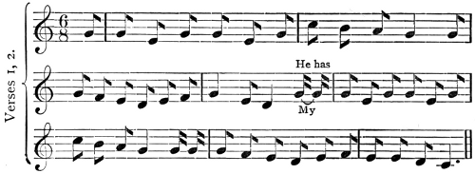
(b) A ring is formed by the children joining hands. One child kneels in the centre, covering her face with her hands. The ring dances round, and sings the first two verses. The kneeling child then takes her hands from her face and sings the next verse, still kneeling. While the ring sings the next verse, she rises and chooses one child out of the ring. They stand together, holding hands while the others sing the marriage formula, and kiss each other at the command. The ring of children dance round quickly while singing this. When finished the first “Mary” takes a place in the ring, and the other child kneels down (Barnes and other places). At Enborne school, Newbury (Miss Kimber), this game is played by boys and girls. All the children in the ring sing the first two verses. Then the boys alone in the ring sing the next verse; all the ring singing the fourth. While singing this the kneeling child rises and holds out her hand to any boy she prefers, who goes into the ring with her. When he is left in the ring at the commencement of the game again, a boy’s name is substituted for that of “Mary.” There appears to be no kissing. In the Liphook version (Miss Fowler), after the girl has chosen her sweetheart the ring breaks, and the two walk out and then kneel down, returning to the ring and kissing each other. A version identical with that of Barnes is played by the girls of Clapham High School. All tunes sent me were similar to that given.
(c) The analysis of the game rhymes is on pp. 56-60.
This analysis shows that the incidents expressed by the rhymes are practically the same in all the versions. In the majority of the cases the weeping is depicted as part of a ceremony, by which it is known that a girl desires a lover; she is enabled then to choose one, and to be married. The marriage formula is the usual one in the Barnes’ version, but follows another set of words in three other versions. In the cases where the marriage is neither expressed by a formula, nor implied by other means (Winterton and Forest of Dean), the versions are evidently fragments only, and probably at one time ended, as in the other cases, with marriage. But in three other cases the ending is not with marriage. The Earls Heaton and Scottish versions represent the cause of weeping as the death of a father, the Berkshire version introduces the apparently unmeaning incident of Mary bearing a shepherd’s cross, and the South Devon version represents the cause of weeping the death of a lover at sea. It is obvious that at places where sailors abound, the incident of weeping for a sailor-lover who is dead would get inserted, and the fact of this change only occurring once in the versions I have collected, tells all the more strongly in favour of the original version having represented marriage and love, and not death, but it does not follow that the marriage formula belongs to the oldest or original form of the game. I am inclined to think this has been added since marriage was thought to be the natural and proper result of choosing a sweetheart.
(d) The change in some of the verses, as in the Cambridge version, is due to corruption and the marked decadence now occurring in these games. No. 13 in the analysis is from the game “Pretty little girl of mine,” and Nos. 42-3 “Ring o’ Roses.”
Poor Widow
I.
Here’s an old widow who lies alone, Lies alone, lies alone, Here’s an old widow who lies alone, She wants a man and can’t get one. Choose one, choose two, choose the fairest. The fairest one that I can see Is [Mary Hamilton], come unto me. Now she is married and tied to a bag, She has got a man with a wooden leg.
—Belfast (W. H. Patterson).
II.
There was an old soldier he came from the war, His age it was sixty and three. Go you, old soldier, and choose a wife, Choose a good one or else choose none. Here’s a poor widow she lives her lone, She hasn’t a daughter to marry but one. Come choose to the east, choose to the west, And choose the very one you love best. Here’s a couple married in joy, First a girl and then a boy, Seven years after, and seven years come, Pree[1] young couple kiss and have done.
—Belfast (W. H. Patterson).
III.
There was a poor widow left alone, And all her children dead and gone. Come, choose you east, Come, choose you west, Take the man you love best. Now they’re married, I wish them joy, Every year a girl or a boy, I hope this couple may kiss each other.
—Nairn (Rev. W. Gregor).
(b) One child is chosen to act the part of the widow. The players join hands and form a circle. The widow takes her stand in the centre of the circle in a posture indicating sorrow. The girls in the circle trip round and round, and sing the first five lines. The widow then chooses one of the ring. The ring then sings the marriage formula, the two kiss each other, and the game is continued, the one chosen to be the mate of the first widow becoming the widow in turn (Nairn).
(c) This game is probably the same as “Silly Old Man.” Two separate versions may have arisen by girls playing by themselves without boys.[Addendum]
Pop Goes the Weasel
Half a pound of tup’ny rice, Half a pound of treacle; Mix it up and make it nice, Pop goes the weasel.
—Earls Heaton (Herbert Hardy).
(b) Children stand in two rows facing each other, they sing while moving backwards and forwards. At the close one from each side selects a partner, and then, all having partners, they whirl round and round.
(c) An additional verse is sometimes sung with or in place of the above in London.
Up and down the City Road; In and out the Eagle; That’s the way the money goes, Pop goes the weasel.
—(A. Nutt).
Mr. Nutt writes: “The Eagle was (and may be still) a well-known tavern and dancing saloon.”
Pop-the-Bonnet
A game in which two, each putting down a pin on the crown of a hat or bonnet, alternately pop on the bonnet till one of the pins crosses the other; then he at whose pop or tap this takes place, lifts the stakes.—Teviotdale (Jamieson). The same game is now played by boys with steel pens or nibs.
See “Hattie.”
Poppet-Show
See “Pinny Show.”
Port the Helm
This is a boys’ game. Any number may join in it. The players join hands and stand in line. The leader, generally a bigger boy, begins to bend round, at first slowly, then with more speed, drawing the whole line after him. The circular motion is communicated to the whole line, and, unless the boys at the end farthest from the leader run very quickly, the momentum throws them off their feet with a dash if they do not drop their hold.—Keith, Nairn (Rev. W. Gregor).
Pots, or Potts
Throwing a ball against a wall, letting it bounce and catching it, accompanied by the following movements:—
1. Simply three times each.
2. Throw, twist hands, and catch.
3. Clap hands in front, behind, in front.
4. Turn round.
5. Beat down ball on ground three times, and catch.
6. Again on ground and catch (once) at end of first “pot,” and twice for second “pot.”
—Hexham (Miss J. Barker).
[Addendum]
Pray, Pretty Miss
I.
Priperty Miss, will you come out, Will you come out, will you come out? Priperty Miss, will you come out To help us with our dancing? No! The naughty girl, she won’t come out, She won’t come out, she won’t come out; The naughty girl, she won’t come out To help us with our dancing. Priperty Miss, will you come out, Will you come out, will you come out? Priperty Miss, will you come out To help us with our dancing? Yes! Now we’ve got another girl, Another girl, another girl; Now we’ve got another girl To help us with our dancing.
—Fochabers (Rev. W. Gregor).
II.
Pray, pretty Miss, will you come out, Will you come out, will you come out? Pray, pretty Miss, will you come out To help me in my dancing? No! Then you are a naughty Miss! Then you are a naughty Miss! Then you are a naughty Miss! Won’t help me in my dancing. Pray, pretty Miss, will you come out, Will you come out, will you come out? Pray, pretty Miss, will you come out To help me in my dancing? Yes! Now you are a good Miss! Now you are a good Miss! Now you are a good Miss! To help me in my dancing.
—Cornwall (Folk-lore Journal, v. 47, 48).
III.
Pray, pretty Miss, will you come out to help us in our dancing? No! Oh, then you are a naughty Miss, won’t help us with our dancing. Pray, pretty Miss, will you come out to help us in our dancing? Yes! Now we’ve got our jolly old lass to help us with our dancing.
—Sheffield, Yorks. (Folk-lore Record, v. 87).
IV.
Oh, will you come and dance with me, Oh, will you come and dance with me? No!
[They say as above to the next girl, who says “Yes.”]
Now we’ve got our bonny bunch To help us with our dancing.
—Hurstmonceux, Sussex (Miss Chase).
(b) The Scottish version of this game is played as follows:—All the players stand in a line except two, who stand facing them. These two join hands crosswise, and then advancing and retiring, sing to the child at the end of the line the first four lines. The first child refuses, and they then dance round, singing the second verse. They sing the first verse again, and on her compliance she joins the two, and all three dance round together, singing the last verse. The three then advance and retire, singing the first verse to another child.
The Cornish version is played differently: a ring is formed, boy and girl standing alternately in the centre. The child in the middle holds a white handkerchief by two of its corners; if a boy he would single out one of the girls, dance backwards and forwards opposite to her, and sing the first verse. If the answer were “No!” spoken with averted head over the left shoulder, he sang the second verse. Occasionally three or four in turn refused. When the request was granted the words were changed to the fourth verse. The handkerchief was then carefully spread on the floor; the couple knelt on it and kissed: the child formerly in the middle joined the ring, and the other took his place, or if he preferred it remained in the centre; in that case the children clasped hands and sang together the first verse over again, the last to enter the ring having the privilege of selecting the next partner.
(c) Miss Courtney says (Folk-lore Journal, v. 47), that this game is quite a thing of the past. Of the Hurstmonceux version, Miss Chase says, “This game is not fully remembered. It was played about 1850.” The words indicate an invitation to the dance similar to those in “Cushion Dance,” “Green Grass.”
Pretty Little Girl of Mine
[Play]
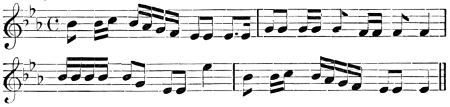
—Monton, Lancashire (Miss Dendy).
[Play]
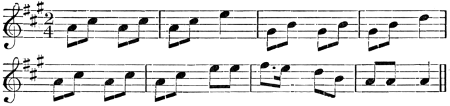
—Tean, North Staffordshire (Miss Burne).
[Play]
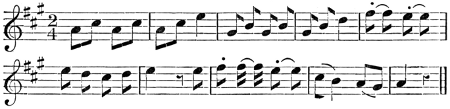
—Eccleshall (Miss Burne).
[Play part 1, part 2]
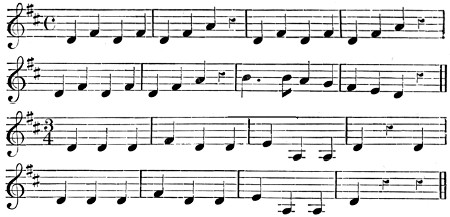
—Nottingham (Miss Youngman).
[Play version 1, version 2]
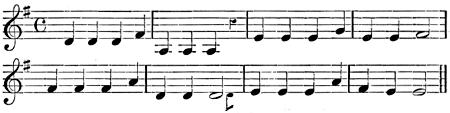
—Hanbury, Staffordshire (Edith Hollis).
I.
Here’s a pretty little girl of mine, She’s brought me many a bottle of wine; A bottle of wine she gave me too— See what this little girl can do. On the carpet she shall kneel As the grass grows on the fiel’; Stand upright on your feet, And choose the one you love so sweet. Now you are married I wish you joy, First a girl and then a boy; Seven years after, son and daughter; Pray, young couple, kiss together.
—Symondsbury, Dorset (Folk-lore Journal, vii. 207).
II.
Oh, this pretty little girl of mine, Brought me many a bottle of wine; A bottle of wine and a guinea, too, See what my little girl can do. Down on the carpet she shall kneel, As the grass grows in the field; Stand upright on your feet, And choose the one you love so sweet. Now I’m married and wish you joy, First a girl and then a boy; Seven years after, seven years past, Kiss one another and go to your class.
—Hampshire (Miss Mendham).
III.
Here’s a pretty little girl of mine, Who’s brought her bottle and glass of wine; A glass of wine and a biscuit too, See what my pretty girl will do. On the carpet she shall kneel, While the grass grows in the field; Stand upright upon your feet, Choose the one you love so sweet. When you’re married I wish you joy, First a girl and second a boy, Seven years after, son and daughter, Now, young couple, kiss together.
—Gambledown, Hants (Mrs. Pinsent).
IV.
Oh! this pretty little girl of mine, Has cost me many a bottle of wine; A bottle of wine and a guinea or two, So see what my little girl can do. Down on the carpet she shall kneel, While the grass grows on her field; Stand upright upon your feet, And choose the one you love so sweet. Now you are married you must obey, Must be true in all you say; You must be kind and very good, And help your wife to chop the wood.
—Maxey (Northants Notes and Queries, i. 214).
V.
Here’s a pretty little girl of mine, She’s cost me many a bottle of wine; A bottle of wine and a guinea too, See what my little girl can do. Down on the carpet she must kneel, As the grass grows in the field; Stand upright upon her feet, And choose the one she loves so sweet. Now you’re married I wish you joy, Father and mother you must obey; Love one another like sister and brother, And pray, young couple, come kiss one another.
—Colchester (Miss G. M. Frances).
VI.
Oh! this pretty little girl of mine, She bought me many a bottle of wine, A bottle of wine she gave me too, So see what my little girl could do. Stand up, stand up upon your feet, And choose the one you love so sweet.
—Liphook, Hants (Miss Fowler).
VII.
See what a pretty little girl have I, She brings me many a bottle of wi’; A bottle of wine and a biscuit too, See what a little girl can do. On the carpet she shall kneel, As the grass grows in the fiel’; Stand upright upon your feet, And choose the one you love so sweet. Now you’re married we wish you joy, First a girl and then a boy, Seven years after, son and daughter, May you couple kiss together.
—South Devon (Notes and Queries, 8th series, i. 249; Miss R. H. Busk).
VIII.
See what a pretty little girl I am, She gave me many a bottle of wine, Many a bottle of wine, and a biscuit too, See what a pretty little girl can do. On the carpet you shall kneel, Stand up straight all in the field, Choose the one that you love best. Now we are married and hope we enjoy, First a girl and then a boy, Seven years after and seven years to come, May young company kiss have done.
—Holywood, Co. Down (Miss C. M. Patterson).
IX.
See what a pretty little girl I am! Brought me many a bottle o’ wine! Bottle o’ wine to make me shine! See what a pretty little girl I am! Upon the carpets we shall kneel, As the grass grows in yonder field; Stand up lightly on your feet, And choose the one you love so sweet. Now these two are going to die, First a girl, and then a boy; Seven years at afterwards, seven years ago, And now they are parted with a kiss and a go.
—Monton, Lancashire (Miss Dendy).
X.
See this pretty little maid of mine! She’s brought me many a bottle of wine; A bottle of wine, a good thing, too; See what this pretty maid can do! Down on the carpet she must kneel, Till the grass grows on her feet; Stand up straight upon thy feet, Choose the very one that you love sweet. Take her by her lily-white hand, Lean across the water; Give a kiss,—one, two, three,— To Mrs. ——’s daughter.
—Suffolk (Mrs. Haddon).
XI.
See what a pretty little girl I am! They brought me many a bottle of wine— Bottle of wine to make me shine; See what a pretty little girl I am! On the carpets we must kneel, As the grass grows in yonder field; Rise up lightly on your feet, And kiss the one you love so sweet. My sister’s going to get married, My sister’s going to get married, My sister’s going to get married, Ee! Ii! Oh!
Open your gates as wide as high, And let the pretty girls come by, And let the - jolly - matrons[2] by. bonny One in a bush, Two in a bush, Ee! Ii! Oh!
—Colleyhurst, Manchester (Miss Dendy).
XII.
On the carpet you shall kneel Where the grass grows fresh and - green; clean; Stand up, stand up on your pretty feet, And show me the one you love so sweet. Now Sally’s got married, we wish her good joy, First a girl, and then a boy; Seven years arter, a son and darter, So, young couple, kiss together.
Or,
Seven years now, and seven to come, Take her and kiss her and send her off home.
—Eccleshall, Staffs. (Miss Burne).
XIII.
On the carpet you shall kneel, As the grass grows on the field; Stand up straight upon your feet, And tell me the one you love so sweet. —— is married with a good child, First with a girl and then with a boy; Seven years after son and daughter, Play with a couple and kiss together.
—Tean, North Staffs. (from a Monitor in the National School).
XIV.
On the carpet you shall kneel, As the grass grows in the field; Stand up, stand up upon your feet, And tell me whom you love so sweet. Now you’re married I wish you joy, First a girl, and then a boy; Seven years after son and daughter, Come, young couple, come kiss together.
—Middlesex (Miss Winfield).
XV.
On the carpet you shall kneel, As the grass grows in the field; Stand up, stand up on your feet, Show the girl you love so sweet. Now you’re married I hope you’ll enjoy A son and a daughter, so Kiss and good-bye.
—Long Eaton, Nottinghamshire (Miss Youngman).
XVI.
Down on the carpet you shall kneel, While the grass grows on your field;[3] Stand up straight upon your feet, And choose the one you love so sweet. Marry couple, married in joy, First a girl and then a boy; Seven years after, seven years come, Please,[4] young couple, kiss and have done.
—Belfast (W. H. Patterson).
XVII.
On the carpet you shall kneel, While the grass grows fresh and green; Stand up straight upon your feet, And kiss the one you love so sweet. Now they’re married, love and joy, First a girl and then a boy; Seven years after, seven years ago, Now’s the time to kiss and go.
—Liverpool and neighbourhood (Mrs. Harley).
XVIII.
On the carpet you shall kneel, As the grass grows in the field; Stand up, stand up on your feet, And shew me the girl you love so sweet. Now Sally’s married I hope she’ll enjoy, First with a girl and then with a boy; Seven years old and seven years young, Pray, young lady, walk out of your ring.
—Derbyshire (Folk-lore Journal, i. 385).
XIX.
On the carpet you shall kneel, Where the grass grows fresh and green; Stand up, stand up on your pretty feet, And show me the one you love so sweet.
—Berrington (Burne’s Shropshire Folk-lore, p. 509).
[Same ending as Eccleshall version.]
XX.
On the carpitt you shall kneel, While the grass grows in the field; Stand up, stand up on your feet, Pick the one you love so sweet.
—Wakefield, Yorks. (Miss Fowler).
XXI.
King William was King David’s son, And all the royal race is run; Choose from the east, choose from the west, Choose the one you love the best.[5] Down on this carpet you shall kneel, While the grass grows in yond field; Salute your bride and kiss her sweet, Rise again upon your feet.
—Hanging Heaton, Yorks. (Herbert Hardy).
XXII.
On the carpet you shall kneel, while the grass grows at your feet; Stand up straight upon your feet, and choose the one you love so sweet. Now Sally is married, life and joy, first a girl and then a boy; Seven years after, seven years ago, three on the carpet, kiss and go.
—Hanbury, Staffordshire (Miss Edith Hollis).
XXIII.
I had a bonnet trimmed wi’ blue. Why dosn’t wëare it? Zo I do; I’d wëare it where I con, To tëake a walk wi’ my young mon. My young mon is a-gone to sea, When he’d come back he’ll marry me. Zee what a purty zister is mine, Doan’t ’e think she’s ter’ble fine? She’s a most ter’ble cunnèn too, Just zee what my zister can do. On the carpet she can kneel, As the grass grow in the fiel’. Stand upright upon thy feet, And choose the prettiest you like, sweet.
—Hazelbury Bryan, Dorset (Folk-lore Journal, vii. 208).
XXIV.
Kneel down on the carpets, we shall kneel; The grass grows away in yonder fiel’, Stand up, stand up upon your feet, And show me the one you love so sweet. Now they get married, I wish they may joy Every year a girl or a boy; Loving together like sister and brother, Now they are coupled to kiss together.
—Galloway, N.B. (J. G. Carter).
(c) This game is played in the same way in all the different variants I have given, except a slight addition in the Suffolk (Mrs. Haddon). A ring is formed by the children joining hands—one child stands in the centre. The ring dances or moves slowly round, singing the verses. The child in the centre kneels down when the words are sung, rises and chooses a partner from the ring, kisses her when so commanded, and then takes a place in the ring, leaving the other child in the centre. In those cases where the marriage formula is not given, the kissing would probably be omitted.
(d) Of the twenty-four versions given there are not two alike, and this game is distinguished from all others by the singular diversity of its variants; although the original structure of the verses has been preserved to some extent, they seem to have been the sport of the inventive faculty of each different set of players. Lines have been added, left out, and altered in every direction, and in the example from Hazelbury Bryan, in Dorsetshire (No. xxiii.), a portion of an old song or ballad has been added to the game rhyme. These alterations occur not only in different counties, but in the same counties, as may be seen by the Dorset, Hants, Staffordshire, and Northants examples. Mr. Carter says of the Galloway game that the kissing match sometimes degenerates into a spitting match, according to the temper of the parties concerned. In the Suffolk version (Mrs. Haddon), at the words “Lean across the water,” the two in the centre lean over the arms of those forming the ring. These words and action are probably an addition. They belong to the “Rosy Apple, Lemon and Pear” game.
These peculiar characteristics of the game do not permit of much investigation into the original words of the game-rhyme, but they serve to illustrate, in a very forcible manner, the exactly opposite characteristics of nearly all the other games, which preserve, in almost stereotyped fashion, the words of the rhymes. It appears most probable that the verses belonged originally to some independent game like “Sally, Sally Water,” and that, when divorced from their original context, they lent themselves to the various changes which have been made. The minute application of modern ideas is seen in the version from Gambledown, where “A bottle of wine and a guinea, too,” becomes “A bottle of wine and a biscuit, too;” and at West Haddon, in Northamptonshire, a variant of the marriage formula is given in Northants Notes and Queries, ii. 106, as—
Now you’re married, we wish you joy, First a girl and then a boy; Cups and saucers, sons and daughters, Now join hands and kiss one another.
Another version from Long Itchington, given in Notes and Queries, 7th series, x. 450, concludes with—
Up the kitchen and down the hall, Choose the fairest of them all; Seven years now and seven years then, Kiss poor Sally and part again.
Pretty Miss Pink
Pretty Miss Pink, will you come out, Will you come out, will you come out? Pretty Miss Pink, will you come out, To see the ladies dancing? No, I won’t. Pretty Miss Pink, she won’t come out, Won’t come out, won’t come out, &c. She will come out. Pretty Miss Pink, she has come out, &c.
—Winterton, Lincs and Nottinghamshire (Miss M. Peacock.)
(b) The children place themselves in a row. They each choose a colour to represent them. One player must be pink. Another player stands facing them, and dances to and fro, singing the first four lines. The dancer then sings the next two lines, and Miss Pink having answered rushes forward, catches hold of the dancer’s hand, and sings the next verse. Each colour is then taken in turn, but Miss Pink must always be first.
(c) This is clearly a variant of “Pray, Pretty Miss,” colours being used perhaps from a local custom at fairs and May meetings, where girls were called by the colours of the ribbons they wore.
Prick at the Loop
A cheating game, played with a strap and skewer at fairs, &c., by persons of the thimble-rig class, probably the same as the game called “Fast and Loose.”
Prickey Sockey
Christmas morning is ushered in by the little maidens playing at the game of “Prickey Sockey,” as they call it. They are dressed up in their best, with their wrists adorned with rows of pins, and run about from house to house inquiring who will play at the game. The door is opened and one cries out—
Prickey sockey for a pin, I car not whether I loss or win.
The game is played by the one holding between her two forefingers and thumbs a pin, which she clasps tightly to prevent her antagonist seeing either part of it, while her opponent guesses. The head of the pin is “sockey,” and the point is “prickey,” and when the other guesses she touches the end she guesses at, saying, “this for prickey,” or “this for sockey,” At night the other delivers her two pins. Thus the game is played, and when the clock strikes twelve it is declared up; that is, no one can play after that time.—Mirror, 1828, vol. x. p. 443.
See “Headicks and Pinticks.”
Prickie and Jockie
A childish game, played with pins, and similar to “Odds or Evens,”—Teviotdale (Jamieson), but it is more probable that this is the game of “Prickey Sockey,” which Jamieson did not see played.
Priest-Cat (1)
See “Jack’s Alive.”
Priest-Cat (2)
A peat clod is put into the shell of the crook by one person, who then shuts his eyes. Some one steals it. The other then goes round the circle trying to discover the thief, and addressing particular individuals in a rhyme—
Ye’re fair and leal, Ye canna steal; Ye’re black and fat, Ye’re the thief of my priest-cat!
If he guesses wrong he is in a wadd, if right he has found the thief.—Chambers’ Popular Rhymes, p. 128.
This is an entirely different game to the “Priest-Cat” given by Mactaggart (see “Jack’s Alive”), and seems to have originated in the discovery of stolen articles by divination.
Priest of the Parish
William Carleton describes this game as follows:—“One of the boys gets a wig upon himself, goes out on the floor, places the boys in a row, calls on his man Jack, and says to each, ‘What will you be?’ One answers, ‘I’ll be Black Cap,’ another, ‘Red Cap,’ and so on. He then says, ‘The priest of the parish has lost his considering-cap. Some says this, and some says that, but I say my man Jack.’ Man Jack then, to put it off himself, says, ‘Is it me, sir?’ ‘Yes you, sir.’ ‘You lie, sir.’ ‘Who then, sir?’ ‘Black Cap.’ If Black Cap then doesn’t say, ‘Is it me, sir?’ before the priest has time to call him he must put his hand on his ham and get a pelt of the brogue. A boy must be supple with the tongue in it.”—Traits and Stories of the Irish Peasantry, p. 106 (Tegg’s reprint).
This game is no doubt the original form of the game imperfectly played under the name of “King Plaster Palacey” (see ante, i. 301).
Prisoner’s Base or Bars
The game of “The Country Base” is mentioned by Shakespeare in “Cymbeline”—
“He, with two striplings (lads more like to run The country base, than to commit such slaughter), Made good the passage.”—Act v., sc. 3.
Also in the tragedy of Hoffman, 1632—
“I’ll run a little course At base, or barley-brake.”
Again, in the Antipodes, 1638—
“My men can runne at base.”
Also, in the thirtieth song of Drayton’s “Polyolbion”—
“At hood-wink, barley-brake, at tick, or prison-base.”
Again, in Spenser’s “Faerie Queen,” v. 8—
“So ran they all as they had been at bace.”
Strutt (Sports and Pastimes, p. 78), says, “This game was much practised in former times. The first mention of this sport that I have met with occurs in the Proclamations at the head of the Parliamentary proceedings, early in the reign of Edward III., where it is spoken of as a childish amusement; and prohibited to be played in the avenues of the palace at Westminster during the Sessions of Parliament, because of the interruption it occasioned to the members and others in passing to and fro. . . . The performance of this pastime requires two parties of equal number, each of them having a base or home, as it is usually called to themselves, at the distance of about twenty or thirty yards. The players then on either side taking hold of hands extend themselves in length and opposite to each other, as far as they conveniently can, always remembering that one of them must touch the base; when any one of them quits the hand of his fellow and runs into the field, which is called giving the chase, he is immediately followed by a second from the former side, and he by a second opponent; and so on alternately, until as many are out as choose to run, every one pursuing the man he first followed and no other; and if he overtake him near enough to touch him, his party claims one toward their game, and both return home. Then they run forth again and again in like manner, until the number is completed that decides the victory; this number is optional. It is to be observed that every person on either side who touches another during the chase, claims one for his party.”
Strutt describes the game in Essex as follows:—“They play this game with the addition of two prisons, which are stakes driven into the ground, parallel with the home boundaries, and about thirty yards from them; and every person who is touched on either side in the chase is sent to one or other of these prisons, where he must remain till the conclusion of the game, if not delivered previously by one of his associates, and this can only be accomplished by touching him, which is a difficult task, requiring the performance of the most skilful players, because the prison belonging to either party is always much nearer to the base of their opponents than to their own; and if the person sent to relieve his confederate be touched by an antagonist before he reaches him, he also becomes a prisoner, and stands in equal need of deliverance.”—Sports and Pastimes, p. 80.
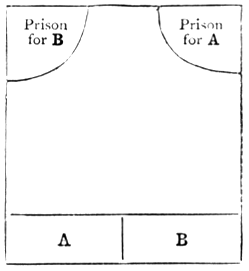
But this is not quite the same as it is played in London. There the school ground is divided in the following manner:— The boys being divided into equal sides, with a captain for each, one party takes up its quarters in a, the other in b. Lots are chosen as to which side commences. Then one member of the side so chosen (say b) starts off for the middle of the playground and cries out “Chevy, Chevy Chase, one, two, three;” thereupon it becomes the object of the side b to touch him before reaching home again. If unsuccessful one from side b goes to the middle, and so on until a prisoner is secured from one of the sides. Then the struggle commences in earnest, after the fashion described by Strutt as above. If a boy succeeds in getting to the prison of his side without being touched by an opponent, he releases a prisoner, and brings him back home again to help in the struggle. The object of the respective sides is to place all their opponents in prison, and when that is accomplished they rush over to the empty home and take possession of it. The game then begins again from opposite sides, the winning side counting one towards the victory.—London (G. L. Gomme).
This was once a favourite game among young men in North Shropshire (and Cheshire). It was played yearly at Norton-in-Hales Wakes, and the winning party were decorated with ribbons. Men-servants, in the last century, were wont to ask a day’s holiday to join or witness a game of “Prison-bars,” arranged beforehand as a cricket-match might be (see Byegones, 2nd May 1883). A form of the game still survives there among the school-children, under the name of “Prison Birds.” The Birds arrange themselves in pairs behind each other, facing a large stone or stump placed at some little distance. Before them, also facing the stone, stands one player, called the Keeper. When he calls, “Last pair out!” the couple next behind him run to the stone and touch hands over it. If they can do so without being touched by the Keeper, they are free, and return to a position behind the other birds; but any one whom he touches must remain behind the stone “in prison.”—Ellesmere (Burne’s Shropshire Folk-lore, p. 524).
The Ellesmere inhabitants were formerly accustomed to devote their holiday occasions to the game, and in the year 1764 the poet laureate of the town (Mr. David Studley) composed some lines on the game as it was played by the Married v. Single at Ellesmere. They are as follows:—
“Ye lovers of pleasure, give ear and attend, Unto these few lines which here I have penned, I sing not of sea fights, of battles nor wars, But of a fine game, which is called ‘Prison Bars.’ This game was admired by men of renown, And played by the natives of fair Ellesmere town; On the eighth day of August in the year sixty-four, These nimble heel’d fellows approached on the moor. Twenty-two were the number appear’d on the green, For swiftness and courage none like them were seen; Eleven were married to females so fair, The other young gallants bachelors were. Jacob Hitchen the weaver commands the whole round, Looks this way, and that way, all over the ground, Gives proper directions, and sets out his men, So far go, my lads, and return back again. Proper stations being fixed, each party advance, And lead one another a many fine dance. There’s Gleaves after Ellis, and Platt after he, Such running before I never did see. Huzza! for the young men, the fair maids did say, May heaven protect you to conquer this day, Now, my brave boys, you’re not to blame, Take courage, my lads, nine and eight is the game. Now behold the Breeches makers, master and man, Saddlers, Slaters, and Joiners, do all they can; The Tailor so nimble, he brings up the rear, Cheer up, my brave boys, you need not to fear. Alas! poor old Jacob, thy hopes are in vain, Dick Chidley is artful, and spoils all thy schemes. The Barber is taken, the Currier is down, The Sawyer is tired, and so is the Clown.”
The moor referred to in the last line of the second verse was the Pitchmoor. The Clown was a nickname for one of the players, who, on hearing the song repeated in the presence of the author, became so exasperated, that, to appease him, the words “the game is our’n” were substituted for the words “so is the Clown “in the last line of the concluding verse.
Puff-the-Dart
A game played with a long needle inserted in some worsted, and blown at a target through a tin tube.—Halliwell’s Dictionary. This game is also mentioned in Baker’s Northamptonshire Glossary.
Pun o’ mair Weight
A rough play among boys, adding their weight one upon another, and all upon the one at the bottom.—Dickinson’s Cumberland Glossary.
Punch Bowl
I.
Round about the punch bowl,— One, two, three; If anybody wants a bonnie lassie, Just take me.
Another form of words is—
The fillan o’ the punch bowl, That wearies me; The fillan o’t up, an’ the drinkan’ o’t doon, An’ the kissan o’ a bonnie lass, That cheeries me.
—Fochabers (Rev. W. Gregor).
II.
Round about the punch bowl, Punch bowl, punch bowl; Round about the punch bowl, one, two, three. First time never to fall, Never to fall, never to fall; First time never to fall, one, two, three. Second time, the catching time, Catching time, catching time; Second time, the catching time, one, two, three. Third time, the kissing time, Kissing time, kissing time, Third time, the kissing time, one, two, three.
—Belfast (W. H. Patterson).
III.
Round about the punch bowl,—one, two, three; Open the gates and let the bride through. Half-a-crown to know his name, to know his name, to know his name, Half-a-crown to know his name, On a cold and frosty morning. Ah! (Michael Matthews) is his name, is his name, is his name; (Michael Matthews) is his name, On a cold and frosty morning. Half-a-crown to know her name, to know her name, to know her name, Half-a-crown to know her name, On a cold and frosty morning. (Annie Keenan) is her name, is her name, is her name, (Annie Keenan) is her name, On a cold and frosty morning. They’ll be married in the morning, Round about the punch bowl, I [? Hi!].
—Annaverna, Ravensdale, Co. Louth, Ireland (Miss R. Stephen).
(b) The Fochabers’ game is played by girls only. The players join hands and form a ring. They dance briskly round, singing the verse. The last word, “me,” is pronounced with strong emphasis, and all the girls jump, and if one falls she has to leave the ring. The game is carried on until all the players fall. In the Belfast game, at the words “one, two, three,” the players drop down in a crouching position for a few seconds. In the Louth (Ireland) game the players all curtsey after the first line, and the one who rises last is the bride. She is led outside the ring by another, and asked to whom she is engaged. She tells without letting those in the ring hear, and the two return to the ring saying the second line. Then all the ring sing the next three lines, and then the girl who has been told the name tells it to the ring, who thereupon sing or say the remaining lines of the verse.
(c) The Louth version has more detail in its movements, and probably represents the oldest form. At all events, it supplies the reason for the words and movements, which are not quite so obvious in the other versions. Many ancient monoliths are known as “Punch Bowls,” and it may be that this game is the relic of an old marriage ceremony, “at the stones.”
Purposes
A kind of game. “The prettie game which we call purposes” (Cotgrave in v. “Opinion”).—Halliwell’s Dictionary.
Push in the Wash Tub
A ring of girls is formed. Two go in opposite directions outside the ring, and try to get back first to the starting-point; the one succeeding stops there, rejoining the ring, the other girl pushes another girl into the ring, or wash tub, with whom the race is renewed.—Crockham Hill, Kent (Miss Chase).
Push-pin, or Put-pin
A child’s play, in which pins are pushed with an endeavour to cross them. So explained by Ash, but it would seem, from Beaumont and Fletcher, vii. 25, that the game was played by aiming pins at some object.—Halliwell’s Dictionary.
“To see the sonne you would admire, Goe play at push-pin with his sire.”
—Men’s Miracles, 1656, p. 15.
“Love and myselfe, beleeve me on a day, At childish push-pin for our sport did play.”
—Herrick’s Works, i. 22.
There is an allusion to it under the name of put-pin in Nash’s Apologie, 1593—
“That can lay down maidens bedds, And that can hold ther sickly heds; That can play at put-pin, Blow poynte and near lin.”
Two pins are laid upon a table, and the object of each player is to push his pin across his opponent’s pin.—Addy’s Sheffield Glossary.
See “Hattie,” “Pop the Bonnet.”
Push the Business On
I.
I hired a horse and borrowed a gig, And all the world shall have a jig; And I’ll do all ’at ever I can To push the business on. To push the business on, To push the business on; And I’ll do all ’at ever I can To push the business on.
—North Kelsey, Anderby, and near the Trent, Nottinghamshire (Miss M. Peacock).
II.
Beeswax and turpentine make the best of plaster, The more you try to pull it off, it’s sure to stick the faster. I’ll buy a horse and hire a gig, And all the world shall have a jig; And you and I’ll do all we can To push the business on, To push the business on; And we’ll do all that ever we can To push the business on.
—Brigg, Lincolnshire (Miss Barker, from a Lincolnshire friend).
III.
I’ll buy a horse and steal a gig, And all the world shall have a jig; And I’ll do all that ever I can To pass the business on. To pass the business on, To pass the business on; And I’ll do all that ever I can To pass the business on.
—Wolstanton, North Staffs. (Miss Bush, Schoolmistress)
IV.
We’ll borrow a horse and steal a gig, And round the world we’ll have a jig; And I’ll do all that ever I can To push the business on.
—Earls Heaton (Herbert Hardy).
V.
I’ll hire a horse and steal a gig, And all the world shall have a jig; And I’ll do all that ever I can To push the business on, To push the business on, to push the business on, And I’ll do all that ever I can to push the business on.
—Settle, Yorkshire (Rev. W. S. Sykes).
(b) The players stand in a circle, boy and girl alternately, and sing the lines. At the fourth line they all clap their hands, keeping time with the song. When singing the seventh line each boy takes the girl on his left hand,—dances round with her and places her on his right hand. This is done till each girl has been all round the circle, and has been turned or danced with by each boy. In the Wolstanton version (Miss Bush), after singing the first four lines, the children fall behind one another, march round, clapping their hands and singing; at the seventh line they all join in couples and gallop round very quickly to the end. When they finish, the girls stand at the side of the boys in couples, and change places every time they go round until each girl has partnered each boy. At Hexham there is rather more of the regular dance about the game at the beginning. At the fourth line they set to partners and swing round, the girls changing places at the end, and continuing until they have been all round each time with a different partner.
(c) This game seems of kin to the old-fashioned country dances. Miss Bush writes that this game was introduced into the school playground from Derbyshire a few years ago, and is sung to a simple tune.
Puss in the Corner
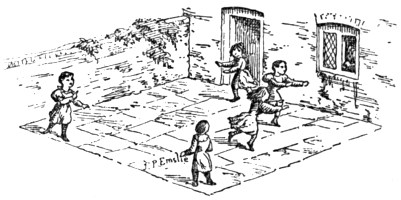
The children stand at fixed points: one stands in the middle and chants, “Poor puss wants a corner.” The others beckon with the fore-finger, and calling, “Puss, puss,” run from point to point. Puss runs also to one of the vacant spaces. The one left out becomes puss.—Monton, Lancashire (Miss Dendy).
The players place themselves each in some “coign of vantage,” as the play place allows; one player in the middle is “out.” Those in the corners change places with each other at choice, calling, “Puss, puss, puss,” to attract each other’s attention. The one who is out watches his opportunity to slip into a vacant corner, and oblige some one else to be “out.” A favourite game in the streets of Market Drayton.—Burne’s Shropshire Folk-lore, p. 523.
When we played this game, the child who was to be “Puss” was invariably decided upon by a counting-out rhyme. He or she being the last of the five players “not he.” The words we used when wishful to change corners were, “Puss, puss, give me a drop of milk.” The players in the corners beckoned with the finger to an opposite player in another corner (A. B. Gomme).
The game in Scotland is called “Moosie in the Corner,” and is played by boys or girls, or by both together, either outside or in a room. Each player takes a corner, and one stands in the middle. On a given signal, usually by calling out the word “Change,” a rush is made from the corners. The aim of the one standing in the middle is to reach a vacant corner. If the game is played in a room, as many chairs, or other seats, are placed as there are players, less one. Each takes a seat, and one is left standing. On the word “Change” being called out, each jumps from the seat and makes for another. The one standing strives to get a seat in the course of the change.—Nairn and Macduff (Rev. W. Gregor).
Pussy’s Ground
Name for Tom Tiddler’s Ground in Norfolk.
See “Tom Tiddler’s Ground.”
Pyramid
A circle of about two feet in diameter is made on the ground, in the centre of which a pyramid is formed by several marbles. Nine are placed as the base, then six, then four, and then one on the top. The keeper of the pyramid then desires the other players to shoot. Each player gives the keeper one marble for leave to shoot at the pyramid, and all that the players can strike out of the circle belong to them.—London streets (A. B. Gomme), and Book of Sports.
See “Castles.”
Quaker
Men and women stand alternately in a circle, and one man begins by placing his left hand on his left knee, and saying, “There was an old Quaker and he went so.” This is repeated all round the circle; the first man then says the same thing again, but this time he places his right hand on his right knee. Then he places his hand on the girl’s shoulder, then round her neck, and on her far shoulder, then looks into her face, and, lastly, kisses her.—Sharleston, Yorks (Miss Fowler).
Quaker’s Wedding
Hast thou ever been to a Quaker’s wedding? Nay, friend, nay. Do as I do; twiddle thy thumbs and follow me.
The leader walks round chanting these lines, with her eyes fixed on the ground. Each new comer goes behind till a long train is formed, then they kneel side by side as close together as possible. The leader then gives a vigorous push to the one at the end of the line [next herself, and that one to the next], and the whole line tumble over.—Berkshire (Miss Thoyts in the Antiquary, xxvii. 194).
See “Obadiah,” “Solomon.”
Queen Anne
I.
Lady Queen Ann she sits in her stand, And a pair of green gloves upon her hand, As white as a lily, as fair as a swan, The fairest lady in a’ the land; Come smell my lily, come smell my rose, Which of my maidens do you choose? I choose you one, and I choose you all, And I pray, Miss ( ), yield up the ball. The ball is mine, and none of yours, Go to the woods and gather flowers. Cats and kittens bide within, But we young ladies walk out and in.
—Chambers’ Pop. Rhymes, p. 136.
II.
Queen Anne, Queen Anne, who sits on her throne, As fair as a lily, as white as a swan; The king sends you three letters, And begs you’ll read one. I cannot read one unless I read all, So pray ( ) deliver the ball. The ball is mine and none of thine, So you, proud Queen, may sit on your throne, While we, your messengers, go and come.
(Or sometimes)—
The ball is mine, and none of thine, You are the fair lady to sit on; And we’re the black gipsies to go and come.
—Halliwell’s Pop. Rhymes, p. 230.
III.
Queen Anne, Queen Anne, you sit in the sun, As fair as a lily, as white as a wand, I send you three letters, and pray read one. You must read one, if you can’t read all, So pray, Miss or Master, throw up the ball.
—Halliwell’s Pop. Rhymes, p. 64.
IV.
Here we come a-piping, First in spring and then in May. The Queen she sits upon the sand, Fair as a lily, white as a wand: King John has sent you letters three, And begs you’ll read them unto me. We can’t read one without them all, So pray, Miss Bridget, deliver the ball.
—Halliwell’s Pop. Rhymes, p. 73.
V.
Queen Anne, Queen Anne, She sot in the sun; So fair as a lily, So white as a nun; She had a white glove on, She drew it off, she drew it on. Turn, ladies, turn. The more we turn, the more we may, Queen Anne was born on Midsummer Day; We have brought dree letters from the Queen, Wone of these only by thee must be seen. We can’t rëade wone, we must rëade all, Please ( ) deliver the ball.
—Dorsetshire (Folk-lore Journal, vii. 229).
VI.
Here come we to Lady Queen Anne, With a pair of white gloves to cover our hand; As white as a lily, as fair as the rose, But not so fair as you may suppose. Turn, ladies, turn. The more we turn the more we may, Queen Anne was born on Midsummer Day. The king sent me three letters, I never read them all, So pray, Miss ——, deliver the ball. The ball is yours, and not ours, You must go to the garden and gather the flowers. The ball is ours, and not yours, We go out and gather the flowers.
—Cornwall (Folk-lore Journal, v. 52-53).
VII.
Queen Anne, Queen Anne, she sits in the sun, As fair as a lily, so white and wan; A pair of kid gloves she holds in her hand, There’s no such a lady in all the fair land. Turn all. The more we turn the better we are, For we’ve got the ball between us.
—North Kelsey, Lincolnshire (Miss M. Peacock).
VIII.
Lady Queen Anne she sits on a stand [sedan], She is fair as a lily, she is white as a swan; A pair of green gloves all over her hand, She is the fairest lady in all the land. Come taste my lily, come smell my rose, Which of my babes do you choose? I choose not one, but I choose them all, So please, Miss Nell, give up the ball. The ball is ours, it is not yours, We will go to the woods and gather flowers; We will get pins to pin our clothes, You will get nails to nail your toes.
—Belfast (W. H. Patterson).
IX.
Queen Anne, Queen Anne, she sits in the sun, As fair as a lily, as brown as a bun; We’ve brought you three letters, pray can you read one? I can’t read one without I read all, So pray —— deliver the ball. You old gipsy, sit in the sun, And we fair ladies go and come; The ball is mine, and none o’ thine, And so good-morning, Valentine.
—Swaffham. Norfolk (Miss Matthews).
X.
Queen Anne, Queen Anne, she sits in the sun, As fair as a lily, as brown as a bun. Turn, fair ladies, turn. We bring you three letters, and pray you read one. I cannot read one without I read all, So please ( ) give up the ball.
[If the wrong guess is made the girls say—]
The ball is ours, and none of yours, And we’ve the right to keep it.
[If the right child is named, they say—]
The ball is yours, and is not ours, And you’ve the right to take it.
[Some of the children said this rhyme should be—]
The ball is ours, and none of yours, So you, black gipsies, sit in the sun, While we the fair ladies go as we come.
—London (A. B. Gomme).
XI.
Queen Anne, Queen Anne, she sits in the sun, As fair as a lily, as white as a swan; I bring you three letters, so pray you choose one, I cannot read one without I read all, So pray —— give up the ball.
[If the wrong girl is asked, they say—]
The ball is ours, it is not yours, And we’ve the right to keep it.
[When the right one is guessed—]
The ball is yours, it is not ours, And you’ve the right to keep it.
—Barnes, Surrey (A. B. Gomme).
XII.
The lady Queen Anne she sat in a tan (sedan), As fair as a lily, as white as a swan; The Queen of Morocco she sent you a letter, So please to read one. I won’t read one except them all, So please, Miss ——, deliver the ball.
—Hersham, Surrey (Folk-lore Record, v. 87).
XIII.
Queen Ann, Queen Ann, She sits in the sun, As fair as a lily, and bright as one; King George has sent you three letters, And desires you to read one. I cannot read one Without I read all, So pray, Miss ( ), Deliver the ball.
[Rhyme when right is seldom in use, and the one when wrong forgotten.]
The ball is ours, and none of yours, So, black gipsies, sit in the sun, And we, fair ladies, go as we come.
—Sussex, about 1850 (Miss Chase).
XIV.
Queen Ann, Queen Ann, She sat in the sun; A pair of white gloves to cover her hands, As white as a lily, as red as a rose, To which young lady do you propose?
—Devon (Miss Chase).
XV.
Here come seven sisters, And seven milken daughters, And with the ladies of the land, And please will you grant us. I grant you once, I grant you twice, I grant you three times over; A for all, and B for ball, And please [ ] deliver the ball.
—Bocking, Essex (Folk-lore Journal, vi. 211).
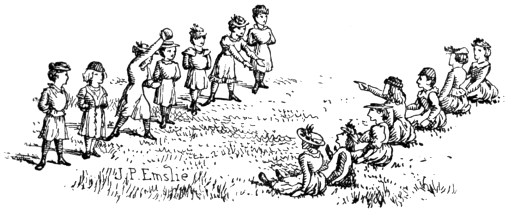
(b) Sides are chosen, and two lines are formed; the words are said by each line alternately. One line, in which is the Queen, standing still or sitting down, the other line advancing and retiring while singing the words. The latter line gives one of their number a ball or some other small object to hold in the hand in such a manner that it cannot be perceived. All the players on this side then assume the same position—either all put their hands behind them or fold their arms, put their hands under their armpits, or under their skirts or pinafores. The object of the other side is to guess which child in the line has the ball. The line which has the ball commences the game by advancing singing or saying the first three or four lines. Queen Anne answers, and then names one of the girls on the opposite side whom she suspects to have the ball, and if she be right in her guess the lines change sides. If she be wrong, the line retires in triumph, the girl who possesses the ball holding it up to show the Queen she is wrong. The children all curtsey when leaving the Queen’s presence. Another girl of the line then takes the ball and the game continues till the right holder of the ball is named. When the Queen tells the line of players to “turn,” they all spin round, coming back to face the Queen, and then stand still again. In the North Kelsey version (Miss Peacock) there is only one player on Queen Anne’s side, the rest form the line. This is also the case with the Cornish game.
(c) The analysis of the game-rhymes is as follows:—
No. Scot- land (Cham- bers). Halli- well (1). Halli- well (2). Halli- well (3). Dor- set- shire. Corn- wall. North Kel- sey. Bel- fast. Swaff- ham. London. Barnes. Hersham. Sussex. Devon.
1. — — — Here we come a-piping. — — — — — — — — — —
2. — — — First in Spring, then in May. — — — — — — — — — —
3. Lady Q. Anne. Q. Anne, Anne. Queen Anne. — Queen Anne. Lady Queen Anne. Queen Anne. Lady Queen Anne. Queen Anne. Queen Anne. Queen Anne. Lady Queen Anne. Queen Ann. Queen Ann.
4. — — — Queen. — — — — — — — — — —
5. Sits in her stand. — — Sits upon the sand. — — — Sits on a stand. — — — Sits in a tan. — —
6. — Sits on her throne. — — — — — — — — — — — —
7. — — Sits in the sun. — Sot in the sun. — Sits in the sun. — Sits in the sun. Sits in the sun. Sits in the sun. — Sits in the sun. Sat in the sun.
8. Pair of green gloves on her hand. — — — White glove on. Pair of white gloves to cover our hand. Pair of kid gloves in her hand. Pair of green gloves all over her hand. — — — — — Pair of white gloves to cover her hand.
9. White as a lily, fair as a swan. Fair as lily, white as swan. — — — White as lily, fair as rose. — Fair as lily, white as swan. — — Fair as lily, white as swan. Fair as lily, white as swan. — White as lily, red as rose.
10. — — Fair as lily, white as wand. Fair as lily, white as wand. Fair as lily, white as nun. — Fair as lily, white and wan. — Fair as lily, brown as bun. Fair as lily, brown as bun. — — Fair as lily, bright as one. —
11. Fairest lady in the land. — — — — — No such lady in the land. Fairest lady in the land. — — — — — —
12. — — — — — Not so fair as you may suppose. — — — — — — — —
13. Smell my lily, smell my rose. — — — — — — Taste my lily, smell my rose. — — — — — —
14. Which of my maidens do you choose? — — — — — — Which of my babes do you choose? — — — — — To which young lady do you propose?
15. — — — — Turn, ladies. Turn, ladies. Turn all. — — — — — — —
16. — — — — More we turn, more we may. More we turn, more we may. More we turn, better we are. — — — — — — —
17. — — — — Queen Anne was born on midsummer day. Q. Anne was born on midsummer day. — — — — — — — —
18. — King sends three letters. I send you three letters. King John has sent three letters. We’ve brought three letters. King sent me three letters. — — We’ve brought three letters. We bring you three letters. I bring you three letters. Queen of Morocco sent you a letter. King Geo. has sent you three letters. —
19. — Begs you’ll read one. Pray read one. Begs you’ll read them unto me. — — — — Pray can you read one. Pray you read one. Pray you choose one. Please to read one. Desires you to read one. —
20. — — — — One of these only by you must be seen. — — — — — — — — —
21. Choose you one and choose you all. Cannot read one unless I read all. You must read one, if you can’t all. We can’t read one without all. We can’t read one, must read all. — — Choose not one but choose all. — Cannot read one without all. Cannot read one without all. I won’t read one except all. Cannot read one without all. —
22. — — — — — I never read them all. — — — — — — — —
23. Pray, Miss, yield up the ball. Pray [ ] deliver the ball. Pray, Miss [ ], throw up the ball. Pray, Miss [ ], deliver the ball. Please [ ] deliver the ball. Pray, Miss [ ], deliver the ball. — Please, Miss Nell, give up the ball. Pray deliver the ball. Please give up the ball. Pray give up the ball. Please, Miss [ ], deliver the ball. Pray, Miss [ ], deliver the ball. —
24. — — — — — — We’ve got the ball between us. — — — — — — —
25. The ball is mine, and none of yours. The ball is mine, and none of thine. — — — The ball is yours, and not ours. — — You, old gipsy sit in the sun. — — — So, black gipsies, sit in the sun. —
26. — You, proud Queen, may sit on your throne. — — — — — — We fair ladies, go and come. — — — We fair ladies, go as we come. —
27. — While we, your messengers, go and come. — — — — — The ball is ours, it is not yours. The ball is mine, and none of thine. The ball is ours, and none of yours. The ball is ours, it is not yours. — The ball is ours, and none of yours. —
28. Go to the woods and gather flowers. — — — — Go to the garden and gather flowers. — We’ll go to the woods and gather flowers. — — — — — —
29. — — — — — — — — — And we’ve the right to keep it. And we’ve the right to keep it. — — —
30. — The ball is mine, and none of thine. — — — The ball is ours, and none of yours. — — — The ball is yours, and not ours. The ball is yours, it is not ours. — — —
31. — You are the fair lady to sit on. — — — — — — — You, black gipsies, sit in the sun. — — — —
32. — And we’re black gipsies to go and come. — — — — — — — While we, fair ladies, go as we come. — — — —
33. — — — — — We must go to the garden and gather flowers. — — — — — — — —
34. — — — — — — — — — — And you’ve the right to keep it. — — —
35. Cats and kittens, bide within. — — — — — — — — — — — — —
36. We young ladies walk out and in. — — — — — — — — — — — — —
37. — — — — — — — We will get pins to pin our clothes. — — — — — —
38. — — — — — — — You will get nails to nail your toes. — — — — — —
39. — — — — — — — — So good morning Valentine. — — — — —
No. Scotland (Chambers). Halliwell (1). Halliwell (2). Halliwell (3). Dorsetshire. Cornwall. North Kelsey.
1. — — — Here we come a-piping. — — —
2. — — — First in Spring, then in May. — — —
3. Lady Q. Anne. Q. Anne, Anne. Queen Anne. — Queen Anne. Lady Queen Anne. Queen Anne.
4. — — — Queen. — — —
5. Sits in her stand. — — Sits upon the sand. — — —
6. — Sits on her throne. — — — — —
7. — — Sits in the sun. — Sot in the sun. — Sits in the sun.
8. Pair of green gloves on her hand. — — — White glove on. Pair of white gloves to cover our hand. Pair of kid gloves in her hand.
9. White as a lily, fair as a swan. Fair as lily, white as swan. — — — White as lily, fair as rose. —
10. — — Fair as lily, white as wand. Fair as lily, white as wand. Fair as lily, white as nun. — Fair as lily, white and wan.
11. Fairest lady in the land. — — — — — No such lady in the land.
12. — — — — — Not so fair as you may suppose. —
13. Smell my lily, smell my rose. — — — — — —
14. Which of my maidens do you choose? — — — — — —
15. — — — — Turn, ladies. Turn, ladies. Turn all.
16. — — — — More we turn, more we may. More we turn, more we may. More we turn, better we are.
17. — — — — Queen Anne was born on midsummer day. Q. Anne was born on midsummer day. —
18. — King sends three letters. I send you three letters. King John has sent three letters. We’ve brought three letters. King sent me three letters. —
19. — Begs you’ll read one. Pray read one. Begs you’ll read them unto me. — — —
20. — — — — One of these only by you must be seen. — —
21. Choose you one and choose you all. Cannot read one unless I read all. You must read one, if you can’t all. We can’t read one without all. We can’t read one, must read all. — —
22. — — — — — I never read them all. —
23. Pray, Miss, yield up the ball. Pray [ ] deliver the ball. Pray, Miss [ ], throw up the ball. Pray, Miss [ ], deliver the ball. Please [ ] deliver the ball. Pray, Miss [ ], deliver the ball. —
24. — — — — — — We’ve got the ball between us.
25. The ball is mine, and none of yours. The ball is mine, and none of thine. — — — The ball is yours, and not ours. —
26. — You, proud Queen, may sit on your throne. — — — — —
27. — While we, your messengers, go and come. — — — — —
28. Go to the woods and gather flowers. — — — — Go to the garden and gather flowers. —
29. — — — — — — —
30. — The ball is mine, and none of thine. — — — The ball is ours, and none of yours. —
31. — You are the fair lady to sit on. — — — — —
32. — And we’re black gipsies to go and come. — — — — —
33. — — — — — We must go to the garden and gather flowers. —
34. — — — — — — —
35. Cats and kittens, bide within. — — — — — —
36. We young ladies walk out and in. — — — — — —
37. — — — — — — —
38. — — — — — — —
39. — — — — — — —
No. Belfast. Swaffham. London. Barnes. Hersham. Sussex. Devon.
1. — — — — — — —
2. — — — — — — —
3. Lady Queen Anne. Queen Anne. Queen Anne. Queen Anne. Lady Queen Anne. Queen Ann. Queen Ann.
4. — — — — — — —
5. Sits on a stand. — — — Sits in a tan. — —
6. — — — — — — —
7. — Sits in the sun. Sits in the sun. Sits in the sun. — Sits in the sun. Sat in the sun.
8. Pair of green gloves all over her hand. — — — — — Pair of white gloves to cover her hand.
9. Fair as lily, white as swan. — — Fair as lily, white as swan. Fair as lily, white as swan. — White as lily, red as rose.
10. — Fair as lily, brown as bun. Fair as lily, brown as bun. — — Fair as lily, bright as one. —
11. Fairest lady in the land. — — — — — —
12. — — — — — — —
13. Taste my lily, smell my rose. — — — — — —
14. Which of my babes do you choose? — — — — — To which young lady do you propose?
15. — — — — — — —
16. — — — — — — —
17. — — — — — — —
18. — We’ve brought three letters. We bring you three letters. I bring you three letters. Queen of Morocco sent you a letter. King Geo. has sent you three letters. —
19. — Pray can you read one. Pray you read one. Pray you choose one. Please to read one. Desires you to read one. —
20. — — — — — — —
21. Choose not one but choose all. — Cannot read one without all. Cannot read one without all. I won’t read one except all. Cannot read one without all. —
22. — — — — — — —
23. Please, Miss Nell, give up the ball. Pray deliver the ball. Please give up the ball. Pray give up the ball. Please, Miss [ ], deliver the ball. Pray, Miss [ ], deliver the ball. —
24. — — — — — — —
25. — You, old gipsy sit in the sun. — — — So, black gipsies, sit in the sun. —
26. — We fair ladies, go and come. — — — We fair ladies, go as we come. —
27. The ball is ours, it is not yours. The ball is mine, and none of thine. The ball is ours, and none of yours. The ball is ours, it is not yours. — The ball is ours, and none of yours. —
28. We’ll go to the woods and gather flowers. — — — — — —
29. — — And we’ve the right to keep it. And we’ve the right to keep it. — — —
30. — — The ball is yours, and not ours. The ball is yours, it is not ours. — — —
31. — — You, black gipsies, sit in the sun. — — — —
32. — — While we, fair ladies, go as we come. — — — —
33. — — — — — — —
34. — — — And you’ve the right to keep it. — — —
35. — — — — — — —
36. — — — — — — —
37. We will get pins to pin our clothes. — — — — — —
38. You will get nails to nail your toes. — — — — — —
39. — So good morning Valentine. — — — — —
This game appears to be in such a state of decadence that it is difficult to do more than suggest an origin. It may be that “Queen Anne” represents an oracle, and the petition is addressed to her to discover the stolen treasure; but more probably the players represent disguised damsels, one of whom is a bride whose identity has to be found out by her showing or possessing some object which belongs to or has been given previously by her suitor. The “guessing” or “naming” a particular person runs through all the versions, and is undoubtedly the clue to the game. If the Belfast version is the nearest to the original of those at present existing, and there is every probability that this is so, especially as Chambers’ version is so similar, an early form of the game might be restored, and from this its origin may be ascertained. Using the first four lines of one of Halliwell’s versions, and what appear to be the common lines of the other versions, the reading is—
Suitor and Friends. Here we come a-piping, First in Spring and then in May. The Queen she sits upon the sand, Fair as a lily, white as a wand [swan].
Here’s a pair of - white - gloves to cover the hands [suitors offer gloves],
green
Of the fairest lady in all the land. Guardian (or Mother) and Maidens.
Come - taste - my lily, come - taste - my rose,
smell smell
For which of my maidens do you propose? Suitors or Queen Anne. I chose but one, I chose from all, I pray, Miss ( ), receive the ball [throwing ball to one girl, who catches it].
Or—
I pray this hand receive the ball, [putting a ball into the extended hands of one of three girls.]
Guardian then disguises three girls (one with the ball) with veils or other coverings, so that they precisely resemble each other, and returns with the girls to the suitors, saying to the girls—
Turn, ladies, turn; turn, ladies, turn;
and to the suitors—
Come choose your own, come choose from all. I’ve brought you three letters, pray can you read one? Suitor (touching one of the disguised girls). I cannot read one without I read all. I pray, Miss ( ), yield up the ball. Disguised Maiden (one who did not receive the ball). The ball is mine, and none of thine, And so, good morning, Valentine. Chorus of Maidens (curtseying). We will go to the wood and gather flowers, We will get pins to pin our clothes, You will get nails to nail your toes. Cats and kittens bide within, But we, young maidens, come out and in.
The inference being that the chosen maiden is still free until the suitor can try again, and is fortunate enough to indicate the right maiden.
If this conjectural restoration of the verses be accepted on the evidence, it would suggest that this game originated from one of the not uncommon customs practised at weddings or betrothals—when the suitor has to discriminate between several girls all dressed precisely alike and distinguish his bride by some token. (See “King William.”) This incident of actual primitive custom also obtains in folk tales, thus showing its strong hold upon popular tradition, and hence increasing the probability that it would reappear in games. It must be remembered that the giving of gloves was a significant fact in betrothals.
This game is said by some to have its origin in the use of the sedan chair. A version taken from a newspaper cutting (unfortunately I had not recorded the name and date, but think it was probably the Leeds Mercury some years ago) gives the following rhyme. The writer does not say whether he knows it as a game—
Lady Lucan she sits in a sedan, As fair as a lily, as white as a swan; A pair of green gloves to doff and to don. My mistress desires you will read one, I can’t read one without them all, So I pray this hand decline the ball.
In this version there is still the puzzle to solve, or riddle to read.[Addendum]
Queen Mary
[Play]
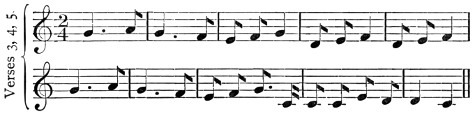
—Hexham (Miss J. Barker).
I.
Queen Mary, Queen Mary, my age is sixteen, My father’s a farmer on yonder green; He has plenty of money to dress me in silk— Come away, my sweet laddie, and take me a walk. One morning I rose and I looked in the glass, I thought to myself what a handsome young lass; My hands by my side, and a gentle ha, ha, Come away, my sweet lassie, and take me a walk. Father, mother, may I go, may I go, may I go; Father, mother, may I go, to buy a bunch of roses? Oh yes, you may go, you may go, you may go; Oh yes, you may go, buy a bunch of roses! Pick up her tail and away she goes, away she goes, away she goes; Pick up her tail and away she goes, to buy a bunch of roses.
—Sang by the children of Hexham Workhouse (Miss J. Barker).
II.
Queen Mary, Queen Mary, my age is sixteen, My father’s a farmer on yonder green; He has plenty of money to keep me sae braw, Yet nae bonnie laddie will tak’ me awa’. The morning so early I looked in the glass, And I said to myself what a handsome young lass; My hands by my side, and I gave a ha, ha, Come awa’, bonnie laddie, and tak’ me awa’.
—Berwickshire, A. M. Bell, Antiquary, xxx. 17.
III.
My name is Queen Mary, My age is sixteen, My father’s a farmer in Old Aberdeen; He has plenty of money to dress me in black— There’s nae [no] bonnie laddie ’ill tack me awa’. Next mornin’ I wakened and looked in the glass, I said to myself, what a handsome young lass; Put your hands to your haunches and give a ha, ha, For there’s nae bonnie laddie will tack ye awa’.
—N. E. Scotland (Rev. W. Gregor).
IV.
My name is Queen Mary, My age is sixteen, My father’s a farmer in yonder green; He’s plenty of money to dress in silk [fu’ braw’], For there’s nae bonnie laddie can tack me awa’. One morning I rose and I looked in the glass, Says I to myself, I’m a handsome young lass; My hands by my edges, and I give a ha, ha, For there’s nae bonnie laddie t’ tack me awa’.
—Cullen (Rev. W. Gregor).
(b) The Scottish game is played by girls. The players join hands, form a circle with one in the centre, and dance round singing. At the words “’ill tack me awa’,” the centre player chooses another one, and the two wheel round. Then the singing proceeds. At the exclamation “ha! ha!” the players suit the action to the words of the line. In the Cullen game the girls stand in a row with one in front, who sings the verses and chooses another player from the line. The two then join hands and go round and round, singing the remaining verses.
Queen of Sheba
Two rows of people sit on chairs face to face on each side of a door, leaving just sufficient space between the lines for a player to pass. At the end of the rows furthest from the door sits the “Queen of Sheba,” with a veil or shawl over her head. A player, hitherto unacquainted with the game, is brought to the door, shown the Queen, and told to go up between the rows, after being blindfolded, to kiss her, taking care, meanwhile, to avoid treading on the toes of the people on each side the alley leading to the lady. While his mind is diverted by these instructions, and by the process of blindfolding, the Queen gives up her seat to “the King,” who has been lurking in the background. He assumes the veil and receives the kiss, to the amusement of every one but the uninitiated player.
—Anderby, Lincolnshire, and near the Trent, Nottinghamshire (Miss M. Peacock).
Ragman
An ancient game, at which persons drew by chance poetical descriptions of their characters, the amusement consisting—as at modern games of a similar kind—in the peculiar application or misapplication of the verses so selected at hazard by the drawers.—Halliwell’s Dictionary. Halliwell goes on to say that the meaning of this term was first developed by Mr. Wright in his Anecdota Literaria, 1844, where he has printed two collections of ancient verses used in the game of “Ragman.” Mr. Wright conjectures that the stanzas were written one after another on a roll of parchment; that to each stanza a string was attached at the side, with a seal or piece of metal or wood at the end; and that when used the parchment was rolled up with all the strings and their seals hanging together, so that the drawer had no reason for choosing one more than another, but drew one of the strings by mere chance, and which he opened to see on what stanza he had fallen. If such were the form of the game, we can very easily imagine why the name was applied to a charter with an unusual number of seals attached to it, which, when rolled up, would present exactly the same appearance. Mr. Wright is borne out in his opinion by an English poem, termed “Ragmane roelle,” printed from MS., Fairfax, 16:—
“My ladyes and my maistresses echone, Lyke hit unto your humbyble wommanhede, Resave in gré of my sympill persone This rolle, which, withouten any drede, Kynge Ragman me bad me sowe in brede, And cristyned yt the merour of your chaunce; Drawith a strynge, and that shal streight yow leyde Unto the verry path of your governaunce.”
That the verses were generally written in a roll may perhaps be gathered from a passage in Douglas’s Virgil:—
“With that he raucht me ane roll: to rede I begane, The royetest ane ragment with mony ratt rime.”
Halliwell also quotes the following:—
“Venus, whiche stant withoute lawe, In non certeyne, but as men drawe Of Ragemon upon the chaunce, Sche leyeth no peys in the balaunce.”
—Gower, MS. Society of Antiquaries, 134, 244.
The term rageman is applied to the devil in “Piers Ploughman,” 335.
Rag-stag
See “Stag Warning.”
Rakes and Roans
A boys’ game, in which the younger ones are chased by the larger boys, and when caught carried home pick-a-back.—Halliwell’s Dictionary.
Moor (Suffolk Words and Phrases) says this game is often called “Rakes” only, and is the same, probably, that is thus alluded to: “To play Reaks, to domineer, to show mad pranks.” The jest of it is to be carried home a pig-back, by the less swift wight who you may catch.
Rakkeps
A game among boys [undescribed].—Dickinson’s Cumberland Glossary.
Range the Bus
Sides are chosen, and a line made across the playground. One of the sides goes up and the other goes down, and throws their bonnets on the ground. Then one side tries to get one of the opposite side across the line and crown him, and one of the opposite side tries to crown him back. If another boy can catch this player before he gets near him, he is crowned also. All the time the one side is trying to take the bonnets.—Old Aberdeen (Rev. W. Gregor).
See “French and English,” “Scotch and English.”
Rax, or Raxie-boxie, King of Scotland
The players, except one, take their stand at one side, and one stands at the other side in front of them. When all are ready, the one in front calls out “Cock,” or “Caron,” when all rush across to the other side, and he tries to catch one of them in crossing. The one caught helps to catch the others as they run back. Each time the players run from the one side to the other the word “Cock,” or “Caron,” is called out, and the change is continued till all are caught—each one as caught becoming a catcher. In Tyrie the game is called “Dyke King” when played by boys, and “Queen” when played by girls. The word “King,” or “Queen,” is called out before each run, according as the game is played by boys or girls.—Ballindalloch (Rev. W. Gregor).
This game is called “Red Rover” in Liverpool (Mr. C. C. Bell). “Red Rover” is shouted out by the catcher when players are ready to rush across.
See “King Cæsar.”
Relievo
This game is played by one child trying to catch the rest. The first prisoner taken joins hands with the captor and helps in the pursuit, and so on till all the playmates have been taken.—Anderby, Lincs. (Miss M. Peacock).
This game is the same as “Chickiddy Hand,” “Stag Warning.”
Religious Church
The children stand in a line. One child on the opposite side, facing them, says—
Have you been to a religious church?
Row of children answer—
No! Have I asked you? No! Put your fingers on your lips and follow me.
All the row follow behind her to some other part of the ground, where she stands with her back to them, and they form a new row. One child out of the row now steps forward, and standing behind the first girl says—