Volume 1 — CHILDREN’S GAMES (continued 4)
Reading edition
8. — — — — — — — — — — — — — — — — — — Springin’ in a pan. — — — — — — — — — — — — — — — — — — — — — — — —
9. — — — — — — — — — — — — — — — — — — — — — — Sitting in a sigh. — — — — — — — — — — — — — — — — — — — —
10. — — — — — — — — — — — — — — — — — — — — — — — Sitting on the sand. Sitting in the sander. — — — — Sat upon a cinder. — — — — — — — — Sitting on the ground. — — — Sitting in sand.
11. — — — — — — — — — — — — — — — — — — — — — — — — — Tinkle in a can. — — — — — — — — — — — — — — — — —
12. — — — — — — — — — — — — — — — — — — — — — — — — — — — Sitting in the sun. — — — — — Sitting in the sun. — — — — — — — — —
13. Rise and choose a young man. Rise and seek a young man. Hi, choose a young man. Rise for a young man. Rise for a young man. Rise for a young man. — Rise and choose a young man. — Rise for a young man. — — — Rise, for you shall have a husband. — Why don’t you rise for a young man. — — — Rise for a husband. — — — — — Rise and choose a young man. Rise for a young man. — Hi for a young man. — Rise for a young man. Rise for a young man. Rise for a young man. — — Rise for a young man. Rise for a young man. Rise for a good man. — — Rise and choose your good man. Rise and choose. —
14. — — — — — — — — Cry for a young man. — Cry for a young man. — — — — — Who do you lie mourning for a young man. — Cry for a young man. — Crying for a young man. — Weeping for a young man. Weeping for a young man. Weeping for a young man. — — Crying for a young man. — Weeping for a young man. — — — Weeping for a young man. — — — — Sobbing for a young man. Lamenting for a young man. — — Crying for a young man.
15. — — — — — — — — — — — Is not — a nice young man. Down in the meadow there’s a nice young man. — Why do you marry a foolish young man. — — — — — — — — — — — — — — — — — — — — — — — — — — — —
16. — — — — — — — — — — — — — — — — — Send it in a silver saucer to [ ]. — — — — — — — — — — — — — — — — — — — — — — — — —
17. — — — — — — — — — — — — — — — — — — — — — Sprinkle for a young man. — — — — — — — — — — — — Sprinkle for a young man. — — — — — — — —
18. Choose east, west. Turn east, west. — — Choose east, west. — — — — — — — — — — — — — — — Turn east, west. — Choose east, west. Try east, west. Choose east, west. Look east, west. Choose east, west. Fly east, west. Choose east, west. — Choose east, west. Choose east, west. Choose east, west. Fly east, west. — Choose east, west. First east, west. Choose east, west. Turn east, west. Choose east, west. Choose east, west. Choose east, west. —
19. — — Choose best, worst. Choose best, worst. — Choose best, worst. — Choose best, worst. Choose best, worst. — — — — — Pick worst, best. Choose wisest, best. Choose wisest, best. — Choose worst, best. — — — — — — — — — — — — — — — — — — — — — — — —
20. — — — — — — — — — Choose fairest. — — — Choose fairest. — — — — — — — Choose fairest. — — — — — — — — — — — — — — — — — — — — —
21. Choose the best loved. Choose the best loved. Choose the best loved. Choose the best loved. Choose the best loved. Choose the best loved. — Choose the best loved. Choose the best loved. — Choose the best loved. — — — Choose the best loved. Choose the one that lies in your breast. Choose the best loved. — Choose the best loved. — Choose the best loved. — Choose the best loved. Choose the best loved. Choose the best loved. Choose the best loved. Choose the best loved. Choose the best loved. Choose the best loved. Choose the best loved. Choose the best loved. Choose the best loved. Choose the best loved. Fly to the best loved. — Choose the best loved. Then to the bestloved. — Turn to the best loved. Choose the best loved. Choose the best loved. Choose the prettiest. Pick the one you like best.
22. Now you’re married, &c. Now you’re married, &c. Now you’re married, &c. Now you’re married, &c. — — — Now you’re married, &c. Now you’re married, &c. Now she’s married, &c. — — — Now you’re married, &c. — — — — Now you’re married, &c. Now you’re married, &c. Now you’re married, &c. Now you’re married, &c. — Now they’re married, &c. Now you’re married, &c. — Now you’re married, &c. — Married, &c. Now they’re married, &c. Now they are married, &c. Now they’re married, &c. Now they’re married, &c. — Now you’re married, &c. Now you’re married, &c. Now you’re married, &c. There’s a couple, &c. — Here’s a couple, &c. Now they’re married, &c. Now you’re married, &c. Now you’re married, &c.
23. — — — — You must obey, &c. — — — — — — — — — — — — — — — — — — — — — — — — — — — — — — — — — — — — — —
24. — — — — — — — — — — — They shall be married if they agree, &c. — — — — — — — — — — — — — — — — — — — — — — — — — — — — — — —
25. — — — — — — — — — — — — On the carpet she shall kneel, &c. — — — — — — — — — — — — — — — — — — — — — — — — — — — — — —
26. — — — — — — — — — — — — — — — — — — — — — — — — — — — — — — — — — Goes courting, &c. — — — — — — — — —
27. — — — — — — — — — — — — — — — — — — — — — — — — — — — — — — — — — — — — — — A bogie in, &c. — — — —
No. Dorsetshire. Devonshire. Somersetshire. London. Fochabers. Berkshire. Crockham Hill, Kent.
1. Sally Water. — Sally Water. Sally Waters. — Sally Waters. —
2. — Sally Walker. — — Sally Walker. — —
3. — — — — — — Sally Wallflowers.
4. — — — — — — —
5. — — — — — — —
6. Sprinkle in pan. Sprinkle water in the pan. Sprinkle in the pan. Sprinkle in the pan. Sprinkling in a pan. Sprinkled in the pan. Sprinkled in the pan.
7. — — — — — — —
8. — — — — — — —
9. — — — — — — —
10. — — — — — — —
11. — — — — — — —
12. — — — — — — —
13. Rise and choose a young man. Rise and seek a young man. Hi, choose a young man. Rise for a young man. Rise for a young man. Rise for a young man. —
14. — — — — — — —
15. — — — — — — —
16. — — — — — — —
17. — — — — — — —
18. Choose east, west. Turn east, west. — — Choose east, west. — —
19. — — Choose best, worst. Choose best, worst. — Choose best, worst. —
20. — — — — — — —
21. Choose the best loved. Choose the best loved. Choose the best loved. Choose the best loved. Choose the best loved. Choose the best loved. —
22. Now you’re married, &c. Now you’re married, &c. Now you’re married, &c. Now you’re married, &c. — — —
23. — — — — You must obey, &c. — —
24. — — — — — — —
25. — — — — — — —
26. — — — — — — —
27. — — — — — — —
No. Wiltshire. Northants. Oxford. Yorkshire. Surrey. Shropshire (1). Shropshire (2). Notts.
1. Sally Waters. Sally Waters. Sally Water. Sally Waters. Sally Water. — Sally Water. Sally Water.
2. — — — — — Sally Walker. — —
3. — — — — — — — —
4. — — — — — — — —
5. — — — — — — — —
6. Sprinkled in a pan. Sprinkle in a pan. Sprinkle in the pan. Sprinkle in a pan. Sprinkle in the pan. Sprinkle in your pan. Sprinkle in your pan. Sprinkle in your can.
7. — — — — — — — —
8. — — — — — — — —
9. — — — — — — — —
10. — — — — — — — —
11. — — — — — — — —
12. — — — — — — — —
13. Rise and choose a young man. — Rise for a young man. — — — Rise, for you shall have a husband. —
14. — Cry for a young man. — Cry for a young man. — — — —
15. — — — — Is not — a nice young man. Down in the meadow there’s a nice young man. — Why do you marry a foolish young man.
16. — — — — — — — —
17. — — — — — — — —
18. — — — — — — — —
19. Choose best, worst. Choose best, worst. — — — — — Pick worst, best.
20. — — Choose fairest. — — — Choose fairest. —
21. Choose the best loved. Choose the best loved. — Choose the best loved. — — — Choose the best loved.
22. Now you’re married, &c. Now you’re married, &c. Now she’s married, &c. — — — Now you’re married, &c. —
23. — — — — — — — —
24. — — — — They shall be married if they agree, &c. — — —
25. — — — — — On the carpet she shall kneel, &c. — —
26. — — — — — — — —
27. — — — — — — — —
No. Gloucester- shire. Sheffield. Lincolnshire. Wakefield. Warwickshire. Sheffield. Bucks.
1. Sally Water. Sally Water. — Sally Water. Sally Water. — —
2. — — — — — — Sally Walker.
3. — — — — — — —
4. — — Sally Salter. — — Sally Slarter. —
5. — — — — — — —
6. Sprinkle your can. Sprinkle your can. — — — — Sprinkled in a pan.
7. — — Sprinkle in some water. — Water your can. Sitting by the water. —
8. — — — Springin’ in a pan. — — —
9. — — — — — — —
10. — — — — — — —
11. — — — — — — —
12. — — — — — — —
13. Why don’t you rise for a young man. — — — Rise for a husband. — —
14. — Who do you lie mourning for a young man. — Cry for a young man. — Crying for a young man. —
15. — — — — — — —
16. — — Send it in a silver saucer to [ ]. — — — —
17. — — — — — — Sprinkle for a young man.
18. — — — — — Turn east, west. —
19. Choose wisest, best. Choose wisest, best. — Choose worst, best. — — —
20. — — — — — — Choose fairest.
21. Choose the one that lies in your breast. Choose the best loved. — Choose the best loved. — Choose the best loved. —
22. — — — Now you’re married, &c. Now you’re married, &c. Now you’re married, &c. Now you’re married, &c.
23. — — — — — — —
24. — — — — — — —
25. — — — — — — —
26. — — — — — — —
27. — — — — — — —
No. Nairn. Fraserburgh. Cornwall. Settle. Northants. Brigg. Belfast.
1. — — — — Sally Water. Sally Waters. —
2. Sally Walker. Sally Walker. — Sally Walker. — — Sally Walker.
3. — — — — — — —
4. — — — — — — —
5. — — — Sally Sander. — — —
6. — — — — Sprinkle in a pan. — —
7. — — — — — — —
8. — — — — — — —
9. Sitting in a sigh. — — — — — —
10. — Sitting on the sand. Sitting in the sander. — — — —
11. — — — Tinkle in a can. — — —
12. — — — — — Sitting in the sun. —
13. — — — Rise and choose a young man. Rise for a young man. — Hi for a young man.
14. Weeping for a young man. Weeping for a young man. Weeping for a young man. — — Crying for a young man. —
15. — — — — — — —
16. — — — — — — —
17. — — — — — — —
18. Choose east, west. Try east, west. Choose east, west. Look east, west. Choose east, west. Fly east, west. Choose east, west.
19. — — — — — — —
20. — — — — — — —
21. Choose the best loved. Choose the best loved. Choose the best loved. Choose the best loved. Choose the best loved. Choose the best loved. Choose the best loved.
22. — Now they’re married, &c. Now you’re married, &c. — Now you’re married, &c. — Married, &c.
23. — — — — — — —
24. — — — — — — —
25. — — — — — — —
26. — — — — — — —
27. — — — — — — —
No. Earls Heaton. Scotland. Tyrie. Aberdeen. Nairn. Halliwell. Hexham.
1. — — — — — Sally Water. —
2. — Sally Walker. Sally Walker. Sally Walker. Sally Walker. — Sally Walker.
3. — — — — — — —
4. — — — — — — —
5. Alice Sander. — — — — — —
6. — — — — — — Sprinkle in the pan.
7. — — — — — — —
8. — — — — — — —
9. — — — — — — —
10. Sat upon a cinder. — — — — — —
11. — — — — — — —
12. — — — — Sitting in the sun. — —
13. — Rise for a young man. Rise for a young man. Rise for a young man. — — Rise for a young man.
14. Weeping for a young man. — — — Weeping for a young man. — —
15. — — — — — — —
16. — — — — — — —
17. — — — — — Sprinkle for a young man. —
18. — Choose east, west. Choose east, west. Choose east, west. Fly east, west. — Choose east, west.
19. — — — — — — —
20. — — — — — — —
21. Choose the best loved. Choose the best loved. Choose the best loved. Choose the best loved. Fly to the best loved. — Choose the best loved.
22. Now they’re married, &c. Now they are married, &c. Now they’re married, &c. Now they’re married, &c. — Now you’re married, &c. Now you’re married, &c.
23. — — — — — — —
24. — — — — — — —
25. — — — — — — —
26. — — — — Goes courting, &c. — —
27. — — — — — — —
No. Lancashire. Rosehearty. Notts. Morpeth. Gainford. Norfolk. Beddgelert.
1. Sally Waters. — Sallie [ ]. — — Sallie [ ]. Sallie [ ].
2. — Sally Walker. — Sally Walker. Sally Walker. — —
3. — — — — — — —
4. — — — — — — —
5. — — — — — — —
6. — — — — — — —
7. — — — — — — —
8. — — — — — — —
9. — — — — — — —
10. — — Sitting on the ground. — — — Sitting in sand.
11. — — — — — — —
12. — — — — — — —
13. Rise for a young man. Rise for a good man. — — Rise and choose your good man. Rise and choose. —
14. — — Sobbing for a young man. Lamenting for a young man. — — Crying for a young man.
15. — — — — — — —
16. — — — — — — —
17. — — — — — — —
18. First east, west. Choose east, west. Turn east, west. Choose east, west. Choose east, west. Choose east, west. —
19. — — — — — — —
20. — — — — — — —
21. Then to the bestloved. — Turn to the best loved. Choose the best loved. Choose the best loved. Choose the prettiest. Pick the one you like best.
22. Now you’re married, &c. There’s a couple, &c. — Here’s a couple, &c. Now they’re married, &c. Now you’re married, &c. Now you’re married, &c.
23. — — — — — — —
24. — — — — — — —
25. — — — — — — —
26. — — — — — — —
27. — — A bogie in, &c. — — — —
The first thing to note from this analysis are the words Sally and Water. In twenty-three versions they are Sally Water or Waters, in seventeen versions it is Sally Walker, in six versions it is another name altogether, while in two versions it is Sallie only. The most constant name, therefore, points to Sally Water as the oldest version; and it is noticeable that in the Lincolnshire and Sheffield versions, where the name is not Sally Water, the word water is introduced later on in the line which directs the action of sprinkling water. Is it possible, then, that Sally Water may be a corruption from an earlier form where Sally is some other word, not the name of a girl, as it is usually supposed to be, and the word water is connected, not with the name of the maiden, but with the action of sprinkling which she is called upon to perform? If we could surmise that the early form was “Sallie, Sallie, water sprinkle in the pan,” the accusative being placed before the verb, the problem would be solved in this manner; but there is no warrant for this poetical licence in popular verses, and I prefer to suggest that “water” got attached as a surname by simple transposition, such as the Norfolk and Beddgelert versions allow as evidence. It follows from this that Walker and other names appear as degraded forms of the original, and do not enter into the question of origins, a point which may readily be conceded, considering that the general evidence of all these singing games is, that no special names are ever used, but that names change to suit the players. The next incident in the analysis is the ceremony of “sprinkling the water,” which is constant in twenty-one versions, while the Wakefield “Springin’ in the pan,” the Settle “Tinkle in a can,” Halliwell’s “Sprinkle for a young man,” and the eight versions in which this incident is wholly absent in any form, are evident corruptions. The tendency of the corruption is shown by this to be that the “sprinkling of water” came to be omitted from the verse, and therefore the other variants—
Sitting by the water (Sheffield),
Water your can (Warwickshire),
Sitting in a sigh (Nairn),
Sitting on the sand (Fraserburgh and Beddgelert).
Sitting in the sander (Cornwall),
Sitting in the sun (Brigg and Nairn),
Sat upon a cinder (Earls Heaton),
Sitting on the ground (Notts.),
are but the steps through which the entire omission of the water incident was finally attained. The third incident is “Rise and choose” a young man, the alternative being “Crying for a young man.” The first indicates a kneeling and reverential attitude before the water, and occurs in twenty-one versions, while the second only occurs in fourteen versions.
The expression “crying” is really to “announce a want,” as “wants” were formerly cried by the official “crier” of every township, and indeed as children still in games “cry” the forfeits; but losing this meaning, the expression came to mean crying in the sense of “weeping,” and appearing to the minds of children as a natural way of expressing a want, would therefore succeed in ousting any more archaic notion. The incident of crying for a lover appears in other singing games, as, for instance, in “Poor Mary.” Especially may this be considered the process which has been going on when it is seen that “choosing” is an actual incident of the game, even in those cases where “crying” has replaced the kneeling. The choosing incident also assumes two forms, namely, with respect to “east and west” in twenty-two versions, and “best and worst” in nine versions. Now, the expression, “for better for worse,” is an old marriage formula preserved in the vernacular portion of the ancient English marriage service (see Palgrave, English Commonwealth, ii., p. cxxxvi.); and I cannot but think that we have the same formula in this game, especially as the final admonition in nearly all the versions is to choose “the one loved best.” Following upon this comes the very general marriage formula noted so frequently in these games. It is slightly varied in some versions, and is replaced by a different formula, but one that also appears in other games, in two or three versions. One feature is very noticeable in the less common versions of this game, viz., the assumption of the marriage being connected with the birth of children, and the indulgences of the lovers, as in the Tong and Scottish versions xxxii., xxxiii., and xxxiv.
(e) In considering the probable origin of the game, the first thing will be to ascertain as far as possible what ideas the words are intended to convey. Taking note of the results of the analysis, so far as they show the corruptions which have taken place in the words, it seems clear that though it is not possible to restore the original words, their original meaning is still preserved. This is, that they accompanied the performance of a marriage ceremony, and that a chief feature of this ceremony was connected with some form of water-worship, or some rite in which water played a chief part. Now it has been noted before that the games of children have preserved, by adaptation, the marriage ceremony of ancient times (e.g., “Merry ma Tansa,” “Nuts in May,” “Poor Mary,” “Round and Round the Village”); but this is the first instance where such an important particularisation as that implied by water-worship qualifies the marriage ceremony. It is therefore necessary to see what this exactly means. Mr. Hartland, in his Perseus (i. 167-9), draws attention to the general significance of the water ceremonial in marriage customs, and Mr. F. B. Jevons, in his introduction to Plutarch’s Romane Questions, and in the Transactions of the Folk-lore Congress, 1891, deals with the subject in reference to the origin of custom obtaining among both Aryan and non-Aryan speaking people. In this connection an important consideration arises. The Esthonian brides, on the morning after the wedding, are taken to make offerings to the water spirit, and they throw offerings into the spring (or a vessel of water), overturn a vessel of water in the house, and sprinkle their bridegrooms with water. The Hindoo offerings of the bride were cast into a water vessel, and the bride sprinkles the court of the new house with water by way of exorcism, and also sprinkles the bridegroom (Jevons, loc. cit., p. 345). Here the parallel between the non-Aryan Esthonian custom and the Aryan Hindoo custom is very close, and it is a part of Mr. Jevons’ argument that, among the Teutons, with whom alone of Aryan speaking peoples the Esthonians came into contact, the custom was limited to the bride simply stepping over a vessel of water. There is certainly something a great deal more than the parallel to the Teutonic custom in the game of “Sally, Sally Water,” and as it equates more nearly to Hindoo and Esthonian custom, the question is, Does it help Mr. Jevons in the important point he raises? I think it does. A custom is very low down among the strata of survivals when it is only to be recognised as part of a children’s singing game, and the proposition it suggests is that children have preserved more of the old custom than was preserved by the people who adopted a portion of it into their marriage ceremony. A custom so treated must be older than the marriage ceremony with which it thus came into contact, and if this is a true conclusion, we have in this children’s game a relic of the pre-Celtic peoples of these islands—a relic therefore going back many centuries for its origin, and which is of inestimable service in discussing some important problems of the ethnic significance of folk-lore. These conclusions are entirely derived from the significant position which this game occupies in relation to Esthonian (non-Aryan) and to Teutonic (Aryan) marriage customs respectively, and therefore it is of considerable importance to note that it entirely fits in with the conclusion which my husband has drawn as to the non-Aryan origin of water-worship (see Gomme’s Ethnology of Folk-lore, pp. 79-105).
There is, however, something further which seems to bring this game into line with non-Aryan marriage customs. The marriage signified by the game is acknowledged and sanctioned by the presence of witnesses; is made between two people who choose each other without any form of compulsion; is accompanied by blessings upon the young couple and prognostications of the birth of children. These points show that the marriage ceremony belongs to a time when the object of the union was to have children, and when its duration was not necessarily for life. It is curious to note that water worship is distinctly connected with the desire to have children (Proc. Roy. Irish Acad., 3rd ser., ii. 9); and that the idea of the temporary character of the marriage status of the lower classes of the people is still extant I have certain evidence of. Early in November of 1895, a man tried for bigamy gave as his defence that he thought his marriage was ended with his first wife, as he had been away seven years. It is a frequently told story. A year and a day and seven years are the two periods for which the popular mind regards marriage binding. “I was faithful to him for seven years, and had more than my two children,” a woman said to me once, as if two children were the required or expected number to be born in that period. If there is a popular belief of this kind, it is strangely borne out by this game-rhyme. “First a girl, and then a boy,” may also be shown to be a result to be desired and prayed for, in the popular belief that a man’s cycle of life is not complete until he is the father of a daughter, who, in her turn, shall have a son. Miss Hawkins Dempster obtained evidence of such a belief from the lips of a man who considered he was entitled to marry another woman, as his wife had only borne him sons, and therefore his life was not (like hers) complete.
The free choice of both woman and man is opposed to the theory of our present marriage ceremony, where permission or authority to marry is only necessary for the woman, the man being able to do as he pleases. This is now regarded as a sign of women’s early subjection to the authority of men and their subordinate place in the household. But it does not follow that this was the relative position of men and women when a ceremony was first found needful and instituted. I am inclined to think it must have been, rather, the importance attached to the woman’s act of ratification, in the presence of witnesses, of her formal promise to bear children to a particular man. Marriage would then consist of contracts between two parties for the purpose of, and which actually resulted in, the birth of children; of concubinage, or the wife consenting to children being born to her husband by another woman in her stead, if she herself failed in this respect (such children being hers and her husband’s jointly); of marriage without ceremony or set purpose, resulting from young people being thrown together at feast times, gathering in of harvests, &c., which might or might not result in the birth of children. These conditions of the marriage rite are at variance with what we know of the Aryan marriage generally and its results; and that they flow from the customs preserved in the game under consideration is further proof of the origin of the game from a marriage rite of the pre-Celtic people of these islands. The “kissing together” of the married couple is the token to the witnesses of their mutual consent to the contract.
Attention has already been directed to the fact that parts of the formula preserved in this game are also found in other games, and it may possibly be assumed therefrom that the same origin must be given to these games as to “Sally Water.” The objection to such a conclusion is mainly that it is impossible to decide to which game the popular marriage formula originally belonged, and from which it has been borrowed by the other games. Seeing how exactly it fits the circumstances of “Sally Water,” it might not be too much to suggest that it rightly belongs to this game. Another point to be noted is that the tune to which the words of the marriage formula are sung is always the same, irrespective of that to which the previous verses are sung, and this rule obtains in all those games in which this formula appears—a further proof of the antiquity of the formula as an outcome of the early marriage ceremony.[Addendum]
Sally Sober
A game among girls [undescribed].—Dickinson’s Cumberland Glossary (Supplement).
Salmon Fishers
I.
Cam’ ye by the salmon fishers, Cam’ ye by the roperee? Saw ye a sailor laddie Sailing on the raging sea? Oh, dear ——, are ye going to marry? Yes, indeed, and that I am. Tell to me your own true lover, Tell to me your lover’s name? He’s a bonnie lad, he’s a bonnie fellow, Oh, he’s a bonnie lad, Wi’ ribbons blue and yellow, Stockings of blue silk; Shoes of patent leather, Points to tie them up. A gold ring on his finger. Did you see the ship he came in? Did you see it comin’ in? Every lassie wi’ her laddie, Every widow wi’ her son. Mother, struck eight o’clock, Mother, may I get out? For my love is waiting For to get me out. First he gave me apples, Then he gave me pears, Then he gave me a sixpence To kiss him on the stairs. Oh, dear me, I wish I had my tea, To write a letter to my love To come back and marry me.
—Rosehearty (Rev. W. Gregor).
II.
Cam’ ye by the salmon fishers? Cam’ ye by the roperee? Saw ye a sailor laddie Waiting on the coast for me? I ken fahr I’m gyain, I ken fahs gyain wi’ me; I ha’e a lad o’ my ain, Ye daurna tack ’im fae me. Stockings of blue silk, Shoes of patent leather, Kid to tie them up, And gold rings on his finger. Oh for six o’clock! Oh for seven I weary! Oh for eight o’clock! And then I’ll see my dearie.
—Fochabers (Rev. W. Gregor).
III.
Come ye by the salmon fishers? Come ye by the roperee? Saw ye my dear sailor laddie Sailing on the raging sea? Tip for gold and tip for silver, Tip for the bonnie laddie I do adore; My delight’s for a sailor laddie, And shall be for evermore. Sit you down, my lovely Elsie, Take your baby on your knee; Drink your health for a jolly sailor, He will come back and marry you. He will give you beads and ear-rings, He will give you diamonds free; Sailors they are bonnie laddies, Oh, but they are neat and clean! They can kiss a bonnie lassie In the dark, and A, B, C; When the sailors come home at evening They take off their tarry clothes, They put on their light blue jackets, That is the way the sailors go.
—Rev. W. Gregor.
A circle is formed, and the children dance round singing. Before beginning they agree which of the players is to be named in the fifth line of the Rosehearty version.
Jamieson’s Dictionary (sub voce), “Schamon’s Dance,” says, “Some particular kind of dance anciently used in Scotland.”
Blaw up the bagpyp than, The schamon’s dance I mon begin, I trow it sall not pane.
—“Peblis to the Play,” Chronicles of Scottish Poetry, i. 135.
Pinkerton defines salmon as “probably show-man, shaw-man.”
See “Shame Reel, or Shamit Dance.”
Salt Eel
This is something like “Hide and Find.” The name of Salt Eel may have been given it from one of the points of the game, which is to baste the runaway individual, whom you may overtake, all the way home with your handkerchief, twisted hard for that purpose. Salt Eel implies on board ship a rope’s ending, and on shore an equivalent process.—Moor’s Suffolk Words and Phrases.
Save All
Two sides are chosen in this game. An even number of boys, say eight on each side. Half of these run out of the line, and are chased by half of the boys from the other side. If two out of four get “home” to door or lamp-post, they save all the prisoners which have been made; if two out of four are caught before the others get “home,” the side catching them beats.—Deptford (Miss Chase).
Say Girl
A game undescribed, recorded by the Rev. S. D. Headlam as played by some Hoxton school children.—Church Reformer, 1894.
Scat
A paper-knife, or thin slip of wood, is placed by one player on his open palm. Another takes it up quickly, and tries to “scat” his opponent’s hand before he can draw it away. Sometimes a feint of taking the paper-knife is made three or four times before it is really done. When the “scat” is given, the “scatter” in his turn rests the knife on his palm. Scat is the Cornish for “slap.”—Folk-lore Journal, v. 50.
Scop-peril, or Scoperel
Name for teetotum ordinarily manufactured by sticking a pointed peg through a bone button.—Easther’s Almondbury Glossary; also in SW. Lincolnshire, Cole’s Glossary.
See “Totum.”
Scotch-hoppers
In Poor Robin’s Almanack for 1677, in the verses to the reader, on the back of the title-page, concerning the chief matters in the volume, among many other articles of intelligence, the author professes to show—
“The time when school boys should play at Scotch-hoppers.”
Another allusion occurs in the same periodical for 1707—“Lawyers and Physitians have little to do this month, and therefore they may (if they will) play at Scotch-hoppers. Some men put their hands into peoples’ pockets open, and extract it clutch’d, of that beware. But counsel without a cure, is a body without a soul.” And again, in 1740—“The fifth house tells ye whether whores be sound or not; when it is good to eat tripes, bloat herrings, fry’d frogs, rotten eggs, and monkey’s tails butter’d, or an ox liver well stuck with fish hooks; when it is the most convenient time for an old man to play at Scotch-hoppers amongst the boys. In it also is found plainly, that the best armour of proof against the fleas, is to go drunk to bed.”
See “Hopscotch,” “Tray-Trip.”
Scots and English
Boys first choose sides. The two chosen leaders join both hands, and raising them high enough to let the others pass through below, cry—
Brother Jack, if ye’ll be mine, I’ll gie ye claret wine; Claret wine is good and fine, Through the needle ee, boys.
Letting their arms fall they enclose a boy and ask him to which side he will belong, and he is disposed of according to his own decision. The parties being at length formed, are separated by a real or imaginary line, and place at some distance behind them, in a heap, their hats, coats, &c. They stand opposite to each other, the object being to make a successful incursion over the line into the enemy’s country, and bring off part of the heap of clothes. It requires both address and swiftness of foot to do so without being taken by the foe. The winning of the game is decided by which party first loses all its men or its property. At Hawick, where the legendary mimicry of old Border warfare peculiarly flourishes, the boys are accustomed to use the following rhymes of defiance:—
King Covenanter, come out if ye daur venture! Set your foot on Scots’ ground, English, if ye daur!
—Chambers’ Popular Rhymes, p. 127.
The following version was written down in 1821 under the name of Scotch and English:—Two parties of boys, divided by a fixed line, endeavoured to pull one another across this line, or to seize by bodily strength or nimbleness a “wad” (the coats or hats of the players) from the little heap deposited in the different territories at a convenient distance. The person pulled across or seized in his attempt to rob the camp was made a prisoner and conducted to the enemy’s station, where he remained under the denomination of “stinkard” till relieved by one of the same side, or by a general exchange of prisoners.—Blackwood’s Magazine, August 1821, p. 25. The Denham Tracts, i. 150, gives a version of the game much the same as these, except that the words used by the English are, “Here’s a leap into thy kingdom, dry-bellied Scot.” See also Hutton’s History of Roman Wall (1804), p. 104. Brockett’s account, under the title of “Stealy Clothes, or Watch Webs,” is as follows:—The players divide into two parties and draw a line as the boundary of their respective territories. At an equal distance from this line each player deposits his hat or some other article of his dress. The object of the game is to seize and convey these singly to your own store from that of the enemy, but if you are unfortunately caught in the attempt, you not only restore the plunder but become a prisoner yourself. This evidently takes its origin from the inroads of the English and Scotch; indeed, it is plainly proved from the language used on the occasion, which consists in a great measure of the terms of reproach still common among the Borderers.—Brockett’s North Country Words.
Jamieson, also, describes the game under the title of “English and Scotch,” and says the game has originated from the mutual incursions of the two nations.
See “French and English,” “Prisoner’s Base,” “Rigs.”[Addendum]
Scratch Cradle
The game of “Cat’s Cradle.”
Scrush
A game much like Shinty between two sides of boys, each with bandies (scrushes) trying to knock a roundish stone over the other’s line.—Barnes’ Dorset Glossary. See “Shinney.”
Scurran-Meggy
A game much in vogue in Cumberland during the last century, and in which a peculiar form of top called a “scurran top” was used.—Halliwell’s Dictionary.
See-Saw
[Play]
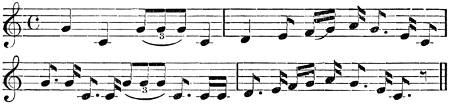
—London (A. B. Gomme).
I.
Titty cum tawtay, The ducks in the water; Titty cum tawtay, The geese follow after.
—Halliwell’s Nursery Rhymes, p. 213.
II.
See-saw, Margery Daw, Sold her bed to lie upon straw; Wasn’t she a dirty slut To sell her bed to lie upon dirt?
—London (A. B. Gomme).
III.
See-saw, Margery Daw, Johnny shall have a new master; He shan’t have but a farthing a day, Because he can’t work any faster.
—London (G. L. Gomme).
IV.
See-saw, sacradown, Which is the way to London town? One boot up, and the other down, And that is the way to London town.
—Halliwell’s Nursery Rhymes, No. cccxxx.
V.
The poor man was digging, To and fro, to and fro; And his spade on his shoulder, To and fro, to and fro. The poor man was digging, To and fro, to and fro; And he caught the black cross, To and fro, to and fro.
—Isle of Man (A. W. Moore).
A common game, children sitting on either end of a plank supported on its centre, and made to rock up and down. While enjoying this recreation, they sing the verse. Addy, Sheffield Glossary, gives Ranty or Rantypole, a plank or pole balanced evenly, upon which children rock up and down in see-saw fashion. Jamieson, Etymological Dictionary, gives Coup-the-Ladle as the name for See-saw in Aberdeen. Moor, Suffolk Words and Phrases, describes this game, and gives the same words to be sung while playing as Halliwell’s above. Grose gives “Weigh,” to play at See-saw. Holloway, Dictionary of Provincialisms, says, in Norfolk See-saw is called Titti cum Totter; and in Gainford, Durham, Ewiggy Shog. Halliwell gives versions of Nos. II. and III. in his Nursery Rhymes, and also other verses with the opening words “See-saw,” namely, “See-saw, Jack-a-Daw,” “See-saw, Sack-a-day;” but these are not connected with the game by Halliwell, and there is nothing in the words to indicate such a connection. Mactaggart, Gallovidian Encyclopædia, calls the game “Coggle-te-Carry,” but gives no verses, and Strutt calls it “Titter Totter.”—Sports, p. 303. He does not give any rhymes, except to quote Gay’s poem, but it is possible that the rhyme to his game may be No. I. Brogden gives “Hightte” as the game of See-saw. The Manx version has not before been published, and Mr. Moore says is now quite forgotten in the Isle. The game is called “Shuggy-shoo” in Irish, and also “Copple-thurrish,” evidently “Horse and Pig,” as if the two animals were balancing against each other, and alternately becoming elevated and depressed.—Ulster Journ. Arch., vi. 102. The child who stands on the plank in the centre and balances it, is frequently called the “canstick” or “candlestick.”
See-Sim
A children’s game. If one of the party is blindfolded, it is “Blind-Sim.”—Spurden’s East Anglian Glossary.
Shame Reel, or Shamit Dance
In several counties of Scotland this was the name of the first dance after the celebration of marriages. It was performed by the bride and best man and the bridegroom and best maid. The bride’s partner asked what was to be the “sham spring,” and she commonly answered, “Through the world will I gang wi’ the lad that lo’es me,” which, on being communicated to the fiddlers, was struck up, and the dance went on somewhat punctiliously, while the guests looked on in silence, and greeted the close with applause. This dance was common in Forfarshire twenty years ago.—Jamieson’s Dictionary.
See “Cushion Dance,” “Salmon Fishers.”
She Said, and She Said
This game requires two confederates; one leaves the room, and the other in the secret asks a player in the room to whisper to him whom she (or he) loved; he then calls in his companion, and the following dialogue is carried on:—
“She said, and she said! And what did she say?” “She said that she loved.” “And whom did she love? Suppose she said she loved ——?” “No! she never said that, whatever she said.”
An indefinite number of names are mentioned before the right one. When that came, to the surprise of the whisperer, the answer is—
“Yes! she said that.”
The secret was very simple; the name of a widow or widower known to both players was always given before that whispered.—Cornwall (Folk-lore Journal, v. 50).
Shepherd and Sheep
Children choose, by “counting out,” or otherwise, a Shepherd and a Wolf (or Mother Sheep, and Wolf). The Wolf goes away, and the rest of the players are the Sheep (or Lambs) and stand in a row. The Shepherd counts them—Sunday, Monday, Tuesday, &c. Then—
Shepherd—“What shall I bring home for you for dinner, Sunday, I’m going to market?”
Sunday chooses something—roast veal, apple tart, or anything else that she likes. Then Monday, Tuesday, and the rest choose also. Shepherd goes away, saying—
“Mind you are all good children.”
The Wolf comes directly the Shepherd goes out of sight, and takes away one of the Sheep. Shepherd comes back and begins to distribute the different things—
“Sunday, Monday,——why, where’s Tuesday?” (or Wednesday, as the case may be.)
The Children cry in chorus—
“Old Wolf came down the chimney and took him (or her) away.”
This formula is repeated till all the children (sheep) are stolen.
The Shepherd now goes to the Wolf’s house to look for his sheep—
Shepherd—“Good morning, have you seen my sheep?”
Wolf—“Yes, they went down Red Lane.”
[Shepherd looks down Red Lane.]
Shepherd—“I’ve been down Red Lane, and they’re not there.”
Wolf—“I’ve just seen them pass, they’re gone down Green Lane,” &c. These questions and answers continue as long as the children’s fancy holds out; then the Shepherd comes back.
Shepherd—“I’ve looked everywhere, and can’t find them. I b’lieve you’ve got them? I smell meat; may I go up and taste your soup?”
Wolf—“You can’t go upstairs, your shoes are too dirty.”
Shepherd—“I’ll take off my shoes” (pretends to take them off).
Wolf—“Your stockings are too dirty.”
Shepherd—“I’ll take off my stockings” (suits the action).
Wolf—“Your feet are too dirty.”
Shepherd—“I’ll cut my feet off” (pretends to cut them off).
(Milder version, “I’ll wash my feet.”)
Wolf—“Then the blood’ll run about.”
(Milder version, “Then they’ll wet my carpet.”)
Shepherd—“I’ll tie up my feet.”
(Or, “I’ll wipe my feet”)
Wolf—-“Well, now you may go up.”
Shepherd—“I smell my sheep.”
The Shepherd then goes to one child, pretends to taste—using fingers of both hands as though holding a spoon and fork—on the top of the child’s head, saying, “That’s my sheep,” “That’s Tuesday,” &c., till he comes to the end of the row, then they all shout out and rush home to the fold, the Wolf with them. A fresh Shepherd and Wolf are chosen, and the game starts once more.—Cornwall (Miss I. Barclay).
One player is chosen to be the Shepherd, another the Thief, and the rest the sheep, who are arranged in a long row. The Shepherd pretends to be asleep; the Thief takes away one of the sheep and hides it; he then says—
Thief— “Shepherdy, shepherdy, count your sheep!” Shepherd— “I can’t come now, I’m fast asleep.” Thief— “If you don’t come now, they’ll all be gone, So shepherdy, shepherdy, come along!”
The Shepherd counts the sheep, and missing one, asks where it is gone. The Thief says, “It is gone to get fat!” The Shepherd goes to sleep again, and the same performance is repeated till all the sheep are hidden; the Shepherd goes in search of them, and when found they join him in the pursuit of the Thief.—Oswestry (Burne’s Shropshire Folk-lore, p. 520).
Mr. Northall (Folk Rhymes, p. 391) gives a version from Warwickshire, and says he believes the Shepherd’s dog to be the true thief who hides his propensity in the dialogue—
Bow, wow, wow, What’s the matter now? A leg of a louse came over my house, And stole one of my fat sheep away.
The game is played as in Shropshire. The dialogue in the Cornish game is similar to that of “Witch.” See “Wolf.”
Shepherds
One child stands alone, facing the others in a line opposite. The single child shouts, “Shepherds, shepherds, give warning.” The others reply, “Warn away! warn away!” Then she asks, “How many sheep have you got?” They answer, “More than you can carry away.” She runs and catches one—they two join hands and chase the rest; each one, as caught, joining hands with the chasers until all are caught.—Liverpool (Mr. C. C. Bell.) See “Stag,” “Warney.”
Shinney, or Shinty, or Shinnops
A writer in Blackwood’s Magazine, August 1821, p. 36, says: The boys attempt to drive with curved sticks a ball, or what is more common, part of the vertebral bone of a sheep, in opposite directions. When the object driven along reaches the appointed place in either termination, the cry of hail! stops the play till it is knocked off anew by the boy who was so fortunate as to drive it past the gog. In the Sheffield district it is played as described by Halliwell. During the game the boys call out, “Hun you, shin you.” It is called Shinny in Derbyshire.—Addy’s Sheffield Glossary. Halliwell’s description does not materially differ from the account given above except that when the knur is down over the line it is called a “bye.”—(Dictionary). In Notes and Queries, 8th series, viii. 446; ix. 115 et seq., the game is described as played in Lincolnshire under the name of “Cabsow,” which perhaps accounts for the Barnes game of Crab-sowl.
In Perthshire it is described as a game in which bats somewhat resembling a golf club are used. At every fair or meeting of the country people there were contests at racing, wrestling, putting the stone, &c., and on holidays all the males of a district, young and old, met to play at football, but oftener at shinty.—Perthshire Statistical Account, v. 72; Jamieson’s description is the same.
Mactaggart’s Gallovidian Encyclopædia says: A game described by Scotch writers by the name of Shintie; the shins, or under parts of the legs, are in danger during the game of being struck, hence the name from shin.—Dickinson, Cumberland Glossary, mentions Shinny as a boyish game, also called Scabskew, catty; it is also the name of the crook-ended stick used in the game. Patterson, Antrim and Down Glossary, under name Shinney, says, This game is played with shinneys, i.e., hooked sticks, and a ball or small block of wood called the “Golley,” or “Nag.”
In London this game is called Hockey. It seems to be the same which is designed Not in Gloucestershire; the name being borrowed from the ball, which is made of a knotty piece of wood.—Grose’s Glossary.
It has been said that Shinty and Hockey differ in this respect, that in the latter two goals are erected, each being formed by a piece of stick with both ends stuck in the ground. The players divide into two parties; to each of these the care of one of the goals belongs. The game consists in endeavouring to drive the ball through the goal of the opposite party.—Book of Sports (1810), pp. 11-13. But in Shinty there are also two goals, called hails; the object of each party being to drive the ball beyond their own hail, but there is no hole through which it must be driven. The ball, or knot of wood, is called Shintie.
See “Bandy,” “Camp,” “Chinnup,” “Crab-sowl,” “Doddart,” “Hockey,” “Scrush.”
Ship
A boy’s game. It is played in two ways—(1) Of a single character. One boy bends down against a wall (sometimes another stands pillow for his head), then an opponent jumps on his back, crying “Ships” simply, or “Ships a-sailing, coming on.” If he slips off, he has to bend as the other; but if not, he can remain as long as he pleases, provided he does not laugh or speak. If he forgets to cry “Ships,” he has to bend down. (2) Sometimes sides are chosen; then the whole side go down heads and tails, and all the boys on the other side have to jump on their backs. The game in each case is much the same. The “naming” was formerly “Ships and sailors coming on.”—Easther’s Almondbury Glossary. Mr. H. Hardy sends an account from Earls Heaton, which is practically the same as these.
Ship Sail
A game usually played with marbles. One boy puts his hand into his trousers pocket and takes out as many marbles as he feels inclined; he closes his fingers over them, and holds out his hand with the palm down to the opposite player, saying, “Ship sail, sail fast. How many men on board?” A guess is made by his opponent; if less he has to give as many marbles as will make up the true number; if more, as many as he said over. But should the guess be correct he takes them, and then in his turn says, “Ship sail,” &c.—Cornwall (Folk-lore Journal, v. 59).
See “Handy Dandy,” “Neivvie-nick-nack.”
Shiver the Goose
A boys’ game. Two persons are trussed somewhat like fowls; they then hop about on their “hunkers,” each trying to upset the other.—Patterson’s Antrim and Down Glossary.
See “Curcuddie.”
Shoeing the Auld Mare
A dangerous kind of sport. A beam of wood is slung between two ropes, a person gets on to this and contrives to steady himself until he goes through a number of antics; if he can do this he shoes the auld mare, if he cannot do it he generally tumbles to the ground and gets hurt with the fall.—Mactaggart’s Gallovidian Encyclopædia.
Shue-Gled-Wylie
A game in which the strongest acts as the Gled or Kite, and the next in strength as the mother of a brood of birds; for those under her protection, perhaps to the number of a dozen, keep all in a string behind her, each holding by the tail of one another. The Gled still tries to catch the last of them, while the mother cries “Shue! Shue!” spreading out her arms to keep him off. If he catch all the birds he wins the game.—Fife, Teviotdale (Jamieson).
See “Fox and Geese,” “Gled-Wylie,” “Hen and Chickens.”
Shuttlefeather
This game is generally known as “Battledore and Shuttlecock.” The battledore is a small hand bat, formerly made of wood, then of a skin stretched over a frame, and since of catgut strings stretched over a frame. The shuttlecock consists of a small cork into which feathers of equal size are fixed at even distances. The game may be played by one, two, or more persons. If by one person, it merely consists of batting up the shuttlecock into the air for as long a time as possible; if by two persons, it consists of batting the shuttlecock from one to the other; if by more than two, sides are chosen, and a game has been invented, and known as “Badminton.” This latter game is not a traditional game, and does not therefore concern us now.
Strutt (Sports and Pastimes, p. 303) says this is a sport of long standing, and he gives an illustration, said to be of the fourteenth century, from a MS. in the possession of Mr. F. Douce. This would probably be the earliest mention of the game. It appears to have been a fashionable pastime among grown persons in the reign of James I. In the Two Maids of Moreclacke, 1609, it is said, “To play at Shuttlecock methinkes is the game now,” and among the anecdotes related of Prince Henry, son to James I., is the following: “His Highness playing at shittle-cocke with one farr taller than himself, and hittyng him by chance with the shittle-cock upon the forehead” (Harl. MS., 6391). Among the accounts of money paid for the Earl of Northumberland while he was prisoner in the Tower for supposed complicity in the Gunpowder Plot, is an item for the purchase of shuttlecocks (Hist. MSS. Com., v. p. 354).
But the popular nature of the game is not indicated by these facts. For this we have to turn to the doings of the people. In the villages of the West Riding the streets may be seen on the second Sunday in May full of grown-up men and women playing “Battledore and Shuttlefeathers” (Henderson’s Folk-lore of the Northern Counties, p. 80). In Leicester the approach of Shrove Tuesday (known amongst the youngsters as “Shuttlecock Day”) is signalised by the appearance in the streets of a number of children playing at the game of “Battledore and Shuttlecock.” On the day itself the streets literally swarm with juveniles, and even grown men and women engage in the pastime. Passing through a by-street the other day I heard a little girl singing—
Shuttlecock, shuttlecock, tell me true How many years have I to go through? One, two, three, four, &c.
—Notes and Queries, 3rd series, iii. 87.
The occurrence of this rhyme suggests that there is some sort of divination in the oldest form of the game, and it appears to me that the origin of the game must be sought for among the ancient practices of divination. An example is found among the customs of the children of Glamorganshire during the cowslip season. The cowslip heads are strung on a piece of thread and tied into a “posty,” and the play is to throw it up a tolerable height, catching it on the distended palm with a blow that sends it up again, while the player sings:—
Pisty, posty, four and forty, How many years shall I live? One, two, three, four, &c.
Of course, if it falls to the ground uncaught, or even if caught in the clenched hand, there is an end of the player’s “life.” There is a good deal of emulation amongst the children as to who shall live the longest (Notes and Queries, 3rd ser., iii. 172). Miss Burne (Shropshire Folk-lore, p. 530) mentions the same custom, giving the rhyme as—
Toss-a-ball, toss-a-ball, tell me true How many years I’ve got to go through,
and she says the cowslip is thence called a “tissy-ball.” In this custom we have no artificial aids to form a game, but we have a significant form of divination from natural flowers, accompanied by a rhyming formula exactly parallel to the rhymes used in the Leicestershire game of “Shuttlecock,” and I conclude therefore that we have here the true origin of the game. This conclusion is confirmed when it is found that divinatory verses generally accompany the popular form of the game.
At Wakefield the children playing “Battledore and Shuttlecock” take it in turn, and say the following sentences, one clause to each bat, and repeated until the shuttlecock falls:—
1st. This year, next year, long time, never.
2nd. Monday, Tuesday, Wednesday, Thursday, Friday, Saturday, Sunday.
3rd. Tinker, tailor, soldier, sailor, rich man, poor man, beggar-man, thief.
4th. Silk, satin, cotton, rags.
5th. Coach, carriage, wheelbarrow, donkey-cart.—Miss Fowler
At Deptford the rhymes were—
Grandmother, grandmother, Tell me the truth, How many years have I been to school? One, two, three, &c. Grandmother, grandmother, Tell me no lie, How many children Before I die? One, two, three, &c.
In the same way the following questions are put and answered:—
How old am I? How long am I going to live? How many children shall I have? Black currant, Red currant, Raspberry tart, Tell me the name Of my sweetheart. A, B, C, D, &c.
Tinker, tailor, soldier, sailor, potter’s boy, flour boy, thief.
Silk, satin, cotton, muslin, rags.
Coach, carriage, wheelbarrow, dungcart.
On their buttons they say: “Bought, given, stolen,” to show how acquired.—Miss Chase.
In London the rhymes were—
One, two, buckle my shoe, Three, four, knock at the door, Five, six, pick up sticks, Seven, eight, lay them straight, Nine, ten, a good fat hen, Eleven, twelve, ring the bell, Thirteen, fourteen, maids a courting, Fifteen, sixteen, maids in the kitchen, Seventeen, eighteen, mistress waiting, Nineteen, twenty, my plate’s empty. One, two, three, four, Mary at the cottage door, Eating cherries off a plate, Five, six, seven, eight. Up the ladder, down the wall, A twopenny loaf to serve us all; You buy milk and I’ll buy flour, And we’ll have pudding in half an hour. One, two, three, four, five, six, &c.
This year, next year, some time, never, repeated.
A, B, C, D, E, &c., repeated for the initial letter of the future husband’s name.
Tinker, tailor, soldier, sailor, apothecary, ploughboy, thief, for future husband’s vocation.
Monday, Tuesday, &c., for the wedding day.
Silk, satin, cotton, rags, for the material of the wedding gown.
Coach, carriage, wheelbarrow, dungcart, for conveyance on wedding day.
Big house, little house, pigsty, barn, for future home.—(A. B. Gomme.)
It will be seen that many of these divination formulæ are used in other connections than that of “Shuttlecock,” but this rather emphasises the divinatory character of the game in its original form.—See “Ball,” “Teesty-tosty.”
Shuvvy-Hawle
A boys’ game at marbles. A small hole is made in the ground, and marbles are pushed in turn with the side of the first finger; these are won by the player pushing them into the shuvvy-hawle.—Lowsley’s Berkshire Glossary.
Silly Old Man
[Play]
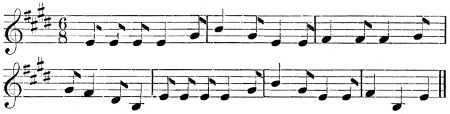
—Leicester (Miss Ellis).
[Play]
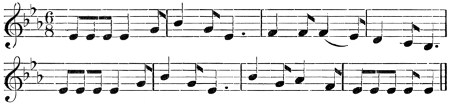
—Monton, Lancashire (Miss Dendy).
I.
Silly old man, he’s all alone, He wants a wife and can’t get one; Round and round and choose a good one, Or else choose none. This young couple are married together, Their fathers and mothers they must obey; Love one another like sister and brother, And down on their knees and kiss one another.
—Leicester (Miss Ellis).
II.
Silly old man, he walks alone, He walks alone, he walks alone; Silly old man, he walks alone, He wants a wife and can’t get one. All go round and choose your own, Choose your own, choose your own; All go round and choose your own, And choose a good one or else choose none. Now young couple you’re married together, Married together, married together; Now young couple you’re married together, Your father and mother you must obey. So love one another like sister and brother, And now young couple pray kiss together.
—Lancashire (Notes and Queries, 5th series, iv. 157).
III.
Silly old maid (or man), she walks alone, She walks alone, she walks alone; Silly old maid, she walks alone, She wants a man (or wife) and she can’t get one. Go around and choose your own, Choose your own, choose your own; Go around and choose your own, And take whoever you like in. Now these two are married together, Married together, married together; Now these two are married together, I pray love, kiss again.
—Isle of Man (A. W. Moore).
IV.
Here’s a silly ould man that lies all alone, That lies all alone, that lies all alone; Here’s a silly ould man that lies all alone, He wants a wife and he can get none. Now young couple you’re married together, You’re married together, you’re married together; You must obey your father and mother, And love one another like sister and brother. I pray, young couple, you’ll kiss together.
—Carleton’s Traits and Stories of the Irish Peasantry, p. 107.
V.
Silly old man, he walks alone, Walks alone, walks alone; Silly old man, he walks alone, Wants a wife and he canna get one. All go round and choose your own, Choose your own, choose your own; All go round and choose your own, Choose a good one or let it alone. Now he’s got married and tied to a peg, Tied to a peg, tied to a peg; Now he’s got married and tied to a peg, Married a wife with a wooden leg.
—Monton, Lancashire (Miss Dendy).
VI.
Silly old maid, she lives alone, She lives alone, she lives alone; [Silly old maid, she lives alone,] Wants a husband but can’t get one. So now go round and choose your own, Choose your own, choose your own; Now go round and choose your own, Choose the very one you love best. Now young couple, you’re married for ever, Your father and mother you must obey; Love another like sister and brother, And now young couple, pray kiss together.
—Dublin (Mrs. Lincoln).
(c) The children form a ring, joining hands. A child, usually a boy, stands in the middle. The ring dances round and sings the verses. The boy in the centre chooses a girl when bidden by the ring. These two then stand in the centre and kiss each other at the command. The boy then takes a place in the ring, and the girl remains in the centre and chooses a boy in her turn. In the Dublin and Isle of Man versions a girl is first in the centre; in the Manx version (A. W. Moore) the two children hold hands when in the centre.
(d) In the Traits and Stories of the Irish Peasantry, Mr. Carleton gives this game as one of those played by young people of both sexes at funeral wakes. It is played in the same way as the game now is; boys and girls stand alternately in a ring holding hands, choosing each other in turn, and kissing. The other versions do not differ materially from each other, except that the Lancashire version described by Miss Dendy has evidently been corrupted quite lately, because a purer form is quoted from the same county in Notes and Queries. The game seems to be one of the group of marriage games arising from the fact that at any gathering of people for the purpose of a ceremonial, whether a funeral or a festival, it was the custom to form matrimonial alliances. The words are used for kiss-in-the-ring games, and also in some marriage games when the last player is left without a partner.
Skin the Goatie
One boy takes his stand in an upright position at a wall. Another boy stoops with his head in the breast of the one standing upright. A third boy jumps stride-leg on his back, and tries to “crown,” i.e., put his hand on the head of the boy at the wall. The boy on whose back he is tries every means by shifting from side to side, and by throwing up his back, to prevent him from doing so, and to cast him off. If he succeeds in doing so, he takes his stand behind the stooping boy in the same position. Another boy then tries to do the same thing over the two stooping boys. If he succeeds in crowning the standing boy, he takes his station at the wall. If not, he takes his stand behind the two stooping boys. The game goes on till a boy “crowns” the one standing at the wall.—Banchory (Rev. W. Gregor).
See “Saddle the Nag.”
Skipping
Strutt says (Sports, p. 383), “This amusement is probably very ancient. Boys often contend for superiority of skill in this game, and he who passes the rope about most times without interruption is the conqueror. In the hop season a hop-stem, stripped of its leaves, is used instead of a rope, and, in my opinion, it is preferable.” On Good Friday on Brighton beach the fisher folk used to play at skipping, six to ten grown-up people skipping at one rope.
Apart from the ordinary, and probably later way of playing, by one child holding a rope in both hands, turning it over the head, and either stepping over it while running, or standing still and jumping until the feet catch the rope and a trip is made, skipping appears to be performed in two ways, jumping or stepping across with (1) more or less complicated movements of the rope and feet, and (2) the ordinary jumping over a turned rope while chanting rhymes, for the purpose of deciding whether the players are to be married or single, occupation of future husband, &c.
Of the first class of game there are the following variants:—
“Pepper, salt, mustard, cider, vinegar.”—Two girls turn the rope slowly at first, repeating the above words, then they turn it as quickly as possible until the skipper is tired out, or trips.
“Rock the Cradle.”—In this the holders of the rope do not throw it completely over, but swing it from side to side with an even motion like the swinging of the pendulum of a clock.
“Chase the Fox.”—One girl is chosen as a leader, or fox. The first runs through the rope, as it is turned towards her, without skipping; the others all follow her; then she runs through from the other side as the rope is turned from her, and the others follow. Then she runs in and jumps or skips once, and the others follow suit; then she skips twice and runs out, then three times, the others all following in turn until one trips or fails. The first one to do this takes the place of one of the turners, the turner taking her place as one of the skippers.
“Visiting.”—One girl turns the rope over herself, and another jumps in and faces her, while skipping in time with the girl she visits. She then runs out again without stopping the rope, and another girl runs in.
“Begging.”—Two girls turn, and two others run and skip together side by side. While still skipping they change places; one says, as she passes, “Give me some bread and butter;” the other answering, “Try my next door neighbour.” This is continued until one trips.
“Winding the Clock.”—Two turn the rope, and the skipper counts one, two, three, up to twelve, turning round each time she jumps or skips.
“Baking Bread.”—Two girls turn, and another runs in with a stone in her hand, which she puts down on the ground, and picks up again while skipping.
“The Ladder.”—The girls run in to skip, first on one foot and then the other, with a stepping motion.
Two other games are as follows:—(1.) Two ropes are used, and a girl holds either end in each hand, turning them alternately; the skipper has to jump or skip over each in turn. When the rope is turned inwards, it is called “double dutch,” when turned outwards, “French dutch.” (2.) The skipper has a short rope which she turns over herself, while two other girls turn a longer rope over her head.
The second class of games consists of those cases where the skipping is accompanied by rhymes, and is used for the purpose of foretelling the future destiny of the skipper. These rhymes are as follows (all collected by Miss Chase):—
Ipsey, Pipsey, tell me true Who shall I be married to? A, B, C, &c.
Letters—initial of one to whom you’ll be married.—Hurstmonceux, Sussex.
Half pound tuppeny rice, Half a pound of treacle, Penny ’orth of spice To make it nice, Pop goes the weazle.
—Crockham Hill, Kent.
When I was young and able, I sat upon the table; The table broke, And gave me a poke, When I was young and able.
[The children now add that when singing
Pass the baker,[8] Cook the tater,
is the full couplet.]—Deptford.
Every morning at eight o’clock, You all may hear the postman’s knock. 1, 2, 3, 4. There goes “Polly.”
Girl named running out, and another girl running in directly.—Marylebone.
Up and down the ladder wall, Ha’penny loaf to feed us all; A bit for you, and a bit for me, And a bit for Punch and Judy.
—Paddington Green.
As they run thus, each calls in turn, “Red, yellow, blue, white.” Where you are tripped, the colour stopped on marks that of your wedding gown.—Deptford.
Each of the two girls turning the rope takes a colour, and as the line of children run through, they guess by shouting, “Red?” “Green?” When wrong nothing happens; they take the place of turner, however, if they hit upon her colour. Another way is to call it “Sweet stuff shop,” or “green grocers,” and guess various candies and fruits until they choose right.—Deptford.
When several girls start running in to skip, they say,
“All in, a bottle of gin,”
and as they leave at a dash, they cry—
“All out, a bottle of stout.”
While “in” jumping, the turners time the skippers’ movements by a sing song.
Up and down the city wall, Ha’penny loaf to feed us all; I buy milk, you buy flour, You shall have pepper in half an hour.
—Deptford.
At pepper turn swiftly.
Up and down the ladder wall, Penny loaf to feed us all; A bit for you, and a bit for me, And a bit for all the familee.
—Marylebone.
Up and down the city wall, In and out “The Eagle,” That’s the way the money goes, Pop goes the weazel.
—From “A London Maid.”
Dancing Dolly had no sense, For to fiddle for eighteenpence; All the tunes that she could play, Were “Sally get out of the donkey’s way.”
—Deptford.
My mother said That the rope must go Over my head.
—Deptford.
Andy Pandy, Sugardy candy, French almond Rock.
—Deptford.
B-L-E-S-S-I-N-G. Roses red, roses white, Roses in my garden; I would not part With my sweetheart For tuppence hapenny farthing.
A, B, C, &c., to X, Y, Z.—Deptford.
Knife and fork, Lay the cloth,[9] Don’t forget the salt, Mustard, vinegar, Pepper!
—Deptford.
They sometimes make a girl skip back and forth the long way of the rope, using this dialogue—
Girl skipping.—“Father, give me the key.”
Father.—“Go to your mother.”
Girl jumping in opposite direction.—“Mother, give me the key.”
Mother.—“Go to your father.”
Lady, lady, drop your handkerchief, Lady, lady, pick it up.
Suiting action to the words, still skipping.
Rhyme to time the jumps—
Cups and saucers, Plates and dishes, My old man wears Calico breeches.
Skyte the Bob
This game might be played by two, three, or more. A small stone of a squarish form, called the “bob,” was placed on a level piece of ground. On this stone each player placed an old button, for buttons were the stakes. A point was fixed several yards from the stone, and a line was drawn. Along this line, “the stance,” the players took their stand, each holding in his hand a small flat stone named “the pitcher.” This stone was thrown so as to strike “the bob” and make the buttons fall on “the pitcher,” or nearer it than “the bob.” The button or buttons that lay nearer “the pitcher” than “the bob” fell to the lot of the player. The second player did the same, but he had to guard against driving any of the buttons nearer the first player’s stone. If a button was nearer his stone than “the bob,” or the first player’s stone, he claimed it. The third player followed the same course if all the buttons had not been won by the two players. If the buttons were not all won at the first throw, the first player had a second chance, and so on till all the buttons were won. If two played, if each won a button, they alternately began, but if one gained the two buttons, the other began. When three played, if one had two for his share he played last in the following game, and the one that had nothing played first. If the players, when three played, were experts, the one whose lot it was to play second, who was called the “poust,” lost heavily, and to be “pousted” was always looked upon as a misfortune, for the reason that the first player often by the first throw gained the whole stake, and then in the following game the last player became the first, and the gainer in the foregoing game became the last. If this player carried off the whole stake, he in the next game took the last place, and the last took the first, and so between the two good players the “poust” had no chance.—Aberdeenshire (Rev. W. Gregor).—See “Buttons.”
Smuggle the Gig
Mr. Ballantyne describes the game as played in his young days at Biggar as follows:—Two boys would each select his own side. “First pick” was decided by lot. A third boy took two straws, one shorter than the other, and held them between his finger and thumb in such a way that only equal lengths were visible. Each leader drew a straw. The one who drew the longest had “first pick” of all the intended players, the other leader had the next; alternate choice was then made by them until both sides were complete, and were ranged by their leaders. Then lots were again drawn as to which side should go out first. The side going out had to show the Gig; anything easily carried in the hand sufficed. The “outs” went out from the den twenty or thirty yards, sometimes round the end of a house, to “smuggle the Gig”—that is, to give one of their number the Gig to carry, care being taken that the “ins” did not know who had it. During this time the leader of the ins called “out” in a loud voice—
Zimerie, twaerie, hickeri seeven, Aucherie, daucherie, ten and eleven; Twall ran musha dan Tweedledum, twadledum, twenty-one. Time’s up!
Outs had all to appear by “Ready” when the chase began. Boundary limits were fixed, beyond which outs could not run and ins could not stand, within a fixed distance of the den. This den was a place marked by a mark or rut in the ground, about four feet by six feet. The outs endeavoured (particularly the one carrying the Gig) to get into the den before any one could catch and “crown” him. The pursued, when caught, was held by the pursuer, his cap taken off, and the palm of the hand was placed on the crown of his head. As he did so the pursuer would say, “Deliver up the Gig.” If he had it not, the pursuer went off after another player. If he had the Gig, and succeeded in getting into the den without being “crowned,” outs won the game; but if the Gig was caught and “crowned,” ins won.
At Fraserburgh the players are divided equally. A spot is marked off, called the Nestie. Any small object known to all is chosen as the Gig. One half of the players receive the Gig and retire, so as not to be seen distinctly by the other half that remains in and near the Nestie. The Gig is concealed on the person of one of the players that retire. When everything is ready those having the Gig move towards the Nestie, and those in the Nestie come to meet them. The aim is to catch the player who has the Gig before reaching the Nestie. If this is done the same players again hide the Gig, but if the Gig is discovered, the players discovering it now hide it.
At Old Aberdeen sides are chosen, then a small article (such as a knife) is made the gig. Then one side, determined by a toss, goes out and smuggles the gig and cries out, “Smuggle the gig.” Then the other side rushes in and tries to catch the one that has the “gig.” If the one that has the gig is free, the same side goes out again.—Rev. W. Gregor.
See “Gegg.”
Snail Creep
In Mid-Cornwall, in the second week of June, at St. Roche, and in one or two adjacent parishes, a curious dance is performed at their annual “feasts.” It enjoys the rather undignified name of “Snail Creep,” but would be more properly called the “Serpent’s Coil.” The following is scarcely a perfect description of it:—“The young people being all assembled in a large meadow, the village band strikes up a simple but lively air and marches forward, followed by the whole assemblage, leading hand-in-hand (or more closely linked in case of engaged couples), the whole keeping time to the tune with a lively step. The band, or head of the serpent, keeps marching in an ever-narrowing circle, whilst its train of dancing followers becomes coiled around it in circle after circle. It is now that the most interesting part of the dance commences, for the band, taking a sharp turn about, begins to retrace the circle, still followed as before, and a number of young men, with long leafy branches in their hands as standards, direct this counter movement with almost military precision.”—W. C. Wade (Western Antiquary, April 1881).
A game similar to the above dance is often played by Sunday school children in West Cornwall, at their out-of-door summer treats, called by them “Roll tobacco.” They join hands in one long line, the taller children at their head. The first child stands still, whilst the others in ever-narrowing circles dance around singing until they are coiled into a tight mass. The outer coil then wheels sharply in a contrary direction, followed by the remainder, retracing their steps.—Courtney’s Cornish Feasts and Folk-lore, p. 39. A Scottish game, “Row Chow Tobacco,” described by Jamieson, is played in the same way, the boy at the extremity being called the “Pin.” A clamorous noise succeeds the “winding up,” the players crying out “Row Chow Tobacco” while giving and receiving the fraternal hug. The words are pronounced Rowity-chowity-bacco. The naming of this game in connection with tobacco is curious. It is undoubtedly the same as “Snail Creep.” I am inclined to think that all these games are connected with an ancient form of Tree-worship, and that the analogy of tobacco-rolling is quite modern.
See “Bulliheisle,” “Eller Tree,” “Tuilyie-waps,” “Wind up the Bush Faggot.”
Snapping Tongs
See “Musical Chairs.”
Snatch Apple
A game similar to “Bob Cherry,” but played with an apple.—Halliwell’s Dictionary.
Snatch Hood
An undescribed boy’s game mentioned in a statute of Edward III.’s time.—Halliwell’s Dictionary.
Soldier
I am an old soldier, I come from the war, Come from the war; I am an old soldier, I come from the war, And my age it is sixty-and-three. I have but one son and he lies alone, lies alone, I have but one son and he lies alone; And he’s still making moan for lying alone. Son, go choose a wife of your own, Choose a good one or else choose none, Or bring none home to me. Now they’re got married, they’re bound to obey, Bound to obey in every degree; And as you go round kiss all but me.
—Belfast, Ireland (W. H. Patterson).
The players form a ring and sing the first three verses. Then one of the players chooses a girl from the ring. The first three verses are again sung until the whole ring is arranged in couples; then the first couple kneels in the middle, and the rest dance round them singing the marriage formula; then the second couple, and so on, each couple kissing.
Solomon
The players knelt in a line; the one at the head, in a very solemn tone, chaunted, “Solomon had a great dog;” the others answered in the same way, “Just so” (this was always the refrain). Then the first speaker made two or three more ridiculous speeches, ending with, “And at last this great dog died, and fell down,” giving at the same time a violent lurch against his next neighbour, who, not expecting it, fell against his, and so on, to the end of the line.—Cornwall (Folk-lore Journal, v. 50).
See “Obadiah,” “Quaker’s Wedding.”
Sort’em-billyort’em
A Lancashire game, very similar to “Hot Peas and Bacon.”—Halliwell’s Dictionary.
Sow-in-the-Kirk
A large hole is made in the ground, surrounded by smaller ones, according to the number of the players, every one of whom has a shintie, or hooked stick. The middle hole is called the kirk. He who takes the lead in the game is called the sow-driver. His object is to drive a small piece of wood or bone, called the sow, into the large hole or kirk; while that of his opponents, every one of whom keeps his shintie in one of the smaller holes, is to frustrate his exertions by driving back the sow. If he succeeds, either in knocking it into one of the small holes, while one of his antagonists is in the act of striking it back, he is released from the drudgery of being driver. In the latter case, the person whose vacancy he has occupied takes the servile station which he formerly held.—Lothian (Jamieson). This is said to be the same game with “Church and Mice” in Fife. Jamieson’s description is not very lucid. It appears that each player must hold his shintie with its end in his hole, and it is only when he takes it out to prevent the sow-driver getting his sow into or towards the kirk, that the sow-driver has the chance of putting the sow into the player’s hole, and so causing that player to take the place of sow-driver.
See “Kirk the Gussie.”
Span Counter
A common game among boys. “You shall finde me playing at Span Counter.”—Dekker’s Northward Hoe. Toone, Etymological Dictionary, mentions this as a juvenile game played with counters.
Boys shall not play At span counter or blow pipe.
—Donne (Satire iv.).
Dr. Grosart, in noting this passage, says, “I rather think the game is still played by boys when they directly, or by rebound, endeavour to play their button or marble into a hole.” Strutt briefly notes the game as being similar to “Boss Out.”—Sports, p. 384. Halliwell (Dictionary) simply gives the quotation from Donne’s Poems, p. 131, mentioning the game.
See “Boss Out.”
Spang and Purley
A mode resorted to by boys of measuring distances, particularly at the game of marbles. It means a space and something more.—Brockett’s North Country Words.
Spangie
A game played by boys with marbles or halfpence. A marble or halfpenny is struck against the wall. If the second player can bring his so near that of his antagonist as to include both within a span, he claims both as his.—Jamieson.
This is the same game as “Banger,” “Boss Out.” Probably the Old English game of “Span Counter,” or “Span Farthing,” was originally the same.—See Johnson’s Dictionary.
Spannims
A game at marbles played in the eastern parts of England.—Halliwell’s Dictionary.
Spawnie
The same game as “Spangie.”—Keith (Rev. W. Gregor).
Spinny-Wye
The name of a game among children at Newcastle-upon-Tyne. I suspect this is nearly the same with “Hide and Seek.” “I spye” is the usual exclamation at a childish game called “Hie, spy, hie.”—Brand, ii. 442.
Splints
A game at marbles, in which they are dropped from the hand in heaps.—Easther’s Almondbury Glossary.
Spurn point
An old game (undescribed) mentioned in the play Apollo Shroving, London, 1627, p. 49.
Spy-arm
A game of Hide-and-Seek, with this difference, that when those are found who are hid the finder cries Spy-arm; and if the one discovered can catch the discoverer, he has a ride upon his back to the dools.—Mactaggart’s Gallovidian Encyclopædia.
See “Hide and Seek” (1).
Stacks
A stack in the centre of the stackyard was selected, and round a part of one side a rut was marked in the earth usually by the toe-bit of the ploughman’s boot. This enclosure, not over four feet wide at the broadest part, was called the den. One of the players, selected to be the catcher, stood within this den, and when all the players were ready turned his face to the stack, and counted out loud the numerals from one to twenty, the last with a great shout. During the count the players ran round the stacks out of sight, but no hiding nor leaving the stackyard, this was “not fair.” When twenty was heard one would shout back “Ready!” Then out came the catcher. He was not permitted to stand in or near the den, but went out among the stacks and caught as many players as he could before they reached the den. The great aim of those “out” was to get into the den unseen and untouched. If all the players got in, then the catcher had to try again; but when all were caught (which was seldom or never), the last one caught was catcher for the next game. When one player was touched by the catcher he or she had to remain in the den till the rest were all in.—Biggar (Wm. Ballantyne).
Mr. Ballantyne says, “This game usually ended in a promiscuous ‘catching’ and ‘touching’ game, each lad trying to catch the lass he liked best, and some lads, for the fun of the thing, would try and get a particular girl first, her wishes and will not being considered in the matter; and it seemed to be an unwritten law among them for the lass to ‘gang wi’ the lad that catched her first,’ yet I have known lassies take this opportunity to favour the lad they preferred. It was the correct thing for the people to visit each other’s farms in rotation to play ‘the stacks.’” This game was played when all the crops of grain were in the stackyard under thack and rape (?nape). Then it was customary for the servant lads and lasses of neighbours’ “ferm toons” to gather together and play at this game. Mr. Ballantyne considers it was the third of three festivals formerly held at the ingathering of the crops.
See “Barley Break.”
Stag
A boys’ game. One boy issues forth and tries to “tig” another, previously saying this nominy, or the first two lines—
Stag, stag arony, Ma’ dog’s bony, Them ’at Aw catch ’Ill ha’ to go wi’ me.
When one boy is tigged (or “tug”) the two issue forth hand in hand, and when more, all hand in hand. The other players have the privilege of breaking the chain, and if they succeed the parties forming it are liable to be ridden back to the den. At Lepton, where the game was publicly played, the boundaries were “Billy tour end, Penny Haas end, and I’ Horsin step.” So played in 1810, and is still.—Easther’s Almondbury Glossary.
In the Sheffield district it is called “Rag Stag,” and is usually played in the playground, or yard, attached to a school. Any number can play. A place is chalked out in a corner or angle formed by the walls or hedges surrounding the playground. This is called the den, and a boy stands within the den. Sometimes the den is formed by chalking an area out upon a footpath, as in the game of “Bedlams.” The boy in the den walks or runs out, crying, “Rag-stag, jinny I over, catching,” and having said this he attempts to catch one of the boys in the playground who have agreed to play the game. Having caught him he takes him back into the den. When they have got into the den they run out hand-in-hand, one of them crying, “Rag-stag, jinny I over, touching,” whilst the other immediately afterwards calls out, “Rag-stag, jinny I over, catching.” They must keep hold of each other’s hands, and whilst doing so the one who cried out “Touching” attempts to touch one of the boys in the playground, whilst the one who cried “Catching” attempts to catch one of such boys. If a boy is caught or touched, the two boys who came out of the den, together with their prisoner, run back as quickly as possible into the den, with their hands separated. If whilst they are running back into the den any boy in the playground can catch any one of the three who are running back, he jumps on his back and rides as far as the den, but he must take care not to ride too far, for when the boys who are already caught enter the den they can seize their riders, and pull them into the den. In this case the riders too are caught. The process is repeated until all are caught.—Addy’s Sheffield Glossary.
Another name for the game is “Stag-out.” One player is Stag, and has a place marked out for his bounds. He stands inside, and then rushes out with his hands clasped together, and endeavours to touch one of the other players, which being accomplished, he has the privilege of riding on the boy’s back to his bounds again.—Book of Sports. In a London version the hands were held above the head, and joined by interlacing the thumbs, the fingers being outspread, the boy had to touch another while in this position.
In Shropshire it is called “Stag-warning.” One boy is chosen Stag; he runs about the playground with his clasped hands held palms together in front of him, trying to tick (= touch) others. Each whom he touches joins hands with him, and they run together in an ever-lengthening chain, sweeping the playground from end to end, the boys at each end of the chain “ticking” others with their disengaged hands, till all are caught but one, who becomes the next “Stag.” The Stag gives notice of his start by exclaiming—
Stag-warning, stag-warning, Come out to-morrow morning!
—Shrewsbury.
Stag a-rag a-rorning Very frosty morning! What I cannot catch to-night I’ll catch to-morrow morning!
—Chirbury (Burne’s Shropshire Folk-lore, p. 523).
The game is mentioned by Mr. Patterson in his Antrim and Down Glossary. Northall’s English Folk Rhymes, p. 392, gives a Warwickshire and Staffordshire version, in which the first player “ticked” or “tagged” becomes Stag when the first game is concluded, all having been caught. The words used are—