Volume 1 — CHILDREN’S GAMES (continued 7)
Reading edition
The ploughman says to the one in the wadd, “Whether will ye hae three questions and two commands, or three commands and two questions to answer, or gang on wi’, sae that ye may win out o’ the wadd?” For the one so fixed has always the choice which of these to take. Suppose he takes the first, two commands and three questions, then a specimen of these may be—“I command ye to kiss the crook,” says the ploughman, which must be completely obeyed by the one in the wadd; his naked lips must kiss the sooty implement. Secondly, says the ploughman, I command ye to stand up in that neuk and say—
“Here stan’ I, as stiff’s a stake, Wha ’ill kiss me for pity’s sake?”
which must also be done; in a corner of the house must he stand and repeat this couplet, until some tender-hearted lass relieves him. Then the questions are asked, such as—“Suppose you were in a bed with Maggie Lowden and Jennie Logan, your twa great sweethearts, what ane o’m wad ye ding owre the bedside, and what ane wad ye turn to and clap and cuddle?” He has to choose one, perhaps to the great mirth of the company. Secondly, “Suppose ye were stannin’ stark naked on the tap o’ Cairnhattie, whether wad ye cry on Peggie Kirtle or Nell o’ Killimingie to come wi’ your claise?” He has again to choose. Lastly, “Suppose ye were in a boat wi’ Tibbie Tait, Mary Kairnie, Sally Snadrap, and Kate o’ Minnieive, and it was to coup wi’ ye, what ane o’ ’em wad ye sink? what ane wad ye soom? wha wad ye bring to lan’? and wha wad ye marry?” Then he has again to choose between the girls named.
Chambers gives the following versions of the “Wadds”:—
The wadds was played by a group seated round the hearth fire, the lasses being on one side and the lads on the other. The questions are asked and answers given alternately. A lad first chants—
O it’s hame, and it’s hame, and it’s hame, hame, hame, I think this night I maun gae hame.
One of the opposite party then says—
Ye had better light, and bide a’ night, And I’ll choose you a bonny ane. O wha will ye choose, an’ I wi’ you abide? The fairest and rarest in a’ the country side.
At the same time presenting an unmarried female by name. If the choice give satisfaction—
I’ll set her up on the bonny pear-tree; It’s straught and tall, and sae is she; I wad wake a’ night her love to be.
If the choice do not give satisfaction, from the age of the party—
I’ll set her up i’ the bank dike; She’ll be rotten ere I be ripe; The corbies her auld banes wadna pike.
If from supposed want of temper—
I’ll set her up on the high crab-tree; It’s sour and dour, and sae is she; She may gang to the mools unkissed by me.
A civil mode of declining is to say—
She’s for another, and no for me; I thank you for your courtesie.
The same ritual is gone through with respect to one of the other sex; in which case such rhymes as the following are used:—
I’ll put him on a riddle, and blaw him owre the sea, Wha’ll buy [Johnie Paterson] for me? I’ll put him on my big lum head, And blaw him up wi’ pouther and lead.
Or, when the proposed party is agreeable—
I’ll set him on my table head, And feed him up wi’ milk and bread.
A refusal must be atoned for by a wadd or forfeit. A piece of money, a knife, or any little thing which the owner prizes, will serve. When a sufficient number of persons have made forfeits, the business of redeeming them is commenced, and generally it is then that the amusement is greatest. The duty of kissing some person, or some part of the room, is usually assigned as a means of redeeming one’s wadds. Often for this purpose a lad has to kiss the very lips he formerly rejected; or, it may be, he has to kneel to the prettiest, bow to the wittiest, and kiss the one he loves best before the forfeit is redeemed.—The substance of the above is from a note in Cromek’s Remains of Nithsdale and Galloway Song, p. 114, who says—In this game formerly young men and women arranged themselves on each side of the fire, and alternately bestowed husbands and wives on each other. Carleton’s Traits and Stories of the Irish Peasantry, p. 106, also describes the game without any material difference.
Another form of this game, practised in Dumfriesshire in the last century, and perhaps still, was more common. The party are first fitted each with some ridiculous name, not very easy to be remembered, such as Swatter-in-the-Sweet-Milk, Butter-Milk-and-Brose, the Gray Gled o’ Glenwhargan Craig, &c. Then all being seated, one comes up, repeating the following rhymes—
I never stealt Rob’s dog, nor never intend to do, But weel I ken wha stealt him, and dern’d him in a cleugh, And pykit his banes bare, bare, bare eneugh! Wha but —— wha but ——
The object is to burst out suddenly with one of the fictitious names, and thus take the party bearing it by surprise. If the individual mentioned, not immediately recollecting the name he bore, failed, on the instant, to say “No me,” by way of denying the accusation respecting the dog, he was subjected to a forfeit; and this equally happened if he cried “No me,” when it was the name of another person which was mentioned. The forfeits were disposed of as in the former case.—Popular Rhymes, pp. 125-126.
It will be seen that the first version of Chambers more nearly resembles “Hey Wullie Wine” (vol. i. p. 207), and that the latter part of the version given by Mactaggart is similar to “Three Flowers” (ante, p. 255, and the first part to “Trades,” p. 305). Mr. W. Ballantyne sent me a version from Biggar as played when he was a boy. It is similar to Mactaggart’s.
This game may indicate an earlier form of playing at forfeits than the “Old Soldier,” “Turn the Trencher,” and kindred English games. Mactaggart does not state that any article belonging to the person who perpetrates the offence was given up and afterwards redeemed by the owner performing a penalty. In Chambers’ versions this is done. It may be that, in Mactaggart’s case, each offending person paid his or her penalty immediately after committing the blunder or offence instead of a leader collecting the forfeits from all offenders first, and then “crying” all together afterwards. Whether the game originated in the practice of “tabu,” or was an outcome of the custom of restitution, or ransom, legally made for the commission of crimes, such as that called wergeld, the penalty or price to be paid to the relatives of a slain man, or of punishment for certain offences then being in the hands of a certain class of people, we cannot now decide; but it was customary for penalties to be attached to the commission of minor offences, and the punishment enforced without appeal to any legally constituted authority. The object of most of the present forfeit games seems to have been to make the offenders ridiculous, or, in the case of the above form of games, to find out the person loved or hated. In Shropshire “Crying the Weds” is the name given to the game of playing at forfeits. Wadd means a pledge. Jamieson says “Wears” signifies the “Wars.” “At the wars” is a common mode still retained of describing the life of a soldier. Ihre supposes that the early term wadd or wed is derived from wadd-cloth, from this kind of merchandise being anciently given and received instead of money; when at any time a pledge was left, a piece of cloth was used for this purpose, and hence a pledge in general would be called wadd.
In Waldron’s description of the Isle of Man (ante, vol. i. p. 139) is an account of a Twelfth Day custom which throws light on the game as described by Chambers.
See “Forfeits,” “Hey Wullie Wine,” “Three Flowers,” “Trades.”[Addendum]
Wadds and the Wears (2)
Jamieson describes the game differently. He says—The players being equally divided, and a certain space being marked out between them, each lays down one or more wadds, or pledges, at that extremity where the party to which he belongs choose their station. A boundary being fixed, the object is to carry off the wadds from the one of these to the other. The two parties advancing to the boundary seize the first opportunity of crossing it, by making inroads on the territories of the other. If one who crosses the line is seized by the opposite party before he has touched any of their wadds, he is set down beside them as a prisoner, and receives the name of a “stinker;” nor can he be released until one of his own party can touch him without being intercepted by any of the others, in which case he is free. If any one is caught in the act of carrying off a wadd, it is taken from him; but he cannot be detained as a prisoner, in consequence of his having touched it. If he can cross the intermediate line with it, the pursuit is at an end. When one party has carried off to their ground all the wadds of the other the game is finished.
Waggles
A game of tip-cat. Four boys stand at the corners of a large paving-stone; two have sticks, the other two are feeders, and throw the piece of wood called a “cat.” The batters act much in the same way as in cricket, except that the cat must be hit whilst in the air. The batter hits it as far away as possible, and whilst the feeder is fetching it, gets, if possible, a run, which counts to his side. If either of the cats fall to the ground both batters go out, and the feeders take their place. A game called “Whacks” is played in a similar way.—London Streets (F. H. Low, Strand Magazine, Nov. 1891).
See “Tip-cat.”
Wallflowers
[Play]
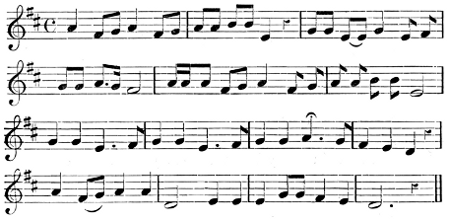
—Nottingham (Miss Youngman).
[Play]
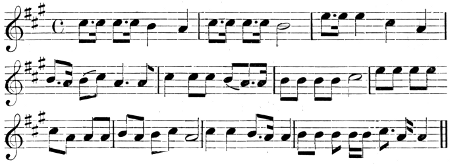
—Connell Ferry, near Oban (Miss Harrison).
[Play]
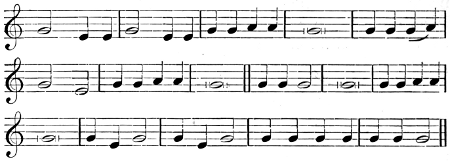
—Beddgelert (Mrs. Williams).
[Play]

—Ogbourne, Wilts. (H. S. May).
[Play]

—Longcot choir girls, Berks. (Miss I. Barclay).
I.
Wallflowers, wallflowers, growing up so high, All of you young ladies are sure to die. Excepting ——, she’s the best of all. She can hop, and she can skip, And she can turn a candlestick. Oh my, fie for shame, turn your face to the wall again.
—Fernham and Longcot (Miss I. Barclay).
II.
Wallflowers, wallflowers, Growing up so high, All you young ladies Are meant to die. Excepting little ——, She is the best of all. She can skip, and she can dance, She can turn the candlestick. O my, fie for shame, Turn your back to the wall again.
—From London maidservant (Miss E. Chase).
III.
Willy, willy wallflower, Growin’ up so high, We are all maidens, We shall all die. Excepting ——, She’s the youngest daughter, She can hop, She can skip, She can turn the candlestick. Fee, fie, shame, shame, Turn your backs together again:—, ——, your sweetheart is dead, He’s sent you a letter to turn back your head.
—Wakefield, Yorks (Miss Fowler).
IV.
Wallflowers, wallflowers, Growing up so high, We young ladies, we shall die. Except ’tis ——, She’s the youngest daughter. She can hop, and she can skip, She can play the wire, Oh for shame, fie for shame, Turn your back and have a game.
—Hampshire (Miss E. Mendham).
V.
Wally, wally wallflower, Growing up so high— All ye young ladies You must all die. Excepting ——, She’s the best of all— She can hop, and she can skip, She can turn the mangle, Oh my, fie for shame, Turn your back to the wall again.
—Barnes, Surrey (A. B. Gomme).
VI.
Wall flowers, wall flowers, growing up so high, We are all children, and we shall all die. Excepting ——, she’s the youngest child, She can hop, she can skip, She can turn the wedding ring, Fie, fie, fie for shame, Turn your face to the wall again.
—Nottingham (Miss Youngman).
VII.
Wally, wally wall-flower, A-growen up so high, All we children be sure to die. Excepting [naming the youngest] ’Cause she’s the youngest, Oh! fie! for shame! fie! for shame! Turn your back to the wall again.
—Symondsbury, Dorset (Folk-lore Journal, vii. 215).
VIII.
Wall-flowers, wall-flowers, growing up so high, We are all living, and we shall all die. Except the youngest here [naming her]. Turn your back to overshed. (?)
(This last line is repeated three times.)
—Symondsbury, Dorset (Folk-lore Journal, vii. 215).
IX.
Wall-flowers, wall-flowers, growing up so high! We shall all be maidens, [and so] we shall all die![13] Excepting Alice Gittins, she is the youngest flower, She can hop, and she can skip, and she can play the hour! Three and four, and four and five, Turn your back to the wall-side!
Or,
She can dance and she can sing, She can play on the tambourine! Fie, fie! fie, for shame! Turn your back upon the game!
—Ellesmere, Berrington, Wenlock (Shropshire Folk-lore, p. 513).
X.
Willie, willie wall-flowers, growing up so high! We are all fair maids, we shall all die! Excepting little ——, and she’s the youngest here, Turn your head towards the south, and she’s the one to bear, The willie, willie wallflowers.
Or,
Oh! for shame, fie, for shame, turn yourself to the wall again—
—Sporle, Norfolk (Miss Matthews).
XI.
Wall-flowers, wall-flowers, growing up so high! We are all ladies, we must all die! Excepting ——, who is the prettiest child. Fie, for shame, fie, for shame, turn your back to the wall again.
—Nottinghamshire and Lincolnshire (Miss Winfield)
XII.
Wall-flowers, wall-flowers, growing up so high! We’re all ladies, and we shall all die! Excepting [naming smallest child in ring], She can hop, and she can skip, and she can play the organ! Oh! for shame, fie, for shame, Turn your back upon our game.
—Enbourne School, Berks. (Miss M. Kimber).
XIII.
Wall-flowers, wall-flowers, growing up so high! We are all pretty maidens, we all have to die! Except ——, she’s the youngest girl, Ah! for shame, ah! for shame, Turn your back to us again. I’ll wash you in milk, I’ll dress you in silk, I’ll write down your name, With a gold pen and ink.
—Earls Heaton (Herbert Hardy).
XIV.
Oh flower, oh flower, growing up so high! We are all children, we have all to die! Except ——, she the youngest gay, Oh! for shame, fie, for shame, Turn your back against the wall.
—Beddgelert (Mrs. Williams).
XV.
Wall-flowers, wall-flowers, growing up so high! We are all little, and we’ve got to die! Excepting ——, and she’s the only one, Oh! for shame, fie, for shame, Turn your back to the wall again.
—Cowes, Isle of Wight (Miss E. Smith).
XVI.
Little Molly white-flower, we are all maidens, And we shall all die, except Polly Pegg, She’s the best of all, She can hop, and she can skip, and she can turn the candlestick! Oh! fie, for shame, Turn your back to the wall.
—Hanbury, Staffordshire (Miss Edith Hollis).
XVII.
Wall-flowers, wall-flowers, growing up so high! We are all playmates, we shall all die! Excepting ——, for she’s the youngest flower, Cry shame, cry shame, And turn your face to the wall again.
—Sheffield (S. O. Addy).
XVIII.
Wall-flower, wall-flower, growing up so high! All the pretty maidens shall not die! Excepting ——, she is the youngest child, Oh! for shame, fie, for shame! Turn your back to the wall again.
—Dean, near Salisbury (Mrs. C. Brough).
XIX.
Water, water wall-flower, growing up so high, We are all maidens, we must all die, Except ——, the youngest of us all. She can laugh, and she can dance, and she can play at ball; Fie! fie! fie for shame! turn your face to the wall again.
—Connell Ferry, near Oban (Miss Harrison).
XX.
Water, water wall-flower, growing up so high, We are all maidens, we must all die. Except ——, she’s the youngest of them all; She can dance, she can sing, And she can dance the wedding ring (or “Hieland fling”) Fie! fie! fie for shame! Turn your back to the wall again.
—Galloway (J. G. Carter).
XXI.
Wall-flowers, wall-flowers, Growing up so high; All ye young maidens Are all fit to die. Excepting ——, and she’s the worst of all, She can hop, and she can skip, And she can turn the candlestick. Fye! fie! for shame, Turn your face to the wall again.
—(Suffolk County Folk-lore, p. 67.)
XXII.
Wall-flowers, wall-flowers, growing up so high, All you young ladies will soon have to die; Excepting ——, and she’s the best of all. She can dance, she can skip, she can turn the mangle quick; Hi, ho! fie for shame! turn your back to the wall again.
—Cambridge (Mrs. Haddon).
XXIII.
Wally, wally wall-flower, growing up so high, We are all maidens, and we shall die; All except the youngest one, and that is [child’s name]. Choose for the best, choose for the worst, Choose the one that you love best. Now you’re married, I wish you joy, First a girl and then a boy, Seven years after son and daughter, Now, young couple, kiss together.
—Hersham, Surrey (Folk-lore Record, v. 84).
XXIV.
Wally, wally wall-flowers, Growing up so high; We’re all ladies, We shall all die. Excepting little ——, She’s the only one; She can hop, she can skip, She can play the herald, Fie! fie! fie for shame! Turn your back to the wall again.
—Deptford, Kent (Miss Chase).
XXV.
Water, water wall-flower, Growing up so high; We are all maidens, And we must all die. —— is the youngest, She must kick, And she must fling, And she must turn the sofa; Fie! fie! fie, for shame! Turn your back to the wall again.
XXVI.
Except ——, and she’s the youngest one, She can hop, and she can skip, She can turn the sofa; Oh fie! fie! fie, for shame! Turn your back to the wall again.
—Cullen and Nairn (Rev. W. Gregor).
XXVII.
She can skip, she can dance, She can ding us all o’er.
—Aberdeen (Rev. W. Gregor).
XXVIII.
Green, green grovers, growing up so high, We are all maidens, And we must all die; Except ——, the youngest of us all, She can dance, and she can sing, She can dance the Hieland fling; Fie! fie! fie, for shame! Turn your back to us again.
—Nairn (Rev. W. Gregor).
XXIX.
Water, water, well stones, Growing up so high, We are all maidens, And we must all die. Except ——, She’s the youngest of us all, She can dance, she can sing, She can dance the “Hielan’ Fling,”[14] Oh fie, fie, for shame, Turn your back to us again.
—Dyke (Rev. W. Gregor).
XXX.
Here’s a pot of wall-flowers, Growing up so high; We’re all maidens, and we shall die. Excepting [girl’s name], She can hop, and she can skip, And she can play the organ. Turn your back, you saucy Jack, You tore your mother’s gown.
—Northants (Rev. W. Sweeting).
XXXI.
Wall-flowers, wall-flowers, growin’ up so high, Neither me nor my baby shall ever wish to die, Especially [girl’s name], she’s the prettiest flower. She can dance, and she can sing, and she can tell the hour, With her wee-waw, wy-waw, turn her face to the wall.
—Howth, Dublin (Miss H. E. Harvey).
Or,
Turn your back to all the game.
—Bonmahon, Waterford (Miss H. E. Harvey).
XXXII.
Sally, Sally, wall-flower [or Waters], Springing up so high, We’re all fair maids, And we shall all die. Excepting [girl’s name], She’s the fairest daughter, She can hop, and she can skip, She can turn the organ. Turn your face toward the wall, And tell me who your sweetheart’s called. Mr. Moffit is a very good man, He came to the door with his hat in his hand, He pulled up his cloak, and showed me the ring; To-morrow, to-morrow, the wedding begins. First he bought the frying-pan, Then he bought the cradle, And then one day the baby was born, Rock, rock the cradle.
—Hurstmonceux, Sussex (Miss Chase).
XXXIII.
Water, water, wild flowers, Growing up so high, We are all maidens, And we shall all die, Excepting [Eva Irving], And she’s the youngest of us all, And she can hop, and she can skip, And she can turn the candlestick, [Or “She can play the organ.”] Piper shame! piper shame! Turn your back to the wall again. I pick up a pin, I knock at the door, I ask for ——, She’s neither in, She’s neither out, She’s up the garden skipping about. Down come ——, as white as snow, Soft in her bosom as soft as glow. She pulled off her glove, And showed us her ring, To-morrow, to-morrow, The bells shall ring.
—Ogbourne, Wilts. (H. S. May).
XXXIV.
Water, water, wall-flowers, growing up so high, We are all maidens, and we must all die, Except ——, she’s the only one, She can dance, she can sing, she can play the organ, Fie, fie, fie for shame, turn your face to the wall again. Green grevel, green grevel, the grass is so green, The fairest young lady that ever was seen. O ——, O ——, your true love is dead, He’ll send you a letter to turn back your head.
—Laurieston School, Kirkcudbright (J. Lawson).
XXXV.
[Mary Kelly’s] stole away, stole away, stole away, [Mary Kelly’s] stole away, And lost her lily-white flowers. It’s well seen by her pale face, her pale face, her pale face, It’s well seen by her pale face, She may turn her face to the wall.
—Belfast (W. H. Patterson).
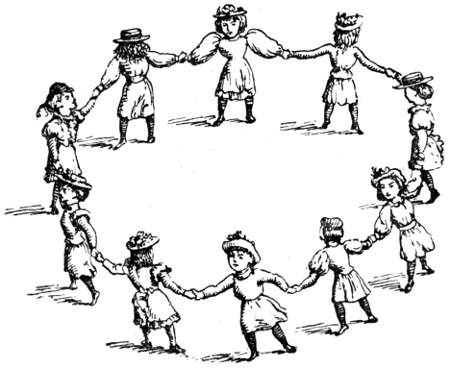
(c) The children form a ring by joining hands. They all dance slowly round, singing the words. When the one child is named by the ring she turns round, so that her face is turned to the outside of the ring and her back inside. She still clasps hands with those on either side of her, and dances or walks round with them. This is continued until all the players have turned and are facing outwards.
This concludes the game in many places, but in others the game is continued by altering the last line of the verses, and the children alternately turning round when named until they all face inside again. In some of the versions the first child to turn her face to the wall is the youngest, and it is then continued by the next youngest, until the eldest is named. This obtains in Hampshire (Miss Mendham), Nottingham, Symondsbury, Shropshire, Beddgelert, Sheffield, Connell Ferry, Oban, Hersham, Surrey, Dyke. In the London (Miss Chase) and Sheffield versions the child named leaves the ring and turns with her face to a wall. In the Wakefield version Miss Fowler says a child stands in the middle, and at the fifth line all the children say their own name. At the end of the verse they all unclasp hands, and turn with their faces outside the circle; the verse is repeated, when they all turn again facing inwards, and so on over again. In the Nairn version, after all the players have turned their faces outside the ring, they all throw their arms over their heads, and turn so as to face inwards if possible without disjoining hands. The children at Ogbourne, Wilts, clap hands when singing the last two lines of the verses. At Enbourne School it is the tallest child who is first named, and who turns her back; presumably the next tallest is then chosen. In the Suffolk game one child stands outside the ring; the ring sings the first four lines, and the child outside sings the rest. At Wenlock Miss Burne says each child is summoned in turn by name to turn their heads when the last line is said. At Hurstmonceux a girl chooses a boy after her face is turned to the wall.
(d) The most interesting point about this game is that it appears to refer to a custom or observance which particularly concerns young girls. We cannot say what the custom or observance was originally, but the words point to something in which a young maiden played the principal part. “We are all maidens” and “she’s the youngest here” runs through most of the versions. A death seems to be indicated, and it may be that this game was originally one where the death of the betrothed of the youngest maiden was announced. This would account for the “turning the face to the wall,” which is indicative of mourning and great sorrow and loss. The mention of the girl’s accomplishments may mean that being so young and accomplished she would quickly get another suitor, and this might also account for the “fie for shame!”—shame to be thinking of another lover so soon; or, on the other hand, the other maidens may regret that by the loss of her lover and betrothed this young maiden’s talents will be lost in “old maidenhood,” as she will not now be married, and this will be “a shame.” She will be, in fact, “on the shelf” or “out of sight” for the rest of her life, and through no fault of her own. The “we are all maidens” might refer to the old custom of maidens carrying the corpse of one of their number to the grave, and the words may have originally been the lament over her death.
With reference to the words “turn the candlestick,” which occurs in six versions, “M. H. P.,” in Notes and Queries (7th ser., xi. 256), says: “Turning the Candlestick.—A candlestick in the game of ’See-saw’ is the Yorkshire name for the child who stands in the centre of the plank, and assists the motion by swaying from side to side.” Toone (Etymological Dictionary) says—Before the introduction of the modern candlestick, the custom was to have the candle held by a person appointed for that purpose, called a candle-holder, and hence the term became proverbial to signify an idle spectator.
“I’ll be a candle-holder and look on.”—Romeo and Juliet.
“A candle-holder sees most of the game.”—Ray’s Proverbs.
If this should be the meaning of the phrase in these rhymes, “she can turn the candlestick” may have originally meant that now this maiden can be nothing but a “looker on” or “candle-holder” in the world. The meaning has evidently been forgotten for a long time, as other expressions, such as “she can turn the organ,” have had to be adopted to “make sense” of the words.
Aubrey (Remaines of Judaisme, p. 45) mentions the sport called “Dancing the Candlerush,” played by young girls; in Oxford called “Leap Candle,” which consisted of placing a candle in the middle of the room and “dancing over the candle back and forth” saying a rhyme. This may be the “dance” referred to in the rhymes.
The tune of most versions is the same. It is pretty and plaintive, and accords with the idea of mourning and grief. The Rev. W. D. Sweeting says the tune in Northants seems to be lost. The game is sung to a sort of monotone.
Northall gives a version from Warwickshire similar to several given here, and Mr. Newell (Games and Songs of American Children) gives a version and tune which is similar to that of Hurstmonceux, Surrey.
See “Green Grass.”
Warney
I’m the wee mouse in the hole in the wa’, I’m come out to catch you a’.
One of the players starts with clasped hands to catch another. When this is done they join hands—each one, on being caught, going into the number to form a chain. If the chain breaks no one can be caught.—Laurieston School, Kirkcudbright (J. Lawson).
See “Stag,” “Whiddy.”
Way-Zaltin
A sort of horse-game, in which two boys stand back to back with their arms interlaced; each then alternately bends forward, and so raises the other on his back with his legs in the air. This term, too, is sometimes used for see-sawing.—Elworthy’s West Somerset Words. Barnes (Dorset Glossary) calls this game “Wayzalt.” Holloway (Dict. Prov.) says, in Hants the game is called “Weighing.”
See “Weigh the Butter.”
We are the Rovers
[Play]
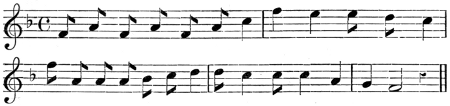
—Bath (A. B. Gomme).
[Play]
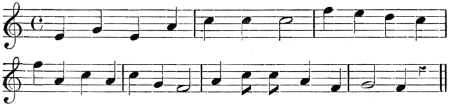
—Hanbury, Staffs. (Miss Edith Hollis).
[Play]
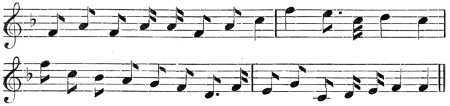
—Wrotham, Kent (Miss D. Kimball).
I.
We are coming to take your land, We are the rovers! We are coming to take your land, [Though you] are the guardian soldiers! We don’t care for your men nor you, [Though you] are the rovers! We don’t care for your men nor you, For we are the guardian soldiers! We will send our dogs to bite, We are the rovers! We will send our dogs to bite, Though you are the guardian soldiers! We don’t care for your dogs nor you, Though you’re the rovers! We don’t care for your dogs nor you, For we are the guardian soldiers! Will you have a glass of wine? We are the rovers! Will you have a glass of wine? For respect of guardian soldiers! A glass of wine won’t serve us all, Though you’re the rovers! A glass of wine won’t serve us all, For we are the guardian soldiers! Will a barrel of beer then serve you all? We are the rovers! Will a barrel of beer then serve you all? As you are the guardian soldiers! A barrel of beer won’t serve us all, Though you’re the rovers! A barrel of beer won’t serve us all, For we’re gallant guardian soldiers! We will send our blue-coat men, We are the rovers! We will send our blue-coat men, Though you are the guardian soldiers! We don’t fear your blue-coat men, Though you’re the rovers! We don’t fear your blue-coat men, For we are the guardian soldiers! We will send our red-coat men, We are the rovers! We will send our red-coat men, Though you are the guardian soldiers! We don’t mind your red-coat men, Though you’re the rovers! We don’t mind your red-coat men, For we are the guardian soldiers! Are you ready for a fight? We are the rovers! Are you ready for a fight? Though you are the guardian soldiers! Yes, we are ready for a fight, Though you’re the rovers! Yes, we are ready for a fight, For we are the guardian soldiers!
—Ellesmere (Shropshire Folk-lore, p. 518).
II.
We have come for a glass of wine, We are the Romans! We have come for a glass of wine, We are King William’s soldiers! We won’t serve you with the wine, We are the Romans! We won’t serve you with the wine, We are King William’s soldiers! We will set our dogs to watch, We are the Romans! We will set our dogs to watch, We are King William’s soldiers! We don’t care for you and your dogs, We are the Romans! We don’t care for you and your dogs, We are King William’s soldiers! We will set our police to watch, We are the Romans! We will set our police to watch, We are King William’s soldiers! We don’t care for you and your police, We are the Romans! We don’t care for you and your police, We are King William’s soldiers! Are you ready for a fight? We are the Romans! Are you ready for a fight? We are King William’s soldiers! We are ready for a fight, We are the Romans! We are ready for a fight, We are King William’s soldiers!
—Wrotham, Kent (Miss D. Kimball).
III.
Will you have a gill of ale? We are the Romans! Will you have a gill of ale? For we are the Roman soldiers! A gill of ale won’t serve us all, We are the English! A gill of ale won’t, &c., For we are the English soldiers! Take a pint and go your way, We are, &c. [As above.] A pint of ale won’t serve us all, We are, &c. Take a quart and go your way, We are, &c. A quart of ale won’t serve us all, We are, &c. Take a gallon and go your way, We are, &c. A gallon of ale won’t serve us all, We are, &c. Take a barrel and go your way, We are, &c. A barrel of ale will serve us all, We are, &c.
—Lancashire: Liverpool and its neighbourhood (Mrs. Harley).
IV.
Have you any bread and wine, For we are the Romans! Have you any bread and wine, We are the Roman soldiers! Yes, we have some bread and wine, For we are the English! Yes, we have some bread and wine, We are the English soldiers! Will you give us a glass of it? For we are, &c. [As above.] Yes, we’ll give you a glass of it, For we are, &c. A glass of it won’t serve us so, For we are, &c. Then you shan’t have any at all, For we are, &c. Then we will break all your glasses, For we are, &c. Then we will go to the magistrates, For we are, &c. Then you may go to the magistrates, For we are, &c. Then let us join our happy ring, For we are, &c.
—Hartley Wintney, Winchfield, Hants. (H. S. May).
V.
Have you any cake and wine? For we are the English! Have you any cake and wine? For we’re the English soldiers! Yes, we have some cake and wine, For we are the Romans! Yes, we have some cake and wine, For we’re the Roman soldiers! Will you give us cake and wine? &c. No, we won’t give you cake and wine, &c. Then we’ll tell our magistrates, &c. We don’t care for your magistrates, &c. Then we’ll tell our highest men, &c. We don’t care for your highest men, &c. Turn up your sleeves and have a fight, For we are the Romans [English]! &c.
—Enbourne School, Berks. (Miss M. Kimber).
VI.
Have you any bread and wine? We are the Romans! Have you any bread and wine? For we’re the government soldiers! Yes! we have some bread and wine, &c. Will you give us a glass of it? &c. We will give you a glass of it, &c. A glass of it won’t serve us all, &c. We will give you a gallon of it, &c. We will break all your glasses, &c. We will tell the magistrates, &c. What care we for the magistrates, &c. Are you ready for a fight? &c. Yes, we’re ready for a fight, &c. Tuck up your sleeves up to your arms, &c. Present! Shoot! Bang! Fire!!
—Maxey, Northamptonshire (Rev. W. D. Sweeting).
VII.
Have you any bread and wine? We are the English! Have you any bread and wine? We are the English soldiers! No, we have no bread and wine, We are the Romans! No, we have no bread and wine, We are the Roman soldiers! A quart of ale won’t serve us all, &c. Take a gallon and go your way, &c. A gallon of ale won’t serve us all, &c. We will fetch the magistrate, &c. We don’t care for the magistrate, &c. We will fetch the p’liceman, &c. We don’t care for the p’liceman, &c. Are you ready for a fight? &c. Yes, we’re ready for a fight, &c.
—Hanbury, Staffs. (Miss Edith Hollis).
VIII.
Have you any bread and wine, bread and wine, bread and wine, Have you any bread and wine, For we are English soldiers! Yes, we have some bread and wine, bread and wine, bread and wine, For we are French soldiers! Will you give us a quarter of it? &c. No, we won’t give you a quarter of it, &c. Then we will send the magistrate, &c. What do we care for the magistrate, &c. What do we care for the convent dogs, &c. Are you ready for a fight, &c. Yes, we are ready for a fight, &c.
—Hurstmonceux, Sussex (Miss E. Chase, 1892).
IX.
Have you any bread and wine, Bread and wine, bread and wine? Have you any bread and wine, My Theerie and my Thorie? Yes, we have some bread and wine, bread and wine, &c. We shall have one glass of it, one glass of it, &c. Take one glass and go your way, go your way, &c. We shall have two glasses of it, two glasses of it, &c. Take two glasses and go your way, go your way, &c.
[Repeat for three, four, and five glasses of it, then—]
We shall have a bottle of it, a bottle of it, &c. A bottle of it ye shall not have, ye shall not have, &c. We will break your glasses all, your glasses all, &c. We will send for the magistrates, the magistrates, &c. What care we for the magistrates, the magistrates? &c. We will send for the policemen, the policemen, &c. What care we for the policemen, the policemen? &c. We will send for the red coat men, the red coat men, &c. What care we for the red coat men, the red coat men? &c. What kind of men are ye at all, are ye at all? &c. We are all Prince Charlie’s men, Prince Charlie’s men, &c. But what kind of men are ye at all, are ye at all? &c. We are all King George’s men, King George’s men, &c. Are ye for a battle of it, a battle of it? &c. Yes, we’re for a battle of it, A battle of it, a battle of it, Yes, we’re for a battle of it, My Theerie and my Thorie.
—Perthshire (Rev. W. Gregor).
X.
What men are ye of? What men are ye of? What men are ye of? Metherie and Metharie. We are of King George’s men, King George’s men, King George’s men, We are of King George’s men, Metherie and Metharie. We will send for the policemen, &c. What care we for the policemen? &c. We will have a bottle of wine, &c. You shall not have, &c. We will have three bottles of wine, &c. You shall not have, &c. We will send for Cripple Dick, &c. What care we for Cripple Dick, &c. We finish off with a battle three, &c.
—Northumberland (from a lady friend of Hon. J. Abercromby).
XI.
We shall have a glass of wine, A glass of wine, a glass of wine, We shall have a glass of wine, Methery I methory. You shall not have a glass of wine, A glass of wine, a glass of wine, You shall not have a glass of wine, Methery I methory. Then we’ll break your dishes, then, &c. Then we’ll send for the blue coat men, &c. What care I for the blue coat men, &c. Then we’ll send for the red coat men, &c. What care we for the red coat men, &c. We are all King George’s men, &c. We are all King William’s men, &c.
—Auchencairn, Kirkcudbright (Prof. A. C. Haddon).
XII.
Have you any bread and wine, bread and wine, bread and wine? Have you any bread and wine? Come a theiry, come a thory. Yes, we have some bread and wine, &c. Will you give us a glass of it? &c. Yes, we’ll give you a glass of it, &c. Will you give us two glasses of it? &c. Yes, we’ll give you two glasses of it, &c. Will you give us a pint of it? &c. A pint of it you shall not get, &c. We will break your window pane, &c. We will tell the policemen, &c. What care we for the policemen, &c. We will tell the red coat men, &c. What care we for the red coat men, &c. We will tell the magistrate, &c. What care we for the magistrate, &c. Will you try a fight with us? &c. Yes, we’ll try a fight with you, &c. Are you ready for it now? &c. Yes, we’re ready for it now, &c.
—Perth (Rev. W. Gregor).
XIII.
Have you got any bread and wine, bread and wine, bread and wine? Have you got any bread and wine? Come a theory, oary mathorie. Yes, we have some bread and wine, &c. We shall have one glass of it, &c. You shall not have one glass of it, &c. To what men do you belong? &c. We are all King George’s men, &c. To what men do you belong, &c. We are all King William’s men, &c. We shall have a fight, then, &c.
—Perth (Rev. W. Gregor).
XIV.
Have you any bread and wine, Ye o’ the boatmen? Have you any bread and wine, Ye the drunk and sober? Yes, we have some bread and wine, &c. Will you give us of your wine, &c. Take one quart and go your way, &c. One quart is not enough for us, &c. Take two quarts and go your way, &c.
[Continue up to six quarts, then—]
Pray, what sort of men are you? &c. We are all King George’s men, &c. Are you ready for a fight? &c. Yes, we’re ready for a fight, &c.
—Forest of Dean (Miss Matthews).
XV.
I will fetch you a pint of beer, He I over; I will fetch you a pint of beer, Whether we are drunk or sober. I will fetch you a quart of beer, He I over; I will fetch you a quart of beer, Whether we are drunk or sober. I will fetch you two quarts of beer, &c. I will fetch you three quarts of beer, &c. I will fetch you a gallon of beer, &c. I will fetch you a barrel of beer, &c. I will fetch the old police, &c. Are you ready for a fight, &c.
—Earls Heaton (H. Hardy)
[Another variant from Earls Heaton is:—]
Have you got a bottle of gin? He I over; Have you got a bottle of gin, As in that golden story?
—(H. Hardy).
XVI.
Have you any bread and wine, Bread and wine, bread and wine? Have you any bread and wine? Cam a teerie, arrie ma torry. Yes, we have some bread and wine, Bread and wine, bread and wine; Yes, we have some bread and wine, Cam a teerie, arrie ma torry. We shall have one glass of it, &c. One glass of it you shall not get, &c. We are King George’s loyal men, Loyal men, loyal men; We are King George’s loyal men, Cam a teerie, arrie ma torry. What care we for King George’s men, King George’s men, King George’s men; What care we for King George’s men, Cam a teerie, arrie ma torry.
—People’s Friend, quoted in a review of “Arbroath: Past and Present,” by J. M. M’Bain.
XVII.
We shall have one glass of wine, We are the robbers; We shall have one glass of wine, For we are the gallant soldiers. You shall have no glass of wine, We are the robbers; You shall have no glass of wine, For we are the gallant soldiers. We shall have two glasses of it, &c. You shall have no glass of it, &c. We will break your tumblers, then, &c. We shall send for the policeman, &c. What care we for the policeman, &c. We shall send for the red coat men, &c. What care we for the red coat men, &c. We shall send for the blue coat men, &c. What care we for the blue coat men, &c. We shall send for the magistrate, &c. What care we for the magistrate, &c. We shall send for Cripple Dick, &c. What care we for Cripple Dick, &c. We shall have a battle then, &c. Yonder is a battle field, &c.
—Laurieston School, Kirkcudbright (J. Lawson).
XVIII.
Here comes three dukes a-riding, a-riding, a-riding; Here comes three dukes a-riding, a-riding, a-riding; My fair ladies. Have you any bread and wine, bread and wine, bread and wine? Have you any bread and wine, bread and wine, bread and wine, My fair ladies? How do you sell your bread and wine, &c. I sell it by a gallon, sir, &c. A gallon is too much, fair ladies, &c. Sell it by a gallon, my fair ladies, &c. Then we’ll have none at all, &c. Are you ready for a fight, &c. Yes, we are ready for a fight, &c. My dear sirs.
—Sporle, Norfolk (Miss Matthews).
(c) The players divide into two sides of about equal numbers, and form lines. The lines walk forwards and backwards in turn, each side singing their respective verses alternately. When the last verse is sung both lines prepare for a fight.
This is the usual way of playing, and there is but little variation in the methods of the different versions. In some versions (Enbourne, Berks.; Maxey, Northants., and Bath) sleeves are tucked up previous to the pretended fight, and in one or two places sticks and stones are used; again in the Northamptonshire and Bath games, at “Present! Shoot! Bang! Fire!!” imitations are given of firing of guns before the actual fight takes place. In the Hants (H. S. May) and Lancashire (Mrs. Harley) versions, when the last verse is reached the players all join hands, form a ring, and dance round while they sing the last verse. In several versions too, when they sing “We don’t care for the magistrates,” or other persons of authority, the players all stamp their feet on the ground. In the Hurstmonceux version the children double their fists before preparing to fight. Some pretend to have swords to fight with, but the greater number use their fists. In most of the versions the players on both sides join in the refrain or chorus.
(d) This game represents an attacking or invading party and the defenders. It probably owes its origin to the border warfare which prevailed for so long a period between Highlanders and Lowlanders of Scotland, the Scotch and English of the northern border counties, and in the country called the marches between Wales and England. Contests between different nationalities living in one town or place, as at Southampton and Nottingham, would also tend to produce this game. That the game represents this kind of conflict rather than an ordinary battle between independent countries is shown by several significant points. These are, the dialogue between the opposing parties before the fight begins, the mention of bread, ale, or other food, and more particularly the threat to appeal to the civil authorities, called in the different versions, magistrates, blue coat men, red coat men, highest men, policemen, and Cripple Dick. Such an appeal is only applicable where the opposing parties were, theoretically at all events, subordinate to a superior authority. The derision, too, with which the threat is received by the assailants is in strict accord with the facts of Border society. Scott in Waverley and the Black Dwarf describes such a raid, and the suggestion to appeal to the civil authority in lieu of a raid is met with the cry of such an act being useless. The passage from the Black Dwarf is: “‘We maun tak the law wi’ us in thae days, Simon,’ answered the more prudent elder. ‘And besides,’ said another old man, ‘I dinna believe there’s ane now living that kens the lawful mode of following a fray across the Border. Tam o’ Whittram kend a’ about it; but he died in the hard winter.’ ‘Hout,’ exclaimed another of these discording counsellors, ‘there’s nae great skill needed; just put a lighted peat on the end of a spear, a hayfork, or siclike, and blaw a horn and cry the gathering word, and then it’s lawful to follow gear into England and recover it by the strong hand, or to take gear frae some other Englishmen, providing ye lift nae mair than’s been lifted frae you. That’s the auld Border law made at Dundrennan in the days of the Black Douglas.’” In Waverley the hero suggests “to send to the nearest garrison for a party of soldiers and a magistrate’s warrant,” but is told that “he did not understand the state of the country and of the political parties which divided it” (chap. xv.). The position of this part of the country is best understood from the evidence of legal records, showing how slowly the king’s record ran in these parts. Thus Mr. Clifford (Hist. of Private Legislation) quotes from Hodgson’s Hist. of Northumberland (vol. iii. pt. 2, p. 171), a paper, in the Cotton MS., on “The bounds and means of the ’batable land belonging to England and Scotland.” It was written in 1550 by Sir Robert Bowes, a Northumbrian, at the request of the Marquis of Dorset, then Warden General of the Marches, and gives a graphic picture of Border life at that time. The writer describes Cassope bridge as “a common passage for the thieves of Tyndalle, in England, and for the thieves of Liddesdalle, in Scotland, with the stolen goods from one realm to the other.” The head of Tyndalle is a place “where few true men have list to lodge.” North Tyndall “is more plenished with wild and misdemeaned people” than even South Tyndall. The people there “stand most by four surnames,” the Charltons, Robsons, Dodds, and Milbornes. “Of every surname there be sundry families, or graves, as they call them, of every of which there be certain headsmen that leadeth and answereth for all the rest. There be some among them that have never stolen themselves, which they call true men. And yet such will have rascals to steal either on horseback or foot, whom they do reset, and will receive part of the stolen goods. There be very few able men in all that country of North Tyndalle, but either they have used to steal in England or Scotland. And if any true man of England get knowledge of the theft or thieves that steal his goods in Tyndalle or Ryddesdale, he had much rather take a part of his goods again in composition than pursue the extremity by law against the thief. For if the thief be of any great surname or kindred, and be lawfully executed by order of justice, the rest of his kin or surname bear as much malice, which they call deadly feade (feud), against such as follow the law against their cousin the thief, as though he had unlawfully killed him with a sword; and will by all means they can seek revenge thereupon.” At sundry times the dalesmen “have broken out of all order, and have then, like rebels or outlaws, committed very great and heinous attempts, as burning and spoiling of whole townships and murdering of gentlemen and others whom they have had grief or malice unto, so that for defence of them there have been great garrisons laid, and raids and incourses both against them and by them, even as it were between England and Scotland in time of war. And even at such times they have done more harm than they have received.” A number of the Tyndaller’s houses are set together, so that they may give each other succour in frays, and they join together in any quarrel against a true man, so that for dread of them “almost no man dare follow his goods stolen or spoiled into that country.”
The sides in the game are under the different names or leadership of Romans and English, King William’s men, rovers and guardian soldiers, Prince Charlie’s men, King George’s men, &c. These names have probably been given in memory of some local rising, or from some well-known event which stamped itself upon the recollection of the people. It is very curious that in four or five versions a refrain, which may well be a survival of some of the slogans or family “cries” (see “Three Dukes”), should occur instead of the “Roman” and “English” soldiers, &c. These refrains are, “My theerie and my thorie,” “Metherie and metharie,” “Methory I methory,” “Come a theeiry, come a thory,” “Come a theory, oary mathorie,” “Cam a teerie, arrie ma torry,” and the three which apparently are still further degradations of these, “Ye o’ the boatmen,” “Drunk and sober,” “He I over.” That “slogans” or “war cries” were used in this species of tribal war there is little doubt. In the Northumberland and Laurieston versions the name is “Cripple Dick,” these words, now considered as the name of a powerful and feared leader, may also indicate the same origin. The versions with these refrains come from Perthshire (three versions), Auchencairn, and Northumberland; Yorkshire has He I over; while the Romans and English, King George’s men, King William’s men, guardian soldiers, rovers, &c., are found in Shropshire, Staffordshire, Gloucester, Kent, Hants, Bath, Berks, Northamptonshire, Sussex, some of which are Border counties to Wales, and others have sea-coasts where at different times invasions have been expected. In Sussex, Miss Chase says the game is said to date from the alarm of Napoleon’s threatened landing on the coast; this is also said in Kent and Hampshire. Miss Burne considers the game in Shropshire to have certainly originated from the old Border warfare. She also considers that the bread and wine, barrels of ale, &c., are indications of attempts made to bribe the beleaguered garrison and their willingness to accept it; but I think it more probably refers to the fact that some food, cattle, and goods were oftentime given to the raiders by the owners of the lands as blackmail, to prevent the carrying off of all their property, and to avoid fighting if possible. It will be noticed that fighting ensues as the result of a sufficient quantity of food and drink being refused. Scott alludes to the practice of blackmail, having to be paid to a Highland leader in Waverley, in the raid upon the cattle of the baron of Bradwardine (see chap. xv.). The farms were scattered, and before the defenders could combine to offer resistance, cattle and goods would be carried off, and the ground laid waste, if resistance were offered.
The tune of the Northants game (Rev. W. Sweeting) and Hants (H. S. May) are so nearly like the Bath tune that it seemed unnecessary to print them. The tune of the Surrey game is that of “Nuts in May.” The words of the Bath version collected by me are nearly identical with the Shropshire, except that “We are the Romans” is said instead of “We are the Rovers.” They are not therefore printed here, but I have used this version in my Children’s Singing Games, series I., illustrated. The tune of the Hants version (H. S. May) is similar to that of Wrotham, Kent (Miss D. Kimball).[Addendum]
Weary
Weary, weary, I’m waiting on you, I can wait no longer on you; Three times I’ve whistled on you— Lovey, are you coming out? I’ll tell mamma when I go home, The boys won’t let my curls alone; They tore my hair, and broke my comb— And that’s the way all boys get on.
—Aberdeen Training College (Rev. W. Gregor).
The girls stand in a row, and one goes backwards and forwards singing the first four lines. She then takes one out of the row, and they swing round and round while they all sing the other four lines.
Weave the Diaper
Weave the diaper tick-a-tick tick, Weave the diaper tick; Come this way, come that, As close as a mat, Athwart and across, up and down, round about, And forwards and backwards and inside and out; Weave the diaper thick-a-thick thick, Weave the diaper thick.
—Halliwell’s Nursery Rhymes, p. 65.
(b) This game should be accompanied by a kind of pantomimic dance, in which the motions of the body and arms express the process of weaving, the motion of the shuttle, &c.
(c) Mr. Newell (Games and Songs of American Children, p. 80) mentions a dance called “Virginia Reel,” which he says is an imitation of weaving. The first movement represents the shooting of the shuttle from side to side and the passage of the woof over and under the threads of the warp; the last movements indicate the tightening of the threads and bringing together of the cloth. He also says that an acquaintance told him that in New York the men and girls stand in rows by sevens, an arrangement which may imitate the different colours of strands. Mr. Newell does not say whether any words are sung during the dancing of the reel. Halliwell gives another rhyme (p. 121), which may have belonged to this weaving game. It is extremely probable that in these fragments described by him we have remains of one of the old trade dances and songs.
Weigh the Butter
Two children stand back to back, with their arms locked. One stoops as low as he can, supporting the other on his back, and says, “Weigh the butter;” he rises, and the second stoops in his turn with “Weigh the cheese.” The first repeats with “Weigh the old woman;” and it ends by the second with “Down to her knees.”—Folk-lore Journal, v. 58.
The players turn their backs to each other, and link their arms together behind. One player then bends forward, and lifts the other off his [her] feet. He rises up, and the other bends forward and lifts him up. Thus the two go on bending and rising, and lifting each other alternately, and keep repeating—
Weigh butter, weigh cheese, Weigh a pun (pound) o’ can’le grease.
—Keith (Rev. W. Gregor).
Mr. Northall (English Folk Rhymes) gives this game with the words as—
A bag o’ malt, a bag o’ salt, Ten tens a hundred.
This game is described as played in the same way in Antrim and Down (Patterson’s Glossary), and also by Jamieson in Roxburgh.
See “Way-Zaltin.”
When I was a Young Girl
[Play]
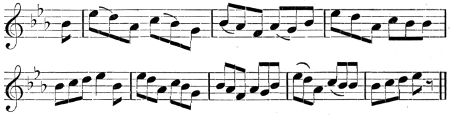
—Platt School, nr. Wrotham, Kent (Miss Burne).
[Play]
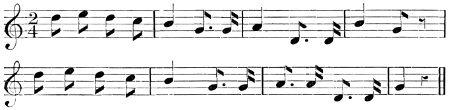
—Hanbury, Staffs. (Miss Edith Hollis).
[Play]
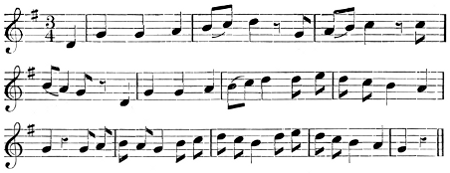
—Market Drayton, Salop (Shropshire Folk-lore).
[Play part 1, part 2]
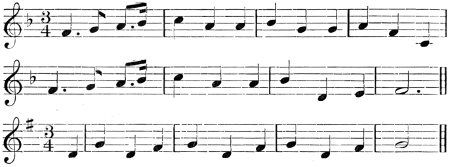
—Ogbourne, Wilts. (H. S. May).
I.
When I was a young girl, a young girl, a young girl, When I was a young girl, how happy was I. This way and that way, and this way and that way, And this way and that way, and this way went I. When I had a sweetheart, a sweetheart, a sweetheart, When I had a sweetheart, how happy was I. This way and that way, and this way and that way, And this way and that way, and this way went I. When I got married, got married, got married, When I got married, how happy was I. This way and that way, and this way and that way, And this way and that way, and this way went I. When I had a baby, a baby, a baby, When I had a baby, how happy was I. This way and that way, and this way and that way, And this way and that way, and this way went I. When my baby died, died, died, When my baby died, how sorry was I. This way and that way, and this way and that way, And this way and that way, and this way went I. When my husband died, died, died, When my husband died, how sorry was I. This way and that way, and this way and that way, And this way and that way, and this way went I. When I kept a donkey, a donkey, a donkey, When I kept a donkey, how happy was I. This way and that way, and this way and that way, And this way and that way, and this way went I. When I was a washerwoman, a washerwoman, a washerwoman, When I was a washerwoman, how happy was I. This way and that way, and this way and that way, And this way and that way, and this way went I. When I was a beggar, a beggar, a beggar, When I was a beggar, how happy was I. This way and that way, and this way and that way, And this way and that way, and this way went I.
—Platt School, near Wrotham, Kent (Miss Burne).
II.
When I was a young girl, a young girl, a young girl, When I was I young girl, how happy was I. And this way and that way, and this way and that way, and this way and that way, and this way went I. When I was a school-girl, a school-girl, a school-girl, When I was a school-girl, oh, this way went I. And this way and that way, and this way and that way, and this way and that way, and this way went I. When I was a teacher, a teacher, a teacher, When I was a teacher, oh, this way went I. And this way and that way, and this way and that way, and this way and that way, and this way went I. When I had a sweetheart, a sweetheart, a sweetheart, When I had a sweetheart, oh, this way went I. And this way and that way, and this way and that way, and this way and that way, and this way went I. When I had a husband, a husband, a husband, When I had a husband, oh! this way went I. And this way and that way, and this way and that way, and this way and that way, and this way went I. When I had a baby, a baby, a baby, When I had a baby, how happy was I. And this way and that way, and this way and that way, and this way and that way, and this way went I. When my baby died, oh, died, oh, died, When my baby died, how sorry was I. And this way and that way, and this way and that way, and this way and that way, and this way went I. When I took in washing, oh, washing, oh, washing, When I took in washing, oh, this way went I. And this way and that way, and this way and that way, and this way and that way, and this way went I. When I went out scrubbing, oh, scrubbing, oh, scrubbing, When I went out scrubbing, oh, this way went I. And this way and that way, and this way and that way, and this way and that way, and this way went I. When my husband did beat me, did beat me, did beat me, When my husband did beat me, oh, this way went I. And this way and that way, and this way and that way, and this way and that way, and this way went I. When my husband died, oh, died, oh, died, When my husband died, how happy was I. And this way and that way, and this way and that way, and this way and that way, and this way went I. Hurrah!
—Barnes, Surrey (A. B. Gomme).
III.
When I was a young gell, a young gell, a young gell, When I was a young gell, i’ this a way went I. An’ i’ this a way, an’ i’ that a way, an’ i’ this a way went I. When I wanted a sweetheart, a sweetheart, a sweetheart, When I wanted a sweetheart, i’ this a way went I. An’ i’ this a way, an’ i’ this a way, an’ i’ this a way went I. When I went a-courting, a-courtin’, a-courtin’, When I went a-courtin’, i’ this a way went I. An’ i’ this a way, an’ i’ this a way, an’ i’ this a way went I. When I did get married, get married, get married, When I did get married, i’ this a way went I. An’ i’ this a way, an’ i’ this a way, an’ i’ this a way went I. When I had a baby, &c. When I went to church, &c. My husband was a drunkard, &c. When I was a washerwoman, &c. When I did peggy, &c. My baby fell sick, &c. My baby did die, &c. My husband did die, &c.
—Liphook, Wakefield (Miss Fowler).
IV.
When I wore my flounces, my flounces, my flounces, When I wore my flounces, this a-way went I. When I was a lady, a lady, a lady, When I was a lady, this a-way went I. When I was a gentleman, a gentleman, a gentleman, When I was a gentleman, this a-way went I. When I was a washerwoman, &c. When I was a schoolgirl, &c. When I had a baby, &c. When I was a cobbler, &c. When I was a shoeblack, &c. When my husband beat me, &c. When my baby died, &c. When my husband died, &c. When I was a parson, &c.
—Hanbury, Staffs. (Miss Edith Hollis).
V.
When I was a lady, a lady, a lady, When I was a lady, a lady was I. ’Twas this way and that way, and this way and that. When I was a gentleman, a gentleman, a gentleman, When I was a gentleman, a gentleman was I. ’Twas this way and that way, and this way and that. When I was a schoolgirl, a schoolgirl, a schoolgirl, When I was a schoolgirl, a schoolgirl was I, &c. When I was a schoolboy, a schoolboy, a schoolboy, &c. When I was a schoolmaster, a schoolmaster, a schoolmaster, &c. When I was a schoolmistress, a schoolmistress, a schoolmistress, &c. When I was a donkey, a donkey, a donkey, &c. When I was a shoeblack, a shoeblack, a shoeblack, &c.
—Ogbourne, Wilts. (H. S. May).
VI.
When I was a naughty girl, a naughty girl, a naughty girl, When I was a naughty girl, a-this a-way went I! And a-this a-way, and a-that a-way, And a-this a-way, and a-that a-way, And a-this a-way, and a-that a-way, And a-this a-way went I! When I was a good girl, &c., a-this a-way went I! &c. When I was a naughty girl, &c. When I went courting, &c. When I got married, &c. When I had a baby, &c. When the baby cried, &c. When the baby died, &c.
—Berrington (Shropshire Folk-lore, p. 514).
VII.
When I was a naughty girl, &c. [as above] When I went to school, &c. When I went a-courting, &c. When I got married, &c. When I had a baby, &c. When the baby fell sick, &c. When my baby did die, &c. When my husband fell sick, &c. When my husband did die, &c. When I was a widow, &c. Then I took in washing, &c. Then my age was a hundred and four, &c.
—Market Drayton (Shropshire Folk-lore, p. 515).
VIII.
First I was a school-maid, a school-maid, how happy was I! And a-this a-way, and a-that a-way went I! And then I got married, how happy was I! &c. And then I had a baby, how happy was I! &c. And then my husband died, how sorry was I! &c. And then I married a cobbler, how happy was I! &c. And then the baby died, how sorry was I! &c. And then I married a soldier, how happy was I! &c. And then he bought me a donkey, how happy was I! &c. And then the donkey throwed me, how sorry was I! &c. And then I was a washing-maid, how happy was I! &c. And then my life was ended, how sorry was I!
—Chirbury (Shropshire Folk-lore, p. 515).
IX.
When first we went to school—to school—to school— How happy was I! ’Twas this way and that way, How happy was I! Next I went to service—to service—to service— How happy was I! ’Twas this way, and that way, How happy was I! &c. Next I had a sweetheart—a sweetheart—a sweetheart— How happy was I! &c. Next I got married—got married—got married— How happy was I! &c. Next I had a baby—a baby—a baby— How happy was I! &c. Next my husband died—he died—he died— How sorry was I! &c. Next my baby died—she died—she died— How sorry was I! &c.
—Dorsetshire (Folk-lore Journal, vii. pp. 218-219).
X.
Oh! when I was a soldier, I did this way, this way. Oh! when I was a mower, I did this way, this way. Oh! when I was a hedge cutter, I did this way, this way. Oh! when I was a boot cleaner, I did this way, this way. Oh! when I was a teacher, I did this way, this way. Oh! when I was a governess, I did this way, this way. Oh! when I had a baby, I did this way, this way. Oh! when my baby died, I did this way, this way.
—Fernham and Longcot Choir Girls, Berks. (Miss I. Barclay).
XI.
When I was a school-boy, a school-boy, a school-boy, When I was a school-boy, this way went I. When I was a school-girl, &c. When I was a-courting, &c. When I got married, &c. When I had a baby, &c. When my baby died, &c. When my husband was ill, &c. When I was a shoe-black, &c. When I was a washerwoman, &c. When I was a soldier, &c. When I was a sailor, &c.
—Frodingham and Nottinghamshire (Miss M. Peacock).
XII.
When I was a school girl, a school girl, a school girl, When I was a school girl, a this way went I. When I was a teacher, a teacher, a teacher, When I was a teacher, a this way went I.
[Verses follow for courtin’—
married woman, having a baby, death of baby.]
—Earls Heaton (H. Hardy).
XIII.
When I went a courting, I went just so. When next I went a courting, I went just so; When next I went a courting, I went just so; When next I went a courting, I went just so.
—Haxey, Lincolnshire (C. C. Bell).
(c) The children join hands and form a ring. They all dance or walk round singing the words of the first two lines of each verse. Then all standing still, they unclasp hands, and continue singing the next two lines, and while doing so each child performs some action which illustrates the events, work, condition, or profession mentioned in the first line of the verse they are singing; then rejoining hands they all dance round in a circle again. The actions used to illustrate the different events are: In the versions from Platt school, for “young girl,” each child holds out her dress and dances a step first to the right, then to the left, two or three times, finishing by turning herself quite round; for a “sweetheart,” the children turn their heads and kiss their hands to the child behind them; for “got married,” they all walk round in ring form, two by two, arm in arm; for having a baby, they each “rock” and “hush” a pretended baby; when the baby dies, each pretends to cry; when the husband dies, they throw their aprons or handkerchiefs over their heads and faces; for “keeping a donkey,” each child pretends to beat and drive the child immediately in front of her; for “washerwoman,” each pretends to wash or wring clothes; for a “beggar,” each drops curtseys, and holds out her hand as if asking alms, putting on an imploring countenance. The Barnes’ version is played in the same way, with the addition of holding the hands together to represent a book, as if learning lessons, for “schoolgirl”; pretending to hold a cane, and holding up fingers for silence, when a “teacher”; when “my husband did beat me,” each pretends to fight; and for “my husband died,” each child walks round joyfully, waving her handkerchief, and all calling out Hurrah! at the end; the other verses being acted the same as at Platt. The Liphook version is much the same: the children beckon with their fingers when “wanting a sweetheart”; kneel down and pretend to pray when “at church”; prod pretended “clothes” in a wash-tub with a “dolly” stick when “I did peggy” is said; and mourn for the “husband’s” death. In the Hanbury game, the children dance round or shake themselves for “flounces “; hold up dresses and walk nicely for “lady”; bow to each other for “gentlemen”; pretend to mend shoes when “cobblers”; brush shoes for “shoeblack”; clap hands when the “husband” dies; and kneel when they are “parsons.” In the Ogbourne game, the children “hold up their dresses as ladies do” in the first verse; take off their hats repeatedly when “gentlemen”; pretend to cry when “schoolgirls”; walking round, swinging their arms, and looking as cocky as possible, when “schoolboys”; patting each other’s backs when “schoolmasters”; clapping hands for “schoolmistresses”; stooping down and walking on all fours for a “donkey”; and brushing shoes for “shoeblack.” In the Shropshire games at Berrington, each child “walks demurely” for a good girl; puts finger on lip for “naughty girl”; walks two and two, arm in arm, for “courting”; holds on to her dress for “married”; whips the “baby,” and cries when it dies. In the Market Drayton game, each pretends to tear her clothes for “naughty girl”; pretends to carry a bag for “schoolgirl”; walk in pairs side by side for “courting”; the same, arm in arm, for “married”; “hushes” for a baby, pretends to pat on the back for sick baby; covers her face with handkerchief when baby dies; pats her chest when husband is sick, cries and “makes dreadful work” when he dies; puts on handkerchief for a widow’s veil for a widow; hobbles along, and finally falls down when “a hundred and four.” In the Dorset game, when at “service,” an imitation of scrubbing and sweeping is given; walk in couples for sweethearts, and married; the remaining verses the same as the Platt version. In the Fernham game the children shoot out their arms alternately for a soldier; for a mower, they stand sideways and pretend to cut grass; for hedge-cutter, they pretend to cut with a downward movement, as with a belt [qy. bill] hook, the other action similar to the Platt and Barnes games. In the Frodingham game they stamp and pretend to drill for “schoolboys,” pretend to sew as “schoolgirls,” kiss for “courting,” put on a ring for “getting married,” run for a doctor when “husband” is ill, punch and push each other for “soldiers,” and haul ropes for “sailors.” In other versions, in which carpenters, blacksmiths, farmers, bakers appear, actions showing something of those trades are performed.
(d) It will be seen, from the description of the way this game is played, that it consists of imitative actions of different events in life, or of actions imitating trades and occupations. It was probably at one time played by both girls and boys, young men and young women. It is now but seldom played by boys, and therefore those verses containing lines describing male occupations are not nearly so frequently met with as those describing girls’ or womens’ life only. Young girl, sweetheart, or going courtin’, marriage, birth of children, loss of baby and husband, widowhood, and the occupations of washing and cleaning, exactly sum up the principal and important events in many working womens’ lives—comprising, in fact, the whole. This was truer many years ago than now, and the mention in many versions of school girl, teacher, governess, indicate in those versions the influence which education, first in the shape of dame or village schools, Sunday schools, and latterly Board schools, has had upon the minds and playtime of the children. These lines may certainly be looked upon as introductions by the children of comparatively modern times, and doubtless have taken the place of some older custom or habit. This game is exactly one of those to which additions and alterations of this kind can be made without destroying or materially altering, or affecting, its sense. It can live as a simple game in an almost complete state long after its original wording has been lost or forgotten, and as long as occupations continue and events occur which lend themselves to dumb action. The origin of the game I consider to be those dances and songs performed in imitation of the serious avocations of life, when such ceremonies were considered necessary to their proper performance, and acceptable to the deities presiding over such functions, arising from belief in sympathetic magic.
At harvest homes it was customary for the men engaged in the work of the farm to go through a series of performances depicting their various occupations with song and dance, from their engagement as labourers until the harvest was completed, and at some fairs the young men and women of the village, in song and dance, would go through in pantomimic representation, the several events of the year, such as courting, marriage, &c., and their several occupations.
Perhaps the most singular instance of imitative action being used in a semi-religious purpose, is that recorded by Giraldus Cambrensis in the twelfth century, who, speaking of the church of St. Almedha, near Brecknock, says a solemn feast is held annually in the beginning of August: “You may see men and girls, now in the church, now in the churchyard, now in the dance, which is led round the churchyard with a song, on a sudden falling on the ground as in a trance, then jumping up as in a frenzy, and representing with their hands and feet before the people whatever work they have unlawfully done on feast days; you may see one man put his hands to the plough, and another, as it were, goad on the oxen, one man imitating a shoemaker, another a tanner. Now you may see a girl with a distaff drawing out the thread and winding it again on the spindle; another walking and arranging the threads for the spindle; another throwing the shuttle and seeming to weave” (Itinerary of Wales, chap. ii.).
For the significance of some of the pantomimic actions used, I may mention that in Cheshire for a couple to walk “arm-in-arm” is significant of a betrothed or engaged couple.
Other versions have been sent me, but so similar to those given that it is unnecessary to give them here. The tunes vary more. In some places the game is sung to that of “Nuts in May.” In Barnes the tune used was sometimes that of “Isabella,” vol. i. p. 247, and sometimes the first one printed here.
The game is mentioned by Newell (Games, p. 88).[Addendum]
Whiddy
Whiddy, whiddy, way, If you don’t come, I won’t play.
The players, except one, stand in a den or home. One player clasps his hands together, with the two forefingers extended, He sings out the above, and the boys who are “home” then cry—
Warning once, warning twice, Warning three times over; When the cock crows out come I, Whiddy, whiddy, wake-cock. Warning!
This is called “Saying their prayers.” The boy who begins must touch another boy, keeping his hands clasped as above. These two then join hands, and pursue the others; those whom they catch also joining hands, till they form a long line. If the players who are in the home run out before saying their prayers, the other boys have the right to pummel them, or ride home on their backs.—London (J. P. Emslie, A. B. Gomme).
See “Chickidy Hand,” “Hunt the Staigie,” “Stag,” “Warney.”
Whigmeleerie
A game occasionally played in Angus. A pin was stuck in the centre of a circle, from which there were as many radii as there were persons in the company, with two names of each person at the radius opposite to him. On the pin an index was placed, and moved round by every one in turn, and at whatsoever person’s radius it stopped, he was obliged to drink off his glass.—Jamieson.
A species of chance game, played apparently with a kind of totum.
Whip
A boy’s game, called in the South “Hoop or Hoop Hide.” This is a curious instance of corruption, for the name hoop is pronounced in the local manner as hooip, whence whip.—Easther’s Almondbury Glossary.
Whishin Dance
An old-fashioned dance, in which a cushion is used to kneel upon.—Dickinson’s Cumberland Glossary.
See “Cushion Dance.”
Who goes round my Stone Wall
I.
Who’s going round my stone wall? Nobody, only little Jacky Lingo. Pray don’t steal none of my fat sheep, Unless I take one by one, two by two, three by three, Follow me. Have you seen anything of my black sheep? Yes! I gave them a lot of bread and butter and sent them up there [pointing to left or right]. Then what have you got behind you? Only a few poor black sheep. Well! let me see.
[The child immediately behind Johnny Lingo shows its foot between her feet, and on seeing it the centre child says]
Here’s my black sheep.
—Winterton, Anderby, Nottinghamshire (Miss M. Peacock).
II.
Who’s that going round my stony walk? It’s only Bobby Bingo. Have you stolen any of my sheep? Yes! I stole one last night and one the night before.
—Enbourne School, Berks (Miss M. Kimber).
III.
Who goes round this stoney wa’? Nane but Johnnie Lingo. Tak care and no steal ony o’ my fat sheep away! Nane but ane.
—Galloway (J. G. Carter).
IV.
Who goes round my pinfold wall? Little Johnny Ringo. Don’t steal all my fat sheep! No more I will, no more I may, Until I’ve stol’n ’em all away, Nip, Johnny Ringo.
—Addy’s Sheffield Glossary.
V.
Who’s that walking round my sandy path? Only Jack and Jingle. Don’t you steal none of my fat geese! Yes, I will, or No, I won’t. I’ll take them one by one, and two by two, and call them Jack and Jingle.
—Barnes, Surrey (A. B. Gomme).
VI.
Who runs round my pen pound? No one but old King Sailor. Don’t you steal all my sheep away, while I’m a wailer! Steal them all away one by one, and leave none but old King Sailor.
—Raunds (Northants Notes and Queries, i. p. 232).
VII.
Who’s that walking round my walk? Only Jackie Jingle. Don’t you steal of my fat sheep; The more I will, the more I won’t, Unless I take them one by one, And that is Jackie Jingle.
—Hersham, Surrey (Folk-lore Record, v. 85).
VIII.
Who’s going round my sunny wall to night? Only little Jacky Lingo. Don’t steal any of my fat chicks. I stole one last night And gave it a little hay, There came a little blackbird, And carried it away.
—Bocking, Essex (Folk-lore Record, iii. 170).
IX.
Who’s that round my stable door [or stony wall]? Only little Jack and Jingo. Don’t you steal any of my fat pigs! I stole one last night and the night before, Chick, chick, come along with me.
—Deptford, Kent (Miss Chase).
X.
Who’s this walking round my stony gravel path? Only little Jacky Jingle. Last night he stole one of my sheep, Put him in the fold, Along came a blackbird, and pecked off his nose.
—Hampshire (Miss Mendham).
XI.
Who is going round my fine stony house? Only Daddy Dingo. Don’t take any of my fine chicks. Only this one, O!
—Ellesmere (Burne’s Shropshire Folk-lore, p. 520).
XII.
Who is that walking round my stone-wall? Only little Johnnie Nero. Well, don’t you steal any of my fat sheep! I stole one last night and gave it a lock of hay, Here come I to take another away.
—Sporle, Norfolk (Miss Matthews).
XIII.
Who’s that going round my pretty garden? Only Jacky Jingo. Don’t you steal any of my fat sheep! Oh, no I won’t; oh, yes I will; and if I do I’ll take them one by one, so out comes Jacky Jingo.
—Ogbourne, Wilts. (H. S. May).
XIV.
Who’s going round my sheepfold? Only poor Jack Lingo. Don’t steal any of my black sheep! No, I won’t, only buy one.
—Roxton, St. Neots (Miss E. Lumley).
XV.
Who goes round my house this night? None but Limping Tom. Do you want any of my chickens this night? None but this poor one.
—Macduff (Rev. W. Gregor).
XVI.
Who goes round my house this night? Who but Bloody Tom! Who stole all my chickens away? None but this poor one.
—Chambers’s Pop. Rhymes, 122.
XVII.
Who goes round the house at night? None but Bloody Tom. Tack care an’ tack nane o’ my chickens awa’! None but this poor one.
—Keith (Rev. W. Gregor).
XVIII.
Johnny, Johnny Ringo, Don’t steal all my faun sheep. Nob but one by one, Whaul they’re all done.
—Easther’s Almondbury Glossary.
XIX.
Who’s going round my stone wall? Only an old witch. Don’t take any of my bad chickens! No, only this one.
—Hanbury, Staffs. (Miss E. Hollis).
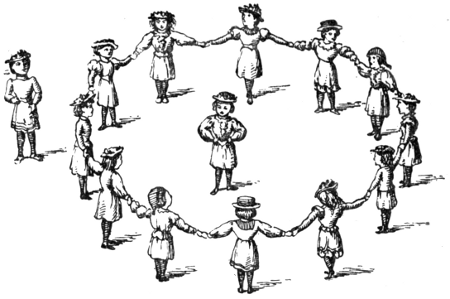
(b) The players stand in a circle, but they do not necessarily hold hands, nor do they move round. One player kneels or stands in the centre, and another walks round outside the circle. The child in the centre asks the questions, and the child outside (Johnny Lingo) replies. When the last answer is given, the outside player, or Johnny Lingo, touches one of the circle on the back; this player, without speaking, then follows Johnny Lingo and stands behind her holding her by her dress, or round the waist. The dialogue is then repeated, and another child taken. This is continued until all the circle are behind Johnny Lingo. Then the child in the centre tries to catch one of them, and Johnny Lingo tries to prevent it; as soon as one player is caught she stands aside, and when all are caught the game is over.
This is the usual way of playing. The variations are: in Galloway, Enbourne, Keith, and Hanbury, the centre player shuts her eyes, or is blindfolded. In the Almondbury version, when the centre child gets up to look for his sheep, and finds them (they do not stand behind Johnny Ringo, but hide), they run about “baaing;” when he catches them he pretends to cut their heads off. In Chambers’s description of the game, all the players except two sit upon the ground in a circle (sitting or lying down also obtains at Barnes), one of the two stands inside, and the other personates “Bloody Tom.” Bloody Tom tries to carry off a player after the dialogue has been said, and the centre child tries to prevent this one from being taken, and the rest of the circle “cower more closely round him.” In the Macduff version, when all the players have been taken, the centre child runs about crying, “Where are all my chickens?” Some of the “chickens,” on hearing this, try to run away from “Limping Tom” to her, and he tries to prevent them. He puts them all behind him in single file, and the centre child then tries to catch them; when she catches them all she becomes Limping Tom, and he the shepherd or hen. Dr. Gregor says (Keith)—The game is generally played by boys; the keeper kneels or sits in the middle of the circle; when all the sheep are gone, and he gets no answers to his questions, he crawls away still blindfolded, and searches for the lost sheep. The first player he finds becomes keeper, and he becomes Bloody Tom. In the Winterton version (No. I.) there is a further dialogue. The game is played in the usual way at the beginning. When Jacko Lingo says, “Follow me” (he had previously, when saying one by one and two by two, &c., touched three children on their back in turn), the third one touched leaves the ring, and stands behind him holding his clothes or waist. This is done until all the children forming the circle are holding on behind him. The child in the centre then asks the next question. When she says, “Here’s my black sheep,” she tries to dodge behind Jacky Lingo, and catch the child behind him. When she has done this she begins again at “Have you seen anything of my black sheep,” until she has caught all the children behind Jacky Lingo. In two versions, Deptford and Bocking, there is no mention of a player being in the centre, but this is an obvious necessity unless the second player stands also outside the circle. In the Raunds version the ring moves slowly round. In the Hants version (Miss Mendham) the children sit in a line. The thief takes one at a time and hides them, and the shepherd pulls them out of their hiding-places. In the Shropshire game, the chickens crouch down behind their mother, holding her gown, and the fox walks round them.
(c) This game appears to represent a village (by the players standing still in circle form), and from the dialogue the children not only represent the village, but sheep or chickens belonging to it. The other two players are—one a watchman or shepherd, and the other a wolf, fox, or other depredatory animal. The sheep may possibly be supposed to be in the pound or fold; the thief comes over the boundaries from a neighbouring village or forest to steal the sheep at night; the watchman or shepherd, although at first apparently deceived by the wolf, discovers the loss, and a fight ensues, in which the thief gets the worse, and some of the animals, if not all, are supposed to be recovered. The names used in the game,—pen pound, pinfold, fold, stone wall, sunny wall, sandy path, gravel path, sheep fold, garden, house, are all indications that a village and its surroundings is intended to be represented, and this game differs in that respect from the ordinary Fox and Geese and Hen and Chickens games, in which no mention is made of these.
Halliwell records two versions (Nursery Rhymes, pp. 61, 68). The words and method of playing are the same as some of those recorded above. There is also a version in Suffolk County Folk-lore, pp. 65, 66, which beginning with “Who’s going round my little stony wall?” after the sheep are all stolen, continues with a dialogue, which forms a part of the game of “Witch.” The Rev. W. S. Sykes sends one from Settle, Yorkshire, the words of which are the same as No. XIV., except that the last line has “just one” instead of “buy one.” Mr. Newell gives a version played by American children.
Widow
I.
One poor widder all left alone, Only one daughter to marry at home, Chews [choose] for the worst, and chews for the best, And chews the one that yew [you] love best. Now you’re married, I wish ye good joy, Ivery year a gal or a boy! If one ’out dew, ye must hev tew, So pray, young couple, kiss te’gither.
—Swaffham, Norfolk (Miss Matthews).
II.
Here is a poor widow who is left alone, And all her children married and gone; Come choose the east, come choose the west, Come choose the one you love the best. Now since you’ve got married, I wish you joy, Every year a girl and boy; Love one another like sister and brother, I pray you couple come kiss together.
—Perth (Rev. W. Gregor).
III.
One poor widow was left alone, Daughter, daughter, marry at home; Choose the worst, or choose the best, Choose the young gentleman you love best. Now you are married, I wish you joy, Father and mother, you must obey, Love one another like sister and brother, And now, young couple, come kiss together.
—Bexley Heath (Miss Morris.)
IV.
One poor widow is left all alone, all alone, all alone, Choose the worst, and choose the best, And choose the one that you like best. Now she’s married I wish her joy, Her father and mother she must obey, Love one another like sisters and brothers, And now it’s time to go away.
—Suffolk County Folk-lore, p. 67.
V.
One poor widow was left alone, She had but one daughter to marry alone; Come choose the worst, come choose the best, Come choose the young girl that you like best.
—Maxey, Northants (Rev. W. D. Sweeting).
VI.
Here’s a poor widow she’s left alone, She has got nothing to marry upon; Come choose to the east, come choose to the west, Come choose the one that you love best. Now they’re married, we wish them joy, Every year a girl and a boy; Seven years old, seven years to come, Now kiss the couple, and that’s well done.
—Auchterarder, N.B. (Miss E. S. Haldane).
(b) The children form a ring by joining hands. One player stands in the centre. The ring dance round singing the first verse; the widow then chooses one player from the ring, who goes into the centre with her, and the ring dances round singing the second part. The one first in the centre then joins the ring, and the second player becomes the widow and chooses in her turn.
This belongs to the marriage group of Kiss in the Ring games. Northall (English Folk Rhymes, p. 374), gives a version similar to the above.
See “Kiss in the Ring,” “Poor Widow,” “Sally Water,” “Silly Young Man.”
Wiggle-Waggle
The players sit round a table under the presidency of a “Buck.” Each person has his fingers clenched, and the thumb extended. Buck from time to time calls out as suits his fancy: “Buck says, Thumbs up!” or, “Buck says, Thumbs down!” or, “Wiggle-waggle!” If he says “Thumbs up!” he places both hands on the table, with the thumbs sticking straight up. If “Thumbs down!” he rests his thumbs on the table with his hands up. If “Wiggle-waggle!” he places his hands as in “Thumbs up!” but wags his thumbs nimbly. Everybody at the table has to follow the word of command on the instant, and any who fail to do so are liable to a forfeit.—Evan’s Leicestershire Words.
See “Horns.”
Wild Boar
“Shoeing the Wild Boar,” a game in which the player sits cross-legged on a beam or pole, each of the extremities of which is placed or swung in the eyes of a rope suspended from the back tree of an outhouse. The person uses a switch, as if in the act of whipping up a horse; when being thus unsteadily mounted, he is most apt to lose his balance. If he retains it, he is victor over those who fail.—Teviotdale (Jamieson).
Wild Birds
“All the Wild Birds in the Air,” the name of a game in which one acts the dam of a number of birds, who gives distinct names of birds, such as are generally known to all that are engaged in the sport. The person who opposes tries to guess the name of each individual. When he errs he is subject to a stroke on the back. When he guesses right he carries away on his back that bird, which is subjected to a blow from each of the rest. When he has discovered and carried off the whole, he has gained the game.—Jamieson. Jamieson adds that this sport seems only to be retained in Abernethy, Perthshire; and it is probable, from the antiquity of the place, that it is very ancient.