Volume 1 — CHILDREN’S GAMES (continued 6)
Reading edition
—Nairn (Mrs. Jamieson, through Rev. W. Gregor).
XXXV.
One poor sailor dressed in blue, dressed in blue, dressed in blue, One poor sailor dressed in blue, Has come for the sake of your daughter Sue. My daughter Sue, she is too young, She cannot bear your flattering tongue. Whether she be young, or whether she be old, For her beauty she must be sold. Take her, take her, the coach is free. The fairest one that I can see is bonny ( ), come with me. [No!] The dirty sclipe, she won’t come out, she won’t come out, she won’t come out; The dirty sclipe, she won’t come out to dance along with me. Now, I have got another poor maid, &c., To come along with me.
—Cullen (Rev. W. Gregor).
XXXVI.
Here comes two ladies down from Spain, A len (?) [all in] French garland. I’ve come to court your daughter Jane, And adieu to you, my darling.
—Scotland (Notes and Queries, 3rd series, v. 393).
XXXVII.
Here are just three tribes come down from Spain, To call upon my sister Jane. My sister Jane, she is far too young; I cannot bear her chattering tongue. The fairest lily that I can see, Is pretty little Lizzie, will ye come to me? [No!] The dirty thing, she won’t come out, she won’t come out, she won’t come out; The dirty thing, she won’t come out, to help us with the dancing. [Yes!] Now we’ve got a pretty maid, a pretty maid, a pretty maid; Now we’ve got a pretty maid, to help us with the dancing.
—Waterford (Miss H. E. Harvey).
(b) The players stand in two lines, facing one another, three boys on one side and the girls (any number) on the other. The boys advance and retire dancing, and saying the first two lines. The girls stand still, one who personates a mother answers with the next two lines. The boys then advance and reply. When they are retiring the mother says the next lines and the boys reply; they then choose a girl and take her over to their side. The dialogue is generally spoken, not sung. The boys turn their toes outwards to show their spurs. The number of players on the girls’ side is generally an uneven one, the odd one is the mother and says the dialogue. This is the most general way of playing, but there are interesting variations. Chambers says two parties play, one representing a dame and her daughters, the other the suitors. The suitors move backwards and forwards with their arms entwined. The mother offers her daughters when she says “Smell my lilies,” and the game ends by some little childish trick, but unfortunately, he does not describe this. Miss Ellis (Leicester) says if the number of players suited, probably all the boys, instead of three, would be on one side and the girls on the other, but there is no hard and fast line. They turn out their toes to show their spurs: when they sing or say, “Pass through the kitchen,” &c., the girls stretch out their arms, still keeping hold of hand, and the boys, forming a long tail, wind in and out under their arms as they stand. Having previously decided among themselves which girl they shall seize, they go up and down the lines several times, until the period of suspense and expectation is supposed to have lasted long enough. Then the last boy in the line puts his arms round the chosen girl’s waist and carries her off. This goes on until there is only one girl left, who recommences the game on her part by singing the first lines, choosing first a boy, who then becomes a Spaniard. In the first version from Belfast, the first girl who is asked to go refuses, and another is asked, who consents. In the Manchester version (Miss Dendy), the girl refuses twice, then accepts. The “mother” is seated in state with her “daughters” round her in the Bexley Heath (Miss Morris) version. The two “gentlemen” advance to her and turn haughtily away when refused. Then they choose a girl and take her over to their side. In the Shropshire (Edgmond) version, two girls, one from each end of the line of “daughters,” goes over to the knights’ side, who also “bow” and “bend” when saying the lines, and the game is repeated saying five, seven, &c., knights. Here, also, the last player left on the girls’ side takes the knight’s part in the next game. Miss Burne adds, at other places the knights call only one girl by name each time. Both lines in the Shropshire game advance and retire. In the Dublin game (Mrs. Lincoln), three young boys are chosen for the suitors, one girl is the mother, and any number from three to six personate the daughters. The first boy only speaks the lines. At “Return, return, your coat is white,” he, with the other two “suitors,” takes the girl, brings her back, and says the last verse. They then sit down, and the second suitor does the same thing, then the third one. Then the game is begun again [with three other boys] until all the daughters have been taken. In the version quoted from Notes and Queries, two children, mother and daughter, stand on one side, the other players opposite to them, and advance and retire. The contributor says they chant the words to a pleasing old melody. The Yorkshire version (Miss E. Cadman) is played in the usual way, both sides advancing and retiring in turn, and at the end one of the “knights” tries to catch one of the girls. They cross the room to each other’s places. In Co. Down, at Ballymiscaw, Miss Patterson says one player refuses when asked, and another consents, this one and the “lord” then join hands and dance round together, saying the last words. The Annaverna version is sung by one on each side—“king and the mother.” The Berwickshire game was played by six children, one on one side, five on the other. The first lines are sung on both sides; then the rest is dialogue until the girl refuses, when the “Jew” dances round by himself, singing the words; she then consents, and the two dance round with joined hands as in a reel, singing the last verse. The dialogue is spoken with animation, and the “Jew steps his foot” and prances away when saying these words. Twelve children in the Perth version stand in a row, another stands a little in advance, who is called “daughter Jane,” another is the “mother.” Three more stand in front of the twelve and are the “Dukes.” These dance forwards and backwards before “Jane and her mother,” singing the first lines. The mother answers. When they sing the last line the “Dukes” choose one of the twelve, and sing the words over again until all the twelve are on the “Dukes’” side. Then they try to carry off “Jane” and the “mother,” and run until they are caught. In the Clapham school version (Mrs. Herbertson), the “Duke” tries to drag by force the chosen girl across a handkerchief or other boundary, if successful she goes on his side. In the Cornwall version the “Dukes” retire and consult before choosing a girl, then select one. When all have been taken they bring them back in the same order to the “mother,” saying the last verse, and the “mother” replies in the last two lines. In the London version, the “Dukes” take the girl and rob her, then bring her back. In the Fochabers version (Rev. W. Gregor), the two “sailors” join hands crosswise, walk backwards and forwards, and sing the words. The girl crosses over to them when chosen. When all are chosen the “sailors” bring all the girls before the mother, singing the last verse. The mother searches the daughters one after the other, finding neither money nor ring. She then chases the sailors, and the one caught becomes mother next game.
(c) This game has been said by previous collectors, and at first sight may be thought to be merely a variant of “Three Dukes,” but it will on investigation, I think, prove to be more than this. In the first place, the obvious borrowing from the “Three Dukes” of a few words, as in versions Nos. 29, 30, and 31, tells against the theory of identity of the two games. Then the form of marriage custom is different, though it is still marriage under primitive conditions of society. The personal element, entirely absent from the “Three Dukes,” is here one of the principal characteristics. The marriage is still one without previous courtship or love between two individuals, but the parental element is present here, or at any rate that of some authority, and a sanction is given, although there is no trace of any actual ceremony. The young men, or suitors, apparently desire a particular person in marriage, and although there is no wooing of that person a demand is made for her. These suitors are, I think, making the demand on the part of another rather than for themselves. They are the ambassadors or friends of the would-be bridegrooms, and are soliciting for a marriage in which purchase money or dowry is to be paid. The mention of “gold and silver” in many versions, and the line, “she must be sold,” is important.
All these indications of purchase refer to a time when the custom of offering gold, money, or other valuables for a bride was in vogue. While, therefore, the game has traces of carrying off the bride, this carrying off is in strict accord with the conditions prevalent when marriage by purchase had succeeded to marriage by capture. The bargaining spirit is not much “en evidence” in this game, not, that is to say, in the same sense as is shown in “Three Sailors,” p. 282, but there is sufficient evidence of a mercantile spirit to prove that women and girls were too valuable to be parted with by their own tribe or family without something deemed equivalent being given in return. There is a desire shown to possess the girl for her beauty; and that a choice of a suitor could or would be made is shown by the remarks that she is too young and does not know the language and customs of this suitor.
The mention of the spurs conveys the suggestion that the suitors or ambassadors are men of quality and renown. To win their spurs was an object greatly desired by all young men. Their reply to the taunt that their spurs are “dull” may mean that they are not bright from use, and may also show the idea that these men have come on a journey from some distance for a bride or brides, and this only is responsible for their spurs not being as bright as usual. Again, being “richly wrought” is probably an indication of wealth or consequence. Mention must be made of the mead not being made nor the cake yet baked, which occurs in two versions. If these two versions can be considered old ones, this would tend to show evidence of the ceremony of the eating together of particular food, which forms the most important element in primitive marriage ceremonies.
There occurs in some versions the incident of asking the girl to come, and the dancing round when she consents, mostly in connection with the incident of invitation to dance. This may not therefore belong, and I do not think it does, to the early forms of this game; but we must remember that dancing formed a part of the marriage ceremonies down to quite a late date, and it is therefore not surprising it should be found in many versions.
It has been suggested that this game has for its origin an historical event in the reign of Edward III., whose daughter Jane married a prince of Spain. There is some possibility in this, as doubtless the marriage was conducted by ambassadors first of all with pomp and ceremonial, but I think the game really dates from a much earlier period, and if there are any grounds for connecting it with this particular royal marriage, it may merely have altered and fixed some of the words, such as “daughter Jane,” “Lords from Spain,” “Spanish gold,” in people’s minds, and in this way tended to preserve the game in its modern form.
Mr. Addy, in his Sheffield Glossary, considers that the mention of the three knights and gifts of gold is a fragment of some old pageant of the Three Kings of Cologne, who, according to ancient legend, brought gifts to the infant Jesus, but I can see no evidence of this.
It is somewhat curious that this game is very rarely sung to a tune, nor have I succeeded in obtaining one. It is usually said to a sort of sing-song chant, or else it is spoken in dialogue, and that with a good deal of animation.
Mr. Newell gives versions, as played in America, similar to many here given, and Mr. Northall (Folk Rhymes, p. 385) gives one from Gloucestershire and Warwickshire.[Addendum]
Three Little Ships
[Play]
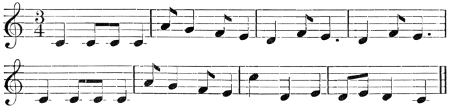
—London (A. B. Gomme).
[Play]
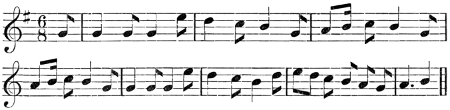
—Rimbault’s Nursery Rhymes.
I.
Three little ships come sailing by, Sailing by, sailing by; Three little ships come sailing by, New Year’s day in the morning. Who do you think was in the ships, In the ships, in the ships; Who do you think was in the ships, New Year’s day in the morning? Three pretty girls were in the ships, In the ships, in the ships; Three pretty girls were in the ships, New Year’s day in the morning. One could whistle, and one could sing, One could play on the violin; One could whistle, and one could sing, New Year’s day in the morning.
—London (A. B. Gomme).
II.
I saw three ships come sailing by, Come sailing by, come sailing by; I saw three ships come sailing by On New Year’s day in the morning. And what do you think was in them then, In them then, in them then; And what do you think was in them then, On New Year’s day in the morning? Three pretty girls were in them then, &c. One could whistle, and one could sing, The other could play on the violin; Such joy was there at my wedding, On New Year’s day in the morning.
—Rimbault’s Nursery Rhymes.
III.
As I sat on a sunny bank, A sunny bank, a sunny bank; As I sat on a sunny bank On Christmas day in the morning. I saw three ships come sailing by, Come sailing by, come sailing by; I saw three ships come sailing by On Christmas day in the morning. And who do you think was in those ships? &c. But Joseph and his lady. And he did whistle, and she did sing, And all the bells on earth did ring For joy our Saviour he was born On Christmas day in the morning.
—Burne’s Shropshire Folk-lore, p. 564.
[The above verses, except the last one, are sung at Oswestry with these additional ones:—]
Pray, whither sailed those ships all three? &c. Oh! they sailed unto Bethlehem, &c. They combed his hair with an ivory comb, &c. They washed his face in a golden cup, &c. They wiped his face with a lily-white cloth, &c. They brushed his shoes with a hairy brush, &c.
—Burne’s Shropshire Folk-lore, p. 564.
(c) In the London version, which I obtained from a maid-servant—two lines of children stand, hand in hand, facing one another. They advance and retire in line, with dancing steps, alternately. The children sing the lines. When the last verse is sung a girl from the end of each line advances, and the two dance round together. This is continued until all have danced in turn in the space between the lines.
(d) It will be seen that there is a probability of the version I collected as a dance game and Rimbault’s nursery song being derived from the Christmas carol, a variant of which I reprint from Miss Burne’s Shropshire Folk-lore. A version of this carol from Kent is given in Notes and Queries, 3rd series, iii. 7. Mr. A. H. Bullen, in Carols and Poems, gives an older version of the same. In this version there is no mention of whistling, singing, or playing the violin; but in the Kent version, the third verse is the same as the fourth of that collected by Miss Burne, and the dance collected by myself. In the Revue Celtique, vol. iv., Mr. Fitzgerald considers this carol to have been the original from which the pretty words and dance, “Duck Dance,” were derived, see ante, vol. i. p. 113. If these words and dance owe their origin to the carol, they may both show connection with an older form, when the carol was danced as a dramatic round.
Three Old Bachelors
Here come three old bachelors, Walking in a row, Seeking wives, and can’t find ’em; So open the ring, and take one in. Now you’re married, you must obey; You must be true to all you say; You must be kind, you must be good, And help your wife to chop the wood.
—Earls Heaton, Yorks. (Herbert Hardy).
Mr. Hardy suggests that this is a variant of “See the Farmer Sow his Seed,” but it more nearly resembles “Silly Old Man,” although the marriage formula is that of “Oats and Beans.”
Three Sailors
[Play]
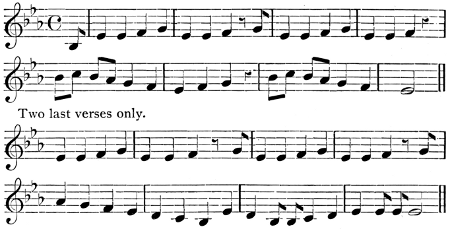
—London (A. B. Gomme).
I.
Here come three sailors, three by three, To court your daughter, a fair lady (pronounced ladee); [Or, And down by your door they bend their knee]. Can we have a lodging here, here, here? Can we have a lodging here? Sleep, sleep, daughter, do not wake, Here are three sailors we can’t take; You cannot have a lodging here, here, here, You cannot have a lodging here. Here come three soldiers, three by three, To court your daughter, a fair lady; Can we have a lodging here, here, here? Can we have a lodging here? Sleep, sleep, daughter, do not wake, Here are three soldiers we can’t take; You cannot have a lodging here, here, here, You cannot have a lodging here. Here come three kings, three by three, To court your daughter, a fair lady; Can we have a lodging here, here, here? Can we have a lodging here? Wake, wake, daughter, do not sleep, Here come three kings that we can take; You can have a lodging here, here, here, You can have a lodging here. Here’s my daughter, safe and sound, And in her pocket one hundred pound, And on her finger a gay gold ring, And she is fit to walk with a king. Here’s your daughter, not safe nor sound, Nor in her pocket one hundred pound, On her finger no gay gold ring, I’m sure she’s not fit to walk with a king.
—Barnes, Surrey, and London (A. B. Gomme).
II.
Here come three tinkers, three by three, To court your daughter, fair lady; Oh! have you any lodgings here, oh, here? Oh! have you any lodgings here? Sleep, sleep, daughter, do not wake, Here come three tinkers we cannot take; We haven’t any lodgings here, oh, here, We haven’t any lodgings here. Here come three soldiers, three by three, To court your daughter, fair lady; Oh! have you any lodgings here, oh, here? Oh! have you any lodgings here? Sleep, sleep, daughter, do not wake, Here come three soldiers we cannot take; We haven’t any lodgings here, oh, here, We haven’t any lodgings here. Here come three kings, three by three, To court your daughter, fair lady; Oh! have you any lodgings here, oh, here? Oh! have you any lodgings here? Wake, wake, daughter, do not sleep, Here come three kings that we can take; We have some lodgings here, oh, here, We have some lodgings here. Here’s my daughter, safe and sound, And in her pocket five hundred pounds, And on her finger a five guinea gold ring, And she is fit to walk with a king. Here’s your daughter, nor safe nor sound, And in her pocket no five hundred pound, And on her finger no five guinea gold ring, And she’s not fit to walk with the king.
—Sporle, Norfolk (Miss Matthews).
III.
Here’s three sweeps, three by three, And down by the door they bend their knee; Oh! shall we have lodgings here, oh, here? Oh! shall we have lodgings here? Sleep, dear daughter, do not wake, For here’s three sweeps coming to take; Lodgings here they shall not have, So sleep, dear daughter, sleep. Here’s three bakers, three by three, And down by the door they bend their knee; Oh! shall we have lodgings here, oh, here? Oh! shall we have lodgings here? Sleep, dear daughter, do not wake, &c. (as above). Here’s three kings, three by three, &c. (as above). Wake, dear daughter, do not sleep, For here’s three kings coming to take; Lodgings here they all may have, So wake, dear daughter, wake. Here’s my daughter, safe and sound, And on her finger a guinea gold ring, And in her pocket a thousand pounds, So she is fit to marry a king. Here’s your daughter, safe and sound, And on her finger no guinea gold ring, And in her pocket no thousand pounds, So she’s not fit to marry a king.
—Aberdeen Training College (Rev. W. Gregor).
IV.
Here come three tailors, three by three, To court your daughter, fair and fair; Have you got a lodger here, oh, here? Have you got a lodger here? Sleep, daughter, sleep, sleep, Here come three tailors we can’t take; We haven’t got a lodger here, oh, here, We haven’t got a lodger here.
[The verses are repeated for “sailors,” “blacksmiths,” &c., and then “kings,” and ends in the same way as the preceding version.]
—Swaffham, Norfolk (Miss Matthews).
V.
Here come three sailors, three by three, A courting your daughter, Caroline Mee; [Some would sing it “Because your daughter”] Can we have a lodging here to-night? Sleep, daughter, do not wake, Here’s three sailors we can’t take; You cannot have a lodging here to-night. Here come three soldiers, three by three, A courting your daughter, Caroline Mee; Can we have a lodging here to-night? Sleep, daughter, do not wake, Here’s three soldiers we can’t take; You cannot have a lodging here to-night.
[This is repeated for “kings,” and the game ends as in the previous versions. “Three” hundred pounds being substituted for “five.”]
—Deptford, Kent (Miss Chase).
VI.
Here come some travellers three by three, And down by a door they bend their knee. “Can we get lodgings here?” The fairest one that I can see Is pretty little ——, come to me, And you’ll get lodgings here— “Will you come?” “Yes,” or “No!”
—Isle of Man (A. W. Moore).
(c) The players form in two lines, and stand facing one another. One line consists of a mother and daughters. The other of the suitors. The mother stands a little in advance of her daughters. They remain stationary during the game, the mother alone singing the words on her side. The suitors advance and retire in line while singing their verses. The mother turns partly round when singing the two first lines of her verses addressing her daughters, and then faces the suitors when singing to them the remaining two lines. When she accepts the “kings” she brings one of her daughters forward, presents her to the suitors, and shows them the money in her pocket, and the ring on her finger. The daughter goes with the kings, who take her a little way apart, pretend to rob her of her ring, money, and clothes, and then bring her back to her mother, and sing the last verse. They then run off in all directions, and the mother and daughters chase and catch them, and they change sides. Sometimes all the daughters are taken by the suitors before they are robbed and brought back. The game is also played by five players only; three representing the sailors or suitors, and two the mother and daughter. The mother then chases the suitors, and whoever she catches becomes the daughter the next game. These are the usual methods of playing. In the Norfolk version the middle one of the three suitors takes the girl, robs her, and all three bring her back and sing the verses. In the Isle of Man version one player sits down, the others join hands, advance and retire singing the lines. The girl who is chosen joins the one sitting down.
(d) This game points to that period of tribal society, when the youths of one tribe sought to obtain their wives from the maidens of another tribe according to the laws of exogamy, but a definite person is here selected for the wife, and it is to the relatives or persons having authority (as in “Three Knights”) that the demand for the bride is made, and not to the girl personally, as in “Three Dukes.”
The game, while not so interesting a one to us as “Three Dukes,” and “Three Knights,” has its particular or peculiar features. It is probably later, and shows more clearly that position and wealth were of importance to a man in the obtaining of a wife. Individually he has not (apparently) courted the girl before, but he comes for that purpose now. He may be announcing himself under the various ranks or professions mentioned, before stating his real position; or, this may show that the girl having many suitors, and those of all degrees, the “mother” or relatives are actuated by purely mercenary motives, and wish to select the best and richest suitor for her. We must remember that it was accounted great honour to a girl to have many suitors and amongst these men distinguished by the performance of brave deeds, which had gained them renown and pre-eminence, or wealth. The fact that the rejection or acceptance of the suitors is made known to the girl by the “mother,” or person having authority, shows that “sanction” or permission is necessary, and that “rejection” or “acceptance” is signified to the suitors in the words, you “may not,” or, you “may” have a lodging here, signifies admission into the family. This is a most interesting feature. The girl is to “wake up,” that would be to rouse up, be merry, dress in bridal array and prepare for the coming festival. She is also given to the suitors with “in her pocket one hundred pounds,” and “on her finger a gay gold ring.” This, it will be seen, is given her by her “mother” or person having authority, and probably refers to the property the girl brings with her to her new abode for her proper maintenance there; the ring shows likewise her station and degree in her former abode, and is the token that she is fit bride for a king, and must be treated accordingly. Curious, too, is “Here’s my daughter safe and sound,” which looks like a warrant or guarantee of the girl’s fitness to be a bride. The expression “walk with,” meaning “to marry,” again occurs in this game as in “Three Dukes.” The line occurring in two versions, “And down by the door they bend their knee,” is suggestive of courtesy shown to the bride and her family at the threshold of the house.
The incident of the three kings becoming robbers is not easily understood. Robbery was common of course, particularly when money and valuables were known to be carried on the person; but I do not think this is sufficient in itself to account for the incident. It may be a reflection of the later fact that a man always took possession of his wife’s personal property after marriage, and considered it his own to do as he pleased with. When this idea became codified in written law, the idea might readily get reflected in the game, when kings would not be understood as apparently taking things that did not belong to them, unless they were bandits in disguise. This last verse and the robbery may be a later addition to the game, when robbery was of everyday occurrence. There may have been (although there is nothing now in any version to warrant the idea) some similar action on the part of the kings, such as a further arraying of the bride, and presenting her to their party or house, which has been misunderstood. Mr. Newell suggests that children having forgotten the original happy finish, and not understanding the “haggling” over the suitors, turned the kings into bandits. Children think it such a natural thing to wish to marry kings, princes, and princesses, and are so sincere in thinking it a matter of course to refuse a sailor or soldier for a king, when it is only a question of marriage, and not of choosing the one you like the best, that this reason does not to me seem to apply to a game of this kind.
Through the Needle Eye, Boys
Two leaders each choose a name such as “Golden Apple” and “Golden Pear.” The remaining children all hold each other’s waists in a long string, the “Golden Apple” and “Golden Pear” holding hands aloft like an arch. The string of children then runs under the arch. The last child that passes under is detained by the “Golden Apple” and “Golden Pear” (they having dropped hands previously). The detained child is asked in a whisper which she prefers, “Golden Apple,” “Golden Pear;” she chooses, and then stands at the back of the “Golden Apple” or “Golden Pear.” When all the children have passed through, the “Golden Apple” and “Golden Pear” hold each other’s hands and stand with the others behind them and pull like a “Tug of War.” There should be a line drawn between the “Golden Apple” and the “Golden Pear,” and whichever side pulls the other over the line, wins the game.—Northumberland (from a lady friend of Hon. J. Abercromby).
The formula sung in Fraserburgh when the players are running under the raised arms is—
Clink, clink, through the needle ee, boys, One, two, three, If you want a bonnie lassie, Just tak me.
After the tug of war the victors call out “Rotten eggs, rotten eggs” (Rev. W. Gregor).
The words used in Galloway are—
Through the needle e’e, boys, Through the needle e’e! If ’twasna for your granny’s sake, I wadna let ’e through.
—Galloway (J. G. Carter).
Jamieson describes this game in the south of Scotland as follows: “Two children form an arch with both hands. The rest, who hold each other by the skirts following in a line, attempt to pass under the arch. The first, who is called the king, is sometimes laid hold of by those who form the arch, each letting fall one of his arms like a portcullis for enclosing the passenger. But more generally the king is suffered to pass, the attempt being reserved for the last; whoever is seized is called the prisoner. As soon as he is made captive he takes the place of one of those who formed the arch, and who afterwards stand by his side.”
It is differently played in Mearns, Aberdeen, and some other counties. A number of boys stand with joined hands in a semicircle, and the boy at one end of the link addresses the boy at the other end of the line:
A—— B——, if ye were mine, I wad feed you with claret wine; Claret wine is gude and fine, Through the needle-ee, boys.
The boy to whom this is addressed makes room between himself and his next neighbour, as they raise and extend their arms to allow the opposite boy to run through the opening followed by all the other boys still linked to each other. If in running through the link should be broken, the two boys who are the cause suffer some punishment.—Ed. Jamieson’s Dictionary.
The Northumberland game resembles “Oranges and Lemons.” The other versions are nearer the “Thread the Needle” and “How many Miles to Babylon” games. Both games may be derived from the same custom.
See “How many Miles to Babylon,” “Thread the Needle.”
Thun’er Spell
A thin lath of wood, about six inches long and three or four inches broad, is taken and rounded at one end. A hole is bored in that end, and in the hole is tied a piece of cord between two and three yards long. It is then rapidly swung round, so as to produce a buzzing sound. The more rapidly it is swung, the louder is the noise. It was believed that the use of this instrument during a thunder-storm saved one from being struck with “the thun’er bolt.” I have used it with this intention (Keith). In other places it is used merely to make a noise. It is commonly deeply notched all round the edges to increase the noise.
Some years ago a herd boy was observed making one in a farm-kitchen (Udny). It was discovered that when he was sent to bring the cows from the fields to the farmyard to be milked, he used it to frighten them, and they ran frantically to their stalls. The noise made the animals dread the bot-fly or “cleg.” This torment makes them throw their tails up, and rush with fury through the fields or to the byres to shelter themselves from its attacks. A formula to effect the same purpose, and which I have many and many a time used when herding, was: Cock tail! cock tail! cock tail! Bizz-zz-zz! Bizz-zz-zz.—Keith (Rev. W. Gregor).
Dr. Gregor secured one of these that was in use in Pitsligo, and sent it to the Pitt-Rivers Museum at Oxford, where it now lies. Professor Haddon has made a collection of these toys, and has written on their connection with the Australian boomerang.
They are still occasionally to be met with in country districts, but are used simply for the purpose of making a noise.
See “Bummers.”
Tick
A game mentioned by Drayton, and still played in Warwickshire.—Halliwell’s Dictionary. The same game as “Touch.”
Tickle me Quickly
An old game (undescribed) mentioned in Taylor’s Motto, 1622, sig. D, iv.
Ticky Touchwood.
Ticky, ticky Touchwood, my black hen, She lays eggs for gentlemen; Sometimes nine and sometimes ten, Ticky, ticky Touchwood, my black hen.
—Sporle, Norfolk (Miss Matthews).
Addy (Sheffield Glossary, under “Tiggy Touchwood”) says, “One player who is called Tiggy stands out, and each of the others takes hold of or touches a piece of wood, such as a door, or rail, &c. One then leaves his ‘wood’ and runs across the playground, and if whilst doing so Tiggy can touch him he must stand out or take Tiggy’s place.”
One child is chosen to be “Ticky,” i.e., to be on the qui vive to lay hold of or touch any one who is not touching wood. If played out of doors it must be clearly defined what is wood, trees and all growing wood being forbidden. The fun consists in the bold ventures of those who tempt “Ticky” to run after them, and contrive to touch “wood” just before he touches them. When one is caught he is “Ticky” in turn.—Swaffham, Norfolk (Miss Matthews).
Played within a given boundary, in which were wooden buildings or fences. When one of the players was being pursued by the tigger, if he touched wood he could not be made prisoner, but he was not allowed to remain long in that position, and directly his hand left wood he was liable to instant capture. If when pursued he called out “a barla!” he was again exempt from capture, but he could not move from the position or place where he or she was when they called out, a barla! When wishing to move he had to call out “Ma barla oot!” No den in this game, but constant running.—Biggar (Wm. Ballantyne).
Lowsley (Berkshire Glossary) says, “Boys have games called Touch-wood and Touch-iron, where any one not touching either of the substances named is liable to be caught by the one standing out.”
Ross and Stead (Holderness Glossary) give this game as Tiggy Touchwood, a game similar to Tig, but in which the player must touch wood. It is called Ticky, Ticky Touchwood by Brogden (Lincolnshire Provincial Words), and Tiggy in Addy’s Sheffield Glossary.
Also played in another way. One tree or piece of wood was selected for “Home,” and the players darted out from this saying, “Ticky, Ticky Touchwood,” then running back to the tree and touching it before Ticky caught them. “Parley” or “fainits” were the words called out when exempt.—London (A. B. Gomme).
It is also described in Patterson’s Antrim and Down Glossary.
Tig.
A game in which one player touches another, then runs off to be pursued and touched in turn.
Mr. Addy says, “Children tig each other when they leave school, and there is a rivalry among them to get the last tig. After a boy has said tig-poison, he is not to be ‘tigged’ again.” Brockett says: “Tig, a slight touch (as a mode of salutation), a play among children on separating for the night, in which every one endeavours to get the last touch; called also Last Bat.”—Brockett’s North Country Words, and consult Dickinson (Cumberland Glossary), also Jamieson. A boys’ game, in which the player scores by touching one who runs before him.—Stead’s Holderness Glossary. A play among children when separating for the night.—Willan’s Dialect Words of West Riding of Yorks. Called also “Touch” and “Tigga Tiggy,” in East and West Cornwall; (Courtney and Couch), also Patterson’s Antrim and Down Glossary.
See “Canlie,” “Cross Tig.”
Time.
The players stand in a line. Two are chosen, who stand apart, and fix on any hour, as one, two, three, &c., or any half-hour. A nestie is marked off at some distance from the row of players. One of the two goes in front of the line of players, and beginning at one end asks each the hour. This is done till the hour fixed on between the two is guessed. The one that makes the right guess runs to catch the other of the two that fixed the hour, and she makes off to the “nestie.” If she is caught she goes to the line of players, and the one that caught her takes her place. If she reaches the “nestie” without being caught, she has still to run to the line of players; if she does this without being caught she holds her place as one of the time-fixers, but if caught she takes her stand in the line, and the one that caught her becomes time-fixer.—Fraserburgh (Rev. W. Gregor).
Tip it.
This is played by six players, divided into two sides of three each, with one captain to each side. A ring or other small object is taken by the side which wins the toss, and then both sides sit down to a small table. The in-side puts their hands under the table, and the ring is given to one of the three players. At a given signal they all bring up their closed hands on to the table, and the other side has to guess in which closed fist the ring is. The guesser has the privilege of ordering “off” the hands which he thinks are empty. If he succeeds in getting the empty hands off, he says “tip it” to the remaining one. If he guesses right the ring changes sides. The game is to keep the ring or other object on one side as long as possible.—London (Alfred Nutt).[Addendum]
Tip-Cat.
Strutt says this is so denominated from the piece of wood called a cat, about six inches in length, and an inch and a half or two inches in diameter, diminished from the middle to both ends. When the cat is on the ground the player strikes it smartly, when it rises with a rotatory motion high enough for him to hit it again before it falls, in the same manner as a ball. He says there are various methods of playing the game, and describes the two following: A large ring is made in the ground; in the middle of this the striker takes his station; his business then is to hit the cat over the ring. If he fails in doing so he is out, and another player takes his place; if successful, he judges with his eye the distance the cat is driven from the centre of the ring, and calls for a number at pleasure to be scored towards his game: if the number demanded be found upon measurement to exceed the same number of lengths of the bludgeon, he is out; on the contrary, if it does not, he obtains his call. The second way of playing is to make four, six, or eight holes in the ground in a circular direction, and at equal distances from each other, at every hole is placed a player with his bludgeon: one of the opposite party who stand in the field tosses the cat to the batsman who is nearest him, and every time the cat is struck the players are obliged to change their situations, and run once from one hole to another in succession; if the cat be driven to any great distance they continue to run in the same order, and claim a score towards their game every time they quit one hole and run to another; but if the cat be stopped by their opponents and thrown across between any two of the holes before the player who has quitted one of them can reach the other, he is out.
Mr. Kinahan says there is among old Irish games one sometimes called cat, played with three or more players on each side, two stones or holes as stations, and a lobber, but the regular cat is played with a stick four inches long, bevelled at each end, called the cat. This bevelled stick is laid on the ground, and one end hit with a stick to make it rise in the air, when it is hit by the player, who runs to a mark and back to his station. The game is made by a number of runs; while the hitter is out if he fails three times to hit the cat, or if he is hit by the cat while running.—(Folk-lore Journal, ii. 264.) The common game of “tip-cat” was called cat-and-kitten by Dorset children. The long stick represented the “cat” and the small pieces the “kitten.”—(Folk-lore Journal, vii. 234.) Elworthy (West Somerset Words) calls it Stick and Snell. Brogden (Provincial Words, Lincolnshire) gives it as tip-cat, as does Lowsley (Berkshire Glossary), also Trippit and Coit, and Trippit and Rack in some parts of the North.—Brockett’s North Country Words. Once commonly played in London streets, now forbidden.
See “Cudgel,” “Waggles.”[Addendum]
Tip-tap-toe.
A square is drawn having nine smaller squares or houses within it. Two persons play. They alternately make the one a square and the other a cross in any one of the houses. He that first gets three in a line wins the game.—Peacock’s Manley and Corringham Glossary. Brogden (Provincial Words, Lincolnshire) calls it Tit-tat-toe, also Lowsley (Berkshire Glossary).
Northall says called Tick-tack-toe in Warwickshire and Staffordshire; the rhyme is “Tick-tack-toe, I’ve caught you.”
This game is called “Noughts and Crosses,” in London, probably from those marks being used in the game.
See “Kit-Cat-Cannio,” “Noughts and Crosses.”
Tiring Irons.
An old game with iron rods and rings.—Holland’s Cheshire Glossary.
Tisty Tosty
See “Shuttlefeather,” “Teesty Tosty.”
Titter-totter
The game of see-saw.—Halliwell’s Dictionary.
Tit-tat-toe.
A game played by school children on slates. A round is drawn, which is divided into as many divisions as is thought necessary, sixteen being generally the least. These divisions are each numbered, the centre containing a higher figure than any in the divisions, usually 25, 50, or 100. Several children can play. They each have a place or square allotted to them on the slate in which to record the numbers they obtain. A space is allotted to “Old Nick” or the “Old Man.” The players alternately take a pencil in their right hand (holding it point downwards on 1, and tapping on each number with it), and shutting their eyes move round and round the diagram saying—
“Tit, tat, toe, my first go, Three jolly butcher boys all in a row Stick one up, stick one down, Stick one in the old man’s ground.”
stopping and keeping the pencil in an upright position when the last word is said. The player then opens his eyes, and registers in his square the number at which the pencil stopped. This number is then scratched through on the diagram, to signify that it is taken, the other players proceed in the same manner as the first; then the first one begins again. This is continued till all the numbers are scratched out, or till one of the players puts his pencil into the centre, and thus wins the game. If all the figures are taken before the centre is touched, the game goes to the “Old man” or “Old Nick.” Also, if one player puts his pencil in a division already taken, he records nothing and loses that turn; this is also the case if, after the verse is repeated, the pencil is found to be on a division or boundary line or outside the round.—London (A. B. Gomme).
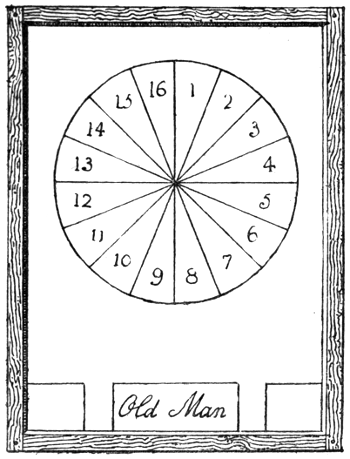
I was taught by a maid servant to play this game on the ground. This girl drew the round and divisions and figures on the gravel path or mould in the garden, and sharpened a piece of stick at one end for the pointer. She did not know the game as one played on slates, but always played it on the ground in this way.
This game appears to indicate a lottery, and might originally have had something to do with allotting pieces of land or other property to prospective owners under the ancient common field system. The places when taken by one player not being available for another, and the fact of it being known as played on the ground, and not on slates, are both significant indications of the suggested origin. The method of allotting lands by lottery is described in Gomme’s Village Community. Mr. Newell, Games, p. 140, records a similar game called “Wheel of Fortune.”
Tods and Lambs
A game played on a perforated board with wooden pins.—Jamieson. The Editor adds that the game is materially the same as the English “Fox and Geese.”
See “Fox and Geese” (2).
Tom Tiddler’s Ground
[Play]

—Liverpool (Mrs. Harley).
A line is drawn on the ground, one player stands behind it. The piece so protected is “Tom Tiddler’s ground.” The other players stand in a row on the other side. The row breaks and the children run over, calling out, “Here we are on Tom Tiddler’s ground, picking up gold and silver.” Tom Tiddler catches them, and as they are caught they stand on one side. The last out becomes Tom Tiddler.—Monton, Lancashire (Miss Dendy).
Tom Tiddler’s Ground is played at Chirbury under the name of “Boney” = Bonaparte! one boy taking possession of a certain area, and the others trespassing on it, saying, “I am on Boney’s ground.” If they are caught there, they are put “in prison” till released by a touch from a comrade.—Chirbury (Shropshire Folk-lore, p. 523-524).
I’m on Tom Tinker’s ground, I’m on Tom Tinker’s ground, I’m on Tom Tinker’s ground, Picking up gold and silver.
—Derbyshire (Folk-lore Journal, i. 386).
Northall (Folk Rhymes) gives the following lines, and describes it as played as above, except that Tom Tinder is provided with a knotted handkerchief, with which he buffets any one caught on his property:—
Here we are on Tom Tinder’s ground, Picking up gold and silver; You pick weeds, and I’ll pick seeds, And we’ll all pick carraway comfits.
In the Liverpool district the game is called “Old Daddy Bunchey” (Mrs. Harley), and in Norfolk “Pussey’s Ground” (Miss Matthews).
It is also mentioned by Lowsley (Berkshire Glossary).[Addendum]
Tops
The special games now played with tops are mentioned under their respective titles, but the general allusions to the ancient whipping-tops are important enough to note.
Strutt says the top was known with us as early at least as the fourteenth century, when its form was the same as now, and the manner of using it can admit of but little if any difference. Representations of boys whipping tops occur in the marginal paintings of the MSS. written at this period; and in a work of the thirteenth century, “Le Miracle de Saint Loys,” the whipping top (Sabot) is mentioned. The top was probably in use as a toy long before. Strutt records the following anecdote of Prince Henry, son of James I., which he met with in a MS. at the Museum, the author of which speaks of it as perfectly genuine. His words are—“The first tyme that he, the prince, went to the towne of Sterling to meete the king, seeing a little without the gate of the towne a stack of corne in proportion not unlike to a topp wherewith he used to play; he said to some that were with him, ‘Loe there is a goodly topp;’ whereupon one of them saying, ‘Why doe you not play with it, then?’ he answered, ‘Set you it up for me, and I will play with it.’”—Sports, p. 385.
Northbroke, in his Treatise against Dicing, 1579, p. 86, says: “Cato giveth counsell to all youth, saying, ‘Trocho lude, aleas fuge, playe with the toppe, and flee dice-playing.’”
In the English translation of Levinus Lemnius, 1658, p. 369: “Young youth do merrily exercise themselves in whipping-top, and to make it run swiftly about, that it cannot be seen, and will deceive the sight.”
Cornelius Scriblerus, in his Instructions concerning the Plays and Playthings to be used by his son Martin, says: “I would not have Martin as yet to scourge a top, till I am better informed whether the trochus which was recommended by Cato be really our present top, or rather the hoop which the boys drive with a stick.”—Pope’s Works, vi. 115.
Among well-known classical allusions may be noted the following mention of whipping the top, in Persius’s third Satire:
“Neu quis callidior buxum torquere flagello.”
Thus translated by Dryden:
“The whirling top they whip, And drive her giddy till she fall asleep.”
Thus also in Virgil’s Æneid, vii. 378:
“Ceu quondam torto volitans sub verbere turbo, Quem pueri magno in gyro vacua atria circum Intenti ludo exercent. Ille actus habenâ Curvatis fertur spatiis: stupet inscia supra, Impubesque manus, mirata volubile buxum: Dant animos plagæ.”
Thus translated by Dryden:
“As young striplings whip the top for sport, On the smooth pavement of an empty court; The wooden engine whirls and flies about, Admired with clamours of the beardless rout, They lash aloud, each other they provoke, And lend their little souls at ev’ry stroke.”
And so Ovid, Trist. 1. iii. Eleg. 12:
“Otia nunc istic: junctisque ex ordine ludis Cedunt verbosi garrula bella fori. Usus equi nunc est, levibus nunc luditur armis: Nunc pila, nunc celeri volvitur orbe trochus.”
Passing from these general allusions to the top as a form of amusement, we enter on more significant ground when we take into consideration the various passages in the early dramatists and other writers (collected together in Nares’ Glossary), which show that tops were at one time owned by the parish or village.
“He’s a coward and a coystril that will not drink to my niece, till his brains turn like a parish-top.”—Shakespeare, Twelfth Night, i. 3.
“A merry Greek, and cants in Latin comely, Spins like the parish-top.”
—Ben Jonson, New Inn, ii. 5.
“I’ll hazard My life upon it, that a boy of twelve Should scourge him hither like a parish-top, And make him dance before you.”
—Beaumont and Fletcher, Thierry and Theod., ii. 1.
“And dances like a town top, and reels and hobbles.”
—Ibid., Night Walker, i. 1.
Every night I dream I am a town-top, and that I am whipt up and down with the scourge stick of love.—“Grim, the Collier of Croydon,” ap. Dodsley, xi. 206.
In the Fifteen Comforts of Marriage, p. 143, we read: “Another tells ’em of a project he has to make town tops spin without an eel-skin, as if he bore malice to the school-boys.”
Poor Robin, in his Almanack for 1677, tells us, in the Fanatick’s Chronology, it was then “1804 years since the first invention of town-tops.”
These passages seem to refer to a custom of keeping tops by a township or parish, and they are confirmed by Evelyn, who, speaking of the uses of willow wood, among other things made of it, mentions great “town-topps” (Sylva, xx. 29). The latest writers who give positive information on the subject are Blackstone, who, in his note on Shakespeare, asserts that to “sleep like a town top” was proverbial, and Hazlitt, who, in his collection of English Proverbs, has “like a parish-top.” (See also Brand, ii. 448.)
Steevens, in his notes on Shakespeare, makes the positive assertion that “this is one of the customs now laid aside: a large top was formerly kept in every village, to be whipt in frosty weather, that the peasants might be kept warm by exercise, and out of mischief, while they could not work.”
This passage is repeated in Ellis’s edition of Brand, so that there is only one authority for the two statements. The question is whether Steevens was stating his own independent knowledge, or whether he based his information upon the passage in Shakespeare which he was illustrating. I think there can be no doubt that the custom existed, in whatever way we accept Steevens’ statement, and the question is one of considerable interest.
“Tops” is one of those games which are strictly limited to particular seasons of the year, and any infringement of those seasons is strictly tabooed by the boys. Hone (Every Day Book, i. 127), records the following rhyme:—
Tops are in, spin ’em agin; Tops are out, smuggin’ about,
but does not mention the season. It is, however, the early spring. This rhyme is still in use, and may occasionally be heard in the streets of London in the top season. Smugging is legitimate stealing when boys play out of season. “Marbles furst, then comes tops, then comes kites and hoops,” said a London boy who had acquired some tops by “smuggin;” but these rules are fast becoming obsolete, as is also the use of a dried eel skin as the favourite whip or thong used.
The keeping of a top by the parish in its corporate capacity is not likely to have arisen for the sake of supplying people with amusement, and we must look to a far more ancient origin for this singular custom. Hone mentions a doubtful story of a top being used in the ritual of one of the churches at Paris. (The burial of Alleluia. The top was whipped by a choir-boy from one end of the choir to the other: Every Day Book, i. 100), and if this can be confirmed it would be a link in the chain of evidence. But the whole subject requires much more evidence than it is now possible to go into here, though even, as far as we can now go, I am tempted to suggest that this well-known toy takes us back to the serious rites of ancient religions.
Brady’s Clavis Calendaria, i. 209, mentions the discontinued custom of whipping tops on Shrove Tuesday as originating in the Popish Carnival as types of the rigour of Church discipline.
It is not improbable that the tee-totum is the earliest form of top, and as its use is for gambling, it is probable that this and the top were formerly used for purposes of divination.
See “Gully,” “Hoatie,” “Hoges,” “Peg Top,” “Peg in the Ring,” “Scurran-Meggy,” “Totum.”[Addendum]
The Totum, or Tee-to-tum
The Totum is really only a top to spin by hand. It is made of a square piece of wood or bone, the four sides being each marked with a letter, and the peg is put through a hole in the centre. Sometimes the totum is shaped to a point on the under side, and a pin fixed in the upper part, by which it is twirled round.
The game played is one of chance; it may be played by two or more, either boys or girls, and is played only at Christmas. In Keith the letters are A, N, D, T. In playing the stake is one pin, and each plays in turn. If the side with A on it falls uppermost the player wins the whole stake—“A, tack a’.” If N turns up the player gets nothing—“N, nikil (nihil), nothing.” If T turns up one pin falls to the player—“T, tack ane.” If D comes uppermost the player has to lay down a pin—“D, dossie doon.” At times the game was played by paying a stake to all the letters except A, and the words used were—“D, dip it,” “T, tip it,” and “N, nip it.”—Keith (Rev. W. Gregor).
We played the game when children usually at Christmas time. The players sat round a table. A pool was made, each player putting in the same amount of stakes, either pins, counters, nuts, or money. One player collected the pool and then spun the tee-totum by his fingers. Whichever letter was uppermost when it stopped, the player had to obey.
T, was take all (the contents of the pool).
H, half the contents.
N, nothing.
P, to put into the pool the same amount as the stakes were at first.
When this was done the next player spun the totum in his turn. When one player got T a fresh pool had to be collected.—London (A. B. Gomme).
Jamieson’s Dictionary says children lay up stores of pins to play at this game at Christmas time.
William Dunbar, the Scottish poet (James IV.), seems to refer to this game in the poem, Schir, ȝit remembir as of befoir, in the words—
“He playis with totum, and I with nichell” (l. 74).
Strutt (Sports and Pastimes, page 385) says the four sides were marked with letters, and describes the game as we now play it in London.
All tee-totums or whirligigs seem to have some reference to tops, except that the tee-totum is used principally for gambling.
Some have numbers on their sides like dice instead of letters, and some are of octagonal shape.
See “Lang Larence,” “Scop-peril,” “Tops.”
Touch
One player is chosen “he.” He then runs amidst the other players and tries to touch one, who then becomes “Tig” or “Touch” in turn.
See “Ticky Touchwood,” “Tig.”
Tower of London
The Tower is formed by a circle of children, two of whom constitute the gate. These two join hands, and raise or lower their arm to open or shut the gate. The Tower is summoned to open its gates to admit “King George and all his merry men,” how represented I can’t remember; but I know that at one point there is a chase, and the prisoner is caught and brought before the king, when there ensues a scrap of dialogue in song (Mrs. Harley).
See “How many miles to Babylon,” “King of the Barbarie.”
Town Lovers
There is a girl of our town, She often wears a flowered gown; Tommy loves her night and day, And Richard when he may, And Johnny when he can; I think Sam will be the man!
—Halliwell’s Nursery Rhymes, pp. 217-218.
A girl is placed in the middle of a ring and says the lines, the names being altered to suit the players. She points to each one named, and at the last line the one selected immediately runs away; if the girl catches him he pays a forfeit, or the game is commenced again, the boy being placed in the middle.
Trades
Sides are chosen. These stand apart from each other, inside the line of their den. One side chooses amongst themselves a trade, and then walk over to the other side, imitating the actions pertaining to different parts of that trade, and giving the initial letter. If the trade is guessed by the opposite side, that side chooses the next trade, and performs the actions. If the trade is not guessed, the side is at liberty to choose another, and continue until one is guessed.—Forest of Dean, Gloucestershire (Miss Matthews).
The players that are to act the dumb tradesmen agree among themselves what trades are to be imitated. When this point is settled they present themselves before those that are to guess the trade, and proclaim three poor tradesmen wanting a trade—dumb. They then begin the work of imitation. The onlooker that first discovers the trade calls it out, and he becomes the dumb tradesman during the next round.—Fraserburgh (Rev. W. Gregor).
Some of the players form a line, while three others come up and say—
“Here are three men from Botany Bay, Got any work to give us to-day.”
The others ask, “What can you do?” To which they reply, “Anything.” And the others retort, “Set to work, then.”
The three then do some imaginary work, while those in the line have to guess what it is.—Ogbourne, Wilts (H. S. May).
“Two broken tradesmen newly come over, The one from France and Scotland, the other from Dover.” “What’s your trade?”
Two boys privately arrange that the pass-word shall be some implement of a particular trade. The trade is announced after the above dialogue, and carpenters, nailors, sailors, smiths, tinkers, or any other is answered; and on guessing the instrument, “Plane him,” “Hammer him,” “Rasp him,” or “Solder him,” is called out; then the fun is that the unfortunate wight who guesses the “tool” is beaten with the caps of his fellows till he reaches a fixed goal, after which he goes out in turn.—Halliwell’s Nursery Rhymes, cccxvi. In his Dictionary it is called “Trades, and Dumb Motions.”
Northall (English Folk-Rhymes) records this game as being played in Warwickshire. The method is practically the same as the Forest of Dean, except that the “tradesmen” are beaten if their trade is easily guessed by the others. They may also be beaten if they show their teeth during the operations.
Trap, Bat, and Ball
A game played with a trap, a ball, and a small bat. The trap is of wood made like a slipper, with a hollow at the heel end for the ball, and a kind of wooden spoon moving on a pivot, in the bowl of which the ball is placed. Two sides play—one side bats, the other fields. One of the batsmen strikes the end or handle of the spoon, the ball then rises into the air, and the art of the game is for the batsman to strike it as far as possible with the bat before it reaches the ground. The other side who are “fielding,” try either to catch the ball before it falls to the ground, or to bowl it from where it falls to hit the trap. If they succeed in catching the ball all the “ins” are out, and their side goes in to strike the ball, and the previous batsmen to field; if the trap is hit the batsman is out and another player of his side takes his place. The batsman is also out if he allows the ball to touch the trap when in the act of hitting it.—(A. B. Gomme.)
Halliwell (Dictionary) says, “Nurspell” in Lincolnshire is somewhat similar to “Trap Ball.” It is played with a kibble, a nur and a spell. By striking the end of the spell with the kibble the nur rises into the air, and the game is to strike it with the kibble before it reaches the ground. He who drives it the greatest distance is the winner. Miss Burne (Shropshire Folk-lore, p. 527) says, “Trib and Knurr,” otherwise “Dog Stick,” are local names for “Knur and Spell,” a superior form of “Trap Ball.” The “knurr” is a hard wooden ball, the “trib” is the trap or receptacle, the “Dog Stick” the sort of club with which it is struck. The game is played as described by Halliwell. She adds it was formerly the favourite pastime of young men on Shrove Tuesday.
At Bury St. Edmonds, on Shrove Tuesday, Easter Monday, and Whitsuntide festivals, twelve old women side off for a game at “Trap and Ball,” which is kept up with the greatest spirit and vigour until sunset.—Suffolk County Folk-lore, p. 56. See also Chambers’s Book of Days, i. p. 428, for a similar custom among women at Chester.
See “Nur and Spel,” “Tribet,” “Trippit and Coit.”
Tray-Trip
Grose says this was an ancient game, like Scotch-hop, played on a pavement marked out with chalk into different compartments. According to Halliwell (Dictionary), it was a game at dice.
See “Hop-scotch,” “Scotch Hop.”
Tres-acre
A game in which generally six are engaged—one taking a station before two about 12 yards behind him, three 12 yards behind these two. One is the catch-pole. Never more than two can remain; the supernumerary one must always shift and seek a new station. If the catch-pole can get in before the person who changes his station, he has the right to take his place, and the other becomes pursuer.—Jamieson.
This is not very descriptive, but the game is evidently the same as “Round Tag” and “Twos and Threes,” played with a small number.
Tribet
A common children’s game played in Lancashire; which, perhaps, may be the primitive form of “Trap.” It is played with a “pum,” a piece of wood about a foot long and two inches in diameter, and a “tribet,” a small piece of hard wood.—Halliwell’s Dictionary.
See “Trap, Bat, and Ball.”
Trippit and Coit
A game formerly known under the appellation of “Trippets,” Newcastle. It is the same as “Trip-cat” in some southern counties. The trippet is a small piece of wood obtusely pointed—something like a shoe—hollow at one end, and having a tail a little elevated at the other, which is struck with a buckstick. It is also called “Buckstick, Spell-and-Ore.”—Brockett’s North Country Words. See also Dickinson’s Cumberland Glossary. Halliwell’s Dictionary says—The game is almost peculiar to the North of England. There is a poem called “The Trip Match” in Mather’s Songs.
See “Nur and Spel,” “Trap, Bat, and Ball.”
Trip and Go
Trip and go, heave and hoe, Up and down, to and fro; From the town to the grove, Two and two let us rove; A-maying, a-playing, Love hath no gainsaying; So merrily trip and go, So merrily trip and go.
—Halliwell’s Nursery Rhymes, cccxlviii.
A game rhyme, but undescribed.
Trip-trout
A game in which a common ball is used instead of the cork and feathers in “Shuttlecock.”—(Kinross) Jamieson.
See “Shuttlefeather,” “Teesty Tosty.”
Troap
A game played by two persons, with bandies or sticks hooked at the end, and a bit of wood called a nacket. At each end of the ground occupied a line is drawn. He who strikes off the nacket from the one line, tries to drive it as near the other as possible. The antagonist who stands between him and the goal tries to throw back with his hand the nacket to the line from which the other has struck it. If he does this he takes the place of the other. If not, the distance is measured between the striking point and the nacket with one of the sticks used in striking, and for every length of the stick one is counted against the caster.—(Angus) Jamieson. The editor of Jamieson adds that the name must have been originally the same as the English Trap, although in this game a ball is used instead of a nacket, and it is struck off as in cricket.
Troco, Trucks
This was an old English game formerly known as “trucks.” Strutt, p. 270, 299 (who gives an illustration of it), considers this game to be the original of billiards. Professor Attwell says, Notes and Queries, 7th series, xii. 137, “This game was played at Nassau House School, Barnes, for twenty years. It is played on a lawn with balls, cues, and rings.”
Troule-in-Madame
In the Benefit of the Auncient Bathes of Buckstones, compiled by John Jones at the King’s Mede, nigh Darby, 1572, 4to. p. 12, we read: “The ladyes, gentle woomen, wyves, and maydes, maye in one of the galleries walke; and if the weather bee not aggreeable too theire expectacion, they may haue in the ende of a benche eleuen holes made, intoo the which to trowle pummetes, or bowles of leade, bigge, little, or meane, or also of copper, tynne, woode, eyther vyolent or softe, after their owne discretion; the pastyme troule-in-madame is termed.” Probably similar to “Nine Holes.”
Trounce-Hole
A game at ball resembling trap, but having a hole in the ground for the trap, a flat piece of bone for a trigger, and a cudgel for a bat.—Norfolk, Holloway’s Dictionary of Provincialisms.
See “Trunket.”
Troy Town
A game in which a plan of a labyrinth is drawn on a slate and presented as a puzzle by boys to their schoolfellows for them to find a way into the central citadel. It appears to owe its origin to the mediæval mazes or labyrinths called “Troy Towns,” or “Troy Walls,” many of which existed in different parts of England and Wales. It appears that games connected with the midsummer festivals were held in these labyrinths. This may, perhaps, account for the origin of this puzzle being considered a game. For accounts of labyrinths or mazes called “Troy Towns,” see Notes and Queries, 1st series, xi. 132, 193; 2nd series, v. 211-213; 8th series, iv. 96, 97; in which many references are given; Tran. Cymmrodorion Soc., 1822, i. 67-69; Roberts’ Cambrian Antiquities (in which is a plan), 212, 213; and Folk-lore Journal, v. 45.
Truncher
A game requiring dexterity. A young man lies flat, resting only on his toes at a certain mark at one extremity and on a trencher in each hand at the other. He then tries to reach out the trenchers as far as possible, and if not held at the right angle and edgewise, down they go and he is defeated.—Dickinson’s Cumberland Glossary.
Trunket
A game at ball played with short sticks, and having a hole in the ground in lieu of stumps or wickets as in “Cricket”; and with these exceptions, and the ball being “cop’d,” instead of bowled or trickled on the ground, it is played in the same way; the person striking the ball must be caught out, or the ball must be deposited in the hole before the stick or cudgel can be placed there.—Halliwell’s Dictionary.
See “Cudgel,” “Trounce Hole.”
Truss
A boy’s game like “Leap-Frog.”—Halliwell’s Dictionary.
Tuilyie-wap
A childish amusement in Teviotdale, in which a number of boys take hold of each other’s hands and wrap themselves round the one who is at the head; clasping themselves as firmly together as possible, and every one pushing till the mass falls over.—Jamieson.
See “Bulliheisle,” “Eller Tree,” “Snail-Creep,” “Wind the Bush Faggot.”
Turn, Cheeses, Turn
Green cheeses, yellow laces, Up and down the market places; First a penny and then a groat, Turn, cheeses, turn.
—Leicester (Miss Ellis).
Green cheeses, yellow laces, Up and down the market places, Turn, cheeses, turn!
—Halliwell’s Nursery Rhymes, cccx.
This is acted by two or more girls who walk or dance up and down, turning, when they say “Turn, cheeses, turn.”—Halliwell.
I remember playing this game, but my remembrance is very imperfect. As far as I remember, there were two lines or rows of children. They danced forwards and backwards, crossing to the opposite side, and turning round. At the words, “Turn, cheeses, turn,” the cheeses all turned round rapidly and then sank on the ground. The players tried to inflate their dresses as much as possible, and then stooped down to the ground, so that the dress remained inflated; only the head and shoulders surrounded by a ball-like skirt then appeared, intended to represent a cheese. All joined hands and danced round at the end. The lines sang were the same as the Leicester except the third, which was—“Some a penny, some a groat, turn, cheeses, turn.” It was necessary for skirts to be very “full” to make good cheeses—as wide at the waist as at the bottom of the skirt.—(A. B. Gomme.)
Holland (Cheshire Glossary) says, a frequent amusement of girls is making cheeses. They turn round and round till their dresses fly out at the bottom; then suddenly squatting down, the air confined under the dress causes the skirt to bulge out like a balloon. When skilfully done the appearance is that of a girl’s head and shoulders peeping out of an immense cushion. Evans’ Leicestershire Glossary mentions this game. He says, “The performers sing a song of which the refrain is ‘Turn, cheeses, turn,’ but I do not remember to have heard the example cited by Mr. Halliwell-Phillips.”—Percy Soc., iv. p. 122.
I always understood that the green cheeses were sage cheeses—cheeses containing sage. Halliwell says, “Green cheeses, I am informed, are made with sage and potato tops. Two girls are said to be ‘cheese and cheese.’”
Turn Spit Jack
A game at country balls, &c., in which young men compete by singing for their partners in the next dance.—Patterson’s Antrim and Down Glossary.
Turn the Ship
This is commonly a girls’ game. Two join hands and trip along, with hands crossed, turning from one side to the other, and crossing their arms over their heads without letting go their hold of each other, singing at the same time—
Tip, tip, toe, London, lo! Turn, Mary Ann, and away you go.
Or—
Tip, tip, toe, leerie, lo! Turn the ship and away you go; A penny to you, and a penny to me, And a penny to turn the basket.
—Fochabers (Rev. W. Gregor).
Turn the Trencher, or, My Lady’s Toilet
An indoor game played at Christmas time by children and adults. All the players in the room must be seated. They are then asked by the leader of the game to choose some article of a lady’s toilet, which article they will personally represent, such as diamond ring, bracelet, comb, brush, jug, basin, powder, hair-dye, dress, mantle, &c.—any article, in fact, belonging to the toilet.
The leader then goes to the centre of the room with a small trencher, round card tray, plate, or saucer in her hand. She spins this (the trencher) round as quickly as possible, saying, “My lady’s going out and needs her ‘dress,’” or any other article she chooses to name. The player who has taken the name of “dress” must get up from her seat and catch the trencher before it falls. If successful this player then spins the trencher, calling out the name of another article of the toilet. If the player fails to catch it, a forfeit is demanded by the leader. Occasionally the spinner will say, “My lady’s going to a ball (or elsewhere), and needs the whole of her toilet.” When this is said, every player has to get up and take another place before the trencher falls; the last one to get a place has to take the trencher, and if it is down, to pay a forfeit. At the end of the game the forfeits are “cried” in the usual way.—(A. B. Gomme.)
This (called “Truckle the Trencher”) used to be a standard game for winter evenings. A circle was formed, and each one was seated on the floor, every player taking the name of a flower. This game was entered into with the greatest vivacity by staid and portly individuals as well as by their juniors.—Dorsetshire (Folk-lore Journal, vii. 238).
A trencher, saucer, or plate is used. The players sit in a circle, and one twirls the trencher, at the same time calling out the name of one of the players. He or she jumps up and tries to catch the whirling trencher before it falls. If it falls or is knocked over, a forfeit is lodged, and the player who lodged the forfeit now becomes the twirler. If the trencher is caught, it is handed back and twirled again, and another name called out. The game continues till all or, at least, most of the players have lodged forfeits. It is called “Turn the Plettie.”—Macduff (Rev. W. Gregor).
This game is played in the same way in Ireland. It is called “Twirl the Trencher,” and the players take names of towns or beasts.—(Miss Keane.)
Brogden (Provincial Words, Lincolnshire) and Halliwell (Dictionary) mention it as “Turn Trencher,” a game played at Christmas time. Moor (Suffolk Words and Phrases) calls it “Move all.”
Turvey
Turvey, turvey, clothed in black, With silver buttons upon your back; One by one, and two by two, Turn about, and that will do.
—Haverfordwest (Notes and Queries, 3rd series, v. 394).
The children marched two and two, in a measured step to a given distance, then turned and marched back again.
See “Alligoshee.”
Tutt-ball
“Tut-ball,”[12] as played at a young ladies’ school at Shiffnal fifty years ago. The players stood together in their “den,” behind a line marked on the ground, all except one, who was “out,” and who stood at a distance and threw the ball to them. One of the players in the den then hit back the ball with the palm of the hand, and immediately ran to one of three brickbats, called “tuts,” which were set up at equal distances on the ground, in such positions that a player running past them all would describe a complete circle by the time she returned to the den. The player who was “out” tried to catch the ball, and to hit the runner with it while passing from one “tut” to another. If she succeeded in doing so, she took her place in the den, and the other went “out” in her stead. This game is very nearly identical with “rounders.”—Shropshire Folk-lore, p. 524.
A game at ball, now only played by boys, but half a century ago by adults on Ash Wednesday, believing that unless they did so they would fall sick in harvest time. This is a very ancient game, and was elsewhere called “Stool-ball,” indulged in by the clergy as well as laity to avert misfortune.—Ross and Stead’s Holderness Glossary. The game is not described.
Addy (Sheffield Glossary) says this game is the same as “Pize-ball.” Halliwell (Dictionary) says it is a sort of “Stob-ball Play.”
See “Cat and Dog,” “Rounders,” “Stool Ball.”
Twelve Days of Christmas
[Play]
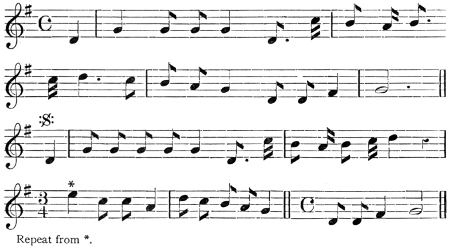
—Rimbault’s Nursery Rhymes.
I.
The first day of Christmas, my true love sent to me A partridge in a pear-tree. The second day of Xmas, my true love sent to me Two turtle doves and a partridge in a pear-tree. The third day of Xmas, my true love sent to me Three French hens and two turtle doves and A partridge in a pear-tree. The fourth day of Xmas, my true love sent to me Four colly birds, three French hens, two turtle doves, and A partridge in a pear-tree. The fifth day of Xmas, my true love sent to me Five gold rings, four colly birds, three French hens, Two turtle doves, and a partridge in a pear-tree. The sixth day of Xmas, my true love sent to me Six geese a-laying, five gold rings, Four colly birds, three French hens, Two turtle doves, and a partridge in a pear-tree. The seventh day of Xmas, my true love sent to me Seven swans a-swimming, Six geese a-laying, five gold rings, Four colly birds, three French hens, Two turtle doves, and a partridge in a pear-tree. The eighth day of Xmas, my true love sent to me Eight maids a-milking, seven swans a-swimming, Six geese a-laying, five gold rings, Four colly birds, three French hens, two turtle doves, and A partridge in a pear-tree. The ninth day of Xmas, my true love sent to me Nine drummers drumming, eight maids a-milking, Seven swans a-swimming, six geese a-laying, Five gold rings, four colly birds, three French hens, Two turtle doves, and A partridge in a pear-tree. The tenth day of Xmas, my true love sent to me Ten pipers piping, nine drummers drumming, Eight maids a-milking, seven swans a-swimming, Six geese a-laying, five gold rings, Four colly birds, three French hens, Two turtle doves, and A partridge in a pear-tree. The eleventh day of Xmas, my true love sent to me Eleven ladies dancing, ten pipers piping, Nine drummers drumming, eight maids a-milking, Seven swans a-swimming, six geese a-laying, Five gold rings, four colly birds, Three French hens, two turtle doves, and A partridge in a pear-tree. The twelfth day of Xmas, my true love sent to me Twelve lords a-leaping, eleven ladies dancing, Ten pipers piping, nine drummers drumming, Eight maids a-milking, seven swans a-swimming, Six geese a-laying, five gold rings, Four colly birds, three French hens, Two turtle doves, and A partridge in a pear-tree.
—Halliwell’s Nursery Rhymes, cccxlvi.
II.
The king sent his lady on the first Yule day, A papingo-aye [a peacock]; Wha learns my carol and carries it away? The king sent his lady on the second Yule day, Three partridges, a papingo-aye; Wha learns my carol and carries it away? The king sent his lady on the third Yule day, Three plovers, three partridges, a papingo-aye; Wha learns my carol and carries it away? The king sent his lady on the fourth Yule day, A goose that was grey, Three plovers, three partridges, a papingo-aye; Wha learns my carol and carries it away? The king sent his lady on the fifth Yule day, Three starlings, a goose that was grey, Three plovers, three partridges, and a papingo-aye; Wha learns my carol and carries it away? The king sent his lady on the sixth Yule day, Three goldspinks, three starlings, a goose that was grey, Three plovers, three partridges, and a papingo-aye; Wha learns my carol and carries it away? The king sent his lady on the seventh Yule day, A bull that was brown, three goldspinks, three starlings, A goose that was grey, Three plovers, three partridges, and a papingo-aye; Wha learns my carol and carries it away? The king sent his lady on the eighth Yule day, Three ducks a-merry laying, a bull that was brown—[The rest to follow as before.] The king sent his lady on the ninth Yule day, Three swans a-merry swimming—[As before.] The king sent his lady on the tenth Yule day, An Arabian baboon—[As before.] The king sent his lady on the eleventh Yule day, Three hinds a-merry hunting—[As before.] The king sent his lady on the twelfth Yule day, Three maids a-merry dancing—[As before.] The king sent his lady on the thirteenth Yule day, Three stalks o’ merry corn, three maids a-merry dancing, Three hinds a-merry hunting, an Arabian baboon, Three swans a-merry swimming, Three ducks a-merry laying, a bull that was brown, Three goldspinks, three starlings, a goose that was grey, Three plovers, three partridges, a papingo-aye; Wha learns my carol and carries it away?
—Chambers’s Pop. Rhymes, p. 42.
III.
My lady’s lap dog, Two plump partridges and my lady’s lap dog; Three grey elephants, two plump partridges and my lady’s lap dog; Four Persian cherry trees, three grey elephants, &c.; Five Limerick oysters, four Persian cherry trees, &c.; Six bottles of frontignac, &c.; Seven swans a-swimming, &c., Eight flip flap, floating fly boats, &c.; Nine merchants going to Bagdad, &c.; Ten Italian dancing-masters going to teach ten Arabian magpies how to dance, &c.; Eleven guests going to celebrate the marriage of the Princess Baldroulbadour with the Prince of Terra-del-Fuego,&c.; Twelve triumphant trumpeters triumphantly trumpeting the tragical tradition of Telemachus.
—London (A. B. Gomme).
IV.
Twelve huntsmen with horns and hounds, Hunting over other men’s grounds! Eleven ships sailing o’er the main, Some bound for France and some for Spain; I wish them all safe home again. Ten comets in the sky, Some low and some high; Nine peacocks in the air, I wonder how they all come there, I do not know and I do not care. Eight joiners in a joiners’ hall, Working with the tools and all; Seven lobsters in a dish, As fresh as any heart could wish; Six beetles against the wall, Close by an old woman’s apple stall; Five puppies of our dog Ball, Who daily for their breakfast call; Four horses stuck in a bog, Three monkeys tied to a clog; Two pudding ends would choke a dog, With a gaping wide-mouthed waddling frog.
—Halliwell’s Nursery Rhymes, cclxxx., cvi.
(c) “The Twelve Days” was a Christmas game. It was a customary thing in a friend’s house to play “The Twelve Days,” or “My Lady’s Lap Dog,” every Twelfth Day night. The party was usually a mixed gathering of juveniles and adults, mostly relatives, and before supper—that is, before eating mince pies and twelfth cake—this game and the cushion dance were played, and the forfeits consequent upon them always cried. The company were all seated round the room. The leader of the game commenced by saying the first line. Generally the version used was similar to No. I. In later years the shorter version, No. III., was said. The lines for the “first day” of Christmas was said by each of the company in turn; then the first “day” was repeated, with the addition of the “second” by the leader, and then this was said all round the circle in turn. This was continued until the lines for the “twelve days” were said by every player. For every mistake a forfeit—a small article belonging to the person—had to be given up. These forfeits were afterwards “cried” in the usual way, and were not returned to the owner until they had been redeemed by the penalty inflicted being performed.
In version No. IV., the game began by the leader saying to the player sitting next to her, “Take this!” holding the hands as if giving something. The neighbour answered, “What’s this?” The leader answered, “A gaping, wide-mouthed, waddling frog.” The second player then turned to the third and repeated, “A gaping, wide-mouthed, waddling frog,” and so on all round the room. The leader then said, “Two pudding-ends would choke a dog,” continuing in the same way until twelve was reached. Chambers does not describe the way the game given by him was played, but it was probably much in the same manner. Rimbault’s Nursery Rhymes gives the tune to which words of the song were repeated. The words given are almost identical with No. I., but the tune, copied here, is the only recorded one I have found.
(d) It seems probable that we have in these rhymes a remnant of a practice of singing or chanting carols or rhymes relating to the custom of sending gifts to friends and relatives during the twelve days of Christmas. The festival of the twelve days was an important one. The great mid-winter feast of Yule consisted of twelve days, and from the events occurring during those days it is probable that events of the future twelve months were foretold.—On the festival of the twelve days consult Keary’s Outlines of Primitive Belief, p. 381. Miss Burne records that the twelve days rule the year’s weather; as the weather is on each day of the twelve, so will it be in the corresponding month, and for every mince-pie eaten in friends’ houses during these days a happy month is promised. In the games usually played at this season, viz., those in which forfeits are incurred, and the redemption of these by penances inflicted on the unhappy perpetrators of mistakes, we may perhaps see a relic of the observance of certain customs and ceremonies, and the penalties likely to be incurred by those persons who omitted to religiously carry them out. It is considered unlucky in the North of England and Scotland to enter a neighbour’s house empty-handed. Christmas bounties, and the practice of giving presents of food and corn and meal on St. Thomas’s Day, 21st December, to the poorer people, when they used to go round to the farmers’ houses to collect food to prepare for this festival, may have had its origin in the idea that nothing could be prepared or cooked during the festival of the twelve days. It was a very general practice for work of all kinds to be put entirely aside before Christmas and not resumed until after Twelfth Day. Dr. Gregor records that no bread should be baked nor washing done during this period, nor work left unfinished. Jamieson, in a note on Yule, says that the gifts now generally conferred at the New Year seem to have originally belonged to Yule. Among the northern nations it was customary for subjects at this season to present gifts to their sovereign,—these were called Jolagiafir, i.e. Yule gifts. The custom in Scotland of presenting what we vulgarly call a sweetie-skon, or a loaf enriched with raisins and currants, has an analogy to this.
It is difficult, with the scanty evidence at command, to do more than make the simple suggestions above. The game is evidently in a process of very rapid decadence, and we have probably only poor specimens of what was originally the form of verses sung in the two versions from Halliwell and Chambers. The London version, No. III., is only recognisable as belonging to this game from the fact that it was known as playing at the “twelve days,” was always played on Twelfth Day, and it was not considered proper nor polite for the guests to depart until this had been played. This fact has induced me to add the fourth version from Halliwell, because it appears to me that it may belong to the final form which this game is taking, or has taken, namely, a mere collection of alliterative nursery words, or rhymes, to puzzle the speaker under a rapid repetition, and to exact forfeits for the mistakes made.
See “Forfeits.”
Twelve Holes
A game similar to “Nine Holes,” mentioned in Florio ed., 1611, p. 20.—Halliwell’s Dictionary.
Uncle John is Ill in Bed
I.
Uncle John is ill in bed, What shall I send him? Three good wishes, and three good kisses, And a race of ginger. Who shall I send it by? By the carrier’s daughter; Catch her by the lily-white hand And carry her over the water. Sally goes a-courting night and day, Histal, whistal, by her side, Johnny Everall by her side.
—Shrewsbury, Chirbury (Burne’s Shropshire Folk-lore, p. 511).
II.
Uncle Tom is very sick, What shall we send him? A piece of cake, a piece of bread, A piece of apple dumpling. Who shall we send it with? Mrs. So and So’s daughter. She is neither without, She is neither within, She is up in the parlour romping about. She came downstairs dressed in silk, A rose in her breast as white as milk. She pulled off her glove, She showed me her ring, To-morrow, to-morrow the wedding shall begin.
—Nairn (Rev. W. Gregor).
(b) The Shropshire version is played by the children forming a ring by joining hands. After the eighth line is sung all the children stoop down—the last to do so has to tell her sweetheart’s name. In the Scotch version the players stand in a row. They sing the first five lines, then one player is chosen (who chooses another); the other lines are sung, and the two shake hands. Another version from Scotland (Laurieston School, Kirkcudbright, Mr. J. Lawson), is very similar to the one from Nairn.
Mr. Newell (p. 72) gives versions of this game which are fuller and more complete than those given here. He thinks it bears traces of ancient origin, and may be the last echo of a mediæval song, in which an imprisoned knight is saved from approaching death by the daughter of the king, or soldan, who keeps him in confinement.
Up the Streets
[Play]
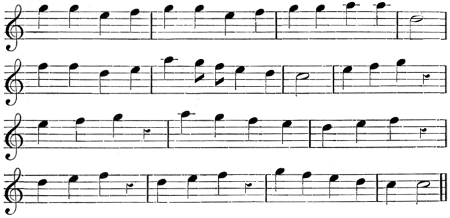
—Liverpool (C. C. Bell).
I.
Up the streets and down the streets, The windows made of glass; Is not [naming one of the children] a nice young lass? She can dance, she can sing, She can show her wedding-ring. Fie, for shame! fie, for shame! Turn your back behind you.
—Liverpool (C. C. Bell).
II.
Up streets, down streets, Windows made of glass; Isn’t “Jenny Jenkins” a handsome young lass? Isn’t “Johnny Johnson” as handsome as she? They shall be married, When they can agree.
—Monton, Lancashire, Colleyhurst, Manchester (Miss Dendy).
III.
Up street and down street, Each window’s made of glass; If you go to Tommy Tickler’s house You’ll find a pretty lass.
—Halliwell’s Nursery Rhymes, cccclxxx.
(b) In the Liverpool version the children stand in a ring and sing the words. At “Fie, for shame,” the child named ceases to sing, and the others address her particularly. When the verse is ended she turns her back to the inside of the ring. All do this in turn. The Monton game is played the same as “kiss-in-the-ring” games.
(c) Northall (English Popular Rhymes, p. 549), gives a version almost the same as the Monton version. He also quotes some verses from a paper by Miss Tennant in the English Illustrated Magazine, June 1885, which she gives as a song of the slums of London. In Gammer Gurton’s Garland (1783, reprint 1810, p. 34), is a verse which is the same as Halliwell’s, with two additional lines—
Hug her, and kiss her, and take her on your knee, And whisper very close, Darling girl, do you love me?
[Addendum]
Wadds and the Wears (1)
Mactaggart, in describing this, says it is one of the most celebrated amusements of the Ingle ring. To begin it, one in the ring speaks as follows:—
I hae been awa at the wadds and the wears These seven lang years; And come hame a puir broken ploughman, What will ye gie me to help me to my trade?
He may either say he’s a “puir broken ploughman” or any other trade, but since he has chosen that trade some of the articles belonging to it must always be given or offered to recruit it. But the article he most wants he privately tells one of the party, who is not allowed to offer him anything, as he knows the thing, which will throw the offerer in a wadd, and must be avoided as much as possible, for to be in a wadd is a very serious matter. Now, the one on the left hand of the “poor ploughman” makes the first offer by way of answer to what above was said—“I’ll gie ye the coulter to help ye to your trade.” The ploughman answers, “I don’t thank ye for the coulter; I hae ane already.” Then another offers him another article belonging to the ploughman’s business, such as the moolbred, but this also is refused: another gives the sock, another the stilts, another the spattle, another the naigs, and so on until one gives the soam, which was the article he most wanted, and was the thing secretly told to the one player. This throws the giver into a wadd, out of which he is relieved in the following manner:—