Volume 1 — ADDENDA
Reading edition
A’ the Birdies.
[See “All the Birds,” vol. i. p. 2; “Oranges and Lemons,” vol. ii. pp. 25-35.]
A’ the birdies i’ the air Tick tae to my tail.
A contest game of the oranges and lemons class. Two players, who hold hands and form the arch, call out the formula, and the other players, who are running about indifferently, go one by one to them and decide, when asked, which side they will favour, and stand behind one or the other.
After the tug the side which has lost is called “Rotten eggs, rotten eggs.”—Aberdeen (Rev. Dr. Gregor).
All the Boys.
[Vol. i. pp. 2-6.]
Two versions of this game, one from Howth and another from St. Andrews, sent me by Miss H. E. Harvey, do not differ sufficiently from the versions i. and ii. printed as above to be given here in full.
The St. Andrews game, after the line,
“I love you, and you love me”
(as printed in vol. i. version ii.), continues—
When we get married, I hope you will agree, I’ll buy the chest of drawers, you’ll buy the cradle. Rock, rock, bubbly-jock, Send her upstairs, lay her in her bed, Send for the doctor before she is dead. In comes the doctor and out goes the clerk, In comes the mannie with the sugarally hat. Oh, says the doctor, what’s the matter here? Oh, says Johnny, I’m like to lose my dear. Oh, says the doctor, nae fear o’ that.
American Post.
One player of a party acts as post and leaves the room. When he is outside he knocks at the door. Another player, who is the doorkeeper (inside), calls out, “Who’s there?” The reply is, “American post.” “What with?” “A letter.” “For whom?” The name of one of the players in the room is given by the post. The one named then must go outside, and kiss the post, and in turn becomes post.—Fraserburgh (Rev. Dr. Gregor).
This, sometimes called “Postman,” is now more generally played as a penalty when forfeits are being performed. The player whose penalty it is, is the first one to be “post.” Postage is demanded, the amount being paid by kisses.
As I was Walking.
The players, usually girls, stand in line up to a wall. One in front sings, going backwards and forwards.
As I was walking down a hill, down a hill, down a hill, As I was walking down a hill, Upon a frosty morning. Who do you think I met coming down, coming down, &c., Who do you think I met, &c.
She then chooses one from the line and both sing:—
I met my true love coming down, &c. He gave me kisses, one, two, three (clap hands), Upon a frosty morning.—Cullen (Rev. Dr. Gregor).
Auld Grannie.
[A version of “Hen and Chickens,” vol. i. pp. 201, 202.]
Here a variation of dialogue occurs. The game is played as previous Hen and Chicken games. The Hen says—
What are ye scrapin’ for?
Auld grannie says—
A darning needle? What are ye going to do with the darning needle? Mak a poke. What to do with the poke? To gang to the peat moss to get some peats. What for? To make a fire, to make some tea, to pour over your wee chickens.
Auld grannie rushes at them, and pretends to throw the water over them. When she has caught some players, and the sides are about equal in strength, the game ends in a tug of war.—Dalry, Galloway (J. G. Carter.)
Another, called “Grannie’s Needle,” has a slightly different parley.
What are you looking for, granny? My granny’s needle. What are you going to do with the needle, granny? To make a bag. And what are you going to do with the bag, granny? To gather sand. What are you going to do with the sand, granny? To sharpen knives. And what are you going to do with the knives, granny? To cut off your chickens’ heads.
—Belfast (W. H. Patterson).
[Addendum] [Addendum] [Addendum]
Ball.
[Pots, vol. ii. p. 64.]
1. Throw the ball up against a wall three times and catch it.
2. Throw it up and clap hands three times before catching it.
3. Throw it up and put your hands round in a circle.
4. Throw it up and clap your hands before and behind.
5. Throw it up and clap and touch your shoulder.
6. Throw it up and clap and touch your other shoulder.
7. Throw it up three times with your right hand and catch it with your right.
8. Throw it up with your left and catch it with your left.
9. Throw it up with your right and catch it with your right, dog snack fashion (i.e. as a dog snacks, knuckles up).
10. Throw it up with your left and catch it with your left (dog snack).
11. Throw it up and clap and touch your knee.
12. Throw it up and clap and touch your other knee.
13. Throw it up and turn round.
These actions should each be performed three times.—Laurieston School, Kircudbrightshire (J. Lawson).
This is a more complete version of “Pots.”
Another game is—
One girl takes a ball, strikes it on the ground, and keeps pushing it down with her hand. While she is doing this, the other players stand beside her, and keeping unison with the ball, repeat—
Game, game, ba’ ba’, Twenty lasses in a raw, Nae a lad amon them a’ Bits game, game, ba’, ba’.
If the girl keeps the ball dancing up and down—“stottin’” during the time the words are being repeated, it counts one game gained. She goes on “stottin’” the ball, and the others go on repeating the words till she allows the ball to escape from her control.—Fraserburgh (Rev. Dr. Gregor); Dalry, Galloway (J. G. Carter).
Another rhyme for a ball game is—
Little wee laddie, foo’s yer daidie? New come oot o’ a basket shadie. A basket shadie’s ower full, New come oot o’ a roarin’ bull. A roarin bull’s ower fat, New come oot o’ a gentleman’s hat. A gentleman’s hat’s ower fine, New come oot o’ a bottle o’ wine. A bottle o’ wine is ower reid, New come oot o’ a crust o’ breid. A crust o’ breid is ower broon, New come oot o’ a half-a-croon. A half-a-croon is ower little, New come oot o’ a weaver’s shuttle. A weaver’s shuttle’s ower holey, New come oot o’ a paint pottie, Game, game, game, game, game!
—Rev. Dr. Gregor.
Bannockburn.
[See Fool, Fool, come to school, vol. i. p. 132.]
Played as “Fool” with these differences. The namer cries to the fool in the same formula as the Sussex version (vol. i. p. 133). The fool, called here “Bannockburn,” says, “Are ye it?” to each player pointing to them in turn. When she points at the correct one that player runs off. Bannockburn runs after and tries to catch her. If the first runner can get back into the row untouched she gets renamed, if caught she has to take Bannockburn’s place.
During the naming, Bannockburn tries to overhear the names given. But when noticed coming near, those being named, cry “Bannockburn away dune the sea.”—Dalry, Galloway (J. G. Carter).
Black Doggie.
[see Drop Handkerchief, vol. i. 109-112.]
A form of Drop Handkerchief differing from those versions previously given.
The players join hands, form a circle and stretch out as far as each one’s arms will allow. One player is outside the ring. When she sees they can stretch no further she cries out “Break,” when they all loose hands and stand as far apart as possible. The player outside then goes round the ring singing, “I have a black doggie, but it winna’ bite you, nor you, nor you,” until she comes to one whom she chooses; she then throws the handkerchief down on the ground behind this one quietly. If this player does not notice the handkerchief, not one in the circle must tell her, or they are “out.” The player who dropped the handkerchief walks round until she comes again to the one behind whom she dropped it. She picks it up and tells her she is “burnt.” Then this player has to stoop down on her knees and is out of the game. Should the selected player notice the handkerchief, she picks it up and pursues the other round and through the ring, following wherever the first one leads until she catches her; they then change places; should she not follow the exact way the first player went, she too is out and must go down on her knees.—Rosehearty (Rev. Dr. Gregor).
Another version from Fraserburgh says that the players may either join hands in a ring or sit upon the ground on their knees. The outside player goes round the circle three times, first saying “Black Doggie winna tack you, nor you.” Then she goes round again and drops the handkerchief behind any one she pleases. She then runs and is pursued until caught, the other child following Black Doggie in and out wherever she goes.[Addendum] [Addendum]
Bonnet Ridgie.
[“Scots and English,” vol. ii. pp. 183-184.]
Players are chosen alternately by two chiefs. The line is drawn between the two sides, and the caps of each side are placed on the ground at each of the ends. When the two sides are ranged, the players try to catch and pull each other across the line. If one is pulled across he is called a “slink,” and must stand till he is set at liberty by one of his own side crossing the line and touching him. If this one manages to touch him before he is crowned, i.e., has the crown of his head touched by one of his opponents, and if he is able to regain his own side before the same operation takes place, both are free. Each player watches an opportunity to gather up the caps of the opposing side. If one is clever and swift enough to reach the caps and gather them all before he is crowned, his side wins.—Dyke School (Rev. Dr. Gregor.)
Button, The.
[“Diamond Ring,” vol. i. p. 96; “Forfeits,” p. 137; “Wads and the Wears,” vol. ii. pp. 327-8.]
Played as “Diamond Ring,” except that all sit round the fire, one man takes a button, puts it between his two hands, and goes round to each of the other players, who have their two hands held out, palms together, saying, “Don’t tell what you got,” and quietly dropping the button into one player’s hands. He then asks the first man, saying, “Who has the button?” One player is named. The master of the game says then “What forfeit will you give me that he has it?” The player gives a forfeit. So on all round, every one guessing and giving a forfeit (including he who holds the button, who, of course, keeps his secret). When all the forfeits are in the master says, “Button, button, show, and let all fools know;” then those who have guessed right receive back their forfeits. The holder of the button then kneels down to deliver sentences on the others. The master takes a forfeit and holds it over the kneeler’s head, saying, “Fine, fine, superfine, what’s the owner of this fine thing of [gentleman’s or lady’s] wear to do?” The man kneeling gives a sentence, such as—to take the broom, ride it three times round the room, and each time kiss the crook hanging in the chimney—and so on.
If a man refuses to perform his sentence he is made to kneel down, and everything that can be got hold of is piled on his back.—Kiltubbrid, Co. Leitrim (L. L. Duncan).
Canlie.
[See “Tom Tiddler’s Ground,” vol. ii. p. 298.]
Name for “Friar’s Ground,” in Co. Cork. “Canlie” is the Friar. The game is played as at Chirbury.—Co. Cork (Mrs. B. B. Greene).
Carry my Lady to London.
[Vol. i. p. 59.]
Carry a lady to London town, London town, London town; London town’s a bonny place, It’s a’ covered o’er in gold and lace.
Or—
Carry a lady to London town, London town, London town; Carry a lady to London town Upon a summer’s day.
Another rhyme for “Carry my Lady to London,” and played in the same way.—Galloway, N. B. (J. G. Carter).
Cat and Dog Hole.
[Vol. i. p. 63; “Tip-cat,” vol. ii. p. 294.]
Two versions of this, differing somewhat from those given previously.
(1.) Played by two players. A hole is dug in the ground, and one player with a “catch-brod” stands in a stooping attitude in front of it, about a foot and a-half away, placing one end of the “catch-brod” on the ground. The other player goes to a distance of some yards, to a fixed point called “the stance.” From here he throws a ball, intending to land it in the hole. The other player’s object is to prevent this by hitting it away with his “catch-brod.” If the bowler succeeds they change places.
(2.) This also is played by two players, and in the same way, except that a stone is substituted for the hole, and the bowler’s object is to strike the stone with the ball. Sometimes it is played with three players, then running is allowed. When the ball is hit the batter tries to run to the “stance” and back, the bowler or the third player then tries to hit the “stance” with the ball while the batter is away making the run. If the third player can catch the ball before it touches the ground he tries to hit the stone with it, thus sending the batter out.—Keith (Rev. Dr. Gregor).
Catch the Salmond.
Two boys take each the end of a piece of rope, and give chase to a third till they contrive to get the rope round him. They then pull him hither and thither in all directions.
—Banchory (Rev. Dr. Gregor).
Evidently an imitation of net-fishing.
Chicken come Clock.
[See “Fox and Goose,” “Hen and Chicken,” vol. i. pp. 139-141, 201; vol. ii. p. 404.]
The children, boys and girls, squat down and take hold of hands, going round, and saying—
Chicken come clock around the rock, Looram, lorram, lumber lock. Five mile and one o’clock, Now the thief is coming. In comes Tod with his long rod, And vanishes all from victim vad. It is, it was, it must be done, Tiddlum, toddlum, twenty-one. Johnny, my dear, will you give me the loan of your spear, Till I fight for one of those Kildares, With a hickety, pickety pie.
At these words one lad, who has been hiding behind a tree, runs in to catch one of the chickens. As the rhyme is finished, they all run, and the fox tries to catch one, another player, the old hen, trying to stop him, the chickens all taking hold of her by the tail.
The fox has to keep on his hands and feet, and the old hen has to keep “clocking” on her “hunkers.”
Some of the children substitute these words for the latter part of the above:—
The crow’s awake, the kite’s asleep, It’s time for my poor chickens To get a bit of something to eat— What time is it, old granny?
—Kiltubbrid, Co. Leitrim (L. L. Duncan).
Mr. Duncan says this game has almost died out, and the people were rather hazy about the words they used to say.
Chippings, or Cheapings.
[See “Tops,” vol. ii. pp. 299-303.]
A game with peg tops played by two or more boys. A large button, from which the shank has been removed, or a round piece of lead about the size of a penny, is placed on the ground between two agreed goals. The players divide into sides, each side tries to send the button to different goals, the tops are spun in the usual way, and then taken up on the hand while spinning, and allowed to revolve once round the palm of the hand, and then thrown on the ground on the button in such a way that the button is projected some distance along the ground. Then a boy on the opposite side spins his top and tries to hit the button in the opposite direction. This is continued alternately until one or other side succeeds in getting the button to the goal.—London Streets (A. B. Gomme).
Chucks.
[Vol. i. p. 69; also “Five-stones,” pp. 122-129, “Huckle-bones,” pp. 239-240.]
A rhyme repeated while playing at “Chucks” with five small stones, lifting one each time.
Sweep the floor, lift a chair, Sweep below it, and lay it down. Cream the milk, cream the milk, Quick, quick, quick, Spread a piece and butter on it thick, thick, thick.
—Perth (Rev. Dr. Gregor).
Churning.
Churn the butter-milk, quick, quick, quick, I owe my mother a pint of milk.
This game used to be played on the shore, just as the tide went out, when the feet sank easily into the sand. The children turned half-way round as they repeated the words.—Isle of Man (A. W. Moore).
Codham, or Cobhams.
[“Tip it,” vol. ii. p. 294.]
A game resembling “Tip it,” and a better form of the game. The parties are decided by a toss up. The object is passed from hand to hand under the table, until the leader of the opposite side calls out “up” or “rise.” When all the closed hands are on the table, the leader orders any hands off which he thinks do not contain the object. If the last hand left on the table contains the object the sides change places, if not the same sides repeat, twelve successful guesses making “game,” each failure counting one to the opposite side. The game is called “Up Jenkins” in the North of Scotland. The words have to be called out when the hands are called to show. Another name is “Cudlums;” this word was called out when the leader pointed to the hand which he believed held the object.—Bedford (Mrs. A. C. Haddon).
Colley Ball.
[“Monday,” vol. i. p. 389.]
The same game as “Monday,” with this difference. The player who first throws the ball against the wall calls out the name of the child he wishes to catch it, saying “A—— B——, no rakes, no better ball.” If the ball goes on the ground the one called has to snatch the ball up and throw it at one of the retreating children.—Hemsby, Norfolk (Mrs. A. C. Haddon).
Also sent me from Isle of Man (A. W. Moore), where it is called “Hommer-the-let.”
Dan’l my Man.
[“Jack’s Alive,” vol. i. p. 257.]
A little slip of wood or straw is lit and blown out, and while it is red it is passed round from one to another, each man repeating as fast as he can—
Dan’l, my man, If ye die in my han’, The straddle and mat is sure to go on.
The man in whose hand the spark dies has to go down on his knees. A chair, or some other article, is held over him, and he has to guess what it is, the others crying out—
Trum,[15] trum, what’s over your head?
If he is wrong it is left on him and another article brought, and so on.—Kiltubbrid, Co. Leitrim (L. L. Duncan).
Deil amo’ the Dishes, The.
[“Ghost at the Well,” vol. i. p. 149.]
One player acts as mother, and sends off one of the other players (her daughters) to take a message. She comes back, pretends to be frightened, and says she can’t go, as there’s something “chap, chap, chappin’.” The mother sends another daughter with her this time, telling them “It’s only your father’s breeks, drap, drap, drappin’.” These two return in the same way, saying again “There’s something chap, chap, chappin’.” Another daughter is now sent with the other two, the mother saying “Its only the ducks, quack, quack, quackin’.” They all come back again more frightened saying the same thing. Then the mother and all the others go together to see what the matter is. They come upon another player who has been sitting apart making a noise with a stone. They all cry out “The deil’s amo’ the dishes,” and there is a great chase.—Aberdeen (Rev. Dr. Gregor).
Dig for Silver.
Dig for silver, dig for gold, Dig for the land that I was told. As I went down by the water side I met my lad with a tartan plaid. My wee lad is a jolly sailor, And shall be for evermore. (Name of boy) took the notion To go and sail on the ocean. He took poor (name of girl) on his knee, And sailed across Kilmarnock sea. Stop your weeping, my dear ——, He’ll come back and marry you. He will buy you beads and earrings, He will buy you a diamond stone, He will buy a horse to ride on, When your true love is dead and gone. What care I for the beads and earrings, What care I for the diamond stone, What care I for the horse to ride on, When my true love is dead and gone.
—Laurieston School, Kircudbrightshire (J. Lawson).
Another version is—
Billy Johnston took a notion For to go and sail the sea; He has left his own true love Weeping on the Greenock quay. I will buy you beads and earrings, I will buy you diamonds three, I will buy you beads and earrings, Bonny lassie, if you marry me. What care I for beads and earrings, What care I for diamonds three, What care I for beads and earrings, When my own true love is far from me.
—Perth (Rev. Dr. Gregor).
Compare with this “Keys of Heaven,” p. 437, and “Paper of Pins,” p. 450.
Dilsee Dollsie Dee.
[See “Here’s a Soldier,” vol. i. p. 206, and “Three Dukes,” vol. ii. pp. 233-255].
A ring is formed, one child standing in the middle, all sing the words—
Which of us all do you love best, do you love best, do you love best, Which of us all do you love best, my dilsee dollsie dee. Which of us all do you love best, my dilsee dollsie dofficer.
The child in the centre says—
You’re all too black and ugly (three times), my dilsee dollsie dee, You’re all too black and ugly, my dilsee dollsie dofficer.
The first verse is repeated, and the child in the centre points to one in the ring and says—
This is the one that I love best, that I love best, that I love best, This is the one that I love best, my dilsee dollsie dee. This is the one I love the best, my dilsee dollsie dofficer.
The centre child takes the one selected by the hand, and they stand together in the centre, while the ring dances round and sings—
Open the gates to let the bride out, to let the bride out, to let the bride out, Open the gates to let the bride out, my dilsee dollsie dee. Open the gates to let the bride out, my dilsee dollsie dofficer.
The children then unclasp hands, and the two children walk out. Another child goes in the centre and the game is begun again, and continued until the ring is too small for dancing round. Sometimes, instead of this, the two children return to the ring singing, “Open the gates and let the bride in,” and then they take places in the circle, while another goes in the centre.—(Dr. A. C. Haddon.)
Doagan.
An extraordinary game, which was played by Manx children sixty years ago. A rude wooden representation of the human form was fastened on a cross, and sticks were thrown at it, just after the fashion of the modern “Aunt Sally.” But it is quite possible that this game, taken in connection with the following very curious words which the children repeated when throwing the sticks, is a survival of a more serious function—
Shoh dhyt y Doagan. “This to thee, the Doagan.” Cre dooyrt y Doagan? “What says the Doagan?” Dar y chrosh, dar y chron, “Upon the cross, upon the block,” Dar y maidjey beg, jeeragh ny cam, “Upon the little staff, straight or crooked,” Ayns y cheylley veg shid hoal, “In the little wood over yonder.” My verrys oo yn kione jeh’n Doagan, “If thou wilt give the head of the Doagan,” Verym y kione jeeds er y hon.[16] “I will give thy head for it.”
Mr. Moore writes that Kelly, who gives these words in his Dictionary, says that Doagan was a play, and that it refers to the head of Dagon being broken off. Does he mean the Philistine god of that name? As he is capable of seeing a reference to the god, Baal, in the Manx word for May-day, Boaldyv, it is quite possible that his imagination may lead him so far!—Isle of Man (A. W. Moore).
Down in Yonder Meadow.
[Vol. i. p. 99; ii. p. 323; “All the Boys,” i. 2-6.]
Down in yonder meadow where the green grass grows, Where (name of girl) she bleaches her clothes; She sang, she sang, she sang so sweet, She sang (name of boy) across the street. He kissed her, he kissed her, he bought her a gown, He bought her a gown and a guinea gold ring, A guinea, a guinea, a guinea gold ring, A feather for the church and a pea-brown hat. Up the streets and down the streets the windows made of glass, Oh, isn’t (name of girl) a braw young lass. But isn’t (name of boy) as nice as she, And when they get married I hope they will agree. Agree, agree, I hope they will agree, And when they get married I hope they will agree.
—Laurieston School, Kirkcudbrightshire (J. Lawson).
Down in yonder meadow where the green grass grows, Where so and so (a girl’s name) she bleaches her clothes; She sang, and she sang, and she sang so sweet, Come over (a boy’s name), come over, come over the street. So and so (same girl’s Christian name) made a pudding so nice and sweet, So and so (same boy’s Christian name) took a knife and tasted it. Taste, love; taste, love; don’t say no, For the next Sabbath morning to church we must go. Clean sheets and pillowslips, and blankets an’ a’, A little baby on your knee, and that’s the best of a’. Heepie tarrie, heepie barrie, bo barrie grounds, Bo barrie ground and a guinea gold ring, A guinea gold ring and a peacock hat, A cherry for the church and a feather at the back. She paints her cheeks and she curls her hair, And she kisses (boy’s name) at the foot o’ the stair.
—Fraserburgh (Rev. Dr. Gregor).
The above are played in the same way as previously described.
Another version, from Perth, says, after the line, “She sang, and she sang” (as above).
Come over the water, come over the street, She baked him a dumpling, she baked it so sweet That bonny (Billie Sanders) was fain for to eat, &c. Down in the meadows where the green grass grows, There’s where my Nannie she sound her horn; She sound, she sound, she sound so sweet; ...... Nannie made the puddin’ so nice and so sweet, Johnny took a knife and he taste a bit; Love, taste; love, taste, and don’t say nay, For next Sunday mornin’ is our weddin’-day. Off wid the thimble and on wid the ring; A weddin’, a weddin’, is goin’ to begin. O Nannie, O Nannie, O Nannie my joy, Never be ashamed for to marry a boy! For I am but a boy, and I’ll soon be a man, And I’ll earn for my Nannie as soon as I can. And every evenin’ when he comes home, He takes her for a walk on the Circular Road. And every little girl that he sees passin’ by, He thinks ’tis his Nannie he has in his eye.
—Howth, Dublin (Miss H. G. Harvey).
Draw a Pail of Water.
[Vol. i. pp. 100-107].
A lump of sugar, Grind your mother’s flour, Three sacks an hour, One in a rush, two in a crush, Pray, old lady, creep under the bush (all jump round).
—Girton village, Cambridgeshire (Dr. A. C. Haddon).
Drop Handkerchief.
[Vol. i. pp. 109-112; “Black Doggie,” vol. ii. p. 407.]
As played at Fochabers the game varies slightly in the way it is played from those previously described. The words are—
“I dropt it, I dropt it, a king’s copper next, I sent a letter to my love, and on the way I dropt it.”
The players forming the ring are forbidden to look round. The one having the handkerchief endeavours to drop it at some one’s back without his or her knowledge, and then to get three times round the ring without being struck by the handkerchief. If the player does not manage this she has to sit in the centre of the ring as “old maid;” the object in this version evidently is not to let the player upon whom the handkerchief is dropped be aware of it.—Fochabers, N.E. Scotland (Rev. Dr. Gregor).
Dumb Crambo.
[See “Hiss and Clap,” vol. i. p. 215.]
The players divide into two sides: one side goes outside the room, the other remains in the room, and decides on some verb to be guessed and acted by the other. The outside party is told that the chosen verb “rhymes with ——.” The outside party decide on some verb, and come in and act this word in dumb show, whilst the inside party sit and look on, hissing if the guess is wrong, and clapping if the acting shows the right word is chosen. No word must pass on either side.—Bedford, and generally known (Mrs. A. C. Haddon).
Dump.
[Vol. i. p. 117.]
A version of this game played by three children. The three sit close together, close their hands and place them over each other, the first one on the knee of one of them. One then asks, “Faht’s that cockin’ up there?” “Cock a pistol; cock it aff,” replies another. The same process is gone through till only one hand is left on the knee. Then the one whose hand was uppermost at the beginning of the game says—
Faht’s in there? Gold and money (is the answer). Fahr’s my share o’t? The moosie ran awa’ wi’t. Fahr’s the moosie? In her hoosie. Fahr’s her hoosie? In the wood. Fahr’s the wood? The fire brunt it. Fahr’s the fire? The water quencht it. Fahr’s the water? The broon bull drank it. Fahr’s the broon bull? At the back a (of) Burnie’s hill Fahr’s the back a Burnie’s hill? A’ claid wi’ snaw. Fahr’s the snaw? The sun meltit it. Fahr’s the sun? Heigh, heigh up i’ the air.
He who speaks first, or laughs first, or lats (lets) their teeth be seen, gets nine nips, nine nobs, an’ nine double douncornes, an’ a gueed blow on the back o’ the head.—Corgarff (Rev. Dr. Gregor).
Eendy, Beendy.
Eendy, Beendy, baniba, roe, Caught a chicken by the toe; To the east, to the west, To the old crow’s nest, Hopping in the garden, swimming in the sea, If you want a pretty girl, please take me.
—N. Scotland, locality forgotten (Rev. Dr. Gregor).
One girl dances forward from a line of children singing the words. Another from a line opposite responds, and they dance together. They look first to the east and then to the west by turning their heads in those directions alternately.
Farmer’s Den, The.
All players but one form a ring, this one stands in the centre. The ring dances round singing the words—
The farmer in his den, the farmer in his den, For it’s oh, my dearie, the farmer’s in his den. For the farmer takes a wife, For the farmer takes a wife; For it’s oh, my dearie, the farmer takes a wife.
The child in centre then chooses one from the circle, who goes in the middle, and the ring dances round again singing—
For the wife takes a child, &c. (as above).
And choosing another child from the ring, then—
For the child takes a nurse, &c. (as above). For the nurse takes a dog, &c. (as above).
Then all the players join in singing—
For we all clap the dog, For we all clap the dog. For it’s oh! my dearie, we all clap the dog.
While singing this all the players pat the one who was chosen as “dog” on his or her back.—Auchencairn, N.B. (Mary Haddon).
Fire on the Mountains.
[See “Round Tag,” vol. ii. pp. 144-145.]
The players arrange themselves into a double circle with a space between each pair. The one at the back stands and the inside players kneel. Another player stands in the centre and cries out, “Fire on the mountain; run, boys, run!” Those players who are standing in the outer circle begin to run round, those kneeling remaining in that position. They continue running until the centre player cries “Stop!” They all then (including the centre player) make a rush to get a stand behind one of the kneeling players, the one who is left out going into the centre.—Auchterarder, N.B. (Miss E. S. Haldane).
This game may possibly suggest an origin for “Round tag,” although the incident of “catching” or “touching” a runner does not appear, and the inner circle of players apparently are always stationary.
Fool, Fool, come to School.
[Vol. i. p. 132.]
Played in the usual way with the following difference in the formula. The leader says, “Fool, foolie, come to your schoolie.” When the fool comes, the leader says, “What have you been doing to-day?” Fool says, “Cursin’ and swearin’.” Fool is then chased off, recalled, and again questioned. Fool answers, “Suppin’ my porridge and readin’ my Bible.” She is then welcome, and asked in the usual way to point out one from the school.—Aberdeen (Rev. Dr. Gregor).
Another formula sent me by Mr. C. C. Bell is to say, when the fool is sent back, “Fool, fool, go back to school, and learn more wit.”
French Jackie,
name for “Round Tag” and “Two and Threes,” in Tyrie (Rev. Dr. Gregor).
Galloping.
Galloping, galloping to the fair, Courting the girls with the red petticoats; Galloping, galloping all day long, Courting the girls with the speckled petticoats.
Girls sing this resting one knee on the ground, striking the other knee with their right hand as they say each word. The length of the song depends upon the ingenuity of the players in finding new colours for the petticoats each time.—Isle of Man (A. W. Moore).
The game is not known now.
Gallant Ship.
[See “Round and Round the Gallant Ship,” vol. ii. p. 143.]
Up spoke a boy of our gallant ship, And a well-spoken boy was he— I have a mother in London town, This night she’ll be looking for me. She may look, she may sigh, with the tear in her eye, She may look to the bottom of the sea. Three times round went our gallant ship, And three times round went she! And three times round went our gallant ship, Till she came to the bottom of the sea!
The players form a ring and dance round, getting quicker as they sing “Three times round,” &c. When the last line is sung they let go hands and sink to the ground. The player who sinks down first is taken away by the others and asked whom he or she loves best. The ring is then reformed, and the child who has given her sweetheart’s name is placed in the centre. The ring then dances round singing out the name of the sweetheart.
Mrs. Brown is new comed hame, A coach and four to carry hame.
—Galloway (J. G. Carter).
Galley, Galley Ship.
[See “Merry-ma-tansa,” vol. i. pp. 369-376; ii. p. 443.]
Three times round goes the galley, galley ship, And three times round goes she; Three times round goes the galley, galley ship, And she sank to the bottom of the sea. Choose your neighbours one or two, One or two, one or two; Choose your neighbours one or two, Around about Mary Matanzie. A treacle scone to tell her name, To tell her name, to tell her name; A treacle scone to tell her name, Around about Mary Matanzie. A guinea gold watch to tell his name, To tell his name, to tell his name; A guinea gold watch to tell his name, Around about Mary Matanzie. (Name of boy) is his name, Is his name, is his name, —— is his name, Around about Mary Matanzie.
—Laurieston School, Kircudbrightshire (J. Lawson).
A version of “Merry-ma-tansa,” incomplete. [See vol. i. p. 375.]
Another is—
Three times around goes our gallant ship, And three times around goes she, she, she; And three times around goes our gallant ship, And she sinks to the bottom of the sea.
Played in ring form with one child in centre. All sink down on the ground when the above lines are sung, and the last to rise must tell the name of her sweetheart. Then the circle forms around her, and all sing—
Here’s the bride just new come in, Just new come in, just new come in; Here’s the bride just new come in, Around the merry guid tanzy. Guess wha’s her guid lad, Her guid lad, her guid lad; Guess wha’s her guid lad, Around the merry guid tanzy. (Willie Broon) is his name, Is his name, is his name, (Willie Broon) is his name, Around the merry guid tanzy.
—St. Andrews and Howth (Miss H. E. Harvey).
Miss Harvey writes: I believe “tanzy” is the name of a kind of dance.[Addendum]
Glasgow Ships.
Glasgow ships come sailing in, Come sailing in, come sailing in; Glasgow ships come sailing in, On a fine summer morning. You daurna set your foot upon, Your foot upon, your foot upon; You daurna set your foot upon, Or gentle George will kiss you. Three times kiss you, four times bless you, Five times butter and bread Upon a silver salver. Who shall we send it to, Send it to, send it to? Who shall we send it to? To Mrs. ——’s daughter. Take her by the lily-white hand, Lead her over the water; Give her kisses, one, two, three. She is the favourite daughter.
—Perth (Rev. Dr. Gregor).
Glasgow ships come sailing in, &c. (three times) Three times bless you, three times kiss you, Three times butter and bread upon a silver saucer. Whom shall I send it to, I send it to, I send it to? To Captain Gordon’s daughter.
—Rosehearty (Rev. Dr. Gregor).
The Glasgow ships come sailing in, &c. (as first version). Three times down and then we fall, then we fall, then we fall, Three times down and then we fall, in a fine summer morning. Three times butter and bread, butter and bread, butter and bread, Three times butter and bread upon a silver saucer. Come, choose you east, come choose you west, Come, choose you east, come choose you west, To the very one that you love best.
—Nairn (Rev. Dr. Gregor).
Glasgow ships come sailing in, &c. (as first version) She daurna set a foot upon, &c. Or gentle John will kiss her. Three times round the ring, three times bless her, I sent a slice of bread and butter upon a silver saucer. Whom shall we send it to? &c. To Captain ——’s daughter. Her love’s dead and gone, dead and gone, dead and gone, She turns her back to the wa’s again. She washes her face, she combs her hair, She leaves her love at the foot of the stair, She wears on her finger a guinea gold ring, And turns her back to the wa’s again.
All join hands and form a ring. At the end of verses the girl named turns her back, and the game is resumed.—Fochabers (Rev. Dr. Gregor); Port William School, Wigtonshire.
In a version from Auchterarder, N. B., sent by Miss E. S. Haldane, the words are very similar to these. After all the children have turned their backs to the inside they have what is called the “pigs’ race,” which is running swiftly round in this position. See “Uncle John,” vol. ii. pp. 321-322.
Granny’s Needle.
[See “Auld Grannie.”]
Green Gravel.
[Vol. i. pp. 170-183.]
Round apples, round apples, by night and by day, There stands a valley in yonder haze; There stands poor Lizzie with a knife in her hand, There’s no one dare touch her, or she’ll go mad; Her cheeks were like roses, and now they’re like snow, Poor Lizzie! poor Lizzie! you’re dying, I know, We’ll wash you with milk, and we’ll dry [or roll] you with silk, And we’ll write down your name with a gold pen and ink.
—New Galloway (Rev. Dr. Gregor).
Boys and girls take hands and go round saying—
Round the green gravel Grass grows green, Many’s the lady fit to be seen, Washed in milk and dried in silk. The last pops down!
The last boy or girl to pop down has to tell who he (or she) is courting.—Kiltubbrid, Co. Leitrim (L. L. Duncan).
Green Grass.
[Vol. i. pp. 153-169.]
All the girls arrange themselves in a line, and one stands in front. The one in front sings—
Dis-a-dis-a green grass, Dis-a-dis-a-dis; Come all ye pretty fair maids, And walk along wi’ us. Will ye have a duck, my dear (pointing to one of the girls in the line), Or will ye have a drake, Or will ye have a young man To answer for your sake?
The girl pointed to answers—
I’ll neither have a duck, my dear, Nor will I have a drake; But I will have a young man To answer for my sake.
She now leaves the line and takes her stand beside the one that stands in front, and all begin to clap their hands and sing—
The bells will ring, And the psalms will sing, And we’ll all claps hands together.
The two in front then begin to sing what the one first sang, and the same goes on till all are chosen.—Peterhead; St. Andrews (Mrs. Stewart, when a girl).
Here we go in a merry band, Round about the berry buss; Come all ye pretty fair maids, And dance along with us; We shall have a duck and drake, We shall have a dragon, We shall have a young man, The prince of the Saigen. The young man dies, And leaves the girl a widow. The birds shall sing, the bells shall ring, And we will all clap hands together. Here we go a roving, A roving in a band; I will take my pretty Mary, I will take her by the hand.
—Perth (Rev. Dr. Gregor).
Another version, very similar to that given in vol. i. pp. 161-162 from Congleton Workhouse School, and sent me by Mr. J. Lawson, Laurieston School, Kirkcudbrightshire, begins, “Will you take silver and gold?”
Another Scottish version of this game is given in Notes and Queries, 3rd ser., v. 393, as follows:—
A duss, a duss of green grass, A duss, a duss, a duss; Come all you pretty maidens, And dance along with us; You shall have a duck, my dear, And you shall have a dragon, And you shall have a young gudeman, To dance ere you’re forsaken. The bells shall ring, The birds shall sing, And we’ll all clap hands together.
Green Grass.
[A game so called by Dr. Gregor, but apparently not belonging to the one usually known under that name.]
The girls stand in a line, and one stands in front. All sing—
Green grass suits us, As my boots are lined with silver; E. I. O, E. I. O, my ain bonnie (a girl’s Christian name).
The girl in front then chooses the girl named, and both girls join hands and wheel round, whilst all sing—
I kissed her once, I kissed her twice, I kissed her three times over. Hop, hop, the butcher’s shop, I cannot stay any longer. If I stay my mother will say I played with the boys up yonder.
—Tyrie (Rev. Dr. Gregor).
Another version is—
Green grass set her fair, a bunch of gold and silver, A white rosette upon her breast, a gold ring on her finger, A I O, my Jessie O; I wish I had my Jessie O. I kissed her once, &c., as above.
Heap the Cairn.
[See “More Sacks to the Mill,” vol. i. p. 390.]
One boy is thrown flat on the ground, then another is thrown over him, and then another and another, and the bigger boys dash the smaller ones on those that are down, while all keep shouting—
Heap the cyarn— Dirt and sharn.
—Keith (Rev. Dr. Gregor).
Hear all! Let me at her.
Hear all! let me at her; Hear all! let me go; Hear all! let me at her, When my mammy will or no. —— has ta’en a notion For to go and sail the sea; There he’s left his own dear ——, Weeping on the Greenland sea. Hold your tongue, my own dear ——, Take your baby on your knee. Drink his health, my jolly sailors, I’ll come back and marry thee. I will buy thee beads and ear-rings, I will buy thee diamond stones, I will buy thee silken ribbons, When thy baby’s dead and gone. —— says she’ll wear the ribbons, —— says she’ll wear them a’— —— says she’ll wear the ribbons When her baby’s dead and gone.
A ring is formed, one player in the centre. When the verses are sung the girl in the middle chooses another to take her place.—Fochabers (Rev. Dr. Gregor.)
Hen and Chickens.
[See “Auld Grannie,” p. 404.]
High Windows.
[See “Drop Handkerchief,” vol. i. pp. 109-112; “Black Doggie,” vol. ii. pp. 407-408.]
Boys hold hands and go round in ring form.
One player stands in the middle and strikes one of those in the ring with a bit of grass; both players then run out of the ring, and the boy who was in the midst must catch the other before he goes round three times. At the third time the boys all cry “High Windows,” raising their hands at the same time to let the two inside the circle.—Kiltubbrid, Co. Leitrim (L. L. Duncan).
Hot Cockles.
[Vol. i. p. 229.]
A version of this game, in which a dell or goal is appointed. The players stand together, one player places his head between the knees of another, who bends down, and slaps him on the back, keeping time to the following rhyme, saying—
Skip, skip, sko, Where shall this young man go? To the east, or the west? Or the young crow’s nest?
The kneeling boy shouts out the name of the dell, and the other players all rush off shouting out its name. The one who gets there first wins the game.—Meiklefolla, Aberdeenshire (Rev. Dr. Gregor).
Hulla-balloo-ballee.
[See “Lubin,” vol. i. pp. 352-361.]
One version of Lubin Loo, from Forfar, Linlithgow, and Argyllshire, is the same as those given in vol. i. A Nairnshire version is called “Hullabaloo-ballee.”
Hulla-balloo, ballee, Hulla-balloo, ballight; Hulla-balloo, ballee, All on a winter’s night, Put your right foot in, &c. Turn round about.
At “turn round about,” they reverse the direction, and dance round the other way, and so on.—Rev. Dr. Gregor; and Mrs Jamieson.
Another version is—
Old Simon, the king, young Simon, the squire, Old Simon, the king, sat round a nice warm fire; Keep your right hand in, shove your right hand out, Shake it a little, a little, and turn yourself about! Keep your right foot in, shove your left foot out, Shake it a little, a little, and turn yourself about. Hally gallee, gallee, gallee; Hally gallo, gallo, gallo; Hally gallee, gallee, gallee, Upon a Saturday night. Keep your right hand in, &c.
—Galloway (J. G. Carter).
Several versions of this game are given by Mr. E. W. B. Nicholson in his interesting little book “Goldspie,” pp. 176-184. He considers “Hilli-ballu,” “Hulla-baloo,” and similar words to be the original of the English forms “Here we dance Looby Loo,” or Lubin, and all of these to be derived from hunting cries, such as ha, là bas! loup! uttered by huntsmen to definite musical notes, possibly introduced into songs and afterwards adapted as lullabies because of their resemblance to the lulling-cries ba (= bye) and lulli.
Isabella.
[Vol. i. pp. 247-256.]
Two or three versions which vary slightly in method of playing may be given. The first is played in the usual way until the last line is said, when the player turns her back to the circle facing outwards as in Wall-flowers.
Isabella, Isabella, Isabella, farewell; There is my hand, love, there is my hand, love, farewell! Over the mountains, over the mountains, over the mountains, farewell! Her love’s dead and gone, dead and gone, dead and gone! Her love’s dead and gone, turn your back behind her.
—Perth (Rev. Dr. Gregor).
Another version is—
Isabella, fare ye wella; Isabella, fare ye wella; Isabella, farewell!
One player then leaves the ring singing—
“I’m off to the Indies,” &c.
The ring all sing—
“Over the mountains” (as above) six times, ending with—
“Isabella, Isabella, farewell” (as above).
The player who had previously left the ring returns singing, “I’m come back from the Indies,” &c.
A ring is formed, one player kneels in the centre, the players in the ring fix their eyes steadily on the kneeling girl all the time.—Fochabers, N.E. Scotland (Rev. Dr. Gregor).
In the next version the words of each verse are:—
Isabella, farewella, &c. Back from London, &c. Go to London, &c. Pull the brooch off my bosom, &c. Pull the ring off my finger, &c.
—Laurieston School, Kircudbrightshire (J. Lawson).
Jenny Jones.
[Vol. i. pp. 260-283.]
The versions printed here vary, it will be seen, from those printed in vol. i., principally in the words used towards the end of the game, the earlier portions being very similar. The first one is an exceedingly interesting variant, the funeral details being fuller, and the idea of the spirit of the dead or Ghost surviving also.
The first lines of each verse are as follows:—
I’ve come to see Jenny Jones, How does she do? She is washing, &c., you can’t see her now. I’ve come to see Jenny Jones, &c. She is scrubbing, &c., you can’t see her now. I’ve come to see, &c. She is ill, &c. I’ve come to see, &c. She’s very ill, &c. I’ve come to see, &c. She’s dying, &c. I’ve come to see. She’s dead. We’ll come in blue, blue, blue. Will that suit? Blue is for sailors, &c. That won’t suit. We’ll come in red, &c. Red is for soldiers, &c. We’ll come in white, &c. White is for weddings, &c. We’ll come in black, &c. Black is for mourning, &c. That will suit.
They then take up Jenny Jones, and carry her to a little distance off, lay her on the ground, and all stand round. One child stands over the grave, and while sprinkling Jenny with dust, says—
Ashes to ashes, dust to dust. If God won’t have you, the devil must.
Then Jenny jumps up and runs after the other children, who try to escape. The one she catches is “Jenny” next time.—Barrington (Dr. A. C. Haddon).
In another version called “Georgina” one player selected to act as Georgina kneels down against a wall, and the others stand round to conceal her. Two go apart to act as callers, while another stands near the group as mother. The callers come forward and say—
We came to see Georgina, &c. And how is she to-day? She’s upstairs washing, &c., And you can’t see her to-day. Farewell, ladies.
They then retire, but return in a little while, and put the question as before. She is then “starching,” said as above; and next time she is “ironing,” the fourth time the mother’s answer is, “She fell downstairs and broke her arm, and you can’t see her to-day;” the fifth time, “Two doctors are at her;” the sixth, she is “worse;” and the seventh, she is “dead.” The two callers remain when this reply is given. At this point Georgina makes a noise by rapping two stones together. The two at once exclaim, “Oh! mother, mother, what’s that knocking?” and she answers, “The coach going by.” The knocking is repeated, and the question, and she says, “The wall falling down.” On the knocking being heard a third time, she tells them to “take a candle and look.” They pretend to do so, and “Georgina” starts up to chase them. They all run off shouting, “The Ghost.”—Strichen and Fochabers (Rev. Dr. Gregor).
I came to see Georgina, Georgina, Georgina, I came to see Georgina, and how is she to-day? She’s upstairs ironing. I came to see Georgina, &c. (as above). She fell downstairs and broke her muckle toe. I’m very sorry to hear that, &c. She’s dead. Bad news, bad news, bad news to-day. What shall we dress her in? &c. Dress her in red. Red is for the soldier, and that won’t do, &c. What shall we dress her in? &c. Dress her in blue. Blue is for the sailor, &c. What shall we dress her in? &c. Dress her in white. White is for the angels, that will do, &c. Mother, mother, what’s that? &c. A gig running past. Mother, mother, what’s that? &c. The boys playing at marbles. Mother, mother, what’s that? what’s that? what’s that? Mother, mother, what’s that? Georgina’s ghost!!
Ending with a general stampede.
—Nairnshire (Mrs. Jamieson).
We’ve come to see poor Janet, And how is she to-day? She’s up the stairs washing, She can’t come down to-day. Very well, we’ll call another day. We’ve come to see poor Janet, And how is she to-day? She’s up the stairs ironing, &c. Well, we’ll call, &c. We’ve come to see poor Janet, &c. She’s fallen downstairs and broken her horn toes, &c. Poor Janet, we’ll call, &c. We’ve come, &c. She’s dead, &c. What’s she to be dressed in? Red. That’s for soldiers; that won’t do. Blue. That’s for sailors; that won’t do. White. That will do.
—Rosehearty (Rev. Dr. Gregor).
Played in usual way until the end. Janet is then carried off and laid down on the ground, but she starts up and chases them.
Many other versions have been sent me, but none with different features. The best is one from Mr. J. G. Carter, Dalry, Galloway, called “Jenny Jo,” but presenting no fresh details, and where white is used for the burial. Four children stand on one side with Jenny at their back, the other players on the opposite. She is buried with great mourning. In a version from Hemsby (Mrs. Haddon) the words are the same, except: “White is the colour for weddings,” and black is for funerals. Then Jenny is carried to the grave, the other children walking behind two by two; they kneel round Jenny, and have a good cry over her. Another version from Laurieston School (Mr. J. Lawson), called “Jerico,” very similar to above, gives two additional verses. The first lines are, “Carry a poor soldier to the grave,” and “Now the poor mother’s weeping at the grave.” In one version, after Jenny has been carried to her grave, the children stand round and sprinkle earth over her, and say, “Dust and dust, dust and dust,” and then pretend to strew flowers. This I got in London. Another version from North Scotland begins, “I come to see Geneva” continues in usual way until “she is lying” instead of “ill”; then “she’s dying,” followed by “she’s dead”; then the funeral. In another version Dr. Haddon sent me, the game is only a fragment. After “Jenny Jo’s dead and gone, all the day long,” they continue, “Pipes and tobacco for Jenny Jo” (repeat twice), “Pipes and tobacco for Jenny Jo, all the day long.”
Jockie Rover.
[See “Stag,” vol. ii. pp. 212, 374.]
One is chosen to be Rover, and a place is marked off called “The Den,” from which he starts, and to which he and the others caught can run for protection. He has to clasp his hands and set off in pursuit of one of the players, whom he must crown without unclasping his hands. Before he leaves the den he calls out—
Jockie Rover, Three times over, If you do not look out, I’ll gie you a blover.
When he catches one he unclasps his hands, and makes for the den along with the one caught. The players close in upon them, and beat them with their caps. The two now join hands, and before leaving the den repeat the same words, and give chase to catch another. When another is caught, the three run to the den, followed by the others pelting them.
During the time they are running to catch another player, every attempt is made by the others to break the band by rushing on two outstretched arms, either from before or from behind. Every time one is taken or the band broken, all already taken rush to the den, beaten by those not taken.—Dyke (Rev. Dr. Gregor).
A form of “Warney,” “Whiddy.”
Jolly Lads, Bold.
[Vol. i. pp. 294-296.]
Here come two bold, jolly lads, Just new come from the shore: We’ll spend our time in drinking wine, As we have done before.
Then the ring dances round, singing—
We will have a round, and a round, We will have a pretty, pretty girl, For to dance upon the ground. Her shoes are made of morocco, Her stockings lined with silk, Her teeth are white as anything, And her skin as white as milk. We shall have a round, and a round, &c.
—Auchterarder, N. B. (Miss E. S. Haldane).
A ring is formed by players joining hands. Two other players dance round the ring in opposite directions, singing the first four lines while the ring stands still. Then the ring dances round singing the rest of the lines. The two outside then each take a player from the ring and begin again.
The words of the dance game, “Here we go around,” vol. i. p. 205, are practically the same as the latter part of this, and suggests that this or a similar round is its original.
Jolly Miller.
[Vol. i. pp. 289-293.]
This is played with the usual double ring, boys on the outside, girls inside, one child in centre. At the last a rush is made to obtain a vacant place.
He was a jolly miller, He lived by himself. As the wheel went round, he made his wealth, One hand in his pocket, the other at his back, As the mill went round, he made his wealth.
The girls being in the inside, turn and go the opposite way; and, while doing so, sing—
A hunting we will go, A hunting we will go, We’ll catch a little fox, and we’ll put him in a box, And a hunting we will go.
—Auchterarder, N. B. (Miss E. S. Haldane).
In this version the “grab” appears to be lost, and the “hunting” put in before the rush for the vacant place is made.
Keys of Heaven.
I will give you a golden ring, And jewels to hang and birds to sing, If you’ll be my true lover, And true love of mine. I will give you the keys of the chest, And gold enough to dress you in church, If you’ll be my true lover, And true love of mine. I will give you the keys of even [heaven], And angels to wait upon you six and seven, If you’ll be my true lover, And true love of mine.
—Marylebone (A. B. Gomme).
Children form a ring by joining hands; they dance round. One stands in centre. She chooses another from the ring after singing the words, and the two dance round together.
This game is evidently but a fragment, the proper way of playing being forgotten. It would originally have been played in line form instead of a circle, and answers of “No” or “Yes,” or other verses implying negative and then affirmative, given by the chosen or selected girl. These lines, and those given post (p. 450), as “Paper of pins,” are interesting fragments probably of one and the same game.
Kick the Block.
[See vol. i. p. 401.]
A small circle is made, and the stone or block is put in it. A boy stands with his foot on the stone and his eyes shut until all the other players are hid. He then tries to find them, and keep his block in its place. If one should come out when he is away from his block it is kicked out, and all the boys that were found hide again.—Laurieston School, Kirkcudbrightshire (J. Lawson).
Another version of the same game, sent me by Mr. William P. Merrick, Shepperton, Middlesex, is called “Fly Whip.”
The same game as “Mount the Tin,” played somewhat differently.
Lady of the Land.
[Vol. i. pp. 313-319.]
A number of girls stand in a line. One of them represents the widow and the other the children. Another stands in front. All sing—
There came a poor widow from Sunderland, With all her children in her hand, One can bake, and one can sew, And one can do the hilygoloo. Please take one out.
The player who is standing alone in front of the other players chooses one from the line. The two then join right and left hands and wheel round in front, all singing—
Oh there’s poor (girl’s name chosen), She has gone without a farthing in her hand, Nothing but a guinea gold ring, Good-bye (girl’s name), Good-bye, good-bye.
The mother shakes hands with the one chosen.
—Fraserburgh (Rev. Dr. Gregor).
Another version—
There is a poor widow from Sankelone, With all her children in her hand, One can knit, and one sew, And one can play the liligolor.
The widow then says—
Please take one in, Please take one in.
The one in front picks out one and places her at her back, and she lays hold of her dress, then all sing—
Now for poor (girl’s name who has been chosen), she is gone, Without her father (? farthing) in her hand, She has lost her guinea gold ring, Good-bye, good-bye, Good-bye, good-bye.
The widow shakes hands with the girl. This is repeated till all are taken out and the widow is left by herself. She cries, and tries to take back her daughters. All run off.
—Cullen (Rev. Dr. Gregor).
Another Isle of Man version varies slightly, beginning, “We’re three young mothers from Babylon,” and continuing in a similar way to the one in vol. i. p. 315—
One can wash, and one can sew, Another can sit by the fire and spin, The other can make a fine bed for the king, Please, ma’am, to take one in.
The queen then says—
Come, my dearest . . . and give me your hand, And you shall have the nicest things in all this pleasant land.
The girls are thus gradually chosen.
—Isle of Man (A. W. Moore).
Here’s a poor widow from Babylon, Six poor children left alone, One can bake, and one can brew, And one can shape, and one can sew. One can sit by the fire and spin, And one can make a bed for a king; Come Tuesday east, come Tuesday west, Come choose the one that you love best.
—Galloway, N. B. (J. G. Carter).
Leap-Frog.
[Vol. i. pp. 133, 327, 328.]
The chief rules of this game, obtaining in N.E. Scotland in Dr. Gregor’s boyhood, were:—The boy that stooped his back was called “the bull,” pronounced “bill.” The bull was not to “horn,” i.e., throw up his back when the player placed his hands on it to leap over, or to bend his back down, and that the player was to lay his hands on the bull’s back quite flat, and not to “knockle,” i.e., drive the knuckles into it. The best way to play was:—A line was drawn beside the bull, over which the heel of the player must not pass. All the players, the one after the other in succession, leaped over the bull. The one last over called out, “Fit it,” i.e., foot it, which meant that the bull had to measure from the line a breadth and a length of his foot. This done he stooped, and all the players went over as before, and another breadth and length of foot were added. This went on as long as the players thought they were able to leap over the bull. When they thought they could not do so, the last player called out, “Hip it,” i.e., take a hop. This done, the bull put himself into position, and each player now took a hop from the line to the bull, and then went over him. Here the same process of footing was gone through as before, as long as the players were able to go clear over the bull. Then came a step with as much footing as was considered safe, and then came a jump with so much footing. It was now with the players “hip, step, an’ jump,” and over the bull. Then more “fitin’,” and perhaps another “hip,” and so on—two hips, two steps, two jumps, and a flying leap over the bull. It was not often the game reached this point. Some one of the players had failed to pass right over the bull and caused him to fall, or had overstepped the line. When any player did either the one or the other, he had to become bull.—Keith (Rev. Dr. Gregor).
This is a fuller and more complete description than that of “Foot and Over” (vol. i. p. 133).
Another mode of playing leap-frog is: the players stand with their backs to the leapers, and only bend the head and the leaper’s hands are placed between the shoulders. Instead of running a few yards in front, each player advances only a few feet, leaving just as much room as to allow the player scope to fall and spring again. This mode requires considerable agility and practice. The higher the leap, so much the greater the fun.—Keith (Rev. Dr. Gregor.)
London Bridge.
[Vol. i. pp. 333-350.]
In the following versions of the game only the first lines of each verse are given, as said by each side. Descriptions of method of playing were not in all cases sent me. They are probably the same as those given under this game in vol. i., which is for two players to form an arch by holding up their joined hands, and the other players running under it.
(1.)
London Bridge is falling down, &c., my fair lady. What will it take to build it up? &c. Needles and pins will build it up, &c. Needles and pins will not hold, &c. Bricks and mortar will build it up, &c. Bricks and mortar will wash away, &c. Silver and gold will build it up, &c. Silver and gold will be stolen away, &c. We will set a watchman to watch all night, &c. What if the watchman falls asleep, &c. We will set a dog to bark, &c. See the robbers passing by, &c. What have the robbers done to you? &c. They have broke my locks and stole my gold, &c. Off to prison they must go, &c. What will you take to set them free? &c.
—Perth (Rev. Dr. Gregor).
(2.)
London Bridge is broken down, Build it up with lime and stone; Lime and stone will build and break; Set an old man to watch all night. Perhaps this man will run away, Ten times the wedding day.
—Tyrie (Rev. Dr. Gregor).
(3.)
Broken bridges falling down, falling down, falling down, my fair lady. What will you give to mend it up? &c.
Those running under the arch say—
A guinea gold ring will mend it up, &c.
The two players say no.
A pin I’ll give to mend it up. No! A thousand pounds to mend it up; This will waste away, my fair lady; We’ll mend it up with golden pins, my fair lady, For golden pins will never rust, never rust, my fair lady.
—Fochabers, N.E. Scotland (Rev. Dr. Gregor).
(4.)
The broken bridge is falling down, falling down, falling down, The broken bridge is falling down, my fair lady; Stones and bricks will build it up, &c.
—Nairnshire (Rev. Dr. Gregor).
(5.)
Broken bridges falling down, My fair lady, which will you have? Open the door for the king’s soldiers. What king are you? I am true to the very last one.
—Isle of Man (A. W. Moore).
Versions of this game from Scotland have been sent me, which show great similarity to those previously printed, but the game is more or less in a state of decadence. The best version is that from Perth. One from St. Andrews, Peterhead, though only consisting of the first verse, has preserved the refrains, “Dance o’er the Lady Lee” and “With a gay lady” of Halliwell’s version. The others commence “broken bridges.” The Isle of Man version is still more incomplete. A version sent me by Dr. Haddon from Barrington is similar to the one given, vol. i. p. 338-9, from Enborne School, and is not therefore printed here.
Magician.
A mirror is covered with a cover, and a girl or boy is taken into the room. She or he is then asked what animal or thing they would like to see. As soon as the wish is stated, the cover is raised, and the child sees his or herself.—London (A. B. Gomme).
Mannie on the Pavement.
One player has charge of the pavement. It is his duty to keep the others off. The others try how often they can touch the wall, and when the “mannie” catches one, that one becomes “mannie.”—Aberdeen (Rev. Dr. Gregor).
Merry-ma-Tansa.
[Vol. i. pp. 369-376; ii. 422-424.]
Here we go round by jingo ring, by jingo ring, by jingo ring, Here we go round by jingo ring, in a cold and frosty morning. Twice about and then we fall, and then we fall, and then we fall, Twice about and then we fall, in a cold and frosty morning.
All bend down. The one who rises up last goes into the centre of the circle, and those in the circle sing—
Choose your maidens all around, all around, all around, Choose your maidens all around, on a cold and frosty morning.
The one in the centre chooses two from the ring, and retires with them a short distance away, when the name of a boy is selected as the lover. During the time the three are standing apart, those in the ring let go each other’s hands, and take hold of the sides of their dresses, and make as if they were sweeping a house, singing the while—
Swype the hoose till the bride comes hame, the bride comes hame, the bride comes hame, Swype the hoose till the bride comes hame, on a cold and frosty morning.
When the three come back, the one that was in the centre takes up the same position, and the two she picked out join those in the circle. Then all wheel round and sing—
A golden pin to tell her name, tell her name, tell her name, A golden pin to tell her name, in a cold and frosty morning.
The answer is—
—— (girl’s name is given) is her name, is her name, is her name, —— is her name, in a cold and frosty morning.
Then comes the lover’s name—
A golden watch to tell his name, tell his name, tell his name, A golden watch to tell his name, in a cold and frosty morning.
The answer is—
So-and-so is his name, is his name, is his name, So-and-so is his name, in a cold and frosty morning.
The one in the middle is then blindfolded, and all wheel round and sing—
Blindfolded dinna catch me, dinna catch me, dinna catch me, Blindfolded dinna catch me, on a cold and frosty morning.
The blindfolded tries to catch one in the ring. The ring should not break, but it is often broken by the one that is on the eve of being caught. The one caught takes her stand in the centre, and the game begins anew from that point.—Dyke (Rev. Dr. Gregor).
This is a most interesting variant of this game—blindfolding the bridegroom in order that he must first catch his bride, and her attempts to elude his caresses, are significant of early custom.
Here we go round by jing-ga-ring, Jing-ga-ring, jing-ga-ring; Here we go round by jing-ga-ring, Around the merry-ma-tansy. Three times round, and then we fall, Then we fall, then we fall; Three times round, and then we fall, Around the merry-ma-tansy. Choose your maidens all around, All around, &c.; High gates till the bride comes in, The bride comes in, &c. A golden pin to tell her name, To tell her name, &c. (Mary Anderson) is her name, Is her name, &c. Blindfold you all around, All around, &c.
A ring with one child in centre, who chooses one from the circle, at the end of third verse, after whispering the bride’s name together outside the circle, they are admitted at “high gates,” when all the girls hold up their hands in arches as they dance round. All players in the ring are then blindfolded, and have to catch the child in the centre.—Nairnshire (Rev. Dr. Gregor).
Another version is—
Here we go round by jingo-ring, By jingo-ring, by jingo-ring, Here we go round by jingo-ring, And round by merry matansy. Twice about, and then we fall, And then we fall, and then we fall. Twice about, and then we fall, And round by merry matansy.
—Fochabers (Rev. Dr. Gregor).
In another version from St. Andrews and Peterhead, with same words, the players all flop down, then rise again and dance round.
Another form of words is—
Here we go round by jingo-ring, Jingo-ring, jingo-ring. Here we go round by jingo-ring In a cold and frosty morning. Three times round, and then we fall, Then we fall, then we fall, Three times round, and then we fall, In a cold and frosty morning.
—Nairn (Rev. Dr. Gregor).
Another similar version from N. Scotland, locality not known.
Round about the jingo-ring, &c. Round about the jingo-ring, &c. First time is catching time, &c., round, &c. A fine gold ring to tell her name, &c. (——) is her name, &c. Third time is kissing time, &c., round, &c.
—London (A. B. Gomme), from Scotch source.
[Addendum]
Milking Pails.
[Vol. i. pp. 376-388.]
A version sent me by Mr. M. L. Rouse, Blackheath, is similar to those previously printed, varying only at the end. After the “wash in the river,” and “the stream will carry the clothes away,” the children say, “Men, you may run after them.” Hereupon they all run off, but the mother does not chase them. They return, and a dialogue ensues similar to a part of “Mother, may I go out to play,” follows between the mother and children:—
“Where have you been all day?”
“Working for Jack, or aunt.”
“What did he give you?”
“A piece of plum-pudding as big as a flea, or a piece of bread as big as a house, and a piece of cheese as big as a mouse.”
The children then run off again, come quickly back with the news that they had seen a large bull in the meadow.
“Where’s the butcher?”
“Behind the stable door cracking nuts, and you may have the shells.” The mother then chases the children, beating all she can catch.
My Delight’s in Tansies.
[See “Sunday Night,” vol. ii. p. 221.]
All the girls stand in a line except one who stands in front of the others. This one walks or dances backwards and forwards. All sing the words—
My delight’s in tansies, O! My delight’s in bransies, O! My delight’s in a red, red rose; The colour o’ my ——
the name of one in the line chosen by the one in front is said. The two in front join right and left hands, and all sing—
Hey ho, my ——, O! My bonnie, bonnie ——, O! A’ the warld wid I gie, For a kiss o’ ——, O. My delight’s in Nancy, O! My delight’s in tancy, O! My delight’s in a red, red rose, [She chooses out a girl] Call her, oh! my (a girl’s name), O! Hey, ho, my ——, O! My bonnie, bonnie ——, O! A’ the warld wad I gie For a kiss o’ ——, O!
—Fraserburgh (Rev. Dr. Gregor).
Namer and Guesser.
[Vol. i. p. 409.]
Another version of this game. It is begun in the same way. As each player gets his name, he or she turns their back to the namer. When all are named, and are standing with their backs to the namer, the namer calls out, “Baker, baker, your bread is burnin’,” or “Bakerie, bakerie, your bread is burnin’.” The guesser answers, “Will you give a corner of it to me?” or “Give me a corner of it,” and takes a stand beside the namer. The namer then says—
Come, cheese me east, Come, cheese me west, Come, cheese me to “Rose.”
The guesser points to one of the players. If the guess is right, the player goes to the guesser’s side; if wrong, to the namer’s side, when all the players except one are chosen. This one gets two names, say “Needles” and “Preens.” The namer then says to the guesser, “Needles” or “Preens”? A guess is made. This is done three times, and each time the names are changed. If the last guess is made correctly, then the player goes to the guesser, if not, to the namer. Sometimes it is decided by “the best o’ three.” Then comes the “tug of war.” The gaining side calls out “Rotten eggs, rotten eggs!”—Fraserburgh (Rev. Dr. Gregor).
Needle Cases.
Needle cases, needle cases, in a silver saucer. Who shall I direct it to but Captain ——’s daughter. What will you give to tell her name, tell her name, tell her name? A hundred pounds and a glass of wine. (The girl’s name is given, and she then asks)— What will you give to tell his name? (The others answer)— Two hundred pounds and a glass of wine. (Boy’s name given by girl). As I gaed down to borrow a pan, I saw her sitting kissing her man; She off with the glove and on with the ring. To-morrow, to-morrow the wedding begins. Clean the brass candlesticks, clean the fireside, Draw up the curtains and let’s see the bride.
All the players but one stand in a circle—this one goes round with a handkerchief, singing the first lines. When the girl’s name is mentioned she tells her sweetheart’s name to the girl with the handkerchief, sits down in the centre, and covers her face with her hands. The one with the handkerchief goes round again, asking, “What will you give?” and the ring answers. Her name is then given, and the girl with the handkerchief again asks, “What will you give to tell his name?” The ring answers again, and the sweetheart’s name is then given. The girl with the handkerchief goes round again and sings the last lines, the ring singing with her. Then the one in the centre joins the ring, and the game begins again.—Aberdeen (Rev. Dr. Gregor).
Nuts in May.
[Vol. i. pp. 424-433.]
Many versions of this have been sent me, but none differ materially from those printed previously.
Odd Man.
A game played by two or three hundred persons who form a circle; every one places his stick in the ground before him, by way of barrier. A person called the odd man stands in the middle and delivers his bonnet to any one in the ring. This is nimbly handed round, and the owner is to recover it; and on succeeding, takes the place of the person whom he took it from, and that person takes the middle place.—Pennant’s “Voyage to the Hebrides,” p. 231.
Old Cranny Crow.
[Vol. i. p. 201; ii. pp. 404-405.]
This game resembles “Hen and Chickens,” but though of that class of game it is not, it will be seen, the usual form of “Hen and Chickens” at its conclusion. The earlier part of the game and dialogue, if any, may, however, have been similar. Mr. Rouse says: “I cannot recollect more of Old Cranny Crow than that she entices children one by one out for a walk, and steals them from their supposed mother. The mother is then invited to dine by Old Cranny Crow, and has a pie (one of her children) set before her, with pepper and salt, which she pretends to eat, and when doing so discovers it to be just like her Tommy (or other child’s name). Then Cranny Crow puts another pie before her; this she discovers to be just like her Katy. She finds out all her children one by one, and they come to life again and run home.”—M. L. Rouse, Blackheath. [See “Mother, mother, pot boils over,” “Witch.”]
Old Johanny Hairy, Crap in!
All players sit round the fire and put out their right feet. The Master of the game repeats—
Onery, twoery, dickery dary, Wispy, spindey, spoke of the lindey, Old Johanny Hairy Crap in![17]
Each word is repeated to a man; and when the leader comes to “Crap in,” the man specified draws in his foot. When all have drawn in their feet but one, this one must then kneel down, and his eyes being blindfolded, the master of the game puts his elbow on his back and strikes him with his elbow or fist, saying—
Hurley, burley, trump the trace, The cow ran through the market-place. Simon Alley hunt the buck, How many horns stand up?
At the same time holding up several fingers. The man kneeling down has to guess the number. If he guesses correctly, the master of the game takes his place. If he fails to guess he is kept down, and another man goes and strikes his back, and so on.—Kiltubbrid, Co. Leitrim (L. L. Duncan.)
A version of “Hot Cockles,” with interesting variations.
Mr. Duncan, when sending me the games he collected, said—“It is very possible that the people may have brought some of the games from England when returning from harvesting. This, however, does not apply to ‘Old Johanny Hairy, crap in,’ as it is now called in English. Crap isteach is the Irish for ‘draw in,’ as in Mr. O’Faharty’s ‘Sports of the Winter’ there is a Gaelic version. This, I should imagine, makes it certain that, although well known elsewhere, the game also obtained in the West of Ireland.”
Paper of Pins.
Paper of pins to you I bring; Say is my love worth anything? Gold and silver to you I bring; Say is my love worth anything? No, I’ll not have anything;
or,
Yes, I will have what you bring.
A ring is formed, and one player walks round outside saying the first four lines, stopping at any child she chooses who answers “Yes” or “No.” If “Yes,” the two go into the ring and kiss.—Marylebone, London (A. B. Gomme).
This is interesting, as a possible fragment of the old Keys of Canterbury [Halliwell’s “Nursery Rhymes,” No. cccclxvi.] and of the Paper of Pins, described so fully by Mr. Newell in “Games and Songs of American Children,” pp. 51-55.
See “Keys of Heaven,” ante, p. 437.
Pickie.
A form of Hopscotch. [See “Hopscotch,” vol. i. pp. 223-227.]
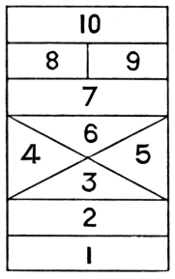
One player commences first by winning the toss. The pick (a small flat stone) is pitched into No. 1 bed. It is then moved out of this first place, backward across the front line, and not otherwise by touching or forcing it with one foot, the other foot being kept up; that is, the player must hop and use the foot on the ground to strike “pick.” No line must be touched. If this happens, or if the pick, when being driven towards the pitching line, gets away otherwise than across the front line, the player is “out,” and the next boy goes in. All the beds are done likewise, and all must be then done in a reverse way, beginning with No. 10. The first player who completes the game wins.—Waterville, Co. Kerry (Mrs. B. B. Green).
Poor Widow.
[Vol. ii. pp. 62, 63.]
Here’s a poor widow from Babylon, All her sons and daughters are gone. Come choose to the east, come choose to the west, Come choose you the very one that you like best. Now they are married I wish them joy, Every year a girl and boy. Loving each other like sister and brother, A happy new couple may kiss together.
—Laurieston School, Kircudbrightshire (J. Lawson).
A circle is formed, two children in the centre, one of whom kneels, the other walks round singing—
I am a poor widow go walking around, Go walking around, go walking around, my own. And all of my children are married but one, Are married but one, are married but one, my own. I put on a nightcap to keep her head warm, To keep her head warm, to keep her head warm, my own. Then rise up my daughter and choose whom you please, And choose whom you please, and choose whom you please, my own.
The mother then joins the circle, and the daughter becomes poor widow. On the mention of the nightcap a white handkerchief is spread over the head, the circle walking around slowly, and chanting the words slowly and dismally.
—Penzance (Miss Courtney).
See “Widow,” ante, p. 381.
Rashes.
A game played by children with rushes in Derbyshire, which is a relic of the old custom of rush-bearing. In the warm days of May and June the village children proceed in parties to the sedges and banks of dyke and brook, there to gather the finest and best rushes. These are brought with childish ceremony to some favourite spot, and then woven into various articles, such as baskets, parasols, and umbrellas. Small arbours are made of green bushes and strewn with rushes, inside which the children sit and sing and play at “keeping house” with much lordly ceremony. At these times they play at a game which consists in joining hands in a circle, and going round a heap of rushes singing or saying—
Mary Green and Bessy Bell, They were two bonny lasses; They built a house in yonder hill, And covered it with rashes. Rashes, rashes, rashes!
At each repetition of the word “rashes” (rushes) they loosen hands, and each picking up a lot of rushes, throw them into the air, so that they may fall on every one in the descent. Many of the articles made with rushes are hung over the chimney-piece in houses, and in children’s bedrooms, as ornaments or samples of skill, and there remain until the next season, or until the general cleaning at Christmas.—Thomas. Radcliffe, in “Long Ago,” vol. i. p. 49 (1873).
Queen Anne.
[Vol. ii. pp. 90-102.]
Lady Queen Anne, she sits in her pan, As fair as a lilly, as white as a lamb; Come tittle, come tattle, come tell me this tale, Which of these ladies doth carry the ball? My father sent me three letters, please deliver the ball.
If a correct guess is made by the opposite side, the queen and the child who had the ball say—
The ball is mine, it is not yours, You may go to the garden and pick more flowers.
—Isle of Man (A. W. Moore).
Sally Water.
[Vol. ii. pp. 150-179.]
Sally, Sally, Walker, sprinkling in a pan, Rye, Sally; rye, Sally, for a young man, Come, choose to the east, come, choose to the west, And come choose to the very one that you love best.
The choice is made here, and the two stand in the centre as usual.
Now there’s a couple married in joy, First a girl and then a boy. —— made a pudding nice and sweet, —— took a knife and tasted it. Taste, love; taste, love, don’t say no, Next Monday morning is our marriage day. Seven years after, seven years to come, This young man shall be kissed and be done.
—Fochabers, N. E. Scotland (Rev. Dr. Gregor).
Sally, Sally, Water, sprinkled in a pan, Rise, Sally; rise, Sally, for a young man. Choose the best, leave the worst, Choose the prettiest you can. Now you’re married we wish you joy, First a girl and then a boy, Seven years after son and daughter, Kiss before you go over the water.
—London (Dr. A. C. Haddon, from Miss E. A. Passmore).
Played in usual way.
Shuffle the Brogue.
[See “Hunt the Slipper,” vol. i. pp. 241, 242.]
The boys sat on their haunches in a circle. One of the players takes a small object, and hands it from one to another under the legs from behind. The players as they pass the brogue repeat the words—
Shuffle the brogue once, Shuffle the brogue twice, Shuffle the brogue thrice.
The object has always to be passed along in the same direction. One player who is blindfolded has to catch it as it is passing along. The one in whose hand it is found becomes the catcher. —Crossmichael, Kirkcudbrightshire (Rev. Dr. Gregor).
Soldiers, Soldiers.
Soldiers, soldiers, march away, Monday morning’s here again; The drums shall rattle, the pipes shall play “Over the hills and far away.” Now you’re married I wish you joy, First a girl and then a boy; If one don’t kiss, the other must, So kiss, kiss, kiss.
—Girton Village, Cambridgeshire (Dr. A. C. Haddon).
A circle is formed, and the children sing the first four lines. One chooses a partner, and they dance round in the ring.
Three Dukes.
[Vol. ii. pp. 233-255.]
In a version of the Three Dukes, collected by Dr. A. C. Haddon, the first lines are—
Here comes one duke a riding by, a riding by, A riding by (repeat). Rasima, Tasima, Tisima tay; Pray what is your will, sir? My will is to get married. Will any of my fair daughters do? They’re all as stiff as pokers. We can bend as well as you, sir.
The duke goes round, chooses one, and sings—
I go to the kitchen, I go to the hall, I pick the fairest one of all (as previous versions).
—Girton Village, Cambridgeshire (Dr. A. C. Haddon).
Three Knights from Spain.
[Vol. ii. pp. 257-279.]
A version of this game called “Gipsies,” varies slightly from those previously printed.
Here comes one gipsy come from Spain, To call upon your daughter Jane; Our daughter Jane is far too young, To be controlled by flattering tongue. Oh, very well, I must away; I’ll call again some other day. Come back, come back, Your tails are flag, And choose the fairest one you see.
The gipsy then chooses a girl from the line of players, and asks her to come. The girl asked replies, “No.” Then the gipsy turns round and dances, saying, “Naughty girl, she won’t come out (repeat), to help me in my dancing.” Again the gipsy asks the girl, when she replies, “Yes,” and goes to the gipsy, who says, “Now we have got the flower of May, the flower of May, &c., to help us with our dancing.”—Auchencairn, N. B. (Mary Haddon).
Tug-of-War Game.
Apples and oranges, two for a penny, Come all ye good scholars, buy ever so many. Come choose the east, come choose the west, Come choose the one you love the best.
Played like “Oranges and Lemons.” One child is “Apple,” and another “Orange.”—Ross-shire (Rev. Dr. Gregor).
Played in the same way is—
Pancakes and flitters is the wax of cantailers,[18] I owe you two farthings, I’ll pay you to-morrow; Here comes a candle to light you to bed, Here comes a hatchet to chop off your head.
—Isle of Man (A. W. Moore).
We are the Rovers.
[Vol. ii. pp. 343-360].
In a version sent me by Dr. Haddon, there is a slight variation. The first lines of each verse are—
Have you any bread and wine? We are the Romans. Have you, &c. Yes, we have some bread and wine, We are the English. Yes, we have, &c. Will you give us some of it, &c. No; we’ll give you none of it, &c. We will tell our magistrates, &c. We don’t care for your magistrates, &c. We will tell our new-born prince, &c. We don’t care for your new-born prince, &c. Are you ready for a fight? Yes, we’re ready for a fight. Tuck up sleeves and have a fight.
General scrimmage follows.—Girton Village, Cambridgeshire (Dr. A. C. Haddon).
When I was a Young Girl.
[Vol. ii. pp. 362-374.]
The first lines are—
When I was a naughty girl, &c., and this way went I (shrugging shoulders), When I was a good girl, &c. (folding arms, walking soberly), When I was a teacher (beating time or whacking, optional), When I went a-courting (walking arm in arm), When I had a baby (nursing apron as baby), When my baby died (crying), When my father beat me (hitting one another), When my father died, How I did laugh! (laughing).
—Girton Village, Cambridgeshire (Dr. A. C. Haddon).