← Table of contents
The Three Voyages of William Barents to the Arctic Regions (1594, 1595, and 1596)

THE THIRD VOYAGE NORTH-WARD TO THE KINGDOMES OF CATHAIA and China, in Anno 1596.

Reading edition

The first of June wee had no night, and the second of June wee had the winde contrary; but vpon the fourth of June wee had a good winde out of the west north-west, and sayled north-east.

The seuenth of June wee tooke the height of the sunne, and found that it was eleuated aboue the horizon thirtie eight degrees and thirtie eight minutes, his declination beeing twentie two degrees thirtie eight minutes; which beeing taken from thirtie eight degrees thirty eight minutes, wee found the Pole to bee seuentie foure degrees: there wee found so great a store of ice, that it was admirable: and wee sayled along through it, as if wee had past betweene two lands, the water being as greene as grasse; and wee supposed that we were not farre from Greene-land, and the longer wee sayled the more and thicker ice we found.

The tenth of June wee put out our boate, and therewith eight of our men went on land; and as wee past by John Cornelisons shippe, eight of his men also came into our boate, whereof one was the pilote. Then William Barents [our pilot] asked him whether wee were not too much west-ward, but hee would not acknowledge it: whereupon there passed many wordes betweene them, for William Barents sayde hee would prooue it to bee so, as in trueth it was.

Meane time William Barents sate in the boate, and sawe vs slide downe, and was in greater feare then wee to behold vs in that danger. In the sayd island we found the varying of our compasse, which was 13 degrees, so that it differed a whole point at the least; after that wee rowed aboard John Cornelisons shippe, and there wee eate our eggs.

The 13 of June we left the island, and sayled north and somewhat easterly, the winde being west and south-west, and made good way; so that when the sunne was north [¼ p. 11 P.M.], we gest that wee had sayled 16 [64] miles north-ward from that island.
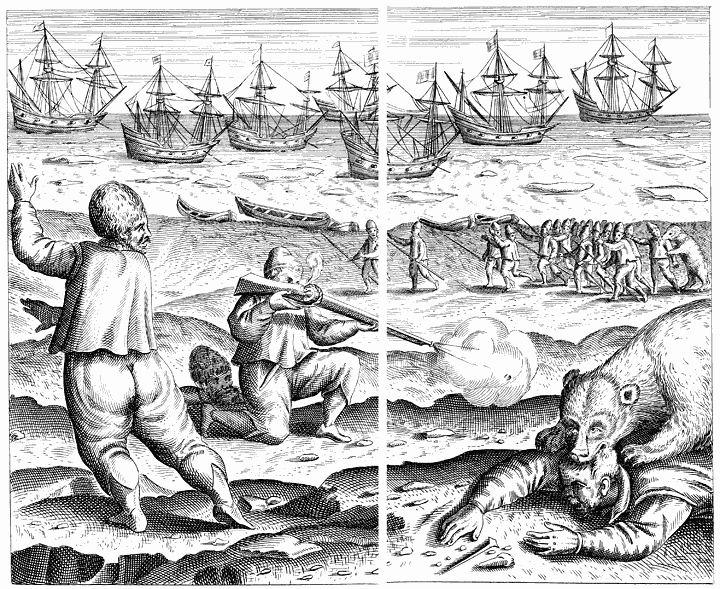
A wonder in the heavens, and how we caught a bear.

A wonder in the heavens, and how we caught a bear.

The 16 of June, with the like speed wee sayled north and by east, with mistie weather; and as wee sayled, wee heard the ice before wee saw it; but after, when it cleared vp, wee saw it, and then wound off from it, when as wee guest wee had sayled 30 [120] miles.
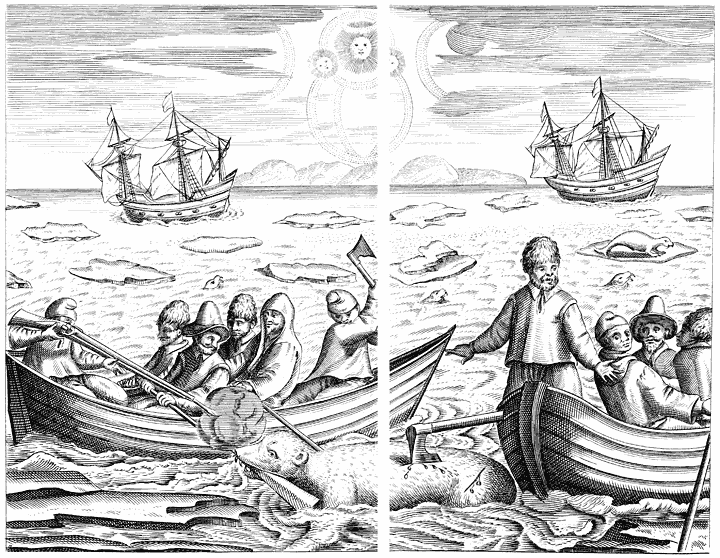
How a bear came unto our boat, and what took place with him.

How a bear came unto our boat, and what took place with him.

Touching the varying of the compasse, for the which cause our men went on land to try the certaintie thereof, it was found to differ 16 degrees.

The twenty eight of June wee gate beyonde the point that lay on the west-side, where there was so great a number of birds that they flew against our sailes, and we sailed 10 [40] miles south-ward, and after that west, to shun the ice.

The twenty nine of June wee sayled south-east, and somewhat more easterly, along by the land, till wee were vnder 76 degrees and 50 minutes, for wee were forced to put off from the land, because of the ice.

The seuenth of July wee cast out our whole lead-lyne, but found no ground, and sailed east and by south, the wind being north-east and by east, and were vnder 72 degrees and 12 minutes.

The sixteenth of July wee got out of the ice, and sawe a great beare lying vpon it, that leaped into the water when shee saw vs. Wee made towards her with our shippe; which shee perceiuing, gotte vp vpon the ice againe, wherewith wee shot once at her.

Then we sailed east south-east and saw no ice, gessing that wee were not farre from Noua Zembla, because wee sawe the beare there vpon the ice, at which time we cast out the lead and found 100 fadome deepe.

The thirtie of July, the sunne being north [½ p. 10 P.M.], there came a beare so neere to our shippe that wee might hit her with a stone, and wee shot her into the foote with a peece, wherewith shee ranne halting away.

The first of August wee saw a white beare, but shee ranne away from vs.

The fourth of August wee got out of the ice to the other side of the island, and anchored there: where, with great labour and much paine, wee fetched a boate full of stones from the land.

Then wee saw an other great peece of ice not farre from vs, lying fast in the sea, that was as sharp aboue as it had been a tower; whereunto wee rowed, and casting out our lead, wee found that it lay 20 fadome deepe, fast on the ground vnder the water, and 12 fadome aboue the water.
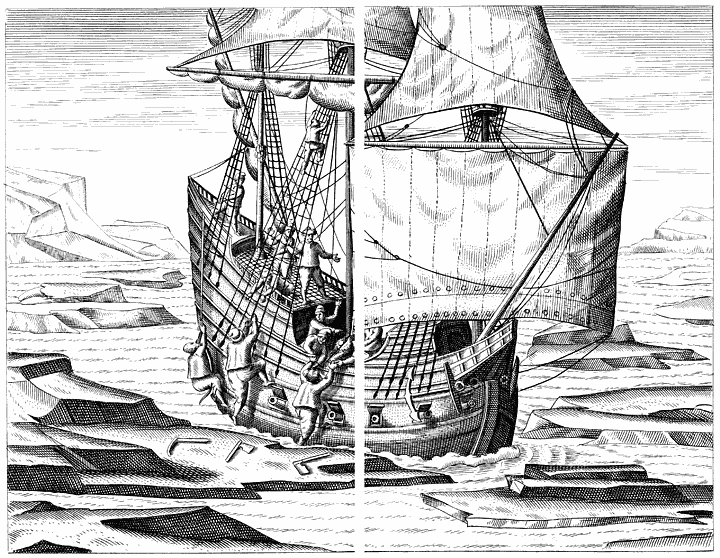
How our ship stuck fast in the ice, whereby three of us were nearly lost.

How our ship stuck fast in the ice, whereby three of us were nearly lost.

The same day in the euening we got to the west side of the Ice Hauen, where we were forced, in great cold, pouerty, misery, and griefe, to stay all that winter; the winde then being east north-east.
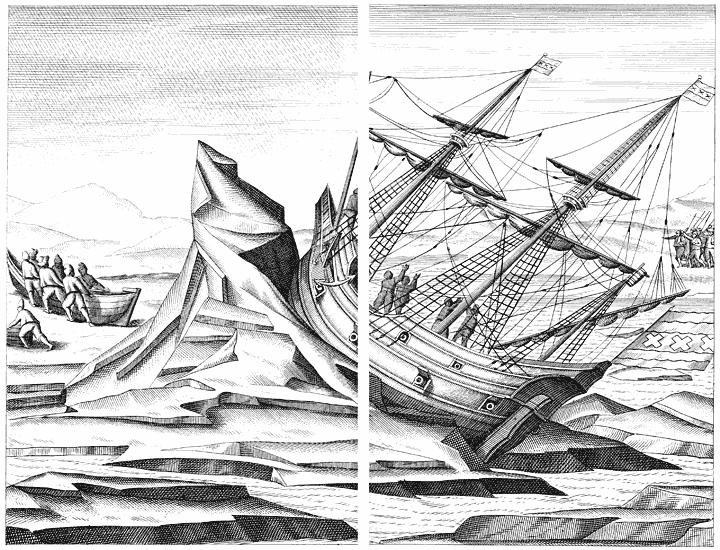
How the ice heaved up the fore part of our ship.

How the ice heaved up the fore part of our ship.

The 4 of September the weather began to cleare vp and we sawe the sunne, but it was very cold, the wind being north-east, we being forced to lye still.

The 8 of September it blew hard east north-east, which was a right contrary wind to doe vs any good touching the carrying away of the ice, so that we were stil faster in the ice, which put vs in no small discomfort.

In the night time two beares came close to our ship side, but we sounded our trumpet and shot at them, but hit them not because it was darke, and they ran away.

The 10 of September the wether was somewhat better, because the wind blew not so hard, and yet all one wind.

The 11 of September it was calme wether, and 8 of vs went on land, euery man armed, to see if that were true as our other three companions had said, that there lay wood about the riuer; for that seeing we had so long wound and turned about, sometime in the ice, and then againe got out, and thereby were compelled to alter our course, and at last sawe that we could not get out of the ice but rather became faster, and could not loose our ship as at other times we had done, as also that it began to be [near autumn and] winter, we tooke counsell together what we were best to doe according to the [circumstances of the] time, [in order] that we might winter there and attend such aduenture as God would send vs: and after we had debated vpon the matter, to keepe and defend ourselues both from the cold and the wild beastes, we determined to build a [shed or] house vpon the land, to keep vs therein as well as we could, and so to commit ourselves vnto the tuition of God. And to that end we went further into the land, to find out How God in our extremest need, when we were forced to live all the winter upon the land, sent vs wood to make vs a house and to serue vs to burne in the cold winter. the conuenientest place in our opinions to raise our house vpon, and yet we had not much stuffe to make it withall, in regard that there grew no trees, nor any other thing in that country convenient to build it withall. But we leauing no occasion unsought, as our men went abroad to view the country, and to see what good fortune might happen unto vs, at last we found an unexpected comfort in our need, which was that we found certaine trees roots and all, (as our three companions had said before), which had been driuen vpon the shoare, either from Tartaria, Muscouia, or elsewhere, for there was none growing vpon that land; wherewith (as if God had purposely sent them vnto vs) we were much comforted, being in good hope that God would shew us some further fauour; for that wood served vs not onely to build our house, but also to burne and serve vs all the winter long; otherwise without all doubt we had died there miserably with extreme cold.

The 13 of September it was calme but very mistie wether, so that we could doe nothing, because it was dangerous for vs to go into the land, in regard that we could not see the wild beares; and yet they could smell vs, for they smell better than they see.
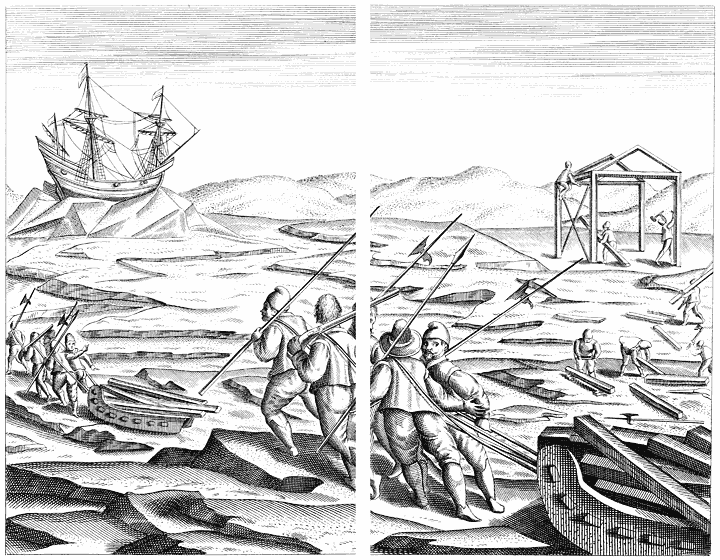
How we built a house of wood, wherein to keep ourselves through the winter.

How we built a house of wood, wherein to keep ourselves through the winter.

The 18 of September the wind blew west, but it snowed hard, and we went on land againe to continue our labour to draw wood to our place appointed, and after dinner the sun shone and it was calme wether.

[The 20 of September we again made two journeys with the sledges, and it was misty and still weather.]

The 22 of September it was faire still weather, but very cold, the wind being west.

The 27th of September it blew hard north-east, and it frose so hard that as we put a nayle into our mouths (as when men worke carpenters worke they vse to doe), there would ice hang thereon when we tooke it out againe, and made the blood follow. The same day there came an old beare and a yong one towards vs as we were going to our house, beeing altogether (for we durst not go alone), which we thought to shoot at, but she ran away. At which time the ice came forcibly driuing in, and it was faire sunshine weather, but so extreame cold that we could hardly worke, but extremity forced vs thereunto.

The 30 of September the wind was east and east south-east, and all that night and the next day it snowed so fast that our men could fetch no wood, it lay so close and high one vpon the other. Then we made a great fire without the house, therewith to thaw the ground, that so we might lay it about the house that it might be the closer; but it was all lost labour, for the earth was so hard and frozen so deep into the ground, that we could not thaw it, and it would haue cost vs too much wood, and therefore we were forced to leaue off that labour.

The 3 of October before noone it was a calme son-shine weather, but so cold that it was hard to be endured; and after noone it blew hard out of the west, with so great and extreame cold, that if it had continued we should haue beene forced to leaue our worke.

The 6 of October it blew hard west [and] south-west, but towardes euening west north-west, with a great snow [so] that we could hardly thrust our heads out of the dore by reason of ye great cold.

The 8 of October, all the night before it blew so hard and the same day also, and snowed so fast that we should haue smothered if we had gone out into the aire; and to speake truth, it had not beene possible for any man to haue gone one ships length, though his life had laine thereon; for it was not possible for vs to goe out of the house or ship.

The 9 of October the winde still continued north, and blew and snowed hard all that day, the wind as then blowing from the land; so that all that day we were forced to stay in the ship, the wether was so foule.

The same day about euening it was faire wether, and we went out of our ship to the house, and carryed the greatest part of our bread thither.

The 11 of October it was calme wether, the wind being south and somewhat warme, and then we carryed our wine and other victuals on land; and as we were hoysing the wine ouer-boord, there came a beare towards our ship that had laine behinde a peece of ice, and it seemed that we had waked her with the noise we made; for we had seene her lye there, but we thought her to be a peece of ice; but as she came neere vs we shot at her, and shee ran away, so we proceeded in our worke.

The 13 of October the wind was north and north-west, and it began againe to blow hard, and then three of vs went a boord the ship and laded a slead with beere; but when we had laden it, thinking to go to our house with it, sodainly there rose such a wind and so great a storme and cold, that we were forced to go into the ship againe, because we were not able to stay without; and we could not get the beere into the ship againe, but were forced to let it stand without vpon the sleade. Being in the ship, we indured extreame cold because we had but a few clothes in it.

The 17 of October the wind was south and south-east, calme weather, but very cold; and that day we were busied about our portaile.

The 18 of October the wind blew hard east [and] south-east, and then we fetched our bread out of the scute which we had drawne vp vpon the land, and the wine also, which as then was not much frozen, and yet it had layne sixe weeks therein, and notwithstanding that it had often times frozen very hard. The same day we saw an other beare, and then the sea was so couered ouer with ice that we could see no open water.

The 21 of October it was calme sunshine wether, and then we had almost fetched all our victuals out of the ship [to the house].

The 22 of October the wind blew coldly and very stiff north-east, with so great a snow that we could not get out of our dores.

The 23 of October it was calme weather, and the wind blew north-east. Then we went aboord our ship to see if the rest of our men would come home to the house; but wee feared yt it would blow hard againe, and therefore durst not stirre with the sicke man, but let him ly still that day, for he was very weake.

The 6 of Nouember the wind was north-west, still wether, and then our men fetcht a slead full of fire-wood, but by reason that the son was not seene it was very dark wether.

The 9 of Nouember the wind blew north-east and somewhat more northerly, and then we had not much day-light, but it was altogether darke.

The 10 of Nouember it was calme wether, the wind north-west; and then our men went into the ship to see how it lay, and wee saw that there was a great deale of water in it, so that the balast was couered ouer with water, but it was frozen, and so might not be pump’t out.

The 13 of Nouember it was foule wether, with great snow, the wind east.

The 14 of Nouember it was faire cleare wether, with a cleare sky full of starres and an east-wind.

The 25 of Nouember it was faire cleare wether, the winde west; and that day we tooke two foxes with a springe that we had purposely set vp.

The 26 of Nouember it was foule weather, and a great storme with a south-west wind and great store of snowe, whereby we were so closed vp in the house that we could not goe out, but were forced to ease ourselues within the house.

The 1 of December it was foule weather, with a south-west wind and great stoare of snow, whereby we were once againe stopt vp in the house, and by that meanes there was so great a smoke in the house that we could hardly make fire, and so were forced to lye all day in our cabens, but the cooke was forced to make fire to dresse our meat.

The 2 of December it was still foule weather, whereby we were forced to keep stil in the house, and yet we could hardly sit by the fire because of the smoake, and therefore stayed still [for the most part] in our cabens; and then we heated stones, which we put into our cabens to warm our feet, for that both the cold and the smoke were vnsupportable.
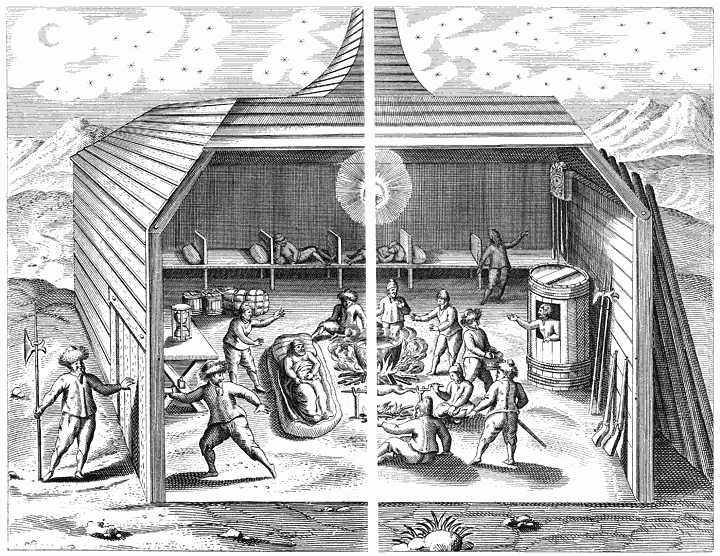
The exact manner of the house wherein we wintered.

The exact manner of the house wherein we wintered.

The 8 of December it was foule weather, the wind northerly, very sharpe and cold, but we durst lay no more coles on as we did the day before, for that our misfortune had taught vs that to shun one danger we should not run into an other [still greater].

The 9 of December it was faire cleare weather, the skie full of starres; then we set our doore wide open, which before was fast closed vp with snowe, and made our springes ready to take foxes.

The 15 of December it was still faire [bright] weather, the wind east. That day we tooke two foxes, and saw the moone rise east south-east, when it was twenty-sixe daies old; [and it was] in the signe of Scorpio.

The 19 of December it was faire wether, the wind being south. Then we put each other in good comfort that the sun was then almost half ouer and ready to come to vs againe, which we sore longed for, it being a weary time for vs to be without the sunne, and to want the greatest comfort that God sendeth vnto man here vpon the earth, and that which reioiceth euery liuing thing.

The 20 of Dece[mber] before noone it was faire cleare wether, and then we had taken a fox; but towards euening there rose such a [violent] storm [and tempest] in the south-west, with so great a snow, that all the house was inclosed therewith.

The 21 of December it was faire cleere wether, with a north-east wind. Then we made our doore cleane againe and made a way to go out, and clensed our traps for the foxes, which did vs great pleasure when we tooke them, for they seemed as dainty as uenison unto vs.

The 22 of December it was foule wether with great store of snow, the wind south-west, which stopt up our doore againe, and we were forced to dig it open againe, which was almost euery day to do.

[Anno 1597]

The 3 of January it was all one weather [constantly boisterous, with snow and a north-west wind, and so exceedingly cold that we were forced to remain close shut up in the house], and we had little wood to burne.

The 4 of January it was still foule stormie weather, with much snow and great cold, the wind south-west, and we were forced to keepe [constantly shut up] in the house. And to know where the wind blew, we thrust a halfe pike out at ye chimney wt a little cloth or fether upon it; but [we had to look at it immediately the wind caught it, for] as soone as we thrust it out it was presently frozen as hard as a peece of wood, and could not go about nor stirre with the wind [so that we said to one another how tremendously cold it must be out of doors].

The 6 of January it was faire weather, the wind north-east. Then we went out and clensed our traps [and springes] to take foxes, which were our uenison; and we digd a great hole in the snow where our fire-wood lay, and left it close aboue like a vault [of a cellar], and from thence fetcht out our wood as we needed it.

The 7 of January it was foule weather againe, with a north-west wind and some snow, and very cold, which put vs in great feare to be shut up in the house againe.

The 8 of January it was faire weather againe, the wind north. Then we made our [traps and] springes ready to get more uenison, which we longed for. And then we might [sometimes begin to] see and marke day-light, which then began to increase, that the sunne as then began to come towards vs againe, which thought put vs in no litle comfort.

The 10 of January it was faire weather, with a north wind. Then seuen of vs went to our ship, well armed, which we found in the same state we left it in, and [in] it we saw many footsteps of beares, both great and small, whereby it seemed that there had bin more than one or two beares therein. And as we went under hatches, we strooke fire and lighted a candle, and found that the water was rysen a foote higher in the ship.

The 19 of January it was faire weather, with a north wind. And then our bread began to diminish, for that some of our barels were not full waight, and so the diuision was lesse, and we were forced to mak our allowance bigger with that which we had spared before. And then some of vs went abord the ship, wherein there was halfe a barrell of bread, which we thought to spare till the last, and there [quite] secretly each of them tooke a bisket or two out of it.

The 21 of January it was faire [clear] weather, with a west wind. At that time taking of foxes began to faile vs, which was a signe that the beares would soone come againe, as not long after we found it to be true; for as long as the beares stay[ed] away the foxes came abroad, and not much before the beares came abroad the foxes were but little seene.

The 23 of January it was faire calme weather, with a south-west wind. Then foure of vs went to the ship and comforted each other, giuing God thankes that the hardest time of the winter was past, being in good hope that we should liue to talke of those things at home in our owne country; and when we were in the ship we found that the water rose higher and higher in it, and so each of us taking a bisket or two with us, we went home againe.

The 25 of January it was darke clowdy weather, the wind westerlie, so that the seeing of the sunne the day before was againe doubted of; and then many wagers were laid, and we still lookt out to see if the sunne appeared. The same day we sawe a beare (which as long as the sunne appeared not vnto vs we sawe not) comming out of the southwest towards our house; but when we shouted at her she came no neerer, but went away againe.

The 29 of January it was foule weather, with great store of snow, the wind north-west, whereby the house was closed vp againe with snow.

The 1 of February, being Candlemas eve, it was boisterous weather with a great storme and good store of snow, whereby the house was closed vp againe with snow, and we were constrained to stay within dores; the wind then being north-west.

The 2 of February it was [still the same] foule weather, and as then the sun had not rid vs of all the foule weather, whereby we were some what discomforted, for that being in good hope of better weather we had not made so great prouision of wood as wee did before.

The 3 of February it was faire weather with an east winde, but very misty, whereby we could not see the sun, which made vs somewhat melancholy to see so great a miste, and rather more then we had had in the winter time; and then we digd our doore open againe and fetcht the wood that lay without about the dore into the house, which we were forced with great paine and labour to dig out of the snow.

The 5 of February it was still foule weather, the wind being east with great store of snow, whereby we were shut vp againe into the house and had no other way to get out but by the chimney, and those that could not clime out were faine to helpe themselues within as well as they could.

The 6 of February it was still foule stormie weather with store of snow, and we still went out at the chimney, and troubled not ovr selues with the doore, for some of vs made it an easie matter to clime out at the chimney.
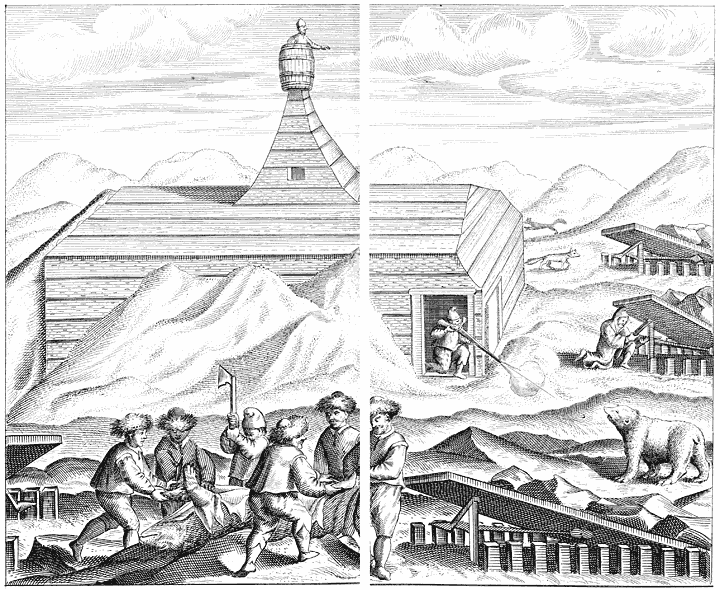
How we shot a bear, wherefrom we got a good hundred pounds’ weight of grease.

How we shot a bear, wherefrom we got a good hundred pounds’ weight of grease.

The 11 of February it was faire weather, the wind south; yt day about noone there came a beare towards our house, and we watcht her with our muskets, but she came not so neere that wee could reach her. The same night we heard some foxes stirring, which since the beares began to come abroad againe we had [not] much seen.

The 13 of February it was faire cleare weather with a hard west wind, at which time we had more light in our house by burning of lamps, whereby we had meanes to passe the time away by reading and other exercises, which before (when we could not distinguish day from night by reason of the darknesse, and had not lamps continually burning) we could not doe.

The 14th of February it was faire cleere weather with a hard west wind before noone, but after noone it was still weather. Then fiue of vs went to the ship to see how it laie, and found the water to encrease in it, but not much.

The 20 of February it was foule weather with great store of snow, the wind south-west; whereby we were shut vp againe in the house, as we had been often times before.

The 25 of February it was foule weather againe and much snow, with a north wind, whereby we were closed vp with snow againe, and could not get out of our house.

The 27 of February it was calme weather, with a south wind, but very cold. Then our wood began to lessen, which put vs in no small discomfort to remember what trouble we had to drawe the last slead-full home, and we must doe the like againe if we would not die with cold.

The 28 of February it was still weather with a south-west wind. Then ten of vs went and fetcht an other slead-full of wood, with no lesse paine and labor then we did before; for one of our companions could not helpe vs, because that the first ioint of one of his great toes was frozen of, and so he could doe nothing.

The 6 of March it was foule weather, with a great storme out of the south-west and much snow. The same day some of vs climbed out of the chimney, and perceaued that in the sea and about the land there was much open water, but the ship lay fast still.

The 13 of March it was still foule weather, with a storme out of the north-east and great store of snow, and the ice mightely driuing in with a great noyse, the flakes rustling against each other fearfull to heare.

The 15 of March it was faire weather, the wind north. That day we opened our dore to goe out, but the cold rather increased then diminished, and was bitterer then before it had bin.

The 16 of March it was faire cleare weather, but extreame cold with a north wind, which put vs to great extremity, for that we had almost taken our leaues of the cold, and then it began to come againe.

The 17 of March it was faire cleare weather, with a north-wind, but stil very cold, wherby wee were wholy out of comfort to see and feele so great cold, and knew not what to thinke, for it was extreame cold.

The 18 of March it was foule cold weather with good store of snow, the wind north-east, which shut vs vp in our house so that we could not get out.

The 22 of March it was cleere still weather, the wind north-east, but very cold; whereupon some of vs were of advice, seeing that the fetching of wood was so toylesome vnto vs, that euery day once we should make a fire of coales.

The 24 of March it was a like cold, with great store of snow and a north wind, whereby we were once againe shut vp into the house, and then the coales serued vs well, which before by reason of our bad vsing of them we disliked of.

The 25 of March it was still foule weather, the wind west, the cold still holding as strong as it was, which put vs in much discomfort.

The 26 of March it was faire cleere weather [with a west wind], and very calme; then we digd our selues out of the house againe and went out, and then we fetcht an other slead of wood, for the great cold had made vs burne vp all that we had.

The 27 of March it was faire weather, the wind west and very calme; then the ice began to driue away againe, but the ship lay fast and stird not.

The 30 of March it was faire cleere weather, with an east wind, wherewith the ice came driving in againe. After noone there came two beares by our house, but they went along to the ship and let vs alone.

The 4 of Aprill it was faire weather, the wind variable. That daie we went all to the ship, and put out [through the hawse] the cable that was made fast to the [bower] anchor, to the end that if the ship chanced to be loose [or to drift] it might hold fast thereby.

The 5 of Aprill it was foule weather with a hard north-east wind, wherewith the ice came mightily in againe and slid in great peeces one vpon the other; and then the ship laie faster then it did before.

The 7 of Aprill it was foule weather, the wind south-west. Then we made our muskets ready, thinking the beare would haue come againe, but she came not. Then we went up vpon the house, where we saw what force the beare had vsed to teare away the saile, which was made so fast vnto the chimney.

The 8 of Aprill it was still foule weather, the wind south-west, whereby the ice draue away againe and the sea was open, which put vs in some comfort that we should once get away out of that fearefull place.

The 11 of Aprill it was faire weather, with a great north-east wind, wherewith the ice still draue one peece vpon another and lay in high hilles.

The 14 of Aprill it was faire cleare weather with a west wind; then we saw greater hilles of ice round about the ship then euer we had seene before, which was a fearefull thing to behold, and much to be wondred at that the ship was not smitten in pieces.

The 17 of Aprill it was faire cleere weather with a south-west wind; and then seauen of vs went to the ship, and there we saw open water in the sea, and then we went ouer the ice hilles as well as we could to the water, for in six or seauen monthes we had not gone so neare vnto it; and when we got to ye water, there we saw a litle bird swiming therein, but as soone as it espied vs it diued vnder the water, which we tooke for a signe that there was more open water in the sea then there had beene before, and that the time approached that the water would [be] open.

The 21 of Aprill it [still] was faire weather with an east wind; and the next day the like weather, but in the euening the wind blewe northerly.

The 23 of Aprill it was faire [clear] weather [with a bright sky] and a [strong] north-east wind; and the next day the like, with an east wind.

The 26 and 27 of Aprill it was faire weather, but an extreeme great north-east wind.

The 5 of May it was faire weather with some snow, the wind east. That euening and at night we saw the sunne, when it was at the lowest, a good way aboue the earth.

The 6 of May it was faire cleere weather with a great south-west wind, whereby we saw the sea open both in the east and in the west, which made our men exceeding glad, longing sore to be gone from thence.

The 12 of May it was foule weather, the wind north-west; and then the water became still opener then it was, which put vs in good comfort.

The 13 of May it was still weather, but it snowed hard with a north[-west] wind.

The 21 of May it was faire weather with a north-east wind, so that the ice came driuing in againe, yet we made preparation touching our things that we should weare, that we might not be hindred thereby.

The 24 of May it was faire weather with a south-east wind, whereby there was but little open water.
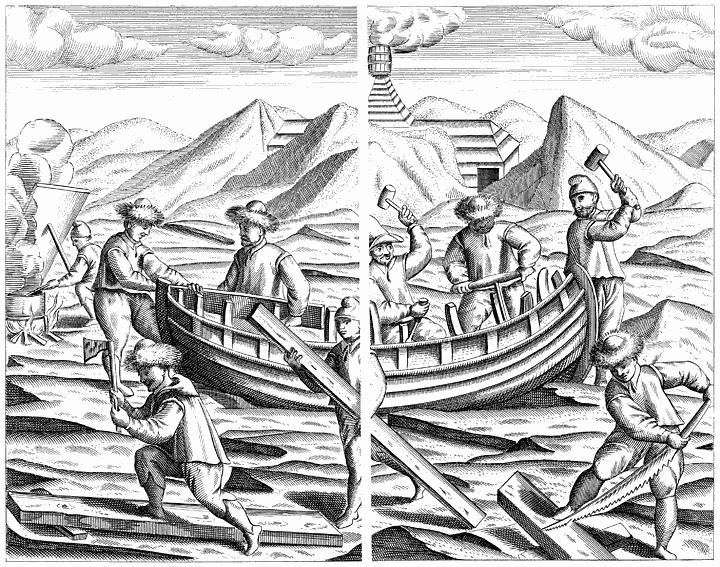
How we made ready to sail back again to Holland.

How we made ready to sail back again to Holland.

The 26 of May it was faire weather with a great north-east wind, whereby the ice came [drifting] in againe [with great force].

[June, 1597.]

The 11 of June it was foule weather and it blew hard north north-west, so that all day we could doe nothing, and we were in great feare least the storme would carry the ice and the ship both away together (which might well haue come to passe); then we should haue beene in greater miserie than ever we were, for that our goods, both victualles and others, were then all in the ship; but God prouided so well for vs that it fell not out so unfortunatly.
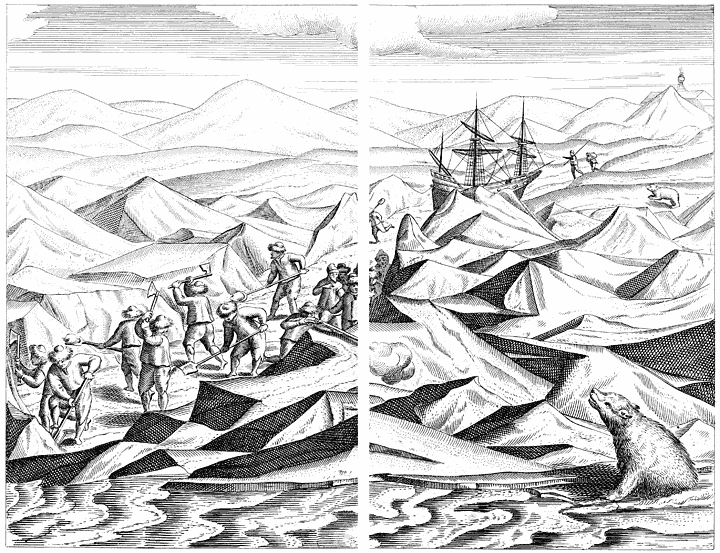
How we prepared a way whereby we brought our boats and goods to the sea.

How we prepared a way whereby we brought our boats and goods to the sea.

The Coppie of their Letter.
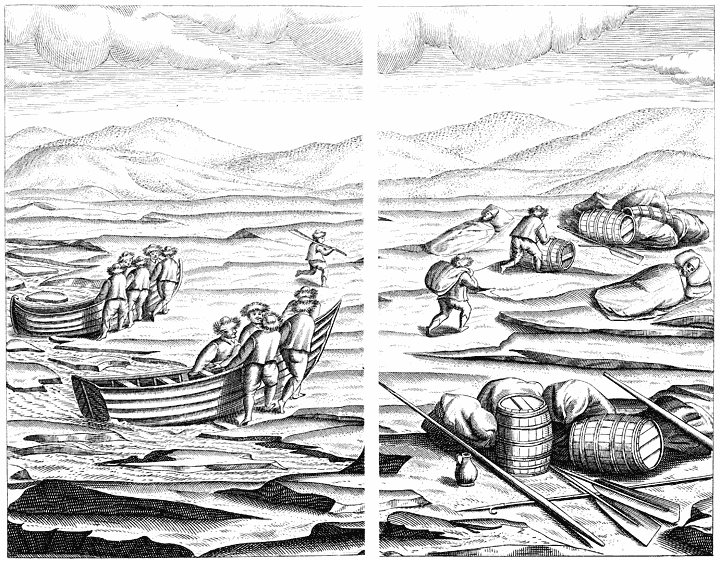
How we were nearly wrecked, and with great danger had to betake ourselves to the ice.

How we were nearly wrecked, and with great danger had to betake ourselves to the ice.

The 21 of June the ice began to driue away againe, and God made vs some opening with [a] south south-west wind; and when the sunne was [about] north west the wind began to blow south-east with a good gale, and we began to make preparations to go from thence.

The 25th of June it blew a great south wind, and the ice whereunto we made our selues fast was not very strong, whereby we were in greate feare that we should breake off from it and driue into the sea; for [in the evening], when the sun was in the west, a peece of that ice brake of, whereby we were forced to dislodge and make our selues fast to another peece of ice.

The 30 of June in the morning, when the sunne was east and by north, the ice draue hard eastward by meanes of the west wind, and then there came two beares vpon a peece of ice that draue in the sea, and thought to set vpon vs, and made show as if they would leape into the water and come to vs, but did nothing, whereby we were of opinion that they were the same beares that had beene there before; and about the south-south-east sunne there came an other beare vpon the fast ice, and made [straight] towards vs; but being neare vs, and hearing vs make a noise, she went away againe. Then the wind was west-south-west, and the ice began somewhat to falle from the land; but because it was mistie weather and a hard wind, we durst not put to sea, but staid for a better opportunitie.

The 4 of July it was so faire cleare weather, that from the time we were first in Noua Zembla we had not the like. Then wee washt the veluets, that had been wet with the salt water, in fresh water drawne out of snow, and then dryed them and packt them vp againe; at which time the wind was west and west south-west.

The 6 of July it was misty weather, but about euening it began to cleere vp, and the wind was south-east, which put vs in some comfort, and yet we lay fast vpon the ice.

The 13 of July it was a faire day; then seuen of our men went to the firme land to seeke for more stones, and found some; at which time the wind was south-east.

The 15 of July it was misty weather; that morning the wind was south-east, but the sunne being west it began to raine, and the wind turned west and west south-west.
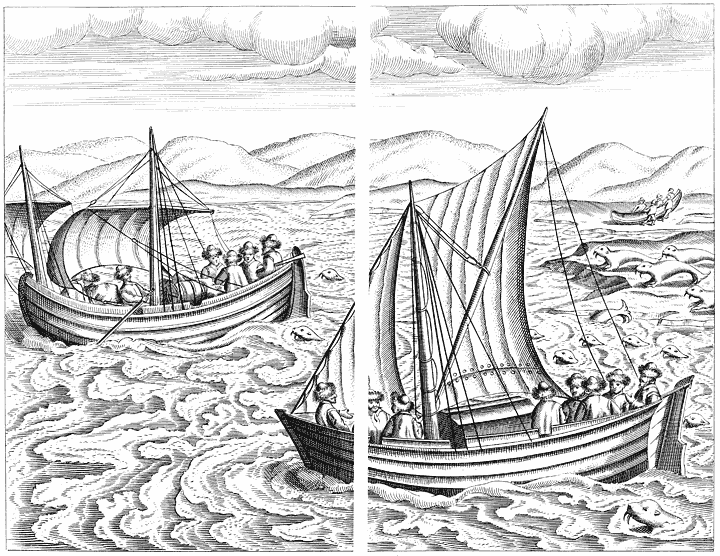
True portraiture of our boats, and how we nearly got into trouble with the seahorses.

True portraiture of our boats, and how we nearly got into trouble with the seahorses.

The 25 of July it was darke misty weather, the wind north, but we were forced to ly still because it blew so hard.

The 3 of September we vnladed all our goods, and there refreshed our selues after our toylesome and weary iourney and the great hunger that we had indured, thereby to recouer our healthes and strengthes againe.

The 15 of Sep[tember] we went into a lodgie [and sailed down the river] wt all our goods and our men to John Cornelisons ship, which lay about half a mile [2 miles] from the towne, and that day [at noon] sailed in the ship [further] downe the riuer til we were beyond the narrowest part therof, which was about half the riuer, and there staied for John Cornelison and our maister, that said they would come to vs the next day.

The 17 of September [in the evening] John Cornelison and our maister being come abord, the next day about the east sunne we set saile out of the riuer [of] Coola, and with Gods grace put to sea to saile hom-wards; and being out of the riuer we sailed along by the land north-west and by north, the wind being south.

Jacob Hemskeck, Maister and Factor.

Peter Peterson Vos.

Geret de Veer.

Maister Hans Vos, Surgion.

Jacob Johnson, Sterenburg.

Lenard Hendrickson.

Laurence Williamson.

John Hillbrantson.

Jacob Johnson Hooghwont.

Peter Cornelison.

John Vous Buysen.

and Jacob Euartson.

FINIS.

These make up the ship’s company, which originally consisted of seventeen persons in all. The seeming discrepancy with regard to two of the names, as they appear in the list in page 193, is easily explained away. Iacob Ianszoon Hooghwout, of Schiedam, and Ian van Buysen Reynierszoon, have here their family names given in addition to their patronymics, which latter alone they had signed in the former list.

Notes in this chapter

Note 1 · Of men noch ten derdemael van slandts wegen wederom eenige toerustinge soude doen—whether any expedition should again for the third time be Note 2 · In the original no mention is made of any proclamation. ↑Note 3 · Een mercklijcke somme—a considerable sum. ↑Note 4 · Als schipper ende comis van de comanschappe, Jacob Heemskerck Heijndricksz.—as captain and supercargo of the merchandize. ↑Note 5 · Jan Cornelisz. Rijp. ↑Note 6 · The Vlie passage is frequented by ships bound northward which do not draw much water. ↑Note 7 · De stroom verliep—the tide ran out. ↑Note 8 · Aen de oost zyde vant Vlie-landt—on the east side of Vlielandt: the island at the entrance of the Vlie, between it and Texel. ↑Note 9 · De eylanden van Hitlandt ende Feyeril. Hitlandt is the Dutch name for the Islands of Shetland, anciently called Hialtland. Feyeril is Fair INote 10 · Waeyde een topseijl—it blew a top-sail breeze. ↑Note 11 · This was the sun’s zenith distance, and not its elevation. ↑Note 12 · Een wonderlijck hemel-teijcken—a wonderful phenomenon in the heavens. ↑Note 13 · Wijdt rondtomme de sonnen—at a distance round about the suns. ↑Note 14 · De onderste cant—its lower edge. ↑Note 15 · The error noticed in the preceding page (note 10) is here repeated. ↑Note 16 · Hielt de loef van ons, ende quam niet af tot ons, maer wy ghinghen hem een streeck int ghemoet—kept to windward of us, and would not fall ofNote 17 · T’zeewaert vant landt—out at sea away from the land. ↑Note 18 · Ende behoorden n. o. aen te gaen—and ought to have sailed N.E. ↑Note 19 · As henceforward the omissions in the translation become more numerous, it is thought better to insert the omitted passage or words in the teNote 20 · Opt verdeck—on deck. ↑Note 21 · Die onder waren—who were below. ↑Note 22 · Dat van den grooten hoop quam dryven—which came drifting from the great mass. ↑Note 23 · One hour. ↑Note 24 · One hour and a half. ↑Note 25 · The accuracy of William Barentszoon’s observations is worthy of remark. According to the observations of Fabure in the “Recherche”, the westNote 26 · Een steylen sneebergh—A steep mountain of snow. This was not a glacier, but merely an accumulation of snow. The land of Bear Island appears Note 27 · Steijl—steep. ↑Note 28 · Wy ghinghen op ons naers sitten. ↑Note 29 · Geweldich—powerful. ↑Note 30 · Bock—yawl. ↑Note 31 · Two hours. ↑Note 32 · Maer ten bequam ons niet wel—but it did not agree with us. ↑Note 33 · Het Beyren Eylandt. The Russian walrus-hunters call this island simply Medvyed, “the Bear”. By the English it has been usually called CherryNote 34 · Hyselachtich—hazy. ↑Note 35 · Floating. ↑Note 36 · Daer wy niet boven conden comen—which we could not weather. ↑Note 37 · See page 25, note 2. ↑Note 38 · There is an error in the calculation here, which may be best explained by repeating the calculation itself, as it was doubtless made:— 33° 3Note 39 · The country thus visited for the first time was supposed by its discoverers to be a part of Greenland; but it is now known to be SpitzbergenNote 40 · Bock. It is impossible to say what is the correct English name for this smaller boat: probably “yawl”. Bock (or pont) is properly a “punt”, Note 41 · Schuijt. This being the generic term for small craft, might well be translated “boat”. ↑Note 42 · Claws. ↑Note 43 · Voor aen den steven—forward in the stem (of the boat). ↑Note 44 · Te landtwaert in—towards the land. ↑Note 45 · Rotgansen—brent geese or “barnacle” geese, as they were called, owing to the absurd idea which formerly prevailed as to their origin. ↑Note 46 · Rot, rot, rot. It is certainly singular that the translator should have attempted to render into English what is intended to represent the nNote 47 · Dit waren oprechte rotgansen—these were true brent geese. Apart from Phillip’s very curious “translation”, it is difficult to imagine how heNote 48 · Wieringen, an island of North Holland, near the Texel. ↑Note 49 · Aen boomen wassen—grow upon trees. ↑Note 50 · Ende de tacken die overt water hangen ende haer vruchten int water vallen—and those branches which hang over the water, and the fruit of whiNote 51 · Swemmen daer hennen—swim away. ↑Note 52 · Comen te niet—come to nothing. This extraordinary fable concerning the origin of these geese, which was prevalent in the sixteenth century, Note 53 · Liggen—lay. ↑Note 54 · Chart. The original has, however, nothing about any “card”, but says noch noyt dat land op die plaets bekent is geweest—nor was that land evNote 55 · This remark, which has previously been made by the author in page 5, is not founded on fact, inasmuch as reindeer do exist in Novaya Zemlya,Note 56 · Des nachts—at night. ↑Note 57 · De selfde getogen van de genomen hooghde. This is erroneous. It should be “from which subtracted the height aforesaid”. ↑Note 58 · By de westwal heenen—along the west wall, i.e., the western shore. ↑Note 59 · Boven dat eylandt niet comen—could not weather that island. ↑Note 60 · Een gheweldigen inham—an extremely large bay or inlet. ↑Note 61 · Laveren. See page 25, note 2. ↑Note 62 · Ende moesten n. aen—and we had to go north. ↑Note 63 · That is to say, the sun’s declination 23° 20′, being taken from his elevation 38° 20′, leaves 15°, the complement of the elevation of the PoNote 64 · See page 76. ↑Note 65 · Wendent over den anderen boech—went upon the other tack. ↑Note 66 · In Phillips’ translation, “sun” is omitted, and the words “and then” substituted, whereby the sense is completely altered. ↑Note 67 · Wat te ruymen—to be somewhat more favourable. ↑Note 68 · That is, to so high a latitude. ↑Note 69 · 73 graden ende 20 minuten. This is an error of the press. It should be 73° 26′. ↑Note 70 · Een tamelijcken coelte—a tolerable breeze. ↑Note 71 · Dandinaes: evidently a misprint for Candinaes, or Kanin Nos; respecting which, see page 38, note 3. ↑Note 72 · Dreven wy in stilte—we drifted in a calm. ↑Note 73 · Seven hours. ↑Note 74 · Des nachts—at night. ↑Note 75 · Watch. ↑Note 76 · 54 graden ende 38 minuten. This is a misprint. It should be “38 degrees and 54 minutes”, from which deducting 21° 54′, the sun’s declinationNote 77 · Willebuijs landt. On the 14th of August, 1553, the unfortunate Sir Hugh Willoughby discovered land in 72° N. lat., 160 leagues E. by N. fromNote 78 · Een eetmael langh—during four and twenty hours. The English translator must be excused for not understanding this expression, when even the Note 79 · Dreven wy in stilte midden int ys—we drifted in a calm, surrounded by the ice. ↑Note 80 · Here, again, the same error is committed as on the 19th of June (see page 77, note 4). The calculation is as follows:— 37° 55′ Elevation of Note 81 · In this they were mistaken, owing to their error in the calculation of their observed latitude, as is shown in the preceding note. On their Note 82 · Het voormarsseijl ende besaen—the fore-topsail and spanker. ↑Note 83 · Het Admiraeliteijts Eylandt—Admiralty Island. See page 13. ↑Note 84 · The “Island with the Crosses” of page 16. ↑Note 85 · Desire. ↑Note 86 · De schipper. ↑Note 87 · Bootshaeck—boat-hook. ↑Note 88 · Huijt—body (literally “hide”). ↑Note 89 · Here are two errors. In the first place, the difference between the sun’s elevation and declination is not 14°, but 14° 15′. This is, manifeNote 90 · Bleeckten—bleached. ↑Note 91 · This would seem to be a misprint for 27°, as all the other observations made in Novaya Zemlya tend to show that at that time the variation wNote 92 · The northernmost point of Novaya Zemlya. See page 24. ↑Note 93 · Daer we langhs heenen laveerden—along which we tacked. ↑Note 94 · Quamen wy boven de hoeck van Nassouwen—we weathered Cape Nassau. See page 16. ↑Note 95 · De hoeck van Troost—Cape Comfort. See page 22, note 4. ↑Note 96 · Boven opt verdeck—above on deck. ↑Note 97 · Quamen wy alle boven—we all came on deck. ↑Note 98 · Nae ons toe, om voor by ’t schip op te climmen—towards us, in order to climb up the bow of the ship. ↑Note 99 · Wy hadden boven opt schip ons schuyten seijl gheschoren—we had placed the sail of our boat on deck as a screen. ↑Note 100 · Voor opt braedspit—forward on the capstan. ↑Note 101 · Een hooghen heuvel—a high hummock of ice. ↑Note 102 · Te dryven—to drift, or move. ↑Note 103 · Int ys beknelt soude werden—we should be crushed by the ice. ↑Note 104 · Ghevaer—danger. ↑Note 105 · Dattet al craeckte watter ontrent was—so that all round about us cracked. ↑Note 106 · Werp ancker—kedge. ↑Note 107 · Watch. ↑Note 108 · Met de steven daer aen—with our stem (bow) on it. ↑Note 109 · Ghevaer—danger. ↑Note 110 · Noch naerder—still nearer. ↑Note 111 · De grootste schotsen dryvende ys—the largest pieces of drift ice. ↑Note 112 · Den cleynen Ys-hoeck. ↑Note 113 · Om—round. ↑Note 114 · Huppelde—limped. ↑Note 115 · Met weynich coelte—with little wind. ↑Note 116 · Began’t beter te coelen—the wind freshened. ↑Note 117 · De Eylandt van Oraengien. On the first voyage the Islands of Orange are spoken of. See page 25. ↑Note 118 · Het schip verlegghen—to change the position of the ship. ↑Note 119 · Brachten—brought. ↑Note 120 · Be reijs ghewonnen waer—i.e., the object of the voyage was attained, and they had become entitled to the reward offered by the States GeneraNote 121 · Werp-ancker—kedge. ↑Note 122 · Een tamelijcke coelte—an easy breeze. ↑Note 123 · De hoeck van Begheerte. Cape Desire. ↑Note 124 · Boven den hoeck waren—had weathered the Cape. ↑Note 125 · De Hooft-hoeck. ↑Note 126 · Het Vlissingher hooft—Flushing Head. ↑Note 127 · De hoeck vant Eylandt. Subsequently called Den Eylandts hoeck, or Island Point. ↑Note 128 · De hoeck van den Yshaven—Ice Haven Point. ↑Note 129 · Het afwater ofte Stroom Bay. ↑Note 130 · Stroom—current. ↑Note 131 · Clommen—climbed. ↑Note 132 · Keerden omme—turned back. ↑Note 133 · De pen vant roer—the tiller. ↑Note 134 · Stucken gheschoven werden—were broken in pieces. ↑Note 135 · Gheschoven—stove in. ↑Note 136 · Stroom—current. ↑Note 137 · Weygats. ↑Note 138 · That is, now that we had passed. ↑Note 139 · Weygats. ↑Note 140 · De schoot—the sheet. ↑Note 141 · De groote bras—the main brace. ↑Note 142 · The bow of the ship. ↑Note 143 · Bock—yawl. ↑Note 144 · Weeck het ys wat wech—the ice gave way a little. ↑Note 145 · 1 Of men noch ten derdemael van slandts wegen wederom eenige toerustinge soude doen—whether any expedition should again for the third time bNote 146 · Koe-voeten—crow-bars: literally cows’-feet, from the resemblance which the bifurcated end bears to the cloven foot of that animal. In one ofNote 147 · Gheknelt—squeezed. ↑Note 148 · Vysel—a screw or jack. ↑Note 149 · Voorsteven—stem. ↑Note 150 · Crevice. ↑Note 151 · Het schuyven des ys—from the action (pushing) of the ice. ↑Note 152 · Pen—tiller. ↑Note 153 · Het gantsche voorschip—the entire fore-part of the ship. ↑Note 154 · In den grondt ghecomen—gone to the bottom. ↑Note 155 · Ons schuijt ende boot—our boat and yawl. ↑Note 156 · Pen—tiller. ↑Note 157 · Borne, carried. ↑Note 158 · Het bleef noch al dicht—it (the ship) remained quite tight. ↑Note 159 · Naenoens—afternoon. ↑Note 160 · Te schuyven vant ys—to be moved by the ice. ↑Note 161 · Vaetkens—small casks. ↑Note 162 · Soo dat de scheck achter van den steven geschoven werde—so that the ice-knees (chocks) started from the stern-post. ↑Note 163 · Hielde de scheck noch dat zy daeraen bleef hangen—kept the ice-knees still hanging on. ↑Note 164 · Ende de bouteloef brack mede stucken met een nieu cabeltou dat wy op het ys hadden vast ghemaeckt—and the bumpkin likewise broke away, with Note 165 · Jae, datter ys berghen dreven, soo groot als de soutberghen in Spaengien—yea, there drifted icebergs by us, as big as the salt mountains in Note 166 · Ende leet veel—and suffered much. ↑Note 167 · Bleeft noch dicht—still remained tight. ↑Note 168 · Dan—for. ↑Note 169 · Fock—foresail. ↑Note 170 · Timmerghereetschap—carpenter’s tools. ↑Note 171 · Oock tamelijck weder ende stilletgens—also tolerable weather and calm. ↑Note 172 · Wy—we. ↑Note 173 · Rheden ende Elanden—deer and elks. It is unaccountable that, with this fact within his own personal knowledge, Gerrit de Veer should have exNote 174 · Ons scheck aen de achter-steven brack altemet noch meer stucken—and the ice-knees on the stern-post broke more and more in pieces. ↑Note 175 · Maer vonden daer gantsch weynich—but found very little there. ↑Note 176 · Meant, intended. ↑Note 177 · Vleysch—meat. ↑Note 178 · Opt ys om te ververschen—upon the ice, to freshen. ↑Note 179 · Maer het bequam hem als de hondt de worst—but it agreed with her as the pudding (sausage) did with the dog. This is a Dutch proverb, made usNote 180 · Loerden op hem of hy oock wederom comen soude—and watched for her coming back. ↑Note 181 · Meant. “Went.”—Ph. ↑Note 182 · By nae—nearly. ↑Note 183 · Ende drie bleven byt hout om dat te behouwen, soo werdet so veel te lichter int slepen—and three remained behind with the wood, to hew it, sNote 184 · Verde—far. The distance which, on the 16th September, they had estimated at nearly one Dutch mile. ↑Note 185 · Conbuys. The cooking-place on board ship. ↑Note 186 · Purmerend. A town in North Holland, about eight miles north of Amsterdam. ↑Note 187 · Cinghel—shingle. ↑Note 188 · Een afwateringhe—a fall or current of water. ↑Note 189 · Een gotelinghs schoot—a falconet shot. See page 33, note 2. ↑Note 190 · Balcken—the beams or principal timbers. ↑Note 191 · Ons scheck ofte achtersteven vant schip wederom ghemaeckt—repaired the ice-knees or stern-post of the ship. ↑Note 192 · Must. ↑Note 193 · Bear. ↑Note 194 · Thuys altemet dicht te maecken—by degrees to close up (the sides of) the house. ↑Note 195 · Wy ghinghen vast voort—we kept on hard at work. ↑Note 196 · “Northly.”—Ph. ↑Note 197 · Teghens—against. ↑Note 198 · We rechten het huys op—we erected (i.e., completed the erection of) our house. ↑Note 199 · Een Meyboom—a May-tree. According to Adelung, in his Hochdeutsches Wörterbuch, “Maybaum” is in many parts of Germany the vernacular name of Note 200 · Alsoo wy nu … laghen—because we now lay. ↑Note 201 · Heel open—quite open. ↑Note 202 · Wy laghen tot den grondt toe bevroren—we lay frozen right down to the ground. ↑Note 203 · “Then.”—Ph. ↑Note 204 · Het vooronder—the forecastle. ↑Note 205 · Deelen—planks. ↑Note 206 · In den mitten wat hoogher—somewhat higher in the middle. ↑Note 207 · Ende braken het achteronder mede uyt, omt huijs voort dicht te maeckten—and pulled down likewise the poop, in order (therewith) to go on cloNote 208 · “W. and S.W.”—Ph. ↑Note 209 · “First.”—Ph. ↑Note 210 · Sneeu—snow. ↑Note 211 · Climbed. ↑Note 212 · Boven—on deck. ↑Note 213 · Boven opt schip—on the deck of the ship. ↑Note 214 · “Kept.”—Ph. ↑Note 215 · Zijnde een iopen vat, aen den bodem stucken ghevroren—which, being a cask of spruce beer, had burst at the bottom through the frost. From a Note 216 · Uyt liep—ran out. ↑Note 217 · Den bodem—the bottom. ↑Note 218 · Scarcely. ↑Note 219 · In de selvighe vochticheyt was de cracht vant gantsche bier—in that liquid part lay the whole strength of the beer. ↑Note 220 · Shovelled. ↑Note 221 · “S.E. and by S.E.”—Ph. ↑Note 222 · Braecken wy de kuiuyt wech—we pulled down the cabin. ↑Note 223 · Het portael—the entrance hall, or porch. ↑Note 224 · Met brandthouten smeten—threw billets of firewood at her. ↑Note 225 · Quam hy effenwel seer vreeselijck tot haer aen—came towards them in a most terrific manner. ↑Note 226 · Int ruijm—in the hold. ↑Note 227 · Clam int fockewant—climbed up the fore-rigging. ↑Note 228 · Eenige openinghe van water in de zee—some open places of water in the sea. ↑Note 229 · Banden—hoops. ↑Note 230 · De joopen vaten—the spruce-beer casks. See page 114, note 2. ↑Note 231 · Bock—yawl. ↑Note 232 · Teghens den somer—towards the summer. ↑Note 233 · Te begheven—to leave us. ↑Note 234 · See page 78, notes 2 and 3. ↑Note 235 · Frighten. ↑Note 236 · In een scheur tusschent ys in—into a crevice in the ice. ↑Note 237 · Onder—below. The caboose had been removed below on account of the extreme cold on deck, as is mentioned in page 108. ↑Note 238 · Their firearms had matchlocks. ↑Note 239 · Overt schip heenen—out beyond the ship. ↑Note 240 · Rabbits. ↑Note 241 · Stelden wy onse orlogie wederom dat de clock sloech—we set up our clock, so that it (went and) struck (the hour). ↑Note 242 · Melted. ↑Note 243 · Tweer was ghebetert—the weather improved. ↑Note 244 · Zy conden uyt haer ooghen niet sien—they could not see out of their eyes. ↑Note 245 · Cinghel—shingle. ↑Note 246 · Doen ghingh de son heel dicht boven der aerden, weynich boven den horisont—then the sun went quite close over the earth, but little above thNote 247 · Niet een hooft dorsten uyt steecken—not one of us durst put his head out of doors. ↑Note 248 · Doncker—dark, overcast. ↑Note 249 · “December.”—Ph. ↑Note 250 · Hy quam met zijn volle rondicheyt niet boven—it did not show (rise with) its whole disk. ↑Note 251 · Ende de beyren ghinghen doen mede wegh—and then the bears also went away. ↑Note 252 · Den boven cant—the upper edge. ↑Note 253 · De mars—the round top. ↑Note 254 · The question of refraction, arising out of this and other observations, is discussed in the Introduction. ↑Note 255 · De son peijlden—observed (lit. measured) the sun. ↑Note 256 · “Off.”—Ph. ↑Note 257 · That is to say, the sun’s longitude was 221° 48′, or 41° 48′ from the autumnal equinox. ↑Note 258 · Onse surgijn—our surgeon. ↑Note 259 · Te stoven—lit. to stew. This is the primary sense of the word stew, which afterwards, like its synonym bagnio, acquired a very different meaNote 260 · Mette son—with the sun. ↑Note 261 · Weder quam—it returned. ↑Note 262 · Under the parallel of 76°, the moon continues incessantly above the horizon about seven or eight days in each month. ↑Note 263 · Vermoeden wy geen dagh, doent al dagh was—we thought that it was not day, when it already was day. ↑Note 264 · Hadde op dien dagh niet uyt de koy gheweest—had not that day been out of bed. ↑Note 265 · So wast wel opt hooghste van den dagh—it was truly the height of day. ↑Note 266 · Loot—a loot or half-ounce; of which 32 go to the pound. The quantity mentioned above is equal to 4 pounds 11 ounces avoirdupois. ↑Note 267 · Was meest al de cracht uytgevroren—had almost all its strength frozen out of it. ↑Note 268 · Een ronden hoep—a round hoop. ↑Note 269 · Dat men se in huys mochten toe halen ghelijck een val, als de vossen daer onder quamen—so that when the foxes came under it, as in a trap, wNote 270 · Met een betoghen lucht—with a cloudy sky. ↑Note 271 · Locxkens. In Sewel’s Dutch and Eng. Dict. by Buys, Lokje, the modern form of this word, is thus defined:—“a little hollow log, such as seameNote 272 · Melted. ↑Note 273 · Een betoghen lucht—a cloudy sky. ↑Note 274 · Een ghetemperden lucht—a moderate sky. ↑Note 275 · Een betoghen lucht—a cloudy sky. ↑Note 276 · A piece of coarse woollen cloth. ↑Note 277 · Tot hemden—for shirts. ↑Note 278 · Hemden—shirts. ↑Note 279 · Wrung. ↑Note 280 · Se ghebroken—broken them. ↑Note 281 · Boiling. ↑Note 282 · Bequaem—suitable, good. ↑Note 283 · De schipper ende stuerman; namely, Jacob Heemskerck and William Barentsz. ↑Note 284 · Noch—yet. ↑Note 285 · Koyen kasen—lit. cow-cheeses, because they were made from the milk of cows, and not of sheep, as is not uncommon in the Netherlands. ↑Note 286 · Ejinde van sparren—ends of spars. ↑Note 287 · “North-east.”—Ph. ↑Note 288 · De barbier—the barber. This is the person who on a former occasion (page 121) was called de surgijn—the surgeon. In the general decline of sNote 289 · Die gheleghentheyt diente van ons waer ghenomen te zijn—it was important for us to avail ourselves of the opportunity. ↑Note 290 · Alle de deuren waren toe ghewaeyt—all the doors were blown to. ↑Note 291 · Een helderen lucht—a clear sky. ↑Note 292 · Quite. ↑Note 293 · Wear. ↑Note 294 · See page 61, note 8. ↑Note 295 · Ondert verdeck—under the deck, i.e., below. ↑Note 296 · Icebergs. ↑Note 297 · Op malcanderen stuwen ende gheschoven werden—were drifting and heaping one upon the other. ↑Note 298 · Jae selfs in de koyen—yea, even in the cots. ↑Note 299 · Mochte—could. ↑Note 300 · “North-east.”—Ph. ↑Note 301 · Vallen—traps. ↑Note 302 · Sareetsche secke—Xeres seco, or sherry-sack. ↑Note 303 · Heet—hot, strong. ↑Note 304 · Over—over. ↑Note 305 · Independently of the quiet humour of this observation, it is worthy of remark, as showing that at that early period the cooling of wine by mNote 306 · Een vlieghenden storm uyten n. o.—a hurricane out of the N.E. ↑Note 307 · Steen-colen—stone or mineral coal; so called to distinguish it from charcoal, the usual fuel on the continent. ↑Note 308 · Maer wy wachtede ons voor de weerstuijt niet—but we did not guard ourselves against the consequences. ↑Note 309 · Cots. ↑Note 310 · Een sodanighen duyselinghe—a sudden dizziness. ↑Note 311 · Started. ↑Note 312 · Swoon. ↑Note 313 · Liep daer heenen—ran thither. ↑Note 314 · Haelde flucks edick ende vreef hem dat in zijn aensicht—quickly fetched some vinegar and rubbed his face with it. ↑Note 315 · In eenen swijm—in a swoon. ↑Note 316 · “North-east.”—Ph. ↑Note 317 · Een helderen lucht—a bright sky. ↑Note 318 · Shoes. ↑Note 319 · Wyde clompen—loose clogs or slippers. ↑Note 320 · Sheep. ↑Note 321 · Were. ↑Note 322 · Blaren ende buylen—“blains and boils.” ↑Note 323 · De Reus—the Giant, as the constellation Orion is called, after the Arabic El-djebbâr. The star Bellatrix γ Orionis, which was here observed,Note 324 · “Twenty-eight.”—Ph. ↑Note 325 · De onuytspreklijcke ondraechelijcke coude—the inexpressible, intolerable cold. ↑Note 326 · Wore. ↑Note 327 · Een joopen vat met water—a spruce-beer cask full of water. ↑Note 328 · Stopten eerst alle de gaten dicht toe—first closely stopped all the holes. ↑Note 329 · Ruijm—hold. ↑Note 330 · Grondt—bottom. ↑Note 331 · Calculated. ↑Note 332 · T’uyterste perck—the utmost limit. ↑Note 333 · “Eighteen.”—Ph. ↑Note 334 · Hoe well datter gheen dagh was—though there was no daylight. ↑Note 335 · Heard. ↑Note 336 · In de pot ofte aent spit—in the pot or on the spit. ↑Note 337 · Keughels—balls. ↑Note 338 · Cots. ↑Note 339 · Dattet int afgaen vanden bergh was: te weten, dat de son zijn wegh wederom nae ons toe nam—that we were now going down hill; that is to say,Note 340 · De daghen die langhen zijn de daghen die stranghen, dan hoope dede pijn versoeten—“the days that lengthen are the days that become more seveNote 341 · Bynaest … verbranden—almost burned. ↑Note 342 · Boers—boors, peasants. ↑Note 343 · Ter poorten van de steden incomen—come in at the gates of the towns. It would almost seem that in the text the word is sleden and not stedenNote 344 · Onder weghen gheweest zijn—have been travelling. ↑Note 345 · Croop—crept. ↑Note 346 · Hoet daer ghestelt was—how matters stood there. ↑Note 347 · Een betoghen lucht—a cloudy sky. ↑Note 348 · Cellar. ↑Note 349 · Several. ↑Note 350 · De trappen te maecken—to set the traps. ↑Note 351 · Stockings. ↑Note 352 · Onghemack—hardship. ↑Note 353 · “This.”—Ph. ↑Note 354 · Begonnen—began. ↑Note 355 · Het block—the block. ↑Note 356 · Bergher visch: so called because it comes principally from Bergen in Norway. ↑Note 357 · Wasset weder wat besadicht—the weather was somewhat milder. ↑Note 358 · Als een verwulfsel van een boogh ofte kelder—like the arch of a vault or cellar. ↑Note 359 · Gheslooft—toiled. ↑Note 360 · Drie Coninghen Avondt—Three Kings’ Even. The fifth of January, as being the eve of the Feast of the Epiphany, is properly “Twelfth Night”. BNote 361 · Begheerden aen den schipper—requested the skipper. ↑Note 362 · Conincxken speelden—drew for king (lit. played at kings). ↑Note 363 · Een wittbroods beschuijt—a (captain’s) biscuit made of wheaten flour. ↑Note 364 · Fancying ourselves to be. ↑Note 365 · Banquet. ↑Note 366 · Uytgedeelt—distributed. ↑Note 367 · This estimated length includes the island of Waigatsch. ↑Note 368 · Namely, the Northern Ocean and the Sea of Kara. ↑Note 369 · Could. ↑Note 370 · Want de coude leerde ons noch wel niet langhe uyt blyven, om dattet buyten niet snick heet was—for the cold itself was quite enough to teachNote 371 · “N.E.”—Ph. ↑Note 372 · “N.W.”—Ph. ↑Note 373 · Oculus Tauri. The exact declination for this year of α Tauri or Aldeberan is + 15° 40′,2; so that the complement of the height of the Pole, Note 374 · Also dat dese metinghe vande voornoemde sterre ende eenighe andere sterren, soo mede de metinghe van de sonne, alle over een quamen dat wy—sNote 375 · Liepen uyt ende schoten de cloot met de cloot van de vlayh-spil, die wy voor heen niet conden sien loopen—ran out and played at ball (lit. tNote 376 · Stil weder met een betoghen lucht—calm weather with a cloudy sky. ↑Note 377 · Twee vossen—two foxes. ↑Note 378 · Bolckvanger—a seaman’s rough coat. ↑Note 379 · Verdeck—deck. ↑Note 380 · Om ons leden wat te verstercken, met gaen, werpen ende loopen—to strengthen our limbs a little with walking, throwing (the ball), and runninNote 381 · Maer des nachts vroort wederom effen cout—but at night it froze again just as cold (as before). ↑Note 382 · Begonde vast te minderen—began to diminish fast. ↑Note 383 · Swymen—swooning. ↑Note 384 · De open schuyten—the open boats. ↑Note 385 · Wast een betoghen lucht ende stil—the sky was cloudy and calm. ↑Note 386 · De cloot schieten—to throw the ball. ↑Note 387 · That is to say, they all three saw it, but Gerrit de Veer saw it first. ↑Note 388 · Which had not been visible since the 3rd of November, as is mentioned in page 121. ↑Note 389 · Dat de sonne aldaer ende op die hooghde openbaren souden—that the sun should appear there and in that latitude. ↑Note 390 · Disich—hazy. ↑Note 391 · Daer van wy wel anders versekert zijn—with respect to which we well know the contrary. ↑Note 392 · This makes the date to have been the twenty-fifth of January. On the 24th, the sun was only in the fourth degree of Aquarius. And all the deNote 393 · Ons eerste gissinghe—our first calculation. ↑Note 394 · That is to say, till February 6th. But on that day, the sun’s declination being—15° 56′,4, it was 1° 41′ below the horizon in 75° 45′ N. latNote 395 · Appeared. ↑Note 396 · “Leave.”—Ph. ↑Note 397 · Josephus Schala. The title of the work here referred to, as given in De Lalande’s Bibliographie Astronomique, p. 120, is “Josephi Scala, SicNote 398 · In the astronomical reckoning of time, the date was certainly January 24th; but, then, “one in the night time” of that day—which would correNote 399 · January 23d 12h, mean time, Paris, corresponding with midnight between January 23rd and 24th in the civil reckoning of time,—which at VeniceNote 400 · This can only be understood in a general sense, as meaning that it was somewhere about six o’clock in the morning. For at the time of the coNote 401 · Want wy sagen gestadich op de vorrnoemde twee planeten dat se altemet malcanderen naerderden—for we looked constantly at the two planets afoNote 402 · The moon stood 3° 47′,7 above Jupiter. At the time of the conjunction, the declination of the latter planet was + 11° 17′,2; so that in 75° Note 403 · The longitude of the conjunction was 32° 17′,3, or 2° 17′,3 of the sign of Taurus, with reference to the old division of the ecliptic; thougNote 404 · Their clock having stopped, and a twelve-hours sand-glass being their only time-keeper, it would be too much to expect precision in their imNote 405 · The moon’s bearing by compass being N. by E. (11° 15′ E.), and the variation of the compass 2 points (22° 30′) W., the moon’s azimuthal distNote 406 · Apart. Their actual distance from each other was only 87° in longitude. ↑Note 407 · This is not correct. The moon passed the meridian at 5h 38m 54s after midnight, and the conjunction was observed 40m 42s before that planet Note 408 · Reeckenen—reckon or calculate. The word “guess” is still used in this sense by the Americans. ↑Note 409 · Oosterlijcker—more easterly. ↑Note 410 · Latitude. ↑Note 411 · The correct position of Venice is 30° 0′ 58″ E. of Ferro, or 12° 21′ 21″ E. of Greenwich, and 45° 25′ 49″ N. lat. It is curious that the latNote 412 · Tot de Cape de Tabijn—to Cape Taimur. See page 37, note 1. ↑Note 413 · Cape Taimur being in about 100° E. long., and the Hollanders’ wintering quarters in 72° E. long., the difference of longitude is apparently Note 414 · This is substantially correct. The exact measurement is 3·64 [14·66] miles. Under the 76th parallel of latitude a degree contains 13,859·414Note 415 · Af te meten—to be calculated. ↑Note 416 · So verde—in so far as; i.e., assuming that. ↑Note 417 · Daer boven zijnde—having passed beyond it. ↑Note 418 · De Strate Anian. The passage between the continents of Asia and America, now known as Behring’s Strait, was formerly so called. It was suppoNote 419 · Wat nu dan belanght dat men verstaen sal van tghene verhaelt is, dat wy de sonne … verloren—Now, as regards the understanding of what has beNote 420 · Disputiren—discussed. ↑Note 421 · Dattet ons in den tijdt niet ghemisten heeft—that we were not mistaken with respect to the time. ↑Note 422 · Een banck oft donckeren wolck—a fog-bank or a dark cloud. ↑Note 423 · Een langh suer legher ghehabt—long lain seriously ill. ↑Note 424 · Seyden hem wat goets voor—spoke kindly to him. ↑Note 425 · Daer nae deden wy een maniere van een lijck-predikinghe met lesen ende psalmen te singhen—after that, we made a sort of funeral discourse, rNote 426 · Aten de vroo cost—ate the funeral meal. ↑Note 427 · Skipper. ↑Note 428 · The refraction must have continued to be about as great as it was on January 25th. For, though in the interval the sun’s declination had incNote 429 · Om ons leden wat radder te maecken—to make our joints somewhat more supple. ↑Note 430 · Verkreupelt geseten—sitten without motion. ↑Note 431 · Daer deur datter veel gebreck van den scheurbuijck ghecreghen hadden—whereby several had fallen sick of the scurvy. The derivation of the teNote 432 · Het portael—the entrance porch. ↑Note 433 · Phillip has here inserted the word “not”, which is not in the original, and is besides inconsistent. ↑Note 434 · Climbed. ↑Note 435 · Grieved. ↑Note 436 · Enjoy. ↑Note 437 · The sun ought properly not to have been visible till the following day. See page 145, note 3. ↑Note 438 · That is to say, according to our common compass. ↑Note 439 · Opgaen moest—should rise or appear. ↑Note 440 · Begont een weynich te coelen—a little breeze sprang up. ↑Note 441 · Een copere duijt—a copper doit. This was formerly the smallest Dutch coin, of the value of about half a farthing. It no longer exists under Note 442 · Al oft hy sien wilde wiet hem gedaen hadde—as if she wished to see who had done it to her. ↑Note 443 · “Their.”—Ph. ↑Note 444 · Melted. ↑Note 445 · Thither. ↑Note 446 · Vastelavont, properly Vastenavond; formerly called in this country also, Fastern’s or Fasten’s Even. The “Fastingham Tuiesday,” and “FastyngNote 447 · De vrolijcke tijt—the merry time of year; the spring. ↑Note 448 · Threw, cast. ↑Note 449 · Springes or traps. ↑Note 450 · In the same state as before. ↑Note 451 · Tghene dat eyselijck scheen noch eyselijcker—that which was frightful appeared more frightful. ↑Note 452 · Behoefden—required. ↑Note 453 · Op d’eene helft—on the one half. ↑Note 454 · Thread. ↑Note 455 · Waterpassen—levels, such as are used by builders. ↑Note 456 · We have here a remarkable instance of what might be called “cooking”, were it not that everything is done in perfect good faith, and that thNote 457 · Helped. ↑Note 458 · Uytet wout—out of the wood. The French say, “la faim chasse le loup hors du bois”; and in several other languages it is the same. In EnglishNote 459 · “Cod.”—Ph. ↑Note 460 · Ons de cracht begheven soude—we should lose our strength. ↑Note 461 · Met een betoghen lucht—with a cloudy sky. ↑Note 462 · “25.”—Ph. ↑Note 463 · Donckere lucht—a dark sky. ↑Note 464 · Vercleumt—benumbed. ↑Note 465 · In de koy—a-bed. ↑Note 466 · Daer my ons mede lyden moesten—wherewith we were forced to be satisfied. ↑Note 467 · Namely, the sum of the sun’s elevation and southern declination, being fourteen degrees. ↑Note 468 · With 7′,5 for refraction, and—7° 10′,8 for the sun’s declination, the above observation gives 76° 8′,7 for the height of the Pole. If no allNote 469 · Twelck haer naemaels niet ten besten verghingh—which did them no good afterwards. ↑Note 470 · Het cocx luijck—the cook’s locker. ↑Note 471 · Wat ghebetert was—was somewhat better. ↑Note 472 · Beducht—afraid. ↑Note 473 · The words “for as then the ice drave” are introduced here unnecessarily by Phillip. ↑Note 474 · Een ruyme zee moeste zijn—there must be an open sea. ↑Note 475 · There is little doubt of their having actually seen the country round the estuaries of the rivers Obi and Yenisei. Lütke says (p. 42) that “Note 476 · Boats. ↑Note 477 · Here, as before, the correct result will be (refraction 5′,1; declination—3° 41′,6) 76° 4′,5; or, deducting 16′ for the sun’s semi-diameter,Note 478 · Skipper. ↑Note 479 · More willing. ↑Note 480 · Cold. ↑Note 481 · Closed up (with ice). ↑Note 482 · Wederom instorteden—relapsed. ↑Note 483 · Namely, on the 3rd of the month, as is mentioned in page 161. ↑Note 484 · Parste—pressed. ↑Note 485 · Huge, immense. ↑Note 486 · Op te gaen—to be used up. ↑Note 487 · Also dat goet raedt doen duer was—so that then good advice was dear. This is a proverbial saying; the meaning of which is, that, as they didNote 488 · If we assume the smaller amount of error to be the more probable, we must regard this observation as having been made on the 20th of March, Note 489 · Van vilten ofte ruyghe hoeden—of felt, or rough hats. It is probable that these were sheets of the rough material, which they had for use amNote 490 · Over de coussen aentrocken—drew on over our stockings. ↑Note 491 · Als of de Maert haer foy hadde willen besetten—as if March (before leaving them) had meant to pay them off—lit. to give them their fee. ↑Note 492 · “For.”—Ph. ↑Note 493 · Dat de coude so fel alse was, niet altijt dueren soude—that the cold, severe as it was, would not last for ever. ↑Note 494 · Haer den neck—its neck. ↑Note 495 · Met helle bittere koude—with a clear sharp cold. The author is not open to the reproach of having, in the whole course of his narrative, madNote 496 · Aen den solder ende wanden van binnen thuijs—on the ceiling and walls inside the house. ↑Note 497 · “18.”—Ph. ↑Note 498 · Daer in gheweldich huijs ghehouden hadden—had made great havoc there. ↑Note 499 · Dat wy hoe langer hoe qualijcker doen conden—which we were less and less able to do. ↑Note 500 · Gheweldighen—huge, immense. ↑Note 501 · Stijf—strongly. ↑Note 502 · On April 2nd at mean noon, Novaya Zemlya, the sun’s declination was + 4° 56′,8, which, with the observed height (corrected for refraction = Note 503 · Een colf om daer mede te colven—literally, “a colf to colve with.” The well-known game of colf or golf derives its name from the hooked sticNote 504 · Deur dattet damper weer ende teruijt vochtich was—because it was damp weather and the powder moist. ↑Note 505 · The steps cut in the snow, as is mentioned in page 136. ↑Note 506 · Nae de deur vant huijs toe—towards the door of the house. ↑Note 507 · Dat boven de deur was—that was above the door. ↑Note 508 · The house was covered with a sail, on which was placed shingle from the beach, to keep it weather tight, as is described in page 119. ↑Note 509 · Voorgaende—late, previous. ↑Note 510 · Vervulde de gantsche zee—filled the entire sea. ↑Note 511 · “21st.”—Ph. ↑Note 512 · Van den houden ghemaect hadden—had made of the hats or felt. See page 166, note 1. ↑Note 513 · Om te sien of hy daer eenighe holen hadde—to see whether she had any holes there. ↑Note 514 · Spiesen—pikes. ↑Note 515 · Af te setten—to go away. ↑Note 516 · The declination here given is that of April 19th. The corrected calculation for the 18th, with refraction 2′,0 and declination + 10° 50′,1, Note 517 · Ende stooften ons—and stewed ourselves. See page 121, note 8. ↑Note 518 · Ghereetschap—utensils. ↑Note 519 · Huijt—literally “hide”, but used in the sense of “body”. ↑Note 520 · There is an omission here in the original. The following words require to be supplied:—“which substracted from the said elevation, there resNote 521 · With the sun’s declination + 14° 8′,7, and refraction 1′8, the corrected calculation will give 76° 2′,5; or, deducting 16′ for the sun’s semNote 522 · See page 168, note 2. ↑Note 523 · Opt hooghste was. An oversight of the author. He meant to say that the sun was on the meridian in the north; where, of course, it must have Note 524 · Had the latitude of the place of observation been really more than 76° the sun ought to have been visible above the horizon at midnight on tNote 525 · Coockten wy onse laetste vleysch—we cooked the last of our meat (beef). ↑Note 526 · Maer hadt maer een manghel, dattet niet langher deuren wilde—only it had but one fault, which was, that it would not last any longer. WhenevNote 527 · Te jancken—to hanker after. ↑Note 528 · Ende also de beste spijs, als vleysch ende grutten ende anders, ons ontbrack—and as our best food, such as beef, barley, and such like, failNote 529 · Speck—pork. ↑Note 530 · Een cleijn vaetgien met peeckelspeck—a small cask of salt pork. ↑Note 531 · Doen wast mede op—then that also was gone. ↑Note 532 · Meer als te voren—more than before. ↑Note 533 · Nu—now. ↑Note 534 · Segghende: dit weer sal hier nimmermeer vergaen—saying, this weather will never more pass away here. ↑Note 535 · The skipper, namely, Jacob Heemskerck. ↑Note 536 · Van daer te sien comen—to see about getting from thence. ↑Note 537 · Maer elck ontsach sich den schipper dat te kennen te gheven—but each was reluctant to make the skipper acquainted with it. ↑Note 538 · Vermidts dat hy hem hadde laten verluyden dat hy begeerde te wachten—because he had given them to understand that he desired to wait. ↑Note 539 · Niet muytischer wyse—not in a mutinous manner. ↑Note 540 · Want zy lieten haer gaerne ghesegghen—for they let themselves easily be talked over. ↑Note 541 · The corrected calculation, with declination + 17° 44′,9 and refraction 12′,2, will give 75° 47′,9. If the sun’s lower edge was observed, 16′Note 542 · Daer deur—whereby. ↑Note 543 · Wore. ↑Note 544 · Van de ruyghe hoetgens—of the rough hats (felt). See page 166, note 1. ↑Note 545 · I.e., walking. ↑Note 546 · Colven. See page 168, note 1. ↑Note 547 · Sprack Willem Barentzoon den schipper aen wat der ghesellen goeden raedt was—William Barentsz told the skipper what the crew thought was besNote 548 · De schuijt ende bock—the boat and yawl. Heemskerck’s first thought, as supercargo, evidently was to save, if possible, the ship and propertyNote 549 · Dat men veel tijts behoeven soude—because much time would be requisite. ↑Note 550 · Bock—yawl; it being the smaller boat of the two. ↑Note 551 · “Thought”—Ph. ↑Note 552 · Reckon, count. ↑Note 553 · Dat den tijt aenquam—till the time should arrive. ↑Note 554 · De schuyten te water soude moghen brenghen—should be able to get the boats afloat. ↑Note 555 · Oft eens tijdt quam dat wy wech comen mochten—if the time should ever come when we might get away. ↑Note 556 · Den wandt vant portael—the sides of the porch or entrance. ↑Note 557 · Hemden—shirts. ↑Note 558 · Die dan wederom ghetoghen van de ghenomen hoochte—which then being taken from the observed height. This error in the original text is correcNote 559 · The declination here given (correctly 20° 46′,5) is that of the 24th May; that of the 25th being 20° 57′,6. The amended calculation for bothNote 560 · Aenstaen—urgent request. ↑Note 561 · Fock—foresail. ↑Note 562 · De seylen—the sails. ↑Note 563 · Eenigh loopende wandt ende trosgens ende anders meer—some running rigging, ropes, and various other things. ↑Note 564 · Nae de schuyt ghegaen om die ontrent het huijs te vertimmeren—went to the boat, in order to repair it near the house. ↑Note 565 · Burghers—burgesses, citizens; that is to say, they must consider Novaya Zemlya as their place of permanent residence. ↑Note 566 · De bock—the yawl. ↑Note 567 · Vreeselijcken—frightful. ↑Note 568 · More boldly. ↑Note 569 · Nether, lower. ↑Note 570 · Stucken van robben met huijt ende hayr—pieces of seals, with the skin and hair. ↑Note 571 · Torn. ↑Note 572 · Niet seer kout maer doncker—not very cold, but dark. ↑Note 573 · Bock—yawl. ↑Note 574 · Om de bock daer mede op te boyen—wherewith to raise the gunwale of our yawl. ↑Note 575 · Van ons eerst de smaeck begeerden te hebben—they desired first to have a taste of us. ↑Note 576 · Also dat hem dit bequam als de hont de worst—so that it agreed with her as the sausage did with the dog. This homely Dutch proverb has alreaNote 577 · Mischien—perhaps. ↑Note 578 · Den—the. ↑Note 579 · Genoech van die sause—enough of that sauce. ↑Note 580 · Geep. A well known fish (Belone vulgaris, Cuvier), which is called in English by a variety of trivial names:—gar-fish, gane-fish, sea-pike, Note 581 · Nae’t open water toe—towards the open water. ↑Note 582 · Ende arbeyden met alle macht aen den bock—and worked with all our might on the yawl. ↑Note 583 · Niet seer koud—not very cold. ↑Note 584 · Maecktense met een spiegel, om also bequamer te zijn inde zee te ghebruijcken—made it with a square stern, in order that it might be a betteNote 585 · Ende maecktense also vaerdich opt bequaemste dat men mocht—and so got it ready in the fittest manner in their power. ↑Note 586 · Swaert (now written zwaarden), lee-boards or whiskers. These are the boards still seen on the sides of Dutch flat-bottomed vessels, which seNote 587 · Van hoeden. See page 166, note 1. ↑Note 588 · Ende maeckten daer presentinghen over om van een zee waters beschermt te zijn—and placed tarpaulings over them, to protect them (the goods) Note 589 · Bock—yawl. ↑Note 590 · Sleden—sledges. ↑Note 591 · Dat men noch effenwel onse handen daer aen mochten slaen—so that we could likewise grasp them with our hands. ↑Note 592 · Om de buydenningen [buijkdenningen] in den bock ende schuyte te maecken—to make the bottom-boards (ceiling) of the yawl and boat. ↑Note 593 · Cleyne vaetgiens—small casks. ↑Note 594 · Schuyten—boats. ↑Note 595 · So mede als wy altemet int ys beset mochten werden—in order that whenever we should be enclosed by the ice. ↑Note 596 · Met bylen, houweelen ende allerley ghereetschap—with hatchets, pick-axes, and all sorts of implements. ↑Note 597 · Ys ende ysberghen—ice and icebergs. ↑Note 598 · Met houwen, smyten, schoppen, graven ende wechwerpen—with chopping, throwing, pushing, digging, and clearing away. ↑Note 599 · Barbier. See page 125, note 3. ↑Note 600 · Smote, struck. ↑Note 601 · Ende besloten doen onderlinghen metten gemeenen maets—and they then resolved jointly with the ship’s company. ↑Note 602 · Brengen—to bring, to take. ↑Note 603 · Ende heeft Willem Barentsz. te voren een cleijn cedelken gheschreven, ende in een muskets mate ghedaen—and William Barentsz had previously wNote 604 · “He”.—Ph. ↑Note 605 · Abandon. ↑Note 606 · Van welcke brief elcken schuyte een hadde—of which letters each boat had one. ↑Note 607 · Bock—yawl. ↑Note 608 · Boat. ↑Note 609 · Daer wy alle naersticheyt toe deden, om die so veel te berghen alst moghelijck was—of which we took every care to preserve as much as was poNote 610 · Harnas tonnen—coffers, trunks. ↑Note 611 · Soetemelcx kaes—in modern Dutch, zoetemelksche kaas—lit. sweet-milk cheese. This is the ordinary Dutch cheese, well known in England, and whNote 612 · Claes Andriesz.—Nicholas, the son of Andrew, or Andrewson. ↑Note 613 · Daer als nu weynich oft geen hope toe en is—whereof there is now little or no hope. ↑Note 614 · Beginning. ↑Note 615 · Dat we vast overleggen—that we considered well. ↑Note 616 · “Or.”—Ph. ↑Note 617 · Daerome hebbe ic met Willem Barentsz. de hoogh-bootsman ende ander officie luyden met alle ander gasten—therefore I, with William Barentsz. Note 618 · It was requisite for us. ↑Note 619 · Daer wy inden arbeyt geen hulpe af en hebben—from whom in our work we have no help. ↑Note 620 · Als we al schoon van dees ur af ons best deden—even if from this moment we did our best. ↑Note 621 · Ende int generael van ons allen onderteijcknet, gedaen ende besloten—and in general by us all subscribed, done, and concluded. ↑Note 622 · Hebben wijt eyndelijck verlaten—we have at length abandoned it. ↑Note 623 · Meester Hans Vos. This is the barber-surgeon, of whom mention has been made in page 125, note 3. The title of “meester”, representing the LaNote 624 · The names, as here given, are neither correctly written nor placed in the order in which they stand in the original text. They are there ranNote 625 · Met ons bock ende schuijt. ↑Note 626 · De Eylandts hoeck. ↑Note 627 · Vier—four. The translator evidently read veel. ↑Note 628 · Cliffs. ↑Note 629 · Hooft-hoeck. ↑Note 630 · Vlissingher hooft—Flushing Head. ↑Note 631 · De Capo van Begeerte—Cape Desire. ↑Note 632 · De Eylanden van Oraengien. ↑Note 633 · Een geweldighen stroom—a strong current. ↑Note 634 · Minghelen. A measure of rather more than an English quart. ↑Note 635 · Mottich, leelich weder—nasty drizzly weather. ↑Note 636 · Wasich—damp. ↑Note 637 · Ys-hoeck. ↑Note 638 · De schipper; namely, Jacob Heemskerck. ↑Note 639 · Al wel, maet, ick hope noch te loopen eer wy te Waerhuys comen—quite well, mate. I still hope to be able to run before we get to Wardhuus. INote 640 · Gerrit, zijn wy ontrent den Yshoeck, soo beurt my noch eens op; ic moet dien hoeck noch eens sien—Gerrit, if we are near the Ice Point, justNote 641 · Liep ten westen—went round to the west. ↑Note 642 · An de schotsen—to the drift ice. ↑Note 643 · Soo vreeselijck—so frightfully. ↑Note 644 · Stand. ↑Note 645 · Redden—save. ↑Note 646 · Goet raet was duer—good counsel was dear. A proverbial expression, explained in page 165, note 2. ↑Note 647 · Ooghenblick—instant. ↑Note 648 · Werter geseyt—it was said (by some one). ↑Note 649 · Een trots ofte tou aent vaste ys conden vast cryghen—could make fast a tackle or rope to the firm ice. ↑Note 650 · Een ghedrenckt calf goet te waghen is. This is another Dutch proverb, which Gerrit de Veer modestly applies to himself, as signifying that hNote 651 · Te brenghen—to carry. ↑Note 652 · Een hoogen heuvel—a high hummock. ↑Note 653 · Des doots kaecken—the jaws of death. ↑Note 654 · Allen de naeden hebben wy mede moeten versien ende dicht maecken, ende diversche presendinghe legghen—we had likewise to examine and close aNote 655 · Te landtwaert in—towards the land. ↑Note 656 · “Up”.—Ph. ↑Note 657 · Claes Andriesz. See page 190, note 6. ↑Note 658 · De hoogh-bootsman—the chief boatswain. ↑Note 659 · Bock—yawl. ↑Note 660 · My dunckt tsal met my mede niet langhe dueren—methinks with me too it will not last long. ↑Note 661 · Las in mijn caertgien dat ic van onse reyse gemaect hadde—looked at my little chart, which I had made of our voyage. ↑Note 662 · Gerrit, geeft my eens te drincken—Gerrit, give me something to drink. ↑Note 663 · The words “next under God” are not in the text. ↑Note 664 · “100.”—Ph. ↑Note 665 · Sluijs—lock, sluice. ↑Note 666 · Capo de Troosts—Cape Comfort. See page 22, note 4. ↑Note 667 · The elevation of the sun, corrected for refraction, was 36° 58′,7 and its declination + 23° 29′,4; so that the elevation of the Pole was 76°Note 668 · De tinnen plateelen met alle het coperwerck—the tin cans with all the copper vessels. ↑Note 669 · Voor ons drincken—for our drink. ↑Note 670 · Streckinghe van’t huijs af—direction (of our course) from the house, etc. ↑Note 671 · Cola. A small sea-port of Russian Lapland, in the government of Archangel, 540 miles N. of St. Petersburg. Population 1000. ↑Note 672 · Chart. ↑Note 673 · Het laghe landt. ↑Note 674 · Stroom-bay. ↑Note 675 · Yshavens hoeck. ↑Note 676 · Eylandts hoeck. ↑Note 677 · Vlissenger hooft—Flushing Head. ↑Note 678 · Hooft hoeck. ↑Note 679 · De Hoeck van Begheerten—Cape Desire. ↑Note 680 · De Eylanden van Oraengien. ↑Note 681 · De Yshoeck. ↑Note 682 · Capo de Troosts—Cape Comfort. ↑Note 683 · Capo de Nassauwen—Cape Nassau. ↑Note 684 · “West and.”—Ph. ↑Note 685 · Het Cruijs Eylandt. ↑Note 686 · Willems Eylandt. ↑Note 687 · De Swarten Hoeck—Cape Negro. See page 13. ↑Note 688 · Het Admiraliteyts Eylandt—Admiralty Island. ↑Note 689 · Capo Plancio—Cape Plancius. See page 219, note 4. ↑Note 690 · Lomsbay. See page 12. ↑Note 691 · De Staten Hoeck—States Point. ↑Note 692 · Capo de Prior oft Langhenes. See page 11. ↑Note 693 · Capo de Cant. See page 219. ↑Note 694 · De Hoeck met de swarte clippen—the Point with the black cliffs. ↑Note 695 · Het Swarte Eylandt. ↑Note 696 · Costintsarck. See page 30, note 4. ↑Note 697 · Constinsarck. A fatality seems to attend the spelling of this name. ↑Note 698 · Cruishoeck. See page 31. ↑Note 699 · S. Laurens Bay. See page 32. ↑Note 700 · “S.S.E.”—Ph. ↑Note 701 · S. Lauwersbay. ↑Note 702 · Meelhaven. See p. 33. ↑Note 703 · De twee Eylanden. On the first voyage they were named St. Clara. See page 34. ↑Note 704 · Matfloo ende Delgoy. See page 36, and also note 6 in page 50. ↑Note 705 · The true course is almost south-east. ↑Note 706 · Inham—inlet. ↑Note 707 · Colgoy—the Island of Kolguev. See page 35, note 2. ↑Note 708 · Candenas—Kanin Nos. See page 38, note 3. ↑Note 709 · De 7 Eylanden. “The Seven Islands (Sem Ostrovi) lie about 16 leagues S.E. by S., by compass, from Tieribieri Point, and by varying the appeaNote 710 · See page 7, note 4. ↑Note 711 · Namely, on August 30th, 1598. ↑Note 712 · Coel. See page 200, note 5. ↑Note 713 · “West.”—Ph. ↑Note 714 · Phillip has inserted here “381 miles Flemish, which is 1143 miles Inglish”. The miles of the text are German or Dutch miles of 15 to the degNote 715 · Beyond. ↑Note 716 · See page 92. ↑Note 717 · Boiled. ↑Note 718 · Matsammore. Evidently a corruption of the Spanish mazamorra, which word, according to the Diccionario of the Royal Spanish Academy, means “bNote 719 · Foresail. ↑Note 720 · Leyden op ons seylen toe—tried to do it with our sailes. ↑Note 721 · Foremast. ↑Note 722 · Arger als een gat—worse than a leak. ↑Note 723 · Grootseyl—main-sail. ↑Note 724 · In den grondt gheslaghen gheweest—been capsized. ↑Note 725 · Al over boort in te loopen—to run quite over the gunwale. ↑Note 726 · Ons ander macker—our other companion. ↑Note 727 · Onser macker—our companion. ↑Note 728 · Hadden zy—they had. ↑Note 729 · Boiled. ↑Note 730 · “17th.”—Ph. ↑Note 731 · Jae zy waren ontelbaar—nay, they were numberless. ↑Note 732 · Dattet op claerde—till it cleared up. ↑Note 733 · Van de seylen een tente opgheslaghen—made a tent of our sails. ↑Note 734 · Haghel—small shot. ↑Note 735 · Verladen—re-load. ↑Note 736 · Bevonden—found out; experienced. ↑Note 737 · Swaricheyt—difficulty. ↑Note 738 · Den bock—the yawl. ↑Note 739 · Ibid. ↑Note 740 · Met schuijt ende al—boat and all. ↑Note 741 · Dat wy daer aenghemaeckt hadden—where we had added to it. ↑Note 742 · Mast-banck—standing-thwart. ↑Note 743 · Al de schuijt—the whole boat. ↑Note 744 · Ondert ander ys heen—away under the other ice. ↑Note 745 · We had entirely lost our boat. ↑Note 746 · Boat. ↑Note 747 · Yawl. ↑Note 748 · Harnas ton—coffer; trunk. ↑Note 749 · Dat deurt ys den bodem ingheschoven werdt—which was stove in by the ice. ↑Note 750 · Boat. ↑Note 751 · De buijckdenningh—the bottom boards. ↑Note 752 · “Staues.”—Ph. A misprint. ↑Note 753 · Behouwen—hewn; i.e., laboured with an axe. ↑Note 754 · Coockten—cooked; lit. boiled. ↑Note 755 · De helmstock—the tiller of the rudder. ↑Note 756 · Harnas ton—coffer; trunk. ↑Note 757 · Verstonden—understood; became aware. ↑Note 758 · Afloopen—run out; drain out. ↑Note 759 · Alst gheschiet is—as it (afterwards) happened; as we afterwards did. ↑Note 760 · Van de schuijt af—from out of the boat. ↑Note 761 · Jan Fransz.—John, the son of Francis. ↑Note 762 · Claes Andriesz. See page 190, note 6. ↑Note 763 · See page 198. ↑Note 764 · Schoten—shot. ↑Note 765 · Die wy op een schots ys nae dryvende, dan opraepten, ende op’t vaste ys brachten—which we then picked up by floating after them on a piece oNote 766 · Mottich—dirty. ↑Note 767 · Fowls; birds. ↑Note 768 · Maeltijt—meal; repast. ↑Note 769 · Afgheweecken—given way. ↑Note 770 · Voort—on; forward. ↑Note 771 · Velden—fields. ↑Note 772 · Uytcomst—issue. ↑Note 773 · Floating. ↑Note 774 · That is, in girth. ↑Note 775 · Mottich—dirty; drizzly. ↑Note 776 · Het Cruijs Eylandt. See page 16. ↑Note 777 · Bergh-eenden—lit. mountain-ducks. This is the common shieldrake or burrow-duck (Tadorna vulpanser): Gould, Birds of Europe, vol. v, pl. 357.Note 778 · Also dattet altemet kermis was tusschen onsen smert—so that there was sometimes a holiday in the midst of our sorrows. ↑Note 779 · Drie minghelen—three minghelen, equal to nearly one gallon. ↑Note 780 · Aent landt—on shore. ↑Note 781 · Steentgiens—pebbles, or probably pieces of rock-crystal. See page 37. ↑Note 782 · Berch-eyndt—burrow-duck. See note 4, in the preceding page. ↑Note 783 · Mottich—drizzly. ↑Note 784 · In zijn huijt—in the body. ↑Note 785 · Scarcely. ↑Note 786 · Smote; struck. ↑Note 787 · Hoe langher hoe meer ons begaven—failed us more and more. ↑Note 788 · “200.”—Ph. ↑Note 789 · Grooter—greater. ↑Note 790 · Recht voort laecken met een goeden voortgangh—right before the wind, at a good rate. ↑Note 791 · Een doorgaende coelte—a steady breeze. ↑Note 792 · In elck eetmael—in every four-and-twenty hours. See page 88, note 5. ↑Note 793 · Phillip here adds, “to bring our voyage to an end”. ↑Note 794 · Hebbende noch die heerlijcke voortgang—making still the same good speed. ↑Note 795 · Den Swarten Hoeck—Cape Negro. See page 13. ↑Note 796 · Het Admiraliteyts Eylandt—Admiralty Island. See page 13. ↑Note 797 · Dear. ↑Note 798 · Zee-monsters. De Veer knew better than to call the walrus a fish. ↑Note 799 · Boats. ↑Note 800 · Capo Plancio—Cape Plancius. This headland is not anywhere named in the account of the first voyage, though it appears in the chart of LomsbaNote 801 · Admiralty Island. ↑Note 802 · Heerlijck—splendid. ↑Note 803 · Aldus nock een goeden voortgangh hebbende—making still rapid progress. ↑Note 804 · Capo de Cant. ↑Note 805 · Clip—cliff. ↑Note 806 · Die moy deurgaende wint—that fine steady breeze. ↑Note 807 · The habits of these birds are not much altered by the presence of men, or else they would not be called foolish Guillemots. See page 12, notNote 808 · Cliffs. ↑Note 809 · Hatch. ↑Note 810 · Van daer af staecken—put off from thence. ↑Note 811 · Weather it. ↑Note 812 · Laveering. ↑Note 813 · Moy openinge—A fine opening. ↑Note 814 · Daer in seylden—sailed in that direction. ↑Note 815 · Openinge—opening. ↑Note 816 · Coockten—boiled. ↑Note 817 · Mottich—dirty. ↑Note 818 · Te landtwaerts in—towards the land. ↑Note 819 · Steentgiens—pebbles. ↑Note 820 · This calculation is altogether erroneous. The sun’s declination on July 24th, 1598, was + 19° 47′,1; so that, with the observed height (corrNote 821 · Several. ↑Note 822 · T’zeewaert in—to seawards. ↑Note 823 · Round. ↑Note 824 · Against. ↑Note 825 · Struck, lowered. ↑Note 826 · Een gheweldigen stroom—a powerful current. ↑Note 827 · Constinsarck. ↑Note 828 · That is to say, the Sea of Kara. If it be an ascertained fact, that there is not here any passage eastward through Novaya Zemlya, this curreNote 829 · De Cruijs-hoeck. See page 31. ↑Note 830 · Cliffs. ↑Note 831 · S. Laurens Bay, ofte Schans hoeck. See page 32. ↑Note 832 · See page 33, note 6. ↑Note 833 · On duytsche—un-Dutch. ↑Note 834 · So veel alsser onser mochten van de sieckte—as many of us as were able on account of our illness. ↑Note 835 · De scheurbuijck—the scurvy. ↑Note 836 · See page 56. ↑Note 837 · Over ons ontset oft becommert waren—confused or concerned about us. ↑Note 838 · Ontstelt—miserable. ↑Note 839 · In de Weygats—in the Weygats. See page 27, note 4. ↑Note 840 · Crabble: intended for the Russian korabl, a ship. ↑Note 841 · Crabble pro pal. The correct question and answer in Russian would be: Propal korabl?—is the ship lost? Korabl propal—the ship is lost. ↑Note 842 · Made signs. ↑Note 843 · In soo soberen staet—in so poor a condition. ↑Note 844 · Boat. ↑Note 845 · No dobbre. The correct Russian is nyet dobre—not good. These Russian seamen appear to have made use of a sort of lingua franca, half RussianNote 846 · Van den schuerbuijck—with the scurvy. See page 152, note 3. ↑Note 847 · Lodgien: intended for the Russian word, lodyi—boats. ↑Note 848 · “Smored.”—Ph. A misprint. ↑Note 849 · Muschuijt (for bischuyt)—biscuits. ↑Note 850 · Een minghelen—about the third part of a gallon. ↑Note 851 · Boiled some of our biscuit. ↑Note 852 · Namely, at Bear Island, on the 1st of July, 1596. See page 85. ↑Note 853 · Verscheurende—ravenous. ↑Note 854 · Alsoo dat—so that. ↑Note 855 · Cinghel—shingle; beach. ↑Note 856 · Aldus aent eylandt ligghende—lying thus by the island. ↑Note 857 · The Strait of Nassau. See page 27, note 4. ↑Note 858 · Lepel-bladeren—spoon-wort or scurvy grass (Cochlearia officinalis), once in great repute as an antiscorbutic. ↑Note 859 · Jae meest al van de scheurbuijck alsoo gheplaecht waren, dat wy naulijch voorts mochten, ende deur dese lepelbladeren vry wat bequaem, want Note 860 · Ran very high. ↑Note 861 · See note 3 in the preceding page. ↑Note 862 · The almost instantaneous effect of a change of diet, and particularly of the use of fresh vegetables, in the cure of scurvy, has been noticeNote 863 · Patientie was ons voorlandt—lit. patience was our fore-land, that is to say, what we had constantly before us. ↑Note 864 · Want wy haddent al overgheset ende adieu gheseyt—for we had quite crossed over and bidden it adieu. ↑Note 865 · Struck, lowered. ↑Note 866 · Ende royden also deurt ys heen—and thus rowed forward through the ice. ↑Note 867 · De ruyme zee—the open sea. ↑Note 868 · Bock—Yawl. ↑Note 869 · To weather. ↑Note 870 · Boat. ↑Note 871 · Yawl. ↑Note 872 · Weathered. ↑Note 873 · Als hyt van buyten om seylde—while he was rounding it on the outside. ↑Note 874 · Struck, lowered. ↑Note 875 · The point where they thus reached the Russian coast would seem to be in about 55 E. long., on the eastern side of the mouth of the Petchora.Note 876 · Een Russche jolle—a Russian yawl. ↑Note 877 · Boven op haer jolle—on the deck of their yawl. ↑Note 878 · Candinaes—Kanin Nos; the cape at the eastern side of the entrance to the White Sea. See page 38, note 3. ↑Note 879 · Pitzora—the river Petchora. See page 55, note 3. ↑Note 880 · Daert seer droogh was—where it was very shallow. ↑Note 881 · We have here a convincing proof that they were no longer under the able guidance of William Barentsz. For this reason it has, since the timeNote 882 · Ende bevondt datter groente was, met sommighe cleyne boomkens—and found verdure there with a few small trees. ↑Note 883 · Wilt te schieten—game (for us) to shoot. ↑Note 884 · Wat schummelt broodt—a little mouldy bread. ↑Note 885 · Also dat—so that. ↑Note 886 · Den inham—the bay or inlet; namely, the estuary of the river Petchora. ↑Note 887 · This was the promontory on the western side of the Petchora estuary. ↑Note 888 · Hadde deerlijck sien moghen helpen—if looking deplorable could have helped us. ↑Note 889 · Verdriet—sorrow. ↑Note 890 · Ende—and. ↑Note 891 · ’t laghe landt henen—along the low land. ↑Note 892 · Een baeck staen daer een stroom by uyt liep—a beacon standing, by which there ran a current. ↑Note 893 · Daer deur wy vermoeden datter de cours was daer de Russen heenen quamen, tusschen Candinas ende ’tvaste landt van Ruslandt—whence we concludNote 894 · Zee-robbe—seal. ↑Note 895 · De schuyten—the boats. ↑Note 896 · Een goedt wiltbraedt—lit. a good venison. ↑Note 897 · Dat wy ons noch liever lyden souden, want Godt de Heere die—that we should rather make shift without it; for the Lord God, who.… ↑Note 898 · Maer opt onversienste helpen—but help us when least foreseen. ↑Note 899 · Mottich—dirty. ↑Note 900 · Forced. ↑Note 901 · Bock—yawl. ↑Note 902 · Schuijt—boat. ↑Note 903 · Dicht aent strandt—close to the shore. ↑Note 904 · Lodja or boat. ↑Note 905 · Seylen—sail. ↑Note 906 · Om de schuyten inde diepte te cryghen—to get the boats into deep water. ↑Note 907 · A Spanish dollar, of eight reals. ↑Note 908 · Boiled. ↑Note 909 · Vier—four. ↑Note 910 · Soo wel de minste als de meest—the lowest as well as the highest. ↑Note 911 · There must be some mistake here. When the sun set on the 12th of August, in latitude 68° N., his azimuth was 46° 37′,7 W., which would give Note 912 · Jolle—yawl. ↑Note 913 · Lepelbladeren—spoon-wort. See page 226, note 3. ↑Note 914 · Opghebluckt—plucked. ↑Note 915 · Een moy coeltgen—a nice breeze. ↑Note 916 · Meant; intended. Misprinted “went”. ↑Note 917 · This point, which they mistook for “Candinaes”, or Kanin Nos, was apparently Cape Barmin, on the east side of Tcheskaya Bay, over which theyNote 918 · Wat wy malcanderen mochten mede deelen—that we could divide between us. ↑Note 919 · Nae Ruslandt toe. This is a mistake in the original. The coast of Norway or Lapland is meant. ↑Note 920 · Wy ons seijl streecken, ende namen een riff oft twee in—we lowered our sail and took in a reef or two. ↑Note 921 · Onse maets die wat styver onder seijl waren—our comrades, who stood somewhat better under sail. ↑Note 922 · Aendt Noordtsche cust over de Witte Zee—on the coast of Norway, on the other side of the White Sea. ↑Note 923 · Koelte—breeze. ↑Note 924 · Vry wat—a good deal. As the sun’s azimuth at his rising was 49° 56′,5 W., the variation would be 17° 33′,5 or about 1½ points W. This, as coNote 925 · Koelte—breeze. ↑Note 926 · Een moye coelte—a nice breeze. ↑Note 927 · They had here reached the western side of Tcheskaya Bay. ↑Note 928 · Boats. ↑Note 929 · Kilduijn. See page 7, note 1. ↑Note 930 · Zy smeten haer handen van een—they spread their hands out. ↑Note 931 · Gantsch in een inham beset—quite inclosed in a bay or creek. They would seem to have here been at the north-western corner of Tcheskaya Bay.Note 932 · Vraeghen wy haer nae Sembla de Cool—we asked them after Sembla de Cool. By this jargon, which is here a compound of Russian and Spanish, theNote 933 · Dattet Sembla de Candinas was—that it was Sembla de Candinas; i.e., Kanineskaya Zemlya. ↑Note 934 · Om deur dat gat te comen daer zy voor lagen—to get through the passage, before which they lay. ↑Note 935 · Weder aen haer schip—back to their ship. ↑Note 936 · Onderrechten—to instruct; to give information. ↑Note 937 · Caerte—chart. ↑Note 938 · Waren beducht—were alarmed. ↑Note 939 · Bock—yawl. ↑Note 940 · Nu wy 22 mylen al over de zee waren geseylt—now that we had sailed 22 miles right across the sea. ↑Note 941 · Onse mackers—our companions. ↑Note 942 · Gat—passage. ↑Note 943 · Het cleyne lodtgien—the little lodja or boat. ↑Note 944 · Onviel hem n. w.—turned to the N.W. This must have been Cape Mikalkin, the S.E. cape of Kanineskaya Zemlya. ↑Note 945 · Stroom—tide. ↑Note 946 · Boiled. ↑Note 947 · Datter kersmis was—that it was Christmas. It is kermis, which means a festival or fair-day. See page 39, note 2. ↑Note 948 · Onse ander maets—our other companions. ↑Note 949 · Bescheyt—information. ↑Note 950 · Soo beduyden zijt ons noch bet—they explained it better to us. ↑Note 951 · Dattet mede sodanighen open schuijt was—that it was a similar open boat. ↑Note 952 · Hadden—had; obtained. ↑Note 953 · Hooghbootsman—the chief-boatswain, or first mate. ↑Note 954 · Volck—people. ↑Note 955 · See page 226, note 3. ↑Note 956 · Ende als wy meenden voort te varen, so moesten wy daer blyven liggen, want den stroom verloopen was—and when we intended to proceed on our vNote 957 · Werp-ancker—kedge. ↑Note 958 · Schemeringe van eenige cruycen—the faint images of some crosses. ↑Note 959 · Desen hoeck is een kenlijcken hoeck met 5 cruycen daer op, ende datmen perfect can sien hoese aen beyden syden omvalt, aen de eene zyde int Note 960 · Die wy niet dienden te versuymen—which it would not do for us to neglect. ↑Note 961 · Ende maeckten een afsteecker ontrent de son n. w.—we took our departure when the sun was about N.W. ↑Note 962 · An hour and a half. ↑Note 963 · Dat dit een ander clippich lant was—that it was another rocky shore. ↑Note 964 · Met weynich geberchte—with few mountains. ↑Note 965 · Made sure. ↑Note 966 · Waerders—cautions; directions. ↑Note 967 · Dat daer een goede reede was—that there was a good roadstead there. ↑Note 968 · Lodja or boat. ↑Note 969 · So maeckten wy ons daer vast—we anchored there. ↑Note 970 · Zy leyden ons in haer stoven—they led us into their rooms. In Dutch, as in German, a room heated by a stove or oven is called by the name ofNote 971 · Coocten ons een sode visch, ende nooden ons seer hertelijck—cooked us a dish of fish, and made us right welcome. ↑Note 972 · Visch tot visch—lit. fish with fish; i.e., nothing but fish. ↑Note 973 · Overschot—remains. ↑Note 974 · Wy … ons heel ontsetteden—we were quite astonished. ↑Note 975 · Cocht—bought. ↑Note 976 · Coockten—cooked. ↑Note 977 · Lepel bladeren—spoon-wort or scurvy-grass. See page 226, note 3. ↑Note 978 · Te becomen—to procure; to obtain. ↑Note 979 · Onversiens—unprepared. ↑Note 980 · Om daer eten voor te coopen—to buy victuals therewith. ↑Note 981 · Ende gedroncken van den claren, als in den Rhijn voorby Colen loopt—and drank of the pure article, such as flows past Cologne in the Rhine. Note 982 · Ons ander maets—our other comrades. ↑Note 983 · Een goeden drincpennick—a handsome present: lit. a good drink-penny. ↑Note 984 · Den cock mede betaelt—also paid the cook. ↑Note 985 · Den bock—the yawl. ↑Note 986 · See page 203, note 4. ↑Note 987 · Also wy goeden voortgang hadden—as we were making good way. ↑Note 988 · Met goeden voortgangh seylende, quamen wy ontrent de z. w. son verby de selvige eylanden langs de wal henen, onder eenighe visschers die na Note 989 · Crabble propal. See page 224. ↑Note 990 · Tot Cool Brabanse crable. A mixture of Dutch and Russian, meaning “at Kola there are Brabant ships”. The correct Russian is v’Kolye BrabantsNote 991 · Waerhuysen. See page 39, note 1. ↑Note 992 · Dat de Russen oft Grootvorst ep haer grensen ons eenich verlet soude doen—that the Russians or (their) Grand Prince might do us some injury Note 993 · Boats. ↑Note 994 · Wat te lantwaerts ingegaen—going a little way on shore. ↑Note 995 · “We.”—Ph. ↑Note 996 · Wy meenden dat se telckemael de schuyten in den gront gesmeten souden hebben—we thought that each wave would have swamped the boats. ↑Note 997 · Twee clippen—two cliffs or rocks. ↑Note 998 · Twee realen van achten. This, though incorrect, was an usual expression in Dutch. It means, properly, two Spanish dollars of eight reals. ↑Note 999 · Nam een roer mede—took a musket with him. ↑Note 1000 · Ende trocken noch teghen den nae nacht op ter loop—and set off before break of day—lit. towards the after-night. ↑Note 1001 · Om dat wat te verluchten—to air them a little. ↑Note 1002 · Spyse—food. ↑Note 1003 · Quas. The well-known Russian drink. Dr. Giles Fletcher, ambassador from Queen Elizabeth to the Emperor Fedor in 1588, describes it as “a thiNote 1004 · Blauwe-besyen met Braem-besyen—bilberries and blackberries. The latter are probably the Moroschka—cloudberries, or fruit of the mountain-braNote 1005 · Scheurbuyck—scurvy. See page 152, note 2. ↑Note 1006 · Wy daer een lager wal hadden—we there had a lee shore. ↑Note 1007 · Phillip substitutes for this the words “this having done”. ↑Note 1008 · D’ander vast aenquamen—the others were fast approaching. ↑Note 1009 · De schuyten qualijck van den wal conden houden, dat se met in stucken ghesmeten werden—could scarcely keep the boats from going on shore, anNote 1010 · Seer beducht—much alarmed. ↑Note 1011 · Datse in sulcken weer ende reghen aende legher wal verblyven moesten—that in such wind and rain they should have had to lie under a lee shorNote 1012 · See page 249, note 4. ↑Note 1013 · Met lijtsaemheyt verhopende—hoping with resignation. ↑Note 1014 · Ende de saecke dien dach opghevende—and giving the matter up for that day. ↑Note 1015 · Meant. ↑Note 1016 · In beducht—in fear. ↑Note 1017 · Dat wy al lange om den hals gecomen waren—that we had lost our lives long ago. ↑Note 1018 · Over onse comste—of our arrival. ↑Note 1019 · Jan Cornelisz. Rijp. See page 71. ↑Note 1020 · See page 85. ↑Note 1021 · Zijn beloofde penningen—his promised reward: lit. pence. ↑Note 1022 · Clothes. ↑Note 1023 · Ghenoech in behouden haven—sufficiently in a safe port. ↑Note 1024 · Dat wy tot malcanderen seyde, hy moet kunsgens kunnen—so that we said to one another, he must know some (conjuring) tricks. ↑Note 1025 · Daer heb ick zijn hant noch wel—there I certainly still have his handwriting. ↑Note 1026 · Een jol—a yawl. ↑Note 1027 · Rostwijcker-bier. A strong beer brewed at Roswick, a town of Sweden, in West Bothnia. ↑Note 1028 · Brandewijn—spirits distilled from malt; common Hollands gin. ↑Note 1029 · Een stuck ghelts—some money. ↑Note 1030 · Mettet hoochste water—at high water; at the top of the tide. ↑Note 1031 · “The entrance to Kola, which by some is most incorrectly called a river, is one of those bays to which the English apply the designation of Note 1032 · De soutketen—the salt-works. The buildings in which the manufacture of salt is carried on are called in Dutch keten. ↑Note 1033 · Daer wy eens overclommen ende droncken daer eens—into which we clambered up, and there had something to drink. ↑Note 1034 · Den elfden dag—on the eleventh day. This would seem to have been the eleventh day after their arrival, or after the 3rd of September, ratherNote 1035 · Den Bayaert—the boyard; a Russian title, signifying a nobleman, great man, or chief. ↑Note 1036 · Int coopmans huys. This is a literal translation of the Russian gostinuy dvor’, which is a collection of shops, corresponding to the bazar oNote 1037 · Lieten die daer staen—left them there. ↑Note 1038 · Veel—much. ↑Note 1039 · Dat metter tijt gheschieden moeste—which required some time. ↑Note 1040 · De Maes—the river Maas or Meuse. ↑Note 1041 · Maeslantsluys. A town on the river Maas, opposite the Briel. ↑Note 1042 · Reysde also deur Delft, den Haech ende Haerlem—thence travelled through Delft, the Hague, and Haerlem. ↑Note 1043 · Bonte mutsen van witte vossen—white fox-skin caps. ↑Note 1044 · Een van de bewinthebbers der stadt van Amstelredam gheweest was, tot uytrustinge van de twee schepen—who had been one of the managers, on beNote 1045 · Int Princen Hof. This was formerly the Court of Admiralty at Amsterdam. But when the Town-House was given as a palace to Louis Napoleon, theNote 1046 · Aldaer op die tijdt mijn E. Heeren den Cancelier ende Ambassadeur van den Allerdoorluchtichsten Coninck van Dennemarcken, Noorweghen, GottenNote 1047 · Mijn Heer de Schout ende twee Heeren van der stadt—master sheriff and two gentlemen of the town (i.e., town-councillors). ↑Note 1048 · Den voornoemde Heere Ambassadeur—the said lord ambassador. ↑Note 1049 · Onse reysen ende wedervaren—our voyages and adventures. ↑Note 1050 · Phillip here inserts the word “dangerous”. ↑Note 1051 · The names will be here repeated, for the purpose of giving them correctly, and also showing those who died during the voyage:— Iacob HeemskeNote 1052 · And when the sunne was about south south-east [½ p. 9 A.M.], wee saw a strange sight in the element:14 for on each side of the sunne there wNote 1053 · John Cornelis shippe held aloofe from vs and would not keepe with vs, but wee made towards him, and sayled north-east, bating a point of ourNote 1054 · The fifth of June wee sawe the first ice, which wee wondered at, at the first thinking that it had been white swannes, for one of our men waNote 1055 · The eight of June wee came to so great a heape of ice, that wee could not saile through it, because it was so thicke, and therefore wee wounNote 1056 · The ninth of June wee found the islande, that lay vnder 74 degrees and 30 minutes,31 and (as wee gest) it was about fiue [20] miles long.32Note 1057 · The eleuenth of June, going on land, wee found great store of sea-mewes egges vpon the shoare, and in that island wee were in great danger oNote 1058 · The 12 of June in the morning, wee saw a white beare, which wee rowed after with our boate, thinking to cast a roape about her necke; but whNote 1059 · The 14 of June, when the sunne was north, wee cast out our lead 113 fadome deepe, but found no ground, and so sayled forward till the 15 of Note 1060 · The 17 and 18 of June, wee saw great store of ice, and sayled along by it vntill wee came to the poynt, which wee could not reach,43 for thaNote 1061 · The 19 of June we saw land againe. Then wee tooke the height of the sunne, and found that it was eleuated aboue the horizon 33 degrees and 3Note 1062 · This land was very great,46 and we sayled west-ward along by it till wee were vnder 79 degrees and a halfe, where we found a good road, and Note 1063 · The 21 of June we cast out our anchor at 18 fadome before the land; and then wee and John Cornelysons men rode on the west side of the land,Note 1064 · After that, we rowed with our scute about a mile [4 miles] inward to the land,51 where there was a good hauen and good anchor ground, on theNote 1065 · Those geese were of a perfit red coulor,54 such as come into Holland about Weiringen,55 and euery yeere are there taken Red geese breed theiNote 1066 · It is here also to be noted, that although that in this land, which we esteeme to be Greene-land, lying vnder 80 degrees and more, there groNote 1067 · The 23 of June we hoysted anchor againe, and sayled north-west-ward into the sea, but could get no further by reason of the ice; and so wee Note 1068 · After that, we hoysted anchor againe, and sayled along by the west side of the land,65 and then our men went on land, to see how much the neNote 1069 · The 24 of June we had a south-west winde, and could not get aboue the island,66 and therefore wee sayled backe againe, and found a hauen thaNote 1070 · The 25 of June we hoysted anchor againe, and sayled along by the land, and went south and south south-west, with a north north-east winde, vNote 1071 · The thirteeth of June we sayled south and somewhat east, and then we tooke the height of the sun, and found that it was eleuated aboue the hNote 1072 · The first of July wee saw the Beare-Island71 againe, and then John Cornelison and his officers came aboard of our ship, to speak with vs aboNote 1073 · The second of July wee sailed east-ward, and were vnder 74 degrees, hauing the wind north north-west, and then wee wound ouer another bough7Note 1074 · The third of July wee were vnder 74 degrees, hauing a south-east and by east wind, and sailed north-east and by north: after that we wound aNote 1075 · The fourth of July wee sailed east and by north, and found no ice, which wee wondered at, because wee sailed so high;76 but when the sunne wNote 1076 · The fifth of July wee sailed north north-east till the sunne was south [11 A.M.]: then wee wound about, and went east south-east with a nortNote 1077 · The eight of July we had a good north [by] west wind, and sailed east and by north, with an indifferent cold gale of wind,78 and got vnder 7Note 1078 · The 11 of July we found 70 fadome deepe, and saw no ice; then we gest that we were right south and north from Dandinaes,79 that is the east Note 1079 · In the morning wee draue forward with a calme,80 and found that we were vnder 72 degrees, and then againe wee had an east south-east winde, Note 1080 · The twelfth of July wee sayled north and by east, the winde being east; and at euening,82 the sunne being north north-east, we wound about aNote 1081 · The thirteenth of July wee sayled east, with a north north-east wind: then we tooke the height of the sunne and found it to bee eleuated aboNote 1082 · The fourteenth of July wee sailed north-east, the winde being north north-west, and in that sort sayled about a dinner time86 along through Note 1083 · The fifteenth of July wee draue through the middle of the ice with a calme,87 and casting out our leade had 100 fadome deepe, at which time Note 1084 · The seuenteenth of July we tooke the height of the sunne, and it was eleuated aboue the horizon 37 degrees and 55 minutes; his declination wNote 1085 · The eighteenth of July wee saw the land againe, beeing vnder 75 degrees, and sayled north-east and by north with a north-west winde, and weeNote 1086 · The nineteenth of July wee came to the Crosse-Island,92 and could then get no further by reason of the ice, for there the ice lay still closNote 1087 · The twenteeth of July wee anchored vnder the island, for wee could get no further for the ice. There wee put out our boate, and with eight mNote 1088 · The one and twenteeth of July wee tooke the height of the sunne, and found that it was eleuated aboue the horizon thirtie fiue degrees and fNote 1089 · The two and twentie of July, being Monday, wee set vp another crosse and made our marke[s] thereon, and lay there before the Cross Island tiNote 1090 · The one and thirteeth of July, the sunne being east north-east [¾ p. 2 A.M.], seuen of our men killed a beare, and fleaed her, and cast her Note 1091 · The fifth of August wee set saile againe towardes Ice-point100 with an east wind, and sailed south south-east, and then north north-east, anNote 1092 · The sixth of August we gate about the point of Nassawe,102 and sayled forward east and east and by south, along by the land.Note 1093 · The seuenth of August wee had a west south-west wind, and sayled along by the land, south-east and south-east and by east, and saw but a litNote 1094 · The 9 of August, lying still fast to the great peece of ice, it snowed hard, and it was misty weather, and when the sunne was south [¾ p. 10Note 1095 · The tenth of August, being Saterday, the ice began mightily to breake,110 and then wee first perceiued that the great peece of ice wherevntoNote 1096 · And being with great feare117 gotten from that peece of ice, we came to an other peece, that was size fadome deepe vnder the water, to the wNote 1097 · The 11 of August, being Sunday, wee rowed to another peece of ice, and cast out our lead, and found that it lay 18 fadom deepe, fast to the Note 1098 · The 13 of August in the morning, there came a beare from121 the east point of the land, close to our ship, and one of our men with a peece sNote 1099 · The 15 of August we came to the Island of Orange,125 where we were inclosed with the ice hard by a great peece of ice where we were in greatNote 1100 · The 16 of August ten of our men entring into one boat, rowed to the firm land at Noua Zembla, and drew the boate vp vpon the ice; which doneNote 1101 · The 18 of August we made preparation to set saile, but it was all in vaine; for we had almost lost our sheat anchor129 and two new ropes, anNote 1102 · The 19 of August it was indifferent good weather, the winde blowing south-west, the ice still driuing, and we set saile with an indifferent Note 1103 · The 21 of August we sailed a great way into the Ice Hauen, and that night ankored therein: next day, the streame138 going extreame hard eastNote 1104 · The 23 of August we sailed againe from the ice south-eastward into the sea, but entred presently into it againe, and wound about140 to the INote 1105 · The 25 of August the weather began to be better, and we tooke great paines and bestowed much labour to get the ice, wherewith we were so incNote 1106 · The 26 of August there blew a reasonable gale of winde, at which time we determined to saile back to the Point of Desire, and so home againeNote 1107 · The 27 of August the ice draue round about the ship, and yet it was good wether; at which time we went on land, and being there it began to Note 1108 · The 28 of August wee gat some of the ice from it,152 and the ship began to sit vpright againe; but before it was fully vpright, as William BNote 1109 · The 29 of August, the ship lying vpright againe, we vsed all the meanes we could, with yron hookes154 and other instruments, to breake the fNote 1110 · The 30 of August the ice began to driue together one vpon the other with greater force than before, and bare against the ship wh a boystrousNote 1111 · The 31 of August, by the force of the ice, the ship was driuen vp 4 or 5 foote high at the beake head,157 and the hinder part thereof lay inNote 1112 · The 1 of September, being Sunday, while we were at praier, the ice began to gather together againe, so that the ship was lifted vp [bodily] Note 1113 · The 2 of September it snowed hard with a north-east wind, and the ship began to rise vp higher vpō the ice,168 at which time the ice burst aNote 1114 · The 3 of September it blew [just as] hard, but snowed not so much, ye wind being north north-east; at which time we began to be loose from tNote 1115 · The 5 of September it was faire sunshine weather and very calme; and at euening, when we had supt, the ice compassed about us againe, and weNote 1116 · The 6 of September it was indifferent faire sea-wether179 and sun-shine, the wind being west, whereby we were somewhat comforted, hoping thaNote 1117 · The 7 of September it was indifferent wether againe, but we perceiued no opening of the water, but to the contrary it180 lay hard inclosed wNote 1118 · The 9 of September it blew [strongly from the] north-east, with a little snowe, whereby our ship was wholly inclosed with ice, for ye wind dNote 1119 · The 12 of September it was calme wether, and then our men went vnto the other side of the land, to see if they could finde any wood neerer vNote 1120 · The 14 of September it was cleere sunshine wether, but very cold; and then we went into the land, and laid the wood in heapes one vpō the otNote 1121 · The 15 of September in the morning, as one of our men held watch, wee saw three beares, whereof the one lay still behind a piece of ice [andNote 1122 · The 16 of September the sunne shone, but towardes the euening it was misty, the wind being easterly; at which time we went [for the first tiNote 1123 · The 17 of September thirteene of vs went where the wood lay with our sleads, and so drew fiue and fiue in a slead, and the other three helpeNote 1124 · The 19 of September it was calme sunshine wether, and we drew two sleads full of wood sixe thousand paces long,192 and that we did twice a dNote 1125 · The 21 of September it was misty wether, but towards euening it cleared vp, and the ice still draue in the sea, but not so strongly as it diNote 1126 · The 23 of September we fetcht more wood to build our house, which we did twice a day, but it grew to be misty and still weather againe, the Note 1127 · The 24 of September we buryed him vnder the sieges195 in the clift of a hill, hard by the water,196 for we could not dig vp the earth by reaNote 1128 · The 25 of September it was darke weather, the wind blowing west and west south-west and south-west, and the ice begā somewhat to open and drNote 1129 · The 26 of September we had a west wind and an open sea, but our ship lay fast, wherewith we were not a little greeued; but it was God’s willNote 1130 · The 28 of September it was faire weather and the sun shon, the wind being west and very calme, the sea as then being open, but our ship lay Note 1131 · The 29 of September in the morning, the wind was west, and after-noone it [again] blew east,204 and then we saw three beares betweene vs andNote 1132 · The first of October the winde blew stiffe north-east, and after noone it blew north with a great storme and drift of snow, whereby we couldNote 1133 · The 2 of October before noone the sun shone, and after noone it was cloudy againe and it snew, but the weather was still, the winde being noNote 1134 · The fourth of October the winde was west, and after noone north with great store of snow, whereby we could not worke; at that time we broughNote 1135 · The 5 of October it blew hard north-west, and the sea was very open209 and without ice as farre as we could discerne; but we lay still frozeNote 1136 · The 7 of October it was indifferent good wether, but yet very cold, and we calk’t our house, and brake the ground about it at the foote therNote 1137 · The 10 of October the weather was somewhat fairer and the winde calmer, and [it] blew south-west and west southwest;216 and that time the waNote 1138 · The 12 of October it blew north and [at times] somewhat westerly, and then halfe of our men [went and] slept222 in the house, and that was tNote 1139 · The 14 of October, as we came out of the ship, we found the barrell of beere standing [in the open air] vpon the sleade, but it was fast froNote 1140 · The 15 of October the wind blew north and [also] east and east south-east [and it was still weather]. That day we made place to set vp our dNote 1141 · The 16 of October the wind blew south-east and south,229 with faire calme weather. The same night there had bin a beare in our ship, but in Note 1142 · The 19 of October ye wind blew north-east, and then there was but two men and a boy in the ship, at which time there came a beare that soughNote 1143 · The 20 of October it was calme sunshine weather, and then againe we saw the sea open,236 at which time we went on bord to fetch the rest of Note 1144 · The 24 of October the rest of our men, being 8 persons, came to the house, and drew the sicke man vpon a slead, and then with great labour aNote 1145 · Things standing at this point with vs, as the sunne (when wee might see it best and highest) began to be very low,241 we vsed all the speedeNote 1146 · The 26 of October we fetcht all things that were necessary for the furnishing of our scute and our boate:242 and when we had laden the last Note 1147 · The 26 of October the wind was north and north north-west, with indifferent faire wether. Then we saw [much] open water hard by the land, buNote 1148 · The 27 of October the wind blew north-east, and it snowed so fast that we could not worke without the doore. That day our men kil’d a white Note 1149 · The 28 of October wee had the wind north-east, and then our men went out to fetch wood; but there fell so stormy wether and so great a snow,Note 1150 · The 29 of October the wind still blew north-east, and then we fetch’d segges253 from the sea side and laid them vpon the saile that was spreNote 1151 · The 30 of October the wind yet continued north-east, and the sunne was full aboue the earth a little aboue the horizon.254Note 1152 · The 31 of October the wind still blew north-east wt great store of snow, whereby we durst not looke out of doores.255Note 1153 · The first of Nouember the wind still continued north-east, and then we saw the moone rise in the east when it began to be darke, and the sunNote 1154 · The 2 of November257 the wind blew west and somewhat south, but in the euening it blew north with calme wether; and that day we saw the sunnNote 1155 · The 3 of Nouember the wind blew north-west wt calme wether, and the sunne rose south and by east and somewhat more southerly, and went downeNote 1156 · The 4 of Nouember it was calme wether, but then we saw the sunne no more, for it was no longer aboue the horizon. Then our chirurgien266 [prNote 1157 · The 5 of Nouember the wind was north and somewhat west, and then we saw [much] open water vpon the sea, but our ship lay still fast in the iNote 1158 · The 7 of Nouember it was darke wether and very still, the wind west; at which time we could hardly discerne the day from the night, speciallNote 1159 · The 8 of Nouember it was still wether, the wind blowing south and south-west. The same day our men fetcht another slead of firewood, and theNote 1160 · The 11 of Nouember it was indifferent wether, the wind north-west. The same day we made a round thing276 of cable yearn and [knitted] like tNote 1161 · The 12 of Nouember the wind blew east, with a little278 light. That day we began to share our wine, euery man had two glasses279 a day, but Note 1162 · The 15 of November it was darke wether, the wind north-east, with a vading light.281Note 1163 · The 16 of Nouember it was [still] wether, with a temperate aire282 and an east-wind.Note 1164 · The 17 of Nouember it was darke wether and a close aire,283 the wind east.Note 1165 · The 18 of Nouember it was foule wether, the wind south-east. Then the maister cut vp a packe of course [woollen] clothes,284 and divided it Note 1166 · The 19 of Nouember it was foule wether, with an east wind; and then the chest with linnin was opened and deuided amongst the men for shift,2Note 1167 · The 20 of Nouember it was faire stil weather, the wind easterly. Then we washt our sheets,286 but it was so cold that when we had washt and Note 1168 · The 21 of Nouember it was indifferent290 wether with a north-east wind. Then wee agreed that euery man should take his turne to cleaue wood,Note 1169 · The 22 of Nouember the wind was south-est, [and] it was faire wether, then we had but292 seuenteene cheeses,293 whereof one we ate amonst vsNote 1170 · The 23 of Nouember it was indifferent good weather, the wind south-east, and as we perceiued that the fox[es] vsed to come oftener and more Note 1171 · The 24 of Nouember it was foule wether, and the winde north-west,295 and then we [again] prepared our selues to go into the bath, for some oNote 1172 · The 27 of Nouember it was faire cleare weather, the wind south-west; and then we made more springes to get foxs; for it stood vs vpon to doeNote 1173 · The 28 of Nouember it was foule stormie weather, and the wind blew hard out of the north, and it snew hard, whereby we were shut vp againe iNote 1174 · The 29 of Nouember it was faire cleare wether and a good aire,299 ye wind northerly; and we found meanes to open our doore by shoueling awayNote 1175 · The 30 of Nouember it was faire cleare weather, the wind west, and [when the watchers302 were about south-west, which according to our calcuNote 1176 · The 3 of December we had the like weather, at which times as we lay in our cabans we might heare the ice crack in the sea, and yet it was atNote 1177 · The 4 of December it was faire cleare weather, the wind north,308 and then we began euery man by turne to dig open our dores that were closeNote 1178 · The 5 of December it was faire weather with an east wind, and then we made our springes309 cleane againe to take foxes.Note 1179 · The 6 of December it was foule weather againe, with an easterly wind and extreame cold, almost not to be indured; whereupon wee lookt pittifNote 1180 · The 7 of December it was still foule weather, and we had a great storme with a north-east wind,314 which brought an extreme cold with it; atNote 1181 · The 10 of December it was still faire star-light weather, the wind north-west.325 Then we tooke two foxes, which were good meate for vs, forNote 1182 · The 11 of December it was faire weather and a clear aire,326 but very cold, which he that felt not would not beleeue, for our shoos327 frozeNote 1183 · The 12 of December it was faire cleare weather, with [a bright sky and] a north-west wind, but extreame cold, so that our house walles and cNote 1184 · The 13 of December it was faire cleare wether, with an east wind. Then we tooke another foxe, and took great paines about preparing and dresNote 1185 · The 14 of December it was faire wether, the wind north-east and the sky full of starres. Then we tooke the height of ye right shoulder of thNote 1186 · The 16 of December it was faire cleare weather, the wind [north] east. At that time we had no more wood in the house, but had burnt it all; Note 1187 · The 17 of December the wind still held north-east, with faire weather, and so great frosts that we were of opinion that if there stood a barNote 1188 · The 18 of December the wind still held north-east, with faire wether. Then seuen of vs went out vnto the ship to see how it lay; and being vNote 1189 · The 23 of December it was foule wether, the wind south-west with great store of snow, but we were in good comfort that the sunne would come Note 1190 · The 24 of December, being Christmas-euen, it was faire wether. Then we opened our doore againe and saw much open water in the sea: for we haNote 1191 · The 25 of December, being Christmas day, it was foule wether with a north-west wind; and yet, though it was [very] foule wether, we hard344 Note 1192 · The 26 of December it was foule wether, the wind north-west, and it was so [extraordinarily] cold that we could not warme vs, although we vsNote 1193 · The 27 of December it was still foule wether with a north-west wind, so that as then we had not beene out in three daies together, nor durstNote 1194 · The 28 of December it was still foule wether, with a west wind, but about euening it began to cleare vp. At which time one of our men made aNote 1195 · The 29 of December it was calme wether and a pleasant aire,356 the wind being southward. That day he whose turne it was opened the doore andNote 1196 · The 30 of December it was foule wether againe, with a storme out of the west and great store of snow, so that all the labour and paine that Note 1197 · The 31 of December it was still foule wether with a storme out of the north-west, whereby we were so fast shut vp into the house as if we haNote 1198 · After that, with great cold, danger, and disease,361 we had brought the362 yeare vnto an end, we entered into ye yeare of our Lord God 1597,Note 1199 · The 2 of January it blew hard, with a west wind and a great storme, with both snow and frost, so that in four or five daies we durst not putNote 1200 · The 5 of January it was somewhat still and calme weather.366 Then we digd our doore open againe, that we might goe out and carry out all theNote 1201 · The 9 of January it was foule wether, with a north-west wind, but not so hard wether as it had bin before, so yt we might378 go out of the dNote 1202 · The 11 of January it was faire weather, the wind north-west380 and the cold began to be somewhat lesse, so that as then we were bold to goe Note 1203 · The 12 of January it was faire cleare weather, the wind west.381 That euening it was very cleare, and the skie full of stars. Then we tooke Note 1204 · The 13 of January it was faire still weather, the wind westerlie; and then we perceaued that daylight began more and more to increase, and wNote 1205 · The 14 of January it was faire weather and a cleare light,385 the wind westerlie; and that day we tooke a fox.386Note 1206 · The 15 of January it was faire cleare weather, with a west wind; and six of vs went aboord the ship, where we found the bolck-vanger,387 whiNote 1207 · The 16 of January it was faire weather, the wind northerly; and then we went now and then out of the house to strech out our ioynts and our Note 1208 · The 17 of January it was cleare weather, with a north wind, and then still more and more we perceiued that the sun began to come neerer vntoNote 1209 · The 18 of January it was faire cleare weather with a south-east wind. Then our wood began to consume,391 and so we agreed to burne some of oNote 1210 · The 20 of January the ayre was cleare,394 and the wind south-west. That day we staied in the house and cloue wood to burne, and brake some oNote 1211 · The 22 of January it was faire wether with a west wind. Then we went out againe to cast the bullet,395 and perceiued that day light began toNote 1212 · The 24 of January it was faire cleare weather, with a west wind. Then I and Jacob Hermskercke, and another with vs, went to the sea-side on Note 1213 · The 20 and 26 of January it was misty and close399 weather, so yt we could not see anything. Then they that layd ye contrary wager wt vs, thNote 1214 · You must vnderstand, that when we first saw the sunne, it was in the fift degree and 25 minutes of Aquarius,401 and it should haue staied, aNote 1215 · Which we striuing and contending about it amongst our selues, we could not be satisfied, but wondred thereat, and amongst vs were of oppinioNote 1216 · The 26 of Janurie it was faire cleere weather, but in the horrison there hung a white or darke cloude,431 whereby we could not see the sun; Note 1217 · The 27 of Januarie it was faire cleere weather, with a south-west winde: then in the morning we digd a hole in the snowe, hard by the house,Note 1218 · The 28 of January it was faire [clear] weather, with a west wind; then we went out many tymes to exercise our selues, by going, running, casNote 1219 · The 30 of January it was darke weather, with an east-wind, and we made a hole through the doore, but we shoueled not the snow very farre froNote 1220 · The 31 of January it was faire calme weather, with an east-wind; then we made the doore cleane, and shoueled away the snow, and threw it vpoNote 1221 · The 4 of February it was [again] foule weather with great store of snow, the wind being south-west, and then we were close up again with snoNote 1222 · The 7 of February it was still foule weather with much snow and a south-west wind, and we thereby forced to keepe the house, which griued444Note 1223 · The 8 of February it began to be fairer weather, [the sky being bright and clear, and] the wind being south-west; then we saw the sun rise sNote 1224 · The 9 of February it was faire cleare weather, the wind south-west, but as then we could not see the sunne, because it was close weather in Note 1225 · The 10 of February it was faire cleare weather [and calm], so that we could not tell where the wind blew, and then we began to feele some heNote 1226 · The 12 of February it was cleare weather and very calme, the wind south-west. Then we made our traps [and springes] cleane againe; meane-timNote 1227 · The 15 of February it was foule weather, with a great storme out of the south-west, with great store of snowe, whereby the house was closed Note 1228 · The 16 of February it was still foule weather, with great store of snow and a south-west wind. That day was Shroue Twesday;455 then wee madeNote 1229 · The 17 of February it was still foule weather and a darke sky, the wind south. Then we opened our dore againe and swept away the snow, and tNote 1230 · The 18 of February it was foule weather with much snow and very cold, the wind being south-west; and in the night time, as we burnt lampes aNote 1231 · The 19 of February it was faire cleere weather with a south-west wind. Then we tooke the hight of the sunne, which in long time before we coNote 1232 · The 21 of February it was still foule weather, the wind north-west and great store of snow, which made vs greiue more then it did before, foNote 1233 · The 22 of February it was clere faire weather with a south-west wind. Then we made ready a slead to fetch more wood, for need compelled vs tNote 1234 · The 23 of February it was calme and faire weather, with a good aire,471 the wind south-west, and then we tooke two foxes, that were as good Note 1235 · The 24472 of February it was still weather, and a close aire,473 the wind south-west. Then we drest our springes [and traps] in good sort foNote 1236 · The 26 of February it was darke weather, with a south-west wind, but very calme: and then we opened our dore againe and exercised our seluesNote 1237 · The first of March it was faire still weather, the wind west but very cold, and we were forced to spare our wood, because it was so great laNote 1238 · The 2 of Marche it was cold cleere weather, with a west wind. The same day we tooke the higth of the sunne, and found that it was eleuated aNote 1239 · The 3 of March it was faire weather [and calm], with a [south-] west wind; at which time our sickemen were somewhat better and sat vpright iNote 1240 · The 4 of March it was faire weather with a west wind. The same day there came a beare to our house, whom we watcht with our peeces as we didNote 1241 · The 5 of March it was foule weather againe, with a south-west wind: and as in the euening we had digd open our dore and went out, when the wNote 1242 · The 7 of March it was still foule weather and as great a wind, so that we were shut vp in our house, and they that would goe out must clime Note 1243 · The 8 of Marche it was still foule weather, with a south-west storme and great store of snow, whereby we could see no ice north-east nor rouNote 1244 · The 9 of March it was foule weather, but not so foule as the [two] day[s] before, and lesse snow; and then we could see further from vs and Note 1245 · The 10 of March it was cleere weather, the wind north. Then we made our house cleane, and digd our selues out and came forth; at which time Note 1246 · The 11 of March it was cold, but faire sunne-shine weather, the wind north-east; then we tooke the higth of the sunne with our astrolabium, Note 1247 · The 12 of March it was foule weather, ye wind north-east; then the ice came mightily driuing in, which [by] the south-west winde had bin driNote 1248 · The 14 of March it was still foule weather with a great east north-east wind, whereby the sea was [again] as close492 as it had bin before, Note 1249 · The 19 of March it was still foule and bitter cold weather, the wind north-east, the ice in the sea cleauing495 faster and thicker together,Note 1250 · The 20 of March it was foule weather, bitter cold, and a north-east wind, then our wood began [by degrees] to consume,497 so that we were foNote 1251 · The 21 of March it was faire weather, but still very cold, the wind north. The same day the sunne entred into Aries in the equinoxciall lyneNote 1252 · The 23 of March it was very foule weather, with infernall bitter cold,506 the wind north-east, so that we were forced to make more fire as wNote 1253 · The 28508 of March it was faire weather, the wind south-west, whereby the ice draue away very fast [and we had much open water]. The same daNote 1254 · The 29 of March it was faire cleere weather, with a north-east wind; then the ice came driuing in againe. The same day we fetcht another sleNote 1255 · The 31 of March it was still faire weather, the wind north-east, wherewith the ice came still more and more driuing in, and made high511 hilNote 1256 · The 1 of Aprill it blew stil512 out of the east, with faire weather, but very cold; and then we burnt some of our coales, for that our wood Note 1257 · The 2 of Aprill it was faire weather, the wind north-east and very calme. Then we tooke the higth of the sunne, and found it to eleuated aboNote 1258 · The 3 of Aprill it was faire cleere weather, with a north-east wind and very calme; then we made a staffe to plaie at colfe,514 thereby to sNote 1259 · The 6 of Aprill it was still foule weather, with a stiffe north-west wind. That night there came a beare to our house, and we did the best wNote 1260 · The 9 of Aprill it was faire cleere weather, but towards euening it was foule weather, the wind south-west, so that stil ye water became opeNote 1261 · The 10 of Aprill it was foule weather, with a storme out of the north-east, with great store of snowe; at which time the ice that draue awayNote 1262 · The 12522 of Aprill it was faire cleere weather, but still it blew hard north-east as it had done two dayes before, so that the ice lay likeNote 1263 · The 13 of Aprill it was faire cleere weather with a north wind. The same day we fetcht a slead with wood, and euery man put on his shooes thNote 1264 · The 15 of Aprill it was faire calme weather with a north wind; then seauen of vs went aboard the ship, to see in what case it was, and foundNote 1265 · The 16 of Aprill it was foule weather, the wind north-west, whereby the ice began some-what to breake.526Note 1266 · The 18 of Aprill it was faire weather, the wind south-west. Then we tooke the higth of the sunne, and it was eleuated aboue the horizon 25 dNote 1267 · The 19 of Aprill it was faire weather with a north wind. That day fiue of vs went into the bath to bathe our selues,528 which did vs much goNote 1268 · The 20 of Aprill it was faire weather with a west wind. The same day five of vs went to the place where we fetcht wood, with a kettle and otNote 1269 · The 25 of Aprill it was faire [clear] weather, the wind easterly. The same day there came a beare to our house, and we shoot her into the skNote 1270 · The 28 of Aprill it was faire weather with a north wind. Then we tooke the higth of the sunne againe, and found it to be eleuated 28 degreesNote 1271 · The 29 of Aprill it was faire weather with a south-west wind. Then we plaid at colfe533 [and at ball], both to the ship and from thence agaiNote 1272 · The 30 of Aprill it was faire weather [with a bright sky], the wind south-west; then in the night wee could see the sunne in the north, whenNote 1273 · The 1 of May it was faire weather with a west wind; then we sod our last flesh,536 which for a long time we had spared, and it was still verNote 1274 · The 2 of May it was foule weather with a [seuere] storme out of the south-west, whereby the sea was almost cleere of ice, and then we began Note 1275 · The 3 of May it was still foule weather with a south-west wind, whereby the ice began wholy to driue away, but it lay fast about the ship. ANote 1276 · The 4 of May it was indifferent faire weather, ye wind south-west. That day fiue of vs went to the ship, and found it lying still as fast inNote 1277 · The 7 of May it was foule weather and snew hard, with a north wind, whereby we were closed vp againe in our house, whereupon our men were soNote 1278 · The 8 of May it was foule weather with great store of snow, the wind west; then some of our men agreed amongst themselues to speake vnto theNote 1279 · The 9 of May it was faire cleere weather with an indifferent wind out of the north-east; at which time the desire that our men had to be gonNote 1280 · The 10 of May it was faire weather with a north-west wind; yt night, the sun by our common compas being north north-east and at the lowest, Note 1281 · The 11 of May it was faire weather, the wind south-west, and then553 it was [quite] open water in the sea, when our men prayed William BarenNote 1282 · The 14 of May [it was fine clear weather with a north wind. Then] we fetcht our last slead with fire wood, and stil ware554 our shooes made Note 1283 · The 15 of May it was faire weather with a west wind, and it was agreed that all our men should go out to exercise their bodies with running,Note 1284 · The 16 of May it was faire weather with a west-wind; at which time the company were glad of the answere that the maister had giuen, but theyNote 1285 · The 17 and 18 of May it was faire cleere weather with a west wind, and then we [almost] began to reconne563 the daies that were set downe anNote 1286 · The 19 of May it was faire weather with an east wind; then foure of our men went to the ship or to the sea side, to see what way we should dNote 1287 · The 20 of May it was foule weather with a north-east wind, whereby the ice began to come in [strongly] againe; and at noone we spake vnto thNote 1288 · The 22 of May it was faire weather with a north-west wind; and for that we had almost spent all our wood, we brake the portall of our dore56Note 1289 · The 23 of May it was faire weather with an east wind; then some of [us] went againe to the place where the wood lay, to wash our sheets.568Note 1290 · The 25 of May it was faire weather with an east wind. Then at noone time we tooke the higth of the sunne, that was eleuated aboue the horizoNote 1291 · The 27 of May it was foule weather with a great north-east wind, which draue the ice mightely in againe, whereupon the maister, at the motioNote 1292 · The 28 of May it was foule weather with a north-west wind; after noone it began to be somewhat better. Then seuen of vs went vnto the ship, Note 1293 · The 29 of May in the morning it was reasonable fair weather with a west wind; then ten of vs went vnto the scute to bring it to the house toNote 1294 · The 30 of May it was indifferent faire weather, but very cold and close aire,583 the wind west; then we began [again with all our men that wNote 1295 · The 31 of May it was faire weather, but somewhat colder then before, the wind being south-west, whereby the ice draue away, and we wrought hNote 1296 · The 1 of June it was faire [beautiful] weather, and then our men were for the most part sicke with eating the liuer of a589 beare, as it is Note 1297 · The 2 of June, in the morning, it was faire weather with a south-west wind; and then sixe of vs went to see and finde out the best way for vNote 1298 · The 3 of June, in the morning, it was faire cleare [sunny] weather, the wind west; and then we were [again become] somewhat [stronger and] bNote 1299 · The 4 of June it was faire cleere [sunny] weather and indifferent warme;594 and about ye south-east sun [½ p. 7 A.M.] eleuen of vs went to oNote 1300 · The 5 of June it was foule [uncomfortable] weather with great store of haile and snow, the wind west, which made an open water; but as then Note 1301 · The 6 of June in the morning it was faire weather, the wind north-east. Then we went with our carpenters to the ship to build vp our scute, Note 1302 · The 7 of June there blew a great north-east wind, whereby we saw the ice come driuing in againe; but the sunne being south-east [½ p. 7 A.M.Note 1303 · The 8 of June it was faire weather, and we drew the wares to the ship which we had packed and made ready; and the carpenters made ready the Note 1304 · The 9 of June it was faire weather with variable windes. Then we washt our shirts and all our linnen against we should be ready to saile awaNote 1305 · The 10 of June we carried foure sleades of goods into the ship, the wind then being variable; and at euening it was northerly, and we were bNote 1306 · The 12 of June it was indifferent faire weather; then we went with hatchets, halberds,607 shouels and others instruments, to make the way plNote 1307 · The 13 of June it was faire weather; then the maister and the carpenters went to the ship, and there made the scute and the boate ready, so Note 1308 · Hauing till this day stayd for the time and opportunity, in hope to get our ship loose, and now are cleane out of hope thereof,624 for that Note 1309 · The 14 of June in the morning, the sunne easterly [½ p. 4 A.M.], we [by God’s mercy] put of from the land of Noua Zembla and the fast ice thNote 1310 · The 15 of June the ice began to goe away; then we put to saile againe with a south wind, and past along by the Head Point641 and the FlushinNote 1311 · The 16 of June we set saile againe, and got to the Island[s] of Orange644 with a south wind, which is 8 [32] miles distant from the Point ofNote 1312 · The 17 of June in the morning, when we had broken our fastes, the ice came so fast655 vpon vs that it made our haires stare656 vpright vpon Note 1313 · The 18 of June we repaired and amended our scutes againe, being much bruised and crushed with the racking of the ice, and were forced to driNote 1314 · The 19 of June it was indifferent weather, the wind north-west, and [during the day west and] west south-west, but we were still shut vp in Note 1315 · The 20 of June it was indifferent weather, the wind west, and when the sunne was south-east [½ p. 7 A.M.] Claes Adrianson669 began to be extNote 1316 · The 22 of June, in the morning, it blew a good gale out of the south-east, and then the sea was reasonable open, but we were forced to draw Note 1317 · The 23 of June we sailed still forward west and by south till the sunne was south-east, and got to the Trust Point,678 which is distant fromNote 1318 · The stretching of the land from the house682 where we wintered, along by the north side of Noua Zembla to the Straights of Waigats, where weNote 1319 · From the Low Land685 to the Streame Baie,686 the course east and west 4 [16] miles. From the Streame Baie to the Ice-hauen Point,687 the couNote 1320 · The 24 of June, the sunne being easterly, we rowed here and there [round about] in the ice, to see where we might best goe out, but we saw nNote 1321 · The 26 of June it still blew hard out of the south, and broke the ice whereunto we were fast in peeces, and we thereby draue into the sea, aNote 1322 · The 27742 of June we set saile with an indifferent gale out of the east, and got a mile [4 miles] aboue the Cape de Nassaw one the west sideNote 1323 · The 28th of June, when the sunne was in the east, we laid all our goods vpon the ice, and then drew the scutes vpon the ice also, because weNote 1324 · The 29th of June, the sunne being south south-west, the two beares came againe to the place where the dead beare laie, where one of them tooNote 1325 · The 1 of Julie it was indifferent faire weather, with a west-north-west wind; and in the morning, the sunne being east, there came a beare fNote 1326 · The 2 of Julie, the sunne east, there came another beare vnto vs, but we making a noyse she ran away; and when the sun was west south-west iNote 1327 · The 3 of July in the morning, the sunne being east, two of our men went to the water, and there they found two of our oares, our helme stickNote 1328 · The 5 of July it was faire weather, the wind west south-west. The same day dyed John Franson773 of Harlem (Claes Adrians774 nephew, that dyeNote 1329 · The 7 of July it was faire weather with some raine, the wind west south-west, and at euening west and by north. Then wee went to the open waNote 1330 · The 8 of July it was close778 misty weather; then we drest the foules779 which we had killed, which gaue us a princely mealetide.780 In the Note 1331 · The 9 of July, in the morning, the ice began to driue, whereby we got open water on the land side, and then also the fast ice whereon we layNote 1332 · The 10 of July, from the time that the sunne was east north-east till it was east, we tooke great paines and labour to get through the ice; Note 1333 · The 11 of July in the morning as we sate fast vpon the ice, the sunne being north-east, there came a great beare out of the water running toNote 1334 · The 12 of July in the morning, when the sunne was east, the wind began to blow east and east north-east, with misty weather; and at euening Note 1335 · The 14 of July it was faire weather with a good south wind, and then the ice began to driue from the land, whereby we were in good hope to hNote 1336 · The 16 of July there came a beare from the firme land that came very neere vnto vs, by reason that it was as white as snow, whereby at firstNote 1337 · The 17 of July, about the south south-east sunne, 5 of our men went againe to the nearest island to see if there appeared any open water, foNote 1338 · The 18 of July, about the east sunne, three of our men went vp vpon the highest part of the land, to see if there was any open water in the Note 1339 · The 19 of July, lying in that manner vpon the ice, about the east sunne seuen of our men went to the Crosse Island, and being there they sawNote 1340 · The 20 of July, hauing still a good gale,807 about the south-east sunne we past along by the Black Point,808 which is twelue [48] miles distNote 1341 · The 21 of July we past by Cape Pluncio813 about the east north-east sunne, which lyeth west south-west eight [32] miles from ye Admirable IsNote 1342 · The 22 of July, we hauing so good a gale of wind,816 when we came to Cape de Cant,817 there we went on land to seeke for some birds and egs,Note 1343 · The 23 of July it was darke and mistie weather, with a north wind, whereby we were forced to lye still in that creeke or hauen: meanetime soNote 1344 · The 24 of July it was faire weather, but the wind still northerly, whereby we were forced to lye still; and about noone we tooke the higth oNote 1345 · The 26 of July it began to be faire weather, which we had not had for certaine834 daies together, the wind still north; and about the south Note 1346 · The 27 of July it was faire cleare weather, so that we rowed all that day through the broken ice along by the land, the wind being north-wesNote 1347 · The 28 of July it was faire weather, with a north-east wind; then we sailed along by the land, and with the south-west sunne got before S. LNote 1348 · The 29 of July it was reasonable faire weather, and that morning the Russians began to make preparation to be gone and to set saile; at whicNote 1349 · The 30 of July lying at anchor,869 the wind still blew [just as stiff from the] north-west, with great store of raine and a sore storme, so Note 1350 · The 31 of July, in the morning, about the north-east sunne, we rowed from that island to another island, whereon there stood two crosses, whNote 1351 · The 1 of August the wind blew hard north-west, and the ice, that for a while had driuen towards the entry of the Weigats, stayed and draue nNote 1352 · The 2 of August it was dark misty weather, the wind stil blowing stiffe north-west; at which time our victuals began to decrease, for as theNote 1353 · The 3 of August, about the north sun, the weather being somewhat better, we agreed amongst our selues to leaue Noua Zembla and to crosse oueNote 1354 · The 4 of August, about the south-east sunne, being gotten out of the ice, we sailed forward with a north-west wind, and held our course [mosNote 1355 · The 5 of August, lying there, one of our men went on shore, and found the land further in to be greene and ful of trees,895 and from thence Note 1356 · The 6 of August the weather began to be somewhat better; at which time we determined to row forward, because the wind was [dead] against vs,Note 1357 · The 7 of August, the wind being west north-west, it serued vs well to get out of that creeke, and so we sailed forward east and by north tilNote 1358 · The 8 of August there was no better weather, but still the wind was [dead] against vs, and we lay a good way one from the other, as we foundNote 1359 · The 9 of August it was all one weather, so that the wind blowing contrary we were forced to lye still and could goe no further, our greefe sNote 1360 · The 10 of August it was stil a north-west wind, with mistie and darke912 weather, so that we were driuen913 to lie still; at which time it wNote 1361 · The 11 of August, in the morning, it was faire calme weather; so that, the sunne being about north-east, the master sent one of his men to vNote 1362 · The 12 of August it was faire weather; at which time, the sunne being east, we saw a Russia lodgie917 come towards vs with al his sailes vp,Note 1363 · The 13 of August we [again] had the wind against vs, being west south-west, and our course was west and by north, whereby we were forced to Note 1364 · The 14 of August in the morning, it being indifferent good weather with a south-west wind, we sailed west north-west, and then it began to cNote 1365 · The 15 of August wee saw the sunne rise east north-east, wherevpon we thought that our compasse varied somewhat;937 and when the sunne was eNote 1366 · The 16 of August in the morning, sayling forward north-west, wee perceiued that we were in a creeke,944 and so made towards ye Russian lodgiNote 1367 · The 17 of August, lying at anchor, in the morning at breake of day we saw a Russian lodgie that came sayling out of the White Sea, to whom wNote 1368 · The 18 of August in the morning, the sunne being east, [in order to gain time] wee puled vp our stone (which we vsed in steed of an anchor,9Note 1369 · The 20 of August, being not farre from the land, the north-east wind left vs, and then it began to blow stiffe north-west; at which time, seNote 1370 · The 21 of August it rained most part of the day, but not so much after dinner as before. Then our master brought988 good store of fresh fishNote 1371 · The 22 of August the rest of our men995 with the boate came unto vs about the east south-east sunne, whereat we much reioyced, and then we pNote 1372 · The 23 of August the cooke began to knead our meale, and made vs bread thereof; which being don, and the wind and the weather beginning to bNote 1373 · The 24 of August the wind blew east, and then, the sunne being east, we got to the Seuen Islands,999 where we found many fishermen, of whom Note 1374 · The 25 of August, sailing along by the land with a south-east wind, about the south sun we had a sight of Kilduin, at which time we held ourNote 1375 · The 26 of August it was faire weather, the wind south-east, at which time we drew vp both our scutes vpon the land, and tooke all the goods Note 1376 · The 27 of August it was foule weather with a great storm [out of the] north and north north-west, so that in regard that the strand was low,Note 1377 · The 28 of August it was indifferent good weather, and then we drew the scutes vpon the land againe, that we might take the rest of the goodsNote 1378 · The 29 of August it was indifferent faire weather, and we were still in good hope1026 to heare some good newes from Coola, and alwaies lookeNote 1379 · The 30 of August it was indifferent faire weather, we still wondering who that John Cornelison might be that had written vnto vs; and while Note 1380 · The 31 of August it was indifferent faire weather, the wind easterly, but in the evening it began to blow hard from the land; and then we maNote 1381 · The 1 of September in the morning, with the east sunne, we got to ye west side of the river of Coola,1044 and entered into it, where we [saiNote 1382 · The 2 of September in the morning we rowed vp the riuer, and as we past along we saw some trees on the riuer side, which comforted vs and maNote 1383 · The 11 of September,1047 by leaue and consent of the bayart,1048 gouernour for the Great Prince of Muscouia, we brought our scute and our boNote 1384 · The 19 of September, about the south sunne, we got to Ware-house, and there ankored and went on land, because John Cornelison was there to tNote 1385 · The 6 of October, about euening, the sunne being south-west, we set saile, and with Gods grace, from Ware-house for Holland; but for that itNote 1386 · The Names of those that came home againe from this1063 Voiage were1064:—
Explore with AITake your curiosity a little further.

Reading settings