INTRODUCTION TO THE FIRST EDITION.
Reading edition
BY
CHARLES J. BEKE, Phil.D.
The three voyages undertaken by the Dutch, towards the close of the sixteenth century, with a view to the discovery of a north-east passage to China, are deservedly placed among the most remarkable exploits of that enterprising nation; while the ten months’ residence of the adventurous seamen at the furthest extremity of the inhospitable region of Novaya Zemlya, within little more than fourteen degrees of the North Pole, and their homeward voyage of upwards of seventeen hundred geographical miles in two small open boats, are events full of romantic interest.
The republication by the Hakluyt Society of the narrative of these three voyages, is most appropriate at this particular juncture, when public attention is so painfully absorbed by apprehensions as to the fate of Franklin and his companions. At all times would this work be read with interest, as giving in plain and simple language, which vouches for its truth, the first account of a forced winter residence in the Arctic Regions, patiently and resolutely endured and successfully terminated; but at the present moment it acquires a far deeper importance from its representation—faint, perhaps, and wholly inadequate to the reality—of the hardships which must have been undergone by our missing countrymen; happy if some of them shall have survived, like Gerrit de Veer, to tell the tale of their sufferings and of their final deliverance from their long captivity.
In adverting to the causes which led to these three expeditions, it would be quite superfluous to enter upon the general history of Arctic discovery. All that is requisite for the proper elucidation of the present subject, is an investigation of the actual state of our knowledge respecting the precise field of the labours of our Dutch navigators, previously to the date of their adventurous undertaking.
Three centuries have now elapsed since the first attempt was made to discover a north-east passage to China and India. The circumstances under which this took place, cannot be better detailed than in the words of Clement Adams, in his account of “the newe Nauigation and discouerie of the kingdome of Muscouia, by the north-east, in the yeere 1553”, which is printed by Hakluyt in the first volume of his Principal Navigations.
In thus attributing the discovery of Novaya Zemlya to Sir Hugh Willoughby, it is in no wise intended to deny that that island—or chain of islands, as it may be more correctly designated—was previously known to the inhabitants of the northern coasts of Russia. The name itself,—Novaya Zemlya, which in the Russian language signifies “the New Country” or “Newfoundland”,—and the fact that the early European navigators, both English and Dutch, who followed in Willoughby’s footsteps, met with native vessels on the coast, from the crews of which they learned their way and obtained various particulars of local information, are quite sufficient to establish the priority of the Russians.
Richard Chancellor, pilot-major of Willoughby’s fleet, was far more fortunate than his hapless chief. In the third vessel, the Edward Bonaventure, commanded by Stephen Burrough, he succeeded in entering the Bay of St. Nicholas, since better known as the White Sea, and on the 24th of August, 1553, reached in safety the western mouth of the river Dwina, whence he proceeded overland to the court of the Emperor of Muscovy or Russia, at Moscow. The result was the foundation of the commercial and political relations between England and Russia, which have subsisted, with but brief interruptions, till the present day.
Shortly after Chancellor had brought his section of Willoughby’s expedition to so successful an issue, the company of merchant-adventurers, by whom the three ships had been fitted out, received a charter of incorporation, bearing date February 6th, 1 and 2 Ph. and Mar. (1554–5); and subsequently, in the eighth year of Queen Elizabeth (1566), they obtained an Act of Parliament, in which they are styled “the Fellowship of English Merchants for Discovery of New Trades”; a title under which they still continue incorporated, though they are better known by the designation of the “Muscovy” or “Russia Company”.
It is not here the place to discuss the general proceedings of the Russia Company, important though they be, and highly deserving of being made the subject of special investigation. All that we have to do is to notice the expeditions which were undertaken under the auspices of that company, for the purpose of exploring the seas bounding the Russian Empire on the north, with a view to the discovery of a north-east passage to China.
For several years after Stephen Burrough’s voyage in the Searchthrift, the Russia Company appear to have directed their attention principally to the trade with the White Sea, and thence, overland, with the interior of the continent both in Europe and in Asia. Still, it must not be imagined that they at all abandoned the idea of a north-east passage to China. On the contrary, there is evidence in the instructions given by them on the fitting out of two expeditions, at intervals of twelve years each, that the subject was not lost sight of by them, and that they neglected no means of obtaining information, with a view to the eventual realisation of the scheme which was their principal object in the original formation of the company.
A Commission given by vs, Thomas Randolfe, ambassadour for the Queenes Maiestie in Russia, and Thomas Bannister, etc., vnto Iames Bassendine, Iames Woodcocke, and Richard Browne; the which Bassendine, Woodcocke, and Browne we appoint ioyntly together, and aiders the one of them to the other, in a voyage of discouery to be made (by the grace of God) by them, for searching of the sea and border of the coast, from the riuer Pechora to the eastwards, as hereafter followeth. Anno 1568, the first of August.
Imprimis, when your barke with all furniture is ready, you shall at the beginning of the yere (assoone as you possibly may) make your repaire to the easterne part of the riuer Pechora, where is an island called Dolgoieue, and from thence you shall passe to the eastwards alongst by the sea coast of Hugorie, or the maine land of Pechora; and sailing alongst by the same coast, you shall passe within seuen leagues of the island Vaigats, which is in the straight, almost halfe way from the coast of Hugorie unto the coast of Noua Zembla; which island Vaigats and Noua Zembla you shall finde noted in your plat, therefore you shall not need to discouer it, but proceed on alongst the coast of Hugory towards the river Obba.
There is a bay betweene the sayd Vaigats and the river Obba, that doth bite to the southwards into the land of Hugory, in which bay are two small riuers, the one called Cara Reca, the other Naramsy, as in the paper of notes which are giuen to you herewith may appeare: in the which bay you shall not need to spend any time for searching of it, but to direct your course to the river Ob (if otherwise you be not constrained to keepe alongst the shore); and when you come to the river Ob, you shall not enter into it, but passe ouer into the easterne part of the mouth of the sayd riuer.
And when you are at the easterne part of the mouth of Obba Reca, you shall from thence passe to the eastwards, alongst by the border of the sayd coast, describing the same in such perfect order as you can best do it. You shall not leaue the sayd coast or border of the land, but passe alongst by it, at least in sight of the same, untill you haue sailed by it so farre to the eastwards, and the time of the yeere [be] so farre spent, that you doe thinke it time for you to returne with your barke to winter, which trauell may well be 300 or 400 leagues to the eastwards of the Ob, if the sea doe reach so farre, as our hope is it doth; but and if you finde not the said coast and sea to trend so farre to the eastwards, yet you shall not leaue the coast at any time, but proceed alongst by it, as it doth lie, leauing no part of it vnsearched or [un-]seene, unlesse it be some bay or river, that you doe certeinly know by the report of the people that you shall finde in those borders, or els some certeine tokens whereby you of your selues may iudge it to be so. For our hope is that the said border of land and sea doth, in short space after you passe the Ob, incline east, and so to the southwards. And therefore we would haue no part of the land of your starreboord side, as you proceed in your discouery, to be left vndiscouered.
But and if the said border of land do not incline so to the eastwards as we presuppose it, but that it doe proue to incline and trend to the northwards, and so ioyne with Noua Zembla, making the sea from Vaigats to the eastwarde but a bay; yet we will that you do keepe alongst by the said coast, and so bring us certaine report of that forme and maner of the same bay.
The Commission from the Russia Company to Pet and Jackman was “for a voyage by them to be made, by God’s grace, for search and discoueries of a passage by sea by Borough’s Streights and the island Vaigats, eastwards to the countries or dominions of the mightie prince, the emperour of Cathay, and in the same unto the cities of Cambalu and Quinsay, or to either of them”. And for that purpose they were directed to “saile from this river of Thames to the coast of Finmarke, to the North Cape there, or to the Wardhouse”; and from thence, continued their instructions, “direct your course to haue sight of Willoughbies Land, and from it passe alongst to the Noua Zemla, keeping the same landes alwayes in your sight on your larboord sides (if conueniently you may), to the ende you may discouer whether the same Willoughbies Land be continent and firme land with Noua Zemla or not; notwithstanding we would not haue you to entangle your selues in any bay, or otherwise, so that it might hinder your speedy proceeding to the Island Vaigats.
Notes concerning the discouery of the river of Ob, taken out of a Roll written in the Russian tongue, which was attempted by the meanes of Antonie Marsh, a chiefe Factor for the Moscouie Company of England, 1584, with other Notes of the North-east.
First, he wrote a letter from the citie of Mosco, in the year 7092, after the Russe accompt, which after our accompt was in the yeare 1584, unto foure Russes, that vsed to trade from Colmogro to Pechora and other parts eastward; whose answer was:
Master Marsh also learned these distances of Places and Ports from Caninos to Ob by sea.
From Caninos to the Bay of Medemske (which is somewhat to the east of the riuer Pechora) is seuen days sayling. The bay of Medemsky is ouer a day and a halfe sayling. From Medemske Sauorost to Carareca is sixe dayes sayling. From Carska Bay to the farthest side of the riuer Ob is nine dayes sayling. The Bay of Carska is from side to side a day and a nights sayling.
The aforesaid Anthonie Marsh sent one Bodan, his man, a Russe borne, with the aforesaid foure Russes and a yong youth, a Samoed, which was likewise his seruant, vpon the discouery of the riuer of Ob by land, through the countrie of the Samoeds, with good store of commodities to trafficke with the people. And these his seruents made a rich voyage of it, and had bartered with the people about the riuer of Ob for the valew of a thousand rubles in sables and other fine furres. But the emperour hauing intelligence of this discouery, and of the way that Bodan returned home by, by one of his chiefe officers lay in waite for him, apprehended him, and tooke from him the aforesaid thousand markes worth of sables and other merchandises and deliuered them into the emperours treasurie, being sealed vp, and brought the poore fellow Bodan to the citie of Mosco, where he was committed to prison and whipped, and there detained a long while after, but in the end released. Moreouer, the emperours officers asked Anthonie Marsh how he durst presume to deale in any such enterprise. To whom he answered, that, by the priuileges granted to the English nation, no part of the emperours dominions were exempted from the English to trade and trafficke in: with which answere they were not so satisfied, but that they gaue him a great checke, and forfeited all the aforesaid thousand markes worth of goods, charging him not to proceede any further in that action: whereby it seemeth they are very iealous that any Christian should grow acquainted with their neighbours that border to the north-east of their dominions; for that there is some great secret that way, which they would reserue to themselves onely. Thus much I vnderstood by Master Christopher Holmes.
The singular description thus given by Marsh of this passage through “Mattuschan Yar”, between Novaya Zemlya and “the Land of Matfeov (Matpheoue)”, does not appear to have been hitherto noticed by any writer except Dr. Hamel.60 Unfortunately, that author, through what would seem to be a systematic omission of all particular reference to his sources of information, has rendered his work of little value as an authority; inasmuch as, without having the means of appeal to the originals, it is impossible to discriminate between the facts and opinions gathered by him from others, and the conclusions, or sometimes mere hypotheses, based by himself on such information.
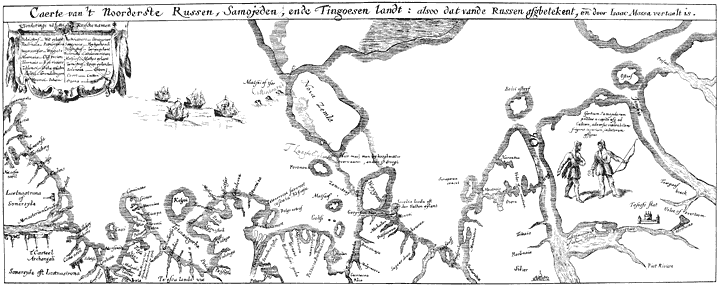
Caerte van’t Noorderste Russen, Samojeden, ende Tingoesen landt: alsoo dat vande Russen afghetekent, en door Isaac Maera vertaelt is.
There can, further, be no doubt that Dr. Hamel is right in his conclusion,—indeed, it is self-evident from Marsh’s statement,—that towards the close of the sixteenth century, and previously to the time when the Dutch visited those parts, Novaya Zemlya was looked on as an island extending from Burrough’s Strait (Karskoi Vorota) as far northwards only as “Mattuschan Yar” (Matyushin Shar): and that the land lying to the north of this latter passage was not deemed to be a part of Novaya Zemlya, but had a distinct designation, namely, Matthew’s Land, which in Russian would be Matvyéeva Zemlya,—an expression which corresponds precisely with Marsh’s “Land of Matfeov (Matpheoue)”.
Notwithstanding the length of time during which the name has been lost, there does not appear to be any good reason why the original and correct designation of Matthew’s Strait, Matvyéeva Shar (“Matfeiof tsar”), or Matyushin Shar, should not be restored to the channel between the two islands, instead of its continuing to bear the modern corrupted form of the latter name, Matochkin Shar.
It likewise seems only right that the name Matthew’s Land (the “Land of Matpheoue”) or Matvyéeva Zemlya, should not be lost from our maps; and it is therefore proposed to appropriate that designation to the small island extending from Matyushin Shar (“Matochkin Shar”) northwards as far as the channel, in about 74° N. lat., running across the land from Cross Bay to Rosmuislov’s “Unknown Bay”.
As to the name Novaya Zemlya, there can be no doubt that it ought still to continue the generic appellation of the entire series of islands, of which the country usually known by that name is now found to consist. But, at the same time, as it is highly expedient that each of those islands should possess some distinctive specific designation, there is a propriety in restricting the title of Novaya Zemlya (Proper), as it appears in the map of Isaac Massa and Theunis Ys, to the southernmost island of the series, lying between the Kara Gate or Burroughs Strait to the south and Matyushin Shar or Matthew’s Strait to the north.
To the famous and renowned Gerardus Mercator, his reuerend and singular friend, at Duisburg in Cliueland, these be deliuered.
Yours wholy at commandement,
John Balak.
It is not known what success attended this Alferius or Oliver in his scheme, or what subsequently became of him; unless, indeed, it be assumed that he is the Oliver Brunel (or Bunel), concerning whom several unconnected notices are met with, and with respect to whom various conflicting opinions have been entertained. The early history of the discovery of Novaya Zemlya would hardly be complete were these notices and opinions passed over in silence.
The first mention made of this individual is by Gerrit de Veer, when speaking, in page 30 of the present work, of “a great creeke, which William Barents iudged to be the place where Oliuer Brunel had been before, called Costincsarch”.
As this work of Gerard is but little known, the commencement of the author’s Preface (Prolegomena) shall be reprinted here, both on account of its clearing up the history of Oliver Brunel, and also because it shows the important bearing which his adventure had on the subsequent voyages of the Dutch, which form the subject of the following pages.
Oliver Brunel, or “Bunel”, was therefore no Englishman, but a native of Brussels; and if the particulars thus recorded of him and of the motives of his enterprise be correctly stated, he would scarcely seem to be the Alferius of Balak’s letter to Mercator. Still, the point cannot be looked on as absolutely decided. One further remark is necessary with respect to the spelling of his name. On the one hand, it will be seen that, according to De Veer and Logan, it is “Brunel” or “Brunell”, while Hudson makes it to be “Brownell”, which latter may, however, be regarded as merely a broad pronunciation of the word, or perhaps an attempt to give it a vernacular and significant form;—a process with respect to proper names not unusual among seamen of all nations. On the other hand, Gerard writes “Bunel”. But this form cannot be allowed to stand in opposition to the conjoint authority of the three seamen, all writing separately and without concert; and we may quite reasonably conjecture the r to have been left out by Gerard, through some clerical or typographical error.
The absurdity of Forster’s derivation of the name Kostin Shar is manifest from the explanation of it given in page 30 (note 4) of the present work. And as to the allegation that “the name Oliver Bennel is entirely English”, it could only have been made by a foreigner. On the contrary, it may be asserted that such a name as “Bennel” is altogether un-English; and were it not for the cosmopolitan character of our English surnames, it might—had it really been that of the individual in question—in itself be fairly taken as evidence that he was not an Englishman. With much more reason might we, at the present day, claim “Brunel” as an English name. Probably Forster had in his mind the “entirely English” name of Stephen Bennet, the well-known walrus-hunter on Bear (Cherie) Island.
With the statements of the various writers who preceded Barrow before us, we can see at a glance, though no authorities are cited by him, that he took that of Purchas as his basis, modifying it by means of those of Hudson, Logan, and Forster. It is to be regretted that he did not refer to the original Dutch authority cited by Purchas.
From this authority, then, we learn that Oliver Brunel, a native of Brussels, went in a vessel belonging to the town of Enkhuysen on a trading voyage into the Russian seas, where, after collecting a valuable cargo, he was lost; and that his enterprise (though unsuccessful), together with those of the English in the same quarter, induced the Dutch to set on foot the memorable expeditions which form the subject of the following pages. If this person was really the Alferius who was recommended by Balak to Mercator in the year 1581, he must subsequently have been engaged in the Russian trade for several years before his unlucky end; or else Gerard, writing in 1612, would surely not have named him as an immediate cause of an undertaking which was not projected till 1593.
It is unnecessary, for the consideration of the subject before us, to enter into any details respecting the commercial and political relations with Russia of the Netherlanders generally, in the first instance, and eventually of the natives of the United Provinces—commonly, though not very correctly, called the Dutch—in particular. It is sufficient to remark, that after their first entrance into the White Sea, they soon became powerful rivals of the English in the trade with Russia, and that it was also not long before their attention was directed to the extension of their commerce to the eastward of that country, and to the endeavour to reach China and the Indian Seas by a passage to the north-east.
Before proceeding further, a few words must be said respecting the individual whose name has become inseparably associated with the three memorable expeditions, of which the first is now under consideration.
But whatever may have been Barents’s general education, it is unquestionable that he was a man of considerable capacity and talent, and that as a seaman he was possessed of far more than ordinary acquirements. By Linschoten he is described as having great knowledge of the science of navigation, and as being a practical seaman of much experience and ability; his astronomical observations have stood the severest tests of modern science; while his feats of seamanship will bear comparison with those of the ablest and most daring of our modern navigators. Of his great determination, perseverance, and indomitable courage, some remarkable instances will be adduced; and that his personal character, and general conduct, were such as to secure to him the respect, confidence, and attachment of those who sailed with him, is clearly manifest from various expressions in Gerrit de Veer’s simple narrative, and from its tone throughout.
The name of this able navigator has been written in various ways. The Dutch usually have Barentsz., which has been adopted in the notes on Phillip’s text in the present volume, it being the usual native contraction of the full name, Barentszoon. In the Amsterdam Latin and French versions of De Veer’s work, the name is translated “filius Bernardi,” and “fils de Bernard”. Purchas and other early English writers, have Barents or Barentson, and sometimes even Bernardson. The first of these forms—namely, Barents—is most conformable to the genius of our language (in which we have Williams and Williamson, Richards and Richardson, etc.), at the same time that it accords with that of the Dutch, in which language this form of name is not uncommon. Barentz and Barentzen, as it has not unfrequently been written, are incorrect.
From a perusal of the mere dry details of their various courses in this part of their voyage, which are nearly all that is recorded in their journal, no idea could be formed of the difficulties they had to contend with, or the amount of labour actually performed. It is only when their track is laid down on the map,—as it has been, most carefully and with all possible accuracy, by Mr. Augustus Petermann,—that their enormous exertions become apparent. The result is really astonishing. Their voyage from Cape Nassau to the Orange islands and back occupied them from the 10th of July till the 3rd of August, being twenty-five days. During this period, Barents put his ship about eighty-one times, and sailed 1,546 geographical miles, according to the distances noted in the journal; to which, however, must be added the courses sailed along the coast, and also those which in some instances have been omitted to be specified, so that it may be reasonably assumed that the entire distance gone over was not much (if anything) short of 1,700 miles. This is equal to the distance from the Thames to the northern extremity of Spitzbergen, or from Cape Nassau to Cape Yakan, not far from Bering’s Strait. And all this was performed in a vessel of one hundred tons’ burthen, accompanied by a fishing smack!
One remarkable fact must not be omitted to be mentioned. On laying down Barents’s track from the bearings and distances given in his journal, from the 10th to the 19th of July, being the interval between his passing Cape Nassau, and being driven back again to that point,—during which period he tacked about in numerous directions, and sailed more than six hundred miles,—Mr. Petermann found it to agree so accurately, that its termination fell precisely upon Cape Nassau, without any difference whatever. This extreme precision can hardly be regarded as anything but a singular coincidence. Nevertheless, when viewed in connexion with Barents’s other tracks, and with his observations generally, as tested by the recent explorations of Lütke and other modern navigators, it must still remain a striking proof of the wonderful ability and accuracy of that extraordinary man.
After much rejoicing on both sides at their happy meeting, the whole fleet now sailed homewards in company, and on the 14th of September came to the Doggers Sand, whence Nai, in the Swan, proceeded to Middelburg, whilst the other vessels passed by the Texel to their several ports.
The reports made by Barents and Linschoten of the results of their respective voyages were very different in character. The former, though anything but an illiterate man, could make no pretensions to scholarship. The latter was an accomplished scholar, as is plainly shown by his narrative of this first and of the second voyage (which will be more particularly noticed in the sequel), and by his other published works; and though the vessels which he accompanied had not in reality accomplished so much as those of Barents, yet he appears to have had no difficulty in convincing their employers and the higher authorities that they had been not far from the realisation of the object of their voyage.
Stimulated by Linschoten’s report, the adventurers who had fitted out the former expedition, with others who now joined them, determined on dispatching in the following year a large and well-appointed fleet, not merely in the hope of accomplishing the passage to China which had been so well commenced, but also with a view to the establishment of an advantageous trade with that kingdom, and the other countries that might be discovered and visited in the course of the voyage, in respect of which trade they obtained from the Government of the United Provinces certain exclusive privileges and advantages.
Instructions to Jan Huygen van Linschoten and Françoys de la Dale, Chief Commissioners, for the regulation of their conduct in the kingdom of China, and other kingdoms and countries which shall be visited by the ships and yachts destined for the voyage round by the North, through the Vaigats or Strait of Nassau.
In the first place, after Mr. Christoffel Splindler, the Slavonian, shall have been on shore and ascertained whether they may land there, they shall go on shore to the king, governor, or other authority of the place, to whom they shall, on behalf of these States, offer all friendship, and shall explain the circumstances of these States, namely, that they hold communication by sea with all countries and nations in the whole world, for the purpose of trafficking, trading, and dealing with them in a friendly and upright manner, for which they possess many advantages of divers sorts of merchandise and otherwise.
Item, that the Government of this Country being surely informed that upright trade, traffic, and dealings are carried on in the said kingdoms and countries, have found it good to send thither some ships, under good order, government, and regulation, with merchandise, money, and other commodities, in order to begin dealings, by means of certain trusty and honest persons on board the said ships, for whom they shall ask free intercourse there, to the end aforesaid.
They shall do their best to come to an agreement for a fair, faithful, upright, and uninterrupted trade, traffic, and navigation, to the mutual advantage of the said kingdoms and of these States, as well as of their respective inhabitants; and in case the same shall be found good there, they shall declare that to that end it is intended to visit them with a good embassy by the first opportunity, provided the same shall be agreeable to them.
They shall explain there what commodities and merchandizes can from time to time be taken thither from these States; and they shall also carefully examine so as to ascertain what merchandizes and wares may, in return for the same, be obtained from those kingdoms and countries and brought to these States.
They shall keep a good and accurate account of everything that shall occur during the voyage, as well on ship-board, in the discovery of countries and ports, and on all other occasions, as likewise of that which shall happen to them on shore; so that, immediately on their return, they may of all things make a good and faithful report in writing to the Lords the States General.
Done and concluded in the Assembly of the Lords the States General of the United Netherlands at the Hague, the 16th of June 1595.
Sloeth vt.
By order of the Lords, the States aforesaid.
PROTEST.
On this day, the 15th of September, 1595, in the country and in the roads of the Cross Point, in the Strait of Nassau, where the ships are now lying at anchor all together, by desire and command of the admiral, Cornelis Cornelisz., the captains or pilots of all the aforesaid ships being assembled and met together in the cabin of the ship of the said admiral, in order that, jointly and each of them severally, they may without dissimulation and freely declare their opinion and final decision, and so consult together as to what is best and most advantageous to be done and undertaken in respect of the voyage which they have commenced round by the north towards China, Japan, etc.; and they having maturely and most earnestly considered and examined the subject, and also desiring strictly to carry out, as far as is practicable and possible, the instructions of His Excellency and the Lords the States, for the welfare and preservation of the same ships, their crews and merchandize: It is found that they have all of them hitherto done their utmost duty and their best, with all zeal and diligence, not fearing to hazard and sometimes to put in peril the ships and their own persons (whenever need required it), in order to preserve their honour in everything, and so as to be able with a clear conscience to answer for the same to God and to the whole world. But inasmuch as it has pleased the Lord God not to permit it on the present voyage, they find themselves most unwillingly compelled, because of the time that has elapsed, to discontinue the same navigation for this time, being prevented by the ice caused by the severe and unusually long frost, which, from what they have heard on the information of others and from their own experience, has this year been very hard and extraordinary in these parts. All which having been well considered and discussed by them together, they find no better means, being forced by necessity, than, with the first fit weather and favourable wind, to take their course homewards, all together and in the order in which they came, using every diligence so as if possible to preserve themselves from the frost which is momentarily expected to set in, and with God’s help to bring the ships, before all the perils of winter, into a safe harbour; inasmuch as at the present time no other better means can be found to lead them to a better judgment. Protesting before God and the whole world, that they have acted in this matter as they wish God may act in the salvation of their souls, and as they hope and trust cannot be gainsaid or controverted by any of those who have accompanied them; and they willingly submit themselves to defend this at all times, if requisite, by means of the fuller and more detailed journals and notes, which each of them, separately and without communication with the others, has kept thereof. And in order that there may be no disorder or idle talking unjustly spread abroad, to the disadvantage or derogation of those who with such good will have braved so many perils for the honour and advantage of our country, whereby they might be deprived of their merited reward, they have, for their defence and in order to provide before hand against the same, unanimously signed this Act, which I, Ian Huyghen van Linschoten, have drawn up at their request, and together with Françoys de la Dale, as chief commissioners of the said fleet, have, with the like affirmation and in further corroboration, in like manner signed, the day and date above written.
Cornelis Cornelisz. Brant Ysbrantsz. Willem Barentsz. Lambert Gerritsz. Thomas Willemsz. Harmen Ianssz. Hendrick Hartman. Ian Huyghen van Linschoten. Françoys de la Dale.
It may well be conceived that it was no easy task for a bold and resolute sailor, and at the same time a devout and conscientious man, as William Barents undoubtedly was, to “protest before God, as he wished He might act in the salvation of his soul”, that it was impossible for him to do more than he had done, so long as his ship was staunch and he had a crew willing to go forward with him, or even to brave a winter residence in those inhospitable regions. Linschoten speaks of the dissentient Amsterdammers in the plural number; whence it is to be inferred that Barents did not stand alone, but that Harmen Ianszoon, the master of the other Amsterdam vessel, was at first of the same opinion; and, most probably, it was only when he yielded, that Barents saw himself, however reluctantly, forced to give in.
After the protest had been so signed, the fleet proceeded on its homeward voyage, and on the 30th of September reached Wardhuus, where it remained till the 10th of the following month. The vessels then again set sail all together; but the vice-admiral’s ship, the Hope, on board of which was Linschoten, managed to get the start of the rest, arriving at the Texel on the 26th of October. It was not till the 18th of the following month that Barents’s vessel arrived in the river Maas.
The journal of the proceedings of the fleet, which was kept by Linschoten in pursuance of his instructions, was communicated by him to the Government immediately on his arrival; but it was not till six years afterwards that he published his very interesting and valuable narrative of this voyage, as well as of that of the preceding year so far as concerns the Enkhuysen vessels, which had sailed through Yugorsky Shar—“Pet’s Strait” or the “Strait of Nassau”—into the Sea of Kara.
So little appears to be known by bibliographers respecting Linschoten’s narrative of these voyages, that we have scarcely the means of describing any other editions than those which happen to exist in the British Museum.
The earliest of these appeared in Dutch, in 1601, in folio, under the following title:—
Voyagie, ofte Schip-vaert, van Ian Hvyghen van Linschoten, van by Noorden om langes Noorwegen, de Noortcaep, Laplant, Vinlant, Ruslandt, de Witte Zee, de Custen van Candenoes, Swetenoes, Pitzora, &c. door de Strate ofte Engte van Nassau tot voorby de Revier Oby. Waer inne seer distinctelicken Verbaels-ghewijse beschreven ende aenghewesen wordt, alle t’ghene dat hem op de selve Reyse van dach tot dach bejeghent en voorghecomen is. Met de af beeldtsels van alle de Custen, Hoecken, Landen, Opdoeningen, Streckinghen, Coursen, Mijlen, ende d’ander merckelicke dingen meer: Gelijc als hy’t alles selfs sichtelicken en̄ waerachtelicken nae’t leven uytgeworpen ende gheannoteert heeft, &c. Anno 1594 en̄ 1595.
Ghedruct tot Franeker, by Gerard Ketel.
The colophon has—
Ghedruct tot Franeker, by Gerard Ketel, voor Ian Huyghen van Linschoten, resideerende binnen Enchuysen, anno 1601.
This rare edition consists of thirty-eight numbered leaves, with a dedication to the States General, dated June 1st, 1601, on two leaves unnumbered, and contains numerous maps and coast views by Johannes and Baptista a Doetechum. It was reprinted at Amsterdam in 1624, likewise in folio, with the same plates.
In the first edition, between the dedication and the text, are inserted several eulogistic poems, the longest of which is an ode on “Vaygats ofte de Straet van Nassau”, by C. Taemssoon van Hoorn, and another is a “Lof-dicht”, by Jacobus Viverius, which is directed to be sung to the tune of the forty-second Psalm. It is worthy of remark, that, even so early as 1595, allusion was made to the first north-east voyage of Linschoten in the commendatory verses (which included also the poem on Vaygats above referred to) at the commencement of the “Reys-gheschrift van de Navigatien der Portugaloysers in Orienten.….….door Jan Huyghen van Linschoten. Amstelredam, MDXCV. folio”; which work, though it bears the date of 1595, the register shows to be a portion of the author’s “Itinerario, Voyage ofte Schipvaert van Jan Huygen van Linschoten naer Oost ofte Portugaels Indien”, the title-page of which is dated a year later. This was reprinted in 1604 with the same verses.
An abstract in Dutch of Linschoten’s narrative was printed at Amsterdam by G. J. Saeghman, in 4to., with the following title:—
Twee Journalen van twee verscheyde Voyagien, gedaen door Jan Huygen van Linschooten, van by Noorden om, langhs Noorwegen, de Noordt-Caep, Laplandt, Findlandt, Ruslandt, de Witte Zee, de Kusten van Candenoes, Sweetenoes, Pitzora, etc., door de Strate ofte Enghte van Nassouw, tot voorby de Reviere Oby, na Vay-gats, gedaen in de Jaren 1594 en 1595. Waer in seer pertinent beschreven ende aen gewesen wordt, al het geene hem op de selve Reysen van dagh tot dagh voor gevallen is, als mede de Besschryvingh van alle de Kusten, Landen, Opdoeningen, Streckingen en Courssen, etc. T’Amsterdam, Gedruckt by Gillis Joosten Saeghman, in de Nieuwe-Straet, Ordinaris Drucker van de Journalen ter Zee, en de Reysen te Lande.
This has no date, but was probably printed in or about 1663, the year in which Saeghman printed the “Verhael van de vier eerste Schip-vaerden der Hollandtsche en Zeeuwsche Schepen naar Nova Zembla, etc.”, which will be more particularly described when we come to speak of the editions of Gerrit de Veer’s work.
We learn from Mr. Henry Stevens that a copy of this abstract is in the possession of John Carter Brown, Esq., of Providence, Rhode Island.
In 1610, appeared a French translation of Linschoten’s voyages, with the following title:—
Histoire de la Navigation de Iean Hvgves de Linscot, Hollandois, et de son voyage es Indes Orientales: contenante diuerses descriptions des Pays, Costes, Haures, Riuieres, Caps, et autres lieux iusques à present descouuerts par les Portugais: Obseruations des coustumes des nations de delà quant à la Religion, Estat Politic et Domestic, de leurs Commerces, des Arbres, Fruicts, Herbes, Espiceries, et autres singularitez qui s’y trouuent: Et narrations des choses memorables qui y sont aduenues de son temps. Avec annotations de Bernard Paludanus, Docteur en Medecine,.….. à quoy sont adiovstées quelques avtres descriptions tant du pays de Guinee et autres costes d’Ethiopie, que des nauigations des Hollandois vers le Nord au Vaygat et en la nouuelle Zembla. Le tovt recveilli et descript par le mesme de Linscot en bas Alleman, & nouuellement traduict en Francois. A Amstelredam, de l’Imprimerie de Theodore Pierre, MDCX. folio.
Although the voyages to the north are thus announced in the title-page, they are not inserted in the only copy which we have been able to consult, namely, that in the British Museum; nor is any light thrown on the matter by bibliographers.
In the title of the third edition, published at Amsterdam in 1638, fol., these northern voyages are not announced, nor are they given, but the edition is described as “troixiesme édition augmentée”.
The second French edition has not fallen within our reach, but we believe the date to be 1619.
The only French version of Linschoten’s narrative of his northern voyages with which we are acquainted, is that inserted in the fourth volume of the “Recueil de Voiages au Nord”, published in eight volumes, Amsterdam, 1715–27, 12mo.; of which another edition, in ten volumes, 12mo., was published at the same place, 1731–38.
This French version formed the basis of the German description of these voyages given by Johann Christoph Adelung, at pp. 107–213 of his Geschichte der Schiffahrten, published at Halle, 1768, 4to.
An abstract of Linschoten’s work is given in Latin, at fol. 31 of the first volume of Blaeu’s “Atlas Major sive Cosmographia Blaviana, qua Solum, Salum, Cœlum accuratissime describuntur”. Eleven volumes in folio, Amsterdam, 1662.
In the French edition, entitled “Le Grand Atlas ou Cosmographie Blaviane”, etc., 12 vols. in folio, Amsterdam, 1663, and republished in 1667, the same appears at fol. 35 of the first volume of the latter edition, which is the only one in the British Museum.
It is also at fol. 52 of the first volume of the Spanish edition, entitled “Atlas Mayor, Geographia Blaviana”, etc.; Amsterdam, 1659–72, 10 vols., fol.
In the elaborate dissertation on the works of John Blaeu, contained in the fourth volume of Clement’s “Bibliothèque Curieuse”, mention is made, at page 277, of an “Atlas Flamand de l’an 1662”. This is apparently a Dutch edition, to which reference is made by Lütke, under the title of “J. Blaeu’s Grooten Atlas, of Werelt Beschrijving, Erste Deel, ’t Amsterdam, 1662”. Beyond this reference, we know nothing of that edition.
A German edition is also described by Brunet as announced in a catalogue of Blaeu’s; but it is not alluded to by Clement, nor can we find any other trace of it. If ever printed or in progress of printing, it may have been consumed in the great fire, by which, on the 22nd February, 1672, nearly all Blaeu’s stock in trade was destroyed.
In part XII, pp. 20–23, of Levinus Hulsius’s Collection, is an extract from Linschoten’s Navigation, stating the progress of the Dutch in the attempt to find the passage, the discovery of which formed a favourite scheme of his countrymen at the end of the sixteenth and beginning of the seventeenth centuries.
Summaries more or less concise, derived apparently from Blaeu’s abstract, the French “Recueil de Voyages au Nord”, or Adelung’s “Geschichte der Schiffahrten”, have also been given in most of the histories of Arctic discovery.
Gerrit de Veer’s description of the second voyage, contained in the present volume, must be understood to relate almost exclusively to the proceedings of Barents’s vessel, as forming one of the fleet under Nai’s command. This reconciles or explains away such differences as may appear to exist between his narrative and that of Linschoten.
A better founded cause of surprise might be, that Barents himself had not the command of the expedition. Yet for this a sufficient reason suggests itself. He was evidently resolved to perform (as it were) impossibilities, rather than fail in a project on which he had set his heart; and the merchants, however willing to risk their property on the adventure, may naturally have been disinclined to entrust it absolutely to one, who would not have hesitated to sacrifice it, or even his own life, in the attempt to accomplish his long-cherished undertaking.
In being made subordinate to a nobleman like Jacob van Heemskerck, who, though no seaman by profession, had already sailed with him, and had thus had an opportunity of learning and appreciating his many estimable qualities, Barents, a man of humble birth, could however in no wise have felt himself humiliated or aggrieved. It was a case similar to that of Sir Hugh Willoughby and Richard Chancellor, and was moreover quite in accordance with the practice of those times, which afford repeated instances of the command of a naval expedition being entrusted to a soldier, who had probably never before been on salt water.
We have now to take a rapid glance at some of the most important results of this third voyage, into the particulars of which, as they are recorded in De Veer’s journal, it is unnecessary to enter.
Before adverting to the subject of the memorable wintering of the Dutch at this spot, it is necessary to make a few remarks with respect to the identification of the several points along the coast, which were reached and noted by them during the course of their first and third voyages. This is the more needful, because widely different opinions are entertained by two of the highest living authorities on the subject, Admiral Lütke and Professor von Baer.
Consequently, without waiting for any corroboration to be obtained from future surveys, we deem it perfectly safe to reinsert in our maps the north-eastern portion of Novaya Zemlya, which has been omitted on the authority of Zivolka and Baer. This is a matter not without importance, inasmuch as an extent of at least ten thousand square geographical miles will thereby be restored to the Russian dominions. And we likewise consider it due to the memory of the first and only explorer of this region, that it should bear the specific designation of “Barents’s Land,” which name is accordingly given to it in the accompanying map. To that portion of Novaya Zemlya which lies between Barents’s Land and Matthew’s Land, we have further thought that no more fitting appellation can be given than “Lütke’s Land,” in honour of that able navigator, who has done more for the geography of Novaya Zemlya than any one since the time of Barents.
The ten months’ residence of Barents and his companions at the furthest extremity of Novaya Zemlya, has so often formed the subject of comment on the part of writers on Arctic discovery, that we deem it unnecessary to dilate on it here, especially as our other introductory remarks have already extended to so great a length.
Gerrit De Veer’s simple narrative has further an air of unaffected and unostentatious piety and resignation to the will of Providence, which contrasts remarkably with the general tone of Linschoten’s works, of which some instances have been given in the preceding pages; and we may perceive that the reliance of himself and his comrades on the Almighty was not less firm or sincere because His name was not incessantly on their lips. Cheerfulness, and even frequent hilarity, could not fail to be the concomitants of so wholesome a tone of mind; and these, joined to the bodily exercise which they took at every possible opportunity, and the labour which they were compelled to perform in preparing for their return voyage, must have been very instrumental in preserving them from sickness.
The most remarkable occurrence during their stay in Novaya Zemlya, was the unexpected reappearance of the sun on the 24th of January, 1597. This phenomenon not only caused the greatest surprise to the observers and their companions, but after their return to Holland gave rise to much controversy among the learned men of the day. Their opinion generally was unfavourable to the truth of the alleged fact, as being “opposed to nature and to reason”. Among these was Robert Robertsz. le Canu, “homme fort entendu en l’art de la marine, et qui faisoit profession de l’enseigner aux autres”, who wrote a letter on the subject to William Blaeu, the father of the celebrated John Blaeu, which was published by the latter in his Great Atlas. This letter shall be reproduced here, not merely on account of its giving the objections which were raised at the time, but because it likewise contains some curious matters relating personally to our author and his companions, which it would be wrong to omit.
Mon bon amy Guillaume Jansse Blaeu,
Puisque vous m’avez témoigné desirer que je vous envoyasse un extrait du discours que j’ay eu avec Jacob Heemskerck, Gerard de Veer, Jean Corneille Rijp, et plusieurs autres de mes escoliers, lesquels ayant fait voile en l’an 1596, retournerent en 1597, sans avoir rien effectué touchant la commission qu’ils avoyent de reconnoistre les Royaumes de la Chine, & du Cathay, & dans la mesme année 1597 me vinrent trouver pour me raconter les merveilleuses aventures de leur voyage, entre lesquelles la plus remarquable estoit, que le Soleil leur estoit disparu le IV de Novembre en l’an 1596, & avoyent commencé de le revoir l’an 1597 le 24 de Ianvier, sous la mesme hauteur de 76 degrez, sous laquelle ils avoient basty leur maison dans la Nouvelle Zemble, matiere suffisante, ainsi qu’ils ont escrit, pour exercer long-temps les beaux esprits: & puis qu’outre vostre propre satisfaction vous me conviez encor à vous declarer mon sentiment sur ce sujet par l’advis que vous me donnez des contentions & debats survenus à cette occasion entre tous les sçavans de l’Europe, je veux vous faire un court recit du Dialogue que j’ay eu là dessus avec tous ces Messieurs que j’ay deja nommez, qui avoyent esté spectateurs d’une chose si extraordinaire, & qui me la raconterent avec grand estonnement; je raisonnois donc avec eux comme il s’ensuit:
From this letter of Robert le Canu it will be perceived, that the fact of the sun’s disappearance on the 4th of November 1596 was equally denied by him with that of its reappearance on the 24th of January following. The former, though differing in degree, was, as far as regards the fact itself, deemed not less abnormal and “opposed to nature and to reason” than the latter. It is therefore of importance to demonstrate that the particulars recorded by Gerrit de Veer concerning the sun’s latest appearance and final disappearance, are in all respects absolutely and literally true.
Had Gerrit de Veer and his companions been weak enough to give way to the dogmatical assertion of their teacher, that “pendant le grand jour d’esté ils avoyent omis à compter quelques revolutions du soleil”, they might perhaps at the time, and during the two centuries and a half which have since elapsed, have enjoyed some little more credit than has been accorded to them; but they would eventually have deprived themselves of that triumphant vindication of their character for perfect truthfulness and sincerity which it is our good fortune to be the means of now affording to them.
The reappearance of the sun on the 25th of January 1597, is not, at least for the present, capable of so complete and satisfactory an explanation. But hitherto the subject has never been properly understood, because the facts have never been correctly stated. One of the most recent examinations of this phenomenon is that made by the Rev. George Fisher, in his remarks “On the Atmospheric Refraction,” contained in the “Appendix to Captain Parry’s Journal of a Second Voyage, etc.”, published in 1825.
“M. Le Monier, from the observations made on these two days, assures us that there must have been more than 4½ degrees of refraction, and that he ‘could neither explain these observations, reject them as doubtful, nor suppose any error, as was done by most other astronometers.’ How this conclusion has been deduced from the facts related in the Journal does not appear, neither is there the least occasion to reject as doubtful the simple and honest account of the Dutchmen.”
Now the facts of the case are in reality as follows:—In the first place, the Dutch reckoned their time according to the new style, which had already been adopted in the Netherlands. This is not only to be deduced from the correspondence of their several astronomical observations with this reckoning alone; but it also admits of direct proof from the express statement of William Barents, in his note on the tides at States Island, that the dates were “stilo novo.”
Now, according to theory, the sun’s upper edge ought not, in 75° 45′ north latitude, to have been visible till the 9th of February; so that on the 25th of January (not the 24th, as De Veer erroneously supposed), at mid-day, the extraordinary and anomalous refraction was as much as 3° 49′, and on the 27th of that month it could not have been much, if at all, less. On the 8th of February, however, when they “saw the sun rise S.S.E. and go down S.S.W.”, the entire refraction would have been 2° 10′,7, which is about one degree and a half more than according to theory it ought to have been; and on the 19th of the latter month, when they took the sun’s height, the refraction had again attained its normal amount.
Without attempting any explanation of the phenomenon thus described, what we have now to do is to show that Gerrit de Veer and his companions could not possibly have been materially in error with respect to their dates.
Commencing then from the 4th of November, when it has been demonstrated that their time was strictly correct, we have their subsequent astronomical observations on December 14th and January 12th, which establish that till the latter date they were still right in their time. If, therefore, they lost their reckoning at all, it must have happened between the 12th and the 25th of January—an interval of only thirteen days; and certainly neither their oversleeping themselves (assuming them to have done so), nor any error, however great, in the rate of their twelve hours’ sand-glass, could in that short interval have occasioned any gross miscalculation with respect to the time of a phenomenon which extended over a period of fourteen days. Then again, on the 19th of February, and also on the 2nd of March, they obtained by similar astronomical observations the means of checking their time; so that it is utterly impossible for them to have fallen into any material error. The mistake of a few hours, which caused them to place the conjunction of the moon and Jupiter, and consequently the reappearance of the sun, on the 24th instead of the 25th of January, is only an additional proof in favour of their general correctness, as it is just such an error as they were likely to fall into from their inability to measure their time with strict precision.
But the fact of the conjunction itself has yet to be noticed. De Veer tells us that they had watched the approach of the two planets to each other, till at length they came together in a certain direction and at a certain time; and that contemporaneously with this occurrence the sun reappeared. Now there was no other conjunction of those two planets till 27¼ days later, namely, at noon on the 21st of February, and at that date the sun had been at least nine days above the horizon; besides which, the conjunction would not have been visible, on account of the daylight. Consequently, if the conjunction on the 25th of January is not intended, the whole account must be an invention and a fabrication. And to suppose this would assuredly be imputing to De Veer, not only more deceit, but also very much more skill than he possessed. For, even assuming him to have been capable of calculating the place of Jupiter and the time of that planet’s setting, he would have found (as Mr. Vogel has now found) that at the time of the conjunction that planet had already set 1 hour and 48 minutes, and was at the time actually 2° 44′ below the horizon; and it is altogether too much to suppose that he would have adduced a conjunction, which according to calculation was invisible, as evidence of another phenomenon which was equally opposed to the recognized laws of nature.
We have therefore no alternative but to receive the facts recorded by De Veer as substantially true, and to believe that owing to the peculiar condition of the atmosphere, there existed an extraordinary refraction, not merely on the 25th of January, but continuously during fourteen days afterwards, at first amounting to nearly four degrees, but gradually decreasing to about one degree and a half.
With respect to the personal history of Gerrit de Veer we know almost nothing. From his familiar allusion to “the salt hills that are in Spaine”, it is to be inferred that he had visited that country at some time previously to the year 1595, when he joined Barents’s second expedition. From Robert le Canu’s letter we learn that he had studied navigation under him, and also that his death occurred some time previously to the year 1627, when that letter was written. The position of his name in the two lists of the crew of Heemskerck’s vessel, between those of the first mate and the surgeon, shows that he was one of the officers—probably the second mate; and we learn incidentally that he was a small man, “being the lightest of all their company”. More than this we know not.
Of the various editions, abridgments, and summaries of De Veer’s work, we have collected the following particulars.
The first printed account of these interesting voyages was published in Dutch at Amsterdam in the year 1598, under the following title:—
Waerachtighe Beschryvinghe van drie seylagien, ter werelt noyt soo vreemt ghehoort, drie jaeren achter malcanderen deur de Hollandtsche ende Zeelandtsche schepen by noorden Noorweghen, Moscovia ende Tartaria, na de Coninckrijcken van Catthay ende China, so mede vande opdoeninghe vande Weygats, Nova Sembla, en̄ van’t landt op de 80. gradē, dat men acht Groenlandt tezijn, daer noyt mensch gheweest is, ende vande felle verscheurende Beyren ende ander Zeemonsters ende ondrachlijcke koude, en̄ hoe op de laetste reyse tschip int ys beset is, ende tvolck op 76. graden op Nova Sembla een huijs ghetimmert, ende 10. maenden haer aldaer onthouden hebben, ende daer nae meer als 350. mylen met open cleyne schuyten over ende langs der Zee ghevaren. Alles met seer grooten perijckel, moyten, ende ongeloofelijcke swaricheyt. Gedaen deur Gerrit de Veer van Amstelredam.
Ghedruckt t’Amstelredam, by Cornelis Claesz, op’t water, int Shrijf-boeck. Ao. 1598. Oblong 4o.
This rare and valuable book, a copy of which is in the British Museum, does not appear to have been hitherto noticed by bibliographers. It contains sixty-one numbered leaves, in addition to the Dedication on two leaves not numbered, six maps by Baptista à Doetechum, and twenty-five plates, which are coloured. The title-page also bears a plate, in eight partitions, four of which contain reductions from plates in the volume.
The following is a translation of Gerrit de Veer’s Dedication.
To the Noble, Mighty, Wise, Discreet, and very Provident Lords, the States General of the United Netherlands, the Council of State, and the Provincial States of Holland, Zeeland and West Friesland; and also to the most illustrious Prince and Lord, Maurice, born Prince of Orange, Count of Nassau, Catzenellenbogen, Vianden, Dietz, etc., Marquis of Vere and Flushing, etc., Lord of St. Vyt, Doesburg, the city of Grave, and the countries of Kuyct, etc., Stadtholder and Captain-General of Gelderland, Holland, Zeeland, West Friesland, Utrecht, and Overyssel, and Admiral of the sea; and to the Noble, Honorable, Wise, and Discreet Lords, the Commissioners of the Admiralty in Holland, Zeeland, and West Friesland.
My Lords: the art of navigation, which in utility surpasses nearly all other arts, has now in these latter years and within the memory of man been wonderfully improved, and has more especially contributed to the welfare of these States. This has been mainly the result of the skilful use and practice of navigation, and of the measurement of the latitudes and bearings of countries according to the rules of mathematical science; whereby countries lying on the very confines of the world have been reached, and their products imported for our use. Thus this child of Astrology has proved of greater service on the ocean than on land; for, there it is merely a science, whereas here its usefulness is so much extended, that various bearings, courses, headlands, and promontories unmentioned by Ptolemy and Strabo, and unknown for a long period after that time, have now become known by the investigations and experiences of this science. And as many previously unknown places were not found till after repeated search, so now three unsuccessful trials have been made from these States to find a passage round by the north to the kingdoms of Cathay and China; which although hitherto unsuccessful, have not been altogether useless, nor have they shown the attempt to be hopeless. For these reasons I have drawn up a brief description of the three aforesaid voyages (in the last two of which I myself was engaged), which were made from these States by the north of Norway, Muscovy, and Tartary, towards the aforesaid kingdoms of Cathay and China. And I have done so because many interesting circumstances happened in those voyages, and because I think that the right course may still be discovered; inasmuch as the direction and position of Vaygatz and Nova Zembla, and also the eastern part of Greenland (as we call it) in 80°, are now ascertained, where it was formerly thought there was only water and no land; and because there in 80° it was less cold than at Nova Zembla in 76°, and in 80° aforesaid, in June early in the summer, plants and grass were growing and beasts that feed on grass were found, while on the contrary in 76°, in August in the hottest of the summer, there were found neither plants nor grass, nor animals that feed on grass. From all which it appears that it is not the proximity of the Pole which causes the ice and cold, but the Sea of Tartary (called the Frozen Ocean), and the proximity of the land, round about which the ice remains floating. For, in the open sea between the land situated in 80 degrees and Nova Zembla, which lie at a distance of full 200 (800) miles E.N.E. and W.S.W. of each other, there was little or no ice; but as often as we approached land we immediately fell in with the cold and the ice. Indeed, it was by means of the ice that we always first perceived that we were near land before we saw the land itself. At the east end of Nova Zembla also, where we passed the winter, the ice drifted away with a W. and S.W. wind, and returned with a N.E. wind. Hence it certainly appears, that between the two lands there is an open sea, and that it is possible to sail nearer to the Pole than has hitherto been believed; and this notwithstanding that ancient writers say that the sea is not navigable within 20 degrees of the Pole because of the intense cold, and that therefore nobody can live there; whereas we have both been as far as 80 degrees, and in 76 degrees have with small means passed the winter; and thus it appears that the said passage may be effected between the two above-named countries by taking a N.E. course from the North Cape in Norway. This too was the opinion of the renowned pilot Willem Barentsz., as well as of Jacob Heemskerck, our captain and supercargo, who would have dared to undertake it by keeping that course, its accomplishment being left to God’s mercy. Yea, notwithstanding that on our last voyage, through our manifold difficulties, we were entirely exhausted and ofttimes in peril of death, yet our courage was not so broken but that if our ship (which became fast in the ice) had been set free a little sooner, we would once more have made the attempt in that direction, as a proof that we believed the passage might thereby have been effected; although this last voyage had been very troublesome, wherein we (speaking without vanity) made no account either of labours, difficulties, or danger, in order to bring it to a successful end, as will appear from the relation thereof; but neither the time nor the opportunity permitted it. And as the aforesaid three voyages were made through the gracious assistance of your Lordships, and thus the fruits which may still result from them belong to your Lordships, I have taken the liberty of dedicating to you this narrative, which, if not an eloquent, is at least a faithful one.
Praying to God that he will bless with success the government of your Lordships, in honour of his name, and for the welfare of these States,
Your noble, mighty, illustrious, wise, and provident Lordships’ obedient servant,
Gerrit de Veer.
From Amsterdam, the last day but one of April, in the year 1598.
Another edition was brought out, as the first part of a collection of early Dutch voyages at Amsterdam, with the following title:—
Oost-Indische ende Uvest-Indische voyagien, Namelijck, De waerachtighe beschrijvinge vande drie seylagien, drie Jaren achter malkanderen deur de Hollandtsche ende Zeelandtsche Schepen, by noorden Noorweghen, Moscovien ende Tartarien nae de Couinckrijcken van Catthay ende China ghedaen.
Tot Amsterdam. By Michiel Colijn, Boeck-verkooper, op’t Water, in’t Huys-boeck, aen de Kooren-marckt. 1619. Oblong 4to.
This edition contains eighty numbered leaves. De Veer’s Dedication is omitted. The plates are copies from those in the former editions, but smaller and reversed. The colophon reads:—
Ghedruckt tot Enchuysen, by Jacob Lenaertsz. Meyn, Boeckvercooper op de Nieuwe straet int vergulden schrijfboeck. Anno 1617.
Latin. In the same year that the first edition of these voyages was published in Dutch, viz., 1598, a Latin translation was brought out at Amsterdam by the same publisher. The translator signs himself C. C. A., and dates his preface, Leyden, July 7th (“nonis Julij”) 1598; thereby showing that little more than two months had elapsed since the appearance of the original work. It bears the following title:—
Diarivm Navticvm, seu vera descriptio Trium Navigationum admirandarum, & nunquam auditarum, tribus continuis annis factarum, à Hollandicis & Zelandicis navibus, ad Septentrionem, supra Norvagiam, Moscoviam & Tartariam, versus Catthay & Sinarum regna: tum ut detecta fuerint Weygatz fretum, Nova Zembla, & Regio sub 80. gradu sita, quam Groenlādiam esse censent, quam nullus unquam adijt: Deinde de feris & trucibus vrsis, alijsque monstris marinis, & intolerabili frigore quod pertulerunt. Quemadmodum præterea in postrema Navigatione navis in glacie fuerit concreta, & ipsi nautæ in Nova Zembla sub 76. gradu sita, domum fabricarint, atque in ea per 10. mensium spatium habitarint, & tandem, relictâ navi in glacie, plura quam 380. milliaria per mare in apertis parvis lintribus navigarint, cum summis periculis, immensis laboribus, & incredibilibus difficultatibus. Auctore Gerardo de Vera Amstelrodamense.
Amstelredami, ex Officina Cornelij Nicolaij, Typographi ad symbolum Diarij, ad aquam. Anno M.D.XCVIII. Folio.
This edition contains forty-three numbered leaves, and has the same plates and maps as the Dutch edition; but the Dedication is omitted. A copy is in the British Museum.
French. In the same year, and probably near the same time as the preceding edition, appeared a French translation under the following title:—
Vraye Description de trois Voyages de mer tres admirables, faicts en trois ans, a chacun an vn, par les navires d’Hollande et Zelande, av nord par derriere Norwege, Moscovie, et Tartarie, vers les Royaumes de China & Catay: ensemble les decouvremens du Waygat, Nova Sembla, & du pays situé souz la hauteur de 80 degrez; lequel on presume estre Greenlande, où oncques personne n’a esté. Plus des Ours cruels & ravissans, & autres monstres marins: & la froidure insupportable. D’avantage comment a la derniere fois la navire fut arrestee par la glace, & les Matelots ont basti vne maison sur le pays de Nova Sembla, situé souz la hauteur de 76. degrez, où ils ont demeuré l’espace de dix mois: & comment ils ont en petittes barques passé la Mer, bien 350. lieues d’eaue; non sans peril, a grand travail, & difficultez incroyables. Par Girard Le Ver.
Imprimé a Amstelredam par Cornille Nicolas, sur l’eaue, au livre à écrire. Anno M.D.XCVIII. folio.
This edition contains forty-four numbered leaves, and the same plates and maps as the original Dutch edition. There is a copy in the Grenville Library. It was reprinted in 1600 and in 1609. There is a copy of the edition of 1609 in the British Museum, in which the same plates and maps occur as in the first Dutch edition.
An edition in 8vo. was published at Paris by Chaudière in 1599, under the title of “Trois navigations admirables faites par les Hollandois et les Zélandois au Septentrion.”
Italian. An Italian translation, which was made at the instance of Gioan Battista Ciotti, by whom it is dedicated to Gasparo Catanei, appeared at Venice in 1599, in Italic characters. Its title runs thus:—
Tre Navigationi fatte dagli Olandesi, e Zelandesi al Settentrione nella Norvegia, Moscovia, e Tartaria, verso il Catai, e Regno de’ Sini, doue scopersero il Mare di Veygatz, La Nvova Zembla, et vn Paese nell’ Ottantesimo grado creduto la Groenlandia. Con vna descrittione di tvtti gli accidenti occorsi di giorno in giorno a’ Nauiganti, Et in particolare di alcuni combattimenti con Orsi Marini, e dell’ eccesiuo freddo di quei paesi; essendo nell’ ultima Nauigatione restata la Naue nel ghiaccio, onde li Marinari passorono infinite difficoltà, per lo spatio di diece mesi, e furono forzati alla fine di passare con li Batelli trecento miglia di Mare pericolosissimo. Descritte in Latino da Gerardo di Vera, e Nuouamente de Giouan Giunio Parisio Tradotte nella lingua Italiana.
In Venetia, presso Ieronimo Porro, e Compagni. 1599. 4to.
It contains seventy-nine leaves, with copies of the usual maps and plates, but badly executed.
This was reprinted in the third volume of the 1606 edition of Ramusio’s Navigationi et Viaggi.
English. The only other language, as far as we are aware, into which De Veer’s work has been translated, is English; the first and only edition of which translation, now extremely scarce, is that reproduced in the present volume.
ABRIDGEMENTS.
German. The first and most important German edition of De Veer’s narrative was an abridgement, published at Nuremberg by Levinus Hulsius, the dedication of which bears date the 10th of August, 1598, being little more than three months after that of the original Dutch work. Its title runs thus:—
Warhafftige Relation der dreyen newen vnerhörten seltzamen Schiffart, so die Holländischen vnd Seeländischen Schiff gegen Mitternacht, drey Jar nach einander, als Anno 1594, 1595 vnd 1596 verricht. Wie sie Nortwegen, Lappiam, Biarmiam, vnd Russiam, oder Moscoviam (vorhabens ins Königreich Cathay vnd China zukommen) vmbsegelt haben. Als auch wie sie das Fretum Nassoviæ, Waygats, Novam Semblam, vnd das Land vnter dem 80. Gradu latitud. so man vermeint das Groenland sey, gefunden: vnd was für gefahr, wegen der erschröcklichen Bern, Meerwunder, vnd dem Eyss, sie aussgestanden. Erstlich in Niderländischer sprach beschrieben, durch Gerhart de Ver, so selbsten die lezten zwo Reysen hat helffen verrichten, jezt aber ins Hochteutsch gebracht, Durch Levinum Hulsium. Noribergæ, Impensis L. Hulsij. Anno 1598. 4to.
Translator’s dedication two pages. Preface twelve pages. An address to the reader, headed and subscribed “Gerardus de Veer,” four pages. Text one hundred and forty-six numbered pages. Thirty-five plates and maps. The colophon reads:—
Gedruckt zu Nürnberg, durch Christoff Lochner, In verlegung Levini Hulsii, anno 1598.
It was re-issued in the year 1602, as the “Dritter Theil” of Hulsius’s celebrated collection of voyages. This is, however, merely a duplicate of the edition of 1598, excepting the first sheet, which has been reprinted, apparently with the view of affording Hulsius an opportunity of alluding, on the fourth page of his Preface, to the publication of the beautiful book (“schones Buch”) of Linschoten the year before. The dedication is dated Nuremberg, 6th February.
A “secunda editio,” considerably abridged, appeared from the same press in the same year (1602), with the dedication dated Frankfort, 1st August: the text of this extends only to one hundred and twenty-one pages, and the address to the reader and colophon are omitted. In his dedication, Hulsius informs us, as a reason for this rapidity of republication, that upwards of 1,500 copies of the former edition had already been disposed of, and that the demand for the work was still very great.
A third and fourth edition, yet further abridged, and similarly forming the “Dritter Theil” of Hulsius’s collection, appeared respectively in the years 1612 and 1660.
Copies of all these editions are in the Grenville Library in the British Museum.
This work of Hulsius enjoys a degree of credit among bibliographers, to which intrinsically it would hardly seem to be entitled. On the title-page, and also in the publisher’s dedication, it professes to be a translation from the Dutch of Gerrit de Veer. But it is neither this, nor is it a true and genuine abridgement. On the contrary, copious omissions are made throughout, while at the same time passages are frequently introduced, which are not to be found in the original. It would be an almost endless task, and one quite out of place here, to attempt a collation of the two works. Still it is expedient that a specimen should be adduced of the liberties which Hulsius has taken with his author; and for this purpose the commencement of his narrative of the second expedition (pages 16–18) shall be given verbatim.
Im Jar nach unserer Erlösung 1595, sein von den Unirten Ständen in Holl und Seeland, &c., und dem Duchleuchtigen Hochgebornen Fürsten und Herren, Herren Mauritz, Grafen zu Nassaw, &c., siben Schiff vorhabens, damit den Weg durch Waygats, und das Fretum Nassoviæ, nach Cathay und China zufinden, zugerüstet worden: zwey zu Amsterdam, zwey in Seeland, zwey zu Enckhausen, und einss zu Roterdam. Deren sechs mit allerley Kauffmanns Wahren, unnd mit Geld beladen gewest, das sibende aber, war ein Pinasse, welche befehl hatte, wann die andern sechs Schiffe, umb den Capo oder Promontorium Tabin (so dass eusserste Eck der Tartarey gegen Mitternacht ist) gefahren weren, dass er als dann also bald wider nach Holland um̄wenden und von den andern Schiffen zeittung bringen solte.
Das Admiral Schiff war ein Boyer, von Middelburg, genandt der Greiff, vermöchte 80 Last, das ist 3200 Centner ein zu laden, hatte 22 Stuck Eysern Geschütz, so Kügel 5 oder mehr pfunden geschossen, auch zehen Mörser oder Pöler, und sein auff disem Schiff 64 Mann gewesen.
Sein Jacht Schiff war ein Flieboot von Armuien in Seeland von 25 Last, oder 1000 Centner, darauff waren 8 stück, so 2 oder 3 Pfund Eysen schossen, 4 Mörser, und 18 Mann.
Das Vice Admiral Schiff war von Enckhausen auss Holland, 96 last gross, das man mit 3840 Centnern belagen können, und Spes oder die Hoffnung genannt, darauff 24 stück Eysern Geschütz, so ungefehrlich 5 pfund Eysen geschossen, zween Mörser, und 58 Mann.
Sein Jacht Schiff war von Enckhausen von 28 Last, genandt die Jacht von Glück unnd unglück, darauff waren sechs Eysene stück, 4 Mörser, und 15 Mann.
Das Schiff von Amsterdam war ein Pinasse, auff 160 Last, oder 6400 Centner, genennet der Gülden Windhund, dar auff vier metallene Stück, deren jedes 45 pfund Eysen schoss, 32 Eyserne Stück, zu 5 und 6 pfunden, am vordersten theil dess Schiffs waren zwo Schlangen, die 38 pfund schossen, und 12 Mörser, auch 6 Trommeter, und andere Spiel: etliche Diamant schneider, Goldarbeyter, auch andere mehr Ambtleut, oder abgesandte der Stände, uñ 80 Schiffknecht, und also in allem 108 Mann. In disem Schiff war der wolerfahren Wilhelm Barentz Oberster Pilot oder Stewrmann, und Jacob Hembsskirch Oberster Commisari. Auff disem bin ich Gerhart de Veer auch gewesen.
Sein Jacht Schiff war auch von Amsterdam, genandt S. Moritz, auff 27 Last gross, darauff 6 Eysene stück, 5 Mörser, und 13 Mann.
Das Schiff Roterdam war ein Pinasse, auf 39 Last, oder 1560 Centner, genandt S. Peters Nachen, darauff 6 Eysene Stück, und 8 Mörser gewesen.
Dise Schiff alle waren versehen mit allerley Proviant und Kriegs munition auff zwey Jar, aussgenommen Roterdam, so allein auff 6 Monat Proviantirt, auss ursach dass es widerumb solte zu Ruck kommen, wie gesagt.
Anno 1595 den 12 Junij, sein wir von Amsterdam nach Texel, da alle Schiff solten zusamman-kom̄en, gesegelt.
Den 2 Julij nach Mittag, da der Wind Sudost, und gut für uns war, namen wir unsern Cours in dem Namen Gottes gegen Nordwest zum Nord.
Den 5 dito, dess Morgens sahen wir Engelland.
Den 6 dito, war gross ungewitter auss N.O.
Den 12 hatten wir guten Wind, nach Mittag sahen wir viel Walfisch, unnd theils unserm Schiff so nahe, das man auff sie hette springen können, die am Stewrruder stunden, hetten zu thun genug das Schiff von den Walfischen hinweg zu steuren.
Den 15 dito sahen wir das Land Nordwegen.
A comparison of the foregoing with Phillip’s translation in pages 42–44 of the present volume, will at once show how widely Hulsius’s version differs from the original text of Gerrit de Veer.
From the use made of De Veer’s name in the “Address to the Reader,” it might at first sight be imagined that Hulsius was in communication with the author, and had his authority for the interpolated passages; though, seeing that Latin and French versions, corresponding strictly with the original Dutch text, were being simultaneously published at Amsterdam, it would certainly be difficult to conceive that De Veer should have lent himself to a work so different in character as this German version. However, on a closer examination, it is apparent that this “Address,” notwithstanding that it is made to bear De Veer’s signature, with the date “Penult. Aprilis Anno 1598,”—which is that of the author’s original Dedication to the States General and other authorities of the United Provinces, of which a translation has been given in pages cxix–cxxii,—is merely made up from that dedication and from the introductory portion of the author’s narrative of the first voyage. And, indeed, Hulsius himself does not pretend to do more than give a translation into German from the original Dutch work; his words being, “Hab ich auch dise drey letzte Schiffarten gegen Mitnacht, so bald sie mir in Niderlandischer sprach zukommĕ, ins hochteutsch versetzt;” so that his use of the author’s name in the way adverted to is manifestly unjustifiable, and in fact nothing better than a fraud on the public.
The foregoing specimen of the differences between the two works has purposely been taken from the commencement of the narrative of the second expedition, because we have the independent authority of Linschoten to fall back upon; in whose work nothing is found to warrant the interpolations on the 5th and 12th of July, and whose official description of the vessels composing that expedition—which forms the basis of the statement made in previous pages of the present Introduction,—differs materially from that given by Hulsius.
It is scarcely to be doubted that the latter had an authority of some sort for these important variations; though had that authority been at all of an authentic nature, there is no conceivable reason why he should not have referred to it. On a consideration of the whole case, we are inclined to believe that he was desirous of imparting to his production the character of an original work; and hence these variations in the text, and also the fact that most of his illustrations are not copies, but free imitations of the plates in the original Amsterdam editions.
Before quitting this subject, which is perhaps not undeserving of a closer investigation, we may adduce a curious instance of erroneous translation on the part of Hulsius. In the introduction to the narrative of the second voyage (page 40 of the present work), De Veer speaks of Linschoten as having been on the first voyage the commissary or supercargo of the two ships of Zeeland and Enkhuysen—“daer Jan Huyghen van Linschoten comis op was.” This is rendered by Hulsius (p. 14): “darauff der Hocherfahrne in Schiffsachē Johan̄ Huyghen von Linschott, Comes oder Oberster gewesen war,” as if Linschoten had actually been the commander of those two vessels!
Another German abridgement of De Veer’s narrative was made by the brothers De Bry, in 1599, and is given as the third article in the third part of their India Orientalis (or that portion of their collection commonly known as the Petits Voyages), on the collective title of which it is described as follows:—
Drey Schiffahrten der Holländer nach obermeldten Indien durch das Mittnächtigsche oder Eissmeer darinnen viel vnerhörte Ebentewer. Sampt Vielen schönen künstlichen figurn vnd Landtafeln in Kupffer gestochen vnd an Tag geben durch Jo. Theodor vnd Jo. Israel de Bry, Gebrüder. Gedruckt zu Franckfurt am Mayn durch Mattheum Becker. M.D.XCIX. folio.
It is from this German edition that the plates which accompany the present volume have been taken. They are copies from those of the original Amsterdam editions, reversed and more artistically finished. De Bry, doubtless having Hulsius’s work in his mind, says of them that they are: “Alles zierlich und nach dem aechten original fürgetragen.”
This abridgement was reprinted in the German editions of De Bry in 1628 and 1629.
Latin. The same abridgement was also given in Latin by De Bry, in the edition of the India Orientalis of 1601, on the collective title of the third part of which it is thus described:—
Tres nauigationes Hollandorum in modò dictam Indiam per Septentrionalem seu glacialem Oceanum, vbi mira quædam et stupenda denarrantur.
The sub-title, at page 129, is as follows:—
Tertia pars, Navigationes tres discretas, trib. continvis annis per Septentrionem supra Norvegiam, Mvscoviam et Tartariam, freto Weygatz & Noua Zembla detectis, ab Hollandis & Zelandis in Cathay & Chinarum regnum versus orientem susceptas, describens.
This abridgement was reprinted in 1629, also as the third article in the third part of De Bry’s India Orientalis.
English. In the third volume of Purchas’s collection, pp. 473–518, is given a faithful abridgement of Phillip’s translation.
ABSTRACTS OR SUMMARIES.
Latin. An abstract of De Veer’s work was given in Linschoten’s—
Descriptio totius Guineæ tractus, Congi, Angolæ, et Monomotapæ, eorumque locorum, quæ e regione C. S. Augustini in Brasilia jacent, etc. Accedit noviter historia navigationum Batavorum in Septentrionales Oras, Polique Arctici tractus, cum Freti Vaygats detectione summa fide relata.
Hagæ-Comitis. Ex officinâ Alberti Henrici. Anno 1599. folio.
The narrative of the Three Navigations to the North, which occupies nine pages, commences at page 17, with the following head-title:—
Historia trium navigationum Batavorum in Septentrionem. Admirabilium ac nunquam ante auditarum trium navigationum Batavorum in Septentrionales Oras detegendi Freti Vaygats gratia, et in Novam Zemblam, per hactenus incognita Maria, fidelis relatio.
This abstract appears to have been made by Linschoten himself, as Camus states (p. 191) that this Latin edition of his works was translated by himself from the Dutch of 1596.
Although the description of Guinea, to which this abstract forms an appendix, has a separate title-page and pagination, it is shown by the register to form part of—
Navigatio ac Itinerarium Johannis Hugonis Linscotani in Orientalem sive Lusitanorum Indiam … Collecta … ac descripta per eundem Belgice, nunc vero Latine redditum Hagæ Comitis ex officinâ Alberti Henrici. Impensis authoris et Cornelii Nicolai, prostantque apud Ægidium Elsevirum. Anno 1599. Fol.
From the circumstance of this abstract appearing at the end of Linschoten’s work, it has been by some confounded with his narrative of his own two Arctic voyages.
Dutch. In 1646, another abstract of the original narrative appeared in the first volume of the Dutch collection, entitled:—
Begin ende Voortgangh van de Vereenighde Nederlandtsche Geoctroyeerde Oost-Indische Compagnie. 1646. obl. 4to.
This important work, which is profusely illustrated, has no editor’s name or place of imprint. It was, however, edited by Isaak Commelin, a learned Amsterdammer, and printed at Amsterdam, as we learn from Chalmot’s Biographisch Woordenboek de Nederlanden, in art. Commelin (Isaak). Chalmot had a good authority for this statement, namely, Isaak Commelin’s son, Kasper, who, at page 866 of his Beschryvinge van Amsterdam, declares his father to have been the editor, further mentioning that this and other works were all printed at Amsterdam by Jansson.
It was reprinted in 1648, under the following title:—
Verhael van de eerste Schip-vaert der Hollandische ende Zeeusche Schepen doer’t Way-gat by Noorden Noorwegen, Moscovien ende Tartarien om, na de Coninckrijcken Cathay ende China, Met drie Schepen, uyt Texel gezeylt in den Jare 1594. Hier achter is by-ghevoeght de beschrijvinghe van de Landen Siberia, Samoyeda, ende Tingæsa. Seer vreemt on vermaackelijck om lesen. T’ Amsterdam. Voor Ioost Hartgers, Boeck-verkooper in de Easthuys-steegh in de Boeck-winckel bezijden het Stadt-huys, 1648. 4to.
And it re-appeared in 1650 with the same title. This work, though professing on the title-page to be an account of the first voyage only, contains an account of the second and third voyages also.
Another Dutch abstract was printed by G. J. Saeghman at Amsterdam, in 1663, with the following title:—
Verhael van de vier eerste Schip-Vaerden der Hollandtsche en Zeeuwsche Schepen naar Nova Zembla, by Noorden Noorwegen, Moscovien ende Tartarien om, na de Coninckrijcken Cathay en China. Uytgevaren in de Jaren 1594, 1595, 1596, en 1609, ende hare wonderlijcke avontueren, op de Reysen voor gevallen. Den laetsten druck van nieuws ouersien, en met schoone Figueren verbetert. T’Amsterdam, Gedruckt by Gillis Joosten Saeghman, Boeckdrucker en Boeck verkooper, in de Nieuwe Straet. Anno 1663. 4to.
We have not had an opportunity of seeing this work, and therefore cannot say whether or not it is a reprint of the last-mentioned abstract. The fourth voyage of 1609 can only be that of Henry Hudson, who undertook it at the instance of the Dutch East India Company. The journal of this voyage, written by Robert Juet of Limehouse, “master’s mate”, is given by Purchas in his “Pilgrimes”, vol. iii, pp. 581–595.
An abstract of De Veer’s work is likewise contained in the first volume of the several editions of Blaeu’s “Great Atlas”, which have been already described in page cxxv: in the Latin at page 24; in the French at page 27; and in the Spanish at page 42. The Dutch edition we have not seen.
German. A translation from Saeghman’s abstract appeared in 1675, in a collection by Rudolf Capel, entitled, “Vorstellungen des Norden”. Hamburg, 1675, 4to.; in the fifth chapter of which it is entered as follows:—
Die von den Holländern zu vier unterschiedenen mahlen, nemlich in Jahr c. 1594, 1595, 1596, und 1609, umsonst versuchte Seefarth durchs Norden nach der Sineser Land Japan und Ost Indien. Auss der Niederländischen in die Hochteutsche Sprache übersetzet.
Another edition appeared in 1678.
Another abstract in German was given in 1768, in Adelung’s Geschichte der Schiffahrten, published at Halle, 1768. In speaking of the great rarity of the original, Adelung acknowledges himself obliged to make use of the summary in the French collection, next described, which he collated with that of Capel.
French. The French collection to which we have just alluded, was edited by Constantin de Renneville, under the title:—
Recueil des Voyages qui ont servi à l’établissement et aux progrès de la Compagnie des Indes orientales, formée dans les provinces Unies des Pays Bas. Amst., 1702, 1710, 1716, 1725, in 6 vols.; and in 1754, in 6 vols. in 12mo.
This is an unacknowledged translation, with a slight alteration in the language at the commencement of the work, from the Dutch collection already described, “Begin ende Voortgangh,” etc.
English. In the year 1703, was published an English translation of the above abstract, which was probably made from the French version by Renneville.
A very brief summary of the three voyages is also given in the first volume of Harris’s Navigantium et Itinerantium Bibliotheca, pp. 550–564. Lond. 1705. Fol.
The winter’s residence of the Dutch in Novaya Zemlya has been repeatedly treated of in various forms. The most recent work on the subject is probably a poem with the title—
De Overwintering der Hollanders op Nova Zembla gedicht van Tollens, met Houtsneden van Henry Brown, naar teekeningen van I. H. I. van den Bergh. Leeuwarden, G. T. W. Suringar, 1843. 4to.
The editor has already acknowledged the aid afforded to him by Mr. Vogel and Mr. Petermann. He has now also to express his obligation to Mr. R. H. Major and Mr. W. B. Rye, of the British Museum, for much valuable assistance in the bibliographical portions of this Introduction. And he has further to record, that to his worthy friend and preceptor in the Dutch language, Mr. John Bos,—who was employed by him to make a new translation of De Veer’s text into English, in order that he might be spared the inconvenience of collating the whole work in the Reading Room of the British Museum,—he is indebted for much help in the preparation of the index at the end of this volume, and also for many curious particulars of information which none but an old Amsterdammer could well have supplied.
February 15th, 1853.