← Table of contents
The Three Voyages of William Barents to the Arctic Regions (1594, 1595, and 1596)

A BRIEFE DECLARATION OF A SECOND NAUIGATION MADE IN ANNO 1595, Behinde Norway, Moscouia, and Tartaria, towards the kingdoms of Cathaia and China.

Reading edition

The 2 of July, wee set saile out of the Texel, in the morning at breake of day, holding our course north-west and by north, and sayled about sixe [24] miles.

After that wee sailed north north-west 18 [72] miles, till the 3 of July in the morning, being then as we esteemed vnder 55 degrees; then the wind being north-west, and north north-west, calme weather, we sailed west and west and by south 4 [16] miles, till the 4 of July in the morning: after that, the winde being north north-west and rather more northerly, wee sayled west and west and by north 15 [60] miles, till the 5 of July in the morning, and after that 8 [32] miles more, till the sunne was west [¼ to 4 P.M.]

Then we wound about and sailed 10 [40] miles north-east, till the 6 of July in the morning, and so held on our course for the space of 24 [96] miles till the 7 July, the sunne being south [¾ p. 10 A.M.], and held the same course for 8 [32] miles, till midnight.

Then wee wound about and sailed west south-west fourteene [56] miles, till the ninth of July in the morning; and then againe wee wound north-eastward till evening, and so sayled about tenne [40] miles.

The 13 of July wee wound about againe, and sailed south-west and west south-west 10 [40] miles, till about three houres before euening; then wee wound againe, and sailed north north-east 10 [40] miles, till the 14 of July, the sunne being south south-east [9 A.M.], and then north and by east and north north-east 18 [72] miles, till the 15 of July in the morning: after that north and by east 12 [48] miles vntill euening; then wee saw Norway, and then wee sayled north and by east 18 [72] miles, till the 16 of July in the euening; at that time the sunne being north-west [½ p. P.M.]; and vpon the 17 of July, north-east and north-east and by north, 24 [96] miles, till the sunne was in the west [¾ p. 3 P.M.]

Then we wound about againe, being halfe a mile [2 miles] from the land, and sayled east and by north three [12] miles, till the 3 of August, the sunne south-west [1 P.M.]; and then along by the land about 5 [20] miles.

The 24 of August in the morning betimes, we went on board of the lodgie, to haue further information and instruction of the sea on the east side of Wey-gates, and they gaue vs good instruction such as you haue heard.
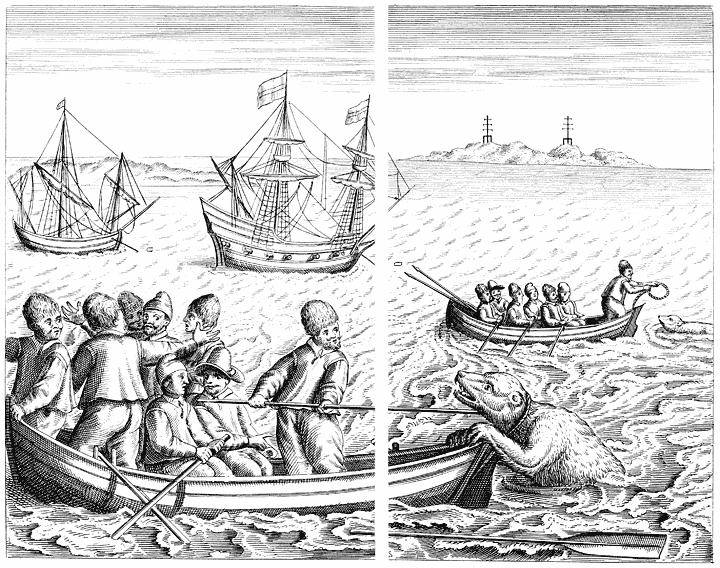
How a frightful, cruel, big bear tare to pieces two of our companions.

How a frightful, cruel, big bear tare to pieces two of our companions.

Sunday in the morning wee had the winde north and north-west, with a great gale, and then the admirals pinnace kept vs company, and sailed by vs with one saile from morning to evening, south south-west and south-west and by south, for the space of 6 [24] miles.

The course or miles from Ward-house into Holland I haue not here set downe, as being needlesse, because it is a continuall uoiage knowne to most men.

THE END OF THE SECOND VOYAGE.

Notes in this chapter

Note 1 · Dae Jan Huyghen van Linschoten comis op was—whereof John Hugh van Linschoten was commissary or supercargo. This well-known traveller was borNote 2 · Die de saeck vry wat breedt voort stelde—who represented the matter very favourably. ↑Note 3 · Petrus Plancius, a celebrated theologian and mathematician, born in 1552, at Drenoutre in Flanders. He was one of the principal promoters anNote 4 · The original has 305 miles, which are equal to 1220 geographical miles. The distance meant is from the pole to the Arctic circle. ↑Note 5 · Page 5. ↑Note 6 · Gheberchte van Pireneen—the Pyrenees. ↑Note 7 · Als dese aen de Noordt Zee ligghende Nederlanden—than these (our) Netherlands, which lie on the North Sea. ↑Note 8 · By den Noorden om—round by the north. ↑Note 9 · De Waygats oft Strate de Nassou. See page 27, note 4. By the Russians these straits are called Yugórskyi Schar.—Lütke, p. 29. ↑Note 10 · Cape Taimur. See page 37, note 1. ↑Note 11 · Die opperste Piloot was. ↑Note 12 · Opper Comis—chief commissary or supercargo. Jacob Heemskerck was a native of Amsterdam, of a family of distinction still resident there. He Note 13 · Ons den behoorlijcken eedt afghenomen is—we had been duly sworn. There is no reason for supposing that any special oath was administered, buNote 14 · Noorden ten oosten—N. by E. ↑Note 15 · Ontrent zuyder son—when the sun was about south. (Omitted.) ↑Note 16 · N. ten o.—N. by E. ↑Note 17 · Tottet seste glas int eerste quartier.—Six half-hour glasses of the first watch would make the reckoned time to be 11 P.M. But from the contNote 18 · Watch. ↑Note 19 · Op de ly legghen—lying to. ↑Note 20 · Des naenoens—in the afternoon. ↑Note 21 · The bow of the ship. ↑Note 22 · “Thirteenth.”—Ph. ↑Note 23 · Totten 24 n. w. son—till N.W. sun [½ p. 7 P.M.] on the 24th. ↑Note 24 · “Fifteenth.”—Ph. ↑Note 25 · 71° 15′ N. lat. ↑Note 26 · 72° 20′ N. lat. ↑Note 27 · “19.”—Ph. ↑Note 28 · Meest—mostly. (Omitted.) ↑Note 29 · “North-west.”—Ph. ↑Note 30 · Trompsont—Troms-oe, a small island on the coast of Norway, in about 69° 40′ N. lat. ↑Note 31 · Met weynich coelts—with little wind. ↑Note 32 · Ysbrandt de vice admirael. The admiral was Cornelius Nai. They had both taken part in the former expedition. See page 36, note 3. The title Note 33 · De windt was n. o. ten o. ende z. o. meest z. o. ende z.—the wind was N.E. by E. and S.E., but mostly S.E. and S. ↑Note 34 · De Noordt-caep. The northernmost point of Europe; unless, indeed, we regard Spitzbergen as forming a portion of this quarter of the globe. TNote 35 · De Moer mette Dochters. Three remarkable islands, so called, lying off the coast of Norway. ↑Note 36 · Doen quam tschip van Ysbrandt de vice admirael ende wy tsamen, ende maeckten malcanderen seer reddeloos—then the ship of Ysbrand, the vice-aNote 37 · Doen streecken wy de seylen—then we took in our sails. The translator appears to have carried this expression into the preceding sentence, oNote 38 · Hauled them up again. ↑Note 39 · S. w.—South-west. ↑Note 40 · Guessed, i.e., estimated. ↑Note 41 · Noordtkien. The extreme northern point of the main land of Norway, and consequently of the continent of Europe. ↑Note 42 · Soo dreven wy in stilte—so we drifted in a calm. ↑Note 43 · Two hours. ↑Note 44 · These were some merchant vessels, bound for the White Sea, with which the expedition had fallen in, and which now parted from it. ↑Note 45 · Here again, as on the 15th of August (see page 36, note 1), the note of the sun’s bearing can only be regarded as approximative. It must, inNote 46 · Steeck—stiff; that is, good for anchorage. ↑Note 47 · Steeck—stiff. ↑Note 48 · Met veel cleyne stipkens—with many small specks. ↑Note 49 · An hour and a half. ↑Note 50 · Swarte stipkens—black specks. ↑Note 51 · Zijn Excell. van Oraengien ende zijn broeder—his Excellency of Orange and his brother. These islands were so named by Cornelius Nai on the fNote 52 · Meest steeck grondt met swarte stipkens ghemenght—mostly stiff ground mixed with black specks. ↑Note 53 · Van de 70 graden—from the 70th parallel of north latitude. ↑Note 54 · Steeck—stiff. ↑Note 55 · Stipkens—spots. ↑Note 56 · Ende was ghestadich hout loef ende draghende—and we kept continually luffing and falling off before the wind. ↑Note 57 · Two hours. ↑Note 58 · Beelthoeck. See page 27, note 4. ↑Note 59 · De Samiuten landt—a part of the country of the Samoyedes, lying in the extreme north-east of the present government of Archangel. ↑Note 60 · Wel moghelijck—well possible. ↑Note 61 · Traenbay—Train-oil Bay. ↑Note 62 · Den ysganck—the drifting of the ice. ↑Note 63 · Diepste—the deepest. ↑Note 64 · See page 10, note 2. ↑Note 65 · A very unscientific, and indeed incorrect, mode of expressing the fact, that they were in 69° 21′ N. lat., as resulting from an observation Note 66 · Opt lande van de Weygats—on land from the Weygats. De Veer adopts the vulgar error adverted to in page 27 (note 4) of the present work, and Note 67 · Diversche sleden met velwerck, traen, ende dierghelijcke waer—several sledges with skins, train-oil, and such like wares. ↑Note 68 · Op den Beeldthoeck—at Image Point. ↑Note 69 · Samiuten—Samoyedes. ↑Note 70 · Van de Weygats—from Weygats. (Omitted.) ↑Note 71 · De gheleghentheyt der zeevaert—the particulars of the navigation. ↑Note 72 · Opt Waygats. Here, however, De Veer speaks of the Island of Waigatsch. ↑Note 73 · Wy … verder z. o. aen trocken nae den oever van der zee—we went further S.E. towards the sea-side. It is manifest, that while going towards Note 74 · Schipper—captain or master of the vessel. Most probably William Barentsz is meant; though in page 63 Cornelis Jacobszoon is spoken of as theNote 75 · The sea of Kara. ↑Note 76 · Cruijs-hoeck; by the Russians called Sukhoi Nos. ↑Note 77 · De Twist hoeck—Cape Dispute; so named, because, on the first voyage of Nai and Brandt Ysbrandtsz, a dispute arose between them as to whetherNote 78 · See page 33, note 6. ↑Note 79 · The Petchora, a considerable river, which rises in the Ural mountains, and flows into the Arctic Ocean to the S. of Novaya Zemlya. ↑Note 80 · Met bast tsamen ghenaeyet—sewed together with bast:—the inner bark of the linden or lime-tree (Tilia), of which is formed the Russian mattinNote 81 · Trayn—train-oil. ↑Note 82 · Voorby de reviere Oby—beyond the river Oby. ↑Note 83 · Linschoten has “to another river, which they said was called Gillissy”, meaning the large river Yenisei, which carries a great portion of thNote 84 · Dattet gat soude toe vriesen, ende alst begon te vriesen soudet dan stracks toe vriesen, ende datmen dan over ys mocht loopen tot in TartariNote 85 · Die zy seer veel … hadden—whereof they had many. (Omitted.) ↑Note 86 · Van voren tot achteren—from stem to stern. ↑Note 87 · Vleysch—meat. ↑Note 88 · So hebbense daer alle t’samen van ghegheten, met hooft, met staert, met al, van boven af bytende—they one and all partook of them; and, bitiNote 89 · Cruijs hoeck—Cross Point. See page 54, note 8. ↑Note 90 · Twisthoeck—Cape Dispute. See note 1 in the preceding page. ↑Note 91 · N. o. wel soo oostelijk—north-east a little easterly. ↑Note 92 · De fock—the foresail. ↑Note 93 · Aent vaste landt—to the main land; namely, the coast of Russia. ↑Note 94 · Samiuten—Samoyedes. ↑Note 95 · In twee hoopen—in two bodies. ↑Note 96 · Two lines of Phillip’s translation, being from *, are printed twice by mistake. ↑Note 97 · Dese gheleghentheyt ghevonden—availing himself of this opportunity. ↑Note 98 · Wysende—pointing. ↑Note 99 · Wysende nae’t z. o. op—pointing towards the south-east. ↑Note 100 · Met een partye volcks—with a number of persons. ↑Note 101 · Effenwel niet—not altogether. ↑Note 102 · Rheeden—reindeer. ↑Note 103 · Sledges. ↑Note 104 · Pinnace. ↑Note 105 · Sulcken beelden voor haer Goden—such images for their gods. ↑Note 106 · Image Point. See page 53. ↑Note 107 · Ontrent zuyder son—the sun being about south. ↑Note 108 · From this it is manifest that a previous dispute had taken place, which is not recorded. ↑Note 109 · Hem uyt ghehoort hadden—had heard him out. ↑Note 110 · Willem Barentsz. Nai did not call him captain, but addressed him by his name. ↑Note 111 · Willem Barentsz, siet wat ghy seght—mind what you say. ↑Note 112 · Ons werp ancker—our kedge-anchor. ↑Note 113 · Op een laghen wal—on a lee shore. ↑Note 114 · Fore-sail. ↑Note 115 · Met diversche reyse zijn werp-ancker uyt te brenghen—by repeatedly carrying out their kedger (and so warping out). ↑Note 116 · Cape Dispute. ↑Note 117 · Mosten stedts wenden—were forced continually to tack. ↑Note 118 · De Wachters. The stars β and γ of the Little Bear were called by the earlier navigators of modern times le Guardie, les Gardes, the Guards, Note 119 · Staten Eylandt. See page 37, note 4. ↑Note 120 · Den ysgangk—the drifting of the ice. ↑Note 121 · Schieten—to shoot. ↑Note 122 · Namely, pieces of rock-crystal. See page 37. ↑Note 123 · Die by hem in de cuijl lach—that lay near him in the hollow. ↑Note 124 · De beyr beet den eenen terstond thooft in stucken—the bear instantly bit the one man’s head in pieces. ↑Note 125 · Haer roers ende spietsen gevelt—lowering their muskets and pikes. ↑Note 126 · See page 26, note 2. ↑Note 127 · Cornelis Jacobsz. de schipper van Willem Barentsz. William Barentsz was not in the capacity merely of commander of his own vessel, but in thNote 128 · Hans van Nuffelen, schryver van Willem Barentsz—i.e., his clerk or writer. ↑Note 129 · Een Schotsman. From the intercourse which then existed, as now, between the opposite coasts of the German Ocean, there is nothing surprisingNote 130 · In stucken spronghen—shivered in pieces. ↑Note 131 · By de wal henen—along the coast. (Omitted.) ↑Note 132 · Cape Dispute. See page 55, note 1. ↑Note 133 · The Sea of Kara. ↑Note 134 · Boat. ↑Note 135 · Image Point. See page 60. ↑Note 136 · W. z. w.—W.S.W. ↑Note 137 · Moddich—dirty. ↑Note 138 · Met sneejacht—with drifting snow. ↑Note 139 · Also dat wy deur dreven—so that we drifted before it. ↑Note 140 · Die stroom quam stijf—the current ran strong. ↑Note 141 · Ende was tot den avondt—and till the evening it was. ↑Note 142 · Aent vaste landt—to the main land. ↑Note 143 · Voeren heel in de bocht achter het eylandt mette steert—went quite into the bay behind the island with the tail. This is a small island lyinNote 144 · Een groot afwater—a great fall of water. ↑Note 145 · Ende de stengh om hoogh—and set the top-mast. (Omitted.) ↑Note 146 · Quam het ys weder om het oosteijnt vande Weygats in dryven—the ice came again drifting in round the east end of Weygats. ↑Note 147 · See page 36, note 2. ↑Note 148 · Watch. ↑Note 149 · Courses. ↑Note 150 · Stippelen—specks. ↑Note 151 · Kanin Nos. See page 38, note 3. ↑Note 152 · De fock—the fore-sail. ↑Note 153 · Dreven—drifted. ↑Note 154 · N. ten o.—N. by E. ↑Note 155 · Met beyde mars-seylen—with both top-sails. ↑Note 156 · Van den avont—from evening. ↑Note 157 · One watch or four hours. ↑Note 158 · Till half our second watch was out; that is, till 2 A.M. ↑Note 159 · Two courses. See page 7, note 4. ↑Note 160 · This and the preceding sentence should properly form but one, which should read thus:—After that, in the second watch, we tacked north-ward,Note 161 · Watch. ↑Note 162 · Courses. ↑Note 163 · Kilduin. See page 7, note 4. ↑Note 164 · Maer quamen te laech—but fell short of it. ↑Note 165 · Two watches, or eight hours. ↑Note 166 · Teghen—towards. ↑Note 167 · Guessed. ↑Note 168 · Waerhuys. See page 39, note 1. ↑Note 169 · And then eighteene [72] miles more, east-ward,15 till the tenth of July in the euening; then we wound about againe and sailed south-west, eiNote 170 · Then againe wee sayled north-east,17 20 [80] miles, till the 18 of July, the sunne being north-west; from thence wee sayled north-west and bNote 171 · From thence againe we wound about, north-east and by north and north-east, till the 20 of July, while sixe glasses were run out, in the firsNote 172 · Then we sayled south-east and by east 26 [104] miles, till the 21 of July in the euening, when we set our watch, and held on the same courseNote 173 · The twenty-third23 of July wee sayled south-east and by south fifteene [60] miles, till the sunne was south south-west and saw land about foNote 174 · After that we sayled north-ward tenne [40] miles, till the twenty-fifth25 of July at noone, and then north north-west eight [32] miles, tillNote 175 · The sunne being south south-west, wee wounde about againe and sayled north-east and by north, till the seauen and twentie of July, the sunneNote 176 · After that, we wound about againe, east and by north, and sayled eight [32] miles, till the 30 of July, when the sunne was north [½ p. 10 P.Note 177 · From thence wee sayled east-ward 8 [32] myles, till the first of August about midnight, in calme faire weather, and saw Trumpsand32 south-eaNote 178 · Then we wound about again, because there lay a rocke or sand, that reached about a mile and a halfe [6 miles] out from the land into the seaNote 179 · Then we tooke the height of the sunne, and found it to be seauentie and one degrees and ¼. At which time till noone36 wee had calme weather:Note 180 · Then we sailed east north-east till the 6 of August, when wee had the sunne west north-west [5 P.M.], and then Isbrandt, the uize-admiral, cNote 181 · Then wee hoysed vp our sayles againe,40 till the sunne was north-west, and after that halde vp againe41 with an east and east north-east winNote 182 · The sunne being south [¾ p. 10 A.M.], the North Cape lay south-west and by south from vs about a mile and a halfe [6 miles], and the Mother Note 183 · Then wee wound about againe, when the North Cape lay west and by south from vs about 9 [36] miles, the North-kyen44 being south and by west Note 184 · From thence wee wound about againe, with an east north-east wind, and sailed south-east and by south 8 [32] miles, till the sunne was south-Note 185 · Then we sailed south-east and by east about 4 glasses,46 and the Iron-hogge with her companie (being marchants)47 took their course south-waNote 186 · The sunne being south,48 and the height thereof being taken, it was found to be 70 degrees and 47 minutes; then in the night time wee cast oNote 187 · Then we sailed east, and so continued till the 17 of August, the sunne being east [½ p. 4 A.M.] and cast out our lead, and found 60 fadome dNote 188 · After that we held diuers courses because of the ice, and sayled south-east and by east and south south-east for the space of 18 [72] miles,Note 189 · Then we sailed east, and oftentimes casting out the lead we found 20, 19, 18, and 17 fadome deepe, good grounde mixed with blacke shels,55 aNote 190 · Then we sailed vnder 70 degrees,56 vntill we came to the Wey-gates, most part through broken ice; and when we got to Wey-gates, we cast out Note 191 · The right chanell betweene the Image Point61 and the Samuters land62 was full of ice, so that it was not well63 to be past through, and so wNote 192 · The 20 of August, the height of the sunne being taken with the crosse-staffe,67 wee found that it was eleuated aboue the horizon 69 degrees Note 193 · The 21 of August we went on land within the Wey-gates69 with foure and fiftie men, to see the scituation of the countrey, and being 2 [8] miNote 194 · And to assure vs the more thereof, wee might perceiue it by the great number of images, which we found there upon the Image or Beelthooke71 Note 195 · And when wee entered further73 into the land, wee vsed all the meanes we could, to see if we could find any houses, or men, by whom wee mighNote 196 · The twentie three of August wee found a lodgie81 or boate of Pitzore,82 which was sowed together with bast or ropes,83 that had beene north-Note 197 · Which shippes they sayd (when they spake with vs), were to saile into the Tartarian Sea, by the riuer of Oby,85 to a place called Vgolita86 Note 198 · The 25 of August we went againe to the lodgie, and in friendly maner spake with them, we for our parts offering them friendship; and then thNote 199 · About noone wee hoysed vp our anchors with a west north-west wind; the course or stretching of Wey-gates is east to the Cruis point,92 and tNote 200 · The 26 of August in the morning we hoysed anchor, and put out our forke-saile,95 and so sailed to our old road, there to stay for a more conNote 201 · The 28, 29, and 30 of August till the 31, the winde for the most part was south-west, and William Barents our captaine sayled to the south sNote 202 · The maner of their apparell is like as we vse to paint wild men; but they are not104 wilde, for they are of reasonable iudgement. They are aNote 203 · Their sleades106 stood alwayes ready with one or two hartes in them, that runne so swiftly with one or two men in them, that our horses wereNote 204 · After that we tooke our leaues one of the other, with great friendship on both sides; and when we were in our penace,107 we al put off our hNote 205 · And after they were gone from vs and were some-what within the land, one of them came ryding to the shore, to fetch a rough-heawed image, thNote 206 · Hauing left the Samuters, the sunne being south-ward,110 William Barents, our captaine, spake to the admirall to will him to set sayle, thatNote 207 · The 2 of September, a litle before sunne rising, wee put foorth our anckor115 to get out, for that the winde as then blew south south-west; Note 208 · When wee put out our focke-sayle,117 the sunne was east and by south [½ p. 5 A.M.]; and then we sayled to the Crosse-poynt, and there wee caNote 209 · The 4 of September, we hoysed anchor because of the ice, and sailed betwene the firme land and the States Island, where wee lay close by theNote 210 · The 6 of September, some of our men went on shore vpon the firme land to seeke for stones, which are a kinde of diamont,125 whereof there arNote 211 · The beare at the first faling vpon the man, bit his head in sunder,127 and suckt out his blood, wherewith the rest of the men that were on lNote 212 · We perceiuing out of our ship and pinace that our men ran to the sea-side to save themselues, with all speed entered into our boates, and roNote 213 · The ninth of September, wee set saile from the States Island,134 but the ice came in so thicke and with such force, that wee could not get tNote 214 · The tenth of September wee sayled againe from the States Island towards the Wey-gates, and sent two boates into the sea to certifie vs what Note 215 · The 11 of September in the morning, we sailed againe into the Tartarian Sea,136 but we fell into great store of ice, so that wee sailed backNote 216 · The 14 of September the weather beganne to bee somewhat clearer, the winde being north-west, and the storme blowing stiffe143 out of the TarNote 217 · The same day in the morning the winde draue in from the east end of the Wey-gates,149 whereby wee were forced presently to hoyse anchors, anNote 218 · The 16 of September, from morning to evening, wee sayled west north-west 18 [72] miles, at 42 fadome deepe; in the night it snowed, and therNote 219 · After that wee sailed all the night againe till the 17 of September in the morning, with two schower sailes,152 north-west and by west and wNote 220 · Then we saw the point of Candynaes154 lying south-east from vs, and then wee had 27 fadome deepe, redde sand with blacke shels. Sunday at niNote 221 · The 18 of September in the morning, wee lost the sight of the pinnace that followed vs, and till noone sought after her, but wee could not fNote 222 · The 20 of September, wee sayled south and by west and south south-west, 7 [28] or 8 [32] miles, at 80 fadome deepe, black slimie ground; froNote 223 · The 21 of September from night159 till Thurseday in the morning, wee sayled one quarter160 west, and so till day, still west, 7 [28] miles, Note 224 · From morning till noone, south-west 5 [20] miles, at 65 fadome deepe, oasie ground: at noone wee wound north-ward againe, and for three hourNote 225 · The 22 of September wee sayled north and by east and north north-east 4 [16] miles:163 and from morning till noone, north-east, 4 [16] mylesNote 226 · From euening till Tuesday in the morning, being the 26 of September, we sailed west 10 [40] miles, and then in the morning wee were hard by Note 227 · The nine and twentieth of September in the morning, wee sayled north-west and by west foure [16] miles; and all that day till euening it wasNote 228 · Jae noch—yea, even. ↑Note 229 · Namely, Spitzbergen, which they had just left. ↑Note 230 · After that the seuen shippes (as I saide before) were returned backe againe from their north uoiage, with lesse benefit than was expected, tNote 231 · The 5 of May all the men in both the shippes were mustered, and vpon the tenth of May they sayled from Amsterdam, and the 13 of May got to t
Explore with AITake your curiosity a little further.

Reading settings