Wild Western Journalism.
Reading edition
By an ex-Editor.
NE of the most thrilling occupations that a human being could follow in the old days—say a brief generation since—was that of editing a newspaper in a small American town. There was a fulness in the life, a feverish activity in the office and a perpetual spice of danger out of it, that made all other callings seem trivial. Things have changed a great deal in the past few years, but even yet Wild Western journalism can boast a flavour—a tang of its own. There is no other Press in the world quite like it; there is no similar body of men like those who engineer it. To our old friends, Mr. Pott, of the Eatanswill Gazette, and Mr. Slurk, of the Eatanswill Independent, their Occidental followers of the Arizona Arrow and the Tombstone Epitaph bear but faint resemblance. Perhaps in the birth-throes of English journalism—in the era of the Mercurius Pragmaticus and the Scot's Dove—the vicissitudes of editors were not dissimilar to those endured by the Colorado and Texas editor of yesterday, who was often his own publisher, his own printer, and his own editor rolled in one—and not only that, but was forced to perform these functions with a six-chambered revolver reposing gracefully, yet ominously, on his desk. As to his Protean character there has been little if any improvement. I cull the following from a recent issue of the Yampa (Oregon) Leader:—
The great city papers think they are smart in having a large staff, and, although we have not published ours before, we shall do so to take some of the conceit out of the city brethren. The editorial staff of the Leader is composed of: Managing editor, V. S. Wilson; city editor, Vic Wilson; news editor, V. Wilson; editorial writer, Hon. Mr. Wilson; exchange editor, Wilson; pressman, the same Wilson; foreman, more of the same Wilson; devil, a picture of the same Wilson; fighting editor, Mrs. Wilson.
By no means exaggerated is the description of a Western editor and his environment which was given some years ago by the authors of that amusing novel, "The Golden Butterfly." Prototypes of Gilead P. Beck could be found in abundance throughout the region west of the Mississippi. One of the most extraordinary characters and one of the most delightful was the late Alvin S. Peek—"Judge" Peek of Dakota—whose boast it was that he had "run" papers in nine different States and territories, had shot eleven men who disagreed with his opinions—three of them fatally—-and had never swallowed a word he had ever written, and who died universally respected in bed and at the ripe age—for Dakota—of fifty-one years.
But apart from any personal contact with the men who make the newspapers of the wild and woolly West it was once my experience to receive and peruse weekly many hundreds of their productions—"exchanges" they are called—and ranging from the Mother Lode Magnet of California and the Tombstone Epitaph of Tombstone, Arizona, to the Arkansas Howler and the Mustang (Colorado) Mail. Many a pleasant evening have I spent over them, and I still prize a scrap-book containing things to me as funny as I could find in any collection of wit and humour in the world. There is reason for this, because the backwoods and prairie Press of America is the nursery of American humour. It produced Mark Twain, Bret Harte, Petroleum V. Nasby, Joshua Billings, J. M. Bailey, Bob Burdette, Bill Nye, John Phœnix, and F. L. Stanton, to mention only a few of the humorists of international renown. I was well acquainted with Stanton at the time he was editing, printing, and publishing the famous Smithville News. Texas Siftings, the Arizona Kicker, and the Burlington Hawkeye have made the peculiarities and amenities of Western journalism familiar to English readers. Albeit, scattered through a dozen States and territories are thousands of small newspapers, eking out a precarious existence—full of native humour and sentiment—of which not even the resident of Chicago and St. Louis has so much as heard. How precarious that existence is may be judged from the following editorial appeal in the Gem, of Flagstaff, Arizona:—
Have you paid your subscription yet? Remember even an editor must live. If the hard times have struck your shebang, don't forget turnips, potatoes, and corn in the shock are most as welcome as hard cash at the Gem office. Also hard wood. Our latch-string is always out, or same (i.e., the turnips, etc.) can be delivered to our wife, who will give receipt in our absence.
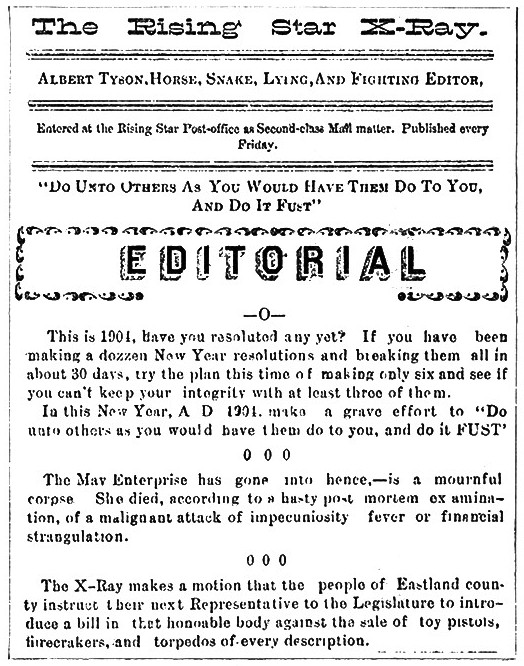
One of the pleasing fictions preserved by the Western Press is, as we have seen, that of a plurality of editors. To these supposititious editors the most extraordinary titles and functions are bequeathed. On the front page of the Rising Star (Texas) X-ray no pretence of a numerous staff is made—Mr. Albert Tyson boldly announces himself as "horse, snake, lying, and fighting editor," while his motto is, "Do unto others as you would have them do to you, and do it fust!"
In mining districts or in the new territories, where a "tenderfoot" is made welcome in the "'eave 'arf-brick" fashion, the career of an editor is one of constant risk and turmoil. If he is young and inexperienced there are always lawless spirits ready to take a rise out of him, just for the pleasure and excitement of the thing.
Even in the civilized Southern States to the east of the Mississippi editing was not fifteen years ago a healthy pastime. On one occasion, when I was assisting a friend in Georgia, a citizen in a high state of excitement entered the "editorial sanctum"—they are very particular about the dignity of these epithets in America—and riddled the walls and my desk with bullets from a revolver.
Luckily, I happened not to be there, but in the composing-room, engaged in making-up the editorial page. My eye dwelt lovingly on a neat row of paragraphs, one beginning in this wise:—
If our esteemed (but chronically overheated) fellow-townsman, Sam Beale, will take our advice, etc.
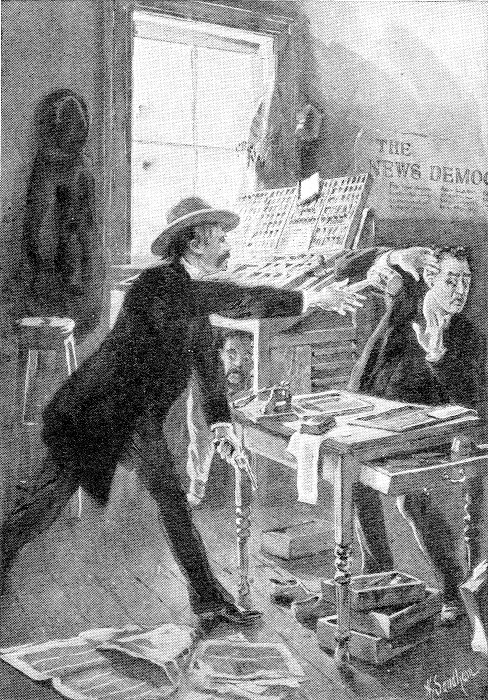
"THE MALLET GRAZED MY EAR AND CRASHED INTO THE WALL."
At that moment three shots rang out in deafening succession. My journeyman "comp." dropped on his knees under the composing-case, and I was just deciding on my own line of conduct when the door was flung violently open, and Mr. Samuel Beale and I stood face to face. There were no words—none which I could bring my pen to write—but a heavy printer's mallet lay at one end of the make-up stone; this "our esteemed (but chronically overheated) fellow-townsman" seized and flung with all possible force straight at my head. Had his aim been true I should never have lived to tell this tale. As it was, the mallet grazed my ear and crashed into the wall, and the next object I saw was Beale wrestling with the door in a frantic effort to escape. The conclusion of this anecdote doesn't matter; but my printer was, I believe, finally obliged to haul me off the body of the prostrate Mr. Beale, upon whom I then and there felt it my editorial duty to take summary vengeance. Afterwards I wisely went armed, my victim having openly threatened to shoot me on sight. But the quarrel was eventually patched up, my chief inserting the following characteristic amende:—
The News-Democrat having on divers occasions, through a misapprehension of the true circumstances, stated that our esteemed townsman Sam Beale was a liar, a thief, and the meanest skunk in the whole State of Georgia, we beg hereby to retract this, and declare that our knowledge is solely confined to Pawnee County. Shake, Sam, and be friends!
One of the arts which a Western editor must understand is that of "padding," especially in his local "society" items.
Thus a Missouri paper, the Hannibal Hornet, is responsible for the following string of "personals":—
Dec. 7th. Miss Sadie James, of Tarrant Springs, is visiting her friend, Miss Annabel S. Colver, at the house of Miss Annabel S. Colver, on Decatur Street.
Dec. 8th. Miss Annabel S. Colver gave a party in honour of her guest, Miss Sadie James, who is visiting her at Miss Colver's beautiful home on Decatur Street, at which all the youth and beauty of Hannibal were present in full force.
Dec. 9th. Miss Sadie James, of Tarrant Springs, was observed out sleigh-riding with her charming hostess, Miss A. S. Colver, and their neat turn-out was shortly joined by several others.
Dec. 10th. Miss Sadie James terminated a pleasant visit to Hannibal and returned to Tarrant Springs.
But occasionally it happens that an exquisite item of "society" falls in the editor's way, without his having to do any "padding" at all, as in this from the Fairplay Flume, published in the flourishing Colorado "city" of Fairplay:—
Married. Markham—Seely.—At the residence of the groom's parents one of the most up-to-date weddings took place. (There had been an agreement between the bride and groom not to be married in the old-fashioned way, but to change the mode a little.) Therefore they were married at the residence of the father of the groom, Peter J. Seely, Esq. The groom wore a long pair of overalls and a cutaway coat. The bride wore a calico dress and apron. They both looked the picture of health, and were ably assisted—the groom by the bride's sister and the bride by Mr. Sam Meadows, a particular friend of the groom's. After spending a couple of weeks in the West they will return and settle down in their pleasant home, "Swandown"; Burlap, the furniture man at Five Forks, having already the contract to see that their home is properly furnished during their absence.
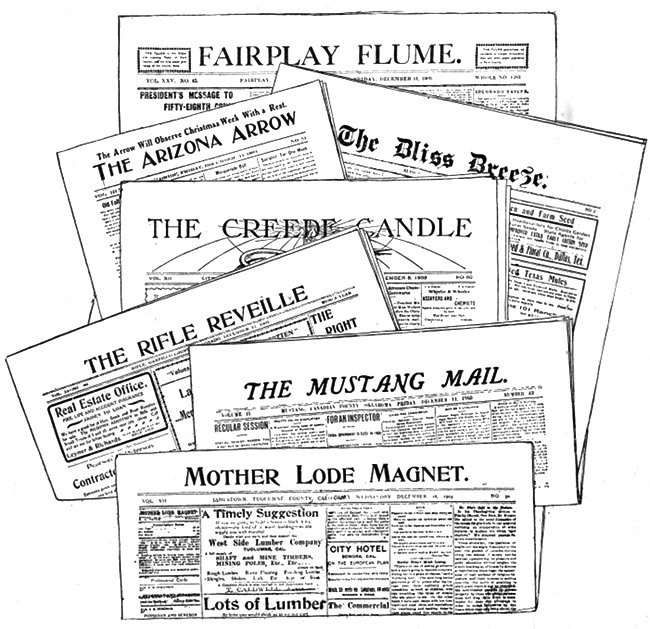
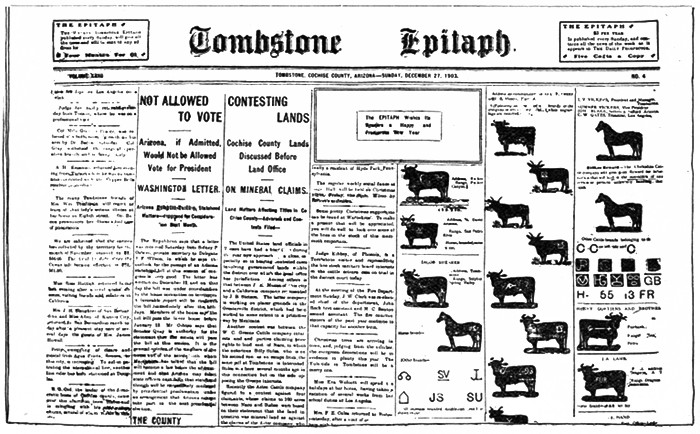
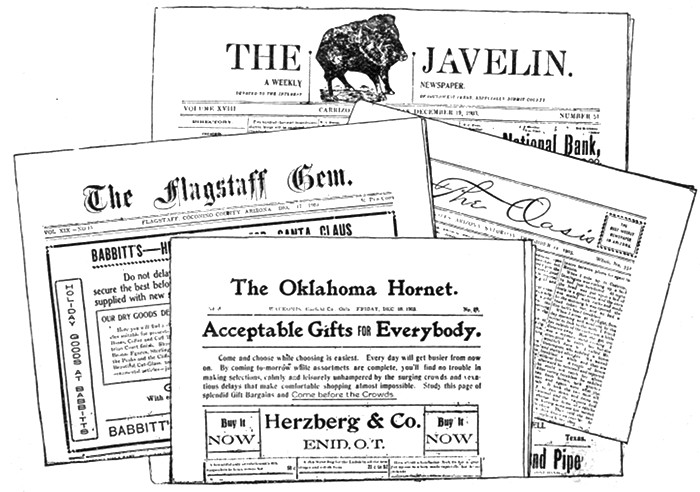
As to the titles of many of these Western productions, it might be supposed these spring from the fertile brain of some incorrigible humorist. But this is not so. Nothing could be more real—"alive and kicking"—in Anno Domini 1904, than the Creede (Colorado) Candle, the Arizona Arrow of Chloride, Arizona, the Rifle Reveille, the Rising Star X-ray, the Bald-Knob Herald, the Dallas World Hustler, the Kosse Cyclone, the Blooming Grove Rustler, the Carrizo Javelin, the Noyales Oasis, and the Devil's Lake Free Press. The names of some Western towns are fantastic to a degree, and the editorial love for alliteration is strong. Thus we have the Bliss Breeze, the Mustang Mail, and the Searchlight Searchlight in addition to those I have mentioned. What more natural in the "city" of Tombstone, Arizona, than that the newspaper should be entitled the Epitaph? Or that an Epitaph should take as naturally to obituaries as a duck to water or an Arizonian takes to his "gun"?
Jake Moffatt Gone Skyward!
As we feared on hearing that two doctors had been called in, the life of our esteemed fellow-citizen Jake Moffatt ered out on Wednesday last, just after we had gone to press. Jake was every inch a scholar and a gentleman, upright in all his dealings, unimpeachable in character, and ran the Front Street Saloon in the very toniest style consistent with order. Jake never fully recovered from the year he spent in the county jail at the time of the Ryan-Sternberg fracas. His health was shattered, and he leaves a sorrowing widow and nary an enemy.
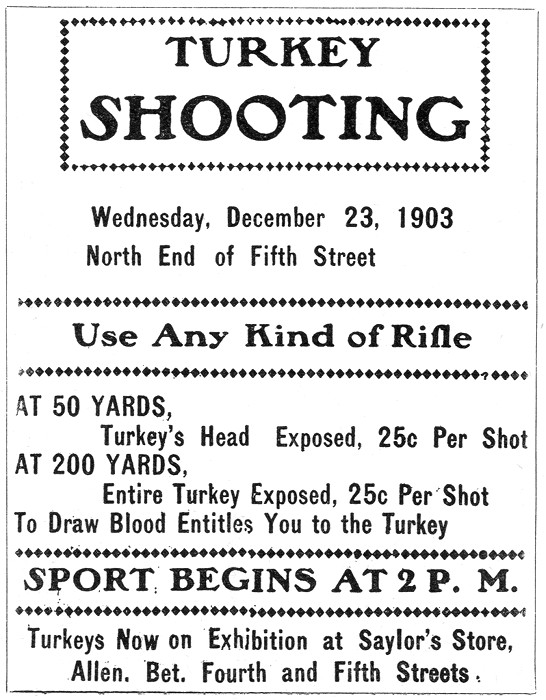
The Tombstone men are handy with their "shooting-irons," as may be judged from the accompanying cheery advertisement last Christmas time.
The chief advertisements in the Epitaph, as in the other papers in the ranching country, consist of cattle-brands—i.e., rude outlines or silhouettes of equine or bovine quadrupeds, marked with the peculiar sign which distinguishes their ownership from others. By this means any strayed or stolen cattle are readily identified.
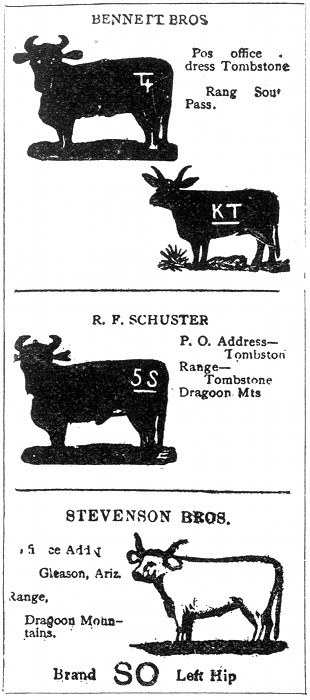
CATTLE-BRAND ADVERTISEMENTS.
As to the technical aspect of all the papers, which have so much in common, the reader may like to learn something. How are they produced so as to cover expenses in a "city" which boasts often fewer than one thousand inhabitants, rarely reaches two thousand, and not seldom has but five hundred souls? The answer is, in the first place, to be found in the invention of patent "insides" or "outsides." These are sheets ready printed on two of the four outside or inside pages; or, if it should happen to be an eight-page paper, six pages would be set up and printed at some great centre of population like Chicago or St. Louis. The invention is of English origin, but owes its vogue in America to A. N. Kellogg, who in 1861 was editing a little paper at Baraboo, Wisconsin. When the Civil War broke out his printers left him for the front, and, unable to get out his journal, he wrote to the publisher of the Madison Daily Journal for sheets of that paper printed on one side only with the latest available war news. The blank side the enterprising Kellogg filled up himself with big "block" advertisements and local items and the inevitable political "editorial," without which no American newspaper, however small, would be complete in its editor's eyes, although it is rarely read. In a short space of time other country editors followed Kellogg's example, and the Madison daily was printing newspapers for thirty different Wisconsin papers on one side of the sheet. The enterprise grew, Kellogg directed his entire attention to it, and ended by founding a business which to-day prints two thousand different sets or editions of patent insides.
At one time the same formes were used for hundreds of papers, only the titles, headings, etc., being changed to suit each customer. But now the editors of the Oasis and the Hustler have at least a hundred different styles of paper to select from. As to the cost, the editor pays hardly more than what the blank paper is worth, for the ready-print companies derive their profit from the advertisements, for which they reserve several columns of space. These country papers are usually sold in "bundles" of nine hundred and sixty copies, but the circulation may not be one-half of that figure.
We have seen that editing is a precarious livelihood, yet the editor manages to get along somehow. I have seen it publicly stated that there are four classes of men who usually own these small papers: farmers' sons who are too good for farming and not quite good enough to do nothing; school-teachers; lawyers who have made a failure of the law; and professional printers who have "worked their way"—these last two by far the most numerous class. They derive their chief profits from advertisements, for it is a point of honour with the local bankers, storekeepers, implement dealers, lawyers, doctors, liverymen, and blacksmiths to advertise in the local paper. Then there is the annual, and occasionally the semi-annual, circus advertisement, which may bring in as much as a hundred dollars, "if a picture of the elephant is thrown in." In the cattle-raising districts, as in Arizona, the different cattle-brands fill up a large part of the paper, as in the case of the Tombstone Epitaph. But besides the patent "inside," the editor of the little paper has another convenient expedient for filling up his columns. He can buy stereotype plates—that is, columns of interesting matter in thin sheets. These are made to fit metal bases with which he is supplied, and which he keeps in stock. Plates and bases being "type high," or level with the type of the newspaper, are cheap to send by rail, and being furnished to hundreds of other journals are of far higher literary character than the editor could turn out himself for treble cost.
I have said little of illustrated journalism in the Far West; but, as the accompanying reproduction humorously suggests, it is—inexpensive. And it may also betray the fount whence the authors of that amusing brochure, "Wisdom While You Wait," drew some, at least, of their inspiration.
![PHŒNIX'S PICTORIAL, And Second Story Front Room Companion. Vol. I] San Diego, October 1, 1853 [No. 1 Mansion of John Phœnix, Esq., San Diego, California House in which Shakespeare was born, in Stratford-on-Avon](/illustrations/33325762e531071a.jpg)