The Size of the World's Great Cities.
Reading edition
By Arthur T. Dolling.

HOSE imposing agglomerations of houses and dwellers we call cities (in most cases political or commercial capitals) have shown a notable rate of progress during the last two or three decades. More and more do the centripetal forces at work in almost every nation make for the growth of the capital at the expense of the rural community. A century ago a million human beings dwelling side by side under a single municipal government was almost of itself one of the great wonders of the world. Men spoke of London with bated breath and wondered where it would all end. Reports of monster cities in China with a population double that of London were dismissed as travellers' tales. Travellers' tales, verily, they have proved to be, seeing that Peking even to-day has fewer than a million souls. But what would our forefathers have said of these twentieth-century "wens," these "gloomy or glowing, febrile and throbbing concentrations" of human life, numbering not merely two, but three, four, and even five millions of souls?
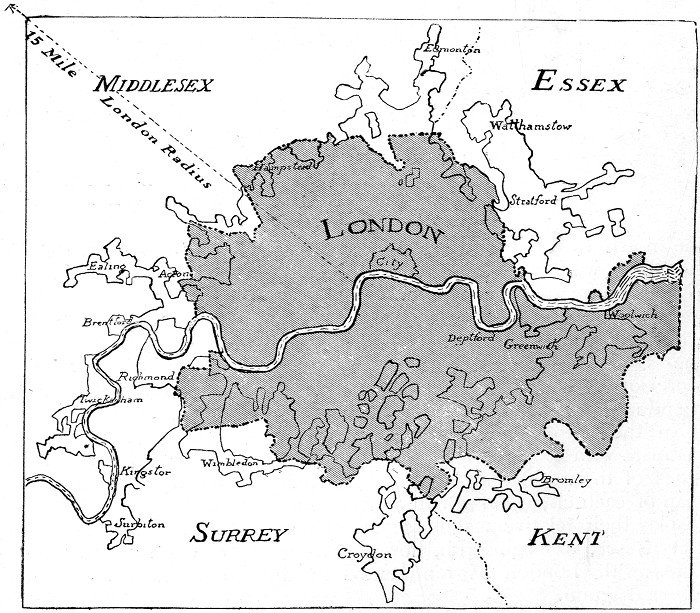
LONDON: THE ADMINISTRATIVE COUNTY OF LONDON, WITH WHICH THE OTHER CITIES ARE COMPARED, IS SHOWN BY THE SHADED PORTION.
Let us take London as the basis of our diagrams. London is an indeterminate quantity. It may mean the City of London, which comprises only 673 acres, or it may mean the Administrative County of London, which boasts nearly 117 square miles, or 74,839 acres, or Greater London, which embraces the Metropolitan Police district, and has an area of no less than 692 square miles, or 443,420 acres. If we take the second of these Londons we shall find it to consist of twenty-nine large and small cities, ranging in population from 334,991 to 51,247 inhabitants. These are called the Metropolitan boroughs; but as it is rather geographical size than population which here concerns us, we may state that the largest of these boroughs is Wandsworth, with an area of 9,130 acres, and the smallest is Holborn, with 409 acres. The average area of these boroughs, if we exclude the City, is about four square miles. Within these borders of London—which must not be confounded with Greater London—there were in 1901 4,536,541 souls, living in 616,461 houses. Within this area, besides buildings, must be counted 12,054 acres of grass, including the public parks and gardens.
If we take Greater London we embrace a far wider and yet still a homogeneous community, for it cannot be denied that the adjoining boroughs just outside the pale of the administrative county are policed from the same centre, are London to the Post Office, and commonly regard themselves, what they must soon be officially, as an integral part of the Great Wen. Greater London—within the fifteen-mile radius—is far more homogeneous and compact than Greater Chicago, for example, or even than Greater New York or Greater Boston. We have here an aggregation of 6,580,000 inhabitants and, as we have already seen, 443,420 acres. But perhaps the fairest estimate of London is the natural one of a single mass of buildings, without any unoccupied or unimproved areas. This gives us a solid, compact city of 85,000 acres and 6,000,000 inhabitants; extending from Edmonton on the north to Croydon on the south, and east and west from Woolwich to Ealing. Nor can one doubt, at the present rate of expansion, that even more distant areas than Croydon will eventually be included, although the Scotsman may have been a little "previous" who addressed a letter to a friend at "Bournemouth, S.W."
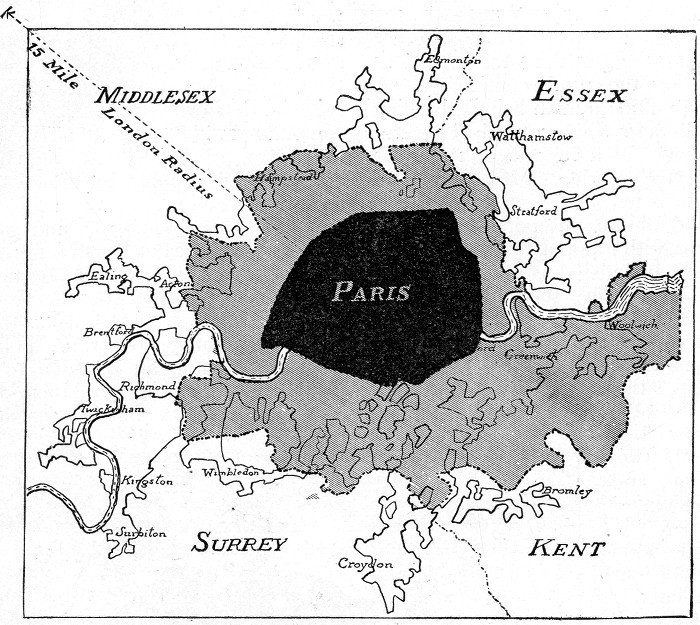
A MAP OF PARIS PRINTED UPON A MAP OF LONDON, SHOWING THE RELATIVE SHAPES AND SIZES.
In the following article we propose to compare with London the sizes of the chief cities of the world and, by printing a black map of each city upon a map of London, to display their relative magnitude at a glance. Let us see, to begin with, how Paris compares with London as represented in the above diagram.
At a coup d'œil we perceive that the French capital is for its population remarkably small in area, a fact clearly owing to its fixed military barriers, which make growth upward rather than outward. Consequently, dwellers in Paris often have six or eight pairs of stairs to climb where the dweller in London has but two. There have been repeated agitations for municipal expansion, but so far nothing has been done to annex the surrounding communes. Paris has a population of 2,700,000, living in 75,000 houses, and an area of over thirty-one square miles. If, however, the agglomeration of houses be taken—including the suburbs—the area is forty-five square miles and the population 3,600,000, although, as yet, this is not actually and geographically Paris.
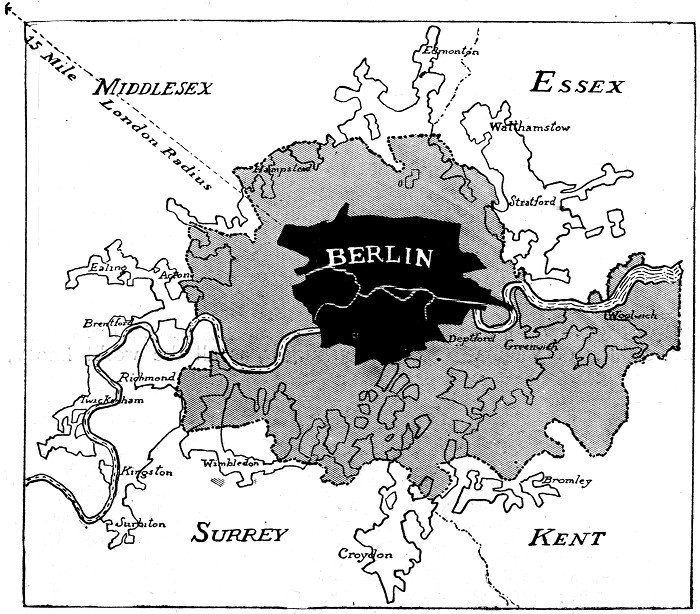
BERLIN COMPARED WITH LONDON.
Berlin, a mere village a century ago, is the third city of Europe in point of population, and its growth since 1870 has been phenomenal, as we shall see. Yet the technical barriers which enclose the city remain precisely what they were more than forty years ago, and Berlin is still as it was in 1861, compressed within twenty-eight square miles, six miles long and five and a half wide. At the close of the Franco-Prussian War Berlin, now the capital of a new empire, became a paradise for builders. Streets of houses appeared almost as if by magic, and the whole aspect of the city became changed. From being the worst lighted, the worst drained, and ugliest capital in Europe it has become one of the finest, cleanest, and handsomest of cities, and its population has more than doubled. Berlin now boasts within its boundaries 1,857,000 inhabitants. But without there is, in Ibsen's phrase, "the younger generation knocking at the door," and Greater Berlin might have a population of 2,430,000, with an area at least treble, extending, indeed, as far as Potsdam. Berlin's actual increase from 1800 to 1900 was 818 per cent., multiplying its population by nine.
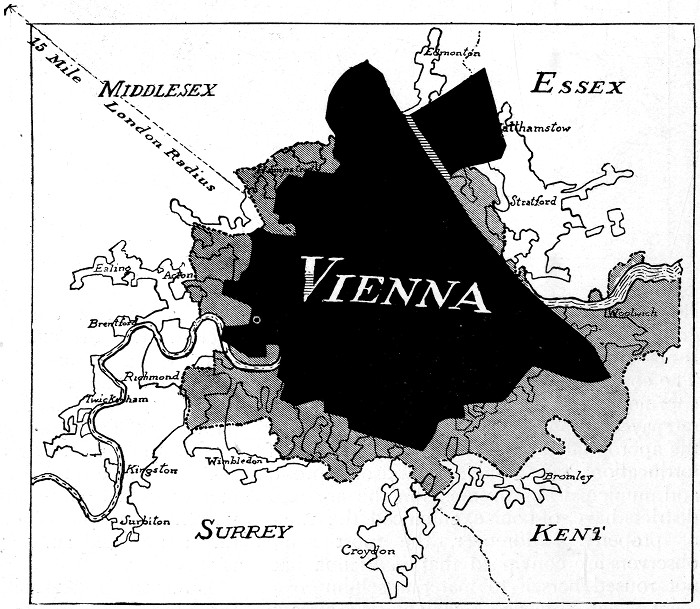
VIENNA COMPARED WITH LONDON.
"The transformation of Vienna" has for nearly half a century been a watchword amongst the progressive party in the Austrian capital. The example of Paris—with which the Viennese love to be compared—has, since 1858, brought to the fore innumerable Haussmannizing projects, all of which have tended to the city's amplifying and beautifying. The second or outer girdle of fortifications has been taken down; the barriers thus removed, fifty suburbs became, in 1891, part and parcel of the capital. Before this time Vienna was twenty-one English square miles, or one-third less than Paris; afterwards it covered sixty-nine square miles, besides having by the process added half a million to its population, which now stands at 1,662,269. But Vienna does not intend to be stationary in the coming decade. The fever of the municipal race for territory is upon her also. She is now reaching out for the adjoining town of Floridsdorf across the Danube, together with four other communes, having a population of 50,000; and this step increases the area of Vienna to about eighty-two square miles, nearly thrice the size of Berlin. Naturally such a large territory for a population smaller than a third that of London would comprise much open ground, especially as there is great overcrowding in the industrial districts. And, as a matter of fact, over five-eighths of Vienna is woods, pastures and vineyards, and arable ground, while above a tenth of the total area is made up of parks, gardens, and squares. The cost of making Vienna so vast has been enormous; but it has not been borne by the ratepayers to any oppressive extent, because the appropriated military ground and sites of fortifications have yielded a handsome profit, and municipal improvements in the annexed districts have, of course, enhanced the value of property. Moreover, the most acute observers are convinced that, if Vienna had not roused herself to material self-improvement, her prestige, which is already threatened by Budapest, would ere this have completely vanished. After the Austro-Prussian struggle and the marvellous rise of Berlin and Budapest, the city on the Danube would have sunk to be the Bruges of the twentieth century.
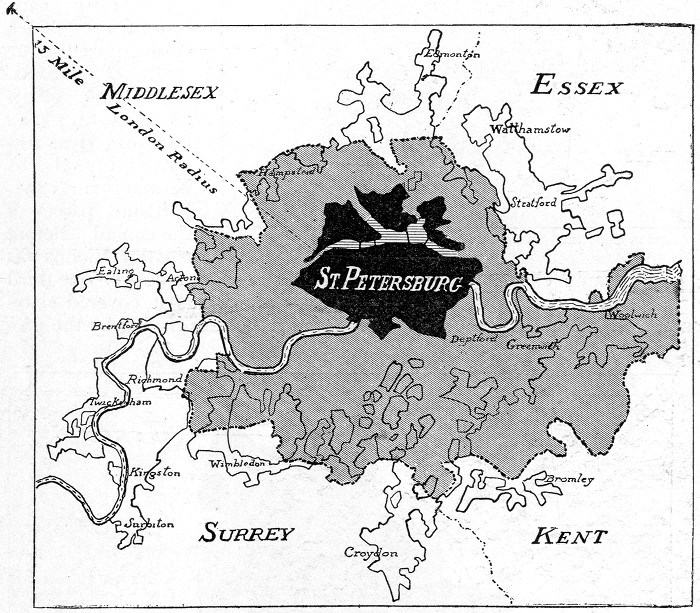
ST. PETERSBURG COMPARED WITH LONDON.
There is, perhaps, hardly a capital in the world so badly situated as St. Petersburg. To its north and east is a desolate wilderness, and to its south is a mighty stretch of marshland, and it is 400 miles from any important commercial centre. Yet, built at the behest of an Imperial autocrat, it has risen steadily into magnitude and wealth, at the cost of hundreds of thousands of human lives.
St. Petersburg is, as all the world knows, built on a swamp, or low-lying alluvial deposits, at the mouth of the Neva. These cover altogether an area of 21,185 acres, of which 12,820 are part of the delta proper of the river and 1,330 acres are submerged. In consequence of its origin and present condition the city is naturally subject to inundations, but these, owing to the admirable public works and precautions taken, are not of frequent occurrence. Of the area of the city, 798 acres are given up to gardens and parks, while a third of the whole area is densely overcrowded, the average in some districts being one inhabitant for every ninety-three square feet and some dwellings containing from 400 to 2,000 inhabitants each. As for the population, it is now 1,248,739, to which if that of the suburbs be added (190,635), the Russian capital is the fifth city of Europe. Yet in area it is far too small; overcrowding is universal, in spite of the 1,000 dwellings that are erected annually, and the mortality is appalling.
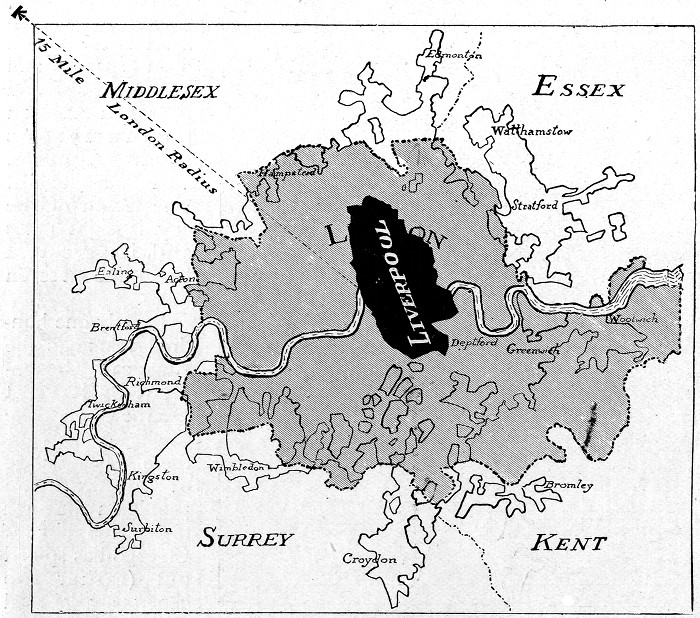
LIVERPOOL COMPARED WITH LONDON.
Liverpool is about six miles long by about three broad, the area being 13,236 acres. It has a population of 686,332 within boundaries less than half the size of Berlin or Paris. But it comprised only 5,210 acres in 1895. In that year, feeling cramped, Liverpool annexed an area of 8,026 acres. Of the total area, there is comprised 772-1/2 acres of parks and gardens.
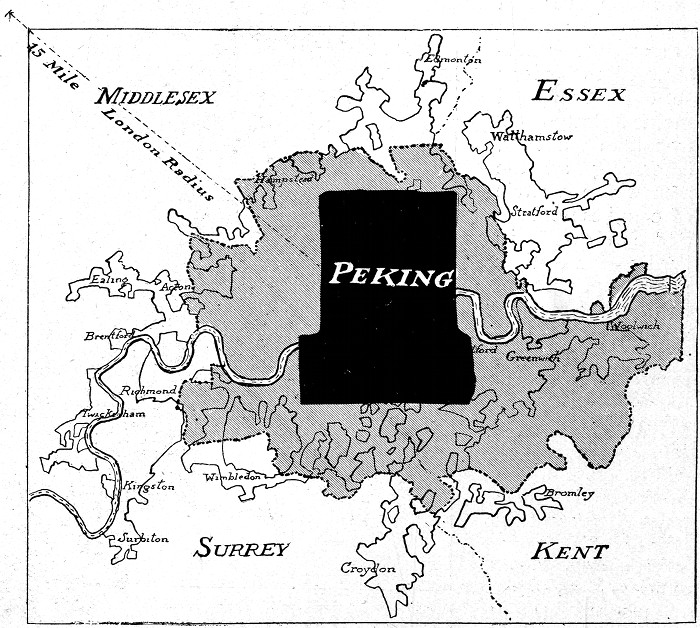
PEKING COMPARED WITH LONDON.
Peking, as we may see, is a walled city of oblong shape, and contains a total area of about thirty square miles. The two chief divisions are known as the Tartar city and the outer or Chinese city. The population is now about 1,000,000. Writing twenty years ago Sir Robert Douglas thought that a population of a mere million was "out of all proportion to the immense area enclosed within its walls. This disparity," he continued, "is partly accounted for by the fact that large spaces, notably in the Chinese city, are not built over, and that the grounds surrounding the Imperial Palace private residences are very extensive."
What would he have said of Chicago, New York, Budapest, or, indeed, of any modern capital "expanded"? To us, at the beginning of the twentieth century, a million inhabitants seems a very respectable population indeed for a city of only thirty square miles, and in this respect we can no longer sneer or be astonished at the "peculiarities" of Oriental cities.
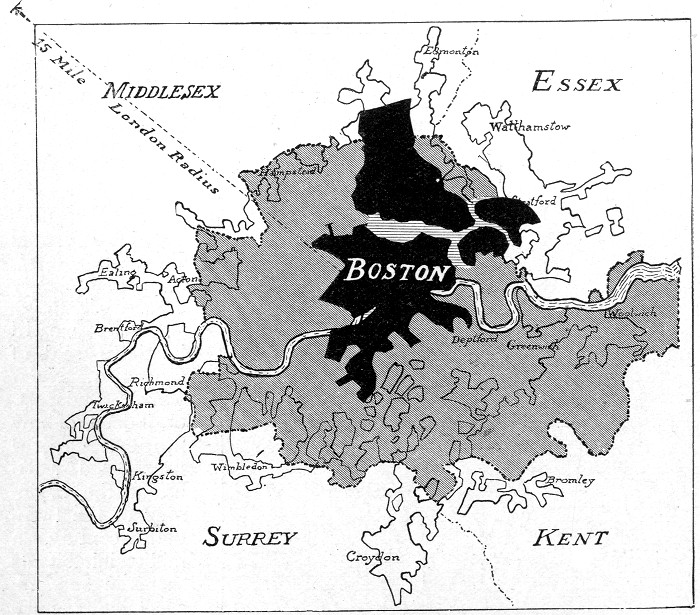
BOSTON COMPARED WITH LONDON.
Boston is one of the older and more conservative American cities which have lately been seized by the expansion fever, and now proudly refers to its "Greater Boston." But this is as yet only a term, and the new Boston metropolitan district, embracing all the area within a circle of ten miles from the State House, is hardly yet a distinct municipality. It will doubtless soon come about, and in that case twenty-two towns and cities will be taken to the bosom of "the Hub," and the total population will be close upon a million and a quarter. At present the area of the city is over thirty-seven square miles (24,000 acres), or just the size of Chicago a decade ago, of which 2,308 acres are common open spaces and 126 acres ponds and rivers, in addition to numerous squares, gardens, and playgrounds. The length of the city is eight miles and its greatest breadth about seven miles.
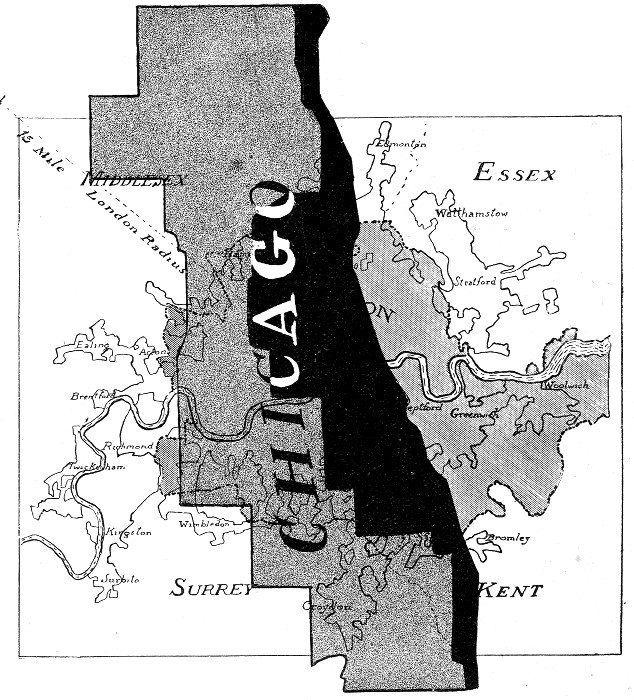
CHICAGO COMPARED WITH LONDON.—THE SOLID BLACK AREA REPRESENTS THE ACTUAL BUILDINGS OF CHICAGO; THE GREY AREA COMPLETING THE ADMINISTERED CITY.
Exactly one hundred years ago the American Government built Fort Dearborn, on Lake Michigan. In 1831 there was a village of one hundred people on the site; to-day the city of Chicago has spread out (rather too generously, its rival municipalities think) until it comprises 190-1/2 square miles and a population of 1,698,575. But only some seventy square miles of this area is improved, and less than fifty miles built upon. As there are also 2,232 acres of parks and open spaces, Chicago cannot be said to be overcrowded; especially when one remembers the great height of most of the buildings in the business quarter. Chicago's expansion, in truth, follows the lines laid down by the early Western boom "cities," which were prairie wilderness one week, were surveyed the next, had a population of twelve, one man to the square mile, and applied for a charter the week following, and elected a Mayor and Corporation. The next week the boom was over and a mere shanty remained to mark the site of Boomopolis.
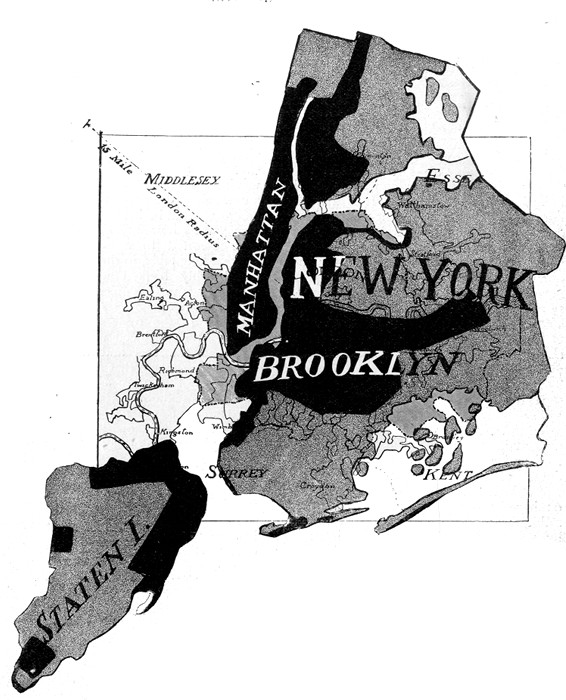
NEW YORK COMPARED WITH LONDON, THE SOLID BLACK AREA REPRESENTING THE ACTUAL BUILDINGS, THE GREY AREA COMPLETING THE ADMINISTERED CITY.
Before 1898 the city of New York lay partly on Manhattan Island, a long and narrow strip of land at the head of New York Bay, thirteen miles long and twenty-two square miles in area, and partly, although to a very trifling extent so far as population was concerned, north of the Harlem River, and on several small islands in the bay and East River. The total area was forty-two square miles, within which was a population of 1,515,301 souls. But in the aforementioned year the great arms of the city flung themselves out and gathered to its bosom so many of the outlying parts and people as to bring the total area of Greater New York up to 307 square miles, and the population to 3,437,202. It must be confessed that much of this huge municipal territory has been rather irrelevantly brought in—especially Staten Island (area 57·19 square miles), which is separated from New York proper by the width of the bay. But, on the other hand, other and nearer towns, such as Jersey City and Hoboken, were excluded, for the reason that they were in another State. Within Greater New York are included 6,766 acres of parks and open spaces, which is but little more than half that of London; yet the proportion of unoccupied land not under the control of the city is, of course, many times as great. The actual agglomeration of buildings in Greater New York—excluding Staten Island—covers barely 51,000 acres, or eighty square miles, as is shown in the diagram. Less than 5,000 acres is built upon in Staten Island.