Illustrated Interviews.
Reading edition
No. LXXXI.—DR. EDWARD ELGAR.
By Rudolph de Cordova.
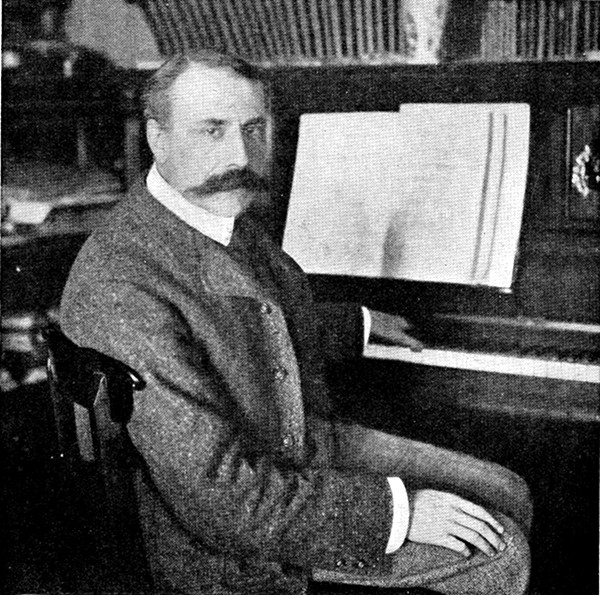
From a Photo. by] DR. EDWARD ELGAR. [George Newnes, Ltd.
F ever this votary of the muse of song looked from the hills of his present home at Malvern, from the cradle of English poetry, the scene of the vision of Piers Plowman, and from the British camp, with its legendary memories of his own 'Caractacus,' and in the light of the rising sun sees the towers of Tewkesbury and Gloucester and Worcester, he might recall in that view the earlier stages of his career, and confess with modest pride, like the bard in the 'Odyssey':—
Self-taught I sing; 'tis Heaven, and Heaven alone, Inspires my song with music all its own."
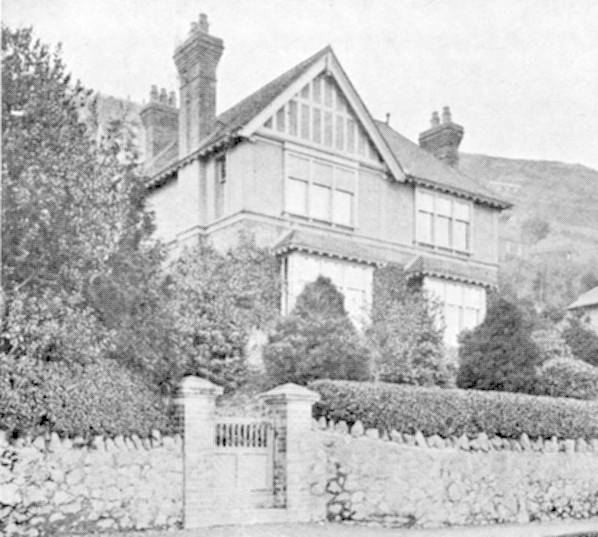
From a Photo. by] DR. ELGAR'S HOUSE AT MALVERN. [George Newnes, Ltd.
It was in November, 1900, that these words were spoken by the Orator when the University of Cambridge honoured itself by conferring the honorary degree of Doctor of Music on Dr. Elgar, whom one of the most distinguished German writers on music declared to be "the most brilliant champion of the National School of Composition which is beginning to bloom in England."
The encomiums which Germany—the acknowledged leader of the world in music—has showered on Dr. Elgar have at length been reflected in England, which has awakened to the fact that to him at least that much misapplied word "genius" belongs by right divine. That awakening was marked by the three days' festival in the middle of March, when Covent Garden Opera House reverted to an old custom and for two glorious nights became the home of oratorio, with a concert on the third night. That festival is unique in the history of music, for it is the first time an English composer has been so honoured.
However gratifying the applause of the public may be to the worker in any art, his greatest pleasure must properly come from his fellow-workers, who know the difficulties which have to be surmounted before the desired effect can be produced.
"Was not Herr Steinbach, the conductor of the Meiningen Orchestra, among the others who said that you have something different from anybody else in the tone of your orchestra?" I asked Dr. Elgar, as we sat in his study at Malvern, with a great expanse of country visible through the wide windows.
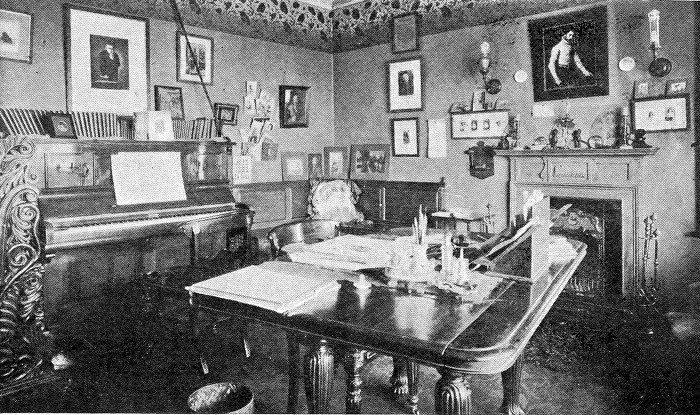
From a Photo. by] DR. ELGAR'S STUDY. [George Newnes, Ltd.
"I believe so," he replied; "and that remark has been one from which I have naturally derived great pleasure.
"You know," said Dr. Elgar, as he settled down to talk for the purpose of this interview, in accordance with a long-standing promise made in what he came to regard as an unguarded moment—"you know, since you compel me to begin at the beginning, that I 'began' in Broadheath, a little village three miles from Worcester, in which city my father was organist of St. George's Catholic Church, a post he held for thirty-seven years. I was a very little boy indeed when I began to show some aptitude for music and used to extemporize on the piano. When I was quite small I received a few lessons on the piano. The organ-loft then attracted me, and from the time I was about seven or eight I used to go and sit by my father and watch him play. After a time I began to try to play myself. At first the only thing I succeeded in producing was noise, but gradually, out of the chaos, harmony began to evolve itself. In those days, too, an English opera company used to visit the old Worcester Theatre, and I was taken into the orchestra, which consisted of only eight or ten performers, and so heard old operas like 'Norma,' 'Traviata,' 'Trovatore,' and, above all, 'Don Giovanni.'
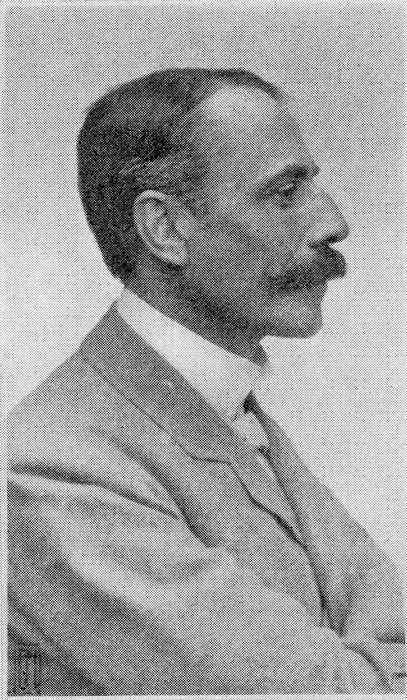
DR. EDWARD ELGAR.
From a Photo. by E. T. Holding.
"My general education was not neglected. I went to Littleton House School until I was about fifteen. At the same time I saw and learnt a great deal about music from the stream of music that passed through my father's establishment.
"My hope was that I should be able to get a musical education, and I worked hard at German on the chance that I should go to Leipsic, but my father discovered that he could not afford to send me away, and anything in that direction seemed to be at an end. Then a friend, a solicitor, suggested that I should go to him for a year and see how I liked the law. I went for a year, but came to the conclusion that the law was not for me, and I determined to return to music. There appeared to be an opening for a violinist in Worcester, and as it occurred to me that it would be a good thing to try to take advantage of the opening, I had been teaching myself to play the violin. Then I began to teach on my own account, and spent such leisure as I had in writing music. It was music of a sort—bad, very bad—but my juvenile efforts are, I hope, destroyed.
"Although I was teaching the violin I wanted to improve my playing, so I began to save up in order to go to London to get some lessons from Herr Pollitzer. On one occasion I was working the first violin part of the Haydn quartet. There was a rest, and I suddenly began to play the 'cello part. Pollitzer looked up. 'You know the whole thing?' he said.
"'Of course,' I replied.
"He looked up, curiously. 'Do you compose, yourself?' he asked.
"'I try,' I replied again.
"'Show me something of yours,' he said.
"I did so, with the result that he gave me an introduction to Mr., now Sir, August Manns, who, later on, played many of my things at the daily concerts at the Crystal Palace.
"When I resolved to become a musician and found that the exigencies of life would prevent me from getting any tuition, the only thing to do was to teach myself. I read everything, played everything, and heard everything I possibly could. As I have told you, I used to play the organ and the violin. I attended as many of the cathedral services as I could to hear the anthems, and to get to know what they were, so as to become thoroughly acquainted with the English Church style. The putting of the fine new organ into the cathedral at Worcester was a great event, and brought many organists to play there at various times. I went to hear them all. The services at the cathedral were over later on Sunday than those at the Catholic church, and as soon as the voluntary was finished at the church I used to rush over to the cathedral to hear the concluding voluntary. Eventually I succeeded my father as organist at St. George's. We lived at that time in the parish of St. Helen's, in which is the mother church of Worcester, which had a peal of eight bells. The Curfew used always to be rung in those days at eight o'clock in the evening, and I believe it is still rung. I made friends with the sexton and used to ring the Curfew, and afterwards strike the day of the month. My enthusiasm was so great that I used to prolong the ringing from three minutes to ten minutes, until the people in the neighbourhood complained, when I had to reduce the time. On Sunday the bells were supposed to go for half an hour before service, from half-past ten to eleven. The performance was divided into certain parts. With a friend, I used to 'raise' and 'fall' the bell for ten minutes, chime a smaller bell for ten minutes or so, and at five minutes to eleven I would fly off to play the organ at the Catholic church.
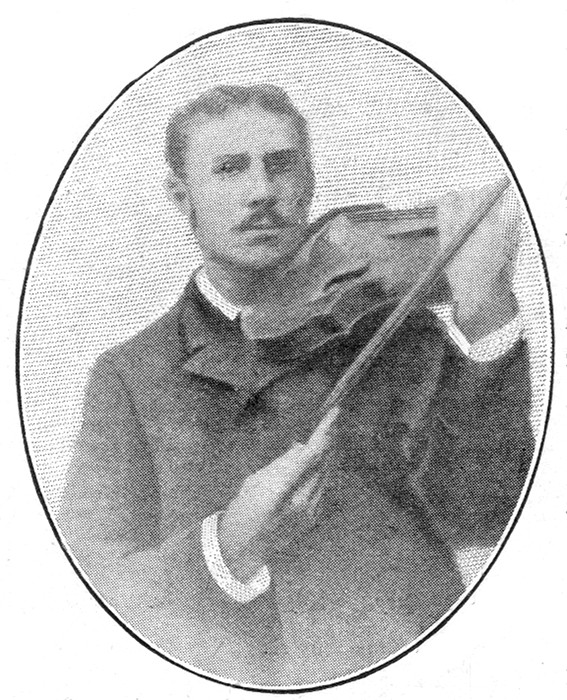
AN EARLY PORTRAIT OF DR. ELGAR.
From a Photograph.
"You ask me to go into greater details about my musical education. I am constantly receiving letters on this point from all over the world, for it is well known that I am self-taught in the matter of harmony, counterpoint, form, and, in short, the whole of the 'mystery' of music, and people want to know what books I used. To-day there are all sorts of books to make the study of harmony and orchestration pleasant. In my young days they were repellent. But I read them and I still exist."
If only cold type could suggest the humour with which those words were spoken!
"The first was Catel, and that was followed by Cherubini. The first real sort of friendly leading I had, however, was from 'Mozart's Thorough-bass School.' There was something in that to go upon—something human. It is a small book—a collection of papers beautifully and clearly expressed—which he wrote on harmony for the niece of a friend of his. I still treasure the old volume. Ouseley and Macfarren followed, but the articles which have since helped me the most are those of Sir Hubert Parry in 'Grove's Dictionary.'"
"How did these various authorities mix?" I interrupted.
"They didn't mix," was Dr. Elgar's reply, "and it appears it is necessary for anyone who has to be self-taught to read everything and—pick out the best. That, I suppose, is the difficulty—to pick out the best. How to forget the rubbish and remember the good I can't tell you, but perhaps that is where his brains must come in.
"It would be affectation were I to pretend that my work is not recognised as modern, and I hate affectation, yet it would probably surprise you to know the amount of work I did in studying musical form. Only those can safely disregard form who ignore it with a full knowledge and do not evade it through ignorance.
"Mozart is the musician from whom everyone should learn form. I once ruled a score for the same instruments and with the same number of bars as Mozart's G Minor Symphony, and in that framework I wrote a symphony, following as far as possible the same outline in the themes and the same modulation. I did this on my own initiative, as I was groping in the dark after light, but looking back after thirty years I don't know any discipline from which I learned so much.
"So you insist on my telling you some more of my early struggles and my early work? I was interested in many other things besides music, and I had the good fortune to be thrown among an unsorted collection of old books. There were books of all kinds, and all distinguished by the characteristic that they were for the most part incomplete. I busied myself for days and weeks arranging them. I picked out the theological books, of which there were a good many, and put them on one side. Then I made a place for the Elizabethan dramatists, the chronicles including Baker's and Hollinshed's, besides a tolerable collection of old poets and translations of Voltaire, and all sorts of things up to the eighteenth century. Then I began to read. I used to get up at four or five o'clock in the summer and read—every available opportunity found me reading. I read till dark. I finished by reading every one of these books—including the theology. The result of that reading has been that people tell me I know more of life up to the eighteenth century than I do of my own time, and it is probably true.
"In studying scores the first which came into my hands were the Beethoven symphonies. Anyone can have them now, but they were difficult for a boy to get in Worcester thirty years ago. I, however, managed to get two or three, and I remember distinctly the day I was able to buy the Pastoral Symphony. I stuffed my pockets with bread and cheese and went out into the fields to study it. That was what I always did. Even when I began to teach, when a new score came into my hands I went off for a long day with it out of doors, and when my unfortunate—or fortunate?—pupils went for their lessons I was not at home to give them.
"By the way, talking about scores, it will probably surprise you to know that I never possessed a score of Wagner until one was given to me in 1900.
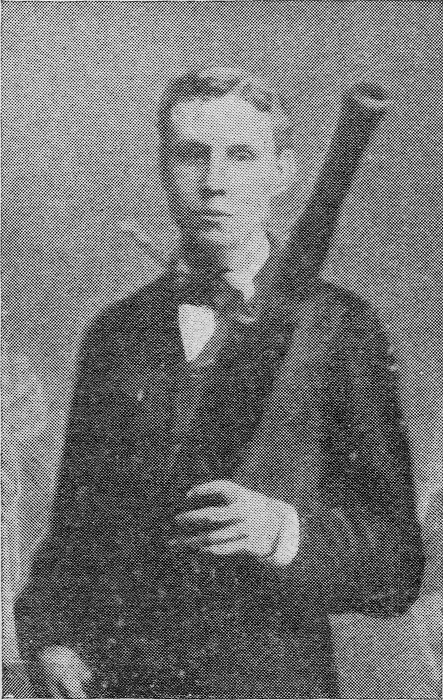
DR. ELGAR AS A MEMBER OF HIS QUINTET, FOR WHICH HE WROTE THE MUSIC.
From a Photo. by Bennett.
"In the early days of which I have been speaking five of us established a wind quintet. We had two flutes, an oboe, a clarionet, and a bassoon, which last I played for some time, and afterwards relinquished it for the 'cello. There was no music at all to suit our peculiar requirements, as in the ideal wind quintet a horn should find a place and not a second flute, so I used to write the music. We met on Sunday afternoons, and it was an understood thing that we should have a new piece every week. The sermons in our church used to take at least half an hour, and I spent the time composing the thing for the afternoon. It was great experience for me, as you may imagine, and the books are all extant, so some of that music still exists. We played occasionally for friends, and I remember one moonlight night stopping in front of a house to put the bassoon together. I held it up to see if it was straight before tightening it. As I did so, someone rushed out of the house, grabbed me by the arms, and shouted, 'It will be five shillings if you do.' He thought I had a gun in my hand.
"The old Worcester Glee Club had been established as long ago as 1809 for the performance of old glees, with an occasional instrumental night. At these last I first played second fiddle and afterwards became leader, as, after a time, I used to do the accompanying. It was an enjoyable and artistic gathering, and the programmes were principally drawn from the splendid English compositions for men's voices. The younger generation seemed to prefer ordinary part-songs, and ballads also were introduced, and the tone of the thing changed. I am not sure if the club is still in existence.
"It was in 1877 that I first went to take lessons of Pollitzer. He suggested that I should stay in London and devote myself to violin playing, but I had become enamoured of a country life, and would not give up the prospect of a certain living by playing and teaching in Worcester on the chance of only a possible success which I might make as a soloist in London.
"The thing which brought me before a larger public as a composer was the production of several things of mine at Birmingham by Mr. W. C. Stockley, to whom my music was introduced by Dr. Wareing, himself a composer, and still resident in Birmingham. At that time I was a member of Mr. Stockley's orchestra—first violin."
In this connection it is interesting to break Dr. Elgar's narrative to tell an anecdote which Mr. Stockley relates. When he decided to do something of Dr. Elgar's, he asked him if he would like to conduct it. "Certainly not," Dr. Elgar replied; "I am a member of the orchestra and I am going to stick in the orchestra. I am not recognised as a composer, and the fact that you are going to do something of mine gives me no title to a place anywhere else." The piece was a success and the audience called for Dr. Elgar, who came down from among the fiddles, made his bow, and then went back to his place.
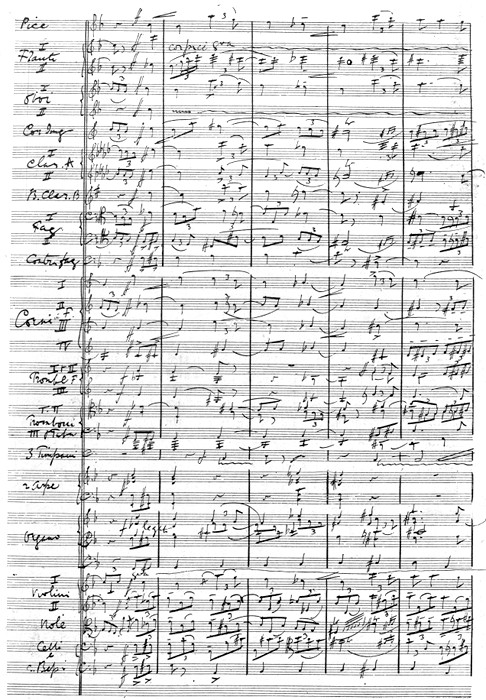
REDUCED FACSIMILE OF A PAGE OF THE FULL SCORE OF "THE DREAM OF GERONTIUS."
To resume. "Don't suppose, however," Dr. Elgar said, "that after that recognition as a composer things were easy for me. The directors of the old Promenade Concerts at Covent Garden Theatre were good enough to write that they thought sufficiently of my things to devote a morning to rehearsing them. I went on the appointed day to London to conduct the rehearsal. When I arrived it was explained to me that a few songs had to be taken before I could begin. Before the songs were finished Sir Arthur Sullivan unexpectedly arrived, bringing with him a selection from one of his operas. It was the only chance he had of going through it with the orchestra, so they determined to take advantage of the opportunity. He consumed all my time in rehearsing this, and when he had finished the director came out and said to me, 'There will be no chance of your going through your music to-day.' I went back to Worcester to my teaching, and that was the last of my chance of an appearance at the Promenade Concerts.
"Years after I met Sullivan, one of the most amiable and genial souls that ever lived. When we were introduced he said, 'I don't think we have met before.' 'Not exactly,' I replied, 'but very near it,' and I told him the circumstance. 'But, my dear boy, I hadn't the slightest idea of it,' he exclaimed, in his enthusiastic manner. 'Why on earth didn't you come and tell me? I'd have rehearsed it myself for you.' They were not idle words. He would have done it, just as he said. He never forgot the episode till the end of his life.
"Two similar occurrences took place at the Crystal Palace: rehearsals were planned which never came off, so I was no nearer to getting a hearing for big orchestral works.
"Mr. Hugh Blair, then the organist of Worcester Cathedral, saw some of the cantata, 'The Black Knight,' and said: 'If you will finish it I will produce it at Worcester.' I finished it, and it was produced by the Worcester Festival Choir. This cantata then came under the notice of Dr. Swinnerton Heap, to whom I owe my introduction to the musical festivals as a writer of choral works. He had known me for a good many years as a violinist, but it had never occurred to him to talk to me about my composing, and he knew nothing of it.
"It was through Dr. Heap that I was asked to write a cantata for the Staffordshire Musical Festival, and, shortly after, the committee asked me to provide an oratorio for the Worcester Festival. They were 'The Light of Life,' performed in Worcester Cathedral, and 'King Olaf,' at Hanley.
"Since then it has been a record of the production of one composition after another until we come to 'The Apostles,' and my new overture 'In the South,' produced at Covent Garden; the one great event that particularly stands out is the production of the 'Variations' by Dr. Richter, to whom I was then a complete stranger.
"For a long time I had had the idea of writing 'The Apostles' in pretty much the form in which I hope it will eventually appear. As you know, there have been oratorios on many points of Jewish and Christian history, but none had shown how Christianity has risen. I take the men who were in touch with Christ, the Apostles in fact, and show them to be ordinary mortals rather than superhuman men, as they are generally represented in art. I was always particularly impressed with Archbishop Whately's conception of Judas, who, as he wrote, 'had no design to betray his Master to death, but to have been as confident of the will of Jesus to deliver Himself from His enemies by a miracle as He must have been certain of His power to do so, and accordingly to have designed to force Him to make such a display of His superhuman powers as would have induced all the Jews—and, indeed, the Romans too—to acknowledge Him King.'
"In carrying out this plan I made the book myself, taking out lines from different parts of the Bible which exactly express my conception. How it was done the following chorus will show you, for you will notice that the references to the text are printed in the margin:—
The Lord hath chosen them to stand before Him, to serve Him.—II. Chron. 29, 11.
He hath chosen the weak to confound the mighty.—I. Cor. 1, 27.
He will direct their work in truth.—Isa. 61, 8.
Behold, God exalteth by His power: who teacheth like Him?—Job 36, 22.
The meek will He guide in judgment, and the meek will He teach His way.—Ps. 25, 9.
He will direct their work in truth.—Isa. 61, 8.
For out of Zion shall go forth the law.—Isa. 2, 3.
"You will notice that occasionally, as in the third extract, I have used the words in their meaning that appears on the surface, and not in the real meaning of the sentence which may be found in any commentary. To keep the diction exactly the same I have not gone outside the Scripture except in one sentence from the Talmud in the case of the watchers on the Temple roof.
"It was part of my original scheme to continue 'The Apostles' by a second work carrying on the establishment of the Church among the Gentiles. This, too, is to be followed by a third oratorio, in which the fruit of the whole—that is to say, the end of the world and the Judgment—is to be exemplified. I, however, faltered at that idea, and I suggested to the directors of the Birmingham Festival to add merely a short third part to the two into which the already published work, 'The Apostles,' is divided. But I found that to be unsatisfactory, and I have decided to revert to my original lines. There will, therefore, be two other oratorios."
This definite pronouncement of Dr. Elgar's cannot fail to evoke the warmest anticipations on the part of the music loving world.
It is worth noting here that shortly after "The Dream of Gerontius" was produced at the Birmingham Festival, in 1900, Herr Julius Buths, the famous conductor of Düsseldorf, was so struck with it that he determined to produce it in Germany and himself translated the libretto. So great a success was this performance that "The Dream," which one of the most celebrated German musical critics has declared to be "the greatest composition of the last hundred years, with the exception of the 'Requiem' of Brahms," was repeated at the Lower Rhine Festival, a thing hitherto unheard of in the annals of English music, and at the Lower Rhine Festival on Whit-Sunday "The Apostles" is to be given.
Dr. Elgar has a delightful and most acute sense of humour, so that I was sure I should not be misunderstood if I ventured to ask a question about his "musical crimes."
He smiled. "But which of my musical crimes do you mean? From the point of view of one person or another I understand all my music has been a crime," he replied, lightly. Then he added, "Oh, you mean 'The Cockaigne,' 'The Coronation Ode,' and 'The Imperial March' especially. Yes, I believe there are a good many people who have objected to them. But I like to look on the composer's vocation as the old troubadours or bards did. In those days it was no disgrace to a man to be turned on to step in front of an army and inspire the people with a song. For my own part, I know that there are a lot of people who like to celebrate events with music. To these people I have given tunes. Is that wrong? Why should I write a fugue or something which won't appeal to anyone, when the people yearn for things which can stir them—"
"Such as 'Pomp and Circumstance,'" I interpolated.
"Ah, I don't know anything about that," replied Dr. Elgar, "but I do know we are a nation with great military proclivities, and I did not see why the ordinary quick march should not be treated on a large scale in the way that the waltz, the old-fashioned slow march, and even the polka have been treated by the great composers; yet all marches on the symphonic scale are so slow that people can't march to them. I have some of the soldier instinct in me, and so I have written two marches of which, so far from being ashamed, I am proud. 'Pomp and Circumstance,' by the way, is merely the generic name for what is a set of six marches. Two, as you know, have already appeared, and the others will come later. One of them is to be a Soldier's Funeral March.
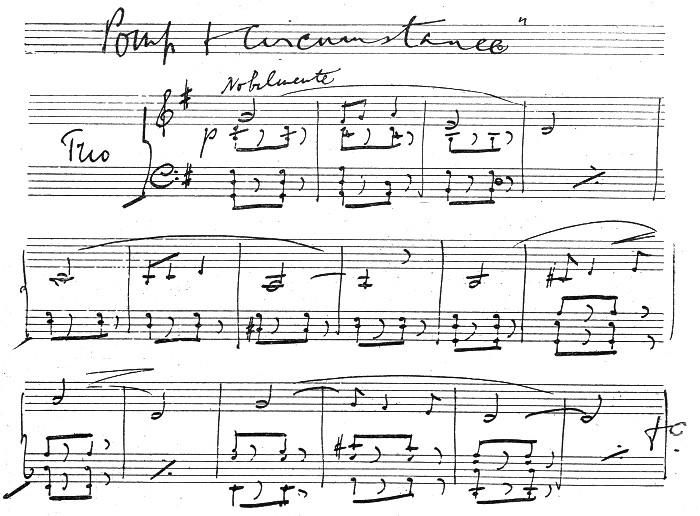
REDUCED FACSIMILE OF MS. OF "POMP AND CIRCUMSTANCE."
"As for 'The Imperial March,' which was written for Queen Victoria's Diamond Jubilee of 1897, it would, perhaps, interest you to know that only on January 22nd last it was given in St. George's Chapel, Berlin, at the unveiling of the memorials of Queen Victoria and the Empress Frederick, and Dr. G. R. Sinclair, of Hereford Cathedral, played it on the organ.
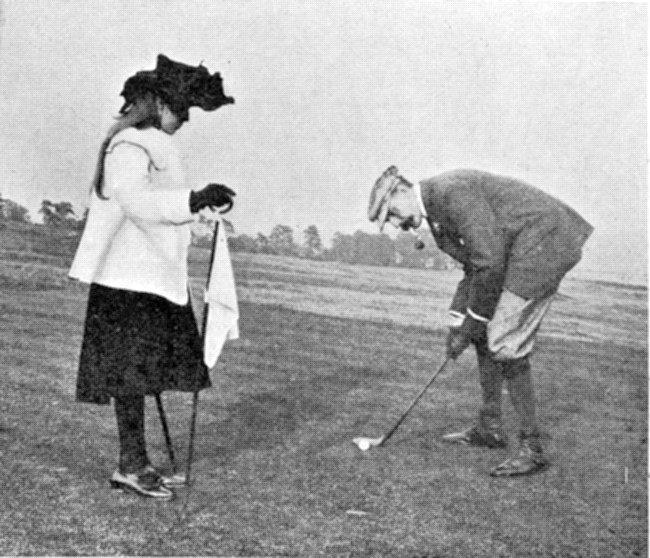
From a Photo. by] GOLF ON MALVERN COMMON. Foulsham & Banfield.
"How and when do I do my music? I can tell you very easily. I come into my study at nine o'clock in the morning and I work till a quarter to one. I don't do any inventing then, for that comes anywhere and everywhere. It may be when I am walking, golfing, or cycling, or the ideas may come in the evening, and then I sit up until any hour in order to get them down. The morning is devoted to revising and orchestration, of which I have as much to do as I can manage. As soon as lunch is over I go out for exercise and return about four or later, after which I sometimes do two hours' work before dinner. A country life I find absolutely essential to me, and here the conditions are exactly what I require. As you see," and Dr. Elgar moved over to the large window which takes up the whole of one side of his study, "I get a wonderful view of the surrounding country. I can see across Worcestershire, to Edgehill, the Cathedral of Worcester, the Abbeys of Pershore and Tewkesbury, and even the smoke from round Birmingham. It is delightfully quiet, and yet in contrast with it there is a constant stream of communication with the outside world in the shape of cables from America and Australia, and letters innumerable from all over the world."
In the house itself there are not many evidences of Dr. Elgar's productions, but prominent in a corner of the drawing-room is the laurel wreath presented to him at Düsseldorf when "The Dream" was first produced. The leaves are brown to-day, but the scarlet ribbon is as bright as the memory of the music in the enraptured ears of those who have heard it. In his study are two prized possessions, the one a tankard made by some members of the Festival Choir at Hanley at the time of the production of "King Olaf." The inscription, taken from one of the choruses, is, appropriately, a Bacchanalian one:—
The ale was strong; King Olaf feasted late and long. —Longfellow.
Next to this is a cup, also specially designed by Mr. Noke, of Hanley, to commemorate the performance of "The Dream." On one side is a portrait of Cardinal Newman and on the other a portrait of Dr. Elgar, with the following inscription from the work itself:—
Learn that the flame of the everlasting love Doth burn ere it transform.