Some Novel Banquets.
Reading edition
By Theodore Adams.
HE art of him who prepares the banquet has reached, in these latter days, a distinction of novelty which might reasonably make the gastronomer of fifty years ago hold up his knife and fork in wonder. It is a novelty born of the desire for change. No longer does the dinner-giver merely prepare, with the aid of his costly chef, the menu for his guests and the viands on it. He—or, more properly, she, because of the present prominence of the fair hostess—tries not only to set a pretty table with flowers and cutlery of gold. The giver of dinners is ever thinking of that which will make the banquet memorable to the guest, and, in some cases, even wonders what the Press will say about it. This means to lie awake at night, and in such nightly vigils many wondrous things have been evolved.
Thus we have come to hear of banquets under conditions that make the imagination reel, and arouse speculation as to what the dinner of the twenty-first century will be like. When thirty-two people sat about on horseback a year ago, in a temporary stable, eating from dishes handed to them by waiters dressed as grooms, it seemed as if the top notch of bizarrerie had been reached. But, as the German says, noch nicht.
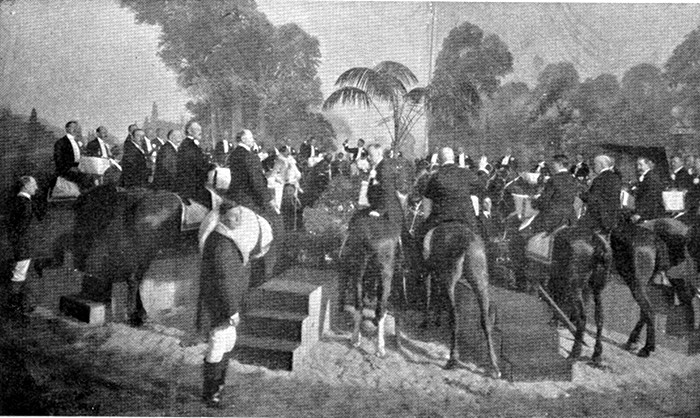
A HORSEBACK DINNER IN A HOTEL BALLROOM, THE TABLES BEING CARRIED IN FRONT OF THE SADDLES.
From a Photo. by Byron.
This remarkable horseback dinner was given in the great ballroom at Sherry's by Mr. C. K. G. Billings, of New York, and, as it was intended to celebrate the construction of a new stable, the rumour went round that the banquet would be held in the structure itself. The guests, however, met at Sherry's, and were escorted to a small banquet room, where a long table, in the form of an ellipse, was lavishly banked with flowers. The centre space was occupied by a stuffed horse, which cast his glass eyes curiously upon the assembly as the oysters and caviare were served. So convinced were the guests that this was the real and much-talked-about equestrian dinner that their surprise was great when they were asked to follow their host into an adjoining room.
"Here," according to the report of one who was at this famous banquet, "there had taken place an amazing transformation, for the decoration, the waxed floors, and everything of the world of indoors had been obliterated. A space sixty-five by eighty-five feet in the centre of the room had been enclosed by scenery. The guests were in a land of winding roadways, of brooks which coursed through green meadows, and of giant elms. There were cottages, vine-covered, and at the edge of a country estate was a porter's lodge. Far away stretched fields of grain. Over all was the blaze of a summer sun, for above in a vault of blue were strung electric lights. On all sides was the country, and in the middle of the room, rising in a pyramid, were geraniums, daisies, and roses, all blooming as if in the air of June. Above them a palm formed the apex of a pyramid thirty feet at the base. The floor was covered with long, velvety grass. Around the centrepiece were arranged thirty-one horses waiting for their riders. Mr. Billings's mount stood near the door, gazing into the geranium bed. How the steeds got up to the ballroom is no mystery in these days of large lifts, and they were well-trained horses, who cared not for lights and unusual conditions. Each guest found his mount by means of a horseshoe-shaped card attached to the saddle of the horse, just as he had been guided to his seat at the preliminary banquet by means of the bits of Bristol-board at each cover."
Between every two horses there was placed a carpet-covered block, from which the diners swung into their saddles, where, from little tables placed upon the pommels, they ate their splendid dinner. The horses showed little nervousness. Their trappings were yellow and gold, making pretty contrast with the costumes of the servants, who wore trousers of white buckskin, scarlet coats, and boots with yellow tops. Towards the end of the feast the horses were treated with a consideration due to their efforts, for a turkey-red fence surrounding the floral pyramid was discovered by the guests to contain feeding-troughs in which had been placed a plentiful quantity of superior oats. After dinner the horses were taken from the room by the grooms, small tables and chairs were brought in, and the guests sat down to an after-dinner chat as if in a beautiful garden.
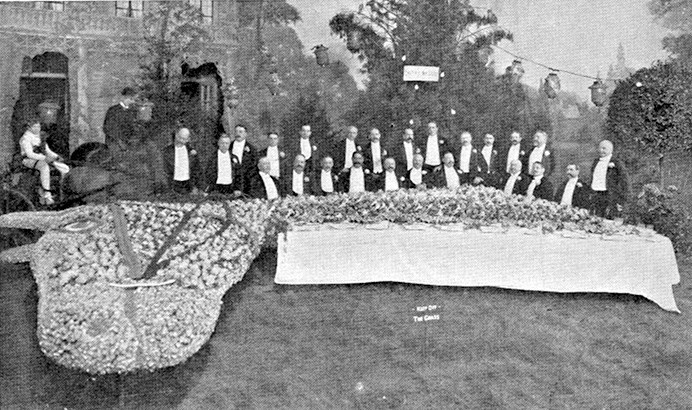
A DINNER OF THE NEW YORK EQUESTRIAN CLUB, THE TABLE REPRESENTING A HORSE'S HEAD.
From a Photo. by Byron.
The horse has figured in a less ambitious, though perhaps quite as attractive, manner at the dinners of the Equestrian Club, which meets in New York during the winter once a month. For one of these banquets was arranged a rural scene with trees, shrubs, and beautiful beds of tulips and hyacinths, the whole floor being covered with stage grass. The table represented a horse's head, chairs being placed around the neck, while the head proper of the horse was a mass of flowers, with eyes, nose, and mouth displayed by means of ornamental and many-coloured flowers. The bridle, particularly, stood out strongly in brilliant red. The menu was formed in the shape of a horse's head, with a small bit and bridle made of leather and steel attached to it.
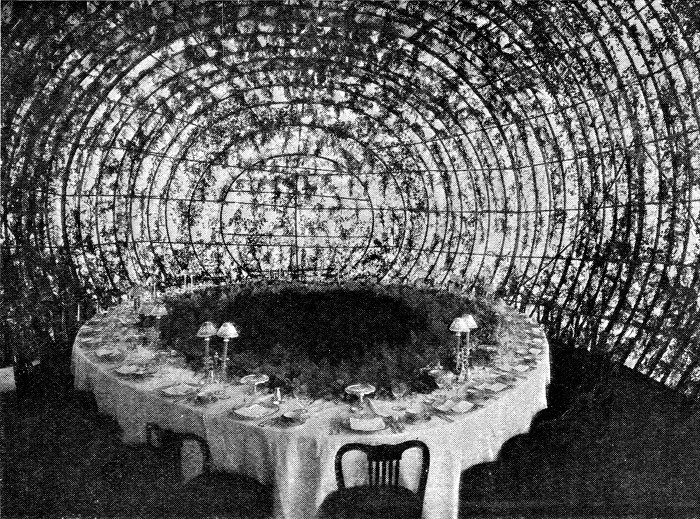
A DINNER INSIDE AN EASTER EGG.
From a Photo. by Byron.
The use of effective scenery at such functions is growing more common. Perhaps the most effective use to which it was ever put was at the Proal banquet of April, 1903, when thirty-five ladies dined within a monster Easter egg. The egg itself towered to the top of Sherry's ballroom and extended almost to the outer walls. Outside the egg was represented a farm on which chickens, ducks, geese, rabbits, pigs, lambs, and guinea-pigs disported to the life—for they were really live. The ballroom had been turned into a fine landscape, with scenes representing fields and pastures, with flowing brooks near by, and farmhouses, windmills, and hayricks in the distance. One or two mirrors reflected parts of this landscape, which had been arranged to express that longing for "green fields and pastures new" which comes to all who live a city life when spring appears.
In every respect the farm was true to life. A farmer with blue overalls and smock passed in front of the guests, followed by a flock of geese. Pigs ran between his legs, and the spring lamb frisked upon the green. Rabbits munched their carrots until, timid at the sight of strange people, they hid themselves in the straw which lay about. Around were scattered the implements of labour, as if the farmers had just left their work. There were scythes, mowing-machines, milk-pails, and milking-stools to be seen. Every detail, in fact, had been thought of necessary to make the illusion complete, and the guests—all of whom had been kept in ignorance until they came into the room—were justly astonished at the sight.
The egg itself, with its shell of white, was geometrically perfect, and brought to mind the famous tale of Sindbad and the gigantic roc. The shell was fashioned with light timber bands bent to the required shape, and the supports were covered with green, all making a delightful arbour-like effect. The table was oval in form, hollowed in the centre, within which were floral decorations representing the white and yellow of an egg. Daffodils and jonquils were used for the yolk, while lilies, candytuft, and other white flowers were freely used. The air was filled with fragrance from these blooms. Mrs. Proal sat at the head of the ornamental table, with her guests around the oval. Music was provided by a band of negro musicians, who, seating themselves on wooden benches outside the dining-room, sang plantation melodies. The waiters were dressed as farm-labourers in gaily coloured shirts and smocks, with wisps of straw upon their heads. Fortunate, indeed, were the thirty-five women who took part at this unique banquet, for the farm and its giant egg had come into existence only for a single day, to be destroyed when luncheon was ended and its use was over.
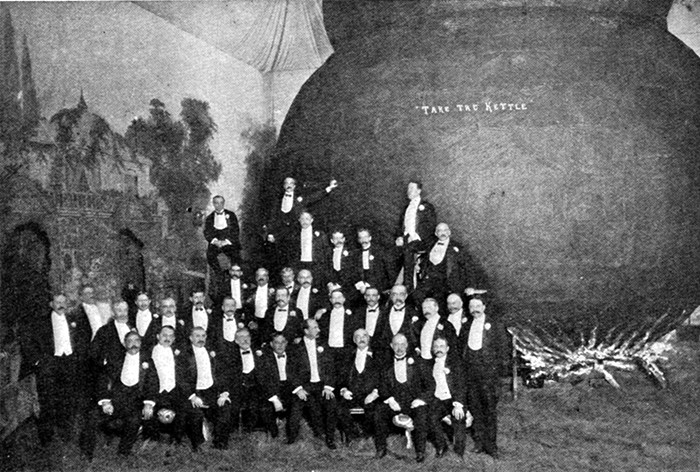
THE GUESTS OF THE KETTLE CLUB DINNER WITH THE KETTLE IN WHICH THEY DINED.
From a Photo. by Byron.
We already begin to see in these dinners the existence of a new form of humour. This is shown even better in the so-called "babies' dinner" given at Sherry's by a Philadelphia organization called the Kettle Club. This club, composed of gentlemen who summer in the Adirondack Mountains, and who eat their forest meals round a vast and fragrant kettle, recently decided to admit five new members, or "babies." The only condition of candidacy was that the "babies" should show due appreciation of the honour conferred upon them. The result was a banquet such as had never been held before. To it were invited the older members of the club. The ballroom resembled a forest glade. Round the walls were painted forests with real trees in the foreground, to one of which was hitched a hunting-horse. The scenic effects included a dark blue cloth which represented a sky, with a moon in the distance and twinkling stars. In the centre of the room rested on a tall mound a huge kettle, twenty-five feet high and twenty-eight feet in diameter, with a door at one side reached by a rustic stairway. There was a circular table within the kettle, around which sat the guests, each with a wine "cooler" at his side.
In the centre of the table, perfectly dark when dinner began, was a bed of tall flowers on the floor, nine feet below. Suddenly, when this hole was lighted, was revealed a magnificent display of orchids, with a vine of pale purple flowers. Below sat a negro with a banjo, who sang and played throughout the evening for the pleasure of the guests. The menu card showed a picture of the kettle, into which five babies were climbing, the faces of these being those of the five new members, each with a teething ring, a nursing bottle, and a rattle. Souvenirs of the occasion were given to the guests in the form of small kettles, each with the name of the guest and the club motto, "Take the Kettle," painted on the side. This same inscription appeared on the structure in which the banquet took place, as shown in our illustration. Here we may note the part which the backcloth played at this noteworthy function.
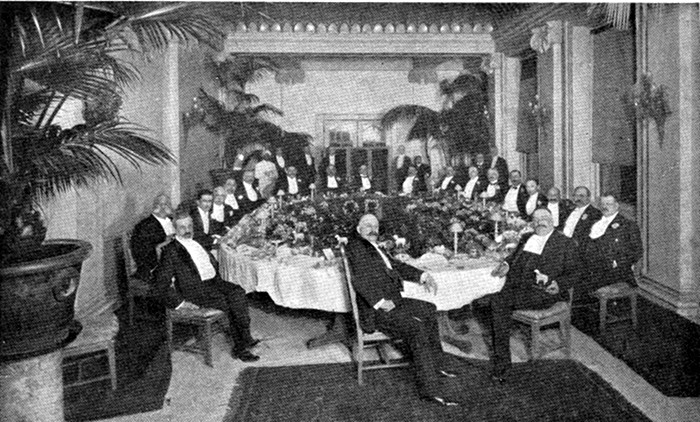
THE OLD GUARDS' "MOCK-MENU" DINNER.
From a Photo. by Byron.
Another novel dinner was that given by a well-known New Yorker, Colonel O'Brien, to the Old Guard of Delmonico's, known to fame as the guard that "dines but never surrenders." For this affair two menus had been provided, one as a joke, the other for consumption. The mock bill of fare contained a list of dishes which might have been provided. For example, under the heading of oysters were the words "half shell," which the waiters solemnly set before the assembled gentlemen, minus the bivalves. These being removed made way for the next item, which, being "cream of celery" and presumably a soup, was found to be small tubes of celery with cold cream inside. Through all the regular courses the joke was carried, with amusing success, the joint being spring lamb with "string," or French, beans. What was the astonishment of the guests to find served for this course a woolly toy lamb on a spring, which squeaked when pressed, and wore dried beans on a string around its neck! The humour of the dinner came with the continued surprise at the ingenuity shown by the preparer of the feast, and it can be truly said that each item tickled the guests immensely. With the woolly lambs this band of gastronomers were especially pleased, and it was at the moment when these ridiculous toys were handed round to the well-proportioned diners that our photograph was secured.
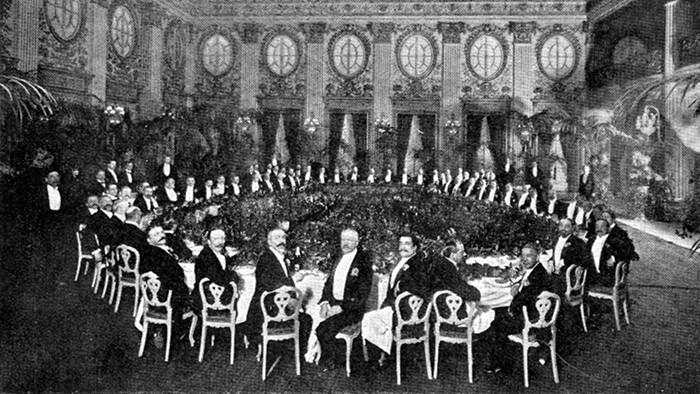
THE "LYRE DINNER," THE TABLE BEING IN THE FORM OF A LYRE.
From a Photo. by Byron.
A few years ago Mr. Sherry himself was returning with the impresario, Maurice Grau, from Europe, and as the result of a wager upon the ship's "run" Mr. Grau was given a splendid dinner. It is now known in gastronomic history as the "lyre dinner," for the table was arranged in the form of an enormous lyre. Long gilded ropes covered with pretty vines represented the strings, while, to carry out the idea of the instrument, there was a golden cloth on the inner side of the table. Into this were woven mauve orchids, with electric lights sparkling under the green leaves, thus bringing out sufficient brilliancy to please the guests and not to affect their eyesight. Between each two seats of the table was a wine "cooler," sunk into the wood in such a way that the neck only of each champagne bottle showed above the edge. The banquet was attended by those best known to music in New York, and its brilliancy has probably never been surpassed.