The Naval War Game and How it is Played.
Reading edition
By Angus Sherlock.
Copyright in the United States by A. P. Watt and Son.
(Note.—This is the only popular article that has ever appeared on the Naval War Game, though it is played in every navy in the world. The subject is of some special interest just at present, because both the Japanese and Russian navies trained on it for the present war. Proofs of the article have been submitted to the inventor, who himself selected the illustrations.)
ROM time to time one reads in the technical naval Press brief references to, or fixtures for, the Naval War Game. At rare intervals a "war-game battle" will be found described at length in some of the Service journals, but beyond this it is safe to say that the game is a mystery to the general public. The reason is, in part, that it touches technical questions that are caviare to the million, but as much, or more so, it is mysterious on account of the secrecy with which many of its details are guarded. It is open to the public to purchase the "game," it is true, but, though the material and plenty of directions can thus he secured, it is by now well enough known that many unpublished "confidential" rules exist.
These, it may be noted, differ in every navy. The problems of naval warfare and the ideals of facing them are not the same for a Russian as for an American, and Sweden and the Argentine Republic again have nothing in common in their naval aspirations. However, were I in a position to divulge these matters they would not be of any great interest to readers of The Strand Magazine, so I propose to confine myself as much as possible to things in which the human interest is the dominant factor.
First, however, some description of the game and its invention may be of interest. The naval war game reached its fruition some five years ago, but Mr. Fred. T. Jane, its inventor, always asserts that he began to think it out when he was a small boy at school.
"When I was a small boy," said Mr. Jane, "I had the boat sailing craze. A school-fellow had a better boat than I; I mounted a gun in mine and committed an act of piracy on a duck-pond. My chum was a sportsman, and, after punching my head, proceeded to arm his ship also. We took to armour-plates made from biscuit-tins, and to squadrons instead of single ships. In the battle that ensued our fleets annihilated each other, and depleted finances forbade their renewal. Then it was that the economy born of necessity caused me to think that make-believe battles would be cheaper. Thus was the naval war game evolved in embryo. At first we fought with imaginary leviathans, but after a time such impossible vessels were claimed that we decided to simulate nothing but existing ships.
"A year or so later I read in some newspaper that a fortune awaited the man who could invent something that could be applied to ships as the land Kriegspiel to armies. I thought I could do with that fortune, so packed the game in an empty Australian beef-tin and sent it to the Admiralty, together with a letter in which the following magnificent sentence occurred: 'I shall not be above accepting financial remuneration, and for convenience this can be paid in instalments.'
"In due course 'My Lords' returned the game with thanks. They had 'inspected it with much interest,' they said.
"Somehow I doubt it. After the lapse of many years I still remember vividly the smell of that old meat-tin in which the game was sent to them.
"My next step was one which is, I believe, chronic with disappointed inventors. I wrote letters to the newspapers attacking Admiralty policy in general, with a view to making the callous authorities tremble! I never witnessed the trembling, but as out of this campaign I grew into what is called a 'naval expert,' I suppose I owe the Admiralty a debt of gratitude! However, that is another story.
"Meanwhile, war game languished, till some seven years ago it was found by accident in a lumber-room. Even then it was resuscitated only as a toy. I used to take it to the Majestic, and it was played there very much à la ping-pong, till one day the captain, Prince Louis of Battenberg, asked about it, and wished to see the rules.
"Feeling somewhat of a fraud," says Mr. Jane, "I hastily recast the thing into its original serious mould, plus a variety of improvements that occurred to me, or were suggested by various naval friends.
"The game was then played in the Majestic once more, and 'caught on.' To my astonishment I was deluged with letters asking about the game. The first came from the Grand Duke Alexander of Russia, the Czar's brother-in-law, who, with that absence of 'side' so characteristic of the Romanoffs, wrote himself as a naval officer. He had, he told me, himself invented a naval war game, the strategical part of which was successful, but the tactical not what he had hoped for it. If mine were satisfactory, he would do all he could for it.
"That is how the game came to have its Imperial and Royal 'godfathers,' as announced on the title-page. Royal sailors are usually regarded as mere ornamental dummies, but both the Grand Duke Alexander and Prince Louis of Battenberg were responsible for many excellent improvements in the game, for which I, perhaps, have received the credit.
"There were two other godfathers—Rear-Admiral H. J. May, of the British Navy, and Captain Kawashima, of the Japanese Navy. The former expended endless labour in revising the rules; the latter it was who played with me all the early experimental games to test the rules, and alter them when necessary to make practice as simple as possible. We used to fight little one-man 'wars,' beginning at about ten in the morning and carrying on till after midnight. Captain Kawashima is now in command of the Matsushima (the famous cruiser that was flagship at Yalu in the Chino-Japanese War), and when I remember the painstaking enthusiasm he used to put into the 'wars' he and I had, I think that he will go far in the present war.
"A lecture at the United Service Institution followed the Majestic battle, and thus the game 'took root.' It is in every navy in the world now."
About this time a foreign Government approached the inventor with a view to purchasing the game and its secret. The offer was declined, but Mr. Jane gave a similar option to the British Admiralty, which, however, made no reply whatever beyond an official acknowledgment of the receipt of the letter. Perhaps, like Mr. Jane, the Permanent Secretary remembered the old meat-tin!
After an interval the game was produced—the very first set to be sold being secured by, of all people, the Chinese! This particular set later on helped to make history; indeed, it has been seriously surmised that it caused the Chinese attack on the allied fleets at Taku. After that affair a British landing party found the ground inside one fort littered with war-game models, each model ship being stuck full of pins. The leader of the party being a war-game player followed up his find, to discover a shed laid out for naval war game and "scorers"[1] of all the allied fleets in various stages of destruction!
The Chinese had apparently worked out things by war game before opening fire. They had, however, made one little mistake—they had made no allowance for the allied fleet firing back!
Following China, the United States, Germany, Russia, and Japan secured early sets, and a little while afterwards the British War Office. That much-abused department was, curiously enough, the very first to recognise the utility of the game for the chief purpose its inventor designed it for—the teaching of the guns and armour of possible enemies. It was procured for the use of artillery officers in sea forts, and in his last report Lord Roberts emphasized the vast difference between those officers who had played the game and those who had not. The former knew the weak points of every possible enemy; the latter, on hearing the name of any ship, could not tell whether she were a battleship or gunboat, dangerous or harmless. Every War Office has since followed suit in adopting the "Kindergarten war system."
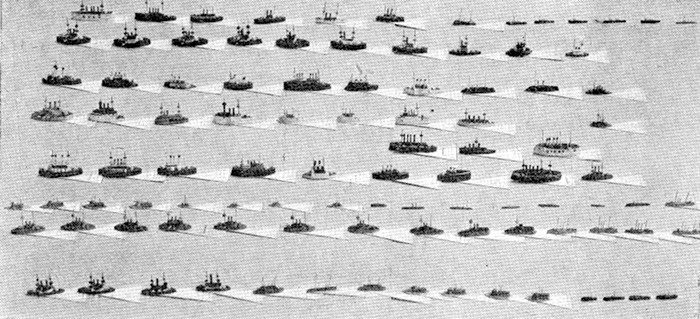
A STANDARD NORWEGIAN NAVAL WAR-GAME SET.
From a Photo. by Symonds & Co.
And now for some account of how the game is played. A large table is the primary requisite. This is covered with blue cards divided into a multitude of little squares, each of which represents half a cable—that is to say, a hundred yards. Over these squares are moved the pieces—model ships on the same scale as the board.
These models are a most important part of the game. They are made of cork, painted, and most accurate representations of actual ships; and this they need to be, for the players have to recognise them. Each model is fitted with tiny guns—little bits of wire set in at various angles which indicate the arcs of training of the corresponding guns in the real ships, while long pins mark the bearings of the torpedo tubes. Other pins, fitted with delicate little military tops, make the masts; and, to digress a moment, hereby hangs a tale.
One of the earliest experimenters with the naval war game was the ubiquitous Kaiser. He took to it keenly, and himself played it often with his admirals. One day, so runs the story in the German Navy, the Kaiser was winning hand over fist, his fleet, led by his flagship, bearing down upon the enemy. Excitement was high, when at the critical moment the Kaiser's fleet suddenly disappeared!
The Kaiser gazed at the deserted board and then at his admirals. An "awkward pause" is said to have ensued, and the writer for one can quite believe that. It is undoubtedly an awkward thing to seem to have played tricks with an Emperor so as to cheat him out of victory.
"Where is my fleet?" asked the Kaiser.
"I do not know, sire," exclaimed his chief opponent, a famous admiral.
He saluted as he spoke, and thereupon there fell to the floor, apparently from down the admiral's sleeve, three of the missing warships! What the admiral felt is better imagined than described.
Fortunately for his reputation one model still remained stuck in his sleeve. In moving his own ships he had rested his arm on the Kaiser's vessels, and so lifted the lot unawares. All's well that ends well, and the Kaiser laughed most heartily; but there is an admiral in the German fleet whom it is in no way wise to talk to about naval war game.
However, this admiral is not the only one who has met misadventure from war-game models, no less a person than the Japanese Admiral Togo heading the list of those who have had "naval war-game hand"—the result of inadvertently leaning on the masts of a model ship!
To resume the description. Every player has assigned to him a particular ship, and this he moves simultaneously with all the others at the direction of his "admiral." Each move nominally occupies a minute of time—actually it usually takes more, and it is in the ways and means adopted to balance this that most of the confidential rules exist. A most essential part of the game is to counterfeit with all possible realism the hurry-scurry of an actual battle.
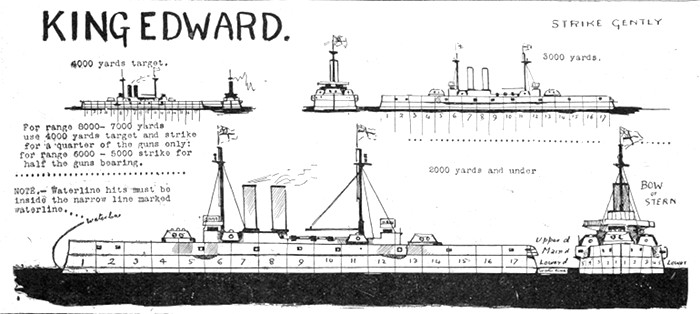
A NAVAL WAR-GAME TARGET—ACTUAL SIZE.
The distance moved depends, of course, upon the speed of the ship represented. A flier like H.M.S. Drake, for instance, can cover as many as eight squares should full speed be ordered. This means eight hundred yards a minute—equivalent, approximately, to a speed of twenty-four knots per hour. In actual practice the ships do not move by squares, else a vessel proceeding along the diagonals would go much faster than one moving straight across; the squares merely exist to afford a rough means of guessing the range. Special measures are, therefore, employed.
Innumerable rules cover such matters as increasing and decreasing speed, turning, and so forth. General conventions exist, but in actual practice the real turning circles of ships are alone made—and here, of course, confidential features are thick. The inventor of the game is probably the repository of more secrets in this respect than three of the best Naval Intelligence Departments of Europe put together.
At the end of each "minute" more firing takes place. This is the characteristic feature of the game. Each player has a card with a plan of his ship showing guns, armour, etc., and divided into arbitrary vertical sections of twenty-five feet each. This card is known technically as a "scorer." Pictures of each ship, similarly divided, but showing no armour, and of different sizes for different ranges, are also provided. These are the "targets."
They are struck at by "strikers," which at first sight are rather like ping-pong bats with a pin in them.[2] This pin is nearly, but never quite, in the centre of the striker. To ensure hitting any particular part of a ship is, therefore, practically impossible, except at close range, and not very often then. Nice calculation is required, and also great coolness—too great effort after accuracy being usually as fatal as too little. Thus, by automatic means, that great factor of modern warfare, "moral effect," is provided for, since experience shows that no player whose ship has been badly knocked about ever hurts the enemy very much. One strike per gun is allowed; with reduced gun-fire he feels his chances of hitting reduced, and tries harder to make the most of what he has got, and the slight excitement, coupled with the extra effort that he makes, invariably disconcerts his aim.
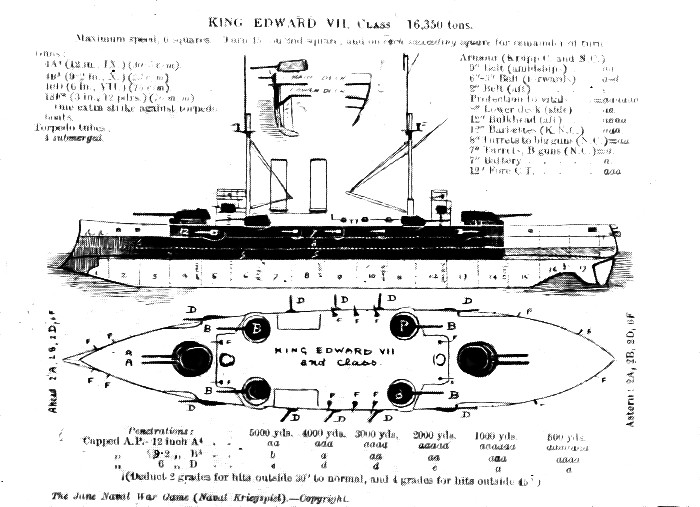
"SCORER" FOR H.M.S. "KING EDWARD VII."
To some extent the excitement of a battle always does this. When the game was first exhibited at the Royal United Service Institution, a certain admiral urged as a weak point in the shooting system that he could hit the enemy every time. He took a target and did it. Yet in the battle that ensued he never scored a single hit—the slight extra tension upset his aim completely. And it is astonishing how many misses are made by many players from this cause.
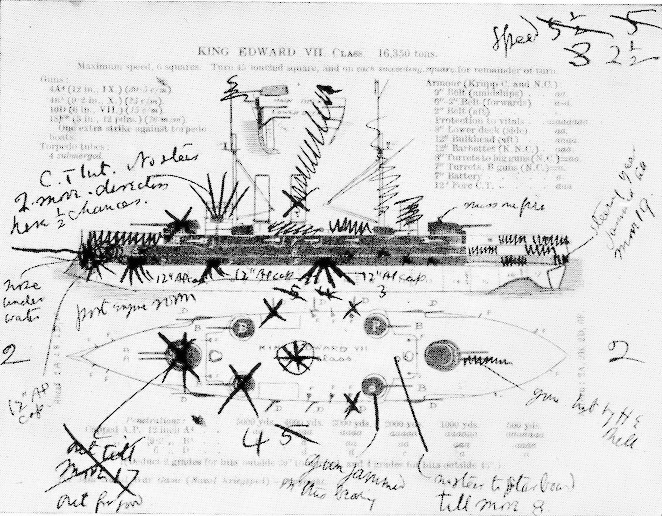
THE SAME "SCORER" AFTER A BATTLE IN WHICH THE SHIP WAS KNOCKED ABOUT. THE DAMAGES HAVE BEEN SCORED ACCORDING TO HITS RECEIVED ON "TARGETS."
Hitting the enemy is, however, but half the battle. If the ship fired at is armoured the impact may be on a cuirass that the gun represented cannot get through, or an armour-piercing shot may hit a part where no armour exists, and so do next to no harm. When harm is done it is scored on the card of the ship hit on a scale corresponding to the actual damage that would be inflicted. In a very little while the player realizes that what will put one ship out of action will hardly hurt another. This in theory he has, of course, always known, but between knowing a thing and fully realizing it there is an enormous gap. He has been firing, perhaps, at the German Kaiser Friedrich and blown her to pieces almost with big shell. He shifts his fire to the Wittelsbach, hits her as often, and she comes on unhurt. These two ships have the same armament and the same weight of armour—it is merely differently disposed. That difference of disposition tells in naval war game as heavily as it would in actual war.
In this little piece of realism lies the fascination of the game. That it has extraordinary fascinations for some naval officers is beyond dispute. The Grand Duke Alexander of Russia, for instance, had all the furniture turned out of the big drawing-room at the Xenia Palace, St. Petersburg, in order to have set up a table large enough to allow huge fleets to be manœuvred, and he invited the inventor over to stay with him at St. Petersburg for a month in order to play against him. In a Russian lunatic asylum there is at this day a captain who actually went mad on the game and spends his existence in perpetual imaginary battles. In the British Navy there are dozens of young officers who think nothing of playing a game from half-past eight on to four in the morning, taking their chances of being able to find a shore-boat to take them back to their ships at that hour in the depth of winter. I have seen battles often in which the opposing sides would not speak to each other; indeed, when a regular "war" is being worked out this is the usual situation. It is being "real war in miniature" that produces this. The writer can vouch for the maddening effect in a battle of some apparently splendid scheme being ruined by a single "lucky shell" from the enemy. Too late one realizes that the best dispositions are not those that promise most, but those in which a lucky shot or two will not bring about failure.
Torpedoes, however, perhaps take first place as maddening irritants. In the game as now played in the British Navy, between each move screens are usually put up. The object of these is to prevent the enemy "answering" any change of formation more quickly than could be done in actual battle. Under cover of these screens torpedoes are fired—the firing method being to draw a pencil line following the bearing of the tube, firing not at the enemy, but at the spot on which he is expected to be when the torpedo reaches him. Torpedoes are slow things relatively. They can travel a thousand yards in a minute, but take three minutes to do two thousand yards, and six to go three thousand. Very nice calculation is, therefore, needed. At the expiration of the time—that is to say, anything from one to six moves after firing—if the torpedo line and any ship (friend or foe) coincide, the ship is torpedoed. Till then nothing has been said: the torpedo comes as a bolt from the blue.
The panic caused by the first torpedoes fired under this system was immense. Both fleets put about and rushed away from each other, never getting within torpedo range again. In the centre, between the fleet, lay the victim, which the umpire had notified as torpedoed. Not till the battle was over was it made known that the torpedoed vessel had been hit by a torpedo fired by one of her consorts, across the path of which she had unwittingly wandered!
The acme of horror in this direction is perhaps provided by submarines. Slow moving, they have more or less to take up their positions before the battle begins. It is not permitted me to describe exactly how they are worked. I may say, however, that they are manœuvred on a separate board, and work blindly enough; for all that the player of a submarine sees of the battlefield is what he can find reflected in a tiny mirror. He has, in fine, to guess a great deal as to the course and distance of the enemy from the spot corresponding to that on which he is supposed to be, which reproduces the conditions under which a periscope is used fairly accurately. If a submarine can get within a square (one hundred yards) of a ship, that ship is allowed torpedoed. Nothing is allowed for the chance of the boat being seen by the ship, the assumption being that these chances are too small to be worth consideration; at any rate, till such time as it is too late for the ship to do anything.
This looks like an easy time for the submarine, but it is not so comfortable in reality, because destroyers and picket-boats may be with the enemy. Should a destroyer at any time pass within a hundred yards of the submarine, it is exit submarine!
In the British Navy the official home of the naval war game is at Greenwich Naval College, where captains play it during the "war course." In the United States the War College is its home. Its real British head-quarters are at Portsmouth, where a voluntary society plays it twice a week. Admiral Sir John Hopkins is the president of this association, and Mr. Fred. T. Jane, the inventor, its secretary. Both naval and military officers are eligible for membership, and, as far as possible, junior officers only. At the "war course" tactics are the principal study, but at Portsmouth tactics play a minor part. "Tactics cannot be taught by naval war game, save in a very general way," is the dictum of the inventor. "The Portsmouth Naval War-Game Society exists for quite different objects. It aims chiefly at teaching the guns and armour of possible enemies; and for the rest tries to train officers to think out war problems, to train them to think things quickly, and to exhibit resource, to learn the value of all the vital side issues of war, such as international law or the keeping up of communications, and so forth. There is no such thing as the abstract right or wrong move in war; to do a more or less wrong thing at once may often be better than doing a better thing a little later. 'Act' is the motto that the society strives to inculcate."
It is, it will be seen, far removed from a "theory hot-bed." In pursuance of the plan the society's members are incessantly at war with each other. Advantage is taken of the rivalry that exists between ships in the Navy—and one ship's officers are usually pitted against those of another ship. At other times it is the Navy against the Army; and before now personal enemies have been pitted against each other.
"In cards and games you play for sport, but in war game you must 'play to win,'" is the principle inculcated.
To this end anything whatever may be claimed, subject, however, to the provision that, should the umpire consider any claim impossible or absurd, the maker of it gets a breakdown to his best ship as a reward.
The record in claims is held by a young lieutenant who acted as Admiral Alexieff in a Russo-Japanese War. His claim ran as follows:—
"Orders issued that no offal is to be thrown overboard from Russian ships.
"A special field of small observation mines is to be laid at —— (here a place geographically suitable near Port Arthur is mentioned). At this spot offal is to be freely thrown into the water to attract porpoises and sharks. When a good number have collected the mines are to be exploded and the stunned fish collected.
"Each is then to have strapped to it a leather band, holding a short pole in position (as per small model accompanying), after which it is to be liberated.
"I claim that these fish will, as usual, follow any vessels in the neighbourhood of Port Arthur dropping offal—that is to say, Japanese ships only—and that they will be taken for submarine boats when the pole like a periscope is sighted.
"The Japanese will soon detect the imposition, and then grow so used to the sight that after a time a real submarine will be able to approach without attracting any suspicion."
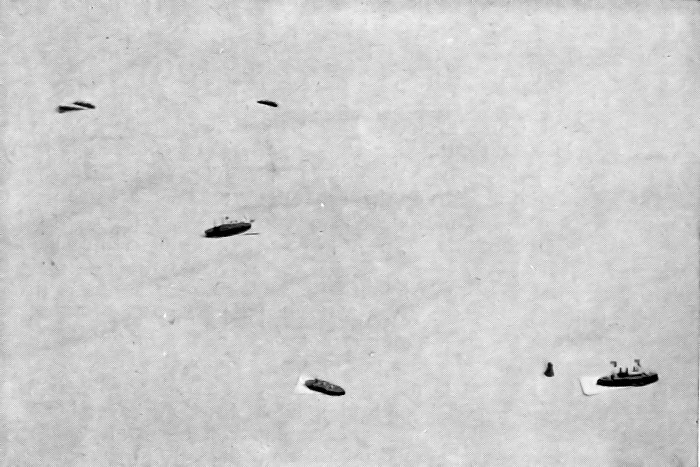
Attacking destroyers (Japanese).
Russian merchantman. Russian battleship Peresviet.
A TORPEDO-BOAT ATTACK IN A RUSSO-JAPANESE WAR GAME—PLAYED OCTOBER-DECEMBER LAST. AS USUAL IN TORPEDO OPERATIONS, THIS WAS PLAYED ON A BOARD WITHOUT SQUARES, IN ORDER TO RENDER IT MORE DIFFICULT TO JUDGE DISTANCES.
From a Photo. by West.
Truly an astounding claim! It was not allowed by the umpire, but the fertile brain whence it originated is never likely to let its owner come to grief for want of an expedient.
As a rule possible actual wars are not often played: more usually imaginary countries are established in some part of Europe and given the ships which it is most desired to study. Admiralty charts are used, and an immense amount of study of harbours is thus put in as pastime, while these little wars give prominence to such minor operations as attacks on coastguard stations and so forth, which could not well enter into a larger war. Usually, too, there is some special theme—international law, perhaps, one time, gleaning and sifting intelligence another time, and so forth.
What was, perhaps, the funniest war ever carried out had "Intelligence Sifting" as its theme. The combatants were allowed to procure information of each other's plans by any means they chose—any trick being regarded as legitimate. The gamut of the possible was run in no time. Both sides enrolled their friends as spies, and a silver-haired old lady, who liked to hear officers talk of their professions, was most deadly to one player. Two others, wishing to ensure private discussion, hired a motor-car. They had only gone some little way into the country when a policeman sprang from the hedge and stopped them. After the usual protests the policeman admitted an element of doubt in the case; if they would drive him to the police-station he would have his stop-watch tested in their presence. They took him on board and, as motorists have done before and since, marooned him far away after an hour's drive. By then, plans being decided, they went home by devious routes, thinking no more of the marooned policeman. Not till some days afterwards did it dawn on them that the policeman was a bogus one—an enemy who had availed himself of this means of learning their secret plans!
They were not, however, without resource. The day following the discovery they called on the ship which the chief "admiral" of the other side served in. Keeping out of sight, they waited till he went to his cabin; then, slipping in, gagged and bound him, after which they proceeded to rifle his cabin. Plans were soon found, but false information had been disseminated once or twice, and they were wary. They continued the search, being at last rewarded by finding the whole plan of campaign concealed inside a telescope.
After this they departed happy, and made their dispositions accordingly, handing these in to the umpire long before the gagged one—for they left him gagged and bound—was able to release himself.
Total failure was theirs: their wily enemy had in some way anticipated their raid, and the plan concealed in the telescope had been carefully prepared for their undoing!
It must not be supposed, however, that a war game is often so frivolous as this one, for in the ordinary way any such "spying" is strictly forbidden. Yet few games, perhaps, have been more useful than this one, for certainly half the players must have had impressed upon them in the most direct and unexpectedly forcible of ways the urgent necessity of taking no information for granted and also of sifting it all most carefully, which was the object sought. And if in the hereafter any one of them is the repository of important Service secrets he will have to be a very wily spy who secures them from him. There cannot be much wrong while young officers can be found ready to sacrifice such little leisure as they get in studying war problems for amusement.
It is only in the British Navy that—so far as I can ascertain—this is done. In other navies officially supervised games are plentiful enough, but with them, of course, there is not the same interest. Here and there isolated foreign ships have the game on board and use it for purposes akin to those for which the inventor designed it. Two such ships are the Russian Bayan and Novik—the only two ships which have, so far, distinguished themselves in the present war.
In connection with the former ship it is interesting to note that her captain was a regular attendant at the Grand Duke Alexander's games in St. Petersburg, and used there to be laughingly called the "War-Game Skobeleff." Skobeleff, it will be remembered, was that Russian general who, in the Turco-Russian War, led a hundred desperate forlorn hopes untouched, though all around him were killed or wounded. Any ship played by Captain Wiren of the Bayan used to have similar extraordinary luck; as one Russian officer, who must have Irish blood in him, put it: "The enemy's hits on him were all misses." Strangely enough, the same luck has followed him in the present war—the Bayan survived the torpedo attack of February 8th; in the battle of the 9th, though she charged the Japanese fleet, she was untouched; in the action of the 25th February, when Captain Wiren, with three Russian cruisers, tried to fight the entire Japanese squadron, two were badly mauled, but the Bayan was not hurt.
In concluding this brief sketch of naval war game from the popular standpoint a reference may be made to flying-machines, which some think will be the warships of the future. Rules of the aerial fights of the future are said to exist all ready cut and dried, together with an ingenious machine by which the aerial warship's moves can be made. There is, in fine, nothing in earth, sky, or sea, or under the sea, that has not been the subject of rules in this "War by Kindergarten."
Copyright 1904, by George Newnes, Limited.
XI.—THE BEGINNING OF THE END.
ELL, I must say," mother said, looking at the Wishing Carpet as it lay, all darned and mended and backed with shiny American cloth, on the floor of the nursery—"I must say I've never in my life bought such a bad bargain as that carpet."
A soft "Oh!" of contradiction sprang to the lips of Cyril, Robert, Jane, and Anthea. Mother looked at them quickly, and said:—
"Well, of course I see you've mended it very nicely, and that was sweet of you, dears."
"The boys helped too," said the dears, honourably.
"But, still—twenty-two and ninepence! It ought to have lasted for years. It's simply dreadful now. Well, never mind, darlings, you've done your best. I think we'll have cocoanut matting next time. A carpet doesn't have an easy life of it in this room, does it?"
"It's not our fault, mother, is it, that our boots are the really reliable kind?" Robert asked the question more in sorrow than in anger.
"No, dear, we can't help our boots," said mother, cheerfully, "but we might change them when we come in, perhaps. It's just an idea of mine. I wouldn't dream of scolding on the very first morning after I've come home. Oh, my Lamb, how could you?"
This conversation was at breakfast, and the Lamb had been beautifully good until everyone was looking at the carpet, and then it was for him but the work of a moment to turn a glass dish of syrupy blackberry jam upside down on his young head. It was the work of a good many minutes and several persons to get the jam off him again, and this interesting work took people's minds off the carpet, and nothing more was said just then about its badness as a bargain and about what mother hoped for from cocoanut matting.
When the Lamb was clean again he had to be taken care of while mother rumpled her hair and inked her fingers and made her head ache over the difficult and twisted housekeeping accounts which cook gave her on dirty bits of paper, and which were supposed to explain how it was that cook had only fivepence-halfpenny and a lot of unpaid bills left out of all the money mother had sent her for housekeeping. Mother was very clever, but even she could not quite understand the cook's accounts.
The Lamb was very glad to have his brothers and sisters to play with him. He had not forgotten them a bit, and he made them play all the old exhausting games: "Whirling Worlds," where you swing the baby round and round by his hands; and "Leg and Wing," where you swing him from side to side by one ankle and one wrist. There was also climbing Vesuvius. In this game the baby walks up you, and when he is standing on your shoulders you shout as loud as you can, which is the rumbling of the burning mountain, and then tumble him gently on to the floor and roll him there, which is the destruction of Pompeii.
"All the same, I wish we could decide what we'd better say next time mother says anything about the carpet," said Cyril, breathlessly ceasing to be a burning mountain.
"Well, you talk and decide," said Anthea; "here, you lovey ducky Lamb. Come to Panther and play Noah's Ark."
The Lamb came with his pretty hair all tumbled and his face all dusty from the destruction of Pompeii, and instantly became a baby snake, hissing and wriggling and creeping in Anthea's arms, as she said:—
I love my little baby snake, He hisses when he is awake, He creeps with such a wriggly creep, He wriggles even in his sleep.
"Well, you see," Cyril was saying, "it's just the old bother. Mother can't believe the real true truth about the carpet, and——"
"You speak sooth, O Cyril!" remarked the Phœnix, coming out from the cupboard where the black-beetles lived, and the torn books, and the broken slates, and odd pieces of toys that had lost the rest of themselves. "Now hear the wisdom of the Phœnix, the son of the Phœnix."
"There's a society called that," said Cyril.
"Where is it? And what is a society?" asked the bird.
"It's a sort of joined-together lot of people—a sort of brotherhood—a kind of—well, something very like your temple, you know, only quite different."
"I take your meaning," said the Phœnix. "I would fain see these calling themselves Sons of the Phœnix."
"But what about your words of wisdom?"
"Wisdom is always welcome," said the Phœnix.
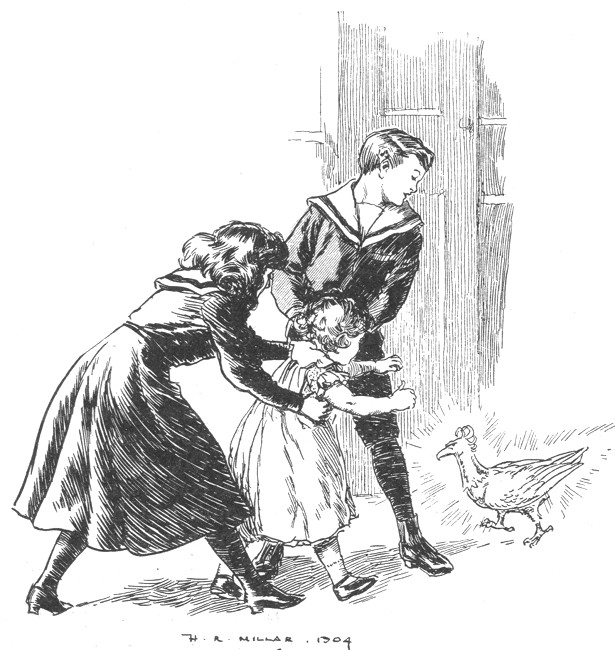
"'PRETTY POLLY!' REMARKED THE LAMB."
"Pretty Polly!" remarked the Lamb, reaching his hands towards the golden speaker.
The Phœnix modestly retreated behind Robert, and Anthea hastened to distract the attention of the Lamb by murmuring:—
I love my little baby rabbit; But oh, he has a dreadful habit Of paddling out among the rocks And soaking both his bunny-socks.
"I don't think you'd care about the Sons of the Phœnix, really," said Robert. "I have heard that they don't do anything fiery. They only drink a great deal. Much more than other people, because they drink lemonade and fizzy things, and the more you drink of those the more good you get."
"In your mind, perhaps," said Jane; "but it wouldn't be good in your body. You'd get too balloony." The Phœnix yawned.
"Look here," said Anthea, "I really have an idea. This isn't like a common carpet. It's very magic indeed. Don't you think, if we put Tatcho on it and then gave it a rest, the magic part of it might grow, like hair is supposed to do?"
"It might," said Robert, "but I should think paraffin would do as well—at any rate as far as the smell goes, and that seems to be the great thing about Tatcho."
But with all its faults Anthea's idea was something to do, and they did it.
It was Cyril who fetched the Tatcho bottle from father's washhand-stand. But the bottle had not much in it.
"We mustn't take it all," Jane said, "in case father's hair began to come off suddenly; if he hadn't anything to put on it, it might all drop off before Eliza had time to get round to the chemist's for another bottle. It would be dreadful to have a bald father, and it would all be our fault."
"And wigs are very expensive, I believe," said Anthea. "Look here, leave enough in the bottle to wet father's head all over with in case any emergency emerges—and let's make up with paraffin. I expect it's the smell that does the good really—and the smell's exactly the same."
So a small teaspoonful of the Tatcho was put on the edges of the worst darn in the carpet and rubbed carefully into the roots of the hairs of it, and all the parts that there was not enough Tatcho for had paraffin rubbed into them with a piece of flannel. Then the flannel was burned. It made a gay flame, which delighted the Phœnix and the Lamb.
"How often," said mother, opening the door—"how often am I to tell you that you are not to play with paraffin? What have you been doing?"
"We have burnt a paraffiny rag," Anthea answered. It was no use telling mother what they had done to the carpet. She did not know it was a magic carpet, and no one wants to be laughed at for trying to mend an ordinary carpet with lamp-oil.
"Well, don't do it again," said mother. "And now away with melancholy! Father has sent a telegram. Look!" She held it out, and the children holding it by its yielding corners read:—
"Box for kiddies at Garrick. Stalls for us, Haymarket. Meet Charing Cross, 6.30."
"That means," said mother, "that you're going to see 'The Water Babies' all by your happy selves, and father and I will take you and fetch you. Give me the Lamb, dear, and you and Jane put clean lace in your red evening frocks, and I shouldn't wonder if you found they wanted ironing. This paraffin smell is ghastly. Run and get out your frocks."
The frocks did want ironing—wanted it rather badly, as it happened; for, being of tomato-coloured Liberty silk, they had been found very useful for tableaux vivants when a red dress was required for Cardinal Richelieu. They were very nice tableaux, these, and I wish I could tell you about them—but one cannot tell everything in a story. You would have been specially interested in hearing about the tableaux of the Princes in the Tower, when one of the pillows burst and the youthful Princes were so covered with feathers that the picture might very well have been called "Michaelmas Eve; or, Plucking the Geese."
Ironing the dresses and sewing the lace in occupied some time, and no one was dull because there was the theatre to look forward to, and also the possible growth of hairs on the carpet, for which everyone kept looking anxiously. By four o'clock Jane was almost sure that several hairs were beginning to grow.
The Phœnix perched on the fender, and its conversation, as usual, was entertaining and instructive—like school prizes are said to be. But it seemed a little absent-minded and even a little sad.
"Don't you feel well, Phœnix, dear?" asked Anthea, stooping to take an iron off the fire.
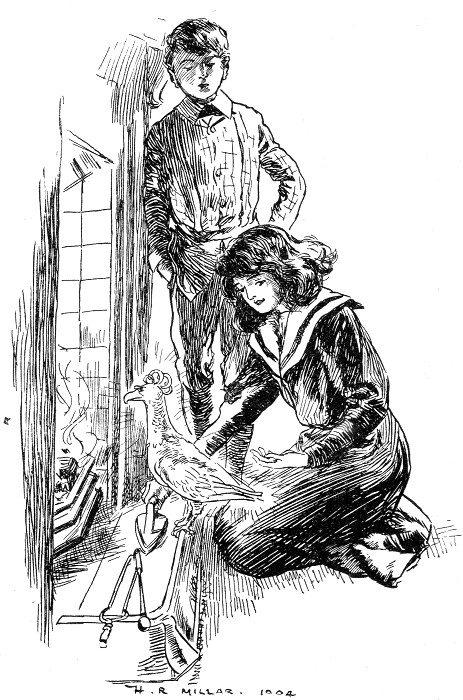
"'DON'T YOU FEEL WELL, PHŒNIX, DEAR?' ASKED ANTHEA."]
"I am not sick," replied the golden bird, with a gloomy shake of the head, "but I am getting old."
"Why, you've only been hatched about two months."
"Time," remarked the Phœnix, "is measured by heart-beats. I'm sure the palpitations I've had since I've known you are enough to blanch the feathers of any bird."
"But I thought you lived five hundred years," said Robert, "and you've hardly begun this set of years. Think of all the time that's before you."
"Time," said the Phœnix, "is, as you are probably aware, merely a convenient fiction. There is no such thing as time. I have lived in these two months at a pace which generously counterbalances five hundred years of life in the desert. I am old, I am weary. I feel as if I ought to lay my egg, and lay me down to my fiery sleep. But unless I'm careful I shall be hatched again instantly, and that is a misfortune which I really do not think I could endure. But do not let me intrude these desperate personal reflections on your youthful happiness. What is the show at the theatre to-night? Wrestlers? Gladiators? A combat of camelopards and unicorns?"
"I don't think so," said Cyril; "it's called 'The Water Babies,' and if it's like the book there isn't any gladiating in it. There are chimney-sweeps and professors, and a lobster and an otter and a salmon, and children living in the water."
"It sounds chilly," the Phœnix shivered, and went to sit on the tongs.
"I don't suppose there will be real water," said Jane. "And theatres are very warm and pretty, with a lot of gold and lamps. Wouldn't you like to come with us?"
"I was just going to say that," said Robert, in injured tones, "only I know how rude it is to interrupt. Do come, Phœnix, old chap; it will cheer you up. It'll make you laugh like anything. Mr. Bourchier always makes ripping plays. You ought to have seen 'Shock-Headed Peter' last year."
"Your words are strange," said the Phœnix, "but I will come with you. The revels of this Bourchier of whom you speak may help me to forget the weight of my years."
So the Phœnix snuggled inside the waistcoat of Robert's Etons—a very tight fit it seemed both to Robert and to the Phœnix—and was taken to the play.
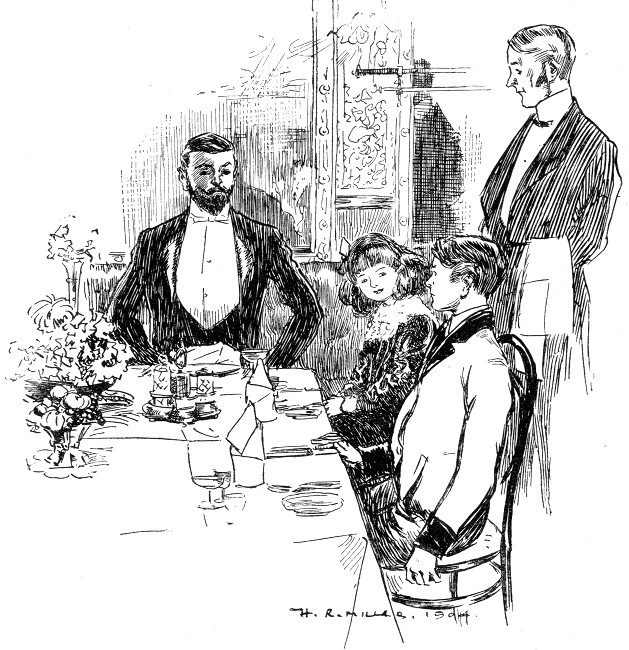
"ROBERT HAD TO PRETEND TO BE COLD."
Robert had to pretend to be cold at the glittering, many-mirrored restaurant where they all had dinner, with father in evening dress, with a very shiny white shirt-front, and mother looking lovely in her grey evening dress, that changes into pink and green when she moves. Robert pretended that he was too cold to take off his great-coat, and so sat sweltering through what would otherwise have been a most thrilling meal. He felt that he was a blot on the smart beauty of the family, and he hoped the Phœnix knew what he was suffering for its sake. Of course, we are all pleased to suffer for the sake of others, but we like them to know it—unless we are the very best and noblest kind of people, and Robert was just ordinary.
Father was full of jokes and fun, and everyone laughed all the time, even with their mouths full, which is not manners. Robert thought father would not have been quite so funny about his keeping his overcoat on if father had known all the truth. And there Robert was probably right.
When dinner was finished to the last grape and the last paddle in the finger-glasses—for it was a really truly grown-up dinner—the children were taken to the theatre, guided to a box close to the stage, and left. Father's parting words were:—
"Now, don't you stir out of this box, whatever you do. I shall be back before the end of the play. Be good and you will be happy. Is this zone torrid enough for the abandonment of great-coats, Bobs? No? Well, then, I should say you were sickening for something—mumps or measles, or thrush or teething. Good-bye."
He went, and Robert was at last able to remove his coat, mop his perspiring brow, and release the crushed and dishevelled Phœnix. Robert had to arrange his damp hair at the looking-glass at the back of the box, and the Phœnix had to preen its disordered feathers for some time before either of them was fit to be seen.
They were very, very early. When the lights went up fully the Phœnix, balancing itself on the gilded back of a chair, swayed in ecstasy.
"How fair a scene is this!" it murmured; "how far fairer than my temple! Or have I guessed aright? Have you brought me hither to lift up my head with emotions of joyous surprise? Tell me, my Robert, is it not that this, this is my true temple, and the other was but a humble shrine frequented by outcasts?"
"I don't know about outcasts," said Robert, "but you can call this your temple if you like. Hush! the music is beginning."
I am not going to tell you about the play. As I said before, one can't tell everything, and no doubt you saw "The Water Babies" yourselves. If you did not it was a shame, or rather a pity.
What I must tell you is that, though Cyril and Jane and Robert and Anthea enjoyed it as much as any children possibly could, the pleasure of the Phœnix was far, far greater than theirs.
"This is indeed my temple," it said, again and again. "What radiant rites! And all to do honour to me!"
The songs in the play it took to be hymns in its honour. The choruses were choric songs in its praise. The electric lights, it said, were magic torches lighted for its sake, and it was so charmed with the footlights that the children could hardly persuade it to sit still. But when the limelight was shown it could contain its approval no longer. It flapped its golden wings, and cried in a voice that could be heard all over the theatre:—
"Well done, my servants! Ye have my favour and my countenance!"
Little Tom on the stage stopped short in what he was saying. A deep breath was drawn by hundreds of lungs, every eye in the house turned to the box where the luckless children cringed, and most people hissed, or said "Shish!" or "Turn them out!"
Then the play went on, and an attendant presently came to the box and spoke wrathfully.
"It wasn't us, indeed it wasn't," said Anthea, earnestly; "it was the bird."
The man said well, then, they must keep their bird quiet.
"Disturbing everyone like this," he said.
"It won't do it again," said Robert, glancing imploringly at the golden bird; "I'm sure it won't."
"You have my leave to depart," said the Phœnix, gently.
"Well, he is a beauty, and no mistake," said the attendant, "only I'd cover him up during the acts. It upsets the performance."
And he went.
"Don't speak again, there's a dear," said Anthea; "you wouldn't like to interfere with your own temple, would you?"
So now the Phœnix was quiet, but it kept whispering to the children. It wanted to know why there was no altar, no fire, no incense, and became so excited and fretful and tiresome that four at least of the party of five wished deeply that it had been left at home.
What happened next was entirely the fault of the Phœnix. It was not in the least the fault of the theatre people, and no one could ever understand afterwards how it did happen. No one, that is, except the guilty bird itself and the four children. The Phœnix was balancing itself on the gilt back of the chair, swaying backwards and forwards and up and down, as you may see your own domestic parrot do. I mean the grey one with the red tail. All eyes were on the stage, where the lobster was delighting the audience with that gem of a song, "If you can't walk straight, walk sideways!" when the Phœnix murmured warmly:—
"No altar, no fire, no incense!" and then, before any of the children could even begin to think of stopping it, it spread its bright wings and swept round the theatre, brushing its gleaming feathers against delicate hangings and gilded wood-work.
It seemed to have made but one circular wing-sweep, such as you may see a gull make over grey water on a stormy day. Next moment it was perched again on the chair-back—and all round the theatre, where it had passed, little sparks shone like tinsel seeds, then little smoke wreaths curled up like growing plants—little flames opened like flower-buds.
People whispered—then people shrieked.
"Fire! Fire!" The curtain went down—the lights went up.
"Fire!" cried everyone, and made for the doors.
"A magnificent idea!" said the Phœnix, complacently. "An enormous altar—fire supplied free of charge. Doesn't the incense smell delicious?" The only smell was the stifling smell of smoke, of burning silk, or scorching varnish.
The little flames had opened now into great flame-flowers. The people in the theatre were shouting and pressing towards the doors.
"Oh, how could you!" cried Jane. "Let's get out."
"Father said stay here," said Anthea, very pale, and trying to speak in her ordinary voice.
"He didn't mean stay and be roasted," said Robert; "no boys on burning decks for me, thank you."
"Not much," said Cyril, and he opened the door of the box.
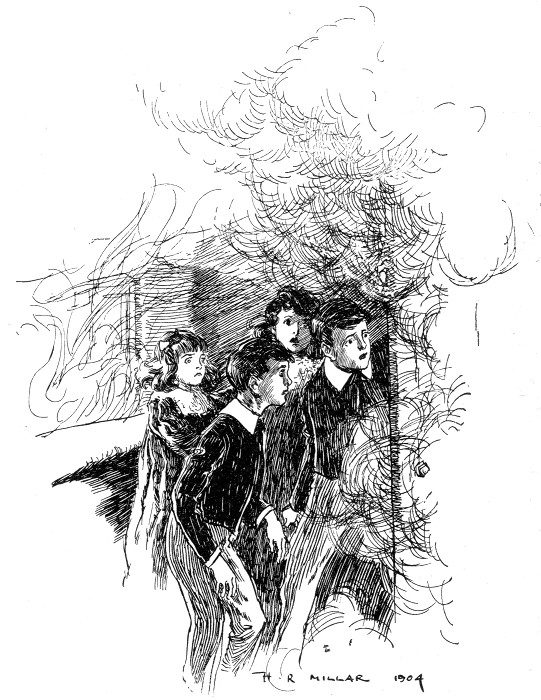
"HE OPENED THE DOOR OF THE BOX."
But a fierce waft of smoke and hot air made him shut it again. It was not possible to get out that way.
They looked over the front of the box. Could they climb down?
It would be possible, certainly, but would they be much better off?
"Look at the people," moaned Anthea; "we couldn't get through." And, indeed, the crowd round the doors looked thick as flies in the jam-making season.
"I wish we'd never seen the Phœnix," cried Jane.
Even at that awful moment Robert looked round to see if the bird had overheard a speech which, however natural, was hardly polite or grateful.
The Phœnix was gone.
"Look here," said Cyril, "I've read about fires in papers; I'm sure it's all right. Let's wait here, as father said."
"We can't do anything else," said Anthea, bitterly.
"Look here," said Robert, "I'm not frightened—no, I'm not. The Phœnix has never been a skunk yet, and I'm certain it'll see us through somehow. I believe in the Phœnix!"
"The Phœnix thanks you, O Robert," said a golden voice at his feet, and there was the Phœnix itself, on the Wishing Carpet.
"Quick!" it said, "stand on those portions of the carpet which are truly antique and authentic—and——"
A sudden jet of flame stopped its words. Alas! the Phœnix had unconsciously warmed to its subject, and in the unintentional heat of the moment had set fire to the paraffin with which that morning the children had anointed the carpet. It burned merrily. The children tried in vain to stamp it out. They had to stand back and let it burn itself out. When the paraffin had burned away it was found that it had taken with it all the darns of Scotch heather-mixture fingering. Only the fabric of the old carpet was left—and that was full of holes.
"Come," said the Phœnix, "I'm cool now."
The four children got on to what was left of the carpet. Very careful they were not to leave a leg or a hand hanging over one of the holes. It was very hot—the theatre was a pit of fire. Everyone else had got out.
Jane had to sit on Anthea's lap.
"Home!" said Cyril, and instantly the cool draught from under the nursery door played upon their legs as they sat. They were all on the carpet still, and the carpet was lying in its proper place on the nursery floor, as calm and unmoved as though it had never been to the theatre or taken part in a fire in its life.
Four long breaths of deep relief were instantly breathed. The draught which they had never liked before was for the moment quite pleasant. And they were safe. And everyone else was safe. The theatre had been quite empty when they left. Everyone was sure of that.
They presently found themselves all talking at once. Somehow none of their adventures had given them so much to talk about. None other had seemed so real.
"Did you notice——?" they said, and "Do you remember——?"
When suddenly Anthea's face turned pale under the dirt which it had collected on it during the fire.
"Oh," she cried, "mother and father! Oh, how awful! They'll think we're burned to cinders. Oh, let's go this minute and tell them we aren't."
"We should only miss them," said the sensible Cyril.
"Well—you go, then," said Anthea, "or I will. Only do wash your face first. Mother will be sure to think you are burnt to a cinder if she sees you as black as that. Mother, she'll faint or be ill or something. Oh, I wish we'd never got to know that Phœnix."
"Hush!" said Robert; "it's no use being rude to the bird. I suppose it can't help its nature. Perhaps we'd better wash too. Now I come to think of it my hands are rather——"
No one had noticed the Phœnix since it had bidden them to step on the carpet. And no one noticed that no one had noticed.
All were partially clean, and Cyril was just plunging into his great-coat to go and look for his parents—he, and not unjustly, called it looking for a needle in a bundle of hay—when the sound of father's latchkey in the front door sent everyone bounding up the stairs.
"Are you all safe?" cried mother's voice; "are you all safe?" and the next moment she was kneeling on the linoleum of the hall, trying to kiss four damp children at once, and laughing and crying by turns, while father stood looking on and saying he was blessed or something.
"But how did you guess we'd come home?" said Cyril, later, when everyone was calm enough for talking.
"Well, it was rather a rum thing. We heard the Garrick was on fire and, of course, we went straight there," said father, briskly. "We couldn't find you, of course—and we couldn't get in—but the firemen told us everyone was safely out. And then I heard a voice at my ear say, 'Cyril, Anthea, Robert, and Jane'—and something touched me on the shoulder. It was a great yellow pigeon, and it got in the way of my seeing who'd spoken. It fluttered off, and then someone said in the other ear, 'They're safe at home'; and when I turned again, to see who it was speaking, hanged if there wasn't that confounded pigeon on my other shoulder. Dazed by the fire, I suppose. Your mother said it was the voice of——"
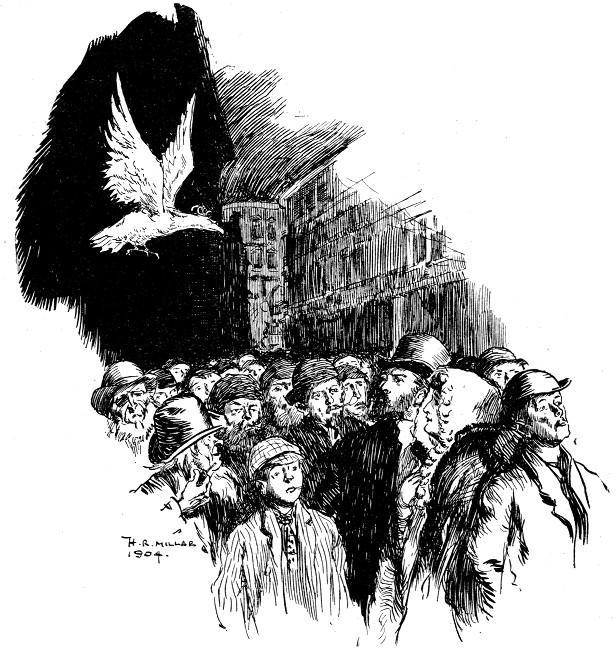
"IT WAS A GREAT YELLOW PIGEON."
"I said it was the bird that spoke," said mother, "and so it was. Or at least I thought so then. It wasn't a pigeon. It was an orange-coloured cockatoo. I don't care who it was that spoke. It was true—and you're safe."
Mother began to cry again, and father said bed was a good place after the pleasures of the stage.
So everyone went there.
Robert had a talk to the Phœnix that night.
"Oh, very well," said the bird, when Robert had said what he felt, "didn't you know that I had power over fire? Do not distress yourself. I, like my high priests in Lombard Street, can undo the work of flames. Kindly open the casement."
It flew out.
That was why the papers said, next day, that the fire at the theatre had done less damage than had been anticipated. As a matter of fact, it had done none, for the Phœnix spent the night in putting things straight. How the management accounted for this, and how many of the theatre officials still believe that they were mad on that night, will never be known.
Next day mother saw the burnt holes in the carpet.
"It caught where it was paraffiny," said Anthea.
"I must get rid of that carpet at once," said mother.
But what the children said in sad whispers to each other, as they pondered over last night's events, was:—
"We must get rid of that Phœnix."
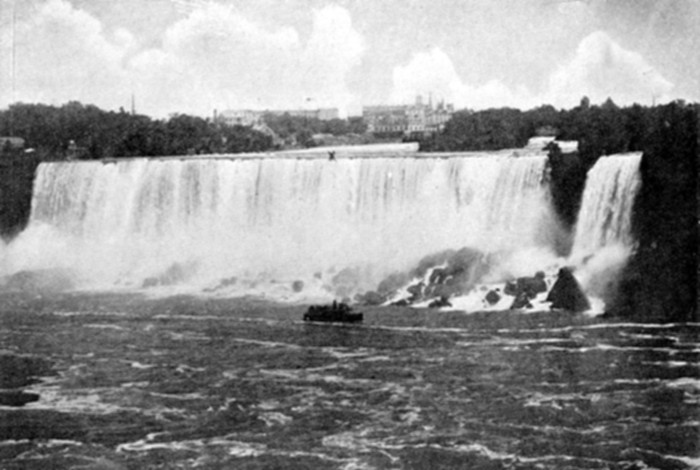
NIAGARA FALLS—THE POINT MARKED X SHOWS THE SPOT REACHED BY GUIDE BARLOW AND SUPERINTENDENT PERRY.
From a Photo.