The Red Counter.
Reading edition
By L. J. BEESTON.
I.
étérin gathered up from the table the papers which his captain pushed toward him. He said, moodily:—
"I am surprised at you. We shall all be killed while you are making love here. You may be very emotional, but you will have to tell that to the German advanced guard."
Nicolas La Hire rose and took his sabre from a chair in this, the best room of the auberge. He was commanding a scattered remnant of cuirassiers who were shadowed by a Prussian force. It was his intention to join the main body, but not only were there many obstacles in the way, but he had fallen very desperately in love with Rachel Nay, the sweetest and prettiest girl in Orgemont. He replied—by no means offended by the familiarity of his officer, for whom he had the greatest friendship:—
"You are needlessly alarmed. Besides, love speaks louder than a bugle-call."
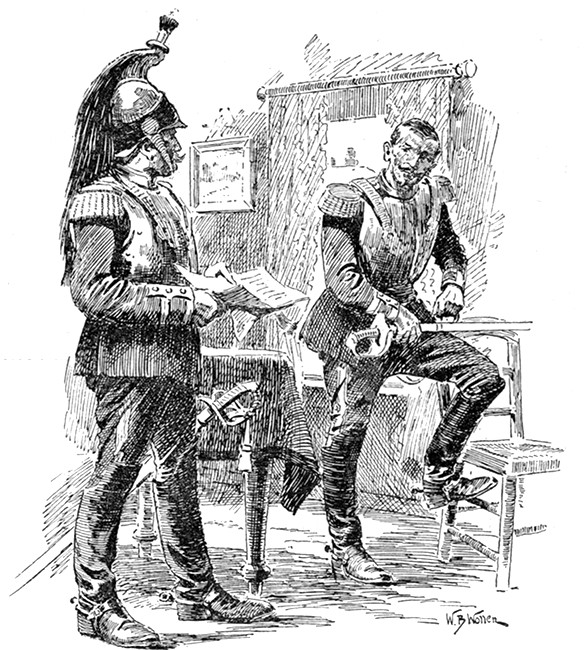
"LOVE SPEAKS LOUDER THAN A BUGLE-CALL."
"But not so loud as a bomb, and that is what we shall get very soon. I am not afraid—I; but there is a time for making love and a time for making war. Then, consider your family. A farmer's pretty daughter is no match for a La Hire. And in any case you will not get her, for she is promised to that rascal Simon Mansart, who lives in the château on the hill yonder"; and Vétérin pointed through the unshuttered window, across the village, where the cottages bore a covering of snow, and the frozen road, to where a clump of acacias crowned an eminence.
"That is what troubles me," answered La Hire, beginning to pace the room. "If she is married to that man, whom she detests and fears—to that miser, that creature——!" he broke off suddenly, then continued: "It is a burning shame that this pure girl, this sweet Rachel, this wild-flower——!"
"Oh, come," interrupted Vétérin, shrugging his shoulders contemptuously, "if you are going to dilate in that strain——"
"Silence!" shouted La Hire; "you go too far." He muttered, in an undertone, "I cannot leave her, loving her as I do, loving me as she does, for I greatly fear that this vulture Mansart will be too strong for me when I am gone."
"Then visit him," said Vétérin. "Have you not a sword to threaten with? Better still, have you not gold to offer? That will persuade him, if anything can."
La Hire thought for a moment; then he said, "That is not at all a bad idea. I will go now.... We will leave to-night. You will give the word. Laporte is moving on Besançon, which is in a state of siege. We really ought to join him three leagues from here, if only these confounded Prussians will let us alone." He went out, murmuring, "I must see Rachel before I go."
"You hear what I say, Monsieur Mansart?" thundered La Hire.
Simon did not reply, nor did his eyes fail before the stern gaze of the captain of cuirassiers. A crafty smile touched the corners of his thin lips, and he stroked with either hand the heads of two immense mastiffs that crouched on the floor by his side.
"Mademoiselle Rachel Nay does not need your attentions. You will not molest or annoy her in any way. Your gold, which, if report says true, you have spent your life in wringing from whom you can, cannot buy a woman's heart, and hers is pledged to me."
Simon smiled still more craftily. He knew that his parsimony had made him notorious; he knew that the widow and the fatherless had little cause to love him. His heart had shrunk in the grip of his miserly instincts. But he was not afraid as he answered:—
"I shall take my own course, monsieur. Who are you to dictate to me? I care not for your clanking spurs, your fierce looks. I have influence with Mademoiselle Rachel's parents, who are very poor, and I shall use it to the uttermost. I pit my gold against your handsome face and swaggering manner. We will see who will win."
"Listen!" said Nicolas, in a voice hoarse with anger. "I will descend to make terms with you, though, mon Dieu! there is little reason why I should. Since money is as vital breath to you, I offer you five thousand francs if you will withdraw your suit."
"I refuse."
"Ten thousand, then?"
Mansart laughed and snapped his dry fingers.
"Come, I offer you fifteen thousand francs, and not a sou further will I go."
Simon was visibly moved, and his hands rested nervously upon the heads of his great curs; but he controlled the rising temptation and answered, bitterly:—
"It is clear that you fear me or you would not make such overtures. I decline your offer."
"Think well! I will never yield this girl."
"That is unfortunate, for I certainly intend to win her."
"Be careful!" said La Hire, in such a terrible voice that the mastiffs growled and bared their teeth.
And instinctively, though he meant nothing, his hand groped at the hilt of his sabre.
Mansart half rose from his chair. "You forget my dogs," he snarled.
"And you forget the Prussians, who cannot be far off," replied the other; and when he perceived that the warning had a distinct effect he followed up his advantage. "You will have to take care of yourself here, monsieur, and yet greater care of your gold. I warn you that a Prussian force is shadowing us, so that they will almost certainly take this direction, if that is comforting for you to know."
Mansart turned pale.
"And as they have a couple of field-pieces, you may expect a display, by Jove!"
He had scarcely spoken the words when a deep sound, a heavy thud, which appeared to come from a long distance, startled him.
"Malediction! A gun!" exclaimed the captain.
He had scarcely spoken when a second and much sharper report sounded. The shell had burst. Faint shouting came from below in the village.
"The 'Blues' have come after all," said La Hire, and he went out.
Looking northward he saw a tiny cloud drifting across the stars. It was the smoke from the cannon which had been discharged. In that direction a ridge broke the flatness of the fields, that were buried under a sheet of ice. He muttered to himself:—
"They are there, on the escarpment. They will put a few shells into the village and turn us out, and we must retreat—as usual. I do not care if I can withdraw them from Orgemont." His eyes grew tender; he was thinking of Rachel.
"Are they here—these Germans?" asked a fearful voice at his elbow.
Mansart also had quitted the house. That note of war, which was the first he had ever heard, had terrified him.
"You may be sure of it," said the other, laughing. "And it is to be hoped that you have some good things in your larder, for if these Prussians visit you you will find that they have the stomachs of wolves."
A bugle sounded.
"They will be expecting me," murmured La Hire.
It was frightfully cold. The air, like the earth, seemed frozen, biting the lungs and making it difficult to breathe. The swaying branches of the trees in the garden appeared to be trying to obtain a little warmth by the exercise. The final crescent of the moon had risen, and her pale gleam upon the fields seemed to have become petrified also with the cold, and permanent.
La Hire had no sooner made up his mind to move than a red flame glowed on the summit of the escarpment, and passed. It was quickly followed by a second heavy thud—the report of a six-pounder field-gun. A bright light appeared upon the sky, moving swiftly.
Something uttered a wail; something rushed amongst the acacia trees in the garden, flinging down branches and tearing up earth. There was a splitting report, sheeted flame, a terrible cry.
The night closed down as before, scarcely disturbed by that burst of passion.
La Hire relaxed his grip of the garden soil. He lifted his face, which was covered with earth.
"Ciel! I thought I was done for," he muttered.
He rose from the prostrate position into which he had flung himself, and looked around with eyes that were still dazed by the explosion.
"Simon—Simon Mansart! Are you still alive?" he called.
A loud burst of derisive laughter came from one of the lower windows of the house.
"Go! The Prussians are waiting for you!" cried Mansart.
La Hire shrugged his shoulders, then stepped briskly from the garden to where an orderly waited with his horse.
And as he rode away he felt his love swell and rise in his heart, and a mad longing to see Rachel once more gripped him; to feel on his lips the soft touch of her lips, and round his neck the clinging fingers once clasped there. And this wave of passion that ran through his veins seemed to unstring his nerves, weaken his purpose, and cast a mist of love over his courage.
He found Vétérin waiting impatiently for his appearance; and he led his men south*-ward, tempting the Prussians and drawing them from the village.
II.
Weeks passed. The battles with the Germans, that were scarring the land and so many hearts, only threatened Orgemont.
Now Simon Mansart lay very ill, and it was said that he was dying. At a late hour that night Rachel received a letter. It was from Mansart, and ran as follows:—
"Rachel,—I am very ill, and have but a few more hours to live. Will you wed me, dying? This is a strange request; but if for one brief hour I might call you wife it should not make you sad, and it would give me happiness.... I have a considerable sum of money with me in this house, which represents the greater part of my fortune. I am anxious that you should possess this when I am gone. I have papers drawn up making over to you the whole of this sum. Only your signature is needed and all becomes yours, even while I live. I would have it so, fearing that you might say, 'If he should not die after all!' In any case you will be rich. But have no fears; I am sinking, and can scarcely hold this pen. Rachel, you have scorned my offer of marriage; at any rate you cannot scorn me now. Let me call you wife; let me hold your hand for my final but sweetest hour.—Simon Mansart."
Old Joseph Nay, when this letter was read to him, slapped his shrunken thighs. "And I wished, when you were born, that you had been a boy!" cried he. "What a piece of fortune this is! At last I hope you will show some sense. Quick, and get ready. I will take you round in the cart. It is a frightful night, but one does not get a fortune every day on such terms. Then one must respect the request of a man who is dying." And he went out, adding to himself, "We are so poor that this is nothing less than a godsend."
Rachel had turned very pale. She had greatly feared Mansart living; now, at his last moments, he still threatened her peace. Seeing marriage only in the holy light it has for lovers, she shrank from this thing.
A month passed.
One day the hamlet was thrown into a state of excitement.
A horseman came dashing bravely up the rough, snow covered road. He was a splendid figure. He wore a steel helmet with streaming plumes, a glittering cuirass, red breeches, and immense boots to his knees. A sabre leaped at his side, and foam flew from the red jaws of his magnificent horse. His bronzed face carried a formidable scar, that added to the fierceness of his appearance. He reined in his charger with a most telling effect.
"Where is Mademoiselle Rachel Nay?" he demanded.
They brought her to him. He sprang off his horse, removed his helmet, which he placed in the bend of his left arm, and bowed with gallantry, while his eyes showed his appreciation of the girl's beauty. He was Philippe Vétérin.
"I have come for you, mademoiselle," said he, trying to soften his voice, that had been roughened in the war.
The blood crept from Rachel's cheeks.
"And with a message from Nicolas La Hire, who is my friend. He is wounded—ah! pardon my stupidness, I am too abrupt; the hurt is not much, but enough to prevent his coming for you. Mon Dieu!—do not look so frightened, my pretty one; I have the best of news—news to bring the blood again to those smooth cheeks. Listen! We ambushed a whole host of Prussians, and we cut them to pieces. La Hire was equal to any two of us. The colonel vowed he would give him whatever he asked for. 'Then send,' said Nicolas, 'to Orgemont, which is three leagues from here, and fetch my sweetheart to me, that I may kiss her lips.'
"We cheered him, mademoiselle, for it appealed to our hearts and made us think of the women whose love is ours, and who are waiting for us. 'It shall be done,' said the colonel, 'and you shall wed her, La Hire, if that be your present wish. Then she can return to her parents to wait for you until we have finished the war.'
"This is my errand, pretty one. I have come to fetch you. Ah! you are paler than before. Courage! You shall have such a wedding that every woman in France shall envy you. The church bells will peal while our sentries guard the roads, the guns will salute you, and each breast that a cuirass hides will swell with the cheers that we shall give you. My sword, why am I not Nicolas La Hire! "
Rachel tried to speak, but there was such a weight upon her heart that the words she would have uttered stopped in her throat. At length she said, faintly: "I—I cannot go: it is impossible."
The trooper laughed outright. "Pardonnez moi," he cried, "I said that I have come for you, and without you I dare not return, or I should be compelled to fight my regiment, one by one. Mademoiselle, you will obtain a horse, and you will accompany me; that is as certain as my name is Philippe Vétérin." He twisted his moustache, and a flash almost of menace sparkled in his black eyes.
They were without old Joseph's cottage as they spoke, and Rachel drew Vétérin in, closing the door against the little crowd of villagers, who turned their attention to the trooper's charger. She said, in a heart-broken voice:—
"Nevertheless, I cannot accompany you. I am married already; I am another man's wife."
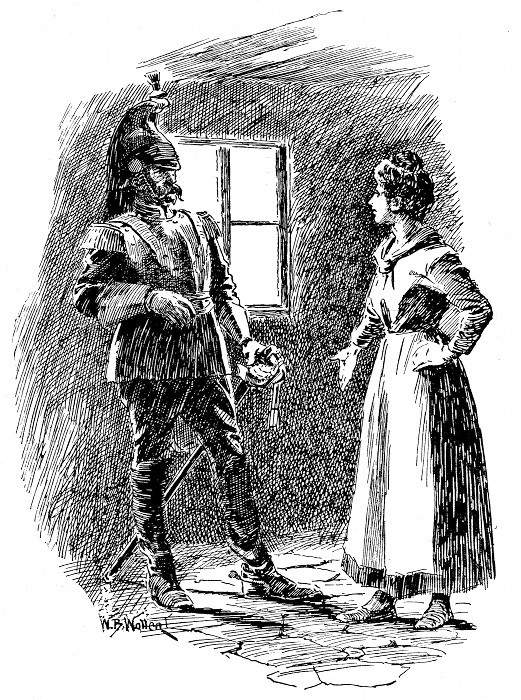
"I AM MARRIED ALREADY."
The trooper gave back a step; then he laughed harshly—a contemptuous laugh.
"Oh, oh!" said he, shrugging his shoulders, "that is a different matter. All the same, it is bad, bad news for La Hire," and he moved toward the door.
"Stay!" said the girl, flushing hotly at his derisive tone. "I have a message in return for yours. Will you tell Nicolas that, though he must come no more to Orgemont, though he must not see me again, I am wife in name only. Maiden I am still, before God, and, for Nicolas's sake, shall always remain so. You will tell him, monsieur, that he had been gone but a few weeks when Simon Mansart——"
"Ah!" interrupted Vétérin, "I have heard about him."
"——when Simon Mansart fell ill. At the point of death (so it seemed to all of us) he besought me to wed him, for he loves me almost as much as he loves his gold. And he offered me in return all his money that is hid in his house. I refused. It was pointed out to me that Monsieur Mansart had no one to whom to leave the wealth which he had accumulated, but he asked nothing better than to leave it to me if I would grant him one brief hour in which to call me wife, that, holding my hand, he might pass the last great barrier. I refused again. Then they made it clear to me that certain papers only wanted my signature, and even while Monsieur Mansart lived his wealth became mine—so certain was he that he could not recover. Again I declined this offer. I was told that I should hold sacred the prayer of one who loved me and was dying; that it would not be only right, but an act of nobleness to render his end peaceful and happy. Still I refused."
"Ah! Yet you yielded!" sighed Vétérin, moved to his heart by a tear that was trickling down one of the soft brown cheeks.
"For my parents' sake. They had their way at last. They are very poor; the war has tried us greatly. Against my heart, against my conscience, I said 'yes.' That night I signed the papers and was wedded to Monsieur Mansart; that night he held my hand as I sat by his couch, and he looked into my eyes with a terrible gaze of love."
"And he lived? My sword! I could swear he was not so ill as he said. The cunning rascal!"
"It was God's will. I have not seen him since then, and will not.... You will tell Nicolas all this, monsieur; and you will give him these papers and ask him to destroy them, lest he should say, 'Rachel married this man for the money.' I thought at first that I would send them back to Monsieur Mansart, for you may be sure I shall not touch this money that has come between Nicolas and me. And you will tell him that he must not grieve for me, because I am not worthy of his remembrance."
"And I shall tell him that you love him still. Is it not so, mademoiselle?" said Vétérin, huskily.
"Yes, yes!" Rachel answered, struggling with her rising tears. She caught the trooper by the arm, clasping his great muscles with her two hands, and her breath fanned his face. "Tell him that—that I love him as much as—as I despise myself; that my heart, which I gave to him, must always be his; that all my thoughts are of him, are with him wherever he goes. And you may tell him, monsieur, if you like, that my heart is breaking—no, no; you must not say that! He would come to see me, and he must not. Oh, mon Dieu!"
The clinging fingers tightened round the soldier's arm; the voice broke off into a sob. Vétérin's eyes were wet. He blinked fiercely.
"Take him my message. Tell him all this. But you cannot, wanting my voice and my eyes, in which he used to read every thought. Yet you will remember how I looked and what I said. And you will tell Nicolas that I love him as he taught me to, that without him all the world has grown dark, and that I shall love him until I die!"
The trooper caught her to him, for he felt that she was falling. Rachel controlled herself by a strong effort, and she pushed him gently toward the door. Vétérin turned to give one last look at that supplicating figure, with the dishevelled hair in sweet confusion about the tear-stained face; then he went out. He muttered, in a voice that he might not have known as his own:
Peste! It seems to me that this Simon Mansart is very much in the way!"
III.
On the evening of that day Simon Mansart was sitting alone before a handful of fire when he heard his big dogs barking with anger. As the disturbance continued he went to the door, and he thought he perceived without, in the black night, a blacker shadow beyond the gate.
"Will you call off your lambs?" shouted a voice.
"Who are you? And what do you want?" cried Mansart, always terribly suspicious of strangers, and especially those who arrived after dusk.
"You do not know me, but I have come on your business."
"Then you will come again when it is daylight, my friend," and he began to close the door.
"Very well," was the immediate reply. "I am determined to see you now, and if your dogs attempt to stop me they must take the consequences."
Simon laughed incredulously; but when he heard the iron gate scream on its rusty hinges, and when he heard the growls of the dogs, he exclaimed, vehemently, "Take care! You will be torn to pieces!"
"I shall at least kill one of your dogs first," was the determined reply.
"Stop! I will call them off," said Mansart, who would never have yielded had he the smallest doubt of the other's resolution. He whistled his great curs off; but he was sorry that he had done so when he perceived his visitor, who was a French trooper, swaggering and fierce, and who could have crushed Mansart in his strong arms.
"May I come in?" said he, and he advanced so persistently that the other was compelled to retreat before him. He closed the door and stood before it—tall, erect, commanding.
"Your errand, monsieur?" demanded Simon, trembling with rage, yet afraid.
"How dark it is in here! And what a little fire for so cold a night!"
"We do not need light to talk by, and I am warm enough."
"And poor enough. Is it not so? It is about that that I have come."
Mansart grew more polite. He had signed away a fortune to a girl who loathed him. When peace should come the courts would make good her claim. So that any overture, any compromise, was welcome.
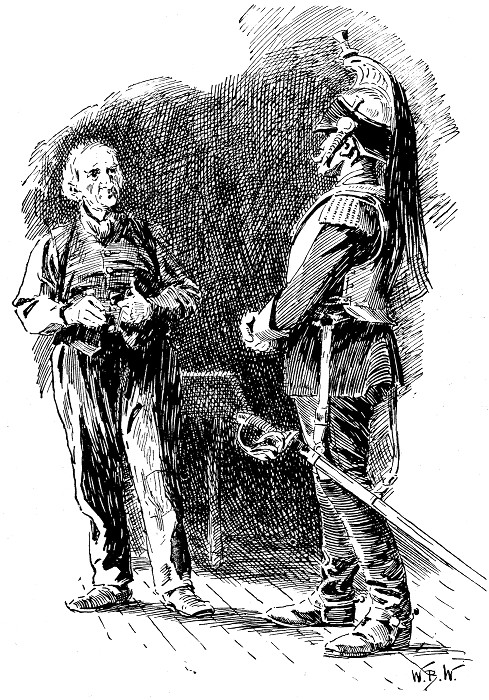
"MY NAME IS PHILLIPE VÉTÉRIN," SAID THE CUIRASSIER.
"My name is Philippe Vétérin," said the cuirassier, folding his arms with their gauntleted hands, and fixing a stern look upon Mansart. "Captain Nicolas La Hire is my friend."
"And my enemy," muttered Simon, his deep-set eyes flashing.
"I have come to Orgemot on his behalf."
"Ah! Is he wounded?"
"He is."
Mansart rubbed his hands together.
"But not badly. Unless you are going to listen to me, I think it likely that La Hire will pay you a visit one of these days."
Simon sank uneasily into his chair. "What has this to do with me?" he demanded. "And how is it that you are here?"
Vétérin went on steadily. "I am here with a message for Mademoiselle Rachel Nay, that sweet girl——"
"That name is hers no longer. Also you will keep your compliments until I ask for them," interrupted the other, savagely.
"You are her husband; that is true enough. To you I bear a message also. Yet I can scarcely call it that, since what I am about to propose to you is entirely an idea of my own, and which I should like to mention in the interests of my friend Monsieur Nicolas La Hire. It is of a most unusual nature. Here it is. Rachel married you believing that you were at Death's door. But the door wouldn't open. Good for you, bad for her, bad for Nicolas, whom she loves. Now, La Hire loves this girl; she is as indispensable to his happiness as your money is to yours. Mark that."
There was a pause. Then Mansart said, "What do you mean?"
"That I have come to offer to restore to you these papers, which represent the fortune which you have bestowed upon your wife. Ah! not so quick. There is one condition attached. You must release this girl."
A terrible light of joy leaped into Simon's face, but it died away instantly. "The thing is impossible," he said. "She is my wife; we were lawfully wedded, remember. How, then, can I release her? How can she be wedded to another?"
"Yet La Hire has sworn that only as her husband will he kiss the lips of his love again."
"But, monsieur, how can it be? See for yourself!"
Vétérin continued, imperturbably:—
"Certainly, if I restore to you these papers, which I am sure you would be glad to get back, that would scarcely break the bond between you and Rachel; yet I am about to yield them to you. It follows, then, that you will still call her your wife and enjoy your own as well? I am afraid that it does, but there is an 'if' in the case; for though I am perfectly willing to give you these papers, yet it is just possible that they may cost you your life."
"My life!"
"Precisely."
Mansart crouched back. "You are threatening me?" said he, hoarsely.
"By no means. Look here."
Vétérin advanced to the table, upon which he emptied a handful of small counters. "There are thirteen of them," he said. "You will perceive that twelve of them are white and that the other is red. Will you count them?"
"Oh, I take your word for it."
"Yet you had better count for yourself. That is right. And now I will tell you my idea, which is so unusual and so dramatic that I rather pride myself upon it. I throw these ivory discs into my helmet and cover them with a handkerchief—so. And I ask you, if you are a man of courage, to raise one corner of the handkerchief and take out a single counter. If it be a white one—as is almost certain to be the case—I hand you the papers in my possession and I wish you good-night, enjoyment of your hoarded gold, and happiness with Rachel. But if it be the solitary red one—and that is extremely unlikely—then—then—if it be the red one, I say——"
The cuirassier broke off and regarded the other steadily. Mansart had turned livid. "Go on," he said, in a shaking voice; "why do you stop? If I should draw the red one—what then?"
Vétérin shrugged his shoulders as he answered, "In that case I should ask you to fight with me."
"Ah! you would murder me!" said Simon, recoiling.
"Pardon, I have two pistols here. It would be fair fighting."
"It is horrible, monstrous! I will not listen to you."
"Almost as terrible as wedding a maid whose soul has been given to another; almost as monstrous as coming eternally between two hearts that beat for each other," was the stern response.
"I tell you that I will not hear of it," repeated Mansart, frantically.
"Then you will be a great fool. I wish I stood in your shoes. The chances of life are twelve; of death, one. And even then it will be fair fighting—though, by my sword, I shall do my best to kill you. Consider. But a moment separates you from your wealth. Come, it might have been over and forgotten by now."
"Monsieur, if you are a gentleman, if you entertain toward me no sinister intent, you will leave my house at once."
"Very well, I will go," said Vétérin, and he moved toward the door. He opened it and was about to pass out when the querulous voice of Simon called to him again.
"Well?"
"The chances in my favour are not sufficient."
"What a coward it is!"
"Add six more to the number and I will agree."
The trooper laughed and tossed half-a-dozen more of the white discs into his helmet. "There you are," he said. "Take one; you are perfectly safe."
"Shake them well together," whispered Mansart, who appeared to be almost fainting with the excitement of this terrible gamble.
Then he put his hand under the handkerchief and into the steel casque. He withdrew it slowly. The trooper snatched away his helmet to prevent any trick, and Simon looked at the disc which his fingers held.
It was the red one!
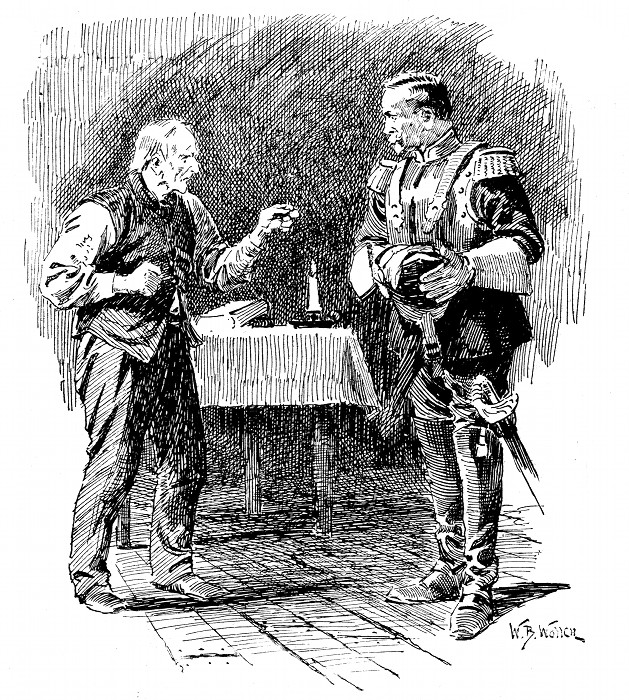
"HE REMAINED GAZING FIXEDLY AT THAT SYMBOL OF DEATH."
And he began to mutter; inarticulate words, such as one may use under the spell of some strangling dream. He remained gazing fixedly at that symbol of death. A rush of blood mounted to his forehead, swelling the veins, then as quickly died away, leaving him pallid.
"Ah!" said Vétérin, "how unfortunate for you!"
Mansart retreated a few steps, crouching back like a wild beast that has received a wound, which simulates an approaching end, and which holds its remaining strength together waiting for its destroyer to draw near.
"You must acknowledge that it does not look like chance," went on Vétérin, who was cool as ice. "Eighteen to one! Ma foi, it is astonishing." He placed two pistols upon the table.
"Come, monsieur," he exclaimed, suddenly, in a hard, rasping voice. "You will play the man, will you not?"
Mansart appeared unable to reply; perhaps he could not. His look was steadily directed upon the trooper, whose slightest movement he observed with the most intense anxiety.
Vétérin examined the pistols, while he threw more than one furtive glance at the other's passionless face. He pushed a pistol toward Simon. "I think you had better defend yourself," he said. "I am going to hold you to your word," and he stepped back, raising his own weapon.
"Stop!" exclaimed Mansart, in a choked voice. "We do not fight on equal terms."
"What do you mean?"
"You are skilled in the use of your weapon, while I——"
"That is easily remedied." Vétérin suddenly extinguished the candle. He called out, "Take care! I shall fire at the first opportunity."
A nebulous red glow came from the nearly-burned log in the grate and shone upon the farther side of the apartment. Both men had retreated into the shadow; both waited.
There was a profound silence, broken occasionally by whispering sounds from the log that pulsated, red and grey, as the draught fanned it. Vétérin was scarcely breathing; his straining eyes peered into the dark, seeking to detect the form of Simon Mansart. He listened intently. Not the faintest sound was audible. Suddenly he believed that he perceived a black object but a few feet from him. Surely that was Mansart.
The cuirassier lifted his pistol and aimed at the centre of that indistinct form; yet his finger did not press the trigger. Instead he gradually lowered the weapon.
"What is the matter with my nerves?" he thought.
He remained standing in a rigid posture, undecided. "Why not?" he asked himself again. "It is fair fighting. Ma foi, I have done worse things."
Another minute passed. Vétérin sighed deeply. "I cannot do it," he muttered; "not even for you, Nicolas." Then he called out aloud:—
"Light the candle; I shall do you no harm."
No answer.
"You need not fear me," repeated the trooper.
Still no reply.
"If I move he will shoot at me," thought Vétérin. Nevertheless, he advanced in the direction of the table and groped about for the candlestick. He found it, went to the fire, and held the coarse wick against the log. All the time he did not remove his eyes for an instant from that black something which he believed to be Mansart. The candle smoked, glowed, then broke into a flame. The trooper had made a mistake; he perceived that the shadowy object was a chair merely.
Vétérin spun round, expecting a pistol-ball and extending his weapon. A low cry escaped him at the sight which met his eyes.
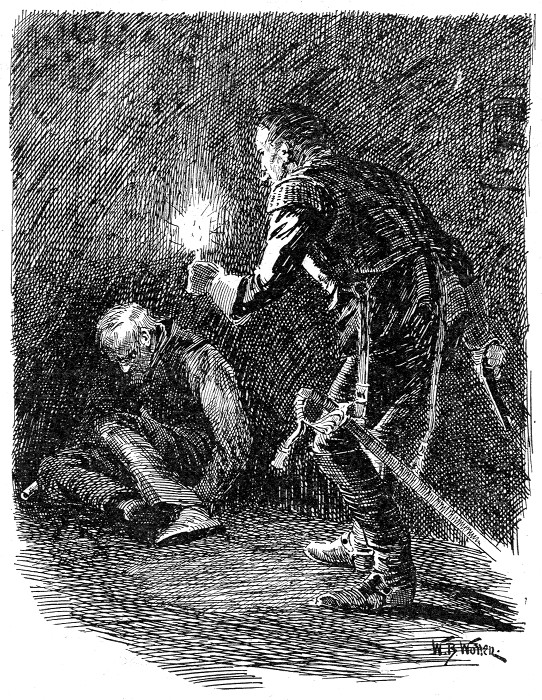
"A LOW CRY ESCAPED HIM AT THE SIGHT WHICH MET HIS EYES."
Simon Mansart, crouched in an angle of the room, held with dead fingers his undischarged pistol, looked with dead eyes at the flaring light. The excitement of the gamble and terror of this unfought duel had stopped his heart.
Vétérin crossed himself. "God judge me! I did it for Nicolas's sake," he said. He crossed to the grate and pushed some papers into the embers.
And all at once there came upon him a sudden fear which sent him running from the house. The sharp air and a strong effort of self-control gave him his wits again. For a moment he halted to look back at the château, with its unlighted windows and dead aspect; and he said aloud, as if concluding an unspoken thought:—
"——and they will be married when the war is over."
A MEETING OF THE PORTSMOUTH NAVAL WAR GAME SOCIETY IN THE NELSON ROOM AT THE "GEORGE", PORTSMOUTH.