A Doubtful Case.
Reading edition
By Mrs. Egerton Eastwick (Pleydell North).

HEN, in the year 189-, a weakness of the throat prevented me from preaching for a time, I had considerable difficulty in persuading Allan Fortescue to take my place in the pulpit.
He had been amongst us rather more than two years; and although an ordained priest in the Church of England, and a man of considerable ability, was without preferment, and, apparently, content to remain so.
How came it, I often wondered, that he stayed on in our quiet village, with no apparent interest or occupation in life beyond his garden and his books?
Nor, when he at length consented to my proposal and preached his first sermon in Stony Lea, was my perplexity lessened. His diction was that of a classical scholar, but his words were also the outpouring of a sensitive, warm-hearted man; I could have fancied that in these impersonal utterances he sought compensation for years of enforced silence and isolation.
He had attracted me from the first. Manly, genial, but strangely reserved, Sir Lewin Maxwell and myself were, I believe, the only visitors who had gained admittance to his cottage.
When I so far induced him to change his habits as to help me with my weekly sermons Sir Lewin Maxwell was abroad. He had left Stony Lea for the Riviera in November, and now, early in May, the fact of his marriage had just been announced. No particulars, however, concerning the bride had reached us, and the appearance of the newly-married couple at the Hall was looked for with much interest and curiosity. They did not come until June, and then, by the express desire of Sir Lewin, were met by no demonstration of any kind; indeed, no one, I believe, except the steward and myself knew the exact date or hour at which they were to be expected.
On the Sunday following their arrival, therefore, glances were turned with some eagerness towards the Hall pew, but it was occupied only by a stout, elderly lady, who could not assuredly be Sir Lewin's newly-married wife.
No sooner, on that day, had Allan Fortescue in due course mounted the pulpit than I became aware of something amiss. From my position in the chancel I could not see his face, but the pause which preceded his announcement of a text was just long enough to cause uneasiness, and his voice, when at length he broke the silence, was harsh and unnatural, although, when once fairly started, he spoke with even more than his usual fervour.
When I reached the sacristy after the service Fortescue had already left, and as I was preparing to follow him I was accosted by the lady whom I had seen in the squire's pew.
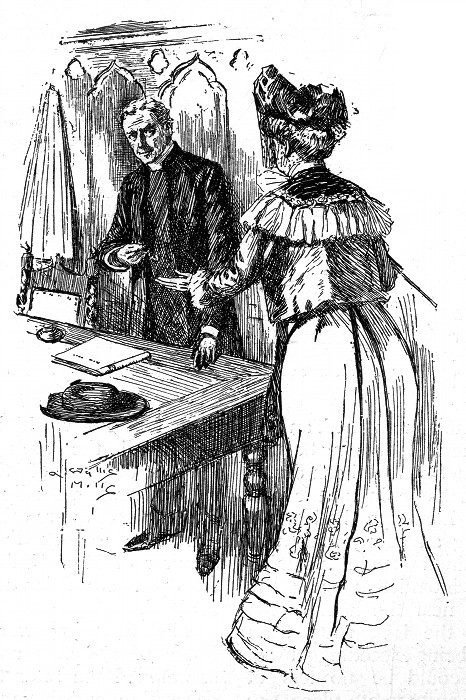
"SHE TURNED TO ME AND INQUIRED WHETHER I WAS AWARE OF THE TRUE CHARACTER OF THE MAN."
My visitor's comely, good-tempered face was flushed with heat and nervous indignation. After abruptly closing the sacristy door upon the two of us she turned to me and inquired whether I was aware of the true character of the man I had admitted to my pulpit, adding that it was with the greatest difficulty she had refrained from walking out of the church.
Somewhat startled, I asked for further explanation, whereupon she gave me, at considerable length, the particulars I will here try to relate as concisely as possible.
It seemed that about five years previously Allan Fortescue had been engaged as resident tutor to Mrs. Llewellyn's only son, and in that capacity had accompanied the family to Llidisfarn, a solitary, old-fashioned place in Wales. The house was occupied for the greater part of the year by a gardener and his wife as caretakers; but during the residence of their mistress these people retired to their own cottage. Mrs. Llewellyn brought with her two old and faithful servants—both women. Her party further included her niece and ward, Edith Graham, now Sir Lewin Maxwell's wife. The evening of her arrival Mrs. Llewellyn retired early to her room and to bed. The latter was an antiquated four-poster; the canopy had been removed for the sake of air, but the curtains remained, and on the night in question, the weather being boisterous and the room draughty, had been drawn so as to have only a small opening at the foot. Before retiring Mrs. Llewellyn had taken from her travelling-bag an ebony and silver casket which contained some valuable diamonds. She had intended placing the casket in an iron safe near the head of the bed, but had found the lock rusty from disuse; consequently, being exceedingly tired, and believing there could be no fear of burglars in this quiet and remote place, she left the casket on the dressing-table.
The dressing-table faced the door of the room, and to cross from one to the other it was necessary to pass the foot of the bed.
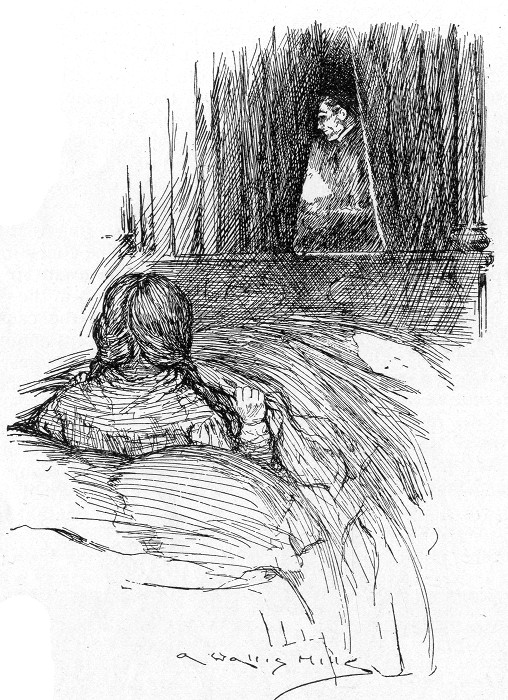
"A FIGURE CARRYING A SMALL READING-LAMP PASSED THE APERTURE."
In the dead of the night Mrs. Llewellyn awoke, feeling sure that someone was stirring in the room, and, as she became more fully conscious, saw on the ceiling above her a dim reflection of light. Almost at the same moment a figure carrying a small reading-lamp passed the aperture between the curtains at the foot of the bed, going towards the door, and she recognised, to her amazement, the tutor, Allan Fortescue. She described herself as being too surprised and terrified to call out; it seemed but a moment before the door was closed and she was in darkness and alone. Then she struck a light, sprang from the bed, and went to the dressing-table. The ebony casket was gone. Even then she gave no alarm. Except her son and Allan Fortescue, only women were in the house; and she reflected that it would be safer and wiser to wait until the morning. That the thief should dispose of the diamonds during the night was virtually impossible. Also the circumstances were otherwise peculiar. Allan Fortescue was at that time the avowed admirer of Miss Graham, and for her sake an open scandal was, if possible, to be avoided.
The following morning, however, after hours of sleepless anxiety, Mrs. Llewellyn summoned the tutor to the study, made her accusation, and demanded the return of her property.
He did not attempt either to explain or deny his presence in her room during the night, but appeared to treat the idea of theft as a ludicrous jest, and stoutly maintained that the jewels were not in his possession. During the altercation which followed Miss Graham entered, and Fortescue at once explained the situation.
Apparently to his surprise, Miss Graham took the affair very seriously, and seemed to feel that the evidence against him was overwhelming. She pleaded, however, so piteously that for her sake he might be spared from public disgrace that Mrs. Llewellyn finally consented to allow him to leave the house, upon the understanding that he should seek no further intercourse with any member of the family, and that he should never again undertake the duties either of a clergyman or a tutor. Under these circumstances he at last seemed to realize the seriousness of his position; he went away that morning, maintaining towards the end an obstinate silence. The most rigorous search, made at his own request, among his possessions failed to reveal the diamonds, which, indeed, had never since been heard of.
I also gathered that, although made fully aware of the penalty to be incurred by any breach of the conditions named, he had steadily refused to bind himself as to his future.
That afternoon, as soon as I was at leisure, I walked down to Allan Fortescue's cottage.
Shocked and distressed as I was at the story, I felt many points in it needed clearing up, and was inwardly assured that, if he would, he had the power to explain the whole matter satisfactorily.
He opened the door himself.
"I know," he said, abruptly, before I could speak, "why you have come. Mrs. Llewellyn was with you this morning; I saw her rustling up towards the sacristy. Don't let charity bring you any farther."
I signed to him to let me come in.
"We can't talk on the doorstep," I said. "Of course, it is all a mistake."
He let me come to the study; then, as he closed the door behind me, he said:—
"There is no mistake. I was there—in her room that night. She saw me."
"You were not there to take the diamonds," I persisted.
"I was not there to steal the diamonds; I will own so much."
"In that case, who did steal them, if stolen they were? No pains should have been spared at the time to discover the actual thief. Even now it might not be too late, if you would only account for your presence in the room."
"The actual thief——" He began restlessly to pace the floor. "What if I were to say that I took the diamonds—with my own hands?"
"I should answer that you must have been in some way unconscious of your actions."
My confidence seemed to touch him; he looked at me, and for a moment I hoped I was to gain some enlightenment; then he said, slowly:—
"I was never in my life more completely master of myself. And now there must be an end of my confessions."
I saw that to question him further would be useless, and shortly afterwards took my leave. As we parted he grasped my extended hand.
"I owe you an apology," he said, "for having brought this annoyance upon you, and I don't know how to thank you for your patience with me."
A few days later an invitation reached me to dine at the Hall. Any intercourse between Allan Fortescue and Sir Lewin Maxwell had inevitably ceased. Sir Lewin, not unnaturally, accepted Mrs. Llewellyn's view of the case, but he did not quarrel with me for taking my own line, and young Lady Maxwell seemed almost grateful for my belief in the possible innocence of her old lover. She was a most charming woman, with an habitually sweet and gracious manner, rendered only more attractive, I at first thought, by a variableness of mood which brought suggestion of possible storms.
An accomplished musician, her talent made a link between us. Often, indeed, during the earlier part of our intercourse she became associated in my mind with the harmonies of Beethoven, whose creations she rendered with remarkable skill and feeling. Later, however, I noticed an increase of nervous restlessness, an expression in her eyes as of some haunting, eager desire, little in keeping with the works of the master, which, however full of variety, are to my mind always instinct with a great satisfaction and repose.
For some time I was inclined to attribute these signs of disturbance to the neighbourhood of Allan Fortescue, and to think that he would have done well to leave the village. But, so far as I could see, he studiously avoided all chance of encounter with any of the Hall party; and, without definite reason, I had not the heart to suggest that he should become once more a wanderer.
In this way some few months passed without noticeable event. Sir Lewin, I thought, at times looked careworn and more aged than the passage of months would justify, but he seemed, if possible, more entirely devoted to his wife than in the earlier days of their marriage. Then, one Monday afternoon early in April, as I was riding homewards from visiting an outlying district, a curious thing happened.
My way led me through Oxley Dell, a piece of road bordered on each side by Sir Lewin's woods, through which to the right a bridle-path leads by a short cut to Stony Lea. The path and immediate neighbourhood are but little frequented, owing to an old story of a murder and a subsequent ghost.
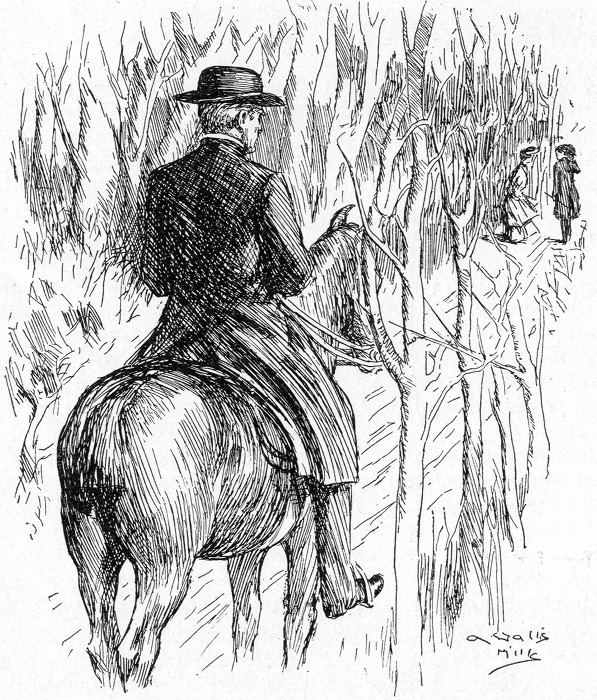
"A WOMAN SUDDENLY APPEARED FROM AMONG THE TREES."
As I neared the Dell I saw Allan Fortescue tramping along the road in front of me, but before I could overtake him he turned aside into the bridle-path. There I presently followed, and had him once more in view, when a woman suddenly appeared from among the trees and accosted him. Allan raised his hat, and the two walked on together; the meeting had the air of an appointment.
Having no wish to play the spy I turned my pony's head, but I was ill at ease. The tall, graceful figure of the woman, enveloped though it was in a long rain-coat, had been ominously familiar, and as I jogged slowly homewards I resolved that I would call that evening on Allan and have the matter out with him.
I found him in better spirits than usual, but when I explained my errand he seemed somewhat disconcerted.
"Ah! you saw us," he said, and bent to knock the ashes from his pipe; then added, "You are sure, I suppose, of the identity of the lady? "
"As sure as it is possible to be without having seen her face to face."
"Still, you might be utterly mistaken. Would it not be better, for the sake of—the lady chiefly concerned in your mind—to give her the benefit of the doubt?"
His eyes met mine fully, I answered question with question.
"Do you think you are dealing fairly with me? Strictly speaking, perhaps this is no affair of mine, and yet——"
"And yet you have been extraordinarily good to me, and deserve that I should be open with you. I can only ask you to trust me a little farther; to believe that the meeting you witnessed to-day cannot possibly injure the lady you are thinking of except through your interference, and that it was as far removed from being of a sentimental nature as though I had met my grandmother."
The Friday following this interview I received a visit from the squire; he looked ill and harassed.
"I am vexed," he said, "about Edith. She went to town for a day's shopping on Wednesday and has not returned. She was to lunch with Mrs. Llewellyn and come back for dinner. She has frequently made these little excursions of late. In the evening, however, I got a telegram to say she was detained by the dressmaker, and yesterday morning a letter to the same effect. This morning I had no letter, but half an hour ago I met General Anson—he had just arrived by the three o'clock train. He told me that he had seen Edith having lunch at Franconi's with Fortescue. They did not see him—his table was behind theirs—but as he left the room he passed close to them and heard Fortescue say, 'To-night, then, without fail, by the seven-thirty.' 'So,' the old man went on, 'I suppose Lady Maxwell comes down to-night, and Mr. Fortescue is to escort her. I thought there was a coolness—that he was under a cloud.' I laughed, and told him it was a case of mistaken identity."
"And Fortescue?"
"He went to London yesterday; I happen to know that."
I must here mention that Stony Lea, although but a small village in Kent, has a good train service, and is but an hour's run from town. I looked at my watch. It was barely four o'clock. "Why not," I said, "go up to town by the four-forty-five, and travel down yourself with Lady Maxwell when she is prepared to come? You could be in Belgrave Road before six o'clock."
"Will you come with me?" he asked.
I consented; and by 6.30 we were in Belgrave Road.
Mrs. Llewellyn's house had an empty, uninhabited air, and the servant who came to the door said his mistress had been out of town for a few days. Lady Maxwell had been staying there during the week. She had driven out in the morning and not returned until four o'clock; then, after a cup of tea, she had gone out again, walking; she had said she was leaving town that evening, and would return about half-past six in a cab for various parcels that were awaiting her.
"Quite so," Sir Lewin said; "she is travelling down with me. I will wait for her here," and he walked straight into the drawing-room, whither I followed him. The room opened into the hall. Presently a hansom drove up; Lady Maxwell got out and entered the house with a latch-key. Sir Lewin moved towards the door of the room as though intending to meet her, when the arrival of another cab made him pause and look round. Lady Maxwell ran lightly upstairs; the door was ajar and I heard the swish-swish of her skirts. The second cab was a four-wheeler; Fortescue descended from it, and the electric bell of the front door tingled persistently in the silence of the house. Then we heard him asking for Lady Maxwell, and almost before the servant could reply Sir Lewin was on the doorstep. Fearful of what might ensue I followed him from the room; I saw him touch Fortescue on the shoulder, and Allan's start of surprise and, apparently, dismay; then the two men entered the hall together.
"Now," said Sir Lewin, "kindly explain your presence here and your business with my wife."
Allan's answer was unexpected.
"I think," he said, quietly, "I will leave that to Lady Maxwell herself."
They had spoken so far in low tones and with outward calm; now Sir Lewin muttered angrily some words which I could not hear, and raised his arm.
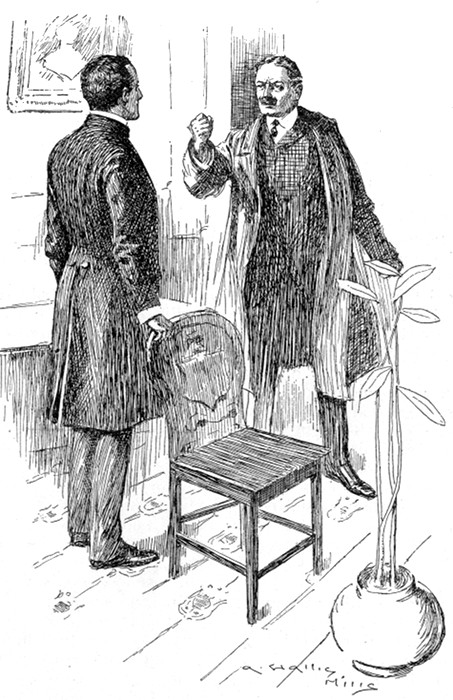
"SIR LEWIN MUTTERED ANGRILY SOME WORDS WHICH I COULD NOT HEAR, AND RAISED HIS ARM."
I stepped forward.
"Come into the drawing-room," I said hurriedly in his ear. "Don't make a public scene."
He shook me off, but at that moment another and more importunate voice intervened.
"My dear Lewin, you here? How exceedingly fortunate! Now we need not rush for that seven-thirty train; you and dear Edith can stay to dinner."
There was a darkening of the doorway, a rustle of garments, and Mrs. Llewellyn advanced with outstretched hands.
Sir Lewin stared in blank amazement. Allan smiled.
"I was in the cab," went on the lady, "waiting for Edith. Mr. Fortescue kindly drove with me from the station, and I had intended to travel down with her, trusting, my dear Lewin, to your hospitality to put me up for the night. I am so sorry I have been unable to return before, to be with the dear child all the time."
She had talked us all to the drawing-room door.
"I still quite fail to see," began Sir Lewin, stiffly, "how Mr. Fortescue——"
"I will explain," said Lady Maxwell. She had come down the stairs unheard, and now advanced towards us. Her face was as white as the gown she wore, her eyes looked wild and startled. "Come with me," she added to Sir Lewin, and led the way to a small back room. He followed her without a word.
"Pay the cab," said Mrs. Llewellyn, cheerfully, to the servant, "and bring all those packages in. Sir Lewin and Lady Maxwell will remain to dinner. Mr. Greyling and Mr. Fortescue, please come in, and let me offer you some refreshment."
She moved towards the dining-room and, the door being safely closed, fell gasping into a chair. There was wine upon the side-board; Allan poured some into a glass and brought it to her. She sighed heavily as she took it. "How all this is to end, Heaven only knows!"
"I think," said Allan, "there is nothing further for me to do. If you will allow me I will bid you good-night."
She looked at him curiously, the wineglass half-way to her lips.
"Can you," she said, "trust your vindication to us?"
"Entirely. It has come to be the last thing I think about," he answered, sadly; "and, if she may in any degree be spared, I beg that it may be the very last thing in your mind also."
A few minutes later Allan and I left the house. We dined in town and travelled back to Stony Lea together; but he offered me no explanation of the events of the afternoon, and I respected his silence.
Nearly a week passed before I heard anything further about the matter.
Then, one morning, Sir Lewin called upon me; he and Lady Maxwell had returned only the previous night from town. He made no reference to the circumstances of our last meeting, but asked me to come to the Hall that afternoon, as his wife was far from well, and anxious to see me.
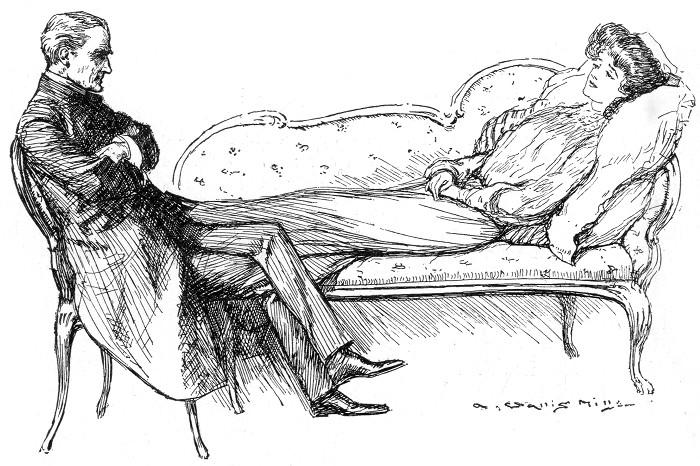
I went accordingly and found her alone, lying upon a couch in her morning-room and looking sadly, terribly changed.
"I have asked you to come," she said, when I had taken a seat beside her, "because I want to tell you the truth about Allan Fortescue; he has suffered all these years through my fault, and I must make what reparation I can before—— It was I who really had the diamonds; I wanted them, and I employed him to bring me the casket; he did this quite innocently, as you will hear, not knowing what it contained. I had seen it on the dressing-table when I went to say good-night to my aunt just after she had gone to bed—about nine o'clock; but I was equally afraid either to take it then or to return to the room in the dark later on. Yet the chance seemed too good to be lost; I had never seen the casket left exposed before; it was always kept under lock and key. On my way downstairs I met Allan Fortescue, and we went together to the drawing-room. As we sat chatting by the fire, the plan I afterwards carried out occurred to me. The talk turned upon ghosts, and he said he should much like to meet one. Then I told him, truly, that one room in the house was said to be haunted by the spirit of a lady who had died there mysteriously on her return from a ball at which she had promised her lover to elope with him. I explained that nothing had been disturbed since the morning she was found there, dead in her chair before the mirror; but instead of the room to which the story really attached I described the one I had just left, and dared him to visit it after midnight. He said he had no fear, but I added that I should not believe in his courage unless he brought me as a proof a small ebony casket which had always stood upon the dressing-table. He laughed and said he would do even that, and I promised to meet him in the conservatory the following morning before breakfast to receive it and hear his experiences. He was quite strange to the house and did not know how any of the bedrooms were occupied except his own and his pupil's, which were in another wing. In the morning he handed me the casket as arranged. You know the rest; you see he was helpless in my hands."
"Do you mean to tell me," I asked, "that you wrecked a man's life for a few jewels?"
"'DON'T JUDGE ME TOO HARDLY,' SHE SAID, PITEOUSLY."
"Don't judge me too hardly," she said, piteously. "I was in terrible straits. I had been staying with some of my father's relations in town, and had learned much of a side of life concerning which Aunt Mary knew practically nothing. I owed a great deal of money, and was afraid to tell her about it. When I had the diamonds I was able to put off the most threatening of my creditors with promises of payment, and, later, one of my cousins helped me to dispose of the stones. I told him they were some jewels of my mother's which had just been made over to me. Aunt Mary would hold no intercourse with my father's family, so I had no fear of awkward explanations. When I was twenty-one I came in for a little money, all that was left of my mother's fortune, and I gave Aunt Mary some fresh jewels. You see, I had inherited certain tendencies from my father—perhaps in the beginning there was some excuse for me; you will understand when I say that he died from a hurt received in a gambling quarrel when I was about twelve years old. The house and all he possessed were sold to pay his debts, and Aunt Mary took charge of me. It was a great change. To me at all events my father had been good always, and I loved him dearly.
"As to Allan Fortescue, when he found how I had tricked him he was furious, but I managed to see him alone and persuaded him to accept the situation. You see, I had contrived things so that his speaking would have been of very little use unless I had chosen to confess—only his word against mine. Of course, I was dreadfully upset when I found that Aunt Mary had seen him. That was just what I had not counted upon; but I couldn't go back then and give up the jewels—I couldn't. I promised him that, if he would keep silence, I would never be reckless and extravagant or wicked again; and for a long time I kept my word. But life was dreadfully dull, and the thought of what I had done made me wretched; if Allan had been prosecuted I don't think I could have borne it—I must have spoken out. As it was, I became subject to dreadful fits of depression, and I think Aunt Mary was very glad to get me safely married, as she called it. For a time, then, I was very happy; for I loved Lewin dearly, and I tried to forget. Then, finding Allan here, seeing the wreck I had made of his life, brought back to me all my trouble. I began to crave again for excitement of any sort. Lewin thought I was ill, and at first used to give me champagne as a tonic.
"When we were in town last year I got back into the old set, from a different standpoint, and with more money at command——"
Once more she stopped, but I would not again interrupt her; I felt that the whole sad story must be finished now.
"I don't know," she continued, presently, "how Allan Fortescue discovered what was going on, but he did. One day I received a communication from him—I can't call it a letter—telling me that he knew the sort of life I was leading, and that unless I kept my promise to him he would speak and tell Lewin the truth even now. He knew and could prove where I had sold the diamonds. In reply to that I induced him to meet me in the Oxley Woods, and persuaded him to give me a little more time. I promised to tell Lewin that very night about my debts. Instead, I went to London. I really meant to start afresh; but I thought I could raise some money and get fairly straight without saying anything to my husband. I—I stayed longer than I meant. Allan came to look for me. He followed me to the places where he thought I was likely to be—he must have kept a watch upon me for some time past—but our meeting at last was accidental. I was really at my wits' end, and I went into Franconi's with Allan to talk things over. We saw General Anson leave the place, and I think that made Allan decide there must be no more concealment; also, I suppose he felt it was useless to trust me any longer. He went straight from me to Aunt Mary and fetched her. She knew that he must be speaking the truth. I had promised to go home that night anyhow; but I don't know what I might have done if I had been left to myself. Then you and Lewin appeared—— It is better as it is—I should never have had the strength, the courage—I am so sorry—so sorry—for Lewin—for myself—for Allan—for my little child that is coming——"
She turned her face to the wall, and I saw her slight frame shiver with voiceless, choking tears.
There is little more to tell. Lady Maxwell lived only a few months after she had made this confession. Her child survived—a son—and there are three men who watch over that boy with perhaps exaggerated solicitude and love—his father, Allan Fortescue, and myself.
Will he reward our care? I think so. He has his mother's face and charm, but in character he takes after Sir Lewin. Allan Fortescue has remained in the village as my curate. I trust he may never leave me, and that the bishop may see fit hereafter to appoint him vicar in my stead; I am growing old.