Curiosities
Reading edition
Copyright, 1904, by George Newnes, Limited.
[We shall be glad to receive Contributions to this section, and to pay for such as are accepted.]
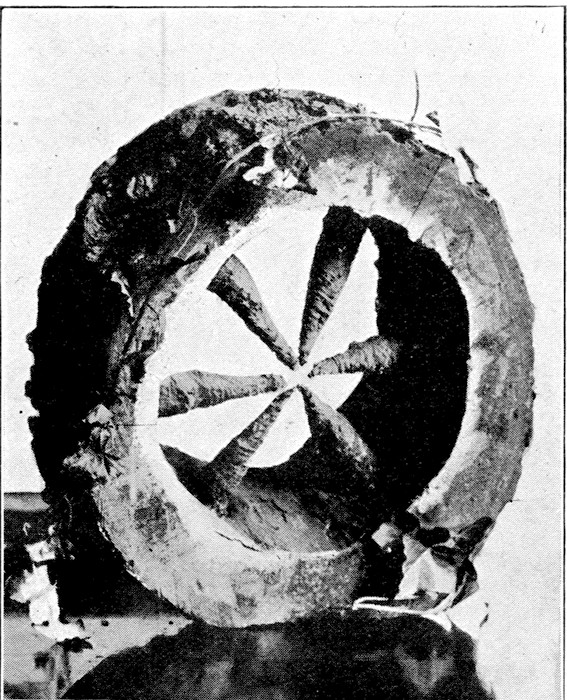
A WHEEL—OR WHAT?
"This is a cross-section of a white pine tree about twenty-eight inches in diameter. What appear to be carrots sticking through the sides are the knots caused by the branches, which, owing to their resinous nature, have not decayed, while the wood which formerly surrounded them has rotted away."—Mr. A. S. Angell, care of Times Printing and Publishing Co., Victoria, B.C.
A HOMEMADE BICYCLE.
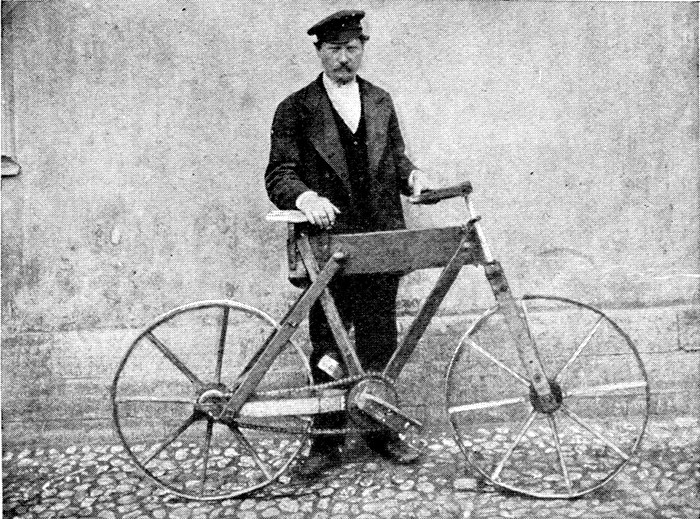
This photograph, taken in Russia by a Blackburn contributor, is of an extraordinary bicycle and its ingenious maker, a Russian peasant, who at the time was employed as a mill watchman in St. Petersburg. The frame of the bicycle is mainly made out of broomsticks, the wheels consist of barrel hoops and wooden spokes, the cranks are of wood, and bobbins form the principal part of the pedals; the front forks are likewise of wood, working inside a ten-inch "slubbing bobbin"; the saddle (movable) is cut out of an ordinary piece of wood, the back of a disused arm-chair does duty as handle-bars, and the chain was taken off an old "flat-card" machine. It only remains to add that this curiosity is not a mere exhibit, for a friend of the gentleman who supplies the photo. rode it more than once, though he never accomplished anything in the way of record-breaking on the wooden "bike."
SWALLOWED BY AN OSTRICH.
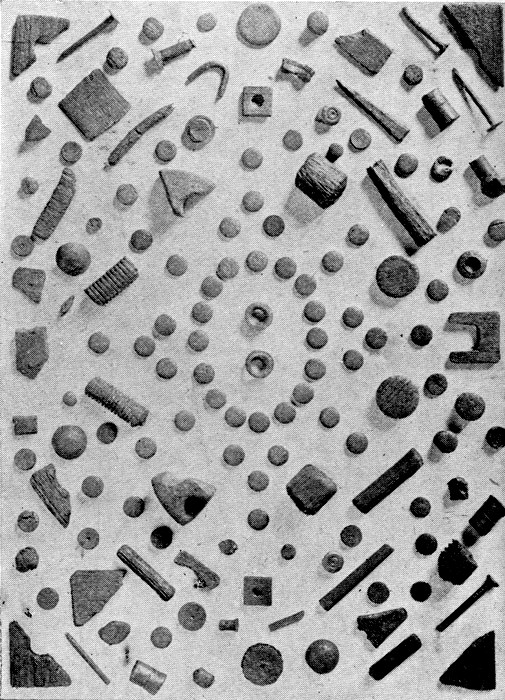
"I send you a photo. of the contents of a tame ostrich's stomach, which you will not be surprised to hear was the cause of its death. All these pieces of metal were picked up by it around the blacksmith's shop of a farm in South America. The circle of round pieces in the centre is made up of 3/8 in. punch pellets from a punching machine, and will give an idea of the size of the rest of the metal. All these pieces were more or less worn, according to the time they had been swallowed; some had almost disappeared. The total weight of iron was considerable."—Mr. E. Windus, Erin Manor, Burgess Hill, Sussex.
PECULIAR MUSICAL INSTRUMENTS
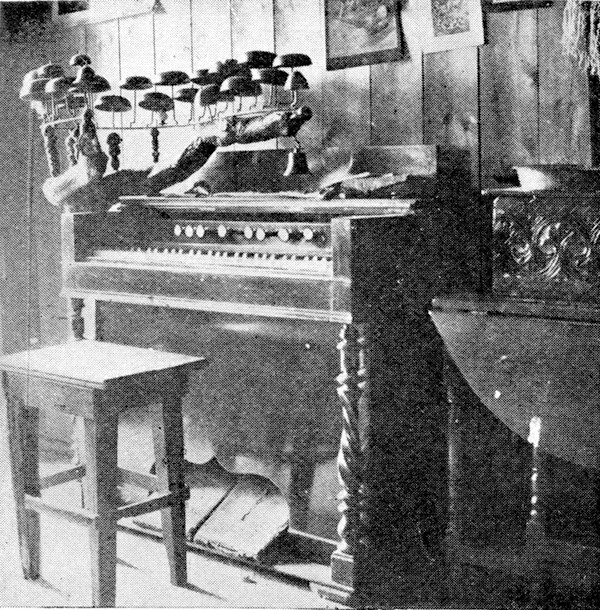
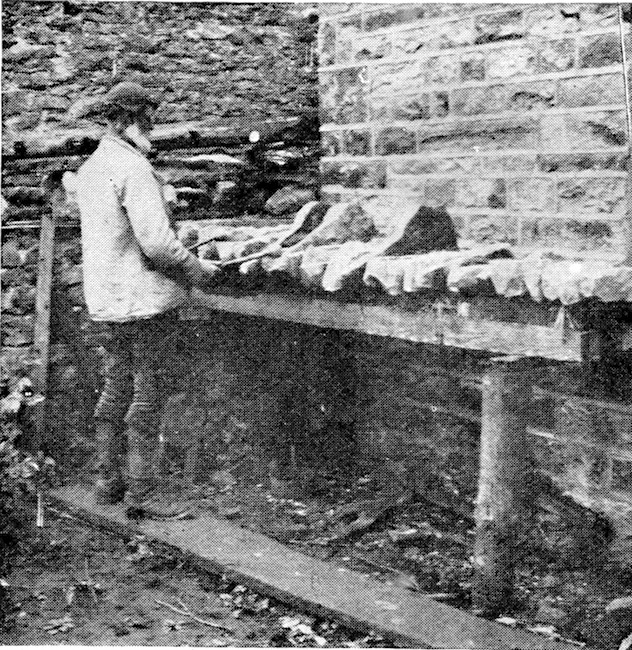
"The accompanying photos. are of two musical instruments which, with their inventor, can be found at an obscure little hamlet called Keld, about twenty miles from Richmond in Yorkshire. No. 1 is an adaptation to a harmonium, and consists of the branch of a tree fastened to the end of the harmonium; upon the branch is a double row of bells which come from all parts of England. When playing, the musician has a long piece of wood ending in a steel spike, and at the lower end of the wood is a finger-hole. The striker is slipped upon one of the fingers of the left hand, and as the treble and bass are being played the finger with the striker upon it is bent in order to strike one of the bells. No. 2 is what the inventor calls 'a stone organ.' The old man said that one day when fishing in the river his foot caught a stone and he noticed that it gave forth a musical note, so he constructed a sounding-board, secured stones from the river, and placed them thereon. He found that clipping a piece off the end of the stone sharpened the note, whilst to clip off the side flattened it; in this way he made three octaves. The old man has never had any lessons in music."—Mr. G. Hardwick, The Promenade, Bridlington.
SAVED BY A CARTRIDGE.
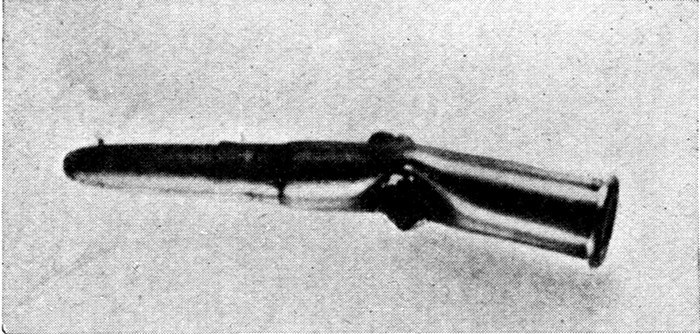
"Here is the photograph of a cartridge which has been pierced by a bullet. My brother, of the 6th Dragoon Guards, was carrying this in his bandolier when he was wounded in the late South African War. The bullet after piercing the cartridge passed clean through his body, leaving in the centre of his back after penetrating one of his lungs. Fortunately it did not touch the spinal cord, owing probably to being deviated by the cartridge, and he recovered. The cartridge did not explode, and has still the explosive in it intact."—Mr. F. W. Robins, 14, Wellington Road, Barnsbury, N.
A DIVING TOWER ON DRY LAND.
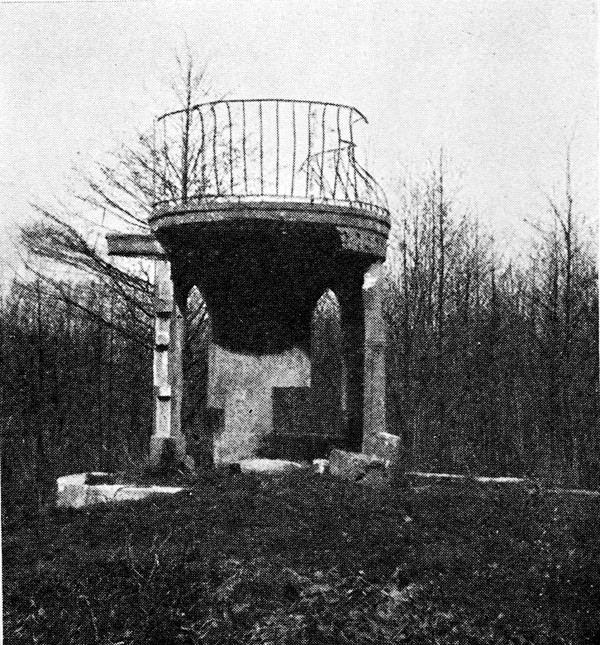
"I send you a photo. of a curious structure which stands not very far from the Lake of Neuchâtel. It would be difficult for anyone unacquainted with its history to give a name to it, for its appearance and position furnish absolutely no clue as to its use. It is, as a matter of fact, a diving tower, built many years ago for the use of bathers in the Lake of Neuchâtel. The peculiar part about it is that anyone desirous of diving from it nowadays would have to fly horizontally over a railway, a road, and a good three hundred yards of dry land before reaching the water, for, the lake having gradually receded, the tower has been left high and dry, about a quarter of a mile from the edge of the water. As may be seen from the photo., it is now in a very tumble-down condition."—Mr. J. O. S. Ziegler, Place Bel Air, Yverdon, Switzerland.
A POSTAL MARROW.
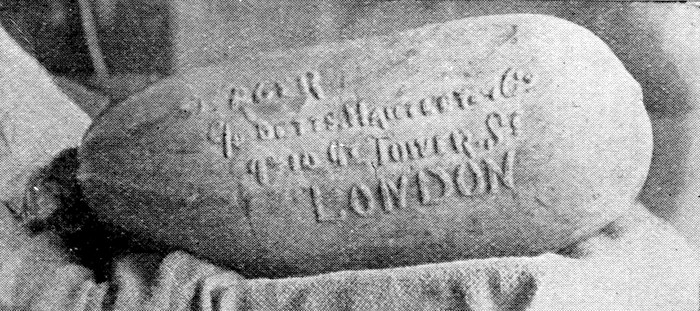
"The vegetable marrow shown in the accompanying photograph was grown by my brother, Mr. David Ager, gardener to Mr. Milton Bode, of West Dean, near Reading, the well-known gold medallist for chrysanthemum culture. The name and address were marked on the marrow when it was quite small, and the writing has become more distinct with increasing age. When about nine inches in length the marrow was cut, a label with the necessary postage affixed tied to the small piece of stalk, and it was then handed in at the post-office. In due course it arrived at its destination, the marrow being none the worse for its journey."—Mr. J. Ager, c/o Messrs. Betts, Hartley, and Co., 9 and 10, Great Tower Street, E.C.
WHAT IS THERE BENEATH THE IVY?
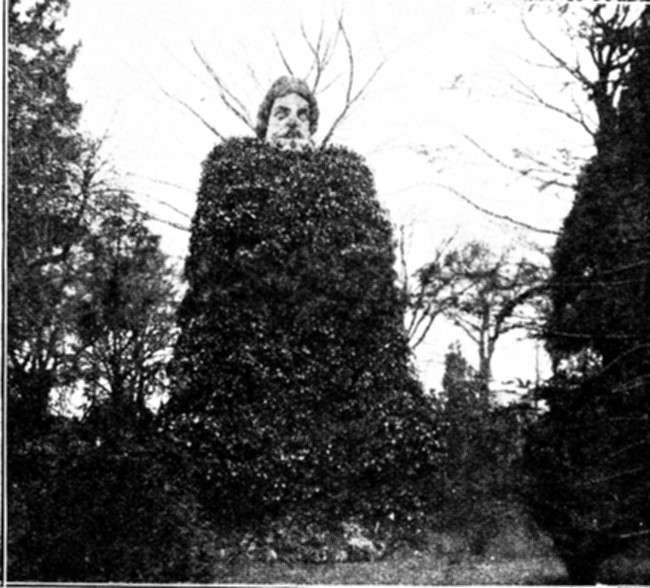
"This curious statue, which appears to be looking out of a tree, is to be found in the public park at Bath. The ivy has been allowed to cover the whole statue with the exception of the head; probably no one knows what the rest of it is like. This is a winter view; in summer the head has a background of foliage."—Mr. James A. Rooth, 112, Oakwood Court, Kensington.
"HOW THE CROW FLIES."
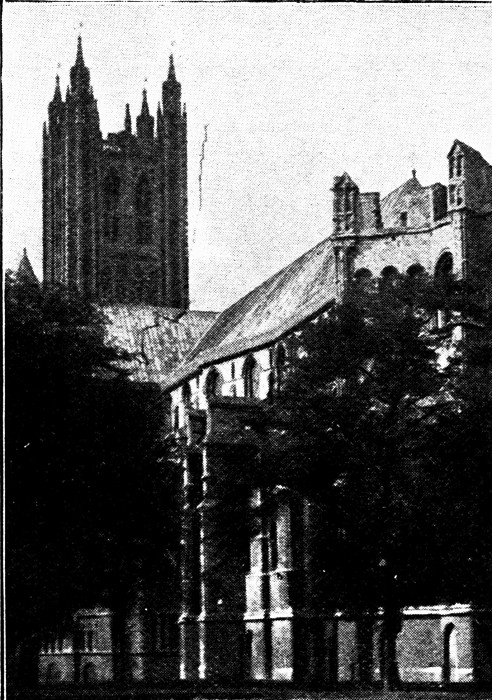
"A remarkable instance of the unexpected happening, especially to devotees of the camera, occurred to me the other day. I took the photograph of Canterbury Cathedral which I send you, and whilst the plate was exposed I noticed a crow rising from the branches of the tree at the extreme left of the picture. The bird flew slowly upwards and in zigzag fashion until it reached a height nearly equal to the cathedral spire. On developing the negative I found that the bird's flight was most accurately recorded in the shape of a thin black line, which can be distinctly traced in the photograph. By means of a magnifying glass the extended wings of the crow could be distinctly seen. I may add that as I was using a small stop the exposure was rather a long one."—Mr. H. J. Divers, 13, Burgate Street, Canterbury.
THE MORRIS DANCE.
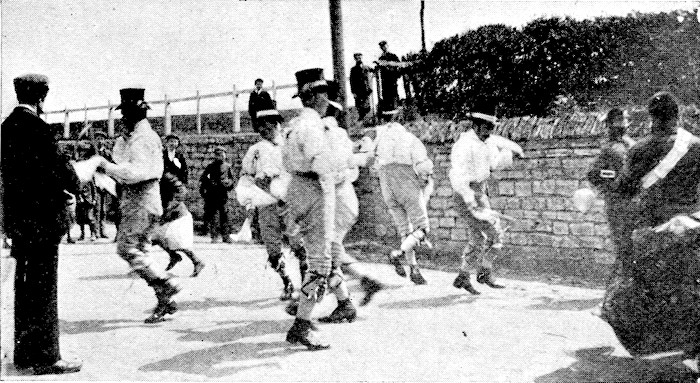
"I send you a photograph which may interest some of your readers. The village of Bidford-on-Avon keeps up the quaint old custom of the Morris Dance, and on high days and holidays the six dancers, accompanied by the clown and the hobby-horse, dance through the village to the music of a violin."—Miss Dryhurst, 11, Downshire Hill, Hampstead.
VERY SIMPLE.
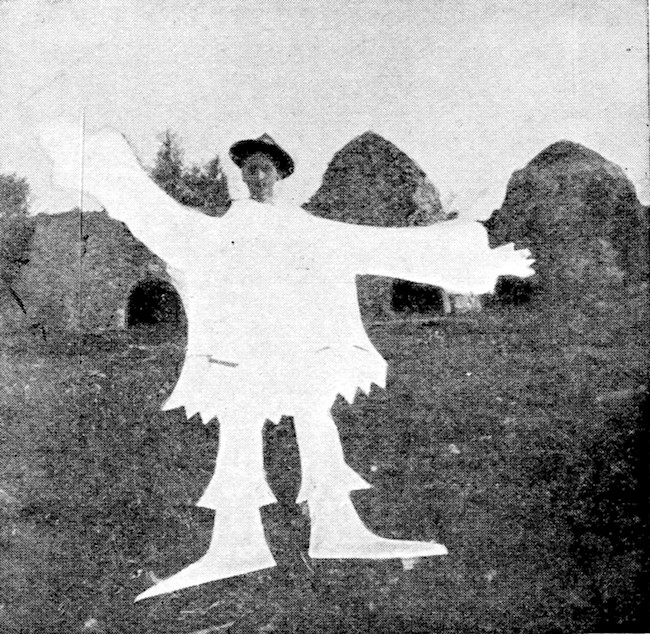
"The curious effect produced in the photograph which I send was obtained by the simple means of placing a small piece of specially-cut paper over the negative."—Mr. R. J. Chenneour, Ishpeming, Mich.
THE FAN TREE.
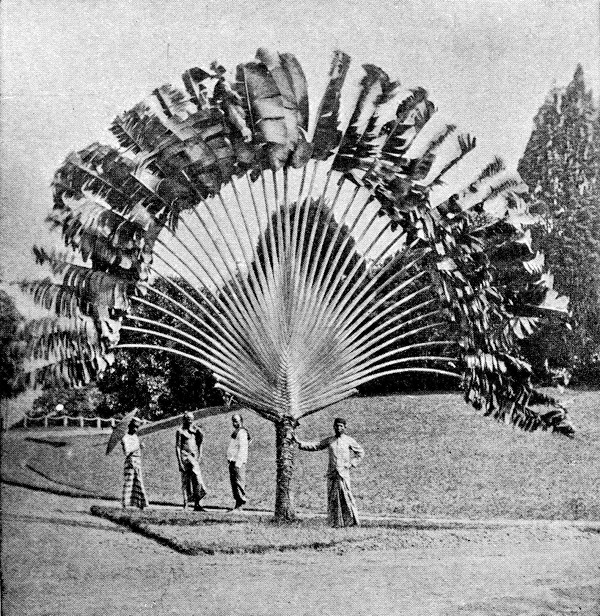
"Travellers in South-Eastern Asia sometimes see at a distance what appears to be a gigantic fan. In fact, it closely resembles the dainty creations of feathers and ivory which are so popular with ladies. On approaching closer, however, the fan is seen to be a natural one, being a species of palm tree which is wonderfully like a fan, not only in the way in which its branches project from the trunk, but in the leaves in which the branches terminate. As shown in the picture, the tree spreads out like an extended fan and the leaves bear a strong resemblance to feathers. It is called the Traveller's Palm, partly for the reason that in the forenoon or afternoon, when the sun is not directly above, it frequently offers welcome shade. Some of the palms grow to a height of fifty or sixty feet, with 'feathers' ranging from ten to fifteen feet in length."—Mr. D. A. Willey, Baltimore.
PETRIFIED WIRE.
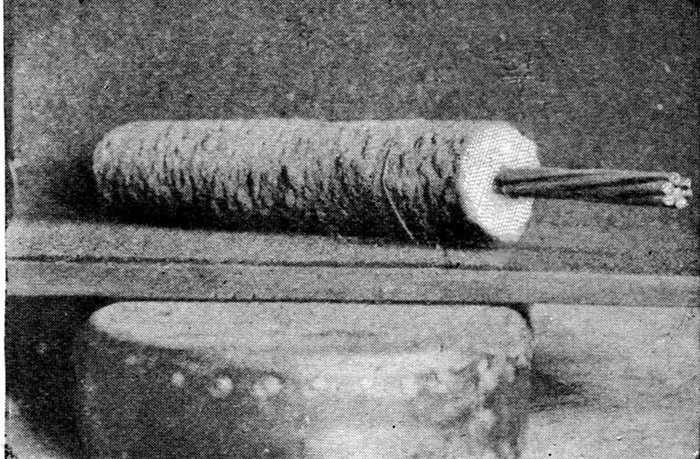
"Here is the photo. of a piece of wire rope taken from a coal-mine in Wales. The mine referred to had not been worked for some ten years, and when the water was pumped out the rope was discovered as shown, encased in a formation of hard stone. I may add that when the stone was broken the wire was found to be in a perfect state of preservation."—Mr. B. H. Wadsworth, Oriel College, Helensburgh, N.B.
NOT WHAT IT SEEMS.
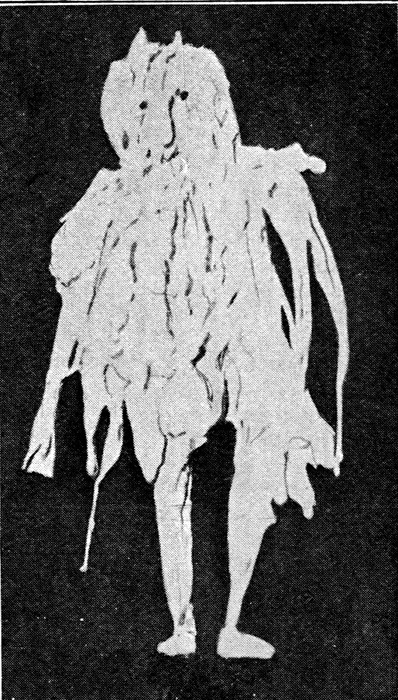
"This is not a snap-shot of Satan, nor of Pluto, or any demon of the heathen mythology. Neither is it the picture of a water-logged member of the 'tramp' profession after a shower of rain. It is simply the photograph of the curious form which a splash of lead took when it dropped from a crucible on the floor."—Mr. Joseph W. Hammond, 12, Stafford Street, Dublin.
A WOODEN SOLDIER.
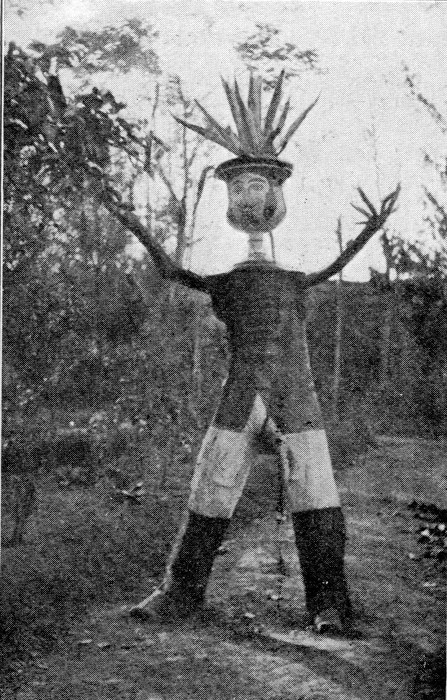
"I took this snap-shot in Spain, at La Zubia, a small town about two miles from Granada. The 'soldier' is a most surprising object to come upon suddenly. He is cut out of a single tree, and is therefore all in one piece. Branches have been neatly adapted to make his fingers, which, it will be observed, have a somewhat knotted and gouty appearance. A flower-pot forms the head, while a plant of aloes makes a very fine plumed head-dress. His uniform is painted in the most realistic way, so that altogether he has a most ferocious appearance and his expression does not invite confidence, as may be seen from the photograph. The garden in which he lives is rather an historic one, for it was here that the great Queen Isabella the Catholic was saved from falling into the hands of the Moors by hiding in a laurel bush. A monument marks the spot."—Miss A. Milne Home, Caldra, Duns, N.B.
IN THE MIDST OF THE ENEMY.
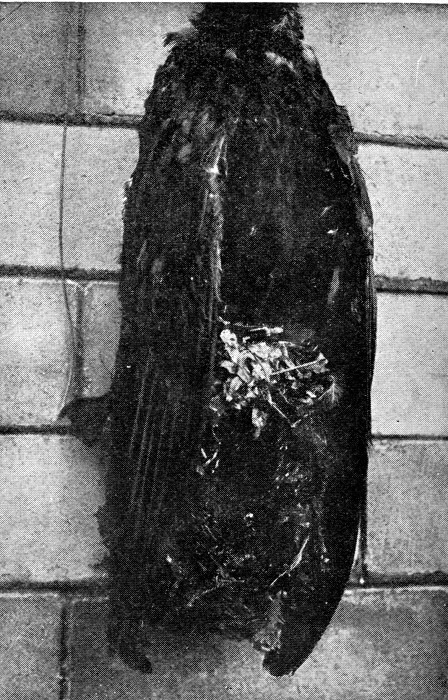
"A gamekeeper in this neighbourhood had shot a fine carrion crow, and hung up his prize, as usual, on a nail near his cottage. A wren finding it built her nest between the wings, and in the body of her greatest enemy actually reared her family. By the kindness of the owner of the nest I have been able to photograph it."—Miss Mary Sharp, Riding Mill, Northumberland.
A PECULIAR HARVEST.
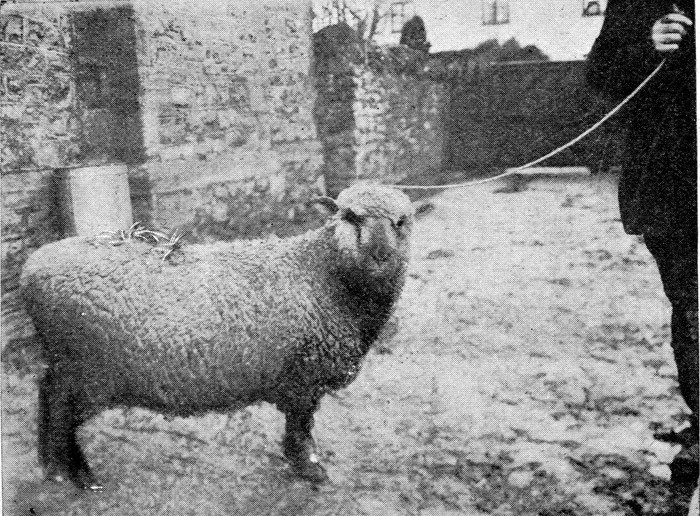
"The Rev. W. H. Jenoure, rector of Barwick, Yeovil, describes a novel sight which may be seen in his parish. A farmer had been feeding his sheep on oats, and some of the grain fell on the back of one of the animals. It has taken root in the wool and sprouted, and the young shoots may be seen growing on the animal's back."—Mr. S. G. Witcomb, Middle Street, Yeovil, Somerset.