THE STORY OF THE UNIVERSE
Reading edition
THE VEGETABLE KINGDOM —David Robertson
There is perhaps scarcely any science that can be more within the reach of the means of the humblest student than the science of botany. A pocket lens, a sharp penknife, and a book descriptive of the flora of the district or country where one lives will form a sufficient equipment to enable the student to name and classify whatever plants he may meet with in his rambles in search of them.
It is by no means intended to imply that finding out the names of plants and being able to classify them constitute the whole science of botany. The truth is that many of the problems in connection with classification are most abstruse, so much so that even now the most recent and generally received system of classification can only be considered provisional. This is especially the case in regard to the lower forms of vegetable life. The life-history of many of the most minute and lowly plants is but imperfectly known, owing to their extreme minuteness and the different forms which they assume at the various stages of their life-history.
This, however, does not detract from the pleasure which any one may derive from being able to describe and name any flowering plants which are to be found in any country at certain seasons.
The dependence of mankind on plants is too obvious to require mention.
To a large extent the vegetation of a district determines its character; for without plants no landscape would possess any particular attractiveness, and every one knows the depressing effect produced by a barren, treeless waste. The contrast between this and fields rich in pasture has occurred to every one; and a well-wooded country never fails to please the eye of the observer.
Mighty forests, teeming with life, have a powerful influence on the imagination; and the value of forests both as regards their effect on climate and their economic importance has been so thoroughly recognized that in the case of India stringent measures have been adopted for their preservation.
Some knowledge of plant life also enables one to guard against the evil and often fatal effects produced by eating poisonous fruits and poisonous fungi.
Some of the lowly organized flowerless plants are man’s most deadly and insidious enemies. These from their excessive minuteness are quite invisible to the naked eye.
Before proceeding further, it will be necessary to give a brief account of the different parts which go to compose the complete flowering plant. The reader who desires a full and detailed account of the different organs of the flowering and flowerless plants will find this in any standard text-book of botany.
We will take any full-grown flowering plant and begin with the root.
The root may be called the descending portion of the axis.
The ascending portion of the axis is usually supplied with leaves, flowers, and green coloring matter, whereas the root is usually devoid of these.
The root generally penetrates into the soil and fulfils a double function.
It is by means of the roots that the plant is attached to the earth and prevented from being blown about by the winds.
In the case of large forest trees, the far-spreading roots have an immense power of resistance. The large surface of a giant tree in full leaf has to endure an enormous lateral pressure during a high wind, and even hurricanes may fail to uproot a large tree, which they may snap asunder. Not only does the root by penetrating the soil attach the plant to the earth, but it absorbs nourishment from the soil for the support of the plant. The root, therefore, fulfils a double function.
The root is at first furnished with a conical hood of cellular tissue, i. e., tissue consisting entirely of cells or little closed bags made up of an outside wall and contents.
The root cup is well seen in some kinds of water-plants, such as duckweed.
There are plants whose roots do not descend. Certain plants hang from the branches of trees, and though they have roots these roots never penetrate the soil. Plants of this kind are called Epiphytes (Greek epi, upon, and phyton, plant). Aerial orchids, which grow in warm and moist parts of India and other countries, are attached to branches of trees or other kinds of support, and their roots hang down from the peculiar stems and are very soft and delicate at the tips.
It must be borne in mind that there is no absolute distinction between root and stem; for some trees have roots which form lateral buds, viz., Pyrus japonica, Maclura aurantiaca, and many others.
This is quite in accordance with the fact that in the organic world different organs frequently shade into one another.
The true root of the plant in its earliest state of existence, that is, as it exists in the seed prior to germination, is the downward prolongation of the axis.
In the case of the division of flowering plants called Monocotyledons (Greek monos, single, and kotyledon, seed-leaf), and in such so-called flowerless plants as ferns, the lower end of the axis soon ceases to grow and the roots which supply these plants with nourishment are really lateral growths. The roots of plants are variously named. Sometimes the branches of the roots are small, and the central axis thick and of considerable length. This kind of root is named a tap-root, and may be well seen in the carrot.
In the turnip, beet, and other plants, where this organ is developed in such a manner as to serve as a reservoir of nutriment, the root is tuberous.
Many roots are fibrous; this may be well seen in grasses.
The perennial woody forms of fibrous roots are very characteristic of shrubby Dicotyledons (plants with two seed-leaves).
Leaves are of two kinds, namely, foliage-leaves and flower-leaves.
A leaf is generally a broad, flat, horizontal surface. It is usually thin, and can be divided by a perpendicular plane, the median plane, into two similar halves.
When the leaves are what is called symmetrical, the parts into which they are divided are counterparts.
If one of these parts were held in front of a looking-glass, the reflected image of this part would represent the part from which it had been separated.
Many leaves, however, can not thus be divided. When this is the case they are said to be unsymmetrical.
The tropical plant begonia affords an excellent example of an unsymmetrical leaf.
The leaves of the spruce are not flat but needle-shaped.
In rushes and many species of stone-crops the leaves are cylindrical or round.
The leaf consists of three parts, viz., the sheath, the stalk or petiole, and the lamina or blade. The sheath incloses the stem at the insertion of the leaf, and has a tubular or sheath-like form. It is well seen in grasses and such plants as celery, corn, parsnip, carrot, and other plants belonging to the Umbelliferæ [Lat. umbella (umbra, shade), little shade, and ferre, to bear].
The leaf-stalk is narrow, and has a semi-cylindrical or prismatic form, bearing at its end the expanded leaf.
When the stalk is flattened and resembles a leaf, as in the case of the Australian acacias, it is termed a phyllode (Greek phyllon, a leaf, and eidos, form).
Many leaves have no sheath, but only the stalk and the blade. This is the case in the maple and gourd.
The leaves of the grasses have no stalk, but only sheath and blade.
The blade is often the only part present, as in the tobacco plant and tiger-lily. Small appendages, looked upon as belonging to the sheath, are frequently present, and are termed stipules (from Lat. stipula, blade). Leaves having these appendages are called stipulate, and leaves devoid of them are exstipulate (from Lat. ex, privative, without, and stipula, blade).
A few plants, such as grasses, have a small outgrowth from the inner upper surface of the leaf at the part where the sheath and the blade are joined. This outgrowth is named a ligule (from Lat. ligula, a little tongue).
If a leaf is carefully examined it will be found that the internal tissues differ in character. The fundamental tissue is generally green, and is named the messophyll (Greek, mesos, or messos, middle, and phyllon, leaf).
It will be seen that bands run through the fundamental tissue called the veins of the leaf. These veins consist of what are termed fibro-vascular bundles. They endure longer than the fundamental tissue, and may frequently be seen after the leaf is withered and dead, forming the skeleton of the leaf.
The arrangement of the veins or fibro-vascular bundles is characteristic of large groups of plants.
In the narrow linear leaves of grasses the stronger veins run almost parallel. In broad leaves, such as those of the lily-of-the-valley, the veins curve, but do not form a network of tracery as in oaks and other Dicotyledons. The margin of leaves is frequently divided, but the technical terms used in describing such leaves can be found in any text-book of botany. They may either be simple or compound. A simple leaf consists of a single lamina, however much it may be divided, provided the divisions do not extend to the central vein or midrib. A leaf is compound when, besides the principal leaf-stalks, a number of lateral leaf-stalks exist bearing at their ends laminæ. The leaves of many plants are compound. The sensitive plant (Mimosa pudica) furnishes an excellent example of the compound leaf.
The characteristic color of foliage leaves is green, and they are so arranged as to receive as much sunlight as possible. The importance of the plant receiving a good supply of light will be referred to when treating of the growth of plants. It is as true of plants as of animals that the organs most suitable for their surroundings are so arranged as to be most advantageous to the individual. Had leaves been placed vertically they would only have received diffused sunlight instead of the direct rays of the sun. No vegetable life could exist but for the sun, as plants not only require light but heat as well.
When the foliage leaves are small they are very numerous, as may be seen in conifers; and when these leaves are large they are not nearly so numerous as, for example, in the sunflower.
Sometimes leaves may consist of scales. These scales are always found on stems growing underground, as in the onion; but they sometimes occur on stems growing above-ground.
Such plants as Orobanche and Neottia have no other kind of leaves except scales.
The leaves are developed very near the apex of the growing stem.
The portions of the stem which lie between the leaves are termed the internodes, and the parts where the leaves are inserted are termed the nodes.
Leaves are arranged in various ways, intimately connected with the order of their development. They may be developed so that three or more are at the same level on the stem; this arrangement is termed a whorl. Or they may be developed singly; this arrangement is termed scattered. For a full account of the various leaf-arrangements any text-book on botany may be consulted.
We have here merely referred to some of the more obvious arrangements of the leaves.
Certain leaves possess a remarkably abnormal shape; for example, stone-crops have cylindrical leaves; if the leaf of an agave is cut across, the section is triangular; leeks, again, are tube-shaped; the central cavity being due to the rapid growth of the outer tissue. These leaves are all juicy or succulent; certain other leaves are leathery, that is, they have a harder and thicker epidermis than the succulent leaves, and may last for several years, as, for example, in the holly and box.
Spines and tendrils are modifications of leaves, or parts of leaves. The tendrils are formed out of entire leaves, midribs, leaflets, or stipules. Both spines and tendrils, however, may be modified branches of the stem.
In buds the leaves are packed or folded in various ways. This is best seen before the buds are opened in spring. The buds may then be pulled carefully to pieces, and in this way the manner in which the leaves are folded can be studied.
We now come to the flower.
Flowers consist of leaves modified in different ways.
Take, for example, the flower of the orange. The flower will be seen to be borne on a short branch which serves as the stalk, and is distinguished by the name of peduncle (from Lat. pedunculus, little stalk). It will be seen that there are no internodes between the flower-leaves.
The lowest and outermost part of the flower forms a little cup having upon its margin fine small teeth, indicating the number of leaves which are joined together so as to form the cup or calyx.
These leaves are named (from Lat. calyx, a covering; Greek kalyx, from kalyptein, to cover) the calyx-leaves, or sepals (French sépale). Although they are united in the flower of the orange, they are often separate in other plants.
In the sacred Lotus or Padma or Pudma of India the sepals are separate or free. The leaves immediately inside the calyx are usually five in number. They are erect, or only slightly curved, and do not grow together like the leaves of the calyx. They are white and wax-like. These leaves form together what is termed the corolla, and the separate leaves of the corolla (from Lat. corolla, a little wreath) are termed petals (from Greek petalon, leaf). In the case of the orange the petals fall early away.
If the calyx and petals are carefully removed, the next part of the flower can be observed.
This series of flower-leaves differs very much in structure from both sepals and petals. Each leaf of this series consists of a linear stalk-like portion, bearing an upper somewhat long and grooved head. The stalk is named the filament, and the oblong head is named the anther (Greek anthos, a flower). The stalk and the head together form what is called the stamen (Lat. stamen, [Greek histanai, to stand] fibre; literally, the warp in the upright loom of the ancients). The stamens of the orange are rather shorter than the petals, and are united to each other.
When the anther is mature, each of its grooves splits near the edge, and allows the fine powdery granules which fill the anthers to be removed by insects or by other means. This fine powder is named the pollen, and each of the granules composing it is named a pollen grain. If the stamens are now removed the centre of the flower alone is left.
If the lower part of the centre of the flower be cut across, it will be found to be divided into a large number of cavities containing the minute rudiments of future seeds. It will be seen that there are ten cavities, though they may vary in number. The central organ of the flower is named the pistil (from Lat. pistillum, pestle). The pistil is usually composed of united leaves.
The separate leaves of the pistil are termed carpels (from Greek karpos, fruit). These leaves are sometimes not combined, as they are in the orange. The style belongs to the carpel, and varies considerably in length, as well as in stoutness, in different flowers. Although the carpels may be united, the styles may remain completely separate, as, for example, in the pink, or, as in the fuchsia, they may be combined into a single rod.
The pollen grains (Lat. fine flour) contained in the anther are composed of very rich protoplasm (Greek protos, first; plasma, formative matter), which usually has in it small drops of oil and small starch granules. The pollen grains are bounded by two principal layers, an outer and an inner; the purpose of the outer layer (which is often provided with thickenings in the shape of knots, spines, etc.) being to preserve the contents of the grain from evaporation.
The inner layer is living and capable of growth, and at certain spots it possesses thickenings which project into the protoplasm. Opposite to these the external cuticle is frequently thinner, and this eventually is lifted off as a sort of lid, and through this the inner substance can grow out, and is then named the pollen tube.
When the anther lobes open to discharge their pollen grains, these grains are completely developed.
The grains fall on the part of the ovary named the stigma (Greek stigma, a puncture made with a sharp instrument; here it means a sharp point or apex) and the inner layer begins to force its way out. The tube is produced from the contents of the pollen grain, and is formed by growth, just as any other part of the plant. The pollen tube passes down to the ovules, the route depending on the length of the style. The time taken by the pollen tube to reach the ovary may amount to a few hours in certain plants, while it needs months in others. It is necessary that at least one pollen tube should enter the mouth of the ovule before it can develop into a seed. The seed, when mature, contains the embryo plant.
It is not possible for an ovule in numerous cases to be fertilized by pollen from stamens that grow near it in the same flower.
It not unfrequently happens that a flower possesses stamens and no pistil, or a pistil and no stamens. Flowers of this kind are technically termed diœcious (Greek dis, twice, and oikia or oikos, place of abode), if the male and female flowers are on different plants. The flowers of such plants as oaks and birches are male and female, but are borne on the same plant, hence termed monœcious (Greek monos, single). The flowers that contain stamens only are called male flowers, and those containing pistils only are named female flowers.
The oaks and birches, as has been stated, have both the male and female flowers on the same plant, though in other cases the male flower is borne on one plant and the female flower on another.
In cases like these the wind carries the pollen from one plant to another. In wind-fertilized flowers the flower is usually produced prior to the foliage leaves, or at least before the plant is crowded with leaves.
These plants produce an immense amount of pollen.
Besides the transference of pollen by the agency of the wind, insect agency plays a very important part. These insect-fertilized plants are much more conspicuous than those fertilized by the wind.
There are numerous natural contrivances in plants to prevent self-fertilization, as this process of self-fertilization is far less effective in producing seeds than when the ovules are fertilized by pollen from another plant of the same species.
In some plants the stigma is mature before the anther, and in such a case the pollen must be brought from a flower that has bloomed a little earlier than itself.
FLORA OF THE EARLY MESOZOIC —Sir J. William Dawson
Great physical changes occurred at the close of the Carboniferous age. The thick beds of sediment that had been accumulating in long lines along the primitive continents had weighed down the earth’s crust. Slow subsidence had been proceeding from this cause in the coal-formation period, and at its close vast wrinklings occurred, only surpassed by those of the old Laurentian time. Hence in the Appalachian region of America we have the Carboniferous beds thrown into abrupt folds, their shales converted into hard slates, their sandstones into quartzite and their coals into anthracite, and all this before the deposition of the Triassic Red Sandstones which constitute the earliest deposit of the great succeeding Mesozoic period. In like manner the coal-fields of Wales and elsewhere in western Europe have suffered similar treatment, and apparently at the same time.
This folding is, however, on both sides of the Atlantic limited to a band on the margin of the continents, and to certain interior lines of pressure, while in the middle, as in Ohio and Illinois in America, and in the great interior plains of Europe, the coal-beds are undisturbed and unaltered. In connection with this we have an entire change in the physical character of the deposits, a great elevation of the borders of the continents, and probably a considerable deepening of the seas, leading to the establishment of general geographical conditions which still remain, though they have been temporarily modified by subsequent subsidences and re-elevations.
Along with this a great change was in progress in vegetable and animal life. The flora and fauna of the Palæozoic gradually die out in the Permian and are replaced in the succeeding Trias by those of the Mesozoic time. Throughout the Permian, however, the remains of the coal-formation flora continue to exist, and some forms, as the Calamites, even seem to gain in importance, as do also certain types of coniferous trees. The Triassic, as well as the Permian, was marked by physical disturbances, more especially by great volcanic eruptions discharging vast beds and dikes of lava, and layers of volcanic ash and agglomerate. This was the case more especially along the margins of the Atlantic, and probably also on those of the Pacific. The volcanic sheets and dikes associated with the Red Sandstones of Nova Scotia, Connecticut, and New Jersey are evidences of this.
At the close of the Permian and beginning of the Trias, in the midst of this transition time of physical disturbance, appear the great reptilian forms characteristic of the age of reptiles, and the earliest precursors of the mammals, and at this time the old Carboniferous forms of plants finally pass away, to be replaced by a flora scarcely more advanced, though different, and consisting of pines, cycads, and ferns, with gigantic equiseta, which are the successors of the genus Calamites, a genus which still survives in the early Trias. Of these groups the conifers, the ferns, and the equiseta are already familiar to us, and, in so far as they are concerned, a botanist who had studied the flora of the Carboniferous would have found himself at home in the succeeding period. The cycads are a new introduction. The whole, however, come within the limits of the cryptogams and the gymnosperms, so that here we have no advance.
As we ascend, however, in the Mesozoic, we find new and higher types. Even within the Jurassic epoch, the next in succession to the Trias, there are clear indications of the presence of the endogens, in species allied to the screw-pines and grasses; and the palms appear a little later, while a few exogenous trees have left their remains in the Lower Cretaceous, and in the Middle and Upper Cretaceous these higher plants come in abundantly and in generic forms still extant, so that the dawn of the modern flora belongs to the Middle and Upper Cretaceous. It will thus be convenient to confine ourselves in this chapter to the flora of the earlier Mesozoic.
Passing over for the present the cryptogamous plants already familiar in older deposits, we may notice the new features of gymnospermous and phænogamous life, as they present themselves in this earlier part of the great reptilian age, and as they extended themselves with remarkable uniformity in this period over all parts of the world. For it is a remarkable fact that, if we place together in our collections fossil plants of this period from Australia, India, China, Siberia, Europe, or even from Greenland, we find wonderfully little difference in their aspect. This uniformity prevailed in the Palæozoic flora; and it is perhaps equally marked in that of the Mesozoic. Still we must bear in mind that some of the plants of these periods, as the ferns and pines, for example, are still world-wide in their distribution; but this does not apply to others, more especially the cycads.
The cycads constitute a singular and exceptional type in the modern world, and are limited at present to the warmer climates, though very generally distributed in these, as they occur in Africa, India, Japan, Australia, Mexico, Florida, and the West Indies. In the Mesozoic age, however, they were world-wide in their distribution, and are found as far north as Greenland, though most of the species found in the Cretaceous of that country are of small size, and may have been of low growth, so that they may have been protected by the snows of winter. The cycads have usually simple or unbranching stems, pinnate leaves borne in a crown at top, and fruits which, though somewhat various in structure and arrangement, are all of the simpler form of gymnospermous type. The stems are exogenous in structure, but with slender wood and thick bark, and barred tissue, or properly as tissue intermediate between this and the disk-bearing fibres of the pines.
The greater part of the cycads of the Mesozoic age would seem to have had short stems and to have constituted the undergrowth of woods in which conifers attained to greater height. An interesting case of this is the celebrated dirt-bed of the quarries of the Isle of Portland, long ago described by Dean Buckland. In this fossil soil trunks of pines, which must have attained to great height, are interspersed with the short, thick stems of cycads, of the genus named Cycadoidea by Buckland, and which from their appearance are called “fossil birds’ nests” by the quarrymen. Some, however, must have attained a considerable height so as to resemble palms.
The cycads, with their simple, thick trunks, usually marked with rhombic scars, and bearing broad spreading crowns of large, elegantly formed pinnate leaves, must have formed a prominent part of the vegetation of the Northern Hemisphere during the whole of the Mesozoic period. A botanist, had there been such a person at the time, would have found this to be the case everywhere from the equator to Spitzbergen, and probably in the Southern Hemisphere as well, and this throughout all the long periods from the Early Trias to the Middle Cretaceous. In a paper published in the Linnæan Transactions for 1868, Dr. Carruthers enumerates twenty species of British Mesozoic cycads, and the number might now be considerably increased.
The pines present some features of interest. In the Mesozoic we have great numbers of beautiful trees, with those elegant fan-shaped leaves characteristic of but one living species, the Salisburia, or gingko-tree of China. It is curious that this tree, though now limited to eastern Asia, will grow, though it rarely fruits, in most parts of temperate Europe, and in America as far north as Montreal, and that in the Mesozoic period it occupied all these regions, and even Siberia and Greenland, and with many and diversified species.
Salisburia belongs to the yews, but an equally curious fact applies to the cypresses. The genus Sequoia, limited at present to two species, both Californian, and one of them the so-called “big tree,” celebrated for the gigantic size to which it attains, is represented by species found as far back at least as the Lower Cretaceous, and in every part of the Northern Hemisphere.[1] It seems to have thriven in all these regions throughout the Mesozoic and early Kainozoic, and then to have disappeared, leaving only a small remnant to represent it in modern days. A number of species have been described from the Mesozoic and Tertiary, all of them closely related to those now existing.
The name itself deserves consideration. It is that of an Indian of the Cherokee tribe, Sequo Yah, who invented an alphabet without any aid from the outside world of culture, and taught it to his tribe by writing it upon leaves. This came into general use among the Cherokees before the white man had any knowledge of it; and afterward, in 1828, a periodical was published in this character by the missionaries. Sequo Yah was banished from his home in Alabama, with the rest of his tribe, and settled in New Mexico, where he died in 1843.
When Endlicher was preparing his synopsis of the conifers, in 1846, and had established a number of new genera, Dr. Jacbon Tschudi, then living with Endlicher, brought before his notice this remarkable man, and asked him to dedicate this red-wooded tree to the memory of a literary genius so conspicuous among the red men of America. Endlicher consented to do so, and only endeavored to make the name pronounceable by changing two of its letters.
Endlicher founded the genus on the redwood of the Americans, Taxodium sempervirens of Lamb; and named the species Sequoia sempervirens. These trees form large forests in California, which extend along the coast as far as Oregon. Trees are there met with of 300 feet in height and 20 feet in diameter. The seeds were brought to Europe a number of years ago, and we already see in upper Italy and around the Lake of Geneva, and in England, high trees; but, on the other hand, they have not proved successful around Zurich.
In 1852, a second species of Sequoia was discovered in California, which, under the name of big tree, soon attained a considerable celebrity. Lindley described it, in 1853, as Wellingtonia gigantea; and, in the following year, Decaisne and Torrey proved that it belonged to Sequoia, and that it accordingly should be called Sequoia gigantea.
While the Sequoia sempervirens, in spite of the destructiveness of the American lumbermen, still forms large forests along the coasts, the Sequoia gigantea is confined to the isolated clumps which are met with inland at a height of 5,000 to 7,000 feet above sea-level, and are much sought after by tourists as one of the wonders of the country. Reports came to Europe concerning the largest of them which were quite fabulous, but we have received accurate accounts of them from Professor Whitney. The tallest tree measured by him has a height of 325 feet, and in the case of one of the trees the number of the rings of growth indicated an age of about 1,300 years. It had a girth of 50 to 60 feet.
We know only two living species of Sequoia, both of which are confined to California. The one (S. sempervirens) is clothed with erect leaves, arranged in two rows, very much like our yew-tree, and bears small, round cones; the other (S. gigantea) has smaller leaves, set closely against the branches, giving the tree more the appearance of the cypress. The cones are egg-shaped, and much larger. These two types are, therefore, sharply defined.
Both of these trees have an interesting history. If we go back into the Tertiary, this same genus meets us with a long array of species. Two of these species correspond to those living at present: the S. Langsdorfii to the S. sempervirens, and the S. Couttsiæ to the S. gigantea. But, while the living species are confined to California, in the Tertiary they are spread over several quarters of the globe.
Let us first consider the Sequoia Langsdorfii. This was first discovered in the lignite of Wetterau, and was described as Taxites Langsdorfii. Heer found it in the upper Rhone district, and there lay beside the twigs the remains of a cone, which showed that the Taxites Langsdorfii of Brongniart belonged to the Californian genus Sequoia established by Endlicher. He afterward found much better preserved cones, together with seeds, along with the plants of east Greenland, which fully confirmed the determination. At Atanekerdluk in Greenland (about 70° north latitude) this tree is very common. The leaves, and also the flowers and numerous cones, leave no doubt that it stands very near to the modern redwood. It differs from it, however, in having a much larger number of scales in the cone. The tree is also found in Spitzbergen at nearly 78° north latitude, where Nordenskiöld has collected, at Cape Lyell, wonderfully preserved branches. From this high latitude the species can be followed down through the whole of Europe as far as the middle of Italy (at Senegaglia, Gulf of Spezia). In Asia, also, we can follow it to the steppes of Kirghisen, to Possiet, and to the coast of the sea of Japan, and across to Alaska and Sitka. It is recognized by Mr. Starkie Gardner as one of the species found in the Eocene of Mull in the Hebrides. It is thus known in Europe, Asia, and America from 43° to 78° north latitude, while its most nearly related living species, perhaps even descended from it, is now confined to California.
With this S. Langsdorfii, three other Tertiary species are nearly related (S. brevifolia, Hr., S. disticha, Hr., and S. Nordenskiöldi, Hr.). These have been met with in Greenland and Spitzbergen and one of them has been found in the United States. Three other species, in addition to these, have been described by Lesquereux, which appear to belong to the group of the S. Langsdorfii, viz., S. longifolia, Lesq., S. angustifolia, and S. acuminata, Lesq. Several species also occur in the Cretaceous and Eocene of Canada.
These species thus answer to the living Sequoia sempervirens; but we can also point to Tertiary representatives of the S. gigantea. Their leaves are stiff and sharp-pointed, are thinly set round the branches, and lie forward in the same way: the egg-shaped cones are in some cases similar.
There are, however, in the early Tertiary six species, which fill up the gap between S. sempervirens and S. gigantea. They are the S. Couttsiæ, S. affinis, Lesq., S. imbricata, Hr., S. sibirica, Hr., S. Heerii, Lesq., and S. biformis, Lesq. Of these, S. Couttsiæ, Hr., is the most common and most important species. It has short leaves, lying along the branch, like S. gigantea, and small, round cones, like S. Langsdorfii and sempervirens. Bovey Tracey in Devonshire has afforded splendid specimens of cones, seeds, and twigs, which have been described in the Philosophical Transactions. More lately, Count Saporta has described specimens of cones and twigs from Armissan. Specimens of this species have also been found in the older Tertiary of Greenland, so that it must have had a wide range. It is very like to the American S. affinis, Lesq.
In the Tertiary there have been found fourteen well-marked species, which thus include representatives of the two living types, S. sempervirens and S. gigantea.
We can follow this genus still further back. If we go back to the Cretaceous age, we find ten species, of which five occur in the Urgon of the Lower Cretaceous, two in the Middle, and three in the Upper Cretaceous. Among these, the Lower Cretaceous exhibits the two types of the Sequoia sempervirens and S. gigantea. To the former the S. Smithiana answers, and to the latter, the Reichenbachii, Gein. The S. Smithiana stands indeed uncommonly near the S. Langsdorfii, both in the appearance of the leaves on the twigs and in the shape of the cones. These are, however, smaller, and the leaves do not become narrower toward the base. The S. pectina, Hr., of the Upper Cretaceous, has its leaves arranged in two rows, and presents a similar appearance. The S. Reichenbachii is a type more distinct from those now living and those in the Tertiary. It has indeed stiff, pointed leaves, lying forward, but they are arcuate, and the cones are smaller. This tree has been known for a long time, and it serves in the Cretaceous as a guiding star, which we can follow from the Urgonian of the Lower Cretaceous up to the Cenomanian. It is known in France, Belgium, Bohemia, Saxony, Greenland, and Spitzbergen (also in Canada and the United States). It has been placed in another genus—Geinitzia—but we can recognize, by the help of the cones, that it belongs to Sequoia.
Below this, there is found in Greenland a nearly related species, the S. ambigua, Hr., of which the leaves are shorter and broader, and the cones round and somewhat smaller.
The connecting link between S. Smithiana and Reichenbachii is formed by S. subulata, Hr., and S. rigida, Hr., and three species (S. gracilis, Hr., S. fastigiata and S. Gardneriana, Carr.), with leaves lying closely along the branch, and which come very near to the Tertiary species S. Couttsiæ. We have, therefore, in the Cretaceous quite an array of species, which fill up the gap between the S. sempervirens and gigantea, and show us that the genus Sequoia had already attained a great development in the Cretaceous. This was still greater in the Tertiary, in which it also reached its maximum of geographical distribution. Into the present world the two extremes of the genus have alone continued; the numerous species forming its main body have fallen out in the Tertiary.
If we look still further back, we find in the Jura a great number of conifers, and, among them, we meet in the genus Pinus with a type which is highly developed, and which still survives; but for Sequoia we have till now looked in vain, so that for the present we can not place the rise of the genus lower than the Urgonian of the Cretaceous, however remarkable we may think it that in that period it should have developed into so many species; and it is still more surprising that two species already make their appearance which approach so near to the living Sequoia sempervirens and S. gigantea.
Altogether, we have become acquainted, up to the present time, with twenty-six species of Sequoia. Fourteen of these species are found in the Arctic zone, and have been described and figured in the Fossil Flora of the Arctic Regions. Sequoia has been recognized by Ettingshausen even in Australia, but there in the Eocene.
This is, perhaps, the most remarkable record in the whole history of vegetation. The Sequoias are the giants of the conifers, the grandest representatives of the family; and the fact that, after spreading over the whole Northern Hemisphere and attaining to more than twenty specific forms, their decaying remnant should now be confined to one limited region in western America[2] and to two species constitutes a sad memento of departed greatness. The small remnant of S. gigantea still, however, towers above all competitors as eminently the “big trees”; but, had they and the allied species failed to escape the Tertiary continental submergences and the disasters of the glacial period, this grand genus would have been to us an extinct type. In like manner the survival of the single gingko of eastern Asia alone enables us to understand that great series of taxine trees with fern-like leaves of which it is the sole representative.
Besides these peculiar and now rare forms, we have in the Mesozoic many others related closely to existing yews, cypresses, pines, and spruces, so that the conifers were probably in greater abundance and variety than they are at this day.
In this period also we find the earliest representatives of the endogenous plants. It is true that some plants found in the coal-formation have been doubtfully referred to these, but the earliest certain examples would seem to be some bamboo-like and screw-pine-like plants occurring in the Jurassic rocks. Some of these are, it is true, doubtful forms, but of others there seems to be no question. The modern Pandanus or screw-pine of the tropical regions, which is not a pine, however, but a humble relation of the palms, is a stiffly branching tree, of a candelabra-like form, and with tufts of long leaves on its branches, and nuts or great hard berries for fruit, borne sometimes in larger masses, and so protected as to admit of their drifting uninjured on the sea. The stems are supported by masses of aerial roots like those which strengthen the stems of tree-ferns. These structures and habits of growth fit the Pandanus for its especial habitat on the shores of tropical islands, where its masses of nuts are drifted by the winds and currents, and on whose shores it can establish itself by the aid of its aerial roots.
Some plants referred to the cycads have proved veritable botanical puzzles. One of these, the Williamsonia gigas of the English oölite, originally discovered by my friend, Dr. Williamson, and named by him Zamia gigas, a very tall and beautiful species, found in rocks of this age in various parts of Europe, has been claimed by Saporta for the Endogens, as a plant allied to Pandanus. Some other botanists have supposed the flowers and fruits to be parasites on other plants, like the modern Rafflesia of Sumatra, but it is possible that after all it may prove to have been an aberrant cycad.
The tree-palms are not found earlier than the Middle Cretaceous. In like manner, though a few Angiosperms occur in rocks believed to be Lower or Lower Middle Cretaceous in Greenland and the Northwest Territory of Canada, and in Virginia, these are merely precursors of those of the Upper Cretaceous, and are not sufficient to redeem the earlier Cretaceous from being a period of pines and cycads.
On the whole, this early Mesozoic flora, so far as known to us, has a monotonous and mean appearance. It no doubt formed vast forests of tall pines, perhaps resembling the giant Sequoias of California; but they must for the most part have been dark and dismal woods, probably tenanted by few forms of life, for the great reptiles of this age must have preferred the open and sunny coasts, and many of them dwelt in the waters. Still we must not be too sure of this. The berries and nuts of the numerous yews and cycads were capable of affording much food. We know that in this age there were many great herbivorous reptiles, like Iguanodon and Hadrosaurus, some of them fitted by their structure to feed upon the leaves and fruits of trees. There were also several kinds of small herbivorous mammals, and much insect life, and it is likely that few of the inhabitants of the Mesozoic woods have been preserved as fossils. We may yet have much to learn of the inhabitants of these forests of ferns, cycads, and pines. We must not forget in this connection that in the present day there are large islands, like New Zealand, destitute of mammalia, and having a flora comparable with that of the Mesozoic in the Northern Hemisphere, though more varied. We have also the remarkable example of Australia, with a much richer flora than that of the early Mesozoic, yet inhabited only by non-placental mammals, like those of the Mesozoic.
The principal legacy that the Mesozoic woods have handed down to our time is in some beds of coal, locally important, but of far less extent than those of the Carboniferous period. Still, in America, the Richmond coal-field in Virginia is of this age, and so are the anthracite beds of the Queen Charlotte Islands, on the west coast of Canada, and the coal of Brora in Sutherlandshire. Valuable beds of coal, probably of this age, also exist in China, India, and South Africa; and jet, which is so extensively used for ornament, is principally derived from the carbonized remains of the old Mesozoic pines.
EXISTING LIFE-FORMS OF PLANTS —Edward Clodd
Plants are divided into two main groups or sub-kingdoms: I, Cryptogams (Greek Kruptos, hidden; gamos, marriage), or flowerless; II, Phanerogams (Greek phaneros, open; gamos, marriage), or flowering.
I. The Cryptogams comprise as their leading representatives: 1. Algæ, Fungi, Lichens; 2. Liverworts, Mosses; 3. Ferns, Horsetails, Club-mosses.
The feature common to these is the absence of any conspicuous organs; i. e., true flowers with stamens and pistils for the production of seeds or fruits. The simplest or single-celled plants increase by subdivision, each cell carrying on an independent life and repeating the process of division. But sexuality is manifest in plants very low down in the scale, the mode of reproduction varying a good deal in different species. In some cryptogams it is almost as complex as in the flowering plants, but notwithstanding the different kinds of sexual organs, there is this fundamental resemblance between them, that the union of the contents of two cells, a male or sperm-cell, and a female or germ-cell, each of which is by itself incapable of further development, is essential to the production of the embryo or seed.
The lowest cryptogams have no stems, leaves, or roots. They are congregations of simple fibreless cells united in rows, or gathered round one another, spreading on all sides. At the bottom of the scale of plant life are the Algæ, comprising some 10,000 species, from the minute fresh-water desmids, one-millionth of an inch in length, with their whip-like cilia, the two-hundredth millionth of an inch long, to the giant sea-weeds or tangles, hundreds of feet in length, that cover thousands of square miles of ocean. The green scum of stagnant ponds; the waving filaments in streams; the shell-coated microscopic diatoms that people the ocean, tingeing its depths with olive green, nourishing the whales that play therein, and whose skeletons form deposits hundreds of miles in length; the rose and purple weeds that flourish in shallow seas, and are cast upon their shores, are all members of a group which is perhaps the venerablest of living things. For although their generally fragile forms have been fatal to their preservation as fossils, there is little doubt that the algæ flourished in dense masses in primeval oceans, and were the chief, if not the sole, representatives of plant-life on the earth during millions of centuries. Like the foraminifera and other low animal organisms, they illustrate the persistency of the earlier forms, in virtue of their simplicity of structure, despite changing conditions, whereas the more complex structures, by reason of the greater delicacy of their parts, can less readily adapt themselves to altered surroundings, and therefore have a much narrower distribution both in time and space.
Next to the algæ in ascending order are those fantastic products of decay, the quick-growing, short-lived Fungi, animal-like in their mode of nutrition, plant-like in their fixity; then the Lichens, which, it is now generally agreed, are composite plants, being a special kind of parasite fungi growing on algæ. These are widely spread, living after the adaptive manner of simple forms, where nothing else can live, unwithered by the heat, unsmitten by the frost; redeeming the earth’s desolate places, from treeless desert flats far as the lines of enduring snow; spreading their flowerless patches of richest colors in metallic-like stain over rock and ruin; incrusting the trees with tint of freshness or touch of age, with hoary fringe or mock hieroglyph; and in their decay yielding rich soil wherein fern and flowering tree may strike root.
In the Mosses, whose glossy, many-colored masses weave softest carpet over the earth, sharing in the service rendered by the humble lichens, the cells have become more developed into rudimentary root, stem, and leaf, manifesting still further transition toward unlikeness in parts due to division of function. But the structure is still cellular—i. e., there are no tissues and fibres. The mosses represent the intermediate form between the lowest and the highest cryptogams, between the green algæ—out of which the liverworts were probably developed—and the ferns, which arose out of liverworts.
In the Ferns, the larger number of cells have joined together to form fibrous vessels, lengthening of thickening in varying shape and texture, according to the functions to be discharged by them, resulting in the woody tissue which enters into the structure of all the higher plants. The cells which are thus converted into tissue cease to grow; the formative protoplasm becomes the formed, having given up its life for the plant, and locked up in the compacted material a store of energy for service both within the plant and by the agency of the plant. The ferns and club-mosses and horsetails of the present day are the dwarfed representatives of the stately and luxuriant, although sombre, flowerless trees that composed the dense jungles of green vegetation in the Devonian and succeeding Primary periods. These are distinguished as the Era of Fern Forests, during which our fossil fuel was chiefly formed; and although the palm-like vegetation of the tropics more nearly approaches its Devonian prototype, it falls far behind it in size and abundance.
II. The Phanerogams have their flowers with stamens and pistils conspicuous, and are divided, according to the formation of their seeds, into:
1. Gymnosperms, or naked-seeded, the ovules not being inclosed within a seed-vessel or ovary, but carried upon a cone, as in pines and allied species.
2. Angiosperms, or cover-seeded, the ovules being inclosed within an ovary.
This group is subdivided into (a) plants having one seed leaf from which they are developed, as palms, lilies, orchids, grasses; and into (b) plants having two seed-leaves, as oaks, beeches, and all trees and shrubs not included in the foregoing species.
In naked-seeded plants the pollen or male element falls on the exposed ovules; in cover-seeded plants it falls on the stigma, passes down the pistil into the seed-vessel, and enters the ovule through an opening in it called the microphyle, or “little gate.”
While the gymnosperms are, on the one hand, most nearly allied in the order of descent to ferns, the sombre flowers which they bear giving them, only by strict botanical classification, a place among phanerogams, they are, on the other hand, more complex in structure than the single seed-leaf plants, because their bark, wood, and pith are clearly defined, as in the double seed-leaf plants. Their lowest representatives comprise the cycads or palm-ferns, so called from their resemblance to palms, for which, with their crown of feathery leaves, they are often mistaken. Next in order is the much more varied and widely distributed conifer family, notably pines, firs, and larches, and, lesser in importance, cedars and cypresses. A still higher class, various in its modes of growth, marks the transition, to angiosperms, the flowers of both having many features in common.
The single seed-leaf angiosperms have no visible separation of their woody stuff into bark, stem, and pith, and have no rings of growth, the wood exhibiting an even surface, dotted over with small dark points. Their leaves have parallel veins or “nerves,” as in the onion and tulip, and the blossom-leaves, or petals, are grouped in threes or multiples of three. Among their several representatives we may single out the lilies for their beauty and fragrance, and the cereals for their value and importance, both classes being in near connection, since the grasses from which man has developed wheat, barley, oats, rice, and maize are, in a botanical sense, degenerate descendants of the lily family.
The double seed-leaf plants include all the highest and most specialized varieties. Bark, stem, pith, and concentric rings of growth are clearly defined; the leaves are netted-veined, and the petals grouped in fours or fives or multiples of these numbers. The lowest class, represented by the catkin-bearers, as the birch and alder, the poplar and the oak, and by plants allied to the nettle and to the laurel, are nearly related to the highest gymnosperms. Next in order are the crown-bearers, or flowers with corollas, as the rose family, which includes most of our fruit yielders, from strawberries to apples; while the highest and most perfect of all are plants in which the petals are united together in bell-shape or funnel fashion. Such are the convolvulus and honeysuckle, the olive and ash, and at the top of the plant-scale, the family of which the daisy is the most familiar representative. Its position among plants corresponds to man’s position among animals. As he, in virtue of being the most complex and highly specialized, is at their head, albeit many exceed him in bulk and strength, so is the daisy with its allies, for like reasons, above the giants of the forest.
The primary function for which the organs of plants known as flowers exists is not that which man has long assumed. He once thought that the earth was the centre of the universe until astronomy dispelled the illusion, and there yet lingers in him an old Adam of conceit that everything on the earth has for its sole end and aim his advantage and service. Evolution will dispel that illusion. But our delight in the colors and perfumes of flowers will not be lessened, while wonder will have larger field for play in learning that the colored leaves known as flowers, together with their scent and honey, have been developed in furtherance of nature’s supreme aim—the preservation and increase of the species. And truly the contrivances to secure this which are manifest in plant-life are astounding even to those who perceive most clearly the unity of function which connects the highest and lowest life-forms together. It is difficult, nay, wellnigh impossible, to deny the existence of a rudimentary consciousness in the efforts of certain plants to secure fertilization. Take, for example, the well-known aquatic plant, Vallisneria spiralis. When the male flowers detach themselves and float about the water, the female flowers develop long spiral stalks by which to reach them, and become fertilized by the discharge of pollen on their pistils. Most flowers have their male and female organs within the same petals, and in some cases fertilize themselves by scattering the pollen from the bursting stamens on the stigma or head of the pistil. But nature is opposed to this; “tells us in the most emphatic manner that she abhors perpetual self-fertilization,” with its resultant puny and feeble offspring; and we find a number of contrivances to prevent this, and to secure fertilization by the pollen of another plant, to the abiding gain all round of the plant, whose blood, as we may say, is thus mixed with that of a stranger. Two agencies—insects and the wind—undesignedly effect this; while in the dispersion of the matured seed, birds and other animals play an important, although equally unconscious, part.
Plants which are wind-fertilized have no gayly colored petals or sepals, and do not secrete water. Such are the naked-seeded groups whose sombre flowers are borne on dull brown cones; and, among cover-seeded groups, grasses and rushes, with their feathery flowers; and willows and birches, with their long waving clusters of catkins. All of these provide against the fitfulness of the wind, which is as likely to blow the pollen one way as another, by producing it in large quantities.
Plants which are insect-fertilized seek to attract their visitors by secreting honey and developing colored floral organs. The way in which this came about is probably as follows:
The common idea about flowers is that they are made up of petals and sepals, whereas the essential parts are the stamens and pistils—i. e., the male, or pollen-producing organs, and the female, or seed-containing organs. The earliest flowers consisted of these alone, having no colored whorl of petals within another colored whorl of sepals, but were only scantily protected by leaves, as are many extant species. These the food-seeking insects then, as now, visited for the sake of the pollen, to the detriment of the plant, which lost the fertilizing stuff and gained nothing in return. To arrest this, certain plants began, especially when in the act of flowering, to secrete honey and store it in glands or nectaries, or near their seed-vessels, where the insects could not get at it without covering their bodies with some of the pollen, which they rubbed on the pistils of the plant next visited, and thus fertilized the ovule, provided that the plants were nearly related. Honey is sweeter to the taste than pollen, and the plants that produced the most honey stood the better chance of visits from insects, and therefore of fertilization, to the advantage of this species over others. As a rule, those which secrete honey have hairy coverings at the base of the petals, or other contrivances to prevent it being washed out by the rain or dew, or seized by useless insects, and we find curious interrelations established between plants and their desired visitors. Certain flowers adapt themselves to certain insects, and vice versâ, as where the plant has secreted the honey at the bottom of a long tube and the insect has developed a correspondingly long proboscis to gather it. By these and kindred devices the pollen is preserved for its sole function, the energy of the plant being conserved in the smaller quantity which it has to produce. As the honey was secreted as counter-attraction to the pollen, so the colored floral envelopes were developed to attract the insects, to the honey-secreting plant, and those floral whorls, both of petals and sepals, are modified or transformed stamens which have exchanged their function of pollen-producers for that of insect-allurers. And as both stamens and pistils are leaves aborted or modified for the special function of reproduction, Goethe’s well-known generalization that the leaf is the type of the plant has a large measure of truth in it.
But before speaking further about color-development in plants, it may be useful to say a little about color itself. Since everything is black in the dark, and moreover has no color in itself, it follows that color is in some way a property of light. Now light, which is itself invisible, is due to vibrations or oscillations set up in all directions by any luminous body—whether the sun or a rushlight—in the ethereal medium which pervades all space, and is composed of rays of different refrangibilities—i. e., change of direction in passing from one medium to another. White light is due to a combination of all these rays, ranging through innumerable gradations of color, from red to violet, and it is to the absence of one or more of them that the infinite variety of colors is due. If a body is quite opaque, or otherwise so constituted as to absorb none of the rays, it appears white; if it absorbs them all it appears black; if it absorbs green, blue, and violet, and not red, it appears red; if it absorbs red, orange, and violet and returns or reflects green, it appears green. The colors which bodies reflect are therefore regulated by their structure; the way in which their molecules are arranged determines the number and character of the light vibrations or ether waves which are returned to the eye and which rule the color we see—e. g., charcoal and the diamond are both pure carbon; the dull opacity of the one and the trembling splendor of the other are solely due to the arrangement of the several molecules of each.
It is thus obvious that any change in the nature or structure of a thing is accompanied by change in its color, and to this cause the various pigments in plants are to be referred.
All growth involves expenditure of the energy which the plant has stored within itself, and which becomes active when the hydrocarbons combine with oxygen, resulting in cellular change, and appearance of other colors than the green, which is due to chlorophyl. Thus may be explained the color of sprouting buds and young shoots and the more or less intensified colors of leaves and flowers—one and all due to oxidation, the minutest changes inducing subtle variations in color.
Whichever plants made the most show of color would the sooner catch the eye of insects, however dim their perception of the difference in colors might be, and would thus get fertilized before plants which made less display. Thus have insects been the main cause in the propagation of flowering plants; the plants in return developing the color-sense in insects. The flower nourishes the insect, the insect propagates the flower. Other contrivances to meet the need for fertilization might be cited, as the markings upon the petals to guide the insect to the nectary; the exhalation of scent by inconspicuous flowers, or by such as would attract visitors at night, and so forth; but enough has been adduced to show what is the chief, if not the sole, function discharged by flowers—the attraction of insects to aid in securing cross-fertilization. Nor does the provision stop here. The fertilized seed is not left to chance, but, like the fertilizing pollen, is intrusted to secondary agents, to the care of the birds and the breezes. Where not scattered by the bursting of the ovary it is winged with gossamer shafts, as in the dandelion, and carried by the wind, floated on gentlest zephyr or rushing storm to a genial soil. Such wind-wafted seeds, like wind-fertilized flowers, are rarely colored; neither are the seeds of the larger trees, since their abundance ensures notice by food-seeking animals; nor the nuts, which are protected by shelly coats. But other seeds inwrap themselves in sweet pulpy masses, called fruits, whose skins brighten as they ripen, and attract the eye of fruit-loving birds and beasts. The seeds pass through their stomachs undigested, and are scattered by them in their flight over wide areas. As with the brightest-hued and sweetest-scented flowers, so it is with the brightest and juiciest fruits; they sooner attract the visitor whose services they need, and thus gain advantage over less-favored members of their species, developing by the selective action of their devourers into the finest and pulpiest kinds.
PLANT GEOGRAPHY —Louis Figuier
We can distinguish in Europe three great botanical regions. 1. The region of the North; 2. The Middle region; and 3. The region of the South, or Mediterranean.
The Northern region comprehends Lapland, Iceland, Sweden, Norway, and the northern provinces of Russia. The vegetation is monotonous; the ligneous species form only the one-hundredth part of the plants; the cryptogams predominate. The trees are principally coniferous and amentaceous. The oak, the hazel, and poplar are arrested at 60° N. lat.; the beech, the ash, and the lime at 63°; the conifers at 67°; barley and oats can be cultivated up to 70°. Spitzbergen, the most northerly island of Europe, situated between 76° 30′ and 81°, contains only ninety-three species of phanerogamous plants, belonging principally to the families of Graminaceæ, Cruciferæ, Caryophyllaceæ, Saxifragaceæ, Ranunculaceæ, and Compositæ. Among these plants there is scarcely a single tree or shrub, but only an under-shrub, Empetrum nigrum, and two small creeping willows.
Martius, to whom botanical geography is indebted for many valuable observations, made a voyage along the western coast of Norway, from Drontheim to North Cape, in recording which he has traced with a vigorous hand the picturesque vegetation of that country. “While disembarking I was much surprised to see cherry-trees bearing fruit about the size of peas. Lilac, mountain ash, black currant, and Iris germanica were covered with expanding flowers. My astonishment ceased, however, when I learned that the spring had been a very fine one. The most common tree in the gardens and streets is the mountain ash. I remarked also four oaks (Quercus Robur), which appeared to suffer from the cold; in fact, upon the west coast of Norway the northern limit of the oak lies half a degree south of Drontheim. The ash is a more hardy tree, but it never attains the dimensions of the oak in Sweden, and in latitude 61° 18′ I noted the last of them. The lime lives at Drontheim, as do the poplar (P. balsamifera) and the horse chestnut; the lilac blooms in every garden. All fruit trees can only be cultivated as espaliers. Even in the most favored situations, the apple, pear, and plum do not ripen every year. In the environs of Drontheim, groups of elder, birch, fir, intermingled with ash, maple, aspen, bird-cherry, hazel, juniper, and willow crown the heights. The fields are dry and well exposed, while the meadows occupy the lower ground.
“Toward the north I pushed on to Cape Ladehamer, which is crowned with light-foliaged birches. In the fields and by the roadsides I found a great many plants which occupy similar situations in France. Nevertheless,” he continues further on, “the eye of the botanist was rejoiced by the sight of a vegetation belonging at once to the Flora of the Boreal regions of the Alps and of the seashore.” In the thickets grow Geranium sylvaticum, Aquilegia vulgaris, Aconitum septentrionale, Pedicularis lapponica, Trientalis europæa, Paris quadrifolia; in the less sheltered places, Cornus suecica, Vaccinium Vitis-idæa, Polygonum viviparum; in the marshes, the Bleaberry and Geum rivale; upon the sandy seashore, Plantago maritima, Glaux maritima, Elymus arenarius, Triglochin maritimum, and many others equally interesting to the botanist.
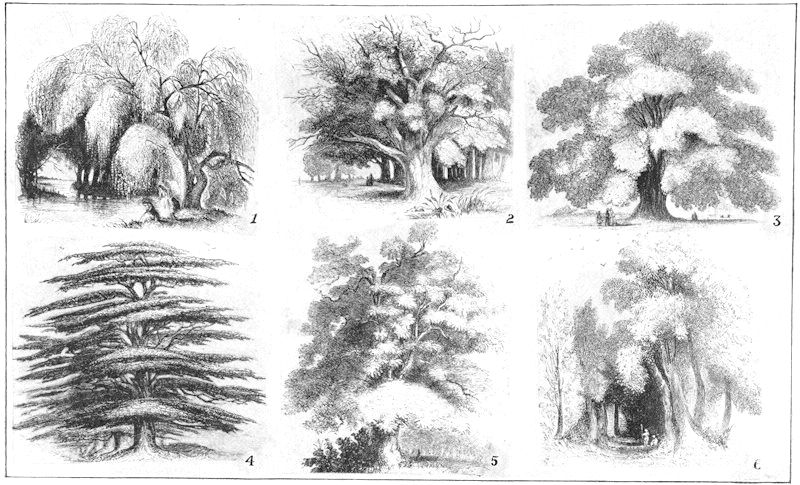
Six Familiar Tree Forms
1. Willow; 2. Oak; 3. Sycamore; 4. Cedar; 5. Chestnut; 6. Olive
“At Bodoë, in 67° 16′,” he continues, “I saw for the first time houses covered with turf, upon which grew many tufts of grass. According to my custom, I first examined the cultivated vegetables, but I saw only a few potatoes, peas, radishes, a few gooseberry-trees without fruit, and some fields of barley and rye. In the meadows just above the sea-level I found some plants which would have demonstrated to me, in the absence of other proofs, how much the climate of this country approaches that of the most elevated Alpine regions.
“At Hammerfest, which is under 70° 48′ north latitude, all attempts at cultivation had disappeared. The energies of the place are turned to commerce; it is from curiosity rather than for profit or utility that a few vegetables are cultivated.
“Near the city I observed rich meadows, that were cut once a year, and some herds of half-wild reindeer, which grazed and roamed about freely. We shall deceive ourselves, however, if we consider Hammerfest a dull or melancholy city. Its principal streets, on the contrary, consist of very fair new wooden houses, well ordered, and in all respects comfortable. These are the habitations of the better class of inhabitants. The houses of the lower classes are poorer and older; borrowing, however, a particular charm from the flowery turf with which they are covered. The roofs are formed of great squares of turf, on which a number of plants have germinated and grow vigorously. In seeing these aerial gardens I have for the first time been able to comprehend the phrase ‘in tectis’, which often occurs in the writings of Linnæus, indicative of the locality. In short, it was upon the roofs of houses that the learned botanist of Upsala herborized at Hammerfest; indeed, I frequently borrowed a ladder myself from the proprietor in order to gather the plants which grew round the chimney of one of these picturesque old houses. What I often found there were Cochlearia anglica, Lychnis diurna, Chrysanthemum inodorum, Shepherd’s Purse, Poa pratensis, and P. trivialis. In autumn, when the flowers of Chrysanthemum inodorum are in full bloom, these hanging meadows rival in beauty those of our own more genial climate, and give the city a smiling physiognomy which contrasts most happily with the severe aspect of surrounding Nature. Ranunculus glacialis, Arabis alpina, Silene acaulis, Saxifraga nivalis, Bilberries, Diapensia lapponica, Salix reticulata, S. herbarcea, etc., grow in the neighborhood.
“How great was my surprise on landing at the North Cape, in latitude 71°, to find myself in the middle of the richest subalpine meadows that can be imagined! high and tufted grass, which reached my knees. I found here, in short, at the northern extremity of Europe, the flowers which had so often attracted my admiration at the foot of the Swiss Alps; there they were, as vigorous, as brilliant, and much larger than among the mountains.”
The mid-European region includes southern Russia, Germany, Holland, Belgium, Switzerland, the Tyrol, and the British Isles, Upper Italy, and the greater part of France. This region, whose exact limits it would be difficult to trace, is very different from the preceding. It is milder, more temperate; its woods and forests consist essentially of oak (Quercus Robur), to which we may add chestnut, beech, birch, elm, hornbeam, alder, etc.; but the oak predominates. These trees, all of which lose their leaves during winter, give to the landscape a very peculiar feature, varying with the season. This region is especially favorable to the cultivation of the cereals. An oblique line, drawn from east to west, with certain inflections of its course, but ranging between the forty-seventh and forty-eighth parallel, and inclining a little toward the north, would divide it into two zones—one, the Northern, in which the vine and the mulberry yield to the rigor of winter, whose forests are chiefly composed of conifers, where the culture of the apple and pear takes their place, and which includes more Cyperacæ, Rosaceæ, and Cruciferæ; the other, the Southern, characterized by the culture of the vine, the mulberry, and the maize, and in which Labiatæ begin to predominate.
In the Southern region, the Mediterranean forms the centre. It is a vast basin, whose shores present a vegetation which, if not identical, is at least analogous in its whole extent. Labiatæ abound there, and in certain seasons the air is filled with their sweet perfume. To this extensive family we may add a large number of Caryophyllaceæ, Cistaceæ, Liliacæ, and Boraginaceæ. The Mediterranean draws its distinctive character, however, from the vast extent of uncultivated country, where the kermes oak, Phillyrea, the evergreen oak, and various half frutescent Labiatæ, reign supreme. These plants more especially abound in Italy, Spain, Greece, Algeria, and in the northern portion of Asia Minor. Nevertheless, a new vegetation makes its appearance at Rhodes and Jaffa, which becomes closely connected with that of Egypt. The vegetation of the Mediterranean often presents itself with a smiling and agreeable aspect. Clumps of odorous myrtles, Arbutus, and Vitex Agnus-castus, frequently occur on its shores; magnificent oleanders, whose praises have been sung by the poets, occupy the edges of the brooks. In Italy, Sicily, and Spain, the orange-trees bear without cessation flowers and fruit. The prickly pear (Opuntia vulgaris), and the American Agave, naturalized here, form impenetrable hedges in the southern parts of these countries, to which they give a marked and very characteristic landscape. The forests consist essentially of the evergreen oak (Quercus Ilex), whose persistent leaves remain until after their third year, and whose acorns, which have a very agreeable taste, form a considerable portion of the people’s food, and of the cork-tree (Quercus Suber), mixed with other characteristic trees and shrubs, such as Erica arborea, numerous species of Cistus, with ephemeral flowers, often large and of dazzling brilliance, and of Cytisus, Genista, etc.
Among the other species characteristic of these happy regions we may cite the cypress (Cupressus), the Aleppo pine, the stone pine, planes, the olive, which we scarcely meet with elsewhere; mastic-tree (Pistacia lentiscus), and the pomegranate (Ceratona Siliqua), etc.
Over a great part of the south coast of Sicily, a palm, the Chamærops humilis, with fan-like foliage, waves sometimes beside the date, from the bosom of a clump of oranges and citrons, its tall stipe crowned with an elegant panicle of drooping and feather-like leaves.
It would require a volume to give even an idea of the rich and varied vegetation of Asia. We must limit ourselves to a rapid glance of the features most characteristic of its Northern, Central, and Southern divisions.
The Northern region, or Siberia, forms a botanical region in close connection with the northern region of Europe in the one direction, and with its own middle region in the other. It has its own peculiar character, nevertheless, from the predominance of certain families, such as Leguminosæ, Ranunculaceæ, Cruciferæ, Liliaceæ, and Umbelliferæ. Some genera are remarkable for the number of their species; we may quote Astragalus among the Leguminosæ; Spiræa among the Rosaceæ; and Artemisia among the Compositæ. Considering that the mean temperature varies from 29° to 46° Fahr., we can not reckon on a condition of vegetation very varied. Forests are formed by larch, spruce, Pinus Cembra, P. sibirica, P. sylvestris, etc.; white and balsam poplars and isolated balsamic plants, dwarf birches, service-trees, alder buckthorn, alders, willows, accompany them, while whortleberries and rhododendrons form the under-shrubs. The flora of the steppes of Kamtchatka does not differ materially from that of the pasturages of central Europe. According as the spectator expects these to be rich or sterile, he is the more or less surprised to find stately tulips and graceful irises mingling with the grassy turf in spring, but the wormwood (Artemisia) and other monotonous forms of vegetation succeed them.
Humboldt assigns to the forests of the Ural the vegetation characteristic of a park. “They present,” he says, “an alternation consisting of a mixture of needle-leaved and round-leaved trees, and lawns; an assemblage which is completed by masses of brushwood, formed by wild roses, honeysuckles, and junipers, while Hesperis, Polemonium, Cortusa, Mathioli, magnificent primroses, and larkspurs form a perfect carpet of flowers; while the water buckbean, with white blossoms, is the grace of the marshes.” He saw also “on the banks of the Irtisch great spaces entirely colored red by Epilobium, with which were associated tall-stemmed larkspurs (Delphinium), with blue flowers, and the fiery-scarlet Lychnis chalcedonica.”
The Central region consists of northern China and Japan. The magnolias—those grand-leaved trees, with magnificent flowers and delicate aroma, which give such an attractive feature to gardens where they can be cultivated—are natives of this vast region. So is the camellia, which has been, as it were, naturalized in the greenhouses of Europe, whose evergreen, glossy, and persistent foliage is the admiration of travelers, and of which we may reckon upward of 700 varieties; and the tea-plant (Camellia Thea), of whose leaves so many millions of pounds are annually imported into Europe. Also the Aucuba, with coriaceous leaves and clustered flowers, so ornamental in our gardens and shrubberies; Celastrus, hollies, spindle-tree, Lagerströmia, Spiræa, Elæagnus, etc.
The most remarkable trees and shrubs besides these are the palm, Raphis flabelliformis; the paper mulberry (Broussonetia papyrifera); Osmanthus, whose flowers are employed to give flavor to tea leaves; the ebony-tree (Diospyros Kaki), with white flowers, and berries of a cherry-red, and of a delicious flavor; the loquat (Eriobotrya japonica); Salisburia adiantifolia, which is planted round the temples; yews (Taxus nucifera and verticillata); cypress (Cupressus japonica); junipers, thujas, oaks (Quercus glabra and glauca); Alnus japonica, Juglans nigra, and several species of laurels and maples.
Among the cultivated plants we find rice, wheat, barley, oats, Sorghum vulgare, Sago (Cycas revoluta), taro (Caladium esculentum), Convolvulus Batatas, apple, pear, quince, plum, apricot, peach, orange, radish, cucumber, gourds, watermelons, anise (Pimpinella Anisum), peas, beans, hemp, and cotton (Gossypium herbaceum)—a remarkable mingling of vegetable productions, which transports us at one moment from Asia to Europe, and at the next from America to Asia. We might dwell upon a crowd of ornamental plants, many of which are now well known in Europe, as the Glycine, the lily of Japan, tiger lily, and Chinese primrose.
The Southern region of Asia comprehends the two Indian peninsulas. Here non-tropical species disappear, or only present themselves very rarely. Tropical families become more numerous; the trees cease to lose their leaves; ligneous species are more numerous than without the tropics; the flowers are larger, more magnificent; climbing, creeping, and parasitic plants increase in number and size. India may be considered the true country of aromatic plants. Nor is the rich soil less fruitful in the production of suitable timber for constructive purposes.
Among the most abundant arborescent plants in this botanical region are Bombax, Sapindus, Mimosa, Acacia, Cassia, Jambosa, Gardenia; ebony (Diospyros Ebenus) has been celebrated for its black-colored solid wood from the most ancient times; Bignonia; teak (Tectona grandis), is a magnificent tree, which furnishes timber well adapted for building purposes from its great endurance; Isonandra Gutta produces gutta-percha; laurels have an aromatic bark; the nutmeg-tree (Myristica) produces seeds which are employed as spice; figs (Ficus religiosa, indica, elastica); palms, such as the Borassus (Borasus flabelliformis) with magnificent large fan-like leaves; Sagus, whose soft pulp yields sago, a farinaceous product very rich in starch; Calamus, whose twining and creeping stem is sometimes upward of 500 feet in length, of one uniform thickness, and of which the canes used in Europe are made; areca (Areca Catechu), the nut of which is a favorite masticatory with the natives; Corypha umbraculifera, the trunk of which, sometimes reaching the height of sixty or seventy feet, is crowned with an ample tuft of leaves spread out in umbrella form, covering a space of eighteen feet; Dracæna; screw-pines (Pandanus); last, but not least, the bamboo.
If we throw a glance, moreover, at the plants under cultivation, we find them equally important: rice, earth-nut, Sorghum, Indian corn, the cocoanut, the elegant and useful tree which gives to man almost all the necessaries of life, supplying him at once with shelter, food, light, heat, and clothing; the clove-tree (Caryophyllus aromaticus), the unopened flower of which is the well-known clove; pepper (Piper nigrum), the fruit of which, gathered before maturity, has been constantly brought to Europe since the expedition of Alexander the Great; and the betel (Chavica Betel), with bitter and aromatic leaves, in which the southern Asiatics inclose a few slices of the areca-nut, which they chew; the tamarind (Tamarindus indica), a magnificent tree, the fruit of which incloses a pulp of acid flavor; the mango (Mangifera indica), whose much-vaunted fruit has a sweet and richly perfumed flavor accompanied with a grateful acidity; the mangosteen (Garcinia Mangostana), whose berry incloses, under a bitter and astringent epicarp, a delicious pulp; the banana, whose yellow-clustered fruit, each six or eight inches long, furnishes a very nourishing food; the rose apple (Jambosa vulgaris), the guava (Psidium pomiferum), with yellow fruit of the size of a pear; oranges, watermelons, sugar-cane, and coffee.
Africa, like Asia, presents three very distinct regions: 1st, the Northern, which comprehends the Mediterranean littoral and the Sahara; 2d, the Central, which is tropical; 3d, the Southern, which includes the Cape of Good Hope.
The Mediterranean region, by which we mean the African littoral bathed by the Mediterranean, includes Algeria from the northern slopes of the Atlas to the sea, and the Delta of the Nile. This part of Africa represents, in many respects, a vegetation analogous to that of South Europe. In the mountain region of North Africa all the plants of Central Europe may be cultivated with advantage. The vine prospers in the neighborhood of Tlemcen, Milianah, Mascara, and Medeah, where the colonists and even the natives have undertaken its cultivation. The olive, so generally spread over North Africa, constitutes one of the chief sources of wealth to the Kabyle tribes. The cork-tree forms immense forests in the lower mountain region of the littoral: in the province of Constantine, gathering the cork has become an important trade since its conquest by France. With respect to the Sahara, M. Cosson, a traveler and botanist, thus expresses himself:
“Northern Africa is especially characterized by the extreme rarity of rains, the dryness of the atmosphere, and the extremes of temperature; the absence of great ranges of mountains and of permanent water-courses gives an aspect quite special to the desert-like vegetation. The number of species growing spontaneously does not exceed 500. The greater number of these are perennials, which grow in tufts, and have a dry and sterile aspect, giving them a characteristically rugged and hard appearance. The families represented in the Algerian Sahara in greatest number are Compositæ, Graminaceæ, Leguminosæ, Cruciferæ, and Chenopodiaceæ. Among the ligneous species are Tamarisks, a genus of elegant flowering shrubs, and the Pistacia atlantica. The date-tree is, however, the chief source of wealth in the gardens of the oases. This tree is cultivated, not alone for the abundance and variety of its products, but also for its shade, which secures other cultivated plants from the violence of the winds, and maintains in the soil the moisture required for the cultivation of other crops.
“Besides the date, an oasis generally presents an abundant crop of figs, pomegranates, apricots, frequently the vine. The peach, the quince, the pear, and the apple, are planted in gardens, and in the oases, the citron, the orange-tree, olives, barley, more rarely still, wheat, are cultivated in the irrigated lands of the neighborhood, and in the intervals between the date plantations. Onions, beans, carrots, turnips, and cabbages, occupy a large place among the plants cultivated. Pimento is also largely cultivated for the stimulating properties of its fruit, which render it a favorite condiment with the Arabs. The egg-plant and the tomato are cultivated in some gardens for their fruit. Numberless species of Cucurbitaceæ are also sown in the gardens in summer, and sometimes attain a great size. The gombo (Hibiscus esculentus) is cultivated here and there by the negroes for its mucilaginous fruit. The industrial and fodder plants are principally hemp, represented by a dwarf variety (Haschich), which is not employed as a textile plant, but its extremities are smoked by some of the less fervent Mussulmans. Tobacco is also cultivated. Henna (Lawsonia inermis), the leaves of which have been employed in dyeing a black color, scarcely exists except in the oasis of Ziban.”
The Central region is only very imperfectly known, in consequence of the terribly insalubrious nature of its coast. The same forms of vegetation, however, prevail there which are found in other tropical regions. We may remark here that the plants, which are usually herbaceous in countries without the tropics, become ligneous in these regions. This is the case with plants of the families Rubiaceæ and Malvaceæ. We note here also the almost entire disappearance of Cruciferæ and Caryophyllaceæ. The prevailing families are Leguminosæ, Terebinthaceæ, Malvaceæ, Rubiaceæ, Acanthaceæ, Capparidaceæ, and Anonaceæ. If we take a glance at prevailing vegetation proper to this region of Africa, we find upon the humid coasts impenetrable forests formed of mangroves (Rhizophora Mangle), and Avicennia tomentosa, Musa, Canna, Amomum, Pandanaceæ, gigantic Malvaceæ (such as the baobab), Bromeliaceæ, Aroideæ. Aloes (Aloe socotrina) furnishes the aloes of medicine; and several fleshy Euphorbias impress their strange characteristics upon the vigorous vegetation of this region.
It would be depriving African vegetation of its richest ornament not to mention its admirable palms. At their head stands the oil palm (Elæis guineensis), the fruit of which, of the size of an olive, contains so much oil that the liquid flows out when it is pressed between the fingers. The seed contains a sort of butter. The sap of this precious tree yields an excellent wine; its leaves prove excellent food for sheep and goats. But the true palm wine is produced from Raphia vinifera. Another remarkable member of this elegant family is Lodoicea Seychellarum, the fruit of which is larger than a man’s head and weighs upward of twenty pounds; it sometimes floats as far as the coast of India. It is a fact worthy of remark that in this region very few ferns or orchids are observed, and yet these groups of plants are extremely numerous in other tropical countries.
Among the exotic vegetables which are successfully cultivated in central Africa we may reckon maize, rice, Sorghum, Indian corn, manioc, Caladium esculentum, belonging to the family of the Araceæ, the rhizome and leaves of which are alimentary; the banana, the mango, the papaw-tree (Carica Papaya), the fruit of which, about the size of a small melon, is eaten either raw or cooked, and the pulp mixed with sugar forms a delicious marmalade; the pineapple, figs, coffee, sugar-cane, ginger, various species of Dolichos, the earth-nut, cotton, tobacco, and the tamarind.
The Southern region of the Cape of Good Hope is the country of the species of Protea, Pelargonium, Epacridaceæ, Oxalis, and Ixia, which decorate our hothouses and parterres. No other country can compare with this region for the prodigious abundance and dimensions of its heaths. While the plains of Europe, the Alps included, scarcely yield a dozen species, at the Cape there are many hundreds. They attain sometimes the height of fifteen or sixteen feet. Their leaves are small, inconspicuous, and acicular; but their flowers are large, and the colors which decorate them brilliant in the extreme, varying from the softest shades to dazzling ones.
The flora of this region is rich in vegetable forms, but it is by no means smiling in its aspect. We find no true forests, grand and sombre, in the whole region; there are few creeping plants, but, on the other hand, there are many succulents. The most characteristic families are the Restiaceæ, Iridaceæ, Proteaceæ, Ericaceæ, Mesembryanthaceæ, Rutaceæ, Gernaiaceæ, Oxalidaceæ, and Polygalaceæ. Among the characteristic genera we may mention the Ixia; Gladiolus, with their sword-shaped leaves and party-colored flowers; Strelitzia, so remarkable for their inflorescence, and for their blue and yellow flowers; Protea, so named for their diversity of appearance; Leucadendron, of which one species, L. argenteum (the silver-tree), rises to the height of from thirty to forty feet, its branches bearing lanceolate leaves, silky and silvery; Helichrysum and Gnaphalium, corymbiferous composites, better known as Immortelles; Mesembryanthemum, or ice-plants; Stapelia, leafless asclepiads, with angular fleshy stem and showy flowers, but somewhat fœtid odor; Phylica, a genus of Rhamnads somewhat resembling heaths, with abundant evergreen foliage and small cottony heads of white flowers; Pelargonium, of which an infinite variety of forms, the result of culture, are known; Oxalis, the evergreen Sparmannia, whose white flowers, stamens with purple filaments and irritable anthers, are so ornamental in orangeries. It is upon the sandy coast of this curious botanical region that the species of Stapelia, Iridaceæ, Mesembryanthemum, and Diosma abound. The heaths and crassulas grow upon the slopes of the mountains.
The cultivated plants are the cereals, most of the fruits and vegetables of Europe, the sorghum of Kaffirland, yam, banana, tamarind, and guava.
Vegetation is richer and more varied in America than in any other part of the globe. Beginning with North America, we find its polar vegetation quite analogous to that of Europe and Asia under the same latitudes. The willow, birch, and poplar, exposed to the persistent action of the cold, become stunted bushes; and saxifrages, mosses, and lichens prevail.
Without dwelling on the Arctic regions, then, we may divide this immense country into two regions; one of which, descending as far as 36°, may be called the Northern region; the other, comprehended between 36° and 30° of latitude, will constitute the Southern region.
The Northern region well deserves to be called the region of Aster and Solidago; those beautiful composites abound there with Liatris, Rudbeckia, and Galardia, of the same family. Œnothera, Clarkia, Andromeda, and Kalmia, charming ornamental plants, well known in our flower gardens, likewise characterize this vegetable zone. Among the most abundant arborescent species, we may mention numerous species of pine, fir, larch, Thuja, juniper; no less than twenty-seven species of willow; twenty-five of oak, beeches, chestnuts, elms, hornbeams, alders, birches, poplars, and ashes. With these are mingled the American plane, Liquidambar, the trunk and branches of which furnish juices used in medicine; the tulip-tree, with singularly truncate leaves and large, spreading, solitary, yellowish flowers; different species of maple, lime, Robinia, and walnut. Together with these numerous and varied arborescent species, which attain considerable dimensions, grow the Myrica cerifera, which furnishes an abundant wax drawn from the fruit by boiling; the currant (Ribes), with colored and ornamental flowers in great varieties of red, yellow, and white; the elegant Andromeda, Azalea, Rhododendron, and Spiræa, present themselves in endless varieties; sumacs, a species of which (Rhus toxicodendron), with greenish yellow flowers, contains a juice so acrid that contact with it produces blisters and erysipelas, and is a dangerous poison; Ceanothus, hollies, and buckthorns.
In the Southern region the vegetation somewhat resembles that of the tropics, being a transition between that of the temperate and torrid zones. Walnuts, elms, chestnuts, and oaks are found there, and with them three species of palms, one of which is Chamærops Palmetto; species of Yucca; of Zamia, among the Cycadaceæ; Passiflora; of woody twining plants, such as Bignonia sapindus; cacti, and laurels. Lastly, by the side of tulip-trees, Pavia, and Robinia, grow magnificent species of Magnolia, of which this is the true domain. The vegetation of this region is thus remarkable in its variety. The sugar-cane, indigo, cotton, and tobacco cover the cultivated plains. In Missouri, Texas, Arkansas, and Mexico, the great colony of the cacti raise their lofty stems. In this region Cactus, Opuntia, Cereus, Echinocactus, and Melocactus, raise their oddly branching stems and clustering flowers, the most remarkable of all doubtless being Cereus giganteus. It inhabits the wildest and most inaccessible regions, requiring little or no soil to attain a prodigious development. It has at first the appearance of an enormous tomahawk. Thence rises a column, three yards high, which branches off and assumes the shape of an immense candelabrum, the height of which may be twelve or thirteen yards. Mexico, according to the reports of botanists, may be divided into three regions of altitude. The first extends from the valleys as far as the oak forests—this is the region of palms, cotton, indigo, sugar-cane, coffee, and tropical fruits. The second, situated at an elevation of from 3,500 to 9,000 feet above the sea, is the temperate region. It stretches from the oak forests to the forests of Coniferæ. At this height the temperature is still sufficient to ripen some tropical fruits. The third, or cold region, occupies a space comprehended between the Conifers and perpetual snow. In many places it possesses a climate under which pear, apple, and cherry trees, and the potato, can still grow. In ascending from the foot of Orizaba, one sees successively appear and disappear Mimosa, Acacia, cotton, Convolvulus, Bignonia, oaks, palms, bananas, myrtles, laurels, Terebinthaceæ, tree-ferns, Magnolia, arborescent composites, plane, Storax, apples, pears, cherries, apricots, pomegranates, lemon and orange trees, orchids, Fuchsia, and Cactus.
The plains of Venezuela, known under the name of Llanos, are principally covered with grass-like plants, such as Kyllingia, Cenchrus, and Raspalum. With these we find a few dicotyledonous plants, such as Turnera; some Malvaceæ, and, what is very remarkable, species of Mimosa, with leaves quite sensitive to the touch, which the Spaniards call Dornuderas. The same race of cows which in Spain fatten upon sainfoin and clover, here find excellent nourishment in the herbaceous sensitive plants. The pasturage is richest, not only near rivers subject to inundations, but also where the trunks of the palm-trees are the most crowded, which can not be attributable to the shelter and protection which they have from the sun’s rays, since the palm of the Llanos (Corypha tectorum) has only a very few corrugated and palmate leaves, like those of Chamærops, and the lower are always parched and dried up. Besides the isolated trunks of palms we also find, here and there, in the Llanos, groups of palms, in which the Corypha mingles with a tree of the family of Proteaceæ—a new species of Rhopala, with hard and resonant leaves. In the Llanos of Caracas, the Corypha extends from the Mesa de Paja to Guayaval. More to the north and northwest it is replaced by another species of the same genus, with leaves equally palmate, but much larger. To the south of Guayaval other palms predominate, chiefly the pinnate-leaved Piritu (Guilielma speciosa) and the Mauritia flexuosa, the sago-tree of America, which supplies farinaceous food, good wine, thread to weave into hammocks, clothes, and baskets; its fruit, in shape resembling pine-cones, being covered with scales, like those of Calamus (Rotang), with something of the taste of an apple. The Guaranes, whose very existence, so to speak, depends on the Murichi palm, obtain an acid and very refreshing fermented liquor from it. This palm has large, shiny, corrugated, and fan-like leaves, maintaining a most beautiful verdure in times of the greatest drought. The sight of it alone in the Llanos produces an agreeable and refreshing sensation; and the Murichi, laden with its scaly fruit, contrasts singularly with the sad aspect of the palm of Cobija, the leaves of which are always gray and covered with dust.
If we ascend the Andes, between 20° south latitude and 5° north, at a height of from 5,000 to 10,000 feet above the sea level, we shall find extra-tropical forms of vegetation become more abundant: Graminaceæ; some Amentaceæ—such as the oaks, willows; Labiatæ; Ericaceæ; numerous Compositæ; Caprifoliaceæ; Umbelliferæ; Rosaceæ; Cruciferæ; and Ranunculaceæ. Tropical plants, on the contrary, disappear, or become very rare; but still, isolated species of palms, pepper-plants, Cactaceæ, passion-flowers, and Melastomaceæ are found at considerable heights. Among the most abundant ligneous species are the Ceroxylon andicola, the highest of all the palms, which reaches the height of 200 feet, and produces a wax which exudes from its leaves, and from the base of their petioles; willow and Humboldt’s oak; several species of Cinchona, which here reign supreme; a few hollies, and species of Andromeda. Vegetables cultivated between the tropics, in Mexico, and as far south as the river Amazon, disappear almost entirely here; but maize and coffee, the cereals and European fruits, are cultivated in these regions; potatoes; Chenopodium Quinoa, the seeds of which, when boiled, serve as food for the inhabitants of the mountains.
If we ascend to the height of 10,000 feet above the sea on the Andes, and in the same latitude, tropical forms of vegetation almost entirely disappear. Those, on the contrary, which characterize temperate climates, and even the Polar regions, become abundant. Large trees are no longer seen. Alders, bilberries, currants; Escallonia, with bitter and tonic leaves, of which this is the home; hollies and Drymis, are bushes belonging to these regions, as well as the curious calceolarias, with shoe-shaped corolla, the seeds of which have supplied horticulture with an infinite number of varieties. Among the characteristic families we also find Umbelliferæ, Caryophyllaceæ, Cruciferæ, Cyperaceæ, mosses and lichens. Returning to more circumscribed botanical districts, the climate of Caracas has often been called one of perpetual spring. A more delicious temperature can not be conceived. During the day it ranges between 60° and 68° Fahr., and in the night between 60° and 64°, at once favorable to the growth of the banana, the orange, coffee, the apple, apricot, and wheat.
We must not quit these regions without mentioning two beneficent trees—the Theobroma Cacao and the cow-tree, Brosimum Galactodendron. The roasted and crushed seeds of Theobroma Cacao, with the addition of sugar, make chocolate. Humboldt gives the following account of the cow-tree, which has the habit of Chrysophyllum Cainito: “The fruit is rather fleshy, consisting of one, sometimes two nuts. When incisions are made in the trunk an abundance of thick glutinous milk flows, which is without any acidity. This substance exhales a very agreeable balsam-like odor. It was presented to us in the fruit of the Calabash-tree. We drank considerable quantities of it in the evening before going to bed, and again early in the morning, without experiencing any injurious effects. Negroes and free people who work on the plantations drink of it, and soak their maize or manioc bread in it. The master of the farm assured us that the slaves fattened visibly during the season when the Palo de Vacca furnishes them with most milk. Upon the arid flank of a rock,” adds Von Humboldt, “there grows a tree whose leaves are dry and coriaceous, its great ligneous roots almost piercing the stone. During many months of the year not a shower waters its foliage, the branches appear dry and dead; but when the trunk is pierced a sweet and nourishing milk follows the incision.”
In order to penetrate to the heart of the vegetation of Brazil, the region of palms and Melastomaceæ, the land of promise to the naturalists, we shall take as our guide Martius and August de Sainte-Hilaire, who have written with much exactness on the vegetable wonders displayed in the Brazilian forests. Their aspect varies according to the nature of the soil, and the distribution of water traversing them. If these forests are not the seat of a constant supply of moisture, or if the moisture is only renewed by periodical rains, the drought stops the vegetation, and it becomes intermittent, as in European climates. This is the case in the Catingas. The vegetation of the untrodden forests, on the contrary, of which Sainte-Hilaire gives an eloquent picture, is the reverse of this; excited by the ceaseless action of the two agents, humidity and heat, the vegetation of the virgin forests remains in a state of continual activity. The winter is only distinguished from the summer by a shade of color in the verdure of the foliage; and if some of the trees lose their leaves, it is to assume immediately a new appearance. “When a European arrives in America, and sees from a distance the untrodden forests for the first time, he is astonished not to see the singular forms which he admired in European hothouses, but which are here mingled in masses and lost. And he is astonished at the little difference in the outline of the forests between those of his own country and those of the New World, and he is only struck with the proportions and the deep green color of the leaves, which, under the most brilliant sky imaginable, impart a grave and severe aspect to the landscape. In order to appreciate all the beauties of the tropical forest we must plunge into retreats as old as the world. Nothing there reminds us of the fatiguing monotony of our oak and fir forests: each tree has a bearing peculiar to itself. Each has its own foliage, and often its own peculiar shade of verdure. Gigantic specimens of vegetation, each belonging to different, sometimes to remote, families, mingle their branches and blend their foliage. Five-leaved Bignoniaceæ grow beside Cæsalpinia, and the golden leaves of Cassia spread themselves in falling upon arborescent ferns. Myrtles and Eugenia, with their thousand-times-divided branches, are finely contrasted with the elegant simplicity of the palms; Cecropia spreads its broad leaves and branches, which resemble immense candelabra, among the delicate foliage of Mimosa. There are trees with perfectly smooth bark, others are defended by prickly spines; and the enormous trunk of a species of wild fig spreads itself out with sloping plates, which seem to support it like so many arched buttresses. The obscure flowers of our beeches and oaks only attract the attention of naturalists; but in the forests of South America gigantic trees often display the most brilliant colors in their corolla. Long golden clusters hang from the branches of the Cassia. Vochysia erect a thyrsus of odd-shaped flowers. Yellow and sometimes purple corollas, longer than those of our Digitalis, cover in profusion the species of trumpet-flowered Bignonia; and Chorisia is decked with flowers which resemble our lily in shape, and remind us of Alstromeria from the mixture of colors they present. Certain vegetable forms, which assume at home very humble proportions, present themselves with a floral pomp unknown in temperate climates; some Boraginaceæ become shrubs; many Euphorbiaceæ assume the proportions of majestic trees, offering an agreeable shelter under their thick umbrageous foliage.”