THE STORY OF THE UNIVERSE (continued 6)
Reading edition
Dreadful, on the contrary, is the action of the terrible wourali poison, which the inhabitants of the banks of the Orinoco concoct with mystic conjurations, the chief ingredients of which are furnished by the juice of a plant belonging here (Echites suberecta) and the bark of another, likewise an Apocynaceous tree, Strychnos guinanensis and Strychnos toxifera. The North Americans also use an Apocynaceous plant (Gonolobium macrophyllum) to poison their arrows; and Mungo Park related the like of the Mandingoes of the Niger (according to him it is a species of Echites).
Many allied plants are among the most active poisons (Cerbera Thevetia and Cerbera Ahovai), and the seeds of this group, in particular, are almost more remarkable for their deadliness than those of the foregoing, for two of the most violent vegetable poisons, strychnine and brucine, occur in them. Some of our most active medicinal substances are especially known on this account; for instance, the St. Ignatius’s beans (Ignatia amara from Manila), and the Nux vomica (Strychnos nux Vomica), distributed throughout the tropics.
It would not be difficult to make some of the more important characters of the two families I have mentioned so clear, even to a person unacquainted with botany, that he would be enabled readily to distinguish any plant belonging to them. Very different is it with the following, the last group, the Jussieuan family of nettle-plants, or Urticaceæ. The plants belonging to this vary in the most striking manner in their external forms, from the smallest, most insignificant weeds, like our common pellitory of the wall and our nettles, to vast and stately trees like the breadfruits (Artocarpus integrifolia and incisa), which, with their wide-stretched branches and broad, beautifully formed leaves, overshadow the huts of the South Sea Islander, who lives upon their savory fruit. As in the family of the spurges, only some few plants bestow in their seed a pleasant nut-like kernel (as Aleurites triloba in the Moluccas, Conceveiba guianensis in South America); as in the Apocynaceous group, several trees afford cooling, juicy, and therefore highly valued fruits to the inhabitants of hot regions (Carissa Carandas in the East Indies, Carissa edulis in Arabia, etc.), so the family of the Urticaceæ includes the strangest multiplicity of fructifications. The little oil grains of the hemp, the green grape-like bunches which gracefully adorn the slender twining hop, the aromatic mulberry, the sweet fig, the useful bread-fruit, all those so various forms belong to one group of plants, and the botanist traces in all the same fundamental structure, however incongruous these manifold shapes may appear to the eye of the uninitiated. One peculiarity alone extends without exception throughout all the species of this large order, namely, the presence of fine but strong bass-fibres in the bark. The German name for muslin, Nessel-tuch (nettle-cloth), denotes the source from whence the fibre of which it is made was originally obtained (Urtica cannabina), and the skilful industry of the gentle Tahitan prepares the most delicate stuff, without spinning-wheel or loom, from the fine white bass of the auté of paper-mulberry (Broussonetia papyrifera).
An elegant tree, allied to the last, the Holquahuitl of the Mexicans, or Ule di Papantla of the Spaniards (Castilloa elastica Deppe), furnishes the caoutchouc of New Spain, and the inconceivable quantities of this substance which are brought to our ports from the East Indies are collected in great part from the venerable fig-trees in which that Asiatic tropical world is so rich. On a trunk of giant girth, but seldom more than fifteen feet high, rests the enormous crown of the banyan, or holy fig (Ficus religiosa); the branches often run a hundred feet horizontally out from the trunk, sending down to the ground, at various intervals, long straight roots, which quickly penetrate and take firm hold, thus becoming props to the long branches. These wonderful trees, each one resembling a small wood, are dedicated to the god Fo, and the helpless, lazy Bonze builds his hut, not unlike a bird-cage, in its branches, in which he passes the day, sometimes asleep, sometimes dreaming in contemplative indolence in the pleasant cool shade. These great fig-trees (Ficus religiosa, indica, benjaminea, elastica) have sweet fruits, and their milk-sap contains the interesting caoutchouc. Some of these plants also yield a harmless juice. By far the most remarkable in this respect is the Palo de Vacca or Arbol de Leche, the cow-tree of South America (Galactodendron utile), which was first made known to us by Alexander von Humboldt. When a tolerably large incision is made into the trunk of this tree, a white, oily, fragrant, and sweet fluid, very similar to animal milk, flows out in sufficient quantity to refresh and satisfy the hunger of several persons.
A striking contrast to this is afforded by the properties of other nettle-plants. One is tempted to call them the serpents of the vegetable kingdom; and the parallel is not difficult to carry out. The similarity between the instruments with which both produce and poison their wounds is very remarkable. The snakes have in the front of the upper jaw two long, thin, somewhat curved teeth, which are perforated lengthwise by a minute canal, which opens in front at the sharp point. These teeth are not fixed firmly in the jaw like the others, but movable, like, but in a less degree, the claws of a cat. Beneath each tooth, in a cavity in the jaw, lies a little gland, in which the poison is prepared, and the excretory duct of this gland runs through the canal in the tooth, and opens at its apex. When the animal bites, the resistance of the bitten body pushes back the tooth, so that it presses upon the gland, which squeezes out of it the deadly fluid into the wound. If we examine, now, the hairs on the leaf of the nettle, we find a wonderful agreement. The stinging hair consists of a single cell, terminating above in a little knob. Below, it expands into a small sac, which contains the irritating juice.
The slightest touch breaks off the brittle point with the little knob, the canal of the hair is thus opened, and it penetrates any soft substance; in consequence of the pressure which the resistance to its entry exerts upon the sac, a portion of the poisonous juice is ejected out into the wound. The poisons of our native nettles and snakes are not of much consequence, but the nearer we approach the tropics, the more frequent and more deadly they both become. Where the glowing Indian sun ripens the poison of the fearful spectacle snake, there grow the most dangerous nettles.
Every one among us has felt the slight but irritating sting of the nettle which it produces by its slender poisonous hair, but we have no notion of the torture which its near allies (Urtica stimulaus, Urtica crenulata) produce in the East Indies. A gentle touch suffices to cause the arm to swell up with the most frightful pain, and the suffering lasts for weeks; nay, a species growing in Timor (Urlica urentissima) is called by the natives Daoun Setan (devil’s leaf), because the pain lasts for years, and often even death can only be avoided by the amputation of the injured limb.
We do, indeed, find many violent poisons in this family, and even some species of fig are included among the most dangerous plants (Ficus toxicaria), but it is not worth while to linger among those of lesser importance. The tales recounted of the Upas and the Poison-valley mingle almost like a dark and gloomy legend in our knowledge of the East Indian islands.
In the Sixteenth Century stories circulated about the macassar poison-tree of the Celebes; and physicians and naturalists came gradually to tell of the action of the poison, the descriptions of which had become so terrible that if the smallest quantity entered the blood, not only immediate death resulted, but its action was so fearfully destructive that within half an hour afterward the flesh fell from the bones. From Rumph we learned that the poison-tree is also met with in Sumatra, Borneo, and Bali, as well as in Celebes. But the Dutch surgeon, Försch, first spread the wild tales of the poison-tree of Java about the end of the Eighteenth Century.
Two very different trees grow in those little visited primeval forests of Java. All the paths leading to them are closed and watched, like those leading to the gates of the Holy of Holies. With fire and axe must the road be made through the impenetrably interwoven mass of lianes, the paullinias, with their clusters of great scarlet blossoms several feet long, the cissi or wild vines, on the widespread creeping roots of which thrives the gigantic flower of the Rafflesia Arnoldi. Palms, with spines and thorns, rush-like plants with cutting leaves, wounding like knives, warn the intruder back by their attacks, and in every part of the thicket threaten the fearful nettles formerly mentioned. Great black ants, whose painful bite tortures the wanderer, and countless swarms of tormenting insects pursue him. Are these obstacles overcome? Yet follow the dense bundles of bamboo stems, as thick as a man’s arm, and often fifty feet high, the firm glassy bark of which repels even the axe. At last the way is opened and the majestic aisles of the true primeval forest now display themselves. Gigantic trunks of the bread-fruit, of the iron-like teak (Tectona grandis), of Leguminosæ, with their beautiful blossoms, of Barringtonias, figs, and bays, form the columns which support the massive green vault. From branch to branch leap lively troops of apes, provoking the wanderer by throwing fruit upon him. From a moss-clad rock the melancholy orang-outang raises himself gravely on his staff, and wanders into deeper thickets. All is full of animal life; a strong contrast to the desert and silent character of many of the primeval forests of America. Here a twining, climbing shrub, with a trunk as thick as one’s arm, coils round the columns of the dome, overpassing the loftiest trees, often quite simple and unbranched for a length of a hundred feet from the root, but curved and winding in the most varied forms. The large, shining green leaves alternate with the long and stout tendrils with which it takes firm hold, and greenish-white heads of pleasant smelling flowers hang pendent from it. This plant, belonging to the Apocynaceæ, is the Tjettek of the natives (Strychnos Tieute), from the roots of which the dreadful Upas Radia, or Sovereign Poison, is concocted. A slight wound from a weapon poisoned with this—a little arrow made of hard wood, and shot from the blow-tube, as by the South Americans—makes the tiger tremble, stand motionless a minute, then fall as though seized with vertigo, and die in brief but violent convulsions. The shrub itself is harmless, and he whose skin may have been touched with its juice need fear no consequences. As we go forward, we meet with a beautiful slender stem, which overtops the neighboring plants. Perfectly cylindrical, it rises sixty or eighty feet, smooth and without a branch, and bears an elegant hemispherical crown, which proudly looks down on the more humble growths around, and the many climbers struggling up its stem. Woe to him who heedlessly should touch the milk-sap that flows abundantly from its easily wounded bark. Large blisters, painful ulcers, like those produced by our poisonous sumach, only more dangerous, are the inevitable consequences. This is the Antiar of the Javanese, the Pohon Upas (signifying poison-tree) of the Malays, the Ipo of Celebes and the Philippines (Antiaris toxicaria).
NUTS —Grant Allen
On the wooded slope where the park shelves slowly toward the Bourne Brook, the ground to-day (October) is thickly strewn in many places with the sharp, prickly husks and small, barren, angular nutlets of the beautiful Spanish chestnuts. They are not truly indigenous to Britain, these noble spreading forest trees, though they have been planted so long in our pleasure grounds and lawns that we have got to look upon them almost as naturalized British subjects; and the climate, though it suits the leaves and wood well enough, is not sufficiently kindly to ripen the fruits in due season; they are almost always mere empty, shriveled shells here in England, so that we have to import seed for sowing from the mountain regions of Southern Europe. There we have all seen them growing in their own wild luxuriance on the lower escarpments of the Alps or the Apennines, and bringing forth fertile nuts sufficient to feed half the teeming population of the Lombard plain in seasons of scarcity. Side by side with them in the park here, the boys are impartially shying sticks at the very similar, though wholly unrelated, clusters of the common horse-chestnuts, which, in spite of their close external likeness, belong in reality to a totally different and much more restricted family. The true chestnut is a catkin bearer, a near relation of the English oak, as one might almost guess at sight from its foliage and habit; the horse-chestnut is a member of a tribe unrepresented in our native English flora, but not very unlike the maples and sycamores in its principal characters. It is interesting to note how in the case of these two wholly different and originally dissimilar trees similarity of circumstances has at last produced such great similarity of adaptive peculiarities.
The key to this strange resemblance between the chestnut and the horse-chestnut is to be found in the fact that they are both nuts—they have survived in the struggle for existence by adopting for their seed-vessels the exactly opposite tactics from those adopted by the true fruits. A fruit, as we have often seen, is a seed-vessel which lays itself out, by all the allurements of bright color, sweet scent, sugary juices, and nutritive properties, to attract animals who will aid it by swallowing it, and so eventually dispersing its seeds. But a nut is a seed-vessel which, on the contrary, being richly supplied with starches and oils for the supply of the young plantlet, would be injured and diverted from its real intent and purport if it were to be eaten and digested by any animal. Accordingly, nuts have concentrated all their efforts upon repelling rather than attracting the attention of animals; or, to put it in a more strictly physical way, those nuts which have happened to be least attractive in color and most protected by hairs, spines, prickles, or bitter juices have best succeeded in escaping the attacks of animals, and so have prospered best in the struggle for existence. Thus, to drop into metaphor once more, while the fruits want to be eaten, the nut, on the contrary, wants to escape.
We may take the chestnut as a very good example of the general result which the necessity for protection usually produces in these peculiar seed-vessels. While it still grows on the tree the entire fruit is green and unobtrusive, hardly noticeable at a little distance among the heavy foliage which covers it on every side. Compare this shrinking and secretive habit with the brilliancy and vividness of oranges and mangoes, or even with our own bright-colored northern rose-hips, and haws, and mountain ashes, and holly-berries. Again, instead of being smooth skinned and soft, like these bird-enticing fruits, the outer rind of the chestnut is rough and repellent with serried prickles, which rudely wound the tender nose of the too inquisitive squirrel, or even the feathery cheeks of the more protected nut-hatch. Once more, when the separate nuts inside have fallen out upon the ground, they are no longer green like the foliage upon the tree, but light brown or “chestnut,” like the dead leaves and withered bracken into whose midst they have gently fallen. Chestnuts themselves are apparently sufficiently protected by these devices of color and prickliness; they do not seem further to require the special nut-like covering of a hard and woody shell; but the filbert, which suffers far more from the depredations of dormice, squirrels, nut-hatches, and other birds or mammals, has not only incased itself without in a green husk covered by sharp and annoying little hairs, but has also acquired a very solid and difficult shell, which often succeeds in baffling even the keen teeth or beaks of its persistent and aggressive animal foes.
Indeed, even among British nuts, one may trace a regular gradation (not, of course, genealogical) from the softest and least protected to the hardest and most defensive kinds. The acorn, produced in vast numbers by a very large and long-lived tree, the oak, has hardly any need of a strong outer coat of armor, especially as its kernel is rather bitter and far from attractive to most animals, though it still feeds a considerable legion of hoarding squirrels, and must once have been munched in immense quantities by the native wild boars, or their mediæval successors, the half-tamed forest swine. In the beech, the shell of the actual nut itself is merely leathery; but the outer coat or involucre is sprinkled over with distinctly protective prickles. (It is worth while to note in passing that the beechnuts or mast rarely contain a kernel in Britain—in other words, they are almost always sterile; whereas in other countries where the beeches are more sturdy, the nuts are usually fertile; and this fact may be put side by side with the corelative fact that the beech is a decadent tree in England, where it was once dominant, but is now rapidly dying out before our very eyes, at least in its indigenous form.) In the lime, the very small nut has a decided shell, while its globular shape also makes it difficult for quadrupeds to open with their paws and teeth. Finally, in the hazel, the filbert has a very hard integument indeed, and a disagreeable, husky covering of smarting hairs.
Our own English nuts are only exposed to the attacks of extremely small and comparatively harmless mammals, or of inconsiderable native birds; and, therefore, their defensive tactics have never been carried any further than in the case of the hedgerow filbert. But in southern climates, and especially in the tropics, nuts are exposed to far larger and more dangerous forestine foes, like the monkeys and parrots, against whose teeth or bills, as we all know, even the solid shell of the Barcelona cob is absolutely no protection. Hence, under these circumstances, only the very hardest or most disagreeable nuts have been able to survive and to grow up in due time into flourishing nut-trees. Sometimes, as in the walnut, the chief protection is afforded by a nauseous outer rind—a system which reaches its climax in the South American cashews, whose pungent juice blisters the skin like a cantharides plaster; sometimes, as in the cocoanut, it is afforded by great thickness and hardness of shell, which sets at naught the most persistent endeavors of the hungry aggressor. In the Brazil nut, a number of sharp, angular nuts are crowded together inside a large and hard outside shell, so that even after the monkey has managed to crack the big outer nut, he has still to open all the inside nuts one by one in detail. It is worth while to notice, too, that an exactly similar modification is undergone in the tropics by the stones of stone-fruits; which are really nuts in disguise, covered only by a soft, sweet pulp that entices animals to aid in dispersing them, by dropping the hard seed on to the ground in favorable spots for its growth. In temperate climates the stones are only hard enough to defy squirrels and birds: in tropical countries they are hard enough to defy monkeys and parrots. Compare, for example, the English sloe or bird-cherry with the peach-stone, and the English haw with the mango or vegetable ivory. This last nut is one of the oddest in the whole range of nature, for it is here the actual kernel itself that grows so hard and horny. Yet even the vegetable ivory, which consists really of very solid starchy cells, softens and yields up its material to the growing plant as soon as the embryo it incloses begins to sprout under the influence of warmth and moisture.
THE CACTUS TRIBE —M. J. Schleiden
Let us leave the forest of Guiana, the last mat-roof of the Guaranese between the trunks of the Mauritius palm, and enter the pampas of Venezuela, of which Humboldt has sketched such a clever and vivid picture. No smiling verdure clothes the glowing rock-soil here; here and there in its crevices the Melocactus displays its round balls, “horrid” with threatening thorns. Ascend we thence the Andes; instead of tender grass, the earth is covered with pale, gray-green globes of spiny Mamillarias, while, intermingled, rises the solemn and mournful old-man cactus, with its venerable-looking long gray hair. Borne on the wings of fancy further north, we descend into the plains of Mexico, where the gigantic fragments of the city of the Aztecs, a product of a solitary era of civilization long lost to history, display themselves; the landscape spreads out before us as the bare and naked Tierra caliente, parched by the glowing sun; of a dull green hue, without a branch or leaf, the angled-columns of the torch-thistles rise twenty or thirty feet high, hemmed in with an impenetrable thicket of irritably pricking Indian figs, while round about appear the strangest, ugliest forms, in the groups of the Echinocacti and little Cerei, between which creeps snake-like, or as some great poisonous reptile, the long, dry stem of the great flowered cactus (Cereus nycticallus). In short, one family accompanies us through all our wanderings, that of the cactus plants, which seems in all its wondrous forms to withdraw itself entirely from the principle of beauty, and yet at the same time presses forward so strikingly, so determinately marking the peculiar character of the landscape, that we are compelled to turn our attention to it. And in truth, a group which appears to retreat so far from all the laws of other plants deserves our interest in a very high degree.
Everything about these plants is wonderful. With the exception of the genus Peireskia, no plant of the order possesses leaves. Those parts of Cactus alatus, and the Indian fig, which are commonly called leaves, are nothing but flattened expansions of the stem. On the other hand, they are all distinguished by an extraordinarily fleshy stem, which, clothed by a grayish-green, leathery cuticle, and beset, in the places where leaves are situated in regular plants, with various tufts of hair, spines, and points, gives by its very varied degrees of development the varied character of the plants. The torch-thistles rise in form of nine-angled or often round columns to a height of thirty or forty feet, mostly branchless, but sometimes ramifying in the strangest ways, and looking like candelabra; the Indian figs are more humble; their oval, flat branches, arranged upon one another on all sides, produce special forms. The lowest and thickest torch-thistles connect themselves with hedgehog and melon-cacti, with their projecting ribs, and thus lead us to the almost perfectly globular Mamillarias, which are covered very regularly with fleshy warts of various heights. Finally, there are forms in which the growth in the longitudinal direction prevails, which with long, thin, often whip-like stems, like those of the serpent-cactus, hang down from the trees upon which they live as parasites.
Few families have so limited a range of distribution upon the globe. All the species of cactus, perhaps without a single exception, are indigenous in America, between the parallels of 40° S. lat. and 40° N. lat. But some of them were so rapidly distributed through the Old World directly after the discovery of America, that they may almost be looked upon as fully naturalized there. Almost all delight in a dry situation, exposed to the burning rays of the sun, which contrasts strangely with their fleshy tissue, tumid with watery and not unpleasantly flavored with acid juice. This peculiarity gives them inestimable value to the fainting traveler, and Bernardin de St. Pierre has aptly called them the “Springs of the Desert.” The wild ass of the llanos, too, knows well how to avail himself of these plants. In the dry season, when all animal life flees from the glowing pampas, when cayman and boa sink into death-like sleep in the dried-up mud, the wild ass alone, traversing the steppe, knows how to guard against thirst; cautiously stripping off the dangerous spines of the Melocactus with his hoof, and then in safety sucking the cooling vegetable juice. In vertical extension, the cacti are not confined within such narrow limits, and they stretch from the lowest tracts along the coast, through the vast plains, up to the highest ridges of the Andes chain. On the shore of Lake Titicaca, 12,700 feet above the level of the sea, are seen the tall-stemmed Peireskias with their splendid deep brown-red blossoms, and on the plateaus of southern Peru, near the limit of vegetation, therefore about 14,000 feet high, the wanderer is surprised by peculiar shapes of a yellowish-red color, which at a distance look like reposing savages, but which a closer inspection reveals to be shapeless heaps of low cacti, closely beset with yellowish-red spines.
What Nature has withheld, however, in external aspect, she has, in most, richly replaced in the magnificent blossom. We are astonished to find the deformed gray-green mass of the Mamillaria decked with the most beautiful purple-red flowers. Strange is the contrast between the wretched and gloomy aspect of the naked, dry stem of the large-flowered torch-thistle (Cereus grandiflorus), and its large, splendid, Isabel-colored,[8] vanilla-scented, flowers, which, unfolding under cover of the silent night, beam like suns, and in the wonderful sporting of their stamens, seem almost to strive toward a higher—an animal life.
But it is not the beauty of the blossom alone which gladdens us, not the refreshing sap alone that revives the languishing traveler. The economic uses are also manifold. Almost all the cacti bear edible fruit, and a portion of them are among the most delightful refreshments of the hot zones which ripen them. Almost all the Opuntias, known by the name of Indian figs, furnish, in the West Indies and Mexico, a favorite dessert fruit, and even the little rose-red berries of the Mamillarias, which with us are tasteless, have, beneath the tropics, a pleasant, acidulated, sweet juice. We may say, in general terms, that their fruit is a nobler form of our native gooseberry and currant, to which also they are the nearest allies in a botanical point of view. Succulent as is the stem of most of the cacti, yet, in the course of time, they perfect in it a wood as firm as it is light. This is especially the case in the tall columnar species of cereus, the old dead stems of which, after the decay of the gray-green rind, remain erect, their white wood standing ghost-like among the living stems, till a benighted traveler seizes it in that scantily wooded region, to make a fire to protect him from the mosquitoes, to bake his maize-cake, or burns it as a torch to light up the dark tropical night. It is from the last use that they have obtained the name of torch-thistles. These stems, on account of their lightness, are carried up on mules to the heights of the Cordilleras, to serve as beams, posts, and door-sills in the houses; as, for instance, in the mayoral of Antisana, perhaps the highest inhabited spot in the world (12,604 feet). Just as their allies, the gooseberry bushes, are used by our country people to form hedges to their gardens, are the Opuntias in Mexico, on the west coast of South America and in the southern part of Europe, and with greater success in the Canaries; their firm, shapeless branches soon interweave themselves into an impenetrable barrier, opposing, by their dreadful spines, an insuperable obstacle to the intruder. Lastly, the medicine-chest does not go away empty, for the physicians of America make abundant use of the acid juice for fomentations in inflammations, not to mention some other prescriptions.
In the same way that grass and clover are not immediately valuable to man, but serve as food for useful animals, so it is with a number of cacti, which support an insect of extraordinary importance. This is the cochineal insect (Coccus Cacti), a little, very insignificant creature, externally just like the little, white, cottony parasite, which is so often found upon the plants in our hothouses, and yet, through the invaluable coloring matter it contains, so infinitely different from it.
While the ugly form, the splendor of the blossom, and the manifold uses of the cactus plants attract general interest in a high degree, they are not less interesting, in a narrower sphere, to the botanist. Zoologists have at all times found in the examination of monstrosities and aberrant forms rich material toward the clearing and expanding of their knowledge of the regularly developing organism. It is to be expected, therefore, that similar conditions will have similar value in the vegetable world; and what family could be better selected for this purpose than the Cactaceæ, which seems to be but a natural museum of monstrosities, where the forms are, in some cases, so abnormal that no other name could be thought of for one species but that of the deformed cactus (Cereus monstrosus)?
It is believed that from the vast amount of watery juice in the cactus tribe, joined to the fact that most of them, and exactly those richest in sap, vegetate on dry sand, almost wholly devoid of vegetable mould, where they are besides exposed often three-fourths of the year to the parching sunbeams of an eternally serene sky; from this combination of circumstances, even, it is thought that we may the more safely conclude that these plants draw their nourishment from the air, since in our own hothouses also it has been observed that the branches of cactus stems cut off and left forgotten in a corner without further care, far from dying, have frequently grown on and made shoots three feet long or more. De Candolle first found the right path when he weighed such cactus shoots which had grown without soil, and found that the plant, though larger, was always lighter, therefore, instead of abstracting anything from the atmosphere, must rather have given up something to it. All the growth takes place, in such cases, at the expense of the nutritive matter previously accumulated in the juicy tissue, and it generally exhausts the plant to such a degree that it is no longer worth preserving. It is that succulent tissue which enables the cactus plants—one might compare them with the camels—to provide themselves beforehand with fluid, and thus to brave the rainless season. Their anatomical structure also assists them in this respect in a peculiar manner. We know from the experiments of Hales that plants chiefly evaporate the water they contain through their leaves, and the cactus tribe have none. Their stem, too, unlike that of all other plants, is clothed with a peculiar leathery membrane, which wholly prevents evaporation. This membrane is composed of very strange, almost cartilaginous, cells, the walls of which are often traversed by elegant little canals. Its thickness varies in different species, and it is thickest, and therefore most impenetrable, in the Melocacti, which grow in the driest and hottest regions, while it is least remarkable in the species of Rhipsalis, which are parasites on the trees of the damp Brazilian forests.
Another striking point about this group is the formation of an extraordinary quantity of oxalic acid. If this acid were collected in large amount in the plant, it must necessarily be dead to it. The plant, therefore, takes up from the soil on which it grows a proportionate quantity of lime, which combines with the oxalic acid, forming insoluble crystals, which occur in abundance in all the Cactaceæ.
A third peculiarity is exhibited in the globular forms of Melocactus and Mamillaria, in the structure of the wood, which differs entirely from that of the common ligneous plants. Common wood, for example that of the poplar, is composed of long wood-cells, the walls of which are quite simple and uniform, and of cells containing air, the so-called vessels, the walls of which are very thickly beset with little pores. Wholly unlike this, the wood of the cactus, above-mentioned, exhibits only short, spindle-shaped cells, inside which wind most elegant spiral bands, looking like little spiral staircases.
Lastly, the hair, spines, etc., situated in the places of leaves, deserve a special mention. Generally speaking, three forms may be distinguished, all three usually occurring together on the same spot. The first are very flexible, simple hairs, which form a little flat, soft cushion; among these is found a bunch of longish but thin spines. These it is chiefly which, on account of their peculiar structure, make the careless handling of the cactus plants so dangerous. These little spines are very thin and brittle, so that they readily break off, and are covered with barbed hooks directed backward from the point. When touched, a whole bunch penetrate the skin; if an attempt is made to draw them out, the separate spines break in the skin, and the fragments pierce in other places; when the hand is drawn over them, they catch in, and an insufferable itching, terminating in a slight inflammation, spreads over all the parts which have been touched. The Opuntia ferox is especially remarkable for these spines, whence its name, the savage. Among the hairs and smaller spines arise very long and thick spines, in different form and number, which give the best characters for the determination of the species. In some these are so hard and strong that they even lame the wild asses which incautiously wound themselves, when kicking off the spines to reach the means to still their thirst. In Opuntia Tuna, which is the kind most frequently used for hedges, they are so large that even the buffaloes are killed by the inflammation following from these spines running into their breasts.
FUNGI —Hugh Macmillan
Fungi are intimately associated with autumn; unrobed prophets that see no sad visions themselves, but that bring to us thoughts of change and decay. Indeed, so close is this association that they may be called autumn’s peculiar plants. The bluebell still lingers on the wayside bank, and in the woods a few bright but evanescent and scentless flowers appear, but fungi and fruits form the wreath that encircles the sober and melancholy brow of autumn: fruits, the death of flower-life; fungi, the resurrection of plant-death. The seasonal conditions which arrest the further progress of all other vegetation, which cause the leaf to fall, and the flower to wither, and the robe of nature everywhere to change and fade, give birth to new forms of plant-life which flourish amid decay and death. From the relics of the former creations of spring and summer reduced to chaos, springs up a new creation of organic life; and thus nature is not a mere continuous cycle of birth, maturity, and decay, but rather a constant appearance of old elements in new forms.
In many respects they are the most mysterious and paradoxical of all plants. In their origin, their shapes, their composition, their rapidity of growth, the brevity of their existence, their modes of reproduction, their inconceivable number and apparent ubiquity, they are widely different from every other kind of vegetation with which we are acquainted. In studying their history we walk amid surprises; and as we lift each corner of the veil, more and more marvelous are the vistas that reveal themselves.
The first thing that suggests remark in regard to these curious organisms is their origin. Incapable of deriving the elements of growth from the crude unorganized crust of the earth, they are parasitical upon organic bodies, and are sustained by animal and vegetable substances in a state of decomposition. That living and often nutritious objects should spring from festering masses of corruption and decay; that plants, endowed with all the organs and capacities of life, should start into existence from the dead tree that crumbles into dust at the slightest touch, or draw their nourishment from dried and exhausted animal excretions, which have lain for months under the influence of drenching rains and scorching sunbeams, is indeed a profound mystery of nature. No sooner does the majestic oak yield to the universal law of death, than several minute existences, which had been previously bound up and hid within its own, reveal themselves, seize upon the body with their tiny fangs, fatten and revel upon its decaying tissues, and in a short space of time reduce the patriarch and pride of the forest, which had braved the storms of a thousand years, into a hideous mass of touchwood, or into a heap of black dust. How strikingly do these plants illustrate the great fact, that in nature nothing perishes; that in the wonderful metamorphoses continually going on in the universe there is change, but not loss; that there is no such thing as death, the extinction of one form of existence being only the birth of another, each grave being a cradle.
In many of their properties the fungi are closely allied to some members of the animal kingdom. They resemble the flesh of animals in containing a large proportion of albuminous proximate principles; and produce in larger quantity than all other plants azote or nitrogen, formerly regarded as one of the principal marks of distinction between plants and animals. This element reveals itself by the strong cadaverous smell, which most of them give out in decaying, and also by the savory meat-like taste which others of them afford. Of all known bodies, nitrogen is the most unstable. Its compounds are decomposed by slight causes; and, therefore, its presence in the animal frame is the cause of its activity and proneness to change. To this circumstance also is owing the fugacious character of fungi, their speedy growth and decay. Unlike other vegetables, fungi possess the remarkable property of exhaling hydrogen gas; and the great majority of species, like animals, absorb oxygen from the atmosphere, and disengage in return from their surface a large quantity of carbonic acid. By chemical analysis, they are found to contain, besides sugar, gum, and resin, a yellow spirit like hartshorn, a yellow empyreumatic oil, and a dry, volatile, crystalline salt, so that their nature is eminently alkaline, like animal substances extremely prone to corruption. The cream-like substance, of which the family of Myxogastres is composed, resembles sarcode, and exhibits Amœba-like movements. Some of them contain such a quantity of carbonate of lime that a strong effervescence takes place on the application of sulphuric acid. Fungi feed like animals upon organic compounds elaborated by other plants. They contribute in no way as vegetables to the balance of organic nature.
Another property they possess, which connects them with animals, is their luminosity. This quality is very rare among plants, and is almost peculiar to the lowest order of animals, particularly those which inhabit the ocean. A species of mushroom (Agaricus olearius) grows on the olive-tree which is often luminous at night, and resembles the faint, lambent, flickering light emitted by the scales of fish and sea-animals kept in a dark place. Anomalous conditions of various species of Polyporus, Hypoxylon, etc., formerly referred to the genus Rhizomorpha, from their root-like appearance, cover the walls of dark mines with long, black, branchy, flat fibres, and give out a remarkably vivid phosphorescent light, almost dazzling the eye of the spectator. In the coal mines near Dresden, these fungoid bodies are said to cover the roof, walls, and pillars with an interlacing network of beautiful, flickering light like brilliant gems in moonlight, giving the coal mine the appearance of an enchanted palace on a festival night.
Fungi growing in mines exhibit the same characteristic colors which they display on the surface of the ground. Sometimes, however, species that grow in caves, or in hollow trees, assume the most curious abnormal forms, their metamorphosis remaining incomplete, so that instead of producing fructification the whole fungus becomes a monstrous modification of the mycelium. Their love of seclusion and darkness gives an etiolated, sickly complexion to the whole tribe. In consequence of this habit, they are, as a rule, the most sombre of all plants, although instances occur in which the prevailing neutral tints are exchanged for the most brilliant scarlets and yellows. Green, which is the most frequent of all colors, the household dress of our mother earth, more characteristic of ferns, mosses, lichens, and algæ than of the higher plants, is almost unknown in the fungi; and even when it occurs, it is always more or less of a verdigris tint, and does not appear to be owing to the action of light and oxygen upon the contents of the cell.
Another of the remarkable peculiarities of the fungi is the extreme rapidity of their growth, a peculiarity more frequently to be seen among the lowest forms of animal life than among plants. They seem special miracles of nature, rising from the ground, or from the decaying trunk of the tree, full-formed and complete in all their parts in a single night, like Minerva from the head of Jupiter, or the armed soldiers from the dragon’s teeth of Cadmus, sown in the furrows of Colchis. It has long been known that the growth of fungi takes place with great rapidity during thundery weather, owing, in all probability, to the nitrogenized products of the rain which then falls. One is surprised after a thunderstorm in the beginning of August, or a day of warm, moist, misty weather, such as often occurs in September, to see in the woods thick clusters of these plants which had sprung into existence in the short space of twenty-four hours, covering almost every decayed stump and rotten tree. In tropical countries, stimulated by the intense heat and light, the rapidity of vegetable growth is truly astonishing; the stout, woody stem of the bamboo-cane, for instance, shooting up in the dense jungles of India at the rate of an inch per hour. In the Polynesian Islands, so favorable to vegetable life are the climate and soil that turnip, radish, and mustard seed when sown show their cotyledon leaves in twenty-four hours; melons, cucumbers, and pumpkins spring up in three days, and peas and beans in four. But swift as is this development of vegetation in highly favorable circumstances, the rapidity of fungoid growth, under ordinary conditions, is still more astonishing. These plants usually form at the rate of twenty thousand new cells every minute. The giant puff-ball (Lycoperdon giganteum), occasionally to be seen in fields and plantations, increases from the size of a pea to that of a melon in a single night; while the common stinkhorn (Phallus impudicus) has been observed to attain a height of four or five inches in as many hours.
Rapidity of growth in fungi is necessarily followed by rapidity of decay. Though some of the larger and more corky species last throughout the summer, autumn, and winter, and a few are perennial, growing on the same trunk for many years, slowly and almost insensibly adding layer to layer, and attaining an enormous size, yet the vast generality of fungi are very fugacious. They are the ephemera of the vegetable kingdom. The entire life of most of the species ranges from four days to a fortnight or month; while there are numerous microscopic species of the mould family whose lives are so brief and evanescent as scarcely to allow sufficient time to make drawings of their forms.
Fungi are extremely simple in their organization. They bring us back to first principles, and reveal to us the secret manner in which Nature builds up her most complicated vegetable structures. They are composed entirely of cellular tissue, of a definite aggregation of loose, more or less oval, elliptical cells with cavities between them. These cells in many species may be seen by the naked eye, and consist of little closed sacs of transparent colorless membrane. Here is the starting-point of life. Such cells are the primary germ or element from which every living thing, whether plant or animal, is produced. The whole process of vegetable growth is but a continuous multiplication of these cells.
Although the structure of fungi is generally of a loosely cellular nature, yet they exhibit an astonishing variety of consistence. Each genus, and in many instances each species, displays a different texture. They range in substance from a watery pulp or a gelatinous scum to a fleshy, corky, leathery, or even ligneous mass. Some are mere thin fibres of airy cobweb spreading like a flocculent veil over decaying matter; while others resemble large, irregular masses of hard, tough wood. Their qualities are also exceedingly various. Like the ferns, they all possess a peculiar odor by which they may be easily recognized, although it is somewhat different in different individuals, some smelling strongly of cinnamon and bitter almonds, others of onions and tallow, while others yield an insupportable stench. As regards their tastes, the fungi are equally diversified, being insipid, acrid, styptic, caustic, or rich and sweet. Some have no taste in the mouth while masticated, but shortly after swallowing there is a dry, choking, burning sensation experienced at the back of the throat, which lasts for a considerable time. Upward of 3,000 distinct species have been found and described in Britain alone; while more than 20,000 species altogether are known to the scientific world. In round numbers it may be said that fungi form about a third of the flowerless plants.
The following instances may be brought forward as illustrations of the remarkable shapes which many of the fungi exhibit. On the trunk of the oak, the ash, the beech, and the chestnut may occasionally be seen a fungus so remarkably like a piece of bullock’s liver that it may be known from that circumstance alone. This is the Fistulina hepatica, or liver fungus. Its substance is thick, fleshy, and juicy, of a dark Modena red, tinged with vermilion. It is marbled like beet root and consists of fibres springing from the base, from which a red pellucid juice like blood slowly exudes. Of all vegetable substances this exhibits the closest resemblance to animal tissue. Even in the minutest particular it seems to be a caricature of nature, a sportive imitation on an unfeeling oak tree of the largest gland of the animal body. Like the liver it is also nutritious, and forms a favorite article of food in Austria, though it is somewhat tough and acrid in taste. Another remarkable species of fungus, called Jew’s Ears (Hirneola Auricula-Judæ), from its close resemblance to the human ear, clings to the trunks of living trees, particularly the elder, throughout the whole autumnal season. Another remarkable species, the Tremella mesenterica, common all the year round, on furze and sticks in woods, bears a strong resemblance to the human mesentery. It is of a rich orange color. This extraordinary resemblance which different fungi bear to the different parts of the animal body served to confirm the opinion of the ancient botanists and herbalists that they were animal structures, or at least intermediate links between the animal and vegetable kingdoms.
Although fungi in general are sober, nun-like plants, preferring quiet Quaker colors suitable to the dim, secluded places which they usually affect, yet some of them depart widely from this soberness and exhibit themselves in the most gaudy hues. Some species are of a brilliant scarlet color; others of a bright orange. Many are yellow, while a few don the imperial purple. In short, they are to be found of every color, from the purest white to the dingiest black, dark emerald or leaf-green alone excepted. Some are beautifully zoned with iridescent convoluted circles, or broad stripes of different hues. Some shine as if sprinkled with mica; others are smooth as velvet, and soft as kid-leather.
Let us take a specimen of one of the most perfectly formed and highly developed fungi, the common, shaggy mushroom, for instance (Agaricus procerus), which is also the most familiar example, and endeavor to point out the peculiarities of its structure. Like all plants, it consists of two distinct parts, the organs of nutrition or vegetation and the organs of reproduction; the former bearing but a very small proportion in size to the latter. The organs of nutrition or vegetation consist of grayish-white interlacing filaments, forming a flocculent net-like tissue, and penetrating and ramifying through the decaying substances on which the mushroom grows. These filaments are formed of elongated colorless cells. They are developed under ground, and in other plants would be called roots. This part of the fungus is called by botanists mycelium, and is popularly known as the spawn by which the mushroom is frequently propagated. In favorable circumstances this mycelium spreads with great rapidity, sometimes, especially when prevented from developing organs of reproduction, attaining enormous dimensions. It may be kept dormant in a dry state for a long time, ready to grow up into perfect plants when the necessary heat and moisture are applied. When the requisite conditions are present and the mycelium begins to develop the reproductive tissue, there is formed at first a small, round tubercle, in which the rudiments or miniature organs of the future plant may, after a while, be distinctly traced. In this infantile condition, the mushroom is covered completely with a fine, silky veil or volva, which afterward disappears. The tubercle rapidly increases, until at last it produces from its interior a long, thick, fleshy stem, or stipe, surmounted by a pileus, or round convex, concave, or flat cap, similar to that anciently worn by the Scottish peasantry. This is the organ of reproduction, equivalent to the thecæ of mosses and the flowers of phanerogamous plants. This cap is covered with a veil or wrapper, which is ruptured at a certain stage, and retires to form an annulus or ring round the stem. When it is removed from the under side of the pileus, a number of vertical plates or gills is revealed of a pale pinkish-yellow or white color, different from the rest of the plant, and radiating round the cap from a common centre.
The whole of this apparatus is called the hymenium. Each of the gills when examined under the microscope is found to consist of a number of elongated cells called basidia, united together on both sides of a cellular stratum, and bearing at their summits four minute spores supported on tiny stalks. It is by these spores, which become detached when ripe, that the plant is propagated. These spores are so very minute that many thousands of them are required to make a body the size of a pin-head; and they are capable of enduring a temperature at least equal to that of boiling water. While upon the subject of spores I may mention here that the remarkable elastic force with which many of the fungi eject their seed has often excited attention, and is fully equal to anything of the same kind observed among flowering plants.
The mushroom may be regarded as an ideal fungus of the highest type. There are six large orders of fungi in which the organs of fructification are widely different. The first order is called Hymenomycetes, or naked fungi, because the seed-bearing organs are naked or placed externally. This is the largest, most important, and most highly developed order. The mushroom, toadstool, chantarelle, amadou, are familiar examples of it. The hymenium assumes various shapes in the different genera. In the mushroom it forms gills, in the toadstool tubes, in the chantarelle veins, in the amadou pores, and in the hydnum spines. The second order, called Gasteromycetes, has the seed-bearing organs inclosed in a membraneous covering, like the stomach of an animal, whence the name. The stinkhorn, the Melanogaster, or red truffle of Bath, the bird’s-nest fungus, and the puff-ball are familiar examples of this order. Some of the forms, such as Stemonitis fusca, common on rotten wood, are exceedingly elegant. The third order is called Concomycetes, or dust-fungi, because the spore-cases are produced beneath the epidermis of plants, or the matrix in which they are developed, in the form of a minute collection of dust, entirely destitute of any covering or receptacle, except that which is furnished by the skin of the plant raised around them. This class is the most destructive of the whole tribe. Smut, bunt, and rust are too familiar examples of this most notorious class. The fourth order is called Hyphomycetes, or web-like fungi, because the spores are free, developed or naked filament whose terminal cells are often transformed into a series of spores like a row of beads. The general appearance of the plants belonging to this order is that of a quantity of dust-like seeds, imbedded in a flaky, cottony substance, like a spider’s web. The different kinds of common mould, blue, yellow, and green, the potato disease, caterpillar and silkworm blights, and various kinds of mildew are common examples of this order. The fifth order, called Physomycetes, is distinguished by its stalked sacs containing numerous spores, or sporidea. It is the smallest of all the orders. The black, felty cellar-fungus and the gray mucor or mould on preserves are familiar illustrations of this order. The sixth and last order is that of the Ascomycetes, or asci-bearing fungi, whose spores, generally eight in number, are produced in the interior of groups of elongated sacs or thecæ contained in fleshy, leathery, or wart-like fructification. These fungi, of which the morel, truffle, and vine disease are well-known examples, resemble lichens in every respect except that they are produced on decaying substances, and are possessed of a mycelium or spawn destitute of the green cellular matter of lichens.
Although fungi are in an especial manner capable of universal dissemination, yet we find that in their geographical distribution they are as much restricted as other plants. Some representatives of the class are found in every part of the world, and some particular species have the power of indefinite extension and localization, but, as a whole, like the higher cryptogams, they can only spread within certain limited areas. In tropical forests, where the exuberance of the vegetation excludes the rays of the sun, and creates the dim light and the still, moist air which they love, and where there is always an immense quantity of decaying organic matter, we might expect to find them in the greatest quantity and luxuriance. But, strange to say, fungi, as a class, are comparatively rare in tropical woods. Their headquarters seem to be in northern latitudes, where the temperature is mild and genial, and where there is a constant supply of moisture. Professor Fries of Upsal, the presiding genius of these plants, gathered in Sweden, within a space of ground not exceeding a square furlong, more than two thousand distinct species. “This country,” says Mr. Berkeley, “with its various soils, large mixed forests, and warm summer temperature, seems to produce more species than any part of the known world; and next in order, perhaps, are the United States as far south as South Carolina, where they absolutely swarm. A moist autumn after a genial summer is most conducive to their growth, but cold, wet summers are seldom productive. The portion of the Himalayas which lies immediately north of Calcutta is, perhaps, almost as prolific in point of individuals as the countries named above, but the number of species on examination proves far less than might at first have been suspected. It is probably not a fifth of what occurs in Sweden. Great Britain, though possessing a considerable list of species, is not abundant in individuals, except as regards a limited number of species. The exuberance, even in the most favorable autumn, is not to be compared with that of Sweden or many parts of Germany.” They are found in Arctic and Antarctic regions, almost as far as the limits of vegetation. They penetrate to the dreary regions of Greenland and Lapland, supplying the natives with their tinder, and with an excellent styptic for stopping blood and allaying pain; and they announce to the hapless exiles of Siberia, when their gayly colored forms spring forth from the crevices of the rocks, and in the dark haunts of the gloomy fir-woods, that the stormy blasts of winter and spring are past, and that the summer and autumn, those short, sweet seasons of indescribable beauty and pleasure, have come.
Certain genera and species occur only in tropical and sub-tropical regions, having their northern limit in the north of Africa or the coast of the Mediterranean. Several genera and species are confined to New Zealand, others to Ceylon and Java, others to the Cape de Verde Islands and the United States. Like flowering plants, the fungi of different climates and zones are found at different heights along the sides of tropical mountains that rise above the snow-line. In the Sikkim Himalayas, Polyporus Sanguineus, and Xanthopus luxuriate in the stifling tropical woods at the base of the hills; higher up the fungi peculiar to Ceylon and Java grow among the palms and tree-ferns of the mid regions; higher still, the species of Southern Europe abound in the deodar forests and among the rhododendron thickets of the upper heights; while below the line of perpetual snow, on grassy slopes and amid scrubby vegetation, may be seen species, if not identical with, at least very closely allied to, those of Britain and Sweden. One species has been found at a height of 18,000 feet, which is probably the highest range of fungoid growth.
FAIRY RINGS —A. B. Steele
The green circles, or parts of circles in pastures, popularly known as fairy rings, have given rise to many curious beliefs and sayings, and their marvelously rapid growth has struck the uncultivated as a supernatural phenomenon. The prevalent belief was that they were caused by the midnight dancing and revelry of the fairies; and Shakespeare speaks of the elves—
“Whose pastime Is to make midnight mushrooms.”
In the west of England these rings are called “hogs’ tracks.” In the myths and folklore of Sweden they are said to be enchanted circles made by fairies. The elves perform their midnight stimm, or dance, and the grass produced after the dancing is called ailfexing. A belief prevails in some parts of this country that any one treading within the magic circles either loses consciousness, or can not retrace his steps. Many absurd theories have been propounded as to the cause of these rings. Aubrey, who wrote the Natural History of Wiltshire, in the Seventeenth Century, says that they are generated from the breaking out of a fertile subterraneous vapor, which comes from a kind of conical concave, and endeavors to get out at a narrow passage at the top, which forces it to make another cone, inversely situated to the other, the top of which is the green circle. Another remarkable theory by a writer, quoted in Captain Brown’s notes to White’s Selborne, attributes these rings to the droppings of starlings, which when in large flights frequently alight on the ground in circles, and are sometimes known to sit a considerable time in these annular congregations. It was also thought that such circles were caused by the effects of electricity, and for this belief the withered part of the grass within the circles may have given foundation. Priestley was a strong advocate of the electric theory, and was supported by many eminent men of his time.
“So from the clouds the playful lightning wings, Rives the firm oak, and prints the fairy rings,”
says Dr. Darwin, and appends a note that flashes of lightning, attracted by the moister part of grassy plains, are the actual cause of fairy rings. Archæologists suggested that they might be the remains of circles formed by the ancient inhabitants of Britain, in the celebration of their sports, or the worship of their deities. Naturalists formerly came to the conclusion that the rings were caused by the underground workings of insects, and a few years ago a writer in the Transactions of the Woolhope Club attempted to prove that they were the work of moles. These so-called fairy rings, which have long puzzled philosophers, are caused by a peculiar mode of the growth of certain species of fungi, the peculiarity being their tendency to assume a circular form. A patch of spawn arising from a single seed, or a collection of seeds, spreads centrifugally in every direction and forms a common felt from which the fruit rises at its extreme edge; the soil in the inner part of the disk is exhausted, and the spawn dies or becomes effete there while it spreads all round in an outward direction and produces another crop, whose spawn spreads again. The circle is thus continually enlarged and extends indefinitely until some cause intervenes to destroy it. This mode of growth is far more common than is supposed, and may be constantly seen in our woods, when the spawn can be spread only in the soil or among the leaves and decaying fragments which cover it. In the fields this tendency is illustrated by the formation of circles or parts of circles of vigorous dark green grass. To get at the cause, however, of the rank growth of the grass composing these rings is not without its difficulties still. It is known that fungi exhaust the soil of plant-food and store it up in their own substance. In the case of these fairy rings they take up from the soil the organic nitrogen which is not available to the grasses, and in some way become the medium of the supply of the soil-nitrogen to the grasses forming the circle. How exactly the nitrogen, one of the most important plant-foods, is fixed by these fungi has not yet been discovered, but the grasses immediately following the fungi have been analyzed and found to contain a larger proportion of nitrogen than the herbage in the neighborhood.
Fairy rings are sometimes distinctly seen visible on a hillside from a considerable distance, many of them being years old and of enormous dimensions. One recorded from Stebbing, in Essex, measured 120 feet across, the grass all over it being very coarse and dark green in color, chiefly of the cock’s-foot species. Rings found in pasture lands are composed of several species of fungi, all of which are edible. They are most frequently observed to be formed by marasmius oreades, a little buff mushroom which most people know under the name of champignons, or Scotch bonnets. It is abundant everywhere. For several months in the year it comes up in successive crops in great profusion after rain, and continually traces fairy rings among the grass.
Another and very delicious mushroom, agaricus prunulus, sometimes called the plum agaric, and known in America as the French mushroom, occasionally succeeds a crop of the champignons which had recently occupied the same site. It is sometimes found throughout the summer, but autumn is the time to look for it. The only other good edible fungi to be found in any quantity forming rings are the horse-mushroom, the giant-mushroom, and St. George’s mushroom. The first two are excellent eating, and to be had in the late summer and autumn; but the last are reproduced in rings in spring every year—the circle continuing to increase till it breaks up into irregular lines. The continuity of the circle is a sign to the collector that there will be a plentiful harvest next spring, while the breaking up is conclusive proof that it is going to disappear from that place. Spring is the only time it makes its appearance, and the proper place to look for it is the borders of woodlands. It is one of the most savory of mushrooms, and difficult to be confounded with any other, as it appears at a time when scarcely any other kinds occur. Like the champignon, it has an advantage over the common mushroom in the readiness with which it dries, and is largely employed in the preparation of ketchup. It is called St. George’s mushroom on account of its appearing about St. George’s Day, the 23d of April, and among the peasants of Austria is looked on as a special gift from that saint. In Italy a basket of early specimens is a favorite present among all classes.
LICHENS —Hugh Macmillan
Lichens are exceedingly diversified in their form, appearance, and texture. About five hundred different kinds have been found in Great Britain alone, while upward of three thousand species have been discovered in different parts of the world by the zealous researches of naturalists. In their very simplest rudimentary forms, they consist apparently of nothing more than a collection of powdery granules, so minute that the figure of each is scarcely distinguishable, and so dry and utterly destitute of organization that it is difficult to believe that any vitality exists in them. Some of these form ink-like stains on the smooth tops of posts and felled trees; others are sprinkled like flower of brimstone or whiting over shady rocks and withered tufts of moss; while a third species is familiar to every one, as covering with a bright green incrustation the trunks and boughs of trees in the squares and suburbs of smoky towns, where the air is so impure as to forbid the growth of all other vegetation. It also creeps over the grotesque figures and elaborate carving on the roofs and pillars of Roslin Chapel, near Edinburgh, and gives to the whole an exquisitely beautiful and romantic appearance. One species, the Lepraria Jolithus, is associated with many a superstitious legend. Linnæus, in his journal of a tour through Œland and East Gothland, thus alludes to it: “Everywhere near the road I saw stones covered with a blood-red pigment, which on being rubbed turned into a light yellow, and diffused a smell of violets, whence they have obtained the name of violet stones; though, indeed, the stone itself has no smell at all, but only the moss with which it is dyed.” At Holywell, in North Wales, the stones are covered with this curious lichen, which gives them the appearance of being stained with blood; and, of course, the peasantry allege that it is the ineffaceable blood which dropped from Ste. Winifred’s head, when she suffered martyrdom on that sacred spot. A higher order of lichens (Bæomyces) is furnished besides this powdery crust, with solid, fleshy, club-shaped fructification like a minute pink fungus; while a singularly beautiful genus (Calicium), usually of a very vivid yellow color, spreading in indefinite patches over oaks and firs, is provided with capsules somewhat like those of the mosses.
Most of the crustaceous lichens are merely gray filmy patches inseparable from their growing places, indefinitely spreading, or bounded by a narrow dark border, which always intervenes to separate them when two species closely approximate, and studded all over with black, brown, or red tubercles. The foliaceous species are usually round rosettes of various colors, attached by dense black fibres all over their under-surface, or by a single knot-like root in the centre. Some are dry and membranaceous; while others are gelatinous and pulpy, like aerial sea-weeds left exposed on island rocks by the retiring waves of an extinct ocean. Some are lobed with woolly veins underneath; and others reticulated above, and furnished with little cavities or holes on the under-surface. The higher orders of lichens, though destitute of anything resembling vascular tissue, exhibit considerable complexity of structure. Some are scrubby and tufted, with stem and branches like miniature trees; others bear a strong resemblance to the corallines of our seashores; while a third class, “the green-fringed cup-moss with the scarlet tip,” as Crabble calls it, is exceedingly graceful, growing in clusters beside the black peat moss or underneath the heather tuft,
“And, Hebe-like, upholding Its cups with dewy offering to the sun.”
As an illustration of the extraordinary appearance which lichens occasionally present, I may describe the Opegrapha, or written lichen, perhaps the most curious and remarkable member of this strange tribe. In her cacti and orchids sportive Nature often displays a ludicrous resemblance to insects, birds, animals, and even the “human face and form divine”; but this is one of the few instances in which she has condescended to imitate in her vegetable productions the written language of man. A cryptogam is in this case a cryptogram! The crust of the curious autograph of nature is a mere white tartareous film of indefinite extent, sometimes bounded by a faint line of black, like a mourning letter. It spreads over the bark of trees, particularly the beech, the hazel, and the ash. On the birch-tree—whose smooth, snow-white vellum-like bark seems designed by nature for the inscription of lovers’ names and magic incantations—it may often be seen covering the whole trunk. The fructification consists of long wavy black lines, sometimes parallel like Runic inscriptions; sometimes arrow-headed, like the cuneiform characters engraved upon the monumental stones of Persepolis and Assyria; and sometimes gathered together in groups and clusters, bearing a strong resemblance to Hebrew, Arabic, or Chinese letters.
Lichens are extremely simple in their construction. They are composed of two parts, the nutritive and the reproductive system. The nutritive portion is called the thallus, which, in the typical plant, spreads equally on all sides from the original point of development, in the from of an increasing circle; the circumference of which is often healthy, while the central parts are decayed or completely wanting.
Nature has bestowed upon the lichens a peculiar mode of reproduction which appears quite different from that of the higher orders of the vegetable kingdom; and yet they are propagated with as unerring certainty and as great rapidity as the most prolific family of flowers. Every one who has an attentive eye must have often noticed the curious round disks or shields, usually of a different color from the rest of the plant, with which their surface is often studded. These are called apothecia, and correspond with the flowers of the higher plants; for in them are lodged the seeds or germs by which the lichens are perpetuated. When examined under the microscope they are found to consist of a number of delicate flask-shaped cells, called thecæ, containing 4, 8, 12, or 16 sporidia, that is, cells of an oval form, with spores or seeds in their interior. The mode in which these spores are ejected affords as wonderful a proof of design as in the case of ferns and mosses.
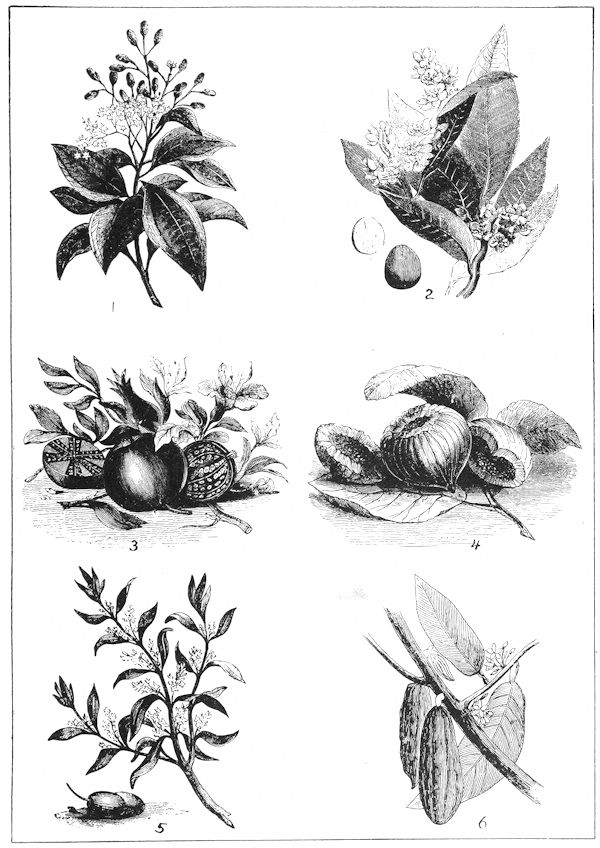
Typical Nuts and Tree-Products
1, Cinnamon; 2, Camphire (Camphor); 3, Pomegranate; 4, Sycamore Figs; 5, Olive Twig and Fruit; 6, Theobroma Cacao (Chocolate)
Lichens are very slow-growing plants. They spring up somewhat rapidly during the first year or two, as is evinced by the luxurious growth which they form over young fruit-trees and espaliers in gardens; but after a circular frond is formed, they subside into a dormant state, in which they remain unaltered for many years. The foliaceous and scrubby species are the most fugacious, though even these have great powers of longevity. We have no data from which to ascertain the age of tartareous species, which adhere almost inseparably to stones. Some of them are probably as old as any living organisms that exist on the earth.
In the Arctic regions—those outer boundaries of the earth where eternal winter presides—these humble plants constitute by far the largest proportion of the flora, and by their prodigious development, and their wide social distribution, give as marked and peculiar a character to the scenery as the palms and tree-ferns impart to the landscapes of the tropics. In the Southern Hemisphere also lichens extend almost to the pole. They mark the extreme limit at which land vegetation has been found; one scrubby species, with large, deep, chestnut-colored fructification, called Usnea fasciata, having been observed by Lieutenant Kendal on Deception Island, the Ultima Thule of the Antarctic regions.
In tropical countries, where there is not too much moisture and shade, the trees are shaggy with lichens; and some of the most magnificent species, both as regards size and color, have been gathered in the Cinchona forests which clothe the lower slopes of the Andes, and in the warmer and more densely wooded parts of Australia and New Zealand. The thick impervious forests of Brazil, however, are said to be almost destitute of them. On the Alps of Switzerland the last lichens are to be found on the highest summits, attached to projecting rocks, exposed to the scorching heats of summer and the fierce blasts of winter; and from forty to forty-five kinds have been found in spots, surrounded by extensive masses of snow, between 10,000 and 14,780 feet above the level of the sea. It is interesting to know that the only plant found by Agassiz near the top of Mont Blanc was the Lecidea geographica, a very beautiful lichen, which covers the exposed rocks on the sides and summits of all the British hills, with its bright-green, map-like patches. This species was also gathered by Dr. Hooker at an elevation of 19,000 feet on the Himalayas, and occupied the last outpost of vegetation which gladdened the eyes of the illustrious Humboldt, when standing within a few hundred feet of the summit of Chimborazo, the highest peak of the Andes.
The Lecidea geographica affords, I may mention, the most remarkable example of the almost universal diffusion of lichens, being the most Arctic, Antarctic, and Alpine lichen in the world—facing the savage cliffs of Melville Island in the extreme north, clinging to the volcanic rocks of Deception Island in the extreme south, and scaling the towering peak of Kinchin-junga, the most elevated spot on the surface of the earth.
It is somewhat remarkable that Alpine lichens generally are more or less of a brown or black color. This peculiarity seems to be owing to the presence of usnine or usnic acid, which in a pure state is of a green color, as in the lichens which grow in shady forests, but which becomes oxidized, and changes to every shade of brown and black, when exposed to the powerful agencies of light and heat on the bleak barren rocks on the mountain side and summit. These gloomy lichens, associated as they always are with the dusky tufts of that singular genus of mosses, the Andræas, give a very marked and peculiar character to many of the Highland mountains, especially to the summit of Ben Nevis, where they creep, in the utmost profusion, over the fragments of abraded rocks which strew the ground on every side, otherwise bare and leafless, as was the world on the first morning of creation, and reminding one of the ruin of some stupendous castle, or the battlefield of the Titans. Some of the Alpine lichens, however, are remarkable for the vividness and brilliancy of their colors. The mountain cup-moss, with its light green stalk clothed and filigreed with scales and emerald cup studded round with rich scarlet knobs, presents no unapt resemblance to a double red daisy. It grows in large clusters on the bare storm-scalped ridges, and forms a kind of miniature flower-garden in the Alpine wilderness. The loveliest, however, of all the mountain lichens is the Solorina crocea, which spreads over the loose mould in the clefts of rocks, and on the fragments of comminuted schist on the summits of the highest Highland mountains, forming patches of the most beautiful and vivid green, varied, when the under side of the lobes is curled up, by reticulations of a very rich orange-saffron color. This species is not found at a lower elevation than 4,000 feet; hence it is unknown in England, Ireland, and Wales, whose highest mountains fall considerably short of this altitude. I have gathered it on Cairngorm, Ben Macdhui, and Ben Lawers. In this last locality, which is well known to botanists as exhibiting a perfect garden of rare and beautiful Alpine plants, it grows in greater abundance, I believe, than in any other spot in the Highlands.
On account of the large quantity of starchy matter which they contain, they often considerably, and sometimes even entirely, form the diet of man and animals in those dreary inhospitable regions where the wintry rigor, or the scorching heat of the climate, forbids all other kinds of vegetation to grow. Every one is familiar with the fact that the reindeer-moss (Cladonia rangiferina) forms altogether the food of that animal during the prolonged northern winters. This lichen grows sparingly in little tufts among the heather in Scotland, and sometimes whitens the sides and plateaus of the Highland hills, covering bare and verdureless places where the snow first falls in winter and lingers longest in summer; but it is in the vast sandy plains, called by the Laplanders Flechten-tundra and Moos-tundra, as lichens or mosses predominate, which border the Arctic Ocean, that it flourishes in the greatest profusion and luxuriance. There it completely covers the ground with its snowy tufts, and occupies as conspicuous a place in the economy of nature as the grass in warmer regions. Linnæus says that no plant flourishes so luxuriantly as this in the pine-forests of Lapland, the surface of the soil being completely carpeted with it for many miles in extent; and that if by an accident the forests are burned to the ground, in a very short time the lichens reappear, and resume all their original vigor.
When the ground is covered with hard and frozen snow, so that the reindeer can not obtain its usual food, it finds a substitute in a very curious lichen called rock-hair (Alectoria jubata), which covers with its beard-like tufts the trunk of almost every tree. In most severe weather the Laplanders cut down whole forests of the largest trees, that their herds may be enabled to browse at liberty upon the tufts which cover the higher branches. The vast, dreary pine-forests of Lapland possess a character which is peculiarly their own, and are perhaps more singular in the eyes of the traveler than any other feature in the landscapes of that remote and desolate region. This character they owe to the immense number of lichens with which they abound. The ground instead of grass is carpeted with dense tufts of the reindeer moss, white as a shower of new-fallen snow; while the trunks and branches of the trees are swollen far beyond their natural dimensions with huge, dusky, funereal bunches of the rock-hair hanging down in masses, exhaling a damp earthy smell, like an old cellar, or stretching from tree to tree in long festoons, waving with every breath of wind, and creating a perpetual melancholy twilight.
Another beard-like lichen (Usnea florida), often growing along with the rock-hair, is gathered in great quantities in North America, from the pine-forests, and stored up as winter fodder for cattle in inclement seasons. Goats, and especially deer, are fond of it; and in winter when other food is scarce, they hardly leave a vestige of it on the trees within their reach. The tortoises of the small rocky islands of the Galapagos Archipelago subsist almost entirely upon it. In Scotland it is one of the most picturesque ornaments of the pine-forests. When fully developed it forms tufts nearly a foot in length. It is quite a miniature larch-tree, with root, stem, and most intricate branches and twigs. Its color is pale sea-green; and a central white thread or pith runs through the main stem, and lateral branches, on which, when cracked with age, the segments of cellular tissue are strung like beads on a necklace. A kind of farinaceous meal is plentifully sprinkled on the ultimate branches. Altogether it is one of the most beautiful and interesting lichens. A reddish variety grows in such quantities on trees of Conyza arborea, forming the alley near Napoleon Bonaparte’s residence in St. Helena, that this hanging vegetation is the first thing that attracts the eye of the visitor.
But it is not to animals alone that lichens furnish a supply of food. There are few, I presume, who are not acquainted with some particulars regarding the history and uses of that remarkable lichen sold in chemists’ shops under the name of Cetraria islandica, or Iceland moss. What barley, rye, and oats are to the Indo-Caucasian races of Asia and western Europe; the olive, the grape, and the fig to the inhabitants of the Mediterranean districts; the date-palm to the Egyptian and Arabian; rice to the Hindu; and the tea-plant to the Chinese—the Iceland moss is to the Laplanders, Icelanders, and Esquimaux.
It may be mentioned that, notwithstanding its name, the Iceland moss is not only more plentiful, but more largely developed in all its varied forms in Norway than in Iceland, and it is in Norway that it is now almost exclusively collected for the European market.
Those who have read the affecting account which Franklin and Richardson give of their expedition to Arctic America must be familiar with the name of the Tripe de Roche, which occurs on almost every page, and is intimately associated with the fearful sufferings which these brave men endured, a part of which only would have sufficed to unseat the reason of most individuals. During their long and terrible journey from the Coppermine River to Fort Enterprise, one of the stations of the Hudson’s Bay Company, in the almost total absence of every other kind of salutary food, their lives were supported by a bitter and nauseous lichen, to which the name of Tripe de Roche (Gyrophora) has been given as if in mockery.
The Tripe de Roche consists of various species of Gyrophora—black, leather-like lichens, studded with small black points like coiled wire buttons, and attached by an umbilical root, or by short strong fibres to rocks on the mountains. Some of them bear no unapt resemblance to a piece of shagreen; while others appear corroded, like a fragment of burned skin, as if the rock on which they grew had been subjected to the action of fire. They are found in cold exposed situations on Alpine rocks of granite or micaceous schist, in almost all parts of the world—on the Himalayas and Andes as well as the British mountains. But it is in the Arctic regions alone that they luxuriate, covering the surface of every rock, to the level of the seashore, with a gloomy Plutonian vegetation that seems like the charred cinders and shriveled remains of former verdure and beauty.
MOSSES —Hugh Macmillan
Mosses belong to the foliaceous or highest division of flowerless plants. Although consisting entirely of cellular tissue and increasing by simple additions of matter to the growing point or apex of parts already formed, they point to far higher orders of vegetation; they are prefigurations of the flowering plants, epitomes of archetypes in trees and flowers. There is nothing in the appearance or structure of the lichens, fungi, or algæ to remind the popular mind of higher plants; they form, as it were, a strange microcosm of their own—a perfectly distinct and peculiar order of vegetable existence. But when we ascend a step higher and come to the mosses, we find for the first time the rudimental characters and distinctions of root, stem, branches, and leaves—we recognize an ideal exemplar of the flowering plants, all whose parts and organs are, as it were, sketched out, in anticipation, in these simple and tiny organisms. Through the small, densely cushioned, moss-like Alpine flowers, they approximate analogically to the phanerogamous plants in their leaves and habits of growth; and through the cone-like spikes of the club-mosses they approximate to the pine tribe in their fructification. From both these classes of highly organized plants, however, they are separated by wide and numerous intervening links. But still it is curious and interesting to find in them an exemplification of the universal teleology of nature—the humblest typical forms pointing to the grand archetypes, the simplest structures anticipating and prefiguring the most highly organized and complicated.
In no tribe of plants is there so great a similarity between the different species as in the mosses. This remarkable similarity, concealing a no less remarkable diversity, has led to the popular belief that there is only one kind of moss. Closely examined, however, by an educated eye, their exceeding variableness of form will at once become evident, some being slender, hair-like plants; some resembling miniature fir-trees, others cedars, and others crested feathers and ostrich-plumes. In size they vary from a minute film of green scarcely visible to the naked eye to wreaths and clusters several feet in length. Nor are their colors less variable, ranging from white through every shade of yellow, red, green, and brown, to the deepest and most sombre black.
The leaves of mosses are their most prominent parts. To the careless and superficial eye, accustomed to look at a tuft of moss as merely a patch of velvety greenness, creeping over an old tree or dike, the leaves of all mosses may appear precisely similar; but the attentive observer who examines them under a microscope will find that the leaves of different kinds of trees are not more distinct from each other than are those of the mosses.
The organs of fructification, however, with which mosses are furnished, are, perhaps, the most wonderful parts of their economy. When the requisite conditions are present, these are generally developed during the winter and spring months, and may be easily recognized by their peculiar appearance. At first a forest of hair-like stalks, of a pale pink color, rises above the general level of the tuft of moss to the height of between one and three inches, giving to the moss the appearance of a pincushion well provided with pins. These stalks, through course of time, are crowned with little wen-like vessels called capsules, which are covered at an early stage with little caps, like those of the Normandy peasants, with high peaks and long lappets—in one species bearing a remarkable resemblance to the extinguisher of a candle—a curious provision for protecting them alike from the sunshine and the rain, until the delicate structures underneath are matured. When the fruit-stalk lengthens and the capsules swell, this hood or cap is torn from its support and carried up on the top of the seed-vessel, much in the same way as the common garden annual, the Eschscholtzia or Californian poppy is borne up on the summit of the cone-like petals before they expand. When the seed-vessel is riper it falls off altogether, and discloses a little lid covering the mouth of the capsule, which is also removed at a more advanced stage of growth. The mouth of the seed-vessel is then seen to be fringed all round with a single or double row of teeth, which closely fit into each other, and completely close up the aperture.
It is extremely interesting to note that the leaf is the type of the plant in the moss as in the flowering plant; the veil being merely a convolute leaf, the lid a metamorphosed leaf, the teeth one or more whorls of minute, flat leaves. It is by no means rare to find individual mosses in which leaves appear at the top of the fruit-stalk in place of the spore-case, just as happens in the phyllode of flowering plants, when the colored parts of the flower are converted into green foliage.
Mosses possess in a high degree the power of reproducing such parts of their tissue as have been injured or removed. They may be trodden under foot; they may be torn up by the plow or the harrow; they may be cropped down to the earth, when mixed with grass by graminivorous animals; they may be injured in a hundred other ways; but, in a marvelously short space of time they spring up as verdant in their appearance and as perfect in their form as though they had never been disturbed.
Mosses also possess the power of resisting, perhaps to a greater extent than most plants, the injurious operation of physical agents; and this likewise is a wise provision to qualify them for the uses which they serve in the economy of nature. The influence of heat and cold upon many of them is extremely limited; some species flourishing indiscriminately on the mountains of Greenland and the plains of Africa. They have been found growing near hot springs in Cochin-China, and fringing the sides of the geysers of Iceland, where they must have vegetated in a heat equal to 186 degrees; while, on the other hand, they have been gathered in Melville Island at 35 degrees, or only just above the freezing-point. Though frozen hard under the snow-wreaths of winter for several months, their vitality is unimpaired; and though subjected to the scorching rays of the summer’s sun they continue green and unblighted. Even when thoroughly desiccated into a brown, unshapen mass that almost crumbles into dust when touched by the hand, they revive under the influence of the genial shower, become green as an emerald; every pellucid leaf serving as a tiny mirror on which to catch the stray sunbeams. Specimens dried and pressed in the herbarium for half a century, have been resuscitated on the application of moisture, and the seed procured from their capsules has readily germinated. They grow freely in the Arctic regions, where there is a long twilight of six months’ duration; and they luxuriate in the dazzling, uninterrupted light of the tropics. They are found thriving amid moist, steam-like vapors, with orchids and tillandsias, in the deep American forests; and they may be seen in tufts here and there on the dry and arid sands of the Arabian deserts. It matters not to the healthy exercise of their functions whether the surrounding air be stagnant or in motion, for we find them on the mountain top amid howling winds and driving storms, and in the calm, silent, secluded wood, where hardly a breeze penetrates to ruffle their leaves.
Unlike the ferns, the size and number of which gradually diminish in passing from tropical to temperate countries, the maximum of mosses is found in cold climates, increasing in luxuriance, beauty, and abundance as we approach the North Pole. Like the ferns, moisture and shade are highly favorable to their growth and well-being; hence, as a rule, they produce a larger number of species and individuals, and spread over wider areas in islands and the vicinity of rivers and lakes than in the interior of continents, unless when well wooded and watered. Their favorite habitats appear to be rocky dells or ravines at the foot of mountains, with streamlets murmuring through them and dense trees interweaving their foliage over their sides and creating a dim twilight in the recesses beneath. In such hermit seclusions the botanist may expect to reap the richest harvest of species.
Mosses, in many instances, are limited to rocks and soils of the same mineral character; their limits of distribution, and of the rocks and soils possessing such character being identical. For instance, some are confined to limestone districts and chalk cliffs; a calcareous soil being indispensable to their existence. Others affect granite; numerous species luxuriate in soil formed by the disintegration of micaceous schist; while not a few are found growing chiefly on sandstone and clay. Some are found only on and near the seashore; others are confined to the beds of streams and cliffs moistened by the spray of cascades, where, however impetuous the torrent may be, they cling tenaciously to the rocks and form carpets of greenest verdure for the white, glistening feet of the descending waters. Some are restricted exclusively to trees whose trunks and boughs they clasp like emerald bracelets; others lead a lonely, hermit-like existence in the dim moist caves and crevices of rocks, where they are discovered only by the glistening of a stray adventurous sunbeam on the drops of dew trembling upon their shining golden leaves.
Mosses are sometimes found in an isolated state as single individuals, but they are far oftener found in a social condition. It is a peculiarity of the family to grow in tufts or clusters, the appearance of which is always distinct and well-marked in different species, and often affords a specific character. This disposition to grow together, which is exhibited in no other plants so strongly, redeems them from the insignificance of their individual state, and enables them to modify in many places the appearance of the general landscape. As social plants they often cover vast districts of land. Along with the lichens they give a verdant appearance to the desert steppes of Northern Europe, Asia, and America. Mixed with grass they luxuriate in parks, lawns, and meadows, particularly in moist, low-lying situations. They spread in large patches over the ground in woods and forests; and at a certain elevation on mountain ranges they take exclusive possession of the soil, forming immense beds into which the foot sinks up to the ankles at every step, bleached on the surface by the sunshine and rain, blackened here and there by dissolving wreaths of snow which lie upon them through all the summer months, and gradually decomposing underneath into black vegetable mould.
The plants whose peculiarities have been described in the preceding pages are called Urn Mosses, their fructification being urn-shaped, furnished with teeth and closed with a lid. There is another large class called Scale-Mosses, so closely allied to the true mosses that they are frequently confounded even by an educated eye. There are upward of a hundred species of scale mosses indigenous to Great Britain and Ireland, some of which are so small as to be scarcely visible and others much larger than any of the true mosses. With the exception of a few prominent species, which are found in every moist wood and on every shady rock, they are somewhat local and limited in their distribution, many of them being remarkably rare and confined to remote and isolated localities. The greatest number of species occurs in the tropics; and nowhere do they luxuriate so much as in the dark woods and mountain ravines of New Zealand. Some of them grow in the bleakest spots in the world, and are to be found even at a higher altitude than the urn-mosses on the great mountain ranges of the globe. They form the faintest tint of green on the edges of glaciers and on the bare, storm-seamed ridges of the Alps and Andes, where not a tuft of moss or a trace of other vegetation can be seen; and this almost imperceptible film of verdure, when cleansed from the earth and moistened with water, presents under the microscope the most beautiful appearance.
The peculiarities of these plants are so remarkable and interesting that they deserve more than a passing notice. As a rule, to which, however, there are a good many exceptions, they do not grow upright in tufts like the mosses, but have a flat, creeping, lichen-like habit, spreading over rocks and trees in closely applied circles which radiate from a common centre. The whole typical plant is like a series or necklace of roundish, flat, imbricated scales, several of which branch from a common point in the middle. The leaves, unlike those of the mosses, are entirely destitute of a central nerve, for what is called the nervure in the membraneous or leafy species is nothing more than the stalk itself on the edges of which the leaves are fastened together in such a manner as to form apparently a continuous whole.