THE STORY OF THE UNIVERSE (continued 7)
Reading edition
The Hepaticæ, or scale-mosses, may be divided into two groups, consisting of those species in which the vegetation is frondose, that is, in which leaf and stem are confounded, and of those in which the vegetation is foliaceous, that is, in which leaves and stem are distinct.
The most interesting of all the frondose group of scale-mosses is the common Marchantia or Liverwort (Marchantia polymorpha). It is very common, creeping in large, dark-green patches over rocks in very moist and shady situations, such as the banks of a densely wooded stream in a deep, narrow glen, or the sides of rivers and fountains. It may often be seen also on the moist walls of hothouses and in the pots and tubs. It adheres closely to rocks, which it sometimes completely covers with its imbricated fronds by the numerous white, downy radicles with which the under surface is covered.
The second or foliaceous group of scale-mosses, in which the leaves and stem are distinct, is called Jungermanniæ, and contains by far the largest number of species and the richest variety of form and color. On either side of the thread-like stem arise in a more or less oblique position the membraneous overlapping leaves; while the fruit-vessel springs from the end of the stem, and is produced upon little silvery foot-stalks. It bursts into four valves, and when fully expanded spreads out into the form of a cross. There is a class of plants whose external appearance and mode of growth would indicate that they belong to the tribe under review, but whose structure and functions are so different that they are commonly supposed to bear a closer analogy to the ferns. They occupy an intermediate position, and form a connecting link between ferns and mosses; I allude to the Lycopods, or club-mosses. They are usually found in bleak, bare, exposed situations in all parts of the world, and sometimes attain a large size; forsaking the creeping habit peculiar to the family, and becoming slightly arborescent in tropical countries, particularly New Zealand, rivaling in rank luxuriance the smaller shrubs of the forest.
The club-mosses are all very graceful and beautiful plants. The Spanish moss (Lycopodium denticulatum) is a great ornament to conservatories and hothouses, where it conceals with its luxuriant drapery the mould in the pots, and keeps the roots of the plants moist. Nothing can be lovelier or more elegant than a basket of orchids in full flower, with clusters of this moss in careless grace from its sides. Lycopods may be said to present the highest type of cryptogamic vegetation, the highest limit capable of being reached by flowerless plants.
The first pages of the earth’s history reveal to us very extraordinary facts with relation to members and allies of the moss tribe. The club-mosses, in particular, at a former period, seem to have played a more important part, or to have found conditions more suitable to their luxuriant development than is the case at the present day. The two or three hundred species at present existing are the mere remnant of a once magnificent group. Some of them are stated to have formed lofty trees eighty feet high, with a proportionate diameter of trunk. They are among the most ancient of all plants. The oldest land-plant yet known is supposed to be a species of lycopodium closely resembling the common species of the moors. In the upper beds of the Upper Silurian rocks they are almost the only terrestrial plants yet found. In the lower Old Red Sandstone they also abounded; while they occupied a considerable space in the Oolite vegetation. But it is in the Coal-measures that they seem to have attained their utmost size and luxuriance, sigillaria, lepidodendron, etc., being now considered by competent botanists to be highly developed lycopodia. Along with ferns they covered the whole earth from Melville Island in the Arctic regions to the Ultima Thule of the Southern Ocean, with rank majestic forests of a uniform dull, green hue.
EUROPEAN SEA-WEEDS —P. Martin Duncan
The zones of life are (1) the littoral zone, or tract between tide-marks; (2) the laminarian zone, from low water to fifteen fathoms; (3) the coralline zone, from low water to fifteen fathoms. Then come other zones leading to the great depths.
The broad-leaved tangles live in the laminarian zone, and it is called so from their Latin name, and therefore they limit the plants and animals of the shore, seaward.
It has been noticed that the animals and plants of the shores of our coasts are not the same everywhere, and that in certain parts some peculiar kinds are to be found. This is produced by climate, the nature of the sediment on the shore, the geological nature of the coast-line and inland parts, and the mineralogy of the district. And with regard to this last, it may be noticed, that where the rocks contain lime, or limestone and chalk, there certain shell-fish and corallines abound; but where this mineral does not exist, there they are comparatively or entirely absent. The British Islands, extending to the north and south, and being washed by the North Sea, the Atlantic, the German Ocean, and the Channel seas, come within the limits of certain natural history provinces. One is called the Boreal, and it extends across the Atlantic from Nova Scotia and Massachusetts to Ireland, the Faroe Islands, and Shetland Islands, and along the coast of Norway. That is to say, there are marine animals and plants which are found on the American, Irish, Scottish, and Norwegian shores, and which are either of the same kind or species, or of the same genus or group.
The next province is the Celtic, and it includes the coasts of England, Scotland, Denmark, southern Sweden, and the Baltic, and all these places have animals of the shore and other zones in common. The Channel Islands and parts of British south coasts come within range of another province, called the Lusitanian, which is that of the west coasts of France, Spain, and of the islands off the coast of Africa. The Celtic province is that to which most of the British coasts belong; and it is a subject of great interest to know that many of the kinds of shelly mollusca, which are now living, lived in the last geological ages, and their remains are found fossil; so that the condition of the coast-lines and shores and a part of the assemblage of animals and plants now living on them have a remote ancestry.
It is by no means easy to say where the seashore begins landward. It may be limited by cliffs and mountain-ground, so that there is but little shore, and the tide-water then comes up the sides of the cliff; and it may reach for miles inland, among salt marshes, the ditches of which have salt water and marine animals and plants in them. Again, even when the shore is perfectly limited inland, there are proofs that the sea is near, long before it is reached. Trees usually get scarce, and often those which are seen are much gnarled and bent and covered with lichens. A new set of flowering plants is noticed, and the old favorites of the meadow and wood are absent; and grasses, reeds, rushes, and many singular plants straggle on the sand and pebbles, out of the range of the tide, but within that of the spray sent in by a high wind. Common observation has enabled even the most unscientific collectors of plants to recognize what may be called a maritime, coast, or shore flora, just as they can distinguish a marsh, mountain, or wood flora beyond the range of the sea. A flora is the name for all the plants of a district, and it has been found that the seaside and seashore floras of these islands are very rich in kinds. Indeed, there are many little local floras included in the great seaside one, for the landscape, the nature of the rocks, and the vegetation of the shore, differ greatly in different parts. Each particular landscape by the sea, and every kind of soil there, has its little set of peculiar plants, some liking limestone, others clay, many rejoicing in sand, and some even finding nourishment among the highest pebbles.
Hence, on walking round British coasts, the plants, as a whole, will differ from those found inland, and at every turn or change of rock and scenery new kinds appear. But many of the inland plants do go down far to the seaside, and the art of gardening and all sorts of accidents have dispersed many plants which originally were not dwellers near the sea; and, on the contrary, they have also removed seaside plants, like sea-kale and asparagus, inland and into our gardens. In many places, however, and where the sea comes up very close, the inland plants are not found. There is a very remarkable thing about this seashore and seaside flora, and it is this, that nearly all the important groups, families, or genera of inland plants have a kind or two in it, and that there are few extraordinary novelties which would enable us to say that such a set of plants was destined for the seaside. Thus the pod-bearing order, which contains the pea, bean, clover, and such plants, has many species which are only found near the sea. The toothed medick (Medicago denticulatus), and the common melilot, love sand and gravel near the sea; the star clover lives on a shingly beach near Shoreham; while two kinds of the genus lotus live on dry places, two being found near the sea in Devon and Cornwall. There is a vetch, with a pale purple flower, on the pebbly beach of Weymouth, and another of a sulphur-color likes such situations. Even the poppy order has a kind with large golden-yellow flowers, with seed-cases from 6 to 12 inches long, living on sandy seashores; and this “horned poppy” has a very interesting companion, for a poppy with a bluish-white flower with a violet spot lives in the fens and on sandy ground near the sea, and it is the kind which yields opium. The cruciferous plants, of which the wall-flower, the rocket, cabbage, mustard, etc., are examples, are well and interestingly represented at the sea. There is a sea-stock living on the sandy seacoasts of Wales, Cornwall, and Jersey. The wild cabbage, the parent of all domestic cabbages, lives on cliffs by the sea; a wild mustard is at St. Aubin’s Bay, Jersey; a white draba, not very unlike the common whitlow grass, is on sandhills by the sea in Islay. The scurvy grasses are all found on seashores, and constitute a shore group. Finally, there are the purple sea-rocket and sea-kale, loving sandy shores, and there is a rare wild sea-radish. Among other well-known inland orders of plants, such as the violets, there is a rare one with its flowers wholly yellow, or yellow with the upper part purple, living on sands by the sea. Of another order, the tamarisk may be seen close to the waves on the Essex coast; even the pink tribe has a sea bladder-campion, an alsine, and a cerastium. Again, the tree mallow lives on rocks by the sea. The rose tribe are certainly not lovers of the seashore, but there is one kind belonging to the whitethorn tribe (Cotoneaster) which ornaments the rocks of the Great Orme’s Head, in Carnarvonshire; and a solitary kind of the thick-leaved plants, a sedum, lives there also, loving the limestone soil. The Corrigiola littoralis of the southwest of England has white-stalked flowers. The sea-holly, with its blue flowers in a head or umbel, lives on sandy seashores; the wild fennel, the Scottish lovage, and the fleshy-leaved, whitish-flowered samphire love rocks by the sea. The sea-carrot lives on the southwestern coasts.
The red valerian is found on chalk cliffs; but no other of its tribe, or of the teazels or scabious set, is found particularly as a seashore plant. Both the composite orders, of which the daisy and the asters are examples, and which form so large a part of the inland flora, have many seashore species. Thus, there is the golden samphire, allied to the elecampane plant, the sea-diotis, the sea-feverfew, and the sea-wormwood. There is, or was, a wild cineraria on the rocks of Holyhead, and there is a thistle with pink flowers which loves sandy places by the sea. The least lettuce likes chalky places. One of the centaury kinds lives on sandy seashores, and there is a seaside bindweed with very handsome pink flowers with yellow bands. One of the bugloss tribe lives on northern seashores, and there is a curious great snap-dragon which is to be found about cliffs overhanging the sea. The primroses and pimpernels are not inhabitants of the seashore, but two sets of plants, called glaux and samolus, belonging to their order, frequent the shore and salt marshes. Then there is the sea-lavender tribe with four kinds, all living in England, or Ireland, on rocky shores and salt marshes; and the thrift plant likes the shore as well as the mountain top, a distribution which is noticed also in the sea-plantain. Many of the spinach tribe, such as the glass worts, the sea-beet, the salsolas, and the sea-purslane, inhabit the shores, and some of them were formerly used in the preparation of barilla. Such a common thing as the dock could hardly be found away from the sea, and there is really a sea-dock found on the marshland; and the Channel Islands have a sea-snake-weed. A thorny shrub with lancet-shaped silvery leaves, and attaining the length of from four to six feet, frequents sandy spots and cliffs, on the southeast and east coasts, and is called the sea-buckthorn. There is also a sea-spurge. The wild asparagus, with a stem not one-third of the height of the cultivated kind, but the true parent of all asparagus, is a rare plant, but it has been found at Kynance Cove, Cornwall, Callar Point, Pembroke, and at Gosford Links in Scotland. Another important plant, the onion, has its representatives on the rocks of Guernsey, and another called chives is a Cornish cliff seaside dweller. The rushes have several kinds on salt marshes and shores, and there is a plant called the zostera, with long leaves, which flourishes under water on many parts of the eastern coast. Belonging to the same botanical order is the Ruppia maritima, found at Newhaven and Guernsey.
The sea-sedges, a cat’s-tail grass, a foxtail grass, an agrostis, a sea reed, and a common poa grass, with a root-like bulb, are familiar objects on swampy seashores; and a whole group of grass plants belonging to a tribe called Sclerochloa inhabit sandy seasides. The couch-grass dwells there also; and the list may be closed by noticing the sea-barley, a tiny plant, but loving sandy pastures near the sea. And among the ferns a spleenwort lives on rocks over the sea.
These are all plants of a complicated structure, and produce seed. But those about to be noticed are the true sea-weeds, which have a simple construction and belong to the cellular plants.
Where the land-plant ends, the sea-weed begins, and as some flowering plants or grasses come close to the edge of the high spring tide, so some sea-weeds choose that position, and appear to like a dry time for a while, and a refreshing return of the salt water at distant intervals.
One of these sea-weeds abounds on muddy seashores, at the entrance of rivers and marshes, and positively adheres to the roots of flowering plants. North Wales, Shoreham, the Essex coast, and the Shannon are places where it is found in abundance. Moreover, like most of the sea-weeds, it has a wide distribution, for it is found on the Atlantic shores of Europe as far south as Spain. The plant is from 2 to 4 inches high, and consists of stems about as thick as stout bristles. They branch and give off side-twigs, like the veins of leaves in shape, and each ends in a curious curl. The whole plant is limp, and easily squeezed flat. It is of a dull purple color, and from its curl endings has received a Greek name, “bostrukos,” a ringlet. Old authors called it “Amphibia,” from its locality, which has just been noticed; and it is remarkable, because most of the other red or reddish sea-weeds of its group live in deep water.
Another sea-weed which lives at the very top of high-water mark, but which is also found on the shores down to low-water mark, and still lower, is a fine plant often growing a foot in height. Its stem is round and solid, and branched in what is called a pinnate manner, like a mimosa leaf. It is yellow or livid green in color, and is very small and starved at high-water mark, but it grows larger and larger until well under the sea. One of the kind is found on loose stones, where a rill of pure fresh water runs into the sea. In Scotland it was formerly eaten under the name of pepper dulse; but better things are now to be had. It is named Laurencia after a French botanist.
A membrane-like sea-weed, which grows upward with swellings like a cactus which give it the appearance of a chain, is called the little chain sea opuntia (Catenella Opuntia). It is also a dweller on rocks, close up to high-tide mark, on our shores as far as the Orkneys.
Often at high-water mark, and on wood and stones down to half-tide level, there is a quantity of dark olive-green sea-weed, in small tufts, getting larger nearer the sea, which often looks dried up, shriveled, and crisp. It grows in tufts when the water goes off rapidly, and it evidently requires exposure to the air for several hours in the day. Nearer the ever-rolling sea the plant grows larger. It is called the channeled fucus, and has an expanded part or root, and a stem which branches in twos, and ends in two long cones of softish stuff which contain the reproductive organs or spores, called receptacles. It belongs to the same group of sea-weeds as the commonest of all, or that which has air-bladders on it and which crackle and burst under the feet. A differently colored high-water-mark weed is found at Yarmouth, Bantry Bay, Torquay, and Sunderland on sand-covered rocks. It lies prostrate and is of a pale green color, forming masses or layers of excessively minute threads of vegetable tissue. It belongs to the genus Codium.
The sea-weeds called wracks or fucus are among the most common of the dark greenish-olive kinds, and one of them lives in a curious place on the shore. The stem or frond is from one to two feet long; there is a kind of midrib to it, besides the cones or receptacles, at the tip of each branch. It is common from Orkney to Cornwall in many places, and is found where a good deal of fresh water mixes with the sea, but it is not restricted to such peculiar positions, for some of the most vigorous plants live in salt water, and some very transparent and weak ones in brackish water. The common bladder fucus is found everywhere on rocks and stones and wood left exposed at low water, and on artificial quays in estuaries extending up rivers as far as the water is decidedly brackish. Even in salt water it is noticed to flourish. The plant or frond is in long, flat, thin branches with a midrib, on either side of which are the bladders, which contain air. The branches end in thick gummy-feeling masses, which are turgid, rather pointed, and contain the spores. The color is olive and it is lighter in the younger parts. It is found along the shores of the Northern Atlantic, extending even to the tropics. It is used as manure, and also in forming kelp for the purposes of the manufacture of iodine. Cattle eat it in the winter, and of late it has been used in baths. A larger kind of fucus grows from high-tide mark to mid-tide level, and it has large swellings on its stem, and the branches, which come off in whorls, are distended, as it were. It is used in the kelp manufacture and for covering up oysters. The Scotch shore-men call it the sea-whistle, for boys make whistles out of the larger air-vessels.
The serrate fucus, so called from its saw-like edges, has no bladders, it clothes the rocks at half-tide level, is very common, and is found on the western shores.
On the rocky bottoms of submarine tide-pools, near low-water mark, all round the coasts of Scotland and England, is a weed with narrow fronds and pinnate ones of a lance-head shape, with spiny teeth on their edges. It is a clear olive-brown plant, and gets a verdigris tint when it is exposed. It is called the ligulate desmarestia.
Perhaps more beautiful, but not more interesting than these kinds of fucus, are the ulvæ, those broad, flat, wrinkled edged, green sea-weeds, looking like half-transparent membranes. One of them, the broad ulva, has a small disk by way of a root, and grows from six to twenty inches in length and from three to twelve in breadth, in tufts of different shapes. It is very common on all shores, on rocks and stones between tide-marks, and extends downward to a depth of ten fathoms. It has a wonderful geographical distribution, for, with the exception of the coldest regions of the globe, it inhabits every shore. It used to be eaten under the title of oyster green, being prepared like laver; and the Icelanders used to, and perhaps may still, ascribe an anodyne virtue to it. They bind it on the forehead in fevers, writes a Scottish botanist.
The other ulva, which is nearly as common as this, is smaller, and grows in the form of an inflated bag, which opens and expands. It is of a very bright and yellowish green, and it is thinner and more delicate than the other kind. It is seldom seen except in spring or early summer, on rocks, stones, and shells between tide-marks, and it is generally distributed around British shores and those of Europe.
A very common green weed, found between tide-marks and also in ditches running into the sea, was supposed by its first describers to resemble an entrail or intestine; hence it has been called Enteromorpha intestinalis, from the Greek words enteron, entrail, and morpha, form. It grows from a few inches to a foot or more in length, and from a line to three or four inches in diameter. Seen where it is attached to a stone, it is like a tube, hollow, membrane-like, and green; but further out it is larger and swells out into an irregular bag, crisped and curled here and there. It is very common all over the world, and finds its way sometimes into fresh water. The Rev. J. Pollexfen notices that it is prepared for culinary purposes by the Japanese for an ingredient in their soups.
The other common green Enteromorpha is called “the compressed.” It is in the form of a branching green, delicate tube, flattened here and there; and it clothes rocks between tide-marks, being sometimes as fine as a hair. It gets narrower at its attachment and is broad at the ends. Near high-water mark it forms a short, shaggy pile of slender fronds spreading over rocks and stones, and most treacherous to the stepping of unwary feet, being most slippery. A little lower down, in the rock-pools, it is larger, tubular, branched, and thin near the root; and where fresh water runs in close to it, the fronds get larger, broader, and more inflated. Almost everything on floating timber or on stone is this kind of weed. From being more or less tubular, these Enteromorphæ have a double green membrane. Now there is a beautiful ribbon-shaped ulva which has this double formation and which is found at half-tide level. It is long, even reaching to two feet, and is only half an inch to two inches broad. Very elegant and graceful are its tapering, curling, wrinkling, and plaiting of the edges; it is called Ulva linza, and is of a bright green color. Among the commonest of the small green sea-weeds are the confervæ, hairy-like green threads, which collect in layers and fleeces and cover much surface, or wave in the rock-pools. One kind called the sandy conferva lives at half-tide level at Bantry Bay and also in Scotland at Appin. It forms fleeces a yard or more in extent, made up of thin layers placed over each other, but so slightly connected that they may be separated like gauze, for some inches, without breaking. The hairs or filaments are five or six inches long and are rather rigid; they are very long-pointed, and consist of a delicate tube membrane which incloses a series of long cells. Another conferva, found attached to other sea-weeds at Bantry Bay, Berwick, Firth of Forth, and Torquay, has its filaments forming densely interwoven layers which cling over their supporting plant. It is of a dark green color. A third frequents salt pools by the edge of the sea and rocks at half-tide level. It is a very twisted thing, and forms crisped layers from a few inches to several feet thick, which closely adhere to the inequalities of the rock, or to the plants which grow on it. It is of a glossy brilliant green color, and is called the tortuous conferva.
There is a pretty green hair-like plant which branches and gives off branchlets on one side more than on the other. It comes from a little group of stems on a stone, and forms a small stunted but very elegant bush, three or four inches high. This cladophora lives in the purest and clearest sea-water only, and in rocky pools left by the tide near low-water mark. It is only got at low spring tides at Dingle and Dublin, and it evidently likes the cool sea-water and darkness. A sea-weed called the Adherent Codium forms a velvet-like pile on the surface of rocks in the southwest of England near low-water mark, but it is rare. Sometimes the green velvet-looking film may be three feet across, and it consists of myriads of short cylindrical filaments with simple club-shaped hairs on them. It is soft and gelatinous, sticks to paper, and appears to grow slowly. Another codium, called the amphibious, has been mentioned already. It occupies a different position on the shore to the other. It frequents turf banks on the west of Ireland, in County Galway, where the bog touches the shore. It is a very mesh of entangled filaments, and it dries up to almost nothing in dry weather, and increases and grows again on the coming of the welcome tide, spray, or rain. There is also a large codium with branches, which looks like a sponge.
Barnacles and shells, living at low-water mark, in exposed situations on the western shores of Scotland and Ireland, Falmouth, and the Land’s End, have a weed upon them of a purplish-brown color like a “crop of threads” (Nemaleon) of from three to ten inches long. They are slender, solid, and divide in twos from a little expanded base. In some places it chooses particular positions, and in our Irish localities it grows in shallow pools on the granite rocks, and nowhere else.
A common weed, sometimes twenty inches in length, varies from pale yellow in shallow water to dark purple in deeper places; it lives at half-tide level, and is made up of tubular fronds filled with watery gelatine. Its tube swells, here and there, and bends at the end in a curious manner. It is called, after a French naturalist, Dumontia. Another weed with a cylindrical stem has many branches, and has swellings at their origin like so many knots. These are air-vessels and help to support the plant, which is rather leathery. It is found on the English and Irish shores, and is called the bladder chain-weed (Cystoseira). But the most elegant of the weeds with air-bladders is called the sea oak (Halidrys) and it is found commonly on rocks and stones in the sea, below half-tide level. The fronds are from one to four feet in length, and the branches bear numerous long pods with compartments in them, the whole looking like a mustard-pod, and these are the air-chambers.
The waving, slender, long weed, so slimy to the touch, and which is so abundant on all British shores—the dread of the bather when it forms submarine meadows, over mud flats—is called the cord-weed (Corda filum). It is sometimes forty feet, but usually from one to twenty feet in length, and is not twice as thick as a bristle where it starts from a stone, tapering and clothed with delicate hair, getting wider in the middle, and slender and hairy at the top.
There are some remarkable sea-weeds, which certainly do not look like things belonging to the sea, but rather to the land, where lichens and fungi live on stones and trees. One often is called rivularia, and is found on rocks, at half-tide level, on the southern shores of England, and in the South and west of Ireland. It incrusts the rocks, rising in short lobes, and it feels fleshy and firm. It begins with a globe-shaped substance, which sends forth ragged-looking pieces; and although it is so dense, the surface is covered with a close pile of exquisite filaments. Many a dark rock, otherwise perfectly barren at the end of summer, is clothed with the bright green patches of this singular weed. Another of these incrusting things is often as round as a half-crown, and looks like a lichen. It is leathery, and gets ragged and warty with age, and is of a coffee-brown color. It is called Ralfsia, after Mr. Ralf. A third kind looks like a flat thin clot or stain of blood; hence its name cruoria, from “cruor,” blood. It forms a scum on the smooth, exposed rocks between tide-marks, and is especially abundant in the west of Ireland and Jersey. The patches are from one to three inches in diameter, and their edges are very clearly curved; they are brown and red, and the hairs or filaments of which they are composed are purplish red. It can be removed in flakes with a knife.
Many sea-weeds are found upon others; and indeed some of the most beautiful kinds are thus parasitic upon larger ones. An instance of this occurs to one of the humble crust-like weeds which is found on pebbles at half-tide mark. So small is the parasite that a slight magnifying power is required to make it distinct, and then it is found to be made up of thousands of minute forked threads, each of which consists of several long cells, one placed before the other, and some of the cells are large and egg-shaped, and contain the seeds or spores. It is called the Myrionema, from two Greek words which mean numberless thread.
The next great group of sea-weeds to be noticed on the shore has many more kinds below low-water mark, where they are never uncovered, than above. They are the great dark, olive-colored, ribbon-shaped, wavy-edged weeds, which have a tough skin and roots, which adhere to rocks, and which are called tangles and laminariæ by botanists. Their proper position, as a rule, is not on the shore, for they almost characterize a particular zone of depth; but there are kinds to be met with on rocks and timber, close to the low-water mark, and on the shore. Some of them are very remarkable when they are placed, as they are in the north of England, on the sea-beaten parts of white or gray rocks. They then often form a dense layer—a sort of black, moving fringe, which is sometimes uncovered. Most of them flourish in the most boisterous seas, and it would appear that those which may, with some reason, be called shore-plants, because they are close to low-water mark, and now and then uncovered, are smaller and more delicate. Thus one kind, which has been called the weak, or the papery tangle (Laminaria fascia), has a stem not bigger than a bristle, which gradually widens into a frond about twelve inches long and two broad. It is greenish or brownish-olive in color, and is very fragile. It has the remarkable geographical distribution which is very common to all those weeds living on the brink of the sea, for it is found as far off as the Falkland Islands. On British coasts it covers sandy rocks and stones near low-water mark, and is to be found in the north of Ireland, the western islands of Scotland, and the southwest of England.
Another kind fringes precipitous rocks at low-water mark, and is abundant on the shores of Scotland and of the north and west of Ireland, the west and southwest coasts of England, and the northeast coast. Mr. Harvey notices it as one of the kind luxuriating in a furious sea, although its frond can be readily torn with the hand. It has a stem as thick as a quill, and a root of many branching fibres. The frond, or ribbon-shaped leaf, is from three to twenty feet in length, and only grows three to eight inches broad. It has a midrib running down its whole length, and the following peculiarities: there are many little leaflets on either side of the stem before it merges into the broad frond, and the surface is perforated with small pores, out of which come tufts of shred-like fibres. It seems to be an everlasting weed, and the first growth in the frond occurs from the stem.
The new parts are lighter colored than the old, and after a while intersection takes place, where the new part joins the old, and the old leaf falls. This plant, from the side leaves giving it a winged appearance, is called the Alaria (from ala, a wing), and it is eaten in some parts of Scotland and Ireland. The midrib is the delicacy, but it is very insipid. The Scottish name is badderlocks, or henware, and the Irish, murlins.
A most graceful and delicate tangle is to be found on the south and east coasts of England, all round Scotland, and at Bantry Bay, Howth, Balbriggan, and Kingston, in Ireland, on rocks and stones in pools left by the tide. When fresh, it is a clear brown-olive in color, and it changes to green when dry or when placed in fresh water. The leaf comes from a stalked root, tapers to the end, is frilled at the sides, and may be from six inches to three or more feet in length, and from one to six inches broad. It is thin, but is traversed by a double layer of large air-cells.
There is a large tangle which goes by the name of furbelows; and when spread out on the shore may make a circle of fronds twelve feet in diameter. It is a clear brown-olive in color, and the root gives rise to a stem with large hollow knobs on it. The leaf is oblong, and is deeply split into many parts. The plant grows on rocks at low-water mark, and is abundant.
But the commonest of all these tangles, with its long stem and branching roots, and beautiful, slippery, crumpled leaf, forms a belt, about low-water mark, round rocky shores, where its long, ribbon-like fronds wave gracefully in the water. When it is in deeper water it is much larger, and is then called the broad-leaved tangle. The great tangles which are employed to form kelp are not shore plants, but live covered with water.
The gems of the seashore are, however, not the olive and green weeds, but the red kinds, and they abound. There is a very large and handsome one, which is rare in deep, shady pools at extreme low-water mark, but which is often washed up in storms, about the southwest coast of England, Bantry Bay, Antrim, Down, and Orkney. It is somewhat kidney-shaped, in the outlines of the large blood-red fronds, and has a stout, round stem. It is made up of three layers, and some plants are male, and others are female. This plant is called Kalymenia, from the Greek words that mean beautiful and membrane. Another kind of the Kalymenia, found at Falmouth, Plymouth, and Bantry Bay, is something like a short, broad tangle with crisped leaves in shape. It is red, and the root is a disk, and the fronds are about a foot in length. It is found on rocks and stones, within tide-marks, in land-locked bays. It is very thin and delicate, and may be compared with a totally different-feeling red sea-weed, which has flat fronds of irregular shape, fringed with little leaflets, the whole being half-gristly to the touch, and of a dull purplish color. It is common on the shores of the south and west of Ireland and Jersey. The root is very fibrous, and altogether it is a most peculiar weed. There is another of these leathery weeds which grows to some size, and has well-grown leaflets on its edges, besides large circular markings on its purple surface, which is pretty common everywhere. They belong to the genus Rhodymenia, so called from the Greek words red and membrane.
The last kind is the dulse of the Scotch, and the dillisk of the Irish. Mr. Harvey thus notices its edible peculiarities: “In Ireland and Scotland this plant is much used by the poor as a relish for their food. It is commonly dried, in its unwashed state, and eaten raw, the flavor being brought out by long chewing. On many parts of the west of England it forms the only addition to potatoes in the meals of the poorest class. The variety which grows on mussel shells between tide-marks is preferred, being less tough than other forms, and the minute mussel-shells and other small shell-fish which adhere to its folds are nowise unpleasing to the consumers of this simple luxury, who rather seem to enjoy the additional goût imparted by the crunched mussels. In the Mediterranean this plant is used in a cooked form, entering into ragouts and made dishes; and it formed a chief ingredient in one of the soups recommended under the name of St. Patrick’s Soup by M. Soyer to the starving Irish peasantry.” It should be noticed that Dr. Harvey was keeper of the herbarium in the University of Dublin, and that he wrote in 1846.
Another dark-red sea-weed, which is very iridescent, when waving under water at low spring tides, is also said to be eaten in Cornwall, but, Harvey says, more by women than men. It is called the Edible Iridæa from its rainbow colors, is about six inches in length, is gristly to the touch, and is rather like a battledore in shape.
The supposed luxury which is served at the tables of many, and which is called laver in England, and sloke, sloak, or sloukawn in Ireland, comes from some sea-weeds which are delicately membranaceous, flat, and more or less purple. The color gives the name Porphyra, from the Greek word “porphuros,” purple. One kind is something like a large, crumpled lettuce-leaf in shape, without the veins and stalk, and the other, which is the commonest, has a long frond like a tangle, of one or two feet long; but there is no long stalk. The edges are crisped, and the end of the frond is rather sharp and long. It is very thin, glossy, and more or less of a vivid purple. It is abundant on rocks and stones between tide-marks on our British shores, and is an annual.
There is a handsome sea-weed called Nitophyllum punctatum, “a shining leaf.” It is of a rose-red color, and its membranaceous frond has its edge cleft; it is veinless, or has irregular veins toward its base. The thin expansion is very delicate, and is characterized by the want of “nervures” or veins, and the presence of spots or tubercles immersed in it. These are large, oblong, and very general, and contain the spores. In other plants of the same kind the spots contain tetraspores. The root is from a small disk, and the fronds grow in small tufts from twelve to twenty inches in length. They are attached to other weeds at low-water mark; and are found on rocks down to fifteen fathoms. It is very abundant on the coast of Antrim, and all round the British coasts.
A rose-red filamentous sea-weed being from two to six inches in height, with the stems not much thicker than bristles, their fronds being long, is found on rocks near low-water mark, and generally in deep pools from Orkney to Cornwall. It is called Griffithsia Corallina.
Other kinds of Rhodymenia are common on rocks and stones, or on the stems of the tangles, near the very verge of low-water, or higher up. One found in the first situation is most common in the southwest of England, but is found everywhere on the British shores. It has a little disk for a root, and a long, slender stem, rather round near the root and flat above, where it gradually expands into a red membrane in the shape of a fan. But it is not whole, for it rather resembles a skeleton of a fan with notches at the edges, a dark spot being at their ends. The whole may be four inches long. The other kind is purplish, and the stem has branches, each of which ends in a ragged fan. It has little knobs on the side of the stem and on the membraneous parts which bear the spores. It is sometimes called by another generic name, that of leaf-bearer, or Phyllophora.
A rose-red sea-weed which has a midrib along all its thin branching fronds, and which is like a flat miniature bushy tree, is common all round British coasts, between tide-marks and more deeply. The tips of the fronds have little bodies on them which are whiter than the rest, and which contain peculiar spores, and there are also little knobs or tubercles which are attached to the midrib, and these contain another kind of spore. It belongs to a number of sea-weeds which have been named Delesseria, after Baron Delessert, a former distinguished botanist. Another, which is called Delesseria sanguinea, from its blood-red, or rather rose-fed color, has a frond like a laurel-leaf, but it is crumpled at the edges. It is thin, has a midrib, and several spring from a stalk. Little fronds come from the midrib, in the middle of the larger fronds. It is one of the many weeds that fruit in winter time, and it is to be found in deep rock-pools, between tide-marks, and generally at the shady side of the pool under projecting ledges of rock. It is a great favorite, and grows to a considerable size, the fronds reaching sometimes ten inches in length.
Perhaps the most beautiful of the red weeds is found on rocks, and on other sea-weeds, at low-water mark. It resembles a number of skeleton leaves on a stem dyed a fine red, for the frond is not a membrane, but a number of branching threads or hairs, and it arises from a stem. It is from six to eight inches in length, and is named Dasya, from dasus, the Greek for hairy. It is much used for ornamental purposes in the collections of sea-weeds.
One of these dissected skeleton-leaved sea-weeds is found on rocks and on other sea-weeds, near low-water mark around British coasts. It is a tender and soft plant of a fine carmine color, and it arises from a stem, which, after growing for a while, branches in twos. Then side-twigs come off opposite each other, and one on either side of the stems and branches, and numerous hairy-looking projections arise from the upper edge of each of the twigs. Each hairy process has others on one side of it, and some of them bear little bulbs which contain the spores. It is singularly regular in its growth, and, as it is small, it looks well under low magnifying power. It is a pretty shrub-like thing, and hence its name beautiful little shrub, or Callithamnion. Another Callithamnion is that branching weed which is seen waving under water upon the stems and fronds of the tangle. It is a robust and shrubby-looking weed, which, even when dry, retains some of its elegance of form. It is of a brownish-red color, and when fresh water is added it becomes of a brilliant orange tint, and gives out a rose-colored powder.
One of the many instances in which one kind of sea-weed is much more luxurious in growth on the Irish than on the British shore is noticed in the case of a beautiful skeleton-looking, crisp, red weed called “Wrangelia,” after a Swedish naturalist. Its fine stem has little whorls of fibrils one above the other, so that it presents a most strange resemblance to the common horsetails of our marsh ground. Branches come off from the whorls, which, horsetail fashion, have their bracelets on successive whorls. It has a root of fibres, and a good-sized specimen would cover a quarto page of paper. They are found on the steep sides of pools near low-water mark, under the shade of other sea-weeds, and they are to be picked on the south of England, Jersey, Belfast, and the west of Ireland.
The braided-hair weed, Plocamium, from plokamos, braided hair, is the pinky-red, ribless, much-branched, rather gristly weed, which, from its elegant arborescence and beautiful color, is an especial favorite with the workers in ornamental sea-weed decorations. It is cast up in quantities on the British shores; but, as a rule, it lives beyond the shore, that is to say, below low-tide level. Another equally common weed has a slightly darker red color, and its frond is horny, flat, branching in twos, and with little fronds on the edges. It is found from the very verge of high water to the extreme of low water, fringing the margins of the rock-pools, and is very common. From its hard condition and horny nature it has been called Gelidium, from gelu, frost. The beautiful red weed, whose resemblance to a great branching tree pressed flat is so great, and which bears thousands of little berry-looking knobs on short stalks, on the sides of its fronds, is called Sphærococcus, or globe-fruit or berry. It is not known on the eastern coast of Britain, but is common on the Irish shores at extreme low-water mark. Another red weed, with a dull purple color, has a frond of from six inches to two feet in length, and every minute ramification of its skeleton-leaved frond has one or more berry-shaped swellings. It is common all round the coast within tide-marks, and has been called after a genus of mosses, Hypnæa.
The last kinds of filamentous, or skeleton-leaved red weeds, to be noticed, are remarkable for their tufty nature, their spreading out in water and showing tree-like branching from a stem, which, when magnified, is seen to be made up of many long cells placed side by side. Some live between tides on rocks, and others at the edge of low tide, but the most interesting are parasitic upon other weeds. From their many-tubed nature they are called Polysiphonia. The parasitic kind (so named) is rather rare, and settles on some of the calcareous weeds. The lanceolate kind is found on the stems and fronds of the tangle; and a dark red species, called Formosa, is found near low-water mark. Brodie’s Polysiphonia is known by the little tufts of branches which come from the main branches, and it has a good stem. It is found on corallines and on rocks.
The fibrous Polysiphonia has tufts at the end of its branches, and is found on mussel-shells; and the violet kind is brownish-red or purple, has a small root-like disk, and fronds which are from six to ten inches in length. It is feathery and much branched.
It has been noticed that some sea-weeds are parasitic, or live on others, fixed certainly, but whether they get any nourishment through their roots is doubtful. One of these is very common on Fuci, the bladder one especially; and it occurs as dense little tufts on the leaves. These, when examined, are found to be made up of long, flaccid, olive-colored hair-like filaments, about an inch in length. They rise from a little hard spot, and form a tuft with a broad circular outline. They belong to a genus called Elachista, from the Greek word for “the least.” The hairy Ceramium is a tufty weed, which is sometimes parasitic and sometimes not. It has a very peculiar shape, being made up of filaments placed side by side in great numbers, but they branch and rebranch, have little whorls of minute prickles along them, and the ends curl gracefully.
Among the more remarkable sea-weeds is the Carrageen, or Irish moss. It is a very variable plant in its color and shape, and it may be a yellowish-green, a livid purple, or of a brownish tint, and it may be in the shape of a wrinkled, crumpled fern, or of a bush. It has a root-stem, reaches a foot in height, and the largest are found in estuaries where mud comes down with fresh water. The weed is found abundantly on the shores of Great Britain, and formerly was used in the place of isinglass for making blanc-mange, an edible which has degenerated with the progress of imitative culinary art. It was a fashionable remedy for consumption, and many of the peasantry of the west coast of Ireland used to collect it.
A most extraordinary fan-shaped sea-weed has a root covered with woolly filaments and fronds, from two to five inches in length, wide at the base, and expanding in almost perfect half-circles. The frond is curved, marked across, and has a disposition to form funnel-shaped pieces. A fringe of orange-colored filaments is on the markings, and at the edge, which is often strongly rolled inward. The outer surface is covered with a kind of whitish powder. The general color is yellow and olive, with a dash of red. This peacock-tail weed is found on rocks in shallow pools, on parts of the south of England coast, and is abundant at Torquay. It is remarkable for being an extension, northward, of a common tropical sea-weed.
A very common plant is to be found, either growing in little tufts on the rocks at low-tide mark, or as a waif cast up by the waves, in bunches, near where the coast contains rocks or earths which have carbonate of lime in them. It is also a dweller in deeper water on the floor of the sea, and oftentimes it may be seen waving lightly in a rock-pool; but it does not look like a plant. There are no leafy fronds, and it does not resemble any other common sea-weed in outside appearance. It has a stony look, and is hard to the touch; it will stand a pinch, and although it may break into separate pieces it can hardly be crushed by the finger and thumb. Usually, as seen by most people, it is of a glistening white color, with some purple about it, and is made up of a number of joints. The coralline, for so it is called, has a sort of broad crust where it adheres to the rock, which gives out a stem. This stem is slender, and is made up of many pieces, placed one before the other, narrow where they join, and rather swollen in the middle or at the end. Other pieces, usually two, come off from the piece at the joint, and there may be hundreds of them or only a few. The end of the plant is made up of tufts of pieces, some of which have a little hole in the end, as if there were a hollow place. Now, if the spots where the pieces join be looked at carefully, there appears to be something like very thin threads uniting one piece to another, and they are not covered, as all the rest is, with the glistening white stuff, which feels gritty between the teeth. These corallines, if placed in vinegar, begin to bubble as if they were made up of chalk, and their outsides are composed of a mineral called carbonate of lime. After a while the vinegar dissolves all the hard white part, and leaves the threads, which are now seen to run the whole length of the coralline. These threads are portions of vegetable fibre, and constitute the inside stem as it were, which is surrounded by a sort of bark of carbonate of lime.
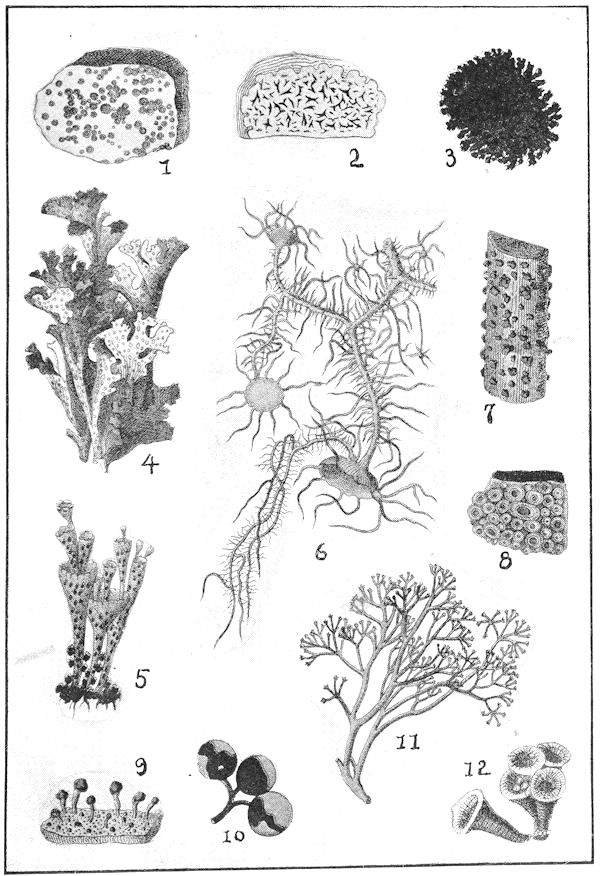
Lichens and Small Fungi
1, Lecanora; 2, Opeographa; 3, Parmelia; 4, Cetraria Islandica; 5, 11, Cladonia; 6, Usnea Barbata; 7, Red Wart Fungus; 8, Pertusaria; 9 Bæomyses; 10, Erysiphe; 12, Cyanthus
But this is only a popular manner of explaining, for if more care is taken, it will be found that, although some fibres run through more than one joint, others, when they are in the midst of a piece, turn outward from the middle, and come near the surface where the carbonate of lime is. There they end in delicate bags or cells in rows, the last of which is quite at the surface; so that the outside of the pieces is made up of a mass of these small microscopic cells, and the rest of the long fibres. The older the plant, the more carbonate of lime is there in this mass of cells; but in very young plants, in the spring of the year, there is but little of the mineral, and they may sometimes be got quite soft. They are then short little stumps fixed on to the expanded root, which sticks on to stones, and they are not white, but of a beautiful claret or port-wine color, the joints, where the fibres are, being greenish or without color. This immature plant can be examined with the microscope, and then the secret of how the carbonate of lime is put in is divulged. First, it appears that any part of the young coralline which is growing, does not have any of the opaque mineral in it, and that the fibres never have it in them, nor has a very delicate skin which covers the whole, and which is very difficult to get a sight of, for it is easily washed off. By putting a young piece in weak acid, bubbles come out, and every now and then one blows up this exquisitely thin pavement-looking film from off the surface. It is then seen to be made up of flat cells, placed side by side, and colorless. This is the important tissue by which the plant lives, for it exists long after all within is hard. It is always growing and being repaired; and in the tropics, where the water is warm, the little cells of it are covered with very long hairs, and, indeed, they may sometimes be traced in English specimens. Leaving these outside cells and the membrane for a while, it is necessary to consider those beneath, and which are more or less connected with the long fibres of the joints. A row of these more deeply seated cells is on the outside, just beneath the membrane, and other rows are deeper and deeper still, until the ends of the fibres are seen to end, as it were, in contact with the innermost. The outer row of all these is of a pale green color, and gradually the port-wine tint comes with depth from the edge. Each of the cells of these rows is not quite covered with the hard mineral, and they communicate their fluid contents to another; and it is found that it is between the cells that the carbonate of lime is deposited, and which can be dissolved out by vinegar. As soon as a set of cells has done growing, the mineral is deposited, invests, and comes outside them, until it invades the delicate membranes of their bag as well. How does this plant live? and where does it get its lime from? It does not absorb anything by its root, for it is placed on a stone, but all nourishment enters by the thin outside layer.
In all sea-water there is some organic stuff or sea soup, the result of the decomposition of tiny things, and there is some air in the water which contains oxygen and nitrogen and carbonic acid. Under the influence of life, the organic stuff is absorbed by the cell-membrane, and is rendered useful to the rest of the plant, into whose cells, not quite walled up by carbonate of lime, it enters like sap, and circulates. The carbonate of lime can only get in by there being some minute quantity in the sea-water, and there is sufficient in the chalky spots and limestone shores, not only dissolved by the sea-water, but held in suspension by it. The water is ever on the move, passing over the coralline, and in a few weeks a few grains, for they make a great show, are absorbed and deposited in it. Small sea-snails browse on the corallines, and have to thank them for their lime, which is necessary for their shell.
There are some other plants found at low-tide marks which are calcareous, but instead of being jointed, like the corallines, they form irregular and rounded little blocks, or simple papery-looking expansions on some of the larger-leaved sea-weeds. They are usually white and hard, and no one would consider them to be of a vegetable nature were their microscopic anatomy not known. They have a great resemblance in mineral structure to the coralline, and are called Melobesia or Nullipores.
The sea-weeds are, as may have been gleaned from the last few pages, divisible into red, olive, or dark and green kinds, and one of their most interesting studies relates to the method of reproduction. Many sea-weeds are annual and die in the winter, so they must be reproduced by seed, or something like it; others are of two or more years’ growth, and outlive the winter, but in the end they must have some method of perpetuating their kind. Some are perennial, or constantly growing. Certain kinds are only found in the spring and summer, others are always to be met with, and some produce spores, or the matter out of which future weed grows, in summer, and others in the autumn and winter. The geographical range of some of the British sea-weeds is immense, and not a few kinds are found at the Antipodes.
SARGASSUM —Cuthbert Collingwood
Among the many remarkable phenomena connected with the Gulf Stream not the least remarkable is the existence of those floating meadows of sea-weed commonly known as the Gulf-weed or Sargassum, whose accumulations, within certain parallels of latitude and longitude, have given to that area the name of the Sargasso Sea. These marine prairies, as they have been called, have attracted the notice of all navigators since the time of Columbus, who, in his first voyage, received his earliest check upon falling in with them. The great pioneer entered the Sargasso Sea in lat. 26° N., and long. 48° W., and his timid shipmates at once took fright at the marvelous appearance, feeling assured that their ships would be entangled in the weed until they were starved to death, or that they were about to strike on some unknown coast. In this part, he says, “the sea was covered with such a quantity of sea-weed, like little branches of the fir-trees which bear the pistachio nuts, that we believed the ships would run aground for want of water.” They could not understand how such vast quantities of vegetation could merely float on the surface, and the appearance of a lobster among the weed confirmed their fears; and deeming it necessary that they must be either in, or approaching shoal water, they entreated the heroic discoverer to turn the ship’s head. But happily he never wavered, and on the tropic, in long. 66°, the first vessel which had ever entered the Sargasso Sea emerged again into clear water.
The extent of the Sargasso Sea is in due proportion to the vast natural agency to which it primarily owes its existence. It stretches from 20° to about 65° West longitude, and from between the parallels of 20° and 45° is of considerable width, narrowing from 12° in its widest part to about 4° or 5° where least developed; while the remaining 20° of westerly extent takes the form of a narrow belt of various detached tracts, influenced as to situation by local currents, and averaging 4° or 5° only in width. An idea may be obtained of its area by the comparison of Maury, who states that it is equal to the great valley of the Mississippi; or still better, perhaps, from Humboldt’s estimate, that it was about six times as large as the Germany of his day.
But, although the geographical boundaries given above are those usually recognized by hydrographers for the Sargasso Sea, it must not be supposed that they are invariable. It may, however, be correctly stated, that it occupies the great sweep made by the Azores, Canaries, and Cape de Verde Islands in the East; while the elongated westerly belt extends as far as between the Bermudas and West Indian islands.
The earlier navigators often found the Gulf-weed a serious impediment to their progress. Lærius mentions that for fifteen continuous days he passed through one unbroken meadow (Praderias de yerva, or sea-weed prairies, as Oviedo characteristically calls them), so that he could find no way through for oars. On certain occasions it has been found that the speed of vessels through the Sargasso Sea has been materially retarded; and it has been described as so thick that, to the eye, at a little distance it appears to be substantial enough to walk upon.
That this is not the condition met with under all circumstances is proved by the fact that passing through this region in 1867, the writer made a seven days’ voyage through its central portion, during which the sea was at no time covered with the weed, so as to form a continuous meadow. It made its appearance usually in large patches, generally upon the surface, but sometimes apparently sunk to some distance below it. It varied considerably in appearance—was sometimes dark-colored, dense, and compact, and covered with berries; at others, pale and attenuated, with few berries. The masses, on some days were round and shapely, and usually scattered somewhat indiscriminately over the surface of the sea. Occasionally only a few small tufts appeared for many hours; and on one day the only sign of its presence was a long narrow streak, extending across the ocean as far as the eye could reach in the direction of the wind. The fact, indeed, is that the Sargasso Sea, dependent as it is upon a great physical phenomenon, changes its position according to the seasons, storms, and winds: its mean position remaining the same as it has been ascertained by observations during many years past. The Gulf Stream is the great power which maintains these marine pastures—a current whose impulse and origin, according to Humboldt, are to be sought to the south of the Cape of Good Hope—after a long circuit it pours itself from the Caribbean Sea and the Mexican Gulf through the Straits of the Bahamas, and following a course from south-southwest to north-northeast, continues to recede from the shores of the United States until, further deflected to the eastward by the banks of Newfoundland, it approaches the European coast. At the point where the Gulf Stream is deflected from the banks of Newfoundland toward the east, it sends off branches to the south near the Azores. This is the situation of the Sargasso Sea.
Patches of the weed are always to be seen floating along the outer edge of the Gulf Stream. Now, if bits of cork, or chaff, or any floating substance, says Captain Maury, be put in a basin, and a circular motion be given to the water, all the light substances will be found crowding together near the centre of the pool, where there is the least motion. Just such a basin is the Atlantic Ocean to the Gulf Stream; and the Sargasso Sea is the centre of the whirl.
The Gulf-weed itself has so peculiar a history that it forms not the least remarkable point of interest in the description of the Sargasso Sea. It is one of the numerous species of the genus Sargassum, which is among the most natural and readily distinguished genera of the family of Fucaceæ. The great cryptogamist, Agardh, enumerates sixty-two species of Sargassum, of which the one concerning which we are speaking is the Sargassum bacciferum, called Fucus natans by Linnæus, and Fucus sargasso by Gmelin. The Spanish word Sargazo, or Sargaço, meaning sea-weed, supplies its common English name.
The integument is leathery and the general color brown, of varying shades, sometimes light and sometimes dark. The most striking peculiarity, on a cursory view, is the abundance of globular cells, which have been taken by the unlearned for fruit, but which are in reality merely receptacles of air, by means of which the plant not only floats upon the surface of the ocean, but also is enabled to support vast numbers of marine animals, which find shelter among its tangled fronds. Columbus, the first discoverer of the Sargasso Sea, described the meadows as yellow like dry hay-seed, bearing leaves of common rue, with numerous berries, which turn black in drying like juniper berries. These berries have received the name of rasins de tropique.
There is one point in the history of the Sargassum which has excited the attention of all observers, and more particularly of botanists. It is the fact that the Sargassum is always found floating upon the deep sea, and is yet destitute of any apparent means of propagation. Agardh remarked that no fruit nor root could be detected; and expressed his belief that it grew in the depths of the ocean and was torn up by the waves. This belief was very general at one time, and it was supposed that the perfect plant was unknown; but that the Gulf Stream collected together the torn-off masses of its vesicular summits. Rumphius suggested that the Sargassum fed upon the fat exhalations and oily effluvia of dead fish, and other organic substances entangled in it. Even modern publications state that there is reason to think that it is first attached to the bottom of the comparatively shallow parts of the sea; but the Gulf-weed is never found so attached. It always floats; and is healthy and abundant in that condition, never exhibiting any organs of fructification, though constantly putting out new fronds.
It does not appear that any other species of Sargassum is originally destitute of roots, even those most closely allied to Sargassum bacciferum, though some of them are not infrequently found both in the fixed, and in considerable masses in the floating state, retaining vitality, and probably propagating themselves in the same manner. Professor Hervey conjectured that the Gulf-weed might be a pelagic variety of Sargassum vulgare, in the same way as the variety subcostatus of Fucus vesiculosus has never been found attached, growing in salt marshes. In the Mediterranean vast quantities of Fucus vesiculosus occur under a peculiar form, consisting entirely of specimens derived from sea-born weed, carried in by the current which sets in to that sea from the Atlantic.