THE STORY OF THE UNIVERSE (continued 4)
Reading edition
From analogous reasons, it is probable that tendril-bearing plants were primordially twiners—that is, are the descendants of plants having this power and habit. For the internodes of the majority revolve, like those of twining plants; and, in a very few, the flexible stem still retains the capacity of spirally twining round an upright stick. With some the internodes have lost even the revolving power. Tendril-bearers have undergone much more modification than leaf-climbers; hence it is not surprising that their supposed primordial revolving and twining habits have been lost or modified more frequently than with leaf-climbers. The three great tendril-bearing families in which this loss has occurred in the most marked manner are the Cucurbitaceæ, Passifloraceæ, and Vitaceæ. In the first the internodes revolve; but I have heard of no twining form, with the exception of Mormodica balsamina, and this is only an imperfect twiner. In the other two families I can hear of no twiners; and the internodes rarely have the power of revolving, this power being confined to the tendrils; nevertheless, the internodes of Passiflora gracilis have this power in a perfect manner, and those of the common vine in an imperfect degree: so that at least a trace of the supposed primordial habit is always retained by some members of the larger tendril-bearing groups.
On the view here given, it may be asked, Why have nearly all the plants in so many aboriginally twining groups been converted into leaf-climbers or tendril-bearers? Of what advantage could this have been to them? Why did they not remain simple twiners? We can see several reasons. It might be an advantage to a plant to acquire a thicker stem, with short internodes bearing many or large leaves; and such stems are ill fitted for twining. Any one who will look during windy weather at twining plants will see that they are easily blown from their support; not so with tendril-bearers or leaf-climbers, for they quickly and firmly grasp their support by a much more efficient kind of movement. In those plants which still twine, but at the same time possess tendrils or sensitive petioles, as some species of Bignonia, Clematis, and Tropæolum, we can readily observe how incomparably more securely they grasp an upright stick than do simple twiners. From possessing the power of movement on contact, tendrils can be made very long and thin; so that little organic matter is expended in their development, and yet a wide circle is swept. Tendril-bearers can, from their first growth, ascend along the outer branches of any neighboring bush, and thus always keep in the full light; twiners, on the contrary, are best fitted to ascend bare stems, and generally have to start in the shade. In dense tropical forests, with crowded and bare stems, twining plants would probably succeed better than most kinds of tendril-bearers; but the majority of twiners, at least in our temperate regions, from the nature of their revolving movement, can not ascend a thick trunk, whereas this can be effected by tendril-bearers, if the trunks carry many branches or twigs; and in some cases they can ascend by special means a trunk without branches, but with a rugged bark.
The object of all climbing plants is to reach the light and free air with as little expenditure of organic matter as possible; now, with spirally ascending plants, the stem is much longer than is absolutely necessary; for instance, I measured the stem of a kidney-bean which had ascended exactly two feet in height, and it was three feet in length: the stem of a pea, ascending by its tendrils, would, on the other hand, have been but little longer than the height gained. That this saving of stem is really an advantage to climbing plants I infer from observing that those that still twine, but are aided by clasping petioles or tendrils, generally make more open spires than those made by simple twiners. Moreover, such plants very generally, after taking one or two turns in one direction, ascend for a space straight, and then reverse the direction of the spire. By this means they ascend to a considerably greater height, with the same length of stem, than would otherwise be possible; and they can do it with safety, as they secure themselves at intervals by their clasping petioles.
Tendrils consist of various organs in a modified state, namely, leaves and flower-peduncles, and perhaps branches and stipules. The position alone generally suffices to show when a tendril has been formed from a leaf; and in Bignonia the lower leaves are often perfect, while the upper ones terminate in a tendril in place of a terminal leaflet; in Eccremocarpus I have seen a lateral branch of a tendril replaced by a perfect leaflet; and in Vicia sativa, on the other hand, leaflets are sometimes replaced by tendril-branches; and many other such cases could be given. But he who believes in the slow modification of species will not be content simply to ascertain the homological nature of different tendrils; he will wish to learn, as far as possible, by what steps parts acting as leaves or as flower-peduncles can have wholly changed their function, and have come to serve as prehensile organs.
In the whole group of leaf-climbers abundant evidence has been given that an organ, still subserving its proper function as a leaf, may become sensitive to a touch, and thus grasp an adjoining object. In several leaf-climbers true leaves spontaneously revolve; and their petioles, after clasping a support, grow thicker and stronger. We thus see that true leaves may acquire all the leading and characteristic qualities of tendrils, namely, sensitiveness, spontaneous movement, and subsequent thickening and induration. If their blades or laminæ were to abort, they would form true tendrils. And of this process of abortion we have seen every stage; for in an ordinary tendril, as in that of the pea, we can discover no trace of its primordial nature; in Mutisia clematis, the tendril in shape and color closely resembles a petiole with the denuded midribs of its leaflets; and occasionally vestiges of laminæ are retained or reappear. Lastly, in four genera in the same family of the Fumariaceæ we see the whole gradation; for the terminal leaflets of the leaf-climbing Fumaria officinalis are not smaller than the other leaflets; those of the leaf-climbing Adlumia cirrhosa are greatly reduced; those of the Corydalis claviculata (a plant which may be indifferently called a leaf-climber or tendril-bearer) are either reduced to microscopical dimensions or have their blades quite aborted, so that this plant is in an actual state of transition; and, finally, in the Dicentra the tendrils are perfectly characterized. Hence, if we were to see at the same time all the progenitors of the Dicentra, we should almost certainly behold a series like that now exhibited by the above-named four genera. In Tropæolum tricolorum we have another kind of passage; for the leaves which are first formed on the young plant are entirely destitute of laminæ, and must be called tendrils, while the later formed leaves have well-developed laminæ. In all cases, in the several kinds of leaf-climbers and of tendril-bearers, the acquirement of sensitiveness by the midribs of the leaves apparently stands in the closest relation with the abortion of their laminæ or blades.
On the view here given, leaf-climbers were primordially twiners, and tendril-bearers (of the modified leaf division) were primordially leaf-climbers. Hence leaf-climbers are intermediate in nature between twiners and tendril-bearers, and ought to be related to both. This is the case: thus the several leaf-climbing species of the Antirrhineæ, of Solanum, of Cocculus, of Gloriosa are related to the other genera in the same family, or even to other species in the same genus, which are true climbers. On the other hand, the leaf-climbing species of Clematis are very closely allied to the tendril-bearing Naravelia: the Fumariaceæ include closely allied genera which are leaf-climbers and tendril-bearers. Lastly, one species of Bignonia is both a leaf-climber and a tendril-bearer, and other closely allied species are twiners.
Tendrils of the second great division consist of modified flower-peduncles. In this case likewise we have many interesting transitional states. The common vine (not to mention the Cardiospermum) gives us every possible grade from finely developed tendrils to a bunch of flower-buds, bearing the single usual lateral flower-tendril. And when the latter itself bears some flowers, as we know is not rarely the case, and yet retains the power of clasping a support, we see the primordial state of all these tendrils which have been formed by the modification of flower-peduncles.
According to Mohl and others, some tendrils consist of modified branches. I have seen no such case, and, therefore, of course, know nothing of any transitional states, if such occur. But Lophospermum, at least, shows us that such a transition is possible; for its branches spontaneously revolve, and are sensitive to contact. Hence, if the leaves of some of the branches were to abort, they would be converted into true tendrils. Nor is it so improbable as may at first appear that certain branches alone should become modified, the others remaining unaltered; for with certain varieties of Phaseolus some of the branches are thin and flexible and twine, while other branches on the same plant are stiff and have no such power.
If we inquire how the petiole of a leaf, or the peduncle of a flower, or a branch first becomes sensitive and acquires the power of bending toward the touched side, we get no certain answer. Nevertheless, an observation by Hofmeister well deserves attention, namely, that the shoots and leaves of all plants, while young, move after being shaken; and it is almost invariably young petioles and young tendrils, whether of modified leaves or flower-peduncles, which move on being touched; so that it would appear as if these plants had utilized and perfected a widely distributed and incipient capacity, which capacity, as far as we can see, is of no service to ordinary plants. If we further inquire how the stems, petioles, tendrils, and flower-peduncles of climbing plants first acquired their power of spontaneously revolving or, to speak more accurately, of successively bending to all points of the compass, we are again silenced, or at most can only remark, that the power of movement, both spontaneous and from various stimuli, is far more common with plants, as we shall presently see, than is generally supposed to be the case by those who have not attended to the subject. There is, however, one remarkable case of the Maurandia semperflorens, in which the young flower-peduncles spontaneously revolve in very small circles, and bend themselves, when gently rubbed, to the touched side; yet this plant certainly profits in no way by these two feebly developed powers. A rigorous examination of other young plants would probably show some slight spontaneous movement in the peduncles and petioles, as well as that sensitiveness to shaking observed by Hofmeister. We see at least in the Maurandia a plant which might, by a little augmentation of qualities which it already possesses, come first to grasp a support by its flower-peduncles (as with Vitis or Cardiospermum) and then, by the abortion of some of its flowers, acquire perfect tendrils.
There is one interesting point which deserves notice. We have seen that some tendrils have originated from modified leaves, and others from modified flower-peduncles; so that some are foliar and some axial in their homological nature. Hence it might have been expected that they would have presented some difference in function. This is not the case. On the contrary, they present the most perfect identity in their several remarkable characteristics. Tendrils of both kinds spontaneously revolve at about the same rate. Both, when touched, bend quickly to the touched side, and afterward recover themselves and are able to act again. In both the sensitiveness is either confined to one side or extends all round the tendril. They are either attracted or repelled by the light. The tips of the tendrils in these two plants become, after contact, enlarged into disks, which are at first adhesive by the secretion of some cement. Tendrils of both kinds, soon after grasping a support, contract spirally; they then increase greatly in thickness and strength. When we add to these several points of identity the fact of the petiole of the Solanum jaspinoides assuming the most characteristic feature of the axis, namely, a closed ring of woody vessels, we can hardly avoid asking whether the difference between foliar and axial organs can be of so fundamental a nature as is generally supposed to be the case.
We have attempted to trace some of the stages in the genesis of climbing plants. But, during the endless fluctuations in the conditions of life to which all organic beings have been exposed, it might have been expected that some climbing plants would have lost the habit of climbing. In the cases of certain South African plants belonging to great twining families, which in certain districts of their native country never twine, but resume this habit when cultivated in England, we have a case in point. In the leaf-climbing Clematis flammula, and in the tendril-bearing vine, we see no loss in the power of climbing, but only a remnant of that revolving power which is indispensable to all twiners, and is so common, as well as so advantageous, to most climbers. In Tecoma radicans, one of the Bignoniaceæ, we see a last and doubtful trace of the revolving power.
With respect to the abortion of tendrils, certain cultivated varieties of Cucurbita pepo have, according to Naudin, either quite lost these organs or bear semi-monstrous representatives of them. In my limited experience I have met with only one instance of their natural suppression, namely, in the common bean. All the other species of Vicia, I believe, bear tendrils; but the bean is stiff enough to support its own stem, and in this species, at the end of the petiole where a tendril ought to have arisen, a small pointed filament is always present, about a third of an inch in length, and which must be considered as the rudiment of a tendril. This may be the more safely inferred, because I have seen in young, unhealthy specimens of true tendril-bearing plants similar rudiments. In the bean these filaments are variable in shape, as is so frequently the case with all rudimentary organs, being either cylindrical or foliaceous, or deeply furrowed on the upper surface. It is a rather curious little fact that many of these filaments when foliaceous have dark-colored glands on their lower surfaces, like those on the stipules, which secrete a sweet fluid; so that these rudiments have been feebly utilized.
One other analogous case, though hypothetical, is worth giving. Nearly all the species of Lathyrus possess tendrils; but L. nissolia is destitute of them. This plant has leaves which must have struck every one who has noticed them with surprise, for they are quite unlike those of all common papilionaceous plants, and resemble those of a grass. In L. aphaca the tendril, which is not highly developed (for it is unbranched, and has no spontaneous revolving power), replaces the leaves, the latter in function being replaced by the large stipules. Now, if we suppose the tendrils of L. aphaca to become flattened and foliaceous, like the little rudimentary tendrils of the bean, and the large stipules, not being any longer wanted, to become at the same time reduced in size, we should have the exact counterpart of L. nissolia, and its curious leaves are at once rendered intelligible to us.
It may be added, as it will serve to sum up the foregoing views on the origin of tendril-bearing plants, that if these views be correct, L. nissolia must be descended from a primordial spirally twining plant; that this became a leaf-climber; that first part of the leaf and then the whole leaf became converted into a tendril, with the stipules by compensation greatly increased in size; that this tendril lost its branches and became simple, then lost its revolving power (in which state it would resemble the tendril of the existing L. aphaca), and afterward losing its prehensile power and becoming foliaceous would no longer be called a tendril. In this last stage (that of the existing L. nissolia) the former tendril would reassume its original function as a leaf, and its lately largely developed stipules, being no longer wanted, would decrease in size. If it be true that species become modified in the course of ages, we may conclude that L. nissolia is the result of a long series of changes, in some degree like those just traced.
The most interesting point in the natural history of climbing plants is their diverse power of movement; and this led one on to their study. The most different organs—the stem, flower-peduncle, petiole, midribs of the leaf or leaflets, and apparently aerial roots—all possess this power.
In the first place, the tendrils place themselves in the proper position for action, standing, for instance, in the Cobæa, vertically upward, with their branches divergent and their hooks turned outward, and with the young terminal shoot thrown on one side; or, as in Clematis, the young leaves temporarily curve themselves downward, so as to serve as grapnels.
Secondly, if the young shoot of a twining plant, or of a tendril, be placed in an inclined position, it soon bends upward, though completely secluded from the light. The guiding stimulus to this movement is no doubt the attraction of gravity, as Andrew Knight showed to be the case with germinating plants. If a succulent shoot of almost any plant be placed in an inclined position in a glass of water in the dark, the extremity will, in a few hours, bend upward; and if the position of the shoot be then reversed, the now downward bent shoot will reverse its curvature; but if the stolon of a strawberry, which has no tendency to grow upward, be thus treated, it will curve downward in the direction of, instead of in opposition to, the force of gravity. As with the strawberry, so it is generally with the twining shoots of the Hibbertia dentata, which climbs laterally from bush to bush; for these shoots, when bent downward, show little and sometimes no tendency to curve upward.
Thirdly, climbing plants, like other plants, bend toward the light by a movement closely analogous to that incurvation which causes them to revolve. This similarity in the nature of the movement was well seen when plants were kept in a room, and their first movements in the morning toward the light and their subsequent revolving movements were traced on a bell glass. The movement of a revolving shoot, and in some cases of a tendril, is retarded or accelerated in traveling from or to the light. In a few instances tendrils bend in a conspicuous manner toward the dark. Many authors speak as if the movement of a plant toward the light was as directly the result of the evaporation or of the oxygenation of the sap in the stem, as the elongation of a bar of iron from an increase in its temperature. But, seeing that tendrils are either attracted to or repelled by the light, it is more probable that their movements are only guided and stimulated by its action in the same manner as they are guided by the force of attraction toward the centre of gravity.
Fourthly, we have in stems, petioles, flower-peduncles and tendrils the spontaneous revolving movement which depends on no outward stimulus, but is contingent on the youth of the part and on its vigorous health, which again, of course, depends on proper temperature and the other conditions of life. This is, perhaps, the most interesting of all the movements of climbing plants because it is continuous. Very many other plants exhibit spontaneous movements, but they generally occur only once during the life of a plant, as in the movements of the stamens and pistils, etc., or at intervals of time, as in the so-called sleep of plants.
Fifthly, we have in the tendrils, whatever their homological nature may be, in the petioles and tips of the leaves of leaf-climbers, in the stem in one case and apparently in the aerial roots of the vanilla, movements—often rapid movements—from contact with any body. Extremely slight pressure suffices to cause the movement. These several organs, after bending from a touch, become straight again, and again bend when touched.
Sixthly, and lastly, most tendrils, soon after clasping a support, but not after a mere temporary curvature, contract spirally. The stimulus from the act of clasping some object seems to travel slowly down the whole length of the tendril. Many tendrils, moreover, ultimately contract spontaneously even if they have caught no object; but this latter useless movement occurs only after a considerable lapse of time.
We have seen how diversified are the movements of climbing plants. These plants are numerous enough to form a conspicuous feature in the vegetable kingdom; every one has heard that this is the case in tropical forests; but even in the thickets of our temperate regions the number of kinds and of individual plants is considerable, as will be found by counting them. They belong to many and widely different orders. To gain some crude idea of their distribution in the vegetable series, I marked from the lists given by Mohl and Palm (adding a few myself, and a competent botanist, no doubt, could add many more) all those families in Lindley’s Vegetable Kingdom, which include plants in any of our several subdivisions of twiners, leaf-climbers, and tendril-bearers; and these (at least some of each group) all have the power of spontaneously revolving. Lindley divides Phanerogamic plants into fifty-nine alliances; of these, no less than above half, namely, thirty-five, include climbing plants according to the above definition, hook and root-climbers being excluded. To these a few Cryptogamic plants must be added which climb by revolving. When we reflect on this wide serial distribution of plants having this power, and when we know that in some of the largest, well-defined orders, such as the Compositæ, Rubiaceæ, Scrophulariaceæ, Liliaceæ, etc., two or three genera alone, out of the host of genera in each, have this power, the conclusion is forced on our minds that the capacity of acquiring the revolving power on which most climbers depend is inherent though undeveloped in most every plant in the vegetable kingdom.
FLOWER COLORATION —Alexander S. Wilson
The Prophet-plant (Arnebia echioides) is a native of Persia and Arabia, but has been introduced and grows freely in gardens in England. Its chief interest lies in its variable flowers, which may fairly rank with those of the changeable Hibiscus and other
“Plants divine and strange That every hour their blossoms change.”
The plant is about two feet in height, and somewhat resembles a cowslip or an auricula. It belongs to the natural order Boraginaceæ, and is nearly allied to the lungwort, viper’s-bugloss, borage, and forget-me-not, all of which exhibit color changes more or less distinct. The various species of Myosotis, or forget-me-not, are also called scorpion grasses, from the upper flower-bearing portion of the stem being curled on itself like a watch-spring. The cluster of flowers, forming the inflorescence of Arnebia, develops in same scorpioid fashion. There is a double row of flower buds on the curled stalk, and as this gradually unwinds pair after pair of the flowers expand in succession. In shape and color the individual flowers are not unlike those of the primrose, though rather smaller. When a flower first opens, five conspicuous jet-black spots are seen upon the yellow rim of the salver-shaped corolla. If the flower be examined the following day, we are surprised to discover that the black spots have vanished as if by magic. The yellow of the corolla is also much paler, and a little later on presents quite a bleached and silvery appearance, the petals becoming almost white. No sooner have the spots disappeared from the first pair of flowers than a second pair expand, and display their sable marks in bold relief upon the yellow enamel of their petals. From this time onward the inflorescence comprises both kinds of flower, those but newly opened having the five conspicuous spots, and the older ones on which no spots are visible. From these dark spots—the so-called finger-marks of Mahomet, Arnebia has received its name—the Prophet-plant. Its flowers seem bewitched, the change is so pronounced and obvious; a day or two after unfolding they differ so much from the newly opened ones beside them, that were they growing on separate plants, we should at once set them down as belonging to another species.
This change of color gives rise to another interesting peculiarity. If Arnebia be examined by daylight, and again in the dim twilight, the observer is struck by a remarkable circumstance. In broad daylight, the golden spotted flowers at once arrest the eye, while their paler companions are hardly observed. The inflorescence owes by far the greater part of its display to the younger flowers. In the dusk this is entirely reversed; the conspicuousness of the inflorescence now depends on the paler flowers, and the others are so obscured that a second glance is needed before they can be discerned. The relative brilliancy of the two sets of flowers can also be tested by gradually retiring from the plant, keeping the eyes still fixed on the blossoms. At dusk the young flowers are lost sight of much sooner than the others; by day the older ones first disappear in the distance. This peculiar transformation imparts to the inflorescence of Arnebia a faint similitude of the pillar of cloud by day and of fire by night—that celestial manifestation of sacred story so closely associated with the native region of this desert flower.
Here, then, we have one of those phenomena which for the naturalist possess all the fascination of a mystery. What can be the explanation of this remarkable change of color, and what advantage does the flower derive from the sudden disappearance of its spots and the blanching of its petals?
With the reader’s permission, we shall now proceed to show why nature has bestowed on Arnebia what she has denied to the leopard—the power of changing its spots. Before we can say why any flower should change its color, we must first know why a flower is colored at all, and why all flowers are not colored alike. Almost all the peculiarities of flowers can be explained as having reference to the visits of insects. The honey is secreted as an inducement, while the secret and brilliant colors serve to attract the attention of the honey-gatherers. The researches of the late Charles Darwin demonstrated the importance of cross-fertilization in the vegetable kingdom. Very many flowers are quite sterile with their own pollen; in other cases, although the flower has the capacity of self-fertilization, the resulting seeds are of very inferior quality compared with those obtained as a result of cross-fertilization. As carriers of pollen, then, insects perform an essential service to plants, and it is in order to secure their services that flowers are brightly colored.
For the variety of color observed among flowers there appear to be two principal reasons. A little reflection will show that, since flowers are so dependent on insects for the conveyance of their pollen, it must be to the advantage of each species of plant to possess flowers distinctively colored and capable of being easily recognized by honey-seeking insects. A bee does not visit all flowers indiscriminately; it would be greatly to the flowers’ disadvantage if it did. In the course of a single journey the bee for the most part restricts itself to the flowers of one species, and has been known to visit as many as thirty dead-nettles in succession, passing over all other flowers. Time is saved by this method, for by keeping to one kind of flower at a time the insect becomes familiar with its outs and ins, and the practice thus acquired enables it to overtake a larger number of blossoms than it could if it did not observe this rule. This constancy in visiting the same kind of flower is of great importance to plants, since it ensures that the pollen will be conveyed to a flower of the same species as that from which it came. But if all flowers were colored and perfumed alike, the winged botanist could not identify the species; the pollen would be constantly transferred to the stigmas of the wrong flowers, where it would be useless, and so the work of cross-fertilization would be seriously impeded.
A second cause contributing to the variety observed among flowers is the desirability of attracting special kinds of insects. As we have just seen, an insect does not visit all kinds of flowers indiscriminately; neither, on the other hand, does a flower attract indiscriminately all kinds of insects. Not only are injurious and unprofitable visitors excluded, but the more specialized insects are in greatest demand. Partiality for particular insects is shown both by the shapes and coloring of flowers. Open shallow flowers, with exposed honey accessible to almost all insects, have, as their most frequent visitors, short-lipped flies and beetles. Many blossoms, again, have become specially adapted to bees. Their honey is placed beyond the reach of short-lipped fliers, and requires the slender proboscis of a bee or butterfly for its extraction. Honeysuckle, habenaria, plumbago, phlox, and narcissus illustrate a third type, with flower-tubes so narrow and deep that their nectar is quite inaccessible even to bees, and is reserved entirely for moths and butterflies, which possess an extremely long and thin proboscis. There is a corresponding adaptation in the colors; the gay tints of the buttercup, poppy, and rose appear to have special attractions for beetles; bees show a decided preference for blue, and this color predominates in flowers whose shapes are adapted to their visits. Deep tubular flowers specialized for Lepidoptera fall into two divisions, according as they solicit the attentions of diurnal butterflies or nocturnal moths. Red and purple are the favorite colors of the former, while nocturnal moths show a preference for white and pale flowers. Thus the carnation and campion (Lychnis diurna), which open by day, have dark tints in comparison with Lychnis respertina, which unfolds its petals toward evening. Almost scentless by day, this white nocturnal flower diffuses a delicious fragrance in the twilight. The evening primrose (Ænothera), which, however, has yellow petals, is another example of this class. But the most remarkable plant of this type is the night-flowering stock (Cereus). Its pale blossoms open about seven in the evening, emit puffs of odor from time to time, and close up again toward midnight; by morning the flowers are withered. It is impossible to doubt that we have in this instance a flower specialized for the visits of nocturnal moths. The reason why nocturnal flowers, like the honeysuckle and evening campion, have pale-colored petals is not far to seek. These pale hues can be more easily distinguished at night than the red or purple of Dianthus or Githago. Among lilies both diurnal and nocturnal flowers occur, and clearly indicate by their colors to which section of the Lepidoptera they are adapted. The Turk’s-cap lily, with its perianth of fiery scarlet, is a characteristic example of a diurnal flower adapted to butterflies which wander abroad in daytime. On the other hand, Lilium Martagon, an L. candidum, with their white bells, are nocturnal lilies fertilized by night-loving moths.
Two flowers, unlike in their coloring, can hardly be equally attractive to the same visitors, even if they grow together on the same plant, as in the case of Arnebia; the presumption, therefore, is that its spotted and pale blossoms are adapted for different insects. Moreover, the stronger colors of the younger flowers correspond with those of the day-blooming class, while the paler tints of those in the second stage will render them more attractive to nocturnal moths; and this view is strongly confirmed by the fact that night-blooming flowers are never variegated, but have their petals uniformly devoid of markings. By night the dark spots tend, in this instance, to conceal the blossoms so much that, if these are to be converted into nocturnal flowers, the removal of the spots is absolutely necessary. We may therefore conclude with tolerable certainty that the flowers of Arnebia in their first stage are adapted to bees and diurnal Lepidoptera, while in their second condition they array themselves in paler hues to attract nocturnal moths.
By the color change, in this instance, a diurnal is converted into a nocturnal flower, and one advantage thereby gained is that the blossoms appeal to a larger class of fertilizing agents. The more restricted the circle of visitors on which any plant depends the greater the risk, in the event of insects being scarce, of its flowers remaining unfertilized and perishing. Here it would seem that Nature proceeds on the same principle as a fisherman in changing his bait. Like some other variable blossoms, Arnebia is in the advantageous position of carrying two strings to her bow.
QUEER FLOWERS —Grant Allen
If Baron Munchausen had ever in the course of his travels come across a single flower one standard British yard in diameter, fifteen pounds avoirdupois in weight, and forming a cup big enough to hold six quarts of water in its central hollow, it is not improbable that the learned baron’s veracious account of the new plant might have been met with the same polite incredulity which his other adventures shared with those of Bruce, Stanley, Mendez Pinto, and Du Chaillu. Nevertheless, a big blossom of this enormous size has been well known to botanists ever since the beginning of the Nineteenth Century. When Sir Stamford Raffles was taking care of Sumatra during our temporary annexation, he happened one day to light upon a gigantic parasite, which grew on the stem of a prostrate creeper in the densest part of the tropical jungle. It measured nine feet round and three feet across: it had five large petals with a central basin; and it was mottled red in hue, being, in fact, in color and texture surprisingly suggestive of raw beefsteak. One flower was open when Sir Stamford came upon it: the other was in the bud, and looked in that state extremely like a very big red cabbage. Specimens of this surprising find were at once forwarded to England, and it was at last duly labeled after the names of its two discoverers as Rafflesia Arnoldi.
The mere size of this mammoth among flowers would in itself naturally suffice to give it a distinct claim to respectful attention; but Rafflesia possesses many other sterling qualities far more calculated than simple bigness to endear it to a large and varied circle of insect acquaintances. The oddest thing about it, indeed, is the fact that it is a deliberately deceptive and alluring blossom. As soon as it was first discovered, Dr. Arnold noticed that it possessed a very curious carrion smell, exactly like that of putrefying meat. He also observed that this smell attracted flies in large numbers by false pretences to settle in the centre of the cup. But it is only of late years that the real significance and connection of these curious facts has come to be perceived. We now know that Rafflesia is a flower which wickedly and feloniously lays itself out to deceive the confiding meat-flies and to starve their helpless infants in the midst of apparent plenty. The majority of legitimate flowers (if I may be allowed the expression) get themselves decently fertilized by bees and butterflies, who may be considered as representing the regular trade, and who carry the fecundating pollen on their heads and proboscises from one blossom to another, while engaged in their usual business of gathering honey every day from every opening flower. But Rafflesia, on the contrary, has positively acquired a fallacious external resemblance to raw meat, and a decidedly high flavor, on purpose to take in the too trustful Sumatran flies. When a fly sights and scents one, he (or rather she) proceeds at once to settle in the cup, and there lay a number of eggs in what it naturally regards as a very fine decaying carcass. Then, having dusted itself over in the process with plenty of pollen from this first flower, it flies away confidingly to the next promising bud, in search both of food for itself and of a fitting nursery for its future little ones. In doing so, it of course fertilizes all the blossoms that it visits, one after another, by dusting them successively with each other’s pollen. When the young grubs are hatched out, however, they discover the base deception all too late, and perish miserably in their fallacious bed, the hapless victims of misplaced parental confidence. Even as Zeuxis deceived the very birds with his painted grapes, so Rafflesia deceives the flies themselves by its ingenious mimicry of a putrid beefsteak. In the fierce competition of tropical life, it has found out by simple experience that dishonesty is the best policy.
The general principle which this strange flower illustrates in so striking a fashion is just this. Most common flowers have laid themselves out to attract bees, and so a bee flower forms our human ideal of central typical blossom: it looks, in short, we think, as a flower ought to look. But there are some originally minded and eccentric plants which have struck out a line for themselves, and taken to attracting sundry casual flies, wasps, midges, beetles, snails, or even birds, which take the place of bees as their regular fertilizers; and it is these Bohemians of the vegetable world that make up what we all consider as the queerest and most singular of all flowers. They adapt their appearance and structure to the particular tastes and habits of their chosen guests.
Most of the flowers specially affected by carrion flies have a lurid red color and a distinct smell of bad meat. Few of them, however, are quite so cruel in their habits as Rafflesia. For the most part, they attract the insects by their appearance and odor, but reward their services with a little honey and other allurements. This is the case with the curious English fly-orchid, whose dull purple lip is covered with tiny drops of nectar, licked off by the fertilizing flies. The very malodorous carrion-flowers (or stapelias) are visited by blue-bottles and flesh-flies, while an allied form actually sets a trap for the fly’s proboscis, which catches the insect by its hairs, and compels him to give a sharp pull in order to free himself: this pull dislodges the pollen, and so secures cross-fertilization. The Alpine butterwort sets a somewhat similar gin so vigorously that when a weak fly is caught in it he can not disengage himself, and there perishes wretchedly, like a hawk in a keeper’s trap.
The south European birthwort, a very lurid-looking and fly-enticing flower, has a sort of cornucopia-shaped tube, lined with long hairs, which all point inward, and so allow small midges to creep down readily enough, after the fashion of an eel-buck or lobster-pot. “Sed revocare gradum, superasque evadere ad auras”—to get out again is the great difficulty. Try as they will, the little prisoners can not crawl back upward against the downward-pointing hairs. Accordingly, they are forced by circumstances over which they have no control to walk aimlessly up and down their prison yard, fertilizing the little knobby surface of the seed-vessel from another flower. But as soon as the seeds are all impregnated, the stamens begin to shed their pollen, and dust over the gnats with copious powder. Then the hairs all wither up, and the gnats, released from their lobster-pot prison, fly away once more on the same fool’s errand. Before doing so, however, they make a good meal off the pollen that covers the floor, though they still carry away a great many grains on their own wings and bodies.
A very similar but much larger fly-cage is set by our common wild arum, or cuckoo-pint. This familiar big spring flower exhales a disagreeable fleshy odor, which, by its meat-like flavor, attracts a tiny midge with beautiful iridescent wings and a very poetical name, Psychoda. As in most other cases where flies are specially invited, the color of the cuckoo-pint is usually a dull and somewhat livid purple. A palisade of hairs closes the neck of the funnel-shaped blossom, and repeats the lobster-pot tactics of the entirely unconnected south European birthwort. The little flies, entering by this narrow and stockaded door, fertilize the future red berries with pollen brought from their last prison, and are then rewarded for their pains by a tiny drop of honey, which slowly oozes from the middle of each embryo fruitlet as soon as it is duly impregnated. Afterward, the pollen is shed upon their backs by the bursting of the pollen-bag; the hairs wither up, and open the previously barricaded exit, and the midges issue forth in search of a new prison and a second drop of honey.
From plants that imprison insects to plants that devour insects alive is a natural transition. The giant who keeps a dungeon is first cousin to the ogre who swallows down his captives entire. And yet the subject is really too serious a one for jesting; there is something too awful and appalling in this contest of the unconscious and insentient with the living and feeling, of a lower vegetative form of life with a higher animated form, that it always makes me shudder slightly to think of it.
On most English peaty patches there grows a little reddish-leaved odd-looking plant known as sundew. It is but an inconspicuous small weed, and yet literary and scientific honors have been heaped upon its head to an extent almost unknown in the case of any other member of the British floral commonwealth. Mr. Swinburne has addressed an ode to it, and Mr. Darwin has written a learned book about it. Its portrait has been sketched by innumerable artists, and its biography narrated by innumerable authors. And all this attention has been showered upon it, not because it is beautiful, or good, or modest, or retiring, but simply and solely because it is atrociously and deliberately wicked. Sundew, in fact, is the best known and most easily accessible of the carnivorous and insectivorous plants.
The leaf of the sundew is round and flat, and it is covered by a number of small red glands, which act as the attractive advertisement to the misguided midges. Their knobby ends are covered with a glutinous secretion, which glistens like honey in the sunlight, and so gains for the plant its common English name. But the moment a hapless fly, attracted by hopes of meat or nectar, settles quietly in its midst, on hospitable thoughts intent, the viscid liquid holds him tight immediately, and clogs his legs and wings, so that he is snared exactly as a peregrine is snared with bird-lime. Then the leaf, with all its “red-lipped mouths,” closes over him slowly but surely, and crushes him by folding its edges inward gradually toward the centre. The fly often lingers long with ineffectual struggles, while the cruel crawling leaf pours forth a digestive fluid—a vegetable gastric juice, as it were—and dissolves him alive piecemeal in its hundred clutching suckers.
Our little English insectivorous plants, however (we have at least five or six such species in our own islands), are mere clumsy bunglers compared to the great and highly developed insect-eaters of the tropics, which stand to them in somewhat the same relation as the Bengal tiger stands to the British wildcat or the skulking weasel. The Indian pitcher-plants or Nepenthes bear big pitchers of very classical shapes, closed in the early state with a lid, which lifts itself and opens the pitcher as soon as the plant has fully completed its insecticidal arrangements. The details of the trap vary somewhat in the different species, but as a whole the modus operandi of the plant is somewhat after this atrocious fashion. The pitcher contains a quantity of liquid, that of the sort appropriately known as the Rajah holding as much as a quart; and the insect, attracted in most cases by some bright color, crawls down the sticky side, quaffs the unkind Nepenthe, and forgets his troubles forthwith in the vat of oblivion prepared for him beneath by the delusive vase. A slimy Lethe flows over his dissolving corse, and the relentless pitcher-plant sucks his juices to supply his own fibres with the necessary nitrogenous materials.
The California pitcher-plant, or Darlingtonia, is a member of a totally distinct family, which has independently hit upon the same device in the Western world as the Indian Nepenthes in the Eastern Hemisphere. The pitcher in this case, though differently produced, is hooded and lidded like its Oriental analogue; but the inside of the hood is furnished with short hairs, all pointing inward, and legibly inscribed (to the botanical eye) with the appropriate motto: “Vestigia nulla retrorsum.” The whole arrangement is colored dingy orange, so as to attract the attention of flies; and it contains a viscid digestive fluid in which the flies are first drowned and then slowly melted and assimilated. The pitchers are often found half full of dead and decaying assorted insects.
There are a great many more of these highly developed insect-eaters, such as the Guiana heliamphora (more classical shapes), the Australian cephalotus, and the American side-saddle flowers, and they all without exception grow in very wet and boggy places, like the English sundews, butterworts, and bladderworts. The reason so many marsh plants have taken to these strange insect-eating habits is simply that their roots are often badly supplied with manure or ammonia in any form; and, as no plant can get on without these necessaries of life (in the strictest sense), only those marshy weeds have any chance of surviving which can make up in one way or another for the native deficiencies of their situation. The sundews show us, as it were, the first stage in the acquisition of these murderous habits; the pitcher-plants are the abandoned ruffians which have survived among all their competitors in virtue of their exceptional ruthlessness and deceptive coloration. I ought to add that in all cases the pitchers are not flowers, but highly modified and altered leaves, though in many instances they are quite as beautifully colored as the largest and handsomest exotic orchids.
The principle of Venus’s Fly-trap is somewhat different, though its practice is equally nefarious. This curious marsh-plant, instead of setting hocussed bowls of liquid for its victims, like a Florentine of the Fourteenth Century, lays a regular gin or snare for them on the same plan as a common snapping rat-trap. The end of the leaf is divided into two folding halves by the midrib, and on each half are three or five highly sensitive hairs. The moment one of these hairs is touched by a fly, the two halves come together, inclosing the luckless insect between them. As if on purpose to complete the resemblance to a rat-trap, too, the edges of the leaf are formed of prickly jagged teeth, which fit in between one another when the gin shuts, and so effectually cut off the insect’s retreat. The plant then sucks up the juices of the fly; and as soon as it has fully digested them, the leaf opens automatically once more, and resets the trap for another victim. It is an interesting fact that this remarkable insectivore appears to be still a new and struggling species, or else an old type on the very point of extinction, for it is only found in a few bogs over a very small area in the neighborhood of Wilmington, South California.
ATHENA IN THE EARTH —John Ruskin
The spirit in the plant—that is to say, its power of gathering dead matter out of the wreck round it, and shaping it into its own chosen shape—is, of course, strongest at the moment of its flowering, for it then not only gathers, but forms, with the greatest energy.
And where this life is in it at full power, its form becomes invested with aspects that are chiefly delightful to our own human passions; namely, first, with the loveliest outlines of shape; and, secondly, with the most brilliant phases of the primary colors, blue, yellow, and red or white, the unison of all; and, to make it all more strange, this time of peculiar and perfect glory is associated with relations of the plants or blossoms to each other, correspondent to the joy of love in human creatures, and having the same object in the continuance of the race. Only, with respect to plants, as animals, we are wrong in speaking as if the object of this strong life were only the bequeathing of itself. The flower is the end or proper object of the seed, not the seed of the flower. The reason for seeds is that flowers may be; not the reason of flowers that seeds may be. The flower itself is the creature which the spirit makes; only, in connection with its perfectness, is placed the giving birth to its successor.
The main fact, then, about a flower is that it is the part of the plant’s form developed at the moment of its intensest life: and this inner rapture is usually marked externally for us by the flush of one or more of the primary colors. What the character of the flower shall be depends entirely upon the portion of the plant into which this rapture of spirit has been put. Sometimes the life is put into its outer sheath, and then the outer sheath becomes white and pure, and full of strength and grace; sometimes the life is put into the common leaves, just under the blossom, and they become scarlet or purple; sometimes the life is put into the stalks of the flower, and they flush blue; sometimes in its outer inclosure or calyx; mostly into its inner cup; but, in all cases, the presence of the strongest life is asserted by characters in which the human sight takes pleasure, and which seemed prepared with distinct reference to us, or rather, bear, in being delightful, evidence of having been produced by the power of the same spirit as our own.
With the early serpent-worship there was associated another—that of the groves—of which you will find the evidence exhaustively collected in Mr. Fergusson’s work. This tree-worship may have taken a dark form when associated with the Draconian one; or opposed, as in Judea, to a purer faith; but in itself, I believe, it was always healthy, and though it retains little definite hieroglyphic power in subsequent religion, it becomes, instead of symbolic, real; the flowers and trees are themselves beheld and beloved with a half-worshiping delight, which is always noble and healthful.
And it is among the most notable indications of the volition of the animating power that we find the ethical signs of good and evil set on these also, as well as upon animals; the venom of the serpent, and in some respects its image also, being associated even with the passionless growth of the leaf out of the ground; while the distinctions of species seem appointed with more definite ethical address to the intelligence of man as their material products become more useful to him.
I can easily show this and, at the same time, make clear the relation to other plants of the flowers which especially belong to Athena, by examining the natural myths in the groups of the plants which would be used at any country dinner over which Athena would, in her simplest household authority, cheerfully rule, here, in England. Suppose Horace’s favorite dish of beans with the bacon; potatoes; some savory stuffing of onions and herbs with the meat; celery, and a radish or two, with the cheese; nuts and apples for dessert, and brown bread. The beans are, from earliest time, the most important and interesting of the seeds of the great tribe of plants from which came the Latin and French name for all kitchen vegetables—things that are gathered with the hand—podded seeds that can not be reaped, or beaten, or shaken down, but must be gathered green. “Leguminous” plants, all of them having flowers like butterflies, seeds in (frequently pendent) pods—“lætum silique quassante legumen”—smooth and tender leaves, divided into many minor ones—strange adjuncts of tendril, for climbing (and sometimes of thorn)—exquisitely sweet, yet pure, scents of blossom, and almost always harmless, if not serviceable seeds. It is of all tribes of plants the most definite; its blossoms being entirely limited in their parts, and not passing into other forms. It is also the most usefully extended in range and scale; familiar in the height of the forest—acacia, laburnum, Judas-tree; familiar in the sown field—bean and vetch and pea; familiar in the pasture—in every form of clustered clover and sweet trefoil tracery; the most entirely serviceable and human of all orders of plants.
Next, in the potato, we have the scarcely innocent underground stem of one of a tribe set aside for evil;[6] having the deadly nightshade for its queen, and including the henbane, the witch’s mandrake, and the worst natural curse of modern civilization—tobacco. And the strange thing about this tribe is that, though thus set aside for evil, they are not a group distinctly separate from those that are happier in function. There is nothing in other tribes of plants like the bean blossom; but there is another family with forms and structure closely connected with this venomous one. Examine the purple and yellow bloom of the common hedge nightshade; you will find it constructed exactly like some of the forms of the cyclamen; and, getting this clew, you will find at last the whole poisonous and terrible group to be—sisters of the primulas!
The nightshades are, in fact, primroses with a curse upon them; and a sign set in their petals by which the deadly and condemned flowers may always be known from the innocent ones—that the stamens of the nightshades are between the lobes, and of the primulas, opposite the lobes of the corolla.
Next, side by side, in the celery and radish, you have the two great groups of umbelled and cruciferous plants; alike in conditions of rank among herbs: both flowering in clusters; but the umbelled group, flat, the crucifers, in spires: both of them mean and poor in blossom, and losing what beauty they have by too close crowding; both of them having the most curious influence on human character in the temperate zones of the earth, from the days of the parsley crown and hemlock drink, and mocked Euripidean chervil, until now: but chiefly among the northern nations, being especially plants that are of some humble beauty, and (the crucifers) of endless use, when they are chosen and cultivated; but that run to wild waste, and are signs of neglected ground, in their rank or ragged leaves, and meagre stalks, and pursed or podded seed-clusters. Capable, even under cultivation, of no perfect beauty, though reaching some subdued delightfulness in the lady’s smock and the wall-flower; for the most part, they have every floral quality meanly, and in vain—they are white, without purity; golden, without preciousness; redundant, without richness; divided, without fineness; massive, without strength; and slender, without grace. Yet think over that useful vulgarity of theirs; and of the relations of German and English peasant character to its food of kraut and cabbage (as of Arab character to its food of palm-fruit), and you will begin to feel what purposes of the forming spirit are in these distinctions of species.
Next we take the nuts and apples—the nuts representing one of the groups of catkined trees whose blossoms are only tufts and dust; and the other, the rose tribe, in which fruit and flower alike have been the types, to the highest races of men, of all passionate temptation or pure delight, from the coveting of Eve to the crowning of the Madonna above the
“Rosa sempiterna Che si dilata, rigrada, e ridole Odor di lode al Sol.”
We have now no time for these; we must go on to the humblest group of all, yet the most wonderful, that of the grass, which has given us our bread; and from that we will go back to the herbs.
The vast family of plants which, under rain, make the earth green for man; and, under sunshine, give him bread; and, in their springing in the early year, mixed with their native flowers, have given us (far more than the new leaves of trees) the thought and word of “spring,” divide themselves broadly into three great groups—the grasses, sedges, and rushes. The grasses are essentially a clothing for healthy and pure ground, watered by occasional rain, but in itself dry and fit for all cultivated pasture and corn. They are distinctively plants with round and pointed stems, which have long, green, flexible leaves, and heads of seed independently emerging from them. The sedges are essentially the clothing of waste and more or less poor or uncultivable soils, coarse in their structure, frequently triangular in stem—hence called “acute” by Virgil—and with their heads of seed not extricated from their leaves. Now, in both the sedges and grasses, the blossom has a common structure, though undeveloped in the sedges, but composed always of groups of double husks, which have mostly a spinous process in the centre, sometimes projecting into a long awn or beard; this central process being characteristic also of the ordinary leaves of mosses, as if a moss were a kind of ear of corn made permanently green on the ground, and with a new and distinct fructification. But the rushes differ wholly from the sedge and grass in their blossom structure. It is not a dual cluster, but a twice threefold one, so far separate from the grasses and so closely connected with a higher order of plants that I think you will find it convenient to group the rushes at once with that higher order, to which, if you will for the present let me give the general name of Drosidæ, or dew-plants, it will enable me to say what I have to say of them much more shortly and clearly.
These Drosidæ, then, are plants delighting in interrupted moisture—moisture which comes either partially or at certain seasons—into dry ground. They are not water-plants; but the signs of water resting among dry places. Many of the true water-plants have triple blossoms, with a small triple calyx holding them; in the Drosidæ, the floral spirit passes into the calyx also, and the entire flower becomes a six-rayed star, bursting out of the stem laterally, as if it were the first of flowers, and had made its way to the light by force through the unwilling green. They are often required to retain moisture or nourishment for the future blossom through long times of drought; and this they do in bulbs under ground, of which some become a rude and simple, but most wholesome, food for man.
So now, observe, you are to divide the whole family of the herbs of the field into three great groups—Drosidæ, Carices, Gramineæ—dew-plants, sedges, and grasses. Then the Drosidæ are divided into five great orders—lilies, asphodels, amaryllids, irids, and rushes. No tribes of flowers have had so great, so varied, or so healthy an influence on man as this great group of Drosidæ, depending not so much on the whiteness of some of their blossoms, or the radiance of others, as on the strength and delicacy of the substance of their petals; enabling them to take forms of faultless elastic curvature, either in cups, as the crocus, or expanding bells, as the true lily, or heath-like bells, as the hyacinth, or bright and perfect stars, like the star of Bethlehem, or, when they are affected by the strange reflex of the serpent nature which forms the labiate group of all flowers, closing into forms of exquisitely fantastic symmetry in the gladiolus. Put by their side their Nereid sisters, the water-lilies, and you have in them the origin of the loveliest forms of ornamental design and the most powerful floral myths yet recognized among human spirits, born by the streams of the Ganges, Nile, Arno, and Avon.
For consider a little what each of those five tribes has been to the spirit of man. First, in their nobleness: the lilies gave the lily of the Annunciation; the asphodels, the flower of the Elysian fields; the irids, the fleur-de-lys of chivalry; and the amaryllids, Christ’s lily of the field; while the rush, trodden always underfoot, became the emblem of humility. Then take each of the tribes, and consider the extent of their lower influence. Perdita’s, “The crown imperial, lilies of all kinds,” are the first tribe; which giving the type of perfect purity in the Madonna’s lily, have, by their lovely form, influenced the entire decorative design of Italian sacred art; while ornament of war was continually enriched by the curves of the triple petals of the Florentine “giglio” and French fleur-de-lys; so that it is impossible to count their influence for good in the Middle Ages, partly as a symbol of womanly character and partly of the utmost brightness and refinement of chivalry in the city which was the flower of cities.
Afterward the group of the turban-lilies, or tulips, did some mischief (their special stains having made them the favorite caprice of florists); but they may be pardoned all such guilt for the pleasure they have given in cottage-gardens, and are yet to give, when lowly life may again be possible among us; and the crimson bars of the tulips in their trim beds, with their likeness in crimson bars of morning above them, and its dew glittering heavy, globed in their glossy cups, may be loved better than the gray nettles of the ash heap, under gray sky, unveined by vermilion or by gold.
The next great group of the asphodels divides itself also into two principal families: one, in which the flowers are like stars, and clustered characteristically in balls, though opening sometimes into looser heads; and the other, in which the flowers are in long bells, opening suddenly at the lips, and clustered in spires on a long stem, or drooping from it when bent by their weight.
The star group of the squills, garlics, and onions has always caused me great wonder. I can not understand why its beauty and serviceableness should have been associated with the rank scent which has been really among the most powerful means of degrading peasant life, and separating it from that of the higher classes.
The belled group of the hyacinth and convallaria is as delicate as the other is coarse; the unspeakable azure light along the ground of the wood hyacinth in English spring; the grape hyacinth, which is in south France, as if a cluster of grapes and a hive of honey had been distilled and compressed together into one small boss of celled and beaded blue; the lilies of the valley everywhere, in each sweet and wild recess of rocky land—count the influences of these on childish and innocent life; then measure the mythic power of the hyacinth and asphodel as connected with Greek thoughts of immortality; finally take their useful and nourishing power in ancient and modern peasant life, and it will be strange if you do not feel what fixed relation exists between the agency of the creating spirit in these and in us who live by them.
It is impossible to bring into any tenable compass for our present purpose even hints of the human influence of the amaryllids and irids—only note this generally, that while these in northern countries share with the Primulas the fields of spring, it seems that in Greece the Primulaceæ are not an extended tribe, while the crocus, narcissus, and Amaryllis lutea, the “lily of the field” (I suspect also that the flower whose name we translate “violet” was in truth an iris), represented to the Greek the first coming of the breath of life on the renewed herbage; and became in his thoughts the true embroidery of the saffron robe of Athena. Later in the year, the dianthus (which, though belonging to an entirely different race of plants, has yet a strange look of having been made out of the grasses by turning the sheath-membrane at the root of their leaves into a flower) seems to scatter, in multitudinous families, its crimson stars far and wide. But the golden lily and crocus, together with the asphodel, retain always the old Greek’s fondest thoughts—they are only “golden” flowers that are to burn on the trees and float on the streams of paradise.
I have but one tribe of plants more to note at our country feast—the savory herbs; but must go a little out of my way to come at them rightly. All flowers whose petals are fastened together, and most of those whose petals are loose, are best thought of first as a kind of cup or tube opening at the mouth. Sometimes the opening is gradual, as in the convolvulus or campanula; oftener there is a distinct change of direction between the tube and expanding lip, as in the primrose; or even a contraction under the lip, making the tube into a narrow-necked phial or vase, as in the heaths, but the general idea of a tube expanding into a quatrefoil, cinquefoil, or sixfoil, will embrace most of the forms.
Now it is easy to conceive that flowers of this kind, growing in close clusters, may, in process of time, have extended their outside petals rather than the interior ones (as the outer flowers of the clusters of many umbellifers actually do), and thus elongated and variously distorted forms have established themselves; then if the stalk is attached to the side instead of the base of the tube, its base becomes a spur, and thus all the grotesque forms of the mints, violets, and larkspurs gradually might be composed. But, however this may be, there is one great tribe of plants separate from the rest, and of which the influence seems shed upon the rest in different degrees: and these would give the impression not so much of having been developed by change as of being stamped with a character of their own, more or less serpentine or dragon-like. And I think you will find it convenient to call these generally Draconidæ; disregarding their present ugly botanical name, which I do not care even to write once—you may take for their principal types the foxglove, snap-dragon, and calceolaria; and you will find they all agree in a tendency to decorate themselves by spots, and with bosses or swollen places in their leaves, as if they had been touched by poison. The spot of the foxglove is especially strange, because it draws the color out of the tissue all round it, as if it had been stung, and as if the central color was really an inflamed spot with paleness round. Then also they carry to its extreme the decoration by bulging or pouting the petal; often beautifully used by other flowers in a minor degree, like the beating out of bosses in hollow silver, as in the kalmia, beating out apparently in each petal by the stamens instead of a hammer; or the borage, pouting inward; but the snap-dragons and calceolarias carry it to its extreme.
Then the spirit of these Draconidæ seems to pass more or less into other flowers, whose forms are properly pure vases; but it affects some of them slightly, others not at all. It never strongly affects the heaths; never once the roses; but it enters like an evil spirit into the buttercup, and turns it into a larkspur, with a black, spotted, grotesque centre, and a strange, broken blue, gorgeous and intense; yet impure, glittering on the surface as if it were strewn with broken glass, and stained or darkened irregularly into red. And then at last the serpent-charm changes the ranunculus into monkshood, and makes it poisonous. It enters into the forget-me-not, and the star of heavenly turquoise is corrupted into the viper’s bugloss, darkened with the same strange red as the larkspur, and fretted into a fringe of thorn; it enters, together with a strange insect-spirit, into the asphodels, and (though with a greater interval between the groups), they change into spotted orchideæ; it touches the poppy, it becomes a fumaria; the iris, and it pouts into a gladiolus; the lily, and it checkers itself into a snake’s head, and secretes in the deep of its bell drops not of venom indeed, but honey-dew, as if it were a healing serpent. For there is an Æsculapian as well as an evil serpentry among the Draconidæ, and the fairest of them, “erba della Madonna” of Venice (Linaria Cymbalaria), descends from the ruins it delights in to the herbage at their feet, and touches it; and behold, instantly, a vast group of herbs for healing—all draconid in form—spotted and crested, and from their lip-like corollas named “labitæ”; full of various balm and warm strength for healing, yet all of them without splendid honor or perfect beauty, “ground ivies,” richest when crushed under the foot; the best sweetness and gentle brightness of the robes of the field—thyme, and marjoram, and euphrasy.
And observe, again and again, with respect to all these divisions and powers of plants; it does not matter in the least by what concurrences of circumstance or necessity they may gradually have been developed: the concurrence of circumstance is itself the supreme and inexplicable fact. We always come at last to a formative cause which directs the circumstance and mode of meeting it. If you ask an ordinary botanist the reason of the form of a leaf, he will tell you it is a “developed tubercle,” and that its ultimate form “is owing to the directions of its vascular threads.” But what directs its vascular threads? “They are seeking for something they want,” he will probably answer. What made them want that? What made them seek for it thus? Seek for it, in five fibres or in three? Seek for it, in serration, or in sweeping curves? Seek for it, in servile tendrils, or impetuous spray? Seek for it, in woolen wrinkles rough with stings, or in glossy surfaces, green with pure strength, and winterless delight?
There is no answer. But the sum of all is, that over the entire surface of the earth and its waters, as influenced by the power of the air under solar light, there is developed a series of changing forms, in clouds, plants, and animals, all of which have reference in their action, or nature, to the human intelligence that perceives them; and on which, in their aspects of horror and beauty, and their qualities of good and evil, there is engraved a series of myths, or words of the forming power, which, according to the true passion and energy of the human race, they have been enabled to read into religion.
PROGRESS OF CULTIVATION —Alphonse de Candolle
In spite of the obscurity of the beginnings of cultivation in each region, it is certain that they occurred at very different periods. One of the most ancient examples of cultivated plants is in a drawing representing figs, found in Egypt in the pyramid of Gizeh. The epoch of the construction of this monument is uncertain. Authors have assigned a date varying between fifteen hundred and four thousand two hundred years before the Christian era. Supposing it to be two thousand years, its actual age would be four thousand years. Now, the construction of the pyramids could only have been the work of a numerous, organized people, possessing a certain degree of civilization, and consequently an established agriculture, dating from some centuries back at least. In China, two thousand seven hundred years before Christ, the Emperor Chenming instituted the ceremony at which every year five species of useful plants are sown—rice, sweet potato, wheat, and two kinds of millet. These plants must have been cultivated for some time in certain localities before they attracted the emperor’s attention to such a degree. Agriculture appears then to be as ancient in China as in Egypt. The constant relations between Egypt and Mesopotamia lead us to suppose that an almost contemporaneous cultivation existed in the valleys of the Euphrates and the Nile. And it may have been equally early in India and in the Malay Archipelago. The history of the Dravidian and Malay peoples does not reach far back, and is sufficiently obscure, but there is no reason to believe that cultivation has not been known among them for a very long time, particularly along the banks of the rivers.
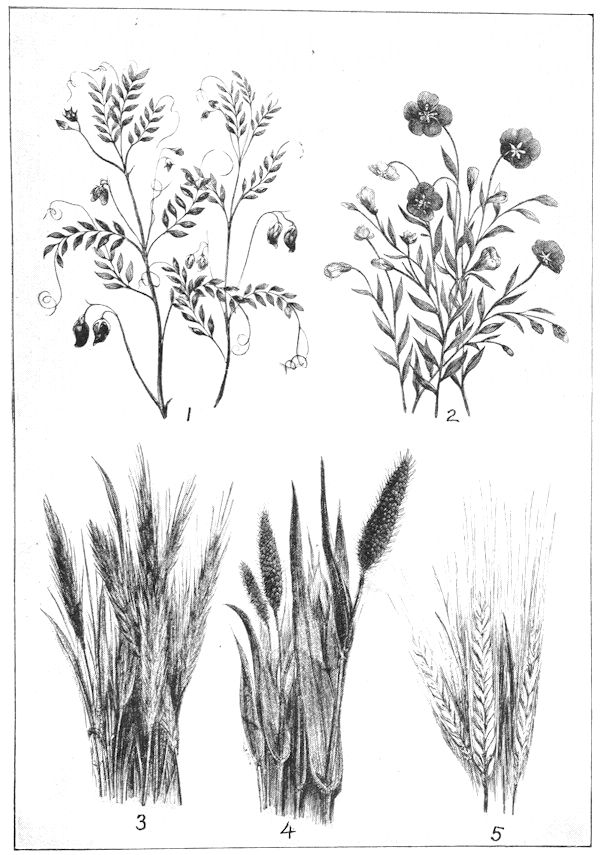
Common Cereals and Food Plants
1, Lentil; 2, Flax; 3, Barley; 4, Millet; 5, Rye
The ancient Egyptians and the Phœnicians propagated many plants in the region of the Mediterranean, and the Aryan nations, whose migrations toward Europe began about 2500, or at least 2000 years B. C., carried with them several species already cultivated in Western Asia. We shall see, in studying the history of several species, that some plants were probably cultivated in Europe and in the north of Africa prior to the Aryan migration. This is shown by names in languages more ancient than the Aryan tongues; for instance, Finn, Basque, Berber, and the speech of the Guanchos of the Canary Isles. However, the remains called kitchen-middens, of ancient Danish dwellings, have hitherto furnished no proof of cultivation or any indication of the possession of metal. The Scandinavians of that period lived principally by fishing and hunting, and perhaps eked out their subsistence by indigenous plants, such as the cabbage, the nature of which does not admit any remnant of traces in the dung-heaps and rubbish, and which, moreover, did not require cultivation. The absence of metals does not in these northern countries argue a greater antiquity than the age of Pericles, or even the palmy days of the Roman Republic. Later, when bronze was known in Sweden—a region far removed from the then civilized countries—agriculture had at length been introduced. Among the remains of that epoch was found a carving of a cart drawn by two oxen and driven by a man.
The ancient inhabitants of Eastern Switzerland, at a time when they possessed instruments of polished stone and no metals, cultivated several plants, of which some were of Asiatic origin. Heer has shown in his admirable work on the lake-dwellings that the inhabitants had intercourse with the countries south of the Alps. They may also have received plants cultivated by the Ibernians, who occupied Gaul before the Kelts. At the period when the lake-dwellers of Switzerland and Savoy possessed bronze, their agriculture was more varied. It seems that the lake-dwellers of Italy, when in possession of this metal, cultivated fewer species than those of Savoy, and this may be due either to a greater antiquity, or to local circumstances. The remains of the lake-dwellers of Laybach and of the Mondsee in Austria prove likewise a completely primitive agriculture; no cereals have been found at Laybach, and but a single grain of wheat at the Mondsee. The backward condition of agriculture in this eastern part of Europe is contrary to the hypothesis, based on a few words used by ancient historians, that the Aryans sojourned first in the region of the Danube, and that Thrace was civilized before Greece. In spite of this example, agriculture seems in general to have been more ancient in the temperate parts of Europe than we should be inclined to believe from the Greeks, who were disposed, like certain modern writers, to attribute the origin of all progress to their own nation.
In America, agriculture is perhaps not quite so ancient as in Asia and Egypt, if we are to judge from the civilization of Mexico and Peru, which does not date even from the first centuries of the Christian era. However, the widespread cultivation of certain plants, such as maize, tobacco, and the sweet potato, argues a considerable antiquity, perhaps two thousand years or thereabout. History is at fault in this matter, and we can only hope to be enlightened by the discoveries of archæology and geology.
The greater number of ancient historians have confused the fact of a cultivation of a species in a country with that of its previous existence there in a wild state. It has been commonly asserted, even in our own day, that a species cultivated in America or China is a native of America or China. A no less common error is the belief that a species comes originally from a given country because it has come to us from thence, and not direct from the place in which it is really indigenous. Thus the Greeks and Romans called the peach the Persian apple, because they had seen it cultivated in Persia, where it probably did not grow wild. It was a native of China. They called the pomegranate, which had spread gradually from garden to garden from Persia to Mauritania, the apple of Carthage (Malum Punicum). Very ancient authors, such as Herodotus and Berosus, are yet more liable to error, in spite of their desire to be accurate.
Agriculture came originally, at least so far as the principal species are concerned, from three great regions, in which certain plants grew, regions which had no communication with each other. These are: China, the southwest of Asia (with Egypt), and intertropical America. I do not mean to say that in Europe, in Africa, and elsewhere savage tribes may not have cultivated a few species locally, at an early epoch, as an addition to the resources of hunting and fishing; but the greater civilizations based upon agriculture began in the three regions I have indicated. It is worthy of note that in the Old World agricultural communities established themselves along the banks of the rivers, whereas in America they dwelt on the highlands of Mexico and Peru. This may perhaps have been due to the original situation of the plants suitable for cultivation, for the banks of the Mississippi, of the Amazon, of the Orinoco, are not more unhealthy than those of the rivers of the Old World. A few words about each of the three regions. China had already possessed for some thousands of years a flourishing agriculture and even horticulture, when she entered for the first time into relations with Western Asia, by the mission of Chang-Kien, during the reign of the Emperor Wu-ti, in the second century before the Christian era. The records known as Pent-sao, written in our Middle Ages, state that he brought back the bean, the cucumber, the lucern, the saffron, the sesame, the walnut, the pea, the spinach, the watermelon, and other western plants, then unknown to the Chinese. Chang-Kien, it will be observed, was no ordinary ambassador. He considerably enlarged the geographical knowledge and improved the economic condition of his countrymen. It is true that he was constrained to dwell ten years in the west, and that he belonged to an already civilized people, one of whose emperors had, 2700 B. C., consecrated with imposing ceremonies the cultivation of certain plants. The Mongolians were too barbarous, and came from too cold a country, to have been able to introduce many useful species into China; but when we consider the origin of the peach and the apricot, we shall see that these plants were brought into China from Western Asia, probably by isolated travelers, merchants or others, who passed north of the Himalayas. A few species spread in the same way into China from the west before the embassy of Chang-Kien.
Regular communication between China and India only began in the time of Chang-Kien, and by the circuitous way of Bactriana; but gradual transmissions from place to place may have been effected through the Malay Peninsula and Cochin-China. The writers of northern China may have been ignorant of them, and especially since the southern provinces were only united to the empire in the second century before Christ.
Regular communications between China and Japan only took place about the year 57 of our era, when an ambassador was sent; and the Chinese had no real knowledge of their eastern neighbors until the Third Century, when the Chinese character was introduced into Japan.
The vast region which stretches from the Ganges to Armenia and the Nile was not in ancient times so isolated as China. Its inhabitants exchanged cultivated plants with great facility, and even transported them to a distance. It is enough to remember that ancient migrations and conquests continually intermixed the Turanian, Aryan, and Semitic peoples between the great Caspian Sea, Mesopotamia and the Nile. Great states were formed nearly at the same time on the banks of the Euphrates and in Egypt, but they succeeded to tribes which had already cultivated certain plants. Agriculture is older in that region than Babylon and the first Egyptian dynasties, which date from more than four thousand years ago. The Assyrian and Egyptian empires afterward fought for supremacy, and in their struggles they transported whole nations, which could not fail to spread cultivated species. On the other hand, the Aryan tribes who dwelt originally to the north of Mesopotamia, in a land less favorable to agriculture, spread westward and southward, driving out or subjugating the Turanian and Dravidian nations. Their speech, and those which are derived from it in Europe and Hindostan, show that they knew and transported several useful species. After these ancient events, of which the dates are for the most part uncertain, the voyages of the Phœnicians, the wars between the Greeks and Persians, Alexander’s expedition into India, and finally the Roman rule, completed the spread of cultivation in the interior of Western Asia, and even introduced it into Europe and the north of Africa, wherever the climate permitted.
Later, at the time of the Crusades, very few useful plants yet remained to be brought from the East. A few varieties of fruit trees which the Romans did not possess, and some ornamental plants, were, however, then brought to Europe.
The discovery of America in 1492 was the last great event which caused the diffusion of cultivated plants into all countries. The American species, such as the potato, maize, the prickly pear, tobacco, etc., were first imported into Europe and Asia. Then a number of species from the Old World were introduced into America. The voyage of Magellan (1520-1521) was the first direct communication between South America and Asia. In the same century, the slave trade multiplied communications between Africa and America. Lastly, the discovery of the Pacific Islands in the Eighteenth Century, and the growing facility of the means of communication, combined with a general idea of improvement, produced that more general dispersion of useful plants of which we are witnesses at the present day.
VEGETABLE MIMICRY AND HOMOMORPHISM —Alexander S. Wilson
Besides the family likeness and similarity of structure characteristic of closely allied organisms, other resemblances included under the terms Mimicry and Homomorphism, are observed among living things which can not be referred to a common ancestry since they are presented by plants and animals whose affinities are more or less remote. If the resemblance confers any benefit on either species it is spoken of as a case of mimicry, but if it results from the operation of general laws and is not directly advantageous, the likeness is described as homomorphic. It is not always possible to draw a sharp line between the two, and homomorphism not improbably represents one stage in the development of mimetic species.
The vital phenomena of plants and animals are so near akin that it would be strange if we did not meet with corresponding facts in the vegetable kingdom. Mimicry is perhaps more frequent in the seed than in any other part of vegetable organism; it occurs, however, in other organs, and even the entire plant body may assume a deceptive appearance. A well-known example is the white dead-nettle, which so closely resembles the stinging nettle in size and in the shape and arrangement of its leaves. In systematic position the two plants are widely removed from each other, but they grow in similar situations and are easily mistaken; any one who has occasion to collect any quantities of Lamium is almost sure to get his hands stung by Urtica, an experience calculated to convince one of the efficacy of protective resemblance. Among animals it is species provided with formidable weapons of defence that are most frequently mimicked by weak defenceless creatures. The stinging nettle is therefore a very likely model for unprotected plants to copy.
A somewhat analogous case is the yellow bugle of the Riviera, which has its leaves crowded and divided into three linear lobes, some of which are again divided. In this the plant differs very greatly from its allies; it has, however, acquired a very striking resemblance to a species of Euphorbia, abundant on the Riviera. The acrid juice of the Euphorbias secures them immunity against a host of enemies. As the two plants grow together there is little room to doubt that, like the dead-nettle, the bugle profits by its likeness to its well protected neighbor.
The rare heath Menziesia cærulia, thought to be protected by its marked resemblance to the crowberry (Empetrum nigrum), has also been adduced as a probable case of mimicry.
Mr. A. R. Wallace in Tropical Nature refers to the stone mesembryanthemum at the Cape described by Dr. Burchell, which closely resembles in form and color the stones among which it grows; on this account the discoverer believes this juicy little plant generally escapes the notice of cattle and wild herbivorous animals.
Mr. J. P. Mansel Weale mentions that in Karoo many plants have tuberous roots above the soil resembling stones so perfectly that it is almost impossible to distinguish them. The tubers of the potato itself in its native home may perhaps be protected in this way.
The last-mentioned observer has also noted a labiate plant, Ajuga orphrydis, in South Africa, which bears a strong resemblance to an orchid. As this is the only species of bugle in the district, Mr. Wallace thinks the flower profits by the mimicry and succeeds in attracting the insects required for its fertilization. A species of balsam at the Cape has also acquired an orchid-like aspect; Tillandsia Usneoides, one of the pineapple family, grows on trees in tropical America, and has a resemblance to a shaggy lichen so marked that it is generally mistaken for a plant of that order. The fly agaric, our most conspicuously colored fungus, according to Dr. Plowright, is closely imitated by a parasitic flowering plant, Balanophora volucrata, the scarlet cap, the dotted warts, the white stem and volva being all accurately represented.
The curious shapes of some exotic orchids are probably advantageous from their resemblance to insects and birds. One of our native orchids, Listua ovata, has a flower which in shape decidedly resembles a species of beetle, Grammoptera lævis, by which it is fertilized. Perhaps in this case the insect mimics the flower, as certainly happens with a pink-colored mantis in Java, which so exactly resembles a pink orchid that butterflies are attracted to it in mistake. The insect is carnivorous, and lies in wait for its prey, which is easily secured by the help of this strange disguise. Mutual resemblances of this description are rather characteristic of the Orchidaceæ. From their resemblance, real or fanciful, to butterflies, moths, bees, spiders, etc., various species of Habenaria, Neotinea, and Ophrys derive their names—the butterfly, spider, bee and fly orchises. In the orchid Ophrys muscifera are two little protuberances, regarded by the late H. Müller as pseudo-nectaries. Of this class of deceptive contrivances, however, we have a better example in Parnassia palustris, one of the saxifrages. This flower has five fan-like scales alternating with the stamens; the margins of the scales are fringed with hair-like processes, and each hair is capped with what appears to be a drop of honey. These are really hard, dry knobs, but so much do they resemble drops of honey that flies lick them before discovering the imposture. The intention of these sham nectar-drops may either be to decoy unprofitable guests from the real nectar, of which a limited supply is produced in the hollow of each scale, or to advertise it for the benefit of the more intelligent visitors.
Somewhat analogous to these pseudo-nectaries are the greenish swellings which arise on the veins of the petals of Eremurus. These little swellings present a striking resemblance to aphides, or plant-lice, and Kerner states that a fly accustomed to hunt after aphides pierces and sucks the swellings, apparently mistaking them for the insects.
Relations which remind us of the pink orchid and mantis, mentioned above, seem to exist between the little bladders of Utricularia and the entomostracans. The bladderwort is a carnivorous plant with small submerged vesicles in which minute insects and entomostracans are caught. In shape these little traps of Utricularia are not unlike the body of a crustacean; the stalk corresponds to the tail, and near the entrance of each bladder are several antenna-like filaments so resembling certain appendages of the crustaceans that they impart to the structure a ludicrous resemblance to such an entomostracan as Daphne. This curious likeness was remarked by Mr. Darwin and can hardly be altogether accidental; perhaps the prey is more readily induced to approach the snare by reason of the resemblance. Here also may be mentioned the imposture practiced on its victims by Darlingtonia, another insectivorous plant. In the hood of its pitcher-like leaf are several transparent spaces through which the light shines into the interior; to these the imprisoned flies are attracted and thereby diverted from the only opening through which escape is possible. Mistaking the “windows” for real openings, the captives exhaust themselves in vain efforts to regain their liberty and are ultimately precipitated into the depths of the pitcher.
The flowers of the ox-eye daisy and the feverfew are very much alike, and this was adduced by the late Mr. Grant Allen as a possible case of mimicry. But the probability is that in this instance the resemblance is merely homomorphic. The colors of flowers are distinctive as well as attractive. Where two species of plant grow together and are in blossom at the same time it is to their disadvantage to have the flowers of the one mistaken for those of the other. To secure cross-fertilization it is needful that the insect visitors pass from one flower to another of the same species, otherwise the pollen will be conveyed to the stigmas of the wrong species. It is of importance that the fertilizing agents should be able readily to distinguish different flowers, and this is no doubt one reason for the diversity of their colors, shapes, and odors. This circumstance must operate as a check against the production of mimetic blossoms; it will not, however, prevent flowers from acquiring a likeness to any object other than a flower.
Mimetic resemblances are much more numerous among fruits and seeds than in flowers. A very curious example is Orphicaryon paradoxum, the snake-nut of Demerara, inside which is the coiled embryo resembling a small snake. Among others mentioned by Lord Avebury are Tricosanthes anguina, the pod of which assumes a snake-like guise; Scorpiurus vermiculata, with pods in the form of a worm or caterpillar; S. subvillosa and Biserrula pelecinus, where the resemblance is to a centipede and certain lupines with spider-like seeds. The seeds of Abrus precatorius, Martynia diandra, Jatropha, the castor oil plant and the scarlet runner mimic certain beetles. The presence of a caruncle representing the head of the insect renders the imitation more complete; this structure takes no part in germination, and Kerner is of opinion that it prevents the ants from attacking the substance of the seeds which they drag about from place to place. The ox-tongue and cow-wheat have worm-like seeds, and several plants have fruit difficult to distinguish from little pieces of dry twig. The jet-black, shining seeds and achenes of Delphinium, Helleborus, Juncus, Atriplex, Polygonum, etc., are easily mistaken for beetles; the brightly colored seeds of Iris Germanica are also in all probability mimetic.
The beautiful glossy scarlet and black piebald seeds of Abrus known as rosary beans perhaps escape destruction through birds mistaking them for some nauseous insect gaudily attired in warning colors. But from the manner in which the seed-vessels of Iris and Arbus dehisce and expose their seeds the brilliant colors of the latter would appear to subserve dissemination rather than protection. Such hard seeds are probably dispersed through the agency of insectivorous birds, which seize them in mistake for their more legitimate prey. According to Lord Avebury, the beans of Abrus mimic the beetle Artemis circumusta. The smaller seeds, known as crab’s eyes, are colored in an analogous manner. These cases are the less surprising if we have regard to the fact that the majority of dry fruits, though green while growing, become black or brown when they fall to the ground, so that their general tint corresponds with their surroundings and tends to concealment.
The odors of fungi are very varied. Clathrus and Phallus are offensive and attract swarms of blow-flies; Lactarius and Hydnum, on the other hand, are sweetly scented like the flowers of Melilotus. Among the odors of fungi enumerated by Dr. Plowright are those of aniseed, mint, peppermint, garlic, horse-radish, cucumber, ripe apricots, rotting pears, rancid herring, Russia leather, gas-tar, prussic acid, nitric acid, and cacodyl. Like the hemlock, Agaricus incanus has the smell of mice, two species of Lactarius have the odor of the common house-bug, while Hygrophorus cossus smells like the larvæ of the goat-moth. Fifteen or sixteen species of agaric resemble oatmeal both in taste and smell, Hydnum repandum has the flavor of oysters, recalling the oyster plant among the Boraginaceæ, whose leaves have a similar taste. Several are possessed of a nut-like flavor. The common stinkhorn, Phallus impudicus, is the best known representative of a large family of fungi, the members of which are found in various parts of the world. The Phalloidi include Phallus, Lysurus, Simblum, Clathrus, Aseröe, and other genera, all characterized by offensive odors and conspicuous colors. These fungi have been carefully studied by Mr. T. Wemys Fulton, whose paper on the Dispersion of Spores in Fungi in the Annals of Botany for 1899 contains many interesting and important observations bearing on mimicry.
The rapid elongation of the stinkhorn is very remarkable; the fungus has been observed to attain a height of several inches in half an hour, furnishing an apt illustration of the proverb that ill weeds grow apace. It not only emits an intolerable charnel-house stench, but its ghastly pallid hue seen against the background of its usual surroundings is peculiarly suggestive of the dead carcass of some animal. Its surface at first exudes a sweetish slime containing sugar, but the hymeneum or spore-bearing portion is deliquescent and the entire mass speedily undergoes a series of changes, the white becoming brown, then black, the solid mass being ultimately resolved into a dark fetid fluid in which the spores are suspended. These mimetic changes, which so closely approximate to those of decomposition, attract carrion flies in prodigious numbers. Blow-flies even deposit their eggs on the fungus, and the maggots seem to develop as though nourished by its substance. On examination Mr. Fulton found the spores adhering in thousands to the feet and proboscides of the insects. Their excrement he found to consist almost entirely of spores, and the latter were found by experiment to be still capable of germination. There is therefore no doubt in this case that flies are employed as agents in the dispersion of the fungus. This statement also applies to various Coprini and others with a deliquescent hymeneum.