THE STORY OF THE UNIVERSE (continued 5)
Reading edition
Quite a number of flowers have distinctly mimetic odors. It can hardly be doubted, for example, that the offensive smell of the carrion flowers Stapelia, Aristolochia, Arum, Rafflesia, and others, is more effective in promoting cross-fertilization because of its resemblance to the odor of putrid meat. So completely are the flesh flies deceived that they often deposit their eggs on the petals of carrion flowers.
Fetid odors occur in Bryonia, Helleborus, Geranium, Stachys, Ballota, Iris and other genera. The odors of others have a curious resemblance to the smells emitted by certain animals. Hypericum hircinum and Orchis hircina are bad smelling flowers with an odor resembling that of the goat; Coriandrum sativum has the fetid smell of bugs, while the hemlock, again, emits a strong odor of mice. Along with these may be mentioned Adoxa, the musk orchis, the grape hyacinth, and other musky-scented flowers.
The resemblance in smell between these flowers and the secretion formed in the scent glands of the musk ox and other animals is, to say the least, a remarkable coincidence. Possibly flies which accompany cattle may be attracted by smells of this description. Very curious also is the vinous smell of Œnanthe, and the brandy-like aroma of the yellow water lily Nuphar, hence called the brandy bottle. Ethereal oils exhaled by plants while attractive to some animals seem to repel others; the scents of sweet-smelling flowers such as Daphne, Thymus, Marjoram, Melilotus, and Gymnademia, though grateful to bees and butterflies, appear to be distasteful to ruminants. Kerner states that in general the latter avoid all blossoms; even caterpillars do not readily attack the petals of their food plants. Odor may therefore be protective or attractive or it may be of use in both ways. The same remark applies to color, which may serve either to attract or repel; the richly variegated leaves of the Indian nettles—species of Colleus—and the tinted foliage of begonia and geranium may possibly escape injury on account of the general resemblance to colored blossoms. Instances in which one plant resembles another in smell are not very common in the flowering class, though cases do occur like the garlic, mustard and apple-scented Salvia. Resembling odors are much more frequent among fungi.
Characteristic examples of homomorphism are seen in the resemblances which many species of Euphorbia present to the cactus tribe and in the pollen-masses of the orchids and asclepias. In Britain the order Euphorbiaceæ is represented by the box, dog’s-mercury, and the sun-spurges, but many foreign species have quite a different appearance and agree with the cacti in their aborted leaves and green succulent stems. The globular, columnar, and angular forms give to both a peculiar aspect by which they are broadly distinguished from all other vegetable types; and yet in systematic position these two orders stand far apart. The nearest affinities of the Euphorbiæ are with the Urticaceæ and other orders having incomplete flowers, while the nearest allies of the Cacti are the Cucurbitaceæ and other calycifloral orders. Succulent stemmed plants of this description are specially adapted to an arid climate, and it is not unreasonable to suppose that the similarity between the Euphorbiæ and Cacti results from the long-continued action of similar external conditions upon similarly endowed tissues.
The Australian Casuarinas are dicotyledons with incomplete flowers nearly related to the oak, hazel, and other Cupuliferæ, but in outward appearance they have a singular resemblance to the horsetails, a family of cryptogams. One of the gymosperms or cone-bearing class, Ephedra, also presents the same jointed appearance so characteristic of Equisetaceæ. Growing in marshy places very like those affected by Equisetum we find the mare’s-tail Hippurus, a flowering plant allied to the fuchsia family, but externally resembling Equisetum in its jointed stem and whorled leaves. A familiar instance of the same kind of homomorphism is Equisetum sylvaticum, which might almost be described as a liliputian fir-tree. The little flowers of the water ranunculus look exactly like miniature water lilies, while the leaves and flowers of Caltha palustris simulate the yellow Nuphar so much that in some parts of the country the marsh marigold is known as the water lily. The specific name of another aquatic, Lymnanthemum nymphædides, indicates a peculiarity of the same kind. Leaf analogies are frequent among aquatic plants; the orbicular, peltate leaf of the Indian cress occurs, for example, in Hydrocotyle, Nelumbium, and others. The brown color and translucence of Potamogeton, Myriophyllum, and other aquatics assimilates them to the fronds of Laminaria and other sea-weeds.
A grass-like habit is assumed by some plants. This character is attained in the meadow vetchling by the arrested development of the compound leaves and the great elongation of the stipules. Lathyrus nissolia has the stipules minute, but the phyllodes or leaf-like petioles impart the grass-like character. A moss-like habit occurs in a great many plants belonging to very different families; thus the wiry stem of the purging flax reminds one of the seta of Polytrichum. The pearlwort of the walls, many alpine saxifrages, pinks, and gentians present very much the appearance of mosses, e. g., Silene acaulis, Saxifraga bryoides, S. hypnoides, Arenaria Cherleri, etc. The sub-species Saxifraga geum is another instance of leaf analogy. The generic name Pyrola implies a fancied resemblance of the leaves to those of the pear tree. Certain leaf-types frequently recur, the rough broadly tongue-shaped leaf of the bugloss, for example; hence the very common specific appellation echioides. The nettle-leaved bell-flower reproduces the foliage of Urtica and the sinuate leaf of the oak appears in several families.
Parasitic phanerogams like Rafflesia commonly exhibit the fungoid character in a marked degree. In their internal structure, coloring, spore-like seeds and other characters they approximate closely to the fungi.
As examples of homomorphism between closely allied plants may be mentioned the false oat, which so strikingly resembles the cultivated species, and the barren strawberry, which agrees so closely with the cultivated strawberry of our gardens.
Although it is only under exceptional circumstances that a flower is likely to mimic another blossom closely, vague general resemblances are not uncommon, such as that between the rock-rose and the buttercup, between the milkwort and the vetch, and between Veronica and Valerianella. A more decided likeness is that of the garden annual Collinsia to the butterfly blossoms of the pea tribe. This case is peculiarly instructive since the homomorphism can be traced to its cause. The butterfly-like corolla of Leguminosæ seems to have afforded the pattern after which a number of flowers have been fashioned. The Papilionaceæ are adapted to bees rather than to butterflies or moths, and the pollen is applied to the ventral surface of the insect, the essential organs being lodged in the carina or pouch formed by the two lower petals. Among the Scrophulariaceæ to which Collinsia belongs, the pollen is commonly sprinkled on the back of the insect and the stamens are contained in the upper lip of the corolla; Collinsia is, however, exceptional; the stamens are lodged within the lower lip of the flower and the pollen is applied to the ventral surface of the bee. Here the resemblance is evidently an indirect result brought about by the flowers of Collinsia having become adapted to the same class of visitors as the Papilionaceæ, viz., bees which have their brushes or baskets of hair for collecting pollen attached to the abdomen. Where two flowers are very like insects are apt to mistake the one species for the other, but this will not involve any loss if there is an interval between their periods of blossoming.
Homomorphic likenesses are not confined to homologous organs; an organ of one plant sometimes exhibits a perfect resemblance to a different organ on some other plant. Thus Aristolochia sipho, the Dutchman’s pipe, so-called from the appearance of its flowers, has a perianth singularly like the leaf-pitchers of Nepenthes, and the curious little nectaries of Nigella might almost be compared with the pitchers of the Australian insectivorous plant Cephalotus. As the Aristolochias imprison small dipterous insects in their flowers these instances favor to some extent Henslow’s idea that both flowers and pitchers have arisen by hypertrophy caused through the irritation set up by insects.
The homomorphism of the orchids and asclepiads is especially interesting because of the objection to the Darwinian theory that it presents; the coincidence is certainly unfavorable to the notion of fortuitous variation. The orchids and asclepiads agree in producing pollinia or pollen-packets which attach themselves to the bodies of insects and are thus transferred from flower to flower. Although the two flowers differ greatly in the details of their structure, this curious contrivance occurs in no other plants, and yet the two orders are as widely separated as it is possible to conceive. The orchids belong to the petaloid division of Monocotyledons; the asclepias to the gamopetalous Dicotyledons, with their nearest allies among the Apocynaceæ, of which Vinca, the periwinkle, is perhaps the best known representative. Although agreeing in this one particular, the flowers are in other respects very dissimilar.
Another contrivance for promoting cross-fertilization met with in unallied plants is the mouse-trap arrangement of hairs by means of which small flies are temporarily imprisoned. This arrangement occurs in Aristolochia, in species of Arum, and in Ceropegia, one of the asclepiads. In these plants, where the affinities are so slight, the mechanism for fertilization must in each case have arisen independently.
THE BAMBOO AND PLANT GROWTH —R. Camper Day
If the many families of flowering plants were arranged in the order of their utility to man or in the order of their abundance, the first place in the list would unquestionably be assigned to the great family of grasses. Of their omnipresence and abundance some idea may be obtained from the fact that at least four thousand different kinds have been described, and a German naturalist has estimated that they constitute a twenty-second part of all known plants. Their utility as food producers becomes obvious as soon as we recall the names of rice, wheat, barley, oats, rye, and Indian corn, and remember how large a proportion of our food is made from their seeds. Most of these civilized and somewhat unnatural grasses have been so long under cultivation, and so much altered by man’s selection, that they are totally unfitted to shift for themselves, and would soon become extinct if brought into competition with wild plants. The fact that the wild forms from which they are descended can not now be identified with certainty shows that their cultivation must date from the very earliest ages. Rice alone is said to furnish more sustenance to the human race than any other single species; the common meadow grasses, such as the purple-tipped Anthoxanthum, which fills the fields with its penetrating fragrance when the hay is newly mown, are almost the only food of sheep and cattle; and those tall and sturdy canes whose juice we squeeze out between rollers, and clarify and crystallize into sugar, are only modified stems of grass.
The largest of the family, and perhaps the most beautiful, is the tropical arborescent grass which bears the name of bamboo. Although it is not cultivated for the sake of its seed, it has many admirable qualities, and wherever it grows in abundance it is applied to a variety of uses. “The strength, lightness, smoothness, straightness, roundness, and hollowness of the bamboo,” says Mr. A. R. Wallace in his Malay Archipelago, “the facility and regularity with which they can be split, their many different sizes, the varying length of their joints, the ease with which they can be cut and with which holes can be made through them, their hardness outside, their freedom from any pronounced taste or smell, their great abundance, and the rapidity of their growth and increase, are all qualities which render them useful for a hundred different purposes, to serve which other materials would require much more labor and preparation. The bamboo is one of the most wonderful and beautiful productions of the tropics, and one of nature’s most valuable gifts to uncivilized man.”
In order that the accuracy of this eulogy may be appreciated, let us imagine the case of a shipwrecked man landing without any tools, except an axe and a knife, upon an island in which we will suppose the bamboos are the only vegetation, and let us see how far he could supply his needs with their assistance. One of his first requirements would be a house, and this could be provided with very little labor. The stems of one of the larger species, such as Bambusa Brandisii, driven into the ground, would form excellent uprights for the framework, which could be completed with lighter cross-pieces nailed to the uprights with pegs of the same material. A good roof could be made by taking broad strips split from large bamboos, and fastening them side by side with their concave surfaces uppermost, the interstices between them being covered with other pieces having their convex sides uppermost. Similar but flatter pieces laid upon the joists, and tied down firmly with strips shredded from the outer rind, would form a smooth and elastic floor such as could not be made out of other materials without a great expenditure of labor. Thin strips plaited together, or broad strips pegged side by side, might be used for the walls.
The furnishing of the house would be an easy matter, for bedsteads, chairs, brooms, baskets, cords, fans, bottles, mats, and hoes can be made of bamboo with the greatest facility. The water-tight joints of the stems form admirable water-vessels, and it would be easy to bring the water to the very door by a gently sloping aqueduct of pieces of bamboo split down the middle and supported at intervals on cross-pieces arranged like the letter X. The jars made from the joints could be utilized not only for holding water, but even for boiling it. Mr. Wallace tells us that rice, fish, and vegetables can be boiled in them to perfection. The young shoots of the bamboo as they first spring from the ground are said to be a delicious vegetable, “quite equal to artichokes.” That fish may be readily caught by the agency of the bamboo is shown by the many specimens of ingenious fish-traps exhibited in the museum at Kew. If we suppose our adventurer to take a thin stem of bamboo, and cut off the end obliquely just above a joint so as to leave a sharp edge, he would be provided with a hard-pointed and very efficient spear. In the same way he could supply himself with daggers and arrows; while from the more elastic species he could make himself a bow, using a thin strip of the outer rind for a bow-string. The lowest internode of Arthrosylidium Schomburgkii, which sometimes attains the extraordinary length of sixteen feet, far surpassing the length of the joints in all other bamboos (says General Munro), furnishes the “Sarbican” or blow-pipe through which poisoned arrows are blown by the natives of Guiana. In the island of Celebes the only article of dress worn by the natives is a body-cloth called Kian Pakkian, made of bamboo split into fine shreds, which are passed between the teeth and bitten until they are soft, when they are woven.
If, after providing himself with these and similar necessaries, our shipwrecked man found leisure to amuse himself, he might make æolian flutes, such as Sir Emerson Tennant saw in Malacca, by boring holes in the stems of living bamboos, or he might construct a harp like that in the Kew Museum, London, which was brought from Timor by Mr. Wallace. This harp is made from a cylinder of bamboo having a node at each end. Under a strip of the outer rind a quarter of an inch wide, a sharp knife is passed so that the strip is detached from the cylinder except at its two ends. The strip forms one of the harp strings. Two small wedges are pushed under it, and the portion between the wedges can be sounded like the string of a guitar. It is also possible, and not very difficult, to make such diverse articles as paper, pens, waterproof clothing, hats, wax, pickles, bird-whistles, rafts, pillows, fermented drink, and bridges from the same versatile vegetable. In the Kew Museum, which should be visited by every one who wishes to see the varied uses to which bamboos can be applied, perhaps the most curious article is a headman’s knife brought by Mr. Franks from the southeastern peninsula of New Guinea. This singular implement, which is shaped like a cheese-scoop and seems very ill-adapted to its purpose, is marked with numerous notches, each notch representing one of its victims; and it is accompanied by an artistic apparatus, also of bamboo, intended apparently to enable the executioner to carry the severed head.
The bamboo usually grows in a cluster of from ten to a hundred stalks, and springing from the same rhizome or root-stock. The rhizome is not the root, but an underground portion of the stem. It consists of a number of segments about the size and shape of a banana and somewhat bloated in the middle. The banana-like segments are joined together irregularly by their tips, so that the whole rhizome forms a strong underground trellis-work admirably adapted to support the light and yet rigid stems that rise up from it. From the under side of the rhizome spring downward the true root-fibres, numerous as the bristles of a broom.
The stem itself, as every one knows, is smooth, polished, and cylindrical, and is divided into air-tight compartments by knots or nodes, which are the points at which the fibres of the stem cross over from one side to the other. The lowest ten nodes or so are usually bare, but from the upper nodes issue branches. These are very slender as compared with the main stem, and carry the foliage leaves. In most species the leaves are rather small, but in some they are very large. The species named Planotia nobilis by General Munro, a native of New Granada, has the largest leaves of any kind of grass; they are often a foot in diameter and fifteen feet in length.
The most important part of the bamboo, from a botanical point of view, is the flower, which roughly resembles the flower of our common grasses. The flower of grass is inclosed in hard, scaly leaflets called glumes; it usually has three stamens and one seed-vessel. There may be only one flower inclosed in the glumes (as in foxtail grass), or more (as in wheat). The flowers of the bamboos, while on the whole conforming to the grass type, exhibit many small differences in different species. In some kinds, as in Arthrostylidium longiflorum, the inflorescence resembles a bunch of ears of wheat; in others, as in Bambusa vulgaris, the flowers are packed into round clusters; in others, as in Chusquea simpliciflora, they are in threes and fours, each flower hanging by a separate slender stalk. The seed generally resembles oats or wheat, but in some species it takes the form of a berry, not unlike the seed of our familiar pimpernels. In the species known as Molocanna, the fruit is exceptionally developed, often attaining the size of a largish pear. Some species flower and die down annually; others flower annually, but live on; as a rule the bamboo grows for many years without flowering, and then suddenly bursts into bloom. From the fact that the number of years between the sowing of the seed and the flowering of the plant varies, and that in some years nearly all the bamboos in a given district flower simultaneously, it would seem as if the blossoming does not take place at any prescribed age, but may occur at any period after the plants reach maturity when a favorable season supervenes. It used to be thought that after a general flowering of the bamboos throughout a district all the plants died, but this view proves to be incorrect. The flowering shoots usually die, and during the flowering the foliage almost entirely disappears, but the entire plant is not necessarily killed.
The Chinese have a proverb that the bamboo produces seed most abundantly in years when the rice crop fails, and several curious cases of the truth of this saying have been recorded. According to General Munro, in 1812 the universal flowering in Orissa prevented a famine. Hundreds of people, he says, were on the watch day and night to secure the seeds as they fell from the branches. Another instance occurred in 1864, when there was a general flowering of the bamboo in the Soopa jungles, and very large numbers of persons came from the neighboring districts to collect the seeds.
In most bamboos, the stem is characterized by straightness, smoothness, roundness, and quickness of growth, no doubt because these qualities have, as a rule, proved serviceable to the plant in the struggle for existence. Light and air being necessary to the life of grass, it is manifest that in the dense vegetation of the tropics a plant which can push itself rapidly to a great height must have an advantage; and in order that growth may be rapid and the plant spring up to a considerable height without climbing, it is essential that there should be as little material as possible in the stem, and yet that it should be as strong as possible. It is difficult to imagine a stem in which these conditions would be better fulfilled than in that of the bamboo. By reason of its hollowness the amount of material is reduced to a minimum; and by reason of its cylindrical shape, its nodes, and the hardness of the outer rind, the strength of the structure is at a maximum. The growth is consequently very rapid, an increase in height of 2 to 2½ feet having been recorded in a single day. The Bambusa Brandisii often measures as many as 120 feet, and is said to attain its full altitude in a few months.
But although, as a general rule, the necessities of natural selection have ordained that bamboos shall be perfectly straight and perfectly round, this archetypal form or idea (to borrow a word from Plato) does not always hold good. One species, found in Asia, is said to have crooked and even creeping stems. Another, found in Ecuador, is described by General Munro as being distinctly a climbing plant. There is a species, recently described by Mr. Thiselton Dyer, with a stem exactly square, and as well defined as if cut with a knife. It has only lately been found in China, where it is grown chiefly for ornament.
According to Mr. Dyer, the Chinese account for its squareness in the following way. They say that in the Fourth Century A. D., the famous alchemist, Ko Hung, took his chopsticks (which consist of slender rods of bamboo pared square) and thrust them into the ground of the spiritual monastery near Mingpo; and then by his thaumaturgical art he caused them to take root and appear as a new variety—the square bamboo.
The growth of plants is one of the greatest mysteries of nature, and nothing is more mysterious in their growth than their limited but very definite power of movement. How is it that some plants grow vertically upward, like the normal bamboo, others climb and twist, others creep, and others grow in zigzag shapes? How is it that some turn toward the light, some away from the light, while others place themselves at right angles to it? And how is it that if you peg down the young stem of a vertically growing plant it will bend upward beyond the peg? No doubt the proximate cause is natural selection; they do these things because they have found them advantageous. But this does not tell us by what mechanism a plant is enabled to keep on growing in the particular direction which it finds advantageous. We know that when a plant bends in a given direction, the cells on the convex side of the bend are more turgescent, that is, more distended with sap, than those on the concave side, and that the increased turgescence of the former is followed by increased rapidity of growth; but what causes the distribution of turgescence in the cells has not been clearly made out. It seems probable, however, that when a shoot is growing in its proper and natural direction, the chief force which guides it and enables it to maintain that direction is the force of gravitation. To this force the growing portions of a plant are extremely sensitive. Consider, for example, the case of a vertically growing shoot. Whenever it is accidentally bent the force of gravity must evidently act upon the portion above the bend, tending to curve it still more, and causing a strain in the material of the stem. The plant in some mysterious way is aware of this strain, and the cells of the lower side of the bent portion are stimulated to increased turgescence as compared with those of the upper side, so that the under side would grow faster; and as the plant would turn upward in consequence, any deviation from the perpendicular would tend to correct itself. Similarly a shoot which grows horizontally is led by the same stimulus of gravitation to rectify any departure from a horizontal position. Gravitation, then, does not cause the bending when a displaced shoot endeavors to regain its normal direction, but serves merely as a guide. By its means the plant is made aware (so to speak) that it has been displaced, and takes measures accordingly. If the force of gravity were absent, the shoot would go on growing in any position in which it might happen to be placed. This may be proved by causing a growing seed to revolve slowly round a horizontal axis, so that at every revolution the force of gravity may act upon it equally in all directions. When a shoot is grown in these conditions, it is found that its power of correcting deviations from any particular line of growth is lost. Similar reasoning applies to the action of light on plants, but, as above stated, we do not know why it is that plants respond to the stimulus of light or gravity; we only know that as a matter of fact they do so.
It has often been vaguely asserted that plants are distinguished from animals by not having the power of movement. It should rather be said that plants acquire and display this power only when it is of some advantage to them; but that this is of comparatively rare occurrence, as they are affixed to the ground, and food is brought to them by the wind and rain. We see how high in the scale of organization the plant may rise when we look at one of the more perfect tendril-bearers. It first places its tendrils ready for action, as a polypus places its tentacula. If the tendril be displaced, it is acted on by the force of gravity and rights itself. It is acted on by the light, and bends toward or from it, or disregards it, whichever may be most advantageous. During several days, the tendril or internodes, or both, spontaneously revolve with a steady motion. The tendril strikes some object, and quickly curls round and firmly grasps it. In the course of some hours it contracts into a spire, dragging up the stem and forming an excellent spring. All movements now cease. By growth the tissues soon become wonderfully strong and durable. The tendril has done its work, and done it in an admirable manner.
THE REIGN OF EVERGREENS —Grant Allen
The poor stripped and draggled garden is beginning to look very bare now (November) of all except a few straggling late-flowering shrubs and those trusty adopted friends that we have always with us, the shrubby, large-leaved southern evergreens. In northern climates, we must ruefully admit, there are hardly any true evergreens, save only the conifers, with their stiff and needle-like foliage, such as pines and spruce-firs; but we make up for it to some extent by borrowing from warmer or more southern lands the laurels, aucubas, laurustinuses and rhododendrons, that help to keep bright our English lawns and shrubberies throughout the long and weary winter months. Indeed, our only native flat-leaved shrubs that retain their full greenness from year’s end to year’s end are privet, box, and butcher’s broom, all three of them very doubtfully indigenous to these islands. It is the rule with English trees and shrubs to shed their foliage every autumn; and the fashion in which they do so shows very clearly how purposive and well adapted to their conditions in life is the deciduous habit. For the leaves do not merely tumble off anyhow, casually, before the first fierce autumnal winds; if they did so there would be loss of sap and of valuable foodstuffs to the whole plant of whose joint commonwealth they form the partially dependent members: their fall is duly provided for beforehand, and when at last it actually takes place, it takes place in an orderly and regular fashion, with the least possible injury to the interests of the entire tree. From the very beginning there has been arranged at the joint where the leaf-stalk joins the stem, or where the separate leaflets join the central midrib, a row or articulation composed of cellular tissue, and specially designed to act as a joint for the dry leaves. When winter approaches, and chilly northern winds are likely to tear to pieces the leaves on the trees, all the protoplasm and other valuable cell-contents are withdrawn into the permanent tissues of the plant, leaving only the minor red and yellow coloring matters (mostly effete and used-up foodstuffs) which give so much beauty and glory to the general aspect of our autumn woodlands.
Then the articulation dries up and withers, and the dead leaf separates at the joint, leaving behind it a regular mark or scar, which is the visible token of Nature’s definite precaution against the northern cold and tempests.
It was not always so, however, and it is not so even now in the greater part of the modern world that we ourselves inhabit. It seems quite natural to us northerners that “leaves have their time to fall”; so natural, indeed, that we almost forget the strict limitation of the practice to our own chillier latitudes. Yet in reality the existence of deciduous trees is a mere temporary accident of the here and the now, a passing consequence of the great cold spell which had its culminating point in the last glacial epoch, and from whose lasting effects we ourselves are even still apparently suffering. Whether, as Mr. Alfred Russel Wallace seems hopeful enough to believe, our poor old planet may yet recover from this premonitory chilling or not, whether we may yet look forward to a few more warm spells or otherwise, before the final numbness of all dying worlds comes upon us, is a question rather for the consideration of astronomers and physicists than the mere mundane-roving naturalist, with his petty ephemeral interests in our plants and animals; but one thing at least is certain, that till a very recent period, geologically speaking, our earth enjoyed a warm and genial climate up to the poles themselves, and that all its vegetation was everywhere evergreen, of much the same type as that which now prevails in the modern tropics. Indeed, we have only to look at the existing state of things in order to see how very slight is the effect that has thus been produced upon our temperate flora. For example, among the oaks alone, there are some twenty species in Europe, of which Southern Europe has eighteen, mostly evergreen, while north of the Alps there are only two, or at most three, all of them deciduous. From the evolutionary point of view it is clear that the northern kinds are modern developments, specialized to contend with the peculiarly cold conditions of sub-Arctic Europe.
Fortunately, too, we are not left in this matter to mere conjecture or analogy: thanks to the researches of Heer and others, we have positive geological facts to guide us which show conclusively that up to the Miocene period Europe was covered by forests of large-leaved evergreen trees, of what we should now consider distinctively tropical types. Ever since the Miocene, and on to the culminating point of the great Ice Age, the European climate has been growing steadily colder, and the European flora has been at the same time steadily adapting itself to the new conditions, and to assuming what we now consider a typically northern aspect. During all that time, the large-leaved evergreens gave way before the deciduous trees and the chillier conifers, beginning at the north pole and spreading gradually southward, as the cold deepened and widened its range. Since the end of the great Ice Age, and the subsequent slight amelioration of the climate in Northern Europe, a reverse process has begun to set in; the Arctic types have begun to recede slightly once more, and the comparatively southern or temperate types have pushed their way northward to occupy the place from which they were previously dispossessed by the newly evolved kinds. It is not necessary for us to inquire here into the causes of this great cycle; the facts are there, and for our present purpose they are quite sufficient. They show conclusively, when one follows them out in detail, that the evolution of deciduous trees was concomitant with the growth of cold conditions around the two poles; and that such trees now exist only where winter, for part of the year, renders the evergreen condition an undesirable one. Even in the tropics, indeed, we find on high mountains a belt of deciduous forest, stretching above the belt of large-leaved evergreens, which itself succeeds to the lowland palms and tree-ferns of the thorough-going equatorial plains.
The reason for the evolution of deciduous trees is of course to be found in the peculiar circumstances of the circumpolar regions. In the tropics, trees and plants can thrive and blossom all the year round; and even in temperate countries most small herbs and weeds gain by keeping their foliage throughout the winter; but big trees in cold climates would suffer much by the tearing and strewing of their leaves in winter gales, while they would obtain little advantage by retaining them on the tree during the long chilly season. Hence, if any tree happened to possess any arrangement by which dead or dying leaves could be removed without injury to the permanent tissues, while, at the same time, the useful materials were withdrawn into the young bark to await the spring awakening, such a tree would obviously enjoy an advantage in the struggle for existence, and would be likely to outstrip its evergreen neighbors in rigorous climates. Now, as a matter of fact, the germ of such an arrangement is found even in many herbs or small shrubs, such as, for example, the common pelargoniums or “scarlet geraniums” of our flower-gardens. Everybody who has ever kept these familiar plants in his own rooms must have noticed how easily the dead leaves separate from the stem at their base, by means of the swollen cellular mass where the leaf-stalk joins the axis. All that the forest trees of northern climates had to do, then, was just to take advantage of this nascent provision, wherever it existed (mark this prior necessity), and render it more fixed under the influence of natural selection. But if we may judge by the actual sequel, it was not every kind of tree that could adapt itself to the altered circumstances; as a matter of fact, the number of species among northern forest trees is very small indeed, and even out of this small number a good many are conifers, like the pines and yews, whose narrow tough leaves are well fitted for withstanding and battling against all the winter breezes. Still, among the conifers themselves there are a few species, such as the larches, with tender, delicate foliage, which have also become deciduous under stress of altered conditions. At the present day the large-leaved and flat-leaved evergreens are mostly confined to tropical, sub-tropical, or at least warm temperate climates, and all the forest trees or the circumpolar tracts are either deciduous, or else are tough leathery-leafed conifers. The laurels and rhododendrons, with which we strive artificially to brighten up our comparatively leafless English winter, are either hardy representatives of the warm temperate flora, or else mountain species from southern climates, with constitutions just strong enough to endure our chilly season in favored and carefully selected situations. Such evergreens have generally very rigid and shiny leaves to protect them—a point well marked in ivy and laurel as compared with Virginia creeper and English hawthorn.
OUR MICROSCOPIC FOES —A. Winkelried Williams
Of all the foes that are waging war against mankind, the most dangerous and deadly are minute organisms belonging to the lowest order of plant-life, and invisible to our naked eye. An immense number of these always surround us, and are ready to make an attack should they find a weak point in our defences.
Their presence in the air may be readily demonstrated by exposing some material upon which they can feed, and watching the result. The simplest method is to boil a potato, cut it in half, and immediately place one-half under a bell glass purified by being washed in an antiseptic solution such as corrosive sublimate. Expose the second half to the open air for a short time, and place it also under a glass. Let them remain for a few days, and then examine. If the first half has been placed rapidly enough under the glass, we shall find it unaltered. On the second half, however, we shall see a number of small but growing spots, which will probably vary much in color. These consist of colonies made up by immense numbers of most minute plants, i. e., bacteria, and also of higher fungi. Certain species of the bacteria constitute our dreaded foes.
Bacteria are non-nucleated unicellular plants, which may be roughly classed into two divisions according to their shape, the circular forms being called micrococci, the elongated forms bacilli. In size, they are most minute, being only visible under the highest powers of the microscope. Many are provided with cilia, by the lashing of which they are capable of independent movement. They are composed of a peculiarly resistant protoplasm, which is condensed at the surface, so that by the action of certain caustics they can be separated from many tissues on which they may be lying, the caustics destroying these tissues.
Bacteria have enormous power of reproduction, which is accomplished by division of the cells and fission. Many also form globular spores by a condensation of their protoplasm. The spores have a much higher power of resistance than the bacteria themselves, and may under unfavorable circumstances be quiescent while awaiting better times to take on full development.
Their habitat is almost everywhere. In water, bacteria exist in great numbers; they are even found in springs at their sources. This indicates their presence in the soil, where they are found in great numbers. We have already seen that they exist in the air, but being, for their size, heavy bodies, they are invariably attached to less dense particles of dust. Out at sea, we find the air free from bacteria, although in the water they abound. The higher we ascend, the fewer we find. In towns, the air teems with them; in the country but few exist. In the healthy living body, there are no bacteria, except in the alimentary canal and upper respiratory passages. It must not be supposed that all bacteria are the forerunners of disease; such is the case with only certain forms to which the significant term pathogenic bacteria is applied. Many authorities assert that the non-pathogenic forms may, under certain circumstances, develop into pathogenic forms. This, however, has not been definitely settled, since we are only able to separate the different classes of bacteria by their action on cultivating media and on the living body. We have not yet been able to develop by cultivation a virulent form from a non-virulent, although we have by repeated cultivation diminished the virulence of the most malignant bacteria.
Of all the pathogenic bacteria we have the most direful tale to tell. Of one, discovered by Dr. R. Koch—namely, that of tubercle—the terrible ravages on human life by ferocious animals in India (over 24,800 fatalities per annum) are but trifling compared to the ravages stealthily done in our midst by this the smallest of the class of most minute living units. According to Dr. Koch’s estimate one-seventh of the human race die of pulmonary consumption, and this is only one, certainly the most prolific, of the many diseases directly caused by the tubercle bacillus.
Happily for warm-blooded animals, these terrible death-dealers differ from most other bacteria, for although they can remain alive for some time outside the body, they are unable to develop in the outside world, and this considerably limits their number. A temperature above 96° Fahr. is necessary for their growth, and there are only a very few soils on which they can be cultivated, such as blood-serum and meat jelly. Moreover, they develop more slowly than other known bacteria, which may consequently outgrow them, and prevent their development. How, then, are we to account for the fact that tubercle is such a widely spread disease, not only among all the races of men, but also among many of the lower animals? The consideration of the following facts answers this question.
The tubercle bacillus can form resting spores; consequently, when once the tissues of a part have their vitality so lowered that the entrance of the bacilli is allowed, they can retain their hold with great tenacity. Although the bacilli can not develop outside the body, their vitality is preserved for a long time. Certain animal products used for food, such as the milk of tubercular cows, contain the bacilli. Experiments such as causing animals to inhale the tubercle bacilli, or the introduction of them into the blood, or sometimes the feeding on tubercular matter, result in tuberculosis.
Pulmonary consumption presents an example of the most typical way in which the tubercle bacillus performs its deadly work. In the majority of cases, the bacilli are inhaled with the air, but may also infect the lungs from the blood carrying them from tuberculosis in other parts of the body. The bacilli are incapable of independent movement. This difficulty is too readily overcome in the body, as the streams of blood and lymph easily carry them along.
Their movements in the body may be aided by certain scavengers that are crawling about in our tissues and circulating in our blood; namely, the wandering cells of connective tissue and the white blood corpuscles. These take up the bacilli by wrapping their substance around them; then, for a time, they crawl about carrying with them the bacilli. In this attempt to devour the tubercle bacillus, they often find they have caught a Tartar, who in turn feeds and multiplies in them, and thus their wandering days soon end.
Many other diseases are known to be caused by bacteria, such as anthrax, cholera, pneumonia, typhoid fever, erysipelas, leprosy, suppuration, and ordinary blood-poisoning. Before Sir Joseph Lister introduced the system of antiseptic surgery, bacteria were a most fertile source of danger in surgical operations by the decomposition and suppuration they set up in the wounds.
In this short paper it is impossible to describe the characteristics of any other pathogenic bacteria, but perhaps enough has been written to show the great danger to which we are exposed from attacks by an immense army of minute foes.
FOREST FORMATIONS —M. J. Schleiden
It is difficult to give the character of the various wood-formations in woods with even a small proportion of that vividness and reality which the landscape painter so readily attains by drawing, foliage, color, and effect of light. Nevertheless, the differences are striking enough to all who approach nature with open senses. Even the fir and pine woods exhibit essential differences in their features; the former with straight stems arranged parallel to each other like columns, with the conical crowns of verticillate branches; the latter bearing on the gnarled, curved trunks, the lines of which cross in all directions in perspective, a flat umbel of foliage, a bearing which is most purely and nobly exhibited by the stone pine. These pine-woods, which extend over miles of country in the Mark of Brandenburg, are repeated in more luxuriant development in the “pine-barrens” of North America. Here, as there, loving a sandy soil, they extend in a broad band several hundred miles long, down to the coast of North Carolina, forming by their mass a very prominent feature in the physiognomy of the whole country.
Still more striking is the distinction between the particular formations of the leafy woods; the crowded arrangement of the social beeches, limes, or elms produces woods with dusky shades and a soil void of vegetation, while the proud oak, repressing the growth of all other trees in its immediate neighborhood, stands alone upon a soil pleasantly clothed with grass and herbs, or unites in small groups to form those wonderful woodland landscapes to which the immortal pencil of Ruysdäel so often introduces us.
Differently acts the massive lustre of the magnolia woods of the southern part of North America, from the elegant beauty of the African acacia groves, or the ghost-like transparency of the northern birch, and the whole tropical world unfolds a multiformity, the description of which would be an inexhaustible theme.
When the dense foliage hinders the action of the sun and the refreshing breeze, and thus retards the decomposition of the vegetable masses, where the ground, flat and without any declivity, allows the accumulation of water, and the more since the heaped-up bodies of dead plants continually increase the barriers to the efflux, and the humus formed greedily sucks up the moisture—there are formed the most extensive swamps. By the progressive action of the remains of vegetation the ground becomes elevated, and such spongy, semi-fluid masses often lie, at length, far above the level of the surrounding plain, the sun’s heat never sufficing, even when storms remove the protecting roof, to dry up the marsh, or to restrain its increase. Such a swamp rises twelve feet above the surrounding plains in Virginia, between the towns of Suffolk and Walden, and is called by the inhabitants “the Great Dismal,” giving origin to considerable rivers and supplying them with water. The North American cypress (Cupressus disticha) it is which with its delicate but dense foliage gives rise to the formation of these structures. It is the same tree which forms the terrible evil-renowned cypress swamps of Louisiana, on the banks of the Red River and the Mississippi. Gigantic trunks of unprecedented mightiness crowd together, interweaving their branches and spreading an obscure twilight in the brightest day. The soil consists merely of half-decayed blocks piled one upon another, alternating with a fathomless mud, in which the voracious alligators and snapping-turtles wallow, the sole lords of this hell, steaming up almost beneath the tropical sun—thus in the height of summer; in the spring the thick, miry floods of the issuing streams impetuously overflow this malignant vegetation for many miles. Thus these cypress-swamps, of which Seatsfield has given us such a vivid picture, correspond in inland countries to the mangrove-woods which border the mouths of almost all the tropical rivers. Composed of a very few species of plants, among which the mangrove-tree is the most common, they are especially striking from the great number of strong roots springing out high up the stem, and bearing this aloft above the surface. The peculiar habitation of this plant is the brackish water, which consists, at the ebb, of the fresh water of the river, which is dislodged by the sea-water at the flood. The numerous roots often form a so thickly entangled mass that the interspaces may be stopped up by the falling leaves, collecting thus a soil for a new vegetation, beneath which, at different hours of the day, roll the waves of the river and the sea. But more frequently the roots merely operate to retard the flow of the water and to retain in their interlacements the vegetable and animal bodies driven down the river, which then decay here in contact with sea-water and its salts. In these regions the terrible sulphureted hydrogen gas is developed so abundantly, poisoning the atmosphere, that the natives who have lived in these abodes from their youth upward totter about as it were like spectres, while death almost inevitably snatches off the Europeans who enter there.
As the hill between mountain and level land, so between the wood-formation and the plain a link is formed by the bush and the plains, displaying merely small, isolated groups of trees.
A portion of the so-called woods on the northern coast of Australia must be reckoned here, those which clothe the enormous tract extending southward into the interior from Raffles Bay and Essington. They exhibit a wholly peculiar physiognomy, which is repeated almost everywhere throughout this strange country. The trees and bushes have leathery leaves, the majority of them being covered with a white, resinous powder, which gives them the most monotonous, dismal, pallid look possible. The principal trees are species of Eucalyptus, Acacia, Leptospermum and Melaleuca. Many other plants, scarcely to be reckoned by the side of those named, live beneath the shelter of those lofty grayish stems, which stand far apart, and by their meagre, incessantly trembling foliage, remind us of the weeping willow. Handsome tufts of grass, with long, slender halm, grow throughout the whole extent of these bushes, and in them nestle the kangaroo, with the ring-dove and other birds. The sun’s rays readily penetrate the narrow leaves, always waving on their long petioles, and produce an uncertain light mingled with fleeting shadows. The eye sees far up through the vault of twigs and leaves, and is arrested, not so much by the density of vegetation as by the continually changing glance of an uncertain mystic light.
Still lighter, still less representative of the closed conditions of woods, is the proper palm-form where the social kinds are grouped together. The real palm-groves on the northern border of Sahara and on the shores of the Brazilian rivers more resemble open columned halls with perforated roofs; and on the dry soil of the elevated plains of Mexico the stems of the yucca, fourcroya, and other high-stemmed liliaceous plants are collected in a very peculiar way, affording neither shade from the sun nor shelter from the wind. To these approach the deformed masses of the Maguey-plants, with their broad, thick, rigid, dull-green leaves, sharply toothed on their borders, and their flowering stalks twenty feet high, rounded off into strange, fantastic, and impenetrable bush by cacti of manifold forms.
The impenetrable chaparrals in the extensive plains between the Nueces and the Rio Grande, formed of mosquito-shrubs, six to seven feet high, entwined with lianes; the palmetto-fields on the shores of the Sabine, Natchez, and other rivers of Texas, formed of rush and dwarf palms; the low acacia bush of Australia Felix, and lastly the wide jungles traversed by the elephants and tigers in the East Indies, and formed of bamboo and other lofty grasses, are all peculiarly characterized formations of bush, which often not attaining the height of a man, or but little exceeding it, do not all betray at the first glance the frequently insuperable obstacle they oppose to the intruder, and even after man has settled in the neighborhood can only be traversed by paths which the wild animals have made.
With a kind of feeling of disappointed expectation rides the traveler in the prairies of the West, anything but refreshing appears the monotonous surface uniformly overgrown with high grass, the line of the horizon unbroken even by the smallest elevation. He rides and rides, but ever boundless space expands before his eyes, in the same uniformity, in the same calm simplicity.
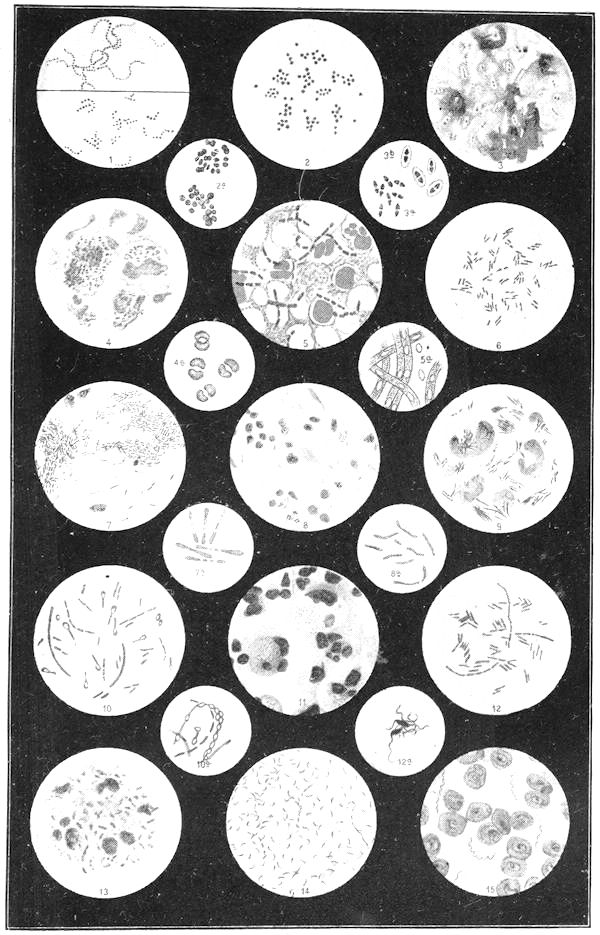
Bacteria and Vegetable Germs
3, Pneumonia; 5, Anthrax; 7, Diphtheria; 8, Tuberculosis; 9, Leprosy; 10, Tetanus; 11, Influenza; 12, Typhus; 14, Cholera
Situated under similar latitudes and climatal conditions, the pampas of Buenos Ayres have a character similar to that of the North American prairies, only man by his influence on nature has here and there impressed a peculiar stamp. The thistle and artichoke, coming with the Europeans, have quickly made themselves masters of the free soil, and with incredible rapidity overspread districts of many square miles with their spiny vegetation, which has here developed in a luxuriance unknown in Europe. These thistle-wastes have become a terrible nuisance, themselves robbers, depriving better plants of the soil, inaccessible hiding-places for the great thievish, sanguinary cats, and the still more dangerous human bandits, the thorny weed of semi-civilization.
From the western border of northern France, through Belgium, North Germany, and Russia, almost to the eastern confines of Siberia, extends a broad plain rarely interrupted by low chains of hills, and just as rarely affording fitting soil for extensive growth of wood, which, on the whole, confines itself to the more favorable soil moistened by the vicinity of rivers. Along the southern border of this plain extends a chain of hills and mountains, now projecting forward like capes into the broad surface, now retreating into broad or narrow creeks, the coast of a sea formerly covering the whole plain. Over all this endless expanse has one single species of plant established an almost exclusive predominance, the heath, which has lent its name to those tracts of land. Conditions similar to those which produce the distinction between the pine barrens and cypress swamps in North America are also active here to cause an essential difference. The great flatness of the ground, even geological conditions in many places, as where slight elevations of the land forming flat inclosed basins, prevent, in many situations, the free discharge of water, and the heath, backed by the special vegetation produced by the moisture, forms by the annual accumulation of vegetable matter, which in water only becomes to a certain degree carbonized or decomposed, those black masses of the remains of plants which as peat bear such an important part in the economy of the inhabitants. Thus, in various modes of distribution, alternate arid, dry sandy heaths with moist, spongy peat heaths or moors. On the margin of the latter, more rarely actually upon them, and on the heaths of Luneburg are often found splendid oaks, which, overshadowing one of those pleasant straw-thatched houses and thrown out by the background of the peculiar red tint of the glancing heather, produce a picturesque charm which would not have been expected here. With these great moors may be associated the peat moors of some of the higher mountain chains of the Brocken, the Röhn, and the Fichtel-Gebirge, and so on, and the so-called mosses of South Germany and Switzerland.
In another climate, in another zone of vegetation, exist similar conditions, stretching across the extreme north of Europe. As there the arid sandy heaths alternate with the wet moors, so here in a more varied manner do the dry, waterless tracts, with the marshy grounds. But we are here in Wahlenberg’s region of lichens and mosses. The arid situations are clothed, in expanses over which the eye can not reach, with dry, lead-gray lichens, among which the reindeer seeks his meagre sustenance, and in the half-fluid grounds, which will not bear the lightest footsteps, a luxuriant vegetation of mosses deceives us, in the distance, with the aspect of a smiling meadow. Here the incautious wanderer sinks into the water, which is rather concealed than displaced by the mosses, while on those lichen heaths, tundras, the Laplanders call them, in summer the glowing soil makes every step a torture.
The wood-formations of the South American catingas may be opposed to the northern leafy woods and, in like manner, the plains of the llanos of Venezuela to the Russian steppes. In the former, of which A. von Humboldt has given such a vivid sketch, the sleep of nature commences with summer, in the hot, dry season; the vegetation becomes dried up and falls to dust, leaving the ground bare; animal life, in the quadrupeds, flies from the dead land, while the crocodiles and boas burrow into the mud of the gradually exhausted rivers of the steppes, and with this become fixed, till the first torrent of rain, which conjures up a fresh, youthful vegetation on the barren soil and awakens them to life.
It is different in the steppes which stretch from southern Russia eastward through central Asia. I will only mention the strange salt-steppes, which in summer often glitter like newly fallen snow, from the salt which effloresces from the soil and nourishes a wholly peculiar vegetation. Yet I can not refrain from attempting a brief description of the sparingly populated but still inhabited Tartarian steppes of Pontus. These do not uniformly present a level surface, being broken by the durrinas, low tracts of bush of blackthorns, hawthorns, roses and brambles. But the remaining part of the vegetation is also divided by the inhabitants of lesser Russia, according to its use for pasture, into two essentially distinct groups, the truwa, the turf, and the burian, the rough, branching plants which, on account of their woody stem, afford no sustenance to the herds of the steppes. The feather-grass[7] is the principal among the Graminaceous plants. Directly after flowering, it expands its long, delicately feathered awns, not unlike marabout feathers, from the spike which rises high above the tuft of narrow, dry leaves. The older the steppe, the higher develops the woody root-stock above the soil, to the annoyance of the mower. Whoever travels but a few miles into the steppes soon hears the word burian. Against the burian inveighs the herdsman with his oxen and horses; over the burian laments the husbandman; the burian is the curse of the gardener and the hope of the cook. For in the soil of the steppe, which is peculiarly fertile for certain plants, which we call weeds, these shoot up to an incredible height, wherever cultivation has loosened the solid soil, which they avoid, and their peculiar use is that, dried up in the autumn, they furnish the only fuel of those regions. Above all, as in the pampas of Buenos Ayres, the thistles distinguish themselves, acquiring a size, a development, and ramification which is really marvelous. Often do they stand like little trees around the humble earth-hovels of the country people; on favorable soil, they often form extensive bush, even overtopping the horseman, who is as helpless in it as in a wood, since they intercept the sight and yet afford no trunk which might be climbed. Beside the thistle rises the wormwood, intermingled with the gigantic mullein or hightaper, the “steppe-light” of lesser Russia. Even the little milfoil grows several feet high and is not a little prized, since the inhabitants, from their poor provision, value it as the best material for fuel. But the most characteristic of all the plants of the burian is that which the Russians call “Perekatipole,” the “Leaf in the Field,” and the German colonists, almost more happily, the “Wind Witch.” A poor thistle-plant, it divides its strength in the formation of numerous dry, slender shoots, which spread out on all sides and are entangled with one another. More bitter than wormwood, the cattle will not touch it even in times of the utmost famine. The domes which it forms upon the turf are often three feet high and sometimes ten to fifteen in circumference, arched over with naked, delicate thin branches. In the autumn the stem of the plant rots off, and the globe of branches dries up into a ball, light as a feather, which is then driven through the air by the autumnal winds over the steppe. Numbers of such balls often fly at once over the plain with such rapidity that no horseman can catch them; now hopping with short, quick springs along the ground, now whirling in great circles round each other, rolling onward in a spirit-like dance over the turf, now, caught by an eddy, rising suddenly a hundred feet into the air. Often one wind witch hooks on to another, twenty more join company, and the whole gigantic yet airy mass rolls away before the piping east wind.
THE HIGH WOODS —Charles Kingsley
My first feeling on entering the high woods was helplessness, confusion, awe, all but terror. One is afraid at first to venture in fifty yards. Without a compass or the landmark of some opening to or from which he can look, a man must be lost in the first ten minutes, such a sameness is there in the infinite variety. That sameness and variety make it impossible to give any general sketch of a forest. Once inside “you can not see the woods for the trees.” You can only wander on as far as you dare, letting each object impress itself on your mind as it may, and carrying away a confused recollection of innumerable perpendicular lines, all straining upward, in fierce competition, toward the light-food far above; and next on a green cloud, or rather mist, which hovers round your head, and rises, thickening and thickening to an unknown height. The upward lines are of every possible thickness, and of almost every possible hue; what leaves they bear, being for the most part on the tips of the twigs, give a scattered, mist-like appearance to the under foliage. For the first moment, therefore, the forest seems more open than an English wood. But try to walk through it, and ten steps undeceive you. Around your knees are probably Mamures, with creeping stems and fan-shaped leaves, something like those of a young cocoanut palm. You try to brush among them, and are caught up instantly by a string or wire belonging to some other plant. You look up and round: and then you find that the air is full of wires—that you are hung up in a network of fine branches belonging to half a dozen sorts of young trees, and intertwined with as many different species of slender creepers. You thought at your first glance among the tree-stems that you were looking through open air; you find that you are looking through a labyrinth of wire-rigging, and must use the cutlass right and left at every five steps. You push on into a bed of strong sedge-like Sclerias, with cutting edges to their leaves. It is well for you if they are only three, and not six, feet high. In the midst of them you run against a horizontal stick, triangular, rounded, smooth, green. You take a glance along it right and left, and see no end to it either way, but gradually discover that it is the leaf-stalk of a young Cocorite palm. The leaf is five-and-twenty feet long, and springs from a huge ostrich plume, which is sprawling out of the ground and up above your head a few yards off. You cut the leaf-stalk through right and left, and walk on, to be stopped suddenly (for you get so confused by the multitude of objects that you never see anything till you run against it) by a gray lichen-covered bar, as thick as your ankle. You follow it up with your eyes, and find it entwine itself with three or four other bars, and roll over with them in great knots and festoons and loops twenty feet high, and then go up with them into the green cloud over your head and vanish, as if a giant had thrown a ship’s cables into the tree-tops. One of them, so grand that its form strikes even the negro and Indian, is a Liantasse. You see that at once by the form of its cable—six or eight inches across in one direction, and three or four in another, furbelowed all down the middle into regular knots, and looking like a chain cable between two flexible iron bars. At another of the loops, about as thick as your arm, your companion, if you have a forester with you, will spring joyfully. With a few blows of his cutlass he will sever it as high up as he can reach, and again below, some three feet down; and while you are wondering at this seemingly wanton destruction, he lifts the bar on high, throws his head back, and pours down his thirsty throat a pint or more of pure, cold water. This hidden treasure is, strange as it may seem, the ascending sap, or, rather, the ascending pure rain-water which has been taken up by the roots, and is hurrying aloft, to be elaborated into sap, and leaf, and flower, and fruit and fresh tissue for the stem up which it originally climbed, and therefore it is that the woodman cuts the water-vine through first at the top of the piece which he wants and not at the bottom; for so rapid is the ascent of the sap that if he cut the stem below the water would have all fled upward before he could cut it off above. Meanwhile the old story of Jack and the Beanstalk comes into your mind. In such a forest was the old dame’s hut, and up such a beanstalk Jack climbed to fight a giant, and a castle high above. Why not? What may not be up there? You look up into the green cloud, and long for a moment to be a monkey. There may be monkeys up there over your head—burly red Howler, or tiny, peevish Sapajou, peering at you, but you can not peer up at them. The monkeys and the parrots and the humming-birds and the flowers and all the beauty are upstairs—up above the green cloud. You are in “the empty nave of the cathedral,” and “the service is being celebrated aloft in the blazing roof.”
We will hope that as you look up you have not been careless enough to walk on, for if you have you will be tripped up at once; nor to put your hand out incautiously to rest it against a tree, or what not, for fear of sharp thorns, ants, and wasps’ nests. If you are all safe, your next steps, probably, as you struggle through the bush between tree-trunks of every possible size, will bring you face to face with huge upright walls of seeming boards, whose rounded edges slope upward till, as your eye follows them, you find them enter an enormous stem, perhaps round, like one of the Norman pillars of Durham nave, and just as huge; perhaps fluted, like one of William of Wykeham’s columns at Winchester. There is the stem, but where is the tree? Above the green cloud. You struggle up to it between two of the board walls, but find it not so easy to reach. Between you and it are half a dozen tough strings which you had not noticed at first—the eye can not focus itself rapidly enough in this confusion of distances—which have to be cut through ere you can pass. Some of them are rooted in the ground, straight and tense; some of them dangle and wave in the wind at every height. What are they? Air-roots of wild pines, or of Matapolos, or of figs, or of Seguines, or of some other parasite? Probably; but you can not see. All you can see is, as you put your chin close against the trunk of the tree and look up, as if you were looking up against the side of a great ship set on end, that some sixty or eighty feet up in the green cloud arms as big as English forest trees branch off, and that out of their forks a whole green garden of vegetation has tumbled down twenty or thirty feet, and half climbed up again. You scramble round the tree to find whence this aerial garden has sprung; you can not tell. The tree-trunk is smooth and free from climbers, and that mass of verdure may belong possibly to the very cables which you met ascending into the green cloud twenty or thirty yards back, or to that impenetrable tangle a dozen yards on, which has climbed a small tree, and then a taller one again, and then a taller still, till it has climbed out of sight, and possibly into the lower branches of the big tree. And what are their species? What are their families? Who knows? Not even the most experienced woodman or botanist can tell you the names of plants of which he only sees the stems. The leaves, the flowers, the fruit, can only be examined by felling the tree; and not even always then, for sometimes the tree, when cut, refuses to fall, linked as it is by chains of liane to all the trees around. Even that wonderful water-vine which we cut through just now may be one of three or even four different plants.
Soon you will be struck by the variety of vegetation, and you will recollect what you have often heard, that social plants are rare in the tropic forests. Certainly they are rare in Trinidad, where the only instances of social trees are the Moras (which I have never seen growing wild) and the Moriche palms. In Europe a forest is usually made up of one dominant plant—of firs or of pines, of oaks or of beeches, of birch or of heather. Here no two plants seem alike. There are more species on an acre here than in all the New Forest, Savernake, or Sherwood. Stems rough, smooth, prickly, round, fluted, stilted, upright, sloping, branched, arched, jointed, opposite-leaved, alternate-leaved, leafless, or covered with leaves of every conceivable pattern, are jumbled together, till the eye and brain are tired of continually asking, “What next?” The stems are of every color, copper, pink, gray, green, brown, black, as if burnt, marbled with lichens, many of them silvery white, gleaming afar in the bush, furred with mosses and delicate creeping film-ferns, or laced with the air-roots of some parasite aloft. Up this stem scrambles a climbing Seguine with entire leaves; up the next, another quite different, with deeply cut leaves; up the next, the Ceriman spreads its huge leaves latticed and forked again and again. So fast do they grow, that they have not time to fill up the spaces between their nerves, and are consequently full of oval holes; and so fast does its spadix of flowers expand, that (as indeed do some other Aroids) an actual genial heat, and fire of passion, which may be tested by the thermometer, or even by the hand, is given off during fructification. Beware of breaking it or the Seguines. They will probably give off an evil smell, and as probably a blistering milk. Look on at the next stem. Up it, and down again, a climbing fern, which is often seen in hothouses, has tangled its finely cut fronds. Up the next a quite different fern is crawling, by pressing tightly to the rough bark its creeping root-stalks, furred like a hare’s leg. Up the next, the prim little Griffechatte plant has walked, by numberless clusters of small cat’s claws which lay hold of the bark. And what is this delicious scent about the air? Vanille? Of course it is; and up that stem zigzags the green fleshy chain of the Vanille Orchis. The scented pod is far above, out of your reach, but not out of the reach of the next parrot, or monkey, or negro-hunter who winds the treasure. And the stems themselves—to what trees do they belong? It would be absurd for one to try to tell you who can not tell one-twentieth of them himself. Suffice it to say that over your head are perhaps a dozen kinds of admirable timber which might be turned to a hundred uses in Europe, were it possible to get them thither: your guide will point with pride to one column after another, straight as those of a cathedral, and sixty to eighty feet without branch or knob. That, he will say, is Fiddle-wood; that a Carap; that a cedar; that a Roble (oak); that, larger than all you have seen yet, a locust; that a Poui; that a Guatecare; that an Olivier—woods which, he will tell you, are all but incorruptible, defying weather and insects. He will show you, as curiosities, the smaller but intensely hard letter wood lignum-vitæ, and purple heart. He will pass by as useless weeds Ceibas and sandbox-trees, whose bulk appalls you. He will look up, with something like a malediction, at the Matapalos, which every fifty yards have seized on mighty trees, and are enjoying, I presume, every different stage of the strangling art, from the baby Matapalo, who has let down his first air-root along his victim’s stem, to the old sinner whose dark crown of leaves is supported, eighty feet in air, on innumerable branching columns of every size, cross-clasped to each other by transverse bars. The giant tree on which his seed first fell has rotted away utterly, and he stands in its place, prospering in his wickedness, like certain folk whom David knew too well. Your guide walks on with a sneer, but he stops with a smile of satisfaction as he sees lying on the ground dark green glossy leaves, which are fading into a bright crimson, for overhead somewhere there must be a Balata, the king of the forest; and there, close by, is his stem—a madder-brown column, whose head may be a hundred and fifty feet or more aloft. The forester pats the sides of his favorite tree as a breeder might that of his favorite race-horse. He goes on to evince his affection, in the fashion of the West Indians, by giving it a chop with his cutlass, but not in wantonness. He wishes to show you the hidden virtues of this (in his eyes) noblest of trees—how there issues out swiftly from the wound a flow of thick white milk, which will congeal, in an hour’s time, into a gum intermediate in its properties between caoutchouc and gutta-percha. He talks of a time when the English gutta-percha market shall be supplied from the Balatas of the northern hills which can not be shipped away as timber. He tells you how the tree is a tree of a generous, virtuous, and elaborate race—“a tree of God, which is full of sap,” as one said of old of such—and what could he say better, less or more? For it is a Sapota, cousin to the Sapodilla, and other excellent fruit-trees, itself most excellent even in its fruit-bearing power; for every five years it is covered with such a crop of delicious plums that the lazy negro thinks it worth his while to spend days of hard work, besides incurring the penalty of the law (for the trees are government property), in cutting it down for the sake of its fruit.
But this tree your guide will cut himself; so he leaves a significant mark on his new-found treasure and leads you on through the bush, hewing his way with light strokes right and left, so carelessly that you are inclined to beg him to hold his hand and not destroy in a moment things so beautiful, so curious—things which would be invaluable in an English hothouse.
And where are the famous orchids? They perch on every bough and stem; but they are not, with three or four exceptions, in flower in the winter; and if they were, I know nothing about them—at least I know enough to know how little I know. Whosoever has read Darwin’s Fertilization of Orchids, and finds in his own reason that the book is true, had best say nothing about the beautiful monsters till he has seen with his own eyes more than his master. And yet even the three or four that are in flower are worth going many a mile to see. In the hothouse they seem almost artificial from their strangeness; but to see them “natural,” on natural boughs, gives a sense of their reality which no unnatural situation can give. Even to look up at them, as one rides by, and to guess what exquisite and fantastic forms may issue, in a few months or weeks, out of those fleshy, often unsightly, leaves, is a strange pleasure—a spur to the fancy which is surely wholesome, if we will but believe that all these things were invented by A Fancy, which desires to call out in us, by contemplating them, such small fancy as we possess; and to make us poets, each according to his power, by showing a world in which, if rightly looked at, all is poetry.
Look here at a fresh wonder. Away in front of us a smooth gray pillar glistens on high. You can see neither the top nor the bottom of it. But its color and its perfectly cylindrical shape tell you what it is—a glorious Palmiste; one of those queens of the forest which you saw standing in the fields, with its capital buried in the green cloud and its base buried in that bank of green velvet plumes, which you must skirt carefully round, for they are a prickly dwarf palm, called here Black Roseau. Close to it rises another pillar, as straight and smooth, but one-fourth of the diameter—a giant’s walking-cane. Its head, too, is in the green cloud. But near are two or three younger ones only forty or fifty feet high, and you see their delicate feather heads, and are told that they are Manacques; the slender nymphs which attend upon the forest queen, as beautiful, though not as grand, as she.
The land slopes down fast now. You are tramping through stiff mud, and those Roseaux are a sign of water. There is a stream or gully near; and now, for the first time, you can see clear sunshine through the stems, and see, too, something of the bank of foliage on the other side of the brook. You catch sight, it may be, of the head of a tree aloft, blazing with golden trumpet-flowers, which is a Poui; and of another lower one covered with hoar-frost, perhaps a Croton; and of another, a giant covered with purple tassels: this is an Angelim. Another giant overtops even him. His dark, glossy leaves toss off sheets of silver light as they flicker in the breeze, for it blows hard aloft outside while you are in stifling calm. That is a Balata. And what is that on high—twenty or thirty square yards of rich crimson a hundred feet above the ground? The flowers may belong to the tree itself. It may be a mountain mangrove, which I have never seen in flower; but take the glasses and decide. No. The flowers belong to a liane. The “wonderful” Prince of Wales’s feather has taken possession of the head of a huge Mombin, and tiled it all over with crimson combs, which crawl out to the ends of its branches, and dangle twenty or thirty feet down, waving and leaping in the breeze. And over all blazes the cloudless blue.
You gaze astonished. Ten steps downward and the vision is gone. The green cloud has closed again over your head and you are stumbling in the darkness of the bush, half blinded by the sudden change from the blaze to the shade. Beware. “Take care of the Croc-chien!” shouts your companion; and you are aware of, not a foot from your face, a long, green, curved whip armed with pairs of barbs some four inches apart; and are aware also at the same moment that another has seized you by the arm, another by the knees, and that you must back out, unless you are willing to part with your clothes first and your flesh afterward. You back out, and find that you have walked into the tips—luckily only into the tips—of the fern-like fronds of a trailing and climbing palm such as you see in the Botanic Gardens. That came from the East, and furnishes the rattan canes. This furnishes the gri-gri canes, and is rather worse to meet, if possible, than the rattan. Your companion, while he helps you to pick the barbs out, calls the palm laughingly by another name, “Sueltami-Ingles,” and tells you the old story of the Spanish soldier at San Josef. You are near the water now, for here is a thicket of Balisiers. Push through, under their great plantain-like leaves—step down the muddy bank to that patch of gravel. See first, though, that it is not tenanted already by a deadly Mapepire, or rattlesnake, which has not the grace, as his cousin in North America has, to use his rattle.
The brooklet, muddy with last night’s rain, is dammed and bridged by winding roots, in shape like the jointed wooden snakes which we used to play with as children. They belong probably to a fig, whose trunk is somewhere up in the green cloud. Sit down on one, and look, around and aloft. From the soil to the sky, which peeps through here and there, the air is packed with green leaves of every imaginable hue and shape. Round our feet are Arums, with snow-white spadixes and hoods, one instance among many here of brilliant color developing itself in deep shade. But is the darkness of the forest actually as great as it seems? Or are our eyes, accustomed to the blaze outside, unable to expand rapidly enough, and so liable to mistake for darkness air really full of light reflected downward, again and again, at every angle, from the glossy surfaces of a million leaves? At least we may be excused; for a bat has made the same mistake, and flits past us at noonday. And there is another—no; as it turns, a blaze of metallic azure off the upper side of the wings proves this one to be no bat, but a Morpho—a moth as big as a bat. And what was that second larger flash of golden green, which dashed at the moth and back to yonder branch not ten feet off? A Jacamar—kingfisher, as they miscall her here, sitting, fearless of man, with the moth in her long beak. Her throat is snowy white, her under parts rich red brown. Her breast and all her upper plumage and long tail glitter with golden green. There is light enough in this darkness, it seems. But now look again at the plants. Among the white flowered Arums are other Arums, stalked and spotted, of which beware; for they are the poisonous Seguine-diable, the dumb-cane, of which evil tales were told in the days of slavery. A few drops of its milk, put into the mouth of a refractory slave, or again into the food of a cruel master, could cause swelling, choking, and burning agony for many hours.
Over our heads bend the great arrow leaves and purple leaf-stalks of the Tanias; and mingled with them leaves often larger still: oval, glossy, bright, ribbed, reflecting from their under side a silver light. They belong to Arumas; and from their ribs are woven the Indian baskets and packs. Above these, again, the Balisiers bend their long leaves, eight or ten feet long apiece; and under the shade of the leaves their gay flower-spikes, like double rows of orange and black birds’ beaks upside down. Above them, and among them, rise stiff, upright shrubs, with pairs of pointed leaves, a foot long some of them, pale green above, and yellow or fawn-colored beneath. You may see, by the three longitudinal nerves in each leaf, that they are Melastomas of different kinds—a sure token that you are in the tropics—a probable token that you are in tropical America.
And over them, and among them, what a strange variety of foliage. Look at the contrast between the Balisiers and that branch which has thrust itself among them, which you take for a dark, copper-colored fern, so finely divided are its glossy leaves. What a contrast again, the huge feathery fronds of the Cocorite palms which stretch right away hither over our heads, twenty and thirty feet in length. And what is that spot of crimson flame hanging in the darkest spot of all from an under bough of that low, weeping tree? A flower head of the Rosa del Monte. And what that bright, straw-colored fox’s brush above it, with a brown hood like that of an Arum, brush and hood nigh three feet long each? Look—for you require to look more than once, sometimes more than twice—here, up the stem of that Cocorite, or as much of it as you can see in the thicket. It is all jagged with the brown butts of its old fallen leaves; and among the butts perch broad-leaved ferns and fleshy orchids, and above them, just below the plume of mighty fronds, the yellow fox’s brush, which is its spathe of flower.
What next? Above the Corcorites dangle, amid a dozen different kinds of leaves, festoons of a liane, or of two, for one has purple flowers, the other yellow—Bignonias, Bauhinias—what not? And through them a Carat palm has thrust its thin, bending stem and spread out its flat head of fan-shaped leaves twenty feet long each: while over it, I verily believe, hangs eighty feet aloft the head of the very tree upon whose roots we are sitting. For amid the green cloud you may see sprigs of leaf somewhat like that of a weeping willow; and there, probably, is the trunk to which they belong, or rather what will be a trunk at last. At present it is like a number of round edged boards of every size, set on end, and slowly coalescing at their edges. There is a slit down the middle of the trunk, twenty or thirty feet long. You may see the green light of the forest shining through it. Yes, that is probably the fig; or, if not, then something else. For who am I, that I should know the hundredth part of the forms on which we look?
And above all you catch a glimpse of that crimson mass of Norantea which we admired just now; and, black as yew against the blue sky and white cloud, the plumes of one Palmiste, who has climbed toward the light, it may be for centuries, through the green cloud; and now, weary and yet triumphant, rests her dark head among the bright foliage of a Ceiba, and feeds unhindered on the sun.
There, take your tired eyes down again; and turn them right or left, where you will, to see the same scene, and yet never the same. New forms, new combinations; wealth of creative Genius—let us use the wise old word in its true sense—incomprehensible by the human intellect or the human eye, even as He is who made it all, whose garment, or rather whose speech, it is.
MILK-SAP PLANTS —M. J. Schleiden
All the plants which count caoutchouc among their products belong to the torrid zone. A. von Humboldt, in his Ideas of a Geography of Plants, remarked that the plants yielding milky juices multiply as we approach the tropics. This milky juice of plants it is which contains the peculiar elastic substance. The tropical heat seems to exert a distinct influence in its perfect formation, for it has been remarked that the same plants which under the equator yield abundance of caoutchouc contain instead, with us, even in hothouses, a substance which resembles the bird-lime obtained from our native mistletoe.
Who among my readers has not seen our indigenous wolf’s-milk or spurge, the white milky juice of which popular superstition recommends as a remedy against warts? Who has not in youth at least become acquainted with the celandine, from the broken stalk and leaf of which a bright orange-colored juice runs out? Who has not observed that the lettuce, when it has run up to flower, ejects a milk-white fluid at the slightest touch? But the occurrence of milky juices in plants is not limited to these few. The vegetable world presents to us most useful as well as poisonous matters in this milky sap, and I will content myself at present with recalling to recollection opium, the dried milky juice of our large garden poppy.
A great number of plants, which principally belong to three great families, namely, the Spurges, the Apocynoceæ, and the Nettle plants, are distinguished by a peculiar anatomical structure. In their bark, and also partly in their pith, we find a quantity of long, variously curved and branched tubes, which are not unlike the veins of animals. In these tubes we find a thick juice of the consistence of very rich milk, whence it is called milk-sap. Its color is usually milk-white, but yellow, red, and, very rarely, blue milk-saps are met with, but more frequently still they are wholly colorless. Like animal milk, this juice consists of a colorless fluid and small globules. The composition displays the most varied constituents, and upon the variation of quantity and modes of mixture of these matters depend the abundant varieties of this juice. All contain more or less caoutchouc, which occurs in the form of little globules. These are prevented from coalescing by an albuminous substance, in the same way as are the butter globules in milk. Exactly like the cream (the butter) in milk, the caoutchouc globules rise to the surface of the milk-sap of plants when left to stand, here form a cream, and can not, any more than butter, be separated again into their distinct globules.
All those three great families which are distinguished by their abundance of milk-sap, although differing very widely botanically, exhibit some most remarkable agreements through the nature of their milk-sap.
The spurges or Euphorbiaceæ constitute the most important group in reference to the amount of caoutchouc contained. From the Port of Para in South America, from Guiana, and the neighboring states, an incredible quantity of India-rubber is shipped for Europe, and this is principally obtained from a large tree growing in those regions, called the Siphonia elastica. That beautiful tree, the Siphonia, is about sixty feet high, and has a smooth brownish-gray bark, in which the Indians make long and deep incisions down to the wood, from whence the white juice then abundantly flows forth.
Many other plants of this group contain caoutchouc, but from none is it so easy to obtain in large quantity. Though the sap of Siphonia is at least harmless, though the juice of the Tabayba dolce (Euphorbia balsamifera) is even similar to sweet milk and, thickened into a jelly, eaten as a delicacy by the inhabitants of the Canary Islands, as Leopold von Buch relates in his interesting description of the Canaries; yet most of the plants of this group are to be counted among the suspicious, or even most actively poisonous, on account of this very juice. And yet, strangely enough, they also furnish a most wholesome food, which we have scarcely anything to compare with. Throughout all the hotter part of America the culture of the mandioc-root (Jatropha Manihot) is one of the most important branches of husbandry. The native savages and the Europeans, the black slave and free man of color alike substitute for our white bread and rice the tapioca and the Mandiocca farinha, or Cassava-meal, and the cakes prepared from it (pan de tierra caliente of the Mexicans). The sweet yucca (Yuca dulce), which is the name applied there to the mandioc plant, must be distinguished from the sour or bitter kind (Yuca amara). The former, which is therefore cultivated with great care, may be eaten at once without danger; while the latter, eaten fresh, is an active poison. They serve the uncivilized son of the South American tropics for food.
The sated savage saunters round to seek a new sleeping-place, but woe to him! inadvertently he has prepared his couch beneath the dreadful manchineel (Hippomane Mancinella), and in a sudden shower the rain drips from its leaves upon him. In frightful pain he wakes up, covered with blisters and ulcers, and if he escapes with life, he is at least the richer of a fearful experience of the poisonous properties of the Euphorbiaceæ. But this will seldom happen to a native; the manchineel is avoided in America with the same mysterious and almost superstitious awe as the fabulous poison-tree in Java. Happily, the trumpet-tree (Bignonia leucoxylon), the sap of which is the surest antidote against the manchineel, usually rears its beautiful purple blossoms close at hand, the constant companion of that dangerous Euphorbiacean.
The planter of the Cape strews over pieces of flesh the pounded fruit of a plant that grows there (Hyænanche globosa), and lays them as an infallible poison for the hyena. The wild inhabitants of southern Africa, according to Bruce, poison their arrows with a spurge (Euphorbia caput Medusæ). Virey states that the Ethiopians make a similar application of others (Euphorbia heptagona, Euphorbia virosa, Euphorbia cereiformis), while the savages of the most southern part of America use the sap of a third (Euphorbia cotinifolia). Nay, even our seemingly so innocent box, which also belongs to this family, is so injurious that in places in Persia, where it much abounds, no camels can be kept, because it is impossible to prevent their feeding on this plant, which is deadly to them. I can not take leave of this family without mentioning a remarkable phenomenon, reported to us by Martius, in that work so full of information, his Travels Through Brazil. A spurge grows there (Euphorbia phosphorea), the milk of which, when it flows forth from the stem in the dark, hot summer nights, emits a bright phosphoric light.
While the family just alluded to, the blossoms being generally insignificant, attract the attention of our horticulturists almost solely through their strange forms, which, in some of them, approach to those of the cactus plants, the family of the Apocynaceæ is, on the contrary, a rich ornament of our gardens and hothouses, on account of the wonderful beauty of its blossoms, and is often still more attractive from the remarkable structure of the flowers, and the aberrant, also cactus-like form of the plant itself. What lover of flowers knows not the splendid blossom of the species of Carissa, Allamanda, Thevetia, Cerbera, Plumieria, Vinca, Nervium, and Gelsemium; the strange stalk and toad-colored, ill-smelling flowers of the Stapelia? But this family is not less interesting in other respects. The best caoutchouc at present known, that from Pulo Penang, comes from a plant of this family (Cynanchum ovalifolium). Also that from Sumatra (Urceola elastica), from Madagascar (Vahea gummifera), a part of the Brazilian Collophora utilis and Hancornia speciosa, and the East Indian Willughbeia edulis are obtained from plants which belong to the group of Apocynaceæ.
Most strangely, this family also, as well as the following and last, exhibits the peculiar phenomenon which was described in the first-named, the Euphorbiaceæ, namely, that the milk-sap is in some species rich in India-rubber, in others it is tempered into a clear, agreeably smelling and wholesome milk, while in certain others, on the contrary, this fluid grows, step by step, through successively increasing quantity of noxious matter to a most dreadful poison. In the forests of British Guiana grows a tree which the natives call Hya-Hya (Tabernæmontana utilis). Its bark and pith are so rich in milk that an only moderate-sized stem, which Arnott and his companions felled on the bank of a large forest brook, in the course of an hour colored the water quite white and milky. This milk is perfectly harmless, of a pleasant flavor, and is taken by the savages as a refreshing drink. Still more pleasant must be the taste of the milk of the Ceylon cow-tree, the Kiriaghuma (Gymneura lactiferum), which, according to Burmann’s narrative, the Cingalese use exactly as we do milk.