THE STORY OF THE UNIVERSE (continued 2)
Reading edition
But it is principally among the Graminaceæ that the greatest difference is observable. Of these there are a great number which attain no larger dimensions than our Bromus, forming masses of grass only distinguished from European species by their stems being more branchy, and the leaves larger. Others shoot up to the height of the forest tree, with a graceful habit. At first they are as upright as a lance, terminating in a point, with only one leaf, resembling a large scale, at each internode; when these fall, a crown of short branches springs from their axils, bearing the true leaves. The stems of the bamboos are thus decorated with verticils at regular intervals. It is to the Lianes principally that tropical forests are indebted for their picturesque beauty, and these are the source of the most varied effects. Our own honeysuckle and the ivy give but a faint idea of the appearance presented by the crowd of climbing and creeping plants belonging to many different families. These are Bignoniaceæ, Bauhinia, Cissus, and Hippocrateaceæ, and while they all require a support, they each have notwithstanding a bearing peculiar to themselves. One of those climbing parasites will encircle the trunk of the largest trees to a prodigious height, the marks left by the old leaves seeming in their lozenge-shaped design to resemble the skin of a serpent. From this parasitic stem spring large leaves of a glossy green, while its lower parts give birth to slender roots, which descend again to the earth straight as a plumb-line. The tree which bears the Spanish name of Cipo-Matador, “the murderous Liane,” has a trunk so slight that it can not support itself alone, but must find support on a neighboring tree more robust than itself. It presses against its stem, aided by its aerial roots, which embrace it at intervals like so many flexible osiers, by which it secures itself and defies the most terrible hurricanes. Some Lianes resemble waving ribbons, others are twisted in large spirals, or hang in festoons, spreading between the trees, and darting from one to another, twining round them, and forming masses of stem, leaves, and flowers, where the observer often finds it difficult to assign to each species what belongs to it.
Thousands of different species of shrubs, Melastomaceæ, Boraginaceæ, peppers, and Acanthaceæ, springing up round the roots of large trees, fill up the intervals left between them. Species of Tillandsia and orchids, with flowers of strange and whimsical shape, make their appearance, and these often serve as supports to other parasites. Numerous brooks generally run through these forests, communicating their own freshness to the forest vegetation, presenting to the tired traveler delicious and limpid water, while the banks of the stream are carpeted with mosses, lycopodiums, and ferns, from the midst of which spring begonias, with delicate and succulent stems, unequal leaves, and flesh-colored flowers.
The forests of Paraguay, still little known, situated along the coast of the Atlantic, consist of ligneous Compositæ and Ilex paraguayensis, the Paraguay tea, of which a large quantity is annually exported.
In the Argentine Republic Auguste de Saint-Hilaire found only 500 species of plants, among which only fifteen belonged to families which are not European.
When we reach the south coast of Patagonia and the Falkland Islands, a few brown and coriaceous Graminaceæ and Cyperaceæ, such as Dactylis cæspitosa, Carex trifida, Bolax glebaria, Cardamine glacialis, Veronica, Calceolaria, Aster, Opuntia Darwinii, Lomaria magellanica among the tree ferns, a few brambles, thickets of bilberries and Arbutus, include nearly the whole of the vegetation of these desert lands, where mosses, hepaticas, and lichens reign supreme. We now reach the southern part of South America. In the stormy region of Terra del Fuego thick forests cover the mountains, where they are sheltered from the wind, to the height of 1,500 feet above the level of the sea. Fagus betuloides predominates there; then comes F. antarctica, accompanied by barberry and currant bushes.
At the Island of Hermite, the most southerly point of the American Continent, there is still some arborescent vegetation. Hooker there observed eighty-four flowering plants and many cryptogams. A fungus parasitic on the beech (Cyttaria Gunnii) constitutes there a principal aliment of the miserable inhabitants of these gloomy regions.
The Australian flora presents forms more ancient than any other contemporary vegetation. More than nine-tenths of the species found between 33° and 35° south latitude, in Australia, are absolutely limited to these regions. Many constitute completely distinct families; others form families which are scarcely represented in any other part of the globe. Those even which belong to groups more generally diffused disguise their natural affinities under forms isolated and unlike their congeners. The different species of two genera, namely, Eucalyptus among Myrtaceæ, and Acacia among Leguminosæ, form perhaps, from their number and dimensions, one-half of the vegetation which covers the country. Their leaves are reduced to phyllodes. Neither these phyllodes nor the limb of the real leaves are placed horizontally, like those of Europe and other parts of the world, but are perpendicular to the surface of the soil, so that the light shining between these vertical blades is not arrested, as in the case with our trees and bushes, in which the leaves are placed transversely one above the other. The effect produced by masses of Australian verdure is thus entirely different from that to which we are accustomed. The aspects of these forests particularly struck the first travelers who visited them, from the singular sensation communicated to the eye by this mode of distributing light and shade.
Eucalyptus, which occupies such a large place in Australian vegetation, may be said to be the sacred tree with the natives; it shadows the tombs of the savage inhabitants of these countries. Sir Thomas Mitchell, the traveler to whom we owe the first scientific description of Australia, has given a remarkable picture of “these groves of death,” which are daily becoming more and more rare, and will disappear under the influence of European colonization. He relates that these groves mark the centre of the patrimonial land of each great Australian tribe. Little tumuli of grass, and sandy footpaths, surround the clumps of these funereal squares, over which spreads the shadow of the Eucalyptus and Xanthorrhæa. If to the magnificent Eucalyptus and simple-leaved Acacia, which predominate in the forests and give quite a special character to the vegetation, we add the Xanthorrhæa, with its thick stem, long, narrow, linear leaves, curved and spreading at the summit, from the centre of which rises an elongated stem, terminated by a spike of robust flowers; the Casuarina, with long, pendent, and drooping boughs, most delicately articulated; Araucaria excelsa, whose column-like trunk and verticillate branches rise to the height of ninety or a hundred feet; the elegant Epacridaceæ, with flowers so varied; a vast number of pretty Leguminosæ, which now add to the riches of our hothouses; more than 120 terrestrial Orchidaceæ, nearly all belonging to genera peculiar to Australia, we shall have an idea of the vegetation which covers and decorates in so original a way the shores of New Holland.
The large islands of New Zealand almost correspond in latitude with the zone which we have been examining. These islands are the nearest land (considering Van Diemen’s Land as part of Australia), and are interesting as being the exact antipodes of western Europe, and because they repeat as it were our Mediterranean region on the other side of the globe. While resembling it in climate, however, the native vegetation has its own characteristics. It has some features in common with Australia and the tropics.
In the large island of Ika-na-Nawi there are immense forests of Lianes and interlacing shrubs, which render them impenetrable. In these forests there exist, no doubt, trees of gigantic dimensions, for the canoes of the natives are sometimes as much as sixty feet long, and from three to four broad, all hollowed out of one trunk. At from two to four miles from the coast Messrs. Richard and Lesson saw large spaces, very low and probably marshy, covered with great masses of green trees, of which the Dacrydium cupressinum and Podocarpus dacrydiodes and some others, form the principal species. The European is surprised to meet there many familiar plants, or species closely allied to them, such as Senecio, Veronica, rushes, Ranunculus acris, etc. On the other hand, several plants peculiar to New Zealand grow abundantly in these localities, such, among others, as the Phormium tenax, called by Europeans New Zealand Flax, because its fibres furnish a very strong thread, much used in the manufacture of certain fabrics.
Ferns form a tenth of the number of species in the whole vegetation of New Zealand; among Monocotyledons are Graminaceæ and Cyperaceæ; among Dicotyledons, Umbelliferæ, Cruciferæ, and Onagrariaceæ. New Zealand only furnishes a small number of alimentary plants. The aboriginal inhabitants of this archipelago, for the most part ichthyophagous, were long reduced to the feculent root of a fern, the Pteris esculenta, for food, when they could not obtain fish. None of their trees produce large fruit. The taro (Caladium esculentum) and the sweet potato (Convolvulus Batatas) also serve as nourishment to the inhabitants of these countries. It is to be remarked that European vegetables, introduced into New Zealand by sailors, are propagated there with such facility that the aspect of the ground, as well as conditions of life, are greatly modified. Among the vegetables proper to the archipelago in question we may note the Corypha australis among the palms; arborescent species of Dracæna, forests of Coniferæ, with large leaves, such as Dammara, and Metrosideros among the Myrtaceæ.
ZONES OF VEGETATION —M. J. Schleiden
If, from the snow-covered ice-plains of the extreme north, where the Red-snow Alga alone remind us of the existence of vegetable organization, we turn toward the south, a girdle first expands before us, in which mosses and lichens clothe the soil, and a peculiar vegetation of low plants with subterranean, perennial stems, and generally large, handsome flowers, the so-called Alpine plants, gives a special character to Nature. Almost all the plants form little, flattened, separate tufts; Pyrola, Andromeda, Pedicularis, Cochlearia, poppies, crow-foots, and others are the characteristic genera of this flora, in which no tree, no shrub flourishes. Leaving this region, which botanists call the region of Mosses and Saxifrages, or, after one of the founders of Geographical Botany, Wahlenberg’s region, we go southward, and at first we see little low bushes of birches, then more compacted woods, into which the pines and other coniferous trees assemble, and we at last find ourselves in a second great zone of vegetation which is characterized by the woods consisting almost exclusively of conifers, which thus impress a peculiar character upon the flora; firs and pines, Siberian stone-pines and larches form great widely extended masses of forest; by brooks and on damp soil occur the willow and the alder. On dry hills grow the reindeer lichen and Iceland moss. In the cranberry, cloud-berry, and the currant Nature gives spontaneously, though sparingly, food; and a rich flora of variegated flowers serves for the decoration of the zone, which stretches, in Scandinavia, to the northern limit of the cultivation of wheat, but in Russia and Asia, almost to Kazan and Yakutsk; we will call it the zone of the conifers. Even in the neighborhood of Drontheim, the culture of fruits begins, though sparingly; soon appears the sturdy oak, called, with rather too much poetic license, “the German”; in Schoonen, Zealand, Schleswig, and Holstein flourish the first woods of beech. In about the latitude of Frankfort-on-the-Main, another tree joins company, which, in its bold, picturesque mode of branching, takes its stand beside the oak—which in the beauty of its foliage, as well as the utility of its fruit, it far surpasses—namely, the noble chestnut. The Pyrenees, the Alps, and the Caucasus form the southern limit of the zone, in the more eastern portion of which the lime and the elm contribute so abundantly to the composition of the forests that the former even withstands the devastation which the Esthonians make in the manufacture of their shoes from its bass. In the hop, the ivy, and the clematis we find here the first representation of the tropical climbers. The smiling green of the meadows alternates with the gloomy shadows of the forests; and man has taken possession of the earth, restraining the wild vegetation to that absolutely needful for wood and hay, and rich crops reward his industry. We leave this zone of the deciduous woods to scale the rocky barrier of the Alps. Here suddenly appear quite different plants; with the great woods of trees, the coriaceous shining leaves of which last through the mild winter, and round the mighty stems of which climb the vine and flame-colored Bignonias, unite the smaller bushes of myrtle, arbutus, and pistachio. Here and there the dwarf-palm is met with; labiate plants and crucifers, and fair-flowered rock-roses replace in summer the spring flora of scented hyacinth and narcissus; but rarely, even in the most favored spots, is the eye dazzled by the brilliancy of evergreen leaves, or the glaring play of color of the naked, jagged mountain chains, gladdened by the mild radiance of verdant meadows. In recompense, mankind has, in this zone of evergreen woods, seized upon the fruit of the Hesperides. It is
“the land where the Citrons blow, Through the dark-green leaves the gold Oranges glow.”
But onward, ever onward, strives the insatiable son of Iapetus; no legend of African deserts, no death-news of the many adventurous travelers who have gone forth to seek the source of the Niger, frighten him back. On the west coast of Africa, in the Canary Isles, is, indeed, no longer found the gigantic dog, from which, as Pliny told, the islands derived their name, but Flora gives for booty richest treasures which she, by aid of the tropical sun, has succeeded in extracting from the soil, moistened by the vapors of the ocean. Round sycamores twine mighty cissus stems; capers and bauhinias interlace in the thickets of balsamic shrubs. The slender date-palm soars aloft, and the baobab grows up into gigantic masses of wood. The wondrous cactus-like forms of the leafless spurges, distinguished by their poisonous or pleasant-flavored, sweet milk, as the case may be, betray a peculiar formative power in Nature; and the dragon-tree in the garden of Orotava,[3] in Teneriffe, a gigantic arborescent lily-plant, recounts to the musing listener the traditions of thousands of years.
Six zones of vegetation have we thus passed through, in which the continually increasing temperature of the climate called forth ever a different, ever a more luxuriant vegetation, and we conclude our wanderings, after a short rest under the five-thousand-yeared Dracænas, by climbing the Pic of Teyde. Man has taken possession of the soil of the plain at its foot and dislodged the original vegetation. Through vineyards and maize-fields we ascend, till the shades of the evergreen bay-laurel surround us. Trees of the lace-bark tribe and similar plants succeed; we wander for a time through a zone of evergreen forest trees. At a height of 4,000 feet we lose the plants which had so far accompanied us. A very small number of peculiar plants mark a quickly traversed zone of deciduous trees, and we come among the resinous trunks of the Canary pine. A zone of conifers shield us from the sun’s rays up to a height of 6,000 feet, then the vegetation suddenly becomes low—from humble bushes it passes into a flora which bears all the characters of the Alpine plants, till finally the naked rock sets a limit to all organic life, and no snow and ice bedeck the summit of the mountain, only because its height of 12,236 feet does not, in a position so near the tropics, extend up to the region of eternal snow. Counting by the limits of vegetation, we have resurveyed in a few hours’ climb the wide way from Spitzbergen to the Canaries, an extent of more than fifty degrees of latitude.
The plant is dependent on the condition of the soil, in the widest sense of the word, on the store of nutriment it contains, and on all that influences the chemical process of formation, consequently, above all, upon a determinate temperature. The universal, indispensable nutrient substance of plants, and, at the same time, the matter by means of which all the rest are conveyed into it, is water. Without water there is no vegetation. The orchidaceous plants of the tropical forest let their peculiarly constructed roots hang down from the branch to which they cling in the warm, moist atmosphere, and absorb water in the form of vapor. Our water-lilies and the proper bog-plants will only flourish when surrounded by liquid water, or, at least, with their roots dipping in it. The case is quite different with the great majority of plants; they have to extract their nutriment from the earth, which contains the moisture to be absorbed into them in a peculiar condition. If to these three classes of air, water, and earth-plants we add one more, namely, the true parasites, which, like our dodder, draw their organized nutriment from other plants, we have obtained the principal divisions of stations.
Every soil which bears plants contains also in its composition all the substances required by all plants, only the proportions differ, and the predominance of silex, lime, or common salt must consequently favor especially the growth of grasses, pulses, or shore-plants, although these are by no means exclusively confined to the proper sandy or calcareous soils, or to the seaside. In addition to the chemical conditions, there is yet another which modifies the former and, where it brings about the same actions, contributes to chain particular plants so much the more firmly, exclusively to particular soils, or contrariwise also contributes to conceal or obliterate the connection between plants and the chemical nature of the soil. This consists in the mechanical condition and physical peculiarities of the soil. There are plants which will only settle on unbroken rocks, which when the other conditions coincide, spring from these rocks over on to our walls, like the Wall Rue Spleenwort,[4] a little fern, the name of which denotes its station. Others occur only where weathering has broken up the solid rock into small fragments, drift plants, which, clinging to mankind, select rubbish heaps, which most resemble their natural station; our great nettle and henbane may serve as examples. Lastly, other plants grow only where the rocks have been reduced to fine powder, in sand or in the fine-grained clay produced by chemical decomposition. The so-called German Sarsaparilla, the sea-reed, is an example of the first condition, but there is no definite condition corresponding to it in the vicinity of human habitations. Clay, on the other hand, stands beside the black substance humus, resulting from the decomposition of organic matter. Both rich in soluble salts, important to vegetation, both distinguished in regard to their property of absorbing from the atmosphere, and thus conveying to the roots of plants gases and aqueous vapor, they cause, singly or in combination, the most luxuriant vegetation. We thus obtain three stages in reference to the qualities of the soil-pure earths, wholly devoid of vegetation; mixed earths, without clay or humus, with an arid but characteristic vegetation; and lastly, soil rich in clay and humus, with the greatest abundance and variety of plants.
Australia has, in common with Europe, a very common plant, the daisy (Bellis perennis). The same little flower is found in northern Asia, in some regions in Africa and South America, and where it occurs it climbs the mountains from the level of the sea up to the snow-limit. The little enchanter’s nightshade, the delicate Linnæa, the bittersweet, the bird’s knot-grass, the blue gentian, the dwarf birch, and the herbaceous willow, and several others, are indigenous both in Europe and North America. The common self-heal, the duckweed, and our reed grow in New Holland. The bog-moss covers the moors of Peru and New Granada, as well as those of the Hartz and of Dovrefjeld in Norway. The brownish Parmelia, which clothes all our walls in Germany, palings, and old trees, is no less present on the only ninety-year-old Yorullo in Mexico. The bluish bristle-grass, which is one of the commonest garden and field weeds on sandy soils with us, grows also in the interior of Brazil on suitable soil. A characteristic plant of the seashores of Northern Europe and the vicinity of salt-springs, Ruppia martima, grows equally on the northern coast of Germany, in Brazil, and the East Indies. But it is needless to accumulate examples, for these so hasten to present themselves that the view finds some support in observation which assumes that every plant must exist in every part of the globe where the known conditions of its vegetation are present.
The little daisy (Bellis perennis) exhibits a certain wilfulness. It is wanting all through North America; and that which we tread down as an insignificant weed in our European meadows is there reared with the most tender care in the botanical gardens. If we pass in review the vegetation of different countries, we see that causes appearing similar in our present knowledge of them bring forth indeed similar, but by no means the same, forms of plants. To the plants of a particular northern latitude correspond in the analogous height of the Alps, situated southward, other species of the same genera, or other genera of the same family; or the plants of America are represented in the same latitudes in the Old World by plants which are different, but closely allied, in their development. Nay, even plants which belong to totally different families assume, at least in their outward appearance, similar shapes. Thus the cactus plants of the New World correspond to the leafless, fleshy spurges of the torrid Africa.
If, again, we anticipate that a greater variety of conditions of vegetation is the cause why the variety of vegetation, the number of species of plants, continually augments from the pole toward the equator, and that on the same account the number of sociably growing plants, of species which clothe great tracts in countless individual specimens, also increases in the same measure, we find that we are still far from being enabled to give a scientific account of the matter. It seems to us wholly the result of caprice that particular plants are distributed widely over the globe, while others must live cribbed in the narrowest spot, as, for instance, the Wulfenia, occurring exclusively on the Carinthian Alps; that particular families, like the Compositæ, flourish abroad over the whole earth, while others, like the peppers and the palms, only occur between very definite degrees of latitude on either side of the equator, the Proteaceæ only in the Southern Hemisphere, the cactus tribe only in the western half of our earth. Just as inexplicable is the mode of distribution of the families of plants. While the palms diminish in number from the equator into higher latitudes, the Compositæ attain their highest development in the zones of mean temperature, their number of species diminishes from these in both directions, equally toward the equator and toward the poles; while, finally, the grasses increase constantly from the equator toward the poles.
This, to us inexplicable, mode of distribution of plants according to species, genera, families, orders, and classes gives rise to certain peculiar regions on the globe, which are characterized by the predominance of certain forms of plants, or by the exclusive occurrence of particular families. These portions of the earth’s surface are called Geographical Regions of Plants, and to them have been applied the names of men who have made themselves especially famous by the investigation of these places.
I have already alluded to the regions of saxifrages and mosses, or Wahlenberg’s region, which extends from the eternal snow of the poles, or the summits of the mountains, down to the limit of the growth of trees, and is distinguished by the absence of arborescent plants, and even of the taller shrubs. Adjoining this comes the great Linnæan region, including northern Europe and northern Asia to the great chain of mountains which extends from the Pyrenees to the Alps. Woods of conifers, or deciduous trees, luxuriant meadows, and broad heaths, in Asia the peculiar salt steppes, especially determine the characters of this region, which, at least in its European portion, is now too widely taken possession of to exhibit its natural physiognomy. The wide basin from the Alps to Atlas, the deepest part filled by the Mediterranean Sea, forms a third region, distinguished by the abundance of aromatic Labiate plants, fair, but fleeting, lily plants, and the resinous rock-roses. The solitary dwarf-palm and balsam-trees denote in this, De Candolle’s region, the transition to the tropics. Parallel to the two last-named regions, North America is divided into a northern region named in honor of Michaux, distinguished by peculiar conifers, oaks and walnuts, by innumerable asters and golden-rods from the Linnæan region, and a southern, Pursh’s region, in which most strikingly appear the trees with broad shining leaves and large splendid flowers, like the tulip-tree, the magnolia, and others defining the character. Between Kämpfer’s region, comprehending China and Japan, Wallich’s in the highlands of India, and the Polynesian, or island region of Reinwardt, renowned for its poison-tree and its giant-flower, lies Roxburgh’s region, which extends through both the Indian peninsulas, which conceals among the shadows of the monster fig-trees the Scitaminaceæ, or aromatic lilies, like ginger, cardamums, and turmeric, or in little woods of aromatic barks, like the cinnamon and cassia, matures in thick, shapeless stems the starch of the sago. We pass over Blume’s region in the mountains of Java, Chamisso’s in the Archipelago of the South Sea, and Forster’s region in New Zealand, and turn again to Africa, where the desert, Delile’s region, ripens, in the oases, the date, and in the tender-leaved acacias concocts the abundance of gum-arabic and senega, which commerce brings to the service of our industry. To this, eastward, adjoins Forskäl’s region, where the balsam-trees predominate; on the south, Adanson’s, the characteristic plant of which perpetuates the name of that enlightened botanist, the thousand-yeared giant stem of the Adansonia digitata, the baobab, or monkey’s-bread. The little known Africa gives only one more region, at its southern extremity, Thunberg’s, bedecked with stapelias, mesembryanthemums, brilliant heaths, and evil-scented becku-shrubs, but poor in woods. New Holland and Van Diemen’s Land bear the name of their first and most profound botanical investigator, Robert Brown; and Central and South America distribute their vegetable riches into eight more regions, which are dedicated to Jacquin, Bonpland, Humboldt, Ruiz and Pavon, Swartz, Martius, St. Hilaire, and D’Urville; among these, Jacquin’s region is remarkable for its strange cacti; Humboldt’s, on the heights of the South American Andes, for its Quinoa forests; and that of Martius, in the interior of Brazil, for its abundance of palms, for its quantity of climbing plants or lianes and parasitic plants.
All over the globe has man, for the supply of necessary food, selected almost solely summer plants, that is, such plants as complete their whole vegetative processes, or, at all events, the development of all the parts containing nutrient matter, within the course of a few months. By this means he has rendered himself independent in the half-tropical regions of the evil action of the dry season, and in the higher latitudes of the destructive influence of cold, and thus ensured the possibility of cultivating plants, which there must be killed by the drought of summer, here by the cold of winter. Setting aside the cultivation of fruits, which serve rather pleasure than necessity, there remain but three arborescent vegetables in the whole world which can be included among the true food-plants, namely, the bread-fruit, the cocoanut, and the date, which actually furnish the chief proportion of the food of great bodies of men and over widely extended areas, and thence have become objects of culture; the Cycadaceæ, and sago-palms, on account of their starchy parenchyma, can at most perhaps be taken into our reckoning only in a very limited circle in the East Indies. All the rest of the food-plants are either such as possess a subterraneous, usually tuberous stem, which sends up shoots above the soil, persisting but a few months, on which develop flowers and fruit, while during the remaining time sleeping, as it were, beneath the protecting coverlet of earth, it sets the disfavor of the climate at defiance, or such as die during or at the end of a short period of vegetation, and ensure the future reproduction in the slumbering germ of the seed. To the former belong, for instance, the potato, derived from the Cordilleras of Chili, Peru, and Mexico; to the latter, almost all our corn-plants.
One plant alone distinguishes itself among the cultivated plants by a peculiar mode of vegetation, a plant which was perhaps the earliest gift of Nature to man awakening to life, and thus the object of the earliest culture; I mean the banana. And this plant was not merely the first, but the most valuable gift of Nature; its slightly aromatic, sweet and nutritive fruits are the sole, or at least the chief, food of the major part of the inhabitants of the hotter regions. A creeping subterraneous root-stock sends out on high, from lateral buds, a shaft fifteen to twenty feet long, which consists merely of the rolled-up, sheath-like leaf-stalks, bearing the velvet-like glancing leaves, often ten feet long and two feet broad; the midrib of the leaf alone is firm and thick, but the blade of the leaf on either side so delicate that it is readily torn by the wind, whence the leaf acquires a peculiar feathered aspect. Among the leaves presses up the rich cluster of flowers, which within three months after the shoot has arisen forms from 150 to 180 ripe fruits, about the size and form of a cucumber. The fruits weigh altogether about 70 or 80 pounds, and the same space which will bear 1,000 pounds of potatoes brings forth in a much shorter time 44,000 bananas; and if we take account of the nutritious matter which this fruit contains, a surface which, sown with wheat, feeds one man, planted with bananas, affords sustenance to five-and-twenty. Nothing strikes the European landing in a tropical country so much as the little spot of cultivated land round a hut, which shelters a very numerous Indian family.
Not till long after did man learn to know and cultivate the gifts of Ceres. It must, in fact, surprise us, at present, to see that but a few species of a single family of plants furnish the principal food of the greater proportion of mankind, namely, the so-called corn-plants, or Cerealia, of the family of grasses. This family includes nearly 4,000 species, and yet not twenty of them are cultivated for the food of man. In their real nature these cultivated grasses are all summer plants, but varieties have been obtained from some of the most important of them, which, in the proper climate, sown in autumn, germinate and pass the winter under the warm covering of snow, so that they are in a condition to shoot out strongly in the spring, while the soil is being prepared for the other summer plants.
Barley has the widest range of distribution of all the Cerealia, and is cultivated from the extreme limits of culture in Lapland to the heights immediately beneath the equator. But it has by no means the same importance everywhere that it has in the northern region, where, in a little narrow zone, it appears as the sole bread-corn. In Lapland and northern Asia, rye soon appears beside it, but by the inclemency of the climate confined to favorable years, and therefore not properly to be regarded as the principal food. First in Norway, Sweden, Finland, and Russia does the rye become the peculiar bread-corn; and wheat takes its place beside it in the north of Great Britain and Germany, as the rye before joined barley. In the centre of Germany, in the south of Great Britain, in France, and in a wide range toward the East, including the whole of the Caspian Sea, wheat is the prevailing cultivated plant, which in the basin of the Mediterranean and throughout North America is associated with maize. Rice takes the place of the latter in Egypt and in northern India, and holds undisputed rule in the peninsulas of India, in China, Japan, and the East Indian islands, shares it in the west coast of Africa with maize, which, on the other hand, is the exclusively cultivated corn-plant of the greatest part of tropical America, with only some unimportant exceptions. In southern America, Africa, and Australia wheat again enters the field with the decreasing temperature. The culture of Tef and Tocusso in Abyssinia, of millet in Western Africa and Arabia, as well as of Eleusine and millet in the East Indies, are quite of subordinate importance.
Some other plants bear a far more important share in the nutrition of mankind than the grasses last named. Even in the most northern zone of the barley and rye, the buckwheat is an object of tolerably extensive culture. With the already named banana, the yams, the manioc, and the batatas contribute largely to the daily food of the inhabitants of the tropics, of the Old as of the New World, added to which the Andes presents itself a peculiar vegetable, the quinoa, a plant which simultaneously produces edible tubers and abundance of seeds, comparable to those of buckwheat. Lastly, we may not pass over the Bread-fruit, in the proper sense of the word, which is the principal food of the inhabitants of the large islands which extend from the East Indies through the whole tropical ocean to the west coast of America, the gift of a large and beautiful tree of the family of the nettle, which from the use it is turned to is called the bread-fruit tree. For the sake of variety, some also cultivate with it the tarroo-root, the Tacca tubers, or some ferns, the farinaceous leaf-stalks of which afford a dainty meal. Last of all I will mention the potato, which has spread over the whole earth with such rapidity from the mountains of the New World that in many places it threatens, not exactly to the advantage of mankind, to supplant every other culture.
PHYSIOGNOMY OF PLANTS —Alexander von Humboldt
The carpet of flowers and of verdure spread over the naked crust of our planet is unequally woven; it is thicker where the sun rises high in the ever cloudless heavens and thinner toward the poles, in the less happy climes where returning frosts often destroy the opening buds of spring or the ripening fruits of autumn. Everywhere, however, man finds some plants to minister to his support and enjoyment.
Lichens form the first covering of the naked rock, where afterward lofty forest trees rear their airy summits. The successive growth of mosses, grasses, herbaceous plants and shrubs or bushes, occupies the intervening period of long but undetermined duration. The part which lichens and mosses perform in the northern countries is effected within the tropics by Portulacas Gomphrenas and other low and succulent shore-plants. The history of the vegetable covering of our planet, and its gradual propagation over the desert crust of the earth, has its epochs as well as that of the migrations of the animal world.
When leaving our oak forests, we traverse the Alps or Pyrenees, and enter Italy or Spain, or when we direct our attention to some of the African shores of the Mediterranean, we might easily be led to draw the erroneous inference that hot countries are marked by the absence of trees. But those who do so, forget that the south of Europe wore a different aspect on the first arrival of Pelasgian or Carthaginian colonies; they forget that an ancient civilization causes the forests to recede more and more, and that the wants and restless activity of large communities of men gradually despoil the face of the earth of the refreshing shades which still rejoice the eye in northern and middle Europe, and which even more than any historic documents prove the recent date and youthful age of our civilization.
The deserts to the south of the Atlas, and the immense plains or steppes of South America, must be regarded as only local phenomena. The latter, the South American steppes, are clothed, in the rainy season at least, with grass and with low-growing, almost herbaceous, mimosas. The African deserts are, indeed, at all seasons, devoid of vegetation; seas of sand, surrounded by forest shores clothed with perpetual verdure. A few scattered fan-palms alone recall to the wanderer’s recollection that these awful solitudes belong to the domain of the same animated terrestrial creation which is elsewhere so rich and so varied. The fantastic play of the mirage, occasioned by the effects of radiant heat, sometimes causes these palm trees to appear divided from the ground and hovering above its surface, and sometimes shows their inverted image reflected in strata of air undulating like the waves of the sea. On the west of the great Peruvian chain of the Andes, on the coasts of the Pacific, I have passed entire weeks in traversing similar deserts destitute of water.
When once a region has lost the covering of plants with which it was invested, if the sands are loose and mobile and are destitute of springs, and if the heated atmosphere, forming constantly ascending currents, prevents precipitation taking place from clouds, thousands of years may elapse ere organic life can pass from the verdant shores to the interior of the sandy sea, and repossess itself of the domain from which it had been banished.
Those, therefore, who can view nature with a comprehensive glance and apart from local phenomena, may see from the poles to the equator organic life and vigor gradually augment with the augmentation of vivifying heat. But, in the course of this progressive increase, there are reserved to each zone its own peculiar beauties; to the tropics, variety and grandeur of vegetable forms; to the north, the aspect of its meadows and green pastures, and the periodic reawakening of nature at the first breath of the mild air of spring. Each zone, besides its own peculiar advantages, has its own distinctive character.
In determining leading forms, or types, on the individual beauty, the distribution, and the grouping of which the physiognomy of the vegetation of a country depends, we must not follow the march of systems of botany, in which from other motives the parts chiefly regarded are the smaller organs of propagation, the flowers and the fruit; we must, on the contrary, consider solely that which by its mass stamps a peculiar character on the total impression produced, or on the aspect of the country. Among the leading forms of vegetation to which I allude, there are, indeed, some which coincide with families belonging to the “natural systems” of botanists.
Such are the forms of bananas, palms, Casuarinæ, and Coniferæ. But the botanic system divides many groups which the physiognomist is obliged to unite.
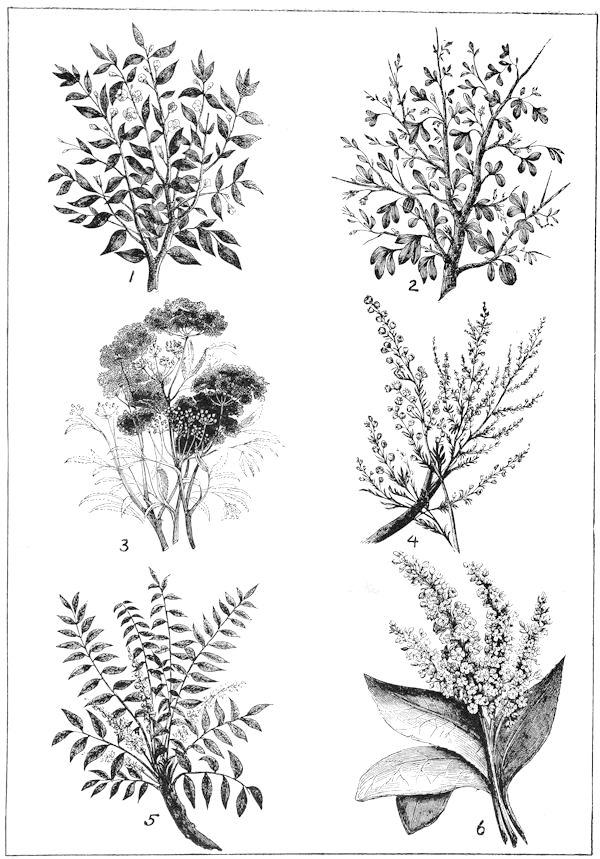
Herbs, Useful and Medicinal
1, Myrtle; 2, Myrrh; 3, Hemlock; 4, Wormwood; 5, Frankincense; 6, Hyssop
We will begin with the palms, the loftiest and noblest of all vegetable forms, that to which the prize of beauty has been assigned by the concurrent voice of nations in all ages; for the earliest civilization of mankind belonged to countries bordering on the region of palms, and to parts of Asia where they abound. Their lofty, slender, ringed, and, in some cases, prickly stems terminate in aspiring and shining either fan-like or pinnated foliage. The leaves are frequently curled, like those of some Gramineæ. Smooth, polished stems of palms carefully measured by me had attained 192 English feet in height. In receding from the equator and approaching the temperate zone, palms diminish in height and beauty. The indigenous vegetation of Europe only comprises a single representative of this form of plants, the sea-coast dwarf-palm or Chamærops, which in Spain and Italy extends as far north as the 44th parallel of latitude. The true climate of palms has a mean annual temperature of 78°.2-81°.5 Fahr. The date, which is much inferior in beauty to several other genera, has been brought from Africa to the south of Europe, where it lives, but can scarcely be said to flourish, in a mean temperature not exceeding 59°-62°.4 Fahr.
In all parts of the globe the palm form is accompanied by that of plantains or bananas; the Scitamineæ and Musaceæ of botanists, Heliconia, Amomum, and Strelitzia. In this form, the stems, which are low, succulent, and almost herbaceous, are surmounted by long, silky, delicately veined leaves of a thin, loose texture, and bright and beautiful verdure. Groves of plantains and bananas form the ornament of moist places in the equatorial regions.
The form of Malvaceæ and Bombaceæ, represented by Ceiba, Cavanillesia, and the Mexican hand-tree Cheirostemon, has enormously thick trunks; large, soft, woolly leaves, either heart-shaped or indented; and superb flowers, frequently of a purple or crimson hue. It is to this group of plants that the baobab, or monkey bread-tree (Adansonia digitata), belongs, which, with a very moderate elevation, has a diameter of 32 English feet, and is probably the largest and most ancient organic monument on our planet. In Italy the Malvaceæ already begin to impart to the vegetation a peculiar southern character.
The delicately pinnated foliage of the Mimosa form, of which Acacia, Desmanthus, Gleditschia, Porleria, and Tamarindus are important members, is entirely wanting in our temperate zone in the Old Continent, though found in the United States, where, in corresponding latitudes, vegetation is more varied and vigorous than in Europe. The umbrella-like arrangement of the branches, resembling that seen in the stone-pine in Italy, is very frequent among the Mimosas. The deep blue of the tropic sky seen through their finely divided foliage has an extremely picturesque effect.
The heath form belongs more especially to the African continent and islands. Arborescent heaths, like some other African plants, extend to the northern shores of the Mediterranean; they adorn Italy and the cistus-covered grounds of the south of Spain. In the countries adjoining the Baltic, and further to the north, the aspect of this form of plants is unwelcome as announcing sterility.
The cactus form is almost exclusively American. Sometimes spherical, sometimes articulated or jointed, and sometimes assuming the shape of tall, upright polygonal columns resembling the pipes of an organ, this group presents the most striking contrast to those of Liliaceæ and bananas.
While the above-mentioned plants flourish in deserts almost devoid of vegetation, the Orchideæ enliven the clefts of the wildest rocks and the trunks of tropical trees blackened by excess of heat. This form (to which the vanilla belongs) is distinguished by its bright green succulent leaves, and by its flowers of many colors and strange and curious shape, sometimes resembling that of winged insects, and sometimes that of the birds which are attracted by the perfume of the honey vessels. Such is their number and variety that, to mention only a limited district, the entire life of a painter would be too short for the delineation of all the magnificent Orchideæ which adorn the recesses of the deep valleys of the Andes of Peru.
The Casuarina form, leafless, like almost all species of cactus, consists of trees with branches resembling the stalks of our Equisetums. It is found only in the islands of the Pacific and in India, but traces of the same singular rather than beautiful type are seen in other parts of the world.
As the banana form shows the greatest expansion, so the greatest contraction of foliage is shown in Casuarinas, and in the form of needle-trees (Coniferæ). Pines, thuias, and cypresses belong to this form, which prevails in northern regions, and is comparatively rare within the tropics: in Dammara and Salisburia the leaves, though they may still be termed needle-shaped, are broader. In the colder latitudes, the never-failing verdure of this form of trees cheers the desolate winter landscape, and tells to the inhabitants of those regions that when snow and ice cover the ground the inward life of plants, like the Promethean fire, is never extinct upon our planet.
Like mosses and lichens in our latitudes, and like Orchideæ in the tropical zone, plants of the Pothos form clothe parasitically the trunks of aged and decaying forest trees: succulent herbaceous stalks support large leaves, sometimes sagittate, sometimes either digitate or elongate, but always with thick veins. The flowers of the Aroideæ are cased in hooded spathes or sheaths, and in some of them when they expand a sensible increase of vital heat is perceived. Stemless, they put forth aerial roots. Pothos, Dracontium, Caladium, and Arum all belong to this form, which prevails chiefly in the tropical world. On the Spanish and Italian shores of the Mediterranean, Arums combine with the succulent Tussilago, the acanthus, and thistles, which are almost arborescent, to indicate the increasing luxuriance of southern vegetation.
Next to the last-mentioned form, of which the Pothos and Arum are representatives, I place a form with which, in the hottest parts of South America, it is frequently associated—that of the tropical twining rope-plants, or Lianes, which display in those regions, in Paullinias, Banisterias, Bignonias, and Passifloras, the utmost vigor of vegetation. It is represented to us in the temperate latitudes by our twining hops and by our grapevines. On the banks of the Orinoco the leafless branches of the Bauhinias are often between 40 and 50 feet long; sometimes they hang down perpendicularly from the high top of the Swietenia, and sometimes they are stretched obliquely like the cordage of a ship; the tiger-cats climb up and descend by them with wonderful agility.
In strong contrast with the extreme flexibility and fresh, light-colored verdure of the climbing plants, of which we have just been speaking, are the rigid, self-supporting growth and bluish hue of the form of the Aloes, which, instead of plaint stems and branches of enormous length, are either without stems altogether or have branchless stems. The leaves, which are succulent, thick, and fleshy, and terminate in long points, radiate from a centre and form a closely crowded tuft. The tall-stemmed aloes are not found in close clusters or thickets like other social or gregarious plants or trees; they stand singly in arid plains, and impart thereby to the tropical regions in which they are found a peculiar, melancholy, and I would almost venture to call it, African character. Taking for our guides resemblance in physiognomy, and influence on the impression produced by the landscape, we place together under the head of the Aloe form (from among the Bromeliaceæ), the Pitcairnias, which in the chain of the Andes grow out of clefts in the rocks; the great Pourretia pyramidata (the Atschupalla of the elevated plains of New Granada); the American Aloe (Agave); Bromelia aranas and Bromelia karatas; from among the Euphorbiaceæ the rare species which have thick, short candelabra-like divided stems; from the family of Asphodeleæ the African Aloe and the Dragon tree (Dracæna draco); and lastly, from among the Liliaceæ, the tall, flowering Yucca.
If the Aloe form is characterized by an almost mournful repose and immobility, the form of Gramineæ, especially the physiognomy of arborescent grasses, is characterized, on the contrary, by an expression of cheerfulness and of airy grace and tremulous lightness, combined with lofty stature. Both in the East and West Indies groves of bamboo form shaded overarching walks or avenues. The smooth, polished and often lightly waving and bending stems of these tropical grasses are taller than our alders and oaks. The form of Gramineæ begins even in Italy, in the Arundo donax, to rise from the ground and to determine by height as well as mass the natural character and aspect of the country.
The form of ferns, as well as that of grasses, becomes ennobled in the hotter parts of the globe. Arborescent ferns, when they reach a height of above forty feet, have something of a palm-like appearance; but their stems are less slender, shorter, and more rough and scaly than those of palms. Their foliage is more delicate, of a thinner and more transparent texture, and the minutely indented margins of the fronds are finely and sharply cut. Tree ferns belong almost entirely to the tropical zone, but in that zone they seek by preference the more tempered heat of a moderate elevation above the level of the sea, and mountains two or three thousand feet high may be regarded as their principal seat. In South America the arborescent ferns are usually associated with the tree which has conferred such benefits on mankind by its fever-healing bark. Both indicate by their presence the happy region where reigns a soft, perpetual spring.
I will next name the form of Liliaceous plants (Amaryllis, Ixia, Gladiolus, Pancratium), with their flag-like leaves and superb blossoms, of which southern Africa is the principal country; also the willow form, which is indigenous in all parts of the globe, and is represented in the elevated plains of Quito (not in the shape of the leaves, but in that of the ramification), by Schinus Molle; Mytraceæ (Metrosideros, Eucalyptus, Escallonia myrtilloides); Melastomaceæ, and the laurel form.
It is under the burning rays of a tropical sun that vegetation displays its most majestic forms. In the cold north the bark of trees is covered with lichens and mosses, while between the tropics the Cymbidium and fragrant vanilla enliven the trunks of the Anacardia and of the gigantic fig-trees. The fresh verdure of the Pothos leaves and of the Dracontia contrasts with the many colored flowers of the Orchideæ; Climbing Bauhinias, Passifloras, and yellow flowering Banisterias twine round the trunks of the forest trees. Delicate blossoms spring from the roots of the Theobroma, and from the thick and rough bark of the Crescentias and the Gustavia. In the midst of this profusion of flowers and fruits, and in the luxuriant intertwinings of the climbing plants, the naturalist often finds it difficult to discover to which stem the different leaves and flowers really belong. A single tree adorned with Paullinias, Bignonias, and Dendrobium forms a group of plants which, if disentangled and separated, would cover a considerable space of ground.
In the tropics vegetation is generally of a fresher verdure, more luxuriant and succulent, and adorned with larger and more shining leaves than in our northern climates. The “social” plants, which often impart so uniform and monotonous a character to European countries, are almost entirely absent in the equatorial regions. Trees almost as lofty as our oaks are adorned with flowers as large and as beautiful as our lilies. On the shady banks of the Rio Magdalena in South America, there grows a climbing Aristolochia bearing flowers four feet in circumference which the Indian boys draw over their heads in sport, and wear as hats or helmets. In the islands of the Indian Archipelago the flower of the Rafflesia is nearly three feet in diameter, and weighs above fourteen pounds.
THE GENESIS OF FLOWERS —Alexander S. Wilson
The flowers most generally known are brightly colored flowers adapted for insect fertilization; only these require to attract insects, which is the end served by the perfume and conspicuous coloring. Very many plants, however, bear blossoms so small and obscurely colored that they are either entirely overlooked or not reckoned as flowers at all. The wind-fertilized flowers of the dock and nettle have no occasion for the services of insects, and are destitute of honey, odor, and brilliant petals. Still more insignificant in appearance are the little self-fertilizing cleistogamic flowers, which, toward the end of the season, are produced on the dog-violet. All three kinds possess stamens and pistils, and are therefore recognized as flowers by botanists. Besides stamens and pistils, which are the essential organs of a flower, petals and sepals are usually present. The petals collectively compose the corolla, the sepals the calyx; both together being spoken of as the floral envelopes or perianth. Occasionally, as in the ash, the flower is reduced to its essential organs, the floral envelopes being absent. Plants bearing flowers, whether with or without floral envelopes, are designated phanerogams or flowering plants; they constitute the highest division of the vegetable kingdom. Ferns and mosses, again, are examples of the cryptogamic or flowerless class; they never bear flowers or seeds, but are propagated by minute reproductive bodies termed spores. This class is divided into thallophytes and vascular cryptogams. The organization of a thallophyte is very simple; the plant body of a fungus or sea-weed, for example, consists entirely of similar cells, and externally shows no distinction into root, stem, and leaf. The structure of a vascular cryptogam, such as a club-moss, horsetail, or fern, is more complicated; both cells and vessels enter into the composition of its tissues, and externally the distinction of stem and leaf is apparent. Phanerogams also admit of a twofold division into gymnosperms and angiosperms; conifers, cycads, and yews are gymnospermous, having naked seeds, exposed either on the ends of branches or on the surface of open scales. All ordinary flowering plants produce their seed in the interior of a closed, ovary, as the lower part of the pistil is called; from this peculiarity they are termed angiosperms.
Only the remains of thallophytes have hitherto been discovered in the oldest Palæozoic rocks. Vascular cryptogams appear in the Silurian strata, attain their maximum in the Carboniferous age, and in succeeding formations are gradually displaced by gymnosperms. The latter occur as early as the Devonian period, but the prevailing type of vegetation down to the close of Palæozoic time continued to be cryptogamic. Angiosperms possibly existed as far back as the Permian times, but it is only in the chalk that their remains begin to be abundant; the vast majority of Mesozoic plants seem to have belonged to the gymnospermous type. Plants with conspicuous flowers only date from Tertiary times; they increase in number and importance as we approach the present day.
Although the plants entombed in the rocks are only an inconsiderable fraction of the numbers that formerly existed, the general succession just indicated is fully made out, and as the palæontological evidence accumulates it tends more and more to establish the view that colored blossoms are, geologically speaking, of comparatively recent origin. The vegetation of the earlier geological epochs was marked by a singular uniformity of character; not only were there fewer species than now, and these widely distributed over the globe, but the monotonous green of Palæozoic and Mesozoic forests was unrelieved by gay blossoms such as adorn our fields and orchards. We are indebted to geology for another important fact; fossil plants occur which have no near relatives in the existing flora. Intermediate forms which can not properly be classified with any living family are met with; in others the characters of several modern groups are blended. Although these generalized forms rather upset our systems of classification, they have an important bearing on the origin of living plants. But what a different aspect, when the coal plants were growing in primeval luxuriance, the landscape must have worn from that on which we are accustomed to look! Odd, uncouth lepidodendra of arborescent growth, huge reed-like calamites, gigantic ferns stretched in interminable forests, clothed in one unvaried tint of sombre green. How different is the scene which nature now presents!—mountains glowing with the purple bloom of heather; hillsides where the furze has spread its cloth of gold; meadows bright with daisies, ranunculi, and cuckoo-flowers; banks where the wild thyme and bluebell grow! The contrast affords a hint of the transformation in our world effected by the introduction of flowers.
Our knowledge may not enable us to describe all the minute steps which led to this remarkable change, but we can at least indicate with great probability the nature of the process and some of the agencies which contributed to bring about this result. To suppose that each species of plant was independently created as we now see it, implies not one creation merely, but many successive creations; moreover, it leaves unexplained all the curious affinities which exist among the members of the vegetable kingdom. The gradations of structure, the geological succession, and the peculiarities of plant growth are much more intelligible when we view the plants which now inhabit the earth as the lineal descendants of those which lived during the earlier ages of geology. From the nature of the case, the theory of development does not admit of actual demonstration; still the evidence in support of it is such that its advocates are entitled to claim a verdict on the mass of indirect and circumstantial evidence.
Among palæozoic cryptogams, we have evidence of the existence of structures which, with comparatively little modification, might be converted into what we now regard as flowers. The abundant remains of lepidodendra in the Coal-measures testify to the important place attained by the group of lycopods, or club mosses, in the Palæozoic flora. To this family might very well have belonged the archetype from which our modern blossom-bearing plants have come. Our knowledge of this group is derived both from fossil remains and from forms still extant. The selaginellas, so commonly cultivated in greenhouses, are examples; also the little club moss (Lycopodium selaginodes) of our highland moors. The last mentioned, though a diminutive form, possesses special interest, being one of the vascular cryptogams which produce two kinds of spores. This heterosporous character was, however, a common feature of extinct lycopods; both large and small spores have been detected in great numbers in coal.
The internal anatomy of the Lycopodiaceæ is somewhat complex, but their external organization is simple. A club moss consists of a cylindrical stem covered with overlapping leaves, spirally arranged, of small size relatively to the stem, and always simple or undivided. The stem branches in a peculiar forked manner, which gives the plant its characteristic candelabra-like form. Existing lycopods are creeping plants, seldom exceeding two feet in height, but many extinct species attained the dimensions of large trees. On the ends of certain branches the leaves are crowded together, giving the terminal portion of each shoot some resemblance to a pine-cone. The crowded leaves on this portion bear, on their upper surfaces, little sacs called sporangia. Certain of these sacs contain very numerous small, rounded bodies, the microspores; others have fewer spores of larger size, distinguished as macrospores. Sacs containing the small male spores are termed microsporangia; those having the large female spores, macrosporangia. When ripe, a sporangium bursts and discharges its spores, which are scattered by the wind. Should a spore alight on a favorable spot, it germinates after a time and gives rise to a structure called a prothallus, which is really an independent plant. This stage in the life-history of a cryptogam is, however, much better seen in ferns, where the prothallus is entirely expelled from the spore and attains a higher degree of independent development. The prothallus throws out root-hairs, nourishes itself and grows, but the leaf-like form it assumes bears not the remotest resemblance to the parent fern from which it sprang. This phenomenon, characteristic of the higher cryptogams, is known as the “alternation of generations,” or “alternate generations.” Similar phases are observed in certain animals, the medusæ or jelly fishes, for example. In the course of its development, a fern passes through two distinct phases; first, the spore-bearing stage or sporophyte, represented by the fern frond; second, the egg-bearing stage, the oöphyte or prothallus. As we ascend in the scale of vegetable life, the egg-bearing or sexual generation diminishes in importance, while the sporophyte preponderates more and more. In club mosses, the prothallus has all but lost its independence; in the case of the selaginella it is formed almost entirely within the spore, only a small part being extruded when the spore ruptures. Some of the lycopods are inosporous—that is, they have, like the ferns, but one kind of spore. Where this is the case, the prothallus developed from the spore bears two sets of sexual organs; the prothallus of one of the heterosporous cryptogams, on the other hand, produces sexual organs of one kind only. Antheridia appear on the prothallus developed from a small spore; archegonia on that from a large one. The former are the male organs, and from them are emitted numerous antherozoids, minute ciliated bodies, which swarm over damp surfaces in all directions. The archegonia are microscopic flasks, each containing an egg-cell or oösphere; they are entered by one or more of the locomotive antherozoids, which coalesce with the egg-cell; the latter is thereby fertilized, and soon grows by cell division into a plant resembling that from which the spores were originally obtained. The life-history of a vascular cryptogam is, so to speak, a story completed in two volumes.
Microscopic research has revealed a most interesting relationship between flowering plants and the heterosporous cryptogams. When the development of a pollen grain in the anther of an ordinary flower is studied and compared with that of a microspore, the two are found to agree in a remarkable manner. The sporangium corresponds in all essential points with the pollen-sac, and its generatic tissue develops in similar fashion to that from which the pollen grains originate. In both cases an archesporium is produced by the division of a hypodermal cell; this tissue next divides into a tapetal layer and a row of mother-cells; the tapetal layer dissolves, isolating the mother-cells, each of which then forms in its interior four daughter-cells, which are the spores or pollen grains, as the case may be. Not only are the antecedents of microspores and pollen grains alike, but their subsequent histories offer many points of resemblance. Pollen grains are known in numerous instances to form in their interior one or more vegetative cells, which can hardly be regarded as other than a rudimentary male prothallus, such as is commonly developed by a microspore.
There is another bond of connection between flowering and flowerless plants of equal or even greater importance. In the interior of the ovule, or young seed, both of angiosperms and gymnosperms, a special cell is developed, called the embryo-sac. When the history of this cell is traced back, its development is found to be exactly that of a spore. Certain structures are also formed in its interior bearing the closest analogy to the internal prothallus observed in the macrospore of selaginella. These are most obvious in the embryo-sacs of gymnosperms, where the prothallus is represented by the endosperm, while the corpuscula, or secondary embryo-sacs—arising on this are the undoubted equivalents of the archegonia of ferns and other cryptogams. The gymnosperms thus stand midway between vascular cryptogams and angiosperms; but even within the embryo-sac of the latter, in the so-called antipodal cells, may still be detected vestiges of the oöphyte or sexual generation, that structure so characteristic of the flowerless class. An alternation of generations can thus be traced throughout the greater part of the vegetable kingdom, from the lowest scale mosses through the urn mosses, ferns, horsetails, lycopods, and conifers up to the highest members of the phanerogamic division. But of more importance for our present purpose is the certain identification of the pollen grain and embryo-sac of flowering plants with the microspore and macrospore of the older cryptogams. The stamen of a flower turns out to be simply a peculiar form of microsporangium, while the ovule is a macrosporangium, containing but one macrospore, or occasionally developing several. It follows, therefore, that we have only to enlarge our conception sufficiently to see in the spore-bearing cones of the lycopods structures of essentially the same nature as flowers. All the materials that go to the making of a flower could thus have been furnished by the flowerless flora of Palæozoic ages.
An important change, which marked the transition from cryptogams to flowering plants, must now be mentioned, and to this the animal kingdom furnishes a striking analogy. The lowest vertebrates, such as fishes, are oviparous; the ova are discharged and afterward incubated. Mammals, on the other hand, are viviparous; the young are hatched within the body of the parent. The young of the kangaroo and other marsupials, which constitute the lowest order of mammals, are still very immature at birth. Analagous conditions are found among plants. Cryptogams are all oviparous; the macrospore, which may be regarded as the ovum or egg, separates from the parent plant before fertilization. Phanerogams, on the other hand, may be described as viviparous, since they retain the macrospore or ovum until it has developed an embryo. The presence of an embryo constitutes the distinction between a seed and a spore. Unless an embryo be present a seed can not germinate, since germination is simply the emergence of the embryo from the coats of the seed. An extreme case of this retention is seen in the mangrove, where the seed germinates while still attached to the tree; the embryo sends down its long radicle into the mud, and only quits its hold of the parent when it has become firmly established. Orchids and many parasitic plants have seeds with exceedingly minute and imperfect embryos, recalling the undeveloped offspring of the marsupials.
The retention of the egg is attended with a manifest advantage; plainly the viviparous method of reproduction, which obtains in the higher divisions of the two organic kingdoms, is much more economical than the other. By the change to the viviparous condition, several structures present in the cryptogams are rendered useless, and a disused organ invariably degenerates; the prothallus and its adjuncts, having no longer any function to perform, must inevitably begin to atrophy. The rudimentary structures appearing in the embryo-sac of phanerogams can in this way be accounted for. The life-history of a cryptogam extends, as we have seen, to two volumes; it now appears that the life-history of a phanerogam is a second edition, of the same story, somewhat abridged and completed in a single volume.
The life-history of certain ferns occasionally undergoes a corresponding abbreviation. In the phenomena of apospory and apogamy we have departures from the ordinary course of development, closely akin to what would be required for the conversion of a cryptogam into a phanerogam. Apospory occurs when the production of spores is omitted, the prothallus growing immediately on the fern frond; apogamy, when the female organs are not developed, and the frond is formed by vegetative growth directly from the prothallus.
There is another fact of which account must be taken. In different groups of plants, in proportion to the complexity of their organization, the female cell tends to increase in size and importance. This is probably accompanied by a chemical or physiological enrichment of the substance of the egg-cell, rendering a higher degree of protection desirable. The inclosure of the embryo-sac within the ovule becomes in these circumstances an advantage. But by this investment, and by the ovule remaining attached to the parent plant, the microspore is of necessity reduced to the condition of a parasite, and the conversion of the male prothallus into a pollen tube becomes intelligible as a case of degeneration.
The closed seed-vessel of angiosperms, there can be little doubt, has in like manner been acquired for the purpose of excluding fungous spores, bacteria, and other destructive germs from the ovules. Van Tieghem found that when the pistil of a flower was opened the ovules could not be directly fertilized, but were invariably attacked by bacteria. The resinous secretions of conifers act as a germicide, rendering less essential the protection of the seeds, which is the rôle of the pistil in angiosperms.
The gradations between stamens, petals and sepals seen in the water-lily, and the conversion of stamens into petals in the garden rose, suggest a possible variation which would explain the first appearance of the floral envelopes. The nectary may not improbably be a transformed water gland, turned to account as an attraction to visitors, and so of use in promoting cross-fertilization. Every new character tending directly or indirectly to secure this advantage would be perpetuated; the colors, perfumes, mechanism, and most of the peculiarities of flowers become intelligible when viewed as results due to the selective agency of insects.
LIFE HISTORY OF PLANTS —E. W. Prevost
The plant possesses a distinct set of organs capable of absorbing mineral food dissolved in water, and there are also means whereby oxygen and carbonic acid gas can be inspired and transformed into tissue. The young sprout, being at first incapable of seeking for its food, is dependent on its seed for its supplies, consisting of two distinct substances—nitrogenous or albuminous matter, and oil and starchy matters. These two last might have been classed separately, but it is unnecessary here to draw any distinction between them, for it appears that the oil is, during germination, for the most part converted into starch. The effect of moisture and warmth causes the seed to sprout, throw out a stem and root, but these being but feeble must be supplied with food ready prepared, and it is under the influence of the oxygen which obtains access to the seed that a small portion of the albuminous matters contained in the seed is altered, and the products act as a ferment which attacks the insoluble starch, converting it into a sugar that can pass with the water always present into the small sprout; when there it becomes again insoluble, and adds to the structure of the rapidly increasing seedling. The first part of this change, such as the starch has undergone, is well exemplified in the malting of barley, which, after its removal from the malt-house, contains a large amount of “glucose,” a kind of sugar which is recognized readily by the taste. The transformation of a portion of the albuminous matter into a ferment not only results in the conversion of starch into sugar, but at the same time the remainder of the albuminoids are rendered soluble and without any change in their composition; they can then accompany the glucose during its passage into the seedling. We see then that the seed is a storehouse for the young plant, providing nourishment until it is strong enough to send down roots into the earth, and put out leaves into the air to seek out food for itself. When the plant becomes strong, and is no longer dependent on the seed for its food, the chemical processes which take place are still more wonderful; how some of the new substances are formed, or why the absence of some one ingredient of the soil (generally present in very small quantities) should produce certain well-known results, is still unknown. From the soil and by the roots are derived the mineral matters and the nitrogen; the latter in the form of nitrates, which in the plant are completely changed in character, being no longer a combination of nitric acid with a base, but the base has been separated, and the nitrogen of the acid, combined with sulphur, hydrogen, and oxygen, is deposited in the new form of albumenoid matter, which is insoluble in water; but being insoluble, and deposited in the minute cells of the plant, it would appear impossible that it could migrate from one part to another, and this would be the case if no other substance were present; but phosphate of potassium is absorbed by the plant, and this coming in contact with the albumenoids renders them soluble; they can now pass through the cell-walls of the stem, and upward into the seed, where they are stored for future use. Phosphates are also necessary for the production of certain fats, of which they form a part, for the fat of the horse-chestnut and oak contains a small percentage of phosphorus. Of the other salts sucked up by the roots, the sulphate of lime is worthy of mention, as it is necessary to the formation of albumenoids, sulphur being an essential ingredient of these matters, whereas phosphorus is not; and also many essential oils require this element in their composition, and it is to its presence that the oils of black mustard and garlic owe their peculiar pungency.
The function which many of the other ingredients found in the ashes of plants perform is still somewhat uncertain, but all experiments indicate that potash, lime, and magnesia (the alkaline earths, as these last two are termed) are indispensable to the life of the plant, and that the absence of iron is accompanied by abnormalities of growth. When a soil contains no iron, and this does not occur naturally, the foliage loses its green color, the loss being due to the non-formation of chlorophyl, or the green coloring matter, and where this is absent, the process of assimilation as performed by the leaves ceases, and therefore the plant is in an unhealthy condition; when we come to speak of the respiration and assimilation of plants, an explanation of these terms will be given, but at present a few words on the use of potash, soda, and silica will not be out of place; but we will not attempt to dilate on the uses of other ash ingredients, such as chlorine, for, as before stated, there is no accurate information concerning them, but that they are requisite is certain, while what their functions may be is uncertain.
For general purposes, the chemist considers that the alkalies, potash and soda, are interchangeable, that what soda will do so will potash, and as the former is the cheaper, it is therefore more generally employed. Plants, however, detect a difference, for we find both soda and potash present in their ash in varying quantities, and neither of them entirely absent, so that each must have a distinct part to play; still, to a certain extent, they are interchangeable, for cultivation greatly alters the proportions in which they are present, and this alteration is very marked in the case of the asparagus, which when growing wild contains equal quantities of these bases, but by cultivation nearly the whole of the soda disappears, while the potash increases nearly threefold. Silica or sand is to be found in every soil, either in the free or combined state, and hence we might suppose that it was indispensable, and certainly it exists in every plant in large proportions, more especially in the hard outer parts, the straw and stems containing a very large quantity of this substance, which is generally considered to be necessary for their rigidity. There are some very remarkable instances known in which deposits of silica are found in plants. Very notable is that occurring in the joints of the bamboo, resembling opal, and bearing the same tabasheer; but yet, though silica exists universally in plants, its absence (under artificial conditions) does not seem to prevent their full development.
The alkaline earths, as well as potash, seem to be necessary for the formation of the various salts, such as the oxalate of lime in the leaves of beet and in the common rhubarb, or the oxalate of potash in the wood sorrel. These bases are introduced in the form of nitrate and sulphate or phosphate, but in the plant they separate from the acid, and combine with new acids, which are elaborated through the agency of the leaves.
Having glanced at the functions performed by the mineral constituents, we will pass on to those of the leaves, and here as before no attempt will be made to answer the question, How do the leaves act? but rather our intention is to show the result of their action. The leaves are the means whereby the plant communicates with the air, absorbing from it that portion which is injurious to the life of animals, namely, carbonic acid gas, which consists of carbon and oxygen; under the influence of sunlight these two components are separated in the leaf, the one from the other, the carbon or solid part remaining in the plant to form all the various compounds, such as starch, oil, and acids, while the oxygen is exhaled into the air for the use of animals; this retention of carbon and conversion into starch, etc., has been termed assimilation, to which we have already referred; now we can appreciate the immense importance of plants of all kinds, for without their aid the atmosphere would become so overburdened with the harmful carbonic acid that it would no longer support life or combustion. A small experiment will readily demonstrate the action of leaves on carbonic acid: if a green laurel-leaf, immersed in a glassful of spring-water, be exposed to sunlight, a number of small bubbles will soon be noticed on the surface of the leaf. In a short time they will increase in size, and finally float to the surface, when by proper means they can be collected and shown to consist of oxygen, which possesses the property of causing a glowing splinter of wood to burst into flame when introduced into it. This oxygen has been produced by the decomposition of the carbonic acid dissolved in the water. It would be incorrect to suppose that the leaves absorb no oxygen, but always give it out, for at all times a proportion of oxygen is inspired, and in the dark, carbonic acid is exhaled, yet the quantity is always less than that of the oxygen exhaled during the day, and at low temperatures the amount of oxygen absorbed exceeds that of the carbonic acid. How to account for the production of starch from the materials at the disposal of the plant is somewhat difficult; but, theoretically, six volumes of carbonic acid combining with five volumes of water produce starch, six volumes of oxygen being liberated; but when once the starch is produced, we know, from laboratory experiments, that sugar can easily be produced from it as well as oxalic acid, etc. The purpose of the leaves is not only to collect air food, but also to get rid of superfluous water, for the roots are continually pumping in water laden with mineral food, so that to allow of the circulation and deposition of this food the water must be got rid of. This water is exhaled from the leaves in the form of invisible vapor, but the quantity depends on the state of the atmosphere, which when moist almost wholly prevents exhalation; on the other hand, in very dry weather, exhalation takes place too rapidly, and the plant withers. Light exerts also a very great influence; the stronger the light the greater is the amount of water exhaled, and, generally speaking, the maximum occurs shortly after midday. During hot and dry weather a grass plant has been known to exhale its own weight in water during the twenty-four hours. From what has been now said, it will be seen how necessary are plants to animals, and animals to plants, as without the one the other would not long survive; for when the atmosphere became exhausted of carbonic acid, which is formed by animals, the plants would have no means of building up starch, etc. The great difference between plants and animals should also be noted, that whereas the plant is continually feeding only to increase and store up material, the animal feeds to increase and repair the waste that is continually proceeding.
LIFE-FORMS OF PLANTS —Edward Clodd
If the life-forms of the past somewhat baffle us by their scantiness and imperfectness, those of the present embarrass us by their abundance. But although the existing species of plants and animals are numbered by hundreds of thousands, and the tale is not yet complete, they are classified into a few primary divisions or sub-kingdoms, representing certain allied types, of which the several species included in each sub-kingdom are modified forms. For example, flies and lobsters, beetles and crabs, are grouped in the sub-kingdom of the Annulosa, because they are alike composed of distinct segments; boys and frogs, pigs and herrings, are grouped in the sub-kingdom of the Vertebrata, because they alike possess an internal bony skeleton, the most important feature of which is the spine or vertebral column. And this classification is applicable alike to past and present organism, there being throughout the whole series of fossil remains no form, however unlike any existing living thing, that is not to be placed in one or other of the sub-kingdoms.
Moreover, a fundamental unity underlies and pervades the whole, a unity of material, of form, and of function, the differences between organisms, from the slime of a stagnant ditch to the most complex animal, being in degree and in kind. Therefore, although each genus, nay, in most cases, each species, needs for its complete study the labor of a lifetime, it suffices for the majority of us, grateful for the results which the zeal of specialists has achieved, to acquaint ourselves with the essential characteristics which mark the main division of the twin sciences of Botany and Zoology. Not only is this the only possible thing for us; it is the one thing needful for all, specialists and non-specialists, otherwise the significance of facts, in their relation and dependence, is missed; the larger generalizations are swamped in a sea of detail; we can not, as the phrase goes, see the wood for the trees.
In the old definition of the three kingdoms of nature, the mineral, the vegetable, and the animal, we were taught that plants grow and live, while animals grow, live, and move. But this no longer holds good, at least in respect of the lower forms. There are locomotive plants and animals that are stationary.
The swarm-cells or zoospores which are expelled from some of the lower plants, as algæ and certain fungi, behave like animals, darting through the water by the aid of hair-like filaments called vibratile cilia, finally settling down and growing into new plants; others, as diatoms and desmids, are locomotive throughout life; certain marine animals, as sponges and corals, are rooted to the spot where they grow; while there are organisms which appear to be plants at one stage of their growth, and animals at another stage.
Other marks of supposed unlikeness have vanished. It was formerly held that among the distinctive features of animals are (1) a sac or cavity in which to receive and digest food; (2) the power to absorb oxygen and exhale carbonic acid; and (3) a nervous system. But although nearly all animals, in virtue of their food being solid, have a mouth and an alimentary cavity, there are certain forms without them, and although plants, in virtue of their food being liquid or gaseous, need not have that cavity, there are plants that have it. Not only is the process of digestion apparent in the leaves of carnivorous plants, but embryonic forms have been found to secrete a ferment similar to the ferment in the pancreatic secretion of animals, and by which they dissolve and utilize the food-stores in their seed-lobes as completely as food is digested in our stomachs. And although green plants, under the action of light, break up carbonic acid and release the oxygen, they do the reverse in the dark, as also in respiration; while the quasi-animal fungi, which are independent of light, absorb oxygen and give off carbonic acid.
In the “irritability” of the sundew, Venus’s fly-trap, and other sensitive plants, still more so in subtile and hidden movements in plant-cells, we have actions corresponding to those called “reflex” in animals, as the contraction of the shapeless amœba when touched, or the involuntary closing of our eyelid when the eye is threatened, or the drawing back of one’s feet when tickled. The filament in the amœba which transmits the impulsion, causing it to contract differs only in one degree from the sensory nerves in ourselves which transmit the impression to the motor nerves, causing the muscles to act; and since there is every reason for referring the contractile actions of plants—i. e., their movements in obedience to stimulus—to like causes, the germs of a nervous system must be conceded to them. The minute observations of Mr. Darwin and his son into the large class of quasi-animal movements common to wellnigh all vegetable life go far to confirm this. The highly sensitive tip of the slowly revolving root, in directing the movements of the adjoining parts, transmitting sensation from cell to cell, “acts like the brain of one of the lower animals; the brain being seated within the anterior end of the body, receiving impressions from the sense organs and directing the several movements.”
In these and kindred vital processes, in the so-called sleep of leaves, and the opening and closing of flowers, both regulated by the amount of light, apparently acting on them as it acts on our nervous system; in the detection of subtle differences in light, which escape the human eye, by plants; in their general sensitiveness to external influences, even in the diseases which attack them, the study of which Sir James Paget has commended to pathologists, we have the rudiments of attributes and powers which reach their full development in the higher animals, and therefore a series of fundamental correspondences between plant and animal which point to the merging of their apparent differences in one community of origin.
In fine, that which was once thought special to one is found to be common to both, and to this there is no exception. Not only is there correspondence in external form in the lower life groups, but, fundamentally, plants and animals are alike in internal structure and in the discharge of the mysterious process of nutrition (although this forms a convenient line of separation) and of reproduction. All, from the lowest to the highest, have their unity and kinship in ancestral life which was neither plant nor animal.
Of course, the difficulty of classifying vanishes in the higher forms; the lowest plants are allied to the lowest animals, but the higher the plant the more it diverges from the animal, which is evidence that in the succession of life the highest plants do not pass into the lower animals. Descent is not lineal, but lateral; the relations between the two kingdoms are represented by two lines starting from a common point and spreading in different directions. Even the “lower” and “higher” are relative terms; the organization of the amœba is as complete for its purpose, as is that of the man for his purpose, the modification in the complex forms being due to the division of functions which are performed in every part by the simple forms.
Although the foregoing and numberless other facts, together with the law of continuity, alike forbid the drawing of any hard and fast lines, and involve the conclusion, to borrow Professor Huxley’s words, “that the difference between animal and plant is one of degree rather than of kind, and that the problem whether, in a given case, an organism is an animal or a plant may be essentially insoluble,” there exists, exceptions notwithstanding, a broad distinction in the mode of nutrition.
“All things the world which fill Of but one stuff are spun,”
and this stuff, the basis of all life, the formative power, is a semi-fluid, sticky material, full of numberless minute granules in ceaseless and rapid motion, to which the name “protoplasm” (Gr. protos, first; plasma, formed) has been given. It consists of four of the elementary substances, carbon, hydrogen, oxygen, and nitrogen, complexly united in the compound called protein, which is closely identical with the albumen or white of an egg. These are the essential elements, but a few others enter into the chemistry of life, with slight resulting differences in the incidental elements in animals and plants. As water is necessary to all vital processes, a very large proportion enters into living matter.
But there is this fundamental and significant difference between the two kingdoms. The plant possesses the mysterious power of weaving the visible out of the invisible; of converting the lifeless into the living. This it does in virtue of the chlorophyll, or green coloring matter, which is found united with definite portions of the protoplasm-mass, of which it is a modification, the exact nature being unknown. The water and the carbonic acid which the plant absorbs through the numberless stomata or mouth-pores in its leaves or integument are, when the sunlight falls upon them, broken up by the chlorophyll, which sets free the oxygen, and locks together the hydrogen and carbon, converting this hydro-carbon into the simple and complex cells and tissues of the plant, with their store of energy for service to itself and other organisms. Animals, a few low forms excepted, can not do this; they are powerless to convert water, salts, gases, or any other inorganic substances, into organic; they are able only to assimilate the matter thus supplied by the plant, nourishing themselves therewith either directly, by eating the plant, or indirectly, by eating some plant-feeding animal.
In other words, the plant manufactures protein from the mineral world, and the animal obtains the protein ready-made; the plant converts the simple into the complex; and this the animal, by combining it with oxygen, consumes, using up the energy it thereby obtains in doing work. So the plant is the origin of all the energy possessed by living things, but why it can by virtue of the sunshine convert the stable inorganic into the unstable organic, while the animal can not, we do not know. Neither do we know whether plant preceded animal, or vice versâ, in life’s beginnings, although the evidence seems to point in favor of the priority of the plant. Structurally the lowest animal is below the lowest plant, since it is a speck of formless, colorless protoplasm, whereas the protoplasm of the lowest plant is organized to the extent that it has formed for itself an outer layer or membraneous coat called the cell-wall. For example, the vegetable character of yeast-granules is determined, apart from their mode of nutrition, by the protoplasm being inclosed within a cellulose coat, and the animal character of the amœba, not because of contractile or locomotive power or of inability to manufacture protein from inorganic matter, but by the absence of any such covering. Upon this Haeckel remarks that the vegetable cells sealed their fate when inclosed within a hard thick cellular shell, being thereby less accessible to external influence, and less able to combine for the construction of nervous and muscular tissues than the animal.
But since the function creates the organ, and where function is not localized there is no variation of parts, life probably began in formless combinations having no visible distinction of parts. And as the cell is the first step in organization, it is the fundamental structure of living things, “it marks only where the vital tides have been or how they have acted,” the lowest organisms consisting of one cell only, and the higher consisting of many cells, which, increasing in complexity or diversity of form adapted to their different functions at later stages, are modified into the special tissues, with resulting unlikeness in parts or organs, of which all plants and animals are composed. Every variation in structure is, therefore, due to cellular changes, and every living thing is propagated in one way or another by cells, by their self-division or multiplication; or by gemmation, i. e., throwing off buds; or by the union of like cells; or, in more complex mode, by the spontaneous or aided union of unlike cells, as the sperm-cell of the male with the germ-cell of the female, giving rise to a seed or egg from which grows offspring more or less like its parents.
In both plant and animal the cell-contents usually, although here again exceptions occur in some of the lowest organisms, exhibit a rounded body called the nucleus, which itself often incloses another body called the nucleolus, the functions performed by both of which in cell development are obscure. That even thus much is known of cell structure may awaken wonder when it is remembered that we are dealing with bodies for the most part beyond the range of our unaided vision. Bacon truly says that “the complexity of nature exceeds the subtlety of man”; the infinite divisibility and indivisibility of matter is apparent in the organic as in the inorganic; and size counts for little; the oak and pine, the acacia and the rose, are lower in scale of life than the thistle and the daisy; the elephant is 150,000 times heavier than the mouse, but the egg of the one is nearly as large as that of the other, and it has been calculated that if one molecule in the nucleus of the ovum of a mammal were to be lost in every second of time, the whole would not be exhausted in seventeen years.
These molecules are the sufficing material media of transmission of resemblances, both striking and subtle, between parent and offspring; and of the vast sum total of inherited tendencies, good or bad, which are the product of no one generation, but which reach us charged with the gathered force of countless ancestral experiences.
“Born into life! man grows Forth from his parents’ stem, And blends their bloods, as those Of theirs are blent in them; So each new man strikes root into a far fore-time.”
CLASSIFICATION OF PLANTS —Louis Figuier
Every plant which grows on the surface of the earth or in the waters constitutes a distinct individuality. The careful examination and comparison of a certain number of these individuals of the vegetable world will lead to the admission that a great many are quite identical in some of their characteristics, while others possess no character in common. Examine the individual plants, for instance, which compose a field of oats; in each the root, the stem, the flowers, the fruit, present the same identical characters. The seed of any one whatever of these plants will yield other plants like those of the field. Every individual in the field belongs therefore to the same species—to the species Avena sativa.
The species, then, is a collection of all the individuals which resemble each other, and which will reproduce other individuals like themselves.
These species may present, as the result of diverse influences, such as change of climate or cultivation, differences more or less marked, more or less persistent, which withdraw them from the original type. To these, according to their importance, botanists give the name of varieties and sub-varieties. The wheat-plant, the vine, the pear, the apple, and most of our cultivated legumes, all yield, under the influence of culture extending over a long series of years, plants altogether different from the original in their exterior; but they preserve, one and all, the essential characters of the species. They are varieties of the wheat-plant, of the vine, of the pear, of the apple.
The assemblage of a certain number of distinct species presenting the same general characteristics, the same disposition of organs, the same structure of flower and fruit, constitutes a group to which the name of genus is applied. Rosa canina, R. villosa, and R. Sabini are three different species of the same group—the genus Rosa. The words oak, poplar, barley, are collective common names, which served, long before botanical science existed, to designate certain groups of plants. These are true generic names of popular creation, which botanists have accepted because they were the result of exact observation. “A man of observant eye and quick intelligence,” says Auguste Pyramus de Candolle, “would observe certain groups in the vegetable kingdom which we call genera before discerning the species.”