THE STORY OF THE UNIVERSE (continued 3)
Reading edition
The germs of botanical science are to be sought for in the rudimentary state in very remote antiquity. In the sacred writings we meet with constant allusions to the vegetable world. The cultivators of the science among the early Greeks and Romans were not botanists, but Rhizotomæ, or root-cutters, since they directed their attention to the roots in search of medicinal properties. Aristotle of Stagira, who lived in the fourth century before our era, may be regarded as the founder of botany; Mithridates, and the younger Juba, King of Mauritania, were among its cultivators. They established botanic gardens, some probably from love of the science, others of them in order to cultivate the deadly plants from which poisonous juices were obtained. Nicander of Colophon, Cato, Varro, Columella, Virgil, Pedanius Dioscorides of Cilicia, and lastly, the elder Pliny, all dwell upon the wonders of vegetation; and war, notwithstanding its desolating tendencies, was made to promote the interests of science.
To the Arabians of the Twelfth Century we are next indebted for our knowledge of botany. After them the darkness of the Middle Ages sets in, and it is only since the illustrious Venetian, Marco Polo, came to examine and describe the wonders of the East that the darkness has been dispelled. He examined the treasures of Asia and the east coast of Africa, described many plants of India and the Indian Ocean, and from his day to the present our knowledge of the names of plants, as well as of their structure and physiology, has been continually on the increase.
The science of botany, as now understood, can not be held, however, to date further back than two centuries. In the year 1682 Nehemiah Grew published his Anatomy of Plants. In 1684 the French botanist Tournefort, then professor of botany at the Jardin des Plantes, published his Elements of Botany, being the first attempt to define the exact limits of genera in vegetables. Most of the genera established by Tournefort remain, proving the correctness of the formula from which he deduced their common characters. Tournefort succeeded to a large extent in unraveling the chaos into which the science of botany had been plunged from the days of Theophrastus and Dioscorides. Separating genera and species according to their characteristics, he described no less than 698 genera and 10,146 species. He published, at the same time, a system for the classification of plants, eminently attractive, especially if we connect it with the times in which it appeared. The French botanist directed the attention of observers, probably for the first time, to those parts of plants most likely to excite admiration, namely, the different forms of the corolla.
In selecting the form of the corolla as the basis of his classification, Tournefort has, perhaps, contributed more to the progress of botany than any other savant of any age. The task of instruction was rendered a pleasure by thus taking, as a subject of scientific inquiry, the most attractive part of the plant. He soon made adepts of those who had hitherto only contemplated flowers as the source of an agreeable sensation.
The system of Tournefort for the classification of plants met with great favor among his contemporaries, on account of its simplicity. Nevertheless, in its application, this system presented many difficulties. The form of the corolla is not always so exactly appreciable that the class to which that plant belongs can be settled from that character alone. But the gravest defect of the system is, that by it the vegetable world is divided into two classes, namely, Herbaceous Plants and Trees—a division which has no existence in nature. The division destroys the natural analogies, for the size of a plant has no bearing upon its organization and structure. In conclusion, the continually increasing number of new species, which were unknown in Tournefort’s time, tests, in the strongest manner, the defects of his system of distribution. The greater number of vegetable species discovered since Tournefort’s time could not be placed in either of his classes. This defect soon became very apparent, and the system fell by degrees out of favor with botanists even among his own countrymen, with whom it had found most admirers.
In England the study of plants had taken a more philosophical direction. About the middle of the Seventeenth Century the microscope was first applied to the study of the organs of plants; and in 1661 spiral vessels were detected by Henshaw in the walnut tree, and shortly afterward the cellular tissues were examined by Hooke. These discoveries were followed by the publication of two works on the minute anatomy of plants by Malpighi and Grew. They examined the various forms of cellular tissues and intercellular passages in their minutest details, and with an exactness which causes their works still to be recognized as the groundwork of all physiological botany. The real nature of the sexual organs in plants was demonstrated by Grew; the important difference between the seeds with one and those with two cotyledons was first pointed out by him. Clear and distinct ideas of the causes of vegetable phenomena were gradually developed, and a solid foundation laid on which the best theories of vegetation have been formed by subsequent botanists.
About the time when Tournefort was engaged in arranging his system of plants, and when Grew had completed his microscopical observations, John Ray was driven from his collegiate employments at Cambridge by differences of opinion with the ruling powers of his university. He sought and found consolation in the study of natural history, to which he was ardently attached, and for which his powers of observation, capacious mind, and extensive learning so highly qualified him. Profiting by the discoveries of Grew and other vegetable anatomists, in 1686 he published the first volume of his Historia Plantarum, in which are embodied all the facts connected with the structure and organs of plants, with an exposition of the philosophy of classification, the merits of which are better appreciated now than they were in his own days.
Ray was careful to guard his readers against the supposition that classification was other than a means of identification. He argued that there was no line of demarcation in nature between one group or order, or even genus, and another, or that any system could be perfect.
While he enumerated the true uses of classification, Ray also laid the foundations of the natural system, which has since been universally adopted by botanists. He separated flowerless from flowering plants, and he divided these again into Monocotyledonous and Dicotyledonous plants.
Forty years after the publication of Tournefort’s system, and while Ray was yet pursuing his philosophical investigations, the Linnæan system appeared. This new mode of distributing vegetable species was hailed with admiration. Its author, Charles von Linnæus, reigned supreme and without a rival till the end of the Eighteenth Century, and even in our days his partisans are neither few nor powerless. In Germany, for instance, more than one botanical work of character has for foundation the system of Linnæus, and many school-gardens are arranged after his classification.
The system of Linnæus rests upon the consideration of the organs of fecundation—organs almost overlooked until then, but whose physiological functions have since been ably demonstrated. He introduced in 1736 a salutary and much-wanted reform into botanical language and nomenclature, defining most rigorously the terms used to express the various modifications and characters of the organs, and reducing the name of each plant to two words, the first designating the genus, the second designating a species of the genus. Before his time, in fact, it was necessary to follow the name of the genus through a whole sentence in order to characterize the species, and in proportion as the number of species increased, the sentences were lengthened until it seemed as if they would never come to an end. It was like the confusion which would arise in society if, in place of using the baptismal name and surname, we were to suppress the baptismal name, and substitute for it an enumeration of many qualities distinctive of the individual; as if, for example, in place of saying Pierre Durand or Louis Durand, we said Durand the great sportsman, or any other phraseology applicable to the qualities of the individual. Nevertheless the Linnæan or binary nomenclature is one of the great titles to that glory which has been awarded to its immortal author. In the scheme of the Linnæan system it has been found possible to describe all plants discovered since his time—an irrefragable proof of the great merits of this artificial classification of species.
This classification of plants has received the name of the artificial system, because it groups the species according to a small number and not from the whole of their characteristics; in short, it rather permits one class to be distinguished from another than makes each known in an intimate manner. It insists much upon their differences, little upon their resemblances. Between species thus compared, only one essential analogy may exist. The rush takes place beside the barberry, because each of these plants has six stamens and only one style. The vine is ranged beside the periwinkle, because they each have five stamens and one style. The carrot is allied to the gooseberry, etc. There may not be between the plants thus compared any natural bond, but only some trace of resemblance in a particular part of the organization, which may be found also in a number of very different plants.
Linnæus was endowed with too sound a judgment, with a tact too exquisite, not to feel the defects of this artificial mode of classification. He detected by the force of his genius the existence of vegetable groups superior to genera, and connected them by a large number of characteristics. He called this group a natural order, and it has since his time been called a “natural family.” He also tried to distribute plants after a natural classification—that is to say, into families. After the death, and during the life, of Linnæus, botanists endeavored to discover upon what principle he had founded his natural orders—that is to say, they sought to find the key to the hidden principle of his orders; but no one has succeeded. Linnæus himself does not appear to have had very fixed views on the subject. He created his orders by a sort of instinct which belongs only to the man of genius; by that kind of semi-divination which the man of learning acquires who possesses vast and profound knowledge of the objects which he passes his life in observing.
In a letter we find the following passage: “You ask me for the characters of my orders. My dear Giseke, I assure you that I know not how to give them.”
Magnol, professor of botany to the School of Medicine, in his work entitled Prodromus Historiæ Generalis Plantarum (1689), is the first author who uses the happy term “family” to designate natural groups of vegetable genera. M. Flourens speaks of the preface to this little book of a hundred pages as calculated to immortalize the author, as in it was first solved a very difficult problem. The following lines are taken from this much-admired preface: “Having examined the methods most in use,” says Magnol, “and found that of Morison insufficient and very defective, and that of Ray much too difficult, I think I can perceive in plants a certain affinity between them, so that they might be ranged in divers families, as we class animals. This apparent analogy between animals and plants has induced me to arrange them in certain families, and, as it appeared to me impossible to draw the characters of these families from the single organ of fructification, I have selected principally the most noted characteristics I have met with, such as the root, the stem, the flower, the seeds. There is also found among plants a certain similitude, a certain affinity, as it were, which does not exist in any of the parts considered separately, but only as a whole. I have no doubt, for instance, but that the characters of families might be taken from the first leaf of the germ as it issued from the seed. I have followed the order that the parts of plants follow in which are found the principal and distinctive characters of families, but without limiting myself to any one single part, for I have often considered many of them together.”
Magnol established seventy-six families, but without giving their characters. His principles of classification are vague and uncertain; they only serve to announce the dawn of a new day which was soon to rise on the science. The few lines which we have quoted from the preface of the Prodromus reveal, as through a fog, the mere idea of a natural system. It is Bernard de Jussieu, demonstrator of botany in the Jardin des Plantes at Paris, to whom belongs the glory of working out the true natural system which was first established in principle by Ray, although it does not appear that Jussieu was acquainted with the works of the English philosopher.
“Others may perhaps have extended the limits, but he was the first to show the way, to trace the method, to establish the principles. Jussieu consigned his discoveries to no book, but in the Gardens of Trianon the mind of the author is recognized. In examining the characters, he remarked that some were more general than others, and these furnished the first division. He recognized that the germination of the seed and the respective disposition of the sexual organs were the two principal and most persistent characteristics. He adopted them, and made them the basis of the arrangement which he established at the Trianon in 1759.”
Four years later, another French botanist, Michel Adanson, a naturalist remarkable for the originality of his views and the extent of his conceptions, published a book upon the families of plants. He proposed a particular course for arriving at the true natural method. But what was that course? He proposed classing all the plants known according to a great number of artificial systems; and after considering them from all possible points of view, he proposed to arrange in the same group those plants which were classed as allies in the greatest number of systems. In this manner Adanson created sixty-five artificial systems, and by their comparison he formed fifty-eight families. He was the first to trace the precise characters and details of all these families; his work in this respect is far superior to those of his predecessors.
The year 1789 was the date of the real establishment of natural families among vegetables. It was in this year that Laurent de Jussieu published his celebrated Genera Plantarum, which marked a new era in the science of botany, and hastened the advent of a natural system of zoological classification as well.
The catalogues of the Gardens of the Trianon, prepared by Bernard de Jussieu, and his conversations with his nephew, were the source whence the latter drew his inspirations.
That the French botanist had acquainted himself with the principles of Ray’s classification is unquestionable; in fact, Jussieu possessed the happy art of adapting the labors of others to perfecting his own conceptions. He made use of the simple language and accurate descriptions of Linnæus, divested of his pedantry. Ray had demonstrated that rigorous definitions in natural history are impossible, and, accepting the decision, Jussieu does not attempt to found his family orders or genera on any single character belonging to objects so various in their habits and organization as plants.
During the last forty or fifty years other botanists have attempted various systems of classification. In those of De Candolle, Endlicher, Lindley, and of Brongniart, the distribution of plants into groups is founded, as in those of Ray and Jussieu, on the consideration of the cotyledons; of the polypetalous, monopetalous, and apetalous flowers; finally, upon the mode of insertion of the stamens. Names have changed; things remain the same; and if in their details the series of families or orders present certain differences, it only arises from the fact that a linear series is incompatible with the natural system, and that the connection of the intermediate groups may be expressed in various ways without affecting the general principles of the system. “The formation of natural orders by Jussieu,” says Ad. Brongniart, “is even now a model which directs botanists in their studies to the affinity which connects the various forms of vegetation. Many of these orders have doubtless been subjected to important modifications, both in extending and limiting them; the numbers have been more than doubled; but the number of species now known is increased more than sixfold. Since the publication of the Genera Plantarum, many points in the organization of plants which were either scarcely touched upon or were altogether unsuspected, have now been considered, and it is found that they do not destroy, but confirm, and perfect the work of Jussieu. One is even astonished to find that the numerous discoveries in the anatomy and organography of plants since the beginning of the century have not introduced greater modifications into the constitution of the natural groups admitted by the author of the Genera Plantarum. It is here that we recognize the sagacity of the savant who established them, and the soundness of the principle which guided him.”
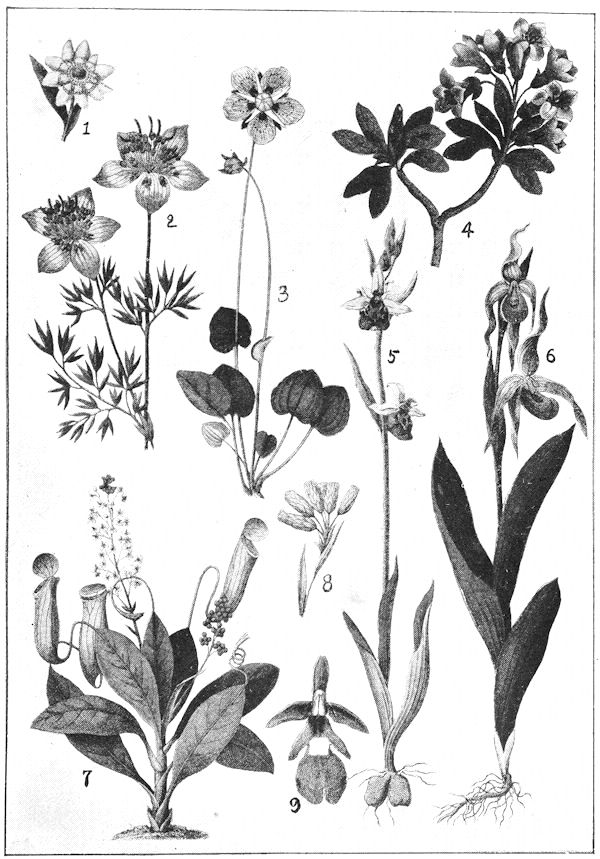
Flowers, Curious and Beautiful
1, Edelweiss; 2, Nigella Arvensis; 3, Parnassia; 4, Rhododendron; 5, Ophrys Arachnites; 6, Cypripedium Calceolus; 7, Nepenthes; 8, Gnaphalium Dioicum; 9, Ophrys Muscifera
The natural classification of plants, their distribution into families, well defined, and founded upon affinities, have been perfected and placed upon a basis more and more certain in our own days. Botanists have set themselves the task of unraveling and establishing the characters which dominate, and those which are subordinate, in each family; numbers have spread themselves over the globe, exploring the most distant regions, interrogating the solitudes of forests and plains which no European had hitherto visited, and have studied in their native wilds many exotic plants, comparing them with already known species, thus giving us a means of pointing out more precisely the tribes, genera, and species of each natural family. Monographs of a great number of such families have thus been written with great research. The study of the formation and evolution of organs; the discovery of the true mode of reproduction in cryptogams, still unknown in Jussieu’s time; the investigation of the inflorescence, of the fruits, of the ovules, of the embryos, have furnished elements for perfecting the limits of families and advancing natural classification.
Auguste Pyramus de Candolle is one of the botanists of the last century who has most contributed to the general adoption of natural families. His Essai sur les Propriétés des Plantes is celebrated for the knowledge which it displays of the comparative physiological and medicinal action of vegetables, and the physical organization which naturally connects certain plants as a group. His Prodromus Systematis Naturalis Regni Vegetabilis, continued by his pupils and his son, is a wonderful work for the extent and precision of its details.
In Great Britain, from the days of Ray, we have always had zealous followers of the science of botany, more especially in the class which may be called field botanists. Withering, Sir James Edward Smith, and hundreds of followers more or less eminent, employed their leisure in the fascinating and healthy pursuit of plants, and perhaps the most valuable contributions to science are the detailed descriptions of species, with their habits and habitats, with which they have enriched our botanical literature. Nor was the study of the physiology of plants—a science which may be said to owe its existence to the researches of Grew and Malpighi—neglected. To the former belongs the merit of having pointed out the difference between seeds with one and seeds with two cotyledons, on which Ray founded the first division of his system of classification.
The German botanists have always been distinguished for their patient and laborious investigations; and it was reserved for the first of Germans, the poet Goethe, to effect the last great revolution that the ideas of botanists have undergone. In 1790, shortly after the appearance of De Jussieu’s Genera, he published a pamphlet on the Metamorphoses of Plants. At this time the functions of the organs of plants were supposed to be pretty well understood. The notion had, however, existed in a form more or less vague, from the times of Theophrastus, that the various parts of the flower were mere modifications of leaves, although their appearance was very different—a doctrine which Linnæus seems to have entertained at one time, as he speaks, in his Prolepsis Plantarum, of the parts of a flower being mere modifications of leaves whose period of development was anticipated. Goethe’s mind was, as he himself tells us, one more adapted to see agreements in things than to mark their distinctions. We are not surprised to find, therefore, that he takes up this theory, and demonstrates that the organs to which so many different names are applied—namely, the bracts, calyx, corolla, stamens, and pistil—are all modifications of the leaf: the bract being a contracted leaf; the calyx and corolla a collection or whorl of several; the stamens contracted and colored leaves; and the pistils leaves rolled up upon themselves and variously coherent.
These views of the poet met at first with little attention from botanists, and we are chiefly indebted to Robert Brown for the elucidation of Goethe’s theory. In his Prodromus of the Plants of New Holland, and in many papers in the Linnæan Transactions, he demonstrates its truth as well as its practical value; showing, by the use of the microscope, that the law was applicable not only to the external parts of plants, but that it was followed in their development also. Robert Brown contributed largely to perfecting the natural method of classification. His great work upon the flora of Australia has greatly extended the circle of our studies for that comparison of characters which is the basis of botanical genera and tribes.
The number of families of flowering plants admitted in the present day, as the result of the investigations of the eminent men whose names have been mentioned, and many others which could not be quoted here without swelling our pages to undue proportions, number three hundred and three; and many of these are again subdivided by botanists who have made certain families their special study.
The primary groups into which flowering plants are divided, and in which therefore the families or orders are themselves comprised in the classification at present accepted, being founded upon the degree of cohesion and adhesion in the petals and stamens, are undoubtedly somewhat artificial. The problem of how the orders are themselves to be combined into natural groups is one which still engages the attention of systematic botanists.
The vegetable kingdom is divided by Dr. Lindley into seven classes:
FLOWERLESS PLANTS (CRYPTOGAMS)
I. Thallogens Stems and leaves imperceptible. A Thallus is a fusion of root, stem, and leaves into one general mass, and Thallogens are destitute of breathing pores, and multiply by the formation of spores, in their interior or upon their surface.
II. Acrogens Stems and leaves quite perceptible. Beyond Thallogens are multitudes of species, flowerless like them, but approximating to more complex structures, sometimes acquiring the stature of lofty trees with breathing pores; their leaves and stems distinctly separated; they multiply by reproductive spores like the Thallogens. Their stem, however, does not increase in diameter, but at their summit, as the name of the class indicates.
FLOWERING PLANTS (PHANEROGAMS)
III. Rhizogens Fructification springing from a Thallus. The Rhizogens are a collection of anomalous plants, mostly leafless and parasitical, having the loose cellular organization of Fungi, although traces of a spiral structure are usually found among their tissues. Some of them spring directly from the shapeless cellular mass which serves at once for stem and root, and seems to be analogous to the Thallus of the Fungi. Their flowers resemble those of more perfect plants; their sexual organs are complete, but their embryo, which is without any visible radicle or cotyledon, simply appears to be a spherical or oblong homogeneous mass.
IV. Endogens Cotyledon single. Permanent woody stem confused. Leaves parallel-veined. In Endogens the embryo has but one cotyledon; the leaves have parallel veins; the trunk contains bundles of spiral and dotted vessels, surrounded by wood cells, arranged in a confused manner.
V. Dictyogens Cotyledon single. Wood of the stem, when perennial, arranged in rings concentric with the veined pith. Leaves netted. Dictyogens are distinguished from Endogens by the stems, which have concentric circles, and the leaves which fall off the stem by a clean fracture.
VI. Gymnogens Cotyledons, two or more. Wood of the stem in concentric rings, and youngest at the circumference. Seeds quite naked. Gymnogens are Exogens which have no style or stigma, the reproductive organs being so constructed that the pollen falls immediately upon the ovules.
VII Exogens Cotyledons, two. Wood with concentric rings. Leaves netted-veined. Seeds inclosed in seed-vessels. Exogens have an embryo with two or three more cotyledons; leaves with netted veins; the trunk consisting of woody bundles, composed of dotted vessels and woody fibres; arranged round a central pith, either in concentric rings or in a homogeneous mass, but always having medullary plates forming rays from the centre to the circumference.
FRUITS AND SEEDS —Lord Avebury
Fruits and seeds, though not generally so conspicuous as flowers, are not less interesting.
In considering them, it is fortunately not necessary to use many technical terms, though it is impossible to avoid them altogether. In order to understand the structure of the seed, we must commence with the flower, to which the seed owes its origin. Now, if you take such a flower as, say, a geranium, you will find that it consists of the following parts: Firstly, there is a whorl of green leaves, known as the sepals, and together forming the calyx; secondly, a whorl of colored leaves, or petals, generally forming the most conspicuous part of the flower, and called the corolla; thirdly, a whorl of organs more or less like pins, which are called stamens, in the heads or anthers of which the pollen is produced. These anthers are in reality, as Goethe showed, modified leaves; in the so-called double flowers, as, for instance, in our garden roses, they are developed into colored leaves like those of the corolla, and monstrous flowers are not infrequently met with, in which the stamens are green leaves, more or less resembling the ordinary leaves of the plant. Lastly, in the centre of the flower is the pistil, which also is theoretically to be considered as constituted of one or more leaves, each of which is folded on itself, and called a carpel. Sometimes there is only one carpel. Generally the carpels have so completely lost the appearance of leaves, that this explanation of their true nature requires a considerable amount of faith, though in others, as for instance in the Columbine (Aquilegia), the original leaf-form can still be traced. The base of the pistil is the ovary, composed of one or more carpels, in which the seeds are developed. I need hardly say that many so-called seeds are really fruits; that is to say, they are seeds with more or less complex envelopes.
We all know that seeds and fruits differ greatly in different species. Some are large, some small; some are sweet, some bitter; some are brightly colored; some are good to eat, some poisonous; some spherical, some winged, some covered with bristles, some with hairs; some are smooth, some very sticky.
We may be sure that there are good reasons for these differences. In the case of flowers much light has been thrown on their various interesting peculiarities by the researches of Sprengel, Darwin, Müller, and other naturalists. As regards seeds also, besides Gærtner’s great work, Hildebrand, Krause, Steinbrinck, Kerner, Grant Allen, Wallace, Darwin, and others, have published valuable researches, especially with reference to the hairs and hooks with which so many seeds are provided, and the other means of dispersion they possess. Nobbe also has contributed an important work on seeds, principally from an agricultural point of view, but the subject as a whole offers a most promising field for investigation.
It is said that one of our best botanists once observed to another that he never could understand what was the use of the teeth on the capsules of mosses. “Oh,” replied his friend, “I see no difficulty in that, because if it were not for the teeth, how could we distinguish the species?”
We may, however, no doubt, safely consider that the peculiarities of seeds have reference to the plant itself, and not to the convenience of botanists.
In the first place, then, during growth, seeds in many cases require protection. This is especially the case with those of an albuminous character. It is curious that so many of those which are luscious when ripe, as the peach, strawberry, cherry, apple, etc., are stringy, and almost inedible, till ripe. Moreover, in these cases, the fleshy portion is not the seed itself, but only the envelope, so that even if the sweet part is eaten the seed itself remains uninjured.
On the other hand, such seeds as the hazel, beech, Spanish chestnut, and innumerable others, are protected by a thick, impervious shell, which is especially developed in many Proteaceæ, the Brazil-nut, the so-called monkey-pot, the cocoanut, and other palms.
In other cases the envelopes protect the seeds, not only by their thickness and toughness, but also by their bitter taste, as, for instance, in the walnut. The genus Mucuna, one of the Leguminosæ, is remarkable in having the pods covered with stinging hairs.
In many cases the calyx, which is closed when the flower is in bud, opens when the flower expands, and then after the petals have fallen closes again until the seeds are ripe, when it opens for the second time. This is, for instance, the case with the common herb Robert (Geranium robertianum). In Atractylis cancellata, a south European plant, allied to the thistles, the outer envelopes form an exquisite little cage. Another case, perhaps, is that of Nigella, the “devil-in-a-bush,” or, as it is sometimes more prettily called, “Love-in-a-mist,” of old English gardens.
Again, the protection of the seed is in many cases attained by curious movements of the plant itself.
The sleep of flowers is also probably a case of the same kind, though it has, I believe, special reference to the visits of insects; those flowers which are fertilized by bees, butterflies, and other day insects, sleep by night, if at all; while those which are dependent on moths rouse themselves toward evening, and sleep by day. On the other hand, in the dandelion (Leontodon), the flower-stalk is upright while the flower is expanded, a period which lasts for three or four days; it then lowers itself and lies close to the ground for about twelve days, while the fruits are ripening, and then rises again when they are mature. In the Cyclamen the stalk curls itself up into a beautiful spiral after the flower has faded.
The flower of the little Linaria of our walls (L. cymbalaria) pushes out into the light and sunshine, but as soon as it is fertilized it turns round and endeavors to find some hole or cranny in which it may remain safely ensconced until the seed is ripe.
In some water-plants the flower expands at the surface, but after it is faded retreats again to the bottom. This is the case, for instance, with the water lilies, some species of Potamogeton, Trapa natans, etc. In Valisneria, again, the female flowers are borne on long stalks, which reach to the surface of the water, on which the flowers float. The male flowers, on the contrary, have short, straight stalks, from which, when mature, the pollen detaches itself, rises to the surface, and, floating freely on it, is wafted about, so that it comes in contact with the female flowers. After fertilization, however, the long stalk coils up spirally, and thus carries the ovary down to the bottom, where the seeds can ripen in greater safety.
Farmers have found by experience that it is not desirable to grow the same crop in the same field year after year, because the soil becomes more or less exhausted. In this respect, therefore, the powers of dispersion possessed by many seeds are a great advantage to the species. Moreover, they are also advantageous in giving the seed a chance of germinating in new localities suitable to the requirements of the species. Thus a common European species, Xanthium spinosum, has rapidly spread over the whole of South Africa, the seeds being carried in the wool of sheep.
There are a great many cases in which plants possess powers of movement directed to the dissemination of the seed.
Some plants even sow their seeds in the ground. In other cases the plant throws its own seeds to some little distance. This is the case with the common Cardamine hirsuta, a little plant six or eight inches high, which comes up of itself abundantly on any vacant spot in kitchen-gardens or shrubberies. The seeds are contained in a pod which consists of three parts, a central membrane, and two lateral walls. When the pod is ripe the walls are in a state of tension. The seeds are loosely attached to the central piece by short stalks. Now, when the proper moment has arrived, the outer walls are kept in place by a delicate membrane, only just strong enough to resist the tension. The least touch, for instance, a puff of wind blowing the plant against a neighbor, detaches the outer wall, which suddenly rolls itself up, generally with such force as to fly from the plant, thus jerking the seeds to a distance of several feet.
In the common violet, besides the colored flowers, there are others in which the corolla is either absent or imperfectly developed. The stamens also are small, but contain pollen, though less than in the colored flowers. In the autumn large numbers of these curious flowers are produced. When very young they look like an ordinary flower-bud, the central part of the flower being entirely covered by the sepals, and the whole having a triangular form. When older, they look at first sight like an ordinary seed capsule, so that the bud seems to pass into the capsule without the flower-stage.
Some species of Vetch, and the common Broom, throw their seeds, owing to the elasticity of the pods, which, when ripe, open suddenly with a jerk. Each valve of the pod contains a layer of woody cells, which, however, do not pass straight up the pod, but are more or less inclined to its axis. Consequently, when the pod bursts, it does not, as in the case of Cardamine, roll up like a watch-spring, but twists itself more or less like a corkscrew.
I have mentioned these species because they are some of the commonest British wild flowers, so that during the summer and autumn we may in almost any walk observe for ourselves this innocent artillery. There are, however, many other more or less similar cases.
Thus the Squirting Cucumber (Momordica elaterium), a common plant in the south of Europe, and one grown in some places for medicinal purposes, effects the same object by a totally different mechanism. The fruit is a small cucumber, and when ripe becomes so gorged with fluid that it is in a state of great tension. In this condition a very slight touch is sufficient to detach it from the stalk, when the pressure of the walls ejects the contents, throwing the seed some distance. I have seen them even in England sent nearly twenty feet; but in a hotter climate the plant grows more vigorously, and they would doubtless be thrown further. In this case, of course, the contents are ejected at the end by which the cucumber is attached to the stalk. If any one touches one of these ripe fruits, they are often thrown with such force as to strike him in the face.
In Cyclanthera, a plant allied to the cucumber, the fruit is unsymmetrical, one side being round and hairy, the other nearly flat and smooth. The true apex of the fruit which bears the remains of the flower, is also somewhat eccentric, and, when the seeds are ripe, if it is touched even lightly, the fruit explodes and the seeds are thrown to some distance.
Other cases of projected seeds are afforded by Impatiens, Hura, one of the Euphorbiæ, Collomia, Oxalis, some species allied to acanthus, and by Arceuthobium, a plant allied to the mistletoe, and parasitic on juniper, which ejects its seeds to a distance of several feet, throwing them thus from one tree to another.
Even those species which do not eject their seeds often have them so placed with reference to the capsule that they only leave it if swung or jerked by a high wind. In the case of trees, even seeds with no special adaptation for dispersion must in this manner be often carried to no little distance; and to a certain, though less, extent, this must hold good even with herbaceous plants. It throws light on the, at first sight, curious fact that in so many plants with small, heavy seeds, the capsules open not at the bottom, as one might perhaps have been disposed to expect, but at the top. A good illustration is afforded by the well-known case of the common poppy, in which the upper part of the capsule presents a series of little doors, through which, when the plant is swung by the wind, the seeds come out one by one. The little doors are protected from rain by overhanging eaves, and are even said to shut of themselves in wet weather. The genus Campanula is also interesting from this point of view, because some species have the capsules pendent, some upright, and those which are upright open at the top, while those which are pendent do so at the base.
In other cases the dispersion is mainly the work of the seed itself. In some of the lower plants, as, for instance, in many sea-weeds, and in some allied fresh-water plants, such as Vaucheria, the spores[5] are covered by vibratile cilia, and actually swim about in the water, like infusoria, till they have found a suitable spot on which to grow. Nay, so much do the spores of some sea-weeds resemble animals that they are provided with a red “eye-spot,” as it has been called, which, at any rate, seems so far to deserve the name that it appears to be sensitive to light. This mode of progression is, however, only suitable to water plants. In much more numerous cases, seeds are carried by the wind.
In other instances, the plants themselves, or parts of them, are rolled along the ground by the wind. An example of this is afforded, for instance, by a kind of grass (Spinifex squarrosus), in which the mass of inflorescence, forming a large, round head, is thus driven for miles over the dry sands of Australia until it comes to a damp place, when it expands and soon strikes root.
So, again, the Anastatica hierochuntica, or “Rose of Jericho,” a small annual with rounded pods, which frequents sandy places in Egypt, Syria, and Arabia, when dry, curls itself up into a ball or round cushion, and is thus driven about by the wind until it finds a damp place, when it uncurls, the pods open and sow the seeds.
These cases, however, in which seeds are rolled by the wind along the ground, are comparatively rare. There are many more in which seeds are wafted through the air.
Another mode, which is frequently adopted, is the development of long hairs. Sometimes, as in Clematis, Anemone, and Dryas, these hairs take the form of a long, feathery awn. In others the hairs form a tuft or crown, which botanists term a pappus. Of this the dandelion and John Go-to-bed-at-noon, so called from its habit of shutting its flowers about midday, are well-known examples. Tufts of hairs, which are themselves sometimes feathered, are developed in a great many Composites, though some, as, for instance, the daisy and lapsana, are without them; in some very interesting species, of which the common Thrincia hirta of our lawns and meadows is one, there are two kinds of fruits, one with a pappus and one without. The former are adapted to seek “fresh woods and pastures new,” while the latter stay near the parent plant and perpetuate the race at home.
In other cases seeds are wafted by water. Of this the cocoanut is one of the most striking examples. The seeds retain their vitality for a considerable time, and the loose texture of the husk protects them and makes them float. Every one knows that the cocoanut is one of the first plants to make its appearance on coral islands, and it is, I believe, the only palm which is common to both hemispheres.
In a very large number of cases the diffusion of seeds is effected by animals. To this class belong the fruits and berries. In them an outer fleshy portion becomes pulpy, and generally sweet, inclosing the seeds. It is remarkable that such fruits, in order, doubtless, to attract animals, are, like flowers, brightly colored—as, for instance, the cherry, currant, apple, peach, plum, strawberry, raspberry, and many others. This color, moreover, is not present in the unripe fruit, but is rapidly developed at maturity. In such cases the actual seed is generally protected by a dense, sometimes almost stony, covering, so that it escapes digestion, while its germination is, perhaps, hastened by the heat of the animal’s body. It may be said that the skin of apple and pear pips is comparatively soft; but then they are imbedded in a stringy core, which is seldom eaten.
These colored fruits form a considerable part of the food of monkeys in the tropical regions of the earth, and we can, I think, hardly doubt that these animals are guided by the colors, just as we are, in selecting the ripe fruit.
In these instances of colored fruits, the fleshy edible part more or less surrounds the true seeds; in others the actual seeds themselves become edible. In the former the edible part serves as a temptation to animals; in the latter it is stored up for the use of the plant itself. When, therefore, the seeds themselves are edible they are generally protected by more or less hard or bitter envelopes, for instance, the horse chestnut, beech, Spanish chestnut, walnut, etc. That these seeds are used as food by squirrels and other animals is, however, by no means necessarily an evil to the plant, for the result is that they are often carried some distance and then dropped, or stored up and forgotten, so that in this way they get carried away from the parent tree.
In another class of instances, animals, unconsciously or unwillingly, serve in the dispersion of seeds. These cases may be divided into two classes, those in which the fruits are provided with hooks and those in which they are sticky. The hooks, moreover, are so arranged as to promote the removal of the fruits. In all these species the hooks, though beautifully formed, are small; but in some species they become truly formidable. Two of the most remarkable are Martynia proboscidea and Harpagophyton procumbens. Martynia is a plant of Louisiana, and if its fruits once get hold of an animal it is most difficult to remove them. Harpagophytum is a South African genus. The fruits are most formidable, and are said sometimes to kill lions. They roll about over the dry plains, and if they attach themselves to the skin, the wretched animal tries to tear them out, and sometimes getting them into his mouth perishes miserably.
The cases in which the diffusion of fruits and seeds is effected by their being sticky are less numerous, and we have no well-marked instance among our native plants. The common plumbago of South Europe is a case which many of you no doubt have observed. Other genera with the same mode of dispersion are Pittosporum, Pisonia, Boerhavia, Siegesbeckia, Grindelia, Drymaria, etc. There are comparatively few cases in which the same plant uses more than one of these modes of promoting the dispersion of its seeds, still there are some such instances. Thus in the common burdock the seeds have a pappus, while the whole flower-head is provided with hooks which readily attach themselves to any passing animal. Asterothrix, as Hildebrand has pointed out, has three provisions for dispersion: it has a hollow appendage, a pappus, and a rough surface.
The next point is that seeds should find a spot suitable for their growth. In most cases, the seed lies on the ground, into which it then pushes its little rootlet. In plants, however, which live on trees, the case is not so simple, and we meet some curious contrivances. Thus, the mistletoe, as we all know, is parasitic on trees. The fruits are eaten by birds, and the droppings often, therefore, fall on the boughs; but if the seed was like that of most other plants it would soon fall to the ground, and consequently perish. Almost alone among those of English plants it is extremely sticky, and thus adheres to the bark.
I have already alluded to an allied genus, Arceuthobium, parasitic on junipers, which throws its seeds to a distance of several feet. These also are very viscid, or, to speak more correctly, are imbedded in a very viscid mucilage, so that if they come in contact with the bark of a neighboring tree they stick to it.
Among terrestrial species there are not a few cases in which plants are not contented simply to leave their seeds on the surface of the soil, but actually sow them in the ground.
I have already alluded to the Cardamines, the pods of which open elastically and throw their seeds some distance. A Brazilian species, C. chenopodifolia, besides the usual long pods, produces also short, pointed ones, which it buries in the ground.
Arachis hypogæa is the ground-nut of the West Indies. The flower is yellow and resembles that of a pea, but has an elongated calyx, at the base of which, close to the stem, is the ovary. After the flower has faded, the young pod, which is oval, pointed, and very minute, is carried forward by the growth of the stalk, which becomes several inches long and curves downward so as generally to force the pod into the ground. If it fails in this, the pod does not develop, but soon perishes; on the other hand, as soon as it is underground the pod begins to grow and develops two large seeds.
A remarkable instance is afforded by a beautiful south European grass, Stipa pennata, the structure of which has been described by Vaucher, and more recently, as well as more completely, by Frank Darwin. The actual seed is small, with a sharp point, and stiff, short hairs pointing backward. The upper end of the seed is produced into a fine twisted cork-screw-like rod, which is followed by a plain cylindrical portion, attached at an angle to the corkscrew, and ending in a long and beautiful feather, the whole being more than a foot in length. The long feather, no doubt, facilitates the dispersion of the seeds by wind; eventually, however, they sink to the ground, which they tend to reach, the seed being the heaviest portion, point downward. So the seed remains as long as it is dry, but if a shower comes on, or when the dew falls, the spiral unwinds, and if, as is most probable, the surrounding herbage or any other obstacle prevents the feathers from rising, the seed itself is forced down and so driven by degrees into the ground.
LEAVES —R. Lloyd Praeger
The stems of plants are the framework on which the leaves and flowers are spread out to catch the light and air, and we find definite relations existing between the form, position, and strength of stems, and the shape, weight, and function of the organs which the stems support. The branches of an apple or pear tree have to be sufficiently strong not only to withstand the stress of winter gales, and the burden, of the wealth of blossom and foliage of early summer, but also the weight of the abundant fruit of autumn. It is interesting to note that among our cultivated fruits strength of stem has not kept pace with the increase in weight of fruit due to artificial selection, so that in gardens our artificial fruits must needs, in a season of abundance, be supported by artificial stems—by props and crutches—lest, like the legs of the prize turkey in the Christmas Carol, the branches might snap like sticks of sealing-wax. In evergreen trees, the weight of snow is a serious contingency that must not be neglected. Nor must the chance of accident owing to wandering animals be left out of account. The young ash saplings, a few feet in height, are as pliable as willow-wands, and spring back into their places as we force our way through them; but the knobby twigs of an old ash tree, which swing clear in the air high overhead, are brittle, and snap across if we attempt to bend them; the elasticity of the whole bough is sufficient to bring them safely through the heaviest storm.
Between the form of a twig and that of the leaves which it bears we can generally at once perceive a relation. The little leaves of the birch are borne on twigs slender as a piece of twine. The oak and elm, with larger leaves, require a stouter twig for their support. The sycamore and ash have twigs which are stouter still. The large leaves of the horse chestnut are borne on very thick twigs, in which the principle of the hollow column is introduced.
The arrangement of the leaves on the stem, or phyllotaxis, is a question of the first importance. The leaves must be so grouped that all may receive as much light as possible. So far as can be arranged, there should be no overlapping, nor should any of the available space be wasted. On the stem of the ash, or sycamore, or teazel, the large leaves are arranged in alternate pairs, the direction of the axis of each pair being at right angles to that of the next. Thus two spaces or internodes separate any pair of leaves from the nearest pair which, being placed in the same position, might overshadow it. This is a very simple case, which we shall find to be the rule when we examine plants in which the leaves are borne in opposite pairs. When leaves are borne in whorls of three a similar rule will be found to hold good. The position of the leaves of any whorl is such that they are vertically below or above the spaces between the leaves of the next whorl. It will be seen at once that the amount of light received by each leaf is materially increased by this arrangement. If in a theatre we can look between the heads of two people in the row immediately in front of us, the head of a person in the next row beyond, even though directly before us, does not much interfere with our view of the stage. In most cases, however, the arrangement of the leaves on the stem is much more complicated than this. The leaves usually emerge singly. If we join by a line the point of emergence of a leaf with that of the next leaf above it on a stem, and that again with the next, a spiral will be the result, along which at equal intervals we reach the nodes, or points where leaves are borne. And the distance between these nodes will be always found to bear some definite relation to the total length of the spiral line in making one complete revolution round the stem. If the distance from node to node is one-half of this whole distance, it signifies that the leaves are borne alternately on opposite sides of the stem, each leaf being vertically below the second one higher up the stem—a very common arrangement. Or the leaves may be borne three to each spiral revolution, so that the position of each leaf shifts one-third way round the stem as compared with the preceding leaf. If we look along such a stem, the leaves will appear to be borne in three vertical rows, with an equal angle between each. Examining some other plant, we may find that we have to go as far as the fifth leaf before we find one vertically above the one from which we started, and if we measure the horizontal distance from any leaf to the next above or below it, it will be found to equal two-fifths of the total circumference, so that we have to go five times two-fifths way round the stem, or two complete revolutions, before completing the cycle. This is called a two-fifths phyllotaxis. In many other cases, the arrangement is immensely more complicated, and need not be entered on here. What is important for us to note at present is that by means of this orderly mathematical arrangement, the leaves are so distributed that each fulfils its functions to the best advantage.
The shape of leaves offers an almost inexhaustible field for observation and scientific speculation. Mr. Ruskin has said: “The leaves of the herbage at our feet take all kinds of strange shapes, as if to invite us to examine them. Star-shaped, heart-shaped, spear-shaped, arrow-shaped, fretted, fringed, cleft, furrowed, serrated, sinuated, in whorls, in tufts, in spires, in wreaths, endlessly expressive, deceptive, fantastic, never the same from footstalk to blossom, they seem perpetually to tempt our watchfulness and take delight in outstripping our wonder.” The size of leaves will naturally vary inversely as their number. A plant of a certain size—say a tree—will require a certain total area of leaf for the manufacture of the requisite amount of plant-food. If we cut the branch of a horse chestnut and of a beech where each had exactly a diameter of one inch, or two, or six inches, and counted and measured the leaves on each, while the number of beech leaves would immensely exceed the number of chestnut leaves the total leaf-area would be about the same in each case. This area of green leaf, then, must be spread out to the best advantage. In this connection, a beautiful relation between the shape of leaves and their arrangement on the stem may frequently be remarked. Lay a twig of beech on a sheet of white paper, and note how small are the interstices between the leaves through which the paper may be seen. The shape of the leaves, and the intervals at which they are borne, are so related that an almost continuous expanse of green is offered to the sunlight. A more remarkable case may be seen in the lime, whose leaves are quite inequilateral, being contracted on one side at the base and expanded at the other, in order the more exactly to fill the space which is available. The elm likewise furnishes a beautiful example of close-fitting leaves. In most trees in which, like the beech, hazel, and elm, the leaves lie in close-ranked rows in the same plane as the twig which supports them, we find more or less oval leaves, their breadth varying with the space between the leaves, i. e., the length of the internode. In trees such as the horse chestnut or sycamore, on the other hand, the leaves grow in opposite pairs, and are typically arranged on upright twigs, the leaf-stems projecting at a wide angle from the twig, with the surface of the leaf horizontal. In this case space is not so curtailed; the leaf is larger, and more or less circular in outline; and the great increase of length in the internodes, as compared with the trees lately considered, prevents a too great overshadowing of the lower leaves by those higher up the shoot.
In plants which have a very short axis—which have in popular language “no stem”—a difficulty arises as to how all the leaves shall receive a due amount of light, since all arise from the same point. This is met in several ways. The leaves are often placed at different angles, the outer leaves, which are the lowest and oldest, spreading horizontally near the ground, the newest rising almost vertically in the centre, the intermediate being disposed at various angles between these extremes. Another solution of the difficulty is effected by a continued growth of the leaf-stalks, each leaf steadily pushing itself outward so that the whole form a slowly expanding circle, in which each leaf-blade successively occupies a position commencing at the centre, ending at the circumference. Such leaf-blades, it is almost needless to say, are widest at the extremity, since that is the portion which receives most light; often the blade is roundish, and placed at the end of a bare leaf-stalk, which pushes it further and further from the centre, as other leaves arise. Such arrangements are well seen in many of our biennial plants. During their first season they form a close leaf-rosette of this kind, which manufactures during the summer and winter a supply of plant-food to be stored for the building up of the tall flowering stem of the succeeding year. The stork’s-bills, crane’s-bills, teazel, and other plants will occur to the reader as examples.
In the case of some plants, the normal position of the blade of the leaf is not horizontal, but vertical. The black poplar and its relation the aspen furnish well-known instances. If we examine the stalk of an aspen leaf we notice that while the lower part of it is circular in section, the part near the leaf is much flattened, permitting free movement in the plane of the leaf-blade. This, together with the position in which the leaves are borne on the twigs, causes the leaves to hang vertically. One result is that the light can stream almost unbroken through the branches even to the ground below, the wealth of foliage producing but a faint tremulous shadow as the leaves rustle in response to every breath of air. Well does Scott, seeking for a simile, say in Marmion:
“Variable as the shade By the light quivering aspen made.”
A peculiar point about these vertical leaves should be noted. On the under side of leaves are situated a myriad of tiny openings (stomata, mouths) through which the plant absorbs carbon dioxide from the atmosphere, and having taken from it the carbon, liberates the oxygen, the stomata being also used for the escape of the surplus water of the plant. Now, the reason why these mouths are situated in most plants on the under side of the leaves is no doubt because they are thus protected from cold and rain and storm, and their work less interfered with. In the aspen, with its vertical leaves, either side of which is equally exposed to atmospheric vagaries, there is nothing to choose between the two sides as regards the position of the stomata, and as a matter of fact, these are equally distributed over both sides of the leaf. A further modification of this kind we may find in plants like the water-lily, the leaves of which float on the surface of water. Following out our line of argument, we would expect to find the stomata confined to the upper side of such a leaf, so that they may be in contact with the atmosphere, and this is exactly what we do find. Plants whose leaves are all continually below the surface of the water, such as the water lobelia and many pond-weeds, must perforce be content with obtaining the carbon dioxide which they require from the small quantity of that gas which is to be found dissolved in the water.
The protection of leaves against various hurtful agencies next claims our attention. The typical leaf has its upper surface built of strong, closely placed cells, to offer a stout resistance to rain and hail, and to frost or overpowering sun-heat. In hot, dry weather, when great evaporation is taking place, the plant can close up all its stomata—shut down, so to speak, all the sluices by which the water employed to convey dissolved salts from root to leaf is allowed to escape, and thus retain an abundant water supply in spite of parching heat. But in arid ground, such as sandy wastes or sea-beaches, further protection against overtranspiration may be desirable, and this is frequently effected by impervious varnish-like layers on the upper surface of the leaves, or by dense coverings of hairs. Layers of impermeable corky cells in the epidermis or skin of the leaves are also frequently to be found in plants liable to excessive transpiration. Such impermeable leaves are beautifully developed in plants like the stone-crops, which, growing in dry ground and on rocks, and being liable to long-continued drought, store up in their leaves a copious water supply. Such reservoir-leaves are greatly developed in the plants of desert countries. Protection against the often fatal effect of frost is likewise afforded by a thickening of the cuticle of leaves, and especially by felt-like coverings of hairs. In some noteworthy cases protection against cold is effected by means of movement on the part of the leaves. The most familiar examples occurring among our native plants are furnished by the trifoliate leaves of many of the clover family. As evening approaches, the clovers and their allies fold their three leaflets together by means of an upward movement; the juxtaposition of the leaflets retards loss of heat, and the vertical position which they thus assume has the same effect, tending to check the radiation of heat to the cold sky overhead. The wood sorrel, which, though of a quite different order, has leaves which resemble those of the clovers, effects the same object by folding its leaflets downward.
Wet, which by lying on the leaves might hinder transpiration, must also be guarded against; a danger which in many species is obviated by means of a waxy excretion, especially on those parts of the leaves where the stomata are situated; on which, as on an oily surface, water will not lie.
Another danger to which plants are exposed, and one which we might think they would be powerless to meet, is the attacks of browsing animals—animals of all sizes, from minute insects up to great munching cattle. But to note how perfectly such defence may be provided for we need only look at our common gorse, which boldly invades the pasture, protected by its impenetrable chevaux-de-frise. This plant, indeed, seems to have put so much of its vital energy into the production of spines that it has none left with which to produce leaves, and the making of plant-food has to be carried on by the green and much-branched stems. The beautiful tribe of the thistles naturally comes to our minds in this connection. Armed with innumerable spines of the most exquisite structure, sharper and more delicate far than needles, the spear thistle and marsh thistle raise their tall and graceful forms untouched amid the close-browsed herbage, and without fear of molestation—save from man, with his implements of iron—open their flower-heads to the sun and the insects, and scatter their numberless winged fruits to the wind. In the thistle the spines are borne alike on the stems, leaves, and involucres or outer whorls of the heads of flowers. The holly is an interesting case. In low bushes the edges of the leaves are provided with strong spines; but when the bush grows into a tree, and bears leaves far above the reach of browsing animals, the unnecessary spines disappear, and the edges of the leaves are entire. In the blackthorn and hawthorn, the strong spines are modified branches; and we may observe that they are much more numerous in young plants than in old bushes. A more complicated mode of protection is found in the nettles. They are furnished with hollow hairs, filled with a virulent fluid, and bent at the tip. A slight pressure causes the curved extremity to break across, leaving a slender tube, tapering to an extremely fine point, which easily enters the flesh and discharges a portion of its venomous contents.
So far we have considered leaves as fulfilling their normal functions of producing plant-food by means of chlorophyll cells. In conclusion, brief reference may be made to various exceptions; for the production of plant-food is not necessarily carried on by leaves, nor is the use of leaves altogether limited to the production of plant-food. First, leaves may be dispensed with, as we have already seen in the case of the gorse. The stem may be modified to supply the place of leaves, as in the butcher’s broom, whose flattened “leaves” are really branches, as we see when we find flowers and fruit borne on these flat leaf-like structures.
In climbing plants the leaves, or a portion of them, are frequently converted into tendrils, often endowed with a marvelous sense of touch, for grasping supports and thus aiding the plant in its upward climb through surrounding herbage to the light. This is seen in many of the vetches, the upper end of whose leaves are modified in this fashion. In the yellow vetchling (Lathyrus aphaca) a further modification has taken place. The whole leaf is converted into a tendril, while the stipules (the usually small pair of leaf-like appendages that often grow at the point where a leaf joins a stem) are enlarged into a very respectable pair of “leaves,” and manufacture food while the true leaf helps the plant to climb.
WIND-FERTILIZED FLOWERS —Alexander S. Wilson
As an agent in cross-fertilization, the wind performs an indispensable service to many plants. Flowers which depend on its agency for the transport of their pollen are termed anemophilous; those adapted to insects, entomophilous. Wind-fertilized blossoms are all of small size, obscurely colored, and, even when clustered together in catkins, inconspicuous; hence they escape observation more readily than their entomophilous neighbors, which are adorned with bright colors to allure visitors. Although anemophilous flowers do not exhibit the variety of curious contrivances found in the entomophilous class, they yet present a number of highly interesting characters, and are well worthy of examination. Wind-fertilization is universal in the lower or gymnospermous division of flowering plants, of which we have examples in the pine, larch, cedar, and other coniferous trees. The apetalous dicotyledons or Incompletæ form another large group in which wind-fertilization prevails extensively.
In this sub-class are included the various species of dock, sorrel, nettle, pellitory of the wall, dog’s-mercury, goosefoot, boxwood, hop, mulberry, elm, and catkin, bearing trees such as the oak, hazel, beech, poplar, birch, alder, walnut, and willow, all of which are wind-fertilized. Anemophily is not so common in dicotyledons belonging to the sub-classes; it occurs, however, in the ash, plantain, wormwood, mare’s-tail, and meadow-rue. The number of wind-fertilized monocotyledons far exceeds those adapted to insects, both as regards individuals and species. The extensive order of grasses, the sedges, carices, and rushes, together with the arrow-head, arrowgrass, bur-reed, and bulrush, are all without exception anemophilous. It thus appears that wind-fertilization occurs in many different and widely separated families. Certain negative characters are common to all the wind-fertilized class; no honey is secreted, no perfume emitted, and conspicuous colors are wanting. On flowers of this description it is difficult for a large insect like a bee to obtain a footing; there is no corolla that can serve as a landing-stage for insects to alight. For these reasons anemophilous blossoms are almost entirely neglected by bees and other flower-hunting insects; only in exceptional instances do visitors have recourse to them in search of pollen, but this is so dry and has so little cohesion that it must be difficult indeed for a bee to collect an appreciable quantity of anemophilous pollen. Wind-fertilized flowers thus offer little or no attraction to insects, and are in no way adapted to derive benefit from their visits. On the other hand, there exists in them a number of provisions which admirably adapt them for cross-fertilization through atmospheric agency. The most important of these is abundant pollen; always more than in insect-fertilized blossoms, the quantity produced by some plants of the wind-fertilized class is enormous. The so-called showers of sulphur, occasionally reported in the newspapers, are really great deposits of pollen blown from the male cone of the Scotch fir. It has been known to fall on ships at sea, and has been swept up in bucketsful from their decks. The common ash discharges an immense quantity from its innumerable flowers, so much so that a person shaking a branch when the tree is in bloom is dusted from head to foot with the dry, powdery pollen. That of the elm is also very abundant, and this is more or less characteristic of all plants which depend for cross-fertilization on the wind. At certain seasons, the air may be said to be literally charged with the pollen of anemophilous plants. In the beginning of May, I exposed on the window-sill for forty-eight hours a microscopic slide smeared with syrup, and on examining it afterward detected upward of fifty pollen-grains belonging to various trees, some of which are not to be found within a radius of two miles. The efficiency of the wind as a fertilizing agent is, therefore, much greater than one might suppose.
The pollen grains of insect-fertilized flowers are frequently, as in the harebell, colt’s-foot, and mallow, studded over with little projecting points; these cause them to adhere readily to each other or to the hairs of an insect. In other cases the pollen is viscid, and the granules are difficult to separate. This cohesive character obviously renders them ill-adapted for transference by means of the wind; accordingly, the pollen of wind-fertilized plants is excessively light and dry, the granules are smooth, they do not stick together, and this incoherence facilitates their wide dispersion. A special provision exists in the pine, whereby its pollen is rendered lighter and more easily wafted by the wind; the extine or outer membrane of each granule is inflated into two globular air-sacs, which reduce its specific gravity so that it can keep longer afloat in the air.
Although there are wind-fertilized species to be found in bloom all the year round, a large number, especially of trees, blossom early in the season; the hazel comes into bloom in February, the elm, poplar, and willow following in March or April. The little flowers of the willow are already developed within the bud at the beginning of winter; in spring they merely expand. It is, therefore, probable that trees of this class originally flowered toward the end of the year, but ultimately became so belated that the opening of their flowers had to be delayed over winter. During the dry, windy days of spring, when the farmer sows his seed-corn, the flowers of our anemophilous trees are in perfection. At this early period, when so few insects are abroad, these unattractive blossoms are not likely to be visited.
A marked peculiarity of anemophilous trees is the appearance of the flowers before the foliage; the blossoms of the elm, poplar, ash, and willow, for example, are put forth while as yet the branches are entirely leafless. This arrangement is clearly advantageous; the foliage would protect the flowers from the wind, preventing its gaining access to the stigmas and interfering with the removal of the pollen.
The fir does not shed its leaves in autumn, as deciduous trees do, but its needle-like foliage interferes as little as possible in the way indicated; nevertheless, the male and female cones are developed on the branches of the fir in the most exposed positions. A good illustration of the manner in which wind-fertilized plants secure the exposure of their blossoms is seen in the dog’s-mercury (Mercurialis perennis). This plant, common in most districts, has rather large leaves; they expand before the flowers, and would be a great hindrance to wind-fertilization were it not that the little staminate flowers are elevated on long, slender stalks which spring from the axils of the leaves and entirely overtop the foliage. The male catkin of the oak is an inflorescence of the same description, not erect, however, but pendulous, and so flexible that it swings freely in the lightest breeze. After the flowering period, the ground under the oak, poplar, and other trees is strewn with their male catkins; these are caducous, falling off soon after they have shed their pollen; the catkins of female flowers are necessarily persistent, though a few may occasionally be broken off by the violence of the wind.
In reeds and grasses, the entire plant, being flexible, is easily shaken by the wind, and the ripe pollen is readily dislodged from the anthers; but where the stem is more rigid either the flower stalks are slender or the stamens have thin, thread-like filaments; or the entire inflorescence is mobile; in any case provision is made in the structure of the flower for the agitation of the anthers by the wind. Slender flower stalks are seen in the dock and in the quaking grass (Briza). The ribwort plantain (Plantago lanceolata) and a great many grasses have their anthers borne on long, excessively thin stalks, so that they quiver in the slightest breeze. Broad and leaf-shaped, the anther itself in plantago is clearly adapted, like the seed-vessels of some crucifers, to be set in motion by the wind. On a calm and warm day in summer the gentlest touch is sufficient to make many grasses, such as the foxtail, cock’s-foot or timothy, emit a little cloud of pollen. Some grasses even appear to eject the pollen with force either by the explosion of the pollen-sacs or by a sudden jerking of the stamens. The nettle and pellitory have each four elastic stamens; when the flower opens, these are bent inward toward the centre in a constrained position; later on the tension is removed and the liberated stamens suddenly straighten out, scattering their pollen like little puffs of smoke. The object of this liliputian artillery is to throw the pollen away quite clear of the plant by which it was produced.
Petals in ordinary flowers are intended to secure the attention of insects; to wind-fertilized blossoms, having no occasion for visitors, they are unnecessary. So far from an advantage, the presence of a corolla would exclude the wind from the essential organs. Accordingly, petals are either absent altogether or reduced to rudimentary proportions. The calyx is also much reduced, and in some flowers is dispensed with entirely. Comparatively few anemophilous flowers possess both sets of floral envelopes. Plantago is, however, dichlamydeous, but its chaffy petals afford incontrovertible evidence of degeneration from the entomophilous condition.
The stigma in the wind-fertilized class is highly specialized, and much larger relatively to the other parts of the flower than is the case with entomophilous blossoms. It is commonly penicillate, consisting of a tuft of hairs, as in nettle; feathery, as in grasses; or elongated and thread-like, as in plantago and the rushes. The spirally twisted stigmas of the last-mentioned flowers are beautiful objects when examined with a pocket lens. The larger the surface which the stigma presents to the wind, the greater are the chances of pollination. Its fine fringes of papillose hairs are also well calculated to entangle the pollen-grains, while the viscid secretion serves to retain them when caught. This adaptation may be seen in the common rye grass; each tiny blossom as it expands hangs out its two white, feathery stigmas from the sides of the spikelet, reminding one of a fisherman spreading out his nets, or a sailor his studding sails to catch the favoring breeze. At the time of fertilization the dock, too, thrusts out its three little brush-like stigmas between the lobes of the perianth. It is instructive to compare these wind-fertilized flowers of Rumex with those of the nearly allied genus Polygonum, which is entomophilous. The perianth of the latter is rose-colored; the stigmas are included within it, never exserted as in the dock—they are not at all brush-like or feathery, but in the form of little knobs; the stamens and flower-stalks are rigid; moreover, the various species of Polygonum secrete nectar and are frequented by many different insects. Stigmas are entirely absent in the gymnospermous division, but in most Coniferæ the ovule at the time of flowering secretes a drop of liquid, and the pollen-grains caught on it are, as the fluid gradually evaporates, stranded on the nucleus of the ovule. The ovule of the larch is provided with elongated papillæ, functionally equivalent to a stigma.
A flower is said to be hermaphrodite or monoclinous when, as in the elm, both stamens and pistils are present in the same blossom. With insect-fertilized flowers this is mostly the case, though there are some exceptions, such as the cucumber and begonia, which are unisexual or diclinous, stamens and pistils being produced in separate blossoms. The diclinous condition is exceedingly common in the wind-fertilized class. The staminate or male, and the pistillate or female, flowers are sometimes found growing on the same individual plant, which is then termed monœcious, as in the oak, hazel, birch, pine, etc. The poplar, willow, yew, juniper, nettle, and dog’s-mercury, on the other hand, are diœcious; their staminate and pistillate flowers grow on separate plants. This separation of the sexes renders self-fertilization impossible, and secures whatever benefit may arise from the physiological division of labor. Anemophilous species in general show a marked tendency in the direction of separation. Self-fertilization may be prevented in monoclinous flowers by the stamens and stigmas maturing at different times. This arrangement, known as dichogamy, occurs in both insect and wind-fertilized blossoms, but while the former usually have the stamens in advance of the stigmas, in the latter the reverse order is much more frequent. There are thus two kinds of dichogamy—protandrous, when the stamens are in advance; protogynous, if the pistils are first developed. Protogyny is characteristic of wind-fertilized flowers, and may be easily observed in the rush and plantain. In the first or female stage of the flower of the rush, the thread-like stigma protrudes from the top of the still unopened perianth, while the stamens, as yet immature, are completely concealed. In the second stage, the pollinated stigmas have begun to shrivel, the perianth has now spread out, disclosing the six stamens which are ready to discharge their pollen. The same two stages are equally apparent in plantago. All our readers must be familiar with the black heads of this plant, which are to be seen in every pasture, bending and waving in the wind. In the first stage, the head appears black, but on looking into it we see projecting from each little unopened floret a white thread-like stigma. Later on, the lower part of the spike or head is seen to be encircled by a wreath of tiny white bodies, and closer inspection shows that these are the stamens, four of which project like little banners from each of the newly opened florets. The protogynous character belongs in the bur-reed to the plant itself rather than the individual flowers. Its pistillate flowers, which are lowermost, expand first; only when their stigmas have withered do the male florets higher up begin discharging their pollen. In this case, it is evident that the flowers on any plant must be fertilized with pollen from another in more advanced condition. A social habit is highly characteristic of wind-fertilized plants—pines, grasses, sedges, nettles, etc., usually grow together in considerable numbers. Entomophilous plants have a much more sporadic character, and admit of a greater degree of isolation; their guests, doubtless, maintain the necessary communication between members of the species. This social habit partly explains the tendency toward the diœcious condition, for a complete separation of the sexes is hardly possible, except in plants of social habit. From the gymnosperms, the oldest flowering plants, being all wind-fertilized, it has been inferred that such must also have been the case with the primitive angiosperms. It is not certain, however, that any of their representatives remain, for many of our existing wind-fertilized flowers appear to be merely degraded forms. Anemophilous species appear in families, the rest of which are highly specialized in relation to insects. Some species of plantago are adapted to insects; others, as we have seen, to the wind. Most of the sub-classes with incomplete flowers, from which so many of our examples are taken, also exhibit striking marks of degeneration, and the same may be said of the grasses and other anemophilous monocotyledons. We also find some flowers in an intermediate condition, such as the vine and certain willows, which secrete honey and are visited by insects. Facts of this description are held by some to show that all existing anemophilous species, with the exception of the gymnosperms, are descended from bright-colored, insect-fertilized ancestors.
Wind-fertilization has, in some instances, been rendered highly efficient, but in any case it is far from economical, for the vast amount of pollen miscarried represents an enormous loss to plants; neither does this method admit of the same certainty and precision as the other. A wind-fertilized bears to an insect-fertilized blossom very much the relation which an æolian harp bears to a pianoforte.
MOVEMENTS OF PLANTS —David Robertson
Scarcely any one can have failed to notice that many plants close their flowers when evening approaches, others again at various periods of the day, while some close their flowers when the sky is overcast; foliage leaves also are in many cases subject to periodic movements.
The movements of different plants are dependent on various causes.
Some of these movements are solely mechanical, and caused by the tissues being affected, owing to the condition of the surrounding air and to varying states of turgidity and exhaustion.
Other movements are apparently due to physical causes, but can not be fully explained by attributing them to these causes.
Movements in plants also depend upon the contractile quality of the protoplasm in the cells, and on the passage of the protoplasm from cell to cell. The property of the protoplasm gives rise to movements caused by the plant itself, which are not at least directly due to any external exciting cause. These movements can be compared with the movements of the lower animals, and to the ciliary motion found in certain tissues belonging to the most highly organized animals.
The periodic movements, such as the “waking” and “sleeping” condition of leaves, the closing of flowers, etc., are manifested only when the organs are fully matured, and when the peculiarity of their internal structure which gives rise to the phenomena of periodic movements is fully developed.
These movements are to be carefully distinguished from those due to unequal growth, such as movements of nutation. In this case there is no special structure upon which the movements depend.
The bursting of seed-vessels, anthers, etc., is due partly to the fact that the condition of the tissues, as regards the amount of liquid they contain from their possessing unequal power of imbibing moisture, is not equally elastic. For this reason, when the less elastic portions of tissue are subjected to strain they are torn apart or bent in various ways, owing to unequal contractions and expansions, caused by an access or withdrawal of moisture.
These cases can scarcely be regarded as vital phenomena, but should rather come under the category of what is in ordinary language named “warping.” They are simply caused by particular modes of the destruction of dead tissue due to conditions brought about by variations in the structure of the tissues in question.
Movements in plants which take place periodically, such as sleeping and waking, or those movements that take place when they are touched or otherwise affected by certain kinds of exciting stimulus, can not be attributed to mechanical causes. The slightest mechanical stimulus on the sensitive plant Mimosa pudica causes the leaflets to fold together. Such movements are not proportional to the external stimulus, but depend on the internal structure of the plant.
To this class of movements have been added the very remarkable movements which give rise to the twining condition of certain stems.
Another class of movements may be mentioned, viz., movements of the protoplasm in cells, or movements of free bodies, such as zoospores (Greek, zoon, animal, and spora, seed), antherozoids (Greek, anthos, flower; zoon, animal; eidos, form), and sometimes even perfect individuals, such as Desmediæ, etc., which may have the power of temporary or permanent locomotion.
The rotation of the protoplasm of cells is attributed to causes similar to those which produce locomotion in the simpler plants, and these movements are strikingly like some of the movements of the protozoa in the animal kingdom. The movements of the products of cell contents having no cell-wall, such as zoospores and antherozoids, are generally caused by the rapid movement of cilia (plural of the Latin word cilium, an eyelid) or small filaments which cover the surface. The locomotion of certain plants, such as Diatomaceæ, is apparently not due to cilia.
Sensitive plants, such as the Mimosa pudica, are strongly affected by any mechanical stimulus, and thus afford us examples of the phenomenon named “irritability.”
The sleep of plants is most probably a case of irritability, and differs only in degree, not in kind.
Sensitiveness in plants is affected both by light and heat. It has been experimentally proved that sensitive plants, if kept in the dark, lose their sensibility after a period of seven days, and actually die after twelve days.
We know that white light is composed of light of different colors. Light is propagated in waves, and each color is distinguished by having a different wave-length from that of any other color. Red light differs, for example, from violet light in the length of its waves, and violet light differs from blue, etc.
It is, therefore, not surprising to find that the different colored rays are capable of producing different effects. It has been ascertained that under the influence of green light sensitive plants die after sixteen days’ exposure, though they retain their sensibility for twelve days.
When the plants were exposed to violet and blue light, their growth completely ceased. They, however, retained their vitality as well as their sensibility for three months. The effect of heat on sensitive plants has also been ascertained.
The sensitiveness and periodical movements of Mimosa do not begin till the temperature of the surrounding air exceeds 15° C. The periodical movements of the lateral leaflets of the Indian telegraph plant (Desmodium gyrans) can only occur when the temperature exceeds 22° C.
When the temperature of the air is 40° C., the leaves become stiff in less than an hour, and at 48° C. to 50° C. rigidity takes place within a few minutes; but when the temperature falls, the sensitiveness may again be manifested.
A temperature of 52° C. not only causes loss of permanent motion, but also the death of the plant.
The mechanism to which the periodic movements of plants is due is not by any means fully known.
The particular circumstances which regulate the turgidity have not been, so far, determined with precision.
It has, however, been clearly ascertained that this turgid state is associated with the passage of fine threads or filaments of protoplasm from one cell to another, and at the same time with an accumulation of a soluble chemical compound named glucose, a kind of sugar, in fact. This substance possesses great osmotic power; that is, it can pass very rapidly through the flexible cell-walls of the pulvinus forming the so-called springs. These movements are, therefore, closely connected with the rapid absorption and expulsion of liquid.
Contrary to the habit of most plants, the sensitive plant raises its leaves at night and closes them by day.
The most usual kind of movement in these plants is that in which the leaves as well as the floral envelopes assume the position they occupied before the buds opened.
Compound leaves, such as the leaves of the Leguminosæ, or pea-family, exhibit a simple or compound movement.
The leaves of the bean fold upward, those of the Lupinus fold downward. In Tamarinds the leaves fold to the side. In some other plants the common petiole of the compound leaves become raised or depressed, while the leaflets turn downward or sidewise. This is the case in Amorpha fruticosa and Gleditschia tracanthus.
In the well-known Mimosa pudica, which is a hothouse plant in temperate regions, the leaflets fold together, the small stalks of the leaflets of the compound leaves of this plant approach each other, and the main petiole becomes depressed.
In one exceedingly sensitive species of Oxalis, the pinnate leaves fold upward. A footfall is said to be sufficient to cause it to close its leaves.
When these movements of leaves or leaf-organs take place at stated hours, and when the leaves remain in the new position after the movement has ceased until a particular period of time recur, the closing up is called the sleep of plants. This condition is observed both in seed-leaves and true leaves, as well as in the petals of flowers.
So far as can be made out, the object of this closing of the leaves seems to be to prevent the chilling effect due to radiation from being injurious to the plant. This folding up causes a smaller extent of surface to be exposed. Radiation of heat during a clear night goes on rapidly from all surfaces such as those of expanded leaves. The closing of the leaves may be supposed to form a protective covering, which prevents the heat passing away into space, and thus saves the plant from the injurious effects of cold.
This is only true of the foliage leaves, which expand during the day and close during the night.
The period at which the movement of closing and opening of flowers takes place is very varied. Ordinary leaves, as has been stated, close toward evening and open in the day. The periods of opening and closing in the case of flowers vary considerably, being affected, no doubt, by the visits of insects, which carry the pollen from plant to plant belonging to the same species. By this means flowers are fertilized, and the seeds resulting from plants that are so fertilized are much more numerous than those resulting from self-fertilized plants. Some plants, such as the pimpernel, close their petals when the sky is overcast. This is doubtless to protect the pollen from the injurious effects of rain. This kind of closing, however, is not to be confounded with the regular and periodic closing and opening of flowers.
The diversity in the regular and periodic opening and closing of flowers in regard to time is so great that Linnæus was able to arrange flowers in a list in accordance with their times of opening and closing.
This list he named a Horologium floræ, or floral clock, the time of opening or closing representing each succeeding hour.
Some closing flowers open under the influence of strong artificial light, such, for example, as Crocus and Gentiana verna; on others, however, such as Convolvulus, artificial light has no effect.
The closing of flowers is usually a slow process, as may easily be observed, but there are exceptions to this.
“In Desmodium gyrans” (the Indian telegraph-plant) “the trilobate compound leaf has a large terminal leaflet and a smaller one on each side. When the plant is exposed to bright sunlight in a hothouse, the end leaflet stands horizontally, and it folds downward in the evening, but the lateral leaflets move constantly during the heat of the day, advancing, edgewise, first toward the end leaflet, and then returning and moving toward the base of the common petiole alternately on each side, in a manner very well compared to the movements of the arm of the old semaphore telegraphs.”
Such are some of the more striking movements of plants. Even in cases where the precise advantage, as far as regards the economy of plant life, is not fully ascertained, it can not be doubted that such movements are advantageous. In strict accordance with the accepted theory of evolution, no peculiarity would be continued from generation to generation of either plants or animals, if it possessed no essential characteristic which helped the plant or animal to hold its own in “the struggle for existence.”
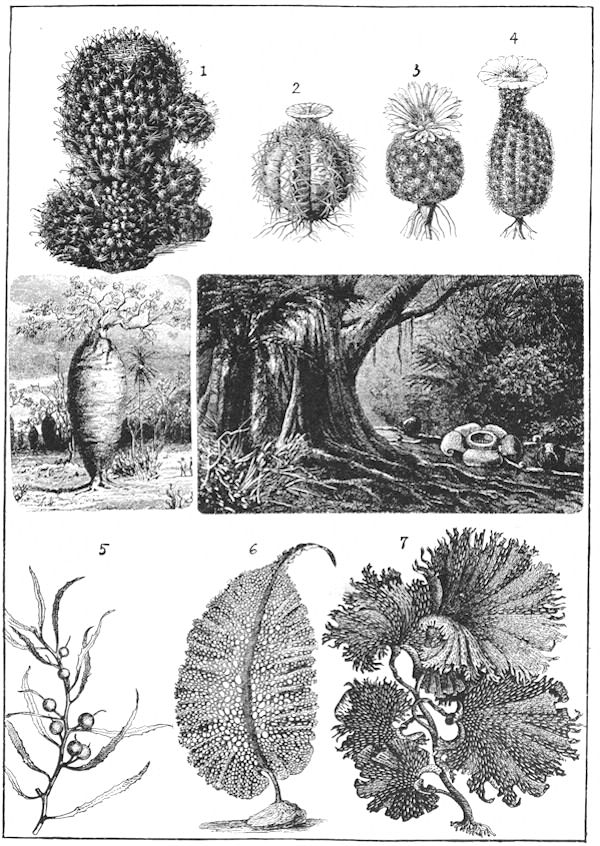
Cacti, Rare Flowers, and Fuci
Cacti—1 and 3, Mamillaria; 2, Echinocactus; 4, Cereus. Fuci—5, Sargassum; 6, Agarum; 7, Thalassophyllum. The Wool Tree (Bombax) and the Rafflesia Arnoldi
MOVEMENT IN PLANTS —Charles Darwin
Plants become climbers in order, it may be presumed, to reach the light and to expose a large surface of leaves to its action and to that of the free air. This is effected by climbers with wonderfully little expenditure of organized matter, in comparison with trees, which have to support a load of heavy branches by a massive trunk. Hence, no doubt, it arises that there are in all quarters of the world so many climbing plants belonging to so many different orders. These plants are here classed under three heads. First, hook-climbers, which are, at least in our temperate countries, the least efficient of all, and can climb only in the midst of an entangled vegetation. Secondly, root-climbers, which are excellently adapted to ascend naked faces of rock: when they climb trees, they are compelled to keep much in the shade; they can not pass from branch to branch, and thus cover the whole summit of a tree, for their rootlets can adhere only by long-continued and close contact with a steady surface. Thirdly, the great class of spiral climbers, with the subordinate divisions of leaf-climbers and tendril-bearers, which together far exceed in number and in perfection of mechanism the climbers of the two previous classes. These plants, by their power of spontaneously revolving and grasping objects with which they come in contact, can easily pass from branch to branch, and securely wander over a wide and sunlit surface. I have ranked twiners, leaf and tendril-climbers as subdivisions of one class, because they graduate into each other, and because nearly all have the same remarkable power of spontaneously revolving. Does this gradation, it may be asked, indicate that plants belonging to one subdivision have passed, during the lapse of ages, or can pass, from one state to the other; has, for instance, a tendril-bearing plant assumed its present structure without having previously existed either as a leaf-climber or a twiner? If we consider leaf-climbers alone, the idea that they were primordially twiners is forcibly suggested. The internodes of all, without exception, revolve in exactly the same manner as twiners; and some few can twine as well, and many others in a more or less imperfect manner. Several leaf-climbing genera are closely allied to other genera which are simple twiners. It should be observed that the possession by a plant of leaves with their petioles or tips sensitive, and with the consequent power of clasping any object, would be of very little use, unless associated with revolving internodes, by which the leaves could be brought into contact with surrounding objects. On the other hand, revolving internodes, without other aid, suffice to give the power of climbing, so that, unless we suppose that leaf-climbers simultaneously acquired both capacities, it seems probable that they were first twiners, and subsequently became capable of grasping a support, which, as we shall presently see, is a great additional advantage.