VIII WORK AT THE LYCEUM
Reading edition
When I am asked what I remember about the first ten years at the Lyceum, I can answer in one word: Work. I was hardly ever out of the theater. What with acting, rehearsing, and studying—twenty-five reference books were a "simple coming-in" for one part—I sometimes thought I should go blind and mad. It was not only for my parts at the Lyceum that I had to rehearse. From August to October I was still touring in the provinces on my own account. My brother George acted as my business manager. His enthusiasm was not greater than his loyalty and industry. When we were playing in small towns he used to rush into my dressing-room after the curtain was up and say excitedly:
"We've got twenty-five more people in our gallery than the Blank Theater opposite!"
Although he was very delicate, he worked for me like a slave. When my tours with Mr. Kelly ended in 1880 and I promised Henry Irving that in future I would go to the provincial towns with him, my brother was given a position at the Lyceum, where, I fear, his scrupulous and uncompromising honesty often got him into trouble. "Perks," as they are called in domestic service, are one of the heaviest additions to a manager's working expenses, and George tried to fight the system. He hurt no one so much as himself.
One of my productions in the provinces was an English version of "Frou-Frou," made for me by my dear friend Mrs. Comyns Carr, who for many years designed the dresses that I wore in different Lyceum plays. "Butterfly," as "Frou-Frou" was called when it was produced in English, went well; indeed, the Scots of Edinburgh received it with overwhelming favor, and it served my purpose at the time, but when I saw Sarah Bernhardt play the part I wondered that I had had the presumption to meddle with it. It was not a case of my having a different view of the character and playing it according to my imagination, as it was, for instance, when Duse played "La Dame aux Camélias," and gave a performance that one could not say was inferior to Bernhardt's, although it was so utterly different. No people in their right senses could have accepted my "Frou-Frou" instead of Sarah's. What I lacked technically in it was pace.
Of course, it is partly the language. English cannot be phrased as rapidly as French. But I have heard foreign actors, playing in the English tongue, show us this rapidity, this warmth, this fury—call it what you will—and have just wondered why we are, most of us, so deficient in it.
Fechter had it, so had Edwin Forrest. When strongly moved, their passions and their fervor made them swift. The more Henry Irving felt, the more deliberate he became. I said to him once: "You seem to be hampered in the vehemence of passion." "I am," he answered. This is what crippled his Othello, and made his scene with Tubal in "The Merchant of Venice" the least successful to him. What it was to the audience is another matter. But he had to take refuge in speechless rage when he would have liked to pour out his words like a torrent.
In the company which Charles Kelly and I took round the provinces in 1880 were Henry Kemble and Charles Brookfield. Young Brookfield was just beginning life as an actor, and he was so brilliantly funny off the stage that he was always a little disappointing on it. My old manageress, Mrs. Wigan, first brought him to my notice, writing in a charming little note that she knew him "to have a power of personation very rare in an unpracticed actor," and that if we could give him varied practice, she would feel it a courtesy to her.
I had reason to admire Mr. Brookfield's "powers of personation" when I was acting at Buxton. He and Kemble had no parts in one of our plays, so they amused themselves during their "off" night by hiring bath-chairs and pretending to be paralytics! We were acting in a hall, and the most infirm of the invalids visiting the place to take the waters were wheeled in at the back, and up the center aisle. In the middle of a very pathetic scene I caught sight of Kemble and Brookfield in their bath-chairs, and could not speak for several minutes.
Mr. Brookfield does not tell this little story in his "Random Reminiscences." It is about the only one that he has left out! To my mind he is the prince of storytellers. All the cleverness that he should have put into his acting and his play-writing (of which since those early days he has done a great deal) he seems to have put into his life. I remember him more clearly as a delightful companion than an actor, and he won my heart at once by his kindness to my little daughter Edy, who accompanied me on this tour. He has too great a sense of humor to resent my inadequate recollection of him. Did he not in his own book quote gleefully from an obituary notice published on a false report of his death, the summary: "Never a great actor, he was invaluable in small parts. But after all it is at his club that he will be most missed!"
In the last act of "Butterfly," as we called the English version of "Frou-Frou," where the poor woman is dying, her husband shows her a locket with a picture of her child in it. Night after night we used a "property" locket, but on my birthday, when we happened to be playing the piece, Charles Kelly bought a silver locket of Indian work and put inside it two little colored photographs of my children, Edy and Teddy, and gave it to me on the stage instead of the "property" one. When I opened it, I burst into very real tears! I have often wondered since if the audience that night knew that they were seeing real instead of assumed emotion! Probably the difference did not tell at all.
At Leeds we produced "Much Ado About Nothing." I never played Beatrice as well again. When I began to "take soundings" from life for my idea of her, I found in my friend Anne Codrington (now Lady Winchilsea) what I wanted. There was before me a Beatrice—as fine a lady as ever lived, a great-hearted woman—beautiful, accomplished, merry, tender. When Nan Codrington came into a room it was as if the sun came out. She was the daughter of an admiral, and always tried to make her room look as like a cabin as she could. "An excellent musician," as Benedick hints Beatrice was, Nan composed the little song that I sang at the Lyceum in "The Cup," and very good it was, too.
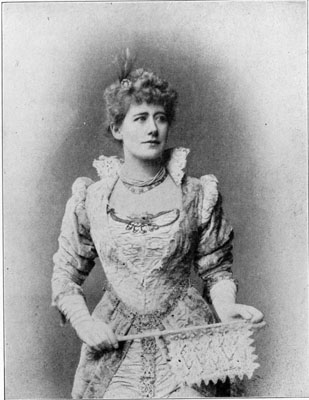
ELLEN TERRY AS BEATRICE
From the collection of Miss Evelyn Smalley
When Henry Irving put on "Much Ado About Nothing"—a play which he may be said to have done for me, as he never really liked the part of Benedick—I was not the same Beatrice at all. A great actor can do nothing badly, and there was so very much to admire in Henry Irving's Benedick. But he gave me little help. Beatrice must be swift, swift, swift! Owing to Henry's rather finicking, deliberate method as Benedick, I could never put the right pace into my part. I was also feeling unhappy about it, because I had been compelled to give way about a traditional "gag" in the church scene, with which we ended the fourth act. In my own production we had scorned this gag, and let the curtain come down on Benedick's line: "Go, comfort your cousin; I must say she is dead, and so farewell." When I was told that we were to descend to the buffoonery of:
Beatrice: Benedick, kill him—kill him if you can. Benedick: As sure as I'm alive, I will!
I protested, and implored Henry not to do it. He said that it was necessary: otherwise the "curtain" would be received in dead silence. I assured him that we had often had seven and eight calls without it. I used every argument, artistic and otherwise. Henry, according to his custom, was gentle, would not discuss it much, but remained obdurate. After holding out for a week, I gave in. "It's my duty to obey your orders, and do it," I said, "but I do it under protest." Then I burst into tears. It was really for his sake just as much as for mine. I thought it must bring such disgrace on him! Looking back on the incident, I find that the most humorous thing in connection with it was that the critics, never reluctant to accuse Henry of "monkeying" with Shakespeare if they could find cause, never noticed the gag at all!
Such disagreements occurred very seldom. In "The Merchant of Venice" I found that Henry Irving's Shylock necessitated an entire revision of my conception of Portia, especially in the trial scene, but here there was no point of honor involved. I had considered, and still am of the same mind, that Portia in the trial scene ought to be very quiet. I saw an extraordinary effect in this quietness. But as Henry's Shylock was quiet, I had to give it up. His heroic saint was splendid, but it wasn't good for Portia.
Of course, there were always injudicious friends to say that I had not "chances" enough at the Lyceum. Even my father said to me after "Othello":
"We must have no more of these Ophelias and Desdemonas!"
"Father!" I cried out, really shocked.
"They're second fiddle parts—not the parts for you, Duchess."
"Father!" I gasped out again, for really I thought Ophelia a pretty good part, and was delighted at my success with it.
But granting these were "second fiddle" parts, I want to make quite clear that I had my turn of "first fiddle" ones. "Romeo and Juliet," "Much Ado About Nothing," "Olivia," and "The Cup" all gave me finer opportunities than they gave Henry. In "The Merchant of Venice" and "Charles I." they were at least equal to his.
I have sometimes wondered what I should have accomplished without Henry Irving. I might have had "bigger" parts, but it doesn't follow that they would have been better ones, and if they had been written by contemporary dramatists my success would have been less durable. "No actor or actress who doesn't play in the 'classics'—in Shakespeare or old comedy—will be heard of long," was one of Henry Irving's sayings, by the way, and he was right.
It was a long time before we had much talk with each other. In the "Hamlet" days, Henry Irving's melancholy was appalling. I remember feeling as if I had laughed in church when he came to the foot of the stairs leading to my dressing-room, and caught me sliding down the banisters! He smiled at me, but didn't seem able to get over it.
"Lacy," he said some days later, "what do you think! I found her the other day sliding down the banisters!"
Some one says—I think it is Keats, in a letter—that the poet lives not in one, but in a thousand worlds, and the actor has not one, but a hundred natures. What was the real Henry Irving? I used to speculate!
His religious upbringing always left its mark on him, though no one could be more "raffish" and mischievous than he when entertaining friends at supper in the Beefsteak Room, or chaffing his valued adjutants, Bram Stoker and Loveday. H.J. Loveday, our dear stage manager, was, I think, as absolutely devoted to Henry as anyone except his fox-terrier, Fussie. Loveday's loyalty made him agree with everything that Henry said, however preposterous, and didn't Henry trade on it sometimes!
Once while he was talking to me, when he was making up, he absently took a white lily out of a bowl on the table and began to stripe and dot the petals with the stick of grease-paint in his hand. He pulled off one or two of the petals, and held it out to me.
"Pretty flower, isn't it?"
"Oh, don't be ridiculous, Henry!" I said.
"You wait!" he said mischievously. "We'll show it to Loveday."
Loveday was sent for on some business connected with the evening's performance. Henry held out the flower obtrusively, but Loveday wouldn't notice it.
"Pretty, isn't it?" said Henry carelessly.
"Very," said Loveday. "I always like those lilies. A friend of mine has his garden full of them, and he says they're not so difficult to grow if only you give 'em enough water."
Henry's delight at having "taken in" Loveday was childish. But sometimes I think Loveday must have seen through these innocent jokes, only he wouldn't have spoiled "the Guv'nor's" bit of fun for the world.
When Henry first met him he was conducting an orchestra. I forget the precise details, but I know that he gave up this position to follow Henry, that he was with him during the Bateman régime at the Lyceum, and that when the Lyceum became a thing of the past, he still kept the post of stage manager. He was literally "faithful unto death," for it was only at Henry's death that his service ended.
Bram Stoker, whose recently published "Reminiscences of Irving" have told, as well as it ever can be told, the history of the Lyceum Theater under Irving's direction, was as good a servant in the front of the theater as Loveday was on the stage. Like a true Irishman, he has given me some lovely blarney in his book. He has also told all the stories that I might have told, and described every one connected with the Lyceum except himself. I can fill that deficiency to a certain extent by saying that he is one of the most kind and tender-hearted of men. He filled a difficult position with great tact, and was not so universally abused as most business managers, because he was always straight with the company, and never took a mean advantage of them.
Stoker and Loveday were daily, nay, hourly, associated for many years with Henry Irving; but, after all, did they or any one else really know him? And what was Henry Irving's attitude. I believe myself that he never wholly trusted his friends, and never admitted them to his intimacy, although they thought he did, which was the same thing to them.
From his childhood up, Henry was lonely. His chief companions in youth were the Bible and Shakespeare. He used to study "Hamlet" in the Cornish fields, when he was sent out by his aunt, Mrs. Penberthy, to call in the cows. One day, when he was in one of the deep, narrow lanes common in that part of England, he looked up and saw the face of a sweet little lamb gazing at him from the top of the bank. The symbol of the lamb in the Bible had always attracted him, and his heart went out to the dear little creature. With some difficulty he scrambled up the bank, slipping often in the damp, red earth, threw his arms round the lamb's neck and kissed it.
The lamb bit him!
Did this set-back in early childhood influence him? I wonder! He had another such set-back when he first went on the stage, and for some six weeks in Dublin was subjected every night to groans, hoots, hisses, and cat-calls from audiences who resented him because he had taken the place of a dismissed favorite. In such a situation an actor is not likely to take stock of reasons. Henry Irving only knew that the Dublin people made him the object of violent personal antipathy. "I played my parts not badly for me," he said simply, "in spite of the howls of execration with which I was received."
The bitterness of this Dublin episode was never quite forgotten. It colored Henry Irving's attitude towards the public. When he made his humble little speeches of thanks to them before the curtain, there was always a touch of pride in the humility. Perhaps he would not have received adulation in quite the same dignified way if he had never known what it was to wear the martyr's "shirt of flame."
This is the worst of my trying to give a consecutive narrative of my first years at the Lyceum. Henry Irving looms across them, reducing all events, all feelings, all that happened, and all that was suggested, to pigmy size.
Let me speak generally of his method of procedure in producing a play.
First he studied it for three months himself, and nothing in that play would escape him. Some one once asked him a question about "Titus Andronicus." "God bless my soul!" he said. "I never read it, so how should I know!" The Shakespearean scholar who had questioned him was a little shocked—a fact which Henry Irving, the closest observer of men, did not fail to notice.
"When I am going to do 'Titus Andronicus,' or any other play," he said to me afterwards, "I shall know more about it than A—— or any other student."
There was no conceit in this. It was just a statement of fact. And it may not have been an admirable quality of Henry Irving's, but all his life he only took an interest in the things which concerned the work that he had in hand. When there was a question of his playing Napoleon, his room at Grafton Street was filled with Napoleonic literature. Busts of Napoleon, pictures of Napoleon, relics of Napoleon were everywhere. Then, when another play was being prepared, the busts, however fine, would probably go down to the cellar. It was not Napoleon who interested Henry Irving, but Napoleon for his purpose—two very different things.
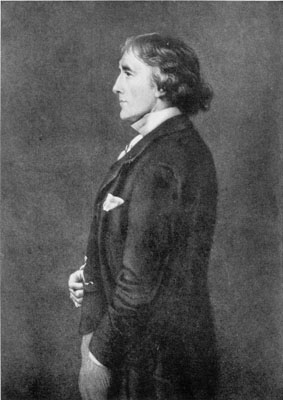
SIR HENRY IRVING
From the painting by Sir John Millais, Bart., P.R.A.
His concentration during his three months' study of the play which he had in view was marvelous. When, at the end of the three-months, he called the first rehearsal, he read the play exactly as it was going to be done on the first night. He knew exactly by that time what he personally was going to do on the first night, and the company did well to notice how he read his own part, for never again until the first night, though he rehearsed with them, would he show his conception so fully and completely.
These readings, which took place sometimes in the greenroom or Beefsteak Room at the Lyceum, sometimes at his house in Grafton Street, were wonderful. Never were the names of the characters said by the reader, but never was there the slightest doubt as to which was speaking. Henry Irving swiftly, surely, acted every part in the piece as he read. While he read, he made notes as to the position of the characters and the order of the crowds and processions. At the end of the first reading he gave out the parts.
The next day there was the "comparing" of the parts. It generally took place on the stage, and we sat down for it. Each person took his own character, and took up the cues to make sure that no blunder had been made in writing them out. Parts at the Lyceum were written, or printed, not typed.
These first two rehearsals—the one devoted to the reading of the play, and the other to the comparing of the parts, were generally arranged for Thursday and Friday. Then there was two days' grace. On Monday came the first stand-up rehearsal on the stage.
We then did one act straight through, and, after that, straight through again, even if it took all day. There was no luncheon interval. People took a bite when they could, or went without. Henry himself generally went without. The second day exactly the same method was pursued with the second act. All the time Henry gave the stage his personal direction, gave it keenly, and gave it whole. He was the sole superintendent of his rehearsals, with Mr. Loveday as his working assistant, and Mr. Allen as his prompter. This despotism meant much less wasted time than when actor-manager, "producer," literary adviser, stage manager, and any one who likes to offer a suggestion are all competing in giving orders and advice to a company.
Henry Irving never spent much time on the women in the company, except in regard to position. Sometimes he would ask me to suggest things to them, to do for them what he did for the men. The men were as much like him when they tried to carry out his instructions as brass is like gold; but he never grew weary of "coaching" them, down to the most minute detail. Once during the rehearsals of "Hamlet" I saw him growing more and more fatigued with his efforts to get the actors who opened the play to perceive his meaning. He wanted the first voice to ring out like a pistol shot.
"Who's there?"
"Do give it up," I said. "It's no better!"
"Yes, it's a little better," he answered quietly, "and so it's worth doing."
From the first the scenery or substitute scenery was put upon the stage for rehearsal, and the properties or substitute properties were to hand.
After each act had been gone through twice each day, it came to half an act once in a whole day, because of the development of detail. There was no detail too small for Henry Irving's notice. He never missed anything that was cumulative—that would contribute something to the whole effect.
The messenger who came in to announce something always needed a great deal of rehearsal. There were processions, and half processions, quiet bits when no word was spoken. There was timing. Nothing was left to chance.
In the master carpenter, Arnott, we had a splendid man. He inspired confidence at once through his strong, able personality, and, as time went on, deserved it through all the knowledge he acquired and through his excellence in never making a difficulty.
"You shall have it," was no bluff from Arnott. You did "have it."
We could not find precisely the right material for one of my dresses in "The Cup." At last, poking about myself in quest of it, I came across the very thing at Liberty's—a saffron silk with a design woven into it by hand with many-colored threads and little jewels. I brought a yard to rehearsal. It was declared perfect, but I declared the price prohibitive.
"It's twelve guineas a yard, and I shall want yards and yards!"
In these days I am afraid they would not only put such material on to the leading lady, but on to the supers too! At the Lyceum wanton extravagance was unknown.
"Where can I get anything at all like it?"
"You leave it to me," said Arnott. "I'll get it for you. That'll be all right.
"But, Arnott, it's a hand-woven Indian material. How can you get it?"
"You leave it to me," Arnott repeated in his slow, quiet, confident way. "Do you mind letting me have this yard as a pattern?"
He went off with it, and before the dress rehearsal had produced about twenty yards of silk, which on the stage looked better than the twelve-guinea original.
"There's plenty more if you want it," he said dryly.
He had had some raw silk dyed the exact saffron. He had had two blocks made, one red and the other black, and the design had been printed, and a few cheap spangles had been added to replace the real jewels. My toga looked beautiful.
This was but one of the many emergencies to which Arnott rose with talent and promptitude.
With the staff of the theater he was a bit of a bully—one of those men not easily roused, but being vexed, "nasty in the extreme!" As a craftsman he had wonderful taste, and could copy antique furniture so that one could not tell the copy from the original.
The great aim at the Lyceum was to get everything "rotten perfect," as the theatrical slang has it, before the dress rehearsal. Father's test of being rotten perfect was not a bad one. "If you can get out of bed in the middle of the night and do your part, you're perfect. If you can't, you don't really know it!"
Henry Irving applied some such test to every one concerned in the production. I cannot remember any play at the Lyceum which did not begin punctually and end at the advertised time, except "Olivia," when some unwise changes in the last act led to delay.
He never hesitated to discard scenery if it did not suit his purpose. There was enough scenery rejected in "Faust" to have furnished three productions, and what was finally used for the famous Brocken scene cost next to nothing.
Even the best scene-painters sometimes think more of their pictures than of scenic effects. Henry would never accept anything that was not right theatrically as well as pictorially beautiful. His instinct in this was unerring and incomparable.
I remember that at one scene-rehearsal every one was fatuously pleased with the scenery. Henry sat in the stalls talking about everything but the scenery. It was hard to tell what he thought.
"Well, are you ready?" he asked at last.
"Yes, sir."
"My God! Is that what you think I am going to give the public?"
Never shall I forget the astonishment of stage manager, scene-painter, and staff! It was never safe to indulge in too much self-satisfaction beforehand with Henry. He was always liable to drop such bombs!
He believed very much in "front" scenes, seeing how necessary they were to the swift progress of Shakespeare's diverging plots. These cloths were sometimes so wonderfully painted and lighted that they constituted scenes of remarkable beauty. The best of all were the Apothecary scene in "Romeo and Juliet" and the exterior of Aufidius's house in "Coriolanus."
We never had electricity installed at the Lyceum until Daly took the theater. When I saw the effect on the faces of the electric footlights, I entreated Henry to have the gas restored, and he did. We used gas footlights and gas limes there until we left the theater for good in 1902.
To this I attribute much of the beauty of our lighting. I say "our" because this was a branch of Henry's work in which I was always his chief helper. Until electricity has been greatly improved and developed, it can never be to the stage what gas was. The thick softness of gaslight, with the lovely specks and motes in it, so like natural light, gave illusion to many a scene which is now revealed in all its naked trashiness by electricity.
The artificial is always noticed and recognized as art by the superficial critic. I think this is what made some people think Irving was at his best in such parts as Louis XI, Dubosc, and Richard III. He could have played Louis XI three times a day "on his head," as the saying is. In "The Lyons Mail," Dubosc the wicked man was easy enough—strange that the unprofessional looker-on always admires the actor's art when it is employed on easy things!—but Lesurques, the good man in the same play ("The Lyons Mail"), was difficult. Any actor, skillful in the tricks of the business, can play the drunkard; but to play a good man sincerely, as he did here, to show that double thing, the look of guilt which an innocent man wears when accused of crime, requires great acting, for "the look" is the outward and visible sign of the inward and spiritual emotion—and this delicate emotion can only be perfectly expressed when the actor's heart and mind and soul and skill are in absolute accord.
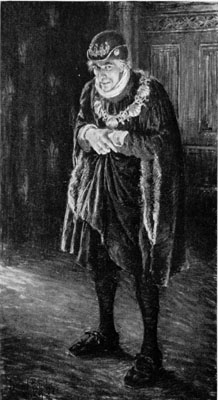
IRVING AS LOUIS XI
In dual parts Irving depended little on make-up. Make-up was, indeed, always his servant, not his master. He knew its uselessness when not informed by the spirit. "The letter" (and in characterization grease-paint is the letter) "killeth—the spirit giveth life." His Lesurques was different from his Dubosc because of the way he held his shoulders, because of his expression. He always took a deep interest in crime (an interest which his sons have inherited), and often went to the police-court to study the faces of the accused. He told me that the innocent man generally looked guilty and hesitated when asked a question, but that the round, wide-open eyes corrected the bad impression. The result of this careful watching was seen in his expression as Lesurques. He opened his eyes wide. As Dubosc he kept them half closed.
Our plays from 1878 to 1887 were "Hamlet," "The Lady of Lyons," "Eugene Aram," "Charles I.," "The Merchant of Venice," "Iolanthe," "The Cup," "The Belle's Stratagem," "Othello," "Romeo and Juliet," "Much Ado About Nothing," "Twelfth Night," "Olivia," "Faust," "Raising the Wind," and "The Amber Heart." I give this list to keep myself straight. My mental division of the years at the Lyceum is before "Macbeth," and after. I divide it up like this, perhaps, because "Macbeth" was the most important of all our productions, if I judge it by the amount of preparation and thought that it cost us and by the discussion which it provoked.
Of the characters played by Henry Irving in the plays of the first division—before "Macbeth," that is to say—I think every one knows that I considered Hamlet to be his greatest triumph. Sometimes I think that was so because it was the only part that was big enough for him. It was more difficult, and he had more scope in it than in any other. If there had been a finer part than Hamlet, that particular part would have been his finest.
When one praises an actor in this way, one is always open to accusations of prejudice, hyperbole, uncritical gush, unreasoned eulogy, and the rest. Must a careful and deliberate opinion always deny a great man genius? If so, no careful and deliberate opinions from me!
I have no doubt in the world of Irving's genius—no doubt that he is with David Garrick and Edmund Kean, rather than with other actors of great talents and great achievements—actors who rightly won high opinions from the multitude of their day, but who have not left behind them an impression of that inexplicable thing which we call genius.
Since my great comrade died I have read many biographies of him, and nearly all of them denied what I assert. "Now, who shall arbitrate?" I find no contradiction of my testimony in the fact that he was not appreciated for a long time, that some found him like olives, an acquired taste, that others mocked and derided him.
My father, who worshiped Macready, put Irving above him because of Irving's originality. The old school were not usually so generous. Fanny Kemble thought it necessary to write as follows of one who had had his share of misfortune and failure before he came into his kingdom and made her jealous, I suppose, for the dead kings among her kindred:
"I have seen some of the accounts and critics of Mr. Irving's acting, and rather elaborate ones of his Hamlet, which, however, give me no very distinct idea of his performance, and a very hazy one indeed of the part itself as seen from the point of view of his critics. Edward Fitzgerald wrote me word that he looked like my people, and sent me a photograph to prove it, which I thought much more like Young than my father or uncle. I have not seen a play of Shakespeare's acted I do not know when. I think I should find such an exhibition extremely curious as well as entertaining."
Now, shall I put on record what Henry Irving thought of Fanny Kemble! If there is a touch of malice in my doing so, surely the passage that I have quoted gives me leave.
Having lived with Hamlet nearly all his life, studied the part when he was a clerk, dreamed of a day when he might play it, the young Henry Irving saw that Mrs. Butler, the famous Fanny Kemble, was going to give a reading of the play. His heart throbbed high with anticipation, for in those days TRADITION was everything—the name of Kemble a beacon and a star.
The studious young clerk went to the reading.
An attendant came on to the platform, first, and made trivial and apparently unnecessary alterations in the position of the reading desk. A glass of water and a book were placed on it.
After a portentous wait, on swept a lady with an extraordinary flashing eye, a masculine and muscular outside. Pounding the book with terrific energy, as if she wished to knock the stuffing out of it, she announced in thrilling tones:
"'HAM—A—LETTE.' By Will—y—am Shak—es—peare."
"I suppose this is all right," thought the young clerk, a little dismayed at the fierce and sectional enunciation.
Then the reader came to Act I, Sc. 2, which the old actor (to leave the Kemble reading for a minute), with but a hazy notion of the text, used to begin:
"Although of Hamlet, our dear brother's death, The memory be—memory be—(What is the color?) green"....
When Fanny Kemble came to this scene the future Hamlet began to listen more intently.
Gertrude: Let not thy mother lose her prayers, Ham—a—lette. Hamlet: I shall in all respects obey you, madam (obviously with a fiery flashing eye of hate upon the King).
When he heard this and more like it, Henry Irving exercised his independence of opinion and refused to accept Fanny Kemble's view of the gentle, melancholy, and well-bred Prince of Denmark.
He was a stickler for tradition, and always studied it, followed it, sometimes to his own detriment, but he was not influenced by the Kemble Hamlet, except that for some time he wore the absurd John Philip feather, which he would have been much better without!
Let me pray that I, representing the old school, may never look on the new school with the patronizing airs of "Old Fitz"3 and Fanny Kemble. I wish that I could see the new school of acting in Shakespeare. Shakespeare must be kept up, or we shall become a third-rate nation!
Henry told me this story of Fanny Kemble's reading without a spark of ill-nature, but with many a gleam of humor. He told me at the same time of the wonderful effect that Adelaide Kemble (Mrs. Sartoris) used to make when she recited Shelley's lines, beginning:
"Good-night—Ah, no, the hour is ill Which severs those it should unite. Let us remain together still— Then it will be good-night!"
I have already said that I never could cope with Pauline Deschapelles, and why Henry wanted to play Melnotte was a mystery. Claude Melnotte after Hamlet! Oddly enough, Henry was always attracted by fustian. He simply reveled in the big speeches. The play was beautifully staged; the garden scene alone probably cost as much as the whole of "Hamlet." The march past the window of the apparently unending army—that good old trick which sends the supers flying round the back-cloth to cross the stage again and again—created a superb effect. The curtain used to go up and down as often as we liked and chose to keep the army marching! The play ran some time, I suppose because even at our worst the public found something in our acting to like.
As Ruth Meadowes I had very little to do, but what there was, was worth doing. The last act of "Eugene Aram," like the last act of "Ravenswood," gave me opportunity. It was staged with a great appreciation of grim and poetic effect. Henry always thought that the dark, overhanging branch of the cedar was like the cruel outstretched hand of Fate. He called it the Fate Tree, and used it in "Hamlet," in "Eugene Aram," and in "Romeo and Juliet."
In "Eugene Aram," the Fate Tree drooped low over the graves in the churchyard. On one of them Henry used to be lying in a black cloak as the curtain went up on the last act. Not until a moonbeam struck the dark mass did you see that it was a man.
He played all such parts well. Melancholy and the horrors had a peculiar fascination for him—especially in these early days. But his recitation of the poem "Eugene Aram" was finer than anything in the play—especially when he did it in a frock-coat. No one ever looked so well in a frock-coat! He was always ready to recite it—used to do it after supper, anywhere. We had a talk about it once, and I told him that it was too much for a room. No man was ever more willing to listen to suggestion or less obstinate about taking advice. He immediately moderated his methods when reciting in a room, making it all the less theatrical. The play was a good répertoire play, and we did it later on in America with success. There the part of Houseman was played by Terriss, who was quite splendid in it, and at Chicago my little boy Teddy made his second appearance on any stage as Joey, a gardener's boy. He had, when still a mere baby, come on to the stage at the Court in "Olivia," and this must be counted his first appearance, although the chroniclers, ignoring both that and Joey in "Eugene Aram," say he never appeared at all until he played an important part in "The Dead Heart."
It is because of Teddy that "Eugene Aram" is associated in my mind with one of the most beautiful sights upon the stage that I ever saw in my life. He was about ten or eleven at the time, and as he tied up the stage roses, his cheeks, untouched by rouge, put the reddest of them to shame! He was so graceful and natural; he spoke his lines with ease, and smiled all over his face! "A born actor!" I said, although Joey was my son. Whenever I think of him in that stage garden, I weep for pride, and for sorrow, too, because before he was thirty my son had left the stage—he who had it all in him. I have good reason to be proud of what he has done since, but I regret the lost actor always.
Henry Irving could not at first keep away from melancholy pieces. Henrietta Maria was another sad part for me—but I used to play it well, except when I cried too much in the last act. The play had been one of the Bateman productions, and I had seen Miss Isabel Bateman as Henrietta Maria and liked her, although I could not find it possible to follow her example and play the part with a French accent! I constantly catch myself saying of Henry Irving, "That is by far the best thing that he ever did." I could say it of some things in "Charles I."—of the way he gave up his sword to Cromwell, of the way he came into the room in the last act and shut the door behind him. It was not a man coming on to a stage to meet some one. It was a king going to the scaffold, quietly, unobtrusively, and courageously. However often I played that scene with him, I knew that when he first came on he was not aware of my presence nor of any earthly presence: he seemed to be already in heaven.
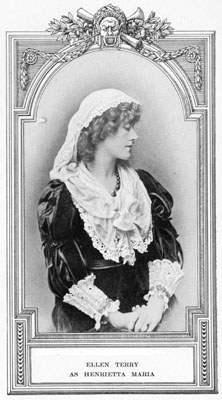
ELLEN TERRY AS HENRIETTA MARIA
Much has been said of his "make-up" as Charles I. Edwin Long painted him a triptych of Vandyck heads, which he always had in his dressing-room, and which is now in my possession. He used to come on to the stage looking precisely like the Vandyck portraits, but not because he had been busy building up his face with wig-paste and similar atrocities. His make-up in this, as in other parts, was the process of assisting subtly and surely the expression from within. It was elastic, and never hampered him. It changed with the expression. As Charles, he was assisted by Nature, who had given him the most beautiful Stuart hands, but his clothes most actors would have consigned to the dust-bin! Before we had done with Charles I.—we played it together for the last time in 1902—these clothes were really threadbare. Yet he looked in them every inch a king.
His care of detail may be judged from the fact that in the last act his wig was not only grayer, but had far less hair in it. I should hardly think it necessary to mention this if I had not noticed how many actors seem to think that age may be procured by the simple expedient of dipping their heads, covered with mats of flourishing hair, into a flour-barrel!
Unlike most stage kings, he never seemed to be assuming dignity. He was very, very simple.
Wills has been much blamed for making Cromwell out to be such a wretch—a mean blackguard, not even a great bad man. But in plays the villain must not compete for sympathy with the hero, or both fall to the ground! I think that Wills showed himself a true poet in his play, and in the last act a great playwright. He gave us both wonderful opportunities, yet very few words were spoken.
Some people thought me best in the camp scene in the third act, where I had even fewer lines to speak. I was proud of it myself when I found that it had inspired Oscar Wilde to write me this lovely sonnet:
In the lone tent, waiting for victory, She stands with eyes marred by the mists of pain, Like some wan lily overdrenched with rain; The clamorous clang of arms, the ensanguined sky, War's ruin, and the wreck of chivalry To her proud soul no common fear can bring; Bravely she tarrieth for her Lord, the King, Her soul aflame with passionate ecstasy. O, hair of gold! O, crimson lips! O, face Made for the luring and the love of man! With thee I do forget the toil and stress, The loveless road that knows no resting place, Time's straitened pulse, the soul's dread weariness, My freedom, and my life republican!
That phrase "wan lily" represented perfectly what I had tried to convey, not only in this part but in Ophelia. I hope I thanked Oscar enough at the time. Now he is dead, and I cannot thank him any more.... I had so much bad poetry written to me that these lovely sonnets from a real poet should have given me the greater pleasure. "He often has the poet's heart, who never felt the poet's fire." There is more good heart and kind feeling in most of the verses written to me than real poetry.
"One must discriminate," even if it sounds unkind. At the time that Whistler was having one of his most undignified "rows" with a sitter over a portrait and wrangling over the price, another artist was painting frescoes in a cathedral for nothing. "It is sad that it should be so," a friend said to me, "but one must discriminate. The man haggling over the sixpence is the great artist!"
How splendid it is that in time this is recognized. The immortal soul of the artist is in his work, the transient and mortal one is in his conduct.
Another sonnet from Oscar Wilde—to Portia this time—is the first document that I find in connection with "The Merchant," as the play was always called by the theater staff.
"I marvel not Bassanio was so bold To peril all he had upon the lead, Or that proud Aragon bent low his head, Or that Morocco's fiery heart grew cold; For in that gorgeous dress of beaten gold, Which is more golden than the golden sun, No woman Veronese looked upon Was half so fair as thou whom I behold. Yet fairer when with wisdom as your shield The sober-suited lawyer's gown you donned, And would not let the laws of Venice yield Antonio's heart to that accursed Jew— O, Portia! take my heart; it is thy due: I think I will not quarrel with the Bond."
Henry Irving's Shylock dress was designed by Sir John Gilbert. It was never replaced, and only once cleaned by Henry's dresser and valet, Walter Collinson. Walter, I think, replaced "Doody," Henry's first dresser at the Lyceum, during the run of "The Merchant of Venice." Walter was a wig-maker by trade—assistant to Clarkson the elder. It was Doody who, on being asked his opinion of a production, said that it was fine—"not a join4 to be seen anywhere!" It was Walter who was asked by Henry to say which he thought his master's best part. Walter could not be "drawn" for a long time. At last he said Macbeth.
This pleased Henry immensely, for, as I hope to show later on, he fancied himself in Macbeth more than in any other part.
"It is generally conceded to be Hamlet," said Henry.
"Oh, no, sir," said Walter, "Macbeth. You sweat twice as much in that."
In appearance Walter was very like Shakespeare's bust in Stratford Church. He was a most faithful and devoted servant, and was the only person with Henry Irving when he died. Quiet in his ways, discreet, gentle, and very quick, he was the ideal dresser.
The Lyceum production of "The Merchant of Venice" was not so strictly archaeological as the Bancrofts' had been, but it was very gravely beautiful and effective. If less attention was paid to details of costumes and scenery, the play itself was arranged and acted very attractively and always went with a swing. To the end of my partnership with Henry Irving it was a safe "draw" both in England and America. By this time I must have played Portia over a thousand times. During the first run of it the severe attack made on my acting of the part in Blackwood's Magazine is worth alluding to. The suggestion that I showed too much of a "coming-on" disposition in the Casket Scene affected me for years, and made me self-conscious and uncomfortable. At last I lived it down. Any suggestion of indelicacy in my treatment of a part always blighted me. Mr. Dodgson (Lewis Carroll, of the immortal "Alice in Wonderland") once brought a little girl to see me in "Faust." He wrote and told me that she had said (where Margaret begins to undress): "Where is it going to stop?" and that perhaps in consideration of the fact that it could affect a mere child disagreeably, I ought to alter my business!
I had known dear Mr. Dodgson for years and years. He was as fond of me as he could be of any one over the age of ten, but I was furious. "I thought you only knew nice children," was all the answer that I gave him. "It would have seemed to me awful for a child to see harm where harm is; how much more when she sees it where harm is not."
But I felt ashamed and shy whenever I played that scene. It was the Casket Scene over again.
The unkind Blackwood article also blamed me for showing too plainly that Portia loves Bassanio before he has actually won her. This seemed to me unjust, if only because Shakespeare makes Portia say before Bassanio chooses the right casket:
"One half of me is yours—the other half yours—All yours!"
Surely this suggests that she was not concealing her fondness like a Victorian maiden, and that Bassanio had most surely won her love, though not yet the right to be her husband.
"There is a soul of goodness in things evil," and the criticism made me alter the setting of the scene, and so contrive it that Portia was behind and out of sight of the men who made hazard for her love.
Dr. Furnivall, a great Shakespearean scholar, was so kind as to write me the following letter about Portia:
"Being founder and director of the New Shakespeare Society, I venture to thank you most heartily for your most charming and admirable impersonation of our poet's Portia, which I witnessed to-night with a real delight. You have given me a new light on the character, and by your so pretty by-play in the Casket Scene have made bright in my memory for ever the spot which almost all critics have felt dull, and I hope to say this in a new edition of 'Shakespeare.'"
(He did say it, in "The Leopold" edition.)
"Again those touches of the wife's love in the advocate when Bassanio says he'd give up his wife for Antonio, and when you kissed your hand to him behind his back in the Ring bit—how pretty and natural they were! Your whole conception and acting of the character are so true to Shakespeare's lines that one longs he could be here to see you. A lady gracious and graceful, handsome, witty, loving and wise, you are his Portia to the life."
That's the best of Shakespeare, I say. His characters can be interpreted in at least eight different ways, and of each way some one will say: "That is Shakespeare!" The German actress plays Portia as a low comedy part. She wears an eighteenth-century law wig, horn spectacles, a cravat (this last anachronism is not confined to Germans), and often a mustache! There is something to be said for it all, though I should not like to play the part that way myself.
Lady Pollock, who first brought me to Henry Irving's notice as a possible leading lady, thought my Portia better at the Lyceum than it had been at the Prince of Wales's.
"Thanks, my dear Valentine and enchanting Portia," she writes to me in response to a photograph that I had sent her, "but the photographers don't see you as you are, and have not the poetry in them to do you justice.... You were especially admirable in the Casket Scene. You kept your by-play quieter, and it gained in effect from the addition of repose—and I rejoiced that you did not kneel to Bassanio at 'My Lord, my governor, my King.' I used to feel that too much like worship from any girl to her affianced, and Portia's position being one of command, I should doubt the possibility of such an action...."
I think I received more letters about my Portia than about all my other parts put together. Many of them came from university men. One old playgoer wrote to tell me that he liked me better than my former instructress, Mrs. Charles Kean. "She mouthed it as she did most things.... She was not real—a staid, sentimental 'Anglaise,' and more than a little stiffly pokerish."
Henry Irving's Shylock was generally conceded to be full of talent and reality, but some of his critics could not resist saying that this was not the Jew that Shakespeare drew! Now, who is in a position to say what is the Jew that Shakespeare drew? I think Henry Irving knew as well as most! Nay, I am sure that in his age he was the only person able to decide.
Some said his Shylock was intellectual, and appealed more to the intellect of his audiences than to their emotions. Surely this is talking for the sake of talking. I recall so many things that touched people to the heart! For absolute pathos, achieved by absolute simplicity of means, I never saw anything in the theater to compare with his Shylock's return home over the bridge to his deserted house after Jessica's flight.
A younger actor, producing "The Merchant of Venice" in recent years, asked Irving if he might borrow this bit of business. "By all means," said Henry. "With great pleasure."
"Then, why didn't you do it?" inquired my daughter bluntly when the actor was telling us how kind and courteous Henry had been in allowing him to use his stroke of invention.
"What do you mean?" asked the astonished actor.
My daughter told him that Henry had dropped the curtain on a stage full of noise, and light, and revelry. When it went up again the stage was empty, desolate, with no light but a pale moon, and all sounds of life at a great distance—and then over the bridge came the wearied figure of the Jew. This marked the passing of the time between Jessica's elopement and Shylock's return home. It created an atmosphere of silence, and the middle of the night.
"You came back without dropping the curtain," said my daughter, "and so it wasn't a bit the same."
"I couldn't risk dropping the curtain for the business," answered the actor, "because it needed applause to take it up again!"
Henry Irving never grew tired of a part, never ceased to work at it, just as he never gave up the fight against his limitations. His diction, as the years went on, grew far clearer when he was depicting rage and passion. His dragging leg dragged no more. To this heroic perseverance he added an almost childlike eagerness in hearing any suggestion for the improvement of his interpretations which commended itself to his imagination and his judgment. From a blind man came the most illuminating criticism of his Shylock. The sensitive ear of the sightless hearer detected a fault in Henry Irving's method of delivering the opening line of his part:
"Three thousand ducats—well!"
"I hear no sound of the usurer in that," the blind man said at the end of the performance. "It is said with the reflective air of a man to whom money means very little."
The justice of the criticism appealed strongly to Henry. He revised his reading not only of the first line, but of many other lines in which he saw now that he had not been enough of the money-lender.
In more recent years he made one change in his dress. He asked my daughter—whose cleverness in such things he fully recognized—to put some stage jewels on to the scarf that he wore round his head when he supped with the Christians.
"I have an idea that, when he went to that supper, he'd like to flaunt his wealth in the Christian dogs' faces. It will look well, too—'like the toad, ugly and venomous,' wearing precious jewels on his head!"
The scarf, witnessing to that untiring love of throwing new light on his impersonations which distinguished Henry to the last, is now in my daughter's possession. She values no relic of him more unless it be the wreath of oak-leaves that she made him for "Coriolanus."
We had a beautiful scene for this play—a garden with a dark pine forest in the distance. Henry was not good in it. He had a Romeo part which had not been written by Shakespeare. We played it instead of the last act of "The Merchant of Venice." I never liked it being left out, but people used to say, like parrots, that "the interest of the play ended with the Trial Scene," and Henry believed them—for a time. I never did. Shakespeare never gives up in the last act like most dramatists.
Twice in "Iolanthe" I forgot that I was blind! The first time was when I saw old Tom Mead and Henry Irving groping for the amulet, which they had to put on my breast to heal me of my infirmity. It had slipped on to the floor, and both of them were too short-sighted to see it! Here was a predicament! I had to stoop and pick it up for them.
The second time I put out my hand and cried: "Look out for my lilies," when Henry nearly stepped on the bunch with which a little girl friend of mine supplied me every night I played the part.
Iolanthe was one of Helen Faucit's great successes. I never saw this distinguished actress when she was in her prime. Her Rosalind, when she came out of her retirement to play a few performances, appeared to me more like a lecture on Rosalind, than like Rosalind herself: a lecture all young actresses would have greatly benefited by hearing, for it was of great beauty. I remember being particularly struck by her treatment of the lines in the scene where Celia conducts the mock marriage between Orlando and Ganymede. Another actress, whom I saw as Rosalind, said the words, "And I do take thee, Orlando, to be my husband," with a comical grimace to the audience. Helen Faucit flushed up and said the line with deep and true emotion, suggesting that she was, indeed, giving herself to Orlando. There was a world of poetry in the way she drooped over his hand.
Mead distinguished himself in "Iolanthe" by speaking of "that immortal land where God hath His—His—er—room?—no—lodging?—no—where God hath His apartments!"
The word he could not hit was, I think, "dwelling." He used often to try five or six words before he got the right one or the wrong one—it was generally the wrong one—in full hearing of the audience.