XII SOME LIKES AND DISLIKES
Reading edition
It is only human to make comparisons between American and English institutions, although they are likely to turn out as odious as the proverb says! The first institution in America that distressed me was the steam heat. It is far more manageable now than it was both in hotels and theaters, because there are more individual heaters. But how I suffered from it at first I cannot describe! I used to feel dreadfully ill, and when we could not turn the heat off at the theater, the plays always went badly. My voice was affected too. At Toledo once, it nearly went altogether. Then the next night, after a good fight for it, we got the theater cool, and the difference that it made to the play was extraordinary. I was in my best form, feeling well and jolly!
No wonder the Americans drink ice-water and wear very thin clothes indoors. Their rooms are hotter than ours ever are, even in the height of the summer—when we have a summer! But no wonder, either, that Americans in England shiver at our cold, draughty rooms. They are brought up in hot-houses.
If I did not like steam heat, I loved the ice which is such a feature at American meals. Everything is served on ice, and the ice-water, however pernicious the European may consider it as a drink, looks charming and cool in the hot rooms.
I liked the traveling; but then we traveled in a very princely fashion. The Lyceum company and baggage occupied eight cars, and Henry's private parlor car was lovely. The only thing that we found was better understood in England, so far as railway traveling is concerned, was privacy. You may have a private car in America, but all the conductors on the train, and there is one to each car, can walk through it. So can any official, baggage man or newsboy who has the mind!
The "parlor car" in America is more luxurious than our first class, but you travel in it (if you have no "private" car) with thirty other people.
"What do you want to be private for?" asked an American, and you don't know how to answer, for you find that with them that privacy means concealment. For this reason, I believe, they don't have hedges or walls round their estates and gardens. "Why should we? We have nothing to hide!"
In the cars, as in the rooms at one's hotel, the "cuspidor" is always with you as a thing of beauty! When I first went to America the "Ladies' Entrance" to the hotel was really necessary, because the ordinary entrance was impassable! Since then very severe laws against spitting in public places have been passed, and there is a great improvement. But the habit, I suppose due to the dryness of the climate, or to the very strong cigars smoked, or to chronic catarrh, or to a feeling of independence—"This is a free country and I can spit if I choose!"—remains sufficiently disgusting to a stranger visiting the country.
The American voice is the one thing in the country that I find unbearable; yet the truly terrible variety only exists in one State, and is not widely distributed. I suppose it is its very assertiveness that makes one forget the very sweet voices that also exist in America. The Southern voice is very low in tone and soothing, like the "darkey" voice. It is as different from Yankee as the Yorkshire burr is from the Cockney accent.
This question of accent is a very funny one. I had not been in America long when a friend said to me:
"We like your voice. You have so little English accent!"
This struck me as rather cool. Surely English should be spoken with an English accent, not with a French, German, or double-dutch one! Then I found that what they meant by an English accent was an English affectation of speech—a drawl with a tendency to "aw" and "ah" everything. They thought that every one in England who did not miss out aspirates where they should be, and put them in where they should not be, talked of "the rivah," "ma brothar," and so on. Their conclusion was, after all, quite as well founded as ours about their accent. The American intonation, with its freedom from violent emphasis, is, I think, rather pretty when the quality of the voice is sweet.
Of course the Americans would have their jokes about Henry's method of speech. Ristori followed us once in New York, and a newspaper man said he was not sure whether she or Mr. Irving was the more difficult for an American to understand.
"He pronounces the English tongue as it is pronounced by no other man, woman or child," wrote the critic, and proceeded to give a phonetically spelled version of Irving's delivery of Shylock's speech of Antonio.
"Wa thane, ett no eperes Ah! um! yo ned m'clp Ough! ough! Gaw too thane! Ha! um! Yo com'n say Ah! Shilok, um! ouch! we wode hev moanies!"
I wonder if the clever American reporter stopped to think how his delivery of the same speech would look in print! As for the ejaculations, the interjections and grunts with which Henry interlarded the text, they often helped to reveal the meaning of Shakespeare to his audience—a meaning which many a perfect elocutionist has left perfectly obscure. The use of "m'" or "me" for "my" has often been hurled in my face as a reproach, but I never contracted "my" without good reason. I had a line in Olivia which I began by delivering as—
"My sorrows and my shame are my own."
Then I saw that the "mys" sounded ridiculous, and abbreviated the two first ones into "me's."
There were of course people ready to say that the Americans did not like Henry Irving as an actor, and that they only accepted him as a manager—that he triumphed in New York as he had done in London, through his lavish spectacular effects. This is all moonshine. Henry made his first appearance in "The Bells," his second in "Charles I.," his third in "Louis XI." By that time he had conquered, and without the aid of anything at all notable in the mounting of the plays. It was not until we did "The Merchant of Venice" that he gave the Americans anything of a "production."
My first appearance in America in Shakespeare was as Portia, and I could not help feeling pleased by my success. A few weeks later I played Ophelia at Philadelphia. It is in Shakespeare that I have been best liked in America, and I consider that Beatrice was the part about which they were most enthusiastic.
During our first tour we visited in succession New York, Philadelphia, Boston, Baltimore, Brooklyn, Chicago, Cincinnati, St. Louis, Detroit, and Toronto. To most of these places we paid return visits.
"To what do you attribute your success, Mr. Irving?"
"To my acting," was the simple reply.
We never had poor houses except in Baltimore and St. Louis. Our journey to Baltimore was made in a blizzard. They were clearing the snow before us all the way from New Jersey, and we took forty-two hours to reach Baltimore! The bells of trains before us and behind us sounded very alarming. We opened in Baltimore on Christmas day. The audience was wretchedly small, but the poor things who were there had left their warm firesides to drive or tramp through the slush of melting snow, and each one who managed to reach the theater was worth a hundred on an ordinary night.
At the hotel I put up holly and mistletoe, and produced from my trunks a real Christmas pudding that my mother had made. We had it for supper, and it was very good.
It never does to repeat an experiment. Next year at Pittsburg my little son Teddy brought me out another pudding from England. For once we were in an uncomfortable hotel, and the Christmas dinner was deplorable. It began with burned hare soup.
"It seems to me," said Henry, "that we aren't going to get anything to eat, but we'll make up for it by drinking!"
He had brought his own wine out with him from England, and the company took him at his word and did make up for it!
"Never mind!" I said, as the soup was followed by worse and worse. "There's my pudding!"
It came on blazing, and looked superb. Henry tasted a mouthful.
"Very odd," he said, "but I think this is a camphor pudding."
He said it so politely, as if he might easily be mistaken!
My maid in England had packed the pudding with my furs! It simply reeked of camphor.
So we had to dine on Henry's wine and L.F. Austin's wit. This dear, brilliant man, now dead, acted for many years as Henry's secretary, and one of his gifts was the happy knack of hitting off people's peculiarities in rhyme. This dreadful Christmas dinner at Pittsburg was enlivened by a collection of such rhymes, which Mr. Austin called a "Lyceum Christmas Play."
Every one roared with laughter until it came to the verse of which he was the victim, when suddenly he found the fun rather labored!
The first verse was spoken by Loveday, who announces that the "Governor" has a new play which is "Wonderful!" a great word of Loveday's.
George Alexander replies:
"But I say, Loveday, have I got a part in it, That I can wear a cloak in and look smart in it? Not that I care a fig for gaudy show, dear boy— But juveniles must look well, don't you know, dear boy. And shall I lordly hall and tuns of claret own? And may I murmur love in dulcet baritone? Tell me at least, this simple fact of it— Can I beat Terriss hollow in one act of it?8 Pooh for Wenman's bass!9 Why should he make a boast of it?"
Norman Forbes:
"If he has a voice, I have got the ghost of it! When I pitch it low, you may say how weak it is, When I pitch it high, heavens! what a squeak it is! But I never mind; for what does it signify? See my graceful hands, they're the things that dignify; All the rest is froth, and egotism's dizziness— Have I not played with Phelps? (To Wenman) I'll teach you all the business!"
T. Mead:
(Of whom much has already been written in these pages.)
"What's this about a voice? Surely you forget it, or Wilfully conceal that I have no competitor! I do not know the play, or even what the title is, But safe to make success a charnel-house recital is! So please to bear in mind, if I am not to fail in it, That Hamlet's father's ghost must rob the Lyons Mail in it! No! that's not correct! But you may spare your charity— A good sepulchral groan's the thing for popularity!"
H. Howe:
(The "agricultural" actor, as Henry called him.)
"Boys, take my advice, the stage is not the question, But whether at three score you'll all have my digestion. Why yearn for plays, to pose as Brutuses or Catos in, When you may get a garden to grow the best potatoes in? You see that at my age by Nature's shocks unharmed I am! Tho' if I sneeze but thrice, good heavens, how alarmed I am! But act your parts like men, and tho' you all great sinners are, You're sure to act like men wherever Irving's dinners are!"
J.H. Allen (our prompter):
"Whatever be the play, I must have a hand in it, For won't I teach the supers how to stalk and stand in it? Tho' that blessed Shakespeare never gives a ray to them, I explain the text, and then it's clear as day to them!10 Plain as A B C is a plot historical, When I overhaul allusions allegorical! Shakespeare's not so bad; he'd have more pounds and pence in him, If actors stood aside, and let me show the sense in him!"
Louis Austin's little "Lyceum Play" was presented to me with a silver water-jug, a souvenir from the company, and ended up with the following pretty lines spoken by Katie Brown, a clever little girl who played all the small pages' parts at this time:
"Although I'm but a little page, Who waits for Portia's kind behest, Mine is the part upon this stage To tell the plot you have not guessed. "Dear lady, oft in Belmont's hall, Whose mistress is so sweet and fair, Your humble slaves would gladly fall Upon their knees, and praise you there. "To offer you this little gift, Dear Portia, now we crave your leave, And let it have the grace to lift Our hearts to yours this Christmas eve. "And so we pray that you may live Thro' many, many, happy years, And feel what you so often give— The joy that is akin to tears!"
How nice of Louis Austin! It quite made up for my mortification over the camphor pudding!
Pittsburg has been called "hell with the lid off," and other insulting names. I have always thought it beautiful, especially at night when its furnaces make it look like a city of flame. The lovely park that the city has made on the heights that surround it is a lesson to Birmingham, Sheffield, and our other black towns. George Alexander said that Pittsburg reminded him of his native town of Sheffield. "Had he said Birmingham, now instead of Sheffield," wrote a Pittsburg newspaper man, "he would have touched our tender spot exactly. As it is, we can be as cheerful as the Chicago man was who boasted that his sweetheart 'came pretty near calling him "honey,"' when in fact she had called him 'Old Beeswax'!"
When I played Ophelia for the first time in Chicago, I played the part better than I had ever played it before, and I don't believe I ever played it so well again. Why, it is almost impossible to say. I had heard a good deal of the crime of Chicago, that the people were a rough, murderous, sand-bagging crew. I ran on to the stage in the mad scene, and never have I felt such sympathy! This frail wraith, this poor demented thing, could hold them in the hollow of her hand.... It was splendid! "How long can I hold them?" I thought: "For ever!" Then I laughed. That was the best Ophelia laugh of my life—my life that is such a perfect kaleidoscope with the people and the places turning round and round.
At the risk of being accused of indiscriminate flattery I must say that I liked all the American cities. Every one of them has a joke at the expense of the others. They talk in New York of a man who lost both his sons—"One died and the other went to live in Philadelphia." Pittsburg is the subject of endless criticism, and Chicago is "the limit." To me, indeed, it seemed "the limit"—of the industry, energy, and enterprise of man. In 1812 this vast city was only a frontier post—Fort Dearborn. In 1871 the town that first rose on these great plains was burned to the ground. The growth of the present Chicago began when I was a grown woman. I have celebrated my jubilee. Chicago will not do that for another fifteen years!
I never visited the stock-yards. Somehow I had no curiosity to see a live pig turned in fifteen minutes into ham, sausages, hair-oil, and the binding for a Bible! I had some dread of being made sad by the spectacle of so much slaughter—of hating the Chicago of the "abattoir" as much as I had loved the Chicago of the Lake with the white buildings of the World's Fair shining on it, the Chicago built on piles in splendid isolation in the middle of the prairie, the Chicago of Marshall Field's beautiful palace of a store, the Chicago of my dear friends, the Chicago of my son's first appearance on the stage! Was it not a Chicago man who wrote of my boy, tending the roses in the stage garden in "Eugene Aram," that he was "a most beautiful lad"!
"His eyes are full of sparkle, his smile is a ripple over his face, and his laugh is as cherry and natural as a bird's song.... This Joey is Miss Ellen Terry's son, and the apple of her eye. On this Wednesday night, January 14, 1885, he spoke his first lines upon the stage. His mother has high hopes of this child's dramatic future. He has the instinct and the soul of art in him. Already the theater is his home. His postures and his playfulness with the gardener, his natural and graceful movement, had been the subject of much drilling, of study and practice. He acquitted himself beautifully and received the wise congratulations of his mother, of Mr. Irving, and of the company."
That is the nicest newspaper notice I have ever read!
At Chicago I made my first speech. The Haverley Theater, at which we first appeared in 1884, was altered and rechristened the "Columbia" in 1885. I was called upon for a speech after the special performance in honor of the occasion, consisting of scenes from "Charles I.," "Louis XI," "The Merchant of Venice," and "The Bells," had come to an end. I think it must be the shortest speech on record:
"Ladies and Gentlemen, I have been asked to christen your beautiful theater. 'Hail Columbia!'"
When we acted in Brooklyn we used to stay in New York and drive over that wonderful bridge every night. There were no trolley cars on it then. I shall never forget how it looked in winter, with the snow and ice on it—a gigantic trellis of dazzling white, as incredible as a dream. The old stone bridges were works of art. This bridge, woven of iron and steel for a length of over 500 yards, and hung high in the air over the water so that great ships can pass beneath it, is the work of science. It looks as if it had been built by some power, not by men at all.
It was during our week at Brooklyn in 1885 that Henry was ill, too ill to act for four nights. Alexander played Benedick, and got through it wonderfully well. Then old Mr. Mead did (did is the word) Shylock. There was no intention behind his words or what he did.
I had such a funny batch of letters on my birthday that year. "Dear, sweet Miss Terry, etc., etc. Will you give me a piano?"!! etc., etc. Another: "Dear Ellen. Come to Jesus. Mary." Another, a lovely letter of thanks from a poor woman in the most ghastly distress, and lastly an offer of a two years' engagement in America. There was a simple coming in for one woman acting at Brooklyn on her birthday!
Brooklyn is as sure a laugh in New York as the mother-in-law in a London music hall. "All cities begin by being lonesome," a comedian explained, "and Brooklyn has never gotten over it."
My only complaint against Brooklyn was that they would not take Fussie in at the hotel there. Fussie, during these early American tours, was still my dog. Later on he became Henry's. He had his affections alienated by a course of chops, tomatoes, strawberries, "ladies' fingers" soaked in champagne, and a beautiful fur rug of his very own presented by the Baroness Burdett-Coutts!
How did I come by Fussie? I went to Newmarket with Rosa Corder, whom Whistler painted. She was one of those plain-beautiful women who are so far more attractive than some of the pretty ones. She had wonderful hair—like a fair, pale veil, a white, waxen face, and a very good figure; and she wore very odd clothes. She had a studio in Southampton Row, and another at Newmarket where she went to paint horses. I went to Cambridge once and drove back with her across the heath to her studio.
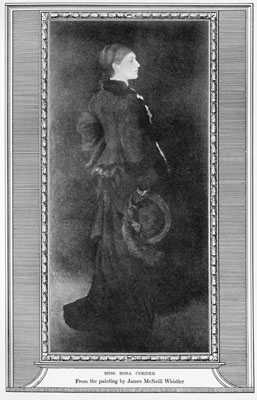
MISS ROSA CORDER
From the painting by James McNeill Whistler
"How wonderfully different are the expressions on terriers' faces," I said to her, looking at a painting of hers of a fox-terrier pup. "That's the only sort of dog I should like to have."
"That one belonged to Fred Archer," Rosa Corder said. "I daresay he could get you one like it."
We went out to find Archer. Curiously enough I had known the famous jockey at Harpenden when he was a little boy, and I believe used to come round with vegetables.
"I'll send you a dog, Miss Terry, that won't be any trouble. He's got a very good head, a first-rate tail, stuck in splendidly, but his legs are too long. He'd follow you to America!"
Prophetic words! On one of our departures for America, Fussie was left behind by mistake at Southampton. He could not get across the Atlantic, but he did the next best thing. He found his way back from there to his own theater in the Strand, London!
Fred Archer sent him originally to the stage-door at the Lyceum. The man who brought him out from there to my house in Earl's Court said:
"I'm afraid he gives tongue, Miss. He don't like music, anyway. There was a band at the bottom of your road, and he started hollering."
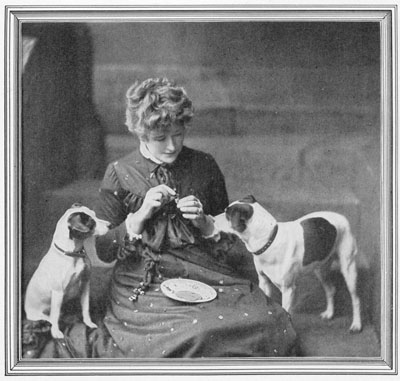
ELLEN TERRY
With her fox-terriers, Dummy and Fussie; from a photograph taken in 1889
We were at luncheon when Fussie made his début into the family circle, and I very quickly saw his stomach was his fault. He had a great dislike to "Charles I."; we could never make out why. Perhaps it was because Henry wore armor in one act—and Fussie may have barked his shins against it. Perhaps it was the firing off of the guns; but more probably it was because the play once got him into trouble. As a rule Fussie had the most wonderful sense of the stage, and at rehearsal would skirt the edge of it, but never cross it. But at Brooklyn one night when we were playing "Charles I."—the last act, and that most pathetic part of it where Charles is taking a last farewell of his wife and children—Fussie, perhaps excited by his run over the bridge from New York, suddenly bounded on to the stage! The good children who were playing Princess Mary and Prince Henry didn't even smile; the audience remained solemn, but Henry and I nearly went into hysterics. Fussie knew directly that he had done wrong. He lay down on his stomach, then rolled over on his back, whimpering an apology—while carpenters kept on whistling and calling to him from the wings. The children took him up to the window at the back of the scene, and he stayed there cowering between them until the end of the play.
America seems to have been always fatal to Fussie. Another time when Henry and I were playing in some charity performance in which John Drew and Maude Adams were also acting, he disgraced himself again. Henry having "done his bit" and put on hat and coat to leave the theater, Fussie thought the end of the performance must have come; the stage had no further sanctity for him, and he ran across it to the stage door barking! John Drew and Maude Adams were playing "A Pair of Lunatics." Maude Adams, sitting looking into the fire, did not see Fussie, but was amazed to hear John Drew departing madly from the text:
"Is this a dog I see before me, His tail towards my hand? Come, let me clutch thee."
She began to think that he had really gone mad!
When Fussie first came, Charlie was still alive, and I have often gone into Henry's dressing-room and seen the two dogs curled up in both the available chairs, Henry standing while he made up, rather than disturb them!
When Charlie died, Fussie had Henry's idolatry all to himself. I have caught them often sitting quietly opposite each other at Grafton Street, just adoring each other! Occasionally Fussie would thump his tail on the ground to express his pleasure.
Wherever we went in America the hotel people wanted to get rid of the dog. In the paper they had it that Miss Terry asserted that Fussie was a little terrier, while the hotel people regarded him as a pointer, and funny caricatures were drawn of a very big me with a very tiny dog, and a very tiny me with a dog the size of an elephant! Henry often walked straight out of an hotel where an objection was made to Fussie. If he wanted to stay, he had recourse to strategy. At Detroit the manager of the hotel said that dogs were against the rules. Being very tired Henry let Fussie go to the stables for the night, and sent Walter to look after him. The next morning he sent for the manager.
"Yours is a very old-fashioned hotel, isn't it?"
"Yes, sir, very old and ancient."
"Got a good chef? I didn't think much of the supper last night; but still—the beds are comfortable enough—I am afraid you don't like animals?"
"Yes, sir, in their proper place."
"It's a pity," said Henry meditatively, "because you happen to be overrun by rats!"
"Sir, you must have made a mistake. Such a thing couldn't—"
"Well, I couldn't pass another night here without my dog," Henry interrupted. "But there are, I suppose, other hotels?"
"If it will be any comfort to you to have your dog with you, sir, do by all means, but I assure you that he'll catch no rat here."
"I'll be on the safe side," said Henry calmly.
And so it was settled. That very night Fussie supped off, not rats, but terrapin and other delicacies in Henry's private sitting-room.
It was the 1888 tour, the great blizzard year, that Fussie was left behind by mistake at Southampton. He jumped out at the station just before Southampton, where they stop to collect tickets. After this long separation, Henry naturally thought that the dog would go nearly mad with joy when he saw him again. He described to me the meeting in a letter.
"My dear Fussie gave me a terrible shock on Sunday night. When we got in, J——, Hatton, and I dined at the Cafe Royal. I told Walter to bring Fussie there. He did, and Fussie burst into the room while the waiter was cutting some mutton, when, what d'ye think—one bound at me—another instantaneous bound at the mutton, and from the mutton nothing would get him until he'd got his plateful. "Oh, what a surprise it was indeed! He never now will leave my side, my legs, or my presence, but I cannot but think, alas, of that seductive piece of mutton!"
Poor Fussie! He met his death through the same weakness. It was at Manchester, I think. A carpenter had thrown down his coat with a ham sandwich in the pocket, over an open trap on the stage. Fussie, nosing and nudging after the sandwich, fell through and was killed instantly. When they brought up the dog after the performance, every man took his hat off.... Henry was not told until the end of the play.
He took it so very quietly that I was frightened, and said to his son Laurence who was on that tour:
"Do let's go to his hotel and see how he is."
We drove there and found him sitting eating his supper with the poor dead Fussie, who would never eat supper any more, curled up in his rug on the sofa. Henry was talking to the dog exactly as if it were alive. The next day he took Fussie back in the train with him to London, covered with a coat. He is buried in the dogs' cemetery, Hyde Park.
His death made an enormous difference to Henry. Fussie was his constant companion. When he died, Henry was really alone. He never spoke of what he felt about it, but it was easy to know.
We used to get hints how to get this and that from watching Fussie! His look, his way of walking! He sang, whispered eloquently and low—then barked suddenly and whispered again! Such a lesson in the law of contrasts!
The first time that Henry went to the Lyceum after Fussie's death, every one was anxious and distressed, knowing how he would miss the dog in his dressing-room. Then an odd thing happened. The wardrobe cat, who had never been near the room in Fussie's lifetime, came down and sat on Fussie's cushion! No one knew how the "Governor" would take it. But when Walter was sent out to buy some meat for it, we saw that Henry was not going to resent it! From that night onwards the cat always sat night after night in the same place, and Henry liked its companionship. In 1902, when he left the theater for good, he wrote to me:
"The place is now given up to the rats—all light cut off, and only Barry11 and a foreman left. Everything of mine I've moved away, including the Cat!"
I have never been to America yet without going to Niagara. The first time I saw the great falls I thought it all more wonderful than beautiful. I got away by myself from my party, and looked and looked at it, and I listened—and at last it became dreadful and I was frightened at it. I wouldn't go alone again, for I felt queer and wanted to follow the great flow of it. But at twelve o'clock, with the "sun upon the topmost height of the day's journey," most of Nature's sights appear to me to be at their plainest. In the evening, when the shadows grow long and all hard lines are blurred, how soft, how different, everything is! It was noontide, that garish cruel time of day, when I first came in sight of the falls. I'm glad I went again in other lights—but one should live by the side of all this greatness to learn to love it. Only once did I catch Niagara in beauty, with pits of color in its waters, no one color definite—all was wonderment, allurement, fascination. The last time I was there it was wonderful, but not beautiful any more. The merely stupendous, the merely marvelous, have always repelled me. I cannot realize, and become terribly weak and doddering. No terrific scene gives me pleasure. The great cañons give me unrest, just as the long low lines of my Sussex marshland near Winchelsea give me rest.
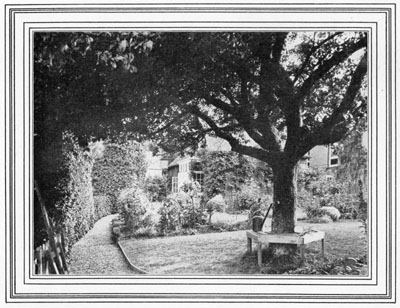
MISS TERRY'S GARDEN AT WINCHELSEA
From a photograph given by her to Miss Evelyn Smalley
At Niagara William Terriss slipped and nearly lost his life. At night when he appeared as Bassanio, he shrugged his shoulders, lowered his eyelids, and said to me—
"Nearly gone, dear,"—he would call everybody "dear"—"But Bill's luck! Tempus fugit!"
What tempus had to do with it, I don't quite know!
When we were first in Canada I tobogganed at Rosedale. I should say it was like flying! The start! Amazing! "Farewell to this world," I thought, as I felt my breath go. Then I shut my mouth, opened my eyes, and found myself at the bottom of the hill in a jiffy—"over hill, over dale, through bush, through briar!" I rolled right out of the toboggan when we stopped. A very nice Canadian man was my escort, and he helped me up the hill afterwards. I didn't like that part of the affair quite so much.
Henry Irving would not come, much to my disappointment. He said that quick motion through the air always gave him the ear-ache. He had to give up swimming (his old Cornish Aunt Penberthy told me he delighted in swimming as a boy) just because it gave him most violent pains in the ear.
Philadelphia, as I first knew it, was the most old-world place I saw in America, except perhaps Salem. Its redbrick side-walks, the trees in the streets, the low houses with their white marble cuffs and collars, the pretty design of the place, all give it a character of its own. The people, too, have a character of their own. They dress, or at least did dress, very quietly. This was the only sign of their Quaker origin, except a very fastidious taste—in plays as in other things.
Mrs. Gillespie, the great-grandchild of Benjamin Franklin, was one of my earliest Philadelphia friends—a splendid type of the independent woman, a bit of the martinet, but immensely full of kindness and humor. She had a word to say in all Philadelphian matters. It would be difficult to imagine a greater contrast to Mrs. Gillespie of Philadelphia than Mrs. Fields of Boston, that other great American lady whom to know is a liberal education.
Mrs. Fields reminded me of Lady Tennyson, Mrs. Tom Taylor, and Miss Hogarth (Dickens's sister-in-law) all rolled into one. Her house is full of relics of the past. There is a portrait of Dickens as a young man with long hair. He had a feminine face in those days, for all its strength. Hard by is a sketch of Keats by Severn, with a lock of the poet's hair. Opposite is a head of Thackeray, with a note in his handwriting fastened below. "Good-bye, Mrs. Fields; good-bye, my dear Fields; good-bye to all. I go home."
Thackeray left Boston abruptly because a sudden desire to see his children had assailed him at Christmas time!
As you sit in Mrs. Field's spacious room overlooking the Bay, you realize suddenly that before you ever came into it, Dickens and Thackeray were both here, that this beautiful old lady who so kindly smiles on you has smiled on them and on many other great men of letters long since dead. It is here that they seem most alive. This is the house where the culture of Boston seems no fad to make a joke about, but a rare and delicate reality.
This—and Fen Court, the home of that wonderful woman Mrs. Jack Gardiner, who represents the present worship of beauty in Boston as Mrs. Fields represents its former worship of literary men. Fen Court is a house of enchantment, a palace, and Mrs. Gardiner is like a great princess in it. She has "great possessions" indeed, but her best, to my mind, is her most beautiful voice, even though I remember her garden by moonlight with the fountain playing, her books and her pictures, the Sargent portrait of herself presiding over one of the most splendid of those splendid rooms, where everything great in old art and new art is represented. What a portrait it is! Some one once said of Sargent that "behind the individual he finds the real, and behind the real, a whole social order."
He has painted "Mrs. Jack" in a tight-fitting black dress with no ornament but her world-famed pearl necklace round her waist, and on her shoes rubies like drops of blood. The daring, intellectual face seems to say: "I have possessed everything that is worth possession, through the energy and effort and labor of the country in which I was born."
Mrs. Gardiner represents all the poetry of the millionaire.
Mrs. Gardiner's house filled me with admiration, but if I want rest and peace I just think of the houses of Mrs. James Fields and Oliver Wendell Holmes. He was another personage in Boston life when I first went there. Oh, the visits I inflicted on him—yet he always seemed pleased to see me, the cheery, kind man. It was generally winter when I called on him. At once it was "four feet upon a fender!" Four feet upon a fender was his idea of happiness, he told me, during one of these lengthy visits of mine to his house in Beacon Street.
He came to see us in "Much Ado about Nothing" and, next day sent me some little volumes of his work with a lovely inscription on the front page. I miss him very much when I go to Boston now.
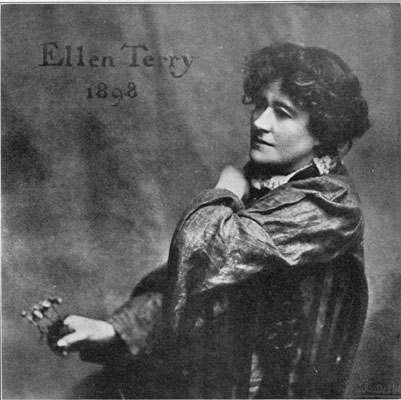
MISS ELLEN TERRY IN 1898
From the collection of Miss Evelyn Smalley
Photographed by T.R. Annan
In New York, how much I miss Mrs. Beecher I could never say. The Beechers were the most wonderful pair. What an actor he would have made! He read scenes from Shakespeare to Henry and me at luncheon one day. He sat next to his wife, and they held hands nearly all the while; I thought of that time when the great preacher was tried, and all through the trial his wife showed the world her faith in his innocence by sitting by his side and holding his hand.
He was indeed a great preacher. I have a little faded card in my possession now: "Mrs. Henry W. Beecher." "Will ushers of Plymouth Church please seat the bearer in the Pastor's pew." And in the Pastor's pew I sat, listening to that magnificent bass-viol voice with its persuasive low accent, its torrential scorn! After the sermon I went to the Beechers' home. Mr. Beecher sat with a saucer of uncut gems by him on the table. He ran his hand through them from time to time, held them up to the light, admiring them and speaking of their beauty and color as eloquently as an hour before he had spoken of sin and death and redemption.
He asked me to choose a stone, and I selected an aquamarine, and he had it splendidly mounted for me in Venetian style to wear in "The Merchant of Venice." Once when he was ill, he told me, his wife had some few score of his jewels set up in lead—a kind of small stained-glass window—and hung up opposite his bed. "It did me more good than the doctor's visits," he laughed out!
Mrs. Beecher was very remarkable. She had a way of lowering her head and looking at you with a strange intentness—gravely—kindly and quietly. At her husband she looked a world of love, of faith, of undying devotion. She was fond of me, although I was told she disliked women generally and had been brought up to think all actresses children of Satan. Obedience to the iron rules which had always surrounded her had endowed her with extraordinary self-control. She would not allow herself ever to feel heat or cold, and could stand any pain or discomfort without a word of complaint.
She told me once that when she and her sister were children, a friend had given them some lovely bright blue silk, and as the material was so fine they thought they would have it made up a little more smartly than was usual in their somber religious home. In spite of their father's hatred of gaudy clothes, they ventured on a little "V" at the neck, hardly showing more than the throat; but still, in a household where blue silk itself was a crime, it was a bold venture. They put on the dresses for the first time for five o'clock dinner, stole downstairs with trepidation, rather late, and took their seats as usual one on each side of their father. He was eating soup and never looked up. The little sisters were relieved. He was not going to say anything.
No, he was not going to say anything, but suddenly he took a ladleful of the hot soup and dashed it over the neck of one sister; another ladleful followed quickly on the neck of the other.
"Oh, father, you've burned my neck!"
"Oh, father, you've spoiled my dress!"
"Oh, father, why did you do that?"
"I thought you might be cold," said the severe father significantly—malevolently.
That a woman who had been brought up like this should form a friendship with me naturally caused a good deal of talk. But what did she care! She remained my true friend until her death, and wrote to me constantly when I was in England—such loving, wise letters, full of charity and simple faith. In 1889, after her husband's death, I wrote to her and sent my picture, and she replied:
"My darling Nellie,— "You cannot know how it soothes my extreme heart-loneliness to receive a token of remembrance, and word of cheer from those I have faithfully loved, and who knew and reverenced my husband.... Ellen Terry is very sweet as Ellaline, but dearer far as my Nellie."
The Daly players were a revelation to me of the pitch of excellence which American acting had reached. My first night at Daly's was a night of enchantment. I wrote to Mr. Daly and said: "You've got a girl in your company who is the most lovely, humorous darling I have ever seen on the stage." It was Ada Rehan! Now of course I didn't "discover" her or any rubbish of that kind; the audience were already mad about her, but I did know her for what she was, even in that brilliant "all-star" company and before she had played in the classics and won enduring fame. The audacious, superb, quaint, Irish creature! Never have I seen such splendid high comedy! Then the charm of her voice—a little like Ethel Barrymore's when Miss Ethel is speaking very nicely—her smiles and dimples, and provocative, inviting coquetterie! Her Rosalind, her Country Wife, her Helena, her performance in "The Railroad of Love"! And above all, her Katherine in "The Taming of the Shrew"! I can only exclaim, not explain! Directly she came on I knew how she was going to do the part. She had such shy, demure fun. She understood, like all great comedians, that you must not pretend to be serious so sincerely that no one in the audience sees through it!
As a woman off the stage Ada Rehan was even more wonderful than as a shrew on. She had a touch of dignity, of nobility, of beauty, rather like Eleonora Duse's. The mouth and the formation of the eye were lovely. Her guiltlessness of make-up off the stage was so attractive! She used to come in to a supper with a lovely shining face which scorned a powder puff. The only thing one missed was the red hair which seemed such a part of her on the stage.
Here is a dear letter from the dear, written in 1890:
"My dear Miss Terry,— "Of course the first thing I was to do when I reached Paris was to write and thank you for your lovely red feathers. One week is gone. To-day it rains and I am compelled to stay at home, and at last I write. I thought you had forgotten me and my feathers long ago. So imagine my delight when they came at the very end. I liked it so. It seemed as if I lived all the time in your mind: and they came as a good-bye. "I saw but little of you, but in that little I found no change. That was gratifying to me, for I am over-sensitive, and would never trouble you if you had forgotten me. How I shall prize those feathers—Henry Irving's, presented by Ellen Terry to me for my Rosalind Cap. I shall wear them once and then put them by as treasures. Thank you so much for the pretty words you wrote me about 'As You Like It.' I was hardly fit on that matinée. The great excitement I went through during the London season almost killed me. I am going to try and rest, but I fear my nerves and heart won't let me. "You must try and read between the lines all I feel. I am sure you can if any one ever did, but I cannot put into words my admiration for you—and that comes from deep down in my heart. Good-bye, with all good wishes for your health and success. "I remain "Yours most affectionately, "ADA REHAN."
I wish I could just once have played with Ada Rehan. When Mr. Tree could not persuade Mrs. Kendal to come and play in "The Merry Wives of Windsor" a second time, I hoped that Ada Rehan would come and rollick with me as Mrs. Ford—but it was not to be.
Mr. Daly himself interested me greatly. He was an excellent manager, a man in a million. But he had no artistic sense. The productions of Shakespeare at Daly's were really bad from the pictorial point of view. But what pace and "ensemble" he got from his company!
May Irwin was the low comedian who played the servants' parts in Daly's comedies from the German. I might describe her, except that she was far more genial, as a kind of female Rutland Barrington. On and off the stage her geniality distinguished her like a halo. It is a rare quality on the stage, yet without it the comedian has uphill work. I should say that May Irwin and J.B. Buckstone (the English actor and manager of the Haymarket Theater during the 'sixties) had it equally. Generous May Irwin! Lucky those who have her warm friendship and jolly, kind companionship!
John Drew, the famous son of a famous mother, was another Daly player whom I loved. With what loyalty he supported Ada Rehan! He never played for his own hand but for the good of the piece. His mother, Mrs. John Drew, had the same quiet methods as Mrs. Alfred Wigan. Everything that she did told. I saw Mrs. Drew play Mrs. Malaprop, and it was a lesson to people who overact. Her daughter, Georgie Drew, Ethel Barrymore's mother, was also a charming actress. Maurice Barrymore was a brilliantly clever actor. Little Ethel, as I still call her, though she is a big "star," is carrying on the family traditions. She ought to play Lady Teazle. She may take it from me that she would make a success in it.
Modjeska, who, though she is a Polish actress, lives in America and is associated with the American stage, made a great impression on me. She was exquisite in many parts, but in none finer than in "Adrienne Lecouvreur." Her last act electrified me. I have never seen it better acted, although I have seen all the great ones do it since. Her Marie Stuart, too, was a beautiful and distinguished performance. Her Juliet had lovely moments, but I did not so much care for that, and her broken English interfered with the verse of Shakespeare. Some years ago I met Modjeska and she greeted me so warmly and sweetly, although she was very ill.
During my more recent tours in America Maude Adams is the actress of whom I have seen most, and "to see her is to love her!" In "The Little Minister" and in "Quality Street" I think she is at her best, but above all parts she herself is most adorable. She is just worshiped in America, and has an extraordinary effect—an educational effect upon all American girlhood.
I never saw Mary Anderson act. That seems a strange admission, but during her wonderful reign at the Lyceum Theater, which she rented from Henry Irving, I was in America, and another time when I might have seen her act I was very ill and ordered abroad. I have, however, had the great pleasure of meeting her, and she has done me many little kindnesses. Hearing her praises sung on all sides, and her beauties spoken of everywhere, I was particularly struck by her modest evasion of publicity off the stage. I personally only knew her as a most beautiful woman—as kind as beautiful—constantly working for her religion—always kind, a good daughter, a good wife, a good woman.
She cheered me before I first sailed for America by saying that her people would like me.
"Since seeing you in Portia and Letitia," she wrote, "I am convinced you will take America by storm." Certainly she took England by storm! But she abandoned her triumphs almost as soon as they were gained. They never made her happy, she once told me, and I could understand her better than most since I had had success too, and knew that it did not mean happiness. I have a letter from her, written from St. Raphael soon after her marriage. It is nice to think that she is just as happy now as she was then—that she made no mistake when she left the stage, where she had such a brief and brilliant career.
"GRAND HOTEL DE VALESCURE, "ST. RAPHAEL, FRANCE. "Dear Miss Terry,— "I am saying all kinds of fine things about your beautiful work in my book—which will appear shortly; but I cannot remember the name of the small part you made so attractive in the 'Lyons Mail.' It was the first one I had seen you in, and I wish to write my delightful impressions of it. "Will you be so very kind as to tell me the name of your character and the two Mr. Irving acted so wonderfully in that play? "There is a brilliant blue sea before my windows, with purple mountains as a background and silver-topped olives and rich green pines in the middle distance. I wish you could drop down upon us in this golden land for a few days' holiday from your weary work. "I would like to tell you what a big darling my husband is, and how perfectly happy he makes my life—but there's no use trying. "The last time we met I promised you a photo—here it is! One of my latest! And won't you send me one of yours in private dress? DO! "Forgive me for troubling you, and believe me your admirer "MARY ANDERSON DE NAVARRO."
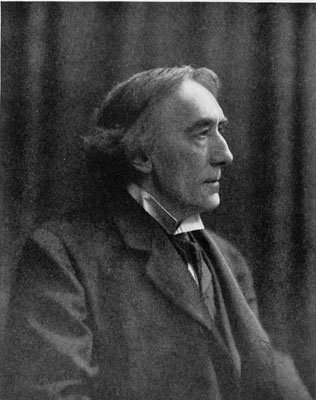
SIR HENRY IRVING
From a portrait given by him to Miss Evelyn Smalley in 1896
Henry and I were so fortunate as to gain the friendship and approval of Dr. Horace Howard Furness, perhaps the finest Shakespearean scholar in America, and editor of the "Variorum Shakespeare," which Henry considered the best of all editions—"the one which counts." It was in Boston, I think, that I disgraced myself at one of Dr. Furness's lectures. He was discussing "As You Like It" and Rosalind, and proving with much elaboration that English in Shakespeare's time was pronounced like a broad country dialect, and that Rosalind spoke Warwickshire! A little girl who was sitting in the row in front of me had lent me her copy of the play a moment before, and now, absorbed in Dr. Furness's argument, I forgot the book wasn't mine and began scrawling controversial notes in it with my very thick and blotty fountain pen.
"Give me back my book! Give me my book!" screamed the little girl. "How dare you write in my book!" She began to cry with rage.
Her mother tried to hush her up: "Don't, darling. Be quiet! It's Miss Ellen Terry."
"I don't care! She's spoilt my nice book!"
I am glad to say that when the little girl understood, she forgave me; and the spoilt book is treasured very much by a tall Boston young lady of eighteen who has replaced the child of seven years ago! Still, it was dreadful of me, and I did feel ashamed at the time.
I saw "As You Like It" acted in New York once with every part (except the man who let down the curtain) played by a woman, and it was extraordinarily well done. The most remarkable bit of acting was by Janauschek, who played Jacques. I have never heard the speech beginning "All the world's a stage" delivered more finely, not even by Phelps, who was fine in the part.
Mary Shaw's Rosalind was good, and the Silvius (who played it, now?) was charming.
Unfortunately that one man, poor creature (no wonder he was nervous!), spoiled the end of the play by failing to ring down the curtain, at which the laughter was immoderate! Janauschek used to do a little sketch from the German called "Come Here!" which I afterwards did in England.
In November, 1901, I wrote in my diary: "Philadelphia.—Supper at Henry's. Jefferson there, sweeter and more interesting than ever—and younger."
Dear Joe Jefferson—actor, painter, courteous gentleman, profound student of Shakespeare! When the Bacon-Shakespeare controversy was raging in America (it really did rage there!) Jefferson wrote the most delicious doggerel about it. He ridiculed, and his ridicule killed the Bacon enthusiasts all the more dead because it was barbed with erudition.
He said that when I first came into the box to see him as "Rip" he thought I did not like him, because I fidgeted and rustled and moved my place, as is my wicked way. "But I'll get her, and I'll hold her," he said to himself. I was held indeed—enthralled.
In manner Jefferson was a little like Norman Forbes-Robertson. Perhaps that was why the two took such a fancy to each other. When Norman was walking with Jefferson one day, some one who met them said:
"Your son?"
"No," said Jefferson, "but I wish he were! The young man has such good manners!"
Our first American tours were in 1883 and 1884; the third in 1887-88, the year of the great blizzard. Henry fetched us at half-past ten in the morning! His hotel was near the theater where we were to play at night. He said the weather was stormy, and we had better make for his hotel while there was time! The German actor Ludwig Barnay was to open in New York that night, but the blizzard affected his nerves to such an extent that he did not appear at all, and returned to Germany directly the weather improved!
Most of the theaters closed for three days, but we remained open, although there was a famine in the town and the streets were impassable. The cold was intense. Henry sent Walter out to buy some violets for Barnay, and when he brought them in to the dressing room—he had only carried them a few yards—they were frozen so hard that they could have been chipped with a hammer!
We rang up on "Faust" three-quarters of an hour late! This was not bad considering all things. Although the house was sold out, there was hardly any audience, and only a harp and two violins in the orchestra. Discipline was so strong in the Lyceum company that every member of it reached the theater by eight o'clock, although some of them had had to walk from Brooklyn Bridge.
The Mayor of New York and his daughter managed to reach their box somehow. Then we thought it was time to begin. Some members of Daly's company, including John Drew, came in, and a few friends. It was the oddest, scantiest audience! But the enthusiasm was terrific!
Five years went by before we visited America again. Five years in a country of rapid changes is a long time, long enough for friends to forget! But they didn't forget. This time we made new friends, too, in the Far West. We went to San Francisco, among other places. We attended part of a performance at the Chinese theater. Oh, those rows of impenetrable faces gazing at the stage with their long, shining, inexpressive eyes! What a look of the everlasting the Chinese have! "We have been before you—we shall be after you," they seem to say.
Just as we were getting interested in the play, the interpreter rose and hurried us out. Something that was not for the ears of women was being said, but we did not know it!
The chief incident of the fifth American tour was our production at Chicago of Laurence Irving's one-act play "Godefroi and Yolande." I regard that little play as an inspiration. By instinct the young author did everything right. The Chicago folk, in spite of the unpleasant theme of the play, recognized the genius of it, and received it splendidly.
In 1901 I was ill, and hated the parts I was playing in America. The Lyceum was not what it had been. Everything was changed.
In 1907—only the other day—I toured in America for the first time on my own account—playing modern plays for the first time. I made new friends and found my old ones still faithful.
But this tour was chiefly momentous to me because at Pittsburg I was married for the third time, and married to an American. My marriage was my own affair, but very few people seemed to think so, and I was overwhelmed with "inquiries," kind and otherwise. Kindness and loyalty won the day. "If any one deserves to be happy, you do," many a friend wrote. Well, I am happy, and while I am happy, I cannot feel old.
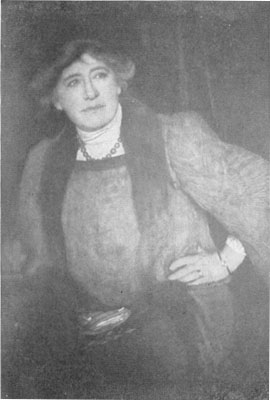
MISS ELLEN TERRY
From a photograph taken on her last tour in America