X LYCEUM PRODUCTIONS (continued)
Reading edition
"MUCH ADO ABOUT NOTHING" TO "FAUST"
Our success with "The Belle's Stratagem" had pointed to comedy, to Beatrice and Benedick in particular, because in Mrs. Cowley's old comedy we had had some scenes of the same type. I have already told of my first appearance as Beatrice at Leeds, and said that I never played the part so well again; but the Lyceum production was a great success, and Beatrice a great personal success for me. It is only in high comedy that people seem to know what I am driving at!
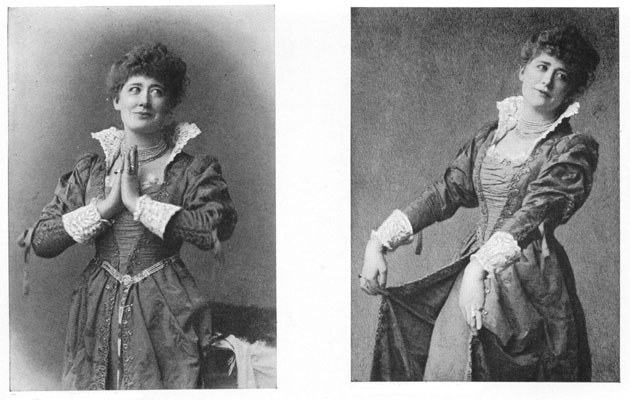
TWO PORTRAITS OF ELLEN TERRY AS BEATRICE
From the collection of Miss Frances Johnston
The stage-management of the play was very good; the scenery nothing out of the ordinary except for the Church Scene. There was no question that it was a church, hardly a question that old Mead was a Friar. Henry had the art of making ceremonies seem very real.
This was the first time that we engaged a singer from outside. Mr. Jack Robertson came into the cast to sing "Sigh no more, ladies," and made an enormous success.
Johnston Forbes-Robertson made his first appearance at the Lyceum as Claudio. I had not acted with him since "The Wandering Heir," and his improvement as an actor in the ten years that had gone by since then was marvelous. I had once said to him that he had far better stick to his painting and become an artist instead of an actor. His Claudio made me "take it back." It was beautiful. I have seen many young actors play the part since then, but not one of them made it anywhere near as convincing. Forbes-Robertson put a touch of Leontes into it, a part which some years later he was to play magnificently, and through the subtle indication of consuming and insanely suspicious jealousy made Claudio's offensive conduct explicable at least. On the occasion of the performance at Drury Lane which the theatrical profession organized in 1906 in honor of my Stage Jubilee, one of the items in the programme was a scene from "Much Ado about Nothing." I then played Beatrice for the last time and Forbes-Robertson played his old part of Claudio.
During the run Henry commissioned him to paint a picture of the Church Scene, which was hung in the Beefsteak Room. The engravings printed from it were at one time very popular. When Johnston was asked why he had chosen that particular moment in the Church Scene, he answered modestly that it was the only moment when he could put himself as Claudio at the "side"! Some of the other portraits in the picture are Henry Irving, Terriss, who played Don Pedro; Jessie Millward as Hero, Mr. Glenny as Don John, Miss Amy Coleridge, Miss Harwood, Mr. Mead, and his daughter "Charley" Mead, a pretty little thing who was one of the pages.
The Lyceum company was not a permanent one. People used to come, learn something, go away, and come back at a larger salary! Miss Emery left for a time, and then returned to play Hero and other parts. I liked her Hero better than Miss Millward's. Miss Millward had a sure touch; strength, vitality, interest; but somehow she was commonplace in the part.
Henry used to spend hours and hours teaching people. I used to think impatiently: "Acting can't be taught." Gradually I learned to modify this conviction and to recognize that there are two classes of actors:
1. Those who can only do what they are taught.
2. Those who cannot be taught, but can be helped by suggestion to work out things for themselves.
Henry said to me once: "What makes a popular actor? Physique! What makes a great actor? Imagination and sensibility." I tried to believe it. Then I thought to myself: "Henry himself is not quite what is understood by 'an actor of physique,' and certainly he is popular. And that he is a great actor I know. He certainly has both imagination and 'sense and sensibility.'" After the lapse of years I begin to wonder if Henry was ever really popular. It was natural to most people to dislike his acting—they found it queer, as some find the painting of Whistler—but he forced them, almost against their will and nature, out of dislike into admiration. They had to come up to him, for never would he go down to them. This is not popularity.
Brain allied with the instinct of the actor tells, but stupidity allied with the instinct of the actor tells more than brain alone. I have sometimes seen a clever man who was not a born actor play a small part with his brains, and have felt that the cleverness was telling more with the actors on the stage than with the audience.
Terriss, like Mrs. Pritchard, if we are to believe what Dr. Johnson said of her, often did not know what on earth he was talking about! One morning we went over and over one scene in "Much Ado"—at least a dozen times I should think—and each time when Terriss came to the speech beginning:
"What needs the bridge much broader than the flood,"
he managed to give a different emphasis. First it would be:
"What! Needs the bridge much broader than the flood!" Then:
"What needs the bridge much broader than the flood."
After he had been floundering about for some time, Henry said:
"Terriss, what's the meaning of that?"
"Oh, get along, Guv'nor, you know!"
Henry laughed. He never could be angry with Terriss, not even when he came to rehearsal full of absurd excuses. One day, however, he was so late that it was past a joke, and Henry spoke to him sharply.
"I think you'll be sorry you've spoken to me like this, Guv'nor," said Terriss, casting down his eyes.
"Now no hanky-panky tricks, Terriss."
"Tricks, Guv'nor! I think you'll regret having said that when you hear that my poor mother passed away early this morning."
And Terriss wept.
Henry promptly gave him the day off. A few weeks later, when Terriss and I were looking through the curtain at the audience just before the play began, he said to me gaily:
"See that dear old woman sitting in the fourth row of stalls—that's my dear old mother."
The wretch had quite forgotten that he had killed her!
He was the only person who ever ventured to "cheek" Henry, yet he never gave offense, not even when he wrote a letter of this kind:
"My dear Guv.,— "I hope you are enjoying yourself, and in the best of health. I very much want to play 'Othello' with you next year (don't laugh). Shall I study it up, and will you do it with me on tour if possible? Say yes, and lighten the drooping heart of yours sincerely, "WILL TERRISS."
I have never seen any one at all like Terriss, and my father said the same. The only actor of my father's day, he used to tell me, who had a touch of the same insouciance and lawlessness was Leigh Murray, a famous jeune premier.
One night he came into the theater soaked from head to foot.
"Is it raining, Terriss?" said some one who noticed that he was wet.
"Looks like it, doesn't it?" said Terriss carelessly.
Later it came out that he had jumped off a penny steamboat into the Thames and saved a little girl's life. It was pretty brave, I think.
Mr. Pinero, who was no longer a member of the Lyceum company when "Much Ado" was produced, wrote to Henry after the first night that it was "as perfect a representation of a Shakespearean play as I conceive to be possible. I think," he added, "that the work at your theater does so much to create new playgoers—which is what we want, far more I fancy than we want new theaters and perhaps new plays."
A playgoer whose knowledge of the English stage extended over a period of fifty-five years, wrote another nice letter about "Much Ado" which was passed on to me because it had some ridiculously nice things about me in it.
SAVILE CLUB, January 13, 1883.
"My dear Henry,— "I were an imbecile ingrate if I did not hasten to give you my warmest thanks for the splendid entertainment of last night. Such a performance is not a grand entertainment merely, or a glorious pastime, although it was all that. It was, too, an artistic display of the highest character, elevating in the vast audience their art instinct—as well as purifying any developed art in the possession of individuals. "I saw the Kean revivals of 1855-57, and I suppose 'The Winter's Tale' was the best of the lot. But it did not approach last night.... "I was impressed more strongly than ever with the fact that the plays of Shakespeare were meant to be acted. The man who thinks that he can know Shakespeare by reading him is a shallow ass. The best critic and scholar would have been carried out of himself last night into the poet's heart, his mind-spirit.... The Terry was glorious.... The scenes in which she appeared—and she was in eight out of the sixteen—reminded me of nothing but the blessed sun that not only beautifies but creates. But she never acts so well as when I am there to see! That is a real lover's sentiment, and all lovers are vain men. "Terriss has 'come on' wonderfully, and his Don Pedro is princely and manful. "I have thus set down, my dear Irving, one or two things merely to show that my gratitude to you is not that of a blind gratified idiot, but of one whose intimate personal knowledge of the English stage entitles him to say what he owes to you." "I am "Affectionately yours, "A.J. DUFFIELD."
In 1891, when we revived "Much Ado," Henry's Benedick was far more brilliant than it was at first. In my diary, January 5, 1891, I wrote:
"Revival of 'Much Ado about Nothing.' Went most brilliantly. Henry has vastly improved upon his old rendering of Benedick. Acts larger now—not so 'finicking.' His model (of manner) is the Duke of Sutherland. VERY good. I did some parts better, I think—made Beatrice a nobler woman. Yet I failed to please myself in the Cathedral Scene." Two days later.—"Played the Church Scene all right at last. More of a blaze. The little scene in the garden, too, I did better (in the last act). Beatrice has confessed her love, and is now softer. Her voice should be beautiful now, breaking out into playful defiance now and again, as of old. The last scene, too, I made much more merry, happy, soft." January 8.—"I must make Beatrice more flashing at first, and softer afterwards. This will be an improvement upon my old reading of the part. She must be always merry and by turns scornful, tormenting, vexed, self-communing, absent, melting, teasing, brilliant, indignant, sad-merry, thoughtful, withering, gentle, humorous, and gay, Gay, Gay! Protecting (to Hero), motherly, very intellectual—a gallant creature and complete in mind and feature."
After a run of two hundred and fifty nights, "Much Ado," although it was still drawing fine houses, was withdrawn as we were going to America in the autumn (of 1883) and Henry wanted to rehearse the plays that we were to do in the States by reviving them in London at the close of the summer season. It was during these revivals that I played Janette in "The Lyons Mail"—not a big part, and not well suited to me, but I played it well enough to support my theory that whatever I have not been, I have been a useful actress.
I always associate "The Lyons Mail" with old Mead, whose performance of the father, Jerome Lesurques, was one of the most impressive things that this fine actor ever did with us. (Before Henry was ever heard of, Mead had played Hamlet at Drury Lane!) Indeed when he "broke up," Henry put aside "The Lyons Mail" for many years because he dreaded playing Lesurques' scene with his father without Mead.
In the days just before the break-up, which came about because Mead was old, and—I hope there is no harm in saying of him what can be said of many men who have done finely in the world—too fond of "the wine when it is red," Henry use to suffer great anxiety in the scene, because he never knew what Mead was going to do or say next. When Jerome Lesurques is forced to suspect his son of crime, he has a line:
"Am I mad, or dreaming? Would I were."
Mead one night gave a less poetic reading:
"Am I mad or drunk? Would I were!"
It will be remembered by those who saw the play that Lesurques, an innocent man, will not commit the Roman suicide of honor at his father's bidding, and refuses to take up his pistol from the table. "What! you refuse to die by your own hands, do you?" says the elder Lesurques. "Then die like a dog by mine!" (producing a pistol from his pocket).
One night, after having delivered the line with his usual force and impressiveness, Mead, after prolonged fumbling in his coat-tail pockets, added another:
"D—, b——! God bless my soul! Where's the pistol? I haven't got the pistol!"
The last scene in the eventful history of "Meadisms" in "'The Lyons Mail" was when Mead came on to the stage in his own top-hat, went over to the sofa, and lay down, apparently for a nap! Not a word could Henry get from him, and Henry had to play the scene by himself. He did it in this way:
"You say, father, that I," etc. "I answer you that it is false!"
Mead had a remarkable foot. Norman Forbes called it an architectural foot. Bunions and gout combined to give it a gargoyled effect! One night, I forget whether it was in this play or another, Henry, pawing the ground with his foot before an "exit"—one of the mannerisms which his imitators delighted to burlesque—came down on poor old Mead's foot, bunion gargoyles and all! Hardly had Mead stopped cursing under his breath than on came Tyars, and brought down his weight heavily on the same foot. Directly Tyars came off the stage he looked for Mead in the wings and offered an apology.
"I beg your pardon—I'm really awfully sorry, Mead."
"Sorry! sorry!" the old man snorted. "It's a d——d conspiracy!"
It was the dignity and gravity of Mead which made everything he said so funny. I am afraid that those who never knew him will wonder where the joke comes in.
I forget what year he left us for good, but in a letter of Henry's dated September, 1888, written during a provincial tour of "Faust," when I was ill and my sister Marion played Margaret instead of me, I find this allusion to him:
"Wenman does the Kitchen Witch now (I altered it this morning) and Mead the old one—the climber. Poor old chap, he'll not climb much longer!"
This was one of the least successful of Henry's Shakespearean productions. Terriss looked all wrong as Orsino; many other people were miscast. Henry said to me a few years later when he thought of doing "The Tempest," "I can't do it without three great comedians. I ought never to have attempted 'Twelfth Night' without them."
I don't think that I played Viola nearly as well as my sister Kate. Her "I am the man" was very delicate and charming. I overdid that. My daughter says: "Well, you were far better than any Viola that I have seen since, but you were too simple to make a great hit in it. I think that if you had played Rosalind the public would have thought you too simple in that. Somehow people expect these parts to be acted in a 'principal boy' fashion, with sparkle and animation."
We had the curious experience of being "booed" on the first night. It was not a comedy audience, and I think the rollickings of Toby Belch and his fellows were thought "low." Then people were put out by Henry's attempt to reserve the pit. He thought that the public wanted it. When he found that it was against their wishes he immediately gave in. His pride was the service of the public.
His speech after the hostile reception of "Twelfth Night" was the only mistake that I ever knew him make. He was furious, and showed it. Instead of accepting the verdict, he trounced the first-night audience for giving it. He simply could not understand it!
My old friend Rose Leclercq, who was in Charles Kean's company at the Princess's when I made my first appearance upon the stage, joined the Lyceum company to play Olivia. Strangely enough she had lost the touch for the kind of part. She, who had made one of her early successes as the spirit of Astarte in "Manfred," was known to a later generation of playgoers as the aristocratic dowager of stately presence and incisive repartee. Her son, Fuller Mellish, was also in the cast as Curio, and when we played "Twelfth Night" in America was promoted to the part of Sebastian, my double. In London my brother Fred played it. Directly he walked on to the stage, looking as like me as possible, yet a man all over, he was a success. I don't think that I have ever seen anything so unmistakable and instantaneous.
In America "Twelfth Night" was liked far better than in London, but I never liked it. I thought our production dull, lumpy and heavy. Henry's Malvolio was fine and dignified, but not good for the play, and I never could help associating my Viola with physical pain. On the first night I had a bad thumb—I thought it was a whitlow—and had to carry my arm in a sling. It grew worse every night, and I felt so sick and faint from pain that I played most of my scenes sitting in a chair. One night Dr. Stoker, Bram Stoker's brother, came round between the scenes, and, after looking at my thumb, said:
"Oh, that'll be all right. I'll cut it for you."
He lanced it then and there, and I went on with my part for that night. George Stoker, who was just going off to Ireland, could not see the job through, but the next day I was in for the worst illness I ever had in my life. It was blood-poisoning, and the doctors were in doubt for a little as to whether they would not have to amputate my arm. They said that if George Stoker had not lanced the thumb that minute, I should have lost my arm.
A disagreeable incident in connection with my illness was that a member of my profession made it the occasion of an unkind allusion (in a speech at the Social Science Congress) to "actresses who feign illness and have straw laid down before their houses, while behind the drawn blinds they are having riotous supper-parties, dancing the can-can and drinking champagne." Upon being asked for "name," the speaker would neither assert nor deny that it was Ellen Terry (whose poor arm at the time was as big as her waist, and that has never been very small!) that she meant.
I think we first heard of the affair on our second voyage to America, during which I was still so ill that they thought I might never see Quebec, and Henry wrote a letter to the press—a "scorcher." He showed it to me on the boat. When I had read it, I tore it up and threw the bits into the sea.
"It hasn't injured me in any way," I said. "Any answer would be undignified."
Henry did what I wished in the matter, but, unlike me, whose heart I am afraid is of wax—no impression lasts long—he never forgot it, and never forgave. If the speech-maker chanced to come into a room where he was—he walked out. He showed the same spirit in the last days of his life, long after our partnership had come to an end. A literary club, not a hundred yards from Hyde Park Corner, "blackballed"' me (although I was qualified for election under the rules) for reasons with which I was never favored. The committee, a few months later, wished Henry Irving to be the guest of honor at one of the club dinners. The honor was declined.
The first night of "Olivia" at the Lyceum was about the only comfortable first night that I have ever had! I was familiar with the part, and two of the cast, Terriss and Norman Forbes, were the same as at the Court, which made me feel all the more at home. Henry left a great deal of the stage-management to us, for he knew that he could not improve on Mr. Hare's production. Only he insisted on altering the last act, and made a bad matter worse. The division into two scenes wasted time, and nothing was gained by it. Never obstinate, Henry saw his mistake and restored the original end after a time. It was weak and unsatisfactory but not pretentious and bad like the last act he presented at the first performance.
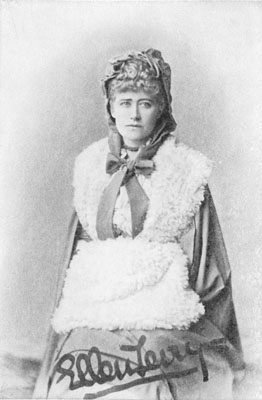
ELLEN TERRY'S FAVOURITE PHOTOGRAPH AS OLIVIA
From the collection of Miss Evelyn Smalley
We took the play too slowly at the Lyceum. That was often a fault there. Because Henry was slow, the others took their time from him, and the result was bad.
The lovely scene of the vicarage parlor, in which we used a harpsichord and were accused of pedantry for our pains, did not look so well at the Lyceum as at the Court. The stage was too big for it.
The critics said that I played Olivia better at the Lyceum, but I did not feel this myself.
At first Henry did not rehearse the Vicar at all well. One day when he was stamping his foot very much, as if he was Matthias in "The Bells," my little Edy, who was a terrible child and a wonderful critic, said:
"Don't go on like that, Henry. Why don't you talk as you do to me and Teddy? At home you are the Vicar."
The child's frankness did not offend Henry, because it was illuminating. A blind man had changed his Shylock; a little child changed his Vicar. When the first night came he gave a simple, lovable performance. Many people now understood and liked him as they had never done before. One of the things I most admired in it was his sense of the period.
In this, as in other plays, he used to make his entrance in the skin of the part. No need for him to rattle a ladder at the side to get up excitement and illusion as Macready is said to have done. He walked on, and was the simple-minded old clergyman, just as he had walked on a prince in "Hamlet," a king in "Charles I.," and a saint in "Becket."
A very handsome woman, descended from Mrs. Siddons and looking exactly like her, played the gipsy in "Olivia." The likeness was of no use, because the possessor of it had no talent. What a pity!
"Olivia" has always been a family play. Edy and Ted walked on the stage for the first time in the Court "Olivia." In later years Ted played Moses and Edy made her first appearance in a speaking part as Polly Flamborough, and has since played both Sophia and the Gipsy. My brother Charlie's little girl Beatrice made her first appearance as Bill, my sister Floss played Olivia on a provincial tour, and my sister Marion played it at the Lyceum when I was ill.
I saw Floss play it, and took from her a lovely and sincere bit of "business." In the third act, where the Vicar has found his erring daughter and has come to take her away from the inn, I had always hesitated at my entrance as if I were not quite sure what reception my father would give me after what had happened. Floss in the same situation came running in and went straight to her father, quite sure of his love if not of his forgiveness.
I did not take some business which Marion did on Terriss's suggestion. Where Thornhill tells Olivia that she is not his wife, I used to thrust him away with both hands as I said—"Devil!"
"It's very good, Nell, very fine," said Terriss to me, "but believe me, you miss a great effect there. You play it grandly, of course, but at that moment you miss it. As you say 'Devil!' you ought to strike me full in the face."
"Oh, don't be silly, Terriss," I said, "she's not a pugilist."
Of course I saw, apart from what was dramatically fit, what would happen.
However Marion, very young, very earnest, very dutiful, anxious to please Terriss, listened eagerly to the suggestion during an understudy rehearsal.
"No one could play this part better than your sister Nell," said Terriss to the attentive Marion, "but as I always tell her, she does miss one great effect. When Olivia says 'Devil!' she ought to hit me bang in the face."
"Thank you for telling me," said Marion gratefully.
"It will be much more effective," said Terriss.
It was. When the night came for Marion to play the part, she struck out, and Terriss had to play the rest of the scene with a handkerchief held to his bleeding nose!
I think it was as Olivia that Eleonora Duse first saw me act. She had thought of playing the part herself some time, but she said: "Never now!" No letter about my acting ever gave me the same pleasure as this from her:
"Madame,—Avec Olivia vous m'avez donné bonheur et peine. Bonheur part votre art qui est noble et sincère ... peine car je sens la tristesse au coeur quand je vois une belle et généreuse nature de femme, donner son âme à l'art—comme vous le faites—quand c'est la vie même, votre coeur même qui parle tendrement, douleureusement, noblement sous votre jeu. Je ne puis me débarrasser d'une certaine tristesse quand je vois des artistes si nobles et hauts tels que vous et Irving.... Si vous êtes si forts de soumettre (avec un travail continu) la vie à l'art, il faut done vous admirer comme des forces de la nature même qui auraient pourtant le droit de vivre pour elles-mêmes et non pour la foule. Je n'ose pas vous déranger, Madame, et d'ailleurs j'ai tant à faire aussi qu'il m'est impossible de vous dire de vive voix tout le grand plaisir que vous m'avez donné, mais puisque j'ai senti votre coeur, veuillez, chère Madame, croire au mien qui ne demande pas mieux dans cet instant que de vous admirer et de vous le dire tant bien que mal d'une manière quelconque. Bien à vous. "E. DUSE."
When I wrote to Madame Duse the other day to ask her permission to publish this much-prized letter, she answered:
BUENOS AYRES, Septembre 11, 1907. "Chère Ellen Terry,— "Au milieu du travail en Amérique, je reçois votre lettre envoyée à Florence. "Vous me demandez de publier mon ancienne lettre amicale. Oui, chère Ellen Terry; ce que j'ai donné vous appartient; ce que j'ai dit, je le peux encore, et je vous aime et admire comme toujours.... "J'espère que vous accepterez cette ancienne lettre que j'ai rendue plus claire et un peu mieux écrite. Vous en serez contente avec moi car, ainsi faisant, j'ai eu le moyen de vous dire que je vous aime et de vous le dire deux fois. "A vous de coeur, "E. DUSE."
Dear, noble Eleanora Duse, great woman, great artist—I can never appreciate you in words, but I store the delight that you have given me by your work, and the personal kindness that you have shown me, in the treasure-house of my heart!
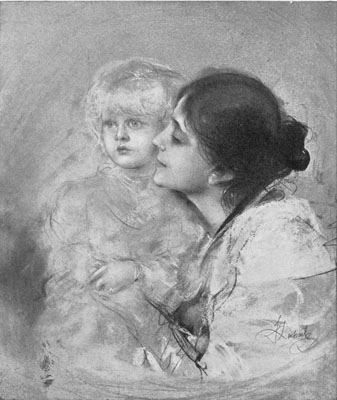
ELEANORA DUSE WITH LENBACH'S CHILD
From the painting by Franz von Lenbach
When I celebrated my stage jubilee you traveled all the way from Italy to support me on the stage at Drury Lane. When you stood near me, looking so beautiful with wings in your hair, the wings of glory they seemed to me, I could not thank you, but we kissed each other and you understood!
"Clap-trap" was the verdict passed by many on the Lyceum "Faust," yet Margaret was the part I liked better than any other—outside Shakespeare. I played it beautifully sometimes. The language was often very commonplace—not nearly as poetic or dramatic as that of "Charles I."—but the character was all right—simple, touching, sublime.
The Garden Scene I know was unsatisfactory. It was a bad, weak love-scene, but George Alexander as Faust played it admirably. Indeed he always acted like an angel with me; he was so malleable, ready to do anything. He was launched into the part at very short notice, after H.B. Conway's failure on the first night. Poor Conway! It was Coghlan as Shylock all over again.
Henry called a rehearsal the next day—on Sunday, I think. The company stood about in groups on the stage while Henry walked up and down, speechless, but humming a tune occasionally, always a portentous sign with him. The scene set was the Brocken Scene, and Conway stood at the top of the slope as far away from Henry as he could get! He looked abject. His handsome face was very red, his eyes full of tears. He was terrified at the thought of what was going to happen. The actor was summoned to the office, and presently Loveday came out and said that Mr. George Alexander would play Faust the following night. Alec had been wonderful as Valentine the night before, and as Faust he more than justified Henry's belief in him. After that he never looked back. He had come to the Lyceum for the first time in 1882, an unknown quantity from a stock company in Glasgow, to play Caleb Decie in "The Two Roses." He then left us for a time, returned for "Faust," and remained in the Lyceum company for some years playing all Terriss's parts.
Alexander had the romantic quality which was lacking in Terriss, but there was a kind of shy modesty about him which handicapped him when he played Squire Thornhill in "Olivia." "Be more dashing, Alec!" I used to say to him. "Well, I do my best," he said. "At the hotels I chuck all the barmaids under the chin, and pretend I'm a dog of a fellow for the sake of this part!" Conscientious, dear, delightful Alec! No one ever deserved success more than he did and used it better when it came, as the history of the St. James's Theater under his management proves. He had the good luck to marry a wife who was clever as well as charming, and could help him.
The original cast of "Faust" was never improved upon. What Martha was ever so good as Mrs. Stirling? The dear old lady's sight had failed since "Romeo and Juliet," but she was very clever at concealing it. When she let Mephistopheles in at the door, she used to drop her work on the floor so that she could find her way back to her chair. I never knew why she dropped it—she used to do it so naturally with a start when Mephistopheles knocked at the door—until one night when it was in my way and I picked it up, to the confusion of poor Mrs. Stirling, who nearly walked into the orchestra.
"Faust" was abused a good deal as a pantomime, a distorted caricature of Goethe, and a thoroughly inartistic production. But it proved the greatest of all Henry's financial successes. The Germans who came to see it, oddly enough, did not scorn it nearly as much as the English who were sensitive on behalf of the Germans, and the Goethe Society wrote a tribute to Henry Irving after his death, acknowledging his services to Goethe!
It is a curious paradox in the theater that the play for which every one has a good word is often the play which no one is going to see, while the play which is apparently disliked and run down is crowded every night.
Our preparations for the production of "Faust" included a delightful "grand tour" of Germany. Henry, with his accustomed royal way of doing things, took a party which included my daughter Edy, Mr. and Mrs. Comyns Carr, and Mr. Hawes Craven, who was to paint the scenery. We bought nearly all the properties used in "Faust" in Nuremberg, and many other things which we did not use, that took Henry's fancy. One beautifully carved escutcheon, the finest armorial device I ever saw, he bought at this time and presented it in after years to the famous American connoisseur, Mrs. Jack Gardiner. It hangs now in one of the rooms of her palace at Boston.
It was when we were going in the train along one of the most beautiful stretches of the Rhine that Sally Holland, who accompanied us as my maid, said:—
"Uncommon pretty scenery, dear, I must say!"
When we laughed uncontrollably, she added:
"Well, dear, I think so!"
During the run of "Faust" Henry visited Oxford and gave his address on "Four Actors" (Burbage, Betterton, Garrick, Kean). He met there one of the many people who had recently been attacking him on the ground of too long runs and too much spectacle. He wrote me an amusing account of the duel between them:
"I had supper last night at New College after the affair. A—— was there, and I had it out with him—to the delight of all. "'Too much decoration,' etc., etc. "I asked him what there was in 'Faust' in the matter of appointments, etc., that he would like left out?' "Answer: Nothing. "'Too long runs.' "'You, sir, are a poet,' I said. 'Perhaps it may be my privilege some day to produce a play of yours. Would you like it to have a long run or a short one?' (Roars of laughter.) "Answer: 'Well—er—well, of course, Mr. Irving, you—well—well, a short run, of course for art, but—' "'Now, sir, you're on oath,' said I. 'Suppose that the fees were rolling in £10 and more a night—would you rather the play were a failure or a success?' "'Well, well, as you put it—I must say—er—I would rather my play had a long run!' "A—— floored! "He has all his life been writing articles running down good work and crying up the impossible, and I was glad to show him up a bit! "The Vice-Chancellor made a most lovely speech after the address—an eloquent and splendid tribute to the stage. "Bourchier presented the address of the 'Undergrads.' I never saw a young man in a greater funk—because, I suppose, he had imitated me so often! "From the address: "'We have watched with keen and enthusiastic interest the fine intellectual quality of all these representations from Hamlet to Mephistopheles with which you have enriched the contemporary stage. To your influence we owe deeper knowledge and more reverent study of the master mind of Shakespeare.' "All very nice indeed!"
I never cared much for Henry's Mephistopheles—a twopence colored part, anyway. Of course he had his moments—he had them in every part—but they were few. One of them was in the Prologue, when he wrote in the student's book, "Ye shall be as gods knowing good and evil." He never looked at the book, and the nature of the spirit appeared suddenly in a most uncanny fashion. Another was in the Spinning-wheel Scene when Faust defies Mephistopheles, and he silences him with, "I am a spirit." Henry looked to grow a gigantic height—to hover over the ground instead of walking on it. It was terrifying.
I made valiant efforts to learn to spin before I played Margaret. My instructor was Mr. Albert Fleming, who, at the suggestion of Ruskin, had recently revived hand-spinning and hand-weaving in the North of England. I had always hated that obviously "property" spinning-wheel in the opera, and Margaret's unmarketable thread. My thread always broke, and at last I had to "fake" my spinning to a certain extent; but at least I worked my wheel right, and gave an impression that I could spin my pound of thread a day with the best.
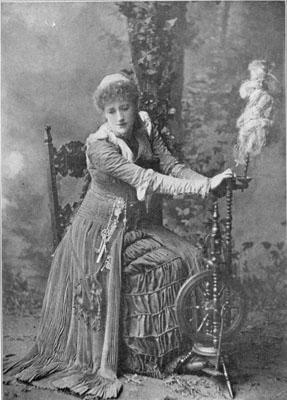
ELLEN TERRY AS MARGARET IN "FAUST"
Two operatic stars did me the honor to copy my Margaret dress—Madame Albani and Madame Melba. It was rather odd, by the way, that many mothers who took their daughters to see the opera of "Faust" would not bring them to see the Lyceum play. One of these mothers was Princess Mary of Teck, a constant patron of most of our plays.
Other people "missed the music." The popularity of an opera will often kill a play, although the play may have existed before the music was ever thought of. The Lyceum "Faust" held its own against Gounod. I liked our incidental music to the action much better. It was taken from many different sources and welded into an effective and beautiful whole by our clever musical director, Mr. Meredith Ball.
In many ways "Faust" was our heaviest production. About four hundred ropes were used, each rope with a name. The list of properties and instructions to the carpenters became a joke among the theater staff. When Henry first took "Faust" into the provinces, the head carpenter at Liverpool, Myers by name, being something of a humorist, copied out the list on a long thin sheet of paper, which rolled up like a royal proclamation. Instead of "God save the Queen!" he wrote at the foot, with many flourishes: "God help Bill Myers!"
The crowded houses at "Faust" were largely composed of "repeaters," as Americans call those charming playgoers who come to see a play again and again. We found favor with the artists and musicians too, even in Faust! Here is a nice letter I got during the run (it was a long one) from that gifted singer and good woman, Madame Antoinette Sterling:—
"My dear Miss Terry,— "I was quite as disappointed as yourself that you were not at St. James's Hall last Monday for my concert.... Jean Ingelow said she enjoyed the afternoon very much.... "I wonder if you would like to come to luncheon some day and have a little chat with her? But perhaps you already know her. I love her dearly. She has one fault—she never goes to the theater. Oh my! What she misses, poor thing, poor thing! We have already seen 'Faust' twice, and are going again soon, and shall take the George Macdonalds this time. The Holman Hunts were delighted. He is one of the most interesting and clever men I have ever met, and she is very charming and clever too. How beautifully plain you write! Give me the recipe.
"With many kind greetings,
"Believe me sincerely yours, "ANTOINETTE STERLING MACKINLAY."
My girl Edy was one of the angels in the vision in the last act of "Faust," an event which Henry commemorated in a little rhyme that he sent me on Valentine's Day with some beautiful flowers:
"White and red roses, Sweet and fresh posies, One bunch for Edy, Angel of mine— One bunch for Nell, my dear Valentine."
Mr. Toole ran a burlesque on the Lyceum "Faust," called "Faust-and-Loose." Henry did not care for burlesques as a rule. He thought Fred Leslie's exact imitation of him, face, spectacles, voice—everything was like Henry except the ballet-skirt—in the worst taste. But everything that Toole did was to him adorable. Marie Linden gave a really clever imitation of me as Marguerite. She and her sister Laura both had the trick of taking me off. I recognized the truth of Laura's caricature in the burlesque of "The Vicar of Wakefield" when as Olivia she made her entrance, leaping impulsively over a stile!
There was an absurd chorus of girl "mashers" in "Faust-and-Loose," dressed in tight black satin coats, who besides dancing and singing had lines in unison, such as "No, no!" "We will!" As one of these girls Violet Vanbrugh made her first appearance on the stage. In her case "we will!" proved prophetic. It was her plucky "I will get on" which finally landed her in her present successful position.
Violet Barnes was the daughter of Prebendary Barnes of Exeter, who, when he found his daughter stage-struck, behaved far more wisely than most parents. He gave her £100 and sent her to London with her old nurse to look after her, saying that if she really "meant business" she would find an engagement before the £100 was gone. Violet had inherited some talent from her mother, who was a very clever amateur actress, and the whole family were fond of getting up entertainments. But Violet didn't know quite how far £100 would go, or wouldn't go. I happened to call on her at her lodgings near Baker Street one afternoon, and found her having her head washed, and crying bitterly all the time! She had come to the end of the £100, she had not got an engagement, and thought she would have to go home defeated. There was something funny in the tragic situation. Vi was sitting on the floor, drying her hair, crying, and drinking port wine to cure a cold in her head!
I told her not to be a goose, but to cheer up and come and stay with me until something turned up. We packed the old nurse back to Devonshire. Violet came and stayed with me, and in due course something did turn up. Mr. Toole came to dinner, and Violet, acting on my instructions to ask every one she saw for an engagement, asked Mr. Toole! He said, "That's all right, my dear. Of course. Come down and see me to-morrow." Dear old Toole! The kindliest of men! Violet was with him for some time, and played at his theater in Mr. Barrie's first piece "Walker London." Her sister Irene, Seymour Hicks, and Mary Ansell (now Mrs. Barrie) were all in the cast.
This was all I did to "help" Violet Vanbrugh, now Mrs. Arthur Bourchier and one of our best actresses, in her stage career. She helped herself, as most people do who get on. I am afraid that I have discouraged more stage aspirants than I have encouraged. Perhaps I have snubbed really talented people, so great is my horror of girls taking to the stage as a profession when they don't realize what they are about. I once told an elderly aspirant that it was quite useless for any one to go on the stage who had not either great beauty or great talent. She wrote saying that my letter had been a great relief to her, as now she was not discouraged. "I have both."
There is one actress on the English stage whom I did definitely encourage, of whose talent I was certain.
When my daughter was a student at the Royal Academy of Music, Dr. (now Sir Alexander) Mackenzie asked me to distribute the medals to the Elocution Class at the end of the term. I was quite "new to the job," and didn't understand the procedure. No girl, I have learned since, can be given the gold medal until she has won both the bronze and the silver medals—that is, until she has been at the Academy three years. I was for giving the gold medalists, who only wanted certificates, bronze medals; and of one young girl who was in her first year and only entitled to a bronze medal, I said: "Oh, she must have the gold medal, of course!"
She was a queer-looking child, handsome, with a face suggesting all manner of possibilities. When she stood up to read the speech from "Richard II." she was nervous, but courageously stood her ground. She began slowly, and with a most "fetching" voice, to think out the words. You saw her think them, heard her speak them. It was so different from the intelligent elocution, the good recitation, but bad impersonation of the others! "A pathetic face, a passionate voice, a brain," I thought to myself. It must have been at this point that the girl flung away the book and began to act, in an undisciplined way, of course, but with such true emotion, such intensity, that the tears came to my eyes. The tears came to her eyes too. We both wept, and then we embraced, and then we wept again. It was an easy victory for her. She was incomparably better than any one. "She has to work," I wrote in my diary that day. "Her life must be given to it, and then she will—well, she will achieve just as high as she works." Lena Pocock was the girl's name, but she changed it to Lena Ashwell when she went on the stage.
In the days of the elocution class there was still some idea of her becoming a singer, but I strongly advised the stage, and wrote to my friend J. Comyns Carr, who was managing the Comedy Theater, that I knew a girl with "supreme talent" whom he ought to engage. Lena was engaged. After that she had her fight for success, but she went steadily forward.
Henry Irving has often been attacked for not preferring Robert Louis Stevenson's "Macaire" to the version which he actually produced in 1883. It would have been hardly more unreasonable to complain of his producing "Hamlet" in preference to Mr. Gilbert's "Rosencrantz and Guildenstern." Stevenson's "Macaire" may have all the literary quality that is claimed for it, although I personally think Stevenson was only making a delightful idiot of himself in it. Anyhow, it is frankly a burlesque, a skit, a satire on the real Macaire. The Lyceum was not a burlesque house! Why should Henry have done it?
It was funny to see Toole and Henry rehearsing together for "Macaire." Henry was always plotting to be funny. When Toole as Jacques Strop hid the dinner in his pocket, Henry, after much labor, thought of his hiding the plate inside his waistcoat. There was much laughter later on when Macaire, playfully tapping Strop with his stick, cracked the plate, and the pieces fell out! Toole hadn't to bother about such subtleties, and Henry's deep-laid plans for getting a laugh must have seemed funny to dear Toole, who had only to come on and say "Whoop!" and the audience roared!
Henry's death as Macaire was one of a long list of splendid deaths. Macaire knows the game is up, and makes a rush for the French windows at the back of the stage. The soldiers on the stage shoot him before he gets away. Henry did not drop, but turned round, swaggered impudently down to the table, leaned on it, then suddenly rolled over, dead.
Henry's production of "Werner" for one matinée was to do some one a good turn, and when Henry did a "good turn," he did it magnificently.7 We rehearsed the play as carefully as if we were in for a long run. Beautiful dresses were made for me by my friend Alice Carr. But when we had given that one matinée, they were put away for ever. The play may be described as gloom, gloom, gloom. It was worse than "The Iron Chest."
While Henry was occupying himself with "Werner," I was pleasing myself with "The Amber Heart," a play by Alfred Calmour, a young man who was at this time Wills's secretary. I wanted to do it, not only to help Calmour, but because I believed in the play and liked the part of Ellaline. I had thought of giving a matinée of it at some other theater, but Henry, who at first didn't like my doing it at all, said: "You must do it at the Lyceum. I can't let you, or it, go out of the theater."
So we had the matinée at the Lyceum. Mr. Willard and Mr. Beerbohm Tree were in the cast, and it was a great success. For the first time Henry saw me act—a whole part and from the "front" at least, for he had seen and liked scraps of my Juliet from the "side." Although he had known me such a long time, my Ellaline seemed to come quite as a surprise. "I wish I could tell you of the dream of beauty that you realized," he wrote after the performance. He bought the play for me, and I continued to do it "on and off" here and in America until 1902.
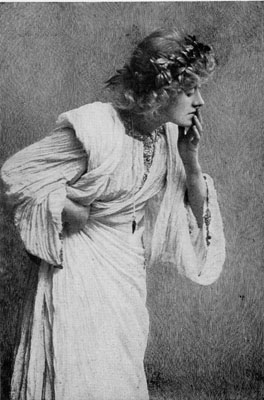
ELLEN TERRY AS ELLALINE IN "THE AMBER HEART"
From the collection of Miss Frances Johnston
Many people said that I was good but the play was bad. This was hard on Alfred Calmour. He had created the opportunity for me, and few plays with the beauty of "The Amber Heart" have come my way since. "He thinks it's all his doing!" said Henry. "If he only knew!" "Well, that's the way of authors," I answered. "They imagine so much more about their work than we put into it, that although we may seem to the outsider to be creating, to the author we are, at our best, only doing our duty by him."
Our next production was "Macbeth." Meanwhile we had visited America three times. It is now my intention to give some account of my tours in America, of my friends there, and of some of the impressions that the vast, wonderful country made on me.