VII EARLY DAYS AT THE LYCEUM
Reading edition
It is humiliating to me to confess that I have not the faintest recollection of "Brothers," the play by Coghlan, in which I see by the evidence of an old play-bill that I made my first appearance under Mr. Hare's management. I remember another play by Coghlan, in which Henry Kemble made one of his early appearances in the part of a butler, and how funny he was, even in those days, in a struggle to get rid of a pet monkey—a "property" monkey made of brown wool with no "devil" in it, except that supplied by the comedian's imagination. We trusted to our acting, not to real monkeys and real dogs to bring us through, and when the acting was Henry Kemble's, it was good enough to rely upon!
Charles Coghlan seems to have been consistently unlucky. Yet he was a good actor and a brilliant man. I always enjoyed his companionship; found him a pleasant, natural fellow, absorbed in his work, and not at all the "dangerous" man that some people represented him.
Within less than a month from the date of the production of "Brothers," "New Men and Old Acres" was put into the Court bill. It was not a new play, but the public at once began to crowd to see it, and I have heard that it brought Mr. Hare £30,000. My part, Lilian Vavasour, had been played in the original production by Mrs. Kendal, but it had been written for me by Tom Taylor when I was at the Haymarket, and it suited me very well. The revival was well acted all round. Charles Kelly was splendid as Mr. Brown, and Mr. Hare played a small part perfectly.
H.B. Conway, a young actor whose good looks were talked of everywhere, was also in the cast. He was a descendant of Lord Byron's, and had a look of the handsomest portraits of the poet. With his bright hair curling tightly all over his well-shaped head, his beautiful figure, and charming presence, Conway created a sensation in the 'eighties almost equal to that made by the more famous beauty, Lillie Langtry.
As an actor he belonged to the Terriss type, but he was not nearly as good as Terriss. Of his extraordinary failure in the Lyceum "Faust" I shall say something when I come to the Lyceum productions.
After "New Men and Old Acres," Mr. Hare tried a posthumous play by Lord Lytton—"The House of Darnley." It was not a good play, and I was not good in it, although the pleasant adulation of some of my friends has made me out so. The play met with some success, and during its run Mr. Hare commissioned Wills to write "Olivia."
I had known Wills before this through the Forbes-Robertsons. He was at one time engaged to one of the girls, but it was a good thing it ended in smoke. With all his charm, Wills was not cut out for a husband. He was Irish all over—the strangest mixture of the aristocrat and the sloven. He could eat a large raw onion every night like any peasant, yet his ideas were magnificent and instinct with refinement.
A true Bohemian in money matters, he made a great deal out of his plays—and never had a farthing to bless himself with!
In the theater he was charming—from an actor's point of view. He interfered very little with the stage management, and did not care to sit in the stalls and criticise. But he would come quietly to me and tell me things which were most illuminating, and he paid me the compliment of weeping at the wing while I rehearsed "Olivia."
I was generally weeping, too, for Olivia, more than any part, touched me to the heart. I cried too much in it, just as I cried too much later on in the Nunnery scene in "Hamlet," and in the last act of "Charles I." My real tears on the stage have astonished some people, and have been the envy of others, but they have often been a hindrance to me. I have had to work to restrain them.
Oddly enough, although "Olivia" was such a great success at the Court, it has never made much money since. The play could pack a tiny theater; it could never appeal in a big way to the masses. In itself it had a sure message—the love story of an injured woman is one of the cards in the stage pack which it is always safe to play—but against this there was a bad last act, one of the worst I have ever acted in. It was always being tinkered with, but patching and alteration only seems to weaken it.
Mr. Hare produced "Olivia" perfectly. Marcus Stone designed the clothes, and I found my dresses—both faithful and charming as reproductions of the eighteenth century spirit—stood the advance of time and the progress of ideas when I played the part later at the Lyceum. I had not to alter anything. Henry Irving discovered the same thing about the scenery and stage management. They could not be improved upon. There was very little scenery at the Court, but a great deal of taste and care in selection.
Every one was "Olivia" mad. The Olivia cap shared public favor with the Langtry bonnet. That most lovely and exquisite creature, Mrs. Langtry, could not go out anywhere, at the dawn of the 'eighties, without a crowd collecting to look at her! It was no rare thing to see the crowd, to ask its cause, to receive the answer, "Mrs. Langtry!" and to look in vain for the object of the crowd's admiring curiosity.
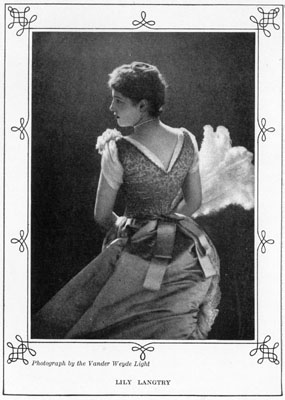
LILLIE LANGTRY
Photograph by the Vander Weyde Light
This was all the more remarkable, and honorable to public taste, too, because Mrs. Langtry's was not a showy beauty. Her hair was the color that it had pleased God to make it; her complexion was her own; in evening dress she did not display nearly as much of her neck and arms as was the vogue, yet they outshone all other necks and arms through their own perfection.
"No worker has a right to criticise publicly the work of another in the same field," Henry Irving once said to me, and Heaven forbid that I should disregard advice so wise! I am aware that the professional critics and the public did not transfer to Mrs. Langtry the actress the homage that they had paid to Mrs. Langtry the beauty, but I can only speak of the simplicity with which she approached her work, of her industry, and utter lack of vanity about her powers. When she played Rosalind (which my daughter, the best critic of acting I know, tells me was in many respects admirable), she wrote to me:
"Dear Nellie,— "I bundled through my part somehow last night, a disgraceful performance, and no waist-padding! Oh, what an impudent wretch you must think me to attempt such a part! I pinched my arm once or twice last night to see if it was really me. It was so sweet of you to write me such a nice letter, and then a telegram, too! "Yours ever, dear Nell, "LILLIE. "P.S.—I am rehearsing, all day—'The Honeymoon' next week. I love the hard work, and the thinking and study."
Just at this time there was a great dearth on the stage of people with lovely diction, and Lillie Langtry had it. I can imagine that she spoke Rosalind's lines beautifully, and that her clear gray eyes and frank manner, too well-bred to be hoydenish, must have been of great value.
To go back to "Olivia." Like all Hare's plays, it was perfectly cast. Where all were good, it will be admitted, I think, by every one who saw the production, that Terriss was the best. "As you stand there, whipping your boot, you look the very picture of vain indifference," Olivia says to Squire Thornhill in the first act, and never did I say it without thinking how absolutely to the life Terriss realized that description!
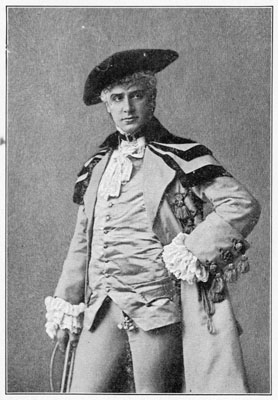
WILLIAM TERRISS AS SQUIRE THORNHILL IN "OLIVIA"
As I look back, I remember no figure in the theater more remarkable than Terriss. He was one of those heaven-born actors who, like kings by divine right, can, up to a certain point, do no wrong. Very often, like Dr. Johnson's "inspired idiot," Mrs. Pritchard, he did not know what he was talking about. Yet he "got there," while many cleverer men stayed behind. He had unbounded impudence, yet so much charm that no one could ever be angry with him. Sometimes he reminded me of a butcher-boy flashing past, whistling, on the high seat of his cart, or of Phaethon driving the chariot of the sun—pretty much the same thing, I imagine! When he was "dressed up" Terriss was spoiled by fine feathers; when he was in rough clothes, he looked a prince.
He always commanded the love of his intimates as well as that of the outside public. To the end he was "Sailor Bill"—a sort of grown-up midshipmite, whose weaknesses provoked no more condemnation than the weaknesses of a child. In the theater he had the tidy habits of a sailor. He folded up his clothes and kept them in beautiful condition; and of a young man who had proposed for his daughter's hand he said: "The man's a blackguard! Why, he throws his things all over the room! The most untidy chap I ever saw!"
Terriss had had every sort of adventure by land and sea before I acted with him at the Court. He had been midshipman, tea-planter, engineer, sheep-farmer, and horse-breeder. He had, to use his own words, "hobnobbed with every kind of queer folk, and found myself in extremely queer predicaments." The adventurous, dare-devil spirit of the roamer, the incarnate gipsy, always looked out of his insolent eyes. Yet, audacious as he seemed, no man was ever more nervous on the stage. On a first night he was shaking all over with fright, in spite of his confident and dashing appearance.
His bluff was colossal. Once when he was a little boy and wanted money, he said to his mother: "Give me £5 or I'll jump out of the window." And she at once believed he meant it, and cried out: "Come back, come back! and I'll give you anything."
He showed the same sort of "attack" with audiences. He made them believe in him the moment he stepped on to the stage.
His conversation was extremely entertaining—and, let me add, ingenuous. One of his favorite reflections was: "Tempus fugit! So make the most of it. While you're alive, gather roses; for when you're dead, you're dead a d——d long time."
He was a perfect rider, and loved to do cowboy "stunts" in Richmond Park while riding to the "Star and Garter."
When he had presents from the front, which happened every night, he gave them at once to the call-boy or the gas-man. To the women-folk, especially the plainer ones, he was always delightful. Never was any man more adored by the theater staff. And children, my own Edy included, were simply daft about him. A little American girl, daughter of William Winter, the famous critic, when staying with me in England, announced gravely when we were out driving:
"I've gone a mash on Terriss."
There was much laughter. When it had subsided, the child said gravely:
"Oh, you can laugh, but it's true. I wish I was hammered to him!"
Perhaps if he had lived longer, Terriss would have lost his throne. He died as a beautiful youth, a kind of Adonis, although he was fifty years old when he was stabbed at the stage-door of the Adelphi Theater.
Terriss had a beautiful mouth. That predisposed me in his favor at once! I have always been "cracked" on pretty mouths! I remember that I used to say "Naughty Teddy!" to my own little boy just for the pleasure of seeing him put out his under-lip, when his mouth looked lovely!
At the Court Terriss was still under thirty, but doing the best work of his life. He never did anything finer than Squire Thornhill, although he was clever as Henry VIII. His gravity as Flutter in "The Belle's Stratagem" was very fetching; as Bucklaw in "Ravenswood" he looked magnificent, and, of course, as the sailor hero in Adelphi melodrama he was as good as could be. But it is as Thornhill that I like best to remember him. He was precisely the handsome, reckless, unworthy creature that good women are fools enough to love.
In the Court production of "Olivia," both my children walked on to the stage for the first time. Teddy had such red cheeks that they made all the rouged cheeks look quite pale! Little Edy gave me a bunch of real flowers that she had picked in the country the day before.
Young Norman Forbes-Robertson was the Moses of the original cast. He played the part again at the Lyceum. How charming he was! And how very, very young! He at once gave promise of being a good actor and of having done the right thing in following his brother on to the stage. At the present day I consider him the only actor on the stage who can play Shakespeare's fools as they should be played.
Among the girls "walking on" was Kate Rorke. This made me take a special interest in watching what she did later on. No one who saw her fine performance in "The Profligate" could easily forget it, and I shall never understand why the London public ever let her go.
It was during the run of "Olivia" that Henry Irving became sole lessee of the Lyceum Theater. For a long time he had been contemplating the step, but it was one of such magnitude that it could not be done in a hurry. I daresay he found it difficult to separate from Mrs. Bateman and from her daughter, who had for such a long time been his "leading lady." He had to be a little cruel, not for the last time, in a career devoted unremittingly and unrelentingly to his art and his ambition.
It was said by an idle tongue in later years that rich ladies financed Henry Irving's ventures. The only shadow of foundation for this statement is that at the beginning of his tenancy of the Lyceum, the Baroness Burdett-Coutts lent him a certain sum of money, every farthing of which was repaid during the first few months of his management.
The first letter that I ever received from Henry Irving was written on July 20, 1878, from 15A, Grafton Street, the house in which he lived during the entire period of his Lyceum management.
"Dear Miss Terry,— "I look forward to the pleasure of calling upon you on Tuesday next at two o'clock. "With every good wish, believe me, sincerely, "HENRY IRVING."
The call was in reference to my engagement as Ophelia. Strangely characteristic I see it now to have been of Henry that he was content to take my powers as an actress more or less on trust. A mutual friend, Lady Pollock, had told him that I was the very person for him; that "all London" was talking of my Olivia; that I had acted well in Shakespeare with the Bancrofts; that I should bring to the Lyceum Theater what players call "a personal following." Henry chose his friends as carefully as he chose his company and his staff. He believed in Lady Pollock implicitly, and he did not—it is possible that he could not—come and see my Olivia for himself.
I was living in Longridge Road when Henry Irving first came to see me.
Not a word of our conversation about the engagement can I remember. I did notice, however, the great change that had taken place in the man since I had last met him in 1867. Then he was really almost ordinary looking—with a mustache, an unwrinkled face, and a sloping forehead. The only wonderful thing about him was his melancholy. When I was playing the piano once in the greenroom at the Queen's Theater, he came in and listened. I remember being made aware of his presence by his sigh—the deepest, profoundest, sincerest sigh I ever heard from any human being. He asked me if I would not play the piece again.
The incident impressed itself on my mind, inseparably associated with a picture of him as he looked at thirty—a picture by no means pleasing. He looked conceited, and almost savagely proud of the isolation in which he lived. There was a touch of exaggeration in his appearance—a dash of Werther, with a few flourishes of Jingle! Nervously sensitive to ridicule, self-conscious, suffering deeply from his inability to express himself through his art, Henry Irving, in 1867, was a very different person from the Henry Irving who called on me at Longridge Road in 1878.
In ten years he had found himself, and so lost himself—lost, I mean, much of that stiff, ugly, self-consciousness which had encased him as the shell encases the lobster. His forehead had become more massive, and the very outline of his features had altered. He was a man of the world, whose strenuous fighting now was to be done as a general—not, as hitherto, in the ranks. His manner was very quiet and gentle. "In quietness and confidence shall be your strength," says the Psalmist. That was always like Henry Irving.
And here, perhaps, is the place to say that I, of all people, can perhaps appreciate Henry Irving least justly, although I was his associate on the stage for a quarter of a century, and was on the terms of the closest friendship with him for almost as long a time. He had precisely the qualities that I never find likable.
He was an egotist—an egotist of the great type, never "a mean egotist," as he was once slanderously described—and all his faults sprang from egotism, which is in one sense, after all, only another name for greatness. So much absorbed was he in his own achievements that he was unable or unwilling to appreciate the achievements of others. I never heard him speak in high terms of the great foreign actors and actresses who from time to time visited England. It would be easy to attribute this to jealousy, but the easy explanation is not the true one. He simply would not give himself up to appreciation. Perhaps appreciation is a wasting though a generous quality of the mind and heart, and best left to lookers-on, who have plenty of time to develop it.
I was with him when he saw Sarah Bernhardt act for the first time. The play was "Ruy Blas," and it was one of Sarah's bad days. She was walking through the part listlessly, and I was angry that there should be any ground for Henry's indifference. The same thing happened years later, when I took him to see Eleonora Duse. The play was "La Locandiera," in which to my mind she is not at her very best. He was surprised at my enthusiasm. There was an element of justice in his attitude towards the performance which infuriated me, but I doubt if he would have shown more enthusiasm if he had seen her at her very best.
As the years went on he grew very much attached to Sarah Bernhardt, and admired her as a colleague whose managerial work in the theater was as dignified as his own, but of her superb powers as an actress, I don't believe he ever had a glimmering notion!
Perhaps it is not true, but, as I believe it to be true, I may as well state it: It was never any pleasure to him to see the acting of other actors and actresses. All the same, Salvini's Othello I know he thought magnificent, but he would not speak of it.
How dangerous it is to write things that may not be understood! What I have written I have written merely to indicate the qualities in Henry Irving's nature, which were unintelligible to me, perhaps because I have always been more woman than artist. He always put the theater first. He lived in it, he died in it. He had none of what I may call my bourgeois qualities—the love of being in love, the love of a home, the dislike of solitude. I have always thought it hard to find my inferiors. He was sure of his high place. He was far simpler than I in some ways. He would talk, for instance, in such an ingenuous way to painters and musicians that I blushed for him. But I know now that my blush was far more unworthy than his freedom from all pretentiousness in matters of art.
He never pretended. One of his biographers has said that he posed as being a French scholar. Such a thing, and all things like it, were impossible to his nature. If it were necessary in one of his plays to say a few French words, he took infinite pains to learn them and said them beautifully.
Henry once told me that in the early part of his career, before I knew him, he had been hooted because of his thin legs. The first service I did him was to tell him they were beautiful, and to make him give up padding them.
"What do you want with fat, podgy, prize-fighter legs!" I expostulated.
Praise to some people at certain stages of their career is more developing than blame. I admired the very things in Henry for which other people criticized him. I hope this helped him a little.
I brought help, too, in pictorial matters. Henry Irving had had little training in such matters—I had had a great deal. Judgment about colors, clothes and lighting must be trained. I had learned from Mr. Watts, from Mr. Godwin, and from other artists, until a sense of decorative effect had become second nature to me.
Before the rehearsals of "Hamlet" began at the Lyceum I went on a provincial tour with Charles Kelly, and played for the first time in "Dora," and "Iris," besides doing a steady round of old parts. In Birmingham I went to see Henry's Hamlet. (I have tried already, most inadequately, to say what it was to me.) I had also appeared for the first time as Lady Teazle—a part which I wish I was not too old to play now, for I could play it better. My performance in 1877 was not finished enough, not light enough. I think I did the screen scene well. When the screen was knocked over I did not stand still and rigid with eyes cast down. That seemed to me an attitude of guilt. Only a guilty woman, surely, in such a situation would assume an air of conscious virtue. I shrank back, and tried to hide my face—a natural movement, so it seemed to me, for a woman who had been craning forward, listening in increasing agitation to the conversation between Charles and Joseph Surface.
I shall always regret that we never did "The School for Scandal," or any of the other classic comedies, at the Lyceum. There came a time when Henry was anxious for me to play Lady Teazle, but I opposed him, as I thought that I was too old. It should have been one of my best parts.
"Star" performances, for the benefit of veteran actors retiring from the stage, were as common in my youth as now. About this time I played in "Money" for the benefit of Henry Compton, a fine comedian who had delighted audiences at the Haymarket for many years. On this occasion I did not play Clara Douglas as I had done during the revival at the Prince of Wales's, but the comedy part, Georgina Vesey. John Hare, Mr. and Mrs. Kendal, Henry Neville, Mr. and Mrs. Bancroft, and, last but not least, Benjamin Webster, who came out of his retirement to play Graves—"his original part"—were in the cast.
I don't think that Webster ever appeared on the stage again, although he lived on for many years in an old-fashioned house near Kennington Church, and died at a great age. He has a descendant on the stage in Mr. Ben Webster, who acted with us at the Lyceum, and is now well known both in England and America.
Henry Compton's son, Edward, was in this performance of "Money." He was engaged to the beautiful Adelaide Neilson, an actress whose brilliant career was cut off suddenly when she was riding in the Bois. She drank a glass of milk when she was overheated, was taken ill, and died. I am told that she commanded £700 a week in America, and in England people went wild over her Juliet. She looked like a child of the warm South, although she was born, I think, in Manchester, and her looks were much in her favor as Juliet. She belonged to the ripe, luscious, pomegranate type of woman. The only living actress with the same kind of beauty is Maxine Elliott.
Adelaide Neilson had a short reign, but a most triumphant one. It was easy to understand it when one saw her. She was so gracious, so feminine, so lovely. She did things well, but more from instinct than anything else. She had no science. Edward Compton now takes his own company round the provinces in an excellent répertoire of old comedies. He has done as much to make country audiences familiar with them as Mr. Benson has done to make them familiar with Shakespeare.
I come now to the Lyceum rehearsals of November, 1878. Although Henry Irving had played Hamlet for over two hundred nights in London, and for I don't know how many nights in the provinces, he always rehearsed in cloak and rapier. This careful attention to detail came back to my mind years afterwards, when he gave readings of Macbeth. He never gave a public reading without first going through the entire play at home—at home, that is to say, in a miserably uncomfortable hotel.
During the first rehearsal he read every one's part except mine, which he skipped, and the power that he put into each part was extraordinary. He threw himself so thoroughly into it that his skin contracted and his eyes shone. His lips grew whiter and whiter, and his skin more and more drawn as the time went on, until he looked like a livid thing, but beautiful.
He never got at anything easily, and often I felt angry that he would waste so much of his strength in trying to teach people to do things in the right way. Very often it only ended in his producing actors who gave colorless, feeble and unintelligent imitations of him. There were exceptions, of course.
When it came to the last ten days before the date named for the production of "Hamlet," and my scenes with him were still unrehearsed, I grew very anxious and miserable. I was still a stranger in the theater, and in awe of Henry Irving personally; but I plucked up courage, and said:
"I am very nervous about my first appearance with you. Couldn't we rehearse our scenes?"
"We shall be all right!" he answered, "but we are not going to run the risk of being bottled up by a gas-man or a fiddler."
When I spoke, I think he was conducting a band rehearsal. Although he did not understand a note of music, he felt, through intuition, what the music ought to be, and would pull it about and have alterations made. No one was cleverer than Hamilton Clarke, Henry's first musical director, and a most gifted composer, at carrying out his instructions. Hamilton Clarke often grew angry and flung out of the theater, saying that it was quite impossible to do what Mr. Irving required.
"Patch it together, indeed!" he used to say to me indignantly, when I was told off to smooth him down. "Mr. Irving knows nothing about music, or he couldn't ask me to do such a thing."
But the next day he would return with the score altered on the lines suggested by Henry, and would confess that the music was improved. "Upon my soul, it's better! The 'Guv'nor' was perfectly right."
His Danish march in "Hamlet," his Brocken music in "Faust," and his music for "The Merchant of Venice" were all, to my mind, exactly right. The brilliant gifts of Clarke, before many years had passed, "o'er-leaped" themselves, and he ended his days in a lunatic asylum.
The only person who did not profit by Henry's ceaseless labors was poor Ophelia. When the first night came, I did not play the part well, although the critics and the public were pleased. To myself I failed. I had not rehearsed enough. I can remember one occasion when I played Ophelia really well. It was in Chicago some ten years later. At Drury Lane, in 1896, when I played the mad scene for Nelly Farren's benefit, and took farewell of the part for ever, I was just damnable!
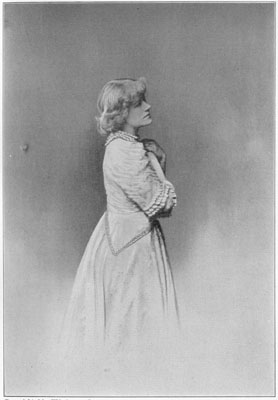
ELLEN TERRY AS OPHELIA
From a photograph taken in 1878, in the collection of Miss Evelyn Smalley
Ophelia only pervades the scenes in which she is concerned until the mad scene. This was a tremendous thing for me, who am not capable of sustained effort, but can perhaps manage a cumulative effort better than most actresses. I have been told that Ophelia has "nothing to do" at first. I found so much to do! Little bits of business which, slight in themselves, contributed to a definite result, and kept me always in the picture.
Like all Ophelias before (and after) me, I went to the madhouse to study wits astray. I was disheartened at first. There was no beauty, no nature, no pity in most of the lunatics. Strange as it may sound, they were too theatrical to teach me anything. Then, just as I was going away, I noticed a young girl gazing at the wall. I went between her and the wall to see her face. It was quite vacant, but the body expressed that she was waiting, waiting. Suddenly she threw up her hands and sped across the room like a swallow. I never forgot it. She was very thin, very pathetic, very young, and the movement was as poignant as it was beautiful.
I saw another woman laugh with a face that had no gleam of laughter anywhere—a face of pathetic and resigned grief.
My experiences convinced me that the actor must imagine first and observe afterwards. It is no good observing life and bringing the result to the stage without selection, without a definite idea. The idea must come first, the realism afterwards.
Perhaps because I was nervous and irritable about my own part from insufficient rehearsal, perhaps because his responsibility as lessee weighed upon him, Henry Irving's Hamlet on the first night at the Lyceum seemed to me less wonderful than it had been at Birmingham. At rehearsals he had been the perfection of grace. On the night itself, he dragged his leg and seemed stiff from self-consciousness. He asked me later on if I thought the ill-natured criticism of his walk was in any way justified, and if he really said "Gud" for "God," and the rest of it. I said straight out that he did say his vowels in a peculiar way, and that he did drag his leg.
I begged him to give up that dreadful, paralyzing waiting at the side for his cue, and after a time he took my advice. He was never obstinate in such matters. His one object was to find out, to test suggestion, and follow it if it stood his test.
He was very diplomatic when he meant to have his own way. He never blustered or enforced or threatened. My first acquaintance with this side of him was made over my dresser for Ophelia. He had heard that I intended to wear black in the mad scene, and he intended me to wear white. When he first mentioned the subject, I had no idea that there would be any opposition. He spoke of my dresses, and I told him that as I was very anxious not to be worried about them at the last minute, they had been got on with early and were now finished.
"Finished! That's very interesting! Very interesting. And what—er—what colors are they?"
"In the first scene I wear a pinkish dress. It's all rose-colored with her. Her father and brother love her. The Prince loves her—and so she wears pink."
"Pink," repeated Henry thoughtfully.
"In the nunnery scene I have a pale, gold, amber dress—the most beautiful color. The material is a church brocade. It will 'tone down' the color of my hair. In the last scene I wear a transparent, black dress."
Henry did not wag an eyelid.
"I see. In mourning for her father."
"No, not exactly that. I think red was the mourning color of the period. But black seems to me right—like the character, like the situation."
"Would you put the dresses on?" said Henry gravely.
At that minute Walter Lacy came up, that very Walter Lacy who had been with Charles Kean when I was a child, and who now acted as adviser to Henry Irving in his Shakespearean productions.
"Ah, here's Lacy. Would you mind, Miss Terry, telling Mr. Lacy what you are going to wear?"
Rather surprised, but still unsuspecting, I told Lacy all over again. Pink in the first scene, yellow in the second, black—
You should have seen Lacy's face at the word "black." He was going to burst out, but Henry stopped him. He was more diplomatic than that!
"They generally wear white, don't they?"
"I believe so," I answered, "but black is more interesting."
"I should have thought you would look much better in white."
"Oh, no!" I said.
And then they dropped the subject for that day. It was clever of him!
The next day Lacy came up to me:
"You didn't really mean that you are going to wear black in the mad scene?"
"Yes, I did. Why not?"
"Why not! My God! Madam, there must be only one black figure in this play, and that's Hamlet!"
I did feel a fool. What a blundering donkey I had been not to see it before! I was very thrifty in those days, and the thought of having been the cause of needless expense worried me. So instead of the crêpe de Chine and miniver, which had been used for the black dress, I had for the white dress Bolton sheeting and rabbit, and I believe it looked better.
The incident, whether Henry was right or not, led me to see that, although I knew more of art and archaeology in dress than he did, he had a finer sense of what was right for the scene. After this he always consulted me about the costumes, but if he said: "I want such and such a scene to be kept dark and mysterious," I knew better than to try and introduce pale-colored dresses into it.
Henry always had a fondness for "the old actor," and would engage him in preference to the tyro any day. "I can trust them," he explained briefly.
In the cast of "Hamlet" Mr. Forrester, Mr. Chippendale, and Tom Mead worthily repaid the trust. Mead, in spite of a terrible excellence in "Meadisms"—he substituted the most excruciatingly funny words for Shakespeare's when his memory of the text failed—was a remarkable actor. His voice as the Ghost was beautiful, and his appearance splendid. With his deep-set eyes, hawklike nose, and clear brow, he reminded me of the Rameses head in the British Museum.
We had young men in the cast, too. There was one very studious youth who could never be caught loafing. He was always reading, or busy in the greenroom studying by turns the pictures of past actor-humanity with which the walls were peopled, or the present realities of actors who came in and out of the room. Although he was so much younger then, Mr. Pinero looked much as he does now. He played Rosencrantz very neatly. Consummate care, precision, and brains characterized his work as an actor always, but his chief ambition lay another way. Rosencrantz and the rest were his school of stage-craft.
Kyrle Bellew, the Osric of the production, was another man of the future, though we did not know it. He was very handsome, a tremendous lady-killer! He wore his hair rather long, had a graceful figure, and a good voice, as became the son of a preacher who had the reputation of saying the Lord's Prayer so dramatically that his congregation sobbed.
Frank Cooper, a descendant of the Kembles, another actor who has risen to eminence since, played Laertes. It was he who first led me onto the Lyceum stage. Twenty years later he became my leading man on the first tour I took independently of Henry Irving since my tours with my husband, Charles Kelly.