IV A SIX-YEAR VACATION
Reading edition
1868-1874
My disappearance from the stage must have been a heavy blow to my father and mother, who had urged me to return in 1866 and were quite certain that I had a great future. For the first time for years they had no child in the theater. Marion and Floss, who were afterward to adopt the stage as a profession, were still at school; Kate had married; and none of their sons had shown any great aptitude for acting. Fred, who was afterwards to do so well, was at this time hardly out of petticoats.
Perhaps it was because I knew they would oppose me that I left the stage quite quietly and secretly. It seemed to outsiders natural, if regrettable, that I should follow Kate's example. But I was troubling myself little about what people were thinking and saying. "They are saying—what are they saying? Let them be saying!"
Then a dreadful thing happened. A body was found in the river,—the dead body of a young woman very fair and slight and tall. Every one thought that it was my body.
I had gone away without a word. No one knew where I was. My own father identified the corpse, and Floss and Marion, at their boarding-school, were put into mourning. Then mother went. She kept her head under the shock of the likeness, and bethought her of "a strawberry mark upon my left arm." (Really I had one over my left knee.) That settled it, for there was no such mark to be found upon the poor corpse. It was just at this moment that the news came to me in my country retreat that I had been found dead, and I flew up to London to give ocular proof to my poor distracted parents that I was alive. Mother, who had been the only one not to identify the drowned girl, confessed to me that she was so like me that just for a second she, too, was deceived. You see, they knew I had not been very happy since my return to the stage, and when I went away without a word, they were terribly anxious, and prepared to believe the first bad tidings that came to hand. It came in the shape of that most extraordinary likeness between me and that poor soul who threw herself into the river.
I was not twenty-one when I left the stage for the second time, and I haven't made up my mind yet whether it was good or bad for me, as an actress, to cease from practicing my craft for six years. Talma, the great French actor, recommends long spells of rest, and says that "perpetual indulgence in the excitement of impersonation dulls the sympathy and impairs the imaginative faculty of the comedian." This is very useful in my defense, yet I could find many examples which prove the contrary. I could never imagine Henry Irving leaving the stage for six months, let alone six years, and I don't think it would have been of the slightest benefit to him. But he had not been on the stage as a child.
If I was able to rest so long without rusting, it was, I am sure, because I had been thoroughly trained in the technique of acting long before I reached my twentieth year—an age at which most students are just beginning to wrestle with elementary principles.
Of course, I did not argue in this way at the time! As I have said, I had no intention of ever acting again when I left the Queen's Theater. If it is the mark of the artist to love art before everything, to renounce everything for its sake, to think all the sweet human things of life well lost if only he may attain something, do some good, great work—then I was never an artist. I have been happiest in my work when I was working for some one else. I admire those impersonal people who care for nothing outside their own ambition, yet I detest them at the same time, and I have the simplest faith that absolute devotion to another human being means the greatest happiness. That happiness was now mine.
I led a most unconventional life, and experienced exquisite delight from the mere fact of being in the country. No one knows what "the country" means until he or she has lived in it. "Then, if ever, come perfect days."
What a sensation it was, too, to be untrammeled by time! Actors must take care of themselves and their voices, husband their strength for the evening work, and when it is over they are too tired to do anything! For the first time I was able to put all my energies into living. Charles Lamb says, I think, that when he left the East India House, he felt embarrassed by the vast estates of time at his disposal, and wished that he had a bailiff to manage them for him, but I knew no such embarrassment.
I began gardening, "the purest of human pleasures"; I learned to cook, and in time cooked very well, though my first essay in that difficult art was rewarded with dire and complete failure.
It was a chicken! Now, as all the chickens had names—Sultan, Duke, Lord Tom Noddy, Lady Teazle, and so forth—and as I was very proud of them as living birds, it was a great wrench to kill one at all, to start with. It was the murder of Sultan, not the killing of a chicken. However, at last it was done, and Sultan deprived of his feathers, floured, and trussed. I had no idea how this was all done, but I tried to make him "sit up" nicely like the chickens in the shops.
He came up to the table looking magnificent—almost turkey-like in his proportions.
"Hasn't this chicken rather an odd smell?" said our visitor.
"How can you!" I answered. "It must be quite fresh—it's Sultan!"
However, when we began to carve, the smell grew more and more potent.
I had cooked Sultan without taking out his in'ards!
There was no dinner that day except bread-sauce, beautifully made, well-cooked vegetables, and pastry like the foam of the sea. I had a wonderful hand for pastry!
My hour of rising at this pleasant place near Mackery End in Hertfordshire was six. Then I washed the babies. I had a perfect mania for washing everything and everybody. We had one little servant, and I insisted on washing her head. Her mother came up from the village to protest.
"Never washed her head in my life. Never washed any of my children's heads. And just look at their splendid hair!"
After the washing I fed the animals. There were two hundred ducks and fowls to feed, as well as the children. By the time I had done this, and cooked the dinner, the morning had flown away. After the midday meal I sewed. Sometimes I drove out in the pony-cart. And in the evening I walked across the common to fetch the milk. The babies used to roam where they liked on this common in charge of a bulldog, while I sat and read.
I studied cookery-books instead of parts—Mrs. Beeton instead of Shakespeare!
Of course, I thought my children the most brilliant and beautiful children in the world, and, indeed, "this side idolatry," they were exceptional, and they had an exceptional bringing up. They were allowed no rubbishy picture-books, but from the first Japanese prints and fans lined their nursery walls, and Walter Crane was their classic. If injudicious friends gave the wrong sort of present, it was promptly burned. A mechanical mouse in which Edy, my little daughter, showed keen interest and delight, was taken away as being "realistic and common." Only wooden toys were allowed. This severe training proved so effective that when a doll dressed in a violent pink silk dress was given to Edy, she said it was "vulgar"!
By that time she had found a tongue, but until she was two years old she never spoke a word, though she seemed to notice everything with her grave dark eyes. We were out driving when I heard her voice for the first time:
"There's some more."
She spoke quite distinctly. It was almost uncanny.
"More what?" I asked in a trembling voice, afraid that having delivered herself once, she might lapse into dumbness.
"Birds!"
The nursemaid, Essie, described Edy tersely as "a piece," while Teddy, who was adored by every one because he was fat and fair and angelic-looking, she called "the feather of England."
"The feather of England" was considered by his sister a great coward. She used to hit him on the head with a wooden spoon for crying, and exhort him, when he said, "Master Teddy afraid of the dark," to be a woman!
I feel that if I go maundering on much longer about my children, some one will exclaim with a witty and delightful author when he saw "Peter Pan" for the seventh time: "Oh, for an hour of Herod!" When I think of little Edy bringing me in minute branches of flowers all the morning, with the reassuring intelligence that "there are lots more," I could cry. But why should any one be interested in that? Is it interesting to any one else that when she dug up a turnip in the garden for the first time, she should have come running in to beg me to come quick: "Miss Edy found a radish. It's as big as—as big as God!"
When I took her to her first theater—it was Sanger's Circus—and the clown pretended to fall from the tightrope, and the drum went bang! she said: "Take me away! take me away! you ought never to have brought me here!" No wonder she was considered a dour child! I immediately and humbly obeyed.
It was truly the simple life we led in Hertfordshire. From scrubbing floors and lighting fires, cooking, gardening, and harnessing the pony, I grew thinner than ever—as thin as a whipping-post, a hurdle, or a haddock! I went to church in blue-and-white cotton, with my servant in silk. "I don't half like it," she said. "They'll take you for the cook, and me for the lady!"
We kept a goat, a dear fellow whom I liked very much until I caught him one day chasing my daughter. I seized him by his horns to inflict severe punishment; but then I saw that his eyes were exactly like mine, and it made me laugh so much that I let him go and never punished him at all.
"Boo" became an institution in these days. She was the wife of a doctor who kept a private asylum in the neighboring village, and on his death she tried to look after the lunatics herself. But she wasn't at all successful! They kept escaping, and people didn't like it. This was my gain, for "Boo" came to look after me instead, and for the next thirty years I was her only lunatic, and she my most constant companion and dear and loyal friend.
We seldom went to London. When we did, Ted nearly had a fit at seeing so many "we'els go wound." But we went to Normandy, and saw Lisieux, Mantes, Bayeux. Long afterwards, when I was feeling as hard as sandpaper on the stage, I had only to recall some of the divine music I had heard in those great churches abroad to become soft, melted, able to act. I remember in some cathedral we left little Edy sitting down below while we climbed up into the clerestory to look at some beautiful piece of architecture. The choir were practicing, and suddenly there rose a boy's voice, pure, effortless, and clear.... For years that moment stayed with me. When we came down to fetch Edy, she said:
"Ssh! ssh! Miss Edy has seen the angels!"
Oh, blissful quiet days! How soon they came to an end! Already the shadow of financial trouble fell across my peace. Yet still I never thought of returning to the stage.
One day I was driving in a narrow lane, when the wheel of the pony-cart came off. I was standing there, thinking what I should do next, when a whole crowd of horsemen in "pink" came leaping over the hedge into the lane. One of them stopped and asked if he could do anything. Then he looked hard at me and exclaimed: "Good God! it's Nelly!"
The man was Charles Reade.
"Where have you been all these years?" he said.
"I have been having a very happy time," I answered.
"Well, you've had it long enough. Come back to the stage!"
"No, never!"
"You're a fool! You ought to come back."
Suddenly I remembered the bailiff in the house a few miles away, and I said laughingly: "Well, perhaps, I would think of it if some one would give me forty pounds a week!"
"Done!" said Charles Reade. "I'll give you that, and more, if you'll come and play Philippa Chester in 'The Wandering Heir.'"
He went on to explain that Mrs. John Wood, who had been playing Philippa at the New Queen's, of which he was the lessee, would have to relinquish the part soon, because she was under contract to appear elsewhere. The piece was a great success, and promised to run a long time if he could find a good Philippa to replace Mrs. Wood. It was a kind of Rosalind part, and Charles Reade only exaggerated pardonably when he said that I should never have any part better suited to me!
In a very short time after that meeting in the lane, it was announced that the new Philippa was to be an actress who was returning to the stage "after a long period of retirement." Only just before the first night did anyone guess who it was, and then there was great excitement among those who remembered me. The acclamation with which I was welcomed back on the first night surprised me. The papers were more flattering than they had ever been before. It was a tremendous success for me, and I was all the more pleased because I was following an accomplished actress in the part.
It is curious how often I have "followed" others. I never "created" a part, as theatrical parlance has it, until I played Olivia at the Court, and I had to challenge comparison, in turn, with Miss Marie Wilton, Mrs. John Wood and Mrs. Kendal. Perhaps it was better for me than if I had had parts specially written for me, and with which no other names were associated.
The hero of "The Wandering Heir," when I first took up the part of Philippa, was played by Edmund Leathes, but afterward by Johnston Forbes-Robertson. Everyone knows how good-looking he is now, but as a boy he was wonderful—a dreamy, poetic-looking creature in a blue smock, far more of an artist than an actor—he promised to paint quite beautifully—and full of aspirations and ideals. In those days began a friendship between us which has lasted unbroken until this moment. His father and mother were delightful people, and very kind to me always.
Everyone was kind to me at this time. Friends whom I had thought would be estranged by my long absence rallied round me and welcomed me as if it were six minutes instead of six years since I had dropped out of their ken. I was not yet a "made" woman, but I had a profitable engagement, and a delightful one, too, with Charles Reade, and I felt an enthusiasm for my work which had been wholly absent when I had returned to the stage the first time. My children were left in the country at first, but they came up and joined me when, in the year following "The Wandering Heir," I went to the Bancrofts at the Prince of Wales's. I never had the slightest fear of leaving them to their own devices, for they always knew how to amuse themselves, and were very independent and dependable in spite of their extreme youth. I have often thanked Heaven since that, with all their faults, my boy and girl have never been lazy and never dull. At this time Teddy always had a pencil in his hand, when he wasn't looking for his biscuit—he was a greedy little thing!—and Edy was hammering clothes onto her dolls with tin-tacks! Teddy said poetry beautifully, and when he and his sister were still tiny mites, they used to go through scene after scene of "As You Like It," for their own amusement, not for an audience, in the wilderness at Hampton Court. They were by no means prodigies, but it did not surprise me that my son, when he grew up, should be first a good actor, then an artist of some originality, and should finally turn all his brains and industry to new developments in the art of the theater. My daughter has acted also—not enough to please me, for I have a very firm belief in her talents—and has shown again and again that she can design and make clothes for the stage that are both lovely and effective. In all my most successful stage dresses lately she has had a hand, and if I had anything to do with a national theater, I should, without prejudice, put her in charge of the wardrobe at once!
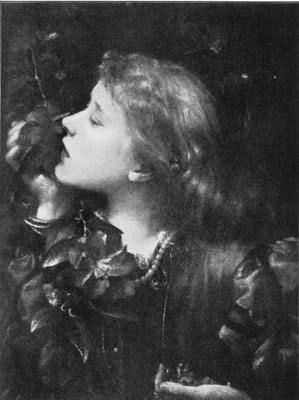
HEAD OF A YOUNG GIRL (ELLEN TERRY)
From the painting by George Frederick Watts, in the collection of Alexander Henderson, Esq., M.P.
Photograph by Braun, Clement & Co.
I may be a proud parent, but I have always refrained from "pushing" my children. They have had to fight for themselves, and to their mother their actual achievements have mattered very little. So long as they were not lazy, I have always felt that I could forgive them anything!
And now Teddy and Edy—Teddy in a minute white piqué suit, and Edy in a tiny kimono, in which she looked as Japanese as everything which surrounded her—disappear from these pages for quite a long time. But all this time, you must understand, they are educating their mother!
Charles Reade, having brought me back to the stage, and being my manager into the bargain, was deeply concerned about my progress as an actress. During the run of "The Wandering Heir" he used to sit in a private box every night to watch the play, and would send me round notes between the acts, telling me what I had done ill and what well in the preceding act. Dear, kind, unjust, generous, cautious, impulsive, passionate, gentle Charles Reade. Never have I known anyone who combined so many qualities, far asunder as the poles, in one single disposition. He was placid and turbulent, yet always majestic. He was inexplicable and entirely lovable—a stupid old dear, and as wise as Solomon! He seemed guileless, and yet had moments of suspicion and craftiness worthy of the wisdom of the serpent. One moment he would call me "dearest child"; the next, with indignant emphasis, "Madam!"
When "The Wandering Heir" had at last exhausted its great popularity, I went on a tour with Charles Reade in several of his plays. In spite of his many and varied interests, he had entirely succumbed to the magic of the "irresistible theater," and it used to strike me as rather pathetic to see a man of his power and originality working the stage sea at nights, in company with a rough lad, in his dramatic version of "Hard Cash." In this play, which was known as "Our Seaman," I had a part which I could not bear to be paid twenty-five pounds a week for acting. I knew that the tour was not a financial success, and I ventured to suggest that it would be good economy to get some one else for Susan Merton. For answer I got a fiery "Madam, you are a rat! You desert a sinking ship!" My dear old companion, Boo, who was with me, resented this very much: "How can you say such things to my Nelly?"
"Your Nelly!" said Charles Reade. "I love her a thousand times better than you do, or any puling woman."
Another time he grew white with rage, and his dark eyes blazed, because the same "puling woman" said very lightly and playfully: "Why did poor Nell come home from rehearsal looking so tired yesterday? You work her too hard." He thought this unfair, as the work had to be done, and flamed out at us with such violence that it was almost impossible to identify him with the kind old gentleman of the Colonel Newcome type whom I had seen stand up at the Tom Taylors', on Sunday evenings, and sing "The Girl I Left Behind Me" with such pathos that he himself was moved to tears. But, though it was a painful time for both of us, it was almost worth while to quarrel with him, because when we made it up he was sure to give me some "treat"—a luncheon, a present, or a drive. We both felt we needed some jollification because we had suffered so much from being estranged. He used to say that there should be no such word as "quarrel," and one morning he wrote me a letter with the following postscript written in big letters:
"THERE DO EXIST SUCH THINGS AS HONEST MISUNDERSTANDINGS. "There, my Eleanora Delicia" (this was his name for me, my real, full name being Ellen Alicia), "stick that up in some place where you will often see it. Better put it on your looking-glass. And if you can once get those words into your noddle, it will save you a world of unhappiness."
I think he was quite right about this. Would that he had been as right in his theories about stage management! He was a rare one for realism. He had preached it in all his plays, and when he produced a one-act play, "Rachael the Reaper," in front of "The Wandering Heir," he began to practice what he preached—jumped into reality up to the neck!
He began by buying real pigs, real sheep, a real goat, and a real dog. Real litter was strewn all over the stage, much to the inconvenience of the unreal farm-laborer, Charles Kelly, who could not compete with it, although he looked as like a farmer as any actor could. They all looked their parts better than the real wall which ran across the stage, piteously naked of real shadows, owing to the absence of the real sun, and, of course, deficient in the painted shadows which make a painted wall look so like the real thing.
Never, never can I forget Charles Reade's arrival at the theater in a four-wheeler with a goat and a lot of little pigs. When the cab drew up at the stage-door, the goat seemed to say, as plainly as any goat could: "I'm dashed if I stay in this cab any longer with these pigs!" and while Charles Reade was trying to pacify it, the piggies escaped! Unfortunately, they didn't all go in the same direction, and poor dear Charles Reade had a "divided duty." There was the goat, too, in a nasty mood. Oh, his serious face, as he decided to leave the goat and run for the pigs, with his loose trousers, each one a yard wide at least, flapping in the wind!
"That's a relief, at any rate," said Charles Kelly, who was watching the flight of the pigs. "I sha'n't have those d——d pigs to spoil my acting as well as the d——d dog and the d——d goat!"
How we all laughed when Charles Reade returned from the pig-hunt to rehearsal with the brief direction to the stage manager that the pigs would be "cut out."
The reason for the real wall was made more evident when the real goat was tied up to it. A painted wall would never have stood such a strain.
On the first night, the real dog bit Kelly's real ankles, and in real anger he kicked the real animal by a real mistake into the orchestra's real drum.
So much for realism as practiced by Charles Reade! There was still something to remind him of the experiment in Rachael, the circus goat. Rachael—he was no she, but what of that?—was given the free run of the garden of Reade's house at Knightsbridge. He had everything that any normal goat could desire—a rustic stable, a green lawn, the best of food. Yet Rachael pined and grew thinner and thinner. One night when we were all sitting at dinner, with the French windows open onto the lawn because it was a hot night, Rachael came prancing into the room, looking happy, lively, and quite at home. All the time, while Charles Reade had been fashing himself to provide every sort of rural joy for his goat, the ungrateful beast had been longing for the naphtha lights of the circus, for lively conversation and the applause of the crowd.
You can't force a goat any more than you can force a child to live the simple life. "N'Yawk's the place," said the child of a Bowery tenement in New York, on the night of her return from an enforced sojourn in Arcady. She hated picking daisies, and drinking rich new milk made her sick. When the kind teacher who had brought her to the country strove to impress her by taking her to see a cow milked, she remarked witheringly to the man who was milking: "Gee! You put it in!"
Rachael's sentiments were of the same type, I think. "Back to the circus!" was his cry, not "Back to the land!"
I hope, when he felt the sawdust under his feet again (I think Charles Reade sent him back to the ring), he remembered his late master with gratitude. To how many animals, and not only four-footed ones, was not Charles Reade generously kind, and to none of them more kind than to Ellen Terry.