V THE ACTRESS AND THE PLAYWRIGHT
Reading edition
THE END OF MY APPRENTICESHIP
1874
The relation between author and actor is a very important element in the life of the stage. It is the way with some dramatists to despise those who interpret their plays, to accuse us of ruining their creations, to suffer disappointment and rage because we do not, or cannot, carry out their ideas.
Other dramatists admit that we players can teach them something; but I have noticed that it is generally in "the other fellow's" play that we can teach them, not in their own!
As they are necessary to us, and we to them, the great thing is to reduce friction by sympathy. The actor should understand that the author can be of use to him; the author, on his side, should believe that the actor can be of service to the author, and sometimes in ways which only a long and severe training in the actor's trade can discover.
The first author with whom I had to deal, at a critical point in my progress as an actress, was Charles Reade, and he helped me enormously. He might, and often did, make twelve suggestions that were wrong; but against them he would make one that was so right that its value was immeasurable and unforgettable.
It is through the dissatisfaction of a man like Charles Reade that an actress learns—that is, if she is not conceited. Conceit is an insuperable obstacle to all progress. On the other hand, it is of little use to take criticism in a slavish spirit and to act on it without understanding it. Charles Reade constantly wrote and said things to me which were not absolutely just criticism; but they directed my attention to the true cause of the faults which he found in my performance, and put me on the way to mending them.
A letter which he wrote me during the run of "The Wandering Heir" was such a wonderful lesson to me that I am going to quote it almost in full, in the hope that it may be a lesson to other actresses—"happy in this, they are not yet so old but they can learn"; unhappy in this, that they have never had a Charles Reade to give them a trouncing!
Well, the letter begins with sheer eulogy. Eulogy is nice, but one does not learn anything from it. Had dear Charles Reade stopped after writing "womanly grace, subtlety, delicacy, the variety yet invariable truthfulness of the facial expression, compared with which the faces beside yours are wooden, uniform dolls," he would have done nothing to advance me in my art; but this was only the jam in which I was to take the powder!
Here followed more jam—with the first taste of the powder:
"I prefer you for my Philippa to any other actress, and shall do so still, even if you will not, or cannot, throw more vigor into the lines that need it. I do not pretend to be as good a writer of plays as you are an actress [how naughty of him!], but I do pretend to be a great judge of acting in general. [He wasn't, although in particular details he was a brilliant critic and adviser.] And I know how my own lines and business ought to be rendered infinitely better than any one else, except the Omniscient. It is only on this narrow ground I presume to teach a woman of your gifts. If I teach you Philippa, you will teach me Juliet; for I am very sure that when I have seen you act her, I shall know a vast deal more about her than I do at present. "No great quality of an actress is absent from your performance. Very often you have vigor. But in other places where it is as much required, or even more, you turn limp. You have limp lines, limp business, and in Act III. limp exits instead of ardent exits."
Except in the actual word used, he was perfectly right. I was not limp, but I was exhausted. By a natural instinct, I had produced my voice scientifically almost from the first, and I had found out for myself many things, which in these days of Delsarte systems and the science of voice-production, are taught. But when, after my six years' absence from the stage, I came back, and played a long and arduous part, I found that my breathing was still not right. This accounted for my exhaustion, or limpness and lack of vigor, as Charles Reade preferred to call it.
As for the "ardent" exits, how right he was! That word set me on the track of learning the value of moving off the stage with a swift rush. I had always had the gift of being rapid in movement, but to have a gift, and to use it, are two very different things.
I never realized that I was rather quick in movement until one day when I was sitting on a sofa talking to the famous throat specialist, Dr. Morell Mackenzie. In the middle of one of his sentences I said: "Wait a minute while I get a glass of water." I was out of the room and back so soon that he said, "Well, go and get it then!" and was paralyzed when he saw that the glass was in my hand and that I was sitting down again!
Consider! That was one of Charles Reade's favorite expressions, and just hearing him say the word used to make me consider, and think, and come to conclusions—perhaps not always the conclusions that he wished, but suggested by him.
In this matter of "ardent" exit, he wrote:
"The swift rush of the words, the personal rush, should carry you off the stage. It is in reality as easy as shelling peas, if you will only go by the right method instead of by the wrong. You have overcome far greater difficulties than this, yet night after night you go on suffering ignoble defeat at this point. Come, courage! You took a leaf out of Reade's dictionary at Manchester, and trampled on two difficulties—impossibilities, you called them. That was on Saturday, Monday you knocked the poor impossibilities down. Tuesday you kicked them where they lay. Wednesday you walked placidly over their prostrate bodies!"
The difficulty that he was now urging me to knock down was one of pace, and I am afraid that in all my stage life subsequently I never quite succeeded in kicking it or walking over its prostrate body!
Looking backward, I remember many times when I failed in rapidity of utterance, and was "pumped" at moments when swiftness was essential. Pace is the soul of comedy, and to elaborate lines at the expense of pace is disastrous. Curiously enough, I have met and envied this gift of pace in actors who were not conspicuously talented in other respects, and no Rosalind that I have ever seen has had enough of it. Of course, it is not a question of swift utterance only, but of swift thinking. I am able to think more swiftly on the stage now than at the time Charles Reade wrote to me, and I only wish I were young enough to take advantage of it. But youth thinks slowly, as a rule.
Vary the pace. Charles Reade was never tired of saying this, and, indeed, it is one of the foundations of all good acting.
"You don't seem quite to realize," he writes in the letter before me, "that uniformity of pace leads inevitably to languor. You should deliver a pistol-shot or two. Remember Philippa is a fiery girl; she can snap. If only for variety, she should snap James' head off when she says, 'Do I speak as if I loved them!'"
My memories of the part of Philippa are rather vague, but I know that Reade was right in insisting that I needed more "bite" in the passages when I was dressed as a boy. Though he complimented me on my self-denial in making what he called "some sacrifice of beauty" to pass for a boy, "so that the audience can't say, 'Why, James must be a fool not to see she is a girl,'" he scolded me for my want of bluntness.
"Fix your mind on the adjective 'blunt' and the substantive 'pistol-shot'; they will do you good service."
They did! And I recommend them to anyone who finds it hard to overcome monotony of pace and languor of diction.
"When you come to tell old Surefoot about his daughter's love," the letter goes on, "you should fall into a positive imitation of his manner: crest, motionless, and hands in front, and deliver your preambles with a nasal twang. But at the second invitation to speak out, you should cast this to the winds, and go into the other extreme of bluntness and rapidity. [Quite right!] When you meet him after the exposure, you should speak as you are coming to him and stop him in mid-career, and then attack him. You should also (in Act II.) get the pearls back into the tree before you say: 'Oh, I hope he did not see me!'"
Yes, I remember that in both these places I used to muddle and blur the effect by doing the business and speaking at the same time. By acting on Reade's suggestion I gained confidence in making a pause.
"After the beating, wait at least ten seconds longer than you do—to rouse expectation—and when you do come on, make a little more of it. You ought to be very pale indeed—even to enter with a slight totter, done moderately, of course; and before you say a single word, you ought to stand shaking and with your brows knitting, looking almost terrible. Of course, I do not expect or desire to make a melodramatic actress of you, but still I think you capable of any effect, provided it is not sustained too long."
A truer word was never spoken. It has never been in my power to sustain. In private life, I cannot sustain a hatred or a resentment. On the stage, I can pass swiftly from one effect to another, but I cannot fix one, and dwell on it, with that superb concentration which seems to me the special attribute of the tragic actress. To sustain, with me, is to lose the impression that I have created, not to increase its intensity.
"The last passage of the third act is just a little too hurried. Break the line. 'Now, James—for England and liberty!'"
I remember that I never could see that he was right about that, and if I can't see a thing I can't do it. The author's idea must become mine before I can carry it out—at least, with any sincerity, and obedience without sincerity would be of small service to an author. It must be despairing to him, if he wants me to say a line in a certain way, to find that I always say it in another; but I can't help it. I have tried to act passages as I have been told, just because I was told and without conviction, and I have failed miserably and have had to go back to my own way.
"Climax is reached not only by rush but by increasing pace. Your exit speech is a failure at present, because you do not vary the pace of its delivery. Get by yourself for one half-hour—if you can! Get by the seaside, if you can, since there it was Demosthenes studied eloquence and overcame mountains—not mole-hills like this. Being by the seaside, study those lines by themselves: 'And then let them find their young gentleman, and find him quickly, for London shall not hold me long—no, nor England either.' "Study to speak these lines with great volubility and fire, and settle the exact syllable to run at."
I remember that Reade, with characteristic generosity, gave me ten pounds and sent me to the seaside in earnest, as he suggests my doing, half in fun, in the letter. "I know you won't go otherwise," he said, "because you want to insure your life or do something of that sort. Here! go to Brighton—go anywhere by the sea for Sunday! Don't thank me! It's all for Philippa."
As I read these notes of his on anti-climax, monotony of pace, and all the other offenses against scientific principles of acting which I committed in this one part, I feel more strongly than ever how important it is to master these principles. Until you have learned them and practiced them you cannot afford to discard them. There is all the difference in the world between departure from recognized rules by one who has learned to obey them, and neglect of them through want of training or want of skill or want of understanding. Before you can be eccentric you must know where the circle is.
This is accepted, I am told, even in shorthand, where the pupil acquires the knowledge of a number of signs, only for the purpose of discarding them when he is proficient enough to make an individual system. It is also accepted in music, where only the advanced pianist or singer can afford to play tricks with tempo. And I am sure it should be accepted in acting.
Nowadays acting is less scientific (except in the matter of voice-production) than it was when I was receiving hints, cautions, and advice from my two dramatist friends, Charles Reade and Tom Taylor; and the leading principles to which they attached importance have come to be regarded as old-fashioned and superfluous. This attitude is comparatively harmless in the interpretation of those modern plays in which parts are made to fit the actors and personality is everything. But those who have been led to believe that they can make their own rules find their mistake when they come to tackle Shakespeare or any of the standard dramatists in which the actors have to fit themselves to the parts. Then, if ever, technique is avenged!
All my life the thing which has struck me as wanting on the stage is variety. Some people are "tone-deaf," and they find it physically impossible to observe the law of contrasts. But even a physical deficiency can be overcome by that faculty for taking infinite pains which may not be genius but is certainly a good substitute for it.
When it comes to pointing out an example, Henry Irving is the monument, the great mark set up to show the genius of will. For years he worked to overcome the dragging leg, which seemed to attract more attention from some small-minded critics (sharp of eye, yet how dull of vision!) than all the mental splendor of his impersonations. He toiled, and he overcame this defect, just as he overcame his disregard of the vowels and the self-consciousness which in the early stages of his career used to hamper and incommode him. His self was to him on a first night what the shell is to a lobster on dry land. In "Hamlet," when we first acted together after that long-ago Katherine and Petruchio period at the Queen's, he used to discuss with me the secret of my freedom from self-consciousness; and I suggested a more swift entrance on the stage from the dressing-room. I told him that, in spite of the advantage in ease which I had gained through having been on the stage when still a mere child, I should be paralyzed with fright from over-acute realization of the audience if I stood at the wing for ten minutes, as he was in the habit of doing. He did not need me then, nor during the run of our next play, "The Lady of Lyons"; but when it came to Shylock, a quite new part to him, he tried the experiment, and, as he told me, with great comfort to himself and success with the audience.
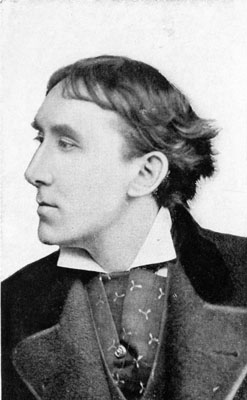
HENRY IRVING
From a photograph in the collection of Miss Evelyn Smalley
Only a great actor finds the difficulties of the actor's art infinite. Even up to the last five years of his life, Henry Irving was striving, striving. He never rested on old triumphs, never found a part in which there was no more to do. Once when I was touring with him in America, at the time when he was at the highest point of his fame, I watched him one day in the train—always a delightful occupation, for his face provided many pictures a minute—and being struck by a curious look, half puzzled, half despairing, asked him what he was thinking about.
"I was thinking," he answered slowly, "how strange it is that I should have made the reputation I have as an actor, with nothing to help me—with no equipment. My legs, my voice—everything has been against me. For an actor who can't walk, can't talk, and has no face to speak of, I've done pretty well."
And I, looking at that splendid head, those wonderful hands, the whole strange beauty of him, thought, "Ah, you little know!"
PORTIA
1875
The brilliant story of the Bancroft management of the old Prince of Wales's Theater was more familiar twenty years back than it is now. I think that few of the youngest playgoers who point out, on the first nights of important productions, a remarkably striking figure of a man with erect carriage, white hair, and flashing dark eyes—a man whose eye-glass, manners, and clothes all suggest Thackeray and Major Pendennis, in spite of his success in keeping abreast of everything modern—few playgoers, I say, who point this man out as Sir Squire Bancroft could give any adequate account of what he did for the English theater in the 'seventies. Nor do the public who see an elegant little lady starting for a drive from a certain house in Berkeley Square realize that this is Marie Wilton, afterward Mrs. Bancroft, now Lady Bancroft, the comedienne who created the heroines of Tom Robertson, and, with her husband, brought what is called the cup-and-saucer drama to absolute perfection.
We players know quite well and accept with philosophy the fact that when we have done we are forgotten. We are sometimes told that we live too much in the public eye and enjoy too much public favor and attention; but at least we make up for it by leaving no trace of our short and merry reign behind us when it is over!
I have never, even in Paris, seen anything more admirable than the ensemble of the Bancroft productions. Every part in the domestic comedies, the presentation of which, up to 1875, they had made their policy, was played with such point and finish that the more rough, uneven, and emotional acting of the present day has not produced anything so good in the same line. The Prince of Wales's Theater was the most fashionable in London, and there seemed no reason why the triumph of Robertson should not go on for ever.
But that's the strange thing about theatrical success. However great, it is limited in its force and duration, as we found out at the Lyceum twenty years later. It was not only because the Bancrofts were ambitious that they determined on a Shakespearean revival in 1875: they felt that you can give the public too much even of a good thing, and thought that a complete change might bring their theater new popularity as well as new honor.
I, however, thought little of this at the time. After my return to the stage in "The Wandering Heir" and my tour with Charles Reade, my interest in the theater again declined. It has always been my fate or my nature—perhaps they are really the same thing—to be very happy or very miserable. At this time I was very miserable. I was worried to death by domestic troubles and financial difficulties. The house in which I first lived in London, after I left Hertfordshire, had been dismantled of some of its most beautiful treasures by the brokers. Pressure was being put on me by well-meaning friends to leave this house and make a great change in my life. Everything was at its darkest when Mrs. Bancroft came to call on me and offered me the part of Portia in "The Merchant of Venice."
I had, of course, known her before, in the way that all people in the theater seem to know each other, and I had seen her act; but on this day, when she came to me as a kind of messenger of Fate, the harbinger of the true dawn of my success, she should have had for me some special and extraordinary significance. I could invest that interview now with many dramatic features, but my memory, either because it is bad or because it is good, corrects my imagination.
"May I come in?"
An ordinary remark, truly, to stick in one's head for thirty-odd years! But it was made in such a very pretty voice—one of the most silvery voices I have ever heard from any woman except the late Queen Victoria, whose voice was like a silver stream flowing over golden stones.
The smart little figure—Mrs. Bancroft was, above all things, petite—dressed in black—elegant Parisian black—came into a room which had been almost completely stripped of furniture. The floor was covered with Japanese matting, and at one end was a cast of the Venus of Milo, almost the same colossal size as the original.
Mrs. Bancroft's wonderful gray eyes, examined it curiously. The room, the statue, and I myself must all have seemed very strange to her. I wore a dress of some deep yellow woolen material which my little daughter used to call the "frog dress," because it was speckled with brown like a frog's skin. It was cut like a Viollet-le-Duc tabard, and had not a trace of the fashion of the time. Mrs. Bancroft, however, did not look at me less kindly because I wore aesthetic clothes and was painfully thin. She explained that they were going to put on "The Merchant of Venice" at the Prince of Wales's, that she was to rest for a while for reasons connected with her health; that she and Mr. Bancroft had thought of me for Portia.
Portia! It seemed too good to be true! I was a student when I was young. I knew not only every word of the part, but every detail of that period of Venetian splendor in which the action of the play takes place. I had studied Vecellio. Now I am old, it is impossible for me to work like that, but I never acknowledge that I get on as well without it.
Mrs. Bancroft told me that the production would be as beautiful as money and thought could make it. The artistic side of the venture was to be in the hands of Mr. Godwin, who had designed my dress for Titania at Bristol.
"Well, what do you say?" said Mrs. Bancroft. "Will you put your shoulder to the wheel with us?"
I answered incoherently and joyfully, that of all things I had been wanting most to play in Shakespeare; that in Shakespeare I had always felt I would play for half the salary; that—oh, I don't know what I said! Probably it was all very foolish and unbusinesslike, but the engagement was practically settled before Mrs. Bancroft left the house, although I was charged not to say anything about it yet.
But theater secrets are generally secrets de polichinelle. When I went to Charles Reade's house at Albert Gate on the following Sunday for one of his regular Sunday parties, he came up to me at once with a knowing look and said:
"So you've got an engagement."
"I'm not to say anything about it."
"It's in Shakespeare!"
"I'm not to tell."
"But I know. I've been thinking it out. It's 'The Merchant of Venice.'"
"Nothing is settled yet. It's on the cards."
"I know! I know!" said wise old Charles. "Well, you'll never have such a good part as Philippa Chester!"
"No, Nelly, never!" said Mrs. Seymour, who happened to overhear this. "They call Philippa a Rosalind part. Rosalind! Rosalind is not to be compared with it!"
Between Mrs. Seymour and Charles Reade existed a friendship of that rare sort about which it is easy for people who are not at all rare, unfortunately, to say ill-natured things. Charles Reade worshiped Laura Seymour, and she understood him and sympathized with his work and his whims. She died before he did, and he never got over it. The great success of one of his last plays, "Drink," an adaptation from the French, in which Charles Warner is still thrilling audiences to this day, meant nothing to him because she was not alive to share it. The "In Memoriam" which he had inscribed over her grave is characteristic of the man, the woman, and their friendship:
HERE LIES THE GREAT HEART OF LAURA SEYMOUR
I liked Mrs. Seymour so much that I was hurt when I found that she had instructed Charles Reade to tell Nelly Terry "not to paint her face" in the daytime, and I was young enough to enjoy revenging myself in my own way. We used to play childish games at Charles Reade's house sometimes, and with "Follow my leader" came my opportunity. I asked for a basin of water and a towel and scrubbed my face with a significant thoroughness. The rules of the game meant that everyone had to follow my example! When I had dried my face I powdered it, and then darkened my eyebrows. I wished to be quite frank about the harmless little bit of artifice which Mrs. Seymour had exaggerated into a crime. She was now hoist with her own petard, for, being heavily made up, she could not and would not follow the leader. After this Charles Reade acquitted me of the use of "pigments red," but he still kept up a campaign against "Chalky," as he humorously christened my powder-puff. "Don't be pig-headed, love," he wrote to me once; "it is because Chalky does not improve you that I forbid it. Trust unprejudiced and friendly eyes and drop it altogether."
Although Mrs. Seymour was naturally prejudiced where Charles Reade's work was concerned, she only spoke the truth, pardonably exaggerated, about the part of Philippa Chester. I know no part which is a patch on it for effectiveness; yet there is little in it of the stuff which endures. The play itself was too unbusiness like ever to become a classic.
Not for years afterwards did I find out that I was not the "first choice" for Portia. The Bancrofts had tried the Kendals first, with the idea of making a double engagement; but the negotiations failed. Perhaps the rivalry between Mrs. Kendal and me might have become of more significance had she appeared as Portia at the Prince of Wales's and preferred Shakespeare to domestic comedy. In after years she played Rosalind—I never did, alas!—and quite recently acted with me in "The Merry Wives of Windsor"; but the best of her fame will always be associated with such plays as "The Squire," "The Ironmaster," "Lady Clancarty," and many more plays of that type. When she played with me in Shakespeare she laughingly challenged me to come and play with her in a modern piece, a domestic play, and I said, "Done!" but it has not been done yet, although in Mrs. Clifford's "The Likeness of the Night" there was a good medium for the experiment. I found Mrs. Kendal wonderful to act with. No other English actress has such extraordinary skill. Of course, people have said we are jealous of each other. "Ellen Terry Acts with Lifelong Enemy," proclaimed an American newspaper in five-inch type, when we played together as Mistress Page and Mistress Ford in Mr. Tree's Coronation production of "The Merry Wives of Windsor." But the enmity did not seem to worry us as much as the newspaper men over the Atlantic had represented.
It was during this engagement in 1902 that a young actor who was watching us coming in at the stage-door at His Majesty's one day is reported to have said: "Look at Mr. Tree between his two 'stars'!"
"You mean Ancient Lights!" answered the witty actress to whom the remark was made.
However, "e'en in our ashes burn our wonted fires," or, to descend from the sublime to the ridiculous, and from the poetry of Gray to the pantomime gag of Drury Lane and Herbert Campbell, "Better to be a good old has-been than a never-was-er!"
But it was long before the "has-been" days that Mrs. Kendal decided not to bring her consummately dexterous and humorous workmanship to the task of playing Portia, and left the field open for me. My fires were only just beginning to burn. Success I had had of a kind, and I had tasted the delight of knowing that audiences liked me, and had liked them back again. But never until I appeared as Portia at the Prince of Wales's had I experienced that awe-struck feeling which comes, I suppose, to no actress more than once in a lifetime—the feeling of the conqueror. In homely parlance, I knew that I had "got them" at the moment when I spoke the speech beginning, "You see me, Lord Bassanio, where I stand."
"What can this be?" I thought. "Quite this thing has never come to me before! This is different! It has never been quite the same before."
It was never to be quite the same again.
Elation, triumph, being lifted on high by a single stroke of the mighty wing of glory—call it by any name, think of it as you like—it was as Portia that I had my first and last sense of it. And, while it made me happy, it made me miserable because I foresaw, as plainly as my own success, another's failure.
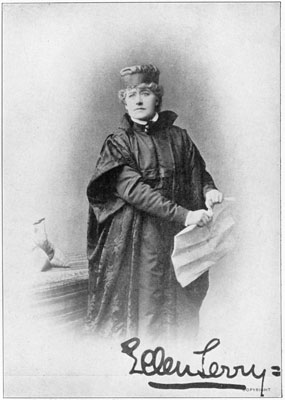
ELLEN TERRY AS PORTIA
From the collection of Miss Evelyn Smalley
Charles Coghlan, an actor whose previous record was fine enough to justify his engagement as Shylock, showed that night the fatal quality of indecision.
A worse performance than his, carried through with decision and attack, might have succeeded, but Coghlan's Shylock was not even bad. It was nothing.
You could hardly hear a word he said. He spoke as though he had a sponge in his mouth, and moved as if paralyzed. The perspiration poured down his face; yet what he was doing no one could guess. It was a case of moral cowardice rather than incompetency. At rehearsals no one had entirely believed in him, and this, instead of stinging him into a resolution to triumph, had made him take fright and run away.
People felt that they were witnessing a great play with a great part cut out, and "The Merchant of Venice" ran for three weeks!
It was a pity, if only because a more gorgeous and complete little spectacle had never been seen on the English stage. Veronese's "Marriage in Cana" had inspired many of the stage pictures, and the expenditure in carrying them out had been lavish.
In the casket scene I wore a dress like almond-blossom. I was very thin, but Portia and all the ideal young heroines of Shakespeare ought to be thin. Fat is fatal to ideality!
I played the part more stiffly and more slowly at the Prince of Wales's than I did in later years. I moved and spoke slowly. The clothes seemed to demand it, and the setting of the play developed the Italian feeling in it, and let the English Elizabethan side take care of itself. The silver casket scene with the Prince of Aragon was preserved, and so was the last act, which had hitherto been cut out in nearly all stage versions.
I have tried five or six different ways of treating Portia, but the way I think best is not the one which finds the heartiest response from my audiences. Has there ever been a dramatist, I wonder, whose parts admit of as many different interpretations as do Shakespeare's? There lies his immortality as an acting force. For times change, and parts have to be acted differently for different generations. Some parts are not sufficiently universal for this to be possible, but every ten years an actor can reconsider a Shakespeare part and find new life in it for his new purpose and new audiences.
The aesthetic craze, with all its faults, was responsible for a great deal of true enthusiasm for anything beautiful. It made people welcome the Bancrofts' production of "The Merchant of Venice" with an appreciation which took the practical form of an offer to keep the performances going by subscription, as the general public was not supporting them. Sir Frederick and Lady Pollock, James Spedding, Edwin Arnold, Sir Frederick Leighton and others made the proposal to the Bancrofts, but nothing came of it.
Short as the run of the play was, it was a wonderful time for me. Everyone seemed to be in love with me! I had sweethearts by the dozen, known and unknown. Most of the letters written to me I destroyed long ago, but the feeling of sweetness and light with which some of them filled me can never be destroyed. The task of reading and answering letters has been a heavy one all my life, but it would be ungrateful to complain of it. To some people expression is life itself. Half my letters begin: "I cannot help writing to tell you," and I believe that this is the simple truth. I, for one, should have been poorer, though my eyes might have been stronger, if they had been able to help it.
There turns up to-day, out of a long-neglected box, a charming note about "The Merchant of Venice" from some unknown friend.
"Playing to such houses," he wrote, "is not an encouraging pursuit; but to give to human beings the greatest pleasure that they are capable of receiving must always be worth doing. You have given me that pleasure, and I write to offer you my poor thanks. Portia has always been my favorite heroine, and I saw her last night as sweet and lovely as I had always hoped she might be. I hope that I shall see you again in other Shakespearean characters, and that nothing will tempt you to withhold your talents from their proper sphere."
The audiences may have been scanty, but they were wonderful. O'Shaughnessy, Watts-Dunton, Oscar Wilde, Alfred Gilbert, and, I think Swinburne were there. A poetic and artistic atmosphere pervaded the front of the house as well as the stage itself.
TOM TAYLOR AND LAVENDER SWEEP
I have read in some of the biographies of me that have been published from time to time, that I was chagrined at Coghlan's fiasco because it brought my success as Portia so soon to an end. As a matter of fact, I never thought about it. I was just sorry for clever Coghlan, who was deeply hurt and took his defeat hardly and moodily. He wiped out the public recollection of it to a great extent by his Evelyn in "Money," Sir Charles Pomander in "Masks and Faces," and Claude Melnotte in "The Lady of Lyons," which he played with me at the Princess's Theater for one night only in the August following the withdrawal of "The Merchant of Venice."
I have been credited with great generosity for appearing in that single performance of "The Lady of Lyons." It was said that I wanted to help Coghlan reinstate himself, and so on. Very likely there was some such feeling in the matter, but there was also a good part and good remuneration! I remember that I played Lytton's proud heroine better then than I did at the Lyceum five years later, and Coghlan was more successful as Melnotte than Henry Irving. But I was never really good. I tried in vain to have sympathy with a lady who was addressed as "haughty cousin," yet whose very pride had so much inconsistency. How could any woman fall in love with a cad like Melnotte? I used to ask myself despairingly. The very fact that I tried to understand Pauline was against me. There is only one way to play her, and to be bothered by questions of sincerity and consistency means that you will miss that way for a certainty!
I missed it, and fell between two stools. Finding that it was useless to depend upon feeling, I groped after the definite rules which had always governed the delivery of Pauline's fustian, and the fate that commonly overtakes those who try to put old wine into new bottles overtook me.
I knew for instance, exactly how the following speech ought to be done, but I never could do it. It occurs in the fourth act, where Beauseant, after Pauline has been disillusioned, thinks it will be an easy matter to induce the proud beauty to fly with him:
"Go! (White to the lips.) Sir, leave this house! It is humble; but a husband's roof, however lowly, is, in the eyes of God and man, the temple of a wife's honor. (Tumultuous applause.) Know that I would rather starve—aye, starve—with him who has betrayed me than accept your lawful hand, even were you the prince whose name he bore. (Hurrying on quickly to prevent applause before the finish.) Go!"
It is easy to laugh at Lytton's rhetoric, but very few dramatists have had a more complete mastery of theatrical situations, and that is a good thing to be master of. Why the word "theatrical" should have come to be used in a contemptuous sense I cannot understand. "Musical" is a word of praise in music; why not "theatrical" in a theater? A play in any age which holds the boards so continuously as "The Lady of Lyons" deserves more consideration than the ridicule of those who think that the world has moved on because our playwrights write more naturally than Lytton did. The merit of the play lay, not in its bombast, but in its situation.
Before Pauline I had played Clara Douglas in a revival of "Money," and I found her far more interesting and possible. To act the balance of the girl was keen enjoyment; it foreshadowed some of that greater enjoyment I was to have in after years when playing Hermione—another well-judged, well-balanced mind, a woman who is not passion's slave, who never answers on the spur of the moment, but from the depths of reason and divine comprehension. I didn't agree with Clara Douglas's sentiments but I saw her point of view, and that was everything.
Tom Taylor, like Charles Reade, never hesitated to speak plainly to me about my acting, and, after the first night of "Money," wrote me a letter full of hints and caution and advice:
"As I expected, you put feeling into every situation which gave you the opportunity, and the truth of your intention and expression seemed to bring a note of nature into the horribly sophisticated atmosphere of that hollow and most claptrappy of all Bulwerian stage offenses. Nothing could be better than the appeal to Evelyn in the last act. It was sweet, womanly and earnest, and rang true in every note. "But you were nervous and uncomfortable in many parts for want of sufficient rehearsal. These passages you will, no doubt, improve in nightly. I would only urge on you the great importance of studying to be quiet and composed, and not fidgeting. There was especially a trick of constantly twiddling with and looking at your fingers which you should, above all, be on your guard against.... I think, too, you showed too evident feeling in the earlier scene with Evelyn. A blind man must have read what you felt—your sentiment should be more masked. "Laura (Mrs. Taylor) absolutely hates the play. We both thought—detestable in his part, false in emphasis, violent and coarse. Generally the fault of the performance was, strange to say for that theater, overacting, want of repose, point, and finish. With you in essentials I was quite satisfied, but quiet—not so much movement of arms and hands. Bear this in mind for improvement; and go over your part to yourself with a view to it.
"The Allinghams have been here to-day. They saw you twice as Portia, and were charmed. Mrs. Allingham wants to paint you. Allingham tells me that Spedding is going to write an article on your Portia, and will include Clara Douglas. I am going to see Salvini in 'Hamlet' to-morrow morning, but I would call in Charlotte Street between one and two, on the chance of seeing you and talking it over, and amplifying what I have said. "Ever your true old friend, "TOM TAYLOR."
A true old friend indeed he was! I have already tried to convey how much I owed to him—how he stood by me and helped me in difficulties, and said generously and unequivocally, at the time of my separation from my first husband, that "the poor child was not to blame."
I was very fond of my own father, but in many ways Tom Taylor was more of a father to me than my father in blood. Father was charming, but Irish and irresponsible. I think he loved my sister Floss and me most because we were the lawless ones of the family! It was not in his temperament to give wise advice and counsel. Having bequeathed to me light-heartedness and a sanguine disposition, and trained me splendidly for my profession in childhood, he became in after years a very cormorant for adulation of me!
"Duchess, you might have been anything!" was his favorite comment, when I was not living up to his ideas of my position and attainments. And I used to answer: "I've played my cards for what I want."
Years afterwards, when he and mother used to come to first nights at the Lyceum, the grossest flattery of me after the performance was not good enough for them.
"How proud you must be of her!" someone would say. "How well this part suits her!"
"Yes," father would answer, in a sort of "is-that-all-you-have-to-say" tone. "But she ought to play Rosalind!"
To him I owe the gaiety of temperament which has enabled me to dance through the most harsh and desert passages of my life, just as he used to make Kate and me dance along the sordid London streets as we walked home from the Princess's Theater. He would make us come under his cloak, partly for warmth, partly to hide from us the stages of the journey home. From the comfortable darkness one of us would cry out:
"Oh, I'm so tired! Aren't we nearly home? Where are we, father?"
"You know Schwab, the baker?"
"Yes, yes."
"Well, we're not there yet!"
As I grew up, this teasing, jolly, insouciant Irish father of mine was relieved of some of his paternal duties by Tom Taylor. It was not Nelly alone whom Tom Taylor fathered. He adopted the whole family.
At Lavender Sweep, with the horse-chestnut blossoms strewing the drive and making it look like a tessellated pavement, all of us were always welcome, and Tom Taylor would often come to our house and ask mother to grill him a bone! Such intimate friendships are seldom possible in our busy profession, and there was never another Tom Taylor in my life.
When we were not in London and could not go to Lavender Sweep to see him, he wrote almost daily to us. He was angry when other people criticised me, but he did not spare criticism himself.
"Don't be Nelly Know-all," I remember his saying once. "I saw you floundering out of your depth to-night on the subject of butterflies! The man to whom you were talking is one of the greatest entomologists in Europe, and must have seen through you at once."
When William Black's "Madcap Violet" was published, common report said that the heroine had been drawn for Ellen Terry, and some of the reviews made Taylor furious.
"It's disgraceful! I shall deny it. Never will I let it be said of you that you could conceive any vulgarity. I shall write and contradict it. Indiscreet, high-spirited, full of surprises, you may be, but vulgar—never! I shall write at once."
"Don't do that," I said. "Can't you see that the author hasn't described me, but only me in 'New Men and Old Acres'?" As this was Tom Taylor's own play, his rage against "Madcap Violet" was very funny! "There am I, just as you wrote it. My actions, manners, and clothes in the play are all reproduced. You ought to feel pleased, not angry."
When his play "Victims" was being rehearsed at the Court Theater, an old woman and old actress who had, I think, been in the preceding play was not wanted. The day the management gave her her dismissal, she met Taylor outside the theater, and poured out a long story of distress. She had not a stocking to her foot, she owed her rent, she was starving. Wouldn't Mr. Taylor tell the management what dismissal meant to her? Wouldn't he get her taken back? Mr. Taylor would try, and Mr. Taylor gave her fifteen pounds in the street then and there!
Mrs. Taylor wasn't surprised. She only wondered it wasn't thirty!
"Tom the Adapter" was the Terry dramatist for many years. Kate played in many of the pieces which, some openly, some deviously, he brought into the English stage from the French. When Kate married, my turn came, and the interest that he had taken in my sister's talent he transferred in part to me, although I don't think he ever thought me her equal. Floss made her first appearance in the child's part in Taylor's play "A Sheep in Wolf's Clothing," and Marion her first appearance as Ophelia in his version of "Hamlet"—perhaps "perversion" would be an honester description! Taylor introduced a "fool" who went about whacking people, including the Prince, by way of brightening up the tragedy.
I never saw my sister's Ophelia, but I know it was a fine send-off for her and that she must have looked lovely. Oh, what a pretty young girl she was! Her golden-brown eyes exactly matched her hair, and she was the winsomest thing imaginable! From the first she showed talent.
From Taylor's letters I find—and, indeed, without them I could not have forgotten—that the good, kind friend never ceased to work in our interests. "I have recommended Flossy to play Lady Betty in the country." "I have written to the Bancrofts in favor of Forbes-Robertson for Bassanio." (Evidently this was in answer to a request from me. Naturally, the Bancrofts wanted someone of higher standing, but was I wrong about J. Forbes-Robertson? I think not!) "The mother came to see me the other day. I was extremely sorry to hear the bad news of Tom." (Tom was the black sheep of our family, but a fascinating wretch, all the same.) "I rejoice to think of your coming back," he writes another time, "to show the stage what an actress should be." "A thousand thanks for the photographs. I like the profile best. It is most Paolo Veronesish and gives the right notion of your Portia, although the color hardly suggests the golden gorgeousness of your dress and the blonde glory of the hair and complexion.... I hope you have seen the quiet little boxes at ——'s foolish article." (This refers to an article which attacked my Portia in Blackwood's Magazine.) "Of course, if —— found his ideal in —— he must dislike you in Portia, or in anything where it is a case of grace and spontaneity and Nature against affectation, over-emphasis, stilt, and false idealism—in short, utter lack of Nature. How can the same critic admire both? However, the public is with you, happily, as it is not always when the struggle is between good art and bad."
I quote these dear letters from my friend, not in my praise, but in his. Until his death in 1880, he never ceased to write to me sympathetically and encouragingly; he rejoiced in my success the more because he had felt himself in part responsible for my marriage and its unhappy ending, and had perhaps feared that my life would suffer. Every little detail about me and my children, or about any of my family, was of interest to him. He was never too busy to give an attentive ear to my difficulties. "'Think of you lovingly if I can'!" he writes to me at a time when I had taken a course for which all blamed me, perhaps because they did not know enough to pardon enough—savoir tout c'est tout pardonner. "Can I think of you otherwise than lovingly? Never, if I know you and myself!"
Tom Taylor got through an enormous amount of work. Dramatic critic and art critic for the Times, he was also editor of Punch and a busy playwright. Everyone who wanted an address written or a play altered came to him, and his house was a kind of Mecca for pilgrims from America and from all parts of the world. Yet he all the time occupied a position in a Government office—the Home Office, I think it was—and often walked from Whitehall to Lavender Sweep when his day's work was done. He was an enthusiastic amateur actor, his favorite part being Adam in "As You Like It," perhaps because tradition says this was a part that Shakespeare played; at any rate, he was very good in it. Gilbert and Sullivan, in very far-off days, used to be concerned in these amateur theatricals. Their names were not associated then, but Kate and I established a prophetic link by carrying on a mild flirtation, I with Arthur Sullivan, Kate with Mr. Gilbert!
Taylor never wasted a moment. He pottered, but thought deeply all the time; and when I used to watch him plucking at his gray beard, I realized that he was just as busy as if his pen had been plucking at his paper. Many would-be writers complain that the necessity of earning a living in some other and more secure profession hinders them from achieving anything. What about Taylor at the Home Office, Charles Lamb at East India House, and Rousseau copying music for bread? It all depends on the point of view. A young lady in Chicago, who has written some charming short stories, told me how eagerly she was looking forward to the time when she would be able to give up teaching and devote herself entirely to a literary career. I wondered, and said I was never sure whether absolute freedom in such a matter was desirable. Perhaps Charles Lamb was all the better for being a slave at the desk for so many years.
"Ah, but then, Charles Lamb wrote so little!" was the remarkable answer.
Taylor did not write "so little." He wrote perhaps too much, and I think his heart was too strong for his brain. He was far too simple and lovable a being to be great. The atmosphere of gaiety which pervaded Lavender Sweep arose from his generous, kindly nature, which insisted that it was possible for everyone to have a good time.
Once, when we were rushing to catch a train with him, Kate hanging onto one arm and I onto the other, we all three fell down the station steps. "Now, then, none of your jokes!" said a cross man behind us, who seemed to attribute our descent to rowdyism. Taylor stood up with his soft felt hat bashed over one eye, his spectacles broken, and laughed, and laughed, and laughed!
Lavender Sweep was a sort of house of call for everyone of note. Mazzini stayed there some time, and Steele Mackaye, the American actor who played that odd version of "Hamlet" at the Crystal Palace with Polly as Ophelia. Perhaps a man with more acute literary conscience than Taylor would not have condescended to "write up" Shakespeare; perhaps a man of more independence and ambition would not have wasted his really fine accomplishment as a playwright for ever on adaptations. That was his weakness—if it was a weakness. He lived entirely for his age, and so was more prominent in it than Charles Reade, for instance, whose name, no doubt, will live longer.
He put himself at the mercy of Whistler, once, in some Velasquez controversy of which I forget the details, but they are all set out, for those who like mordant ridicule, in "The Gentle Art of Making Enemies."
When Tom Taylor criticised acting he wrote as an expert, and he often said illuminating things to me about actors and actresses which I could apply over again to some of the players with whom I have been associated since. "She is a curious example," he said once of an actress of great conscientiousness, "of how far seriousness, sincerity, and weight will supply the place of almost all the other qualities of an actress." When a famous classic actress reappeared as Rosalind, he described her performance as "all minute-guns and minauderies, ... a foot between every word, and the intensity of the emphasis entirely destroying all the spontaneity and flow of spirits which alone excuse and explain; ... as unlike Shakespeare's Rosalind, I will stake my head, as human personation could be!"
There was some talk at that time (the early 'seventies) of my playing Rosalind at Manchester for Mr. Charles Calvert, and Tom Taylor urged me to do it. "Then," he said charmingly, "I can sing my stage Nunc Dimittis." The whole plan fell through, including a project for me to star as Juliet to the Romeo of a lady!
I have already said that the Taylors' home was one of the most softening and culturing influences of my early life. Would that I could give an impression of the dear host at the head of his dinner-table, dressed in black silk knee-breeches and velvet cutaway coat—a survival of a politer time, not an affectation of it—beaming on his guests with his very brown eyes!
Lavender is still associated in my mind with everything that is lovely and refined. My mother nearly always wore the color, and the Taylors lived at Lavender Sweep! This may not be an excellent reason for my feelings on the subject, but it is reason good enough.
"Nature repairs her ravages," it is said, but not all. New things come into one's life—new loves, new joys, new interests, new friends—but they cannot replace the old. When Tom Taylor died, I lost a friend the like of whom I never had again.