XI AMERICA THE FIRST OF EIGHT TOURS
Reading edition
The first time that there was any talk of my going to America was, I think, in 1874, when I was playing in "The Wandering Heir." Dion Boucicault wanted me to go, and dazzled me with figures, but I expect the cautious Charles Reade influenced me against accepting the engagement.
When I did go in 1883, I was thirty-five and had an assured position in my profession. It was the first of eight tours, seven of which I went with Henry Irving. The last was in 1907 after his death. I also went to America one summer on a pleasure trip. The tours lasted three months at least, seven months at most. After a rough calculation, I find that I have spent not quite five years of my life in America. Five out of sixty is not a large proportion, yet I often feel that I am half American. This says a good deal for the hospitality of a people who can make a stranger feel so completely at home in their midst. Perhaps it also says something for my adaptableness!
"When we do not speak of things with a partiality full of love, what we say is not worth being repeated." That was the answer of a courteous Frenchman who was asked for his impressions of a country. In any case it is imprudent to give one's impressions of America. The country is so vast and complex that even those who have amassed mountains of impressions soon find that there still are mountains more! I have lived in New York, Boston and Chicago for a month at a time, and have felt that to know any of these great cities even superficially would take a year. I have become acquainted with this and that class of American, but I realize that there are thousands of other classes that remain unknown to me.
I set out in 1882 from Liverpool on board the Britannic with the fixed conviction that I should never, never return. For six weeks before we started, the word America had only to be breathed to me, and I burst into floods of tears! I was leaving my children, my bullfinch, my parrot, my "aunt" Boo, whom I never expected to see alive again, just because she said I never would; and I was going to face the unknown dangers of the Atlantic and of a strange, barbarous land. Our farewell performances in London had cheered me up a little—though I wept copiously at every one—by showing us that we should be missed. Henry Irving's position seemed to be confirmed and ratified by all that took place before his departure. The dinners he had to eat, the speeches that he had to make and to listen to, were really terrific!
One speech at the Rabelais Club had, it was said, the longest peroration on record. It was this kind of thing: Where is our friend Irving going? He is not going like Nares to face the perils of the far North. He is not going like A—— to face something else. He is not going to China, etc.,—and so on. After about the hundredth "he is not going," Lord Houghton, who was one of the guests, grew very impatient and interrupted the orator with: "Of course he isn't! He's going to New York by the Cunard Line. It'll take him about a week!"
Many people came to see us off at Liverpool, but I only remember seeing Mrs. Langtry and Oscar Wilde. It was at this time that Oscar Wilde had begun to curl his hair in the manner of the Prince Regent. "Curly hair to match the curly teeth," said some one. Oscar Wilde had ugly teeth, and he was not proud of his mouth. He used to put his hand to his mouth when he talked so that it should not be noticed. His brow and eyes were very beautiful.
Well, I was not "disappointed in the Atlantic," as Oscar Wilde was the first to say, though many people have said it since without acknowledging its source.
My first voyage was a voyage of enchantment to me. The ship was laden with pig-iron, and she rolled and rolled and rolled. She could never roll too much for me! I have always been a splendid sailor, and I feel jolly at sea. The sudden leap from home into the wilderness of waves does not give me any sensation of melancholy.
What I thought I was going to see when I arrived in America I hardly remember. I had a vague idea that all American women wore red flannel shirts and carried bowie knives and that I might be sandbagged in the street! From somewhere or other I had derived an impression that New York was an ugly, noisy place.
Ugly! When I first saw that marvelous harbor I nearly cried—it was so beautiful. Whenever I come now to the unequaled approach to New York I wonder what Americans must think of the approach from the sea to London! How different are the mean, flat, marshy banks of the Thames and the wooden toy lighthouse at Dungeness to the vast, spreading Hudson with its busy multitude of steamboats, and ferryboats, its wharf upon wharf, and its tall statue of Liberty dominating all the racket and bustle of the sea traffic of the world!
That was one of the few times in America when I did not miss the poetry of the past. The poetry of the present, gigantic, colossal and enormous, made me forget it. The "sky-scrapers"—what a brutal name it is when one comes to think of it!—so splendid in the landscape now, did not exist in 1883, but I find it difficult to divide my early impressions from my later ones. There was Brooklyn Bridge though, hung up high in the air like a vast spider's web.
Between 1883 and 1893 I noticed a great change in New York and other cities. In ten years they seemed to have grown with the energy of tropical plants. But between 1893 and 1907 I saw no evidence of such feverish increase. It is possible that the Americans are arriving at a stage when they can no longer beat the records! There is a vast difference between one of the old New York brownstone houses and one of the fourteen-storied buildings near the river, but between this and the Times Square Building or the still more amazing Flat Iron Building, which is said to oscillate at the top—it is so far from the ground—there is very little difference. I hear that they are now beginning to build downwards into the earth, but this will not change the appearance of New York for a long time.
I had not to endure the wooden shed in which most people landing in America have to struggle with the Custom-house officials—a struggle as brutal as a "round in the ring," as Paul Bourget describes it. We were taken off the Britannic in a tug, and Mr. Abbey, Laurence Barrett, and many other friends met us—including the much-dreaded reporters.
They were not a bit dreadful, but very quick to see what kind of a man Henry was. In a minute he was on the best of terms with them. He had on what I used to call his best "Jingle" manner—a manner full of refinement, bonhomie, elegance and geniality.
"Have a cigar—have a cigar." That was the first remark of Henry's, which put every one at ease. He also wanted to be at ease and have a good smoke. It was just the right merry greeting to the press representatives of a nation whose sense of humor is far more to be relied on than its sense of reverence.
"Now come on, all of you!" he said to the interviewers. He talked to them all in a mass and showed no favoritism. It says much for his tact and diplomacy that he did not "put his foot in it." The Americans are suspicious of servile adulation from a stranger, yet are very sensitive to criticism.
"These gentlemen want to have a few words with you," said Henry to me when the reporters had done with him. Then with a mischievous expression he whispered: "Say something pleasant! Merry and bright!"
Merry and bright! I felt it! The sense of being a stranger entering a strange land, the rushing sense of loneliness and foreignness was overpowering my imagination. I blew my nose hard and tried to keep back my tears, but the first reporter said: "Can I send any message to your friends in England?"
I answered: "Tell them I never loved 'em so much as now," and burst into tears! No wonder that he wrote in his paper that I was "a woman of extreme nervous sensibility." Another of them said that "my figure was spare almost to attenuation." America soon remedied that. I began to put on flesh before I had been in the country a week, and it was during my fifth American tour that I became really fat for the first time in my life.
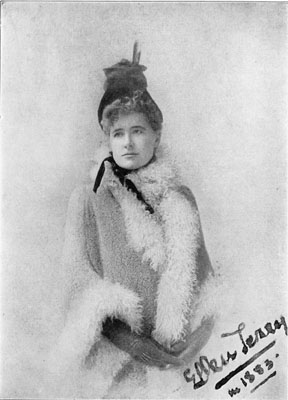
MISS ELLEN TERRY IN 1883
From a photograph taken at the time of her first appearance in America
From the collection of Miss Evelyn Smalley
When we landed I drove to the Hotel Dam, Henry to the Brevoort House. There was no Diana on the top of the Madison Square Building then. The building did not exist, to cheer the heart of a new arrival as the first evidence of beauty in the city. There were horse trams instead of cable cars, but a quarter of a century has not altered the peculiarly dilapidated carriages in which one drives from the dock, the muddy side-walks, and the cavernous holes in the cobble-paved streets. Had the elevated railway, the first sign of power that one notices after leaving the boat, begun to thunder through the streets? I cannot remember New York without it.
I missed then, as I miss now, the numberless hansoms of London plying in the streets for hire. People in New York get about in the cars, unless they have their own carriages. The hired carriage has no reason for existing, and when it does, it celebrates its unique position by charging two dollars (8s.) for a journey which in London would not cost fifty cents (2s.)!
I cried for two hours at the Hotel Dam! Then my companion, Miss Harries, came bustling in with: "Never mind! here's a piano!" and sat down and played "Annie Laurie" very badly until I screamed with laughter. Before the evening came my room was like a bower of roses, and my dear friends in America have been throwing bouquets at me in the same lavish way ever since. I had quite cheered up when Henry came to take me to see some minstrels who were performing at the Star Theater, the very theater where in a few days we were to open. I didn't understand many of the jokes which the American comedians made that night, but I liked their dry, cool way of making them. They did not "hand a lemon" or "skiddoo" in those days; American slang changes as quickly as thieves' slang, and only "Gee!" and "Gee-whiz!" seem to be permanent.
There were very few theaters in New York when we first went there. All that part of the city which is now "up town" did not exist, and what was then "up" is now more than "down" town. The American stage has changed almost as much. In those days their most distinguished actors were playing Shakespeare or old comedy, and their new plays were chiefly "imported" goods. Even then there was a liking for local plays which showed the peculiarities of the different States, but they were more violent and crude than now. The original American genius and the true dramatic pleasure of the people is, I believe, in such plays, where very complete observation of certain phases of American life and very real pictures of manners are combined with comedy almost childlike in its naïveté. The sovereignty of the young girl which is such a marked feature in social life is reflected in American plays.
This is by the way.
What I want to make clear is that in 1883 there was no living American drama as there is now, that such productions of romantic plays and Shakespeare as Henry Irving brought over from England were unknown, and that the extraordinary success of our first tours would be impossible now. We were the first and we were pioneers, and we were new. To be new is everything in America.
Such palaces as the Hudson Theater, New York, were not dreamed of when we were at the Star, which was, however, quite equal to any theater in London in front of the footlights. The stage itself, the lighting appliances, and the dressing-rooms were inferior.
Henry made his first appearance in America in "The Bells." He was not at his best on the first night, but he could be pretty good even when he was not at his best. I watched him from a box. Nervousness made the company very slow. The audience was a splendid one—discriminating and appreciative. We felt that the Americans wanted to like us. We felt in a few days so extraordinarily at home. The first sensation of entering a foreign city was quickly wiped out.
The difference in atmosphere disappears directly one understands it. I kept on coming across duplicates of "my friends in England." "How this girl reminds me of Alice." "How like that one is to Gill!" We had transported the Lyceum three thousand miles—that was all.
On the second night in New York it was my turn. "Command yourself—this is the time to show you can act!" I said to myself as I went on to the stage of the Star Theater, dressed as Henrietta Maria. But I could not command myself. I played badly and cried too much in the last act. But the people liked me, and they liked the play, perhaps because it was historical; and of history the Americans are passionately fond. The audience took many points which had been ignored in London. I had always thought Henry as Charles I. most moving when he made that involuntary effort to kneel to his subject, Moray, but the Lyceum audiences never seemed to notice it. In New York the audience burst out into the most sympathetic spontaneous applause that I have ever heard in a theater.
I know that there are some advanced stage reformers who prefer to think applause "vulgar," and would suppress it in the theater if they could. If they ever succeed they will suppress a great deal of good acting. It is said that the American actor, Edwin Forrest, once walked down to the footlights and said to the audience very gravely and sincerely: "If you don't applaud, I can't act," and I do sympathize with him. Applause is an instinctive, unconscious act expressing the sympathy between actors and audience. Just as our art demands more instinct than intellect in its exercise, so we demand of those who watch us an appreciation of the simple unconscious kind which finds an outlet in clapping rather than the cold, intellectual approval which would self-consciously think applause derogatory. I have yet to meet the actor who was sincere in saying that he disliked applause.
My impression of the way the American women dressed in 1883 was not favorable. Some of them wore Indian shawls and diamond earrings. They dressed too grandly in the street and too dowdily in the theater. All this has changed. The stores in New York are now the most beautiful in the world, and the women are dressed to perfection. They are as clever at the demi-toilette as the Parisian, and the extreme neatness and smartness of their walking-gowns are very refreshing after the floppy, blowsy, trailing dresses, accompanied by the inevitable feather boa of which English girls, who used to be so tidy and "tailor-made," now seem so fond. The universal white "waist" is very pretty and trim on the American girl. It is one of the distinguishing marks of a land of the free, a land where "class" hardly exists. The girl in the store wears the white waist; so does the rich girl on Fifth Avenue. It costs anything from seventy-five cents to fifty dollars!
London when I come back from America always seems at first like an ill-lighted village, strangely tame, peaceful and backward. Above all, I miss the sunlight of America, and the clear blue skies of an evening.
"Are you glad to get back?" said an English friend.
"Very."
"It's a land of vulgarity, isn't it?"
"Oh yes, if you mean by that a wonderful land—a land of sunshine and light, of happiness, of faith in the future!" I answered. I saw no misery or poverty there. Every one looked happy. What hurts me on coming back to England is the hopeless look on so many faces; the dejection and apathy of the people standing about in the streets. Of course there is poverty in New York, but not among the Americans. The Italians, the Russians, the Poles—all the host of immigrants washed in daily on the bosom of the Hudson—these are poor, but you don't see them unless you go Bowery-ways, and even then you can't help feeling that in their sufferings there is always hope. The barrow man of to-day is the millionaire of to-morrow! Vulgarity? I saw little of it. I thought that the people who had amassed large fortunes used their wealth beautifully.
When a man is rich enough to build himself a big new house, he remembers some old house which he once admired, and he has it imitated with all the technical skill and care that can be had in America. This accounts for the odd jumble of styles in Fifth Avenue, along the lakeside in Chicago, in the new avenues in St. Louis and elsewhere. One millionaire's house is modeled on a French château, another on an old Colonial house in Virginia, another on a monastery in Mexico, another is like an Italian palazzo. And their imitations are never weak or pretentious. The architects in America seem to me to be far more able than ours, or else they have a freer hand and more money. It is sad to remember that Mr. Stanford White was one of the best of these splendid architects.
It was Stanford White with Saint-Gaudens—that great sculptor, whose work dignifies nearly all the great cities in America—who had most to do with the Exhibition buildings of the World's Fair in Chicago in 1893. It was odd to see that fair dream city rising out of the lake, so far more beautiful in its fleeting beauty than the Chicago of the stock-yards and the Pit which had provided the money for its beauty. The millionaires did not interfere with the artists at all. They gave their thousands—and stood aside. The result was one of the loveliest things conceivable. Saint-Gaudens and the rest did their work as well as though the buildings were to endure for centuries instead of being burned in a year to save the trouble of pulling down! The World's Fair always recalled to me the story of Michael Angelo, who carved a figure in snow which, says the chronicler who saw it, "was superb."
Saint-Gaudens gave me a cast of his medallion of Bastien-Lepage, and wrote to a friend of mine that "Bastien had 'le coeur au métier.' So has Miss Terry, and I will place that saying in the frame that is to replace the present unsatisfactory one." He was very fastidious about this frame, and took such a lot of trouble to get it right. It must have been very irritating to Saint-Gaudens when he fell a victim to that extraordinary official puritanism which sometimes exercises a petty censorship over works of art in America. The medal that he made for the World's Fair was rejected at Washington because it had on it a beautiful little nude figure of a boy holding an olive branch, emblematical of young America. I think a commonplace wreath and some lettering were substituted.
Saint-Gaudens did the fine bas-relief of Robert Louis Stevenson which was chosen for the monument in St. Gile's Cathedral, Edinburgh. He gave my daughter a medallion cast from this, because he knew that she was a great lover of Stevenson. The bas-relief was dedicated to his friend Joe Evans. I knew Saint-Gaudens first through Joe Evans, an artist who, while he lived, was to me and to my daughter the dearest of all in America. His character was so fine and noble—his nature so perfect. Many were the birthday cards he did for me, original in design, beautiful in execution. Whatever he did he put the best of himself into it. I wrote to my daughter soon after his death:—
"I heard on Saturday that our dear Joe Evans is dangerously ill. Yesterday came the worst news. Joe was not happy, but he was just heroic, and this world wasn't half good enough for him. I keep on getting letters about him. He seems to have been so glad to die. It was like a child's funeral, I am told, and all his American friends seem to have been there—Saint-Gaudens, Taber, etc. A poem about the dear fellow by Mr. Gilder has one very good line in which he says the grave 'might snatch a brightness from his presence there.' I thought that was very happy, the love of light and gladness being the most remarkable thing about him, the dear sad Joe."
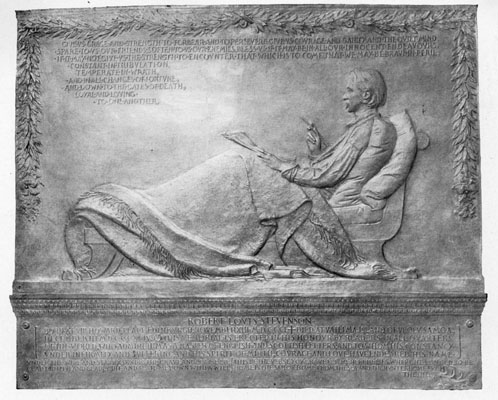
THE BAS-RELIEF PORTRAIT OF ROBERT LOUIS STEVENSON
Modeled by Augustus Saint-Gaudens for the St. Giles Cathedral, Edinburgh. Saint-Gaudens gave a cast of this portrait to Miss Terry's daughter, Edith Craig
Robert Taber, dear, and rather sad too, was a great friend of Joe's. They both came to me first in the shape of a little book in which was inscribed, "Never anything can be amiss when simpleness and duty tender it." "Upon this hint I spake," the book began. It was all the work of a few boys and girls who from the gallery of the Star Theater, New York, had watched Irving's productions and learned to love him and me. Joe Evans had done a lovely picture by way of frontispiece of a group of eager heads hanging over the gallery's edge, his own and Taber's among them. Eventually Taber came to England and acted with Henry Irving in "Peter the Great" and other plays.
Like his friend Joe, he too was heroic. His health was bad and his life none too happy—but he struggled on. His career was cut short by consumption, and he died in the Adirondacks in 1904.
I cannot speak of all my friends in America, or anywhere, for the matter of that, individually. My personal friends are so many, and they are all wonderful—wonderfully staunch to me! I have "tried" them so, and they have never given me up as a bad job.
My first friends of all in America were Mr. Bayard, afterwards the American Ambassador in London, and his sister, Mrs. Benoni Lockwood, her husband and their children. Now after all these years they are still my friends, and I can hope for none better to the end.
William Winter, poet, critic and exquisite man, was one of the first to write of Henry with whole-hearted appreciation. But all the criticism in America, favorable and unfavorable, surprised us by the scholarly knowledge it displayed. In Chicago the notices were worthy of the Temps or the Journal des Débats. There was no attempt to force the personality of the writer into the foreground nor to write a style that should attract attention to the critic and leave the thing criticized to take care of itself. William Winter, and, of late years, Allan Dale, have had their personalities associated with their criticisms, but they are exceptions. Curiously enough the art of acting appears to bore most dramatic critics, the very people who might be expected to be interested in it. The American critics, however, at the time of our early visits, were keenly interested, and showed it by their observation of many points which our English critics had passed over. For instance, writing of "Much Ado about Nothing," one of the Americans said of Henry in the Church Scene that "something of him as a subtle interpreter of doubtful situations was exquisitely shown in the early part of this fine scene by his suspicion of Don John—felt by him alone, and expressed only by a quick covert look, but a look so full of intelligence as to proclaim him a sharer in the secret with his audience."
"Wherein does the superiority lie?" wrote another critic in comparing our productions with those which had been seen in America up to 1884. "Not in the amount of money expended, but in the amount of brains;—in the artistic intelligence and careful and earnest pains with which every detail is studied and worked out. Nor is there any reason why Mr. Irving or any other foreigner should have a monopoly of either intelligence or pains. They are common property, and one man's money can buy them as well as another's. The defect in the American manager's policy heretofore has been that he has squandered his money upon high salaries for a few of his actors and costly, because unintelligent, expenditure for mere dazzle and show."
William Winter soon became a great personal friend of ours, and visited us in England. He was one of the few sad people I met in America. He could have sat upon the ground and told "sad stories of the deaths of kings" with the best. He was very familiar with the poetry of the immediate past—Cowper, Coleridge, Gray, Wordsworth, Shelley, Keats, and the rest. He liked us, so everything we did was right to him. He could not help being guided entirely by his feelings. If he disliked a thing, he had no use for it. Some men can say, "I hate this play, but of its kind it is admirable." Willie Winter could never take that unemotional point of view. In England he loved going to see graveyards, and knew where every poet was buried.
His children came to stay with me in London. When we were all coming home from the theater one night after "Faust" (the year must have been 1886) I said to little Willie:
"Well, what do you think of the play?"
"Oh my!" said he, "it takes the cake."
"Takes the cake!" said his little sister scornfully, "it takes the ice-cream!"
"Won't you give me a kiss?" said Henry to the same young miss one night. "No, I won't with all that blue stuff on your face." (He was made up for Mephistopheles.) Then, after a pause, "But why—why don't you take it!" She was only five years old at the time!
I love the American papers, especially the Sunday ones, although they do weigh nearly half a ton! As for the interviewers, I never cease to marvel at their cleverness. I tell them nothing, and the next day I read their "story" and find that I have said the most brilliant things! The following delightful "skit" on one of these interviews suggested itself to my clever friend Miss Aimée Lowther:—
WHAT CONSTITUTES CHARM
AN ILLUSTRATED INTERVIEW WITH MISS ELLEN TERRY
"Yes, I know that I am very charming," said Miss Ellen Terry, "a perfectly delightful creature, a Queen of Hearts, a regular witch!" she added thoughtfully, at the same time projecting a pip of the orange she was chewing, with inimitable grace and accurate aim into
THE REPORTER'S EYE.
"You know, at all events, that you have charm?" I said.
"What do you think, you idiot! I exercise absolute power over my audiences—I cast over them an irresistible spell—I do with them what I will.... I am omnipotent, enthralling—and no wonder!"
I looked at her across the table, wondering at so much simple modesty.
"But feeling your power, you must often be tempted to experiment with it," I ventured.
"Yes, now and then I am," replied Miss Terry. "Once, I remember, when I was to appear as Ophelia, on making my entrance and seeing the audience waiting breathlessly—as they always do—for what I was going to do next, I said to myself, 'You silly fools, you shall have a treat to-night—I will give you something you will appreciate more than Shakespeare!' Hastily slipping on a
FALSE NOSE
which I always carry in my pocket, I struck an attitude, and then turned
A SOMERSAULT.
"Ah! the applause, the delirious, intoxicating applause! That night I felt my power, that night I knew that I had wished I could have held them indefinitely! But I am only one of several gifted beings on the stage who are blessed with this mysterious quality. Dan Leno, Herbert Campbell, and Little Tich all have it. Dan Leno, in particular, rivets the attention of his audience by his entrancing by-play, even when he doesn't speak. And yet it is
NOT HIS BEAUTY
precisely that does it."
At that moment Miss Terry's little grandchild, who was playing about the room,
BEGAN TO HOWL
most dismally.
"Here is a little maid who was a charmer from her cradle," said the delightful actress, picking up the child and
PLAYFULLY TOSSING
it out of the third-floor window. Seeing me look relieved, though somewhat surprised, she said merrily: "I have plenty more of them at home, and they are
ALL CHARMING,
every one of them! If you want to be charming you must be natural—I always am. Even in my cradle I was
QUITE NATURAL.
And now, please go. Your conversation bores me inexpressibly, and your countenance, which is at once vacuous and singularly plain, disagrees with me thoroughly. Go! or I shall
BE SICK!"
So saying the great actress gave me a
VIGOROUS KICK
which landed me outside her room, considerably shaken, and entirely under the spell of her matchless charm.
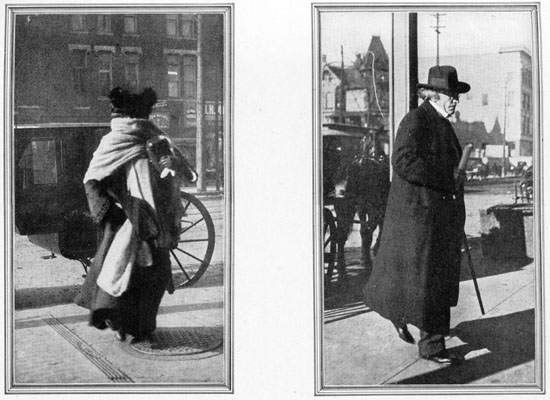
MISS ELLEN TERRY
From a snap-shot taken in the United States
SIR HENRY IRVING
From a snap-shot taken in the United States
For "quite a while" during the first tour I stayed in Washington with my friend Miss Olive Seward, and all the servants of that delightful household were colored. This was my first introduction to the negroes, whose presence more than anything else in the country, makes America seem foreign to European eyes. They are more sharply divided into high and low types than white people, and are not in the least alike in their types. It is safe to call any colored man "George." They all love it, perhaps because of George Washington, and most of them are really named George. I never met such perfect service as they can give. Some of them are delightful. The beautiful, full voice of the "darkey" is so attractive, so soothing, and they are so deft and gentle. Some of the women are beautiful, and all the young appeared to me to be well-formed. As for the babies! I washed two or three little piccaninnies when I was in the South, and the way they rolled their gorgeous eyes at me was "too cute," which means in British-English "fascinating."
At the Washington house, the servants danced a cake-walk for me—the colored cook, a magnificent type, who "took the cake," saying, "that was because I chose a good handsome boy to dance with, Missie."
They sang too. Their voices were beautiful—with such illimitable power, yet as sweet as treacle.
The little page-boy had a pet of a wooly head. Henry once gave him a tip—"fee," as they call it in America—and said: "There, that's for a new wig when this one is worn out," gently pulling the astrakhan-like hair. The tip would have bought him many wigs, I think!
"Why, Uncle Tom, how your face shines to-night!" said my hostess to one of the very old servants.
"Yes, Missie, glycerine and rose-water, Missie!"
He had taken some from her dressing-table to shine up his face in honor of me! A shiny complexion is considered to be a great beauty among the negroes! The dear old man! He was very bent and very old; and looked like one of the logs that he used to bring in for the fire—a log from some hoary, lichened tree whose life was long since past. He would produce a pin from his head when you wanted one; he had them stuck in his pad of white wooly hair: "Always handy then, Missie," he would say.
"Ask them to sing 'Sweet Violets,' Uncle Tom."
He was acting as a sort of master of the ceremonies at the entertainment the servants were giving me.
"Don't think they know dat, Miss Olly."
"Why, I heard them singing it the other night!" And she hummed the tune.
"Oh, dat was 'Sweet Vio-letts,' Miss Olly!"
Washington was the first city I had seen in America where the people did not hurry, and where the social life did not seem entirely the work of women. The men asserted themselves here as something more than machines in the background untiringly turning out the dollars, while their wives and daughters give luncheons and teas at which only women are present.
Beautifully as the women dress, they talk very little about clothes. I was much struck by their culture—by the evidences that they had read far more and developed a more fastidious taste than most young Englishwomen. Yet it is all mixed up with extraordinary naïveté. The vivacity, the appearance, at least, of reality, the animation, the energy of American women delighted me. They are very sympathetic, too, in spite of a certain callousness which comes of regarding everything in life, even love, as "lots of fun." I did not think that they, or the men either, had much natural sense of beauty. They admire beauty in a curious way through their intellect. Nearly every American girl has a cast of the winged Victory of the Louvre in her room. She makes it a point of her education to admire it.
There! I am beginning to generalize—the very thing I was resolute to avoid. How silly to generalize about a country which embraces such extremes of climate as the sharp winters of Boston and New York and the warm winds of Florida which blow through palms and orange groves!