VI A YEAR WITH THE BANCROFTS
Reading edition
My engagement with the Bancrofts lasted a little over a year. After Portia there was nothing momentous about it. I found Clara Douglas difficult, but I enjoyed playing her. I found Mabel Vane easy, and I enjoyed playing her, too, although there was less to be proud of in my success here. Almost anyone could have "walked in" to victory on such very simple womanly emotion as the part demanded. At this time friends who had fallen in love with Portia used to gather at the Prince of Wales's and applaud me in a manner more vigorous than judicious. It was their fault that it got about that I had hired a claque to clap me! Now, it seems funny, but at the time I was deeply hurt at the insinuation, and it cast a shadow over what would otherwise have been a very happy time.
It is the way of the public sometimes, to keep all their enthusiasm for an actress who is doing well in a minor part, and to withhold it from the actress who is playing the leading part. I don't say for a minute that Mrs. Bancroft's Peg Woffington in "Masks and Faces" was not appreciated and applauded, but I know that my Mabel Vane was received with a warmth out of all proportion to the merits of my performance, and that this angered some of Mrs. Bancroft's admirers, and made them the bearers of ill-natured stories. Any unpleasantness that it caused between us personally was of the briefest duration. It would have been odd indeed if I had been jealous of her, or she of me. Apart from all else, I had met with my little bit of success in such a different field, and she was almost another Madame Vestris in popular esteem.
When I was playing Blanche Hayes in "Ours," I nearly killed Mrs. Bancroft with the bayonet which it was part of the business of the play for me to "fool" with. I charged as usual; either she made a mistake and moved to the right instead of to the left, or I made a mistake. Anyhow, I wounded her in the arm. She had to wear it in a sling, and I felt very badly about it, all the more because of the ill-natured stories of its being no accident.
Miss Marie Tempest is perhaps the actress of the present day who reminds me a little of what Mrs. Bancroft was at the Prince of Wales's, but neither nature nor art succeed in producing two actresses exactly alike. At her best Mrs. Bancroft was unapproachable. I think that the best thing I ever saw her do was the farewell to the boy in "Sweethearts." It was exquisite!
In "Masks and Faces" Taylor and Reade had collaborated, and the exact share of each in the result was left to one's own discernment. I remember saying to Taylor one night at dinner when Reade was sitting opposite me, that I wished he (Taylor) would write me a part like that. "If only I could have an original part like Peg!"
Charles Reade, after fixing me with his amused and very glittering eye, said across the table: "I have something for your private ear, Madam, after this repast!" And he came up with the ladies, sat by me, and, calling me "an artful toad"—a favorite expression of his for me!—told me that he, Charles Reade and no other, had written every line of Peg, and that I ought to have known it. I didn't know, as a matter of fact, but perhaps it was stupid of me. There was more of Tom Taylor in Mabel Vane.
I played five parts in all at the Prince of Wales's, and I think I may claim that the Bancrofts found me a useful actress—ever the dull height of my ambition! They wanted Byron—the author of "Our Boys"—to write me a part in the new play, which they had ordered from him, but when "Wrinkles" turned up there was no part which they felt they could offer me, and I think Coghlan was also not included in the cast. At any rate, he was free to take me to see Henry Irving act. Coghlan was always raving about Irving at this time. He said that one evening spent in watching him act was the best education an actor could have. Seeing other people act, even if they are not Irvings, is always an education to us. I have never been to a theater yet without learning something. It must have been in the spring of 1876 that I received this note:
"Will you come in our box on Tuesday for Queen Mary? Ever yours, "CHARLES T. COGHLAN. "P.S.—I am afraid that they will soon have to smooth their wrinkled front of the P. of W. Alas! Hélas! Ah, me!"
This postscript, I think, must have referred to the approaching withdrawal of "Wrinkles" from the Prince of Wales's, and the return of Coghlan and myself to the cast.
Meanwhile, we went to see Irving's King Philip.
Well, I can only say that he never did anything better to the day of his death. Never shall I forget his expression and manner when Miss Bateman, as Queen Mary (she was very good, by the way), was pouring out her heart to him. The horrid, dead look, the cruel unresponsiveness, the indifference of the creature! While the poor woman protested and wept, he went on polishing up his ring! Then the tone in which he asked:
"Is dinner ready?"
It was the perfection of quiet malignity and cruelty.
The extraordinary advance that he had made since the days when we had acted together at the Queen's Theater did not occur to me. I was just spellbound by a study in cruelty, which seemed to me a triumphant assertion of the power of the actor to create as well as to interpret, for Tennyson never suggested half what Henry Irving did.
We talk of progress, improvement, and advance; but when I think of Henry Irving's Philip, I begin to wonder if Oscar Wilde was not profound as well as witty when he said that a great artist moves in a cycle of masterpieces, of which the last is no more perfect than the first. Only Irving's Petruchio stops me. But, then, he had not found himself. He was not an artist.
"Why did Whistler paint him as Philip?" some one once asked me. How dangerous to "ask why" about anyone so freakish as Jimmy Whistler. But I answered then, and would answer now, that it was because, as Philip, Henry, in his dress without much color (from the common point of view), his long, gray legs, and Velasquez-like attitudes, looked like the kind of thing which Whistler loved to paint. Velasquez had painted a real Philip of the same race. Whistler would paint the actor who had created the Philip of the stage.
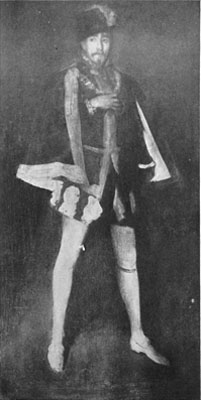
HENRY IRVING AS PHILIP OF SPAIN
From the painting by Whistler
I have a note from Whistler written to Henry at a later date which refers to the picture, and suggests portraying him in all his characters. It is common knowledge that the sitter never cared much about the portrait. Henry had a strange affection for the wrong picture of himself. He disliked the Bastien Lepage, the Whistler, and the Sargent, which never even saw the light. He adored the weak, handsome picture by Millais, which I must admit, all the same, held the mirror up to one of the characteristics of Henry's face—its extreme refinement. Whistler's Philip probably seemed to him not nearly showy enough.
Whistler I knew long before he painted the Philip. He gave me the most lovely dinner-set of blue and white Nanking that any woman ever possessed, and a set of Venetian glass, too good for a world where glass is broken. He sent my little girl a tiny Japanese kimono when Liberty was hardly a name. Many of his friends were my friends. He was with the dearest of those friends when he died.
The most remarkable men I have known were, without a doubt, Whistler and Oscar Wilde. This does not imply that I liked them better or admired them more than the others, but there was something about both of them more instantaneously individual and audacious than it is possible to describe.
When I went with Coghlan to see Henry Irving's Philip I was no stranger to his acting. I had been present with Tom Taylor, then dramatic critic of The Times, at the famous first night at the Lyceum in 1874, when Henry Irving put his fortune, counted not in gold, but in years of scorned delights and laborious days—years of constant study and reflection, of Spartan self-denial, and deep melancholy—I was present when he put it all to the touch "to win or lose it all." This is no exaggeration. Hamlet was by far the greatest part that he had ever played, or was ever to play. If he had failed—but why pursue it? He could not fail.
Yet the success on the first night at the Lyceum in 1874 was not of that electrical, almost hysterical splendor which has greeted the momentous achievements of some actors. The first two acts were received with indifference. The people could not see how packed they were with superb acting—perhaps because the new Hamlet was so simple, so quiet, so free from the exhibition of actors' artifices which used to bring down the house in "Louis XI" and in "Richelieu," but which were really the easy things in acting, and in "Richelieu" (in my opinion) not especially well done. In "Hamlet" Henry Irving did not go to the audience. He made them come to him. Slowly but surely attention gave place to admiration, admiration to enthusiasm, enthusiasm to triumphant acclaim.
I have seen many Hamlets—Fechter, Charles Kean, Rossi, Frederick Haas, Forbes-Robertson, and my own son, Gordon Craig, among them, but they were not in the same hemisphere! I refuse to go and see Hamlets now. I want to keep Henry Irving's fresh and clear in my memory until I die.
When he engaged me to play Ophelia in 1878 he asked me to go down to Birmingham to see the play, and that night I saw what I shall always consider the perfection of acting. It had been wonderful in 1874. In 1878 it was far more wonderful. It has been said that when he had the "advantage" of my Ophelia, his Hamlet "improved." I don't think so. He was always quite independent of the people with whom he acted.
The Birmingham night he knew I was there. He played—I say it without vanity—for me. We players are not above that weakness, if it be a weakness. If ever anything inspires us to do our best it is the presence in the audience of some fellow-artist who must in the nature of things know more completely than any one what we intend, what we do, what we feel. The response from such a member of the audience flies across the footlights to us like a flame. I felt it once when I played Olivia before Eleonora Duse. I felt that she felt it once when she played Marguerite Gauthier for me.
When I read "Hamlet" now, everything that Henry did in it seems to me more absolutely right, even than I thought at the time. I would give much to be able to record it all in detail—but it may be my fault—writing is not the medium in which this can be done. Sometimes I have thought of giving readings of "Hamlet," for I can remember every tone of Henry's voice, every emphasis, every shade of meaning that he saw in the lines and made manifest to the discerning. Yes, I think I could give some pale idea of what his Hamlet was if I read the play.
"Words! words! words!" What is it to say, for instance, that the cardinal qualities of his Prince of Denmark were strength, delicacy, distinction? There was never a touch of commonness. Whatever he did or said, blood and breeding pervaded him.
His "make-up" was very pale, and this made his face beautiful when one was close to him, but at a distance it gave him a haggard look. Some said he looked twice his age.
He kept three things going at the same time—the antic madness, the sanity, the sense of the theater. The last was to all that he imagined and thought, what charity is said by St. Paul to be to all other virtues.
He was never cross or moody—only melancholy. His melancholy was as simple as it was profound. It was touching, too, rather than defiant. You never thought that he was wantonly sad and enjoying his own misery.
He neglected no coup de théâtre to assist him, but who notices the servants when the host is present?
For instance, his first entrance as Hamlet was, what we call in the theater, very much "worked up." He was always a tremendous believer in processions, and rightly. It is through such means that Royalty keeps its hold on the feeling of the public, and makes its mark as a Figure and a Symbol. Henry Irving understood this. Therefore, to music so apt that it was not remarkable in itself, but merely a contribution to the general excited anticipation, the Prince of Denmark came on to the stage. I understood later on at the Lyceum what days of patient work had gone to the making of that procession.
At its tail, when the excitement was at fever heat, came the solitary figure of Hamlet, looking extraordinarily tall and thin. The lights were turned down—another stage trick—to help the effect that the figure was spirit rather than man.
He was weary—his cloak trailed on the ground. He did not wear the miniature of his father obtrusively round his neck! His attitude was one which I have seen in a common little illumination to the "Reciter," compiled by Dr. Pinches (Henry Irving's old schoolmaster). Yet how right to have taken it, to have been indifferent to its humble origin! Nothing could have been better when translated into life by Irving's genius.
The hair looked blue-black, like the plumage of a crow, the eyes burning—two fires veiled as yet by melancholy. But the appearance of the man was not single, straight or obvious, as it is when I describe it—any more than his passions throughout the play were. I only remember one moment when his intensity concentrated itself in a straightforward, unmistakable emotion, without side-current or back-water. It was when he said:
"The play's the thing With which to catch the conscience of the King."
and, as the curtain came down, was seen to be writing madly on his tablets against one of the pillars.
"Oh, God, that I were a writer!" I paraphrase Beatrice with all my heart. Surely a writer could not string words together about Henry Irving's Hamlet and say nothing, nothing.
"We must start this play a living thing," he used to say at rehearsals, and he worked until the skin grew tight over his face, until he became livid with fatigue, yet still beautiful, to get the opening lines said with individuality, suggestiveness, speed, and power.
Bernardo: Who's there? Francisco: Nay, answer me; stand, and unfold yourself. Bernardo: Long live the King! Francisco: Bernardo? Bernardo: He. Francisco: You come most carefully upon your hour. Bernardo: 'Tis now struck twelve; get thee to bed, Francisco. Francisco: For this relief much thanks; 'tis bitter cold....
And all that he tried to make others do with these lines, he himself did with every line of his own part. Every word lived.
Some said: "Oh, Irving only makes Hamlet a love poem!" They said that, I suppose, because in the Nunnery scene with Ophelia he was the lover above the prince and the poet. With what passionate longing his hands hovered over Ophelia at her words:
"Rich gifts wax poor when givers prove unkind."
His advice to the players was not advice. He did not speak it as an actor. Nearly all Hamlets in that scene give away the fact that they are actors, and not dilettanti of royal blood. Irving defined the way he would have the players speak as an order, an instruction of the merit of which he was regally sure. There was no patronizing flavor in his acting here, not a touch of "I'll teach you how to do it." He was swift—swift and simple—pausing for the right word now and again, as in the phrase "to hold as 'twere the mirror up to nature." His slight pause and eloquent gesture was the all-embracing word "Nature" came in answer to his call, were exactly repeated unconsciously years later by the Queen of Roumania (Carmen Sylva). She was telling us the story of a play that she had written. The words rushed out swiftly, but occasionally she would wait for the one that expressed her meaning most comprehensively and exactly, and as she got it, up went her hand in triumph over her head. "Like yours in 'Hamlet,'" I told Henry at the time.
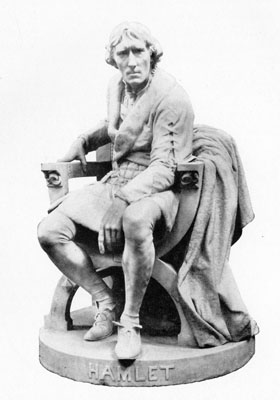
HENRY IRVING AS HAMLET
From the statue by E. Onslow Ford, R.A., in the Guildhall of the City of London
I knew this Hamlet both ways—as an actress from the stage, and as an actress putting away her profession for the time as one of the audience—and both ways it was superb to me. Tennyson, I know, said it was not a perfect Hamlet. I wonder, then, where he hoped to find perfection!
James Spedding, considered a fine critic in his day, said Irving was "simply hideous ... a monster!" Another of these fine critics declared that he never could believe in Irving's Hamlet after having seen "part (sic) of his performance as a murderer in a commonplace melodrama." Would one believe that any one could seriously write so stupidly as that about the earnest effort of an earnest actor, if it were not quoted by some of Irving's biographers?
Some criticism, however severe, however misguided, remains within the bounds of justice, but what is one to think of the Quarterly Reviewer who declared that "the enormous pains taken with the scenery had ensured Mr. Irving's success"? The scenery was of the simplest—no money was spent on it even when the play was revived at the Lyceum after Colonel Bateman's death. Henry's dress probably cost him about £2!
My Ophelia dress was made of material which could not have cost more than 2s. a yard, and not many yards were wanted, as I was at the time thin to vanishing point! I have the dress still, and, looking at it the other day, I wondered what leading lady now would consent to wear it.
At all its best points, Henry's Hamlet was susceptible of absurd imitation. Think of this well, young actors, who are content to play for safety, to avoid ridicule at all costs, to be "natural"—oh, word most vilely abused! What sort of naturalness is this of Hamlet's?
"O, villain, villain, smiling damned villain!"
Henry Irving's imitators could make people burst with laughter when they took off his delivery of that line. And, indeed, the original, too, was almost provocative of laughter—rightly so, for such emotional indignation has its funny as well as its terrible aspect. The mad, and all are mad who have, as Socrates put it, "a divine release from the common ways of men," may speak ludicrously, even when they speak the truth.
All great acting has a certain strain of extravagance which the imitators catch hold of and give us the eccentric body without the sublime soul.
From the first I saw this extravagance, this bizarrerie in Henry Irving's acting. I noticed, too, its infinite variety. In "Hamlet," during the first scene with Horatio, Marcellus and Bernardo, he began by being very absent and distant. He exchanged greetings sweetly and gently, but he was the visionary. His feet might be on the ground, but his head was towards the stars "where the eternal are." Years later he said to me of another actor in "Hamlet": "He would never have seen the ghost." Well, there was never any doubt that Henry Irving saw it, and it was through his acting in the Horatio scene that he made us sure.
As a bad actor befogs Shakespeare's meaning, so a good actor illuminates it. Bit by bit as Horatio talks, Hamlet comes back into the world. He is still out of it when he says:
"My father! Methinks I see my father."
But the dreamer becomes attentive, sharp as a needle, with the words:
"For God's love, let me hear."
Irving's face, as he listened to Horatio's tale, blazed with intelligence. He cross-examined the men with keenness and authority. His mental deductions as they answered were clearly shown. With "I would I had been there" the cloud of unseen witnesses with whom he had before been communing again descended. For a second or two Horatio and the rest did not exist for him.... So onward to the crowning couplet:
"... foul deeds will rise, Though all the earth o'erwhelm them to men's eyes."
After having been very quiet and rapid, very discreet, he pronounced these lines in a loud, clear voice, dragged out every syllable as if there never could be an end to his horror and his rage.
I had been familiar with the scene from my childhood—I had studied it; I had heard from my father how Macready acted in it, and now I found that I had a fool of an idea of it! That's the advantage of study, good people, who go to see Shakespeare acted. It makes you know sometimes what is being done, and what you never dreamed would be done when you read the scene at home.
As one of the audience I was much struck by Irving's treatment of interjections and exclamations in "Hamlet." He breathed the line: "O, that this too, too solid flesh would melt," as one long yearning, and, "O horrible, O horrible! most horrible!" as a groan. When we first went to America his address at Harvard touched on this very subject, and it may be interesting to know that what he preached in 1885 he had practiced as far back as 1874.
"On the question of pronunciation, there is something to be said which I think in ordinary teaching is not sufficiently considered. Pronunciation should be simple and unaffected, but not always fashioned rigidly according to a dictionary standard. No less an authority than Cicero points out that pronunciation must vary widely according to the emotions to be expressed; that it may be broken or cut with a varying or direct sound, and that it serves for the actor the purpose of color to the painter, from which to draw variations. Take the simplest illustration. The formal pronunciation of A-h is 'Ah,' of O-h, 'Oh,' but you cannot stereotype the expression of emotion like this. These exclamations are words of one syllable, but the speaker who is sounding the gamut of human feeling will not be restricted in his pronunciation by dictionary rule. It is said of Edmund Kean that he never spoke such ejaculations, but always sighed or groaned them. Fancy an actor saying: 'My Desdemona! Oh! oh! oh!' "Words are intended to express feelings and ideas, not to bind them in rigid fetters; the accents of pleasure are different from the accents of pain, and if a feeling is more accurately expressed as in nature by a variation of sound not provided by the laws of pronunciation, then such imperfect laws must be disregarded and nature vindicated!"
It was of the address in which these words occur that a Boston hearer said that it was felt by every one present that "the truth had been spoken by a man who had learned it through living and not through theory."
I leave his Hamlet for the present with one further reflection. It was in courtesy and humor that it differed most widely from other Hamlets that I have seen and heard of. This Hamlet was never rude to Polonius. His attitude towards the old Bromide (I thank you, Mr. Gelett Burgess, for teaching me that word which so lightly and charmingly describes the child of darkness and of platitude) was that of one who should say: "You dear, funny old simpleton, whom I have had to bear with all my life—how terribly in the way you seem now." With what slightly amused and cynical playfulness this Hamlet said: "I had thought some of Nature's journeymen had made men and not made them well; they imitated humanity so abominably."
Hamlet was by far his greatest triumph, although he would not admit it himself—preferring in some moods to declare that his finest work was done in Macbeth, which was almost universally disliked.
When I went with Coghlan to see Irving's Philip, this "Hamlet" digression may have suggested that I was not in the least surprised at what I saw. Being a person little given to dreaming, and always living wholly in the present, it did not occur to me to wonder if I should ever act with this marvelous man. He was not at this time lessee of the Lyceum—Colonel Bateman was still alive—and I looked no further than my engagement at the Prince of Wales's, although in a few months it was to come to an end.
Although I was now earning a good salary, I still lived in lodgings at Camden Town, took an omnibus to and from the theater, and denied myself all luxuries. I did not take a house until I went to the Court Theater. It was then, too, that I had my first cottage—a wee place at Hampton Court where my children were very happy. They used to give performances of "As You Like It" for the benefit of the Palace custodians—old Crimean veterans, most of them—and when the children had grown up these old men would still ask affectionately after "little Miss Edy" and "Master Teddy," forgetting the passing of time.
My little daughter was a very severe critic! I think if I had listened to her, I should have left the stage in despair. She saw me act for the first time as Mabel Vane, but no compliments were to be extracted from her.
"You did look long and thin in your gray dress."
"When you fainted I thought you was going to fall into the orchestra—you was so long."
In "New Men and Old Acres" I had to play the piano while I conducted a conversation consisting on my side chiefly of haughty remarks to the effect that "blood would tell," to talk naturally and play at the same time. I "shied" at the lines, became self-conscious, and either sang the words or altered the rhythm of the tune to suit the pace of the speech. I grew anxious about it, and was always practicing it at home. After much hard work Edy used to wither me with:
"That's not right!"
Teddy was of a more flattering disposition, but very obstinate when he chose. I remember "wrastling" with him for hours over a little Blake poem which he had learned by heart, to say to his mother:
"When the voices of children are heard on the green, And laughing is heard on the hill, My heart is at rest within my breast, And everything else is still. Then come home, my children, the sun is gone down, And the dews of the night arise, Come, come, leave off play, and let us away, Till morning appears in the skies. No, no, let us play, for yet it is day, And we cannot go to sleep. Besides, in the sky the little birds fly, And the hills are all covered with sheep...."
All went well until the last line. Then he came to a stop.
Nothing would make him say sheep!
With a face beaming with anxiety to please, looking adorable, he would offer any word but the right one.
"And the hills are all covered with—"
"With what, Teddy?"
"Master Teddy don't know."
"Something white, Teddy."
"Snow?"
"No, no—does snow rhyme with 'sleep'?"
"Paper?"
"No, no. Now, I am not going to the theater until you say the right word. What are the hills covered with?"
"People."
"Teddy, you're a very naughty boy."
At this point he was put in the corner. His first suggestion when he came out was:
"Grass? Trees?"
"Are grass or trees white?" said the despairing mother with her eye on the clock, which warned her that, after all, she would have to go to the theater without winning.
Meanwhile, Edy was murmuring: "Sheep, Teddy," in a loud aside, but Teddy would not say it, not even when both he and I burst into tears!
At Hampton Court the two children, dressed in blue and white check pinafores, their hair closely cropped—the little boy fat and fair (at this time he bore a remarkable resemblance to Laurence's portrait of the youthful King of Rome), the little girl thin and dark—ran as wild as though the desert had been their playground instead of the gardens of this old palace of kings! They were always ready to show visitors (not so numerous then as now) the sights; prattled freely to them of "my mamma," who was acting in London, and showed them the new trees which they had assisted the gardeners to plant in the wild garden, and christened after my parts. A silver birch was Iolanthe, a maple Portia, an oak Mabel Vane. Through their kind offices many a stranger found it easy to follow the intricacies of the famous Maze. It was a fine life for them, surely, this unrestricted running to and fro in the gardens, with the great Palace as a civilizing influence!
It was for their sake that I was most glad of my increasing prosperity in my profession. My engagement with the Bancrofts was exchanged at the close of the summer season of 1876 for an even more popular one with Mr. John Hare at the Court Theater, Sloane Square.
I had learned a great deal at the Prince of Wales's, notably that the art of playing in modern plays in a tiny theater was quite different from the art of playing in the classics in a big theater. The methods for big and little theaters are alike, yet quite unlike. I had learned breadth in Shakespeare at the Princess's, and had had to employ it again in romantic plays for Charles Reade. The pit and gallery were the audience which we had to reach. At the Prince of Wales's I had to adopt a more delicate, more subtle, more intimate style. But the breadth had to be there just the same—as seen through the wrong end of the microscope. In acting one must possess great strength before one can be delicate in the right way. Too often weakness is mistaken for delicacy.
Mr. Hare was one of the best stage managers that I have met during the whole of my long experience in the theater. He was snappy in manner, extremely irritable if anything went wrong, but he knew what he wanted, and he got it. No one has ever surpassed him in the securing of a perfect ensemble. He was the Meissonier among the theater artists. Very likely he would have failed if he had been called upon to produce "King John," but what better witness to his talent than that he knew his line and stuck to it?
The members of his company were his, body and soul, while they were rehearsing. He gave them fifteen minutes for lunch, and any actor or actress who was foolish or unlucky enough to be a minute late, was sorry afterwards. Mr. Hare was peppery and irascible, and lost his temper easily.
Personally, I always got on well with my new manager, and I ought to be grateful to him, if only because he gave me the second great opportunity of my career—the part of Olivia in Wills's play from "The Vicar of Wakefield." During this engagement at the Court I married again. I had met Charles Wardell, whose stage name was Kelly, when he was acting in "Rachael the Reaper" for Charles Reade. At the Court we played together in several pieces. He had not been bred an actor, but a soldier. He was in the 66th Regiment, and had fought in the Crimean War; been wounded, too—no carpet knight. His father was a clergyman, vicar of Winlaton, Northumberland—a charming type of the old-fashioned parson, a friendship with Sir Walter Scott in the background, and many little possessions of the great Sir Walter's in the foreground to remind one of what had been.
Charlie Kelly, owing to his lack of training, had to be very carefully suited with a part before he shone as an actor. But when he was suited—his line was the bluff, hearty, kindly, soldier-like Englishman—he was better than many people who had twenty years' start of him in experience. This is absurdly faint praise. In such parts as Mr. Brown in "New Men and Old Acres," the farmer father in "Dora," Diogenes in "Iris," no one could have bettered him. His most ambitious attempt was Benedick, which he played with me when I first appeared as Beatrice at Leeds. It was in many respects a splendid performance, and perhaps better for the play than the more polished, thoughtful, and deliberate Benedick of Henry Irving.
Physically a manly, bulldog sort of a man, Charles Kelly possessed as an actor great tenderness and humor. It was foolish of him to refuse the part of Burchell in "Olivia," in which he would have made a success equal to that achieved by Terriss as the Squire. But he was piqued at not being cast for the Vicar, which he could not have played well, and stubbornly refused to play Burchell.
Alas! many actors are just as blind to their true interests.
We were married in 1876; and after I left the Court Theater for the Lyceum, we continued to tour together in the provinces during vacation time when the Lyceum was closed. These tours were very successful, but I never worked harder in my life! When we played "Dora" at Liverpool, Charles Reade, who had adapted the play from Tennyson's poem, wrote:
"Nincompoop! "What have you to fear from me for such a masterly performance! Be assured nobody can appreciate your value and Mr. Kelley's as I do. It is well played all round."