PART II.—MODANE TO TURIN.
Reading edition
See Map of Mont Cenis Railway.
TURIN 58½ MODANE. At Modane passengers enter the carriages of the Alta Italia Railway Company. The Italian time is 47 minutes in advance of the Paris time. The best time-table for Italy is the “Indicatore Ufficiale delle Strade Ferrate,” 1 fr.; also a smaller edition, 20 c., sold at all the railway stations. Waiting-room is Sala d’Aspetto. W.-C’s., Cessi, or Latrine, or Retirate. For ladies, Cessi per le donne. Smoking carriages, Pei fumatori. Non-smoking carriages, E vietato il fumare. Way out, Uscita. Way in, Entrata. Station, Stazione or Fermata.
MODANE TURIN 5 53½ BARDONNECCHIA, 4127 ft., pop. 1600. At the station the Albergo della Stazione, and in the town the Hôtel de France. Situated near the Italian end of the tunnel, but in a more fertile country than that above Modane.
MODANE TURIN 12 46½ OULX, pop. 2000, and 3514 ft. high. Inn: Dell’ Alpi Cozzié, at the station. At this pretty little village the road from Briançon, 17 m. S.W. by Mont Genèvre, joins the rail. The mountains, which extend from Monte Viso to Mont Cenis, were called the Alpes Cottiae, from King Cottius, who, according to Pliny, reigned over this region some years before the beginning of the Christian era (Pliny, Hist. Nat., lib. iii. cap. 20). Cottius erected the arch of Susa, and also constructed the road from that town over the Cottian Alps, by Oulx to Ebrodunum, now Embrun, on the Durance (see page 343).
MODANE TURIN 21¾ 36¾ CHIOMONTE, 2526 ft. Beyond are some charming views.
MODANE TURIN 25½ 33 MEANA, 1 m. from Susa, and 325 ft. above it. The train, having traversed beautiful chestnut woods, crosses the Dora and arrives at Bussoleno, 30½ m. from Modane, whence a loop-line of 5 m. extends to Susa, 1625 ft., pop. 5000. Hotels: France; Soleil. This, the ancient Segusium, the chief city of the Segusiani, who inhabited what is now called Savoy, is situated on the Dora, 1625 ft. above the sea. On the W. side of the town is the Roman Triumphal Arch erected about 8 B.C. in honour of Augustus. It is adorned with Corinthian columns and sculptured friezes on the entablature, but all are in a decayed condition. The cathedral, San Giusto, dates from the llth cent.
12 m. from Bussoleno and 16 from Turin is San Ambrogio station, at the foot of Monte Pirchiriano, 3150 ft. above the sea and 1500 above the plain. On the summit is the convent of S. Michele della Chiusa, founded by Ugone Marino in 966, and finished in 1000. It was partially repaired by Carlo Alberto and Vittorio Emanuele II. The government intend to establish a meteorological station here. A good mule-path leads to the top in about an hour, passing the village of S. Pietro, with a good inn, 2617 ft. above the sea.
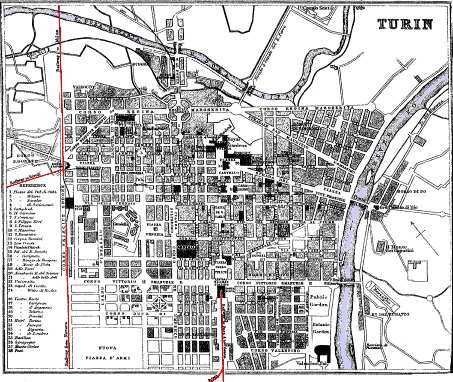
TURIN,
pop. 264,000, on the Po and the Dora Riparia, 785 ft. above the sea, and 490 m. S.E. from Paris. The city derives its name from the tribe Taurini, who were first the opponents and then the allies of the Romans. When Hannibal descended from the Alps he destroyed the city, that he might have nothing to dread from its hostility. Having risen speedily from its ruins, it received within its walls the army of reserve of Julius Cæsar when he marched against the Gauls. Under the Lombards it was made the capital of a duchy, and became the favourite residence of Queen Theodolinda, who, in 602, built the church of S. Giovanni Battista, now the cathedral of Turin, reconstructed in 1498. Francis I. so damaged Turin in 1536 that its entire reconstruction became necessary. The streets are wide, clean, and well paved, and pass through spacious squares ornamented with statues and bordered by handsome arcades. The most aristocratic part of Turin is the western end of the Corso Vittorio Emanuele II. and the streets ramifying southwards from this.
Hotels.—The *Europa, 19 Piazza Castello. In the same square, and less expensive, is the H. di Londra. This piazza is in the neighbourhood of the principal sights, and is the terminus of the most important trams. The other first-class houses are: the *Torino, opposite the arrival side of the station. The *Liguria, 14 Piazza Bodoni, with one end to the Via Carlo Alberto. Their new house is at 9 Via Madama Cristina, near the English chapel and the Vaudois church. The Liguria is patronised by Messrs. Cook. The H. Feder, 8 Via S. Francesco di Paolo. At 31 and 29 Via Roma, the Angleterre; and the Trombetta. The Albergo Centrale, Via delle Finanze; Bonne Femme (Buona Fama), Via Barbaroux. Less expensive: H. *Suisse; H. Bologna, both opposite arrival side of station; *France et Concorde, Via dell’ Accademia Albertina, with one side to the Via di Po; Albergo del Campo di Marte, 40 Via della Providencia; the Dogana Vecchia, 4 Via Corte d’Appello; Albergo del Gran Mogol, 41 Via Lagrange.
Cabs.—One horse, from 6 A.M. till midnight, the course, 1 fr. First half-hour, 1 fr. First hour, 1½ fr. Each successive half-hour, 75 c. The course from midnight to 6 A.M., 1¼ fr. From the central station to any part of the town, 1¼ fr. Trunks, 20 c. each. Cabs with 2 horses, ½ fr. additional. Porters, for carrying each portmanteau from the station to a cab, 2 sous. Each small article, either to cab or to the railway carriage, 1 sou.
Horse-trams traverse Turin in every direction; while the steam-trams
Turin: Stations.
Stations.—The most important is the Central Station, a well-situated and well-arranged and spacious edifice. On a tablet on the departure side is an inscription to the honour of George and Robert Stephenson. Parallel to the station is the wide and handsome Corso Vittorio Emanuele, which traverses the city from east to west, having at the eastern end the Po and the Giardino Pubblico, and at the western the model prison, the Carcere giudiziario, the artillery barracks, and the cattle-market. In front of the station is a bronze statue of Massimo d’Azeglio, a poet and painter, who died in 1866, one of those who helped to throw off the yoke of Rome. Behind the statue is the garden or Piazza Carlo Felice, and the straight street, the Via Roma, extending to the Piazza Castello, by the Piazza S. Carlo, with, in the centre, a bronze equestrian statue, modelled by Marochetti in 1838, of Emanuele Filiberto, Duke of Savoy, and son of Carlo III. il Buono. He died in 1580. The attitude is rather theatrical. The station for Rivoli, at the west end of the Piazza dello Statuto, communicates with the P. Castello by the Via Garibaldi. The Cirié Lanzo station is on the Dora, N. side of plan, at the Ponte-Mosca. Opposite the Rivoli station, in the Piazza dello Statuto, is a monument to the engineers of Mt. Cenis tunnel, in the shape of a pyramid, 60 ft. high, composed of huge blocks of unhewn granite, up which scramble discomfited, colossal, naked Titans in white marble. On the pinnacle stands the Genius of Science, of a slighter make, and on a tablet the names of the engineers, Sommeiller, Gratoni, and Grandi.
Turin: Post Office. Booksellers.
Post and telegraph offices are in the Piazza Carlo Alberto, by the side of the Palazzo Carignano (p. 297). Stamps are sold at all the tobacco shops. This piazza is close to the P. Castello, and connected with the Via di Po by a lofty arcade, covered with glass, and bordered on both sides with well-stocked shops.
Booksellers.—For maps of Italy, Carlo Crespi, 2 Via Lagrange. For guide-books, Loescher and Brero, both in the Via di Po.
Money-changers in the central railway station and in the principal streets. In the main streets are also elegant Cafés, where the charge in all of them for a good cup of coffee with a piece of ice is 6 sous. The same price for an excellent ice cream heaped up in a glass.
Theatres.—See list on plan. A short way east from the central
Turin: Sights.
Sights.—The museums and picture gallery (Pinacoteca) in the “Accademia delle Scienze,” with one side to the Piazza Carignano and another to the Via dell’ Accademia delle Scienze. Nearly opposite is the Palazzo Carignano, containing the zoological and mineralogical collections. The white marble statue in front represents the philosopher, Vincenzo Gioberti, born 5th April 1801 in the house opposite, 5 Via Lagrange, where a white marble tablet states: “II Conte Camillo di Cavour naque in questa casa, addi 10 Agosto 1810. E vi mori il 6 Giugno 1861.” The armoury, enter by door headed “Reale Armeria Antica” under corridor, 13 Piazza Castello; adjoining is the Royal Palace. On the other side of the palace is the cathedral, San Giovanni. A walk down the Via di Po. Several drives in the horsetrams. All the above places are near each other, around the Piazza Castello. The only one that is at a little distance is the Museo Civico, up the side street, V. Rossini, from the Via di Po. The Superga, by steam tram from the Piazza Castello.
Turin: Palazzo dell’ Accademia. Museum of Antiquities.
The Museum of Antiquities and the Picture Gallery.
The Palazzo dell’ Accademia delle Scienze, designed by Guarini, was built in 1678 as a college for the sons of noblemen. It is a vast earthy-coloured brick edifice, of which the ornaments, mouldings, and cornices are also of dingy brick. On the ground-floor are the more massive, and in the first story the smaller antiquities. In the second story is the picture gallery, containing about 800 paintings in fifteen rooms. Open daily from 9 to 4, 1 fr. On Sundays and feast-days free, when it is open from 12 to 4. The large antiquities are contained in two halls. Hall 1. Left. In the centre, against the wall, under an inscription in honour of the Egyptologist Champollion, is the gem of the collection, a black basalt statue of Sesostris, Rameses II., 1388 B.C. On his right, in rose-coloured granite, is the colossal statue of Amenophis II., 1565 B.C., and on his left a small black basalt statue of Amenophis II., the god Ptah. Opposite are three figures in a sitting posture, representing the Egyptian Trinity, Osiris, Horus, and Isis. At the head of this hall is the colossal red sandstone statue of Seti II., in whose reign the exodus of the Israelites took place. From
Parallel to Hall 1 is Hall 2. At the head of this hall, in a sitting posture, is the black basalt statue of Thothmes III., 1591 B.C., who was one of the most powerful of the Pharaohs.
Upstairs, first floor, are the smaller antiquities, contained in three large halls and several rooms. Near the centre of the first hall, left, is the oldest of all the articles in the museum, the pedestal of a table covered with hieroglyphics, supposed to have been made about 2654 B.C. A little farther down, in the centre of the hall, under a glass case, No. 13, is the Tabula Isiaca, a bronze tablet, 4 ft. long by 2 ft. 2 in. wide, inlaid with hieroglyphics in silver, made at Rome in the reign of Hadrian. Exactly opposite this tablet commences the passage that leads to the smaller rooms. In the first room, left, in the corner, is a colossal bust of Juno, hollowed, that the priest might the more easily work the oracle. In the first room, right, is a mosaic pavement, found at Stampacci in Sardinia. The rooms contain besides Phoenician terracotta figures, Etruscan vases, statuettes, urns, reliefs, ancient iron ornaments, lamps, etc.
The Centre Hall contains idols, jewellery, amulets, sarcophagi, mummies, Egyptian heads with the hair on, and bricks made by the Israelites.
In the Third Hall are the Papyri, of which the most important are: No. 4, near centre, against left wall, in second row, The Book of the Dead, 35 ft. long and 8 in. wide, illustrated with plain vignettes. Opposite, in centre of hall, is 126, fragments of the famous annals of Manetho, which contained a list of more than 300 kings of Egypt down to the 19th dynasty.
Turin: Picture Gallery.
In the second story is the Picture Gallery. All the paintings are labelled. In Room 1 are portraits of princes of the house of Savoy, and battles in which they were engaged. Room 2. In this room are excellent specimens of the Turin painter, Gaudenzio Ferrari, No. 49, St. Peter and Donor; 52, Madonna and St. Elizabeth; 53, God; 54, Descent from Cross; 57, Joachim driven from the Temple. Rooms 3 and 4. Italian pictures, Massimo d’Azeglio, another Turin painter, 90, a Landscape. Room 5. Italian paintings of the 14th, 15th, and 16th cents.: Clovio, 127 bis, an Entombment, painted on silk; Bronzino, 127 and 128, Portraits of Eleonora da Toledo and her husband, Cosimo I. de Medici. Room 6. J. da Ponte (II Bassano), 148, Portrait; P. Caliari (Paolo Veronese), 157, Queen of Sheba presenting Room 7. Guido Reni, 163, S. Giovanni; Spagnoletto, 174, St. Jerome. Room 8. Enamels and paintings on porcelain by Constantin of Geneva. Room 9. A small room entirely filled with fruit and flower pieces by Dutch artists. Between rooms 9 and 10 is a dark lobby, hung also with pictures. Room 10. Continuation of the Italian school, 16th, 17th, and 18th cents.: B. Strozzi, 232, Portrait of Prelate; 251, Homer singing his own Songs; Paolo Veronese, 234, Mary Magdalene at our Lord’s Feet; Guido Reni, 235, Apollo; 236, Cupids; G. Dughet (Poussin), 237, 238, Tivoli Waterfalls; G. F. Barbieri (Il Guercino), 239, 262, *S. Francesca Romana, and in next room, Return of Prodigal Son. Room 11. A. Canale (Il Canaletto), 257 bis, Ducal Palace, Venice; F. Albani, 260, 264, 271, and 274, The Four Elements; S. Ricci, 272, Hagar sent away; 275, Solomon burns the Idols; C. Dolce, 276, Head of Madonna; B. Bellotto, 283, 288, Royal Palace, Turin; Old Bridge across the Po. Room 12. Flemish and German school: Acken (Bosch), 309, an Adoration; G. Van Eyck, 313, St. Francis; Rogier Van des Weyden, 312, *Madonna; F. Franck, 335, Room with Ladies and Gentlemen; Van Dyck, 338, 351, The three Children of Charles I. of England; *The Princess Clara Eugenia of Spain; Rubens, 340, Sketch of his apotheosis of Henri IV. in the Uffici of Florence. Room 13. Containing the gems of the collection: A. Mantegna, 355, Virgin, Child, and Saints; L. Credi, 356, *Virgin and Child; G. F. Barbieri (Guercino), 357, *Virgin and Child; Hans Memling, 358, *The Seven Sorrows of the Woman Mary; Saenredam, 361, *Interior of a Protestant Church, the figures by A. Ostade; Van Dyck, 363, *Large equestrian portrait of the Principe Tommaso di Savoia; his finest work is **384, Holy Family; D. Teniers, 364, Tavern; G. Ferrari, 371, Jesus giving up the Ghost; Raphael, 373, *La Madonna della Tenda; Donatello, 375, Virgin and child in relief on marble; Sodoma, 376, *Death of Lucretia; P. Potter, 377, *Cattle grazing in a meadow; H. Holbein, 386, Portrait of Erasmus. Room 14. Dutch and German school: Picture by Jordaens; Sallaert, 398, Procession in Brussels; Floris, 410, Adoration; P. P. Rubens, 416, Resurrection of Lazarus; C. Vos, 417, Portraits of Snyders and his wife; Teniers (the younger), 423, Card Players; Schalcken, 458, Old Woman. Room 15. French school: C. Gélée (Claude Lorrain), 478, 483, Landscapes; I. Courtois (Bourguignon), 481, Cavalry Charge. Catalogues sold of the contents of the museums and picture gallery.
Palazzo Carignano. Royal Armoury.
Museum of Zoology and Mineralogy.
Opposite the Palazzo dell’ Accademia, but a little to the left, is the Palazzo Carignano, also by Guarini, and also of earthy-coloured brick; but the decorations are superior, more varied, and more pleasing than those of the Palazzo dell’ Accademia. In large gilt letters, on the façade fronting the Piazza Carignano and the statue of Gioberti, are the words, “Qui nacque Vittorio Emanuele II.” Within is a high and spacious court, surrounded by lofty halls, and at the east end, fronting the Piazza Carlo Alberto, with the beautiful bronze monument to him by Marochetti, cast in London, is the more pretentious stone façade, built in 1871, but not in harmony with the rest of the building. (See also p. 293.) In this palace, magnificently housed, are the zoological and mineralogical collections. Open daily, 1 fr. Sundays and feast-days free.
Royal Armoury.
No. 13 Palazzo Castello, open on feast-days from 11 to 3 free. On other days procure admission from the secretary. This collection is of great interest only to the inhabitants of northern Italy, as it is filled chiefly with relics of their kings, dukes, and wars. In the first room is “Favorito,” the favourite horse of the magnanimous Ré, Carlo Alberto. Above it, near the roof, are numerous tattered flags taken in battle. In the large hall are two rows of armed knights and foot-soldiers. At the head of this hall, in a glass case, numbered 301, is an embossed oval shield, inlaid with gilding, and surrounded by a fringe of massive gold thread. On five medallions are represented, in alto-relievo, scenes from the war of Marius against Jugurtha. It belongs to the school of Giulio Romano, was executed probably in the latter half of the 16th cent., and was presented to the university of Turin by the Princess Vittoria di Sassonia Hilburghausen. Among the relics are the sword worn by Napoleon at the battle of Marengo, the saddle of Charles V., and some beautifully inlaid body-armour of the Dukes of Savoy. The large door at the end of this hall opens into the “Medagliere del Ré,” containing 30,000 Greek, Roman and ancient coins and medals, including a complete series of those struck in the State of Sardinia; and also 5000 medallions, seals and stamps. In this same part is the Biblioteca del Ré, with 40,000 vols., 1800 MSS., numerous autographs, engravings and drawings by the great masters. To visit these special permission must be obtained. From the windows of the armoury is a view of the palace-gardens. Turin: Royal Palace. In the absence of the royal family the palace may be visited. It is a plain brick building, commenced in 1646, with the front to the Piazza Castello, plastered to imitate stone. Having passed the main entrance, turn to the left. At the end of this corridor is seen, through a glass door, the equestrian statue of Vittorio Amadeo I. (died 1675) in a niche at the foot of the grand staircase. The rider is in bronze, the horse in marble. Ascend the marble steps, then, to the right, two flights of narrow steps lead to the hall of the palace, where the servants will be found who show the palace. Fee, 1 fr.; party, 2 frs. After the guardroom succeeds a series of rooms with much gilding, inlaid floors, and rich furniture. The pictures are all modern, and of no great merit. The room called Maria Theresa’s contains some fine china vases.
Turin: The Cathedral.
The Cathedral.
Adjoining the western end of the palace is the Cathedral San Giovanni Battista. To the left of the altar is the pew of the royal family. Behind the altar, and approached by two staircases of 37 steps each, is the Cappella del Sudario (open till 9 A.M.), a circular chapel, separated from the church by a glass screen. It was built by Guarini in 1694, and is encrusted with the dark grayish-blue marble from Fabrosa, near Mondovi, which brings out in striking relief the pure white of the statues and the rich gilding of the ornaments, cornices, capitals, and eight-limbed stars which spangle the interior. Double monolith columns of the same dark marble, with bronze pedestals and capitals, support six arches ornamented with diaper-work on the soffits. Above them rise six smaller arches containing the windows, while the dome or cupola is composed of an intricate series of interlacing zigzag arched ribs rising from the second tier, and intermingled with loopholes, which throw light in such a manner upon the star at the summit as to give it the appearance of being suspended. The beautiful altar, lighted with gold and silver lamps, has two faces, so that two masses are said before it at the same time. The shrine on this altar is said to contain the shroud (Sudario) in which Joseph of Arimathea wrapped the body of our Lord when he laid Him in the tomb. Round the chapel are the beautiful white marble monuments of three kings of the house of Savoy—Em. Filiberto (ob. 1580), by Marchesi; Carlo Emanuele II. (ob. 1675), by Fraccaroli; and Amedeo VIII., first Duke of Savoy (ob. San Lorenzo, designed by Guarini, and finished in 1687. The interior is gorgeous, but it is chiefly distinguished for the boldness of its arches.
Turin: The Castello. Museo Civico.
The Castello.
The large brick building in the centre of the Piazza Castello was erected in the 13th century, and called the Castello till 1718, when it became the favourite residence of the widow of Carlo Emanuele II., Madama M. G. Battista, who built the stone façade, and in honour of whom it has ever since been called the Palazzo Madama. Before the seat of government was removed to Florence the senators assembled in the great hall of this palace. One of the towers is used as an observatory, and another part of the palace by the “Accademia reale di Medicina,” who here hold their meetings, and have also a museum of craniology.
Museo Civico.
Via Gaudenzio Ferrari, No. 1, near the Via di Po. Open from 12 to 3, 1 fr. Sundays and feast-days free. First room, autographs and MSS. of celebrated Piedmontese. 2. Water-colours, representing landscapes and historical scenes in Piedmont. Under glass frame is a solid oblong chased silver vase, 3 ft. and some inches in its greater diameter, and 2 ft. 8 inches in its smaller. At each of the two long ends is a lion’s head with a ring in his mouth. Near this vase, and also under a glass frame, and also in solid silver, are two candelabra, a vase, and two flower-holders adorned with figures in relief. The first was presented in 1871 by the English Government, and the other by that of the United States to the Count Frederic Sclopis, President of the Geneva arbitration in the Alabama question, and given to this institution by his widow. None of them display much art; as for the English vase, it needs only a lid to turn it into a respectable soup-tureen.
The rooms from 4 to 11 contain modern oil-paintings, some very good, and all labelled. Down the centre are white marble statues; among the best are Eve and the Serpent by Fantacchiotti, and the Crucifixion of Eulalia by E. Franceschi. Second story.—Room 12, Embroidery; 13, Miniatures and illustrated MSS.; 14, Iron work; 15, Carving in wood and ivory—notice 947, Judgment of Solomon; 16, Glass and 17, Italian porcelain; 18, Busts; 19, Small oil-paintings and uniform of Azeglio; *20, Italian painted glass from 1300; 21, Egyptian pottery; 22, Pottery and stone age.
Turin: Via di Po. University. Madre di Dio.
The Via di Po.
The finest of the streets is the Via di Po, which extends from the Piazza Castello to the great rectangular square, the Piazza Vittorio Emanuele, on the bank of the Po; and as both of these spacious squares, as well as this magnificent street, are lined throughout with wide and lofty arcades, they form together an excellent and interesting walk in all weathers. The Via di Po is 768 yards long and 19½ wide, and the pavement within the arcade 6½ yards wide. Good shops are ranged on both sides of the street under the arcades. In the Via di Po is also the University, built in 1713 by Vittorio Amedeo II., but founded in 1404 by the Prince Lodovico di Acaia. It is attended by 2500 students, and directed by 70 professors. The Library, open every day from 9 to 4, contains 200,000 volumes and 3000 MSS. In the court are Roman bas-reliefs, inscriptions, and statues, ancient and modern. Between the Via di Po and the Piazza Carlo Emanuele ramifies the Via dell’ Accademia Albertina, containing at No. 6 the Accademia Albertina delle Belle Arti. Open daily. Apply to the custodi.
The Piazza Vittorio Emanuele is 394 yards long and 121½ wide. In front, on the other side of the Po, is a conspicuous church, the Gran Madre di Dio, built in 1818, in the style of the Pantheon at Rome, by Bansignori, to commemorate the return of Vittorio Emanuele I. to Turin after the fall of Napoleon. A little to the right on a hill (Il Monte) is a Capuchin convent, built towards the end of the 16th cent. The road up is very easy, and the view from the terrace admirable. Immediately above the Madre di Dio church is the palace, La Vigna della Regina, built by Prince Maurice of Savoy, which after his time was inhabited by one of the queens of Sardinia, from whom it acquired its present name, “The Queen’s Vineyard.” It is now a government school for the education of children of military men. Up the river, beyond the suspension bridge, is the Castello del Valentino, distinguished from a distance by its four pavilions with high-pitched roofs. It was built by the widow of Victor Amadeus I., daughter of Henri IV. of France, and is now used as a government school of civil engineering. It contains a good collection of minerals, the larger part of which, obtained from Sardinian provinces, are topographically arranged. The Botanical Garden belonging to the university is also here.
Turin: Monument to Cavour.
Monuments.
In the Piazza Carlo Emanuele II., a short way S. from Piazza Castello, is the monument to Camillo Cavour, by Dupré of Florence, for which he received £1200, contributed by the inhabitants of every part of Italy in 1872. The statues are in white marble, the tablets and friezes in bronze, and the pedestal in granite. The monument is tame and mystic. Cavour, in an upright position, holds in his hand a scroll bearing the words, “libera chiesa in libero stato.” (See p. 294.) The climate of Turin is more suitable for bronze than for marble statues. To the west is the Piazza S. Carlo, with a bronze monument to Emanuele Filiberto (see p. 293). Farther west, in the Piazza Solferino, is the remarkable, almost painful, bronze group representing Ferdinando di Savoia (brother of V. Emanuele II.) at the battle of Novara in 1848. When about to lead the charge on the Bicocca his horse fell, mortally wounded. The poor animal, on bended knees, with gaping mouth and outstretched neck, seems about to breathe its last in an agony of suffering.
A short way west from the Piazza Castello by the Via Palazzo di Citta is the Piazza del Palazzo di Citta, having on one side the Palazzo di Citta, or the Municipality buildings, designed by Lanfrachi, and erected in 1659. At the entrance to the Palazzo are the marble statues of the celebrated Prince Eugene and the Duke of Genoa, brother of King Victor Emanuel, and under the portico statues of Prince Thomas di Carignano and Victor Emanuel. In the centre of the square is a bronze group representing Count Verde (Amadeus VI.) over a fallen Saracen. Close to this square is the church of Corpus Domini, with the interior encrusted with beautiful marble, and ornamented with frescoes and gilding. From this the Via Milano leads towards the Piazza Em. Filiberto, passing by on the left S. Domenico, and on the right the Basilica. In S. Domenico, in the first chapel to the right of the altar, is a picture of the Virgin by Guercino.
Turin: La Consolata. Cemetery.
Near the Piazza Em. Filiberto, by the Via Giulio, is the church La Consolata, with an ugly square brick tower. It consists of three churches built at different periods. On the principal altar is a miracle-working image of the Virgin; while a great part of the adjoining walls is hung with pictures illustrating the cures and deliverances effected by it. Two lovely kneeling figures, in the most precious Carrara marble, looking towards the altar, represent respectively Maria Theresa, queen of Carlo Alberto, and Maria Adelaide, queen of Vit. Emanuele,
In the Piazza Savoia, near the Piazza dello Statuto, is an obelisk 72 ft. high, erected in 1854 to commemorate the abolition of the ecclesiastical courts. On the four sides are the names of the towns which contributed to the monument.
Less than a mile from the Ponte delle Benne is the cemetery or Campo Santo of Turin. (See N.E. corner of plan.) It is badly kept and not worth visiting. The inner or new part is a little better.
A little to the W. of the P. Solferino, and parallel to it, is the citadel and the barracks of the Cernaia. In front of the entrance is the monument to Pietro Mico, who, to save the citadel from the enemy, sprang a mine at the cost of his own life.
Turin: La Superga.
La Superga.
Leave by the steam tram starting from the Piazza Castello; the time-table is in the waiting-room, where the tickets are also sold half an hour before starting. As the train can take only a limited number, the tickets are generally all taken in the first 10 minutes. The tram runs down the Via Po, crosses the Ponte Vit. Emanuele I., passes by the western end of the church, the “Great Mother of God,” and descends by the left side of the Po to the Cassale station, whence the ascent commences by the rope and locomotive railway constructed by Agudio, and opened in 1884. The ascent takes 20 minutes, the length is 3500 yards, the average inclination 13%, and the greatest 20%. At the Superga station are waiting-rooms, and a few feet below them a commodious restaurant. On arriving at the station ascend by the road, right hand, for the Superga. The walk down the mountain is very pleasant, and it is probable that the pedestrian will fall in with some tram when on the main road to Turin.
The Superga is situated 4½ m. N.E. from Turin, on a mountain 1420 ft. above the Po, or 2146 ft. above the sea, and cost £100,000. It was commenced by Vittorio Amedeo II. in 1717, and finished in 1731, to fulfil a vow made by him on 7th September 1706, for the victory over the French at the battle of Turin, when the house of Savoy regained the duchy. The architect was Filippo Juvara.
Enter by door at the north side of the building, where the men will be
From this ascend by 357 steps from floor of church to the gallery outside the lantern. A door about 80 steps up opens into the gallery round the interior of the octagonal dome, whence the church is well seen. The top of the lantern is 229½ ft. above the pavement of the church.
Turin: Views. Lamprede. Wines.
The chief object for visiting the Superga is the splendid view from the outside gallery of the lantern. In one direction is the plain of Piedmont with the Po wandering across it; everywhere else the horizon is bounded by a vast chain of snowy Alps, with Monte Rosa on one side and Mont Blanc on the other.
Among the delicacies of Turin are the lamprede, thin eels from 5 to 8 inches long, caught in the Po. They are killed by being plunged into milk. The white truffles are also celebrated, and when cooked “à la Piedmontese” or “à la fonduta,” and taken with a bottle of Asti wine, make most enjoyable dishes. The vermouth of Turin is an agreeable aperitive, and is taken before sitting down to table. The best wines of Piedmont are the Caluzo, a white wine; the Barolo, a dryish red wine with a taste of the soil; the Barbera, a strong red wine; and the Nebrolo. The Gressini are double baked bread in strips 18 inches long and a quarter of an inch thick. In the Italian houses a handful of them is put down to each cover at the dinner-table. They are made at very many places besides Turin; even at Cannes on the Riviera. A great deal of maccheroni (macaroni) is consumed in Italy. In Turin are important silk mills.
Turin to Cuneo, 54¾ m. S., by Cavallermaggiore (see p. 153). Turin to Genoa, 103¼ m. S.E., by Asti, Alessandria, and Novi (see p. 279). Turin to Savona, 91¼ m. S.E., by Carmagnola, Bra, Carru, and Ceva (see p. 183, and map p. 27). Turin to Florence, 291 m. S.E., by Asti, Alessandria, Piacenza, Parma, Modena, Bologna, and Pistoja (see p. 309, and map p. 199).
THE WALDENSIAN VALLEYS and the Passes between France and Italy.
[Northwest] See map, page 291. [West] For continuation of the French Waldensian Valleys see map, page 326. For S. continuation see map, page 103.
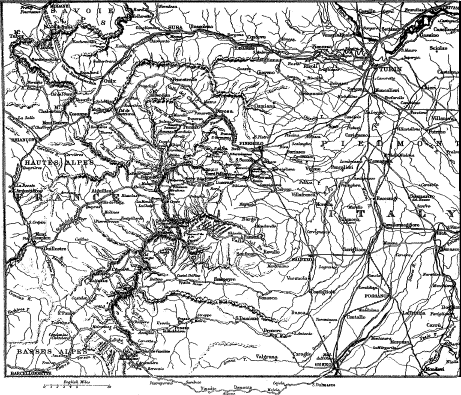
THE VALLEES VAUDOISES, OR THE VALLEYS OF THE WALDENSES.
(See accompanying Map.)
The Waldensian valleys are very beautiful, are drained by splendid trout-streams, and possess a rich variety of rare plants.
The chief town, Torre-Pèllice (formerly called Torre-Luserna) is 34¼ miles S.W. from Turin by rail, passing by Pinerolo, 23½ m. S.W. from Turin, and 10¾ m. N.E. from Torre-Pèllice. From Pinerolo a steam tram runs 12 m. N.W. up the valley of the Chisone to Perosa, the second Waldensian town in importance. Time, 1 hr. 30 min. The tram station is near the railway station.
Pinerolo is connected with Saluzzo by steam tram, 2 hrs. 20 min. S., 2 frs. 15 c. and 1 fr. 55 c., passing Osasco and Cavour. This tram station is at some distance from the Pinerolo railway station.
The Italian steam trams run on single lines laid on one side only of the highroads. Some towns they traverse, while others they merely skirt. They afford excellent opportunities for seeing the country, but run neither so quickly nor so smoothly as the railway trains.
Rail between Cuneo and Mondoví, 11½ m. E. and 58 m. S. by rail from Turin. Mondoví, pop. 17,000, on the Ellero; Inn: Tré Limoni d’Oro. On one side of the Ellero is the railway station, and on the other are the inn and town, built on the lower slopes of a wooded hill rising from the river. The Via San Agostino contains the best shops. On the top of the hill is another town nearly as large as Mondoví (see p. 184).
The country of the Italian Waldenses consists of parts of the valleys of Pèllice, San Martino, and Perosa or Chisone, is about 20 m. long from W. to E. by 13 broad, is divided into 15 parishes, exclusive of the isolated parish of Turin, and contains a population of about 25,000. They have besides a thriving colony in Uruguay. Till Cavour in 1848 procured for Italy civil and religious liberty, the Waldenses were confined by law to their valleys; now, however, they have spread themselves over the best parts of Italy, while many emigrate every year to the United States and to Uruguay. Of late mills and manufactories have been established on their rivers, which has caused a large influx of Piedmontese workmen, so that many Waldensian towns and villages which up to 1848 were inhabited almost exclusively by Protestants have now a larger population of Romanists.
These valleys are very fertile, bearing luxuriant crops of maize, wheat, barley, potatoes, French beans, etc., intersected by long rows
Waldensian Doctrines and Persecutions.
The Vaudois inhabited originally not only the valleys on the E. side of the Alps but also those of Louise, Embrun, and Barcelonnette on the French side (pp. 344, 345), and, as there was constant communication between them, French became the common language, as it is still in a great measure. They consider themselves a part of the Apostolic Church, which by its isolated position in the then almost inaccessible ravines had escaped the early innovations introduced by the church of Rome; albeit not altogether, for they admitted confession by contrite prayer to God and the mention aloud of their sins to a priest, the power of priests to bind and to loose, that sins were of two classes, mortal and venial, and the efficacy of fasts and penance. At the Reformation all these were swept away, and the doctrines and church polity of Calvin adopted. The independent church of the Waldenses, or valley-people, existed about a century before the arrival of Pierre Valdo from Lyons in 1180. Their name is supposed to be derived from “valle densa,” contracted into Vallenses, Valdenses, and finally Vaudois. The first serious persecution of the Italian Vaudois was begun at the instigation of Yolande, sister of Louis XI and wife of Amadée IX., Duke of Savoy. By her representation Innocent VIII. in 1487 fulminated against the Waldenses a bull of extermination. Whoever killed any of these heretics were to be absolved from promises they had made, property wrongly obtained by them was to be rendered legal, and they were to have a complete remission of all their sins. Persecution among the French Vaudois commenced in the 13th cent.
Torre-Pèllice.
Torre-Pèllice, pop. 5200, Inn: H. de l’Ours, good and comfortable, is situated on the Pèllice and its affluent the Angrogna, 34¼ m. S.W. by rail from Turin, 10½ m. from Pinerolo, and 1¼ m. from the station of Luserna-San Giovanni, pop. of both places together, 4200. Luserna is a considerable town to the N. of the station. Inn: Albergo del Belvédère. Opposite is San Giovanni, a large unfinished-looking village, with barracks, a “Tempio Evangelico,” and several elementary Protestant schools.
Torre-Pèllice is a thriving town in the midst of a fertile valley enclosed within most picturesque mountains. At the west end are the Waldensian church, the manse, the college, and the higher school for girls. At the other end of the town are the inn, the post and telegraph office, the Romanist church and schools, and up by the Angrogna the Baptist chapel and manse. On the rivers are cotton and flour mills, and dye and calico-printing works. These establishments have attracted many Piedmontese to the town, which, from this and other causes, have made the Romanist population more numerous than the Protestant.
The wine made in the valley of Pèllice is principally red, and is drunk in the second year. A beautiful walk extends up the valley of the Angrogna to Perosa, about 6 hrs. N. by the defile of Pra de Tor, 4360 ft., and the village of Pramollo with Waldensian chapel and schools. Pop. of the district of Pramollo, 1350.
Bobbio. Mirabouc. Col de la Croix.
Torre-Pèllice to Mont Dauphin by Bobbio, Mirabouc, Les Granges des Pras, the Col de la Croix, La Monta, and Abriés, 47 m. W., 16 to 17 hrs. walking. Up to Bobbio, 2838 ft, 7½ m. and 2½ hrs. walking, pop. 1520, Tempio Evangelico, Inns: Camoscio, etc., there is nothing particular. Afterwards the valley gradually contracts till it becomes a mere gorge, having at the entrance the ruins of Fort Mirabouc. At Mirabouc, 4718 ft., the valley turns southward to the inn and custom-house station, 5683 ft., about 3½ hrs. from Bobbio, where provisions and accommodation may be had for the night. From this commences the ascent of the Col, 7576 ft., 17 m. from Torre-Pèllice and 30 from Mont Dauphin, commanding a splendid view of Monte Viso. The top (with an Hospice) is nearly level, and the descent by the French side easy. At La Chalp the track joins the char-à-banc road leading to Mont Dauphin by La Monta, Ristolas, Abriés, and Guillestre. (For Mont Dauphin and Guillestre, see p. 344, and map p. 304.)
Pinerolo.
PINEROLO.
23½ m. S.W. from Turin by rail and 10¾ m. NE. from Torre-Pèllice is Pinerolo, 1237 ft., pop. 19,000. Inns: *Couronne d’Or; Campana; Cannon d’Oro. A handsome but rather a straggling town, with a large Piazza d’Armi, a good promenade, several hospitals, and representatives of the chief Italian banks. It contains besides a public library, various colleges and schools, including one for cavalry and another for music. The Waldenses have a chapel near the public garden, and a school for girls and another for boys. In the Via Sommeiller is a large seminary. The Cathedral is a handsome building, served by a large staff of dignitaries. In the Piazzetta Santa Croce is Cabs—the course, 1 fr.; the hour, 1 fr. 75 c.; each successive half-hour, 1 fr.
Perosa. Col d’Abriés.
Near the centre of the town is the terminus of the steam tram to Saluzzo, 2¼ hrs. Near the railway station is the terminus of the steam tram to Perosa, 12 m. N.W. from Pinerolo. Perosa, 2015 ft., pop. 2400, Inn: H. National, agreeably situated on the Chisone near its junction with the Germanasca. On the other side of the Chisone is Pomaretto, pop. 760, with a Waldensian chapel and school.
Perosa to Mont Dauphin.—There is a post-road up the Germanasca and down the Guil, an affluent of the Durance, to Mont Dauphin, passing by Perrero and Abriés. Abriés is 24 m. S.W. from Perosa and on the S. side of the Col d’Abriés, and 21 m. N.E. from Mont Dauphin. (For Mont Dauphin, see p. 344.) About 7 m. W. from Perosa is Perrero, 931 ft, pop. 560, on the Germanasca at its junction with the Germanasca di Massello. From this the road, still ascending the Germanasca, turns southward, and passing by the hamlets of Pomeifre, Fontana, Gardiola, and Bonous on the Germanasca at its junction with the Rodoretto, arrives at Prali on the Gormanasca, 4502 ft., pop. of district 1370, about 4½ hrs. walk from Perosa. The road from Prali passes Cugno, Ghigo, Orgiere, and Pomé to Giordano, whence it becomes a mule-path, which at the hamlet of Ribba separates from the path to the Pass Giuliano, 8358 ft. to the S.E., and continues in a S.W. direction by the Germanasca to the Col d’Abriés, 8677 ft., frequented even in winter. The summit is 3 hrs. from Prali, and the descent to the village of Abriés by the hamlet of Roux, 2½ hrs. (For Abriés and Mont Dauphin, see p. 344, and map, p. 304.)
Fenestrelle. Col de Sestrières.
Perosa to Cesanne, 28½ m. N.W. by the river Chisone, Fenestrelle, Pragelas, and Sestrières. 9 m. above Perosa is Fenestrelle, pop. 1120, Inns: Croce Bianca; Scudo di Francia, one of the strongest Italian fortresses on the frontier. 7 m. from Fenestrelle is Pragelas, where the valley becomes more Alpine in character. Other 4½ m. is Sestrières, “whence the road mounts in zigzags to the Col de Sestrières, a nearly level plain 2 m. long, commanding a good view of Mont Albergian. The descent is by long windings to the level of the Dora, which is crossed to reach Cesanne, 8 m. from Sestrières” (Ball’s Alps, p. 36). (For Cesanne to Briançon by Mont Genèvre, see under Briançon, p. 333, and map p. 304.)
SALUZZO.
Saluzzo is 42¼ m. S. by rail from Turin, and 4 hrs. by steam tram from the same city. Saluzzo is 2¼ hrs. N. from Cuneo by steam Inn: Lion d’Or.
The termini of the Cuneo and Saluzzo, the Pinerolo and Saluzzo, and the Turin and Saluzzo steam trams are just within the town. The tram to Pinerolo leaves Saluzzo near the railway station, passing by the marble statue to the poet Silvio Pellico, born at Saluzzo in 1788, d. 1854. Saluzzo, pop. 18,000, Inns: Corona Grossa; Gallo, is a town of considerable size, possessing great facilities for visiting various places in the neighbourhood, either by tram, rail, or coach.
Paesana. Crissolo. Col de la Traversette.
Saluzzo to Mont Dauphin, 65½ m. W. by Paesana, Crissolo, Col de la Traversette, Abriés, and Queyras. Take the coach which starts in the evening for Paesana on the Po, 1778 ft., with two fair inns, passing Martiniana and Sanfront. Above Paesana the valley becomes very picturesque and the view of Monte Viso gradually more and more imposing. After having passed Ostana, 4266 ft., the road reaches the sanctuary of San Chiaffredo, and a little farther on is Crissolo, 8 m. from Paesana, 4374 ft. Next is the Borgo, 4954 ft., the highest village in the valley of the Po, consisting of three hamlets, the lowest having a small inn. On the opposite side of the valley and about 1 m. farther up is the cave, Balma Rio Martino, 5020 ft., in strata of dolomite. The valley shortly after becomes wild and Alpine, yet enclosing two small oases—the Pian Fiorenza, 6034 ft., and the Pian del Ré, 6625 ft., containing in summer a rich variety of rare Alpine plants. A little to the S.W. of the Pian del Ré is the source of the Po. The road to the Col de la Traversette leads N.W. from the Pian del Ré through a hollow covered with snow the greater part of the year, whence the real ascent commences. About 300 ft. below the crest and 9564 ft. above the sea is the tunnel, generally closed with snow, pierced in 1480 by Ludovico II. The summit of the pass is 9680 ft. and about 4 hrs. ascending from Crissolo. The descent into the valley of the Guil is by the Buco di Viso. On the French side, 1897 ft. below the summit, is La Bergerie du Grand Vallon. (See Mont Dauphin to Saluzzo, p. 344, and map p. 304; also Ball’s Alps, p. 22.)
Cuneo.
CUNEO.
54½ m. S. from Turin by rail, and 2½ hrs. S. from Saluzzo by rail, is Cuneo, 1500 ft., pop. 1200, Inns: H. Barra di Ferro; Albergo di Superga. Steam tram to Borgo-San-Dalmazzo, pop. 4600, 45 min. S.W.; also to Dronero on the Maira, 1¼ hr. W. (See also pp. 182 and 279.)
Cuneo to Barcelonnette, 61¼ m. W., by Borgo-San-Dalmazzo, Demonte, Vinadio, Bersezio, the Col de Largentière and l’Arche, the frontier village of France, with two inns. (See under Barcelonnette; Cuneo to Nice by the Col di Tenda, see p. 182.)
Turin to Florence.
291 miles southwards by Alessandria, Piacenza, Parma, Modena, and Bologna. Time by quick trains, 13 hours. For London to Florence, and through tickets, see the Continental Time-tables of the London, Chatham, and Dover Railway, 3d.
FLORENCE 291 TURIN. (For Asti, and the route as far as Alessandria, see p. 280, and map p. 199.)
TURIN FLORENCE 81 210 VOGHERA, pop. 10,000, on the Staffora. Hotel: H. Italia. Branch to Pavia, 17 m. N., and Milan. Between Voghera and the next station, Casteggio, is on the right Montebello, where the battle took place, 9th June 1800, which preceded that of Marengo by five days.
Piacenza. Cathedral.
TURIN FLORENCE 117 174 PIACENZA, pop. 36,000, on the Po. Hotels: S. Marco; Italia; Croce Bianca. Cabs—the course, 1 horse, 70 c.; 2 horses, 1 fr. For the first hour, 1 horse, 1 fr. 50 c.; 2 horses, 1 fr. 80 c.
In the middle of the town is the square called the Piazza de’ Cavalli, from the two bronze equestrian statues of Duke Alexander Farnese and his son Duke Ranuccio. On one side is the church of S. Francesco, and on the other the Palazzo del Governo, and opposite it the picturesque Palazzo del Comune, begun in 1281. The portico underneath is used as a market. The upper part of the building is of red brick with handsome windows. The principal street, the Strada Diritta, leads to the Cathedral (1122-1233), containing some admirable paintings. In the interior the arches are round, but the ribs of the roof meet at an angle. At the 3d altar is a picture, by A. Sirani, of the Ten Thousand Martyrs; at the 4th a painting of the Death of a Saint. In the right transept is an altar-piece, Three Saints, by Calisto di Lodi, and on the ceiling frescoes by Agostino and Lodovico Carracci, in Correggio’s style. The Coronation of the Virgin is by Procaccini. The Cupola is divided into eight compartments; six of them were painted by Guercino, with figures of prophets and sybils; the other two figures were by Morazzone. Below are four allegorical paintings by Franceschini. The roof of the crypt under the church rests on 100 columns. S. Antonino (the former cathedral) was commenced in the 10th cent., and restored in 1562. The curious vestibule and the massive columns bearing the tower are relics of the earlier edifice. At the W. end of the town is Sa. Maria di Campagna, famous for paintings by Pordenone. On S. Sisto (built in the 16th cent.), with an Ionic atrium. Raphael’s Madonna, now at Dresden, was taken from S. Sisto.
The Palazzo Farnese is a great, unfinished, building, begun in 1558 by Margaret of Austria, now used as barracks. The Mandelli palace, now the Prefettura, has a handsome façade. 24 miles to the south of Piacenza is the site of Velleia, a town which was overwhelmed by a landslip in the 3d cent. Many interesting objects have been obtained there; which have been deposited in the museum of Parma. In the vicinity are emanations from the ground of carburetted hydrogen gas, which takes fire on the application of a flame.
Parma. Museum.
TURIN FLORENCE 153 138 PARMA, pop. 46,000, on the Parma. Hotels: Albergo Centrale; Croce Bianca; Leone d’Oro. Parma, although founded by the Boii, and conquered by the Romans 183 B.C., is a neat clean town of modern appearance, surrounded by bastioned walls. The most important of the edifices is the Palazzo Ducale, forming, with the Palazzo Farnese, a large unsymmetrical assemblage of buildings in the Piazza del Corte behind the Piazza Grande. In the Ducal Palace is a collection of paintings belonging to the French school. In the Farnese are the Museum of Antiquities, the Picture-Gallery, the Library, and the Farnese Theatre, now in a ruinous condition. It was built in 1620, in the time of Duke Ranuccio, and for many years was the scene of splendid spectacles and grand public entertainments.
The Museum of Antiquities embraces a small collection, in four rooms, of Roman altars, bronzes, busts, and mosaics, principally from Velleia and Rome. Among the most remarkable, are “The Theft of the Tripoid,” in 1st room. In the 2d room, a statuette of Hercules intoxicated, and the “Tabula alimentaria,” a rescript of the Emperor Trajan, relating to the support of certain poor children. In 4th room, a bust of Maria Louisa, the first Napoleon’s second wife, by Canova. Higher up on the same staircase is the Library, with 150,000 volumes, and some thousands of MSS., in several large galleries and halls, at the end of one of which is Correggio’s fresco of the Coronation of the Virgin.
Parma: Picture-Gallery—Correggio.
The Pinacoteca is on the same floor of the palace as the library, and is open daily during the same hours. The collection is not large, but is remarkable for the number and value of Correggio’s pictures. In selecting the best pictures, we shall arrange the names of the painters alphabetically to facilitate reference.
Annibal Caracci.—Pietá. Lodovico Caracci.—Funeral of the Virgin; the Apostles at the tomb of the Virgin (two large pictures). Cima da Conegliano.—Two very good pictures. (Correggio.)—1. The Madonna della Scala, a fresco. 2. The Flight into Egypt, known as the Madonna della Scodella, from the dish in the Virgin’s hand. 3. The Madonna with St. Jerome, sometimes called Il Giorno, from its bright daylight effect and in contrast with La Notte at Dresden—this is Correggio’s best picture here, perhaps it is the best picture he ever painted on canvas, and it is universally considered one of the marvels of art. The letters A. A. (Antonio Allegri) are worked into the silk that covers the walls of the cabinet. 4. The Martyrdom of St. Placidus and St. Flavia (such subjects are not agreeable, however skilfully treated). 5. The Entombment. 6. Christ carrying his Cross (some critics think this to be a work of Anselmi, others that it is an early production of Correggio). 7. A Portrait attributed to him. (On the walls of some of the rooms are the drawings that were made for Toschi the engraver from Correggio’s frescoes at Parma.) Albert Durer.—Man with a Skull. Francesco Francia.—Descent from the Cross; the Virgin enthroned with Saints; the Virgin with the Infant and St. John (most charming). Garofalo.—Virgin and Child in the clouds, with a landscape below. Giovanni di San Giovanni.—A Singing party. Murillo.—St. Jerome. Parmegianino.—The Marriage of St. Catharine (an exquisite picture); Marriage of the Virgin; Portrait of a Man with a music book (marked “incerto” on the frame). Fra Paola da Pistoia.—Adoration of Magi. Pordenone.—Portrait of a Man with an open book. Raffaello(?).—Christ in the clouds with the Virgin and St. John, and Saints below (it is by no means certain that this is a work of Raffaello). Giuseppe Rosa.—Landscape with Cattle. Lionello Spada.—Fortune-telling, three figures; Marriage of St. Catharine. Spagnoletto.—Twelve pictures of Saints. B. Schidone.—The Entombment; the Maries at the Sepulchre; Virgin, Child, and St. John. Vandyck.—Virgin and Child; Portrait of an Old Lady. Velasquez.—Portrait of a Man in a black dress (there are other portraits ascribed to him). L. da Vinci.—Sketch of a Female Head. Zuccarelli.—River Scene.
The Ducal Garden, open daily to the public, is on the other side of the river, and may be reached from the palace by a bridge called the Ponte Verde. It is a large piece of ground, laid out in a formal style; but when its chestnuts, limes, and acacias, are in leaf, it affords a pleasant promenade. Within the grounds is a palace called Palazzo di Giardino. The Botanic Gardens are at the other side of the town,
Parma: Cathedral.
By a narrow street leading east from the Ducal Palace is the Cathedral, a good specimen of Italian Gothic, built in the 13th and 14th cents. The portals are adorned with lions, by B. da Bisoni, 1281. In the interior, along the top of clustered articulated columns, runs an elegant triforium, and over it extends a lofty elliptical roof, painted by G. Mazzola. The choir is above the level of the nave. Within the great door, left side, is a portrait of Correggio, and on the other, one of Parmegianino. The cupola was painted by Correggio (1526-30), with frescoes representing the Assumption of the Virgin, but they are in a ruined state. Those on the vault of the right transept were by a son of Correggio, while those on the left transept were by Orazio Sammachini. In the Capella dei Canonici, on the right side of the church, at the foot of the choir-steps, is an altar-piece by B. Gatti; and near it a poor bust of Petrarch, with an inscription recording that he was archdeacon here. Beneath the choir is a spacious crypt, supported by thirty-four marble columns. On the walls of the sacristy are frescoes of the 14th century, and intarsias by L. Biancho.
Parma: Baptistery. S. Giovanni.
The Baptistery is a lofty octagonal building (1196-1281), with four deeply-recessed doorways, enriched with bas-reliefs. The four tiers of open galleries with columns, and a fifth tier of engaged arches, the pinnacled canopies at the top, and the ring of fantastic carvings below, combine to render this one of the most remarkable buildings of its class in Italy. In the interior there are two tiers of galleries, some rude sculpture, and a profusion of fresco painting—old, but not of much value. At the middle is a great font, hewn out of one piece of marble, and having in the centre a place where the priest could stand, protected from the water, whilst he immersed the child. The font at which the Parmesans are now baptised is at one side, ornamented with carvings, and supported by a marble lion. S. Giovanni Evangelista (1510), a church standing near the cathedral, and much visited on account of the frescoes painted by Correggio (1520-25) in the cupola; they represent the Vision of St. John, and, though blackened and badly lighted, they are fortunately in a better condition than those in the cathedral. The figures are on a large scale, and include the Evangelists and the Fathers of the Church, who look with astonishment at the glory above. Correggio also painted in grey the decorations of the vault of the sanctuary; and over the door of the sacristy in the left transept a fresco of St. John. frescoes by Parmegianino (four subjects); and in the 6th chapel is a picture, by Anselmi, of Christ with his Cross. The white marble holy-water fonts deserve notice. In the adjoining convent (now used as barracks) is a damaged fresco of two children by Correggio.
Parma: S. Paolo—Correggio.
Near the Piazza Grande is the church of the Madonna della Steccata, from designs by F. Zaccagni in 1521. The best frescoes are by Parmeggianino, Moses breaking the Tables of Stone, Adam and Eve, and the Virtues, on the archway of the choir. On the vault over the high altar a Coronation of the Virgin, by Anselmi. Gatti painted the cupola. The wooden pulpit combines elegance with simplicity. A good Madonna in corner chapel left of main entrance. Near the Piazza di Corte is the church of S. Lodovico, and adjoining it the suppressed Convent of S. Paolo, now a school. In this small building are the best preserved works of Correggio, painted for the abbess of the convent on the walls and ceiling of this her reception-room. The subject is Children, or Amoretti, represented as being seen through the openings of a bower or piece of trellis-work. Their varied attitudes are most charmingly portrayed. Diana herself, whose Triumph is thus depicted, is painted over the fireplace. Below the principal subjects are smaller figures in grey. The frescoes in the next room are by Araldi. The custodian is generally to be found in the picture-gallery.
The famous Parmesan cheese is made chiefly in dairies around Milan, Lodi, and Pavia, and is called Formaggio di grana, because commonly used in a granular form with soup. 17½ miles S.E. from Parma is Reggio Emilia (pop. 24,000). Hotels: Posta; Cavaletto. Cabs—80 c. the course; 1½ fr. the hour. Sights—Cathedral; house of Lodovico Ariosto, born here 1474. His Orlando Furioso went through sixteen editions in the 16th cent. 9 m. N.E. is Correggio, the birthplace of the great painter Antonio Allegri, called Correggio. To the Castle of Canossa and back, 14 frs.
Modena. Cathedral.
TURIN FLORENCE 185¼ 105¾ MODENA, pop. 31,000. Hotels: Reale; San Marco; Italia. Their omnibuses await the trains. Cabs—one horse, 80 c. the course, 1 fr. 50 c. the hour; 2 horses, 1 fr. the course, 1 fr. 70 c. the hour.
Modena (Mutina, Lat.), the capital of the former duchy of Modena,
The Cathedral, begun in 1099, is in the centre of the city. Its exterior is irregular, and encumbered with houses. The principal façade is small but pleasing, with a large rose window and three doorways. On the side next the Piazza Grande is a handsome porch, with columns resting on rudely-carved lions of red marble. The interior, though low, and destitute of paintings of merit, is interesting, especially for the sub-choral chapel, with a roof supported by many marble columns. At the entrance of this chapel is a group of lions, and in one corner life-size figures in coloured terra-cotta, by Begarelli, representing the Nativity. In the church notice the holy-water fonts, which look as if they were the hollowed capitals of ancient columns, and the stone pulpit with bas-reliefs. On the right side of the choir are some curious old bas-reliefs, including one of the Last Supper; and on the left side of the choir is the mausoleum of the last Duke of the house of Este in the male line, died 1803. The Campanile, one of the finest in Italy, 315 feet high, was erected in the 13th and 14th cents. It received the name of Ghirlandina from its vane being ornamented with a bronze garland. Modena: Ducal Palace. At the head of the Corso Vittorio Emanuele is the Ducal Palace, an immense pile, containing the Picture-Gallery, occupying several halls in the upper stories, with an entrance on the north side. It is open daily from 9 to 4. The collection comprises between 500 and 600 pictures, amongst which, though there are no chefs d’œuvre, are many good ones. The gallery once ranked high amongst Italian galleries, but towards the end of the last century 180 pictures were sold, including five Correggios, to the King of Poland (they are now at Dresden); and the Duke when expelled in 1860 took away with him a few more of the best. In two of the rooms are glazed cases full of drawings and sketches by the old masters. Amongst them is a drawing in sepia for Tintoretto’s masterpiece, the Miracle of St. Mark at Venice. In a room kept locked, but which the custode will open on application, are some interesting cabinets (one designed, it is said, by B. Cellini, another of amber, a third of tortoise-shell); also bronzes, carving in wood and ivory, majolica, enamels, etc. Amongst other curiosities is a “Presepio,” with numerous figures in coral, the metal work being of silver.
The Library, on the same staircase as the Pinacoteca, contains
The Ducal Garden is a prettily laid out piece of ground, which is open to the public daily from the early morning to the evening.
Bologna.
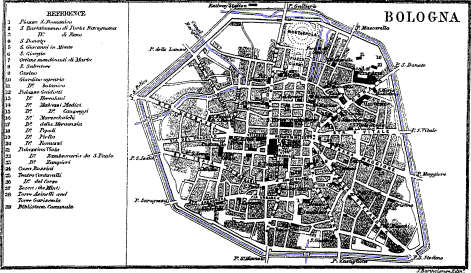
TURIN FLORENCE 208¼ 82¾ BOLOGNA, pop. 91,000. Hotels: Brun; Italia; Bologna; Aquila Nera; del Pellegrino; Tre Re; Venezia; Commercio. Restaurants: Stelloni; Felsineo. Omnibuses from the hotels meet the trains. Cabs—one horse, the course, 75 c.; by the hour, 1 fr. 50 c. To or from the railway station, without luggage, 1 fr.
Bologna is a walled city, with twelve gates, situate on a fertile plain near the foot of the Apennine range. The Bolognese school of painting is called the Scuola Caraccesca, from its founders, Lodovico Carracci (b. 1555, d. 1619), and his two cousins Annibale (b. 1560, d. 1609) and Agostino, a man of erudition, who furnished the general plan of the pictures. Their most distinguished pupils were Guido Reni (b. 1575, d. 1642), Domenichino (b. 1581, d. 1641), Lanfranco (b. 1581, d. 1647), G. Barbiere, called Il Guercino, from his squinting (b. 1590, d. 1666), Michel-Angiolo da Caravaggio (b. 1569, d. 1609), and Carlo Cignani (b. 1628, d. 1719); Bologna: Picture-Gallery. beautiful specimens of whose works are to be seen in the various churches, but especially in the picture-gallery of the “Accademia delle Belle Arti,” situated at the north-east end of the town, near the Porta S. Donato (see plan). It occupies eight rooms of the first floor, contains 360 paintings, all bearing the names of the artists, and is open from 9 to 3. Free on Sundays. The gem is St. Cecilia, by Raphael.
The other best works are:—12. Guercino.—St. William; 13, St. Bruno; 15. St. John the Baptist; 18. St. John the Evangelist. 26. Bugiardini.—Marriage of St. Catharine. 34. Agostino Caracci.—Last Communion of St. Jerome, one of his finest paintings; 35. Assumption. 36. Annibale Caracci.—Virgin and Child, with Angels and Saints; 37 Virgin enthroned, with Saints. 39, 40. Lodovico Caracci.—Assumption; M. Desubleo.—Christ appearing as a Pilgrim to St. Augustine. 75. Lavinia Fontana.—St. Francis de Paul. 78. Fr. Francia.—Virgin and Saints (1490), extremely fine; 79. Annunciation; 80. Virgin and Saints; 81. Virgin and Saints. There are several other unnumbered pictures by this master on frames. 84. Giacomo Francia.—Virgin and Saints; 85. Virgin and Saints. 89, 90. Innocenzio da Imola (an imitator of Raffaello).—Virgin and Saints. 122. Nicola da Cremona—Descent from the Cross.. 134. Guido.—Madonna with the Protectors of Bologna; 135. Massacre of the Innocents; 136. Crucifixion; 137. Samson with the Ass’s Jawbone; 138. The Virgin of the Rosary (this is on silk, and was carried in processions); 139. Bishop Corsini; 143. Portrait of a Carthusian. 152. Raphael.—St. Cecilia, with other Saints, listening to the Music of the Angels (the instruments of secular music lie broken on the ground). This celebrated composition, painted in 1515, is well known from copies and engravings. 175. Elisabetta Sirani.—St. Anthony of Padua; 176. Madonna. 181. L. Spada.—Melchisedec blessing Abraham. 183. Tiarini.—St. Catharine of Alexandria. 197. Perugino.—Virgin and Saints. 204. Timoteo delle Vite.—Magdalene. 206. Domenichino.—Martyrdom of St. Agnes; 207. Madonna of the Rosary; 208. Martyrdom of St. Peter of Verona (the same subject as that treated by Titian in a picture lately burnt at Venice). 212. Unknown.—Sleeping Child. 291. Desubleo.—St. John the Baptist. 292. Innocenzio da Imola.—Virgin and Saints. 294. Bugiardini.—Madonna. 360. Aluno (Nicolo da Foligno).—Virgin and Saints (given to the Gallery by Pius IX.)
In the same building is a collection of old arms and armour (Oploteca), and on the ground-floor a few good modern pictures. A collection of original drawings is preserved in the library.
Bologna: University. S. Giacomo.
Nearly opposite the Accademia is the University, with about 430 students, directed by 59 professors, of whom, among the most famous, have been Galvani, the first that observed the phenomena of Galvanism, Laura Bassi, a lady professor (d. 1778), and Giuseppe Mezzofanti (d. 1849), who spoke fluently upwards of forty-two languages. From the tower is a good view of the town. Attached to the University is a Museum of Antiquities and a Library. The Geological Museum is in a separate building. From the University, walking towards the leaning towers, we pass, in the Strada Donato or Luigi Zamboni (see plan), the oratory of St. Cecilia, the church of S. Giacomo, and (14) the Palazzo Maloezzi-Medici; and shortly after, stand below two of the peculiar kind of watch-towers used in Italy during the middle ages.
S. Giacomo Maggiore was built in 1267, but subsequently restored. In the 6th chapel right is a fine work by Bart. Passarotti, the Virgin
Bologna: The Two Towers.
In St. Cecilia are frescoes representing the legend of St. Cecilia and St. Valerian, by F. and G. Francia, Costa and Amico Aspertini. During the French occupation they were considerably damaged. At the commencement of the Strada Donato are the Two Towers (28 in plan), seen from a great distance. The taller, the Torre degli Asinelli, commenced in 1109, is 272 feet high, with an inclination of 3½ feet, and ascended by a rickety dirty staircase of 447 steps to the summit, whence there is the best view of the town. The Torre Garisenda, commenced in 1110, is 139 feet high, with an inclination of 8½ feet. From the towers, the Mercato di Mezzo leads W. to the Piazza Vittorio Emanuele, with, on the S. side, the church of S. Petronio; on the N., the Palazzo del’ Podesta; on the E., the Pal. dei Banchi; and on the W., the Pal. Pubblico, an immense edifice, commenced in 1290, consisting of various buildings thrown together. In front is the Fountain, by Laureti, adorned with a statue of Neptune, by Bologna.
Bologna: S. Petronio.
S. Petronio, commenced in 1390, but still unfinished, is of brick, and in the pointed arched Gothic style. The doorways of the façade are remarkable works; the middle one was by Jacopo della Quercia (1425). In the interior, notice on the right side the stained glass of the 4th chapel; Sansovino’s statue of St. Anthony of Padua, and Treviso’s grisaille pictures relating to that saint in the 9th chapel; the windows are said to be from M. Angelo’s designs; in the 11th chapel, a bas-relief, an Assumption, by Tribolo, with Angels at the sides, attributed to Properzia de’ Rossi, a Bolognese lady (d. 1535), who was at once painter, sculptor, engraver, and musician. The campanile is over this chapel. The large fresco of the choir is by Franceschini. On the floor of the left aisle is the meridian line traced by Cassini in 1652. In the 1st chapel, on this side, is some modern Milanese glass; in the 7th, a Madonna, by L. Costa; and in the 10th, Sa. Barba, by Tiarini. At the southern end of the church is (29 in Pal. della Mercanzia, the Chamber of Commerce, erected in 1294; (18) the Pal Pepoli, 1344; and (9) the Casino. Bologna: Santo Stefano. Santo Stefano is a combination of ancient churches, chapels, and courts, on the site of a temple dedicated to Isis. Enter first the Church of the Crucifix, so named from the old painting at the great altar. In the 1st chapel on the right is a picture by Muratori; in the 2d on the left St. Elisabetta, by Gessi. Then pass through a small chapel into the circular chapel styled San Sepolchro, which contains the tomb of St. Petronius, with curious carvings, and a miraculous well, considered to have healing virtues. This building is thought to have been formerly the baptistery of the next chapel (originally, perhaps, the principal chapel), dedicated to St. Peter and St. Paul. From a small court, called the Atrium of Pilate, from its alleged resemblance to that at Jerusalem, we gain access to the chapel of the Trinity, which contains four marble columns said to have belonged to the temple of Isis, and some pictures by Tiarini and others. There are ancient mural paintings in the sanctuary dedicated to Our Lady of Consolation; and in the subterranean chapel of the Confession, a broken column is shown which is said to afford the measure of the Saviour’s height. After visiting a cloister, where the columns show much variety of form, we have made the complete tour of this singular labyrinth of buildings, which are of great interest to the ecclesiologist. Behind Santo Stefano in the Strada Maggiore are (beginning at the leaning-towers’ end, see plan), 2, S. Bartolommeo; 23, the Pal. Zampieri; 24 is the house of the celebrated composer Rossini, built by him in 1825. On the opposite side is the church Ai Servi, and No. 13 the Pal. Hercolani, once famous for its collection of pictures. Bologna: San Bartolommeo. Palazzo Zampieri. San Domenico. San Bartolommeo, built in 1653, has some fine marbles and rather a gaudy dome. In 4th chapel right an “Annunciation,” by Albano. The paintings behind the high altar are by Franceschini. In the left transept, an oval picture of the Madonna, by Guido. The Latin inscription on the wall relates how it was returned from London in 1859. Palazzo Zampieri (admission, ½ fr.), although deprived of most of the pictures, still retains the admirable frescoes by Agos. Annibale, and Lod. Caracci and Guercino. The church of Ai Servi, built 1393, has a fine interior, with thin columns. In the 2d chapel left is a “Touch-me-not,” by Albano; and in the 4th, a St. Andrew, also by him. In the 6th chapel an “Annunciation” by Inno da S. Domenico, attached to a convent where St. Dominic lived and died. The church dates from the 12th cent., but restored in the 18th. Interior—2d chapel right, Miracle of Ferrerio, by D. Creti. Right of south transept—the splendidly decorated chapel of St. Dominic, with his sarcophagus ornamented with bas-reliefs, by Nic. di Pisa. The garlands and statuettes were by Nic. di Barri (Arca), 1469. The kneeling angel on the right, and St. Petronius, over the sarcophagus, were by Michael Angelo in his youth. The base of the tomb, with its bas-reliefs illustrating the life of the Saint, was not added until 1532, a work of Alfonso Lombardi. On the beautiful ceiling of the chapel is a fresco by Guercino, “The Transformation” of St. Dominic. The painting of the Saint burning Heretical Books (on the left wall) is by L. Spada; that of the Saint recalling a Child to Life is by Tiarini. In a chapel on the right side of the high altar is the Marriage of Saint Catharine, by Filippino Lippi. The Adoration of the Magi at the high altar is by Bart. Cesi. In the left transept should be noticed the tomb of a Pepoli (1348), and on the wall a portrait of St. Thomas Aquinas, considered here an accurate likeness, though painted 100 years after the death of the saint. Bologna: Guido’s Tomb. Opposite St. Dominic’s chapel, and in the north transept, is the chapel of the Rosary, containing in the centre, under a slab, the grave of Guido Reni (b. 1575; d. 1642). Near him lie the remains of his favourite lady pupil, Elizabeth Sirani, who, with her master and the Caracci, executed the small paintings which adorn the frame of the reredos of the altar in this chapel.
Bologna: San Pietro.
Directly north from the Palazzo Pubblico is S. Pietro, rebuilt in 1605, containing, on the arch above the high altar, an Annunciation, the last painting by Lodovico Caracci, who died a few days after finishing it. Near S. Pietro is a small church Madonna di Galleria, with, in 1st chapel left, St. Philip Neri, by Guercino, and in the next, a fine Albani. N.E. from S. Pietro is S. Martino, 1217, restored. In the 1st chapel right, Giorlanno da Carpi’s Adoration of the Magi; and in the 5th chapel on the left side is an Assumption, attributed to Perugino; in the next, a St. Jerome, by L. Caracci; and in the chapel next the entrance, Madonna and Saints, by F. Francia. Old monuments in the cloisters. East from the leaning-towers is S. Vitale, consecrated in the fifth cent., and lately restored. At the 2d altar, right, is a Flight into Egypt, by Tiarini; in a large chapel on the left, Angels, with a beautiful landscape, by F. Francia; and at the first altar in the body of the chapel on the left, an Adoration of the Infant in Perugino’s manner.
ENVIRONS OF BOLOGNA.
Beyond the Porta Maniola are the convent and church of the Annunziata. In the 2d, 3d, and 4th chapels of the church are three pictures by L. Costa, and in the Chapel of the Sacrament a Madonna by Lippo Dalmasio. In the choir is a very fine work by Fr. Francia (1500), and in the sacristy an Entombment by Giacomo Francia.
Madonna di S. Luca. The Certosa.
Beyond the Porta di Saragossa is the much-visited church of the Madonna di S. Luca, on the top of a hill commanding a beautiful view. It is approached by a portico of 640 arches, which begins just beyond the gate, and extends to the church, a distance of nearly 3 m. This portico was begun in 1672, but many years elapsed before it was finished. The church derives its name from possessing a picture reputed to have been painted by St. Luke. The best pictures have been removed from the church. Outside the same gate is the Certosa, formerly a Carthusian convent, now a cemetery. The church contains some pictures, and the chains of some Algerine slaves with the amount of ransom attached to each.
269¾ m. from Turin and 21¼ from Florence is Pistoja (see p. 231), and 291 m. from Turin is Florence (see p. 233).
St. Pierre to Courmayeur by the Little St. Bernard.
(74 m. N.E. See Map, page 290.)
COURMAYEUR 74 ST. PIERRE D’ALBIGNY (see p. 289), 15 m. S.E. from Chambery, and 45½ m. N.W. from Modane.
ST. PIERRE 14 60 ALBERTVILLE, pop. 5000 on the Arly, and 1180 ft. above the sea. Inns: Million; Balances. A diligence runs between Albertville and Annecy, 22 m. N.
22 52 LA ROCHE CEVINS, pop. 1000. Inns: Croix Blanche; Lion d’Or. Hidden and sheltered behind a great rock which closes the valley. 2 m. beyond is the defile Pas de Briançon.
ST. PIERRE COURMAYEUR 31 43 MOUTIERS, pop. 2100, and 600 ft. above the sea-level, on the confluence of the Doron with the Isère. Inns: Couronne; Courriers. One mile from the town is the Roc du Diable, rising to the height of 8200 ft. At the base are the salt springs, utilised both
Aime. Seez.
ST. PIERRE COURMAYEUR 41 33 AIME, pop. 1100, and 2385 ft. above the sea-level. Inn: Petit St. Bernard. This, the “Forum Claudii et Axuma,” possesses remains of extensive Roman fortifications, and a very ancient church called St. Martin, built of stones from Roman buildings. 4 m. beyond is Bellentre, pop. 1100, on the Isere, where the culture of the vine ceases. The Pass of the Little St. Bernard comes into view.
50 24 BOURG ST. MAURICE, pop. 2600, and 2780 ft. above the sea. Inns: Voyageurs; Royal. A village consisting of one long street, near the confluence of the Isère with the Versoyen and Nantet.
52 22 SEEZ, the ancient Sextum, a pretty village between six mountains, pop. 2600, and 2985 ft. above the sea-level. From Seez the road passes the village of Villard-Dessus, and then crosses the Recluse by a lofty bridge near an escarpment of gypsum, called the Roche Blanche, supposed to be the place noticed by Polybius, where Hannibal posted himself to protect his cavalry and beasts of burden. 3 m. beyond is St. Germain; the last inhabited village during the winter. From St. Germain the ascent is easy to the
ST. PIERRE COURMAYEUR 58½ 15½ HOSPICE, 7077 ft., founded by St. Bernard of Menthon, on a grassy plain 3 m. long, and about a mile from the summit (7193 ft.), indicated by the Colonne de Joux, Jovis, or Jupiter, 23 ft. high, of Cipolino marble. From the Hospice, Mont Belvidere, 10,093 ft, may be ascended. About 300 paces from the column is the Cirque d’Annibal, consisting of a circle of large stones lying on the ground, where Hannibal is said to have held a council of war, 218 B.C. A few miles below are Cantine des Eaux Kousses, with a small inn, and Thuile, a hamlet, 4685 ft. above the sea-level, 9 m. from Courmayeur.
Pré St. Didier.
ST. PIERRE COURMAYEUR 70 4 PRÉ ST. DIDIER, pop. 1300, on the Doire. Inns: Poste; Pavilion. Junction with road to Aosta, 23 m. E. (See map, p. 290.)
74 COURMAYEUR, 4211 ft., the highest considerable village in the valley of Aosta. Inns: Royal; Angelo; Mont Blanc; Union. A public coach leaves daily for Aosta by St. Didier. Fare, 7 frs.; time, 5 hrs. Courmayeur is frequented by Piedmontese in considerable numbers every summer, both on account of the mineral springs in its neighbourhood and for the sake of the exquisite freshness of its climate. The waters, which rise from alluvium, are saline and purgative. Those of La Saxe are sulphureous. All who have visited Courmayeur, under favourable circumstances, agree in considering its position one of the finest in the Alps. Six different routes diverge from Courmayeur—the road to Aosta; that of the Little St. Bernard; the Allée Blanche; the Col du Géant; the Col Ferret; and the Col de Serène, leading to the Great St. Bernard.
Paris to Modane by Lyons, Voiron, and Grenoble.
From Paris to Modane by this route the distance is 476 m., and Modane to Turin 50 m. farther. This is the route to take for the Baths of Allevard, the Monastery of the Grande Chartreuse, and for Grenoble, which is one of the nearest railway stations to Mont Pelvoux and the other lofty mountains in the Dauphiny. The best resting-places are Dijon, Lyon, and Grenoble.
(Map, page 304.)
MODANE 476 PARIS. Start from the station of the Chemins de Fer de Paris à Lyon, where buy one of their Time-tables, 40 c. From Paris to Lyons follow pp. 1 to 29, and examine the maps referred to.
PARIS 318 158 LYONS. Perrache station. (See p. 29.)
325½ 150½ ST. PRIEST, pop. 2800. In the old castle here Charles VII. confined his son Louis XI., then the Dauphin.
Bourgoin. Virieu.
PARIS MODANE 344 132 BOURGOIN, pop. 5200. Inns: Europe; Parc. Situated among 16,000 acres of bog, producing large quantities of peat. 10 m. farther is La Tour-du-Pin, pop. 3200. Inn: Poste. On the Bourbre.
358 118 ST. ANDRE-LE-GAZ. A coach at this station awaits passengers for Chambery, 32 m. E., passing by Les Echelles, whence the Chartreuse may be visited.
363 113 VIRIEU, pop. 2000. With a large old 14th and 16th cent. castle, in good preservation, containing tapestry and portraits, 16th cent.
Chabons. Rives. Voiron.
PARIS MODANE 368 108 CHABONS, pop. 2000. 5 m. distant is Lac Paladru, 3 m. long and 160 ft. deep, surrounded by wooded slopes studded with villages. At the N. end of the lake is Paladru, pop. 1000.
PARIS MODANE 371 105 RIVES, pop. 2900. Inn: Poste. Situated about 1 m. from the station, on the Fure. It has some of the largest paper-mills in France, as well as some considerable forges. A great proportion of the inhabitants employ themselves in the weaving of silk and linen by hand-looms. The parish church was built in the 14th cent. Here are the ruins of the castle of Châteaubourg, destroyed by Richelieu in 1626. Branch line from Rives to St. Rambert, 35 m. W., on the Lyons and Marseilles line (see page 43).
PARIS MODANE 378 98 VOIRON, 939 ft., pop. 12,000. Hotels: Louvre; Cours; Poste. Coaches and gigs await passengers for the Grande Chartreuse, 15 m. distant by the village of St. Laurent-du-Pont, which is 9 m. from Voiron and 6 from the Grande Chartreuse. Fare, 5 frs. Voiron is a busy town on the river Morge, with important silk, linen, and cloth manufactories. Here the monks of the Grande Chartreuse have large premises for the sale of their famous cordials, which they distil, not in the monastery itself, but in a large building a little beyond St. Laurent. The road from Voiron to the Grande Chartreuse joins the road from Voreppe just before reaching the village of St. Laurent-du-Pont, distant from both stations 9 m., 1344 ft., pop. 2000. Inns: Princes; Nord. After leaving St. Laurent we pass on our right the distillery of the monks, and then ascend by a narrow gorge, among fine woods and perpendicular cliffs, to the convent, consisting of an immense square building, garnished with pavilions, situated on a narrow plateau 3200 ft. above the sea-level, at the base of the Grand Som, which towers 3460 ft. higher, easily ascended from this place in about 3 hrs. This monastery, the head establishment of the Carthusian friars, was founded by St. Bruno, the originator of the order, in 1084. At first it consisted only of a small chapel, with six poor cells, the habitations of St. Bruno and his followers, built in what was then an almost inaccessible spot among rocks and forests.
The Grande Chartreuse now contains from 70 to 75 monks, each provided with a suite of three small upper and two lower chambers, and a small garden. They pray 3 hrs. every day, the rest of their time being occupied in cultivating their gardens and working at any of the handicrafts they understand, and in the preparation of their simple vegetable fare. On Thursdays they take together a 3 hrs. A.M. they attend mass, excepting on Sundays, when the hour is 8 A.M. Vespers are said at 4 P.M., and matins at a quarter to 12 midnight. Visitors who wish to see the monks should endeavour to be at the chapel-door at any of these hours. For gentlemen guests there is ample accommodation in the convent, clean beds, three large dining-rooms, good wholesome food and excellent water. The men-servants, of whom there are 59, inhabit the top story; the wives, however, of these servants, not being allowed to enter the convent, dwell in a house a few yards distant kept by nuns. It is in this house also that ladies who accompany gentlemen must lodge, as no female is allowed to enter the monastery.
Their principal revenue is derived from the sale of the liqueurs they distil at St. Laurent, and which are sold both wholesale and retail at Voiron, at the following prices:—Liqueur verte, 8 frs. the litre bottle; liqueur jaune, 6 frs.; liqueur blanche, 4 frs.
From the monastery the ascent is made of the Grand Som, 6660 ft., in about 3 hrs. It is necessary to make a considerable detour before commencing the ascent. The first point reached is the Chapelle St. Bruno, erected on the supposed site of the Hermitage. The view from the top, though limited, is very beautiful. Coach to Grenoble, 17½ m. S., 5 frs. Guests in the monastery should pay 6 to 7 frs. per day.
Moirans. Voreppe. Grenoble.
PARIS MODANE 381½ 94½ MOIRANS, pop. 1000. Inn: H. de Paris. Junction with branch line to Valence, 50 m. S.W., passing, at about half-way, St. Marcellin, pop. 4000. Inns: Poste; Courriers. From St. Marcellin a coach runs daily to the picturesque village of Pont-en-Royan, on the Saône, 11 m. S., whence another coach runs to Die by the Grands Goulets and Chapelle. (For Die, see p. 47.)
385 91 VOREPPE, pop. 3000. Inn: Paris. Passengers for the Grande Chartreuse may alight here also, from which it is 15 m. distant.
PARIS MODANE 394 82 GRENOBLE, pop. 46,000, and 702 ft. above the sea, beautifully situated on the Isère, by far the greater part being on the left bank, while on the other there is a mere strip hemmed in between the river and the steep declivities of the Bastile. Hotels: in the Place Grenette, the *Monnet; Europe; the two principal hotels. Fronting the promenade, in the Rue Montorge, is the Trois Dauphins, frequented by commercial travellers. Napoleon I. on his way from Elba lodged in this house from the 7th to the 9th March 1815. He slept in room
Grenoble: Coaches. Bastile.
From the Place de la Halle coaches start for Sassenage, Nogarey, Seyssenet, and Seyssins; from the P. Notre Dame for Domene and Gières; from the P. Grenette for La Chartreuse, time 4 to 5 hrs., fare 5 frs.; also to Briançon by Bourg d’Oisans, 6 frs., 7 hrs.
The most important place to visit in the neighbourhood is the summit of the Bastile, 915 ft. above the river. To reach it cross the river by the bridge highest up, then ascend by the first road to the left in the village of La Tronche, beyond the gate. After numerous windings by a bullock-cart-road through vineyards, on the side of the mountain exposed to the S., a square house is attained on the plateau behind the fort. The view is magnificent, but it is still better from the peak immediately above, where there is one of the quarries of argillaceous siliceous limestone, extensively used for making cement. Ascend either by the continuation of the same bullock-road or by the steep footpath. The isolated mountain, so prominent from the village of La Tronche, is Mt. Eynard, 4846 ft. Although Grenoble is of great antiquity, all that remains of its early history are some fragments of the walls built by Diocletian. The most interesting of the buildings is the Palais des Dauphins, now the Palais de Justice. Grenoble: Bayard. St. André. In the square in front is a bronze statue of Bayard, one of the most illustrious heroes of a chivalrous age, esteemed by his contemporaries the model of soldiers and of men of honour. Born in 1476 at the neighbouring castle of Pontcharrá, he died at Rebecq on the 30th April 1524 from wounds received at the battle of Romagnane, and was buried in the church of the Minimes, 1¼ m. from Grenoble, whence in 1823 his ashes were removed to the church of St. André and deposited in the tomb in the N. transept. St. André, founded in the 13th cent., was the private chapel of the Dauphins. From the intersection of the transepts rises
Grenoble: Library.
E. by the Rues du Palais and Brocherie is Notre Dame, from the 10th to the 15th cent. Next the altar is a beautifully-wrought stone tabernacle, and behind it, in the aisle, the chapel of St. Hugues, 13th cent. At the S. end of the town are the best streets and houses, the Place de la Constitution, and the Botanic Gardens. The Préfecture occupies the entire S. side of the “Place.” Behind are the Botanic Gardens and the Natural History Museum. Opposite the Prefecture, in a handsome building, are the class-rooms of law, science, and literature. On the E. side are the Artillery School and a large handsome edifice containing the public library and the picture gallery. It is 279 ft. long and 156 ft. wide, and cost £67,585. The Library, open every day except Monday, contains 150,000 vols. and nearly 2000 manuscripts. There is a comfortable reading-room open to all. The great hall, 204 ft. long and 44 ft. wide, is lined with shelves of books in three stages, and lighted by handsome cupolas. Round the sides, under glass, are displayed richly-illuminated manuscripts, while down the centre are other glass cases containing medals and antiquities, many belonging to prehistoric times. Among the MSS. is a Bible (imperfect) translated into French by Raoul de Sestre in 1377 by order of Charles V.; also a New Testament, 12th cent., and another in Vaudois, 13th cent.
Grenoble: Picture Gallery.
The Picture Gallery, open also every day excepting Monday, contains 550 paintings in four spacious halls, of which the centre one is the largest and contains likewise the best pictures. The principal artists are:—Albani, Alfani, Allori, Battoni, Bellini, Blanc-Fontaine, Bloemaert, Bloemen, Bol, Bonifazio, Bouchet, Breughel, Bronzino, Canaletto, Ph. Champaigne, Cock, Coypel, Crayer, Dagnan, Desportes, C. Dolce, Gustave Doré (landscape), Dubuisson, Faure, Feti, Flink, Foschi, Fouquières, Fragonard, Franquelin, Tadeo Gaddi, Gautier, Claude Gellée, Gerard, Giordano, Glauber, Guardi, E. Hebert, Heusch, Holbeina, Jordaens, Jouvenet, G. Lacroix, Lafosse, Lanfranc, Lepic, Licinio, Maltais Le, G. Manni, Massé, Meulen, P. Mignard, Millet, Monnayer, Montessuy, Moor, J. Ouvrié, Pannini, Parrocel, Perugino, Piombo, Procaccini, Rigaud, Rivera, Romano, Roos, Rubens, Ruisdael, Rysbraek, Salvator Rosa, Sassoferrato, Sneyders, Sueur, D. Teniers, Terburg, Thielen, Thulden, Tintoretto, Uden, Valentin, Van den Grenoble: Museum. On the way is passed the entrance to the Botanic Gardens, with the Museum of Mineralogy and Natural History. The great interest of the museum consists in the well-arranged collection of specimens illustrating the organic and inorganic products of this part of the Alps. The birds and ores are well represented. Near the gate leading out to La Tronche is the church of St. Laurent, 11th cent. The crypt, 6th cent., is supported on twenty-four slender marble columns from 4 to 5 ft. high.
Grenoble: Manufactures.
Twelve million pairs of gloves are manufactured annually at Grenoble, representing a value of £1,600,000. The material is given out to the workmen, both men and women, upwards of 25,000, who make it into gloves in their own houses. Certain improvements introduced by Xavier Jouvin in 1840 gave a great impulse to the glove trade and manufacture of Grenoble, but for some years both have been seriously on the decline. Excellent liqueurs, principally of cherries, are made in the department. The wines are indifferent, chiefly because the vines are not well selected.
Courrier every night at 9 to La Motte, 15 m. N., for 2 frs. Returns next day at 8. Coach daily to Barcelonnette, time 11 hrs. (see p. 341), passing Monètier, Allemont, the ancient Roman station of Mutatio on the Roman road and the Durance. 7½ m. N.E. are the ruins of N. D. de Chardavan, in a narrow valley. 1¼ m. N.E. is St. Geniès, with a saline sulphurous spring, and strata of anhydrite gypsum, black marble, anthracite, and lead ore.
the french WALDENSIAN VALLEYS
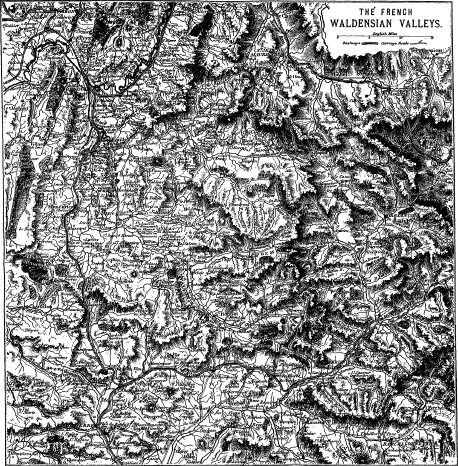
Sassenage.
3¾ m. N. from Grenoble by the Pont du Drac is Sassenage. Omnibuses start from the Place Grenette, fare 40 c. The Sassenage et Noyarez omnibuses leave their passengers at the entrance into the town near the H. Faure, but the Sassenage-Fontaine omnibuses go up to the “Place” and stop before the inn *H. du Commerce. To the left of the inn is the house of the guide for Les Cuves, whose services are necessary to be able to cross the Furon and the torrent from the Cuves.
Grenoble to Briançon.
Grenoble to Briançon by Bourg d’Oisans and the Col de Lautaret (see map p. 304). Distance, 69 m. E. Diligence daily. When there is much snow, the Col is passed on sledges. Time, 15 to 18 hrs., according to the state of the road. Fare, 16 and 14 frs. As the diligence from Briançon to Grenoble stops several hours at Bourg d’Oisans, it is a good plan to alight there for the night. This magnificent mountain-road, commenced by Napoleon I. in 1804, opened in 1842, and finished in 1868, makes a charming walking excursion; while from almost every village grand mountain tours may be made. Bourg d’Oisans, with a comfortable inn, the H. de France, makes capital quarters. There are besides very fair inns at Le Freney, H. d’Europe; La Grave, H. Juge; Le Dauphin, Inn Dode; Le Monètier, H. Alliey, and even in the Hospice itself on the top of the Pass, where beds and food may be had at most reasonable charges.
Claix. Vizille. Séchilienne.
5 m. from Grenoble by a straight road bordered with elms, between the river Drac and the railway, is the village of Claix. Inn: H. de France, with a bridge across the Drac, having a span of 85 ft. and 53 ft. above the river, built in 1611 by Lesdiguières. 5½ m. Vizille, pop. 3900. Inns: Imbert; Lion d’Or, near each other; their omnibuses await passengers at the station. A manufacturing town on the Romanche, in a valley between high mountains. 15 m. from Grenoble is Séchilienne, pop. 1300. Inn: Petit Versailles, where the horses are changed. A village of one street, magnificently situated, 1182 ft. above the sea, in the valley of the Romanche, surrounded by steep mountains towering above each other. To the S. is Mont Taillefer, 9390 ft., ascended from Séchilienne in about 6 hrs. In 1½ hr. the hamlet of La Morte is reached, whence the ascent lies through pastures and pine woods to some steep rocks. The track then, leaving on the right a small tarn, keeps along the base of the rocks to an abandoned mine, where it runs along the ridge called the Arete de Brouffier, overlooking the valley of the Combe de Valloire on the right and the Combe de Gavet on the left. The ridge leads to a small plateau, usually covered with snow; whence a second ridge leads up to the highest peak.
From Séchilienne the diligence passes through the hamlet of Riouperoux, in a narrow defile, among broken masses of rocks brought down by the terrible flood of the 14th September 1219, which desolated the plain from Oisans to Grenoble. 22 m. from Grenoble is the hamlet of Livet at the foot of the Grand Galbert, on the Romanche near its junction with the Olle. Up the Olle are the foundries of Allemont and the argentiferous lead mines of Chalanche. Here is also the Pointe de l’Infernet, 8184 ft., at the entrance to the defile leading up to the Bella Donna.
Bourg d’Oisans. Ecrins. Road to the Ecrins.
29 m. from Grenoble is Le Bourg d’Oisans, 2190 ft, pop. 3100. Inns: France; Milan; Poste. As the diligence from Briançon remains at the Bourg some hours, it is a good plan to break the journey here and start next morning. The village is situated near the Romanche, surrounded either by the vertical cliffs of mountains, upwards of 1000 ft. high, or by their steep but carefully-cultivated slopes studded with houses and hamlets. An easy excursion of 4 hrs. may be made to Lac Blanc, 6170 ft. above Le Bourg, one of the highest lakes for its dimensions in the Alps. It is nearly ½ m. long and 110 yds. wide, and commands an extensive view. From the Bourg a tract mounts nearly due N. in 3 hrs. by the villages of La Garde and Huez to the plateau of Brandes with ruins attributed to the Romans, abandoned mines and valuable deposits of anthracite worked in several places. 1 hr. farther is Lake Blanc.