PART I.—PARIS TO MARSEILLES.
Reading edition
By Sens, Dijon, Lyons, and Avignon, 537 miles.
Best resting-places, Sens, Dijon, Macon, Lyons, and Avignon. For “London to Marseilles,” see under that head in the “Continental Time-tables of the London, Chatham, and Dover Railway.” Through tickets sold at their London office.
MARSEILLES 537 PARIS. Start from the station of the Chemin de Fer de Paris à Lyon, No. 20 Boulevard Mazas, where purchase one of the Time-tables, 8 sous or 40 cents, the only absolutely trustworthy tables respecting the prices, distances, and movements of the trains. Good restaurant at station. Opposite the station is the H. de l’Univers, and a little farther off the H. Jules César.
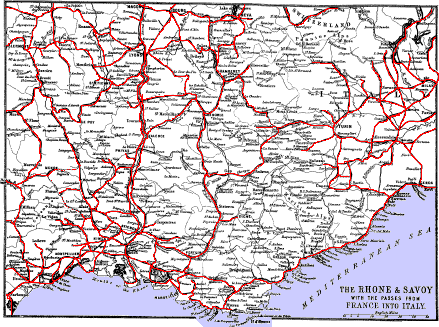
Maps.—For the general route, consult map on fly-leaf; for the details as far as Macon, map page 1; and for the remainder of the journey, map page 26. The fare, third class, from London to Paris by Dieppe, by the London, Brighton, and South Coast Railway, is 17s. From Paris to Marseilles, by the Paris and Lyons Railway, it is £2:7s., time 23 hours; starting from the station of the Chemin de Fer de Lyon at 6.30 A.M., and arriving next day at 5.33 A.M. From Marseilles a train starts at 6.35 A.M. for Toulon, where it arrives at 9 A.M. From Toulon a train starts for Hyères at 9.32 A.M., and arrives at 10.13 A.M. The third-class carriages between Paris and
The train, after leaving the station, skirts the S.W. corner of the Bois de Vincennes at Charenton and St. Maurice, both upon the Marne, which here joins the Seine. Charenton, 4 m. from Paris, pop. 9000, has a large lunatic asylum founded in 1644. Boarders pay £60 the year. St. Maurice, pop. 4300, has in the Château d’Alfort a veterinary college with an hospital for animals, which takes horses for 2s. per day. It contains a library, museum, and laboratory; and possesses a nursery for the cultivation of grasses. Immediately beyond Fort Charenton are the Maisons-Alfort, pop. 8000, on the Seine. Diana of Poitiers and Robespierre resided here some time.
Villeneuve St. George. Melun.
9½ m. S. from Paris is the pretty town of Villeneuve St. George, pop. 1500, on the Seine, where it unites with the Yères, a deep river flowing through a verdant valley. 3¼ m. farther is Montgeron on the Yères, pop. 1300, with the castle which belonged to Sillery, chancellor of Henri IV. On the other side of the river is the village of Crosne; where on the 1st November 1636 was born, in the house No. 3 Rue Simon, Nicolas Boileau Despréaux, died 13th March 1711. He was a great critic, and the first to introduce French versification to rule. Through Pope and his contemporaries he had also a strong influence on English literature.
13¾ m. from Paris is Brunoy, pop. 1550, an ancient town, which was inhabited by the earliest kings of France. Louis XVIII. created the Duke of Wellington Marquis of Brunoy. The train now traverses the Yères viaduct, 1235 ft. long, on 28 arches 104½ ft. high. 28 m. S. from Paris is the prettily situated town of MELUN, pop. 12,000. Inns: Grand Monarque; Commerce; both near each other, and near St. Aspais. Between them is the omnibus office. Église Protestante. Melun, the Melodunum of Julius Cæsar, occupies both banks of the Seine, and the island in the centre, as well as both sides of the Almont, which here enters the Seine. One long, nearly straight road, under the names of the Avenue de Thiers, Rue St. Ambroise, Rue St. Etienne, Rue St. Aspais, and the Rue du Palais de Justice, extends from the railway station to the northmost limit of the town. In the part of Melun on the left or south bank are large cavalry barracks. On the island is the church of Notre Dame, 11th cent., restored; with a neat 2 storied tower over each transept, 10th cent. The large building me siècle.” Behind are the public gardens containing some capitals of ancient columns. Near it is the Place St. Jean, with a handsome fountain. North-west from St. Aspais are the Prefecture and the belfry St. Barthélemy, restored in 1858. The Palais de Justice, the theatre, the Gendarmerie, and another of the prisons, are all together at the north end of the town. The gardens of Melun produce excellent pears—some are very large. Hardly 4 m. N.E. from Melun is the Chateau of Vaux-Praslin, containing paintings by Lebrun and Mignard. From Melun the line continues by the side of the Seine till Bois-le-Roi, where it enters the forest of Fontainebleau.
Fontainebleau.
PARIS MARSEILLES 37 500 FONTAINEBLEAU pop. 9200, about 2 miles from the Seine, and one from the station; but omnibuses await passengers for the hotels. Fare, 30 c. For the Cour du Cheval Blanc of the Chateau, 50 c. The most expensive hotels front the Chateau. The Londres; Europe; France et Angleterre; Ville de Lyon; Aigle Noir; Lion d’Or. At the end of the main street, No. 9 Rue Grande, is the Cadran Bleu. In the Rue de la Chancellerie, near the Cour des Offices or east end of the Chateau, is the H. de la Chancellerie. In the Rue de France, the H. de la Sirène. The last 4 hotels are the most moderate in their charges. Situated among the large hotels facing the Cour du Cheval Blanc is the Pension Launoy; 1st storey, 13 frs., 2d, 11 frs. per day. For those who come for one day, the best plan is to enter at the station any of the Chateau omnibuses. Alight at the end of the Rue Grande, where there is a square with a garden surrounded with good shops—a bookseller’s with maps, plans, and photographs—souvenirs made from wood of the forest; a good confectioner’s shop and some restaurants, where refreshments can be had either before or after visiting the chateau. Those afraid of losing the train, should, however, rather take their refreshments at some of the restaurants opposite the station. From the end of the Rue Grande, the Cour du Cheval Blanc is about 5 minutes’ walk.
Temple Protestant, in which an English service is also held.
Coach Tariff.—The principal cab-stand is at the end of the Rue Grande at the square. Before starting procure a plan, 1½ fr., of the forest in the shop opposite.
A four-wheeled carriage for 5 persons, with 2 horses, 20 frs. for the
Carriages may also be engaged by the hour at the following prices:—
A four-wheeled carriage for 5 persons, with 2 horses, 4 frs. for the first hour, and 3 frs. for each succeeding hour.
A four-wheeled carriage for 4 persons, with 1 horse, for the first hour 3 frs., and each succeeding hour 2 frs. 25 c.
A two-wheeled carriage for 4 persons, with 1 horse, 2 frs. an hour.
Donkeys and mules may be hired at 3 frs. a day.
Fontainebleau deserves a visit, not only to see the Chateau, but to enjoy the delightful air and walks in the gardens and woods, which cover an area of 18,740 acres, intersected by 12,000 m. of roads and footpaths. The palace consists of square towers linked together by congeries of low brick buildings, enclosing spacious courts, each bearing some suggestive name. The roofing is said to occupy 14 acres. The palace is open from 11 to 4. The men who show it attend in one of the rooms on the left side of the “Cour des Adieux,” or “du Cheval Blanc,” which court forms the main entrance. A small fee is expected; but as the Palace belongs to the State, it is not obligatory.
To see the “appartements reservés” an especial order is requisite, procured by letter addressed to “M. Le Commandant des Chateaux.” The “appartements reservés” comprehend sometimes a greater, and sometimes a smaller number of rooms, according to the requirements of the household, but never any of the splendid halls. The order observed in showing the Palace is constantly changed, yet the itinerary we give will be found in the main correct. It is sometimes reversed.
The Chateau of Fontainebleau, as it now stands, was founded by Francis I., who commenced by demolishing the whole of the former edifice, excepting the pavilion of St. Louis, which still exists. Henri IV., who spent £100,000 upon it, doubled the area of the buildings and gardens, and added, among other portions, the gallery of Diana and the gallery des Cerfs. Napoleon I. expended £250,000 upon it, and Louis XVIII. and Louis Philippe contributed also large sums.
Fontainebleau: Entrance. Chapelle de la Trinité.
The principal entrance is at the west end by the Cour du CHEVAL BLANC, the largest of all the courts, measuring 498 ft. by 368. It is also called the Cour des Adieux, because here Napoleon I., forsaken by nearly all his generals, took leave, on the 20th of April 1814, of the ever-faithful soldiers of his Old Guard, from whom he tore himself away amidst sobs and tears, and threw himself into his carriage. On the 19th of March 1815 he was back again in this palace from the island of Elba, wandering with almost infantine joy through the splendid apartments which had witnessed his glory and his wretchedness.
As very little time is given to inspect the different articles, the following abridged list should be read before entering.
The visitor enters by the door under the Horseshoe staircase, which has 46 steps on each side. To the right, the longer of the 2 iron bars in the wall represents the height of Francis I. The first place entered is the Chapelle de la Trinité, built by Francis I. in 1529, and largely
Fontainebleau: Apartments of Napoleon.
Ascend staircase to the APARTMENTS OF NAPOLEON. The first room is the Antichambre des Huissiers (ushers), painting by Brenet, 1785. Cabinet des Secretaires, paintings by Vanloo, Doyen, and Hallé. Pass now through a small passage, painted with flowers by Spraendonck, to the most charming Salle des Bains. The walls are of plate glass, on which are painted, in graceful forms and lovely colours, cupids, birds, and flowers. The bath-room opens into the Abdication Room, containing the famous mahogany table, about a yard in diameter, on which Napoleon signed his abdication, 5th April 1814. Walls hung with rich embroidered satin from Lyons. Cabinet de Travail (study) of the Emperor. Beautiful writing desk by Jakob. Painting on ceiling represents law and justice. Bedroom of Napoleon I. and III. Bed restored under Louis Philippe, and hung with silk velvet from Lyons. Round the wall grisaille paintings of cupids, admirable imitations of relief, by Sauvage. Clock, present from Pio VII. to Napoleon. Salon de Famille or Salle du Conseil; dates from François I. and Henri IV., and made by Louis XV. his study. In centre of room mahogany table, 6 yards in circumference, one piece. The 20 red and blue symbolical paintings round wall are by the two Vanloos. On ceiling arms of France on gold ground. Furniture covered with Beauvais tapestry of time of Louis XV. Clock of Louis XIV. Throne-room. Built by Charles IX., ornamented by Louis XIII. and XIV., to which Napoleon I. added the throne. In this room the marshals of France used to take their oath of allegiance. The ceiling magnificently gilt and painted, and chimney-piece in same style. Over it portrait of Louis XIII. The lustre of rock crystal is valued at £2000.
Fontainebleau: Apartments of Marie Antoinette.
APARTMENTS OF MARIE ANTOINETTE and of the Empress Eugenie. Aurora on ceiling by Barthélemy. Arabesques of the panels on green ground. On console tables by Coindrel, 2 ivory vases presented to Napoleon I by the Emp. of Austria. This room was fitted up for Marie Antoinette by Louis XVI., who forged, but did not finish, the window bolts (espagnolettes). The Bedroom. Occupied successively by Marie de Medicis, Maria Theresa of Austria, Marie Antoinette, Marie-Amélie, wife of Louis Philippe, and the Empress Eugenie. The gorgeous drapery and curtains of the bed were presented to Marie Antoinette by the city of Lyons on the occasion of her marriage. Salon de Musique. Ceiling, Minerva and the Muses by Barthélemy, 1786. Over door the Muses painted in grisaille by Sauvage. Porcelain table by Georget, 1806. Petit Salon, from which a door opens into the
GALERIE DE DIANE or Bibliothèque, built in 1600. The ceiling, divided into compartments, is painted by Pujol and Blondel, representing mythological scenes. In front of one of the windows are suspended the sword and coat of mail worn by Monaldeschi, when he was assassinated on the 15th of October 1657 by order of Christina of Sweden, second daughter of Gustavus Adolphus. The atrocious deed took place in the room immediately below, in the Galerie des Cerfs. The unfortunate man, in parrying the first thrust, had 3 of his fingers cut off. He then fell on his knees before his confessor Father Le Bel, sent him by Christina, and, while praying God for pardon of his sins, one of the murderers thrust his sword into his face; while the other first cut off the crown of his skull, and then pierced his throat, which made him fall to the ground, where he lay breathing for quarter of an hour. Throughout all this terrible scene the kind priest kept bawling aloud with all his might consolation to the dying man. That same evening he was buried, near the holy water basin, in the church of Avon, 1 m. E. from the chateau, at the extremity of the park. Monaldeschi was Queen Christina’s chamberlain, and is supposed to have betrayed some of her secrets. The Marquis begged most piteously Father Le Bel to implore the Queen to spare his life; but when the confessor went to her and beseeched her, in the name of Our Blessed Lord, to have mercy on the unhappy man, she replied with petulance, “that she could not, and that many had been condemned to the wheel who did not deserve it so much as this coward.”
At the extremity of the gallery of Diana is the Salon de Diane, with indifferent modern paintings by Blondel, representing the story of the goddess Diana.
We now enter the Escalier de la Reine, ornamented with hunting scenes by C. Parocel, 1688-1782; Oudry, 1686-1755; and F. Desportes, 1661-1743. The door to the left opens into the Galerie des Chasses, not shown (see page 8). The other leads into
Fontainebleau: Salons de Francois I., Louis XIII., St. Louis. Salon Des Gardes.
LES GRANDS APPARTEMENTS. The Antechamber. Ceiling of pinewood in gilt compartments. Walls hung with ancient Gobelins tapestry. Salon des Tapisseries hung with beautiful tapestry, representing the loves of Psyche. Sevres porcelain vase worth £600, gift to the Empress Eugenie. Salon de François I. Napoleon I. and Charles X. used it as their dining-room. Louis Philippe restored the ceiling. The Flemish tapestry represents royal hunting scenes. In the centre of chimney-piece fresco by Primaticcio, Mars and Venus. The ebony cabinets are of the 15 and 16 cents. Furniture covered with very remarkable Beauvais tapestry. Salon de Louis XIII. The small Venetian looking-glass, one of the earliest manufactured, and the first that came to France, indicates the place where the bed of Marie de Saint Louis. Over chimney-piece equestrian statue in relief of Henri IV. by Jacquet. Salon des Aides-de-Camp. Portraits in Gobelins tapestry of Henri IV. and Louis XV., 1773-1777. Salle des Gardes, principally by Charles IX., but restored by Louis Philippe. In the medallions above the five real and mock doors are portraits of Francis I., with the allegorical figures of Might and the Fine Arts; Henri II., with figures of Diana and Liberality; Antoine Bourbon (father of Henri IV.), with figures of Hope and Abundance; Henri IV., with figures of Peace and Glory; and Louis XIII., with figures of Religion and Justice. Beautiful chimney-piece by Jacquet, 1590, 17 ft. high and 13 wide. In centre bust of Henri IV., and at each side statues of Might and Peace by Francarville. A very pretty little room, with floor of inlaid wood, corresponding in design with the ceiling, leads to the
ESCALIER DU ROI. The top part of this staircase, built by Louis XV., was originally the Chambre de la Duchesse d’Etampes. The frescoes, representing scenes in the life of Alexander, are chiefly by Niccolo dell’ Abate, indifferently restored in 1836 by Abel Pujol.
GALERIE DE HENRI II., or Salle des Fêtes. The most magnificent hall in the palace, shining with gold, 90 ft. long by 30 wide, lighted on one side by 5 windows looking into the Cour Ovale, and on the other by the same number looking to the gardens. It was built by François I., and decorated by Henri II. for his favourite Diane de Poitiers. The walls are covered with frescoes between gilt coupled columns by Primaticcio, Rosso, and Abate, restored in 1864 by Alaux. The ceiling, of walnut, is divided into 27 compartments, elaborately ornamented with scrolls, mouldings, and friezes, all richly gilt, and enclosing the ciphers of Henri II. and of Diana. The chimney-piece, of rare marbles, covered with fleurs-de-lis, is by Rondelet. At the end of this gallery is one of the entrances into the chapel of St. Saturnin, generally closed (see page 8). We return now to the Escalier du Roi, where we enter the
GALERIE DE FRANÇOIS I., parallel to the apartments of Napoleon, 210 ft. long by 20 wide. It was built by Francis to serve as a communication between the Courts of the Cheval Blanc and of St. Louis. Ceiling in variously shaped gilt panels, producing a curious effect. The frescoes, representing mythological scenes, are chiefly by Rosso, but a few are by Primaticcio, restored by Condere. Bust of François I. From the vestibule of the Horseshoe staircase we enter the
APPARTEMENTS DES REINES MERES et du Pape Pie VII. They were inhabited by Catherine de Médicis and Anne of Austria (mother of Louis XIV.), whose portraits hang opposite each other in the bedroom; and also by Pope Pius VII., more, however, as a prisoner than a guest of Napoleon I. The magnificent bedstead was put up by Napoleon III. for Queen Victoria and Prince Albert, when they were expected to have visited Fontainebleau. The tapestry is of the finest Antechamber. Portrait of Diana de Poitiers as the goddess of the chase, one of Primaticcio’s best works. Cabinet (Bahut) of time of Louis XIII. Walls hung with embossed leather. Furniture covered with Cordova leather. Salles des Officers. Hung with Gobelins tapestry, representing the story of Esther. Salon. Walls hung with beautiful coloured Gobelins. Furniture covered with Beauvais tapestry. Elegant ceiling, divided into compartments bearing the initials of Anne of Austria and of Louis XIII. The Old Bedroom (see above). Modern furniture in style of Louis XIII. Table in mosaic given by Pio IX., bearing his signature. Very beautiful ceiling by Cotelle de Meaux. Study of Pio VII.—portrait of him by David. Dressing-room—wardrobe of inlaid wood by Riésener, one of the finest in France. Bust of Louis XV. by Lemoyne, 1751. New Bedroom—bedstead of time of Louis XIV., enlarged in reign of Louis Philippe. Salon de Reception—Gobelins tapestry—furniture of time of Louis XV. Bust of Napoleon by Canova. Waiting-room or Salle d’Attente. Gobelins dating from the time of Louis XV. Beautiful clock of Louis XVI. Antechamber. 4 pictures by Breughel, of which one is on wood. Vestibule of the Galerie des Fresques.
GALERIE DES FRESQUES or Des Assiettes. All the pictures in this gallery were painted in fresco in the reign of Henri IV. by Ambroise Dubois on the gallery of Diana, whence they were removed in 1805, and some of them put on canvas. In addition Louis Philippe placed on the walls 128 plates, with views of the royal residences in France, and incidents connected with Fontainebleau. We now enter the gallery leading to the
SALLE DE SPECTACLE or theatre, built by Napoleon III., and seated for 400. Visitors now leave the palace by the staircase of Charles VIII., adorned with a statue of him in stucco.
Fontainebleau: Chapelle de St. Saturnin.
LES APPARTEMENTS RESERVES.
Chapelle Basse de St. Saturnin, built by Louis VII. after his return from Palestine, and consecrated by Thomas à Becket in 1169. The painted glass of the windows was manufactured at Sevres from designs by the Princess Marie, 1836, daughter of Louis Philippe; and the altar is the same at which Pope Pius VII. performed mass during his stay at Fontainebleau from 1812 to 1814. The lower chapel was reconstructed in 1545 by Francis I., upon which he built the Upper Chapel. It was ornamented with charming frescoes, in the reign of Henri IV., about the year 1608. Napoleon III. commenced the restoration.
Adjoining the lower chapel a corridor leads to the Ancienne Salle à Manger de Louis Philippe, or the Galerie des Colonnes, of the same dimensions as the Galerie de Henri II. immediately over it. To the right is the old spiral staircase of Francis I.
Galerie des Cerfs, built by Henri IV., under the Galerie de Diane, ornamented with views of the royal residences, indifferently executed. It was here Monaldeschi was murdered (see p. 6).
Appartements des Chasses, consisting of two rooms, hung round
Appartements de Madame de Maintenon, consisting of an antechamber, saloon, boudoir, and toilet-room. They are of no interest further than that it was in one of them, it is said, that Louis XIV. signed the revocation of the Edict of Nantes in 1685, which led to such cruelties. The embroidery on the furniture and screen is by the noble pupils of St. Cyr. Adjoining is the Galerie de Henri II. (see p. 7).
The Musée Chinois, consisting of a valuable and interesting collection of articles from China, cannot be seen without especial permission.
THE COURTS.
From the Cour du Cheval Blanc an arched way, near the Horseshoe staircase, leads through to the Cour de la Fontaine. In the side facing the lake is the Galerie de François I. Having passed through the porch in the N.E. corner of the Cour de la Fontaine, we have before us the gardens and forests of Fontainebleau, and immediately to the left the Porte Dorée, one of the gates that opens into the Cour Ovale. It is generally closed. On the soffit and sides are frescoes on a gold ground by Primaticcio, restored in 1835 by Picot. The subjects are mythological. Charles V. entered by this gateway in 1539. And by this portal the Duchesse d’Etampes fled from Fontainebleau, driven from it by the haughty and jealous Diana. Eastward to the left we pass the apsidal portion of St. Saturnin, supported by narrow buttresses, faced with pillars and pilasters. Both here and on the Porte Dorée is the device of Francis I., a salamander. The principal entrance to the Cour Ovale faces the Cour des Offices.
At the east end of the palace, fronting the Place d’Armes, connected with the Rue Grande by the Rue de la Chancellerie, is the Cour de Henri IV. or Des Offices, 285 ft. long by 255 wide, occupied by the artillery college, formerly at Metz. The course lasts 2 years. The gateway is grand, but heavy; the buildings contain nothing particular.
Fontainebleau: Drives in the Forest.
Excursions into the forest. Those wishing to walk should provide themselves with a pocket compass and a copy of the plan of the Forêt de Fontainebleau, 1½ fr. In the forest the posts painted red indicate the way back to the town; the black posts lead in the other direction. The coachmen are acquainted with all the roads. The artistic part of the forest comprises only 3719 acres. The following are the three principal drives, each requiring 6 hours:—
1. Croix du Grand Veneur par la Tillaie—Point de vue du camp de Chailly par la Table du Grand Maitre et le carrefour de Belle Vue—Barbison par le Bas Bréau—Gorges d’Apremont et Franchard.
2. Vallée du Nid de l’Aigle—Mont Ussy—Caverne d’Augas—Vue sur le champ de Courses et Mont Chauvet—Gorges et Rochers de la Solle—Rocher St. Germain—Bocages des Ecouettes—Fort l’Empereur—Calvaire—Roche Eponge et Point de vue de Nemorosa.
3. Rocher Bouligny—Rocher des Demoiselles—Gorge aux Loups
The most picturesque parts of the first drive, or perhaps in the whole forest, are the ravines of Apremont, about 3 m. N.W. from Fontainebleau; and Franchard, about 2½ m. W. The second contains the best places for obtaining good general views of the forest, such as from the Croix du Calvaire, near the railway station, but especially from the Fort de l’Empereur, about 2½ m. N. The Gorge aux Loups in the 3d drive, 3½ m. S., leads to a very picturesque part called the Long Rocher. If only one drive can be taken, take the first, 3¼ m. by rail from Fontainebleau.
After Fontainebleau is Thomery. Inn: Popardin, where the famous grape, the Chasselas de Fontainebleau, is grown extensively on walls and trellis-work.
Moret. Jean Sans Peur.
PARIS MARSEILLES 42 495 MORET, pop. 2000. Inn: Écu de France. An ancient town on the Loing, with remains of fortifications, 15th cent., and the two old city gates Paris and Bourgogne. The church, containing some curious woodwork, is principally of the 12th cent. The portal and organ are of the 15th. 7½ m. farther S.E. is Moutereau junction, where the Chemins de Fer of the Paris and Lyons system unite with those of the Eastern system.
Montereau-faut-Yonne, pop. 7000; station about a mile from the town. Inn: Grand Monarque, where the omnibus stops, near the post office. Those who may require to wait for a train at this junction, should, if time permit, drive up in the omnibus to the town and visit the parish church, with its handsome columns gracefully ramifying into the groining of the roof of the aisles. Suspended to the right of the high altar is the sword of Jean Sans Peur. Beyond this church a fine stone bridge, or rather two continuous bridges, cross the Seine and the Yonne, which here unite. On the tongue of land between them is an equestrian statue of Napoleon I.; and on the bridge over the Yonne a marble slab indicates the spot where Jean Sans Peur was murdered in 1419. On the steep hill overlooking the town is the handsome modern castle of Surville. Montereau has important potteries.
Sens. Thomas À Becket.
PARIS MARSEILLES 71 466 SENS on the Yonne, pop. 12,400. Inns: Paris; Écu. The best street, the Rue Royale, extends from north to south. At the north end is the promenade, and going southwards up the street, we have first the statue of the chemist Thénard, and then the cathedral. At the end of the street is the arch erected in honour of the Duchess of Angoulême, when she visited this city in 1828. Behind are spacious boulevards, which, together with the promenade, form agreeable walks.
The Cathedral of St. Etienne was commenced in 972, but nearly rebuilt two centuries afterwards. The façade, though not without beauty, is heavy and massive. The south tower, 240 feet high, has a belfry attached to it. In the interior, coupled columns, alternating with massive piers, run down each side of the nave, supporting pointed arches, over which runs a triforium of round arches on clustered colonnettes. Against the 5th pier left is a reredos, with sculptured canopies. In the chapel immediately behind the high altar is a beautiful relief in marble, representing the death of St. Savinien, first bishop of Sens, who suffered martyrdom in 240. In the adjoining chapel is the mausoleum of the Dauphin, brother of Louis XVI., by G. Coustou, and statues of Archbishop Duperron and his nephew. In the next or 3d chapel, Becket used to officiate. The picture on the wall by Bouchet, 1846, represents his assassination. He stayed, 1166, in the abbey of St. Columba, 1 m. from the cathedral. It is now occupied by the Sœurs de l’Enfance de Jesus. The transepts are lighted by superb glass; but the best window is the second to the right on entering from the façade, painted in 1530 by Jean Cousin. In a glass case in the treasury are the mitre, albe, chasuble, stole, and maniple worn by Thomas à Becket; discovered in 1523 in an old house adjoining the cathedral; yet there does not exist sufficient evidence to prove that they are genuine. In the same case is an ivory crucifix by Girardon. In the case behind are enamels from Limoges, 15th century, and two small paintings on marble by A. del Sarto. Next them is valuable old tapestry. Near two shrines is a deed signed by St. Vincent de Paul. In one of the shrines is a bone of the arm of Simeon. Adjoining the cathedral is the hall, called the Officialité, restored by Violet le Duc. The convent of St. Colombes is about 1 m. from the church, and to the left of the high road. The only portion of the present buildings that existed in Becket’s time is the piece parallel to the Abbey Church. When in France, he lived chiefly in the Cistercian Abbey of Pontigny, 7 m. S. from St. Florentin, page 16, and 13 m. N.E. from Auxerre, page 14. Becket was assassinated at the foot of the altar of St. Benedict in Canterbury cathedral in 1170, and canonised two years afterwards. Down to the Reformation pilgrimages were made to his shrine by devotees from every corner of Christendom. Every 50th year a jubilee was celebrated in his honour.
Troyes.
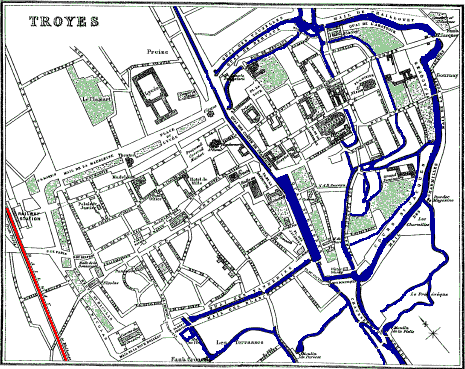
41 m. E. from Sens by the Chemin de Fer de l’Etat is TROYES, pop. 39,000. Hotels: At the station, the Grand Mulet. In the principal street, the Rue Notre Dame, the hotels Saint Laurent, Commerce. In the Rue Hôtel de Ville, the Hôtel des Couriers.
Troyes: Cathedral.
Troyes, the former capital of Champagne, is situate on the Seine, canalised in the 12th century by Theobald IV. These canals move the machinery of numerous manufactories of hosiery, paper, and linen, which produce an annual average value of about two million pounds sterling. Troyes is famous for the number and beauty of its churches, of which the most important is the Cathedral of St. Pierre et St. Paul, situated at the eastern side of the town, the railway station being on the western or opposite side. This edifice, among the most beautiful Troyes: Henry V. Salle Simard. Before the high altar in this church Henry V. of England was affianced to the Princess Catherine, daughter of Charles VI. of France, on the 20th May 1420. Next day the famous treaty was signed, which secured the crown of France to Henry by the exclusion of the dauphin Charles, whenever the poor mad Charles VI. should cease to live. Behind the high altar in the Lady chapel is a Madonna by Simard, and the window containing the oldest glass in the church. A stair to the right of the high altar leads to the treasury, of no great interest. It contains croziers of the 13th century, reliquaries of St. Loup and St. Bernard, with enamels of the 12th century, a tooth of St. Peter in a small gold box, etc. In the reliquary of St. Bernard is a bit of the skull of an Irish primate, St. Malachie, who lived between the 11th and 12th centuries. A few yards to the N. of the cathedral is the building containing the Library, open from 10 to 3, with 125,000 volumes and 3600 MSS., in a large hall, with windows composed of curiously-painted panelled panes. Among the illuminated books are a Bible of St. Bernard and St. Paul’s Epistles, 12th century. In the same building are the Museum, or picture gallery, with paintings by Watteau, Coypel, Mignard, etc.; and the Salle Simard, containing a valuable collection of the Models made by Simard for his statues and works in relief. Also some statuary by Girardon, and other French sculptors. The museum is open to the public on Sundays and feast-days from 1 to 4. On other occasions a small fee is expected. A short distance eastward from the cathedral is the Hospice, and a little beyond St. Nizier, with painted panel panes in the window of the sacristy. The glass in the windows of the church is of the 16th century. Westward, in Rue Urbain IV., is a gem of Gothic architecture, the church of St. Urbain, built by that Pope towards the end of the 13th century. The high altar occupies the place where his father used to sit in the exercise of his calling, which was that of a cobbler. A short way N. is St. Remi, 14th century, with a bronze crucifix over the altar by Girardon. Directly W. from St. Urbain, by the Rue de l’Hotel de Ville, is the Hotel de Ville, built according to the plans of Mansard, commenced in 1624, and finished in St. Jean, 14th century. The high altar was sculptured by Girardon, while the painting of the Baptism of our Lord, forming the reredos of the altar, is by Mignard. Behind, in the chapel “O Sacrum Convivium,” are some good relief sculptures. From St. Jean, pass up northwards by the Rue de Montabert. At the N. corner of the first division is the Post Office; and at the end of the next division is La Madeleine, commenced in the 12th century, and remarkable for its magnificent jubé, or rood-loft, constructed by Jean de Gualde in 1508. The beautiful windows behind the altar belong to the same period. The nearly flat roof might have been called an achievement in Gothic architecture, if the vaulting did not show signs of weakness. West from St. Jean is St. Nicolas, 16th century, near the Hôtel Mulet. To the right of the entrance a broad staircase leads up to a Calvary containing a colossal statue of Christ. In the chapel below is a statue of our Saviour by Gentil, representing him as rising from the dead.
Near St. Nicolas is St. Pantaleon, 16th century. To the right on entering is a Calvary by Gentil. On the panels of the pulpit are beautiful reliefs in bronze by Simard. Behind the pulpit is the chapel of St. Crispin, the patron of shoemakers, containing curious groups. The glass of the windows is rich, while the numerous statues on consoles give the church the appearance of a statue gallery.
South from the church St. Pantaleon by the Rue de Croncels, and its continuation the Faubourg de Croncels, is the small chapel of St. Gilles. In this neighbourhood, 1½ mile northwards from the barracks of the Oratoire, by a road through gardens and fields, are the village and church of St. André, of which the principal feature is the west portal, constructed at the expense of the inhabitants in 1549, and ornamented by Gentil.
Those who prefer to drive through the town should follow the order we have adopted. A cab for four costs 3 frs. per hour; and for two, 2 frs. However, before entering request to see the tariff.
Troy Weight.
The weight known by the name of the Troy weight was brought from Cairo during the time of the crusades, and first adopted in this city. Troyes was the headquarters of Napoleon I. during his struggles in 1814.
Villeneuve-sur-Yonne.
PARIS MARSEILLES 79 458 VILLENEUVE-sur-yonne, pop. 5100. Hotel: Dauphin. In the old castle here of Pulteau the man “au masque de Fer” spent some days while on his way to the Bastile (p. 158). Villeneuve is joined to its suburb, Saint Laurent, by a bridge 700ft. long. 5 m. beyond, or 84 m. from Paris, is St. Julien du Sault, pop. 1500. Hotel: Des Bons Enfants. A poor town, nearly a mile from the station, but possessing a fine church, of which the greater part of the choir, as well as the S. and N. porches, belong to the 13th cent., and the remainder of the edifice to the 14th-16th cents. Overlooking the town, and distinctly seen from the station, is a ruined chapel belonging to the 13th cent.
PARIS MARSEILLES 91 446 JOIGNY, pop. 7000. A good resting-place. Hotels: The Poste, between the station and the bridge; the *Bourgogne, on the quay on the right bank of the Yonne, which is the principal promenade. The most important part of the town occupies the hill rising from the promenade, in which are situated St. André, the most prominent of all; St. Jean, 16th cent.; and St. Thibault, 15th cent.
PARIS MARSEILLES 96 441 LA ROCHE, on the Canal de Bourgogne, at the confluence of the Armançon and the Yonne. Large refreshment-rooms. Junction with branch line to Les Laumes, 79½ m. southwards, passing by Auxerre, Cravant, Sermizelles, Vezelay, Avallon, and Semur. (See map on p. 1.)
Auxerre.
LA ROCHE TO AUXERRE, VEZELAY, AND LES LAUMES.
12½ m. S. from La Roche is Auxerre, pop. 16,500, on the Yonne and the hill rising from the river; Hôtel Laspard. Seen from the station, the most prominent object is the Cathedral, to the right is St. Germain, to the left St. Pierre, and, above St. Pierre, the Tour Guillarde or Clock Tower, at the market-place. The Cathedral, St. Etienne, was rebuilt in the 13th cent., over a crypt of the 11th. The tower over the western entrance is 230 feet high. The north and south portals are crowded with statues. The entire length of the church is 332 feet, and of the transepts 128 feet. 110 feet intervene between the floor and the vaulted roof of the nave and choir, and the pillars are 79 feet high. The great western window, and the end windows of the N. and S. transepts, contain superb glass set in light flamboyant tracery. Adjoining is the Préfecture, formerly the Episcopal Palace, built in the 13th cent. Near the Cathedral is the hospital and the church of St. Germain, with a curious crypt of the 9th cent., but restored in the 17th. Apply to the concierge at the gate beside the now isolated tower, 173 feet high, built in the 11th cent. St. Pierre, begun in the 16th and finished in the 17th cent., is in Italian-Gothic.
Near the Hôtel de l’Épé is the church of St. Eusebe, founded in the 12th cent. The most remarkable parts of the church are the tower, the capitals of the fascicled columns, and the glass of the windows around the chapel of the Virgin behind the high altar. In the principal walk is a statue of Maréchal Davoust. Coach from Auxerre to Pontigny and Chablis. (For Pontigny, see page 16.)
13 miles east from Auxerre is Chablis, pop. 3000, Hôtel Lion d’Or, on the Serein. The vineyards, occupying 30,000 acres, produce the well-known white wine, of which the best growths are those of Val Mur, Vauxdésir, Grenouille, Blanchot, and Mont de Milieu. When the quality of the vintage is good, the wines are dry, diuretic, and of a flinty flavour.
Cravant, pop. 1000, Inn: Hôtel de l’Espérance, on the Yonne, nearly a mile from the station, owing its importance to its position at Clamecy, 22 miles S., with the line to Les Laumes, 56 miles S.E. Cravant is 85 miles from Nevers by Clamecy, and 116 miles from Paris by La Roche. (See map, page 1.)
Sermizelles. Vezelay.
37¼ miles from La Roche, 14¼ miles from Cravant, and 42½ miles from Les Laumes is Sermizelles, the station for Vezelay (6¼ miles distant), for which a coach awaits passengers. Fare, 1½ fr. At the station there is a comfortable little inn, the Hôtel de la Gare, where a private vehicle can be had (20 frs.) for visiting Vezelay, Pont Pierre-Perthuis (for the view), 2 miles distant, and St. Pêre; then back to Sermizelles Station. See also p. 354.
Vezelay, pop. 1300. Inn: Hôtel de la Poste. An ancient and decayed town on the top of a hill, possessing one of the finest ecclesiastical edifices in France, the Church of the Madeleine; restored by Violet le Duc. The narthex belongs to the 12th cent., the nave and aisles to the 11th, and the choir and transept to the 12th and 13th. The length of the building is 404, and the height of the roof 70 feet. The exterior is unadorned, and supported by plain receding flying buttresses. The doors and tympanum of the western entrance are enclosed by a wide expanding circular arch with four sculptured ribs. Above rises a large window with boldly sculptured mullions. Within the doorway is a spacious narthex, of which the triforium is filled with antiquities connected with the monastery which adjoined the church. To appreciate the noble proportions, simplicity, and harmony of this vast edifice it is necessary to have the door between this narthex and the nave opened. The nave and aisles are lighted by forty small round-headed windows, and their roofs rest on forty semicircular arches springing from massive piers, with attached columns ornamented with the peculiar capitals of their period. A triforium runs round the transept and choir. Eleven circular columns, of one stone each, support the arches which enclose the sanctuary. From the S. side of the choir a door opens into what was formerly the “salle capitulaire,” built in the 12th cent. The cloister is a modern addition by Violet le Duc, who also constructed the altar in the beautiful crypt below the choir. Near the abbey church is St. Martin’s, 12th cent., and St. Etienne, now used as a storehouse. The Port St. Croix (15th cent.), as well as parts of the fortifications, still remain. Becket. Thomas à Becket celebrated mass in the Madeleine on the 15th May 1166; when also, with the awful forms provided by the Roman ritual, he pronounced sentence of excommunication against John of Oxford and others, and would have included Henri II. himself, had he not been informed that the King at that time was seriously ill. At Vezelay, in 1190, the crusaders under Richard Cœur-de-Lion joined those under Philippe-Auguste to set out on the third crusade. Vezelay is the birthplace of Theodore Beza (June 24, 1519), one of the pillars of the Reformed Church. In his arms Calvin expired.
1¼ m. from Vezelay is St. Pêre, pop. 2000, with a beautiful church of the 14th cent., but the elegant steeple is of the 13th. 5 m. from St. Pêre is the Château Baroche, which belonged to Marshal Vauban.
9½ m. E. from Sermizelles by rail is Avallon, pop. 6000, on the Cousin. Hotels: Chapeau Rouge; Poste. The parish church of St. Lazare, 12th cent., is a beautiful but somewhat peculiar specimen of Burgundian architecture. Coach awaits passengers at the station for Saulieu, 17 miles distant, pop. 4000. Hôtel de la Poste. An interesting town with a church, St. Andoche, 12th cent. The vineyards of Avallon produce good wine. The best keeps well in bottle from fifteen to twenty years. 10 miles S.W. from Avallon is the Forêt de Morvan, whence Paris receives firewood, sent down the Yonne and Seine in rafts.
Semur.
After Avallon comes Rouvray, with vineyards producing good wine, and then, 20 miles from Avallon and 12½ from Les Laumes, is Semur, pop. 4150. Hotels: Côte d’Or; Commerce. Picturesquely situated on the Armançon, about a mile from the station. The parish church of Notre Dame was founded in 1065 by Robert I., Duke of Burgundy, rebuilt in the 13th cent., and repaired in 1450. The entrance is provided with a sculptured porch. The windows of the N. aisle contain fine old glass; the subjects are portrayed with great expression and quaintness. In this part is a beautifully wrought tabernacle of one stone 16½ feet high. At each transept is a small cloister. There are some pleasant walks around and about the town. The dungeon tower and part of the ramparts still remain. 12½ miles N.E. this branch line joins the main line at Les Laumes, 160 miles from Paris. (See page 19, and map page 1.)
Saint Florentin.
PARIS MARSEILLES 107½ 429½ SAINT FLORENTIN, pop. 3000. Inns: At station, H. de la Gare. In town, H. Porte Dilo. Pilgrims to Pontigny alight here, whence a coach starts in the afternoon for Chablis and Ligny, passing within a mile of Pontigny. There is a small inn at the part where the Pontigny road separates from the Chablis road.
Saint Florentin is on an eminence more than a mile from the station. The parish church, 12th to 15th cents., is small, but interesting. The windows contain 15th and 16th cent. glass, repaired with modern pieces. The sanctuary is surrounded by a screen composed of slender colonnettes standing diagonally, and is shut off from the nave by a beautiful rood-loft. Behind the high altar, which is elaborately sculptured, is a relief, 1548, sadly mutilated, representing the death and resurrection of Jesus Christ.
At Pontigny there is a small but comfortable inn, the Hôtel St. Éloi, but pilgrims to the shrine of St. Edmund are generally lodged in the abbey buildings. From Pontigny a coach runs every other day to Auxerre, 13 m. S.W., stopping at a café near the station. The greater part of the church of Pontigny was built in 1150. It is a plain vast edifice with narthex and round turret at main entrance. The interior, which is grand and imposing, is 355 ft. from W. to E., 72 ft.
Becket arrived at this abbey on the 29th of November 1164, and remained till Easter 1166. From Pontigny he went to Vezelay, and from Vezelay to Sens.
Tonnerre.
PARIS MARSEILLES 123 414 TONNERRE, pop. 6000, on the Armançon. Inns: Lion d’Or; Courriers—both near each other. The street St. Pierre, to the left of the Lion d’Or, leads past the church of Notre Dame (now condemned) up to the cemetery, and to the church of St. Pierre, situated on a terrace right above the town. At the foot of this hill is a beautiful spring of water, enclosed in a circular basin about 40 feet in diameter, called the Fosse Dionne; but it is in a dirty part of the town, and used by the washerwomen. A straight street to the right of the Lion d’Or leads down to the hospital, built in 1834, the original part of which, built by Marguerite de Bourgogne in 1293, is now the church of the hospital. Her remains repose under a beautiful mausoleum in front of the high altar (died September 4, 1308). To the left is the mausoleum of the Marquis de Louvois (died 1691). The arrondissement of Tonnerre produces some excellent wine.
Tanlay.
PARIS MARSEILLES 127½ 409½ TANLAY, pop. 1000, on the Armançon. A small village with a handsome castle in an extensive park. The oldest part was built by Guillaume de Montmorenci, in 1520, but by far the largest portion by a brother of Admiral Coligny, in 1559. The vast façade is flanked by two wings. The principal court is 79 feet by 36. In a
Ancy-le-Franc. Montbard.
PARIS MARSEILLES 136 401 ANCY-LE-FRANC, pop. 2000. The fine castle here was commenced in 1545, and built according to the plans of Primaticcio.
PARIS MARSEILLES 142 395 NUITS-SOUS-RAVIERES, pop. 700. Important junction with the Paris and Bâle line, by Troyes (see page 11), by a branch extending 72 miles north-east to Bricon, passing Châtillon, 22 miles north-east from Nuits. In the environs of Nuits-sur-Armençon are the ruins of the castle of Rochefort, 17th and 18th cents.
PARIS MARSEILLES 151 386 MONTBARD, pop. 3000, on the Canal de Bourgogne. Inn: Hôtel de la Poste. Buffon, the celebrated naturalist, was born in this small village on the 7th of September 1707. His château, a plain large house, is entered from the extremity of the main street farthest from the station. The grounds are extensive, and laid out in terraces. On the western front of the terrace is the small square house, with three windows and one door, into which he retired at five in the morning to pursue his studies. In another building he kept his manuscripts. In the grounds of the château, on the walk below the dungeon tower of the castle of the Dukes of Bourgogne, is the small column erected to his memory by his son, who fell a victim to the tyranny of Robespierre, only fifteen days before the downfall of that monster. Situated on a terrace at the entrance of the grounds is the parish church, containing the tomb of Buffon. A black stone slab over the door bears the following inscription:—
Buffon A été inhumé dans le Caveau de cette chapelle Le 20 Avril 1788.
There is also a bronze statue of him here. 3½ miles from Montbard is the abbey of Fontenay, founded in 1118; now a paper mill.
PARIS MARSEILLES 160 377 LES LAUMES. Inn: H. Duvernet. Overlooking the station is Mount Auxois, 1370 ft. above the sea. Near the top, and about 1½ mile from the station, is the ancient Alesia (Alise-Sainte-Reine, pop. 900. Inn: H. du Cheval Blanc), where Cæsar, B.C. 50, defeated the Gauls under Vercingetorix, whose statue by Millet, pedestal by V. le Duc, stands just above the hospital. The church of St. Thibault (14th cent.) has some curious sculpture. It is visited by pilgrims on the 7th of September. Four miles from Les Laumes is the Château Bussy Rabutin, in a beautiful park of 84 acres, built by Renaudin, one of the benefactors of the abbey of Fontenay, about the year 1150. It contains a valuable collection of portraits of historical personages by eminent artists. (See page 14.)
PARIS MARSEILLES 165 372 DARCEY, pop. 850, 2 miles from its station, at the foot of steep mountains 1315 ft. high. Inn: Hôtel Guyot. Near the village are curious caves, and a subterranean lake, the source of the Douix. Omnibus at station for Flavigny, 1½ mile distant, pop. 1300, on a hill 1390 ft. above the Lozerain. Remains of fine old walls. Church 13th cent., with rood-loft 16th cent. Houses of 13th, 14th, and 15th cents. Convent of the Ursulines, with splendid view.
Source of the Seine.
PARIS MARSEILLES 171¼ 365¾ VERREY, pop. 900. Inns: Hôtel de la Gare; Bourbogne. Station for the Source of the Seine, 6¼ miles S. by the path over the hill through the woods, but 9¼ by the carriage-road, which follows the railway till the village of Villotte, pop. 800, where it ascends the hill towards Bligny-le-Sec, pop. 700, 5 miles from Verrey, and after passing the farmhouse Bonne Rencontre joins the Dijon road. Then turn to the left and follow the Dijon road to a few yards beyond the 33 kilomètre (Côte d’Or) stone, where take the narrow road to the left, which passes first the farmhouse Vergerois and then descends to the source of the Seine (1545 feet above the sea), under an artistic grotto in the midst of a little garden enclosed by a railing. The keeper lives in the house beyond. The tiny infant stream issues forth under the protection of a recumbent statue of the river divinity. Coach there and back 10 frs., or guide 5 frs. It is not necessary to return to Verrey. Those who please can go back by the Dijon road to St. Seine, on the Cressonne, 5 miles south, pop. 1000. Inns: Mack; Soleil d’Or. With a 14th cent, church. A diligence runs between it and Dijon. The railway station for St. Seine is Blaizy-Bas, 7½ m. distant.
PARIS MARSEILLES 179 358 BLAIZY-BAS, situated at the commencement of the tunnel which pierces through the basin of the Seine to that of the Rhône. It is 13,440 feet long, and 1330 feet above the sea.
PARIS MARSEILLES 190 347 VELARS, pop. 1400. After the preceding station of Malain, and before reaching the next station, Plombières-sur-Ouche, there is some bold railway engineering. The viaduct of the Combe-Bouchard is on two tiers of arches and is 492 feet long, while that of Neuvon is 774 feet long. From Velars commences the branch to Nevers by Autun, 74½ miles from Nevers. (For Autun, see page 24.)
Dijon
DIJON
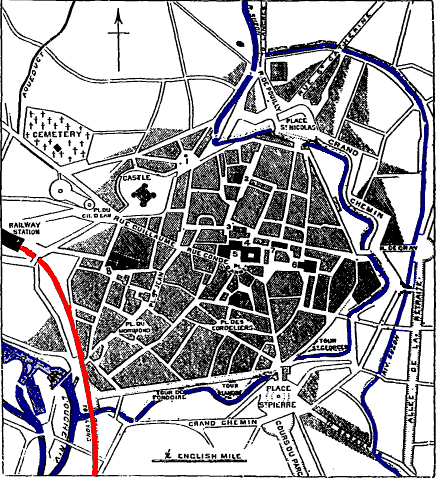
The principal street is the Rue Guillaume. To the left is the Castle built by Louis XI., now the Gendarmerie. Beyond, at No. 1, are the Place and Statue of St. Bernard. No. 2 is the Préfecture. That large building at the foot of the Rue Condé, Nos. 4 and 5, is the ancient Palace of the Dukes of Burgundy, containing the Hôtel de Ville, the Museums, and the Post Office. No. 3 is the Church of Notre Dame; No. 6 St. Michel; and No. 7 the Theatre. Opposite the Palace, at No. 9, is the Palais de Justice. The church near the station (No. 8) is St. Bénigne, easily recognised by its lofty needle spire. Close to it is St. Jean, the church of Bossuet.
PARIS MARSEILLES 196 341 DIJON, pop. 48,000. Good refreshment-rooms at the station. Hotels: La Cloche, in the Rue Guillaume; and the Jura, near the station. Near the Cloche is the Galêre. Just outside the arch, the Bourgogne and the Nord. In the Rue Bossuet, the Genève. Dijon is famous for mustard, gingerbread, and the liqueur Cassis.
Cabs, 1 fr. 75 c. the first hour, and 1 fr. 50 c. every succeeding hour. Coaches daily to Ancey, Fleury-sur-Ouche, La Cude, Cissey, and St. Seine. The St. Seine dil. starts daily from the inn, Hôtel du Commerce, 82 Rue Godrans, and takes about 3½ hours. From St. Seine an excellent road leads to the source of the Seine, 5 m. distant. (See page 19.)
Dijon: Salle des Gardes. Museums.
The most interesting buildings in Dijon are near the palace, which was inhabited by Jean Sans Peur, Philippe le Bon, and Charles le Temeraire; but of that ancient building there remain only the Tour de Brancion, the Salle des Gardes, the kitchens and vaulted rooms on the ground-floor, and the Tour de la Terrasse, 152 feet high, ascended by 323 steps, and commanding a bird’s-eye view of the whole town. The rest is modern, and is occupied by the Hôtel de Ville, the Post Office, the École des Beaux Arts, the Museums, and the Protestant church. The museum is on the right side of the great court, and is open to the public on Sundays. Other days a fee of 1 fr. is expected. In the Salle des Gardes are the magnificent mausoleums of Philippe le Hardi, 1342-1404, and of his son Jean Sans Peur, 1371-1419, with his consort Margaret of Bavaria. Of the two, the first is the more elaborate. It is in pure black and white marble, set round with a delicate frieze, and adorned with forty statuettes representing his most famous contemporaries. Among the articles which belonged to them in this room are three beautifully-carved folding altar-screens for private chapel service; and, under a glass case, the ducal crown, the cup of St. Bernard, and the crozier of St. Robert, first abbot of the Cistercian order, died 1098. Dijon: Notre Dame. St. Benigne. Close to the Rue des Forges is Notre Dame, consecrated in 1331, a very beautiful and interesting specimen of Burgundian architecture. At the east end is the house Vogue, in the Renaissance style, and farther east, in the Rue Chaudronnière, the Maison des Cariatides. A short distance from the front of the Hotel de Ville is the Palais de Justice, formerly the palace of the Parliament of Burgundy. The ceiling of the Cour d’Assises is of massive carved chestnut, 17th cent. The crucifixion in the same room is by Belle. At the end of the Salle des Pas Perdus is the pretty little chapel which belonged to the parliament house. Near the theatre is St. Etienne, founded in the 10th cent., and partly rebuilt in the 18th, but now the corn-market. At the end of this same street, R. Vaillan, is St. Michel, rebuilt in the 16th cent., with a few curious frescoes. Standing at the Arc de Triomphe, looking down the Rue Guillaume, we have, towards the left, the chateau built by Louis XI. in 1478, or rather what remains of it, converted into the Gendarmerie; and a little to the N.E. by a wide Boulevard, the Place and statue of St. Bernard, who was born (1091) at Fontaine Lez-Dijon, in the chateau beside the curious little church, 2 miles N.W. by the road of that name. Towards the right is St. Benigne, easily recognised by its slightly twisted needle spire, built in 1742, 300 feet high, and a little inclined by the tempest of 1805. The crypt and the porch belong to the 11th cent., the remainder to the 13th. In the south aisle is the Dijon: St. Jean. Bossuet. Asile des Aliénés. From this the narrow street, Rue des Novices, leads to St. Jean, founded, as the tablet in the church states, in the 2d cent., rebuilt in 1458, and restored in 1866. The vault of the roof is bold, the tracery of the windows nearly rectilinear, and the mural paintings not without merit. Bossuet was baptised in this church, and born in No. 10 of this “Place,” 27th September 1627. Among the writings of this eloquent and illustrious prelate the finest is the funeral oration on the death of Henrietta Anne, the daughter of our Charles I., and wife of the Duke of Orleans. Southwards is St. Anne, 1690. At the Octroi gate, beside the railway, is the entrance into the Asile des Aliénés, formerly the Chartreuse, founded by Philippe le Hardi in 1379. Fee, 1 fr. On the portal (14th cent.) of the chapel are the kneeling effigies of Philippe and his spouse Marguerite, accompanied by Sts. Antoine and Catherine, whose figures are portrayed in the beautiful glass (15th cent.) of the chancel windows. The visitor is next taken to the well called Le Puits de Moise, 22½ feet in diameter, consisting of a hexagonal pedestal, having on each side a statue of one of the prophets, by Claux Sluter in the 14th cent., the sculptor of the ducal monuments in the Palais des Etats. The statue of Moses is the least successful, and that of Zachariah the most expressive. The house contains on an average 500 patients. Dijon is not a town for sightseers, but an admirable town for resting during a long journey. The Cloche and Jura are comfortable houses, and although La Galêre is less so, its charges are more moderate, while its fare is better. There are a number of pleasant walks. Just beyond the arch is the Promenade du Chateau d’eau, and at the foot of the railway station the Botanic Gardens. Towards the extremity of the gardens is a black poplar 490 years old. The southern continuation of the Place de St. Etienne leads by the Rue Chabot Charny, the Place St. Pierre, and the Cours du Pari (1465 yards long), to the public park. From Dijon the rail runs southwards parallel to the slopes of the famous wine producing hills of the Côte d’Or, extending from N.E. to S.W., and attaining an elevation of 324 feet. Behind them rises another range, reaching the height of 1315 feet, and sheltering the lower range from the cold winds. Between Dijon and Meursault grow the first-class Burgundy wines; while south from Meursault follow the
Gevrey-Chambertin.
PARIS MARSEILLES 203 334 GEVREY-CHAMBERTIN, 1¼ mile from station, pop. 2000. Famous for their first-class growths, of which the best are the red and white Chambertin. Bèze, St. Jacques, Mazy, and Vèroilles, in the commune of Gevrey, produce also first-class Burgundies.
PARIS MARSEILLES 206¼ 330¾ VOUGEOT, on the Vouge, pop. 500, ¾-mile from station. Inn: Groffier. Here there are above 125 acres of vineyards producing first-class Burgundies. Among the most distinguished are the Romanée St. Vivant, Romanée Conti, Richebourg, and La Tache.
PARIS MARSEILLES 209½ 327½ NUITS, pop. 4000. Inn: Trois Maures. Omnibus awaits passengers. The best vineyard here is the St. George, which produces a wine of an exquisite flavour and a delicate and delicious bouquet. The church, St. Symphorien, belongs to the 13th cent., and St. Denis to the 14th. 8 miles from Nuits is the abbey of Citeaux, now used as a house of detention for youthful criminals, who are trained here to be agricultural labourers. This abbey, founded by Robert de Molesme in 1098, had at one time 3600 dependent convents of the Cistercian order, and from it went forth four of its abbots, to assume the keys of St. Peter. The greater part of the buildings was rebuilt in 1798.
Beaune.
PARIS MARSEILLES 219 318 BEAUNE, pop. 12,000. Hotels: Chevreuil; France. On the stream Buzoise. This town is the headquarters of the merchants who deal in Burgundy wines, as Bordeaux is that of the claret merchants. Around it are the first-class vineyards of Beaune Pommard, Volnay, and Romanée. Of these the Volnay vineyards, extending over 532 acres, produce the most valuable wine, under the names of Bouche d’Or and Caillerets, and the Pommard under that of Commarine. The town is of poor appearance. The principal church, Notre Dame, founded in the 12th cent., contains semicircular and equilateral-triangled arches and cusped and Corinthian capitals.
In the Place Monge, off the street de l’Ile, is a bronze statue to Gaspard Monge, the inventor of descriptive geometry, born at Beaune in 1746. To him France is indebted for the establishment of the Polytechnic School. Contiguous to the Chevreuil Inn is the hospital, built in the 15th cent.—a curious and interesting building. The Salle de Conseil upstairs is hung with Aubusson tapestry, and contains also a painting of the Last Judgment by Roger van der Weyden.
Meursault.
PARIS MARSEILLES 223½ 313½ MEURSAULT, pop. 3000, 1½ m. from the station. Omnibus awaits passengers for the Inn. The most distinguished wines produced here are the Goutte d’Or, a golden-coloured wine, and the Perrières, a dry white wine of a slightly sulphureous taste. In the neighbourhood is Puligny, where the delicious sparkling white wine called Montrachet is grown.
PARIS MARSEILLES 228 309 CHAGNY, pop. 4200. Inn: Commerce. Junction with line to Nevers 102 m. W., passing Nolay 5 m. W., Autun 26 m. W., Montchanin 18 m. W., and Le Creusot 22 m. W. (see page 25, and map page 1). From Chagny southwards commence the Macon wines, of which the vineyards around Chagny produce a first-class quality.
Nolay, pop. 5000. Inns: Cheval Blanc, La St. Marie. The vineyards in this neighbourhood produce a good white Macon. A few miles distant is the Vallon de Vaux-Chignon, below cliffs 200 ft. high. In a deep fissure is the source of the Cusane. 3¼ m. E. are the ruins of the castle Rochepot, 15th cent. In the church of the village is a remarkable echo. 8 m. beyond is Epinac, pop. 5000, with coal mines.
Autun.
26 m. W. from Chagny is Autun, pop. 13,000. Hotels: Poste; Cloche. This modernised little town, the ancient Bibracte, claims with Trèves the honour of having been built before the Roman invasion. Cæsar spent a winter in this city with two Roman legions; and at a later period, when the Emperor Augustus went to Gaul, he made Bibracte his headquarters, and erected so many magnificent public buildings that the name of the town was changed to Augustodonum, modernised into Autun. Napoleon III., in his “History of Cæsar,” considers, however, that the site of Bibracte was on the summit of Mount Beauvray, 14 miles westwards, where coins of Gaul, mosaic pavements, fragments of pottery, and an enormous number of amphoræ, have been discovered. The walls of Autun were 10,000 feet in circumference and 8 feet thick, and were garnished with 40 towers, and pierced with four large gates, of which two—the Porte d’Arroux, 55 feet high, and the Porte St. André, lately restored—still remain. The Porte d’Arroux and the temple of Janus (a plain square tower) are behind the railway station. But the Porte St. André, adjoining an ancient church, is on the town side of the line at the Faubourg St. Jean. The Cathedral, which commands the entire city, was completed in 1178. The architecture of the modern portions is Gothic, but the more ancient is Romanesque. The two towers have been restored and adorned with Gothic spires. The interior contains several windows of painted glass. The entrance is by a handsome open portico with sculptured arches and columns. From the Porte St.
In the College is the Public Library, with 12,000 volumes; and the Picture Gallery, containing paintings by Horace Vernet. In 1789 Talleyrand, afterwards Prince Talleyrand, was Bishop of Antun.
Montchanin. Le Creusot.
73 m. E. from Moulins, 86 m. E. from Nevers, 18 m. W. from Chagny, is Montchanin, pop. 2500. Inn: H. des Minis; its omnibus awaits passengers. The town, nearly a mile from the station, consists chiefly of the houses of the workmen employed in the surrounding coalpits, foundries, and large artistic brick and tile works. Outside the town is the Étang Berthaud, the reservoir of the Canal du Centre, which connects the Saône with the Loire, between Chalon and Digoin.
78¼ m. E. from Nevers, 7¾ m. W. from Montchanin, and 26 m. W. from Chagny, is Le Creusot, pop. 25,000, of whom 6300 are employed in the ironworks. Hotels: Commerce; Rodrigue, near each other in the principal street, the Rue d’Autun. Their coaches await passengers. Le Creusot is on the southern slope of one of the wooded hills which enclose this valley, 1¼ mile long and ½ mile wide, occupied by the coal-pits, forges, and foundries of Schneider et Cie, bought by them from the former owners, Manby, Wilson, and Co. Detached straggling suburbs occupy the other slopes of the hills. In all the general feature is the same, rather untidy streets and houses, with parks, shops, and cafes to suit. The streets are full of children, but few priests, policemen, and beggars. In the principal square, near the two hotels, is a statue by H. Chapu of Eugene Schneider, erected in 1878 by the workmen and inhabitants. The view of the works from the road is imposing, and, although they contain a forest of chimneys and all manner of powerful machinery, there is no noise.
West from Le Creusot, and 65¼ m. E. from Nevers, is Etang, with an ancient castle. 51½ m. E. from Nevers is Luzy, pop. 3000, on the Alène. Inn: H. Delaigue, close to station. Coach 12 m. to St. Honoré-Les-Bains, with alkaline sulphureous springs, 90° Fahr. 33 m. E. from Nevers is Cercy-la-Tour, on the Aron, 53 m. south from Clamecy by the rail, skirting the Canal Nivernais. Inn: H. de la Croix, close to station. 23½ m. E. from Nevers is Decize, pop. 4800. Inns: Paris; Commerce. Omnibus awaits passengers. Situated on an island in the Loire, at its junction with the Aron and the Canal Nivernais, which commences here and flows into the Yonne at Auxerre. The parish church has a choir of the 11th, nave of the 16th, and crypt of the 10th cent., containing the tomb of St. Aré. Foundries, glass bottle works, and coal-mines. Coach from Decize to La Machine 80 minutes.
Chalon-sur-Saône.
PARIS MARSEILLES 235 302 CHALON-sur-saône, pop. 21,000. Hotels: at the station, Hôtel Bourgogne; in the town, Chevreuil; Commerce; Trois Faissans. Steamer to Macon and Lyons. Chalon is a quiet town situated on an extensive plain on the Saône, at the mouth of the Canal du Centre, both lined with good quays. The chief structures are—St. Vincent, a Gothic edifice of the latter part of the 13th cent., occupying the site of a church founded in 532; St. Peter, 1713, with two lofty steeples; and the hospitals of St. Laurent and St. Louis. Chalon has two stations—one in the town, and another at St. Come, where the express trains halt. 2 miles from Chalon is St. Marcel, where Abélard died 1142. The church still remains, but the monastery has disappeared. A few miles west by coach is Givry, pop. 3200, with first-class vineyards. Rail to
PARIS MARSEILLES 243 294 VARENNES. South from this station the train passes before the abbey of St. Ambreuil.
PARIS MARSEILLES 254 283 TOURNUS, on the Saône, pop. 6200. Inn: Hôtel Sauvage, not clean. An untidy town on the Saône, with remains of Roman fortifications. In the Place de l’Hôtel de Ville is a marble statue of Greuze, erected by the citizens in 1868. Jean Baptiste Greuze, some of whose works are among the finest paintings of the French school in the Louvre, was born here on August 21, 1725. The parish church, St. Philibert, is an interesting Gothic monument, of which the earliest portions belong to the 9th and the latest to the 16th cent. The interior is ornamented with mosaics. The Hôtel Dieu was founded in 1674, the Hospice de la Charité in 1718, and the Hôtel de Ville more recently. The vineyards of Tournus produce good wines.
the RHONE & SAVOY with the passes from FRANCE INTO ITALY
Macon.
PARIS MARSEILLES 274 263 MACON, pop. 20,000. At station, large refreshment-rooms. Junction with line to Bourg, 41 m. E. Hotels.—Near the station, H. Étrangers. In town the Europe, on the Quai du Nord, near the landing-place from the steamers, which sail daily up and down the Saône, between Chalons, Macon, and Lyons. In the centre of the town are the hotels Champs Elysées and Sauvage. Macon is the great depôt of the Macon wines, an inferior Burgundy. The finest part of the town extends along the quays which line the right side of the Saône, crossed by a stone bridge of 12 arches, uniting Macon with its suburb Saint Laurent on the left side of the river. The oldest edifice is the Cathedral of St. Vincent, built in the 12th cent. The arches are stilted, the columns Romanesque, and the porch arcaded. Next to it is the Préfecture, formerly the Episcopal palace. In this neighbourhood,
In the Rue Dombey is an old timber house, and towards the station, the beautiful church of St. Pierre, built in 1865, in the Romanesque style, and decorated with frescoes. Opposite is the Hôtel de Ville.
From Macon a branch line extends 48 miles westward to Paray-le-Monial, passing Cluny, 15 miles from Macon. From Macon a line extends to Geneva 74 m. E., by Bourg 13½ m. E., Nantua and Bellegards 39¾ m. E. (See Black’s France, North Half, and map page 1.)
Cluny. Paray-le-Monial.
Cluny, pop. 5000. In the valley of the Grosne. Hotels: Bourgogne; Pavilions—both near each other. This is the place where Guillaume-le-Pieux founded in the 10th cent, the famous abbey of Cluny. The abbey buildings are now used as a school. Of the abbey church an insignificant portion alone remains, and of it the most interesting part is the spire. In the Chapelle des Bourbons (15th cent.) are enormous corbels under the empty niches. About 300 yards distant is the Maison Abbatiale, 15th cent., with flattened elliptical-headed windows and ogee arches over the doors. At the entrance is a collection of columns, capitals, etc., from the first church founded in the 10th cent. Upstairs there is a small museum; entrance, ½-franc each.
41½ m. E. from Moulins and 33 m. from Montchanin is Paray-le-Monial, pop. 3700, on the Bourbince. Inns: The Poste, the best; across the bridge, the Lion d’Or; at the head of the principal street, near the Palais de Justice, the Trois Pigeons and the Commerce; opposite the Chapelle de la Visitation, the Inn H. des Pelerins. The Palais de Justice, with the clock tower, occupies the remains of an edifice built in the 16th cent., to which date belongs also the house close to it, occupied by the Mairie and the Post Office.
A little way down the Bourbince is the formerly abbey, now the parish church, founded in the llth cent., but nearly rebuilt in the 12th cent. Over the façade rise two elegant square towers with pyramidal roofs, llth cent.; while from the centre of the transepts rises an octagonal tower in 2 stages, surmounted by a tapering 8-sided slated spire. From the apse radiate chapels adorned with dental friezes and short attached columns.
Marguerite.
From this church, the narrow street, the Rue de la Visitation, leads up to the nunnery of the Visitation, an order instituted in 1620, and established in Paray on the 4th September 1626 by 8 nuns from the monastery of Bellecour at Lyons. In 1633 they commenced to build their chapel, which was repaired in 1823, and restored and beautified in 1854. To this chapel the order attach great importance, as it was in this building that Marguerite-Marie Alacoque had most of her interviews with J. C. In the interior the walls and roof are
The bones of Marguerite, covered with flesh-like wax, and attired in the habit of the order, recline on a silver embroidered cloth in a coffin-like shrine of richly-gilt, tiny glazed arches set with rock-crystal. The face and hands are uncovered. The body is 5 ft. long. On her feast day the shrine is placed beside the Communion rail; at other times it is kept within the very beautiful altar-table, made of one piece of pure white marble. Marguerite-Marie Alacoque was born 22d July 1647, in the village of Versovres, near Autun, entered the convent of the Visitation in Paray on the 25th May 1671, and took the vows on the 6th November 1672. On the day when J. C. told her she had been chosen by him to propagate the worship of his heart, she was seized with a pain in her own heart, which continued throughout her life. She met at first with great opposition in her endeavours to institute the worship of the heart, and her sister nuns treated her as a visionary till 1675, when the R. P. de la Colombière, superior of the Jesuit establishment at Paray, became her convert. In her last illness she said: “I shall die in peace, because the heart of my Saviour commences to be known.” She died in October 1690, and was canonised by Pio IX. on the 14th October 1864. Since the institution of N. D. de Lourdes and de la Salette the number of pilgrims has decreased. In Paray there are 3 nunneries and a vast building belonging to the Jesuits.
From Macon the railway continues its course by the side of the Saône, whose banks become now more picturesque. From Macon use map on page 26.
Romaneche. Belleville.
PARIS MARSEILLES 283 254 ROMANECHE, pop. 3000. Inn: Commerce. Produces a delicate light wine, with a pleasant flavour and bouquet, called Moulin-a-Vent, which should be drunk in the second year from the vintage.
PARIS MARSEILLES 288½ 248½ BELLEVILLE, pop. 4000. The first part of the town is St. Jean, and the next Belleville, 1¼ m. from the station, with a comfortable little inn, the H. Jambon. Omnibus at station. The church, 12th cent., has small round-headed and pointed windows, with some good glass, especially in those of the square towers at the end of the transept, and the small circular window over the west portal. This is the headquarters of the Beaujolais wines. From Belleville a branch line extends 10 m. W. to Beaujeu, pop. 4000, on the Ardière. Church, 13th cent., and some curious houses. (Map, page 26.)
PARIS MARSEILLES 297 240 VILLEFRANCHE-sur-saône, pop. 12,600, on the river Morgan, near the Saône. Hotels: Provence; Europe. Containing important linen manufactories, and vineyards producing a good white wine. The parish church, N. D. des Marais, was commenced in the 14th cent. 5½ m. S. is Trévoux station, 1½ m. from the town, pop. 3000, on the E. bank of the Saône. Inns: Terrasse; France. The Jesuits compiled and printed in this town the Journal de Trévoux in 1701, and the Dictionnaire de Trévoux in 1704.
PARIS MARSEILLES 306 231 ST. GERMAIN au-mont-d’or, junction with line from Paris to Lyons, by Roanne and Tarare.
Lyons.
[West] [East]
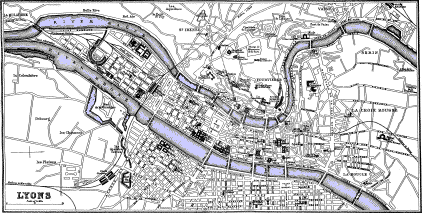
PARIS MARSEILLES 318 219 LYONS, pop. 343,000. The Perrache railway station is 218 m. from Paris, 219 m. from Marseilles, 78 m. from Aix-les-Bains, 36½ m. from Bourg, 104 m. from Geneva, 36 m. from St. Etienne, 56 m. from Roanne, 100 from Vichy, and 214 m. from Turin.
Hotels (first-class).—H. de l’Europe, admirably situated, with one side to the Saône and the Tilsit bridge, and the other to the Place Bellecour, the terminus of some of the best trams. In the Rue de la République are the H. Collet and the H. de Lyon. H. Bellecour in the Place Bellecour. H. des Beaux Arts in the R. de l’Hôtel de Ville, also well situated. In the Place Perrache, below the station, are the hotels Univers, Angleterre, Bordeaux et du Parc.
Less expensive Hotels.—The H. du Globe; and the Havre et du Luxemburg—both near the Place Bellecour. Near the Place des Terreaux in the R. Platière, the H. de Paris et du Nord. Near the Bourse, the H. des Négociants, a large house frequented chiefly by commercial men. Near the Négociants, at No. 47 Rue de l’Hôtel de Ville, the H. Bayard. Hôtel des Étrangers, Place de la République. Hôtel de Toulouse et de Strasbourg, 8 frs., in the Place Perrache, opposite the station. Hôtel National, opposite the theatre. On the Quai do la Charité, near the General Hospital, the H. Bourne. A great
Post Office.—Head Post Office in the Place de la Charité, at the south end of the Place Bellecour. Branch Post Offices in the arcade of the Place des Terreaux and 39 Cours Morand.
Telegraph.—Head office, No. 53 Place de la République. Branch offices—Perrache station, St. Paul station, and No. 38 Cours Morand.
Lyons: Railway Stations. Cab Fares.
Railway Stations.—The great and central station is the Gare de Perrache, in the centre of the tongue of land between the Rhône and the Saône. From it passengers can reach any place, excepting those on the railway to Bourg. The Bourg or Satonay railway station is at the top of the Rue Terme, a street commencing near the N.E. corner of the Place des Terreaux. From the Rue Terme the train is pulled up the hill by a rope in the same way as at Fourvière. The gradient is 16 per 100, and the distance 547 yards. At the top station, in the Boulevard de la Croix Rousse, passengers for Bourg enter the ordinary railway carriages. The rope railway runs every 5 minutes, fare 1d., and forms a convenient way of escaping from the damp foggy atmosphere of Lyons. The Dombes or St. Paul’s railway station is for Montbrison, 40 m. S.W. The Vaise and Brotteaux stations are auxiliaries of the Perrache station. The Brotteaux station, situated on the confines of the Parc de la Tête d’Or, is the terminus of the best of the trams.
CAB FARES
KIND OF CAB. DE 7 H. DU MATIN a minuit. DE MINUIT a 7 H. du mat.
LA course. LA 1re heure. LES H. suiv. LA course. l’heure.
A 2 places (coupés) 1 25 1 50 1 25 1 65 2 50
A 4 places (berlines) 1 50 2 1 50 2 3
Voitures découvertes à 2 places à 4 places 1 75 2 2 2 50 1 75 2 2 15 2 50 3 3 50
The “coupés” are cabs with a seat for two. The “berlines” are cabs with 2 seats for four. Each portmanteau 25 c. At the railway stations the omnibuses from the hotels await passengers.
Lyons: Tramways. Theatres. Steamers.
Tramways.—The fares are moderate, and most of the cars comfortable. The best to take to see the principal parts of the town is the large roomy car running between the Perrache railway station and the Brotteaux railway station, passing through the P. Perrache, P. Henri IV., Rue Bourbon, P. Bellecour, R. and P. de la République between the Hôtel de Ville and the Grand Theatre, across the bridge Morand, and up the Cour Morand to the terminus at the Brotteaux railway station. At the Brotteaux terminus the road by the side of the fort “des Charpennes” leads in 5 minutes into the Parc de la Tête d’Or (see page 40), which having visited, return either by the same car, starting every 10 minutes, or by the other, whose terminus is in the Quai de la Charité. The outside of the cars, taken also by ladies, costs 3 sous; inside, 4. The two most important places to visit on the return journey are the Palais des Arts (page 35), and the silk museum in the Bourse (page 38). Tram between the Place de la Charité and Oullins every 15 minutes; fare outside, 3 sous. To visit the meeting-place of the two rivers, come out at the bridge before crossing the Saône. Oullins, 3¼ m. from Lyons, pop. 4000, is approached also by rail from Lyons.
Theatres.—The Grand Théâtre, between the Hôtel de Ville and the Rhône. Boxes and front stalls, 6 frs. The Théâtre des Célestins, between the Rue St. Dominique and the Saône. Boxes, 6 frs.; stalls, 4 frs. Théâtre Bellecour, No. 85 Rue de la République, quite a new theatre, with all the modern comforts and appliances, and seated for 3000. The prices vary according to the subject. For an opera the stalls cost 7 frs. each; for a play, 4 frs. There are also the Théâtre des Variétés, Cours de Morand; Théâtre du Gymnase, 30 Quai St. Antoine; and the Théâtre de l’Elysée, 3 Place de la Victoire.
Steamers on the Saône (Les Guèpes).—Sail between the Quai St. Antoine (to the north of the Bourse) and Collonges, calling at the Ile Barbe. In summer 5 departures daily.
Les Mouches, or penny boats, sail from the quay near the Place Perrache, by the side of the Pont du Midi, to the Pont du Port Mouton on the Quai de Vaise, calling on the way at numerous stations. From the Pont du Port another set of penny boats ascend to St. Rambert, calling likewise at numerous stations on the way. Opposite St. Rambert is Cuire, and between them in the centre of the river is the Ile Barbe.
The large steamers Parisiens sail in summer between the Quai St. Claire on the Rhône and Aix-les-Bains on Tuesdays, Thursdays, and
Lyons: Sights.
Sights.—Notre-Dame-de-Fourvière (see below). Drive in tram car, outside if possible, between the Place Perrache and the Brotteaux railway station, page 31. The Parc de la Tête d’Or, page 40. The galleries in the Palais des Arts, page 35. The museum of silk manufacture, page 38.
Lyons is a strongly-fortified city, intersected by two of the largest rivers in France, the Rhône and the Saône, which form as they approach each other the isthmus, 545 ft. above the sea, on which the finest part of the city is built. This portion is traversed by three great streets, the Rue de la République, the R. de l’Hôtel de Ville, and the R. Centrale, and contains the three most important and beautiful squares, the Places Perrache, Bellecour, and Des Terreaux. The Place Perrache, in front of the station, was planted with trees in 1851. In the centre was a bronze statue of Napoleon I. by Nieuwerkerke, which was taken down in 1870 and afterwards destroyed by order of the municipality. In its place is a fountain. The Place Bellecour (Bella-Curia), 339 yards long and 328 yards wide, is also planted with trees. In the centre is an equestrian statue of Louis XIV. by Lemot, which occupies the place of a former one by Desjardins, destroyed in 1793. Trams to all the important parts of the city run through these two squares. The Place des Terreaux, flooded with human blood in 1794, during the reign of terror, has on the south side the Palais des Arts, on the east the Hôtel de Ville, and on the west a block of buildings pierced by an arcade decorated by P. Delorme and Maupin (see page 37).
The Rhône is crossed by 9 bridges, and the Saône by 13. The extent of substantial and spacious quays on both sides of these rivers measures 24 miles. For sailing on the Rhône the best steamers are the Bateaux Parisiens, starting from the quay in front of the Place Tholozan behind the Hôtel de Ville, and plying between Lyons and Avignon. For short sails on the Saône the Bateaux Mouches are very convenient, page 31.
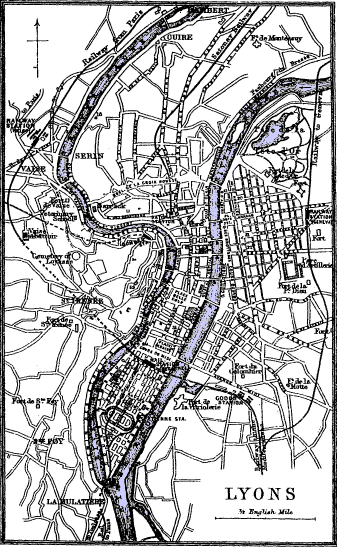
Lyons: Notre-Dame-de-Fourvière. Rope Railway.
The most prominent building in Lyons is the church of Notre-Dame-de-Fourvière, standing on the site of the forum erected by Trajan, the Forum Vetus or Foro Vetere; whence the term Fourvière is supposed to be derived. It ought to be visited as early as possible, even should there be no time for anything else, on account of the excellent bird’s-eye view of the city obtained from it and its terraces. At the west end of the bridge of Tilsitt across the Saône, at the upper side of rope railway, which ascends through tunnels the hill of Fourvière, the length of the Place des Minimes about ¾ of the way up the hill. Fare, 5 sous. From the station walk up, right hand, by the broad road, l’Antiquaille. At the highest part of this road is a large ugly edifice, the Hôpital de l’Antiquaille, especially devoted to the treatment of insanity and of cutaneous diseases. It has accommodation for 600 patients, and occupies the site of the Roman palace in which Claudius and Caligula were born. From in front of this hospital commences a narrow steep road called the Montée de Fourvière, lined nearly all the way with little shops stocked with wares for the pilgrims and devotees, such as images, crucifixes, amulets, chaplets, medals, photographs, and books. At the top are restaurants and hotels.
On the summit, 1206 feet above the sea and 410 feet above the Saône, is the chapel of the “miraculous” image of Notre-Dame-de-Fourvière, from which rises a domed tower crowned with a gilt image of Mary 6½ ft. high. This tower is ascended by 200 steps, fee 25 c., and commands a superb view of the city and environs. Lyons and its two great rivers are immediately below, while in the distance, if the weather be clear, Mont Blanc is distinctly seen. As for the sacred image itself, in the church below, it is about the size of a big doll, and the child rather less. The number of worshippers having become so great, the adjoining church, which is more elegant and much more commodious, was constructed in 1884. It stands on the very brow of the hill, and is the most prominent object in Lyons. In shape it is rectangular, with at the eastern termination an octagonal tower 115 ft. high, which forms the chancel. At each of the four corners is a similar tower, and in each of the two sides are three large windows separated by buttresses like square towers. Round the top of the building as well as of the towers extends a balustrade of stiff sculpture resembling acanthus leaves. The large buildings in the neighbourhood are convents. Lyons: Observatoire Gay. St. Paul. A little eastward is the “Observatoire Gay,” from which a steep path, the Montée des Carmes Déchaussées, 536 yards long, descends to the city, reaching it by the side of the station of the Chemin de Fer des Dombes (page 30). Near this station is the church of St. Paul, all modern excepting the beautiful N. portal, the handsome octagonal lantern resting on pendentive arches, a few of the windows, and part of the walls which belonged to the original church of the 11th cent. The old walls which remain in all the early churches of Lyons are characterised by the enormous size of the stones of which they are composed. Beyond is the bridge of St. Vincent.
Lyons: St. Irénée.
The Terminus of the rope railway from the Pont Tilsit is at No. 42 Rue Trion, higher and to the N.W. of Fourvière and within a very short distance of the church of St. Irénée, on the summit of a hill in the suburb of St. Just. On the terrace at the east end of St. Irénée are a Via Crucis and Calvary, commanding a superb view of the plain watered by the Rhône and the Saône. By the N. side of the church is the entrance into the crypt. The first flight consists of 25 steps; and the second, which terminates in the crypt, of eight. On the first arch across the first flight an inscription states: “Cette crypte fut construite par St. Patient evéque de Lyon au V siècle sur l’emplacement du lieu ou St. Pothin et St. Irénée, envoyés a Lyon par Polycarpe disciple de l’apôtre St. Jean, reunissaient les premiers chretiens. De nombreux martyrs y furent ensevelis.” On the second arch another inscription states that in 1562 the Calvinists having injured the crypt and thrown the bones of animals among those of the saints, Grolier, Prior of St. Irénée, restored the building, separated the bones, and placed those of the saints in that small vault to the right, at the foot of the first flight. In the centre of the crypt is a now covered up well, the original resting-place of the martyrs, down which their bodies were thrown till it overflowed with blood, in the reign of Septimius Severus, A.D. 202. To visit the calvary and crypt apply to the concierge, 50 c. The church of St. Irénée has nothing particular. To the west, in the parish of Ste. Foy, are the remains of the Roman aqueduct which brought water to the city from Mont Pilat. It was 52 miles long, and capable of supplying 11,000,000 gallons per day. At present the water-supply of Lyons is obtained from the Rhône.
Lyons: Cathedral of St. Jean.
Opposite the commencement of the rope railway, and close to the Tilsit bridge, is the Cathedral of Saint Jean, founded in the 8th cent., repaired by Archbishop Leydrade, friend of Charlemagne, and reconstructed almost entirely three centuries later. The chancel dates from the end of the 12th cent., the lower part of the façade from the 13th, and the upper from the 14th cent. The exterior is chastely decorated, but the four towers are too low. The interior, 259 ft. from W. to E. and 108 ft. high, contains some brilliant 13th, 14th, and 15th cent. glass. The wheel window at the west end resembles a fully-blown flower. The clerestory windows are majestic and graceful. First, right hand, is the chapel built by the Cardinal de Bourbon and his brother Pierre, son-in-law of Louis XI. The two windows bearing their portraits, and the curious wheel window at the end, are admirable. The soffits of the arches and the vault of the roof are richly A.D. 177, and sealed his doctrines with his blood. Adjoining the S. aisle is the Manécanterie, 11th cent., formerly the bishop’s place, now the music school for the choristers.
A little farther down the river is the church of St. George (rebuilt) occupied in the 13th cent. by the Knight Templars. Above the cathedral is the Palais de Justice, planned by Baltard, the architect of the large market, the Halles Centrales of Paris. In front is a colonnade of 24 Corinthian columns. The hall is spacious and elegant, but the court rooms around it are too small. The bridge higher up—the Pont de Nemours—leads directly to the church of Saint Nizier, with the façade towards the bridge and the chancel towards the Rue de l’Hôtel de Ville. The handsome portal surmounted by twin spires is by Philibert Delorme, a native of Lyons, and dates from the 16th cent. The rest of the building belongs to the 15th cent. In the interior a broad triforium with heavily-canopied window-openings surrounds the church. The vaulting shafts expand in a curious way over the roof. In the chapel of the south transept is a statue of Mary by Coysvox. At the foot of the pier in this transept a trap-door opens into the crypt, 10th cent. At the south side of the Palais des Arts is St. Pierre, a modern edifice, with a beautiful portal of the 11th cent., all that remains of the original church.
Lyons: Palais des Beaux-Arts. Musée Lapidaire.
On the south side of the Place des Terreaux is the Palais des Beaux-Arts, built in 1667, formerly a convent of the Dames Bénédictines de Saint-Pierre. It contains the picture galleries and the museums. Open to the public on Sundays, Thursdays, and feast-days, from 11 to 4, and to strangers daily.
Admirably arranged under a wide corridor round the great court are the ancient marbles or Musée Lapidaire, one of the best in Europe. The sepulchral inscriptions form a most interesting series of epitaphs, in many instances most tender and affecting. Indeed, reading these records of the love of kindred among the ancient heathen, from the Augustan age upwards, one would incline to believe that the Romans of that day were already “feeling after” Christianity. In the left corner of the court on entering is the stair which leads up to the Archæological Museum and the Picture Gallery, both on the first floor. Up on the second floor is the collection of paintings by the “peintres lyonnais.”
Lyons: Musée Archéologique.
The Musée Archéologique is well arranged and carefully labelled. The only object we would indicate, as it is apt to be overlooked, is the bronze table, A.D. 48, in the second room left hand, with inscribed portions of the harangue of Claudius before he became emperor, imploring the senate to grant to Lyons, his native city, the title of a Roman colony. The letters are beautifully cut and easily legible. This table was discovered in 1528 on the heights of Saint Sébastien. Germanicus, and the Emperors Claudius, Marcus Aurelius, and Caracalla, were also born in Lyons. The father of St. Ambrose was for some time prefect of Lyons. In the same room is a decree of the Egyptian pontiffs in hieroglyphics. There is a good collection of seals, coins, enamels, armour, carved work, and bronzes, as well as some necklaces, bracelets, rings, and coins, part of a treasure buried during the Roman period on the Fourvière heights, and discovered in 1811. The numismatic collection, 30,000 pieces, includes a series of the coins struck at Lyons from 43 B.C. to 1857. Adjoining and on the same floor is the Picture Gallery, contained in six small rooms, of which the first three contain the Flemish and Dutch schools, the next two the Italian and Spanish schools, and the sixth the French school. They are all carefully labelled. Among the pictures which represent the Flemish school are works by Rembrandt, Rubens, Teniers, Van Dyck, Holbein, Stein, Dietrich, Breughel, Wouvermans, and Ruysdael. The Italian and Spanish schools are represented by Canaletto, Sasso Ferrati, Guercino, Zucharo, Murillo, Ribera, Zurbaran, etc. On the floor of the fourth room is a remarkably perfect mosaic pavement, 5½ yards by 3, representing chariot races in the Circus. It was discovered near the church of Ainay.
Lyons: Galerie Chenavard.
In the S.E. corner a handsome staircase leads up to the Galerie Chenavard on the first floor, containing large cartoons drawn by him illustrative of the scenes which accompanied the introduction of Christianity into France. They were intended for the Pantheon of Paris, but, the age of reason supervening, they were not sent. On the floors are three beautiful mosaic pavements found at Lyons. In the room above are the best pictures—J. F. Barbieri, 1590-1661; Bol, Breughel, P. Caliari, 1530-1588; A. Carracci, 1557-1602; L. Carracci, 1555-1619; P. Champaigne, Crayer, Greuze, 1721-1805; E. L. David, 1748-1825; Desportes, 1661-1742; Cuyp, Van Dyck, Heem, 1604-1674; Jordaens, Jouvenet, 1644-1717; Largillière, M. Mierveld, Murillo, 1618-1682; J. Palma, 1544-1628; Pietro Perugino, 1446-1524; an Ascension of Christ, considered the gem of the collection.
* Text shown as printed. Hyacinthe Rigaud, 1659-1743.
The Palais des Arts contains also the Natural History Museum, the Mineralogical Collection, in which are represented the characteristic rocks and fossils of every department of France, and the copper ores from the mine of Chessy, near Arbrèsle; and a library containing 40,000 engravings and drawings, and 650 volumes treating principally on the arts and sciences. There are likewise 6 municipal libraries, open every evening from 7 to 10, and the Bibliothèque de la Ville.