PART I.—PARIS TO MARSEILLES. (continued 5)
Reading edition
Draguignan is situated on the south side of the Malmont mountains, which attain an elevation of 1995 ft. In the old town is the clock-tower, 58 ft. high, commanding an extensive view of the plain and of the surrounding mountains. In the new town the streets are broad and intersected by avenues and a beautiful promenade containing Celtis australis), and a juniper, 20 ft. high, of a very great age. The way to it is from the H. Bertin, ascend the street, and take the first road left. When within a few yards of the kilomètre stone, indicating 1 kil. from Draguignan and 30 from Comps, take the private road to the left, leading into an olive tree plantation (see map, p. 123).
Frejus. Colosseum.
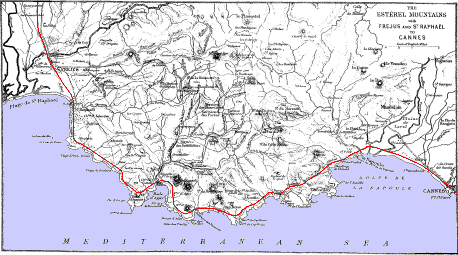
MARSEILLES MENTON 98 57 FREJUS, pop. 3400, H. Midi close to station. Situated on the Reyran at the S.W. extremity of the Estérel mountains, a picturesque group 13 m. from N. to S. and 10 from E. to W., traversed by the “Route de Paris en Italie,” which, from Frejus to Cannes, 22½ m. E., passes by their highest peak, Mont Vinaigre, 2020 ft. above the sea. The peculiar charm of the Estérels is due to the warm reddish hue and fantastic forms of the bare porphyry cliffs rising vertically from the midst of the sombre green pines which clothe these mountains.
To the west of the station are the remains of the city walls, the Porte de Gaules, and the Colosseum, or Arènes, of which the greatest diameter was 224 ft., with accommodation for upwards of 9000 spectators. On the eastern side of the station are the Porte Dorée and the terrace called the Butte St. Antoine. East of the Butte stood a Roman lighthouse. At this part are remains of Roman towers and walls. The masonry throughout is admirable, composed of stones of the size of large bricks. The Porte Dorée has alternate layers of stone and brick. Having visited the ruins by the side of the railway, pass up by the church, and leave the town by a road having on the left hand a large building—the seminary. Having walked a few paces, there will be seen to the left rather an ugly square tower, which marks the site of the theatre. The lofty ruins of arches in this neighbourhood are the remains of the Roman aqueduct which brought water to Frejus from the Siagnole, near Mons, 24 m. N.E., and contained 87 arches. To the right of the road is a terrace supported by (once) powerful masonry. Below is the old Chapelle St. Roch. In the higher part of the town is the parish church, which, with the adjoining
the ESTÉREL MOUNTAINS with FREJUS and St. RAPHAËL to CANNES
Saint Raphael.
MARSEILLES MENTON 100½ 54½ SAINT RAPHAEL, a rapidly-increasing place of 3000 inhabitants. In winter its guests come from the colder regions in quest of warmth, and in summer from the hot interior in quest of the cooling breezes and the still more refreshing sea-bathing. Hotels: close to the station, the France, 8 to 9 frs. More expensive houses: G. H. de St. Raphael, on an eminence, with garden; near the beach, the *G. H. des Bains, 9 to 13 frs.; and Beau Rivage. Among the numerous handsome villas is the cottage built by Alphonse Karr. Temple Protestant, Anglican Chapel. Little steamer daily to St. Tropez; whence diligence to Hyères (p. 134). Omnibus runs between St. Raphael and Valescure, 2 m. inland, with G. H. de Valescure. St. Raphael, only 43 minutes from Cannes, makes a salubrious and agreeable residence, with pleasant walks, either by the beach or up the valley of the Garonne into the Estérel mountains, where the rambles are endless. At the E. end of St. Raphael is a very pleasant park, rising from the rocks on the coast. A little farther towards Cannes is the Boulerie, with a large hotel.
Napoleon landed at St. Raphael on his return from Egypt in 1799, and here he embarked when he sailed for Elba. Along this part of the coast are fine specimens of the Pinus pinea.
Agay. Sainte Baume.
MARSEILLES MENTON 105 50 AGAY, a small custom-house station, with a few houses at the head of a small but deep bay, into which flows the stream Grenouiller. On the top of the conical hill, on the S.W. side of the station, is the Tour de Darmont, a signal-tower. The great excursion from Agay is to La Sainte Baume, 4½ m. distant, and a little to the N. of the peak of Cape Roux, 1444 ft. above the sea. From the station take the path eastward to the old château, which leave on the right hand, and pass under the railway to an abandoned farmhouse. There a good path begins and winds upwards to the summit of a small hill. From there descend boldly into the valley in an eastwardly direction towards the rugged red summit of Cape Roux till a stream is reached. Leaving the stream, a pathway will be seen going upwards to Cape Roux. Follow that till a high ridge is reached, close to the summit, La Sainte Baume, the holy cave of St. Honorat, in which this saint is said to have lived a hermit’s life for some years. The best way back to Agay is by the wide path seen from the hermitage leading westward to the river in the valley. On the way remark, on the left hand, a truncated stone pillar, a Roman milestone, with an inscription. Some archæologists base upon the existence of this stone their assertion that the Via Aurelia passed this way. At the bottom of the valley cross the Grenouiller, and join the road to Agay.
Le Trayas.
After Agay the railway sweeps round by the base of Cape Roux, where a magnificent panoramic view displays itself, just before arriving at Le Trayas, the next and last station before reaching Cannes, 11 m. E. from St. Raphael, 6¼ m. E. from Agay, and 8¾ m. W. from Cannes. From Trayas also a road leads to the chapel of Ste. Baume, which is considered nearer though not so good as the road from Agay. At Trayas the train passes from the department of Le Var to the department of the Alpes Maritimes, then traverses the Saoumes tunnel, 886 yards, and having passed the pretty villages of Theoule and La Napoule, enters the beautifully-situated town of Cannes.
Cannes.
[East Edge: Northward Arrow] To Villa Nevada [East Edge: Southward Arrow] To Hotel California
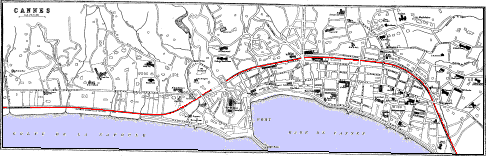
CANNES,
on the Gulf of Napoule, 120½ m. E. from Marseilles, 79 m. N.E. from Toulon, 78¼ m. N.E. from Hyères, and 19¼ m. S.W. from Nice. Fixed population, 19,400. Hotels and Pensions.—Although there are already very many hotels, their number continues to increase. Of villas there are about 450, which, with the exception of some 110 belonging to resident French and English proprietors, are let by the season, from the 1st of October to the last of May, at rents varying from £80 to £1200, including plate and linen. Many have coachhouse, stables, and gardens attached. For information regarding them apply to Taylor and Riddett, agents, bankers, and moneychangers, 43 Rue de Frejus. They have also a well-supplied readingroom, which they place at the disposal of the public without any charge. The first-class hotels charge from 10 to 25 frs. per day; the second from 8 to 12, including everything. A fair gratuity for service during a prolonged stay is from 50 c. to 75 c. per day.
Cannes: Hotels and Pensions.
Those requiring to study economy will find the most reasonable hotels and pensions at the east end of the town. The Pension Mon Plaisir, 8 frs., in garden, Boulevard d’Alsace, near railway station. In the Boulevard Cannet, Pension d’Angleterre, 9 to 10 frs., in garden. Farther up the same Boulevard the Pension St. Nicolas, 8 frs. Near Trinity Church, the *Pension Victoria, 8 to 11 frs., with very large garden fronting the promenade.
Cab, with one horse and seated for two, from the station to the hotels, 1½ fr.; each portmanteau, ½ fr.
The atmosphere on the hills, and at some little distance from the sea, is supposed to be in a less electrical condition, and not so liable to produce wakefulness, as in those places near the beach, and therefore many prefer the hotels and pensions situated inland. Hotels: fronting station, the Négociants; the 1 *Univers, 7½ to 9 frs. In the Allées, on the beach, the Hôtel Splendide, 12 to 20 frs. At E. end of R. d’Antibes, the Pensions Luxembourg; Wagram, 8 to 11 frs.; and the H. Russie, 9 to 12 frs.
Hotels to the east of the Allées, fronting the beach, taking them in the order from west to east:—The National, 9 to 15 frs.; Midi, 8 to 12 frs.; *Beau-Rivage; *Gray and Albion; *Grand Hotel; Plage; the last four are first-class houses, charging from 10 to 20 frs. The
On the north side of the railway, but a little higher, are the Louvre; H. Central; Alsace-Lorraine, all 10 to 20 frs. St. Victor; La Paix. A little way hack are the Pension d’Angleterre; H. de France; H. Méditerranée, 9 to 13 frs.
Farther east, and approaching the region of Californie, are Hotels Windsor; Mont-Fleuri; *Beau-Séjour; St. Charles; Des Anges; *Californie; Des Pins, 10 to 25 frs. On the hill overlooking the H. de Californie is the Villa Nevada, where the Duke of Albany died on Friday morning, 28th March 1884.
In the interior, on eminences on the west side of the Boulevard Cannet, are the *Prince of Wales; *Provence; Des *Anglais; *Richemont; all with gardens, and charging from 12 to 25 frs. per day.
At the foot of this hill, on the Boulevard Cannet, is the Pension Lerins, a plain but comfortable house, charging 7 to 8 frs. A little higher up this Boulevard is the English church of St. Paul; whence a road ascends to the Hôtel *Paradis, which, although a first-class house, on an eminence in a garden, charges only from 10 to 15 frs. Next it is the Hôtel de Hollande, similarly situated. Also well inland, on the Nouveau Chemin de Vallergues, is the H. *Beau-Lieu, 10 to 20 frs.
On the west side of Cannes, near the agency of Taylor and Riddett, is the *Hôtel des Princes, 10 to 20 frs. On the hill above this part is the H. Continental, 10 to 20 frs. Between the Scotch church and the beach, and fronting the public garden, is the H. *Square Brougham, 8 to 10 frs., well situated. Beyond, between the railway and the beach, is the H. Pavilion, 12 to 25 frs. A little beyond is Christ Church, and on an eminence opposite the H. *Terrasse, 12 to 16 frs., a large house with garden. Farther west, and considerably inland, upon separate eminences, are two handsome hotels, the *Belle-Vue, behind the Rothschild villa; and the *Beau-Site, 12 to 25 frs., behind Lord Brougham’s villa. Farther west, and on the same level, is the H. Estérel, same price. On a hill, a little beyond the perfume distillery of M. Lubin, is the Pension de la Tour, well situated, and not expensive. The western suburb of Cannes is called La Bocca, and sometimes La Verrerie, from the bottle-works there. From this a road runs up the broad valley of the Siagne, where there are fields of the fragrant red Turkey rose, gathered in May for the perfumeries (see page 161).
Cannes: Churches. Cab Fares. Steamers.
Churches.—Christ Church, Rue de Frejus; St. Paul’s, Boulevard
Bank and money-changer opposite post office. In the neighbourhood the office of Cook & Son, where their railway and hotel tickets are sold.
Cab Fares.—One horse with 2 seats, the course 1½ fr.; the hour, 2½ frs. Two horses with 4 seats, the course 2 frs.; the hour, 3½ frs. Portmanteaus, ½ fr. each. Steamers from No. 20 Quai St. Pierre for Marseilles and Cette. Twice daily for the islands of St. Marguerite and St. Honorat, 1 and 2 frs. there and back. On Thursdays and Saturdays trips to Theoule, 2 frs.
Lord Brougham.
Cannes extends 4½ m. from east to west, partly on the Gulf of Jouan, and partly on the Gulf of Napoule, covering likewise with its houses and gardens Cape Croisette, which separates these two gulfs. Landwards it extends nearly the same distance, where large hotels crown the hills, and pretty villas with gardens occupy the valleys. The principal square, called the Allés de la Liberté, is nearly in the centre of the town, at the head of the Gulf of Napoule, and is about 700 yards long by 110 wide. It contains the Hôtel de Ville and the H. Splendide. Between them is a marble statue, life-size, “A Lord Brougham, né à Edinburgh, le 19 Septembre 1778. Décédé à Cannes le 7 Mai 1868.” He is in his official robes. In his left hand, resting on the top of a palm, he holds a rose. The Hôtel de Ville contains the Public Library and interesting collections illustrating the natural history of the neighbourhood. The obliging director gives every assistance in naming the plants, insects, and minerals. At the head of the Allées, and on the adjoining eminence, is the old or original town. On this hill is the Church of Notre-Dame-d’Espérance, 17th cent., with a reliquary of the 15th. In front is a rudely-constructed wall with embrasures. Above it are St. Anne, 13th cent., the old chapel of the castle, and the square tower commenced in 1080 by the Abbot Adalbert II., of the monastery of St. Honorat. From the top is an extensive view. Near the foot of the tower is a small observatory. On a much higher hill behind is the new cemetery, where Lord Brougham was buried on the 24th of May 1868. The monument consists of a massive lofty cross on a double basement, bearing the following inscription:— “HENRICVS BROVGHAM. Natus MDCCLXXVIII. Decessit MDCCCLXVIII.” Near him lies James, fourth Duke of Montrose, K.T., died December 1874.
The climate, though dry and sunny, is at times precarious. In Resorts. “While Cannes, therefore, possesses a winter climate well suited for children, elderly people, and many classes of invalids, especially those who require a stimulating atmosphere, it is not so well adapted for the majority of those suffering from affections of the respiratory organs.” —Dr. Hassall.
Cannes: Drives.
Drives.—In Cannes there are great facilities for driving in carriages, light open cabs, and omnibuses. The omnibuses start for their destinations either from the east corner of the Cours (Allées de la Liberté), or from the Rue d’Antibes, near the Cours. The largest livery stables are in the Rue d’Antibes. They charge for a carriage, with coachman and two horses, per month £30. The cabmen carry their tariffs with them, and are bound to show them when required. Copies of the “Tarif des Voitures” are kept for distribution in the Kiosque on the Cours. The recognised gratuity given to coachmen is at the rate of 3 frs. for a 25 frs. fare.
Road to Vallauris.
THE CORNICHE OF CANNES.
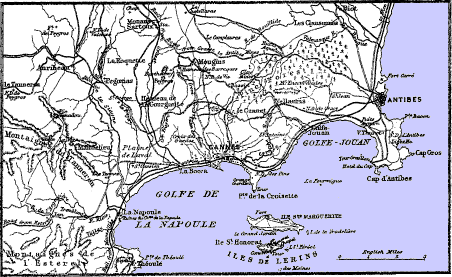
The best of the drives is to Vallauris by the low road to the Golfe de Jouan, 4 m. N.E., then up the valley to Vallauris, 2 m. N., and 250 ft. above the sea. From Vallauris return to Cannes, 5½ m. S.W. by the Corniche road and La Californie. Carriage and pair, 25 frs. Cab with one horse, 14 frs.; with two, 18 frs. Omnibus to Vallauris, 1 fr. By taking the omnibus to Vallauris the remainder makes a delightful and easy walk along the Corniche road. Cross the Vallauris bridge a little below Massier’s pottery, and ascend the broad road. About ½ m. from the bridge is the “Observatoire de la Corniche,” where tea and coffee can be had, and whence there is a charming view east from Cannes to Bordighera. About half-way between this and the observatory at the Cannes or S.W. end of the road is the large hotel Cannes-Eden.
The Belvédère, at the Cannes end of the road, in La Californie, is 545 ft. above the sea, and can be approached by omnibus from the Cours, 1 fr. each. Behind it is the terminus of the branch of the canal which supplies the east part of Cannes. The terminus of the
From the Belvédère an excellent carriage-road ascends to a still higher summit, 795 ft. above the sea, or 250 ft. above the Belvédère. The view is similar, including more of the interior. A short distance N.E. from this is another summit, 804 ft. above the sea, which from the top looks as if it were nearly over Antibes.
Many prefer to commence this drive by Californie, and to return from Vallauris by the Golfe de Jouan and the low road. Opposite the Golfe de Jouan station is C. Massier’s pottery, and a few yards along the road towards Antibes is Napoleon’s column (p. 169).
Vallauris. Pottery. Mines.
Vallauris, pop. 4000, is a poor village, with small cafés and restaurants. The omnibus stops in the “Place” opposite the church and the Hôtel de Ville, containing a large flat stone bearing an inscription, stating that “the Emperor Tiberius remade the road it refers to in the 32d year of his tribunician authority.” Also a column, 4 ft. high and 14 inches in diameter, bearing an inscription to Constantine. Vallauris has long been famous for the manufacture of kitchen pottery, “Potteries Réfractaires,” earthenware utensils, principally of the “marmite” or stewpan class, capable of bearing great heat without cracking. A dozen marmites, in assorted sizes, are sold for 2 frs. To this the Massiers and others have added the manufacture of artistic pottery, of which there is a good display, both in the showrooms in the village and in those down at the Golfe de Jouan. Several of the clay-beds may be seen by the side of the road leading up northwards from Vallauris; but the best and richest strata, all of the Pleiocene period, are in that valley near the spot where this road meets the road to Antibes. About 220 yards beyond this meeting-place a cut-up road ramifies, left, into the valley containing the clay-mines. The entrances into them are covered with roofing. Any one may descend into them. The colours of the clay are blue, red, black, and gray, all in various shades. The most valuable is the blue. Most of the common articles are made of a mixture of all the clays. Red clay from Estaque, near Marseilles, is also used in the making of artistic pottery.
Vallauris to Antibes.
The road leading northward from Vallauris and afterwards S.E. to Antibes traverses beautiful hills and valleys covered with Aleppo pines. Having passed the junction and the valley of the mines, we come to a firebrick and marmite manufactory, 410 ft. above the sea. The road behind, extending N.W., ascends to Castelaras. Afterwards a bridge is passed, and some arches of the aqueduct built by the Romans to convey water to Antibes. (For Antibes, see pp. 154 and 169.)
Cannet. La Croisette.
CANNET.
Two miles N. from Cannes, by the beautiful Boulevard Foncière, is Cannet, 265 ft., pop. 2600. At the head of the Boulevard is the H. *Bretagne, 10 to 20 frs. A little to the east of the church Ste. Philomène is a smaller house, the H. and Pension Cannet, 8 to 10 frs. Immediately opposite the church is the Villa Sardou, where in 1858 the accomplished tragedian Rachel died of consumption. At that time none of those broad roads existed which now encircle the house. Above the church is the “Place,” commanding a very pretty view. Omnibus, 6 sous. Cab to Cannet, and return by the Grasse road, 7 or 9 frs.
Drive to La Croisette, the first cape east from Cannes, by the beautiful road 2 m. long, skirting the sea. Cab, 1 horse and 2 seats, 1½ fr., or 2½ frs. the hour. 2 horses with 4 seats, 2 frs. Tram, 6 sous. Omnibus 6 times daily, fare 30 c. This is a most enjoyable walk or drive by the beautiful esplanade fronting the sea. Near to La Croisette is the entrance to the orange orchard “Des Hesperides,” occupying 4 acres. The trees stand in rows 12 ft. apart, and were planted in 1852, when they were from 5 to 8 years old. In gardens in the country the oranges cost about a sou each, but in the Hesperides they are dearer. The best are those the second year on the tree. Frosts retard the sweetening process, and in some years damage the trees. In the village of La Croisette there is a place for pigeon-shooting, and also the remains of fortifications begun by Richelieu, but never completed.
Cannes to the Cap d’Antibes, 7 m. E. Cab with 1 horse and 2 seats, 18 frs. With 2 horses and 4 seats, 22 frs. Private carriage, 30 frs. Omnibus between Cannes and Antibes 3 times daily. In Cannes it starts from the Allées de la Liberté, and in Antibes from the “Place,” fare 1 fr. Very near this “Place” are two comfortable inns, the H. Escouffier and the H. des Aigles d’Or; pension 7 to 8 frs. Their omnibuses await passengers at the railway station. Antibes has a little harbour and pier, and strong fortifications by Vauban, who also built the fortress Fort Carré, near the northern side of the entrance. From the N. ramparts, but more especially from the high walk above the pier on the roofs of some small houses, are seen distinctly Nice, the fishing village Cros de Cagne, and Cagne. Inland from Cagne are St. Jeannet, La Goude, Vence, and St. Paul, and, farther west, Le Bar. In the background are the Maritime Alps, generally tipped with snow in winter. In the centre of the town are two ancient towers. One of them stands in front of the church, and is used as the belfry; the other forms part of an adjoining building, the “Bureau du Recrutement.”
CANNES & ENVIRONS
Cap d’Antibes. Lighthouse.
The Cap d’Antibes affords a delightful little walking excursion. To visit the “Cap” from Antibes, leave the town by the small gate, the lighthouse built in 1836, on a hill 187 ft. above the sea. The building is 82 ft. higher, and ascended by 115 steps. On the top is a fixed white light, visible at a distance of 28 miles. Fee for one person, ½ fr. The view is splendid. Before descending, observe the road to the Villa Thuret and to the Hôtel du Cap, a first-class house, 10 to 14 frs. Omnibus at station. The villa and grounds of Thuret are now a Government school for the culture and study of semi-tropical trees and shrubs. It is said that the first gum trees introduced into France were planted in 1853, and those in this garden in 1859. (For Antibes, see also p. 169.) The great tower on a rock to the W., overlooking the sea, is a powder-magazine.
Croix des Gardes. Theoule.
Drives to the west of the Hôtel de Ville.—La Croix des Gardes, 2½ m. N.W., and 498 ft. above the sea. The nearest way ramifies from the Frejus road by the E. side of the Belle-Vue hotel. The cross rises from a column on a block of granite. The view is extensive. By the side of the road will be observed considerable plantations of the Acacia farnesiana, from whose flowers a pleasant perfume is distilled.
Cannes to Napoule, 6 m. W, Cab with 1 horse and 2 seats, 12 frs.; with 2 horses and 4 seats, 16 frs. 1 hour’s rest allowed. By omnibus, 30 c., leaving Cannes at 1 for the Bocca. At the Bocca it corresponds with the omnibus to Napoule, 50 c.; which, as it does not return till 4.30, affords ample time to walk on to Theoule and back, 2 m. W. The Napoule road commences from the western, or what is also called the English, portion of Cannes. It passes the little Scotch church, behind which are the Square Brougham and the public gardens. Farther W. is Christ Church, one of the three Episcopal Chapels. A short distance beyond, on the right side of the road, is the villa Eléonore-Louise, where Lord Brougham died. The house is hidden among the trees, but the garden is easily recognised by 2 large cypress trees growing by the side of the rail. Three m. from Cannes, on an eminence covered with pines, oaks, and cypresses, on the S. side of the road, is the poor little chapel of St. Cassien, the patron saint of Cannes, whose day is held on the 23d of July, in much the same manner as the Pardons in Brittany, called here Roumeiragi. Napoule is a small hamlet by the side of an old castle on the beach, at the foot of wooded hills. From it a very pretty road by the coast, cut in the face of the cliffs, leads to the hamlet of Theoule, on a tiny plateau over the beach, at the foot of the Estérel mountains. The restaurant of Theoule is better than that at Napoule. Between these two hamlets, and spanned by the railway viaduct, a narrow precipitous valley penetrates into the mountains. From Theoule a road extends to Trayas.
Estérel. Pégomas.
Cannes to the Inn of Estérel, 12 m. S.W. and 830 ft. above the sea.
7 m. N. from Cannes by the Plaine de Laval and the wide valley of the Siagne, passing the Hôtel Garibondy, is the village of Pégomas, pop. 1350, on the Mourachone, a slow-running stream, in some parts hidden among bamboos. Beyond the mill of the village is a pretty but difficult walk up the ravine of the stream. Omnibus, 75 c. Cab, 12 or 16 frs.; 1 hour’s rest.
About 3 m. N.W. is Auribeau, pop. 480, prettily situated on the Siagne. Cab, 18 or 22 frs., with 2 hours’ rest.
Mougins. Castelaras.
4¾ m. N. from Cannes, on a hill 820 ft. above the sea, is Mougins, pop. 1680. The road ascends all the way, passing by the cemetery and traversing vineyards and large olive groves. The omnibus goes no farther than Les Baraques, about ¼ m. below the town. Fare, 75 c. Cab there and back, one horse, 12 frs.; two horses, 16 frs.; 1 hour’s rest. Mougins still retains a few low portions of its walls and one gate, just behind the church. In the shop near the gate is the key of the church tower. The church dates from the 12th cent. From the tower, ascended by 75 steps, is a beautiful view. To the west is La Roquette, N.W. Mouans-Sartoux, and beyond Grasse. To the S.W. near the sea, and on the border of the Estérels, is the village of Mandelieu.
4 m. N. from Mougins, by the stony old road, or a little farther by the new road, is Castelaras, 1050 ft. above the sea. It is half a villa and half a farmhouse, commanding from the tower a splendid view of Grasse, Le Bar, the valley of the Loup, Tourettes, Vence, etc., to the north; Biot, Antibes, Nice, etc., to the east; Mouans, Auribeau, and the Estérel mountains to the west; and Cannes with its islands to the south. The easiest way to approach Castelaras on foot is to take the train to Mouans-Sartoux, pop. 1010, then ascend the hill by the steep road to the east of the station. When on the top the farmhouse and tower are distinctly seen. Carriage there and back, 35 frs. The column farther north marks the tomb of a gentleman who died at Grasse in 1883.
Sail by steamboat to the Iles de Lerins. Time, 1 hr. The steamer makes two trips, so that passengers may land by the first at Ste. Marguerite, and by the second be carried on to St. Honorat, where the steamer remains sufficient time to visit the castle.
ILES DE LERINS.
The Island of Ste. Marguerite, 4½ m. in circumference and 1½ m. from the mainland, is covered entirely with a pine forest, except at Point Croisette, on which stands the fort founded by Richelieu, containing the apartments in which Marshal Bazaine was confined and the far more interesting vaulted cell in which the Man of the Iron Mask was closely guarded. The present entrance did not exist at that time, the only communication then being by the now walled-up door which led into the house of the governor, M. de St. Mars. From behind the prison a road, bordered by the Eucalyptus globulus, goes right through the pine plantation to the other side of the island.
The Man of the Iron Mask.
The name of the Man of the Iron Mask was Hercules Anthony Matthioli, a Bolognese of ancient family, born on the 1st December 1640. On the 13th of January 1661 he married Camilla, daughter of Bernard Paleotti, by whom he had two sons, one of whom only had posterity, which has long since been extinct. Early in life Matthioli was public reader in the University of Bologna, which he soon quitted to enter the service of Charles III., Duke of Mantua, by whom he was finally made Secretary of State. The successor of Charles III., Ferdinand Charles IV., the last sovereign of Mantua, of the house of Gonzaga, created Matthioli supernumerary senator of Mantua, and gave him the title of Count. Towards the end of 1677 the Abbé d’Estrades, ambassador from France to the Republic of Venice, conceived the idea, which he was well aware would be highly acceptable to the insatiable ambition of his master, Louis XIV., of inducing the weak and unfortunate Duke Ferdinand Charles to allow of the introduction of a French garrison into Casale, a strongly-fortified town, in a great measure the key of Italy. The cession of the fortress of Pinerolo to the French by Victor Amadeus, Duke of Savoy, in 1632, had opened to them the entrance into Piedmont, while the possession of Casale would have opened to them the broad and fertile plains of Milan.
The great difficulty Estrades had to encounter at first in the prosecution of this intrigue was to find a medium of communication between himself and the Duke. This channel was at last found in the person of Matthioli, who enjoyed the Duke’s confidence and favour, and was besides a complete master of Italian politics. Through him the schemes of Estrades progressed so well that he was invited to the French court, where he was received and rewarded by Louis XIV., For this purpose Matthioli was induced to go to the frontier beyond Turin, where he was arrested as a traitor to France by the Abbé, accompanied by four soldiers, on 2d May 1679. Such a scandalous breach of international law required the adoption of extraordinary precautionary means of concealment. His name was changed to Lestang, he was compelled to wear a black velvet mask, and when he travelled armed attendants on horseback were ready to despatch him if he made any attempt to escape, or even to reveal himself.
By the direction of Estrades he was comfortably lodged and fed in prison, till orders came from Paris, stating— “It is not the intention of the king that the Sieur de Lestang should be well treated, nor receive anything beyond the absolute necessaries of life, nor anything to make his time pass agreeably.” He was handed over to the charge of St. Mars, who took him to the castle of Pinerolo, whence in 1681 they removed to the castle of Exiles. From Exiles St. Mars removed his unfortunate and now crazy prisoner to the Island of Ste. Marguerite, where they arrived 30th April 1687, after a journey of twelve days.
Among the erroneous anecdotes told of Matthioli during his ten years’ sojourn on the island are:—On one occasion he is alleged to have written his name and rank on a silver plate, which he threw out of the window. A fisherman picked it up and brought it to St. Mars, who, on finding the man could not read, let him go. On another occasion Matthioli is said to have covered one of his shirts with writing, which he likewise threw out of the window. It was found by a monk, who, when he delivered it to St. Mars, assured him that he had not read it. Two days afterwards the monk was found dead. The origin of these stories is to be found in a letter from St. Mars to the Minister, dated 4th June 1692, in which he informs him that he has been obliged to inflict corporeal punishment upon a Protestant clergyman named Salves, also in his keeping, because he would write things on his pewter vessels and linen, to make known that he was imprisoned unjustly on account of the purity of his faith.
In 1697 Matthioli with his keeper left for the Bastile, of which place St. Mars had been appointed governor. They arrived on 18th September 1698.
On the 19th November 1703, about 10 P.M., Matthioli died in the Bastile, after a few hours’ illness, and was buried next day at 4 P.M. in the cemetery of St. Paul.—Extracted from the History of the Bastile, by R. A. Davenport.
The Island of St. Honorat. Abbey. Massacre.
The Island of St. Honorat contains 97 acres, or is ¼ the size of Ste. Marguerite, from which it is 750 yards distant. A pleasant road of 2½ m., shaded by umbrella pines, leads round the island. Straight convent of Cistercian monks, settled here only since 1859. The original monastery was founded by St. Honorat in 410. In 730 and 891 the Saracens invaded the island, pillaged the establishment, and massacred the monks. In the 10th century the again flourishing brotherhood received Cannes as a gift from Guillaume Gruetta, son of Redouard, Count of Antibes. In 1073 they built the tower on the island, and in 1080 the Abbé Adalbert II. commenced the castle of Cannes. In 1148 the monks strengthened and enlarged the fortifications of their tower. In 1788 the monastery was suppressed on account of the irregularities of the inmates. In 1791 the island and buildings were sold. In 1859 they were finally bought by the Bishop of Frejus, who handed them over to the present occupiers, a colony of Cistercian monks, 50 in number, of whom about two-thirds are lay brethren.
“What Iona was to the ecclesiastical history of northern England, what Fulda and Monte Cassino were to the ecclesiastical history of Germany and southern Italy, St. Honorat was to the church of southern Gaul. For nearly two centuries the civilisation of the great district between the Loire and the Mediterranean rested mainly on the Abbey of Lerins. Sheltered by its insular position from the ravages of the barbaric hordes who poured down the valleys of the Rhône and of the Garonne, it exercised over Provence and Aquitaine a supremacy such as Iona, till the Synod of Whitby, exercised over Northumbria. All the more illustrious sees of southern Gaul were filled by prelates who had been reared at Lerins. To Arles (p. 70) it gave in succession Hilary, Cæsarius, and Virgilius.
“The present cloister of the abbey is much later than the date of the massacre of the monks, which took place, according to tradition, on the little piece of green sward in the centre of the cloister.
“With the exception of the masonry of the side walls, there is nothing in the abbey church earlier than the close of the 11th cent.” —J. R. Green’s Stray Studies.
St. Honorat: Castle.
The tower or rather castle, as it now stands, represents two tall rectangular elevations of unequal magnitude, crowned by projecting cornices. On the ground-floor, with entrance from the beach, is a large hall with groined roof, said by some to have been a chapel, and by others a bakery, but most likely a “parloir” or reception-room. In the wall, a little to the left or west, and about 30 ft. from the ground, is a cannon-ball fired by the English when they took possession of the islands in 1746. The interior of the castle is shown by the concierge of the convent. The first part entered is the oblong cloister, in three stories, of which two remain entire. The corridor of the first is supported on short columns standing round the edge of a cistern. From this corridor open the doors into the bedrooms and refectory. From the upper corridor is the entrance to the chapel, which opened into the library. Above the library was the infirmary, of which not a vestige remains. A good view is had from the top. Visitors are next taken to the convent. The church and buildings are
Chapel of the Trinity.
By the road round the island are the remains of chapels of the 7th cent., or even earlier. Going from west to east there is, against the wall of the convent, a little to the west of the castle, the Chapel of St. Porcaire (restored), where, it is said, the saint was buried. At the western extremity of the island, within an old fort, is the Chapel of St. Sauveur. To the west of the landing-place, near the large gateway, are little better than the foundations of the Chapel of St. Pierre. Farther east, beside the Orphanage, is St. Justine, now a stable. The Orphanage contains about 25 boys. They are taught different trades. The franc charged for showing the castle goes to their support. On the eastern point of the island, beside a fort, is the most interesting chapel of all, the Chapel of the *Trinity, 35 ft. long by about 25 wide, placed from east to west. The great corner-stones of this small temple, by their size and solidity, are the main supports of the building, illustrating thereby the reason why in Scripture so much importance and honour are attached to them in edifices. The roof of the nave is semicircular, strengthened by three arches, the centre one springing from two round columns. The roofs of the three apsidal chapels are semispherical.
Cannes to Grasse, 12½ m. N. by rail, pop. 12,100. Hotels: the G. H. International, 9 to 12 frs., a first-class house on the road to Le Bar. In the town, H. Muraour and the Poste, 8 to 10 frs. Their omnibuses await passengers. Those who wish to walk commence by the stair to the right of the station, and then the steep road on the other side of the highway. Grasse, a town of charming views, delicious water, and the best of air, makes an excellent and beneficial change from Cannes. The town, with its terraces and labyrinth of narrow, crooked, steep streets, is situated 1090 ft. above the sea, on the southern slope of Mt. Rocavignon, which rises almost perpendicularly 695 ft. above the town. To the N.E. of Rocavignon is the Marbrière, 2920 ft. above the sea. The short but stony road to the top of Rocavignon commences opposite the fountain used by the washerwomen. On the summit is a stony plateau, commanding extensive and exquisite views. Plain of Napoleon. A little way inland is a grassy plot, called the Plain of Napoleon, because here, on 2d March 1815, he breakfasted at the foot of the three tall cypresses, and then went on to St. Vallier. In the face of the large calcareous cliff a few yards beyond the trees is a cavern or “foux,” whence, after heavy rains, a large body of water issues in the form of a roaring cascade. The path which leads down into the beautiful valley below commences about 500 yards farther inland. It joins that very pretty road among olive trees, seen from the plateau, which, after passing the large white house, a hospice for the aged, enters Grasse by the powder-house, formerly the chapel of St. Sauveur, a little circular building with flat shallow buttresses, built in the early part of the 10th cent. On entering Grasse by this way, and just at the commencement of the promenade called the Cours, is the hospital. The large door gives access to the chapel, Jean Fragonard. Jean Horace Fragonard, who died at Paris in 1806. The best of them are five pictures, which were painted for Madame Dubarry, representing frolicsome scenes, young people playing games. At the foot of the Rue des Dominicains, in a large house with bulging iron grating, are some decorative paintings attributed to Flemish artists. These pictures are shown by courtesy. In the centre of the old town is the parish church, built in the 11th cent., but altered and repaired in the 17th. It contains several pictures, but the only good one is an Ascension of Mary, by Subleyras, behind the high altar. From the terrace at the east end of the church is one of the many beautiful views. Adjoining is the Hôtel de Ville, and attached to it is a great square tower of the 11th cent.
A stair at the head of the main street leads down to the principal square and market-place, with a fountain at one end and one of the sides arcaded. The best promenades are the Cours, the terrace of the Palais de Justice above it, and the Jardin des Plantes below it.
Perfumery.
PERFUMERY.
The standard industries of Grasse are the distilling of perfumes and the preserving of fruits. The flowers are cultivated on terraces resembling great nursery-beds. Of the perfumes, the most precious are the Otto of Roses and the Néroly. It requires 45 lbs. avoirdupois of rose leaves (petals) to make 1 gramme, or 15½ grains troy of the Otto of Roses, which costs from 2½ to 3 frs. the gramme; and 2¾ lbs. troy of the petals of orange flowers to make 1 gramme of Néroly, which costs 8 to 10 sous the gramme. The best Néroly, the Néroly Bigarrade, is made from the flowers of the bitter orange tree. It is used principally in the manufacture of Eau de Cologne, of which it constitutes the base. In colour it resembles sherry, and the odour is that of Eau de Cologne. The water that comes off in distilling Néroly forms the orange-water of the cafés. The Otto of Roses of Grasse is superior to that of Turkey. Extracts for scenting pocket-handkerchiefs are made from freshly-gathered flowers laid between two sheets of glass, held by their frames 4 inches apart, and piled one above the other, without pressing the flowers. On each side of the glass is a layer of lard ⅓ of an inch thick, which, in 12 to 24 hours, absorbs completely the odoriferous oil. When the flowers are abundant they are renewed every 12 hours, sometimes even every 6. The operation is repeated several times on the same lard with fresh flowers. Jonquilles are changed 30 times, the cassia and violet 60, the tuberose (a kind of hyacinth) and the jasmine, both 80 times. The lard is then melted in a large iron vessel, and mixed with spirits made from grain, which, combining with the volatile oil, rises to the top. The fluid is then filtered.
At the very foot of the Rue des Cordeliers is the confectionery of *Negre. He has showrooms and priced catalogues of his preserved fruits, which are made up in the candied (cristallisé) state, in the glazed-sugar (glacé) state, whole and in syrup (compotes), or as jams and jellies (confitures). At No. 22 Rue des Cordeliers is the perfumery of Bruno-Court, where purchases of the best material may be made from a franc upwards. Below the church is the perfumery of Warwick and Co., and in the B. Fragonard that of Pilar Frères, both of whom supply Atkinson of London with the raw material.
St. Cesaire. Cannes Canal. Callian.
Grasse to St. Cesaire.—9 m. W. by a beautiful road. Carriage there and back, 20 frs. Diligence, 1½ fr. Time, 2 hours. This little village, pop. 350, is situated on an eminence above the Siagne, 1560 feet above the sea, or 470 feet higher than Grasse. In front of a large elm in the “Place” is a plain but clean inn, the Hôtel de la Siagne (pension from 6 to 8 frs.), where those who desire to fish in the river or ramble in the environs can live comfortably. From the end of the street, right from the inn, is a terrace, left hand, whence there is a view of the valley of the Siagne, with the Cannes canal on its eastern side. The path to the cave “Grotto de la Foux” goes by the upper side of this canal, and requires 1½ hour’s easy walking. The commencement of the Cannes Canal is about a half-hour’s walk farther up. No guide is necessary, unless it be desired to inspect the cave with lights. Guide, 5 frs. Like the more famous caves of Cahors and of Vaucluse (p. 64), this cavern or “foux,” at the base of a calcareous cliff, contains a great basin of limpid water, but no stalactites. The Cannes Canal is a narrow uncovered conduit 31 m. long, exposed to animal and vegetable impurities throughout nearly its entire course. Of greater interest is the commencement of the Roman aqueduct, which conveyed water from the Siagnole to Frejus (p. 146, and map, p. 129) by a channel covered with bricks, and stones of the size of bricks, through the Roquotaillado tunnel, 164 ft. long, 27 wide, and 82 high, in all probability originally a cave, but adapted by the Roman engineers to their requirements. It is most easily visited from Montauroux, on the hill opposite, 3 m. distant by a bridle-path, Inn: Bourgarenne, where pass the night. From this village the tunnel is about 9 m. distant by an excellent carriage-road. 1½ m. from Montauroux is the village Callian, Inn: Castel, 1200 ft., supplied with water by the Roman aqueduct.
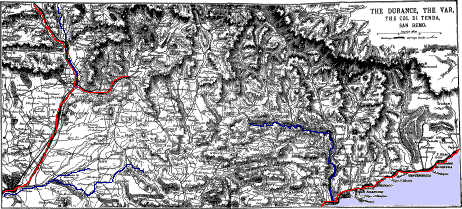
THE DURANCE, THE VAR, the col di tenda, san remo For continuation northwards see map, page 327. For continuation eastwards see map, page 211. For continuation westwards see map, page 66. For continuation southwards see map, page 123.
Nearly 2 hours’ walk from the Cannes Canal up the Siagne, and Mons. Those who have already seen such caves will find in this one nothing new nor striking. To visit it not only is a guide necessary, but the keeper of the cave at Mons must be advised beforehand, that he may be at the mouth of the cave with the key. It is much the better plan to return from the commencement of the Cannes Canal to St. Cesaire, and drive back to Grasse. The olives of St. Cesaire are considered among the best flavoured of the Riviera.
Grasse by Coach to Cagnes Station.
Grasse to the railway station of Cagnes by the Pont du Loup and Vence, 21 m. By omnibus, 3 frs. By private carriage, 30 frs. This drive is generally taken in two parts—Grasse to the Pont du Loup; then from the Pont du Loup to Vence or Cagnes.
Pont du Loup. Tourette.
Grasse to the Pont du Loup by Le Bar, 7½ m. N.E. Carriage with two horses there and back, 15 frs. Omnibus to Le Bar 3 times daily, 1 fr. Distance, 5½ m. N.E.; whence it is a pleasant walk of 2 m. up the valley of the Loup to the inn and Pont du Loup, at the mouth of the Gorge du Loup. From the Pont 2½ hours of fatiguing walking up the ravine of the Loup brings the traveller to the falls of the Loup, which requires a good deal of rain to make them imposing. The whole way from Grasse to Vence is by a beautiful Corniche road, nearly on the same level (1090 ft.) throughout its entire course, disclosing at every turn exquisite views towards the sea. The Pont du Loup, with its little cluster of houses and orange-gardens, is at the top of a long narrow valley, just at the point where the Loup rushes forth from a rocky gorge. On the top of a plateau, about 500 ft. over the Pont du Loup, is the village of Gourdon. From the terrace adjoining the church of Le Bar there is an excellent view of Gourdon, the valley of the Loup, and of the carriage-road on both sides of it. Those who visit the Pont du Loup generally content themselves with a ramble in the gorge, and then, after having taken some refreshments, either return to Grasse or go on to the railway station of Vence-Cagnes (see p. 169), 13½ m. farther, or 21 m. from Grasse. The drive from Grasse to Vence-Cagnes station in a private carriage costs 30 frs. The very same road is traversed by the omnibus from Grasse to Vence, 15 m. eastward. Fare, 2 frs. Time, 4 hours. A seat should be taken in the “Imperial.” Next day, at one, start from Vence to Cagnes railway station by another omnibus. Fare, 1 fr. Time, 1 hour. Distance, 6 m. The road from the Pont to Vence continues to follow the course of the Loup till within a few miles of the village of Tourette, pop. 980, at the foot of Le Puy de Tourette, 4158 ft. above the sea, where the omnibus halts.
Vence.
Vence, 1100 ft. above the sea, pop. 2800. Inn: Lion d’Or, pension 9 frs. Picturesquely situated on a hill in the midst of mountains clothed with olive trees and studded with houses standing singly and in clusters. This, the ancient Vintium, has still large portions of its
The bishopric of Vence, founded in 374, was afterwards united to that of Frejus. In the centre of the town is the cathedral, 110 ft. long, 68 ft. wide, and about 70 high, inside measure. Two aisles with massive piers and semicircular arches (slightly stilted) are on each side of the nave. Above is a triforium 15 ft. wide. Roof waggon-vaulted. The choir, containing 50 stalls in dark carved oak, is in a gallery opposite the altar, in the position usually occupied by the organ. At the N.E. corner of the church is an ancient and beautiful baptismal font, of which, unfortunately, a large piece of the pedestal is sunk into the ground. The chancel was formerly a Roman temple. The column now in the square behind the church, and the other over a well at the west end, stood formerly at the entrance into the temple. On the table of the second altar right is part of a sculptured stone which formerly adorned this temple. In the next chapel is the tomb of St. Lambert, many years Bishop of Vence, with Latin inscription on table of altar. Under the chancel is the vault in which the bishops were buried, while the vault of the Lords of Vence was under the nave. The present “Place” behind the chancel was the public cemetery. Several stones with inscriptions are on the walls. One slab bears an eagle in relief, and under it is a still larger stone sculptured in a diaper pattern, with a stork and crowing cocks worked into the design. The style resembles that of the old carved door in the first chapel right of altar, all probably of the 14th or 15th cent.
Roche-Blanche. Rocher-Noir.
To the N. of Vence is a row of four calcareous mountain cliffs, extending eastward to the Var, and each about 2000 ft. above the sea. The most prominent is the mighty cliff above Vence called the Roche-Blanche, commanding a superb view. On the summit are the remains of a walled village and castle, and less than half-way up the ruins of a castle of the Knight-Templars. The road up to the summit is by the first narrow path beyond the castle, ascending through beds of wild thyme and bushes of the prickly broom. The next hill is the Rocher-Noir, having on its eastern side, right above the bed of the Cagnes, a “foux,” an immense cave called the Riou, containing a large basin of water, whence flows a copious stream. It is 3½ m. from Vence. The next cliff rises over St. Jeannet, and bears its name. The most easterly is La Gaude, with vineyards producing one of the better wines of Provence, drank as vin ordinaire during the first year, when still sweet and unripe, but of good body and agreeable in the fifth and sixth years, when it costs 1½ to 2 frs. the litre bottle. Vence is famous for double violets. They are cultivated in hollows between furrows, and are sold to the makers of perfumes at the rate of 3s. 8d. the pound. A woman will gather 4 kilogrammes (8 lbs. 13 oz.) in a day, for which she is paid at the rate of 2½d. the kilo.
Cagnes.
The road from Vence to the Cagnes railway station descends the whole way, passing at some distance the village of St. Paul, pop. 700, with part of its old walls, and below it the village of La Colle, pop. 1500. The coach drives through the low or modern town of Cagnes. Inn: Savournin, not comfortable during the mosquito season. The real town occupies, as usual, a hill, on the summit of which is a castle built by the Grimaldi, a polygonal tower bought by the present owner at an auction; who has restored the painting by Carloni on the ceiling of the Salle Dorée, representing the Flight of Phaeton, and has also added a small picture gallery. A little way down from the castle are the ruins of the small abbey church of St. Veran, 6th cent. The chancel is still in good preservation. From Cagnes the views are not equal to those from Vence. (For the Vence-Cagnes station, see p. 169.)
St. Vallier.
ST. VALLIER.
Grasse to Digne, 63 m. north.—By the courrier 16 frs., changing coach at Castellane. Fare to St. Vallier, 2½ frs., Escragnolles 4 frs., Castellane 8½ frs., Barrème 11½ frs., and Digne 16 frs. By private coach from Grasse, with two horses, 100 frs. Dining first day at Escragnolles, and passing the night at Castellane. Next day breakfasting at Barrème, and then driving down to Digne (see map, p. 165).
The road between Grasse and Digne is broad, well constructed, and rises at an angle from 5 to 7 in the 100. From Grasse to St. Vallier (2350 ft. above the sea, or 1260 ft. above Grasse, and 6½ m. distant, population 536) the ascent is continuous, disclosing all the way grand views of Cannes, the sea, and the Estérel and the Tanneron mountains. The courrier and private carriages halt generally a few minutes in the “Place,” near the column with a marble bust of Napoleon I., indicating the spot where he reposed “2 Mars 1815.” The Hôtel du Nord is about 100 yards from this. The house is pretty comfortable, and charges per day from 8 to 9 frs. A carriage from this hotel, towards the Ponte-à-Dieu, as far as it can go, 3½ m., costs 5 frs. The remainder can be walked in about half an hour. A carriage from Grasse to St. Vallier, and towards the Pont-à-Dieu and back, 20 frs. The Pont-à-Dieu is a calcareous rock which spans the Siagne in the form of a bridge, like the “Pont” across the Ardèche.
From St. Vallier the road makes very circuitous windings on the steep sides of the mountains, ascending nearly all the way to Escragnolles, a hamlet, pop. 320, consisting of a few houses and a small roadside inn, with clean but hard beds, and plain and scanty fare, situated 3282 ft. above the sea, or 2192 ft. above and 18 m. north from Grasse. A little before arriving at Escragnolles is seen, in a deep valley, one of the principal sources of the river Siagne. The views from Escragnolles and Castellane exhibit lofty, wild, and partially-wooded mountains, with fields of wheat on laboriously-terraced ground.
Castellane. Taulanne. Barrème.
19 m. N.W. from Escragnolles, or 37¼ from Grasse, is Castellane, 2370 ft. above the sea. Pop. 2000. Inns: Levant; Commerce. A village of crooked streets on the Verdon, crossed by a bridge of one Moustiers Sainte Marie (see p. 167). From Castellane the road by a series of zigzags reaches the top of the Col St. Pierre, 3600 ft., and then descends to Taulanne, 7 m. N.W. from Castellane. From Taulanne the road descends 5 m. S., chiefly through a picturesque ravine, to Senez, pop. 620, among wild barren mountains, at the foot of Mont La Combe, on the river Asse. The hamlet has a poor inn, and a cathedral built during 1130 to 1242.
44¼ m. N.W. from Grasse, and 18¾ m. S. from Digne, is Barrème, pop. 1100, on the confluence of the Clumane with the Asse. Breakfast is taken here, and the diligence changes horses. Cloth-mills and trade in dried fruits, especially prunes. In the neighbourhood is a saline spring. The road from Barrème to Digne descends by a ridge between the valleys of the Asse and the Clumane.
Digne.
Digne, pop. 8000, 2000 ft. above the sea, 14 m. E. by loop-line from the station St. Auban on the main line. St. Auban is 80½ m. N. from Marseilles, 62¼ m. N. from Aix, and 20½ m. N. from Manosque. It is 109½ m. S. from Grenoble; 45½ m. S. from Aspres, the terminus of the road from Die; 41 m. S. from Veynes, whence commences the loop-line to Gap; and 31¾ m. S. from Serre, the terminus of the road from Nyons (see map of Rhône and Savoy). Hotels: Boyer; Remusat, both in the Boulevard Gassendi, near the statue of Pierre Gassendi (1592-1655), one of the most eminent philosophers of France. This, the ancient Dinia, the capital of the Avantici, is situated chiefly on hilly ground rising from the Bléonne and the Eaux-Chaudes. On the highest part is the cathedral, and on the plain up the river, near the seminary, the much more interesting church of Notre Dame, 12th cent., numbered among the historic monuments of France. 1¼ m. up the Eaux-Chaudes, at the foot of Mt. St. Pancras, are sulphurous springs, temp. 115° Fahr., efficacious in the cure of wounds and rheumatism. Bath, 2 frs. From Digne Napoleon issued his proclamation of March 1815. Digne makes a good resting-place and good headquarters. Both of the hotels are comfortable and moderate, 8 to 10 frs. per day, and both supply carriages at so much per day (see map, p. 165).
Riez. Barjols.
Among the many diligences that start from Digne, the most important is to Riez, 26 m. S.W., fare 4 frs., time 4½ hrs., a great diligence centre. Riez, pop. 3000, on the Colostre, at the foot of Mont St. Maxime. Inn: H. des Alpes, whence start coaches daily for Manosque, 22 m. W., by Allemagne, 5 m.; St. Martin, 8 m.; and to Gréoulx (see p. 167), 12½ m. S.W. from Riez, and 9½ m. E. from Manosque, fare 4 frs. For Moustiers Sainte Marie (see p. 167), 9 m. E., Montmelian, 18 m. S., by Quinson. Travellers on their way to Draguignan spend the night at Montmelian, H. Sicard, and proceed next morning to Aups, 9½ m. E., Inn: H. du Cours, and thence to Draguignan. From Montmelian a coach runs to Barjols, Inn: H. Pont d’Or, 9½ m. S., whence other coaches run to Brignoles (see p. 142). For Valensole, 7½ m. W., whence to Volx railway station, other 7 m. W. From Volx coach to Digne, 25 m. N., by Puymoisson, 3¾ m. N.; Le Begude, 8 m.; Estoublon, 11¾ m.; Mezèl on the Asse, Inn: H. du Cours, 15¾ m.; and Châteauredon, 7½ m. S. from Digne. All these roads traverse sometimes deep valleys and at other times extend across wide elevated tablelands. Down in the valleys are olive trees, in the higher regions quinces, plums, walnuts, and cherries (see map, p. 165).
Riez, the Colonia Julia-Augusta of the Romans, is still partly surrounded by its old fortifications, of which the highest of the towers has been converted into a belfry. Up the main street, through either of the gateways, are houses with sculptured doors and transomed windows which tell of better days. Near the two inns, but on the other side of the river, is La Rotonde, a temple, square externally, enclosing a peristyle of 8 monolith granite Corinthian columns, bearing an elongated octagonal dome. The diameter of the circle is about 23 ft. Near it are the remains of a colonnade consisting of 4 composite monolith granite columns. On the top of Mont St. Maxime is the chapel St. Maxime, 10th cent., restored and altered in 1857. It is 17 yds. long and 10 wide, outside measure. On each side of the chancel are three Corinthian columns similar to those in the round chapel. At the S.W. corner is a short square tower with a spire. From the brow of the eminence, where there is a statue of Mary, there is an excellent view of the dingy town and of the pleasing valley of the Colostre.
Moustiers Ste. Marie.
A very pleasant drive of 9½ m. E., fare 2 frs., is to the curious village of Moustiers Ste. Marie by the courrier, starting at 2 and returning at 4. Inn: H. du Mouton Couronné. The village consists of poor dingy houses, partly in a narrow gully and partly on the slopes, at the base of vertical calcareous sandstone cliffs, rising to the height of from 500 to 1000 ft. Between two opposite points of these precipices is a chain 745 ft. long, from which was suspended a gilt iron star which fell in 1878. Up the cliffs, by the stair of the “Via Crucis,” is the chapel of Notre Dame, almost immediately below the chain. Several caves are in the neighbourhood. Lower down is the parish church of the 10th and 13th cents. From the S. side rises a square belfry in three diminishing stages. Between Moustiers and Riez is Roumoulles, with the ruins of a castle. 18 m. E. from Moustiers is Castellane, but no public coach runs between them.
Gréoulx. Baths.
12½ m. W. from Riez, and 9½ m. E. from Manosque, is Gréoulx, pop. 1400, a dirty village on a hill rising from the Verdon. On the top are the gaunt ruins of a castle built by the Knight-Templars. Less than ½ m. from the village is the hotel and the bathing establishment. The rooms cost from 2 to 5 frs. Coffee in the morning, 60 cents. map, p. 165).
Manosque.
Manosque, pop. 6200, on the railway between Marseilles and Grenoble, 22 m. north from Pertuis, 41½ m. from Aix, 48½ m. from Gardanne, and 59½ m. from Marseilles. 4½ m. south from Volx, 20½ m. from St. Auban, 31 m. from Sisteron, 61½ m. from Veynes, 66 m. from Aspres, and 130½ m. from Grenoble (see map of Rhône and Savoy).
Hotels: Pascal; Eymon, commanding an extensive view of the surrounding mountains; near it the G. H. de Versailles; and the Poste. Manosque is situated on an eminence rising from the plain of the Durance, nearly surrounded by hills covered with vineyards and olive trees. Portions of the town walls and towers still remain, and the eastern and western gateways have been repaired and restored. Entering the town by the gate close to the hotels, we ascend the narrow and badly-paved principal street to the church of St. Sauveur, easily recognised by the square belfry attached to the S.E. end. Within the main entrance are two large caryatides. The windows of the façade are circular, the others small and round-headed with modern glass. On each side of the nave are semicircular arches of a great span; the chancel is extremely shallow, the roof 4 partite, and the floor considerably lower than the street. The narrow lane opposite the corner of the façade leads to the principal “Place,” where there is a fountain, and whence there is a good view. Higher up the principal street is Notre Dame, in exactly the same style as St. Sauveur. The table or altar in the chapel to the left of the high altar is formed of a marble sarcophagus, 5th cent., with figures, in bold relief, of the apostles, and in the centre a crucifixion. Above is a black image of Mary and child, supposed to date from the 6th cent. In the Hôtel de Ville is a silver bust by Puget of Gérard Jung, the founder of the order of the Hospitallers, a religious community whose office was to relieve the stranger, the poor, and the sick. In the neighbourhood are deposits of gypsum and lignite. Coach daily to Riez, 5 hrs., 22 m. E.; to the baths of Gréoulx, in the same direction; to Apt (see index), 26 m. W., by Reillane 15½ m., and Céreste 20½ m. W. Volx station is the intended terminus of the rail from Apt.
Vallauris. Antibes.
MARSEILLES MENTON 124 31 GOLF JOUAN or VALLAURIS. A few yards straight up from the station is a short column, which marks the spot where Napoleon bivouacked after his arrival from Elba on March 1, 1815. A very pleasant road, lined with villas, connects this small port with Cannes. Opposite station are pottery showrooms.
MARSEILLES MENTON 127 28 ANTIBES, pop. 6000. Hotels: Escouffier, Aigles d’Or. A fortified port founded by the Greeks, but, with the exception of two old towers, without any mark of antiquity. The streets are lined with tolerable houses. In the square the inhabitants have erected a monument to their valour. Those wishing a bird’s-eye view of the town should ascend the tower beside the church. The bellman’s house is close by. The wine of Antibes is of superior quality (see p. 154). From Antibes station omnibus to Biot, pop. 1400.
MARSEILLES MENTON 132 23 VENCE-CAGNES. At this station coaches await passengers for Cagnes, pop. 3000, about 1 mile distant. It is built on the slope of a hill, and contains the old mansion of the Grimaldi. Six miles northwards by the same road is Vence, pop. 3000, with an old cathedral and several interesting antiquities. It is famous for figs, and flowers for perfumery. One mile distant is St. Martin, with a splendid view from the terrace, and most picturesque environs. Between Vence-Cagnes and Nice runs a diligence (see p. 165).
MARSEILLES MENTON 136 19 VAR. This station is on the left or Nice side of the river Var, at the eastern end of the viaduct over the mouth of the river. ¾ m. N.W. from the station by the road to St. Martin are the Nice nurseries or pépinières, extensive, but not well kept. About 2 m. N.E. from the station, up on the hill, is the Caucade cemetery, in three stages. The first is used by the French, the next by the English, and the highest by the Russians. The last two contain many beautiful marble monuments.
At the mouth of the Var is the racecourse. The races take place in January.
Nice.
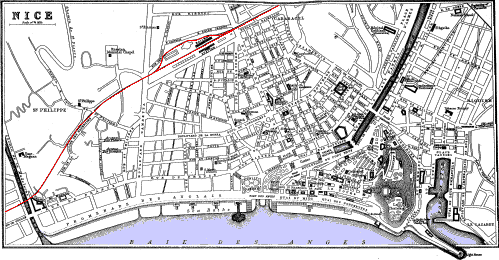
NICE
is 140 m. N.E. from Marseilles, 95½ m. N.E. from Toulon, 95¼ m. N.E. from Hyères, 39 m. N.E. from St. Raphael, and 19¼ m. N.E. from Cannes. It is 9½ m. W. from Monaco, 15 m. S.W. from Menton, 23½ m. S.W. from Bordighera, and 30 m. S.W. from San Remo (see railway map, fly-leaf). Situated on the Bay des Anges and on the embouchure of the Paillon, mostly covered over, pop. 66,300.
Nice: Hotels and Pensions.
Hotels and Pensions on the Promenade des Anglais, taking them in the order of east to west. The Hôtel des Anglais, with one side to the “Jardin Public.” Next it is the Cercle (club) de la Méditerranée; and opposite it, projecting into the sea, a casino. On the other side of the cercle is the H. Luxembourg. Then follow the Pension Rivoir, 13 to 18 frs.; the H. Méditerranée, H. Westminster, and the H. West End, all first-class houses charging from 15 to 25 frs. per day.
The following are at the western end of the Promenade, and, as they have considerable gardens in front, the inmates do not hear the noise of the sea so much. The H. de l’Elysée, No. 59; the Pension *Anglaise, 8 to 11 frs., No. 77; the H. Continental, 10 to 15 frs. On the Boulevard du Midi, the eastern prolongation of the Promenade des Anglais, are the Beau Rivage; the H. des Princes, 12 to 15 frs.; and on the Quai des Pouchettes, the *H. et P. Suisse, 8½ to 12 frs.
Around the “Jardin Public” are the first-class houses, the Angleterre and the Bretagne. On the Quai Massena the H. de France; while in the Place Massena are the best cafés and restaurants, large cab-stands, and the terminus of the trams. Over the river near the Place Massena is the Casino Municipal, fronting the Quai St. Jean Baptiste, on which are the hotels Cosmopolitain; the Paix; and the Grand Hotel, fronting the garden in the Square Massena. These hotels are first-class, and charge from 10 to 20 frs. Higher up is a second-class house, frequented chiefly by French, the H. Ferrand, 8 to 10 frs.
On and near the Avenue de la Gare are some excellent hotels and pensions. Taking them in the order of the Place Massena towards the railway station we have, under the arches, the hotels Meublés, Deux Mondes, and opposite the Univers. Then follow the hotels Ambassadeurs with garden, Iles Britanniques, Prince of Wales, all the three from 10 to 20 frs. Opposite, at No. 42, is the H. and R. Duval, 9 to 12 frs. At the top of the R. de la Gare, the H. National, 9 to 12 frs., and the Hotel des Alpes.
In the streets at right angles to the R. de la Gare near the H. Iles Britanniques are the Russian, German, English, and Scotch churches, and some comfortable hotels and pensions, mostly with gardens. The best of the hotels are the *Paradis and the *Louvre, in the Boul. Longchamp, near the Scotch Church. At the western end of the Boul. Longchamp, the H. et P. des Palmiers, and the H. Splendide, all from 10 to 20 frs. Near the Splendide is the P. Java, 9 to 11 frs.
Behind the Scotch Church are the P. Internationale and the H. et
At W. end of the R. de la Paix the H. Raissan, 10 to 12 frs.; near it the Russie and the Beau Site, both quiet houses with gardens.
Opposite the station the H. et P. du Midi, 9 to 11 frs. Farther down the H. et P. Interlaken, 8 to 11 frs. with wine.
From the E. side of the Avenue de la Gare parallel streets extend to the Boulevard Carabacel. In the first of these, the Rue Carnieri, is the Theatre Français. In the Rue Pastorelli the Pension St. Etienne and the H. Négociants, 8 to 12 frs. In the broad B. Dubouchage are the first-class houses—the H. Littoral; *Empereurs; *Albion. Behind the Albion, in the Rue Alberti, the H. et P. d’Orient. The large building in the B. Dubouchage is the Bourse. Near it is the American Episcopal Church. In the Avenue Beaulieu are the H. Central and the G. H. *Rubion.
The hotels, pensions, and villas at the end of the B. Dubouchage, and about the B. Carabacel, are frequented by delicate people, who sun themselves in the gardens and boulevards of this quarter. At the Carabacel end of the B. Dubouchage are the first-class houses—the H. Hollande; H. *Windsor; and opposite, the H. *Julien. On an eminence in a garden off the B. Carabacel is the H. *Nice. Then follow, on the B. Carabacel, the H. Bristol, P. Londres, H. de Paris, and houses with furnished apartments. In this quarter is the Carabacel Episcopal Church, and near it the Hôtel Carabacel.
On the way up to Cimiès, the G. H. Windsor. On Cimiès Hill, near the Convent of St. Barthélemy, is the H. et P. *Barthélemy, on the road to the Val Obscur, and near many pleasant rambles. On the Cimiès Hill, on opposite sides of the Amphitheatre, are the H. et P. Cimiès, and the Pension Anglaise, in the three houses from 9 to 12 frs. They are about 2 m. from Nice, and 430 ft. above it. The tram from the Place Massena has its terminus near the P. Barthélemy. The H. Cimiès has its own omnibus. The town omnibus runs within a short distance of the P. Anglaise.
In the street behind the Promenade des Anglais, the R. de France, and its continuation the R. Massena, are hotels and pensions, with moderate prices. Commencing at west end and going eastward—at No. 100, in garden, the P. Torelli. On the hill behind the H. de Rome, 12 frs. At No. 121 is the H. de l’Elysée, with front to the Promenade des Anglais. At No. 46 the P. *Metropole, 8 to 10 frs.;
Those requiring to study economy will, by a little search through the private pensions, find very comfortable and moderately-priced lodgings. In the meantime they may alight at any of the following houses, where they can arrange at the prices given:—H. du Midi, opp. station, 8 to 11 frs., 3 meals, wine extra. At the head of the Avenue de la Gare the H. des Alpes and the H. National, 9 to 12 frs. At 17 B. Carabacel H. et P. de Londres, 8 to 10 frs. with wine. In the Rue de France the P. *Metropole, 8 to 10 frs. At the west end of the Promenade des Anglais the Pension Anglaise, 8 to 10 frs. In the Rue Massena the H. St. André, 8 frs., including everything. In the R. Gioffredo the H. and R. Montesquieu, 8 to 9 frs.
Nice: Cafés. Banks.
Cafés.—The best in the Place Massena. Restaurants.—The *London House, Pl. du Jardin Public. Restaurant *Française, 3 Av. de la Gare, and at No. 11 Rest. d’Europe. Clubs or Cercles.—The Cercle de la Méditerranée in the Prom. des Anglais. Cercle Massena, Quai St. Jean.
Banks.—The Banque de France, 6 Quai du Midi. The best for all kinds of banking business and money changing is the “Credit Lyonnais,” 15 Avenue de la Gare. Other banks—the Banque de Nice, 6 P. Massena; Lacroix et Roissard, 2 P. Massena; Viterbo, 13 Avenue de la Gare.
House Agents.—John Arthur and Co., 1 Place Jardin Public; C. Jougla, 55 R. Gioffredo; Salvi and Co., 2 R. du Temple.
Post Office, 20 Rue St. François de Paul, behind the Quai du Midi. Most of the clocks have two minute-hands, one for railway or Paris time, the other for Nice time. The railway time is 20 minutes behind the Nice time. In the same street is the excellent public library, with 45,000 volumes. Open from 10 to 3 and 7 to 10 P.M. It contains a few antiquities, some Roman milestones, a collection of medals, and a bust of Caterina Segurana. The Museum of Natural History is in No. 6 Place Garibaldi. Observatory on the top of Mont Gros, 1201 ft. above the sea.
Booksellers.—Galignani, 15 Quai Massena, with well-supplied reading-room; Barbery, Place du Jardin Public; Visconti, 2 Rue du Cours. Cook’s office adjoins Galignani’s. Gaze’s is at No. 13, and Caygill’s No. 15 Avenue de la Gare.
Druggists.—Of these there are excellent English establishments in the principal streets.
Confectioneries and Perfumeries.—Of the confections the specialité of Nice is candied Parma violets, sold in little round boxes weighing 100 grammes, or 3½ oz., for 5 frs. the box. The most expensive of the glazed fruits are pine-apple, 10 frs. the kilogramme (2 lbs. 3¼ oz.), strawberries, 10 frs., and apricots, without the stones, 8 frs. All the others cost either 5 or 6 frs. the kilo. The best shops are— *Caëtan Féa, 4 Avenue de la Gare; Guitton and Rudel, 23 same street; and *Escoffier, in the Place Massena. Rimmel’s garden and perfume distillery are near the slaughter-house, on the left bank of the Paillon.
Nice: Churches. Conveyances.
Churches.—Temple Évangélique or Vaudois in the Rue Gioffredo; Russian Memorial Chapel, N.W. from the station; Russian Church, Rue Longchamp; German Church, Rue Adelaide; American Church, Rue Carabacel. Trinity Church, Rue de France; St. Michael’s, Rue St. Michel; Carabacel Episcopal Church, at the east end of the Rue Notre Dame. Scotch Church, in the Rues St. Etienne and Adelaide.
Steamers to Marseilles, Genoa, Leghorn, and Corsica once weekly.
Coach hire.—A carriage with coachman and 2 horses, 750 frs. per month. Per day, 30 frs. There are many excellent livery stables, where carriages and riding horses can be had per day or per month.
Cabs.—Drivers have to produce their tariffs. Cab with 1 horse and seat for 2, the course 75 c.; seats for 4, 1 fr. The hour, seat for 2, 2½ frs.; seats for 4, 3 frs. Cabs with 2 horses, the course 1½ fr.; the hour, 3½ frs.
To or from the station. Cab with seat for 2, 1 fr.; with seats for 4, 1½ fr. Cab with 2 horses, 1 fr. 15 sous. Each article on top of cab 25 c., and 25 c. for each stoppage. It is better, if not sure of a hotel, to engage the cab by the hour.
All the tram cars start from the Place Massena.
Diligences.—From the office, No. 34 Boulevard du Pont Neuf, start daily:—Coach to St. Martin Lantosque, 3117 ft. above the sea, and 37 m. N. from Nice. Fare 6 frs., time 10 hrs. (see p. 180). Coach to Puget-Théniers, 1476 ft. above the sea, and 42 m. N.W. from Nice. Fare 2½ frs., time 9 hrs. (see p. 182). To St. Sauveur, 40½ m. N. (p. 182). Omnibus twice daily during the winter season to Monte Carlo, by the low Corniche road. From the office, Place St. François, start:—Coach to Cuneo, 80 m. N., by Tenda and the Col di Tenda tunnel. Fare 16 frs., time 18 hrs. Coach to Tenda alone, 2680 ft. above the sea, and 51 m. N. from Nice. Fare 9 frs., time 11 hrs. (see p. 182). From Hôtel Chapeau Rouge, Quai St. Jean Baptiste, coach to Levens, 1916 ft. above the sea, and 15 m. N. from Nice. Fare 3 frs., time 4 hrs. From the Cloche d’Or, Rue de l’Aqueduct, Contes. Contes, pop. 1700, has good country inns, gardens full of orange trees, and vineyards producing good wine. Cab with 1 horse and 2 seats to Trinité-Victor and back, 5 frs.; ½ hour’s rest allowed.
Nice: Climate.
Climate.—If I should be asked to draw a comparison between Nice and Cannes with respect to climate, I should be inclined to call Nice a trifle colder in winter, especially if there be much snow on the mountains. M. Teysseire has preserved and published records of twenty years’ meteorological observations taken at Nice with instruments placed outside his window, on a fourth floor facing the north-north-east. His mean results for the twenty years are as follow; to which, for the sake of comparison, I append the means of my six winter seasons at Cannes:—
Mean Temperature.
Nice. Cannes.
November 53.8 52.6
December 48.5 46.3
January 47.1 48
February 46.2 48.8
March 51.8 51
April 58.1 55.5
The mistral is as well known at Nice as it is at Cannes.—Health Resorts, by M. Marcet, M.D.
Vallons.
Nice occupies a plain bounded by the limestone summits of the Maritime Alps, whence descend fertile wooded ridges composed of a reddish conglomerate and a gray-blue clay of the Pleiocene period. Between these ridges are deep vallons, gullies, or furrows, with precipitous sides, scooped out to a great depth by the intermittent action of torrents, the breadth and depth of the valleys depending on the volume of water in the stream and the degree of consistence of the conglomerate. The great vallons have tributary vallons. The pleasant Vallon de Magnan exemplifies both kinds. From the Pont de Magnan (near which a tram stops) the first tributary is nearly a mile up the stream, opening from the right or west side. This vallon is short, the walls nearly perpendicular, and in some parts scarcely 2 ft. apart. Higher up the Magnan, and opening from the left or east side, next a church, is the more beautiful and more extensive tributary vallon, the Madeleine, which high up becomes so narrow and so choked with troublesome brambles as to be almost impassable. The banks are covered with vegetation, and the more level parts with maritime pines and olive trees. At the entrance are beds of clay of immense thickness, of which
The city of Nice consists of three distinct parts:—1st, the new or fashionable quarter, stretching westwards from the Paillon, containing avenues and gardens, and broad and well-paved streets bordered with large and elegant buildings, of which a large proportion are hotels and “pensions;” 2d, the Old Town, a perfect labyrinth of narrow, dirty, steep streets, radiating from the Cathedral as a sort of centre, and running up the sides of the Château hill, which separates it from, 3d, the Port, with its seafaring population, and about 16 acres of harbour.
During the season, from November to April, Nice is a luxurious city, with the attractions and resources of the great northern capitals. In winter the population may be estimated at 90,000, whereas in summer it is only about 54,000, a diminution in numbers apparent only in the largest and most elegant part of the city. The non-fluctuating population inhabit the crowded tenements in the narrow streets huddled together between the Paillon and the Château hill.
Nice: Promenade. Castle. Cemetery.
The glory of Nice is the Promenade des Anglais, commenced by the English in 1822 to employ the poor during a season of scarcity. This beautiful terraced walk, 85 ft. broad, extends 2 m. along the beach of the Baie des Anges, from the Quai Lunel of the Port to the mouth of the Magnan, whence it will be continued other 3 m. west to the mouth of the river Var, near the Racecourse.
Over the Port rises the Castlehill, 315 ft., commanding from the platform, in every direction, the most charming views. To the E. are the peninsula of St. Jean and Cape Boron, and rising from it, Fort Montalban, Mt. Vinaigrier, and the Observatory residence and buildings. To the N. is Mt. Chauve; to the E. the roofs of Nice; and in the distance the Roche-Blanche (p. 164), the peninsula of Antibes, and the Estérels. This fortress, founded by the early Phœnician colonists, and destroyed and rebuilt at various periods afterwards, was finally razed to the ground in 1706, by order of Louis XIV., by Maréchal Berwick. Now it has become the great park of Nice. A round tower that still remains, over the Hôtel des Princes, called the Tour Bellanda, was probably added to the Castle by Emmanuel Philibert in 1560. On the W. side of the hill (see plan) is the cemetery in five stages. At the entrance is the monument to the “Victimes de l’Incendie du Theatre, 23d March 1881.” Towards the E. end, at the wall, is the grave of
Caterina Segurana.
Near the harbour, and above the Quai Lunel, is the statue of King Charles Felix. In the Rue du Murier, leading down from the Rue Segurane to the Port, is the mulberry tree where Caterina Segurana had her tent. On the 15th of August 1543 she, at the head of a devoted band, attacked the allied French and Turkish forces commanded by François de Bourbon and the Turk Barbarossa, struck down with her own hand the standard-bearer, and put the enemy to flight. Giuseppe Garibaldi was born, 19th July 1807, in a house which stood at the head of the Port before its enlargement. In a small street, ramifying from the Rue Segurane, is the church of St. Augustin, in which Luther preached in 1510. At the east end of the R. de la Préfecture, last street left, No. 15 R. Droite, is the Palais des Lascaris, with ceilings painted in fresco by Carlone. It is now the “École Professionnelle.” This is also the street of the jewellers patronised by the peasantry. Paganini died (1840) in the house No. 14 R. de la Préfecture. The jambs and lintels of the doorway are slightly decorated. The Cathedral and the other churches in the old town are in the Italian style, ornamented with gilding and variously-coloured marbles. The new church, Notre Dame, in the Avenue de la Gare, is Gothic in style. The first non-Romanist church erected in Nice was the Episcopal chapel of the Trinity in 1822. As it became too small, the present church was built on the same site in 1856 at a cost of £6000. To the N.W. of the railway station, by the Chemin St. Etienne, in an orange grove, is the Nice: Memorial Chapel. Russian Memorial Chapel, a series of ascending domes, built over the spot on which stood the villa in which the Prince Imperial of Russia died, April 24, 1865. The interior is covered with designs in gold leaf, varied here and there by a light-blue ground. Round the base runs a white marble panelling, enclosing frescoes of saints in niches.
The principal thoroughfares in Nice are the Place Massena and the handsome broad street the “Avenue de la Gare,” extending in a straight line northward from the “Place” to the station. Next in importance are the Quais Massena and St. Jean Baptiste. In the above are all the best shops. The Rue Massena, and its continuation the Rue de France, behind the Promenade des Anglais, contain shops principally of the provision kind, British stores, grocers, wine merchants, confectioners, Rue de France is the Croix de Marbre, a marble crucifix under a canopy on four marble columns, erected in 1568 to commemorate the visit of Charles V., Francis I., and Paul III. in 1538, and the partial reconciliation of the two potentates through the intervention of the Pope. The column opposite commemorates the visits of Pio VII. in 1809 and in February 1814. Near this is Trinity Church, and in the Rue Gioffredo the Temple Évangélique, the second Protestant church built in Nice.
André Massena.
On the arched part of the Paillon, fronting the Quai St. Jean, is the large and handsome Casino, and a little farther up the river the pretty public garden called the Square Massena, with a statue in the centre, in an animated posture, of André Massena, Prince of Essling and Marshal of France, who was born on May 7, 1758, in a house now demolished, which stood on the Quai St. Jean Baptiste. In 1810 he was chosen by Napoleon to stop the advance of Wellington in Portugal, and was commissioned “to drive the English and their Sepoy general into the sea.” But the wary strategy and imperturbable firmness of the British general proved resistless, and Massena was compelled to save his military fame by a masterly retreat. On the pedestal Clio is seen writing his name in the chronicles of his native city. This garden forms a pleasant lounge, but it is not so fashionable as the other farther down, at the mouth of the river, called the “Jardin Public,” planted with magnolias, acacias, Japan medlars, and gum, cork, camphor, and pepper trees. The band plays here in the afternoon. The most beautiful of the public gardens is on the Castlehill, intersected by footpaths and carriage-roads up to the summit. On one side of the hill is the public cemetery.
Cimiès.
All the side streets which ramify eastward from the Avenue de la Gare lead to the Quartier Carabacel, one of the most sheltered parts of Nice, and inhabited by the most delicate invalids. Above it, about 2 m. distant, or 3 from the Place Massena, is Cimiès (430 ft. above the sea), another favoured spot, frequented principally by nervous invalids requiring a sedative climate. On the top of this hill stood the Roman city Cemenelium, of which all that remains are the ruins of an amphitheatre 210 ft. long by 175 wide. Just under the Boulevard Prince de Galles are artistic ruins composed of ancient material gathered in this neighbourhood. They stand in the spacious grounds of the superb villa Val Rose, which in shape resembles Noe’s ark. Entrance from behind G. H. Windsor. The first road right from the theatre leads to a Franciscan convent built in 1543 on the site of a temple of Diana.
A path in the corner of the “Place” leads down to St. Pons (p. 179).
At No. 6 Place Garibaldi is the Museum of Natural History. The first hall contains a collection of the fungi growing in the department; and separate, under a glass case, specimens of those allowed to be sold in the market for food.
Nice: Drives.
The best of the drives from Nice is to Menton, 20 m. east, either by the high Corniche road along the flanks of the mountains, passing above Monaco, or by the beautiful new road which seldom rises much above the coast, and passes through La Condamine to Monte Carlo. An omnibus runs daily between the Boul. du Pont Neuf and Monte Carlo by this road (see p. 187).
Cab with 1 horse and 2 seats to Villefranche and back, 5 frs.; ½ hour’s rest allowed. With 2 horses and 4 seats, 7 frs. Above the Pont Neuf, near the Place St. François, omnibuses (without fixed time) start for Villefranche, ½ fr.; St. Jean, 15 sous; and Beaulieu, 15 sous. On feast-days a steamer generally sails to Monaco. In the village of St. Jean there is a very comfortable country inn, H. Victoria, where bouillabaisse can always be had. Pension, 8½ frs. And at Beaulieu, close to the station, is the *H. et P. des Anglais, pension 9½ to 12 frs. Those who go from Nice to St. Jean with luggage should leave in the omnibus, but for Beaulieu the rail should be taken. A carriage with 2 horses to St. Jean and Beaulieu and back, 25 frs. The tour round Mt Boron, ascending by the new and descending by the old road, costs, in a coach with 2 horses, 15 frs. Time, 1½ hour.
Val-Obscur.
Nice to the Val-Obscur, 4 m. N.—Take tram from the Place Massena to St. Maurice, 2 m. N. It stops in front of the gate of the Villa Chambrun, by the side of the Octroi. For the Vallon des Fleurs ascend by the road to the right. For the Val-Obscur ascend by the road to the left, passing the Chapelle du Ray. Carriages can drive the length of the water-conduit. From this part the bed of the stream may be followed, but as it is very stony it is better to keep on the path by the side of the conduit as long as possible. The Val-Obscur is a deep ravine, 440 yards long, between cliffs of an earthy
The Vallon des Fleurs ou des Hepatiques is renowned for its olive trees and its wild flowers in early spring. The commencement of the valley is about 10 minutes’ walk from the St. Maurice terminus of the tram. A path leads to the top of the valley. From the summit it leads round by the head of other two vallons to the Cimiès road, which it joins nearly opposite to the observatory, only a little higher up the valley of the Paillon. The whole forms a very agreeable walk. (For Cimiès, see p. 177.)
Nice: Villa Clery. St. Pons. Grotte St. Andre.
A much-frequented drive or walk is to the Grotte St. André, about 3¾ m. N. from Nice by the west bank of the Paillon and the Vallon St. André. A cab with 1 horse and 2 seats there and back, 5 frs.; with 2 horses and 4 seats, 7 frs.; ½ hour’s stay allowed. Carriage, 15 frs. But if the return to Nice be made by Falicon, 25 frs. When about 1½ m. up the Paillon there is a large gate which gives access to the orchard of the Villa Clery, containing some orange trees above 100 years old, yet in the whole plantation there is not one well-developed specimen. The oranges are sold at from 4½ to 6 frs. the 100, and packed and despatched to order. Almost opposite, on the east side of the Paillon, are the more beautiful gardens and perfume distillery of Rimmel. On the top of the hill (430 ft.), above the Clery orchard, is seen the monastery of Cimiès, built in 1543 after the original house, which stood near the Croix de Marbre, had been destroyed by the Turks. The next large edifice passed on the west bank is the monastery of St. Pons, built in 775 by St. Syagrius, a contemporary of Charlemagne, on the spot where the Roman senator St. Pontius suffered martyrdom. The emperor is said to have spent some days here in 777 while on his way to Rome. In 890 it was destroyed by the Saracens, and in 999 rebuilt by Fredericus, Bishop of Nice. In 1388 the treaty was signed here by which Nice was annexed to the house of Savoy. A short distance beyond, at the part where the stream St. André unites with the Paillon, 3 m. from the Place Massena, is the asylum for the insane. First-class boarders pay 4 frs. per day, second 3 frs. A little higher up the stream are the village, pop. 660, and (on a hill) the château of St. André. The château is a plain house with a small chapel at the west end, Grotte St. André. Fee, ½ fr. each. It is a natural tunnel, 114 ft. long and 25 ft. high, through the limestone rock, under which flows the stream St. André, dammed up at the outer end to enable the man to take visitors through it in a boat. Near it are a restaurant and shop in which petrifactions are sold.
From the “Grotte” up to the 8th kilomètre stone the ravine becomes so narrow that there is barely room between the high cliffs for the road and the stream. It is so picturesque that those who have come to visit the cave should walk up this distance, 1 mile, before returning. Those in carriages generally pass up this way and return by Falicon, a village perched on the top of a steep hill above the river St. André.
To the Observatory, 1215 ft. above the sea, constructed in 1881 at the expense of M. Bischoffsheim. Take the Abbatoir tram the length of the Place Risso (see plan), where take the corner to the right and ascend by the Corniche road. If on foot, on arriving at a well beside a house, ascend the hill by the mule-path. The views are charming. The establishment possesses 1235 acres of land. On the highest part are the various buildings for astronomical purposes. A few yards below, on the west side of the mountain, is a handsome building 228 ft. long and 46 broad. In the centre is the library, and the wing at each end dwelling-houses.
Nice to Cuneo by St. Martin Lantosque.
(Map, page 165, and Map of Rhône and Savoy.)
Nice to Cuneo by St. Martin Lantosque.—Diligence from Nice to St. Martin, 37 m. N. From St. Martin to Entraque, on the north side of the Col di Finestra, 8 hrs. by mule, considered equal to 25 m. From Entraque to Cuneo by Valdieri and Dalmazzo, 24 m. N. by coach.