PART I.—PARIS TO MARSEILLES. (continued 6)
Reading edition
Levens. Lantosque.
The diligence from Nice ascends by the west side of the river Paillon, and after passing the villages of St. André (p. 179) and Tourette, near the ruins of Châteauneuf, arrives at Levens, 1826 ft. above the sea, pop. 1560, Inn: H. des Étrangers, where the coach halts a short time. After Levens it crosses the Col du Dragon, and then descends into the prettiest part of the valley of the Vesubie, where it passes through the village of Duranus, 18 m. from Nice, pop. 1500. Then, after having traversed a tunnel 88 yds. long, crossed the Vesubie, and passed by the hamlet of Le Suque (Suchet), 25 m. from Nice, it reaches the village of Lantosque, 28½ m. from Nice, 1640 Inn: H. des Alpes Maritimes. On a plateau 765 ft. above Lantosque, and 1¼ m. distant, is La Bollène, with a large hotel, charmingly situated amidst hills covered with chestnut trees. The coach next halts at Roquebillère, pop. 1800, on the Vesubie, 3½ m. from Lantosque, 32 from Nice, and 1968 ft. above the sea. It is the station for the village of Belvédère, pop. 1250, with a comfortable hotel on a plateau 755 ft. above Roquebillère. St. Martin Lantosque. Col di Finestra. From Roquebillère the coach proceeds up the valley of the Vesubie by the villages of Berguerie, St. Bernard, and St. Sebastien, to St. Martin Lantosque, 37 m. from Nice, pop. 1956, and 3117 ft. above the sea. An ancient village at the junction of the Vesubie with the Salèses. In the “Place” where the diligence stops is a very good inn, the H. des Alpes. Down in the town is the Belle-Vue pension, 6 frs. Up by the side of the promenade are some good pensions. On the opposite hill, ½ hour walk from St. Martin, and 700 ft. higher, is the village of Venanson, pop. 250, commanding splendid views of the surrounding valleys. The lower parts of the mountains are covered with chestnut and cherry trees, and the higher with large firs. From St. Martin commences the bridle-path to Entraque, by the valley of the Vesubie and the Col di Finestra, 8269 ft. above the sea, called thus from a fancied resemblance of a cleft in the peak to a window. Mule and guide to Entraque, 22 frs.; time, 8 hrs. 1¼ m. up the Vesubie is the stone which marks the boundary between France and Italy, and 6¼ m. farther the inn and the chapel of the Madonna di Finestra, 6234 ft. above the sea. Many rare plants are found here, especially the remarkable Saxifraga florulenta, on the ridges of rock above the sanctuary. Half an hour beyond, a lake is passed among jagged peaks, and, in about another ½ hour more, the summit of the pass, 8269 ft., is attained, commanding an extensive view both towards Italy and France. At Entraque there is an inn, and a coach daily to Cuneo.
Valdieri.
A mule-path from St. Martin extends to the Baths of Valdieri, about 20 m. distant, time 7 to 8 hrs., by the Salèses, which it follows all the way to the Col de Moulières, 6890 ft. A few miles farther northward it crosses also the Col di Fremamorta, a depression between two mountains, 8745 ft. and 8964 ft. respectively above the sea. It then descends by a long dreary road to the Val di Vallaso, where it turns eastwards to the river Valletta and the Baths of Valdieri. From the baths a carriage-road extends 24 m. N.E. to Cuneo, passing by the village of Valdieri on the Gesso, 2493 ft. above the sea, 10 m. N. from the baths, and 7½ m. S. from the next village, Roccavione, in the picturesque valley of the Vermanagna. The coach then passes through the Borgo San Dalmazzo, 5 m. from Cuneo, in a well-cultivated plain at the junction of the Vermanagna with the Gesso.
A more direct but not such a good path separates from the Fremamorta road at a small hamlet about 4 m. N. from St. Martin, whence it ascends northwards by the Col de Cerise, 8500 ft., and then follows the course of the Valletta to the baths. “The Baths of Valdieri make excellent headquarters for exploring this part of the Western The Western Alps, by John Ball.
Puget-Theniers. Saint Sauveur.
Nice to Puget-Theniers, 42 m. N.W. by the Vallon du Var, which does not become picturesque till Chaudan, 22 m. N. from Nice, at the junction of the Tinée with the Var, where the horses are changed and where the coach from St. Sauveur (18¼ m. N. from Chaudan) meets the Puget coach. Puget-Theniers (Castrum de Pogeto de Thenariis, pop. 1450, 1476 ft. above the sea, Inn: *Croix de Malte) is a dirty village on the confluence of the Roudoule with the Var at the foot of bare precipitous mountains. Coach daily from the inn to Guillaumes, pop. 1300, on the Var, 22 m. N., Inn: Ginié. The roads beyond are traversed by mules. Coach also to Entrevaux, 3¾ m. W. from Puget.
The banks of the Tinée are more picturesque than those of the Var. On the Tinée, 40½ m. N. from Nice, is Saint Sauveur, pop. 800, Inn: Vial, with Romanesque church containing a statue of St. Paul, dating from 1309. Hot and cold sulphurous springs issue from a granite rock called the Guez. From St. Sauveur a good road extends northwards by the Tinée to St. Etienne, where there is an inn. From St. Etienne, pop. 150, a good mule-path leads by the Col Valonet to Vinadio (see map, p. 165).
Nice to Turin by the Col di Tenda.
Nice to the village of Tenda, by coach, 51 m., 11 hours, 9 frs.; Tenda to Cuneo, 29 m., 7 hours, 7 frs.; Cuneo to Turin, by rail, 3 hours (see maps, pp. 165 and 107). This is rather a fatiguing journey. The most beautiful views are seen during the descent from Tenda to the Mediterranean. Nice.—Start from the Place St. François. The road ascends the E. bank of the Paillon by the villages of Trinité-Victor, pop. 1300, and Drap, pop. 800, with a sulphurous spring called Eau de Lagarde. Beyond this it leaves the Paillon and crosses over to Escarène on the Braus, 12½ m. N.E. from Nice, pop. 1500. About 1½ m. farther is Touet, pop. 400, whence commences the tedious ascent of the Col di Braus, 3300 ft, between the Tête Lavine on the S. and Mt. Ventabren on the N. The road now descends to Sospel, 1125 ft., pop. 3500, on the Bevera, an affluent of the Roja, 25½ m. N.E. from Nice. H. Carenio; coach daily to and from Menton, 14 m. S. The Giandola. Saorgio. The descent is now made through bleak and barren mountains to Giandola, 39¼ m. N.E. from Nice, 1247 ft., at the base of lofty frowning rocks. Inns: Étrangers, Poste. Coach daily between this and Ventimiglia. To the E., on the Roja, are Breglio, pop. 2580, and the ruins of the castle of Trivella. The road now ascends a narrow defile of the Roja, which, suddenly widening, discloses Saorgio, pop. 1600, 400 ft. above the torrent, composed of parallel rows of dingy houses among almond and olive trees. On the top of the hill is the castle of Malemort, destroyed by the French in 1792. From this the valley contracts so much that the road has repeatedly to cross and re-cross the river on its way to Fontana on the Italian frontier, 43 m. from Nice, pop. 1230. Luggage and passports are examined here. Almost the only habitat of the curious plant Ballota spinosa is between Fontana and Breglio. The road from this to St. Dalmazzo, 5 m. N., passes through one of the most formidable defiles in the Alps, the Gorge de Berghe, between steep massive walls of igneous rock. “The bold forms of the cliffs, and the luxuriant vegetation which crowns every height and fills every hollow, make the scenery of this road worthy to compare with almost any other more famous Alpine pass.” —Ball. At St. Dalmazzo is a hydropathic establishment, pension 8 frs. Coach daily between Ventimiglia and Tenda.
Limone. Cuneo.
51 m. N.E. from Nice, 2 m. S. from the tunnel, and 12 m. S. from Limone, is the village of Tenda, pop. 1800; Inn: H. National; 2680 ft. above the sea, and 1516 ft. below the tunnel; situated on the Roja at the base of a rock, on which are the picturesque ruins of the castle of Beatrice di Tenda, executed on the 13th Sept. 1418 by her jealous and tyrannical husband, Duke Fil. Maria Visconti. Many rare plants are to be found on the rocks over the village. The village church (1476-1518) is a good specimen of Lombardian architecture. The tunnel, opened in 1882—4196 ft. above the sea at the Tenda end, and 4331 ft. at the Limone end—is 9844 ft. long and 23 ft. high. The Tenda end of the tunnel is at the hamlet called La Punta, and the Cuneo end at the hamlet La Panice. From La Panice the road descends rapidly by the Vermanagna to Limone, 3668 ft., 63 m. N.E. from Nice and 17 m. S. from Cuneo; Inn: H. de la Poste; pleasantly situated in the valley of the Vermanagna, from which an occasional glimpse may be had of Monte Viso, 12,670 ft. The road, after passing Robillante, Roccavione, and Borgo-San-Dalmazzo, pop. 4600, arrives at Cuneo, 80 m. N.E. from Nice, 1500 ft. above the sea, pop. 1200; Inns: Barra di Ferro, Albergo di Superga; situated at the confluence of the Stura with the Gesso. 55 m. N. by rail is Turin.
Mondovi. Acqui.
The easiest way to go to Turin from Nice is to take the rail to Savona, whence rail to Turin, 91 m. N.W. by Carru, Bra, and Cavallermaggioré. On this rail, 4 m. W. from Savona, is the Santuario di Savona, a pilgrimage church with large hospice for poor devotees (p. 210). From Carru station, 50 m. N., a branch line extends 8 m. S. Mondovi, pop. 17,000, on the Ellero. Inns: Croce di Malta; Tré Limoni d’Oro. From Mondovi is visited the Cave of Bossea, about 15 m. S., in the valley of the Corsaglia. Each seat in the conveyance, 8 frs.; cave, 2½ frs. each, shown from June to October. 12 m. S.W. from Mondovi, and about the same S.E. by coach from Cuneo, is the Certosa di Val Pésio, formerly a monastery, founded in 1173, now a hydropathic establishment, open from 1st June to 30th September. Pension, 8 to 10 frs. It is well managed, and well situated for botanists, fishers, and sketchers.
At the station S. Giuseppe di Cairo, 13 m. W. from Savona, is the junction with line to Alessandria, 52 m. N., by Acqui, 31 m. N., traversing a picturesque country, between S. Giuseppe and Acqui, where it passes down the beautiful valley of the Bormida.
Acqui, pop. 8000, on the Bormida, and 21 m. S. by rail from Alessandria. Hotels: Italia; Moro. The town is partly on and partly round the Castello. On the other side of the river is the bathing establishment, a large building with abundant accommodation. The pension price per day is from 9 to 12 frs., including the use of the water, which, besides being drank, is employed both in water and in mud baths. The waters are sulphurous and alkaline, temp. 120°, and were known to the Romans under the name of the Aquæ Statielæ, yet of their times nothing exists but the ruins of an aqueduct. The mud-baths of Acqui are remedies of considerable power. The patient remains immersed for about half an hour in the humus or mineralised mud of a temperature as hot as he can bear. Immediately after he receives a warm mineral water bath. “The therapeutic influence of this application is most evident in chronic articular enlargements, rheumatic arthritis, some indolent tumours, intractable cases of secondary syphilis, and rheumatism.” —Dr. Madden’s Health Resorts.
Villefranche.
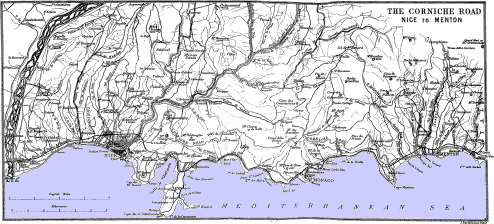
MARSEILLES MENTON 142½ 12½ VILLEFRANCHE, pop. 3500. Approached by omnibuses from the Pont Vieux at Nice, also by rail. Station at the head of the bay. Hotel: Marine. Pleasant boating excursions may be taken here to the peninsulas of St. John and the Hospice. The climate of Villefranche resembles that of Cimiès and Carabacel. 2 m. E. from Nice, at the head of a deep narrow bay, 2 m. long, are the arsenal, fortress, and port of Villefranche, founded in the 13th cent. by Charles II., King of Naples. The bay is a favourite place of anchorage of the French squadron, as well as of other ships of war and yachts. Boat from the mole to the little pier on the peninsula of St. Jean, 1 fr. each person. From Villefranche commences the splendid Road to Monaco, 8 m. long and 18 ft. wide, exclusive of the space for foot-passengers. This most enjoyable carriage-drive skirts with the railway the base of the precipitous cliffs which rise from the sea. 1 m. from Villefranche by rail, or 1¾ by road, is
THE CORNICHE ROAD NICE to MENTON
Beaulieu.
MARSEILLES MENTON 143½ 11½ BEAULIEU, famed for its large olive trees. A little above
Port of St. Jean.
A charming road, at some parts rather narrow for a carriage, leads from Beaulieu round by the edge of the bay and east side of the peninsula to the Port of St. Jean. The real carriage-road commences at the railway bridge, goes round by the west side of the peninsula, and descends to St. Jean, a little before reaching the chapel of St. Francis. The continuation past the chapel, of the road, extends to the lighthouse, passing the signal-tower to the right.
The port of St. Jean, Inn: H. Victoria, is used principally by the tunny fishing-boats from February to April. It makes a very pleasant residence for artists and naturalists. It is situated among creeks and bays, gardens, orchards, villas, and woods, in the most fertile part of the peninsula. Beyond, on the highest point of the peninsula of St. Hospice, is a round tower, the remains of the fortifications razed by the Duke of Berwick in 1706. The more ancient crumbling masonry around belonged to a stronghold of the Saracens, whence they were driven in the 10th cent. “A fir-clad mound amid the savage wild bears on its brow a village, walled and isled in lone seclusion round its ancient tower. It was a post of Saracens, whose Guido and Lita, by the Marquis of Lorne. Below, towards the point, are a cemetery, a church, 11th cent., visited by Victor Emmanuel in 1821, and a battery.
Lighthouse.
At the south extremity of the peninsula of St. Jean is the lighthouse (second-class), built in the 17th cent., but repaired, and the top story added, in 1836. It is 98 ft. high, or 196 ft. above the sea, and is ascended by 120 steps. The light is white and revolving, and is seen at a distance of 20 m. The Antibes light is fixed, and is of the first-class. By the east side of the lighthouse is the grave of Charles Best, who died at Tenda, on the 30th day of July 1817, aged 38. The tomb is hewn in the rock and arched over. His friends have laid him in a grand place to await the call of the resurrection trumpet. Large euphorbias and myrtles cover this stony part of the peninsula.
Petite Afrique. Eze.
EZE.
The most picturesque part of the Monaco road is between Beaulieu and Eze, the next station, 2 m. distant by road, but only 1½ by rail. The steep flanks of the mountains between Beaulieu and Cape Roux are so exposed to the sun, and so protected from the cold, that this region has been called the Petite Afrique. Cape Roux itself, the abrupt termination of a lofty ridge, looks as if it would topple over into the sea, to which it is so close that both the rail and the road have to pass through it by tunnels. On the eastern side of this cape is the equally picturesque and sheltered bay, the Mer d’Eze, backed by a phalanx of lofty stalwart cliffs and mountains. On the peak (1300 ft. high) of one of this confused assemblage of lofty calcareous rocks is the nearly deserted village of Eze, pop. 770, with the ruins of its castle founded by the Saracens in 814, and its small church, recently restored, built on the foundations of a temple of Isis, whence the name Eza or Eze is said to be derived. From the floor of rock of the castle, under the remains of a vaulted roof, a charming marine landscape displays itself, while inland is seen the Pass or highest part (1750 ft.) of the Corniche road, which here crosses the ridge terminated by Mt. Roux. At the Pass are an inn and a few houses. The road up to Eze commences near the station. In some parts it is steep, and much exposed to the sun, and throughout very picturesque and stony, passing through plantations of firs, olives, and carouba or locust trees. The ascent requires, doing it leisurely, 75 minutes. From Eze a road ascends to the Corniche road, and another descends to St. Laurent, on the road to Monaco. A little beyond Eze is the station for La Turbie.
Monaco.
100 min. from Cannes, 35 from Nice, and 44 from Menton, is
MARSEILLES MENTON 149 6 MONACO station, situated in La Condamine. At the station (6) an omnibus awaits passengers for Monaco on the top of the S.W. promontory, 195 ft. above the sea. For Monte Carlo, on the top of the N.E. promontory, alight at the next station, 1¼ m. N.E.
Monaco proper, pop. 1200. Hôtel de la Paix, 7½ frs., splendid view from the square. Pharmacies under the direction of MM. Cruzel and Muratore. Till the arrival of F. Blanc in 1860, Monaco was a poor place, where the Prince and his subjects had to maintain themselves from the produce of a few small vineyards and orchards scattered over patches of scanty soil on the slopes of the mountains. But now that the gambling-tables have brought a flood of gold into the principality, wealth has taken the place of poverty, the palace has been furnished anew, the humble Grimaldi church, 13th cent., thrown down, and in its stead a majestic cathedral erected, the barns have been filled with plenty, costly roads have been cut through the cliffs, the formerly arid hills clothed with exuberant verdure, and beautiful villas have been built in the midst of enchanting gardens, in places where, only a few years ago, hardly enough of short wiry grass could grow to feed a goat. The gambling establishment of Monaco was opened in 1856 by a company with the sanction of Prince Charles III. The first house was in the Place du Château; whence, after sundry changes, the company commenced to build a house in 1858 on Monte Carlo. Becoming short of funds, they sold their rights and property in 1860 to François Blanc.
The Grimaldi family have been in possession of this small territory since 968, when the Emperor Otto I. gave it to Grimaldi I., Lord of Antibes and father of Giballin Grimaldi, who drove the Saracens from the Grand-Fraxinet of St. Tropez (p. 145). The greatest length of the principality, from the cemetery wall at the western extremity to the brook St. Roman at the eastern, is (including curves) 3½ m., and the greatest breadth, from Point St. Martin northwards, 1 m. Population 10,000, distributed among four different centres—the city, or Monaco proper; the port, or La Condamine; Monte Carlo; and Les Moulins. They are all united excepting the city, which, like an eagle’s nest, occupies its own isolated rock, and is the one clean old town on the whole coast of the Mediterranean, and, although about 200 ft. above the sea, is most easily accessible by well-planned and gently-sloping roads. Monaco: The Palace. At the landward or north end of the promontory is the palace, of which the rooms in the upper floor on the west side are shown to the public on
Rooms on right hand of passage. 1. Sitting-room of the Duke of York, brother of George III.; red furniture and hangings; family portraits, some very good, and frescoes by Annibale Carracci. 2. The bedroom in which he died, 1760; the walls hung with rich embroidered scarlet satin; ceiling painted in fresco by Ann. Carracci. Table in mosaic. Elegant bedstead, shut off by a richly-gilt banister or low screen. 3. Sitting-room in pale yellow; style Louis XV. 4. Bedroom. Furniture and walls covered with white satin richly embroidered.
The door in the N.W. corner of the court gives access to a very pretty garden, 130 ft. above the sea, full of palms, orange trees, and flowers. Below, near the beach, is the kitchen garden.
At the southern part of the town is the cathedral, built with money bequeathed by Blanc. It is placed from north to south, is 75 yards long, and at the transepts 32 yards. In front, handsome terrace and good view. Northward, in the Rue de Lorraine, is the Church des Penitents Noirs, and a little way farther down the same street are the Église de la Visitation, founded in 1663, its schools, and the Hôtel Dieu. Down on the face of the southern cliffs is the domain of the washerwomen. They spread their clothes to dry on the hot rocks, or
La Condamine. St. Devota.
On the little plain between the promontories of Monaco and Monte Carlo is La Condamine, whose handsome houses extend, where practicable, a considerable way up the surrounding mountains. In the picturesque gully, entered from beneath the railway viaduct, is the parish church, on the spot where the body of Santa Devota, a Roman martyr, the patroness of Monaco, was washed ashore. In 1070 Hugues, Prince of Monaco, caused the nose and ears of Captain Antinopes to be cut off for having stolen the relics of St. Devota. La Condamine contains the harbour and the principal railway station, as well as the less expensive hotels, such as the G. H. des Bains between the sea and the gas-works, and the Bristol on the terrace. Within the town, the Condamine; Étrangers; Angleterre; Beau-Séjour; Beau Site; France; Marseille; in all, board and lodging from 8 to 10 frs. At the station the H. Nice and Des Voyageurs. On the road up to Monte Carlo are the first-class hotels: Princes; *Beau Rivage; *Monte Carlo, occupying the house the late Madame Blanc built for herself. On Monte Carlo are the first-class houses: the Paris; the *Grand Hotel; *Des Anglais; Russie; Londres; Colonies; still higher up, the *Victoria in the principality, but on the confines of France; in all, 15 to 20 frs. per day. Behind the Londres a narrow lane leads up to the Corniche road by the village of Le Carniet. Those hotels marked in this instance with an asterisk do not receive promiscuous company. Abundance of excellent restaurants, cafés, and furnished rooms. English chapel in France, above the Hôtel Victoria. Mean winter temperature, 49°.3. Cabs.—The course, within the principality, 1½ fr.; the hour, 3 frs. To Menton and back, 15 frs. The omnibus that runs between Monte Carlo and Nice by the new road starts from the Casino (see page 178).
Monte Carlo. Gambling-Rooms.
Monte Carlo is not an isolated rock like Monaco, but the abrupt termination of a ridge sloping upwards from Point Focinana to the Corniche road and the Château Mountains, both a considerable way beyond the territory of Monaco. On the face of Monte Carlo, or rather of Focinana Point, is the Casino, a large and showy building, erected in 1862 by F. Blanc (d. 1877), a native of Avignon, and formerly the gambling-rooms and the office where visitors give their names and addresses before entering. In the first three rooms are the tables for roulette, which is played with one zero, and at which the smallest sum admitted is 5 frs., and the largest 6000 frs. or £240. The fourth room, ornamented with panel paintings by Clairin and Boulanger, representing young lady riders, croquet-players, fencers, fishers, archers, mountaineers, shooters, and sailors, is devoted to trente-et-quarante, at which the smallest sum admitted is 20 frs., and the largest 12,000 frs. or £480. Only French coin and notes taken at the tables.
Les Moulins.
Charming gardens and lawns with exquisite turf surround the Casino, and under it, at the foot of the cliff, is a large pigeon-shooting gallery. Entrance, 5 frs. Well-constructed carriage-drives and footpaths ramify in all directions, up the hill to the Corniche road, and along the coast either to Menton or to Nice by the magnificent coast-road to Villefranche (see p. 184). The whole hill itself, or rather slope, is studded, even beyond the boundaries of Monaco, with beautiful villas, partially hidden among orange, lemon, and olive trees. On the eastern side of Monte Carlo is Les Moulins, now quite a town, with shops, hotels, restaurants, and furnished lodgings. Up on the main road is the Hôtel de la Terrasse, 20 frs., dear. Down below on the coast-road, fronting the sea, is a small house, the Hôtel du Parc.
At the Casino it is not necessary to gamble, while those inclined to that horrid vice will find more dangerous traps laid to catch them in the clubs of the principal towns on the Riviera. In Monte Carlo no one can gamble on credit. Lemons. About a quarter of an hour eastward from Moulins by the main road is the valley of
Excursions.—1640 feet above Monaco is La Turbie, ascended by a road containing 860 terraced steps, of which the best are 14 feet long by 9 feet wide, but a great many are smaller, and the most are in bad condition. The ascent, walking leisurely, requires one hour. It commences from the Rue de Turbie, the second street left from the railway station. At Turbie, pop. 2400, there are three restaurants—the France, Paris, and Ancre; the first is the most frequented. Bedrooms, 2 frs. Delicious lemonade, most grateful after a hot climb. When up at La Turbie ascend by the tower of Augustus to the little knoll close by and take a seat under the rock at the top, whence “From ancient battlements the eye surveys a hundred lofty peaks and curving bays.” But the one great view, which excels all the others, is from the
Tête de Chien.
Tête de Chien.
The road to it ramifies from the Corniche road at the west end of La Turbie. Carriages drive all the way. As there is a Fort on the top, permission must be procured from the captain to approach the brow of the mighty projecting precipice, which by its position commands a splendid uninterrupted view east and west, but spoils that from the other places. From the Tête de Chien eastward are seen every mountain, town, village, cape, creek, and bay the length of San Remo. On the western side the view is much more extensive, reaching to St. Tropez and the Maure mountains. The east side embraces Monaco, Monte Carlo, Les Moulins, Mt. de la Justice, Mt. Gros, Roquebrune, Cape St. Martin, Menton, Ventimiglia, Braja and Bordighera on the Cape San Ampeglio, which conceals San Remo, but not the entrance into the bay. The western side embraces Eze, Cape Roux, Beaulieu, the whole of the peninsula of St. Jean, a piece of Villefranche, the greater part of Nice, Antibes, the lighthouse and peninsula, the Lerins islands, the Esterel mountains, and the Maures above Saint Tropez, which close the view. A good opera-glass should be taken. A stony road leads down the west side of the Tête, through a plantation of firs, to the Monaco road, which it joins near the battery (see map, p. 185).
La Turbie.
La Turbie, the ancient Trophræa Augusti station, on the Via Julia, is a poor village, composed of narrow streets, old houses, and gateways close to the massive Roman fort, which, after having stood nearly intact for 1700 years, was reduced to its present dilapidated condition by a prince of Monaco in the reign of Louis XIV. The village is supplied with excellent water from a spring to the N.W. of Mt. Agel. To the west of Turbie, at the Colonna del Ré, a road descends northwards to the sanctuary of Notre Dame de Laguet, at the foot of Mt. Sembole, 13 m. from Nice, but scarcely 2 from La Turbie.
The conical hill, rising over La Turbie, is Mt. la Bataille, and the long ridge farther east, leading up to Mt. Agel, 3771 ft., are the Château mountains. The view from none of these mountains equals that from the Tête de Chien; moreover, the ascent is uninteresting, by stony paths. Ascend by the first road east from Turbie, and when at the Turbie reservoir turn to the left for the Montagne de la Bataille; but for the Chateau mountains take the path to the right. This path leads round into a narrow ascending valley, at the top of which is the summit of the Château mountains, and the commencement of the peak of Mt. Agel, one half-hour higher. The mountain immediately over Monte Carlo and Les Moulins is La Justice, 911 ft., used as a quarry. On the top is a pillar of rough stones, rudely plastered together. By the side of it are the remains of a similar column. At the chapel of St Roch a road leads up to the Corniche road (see map, page 185).
MARSEILLES MENTON 150¼ 4¾ MONTE CARLO station. Alight here for the Casino, for the hotels on Monte Carlo, and for Les Moulins and its hotels.
Roquebrune.
MARSEILLES MENTON 152½ 2½ ROQUEBRUNE station, where the Corniche road from La Turbie joins the low road from Menton.
Roquebrune, pop. 1080, is 150 ft. above the station and the sea, among great masses of brown conglomerate rocks. From the main road a series of paved steps leads up to the village through a plantation of lemon trees. The streets are steep and narrow, but the houses are better and more comfortable than those of the villages similarly situated in the neighbourhood of Menton, Bordighera, and San Remo. Near the terrace is a small restaurant. On the summit of the hill are the ruins of the great castle built by the Lascaris of Ventimiglia, who, in 1363, ceded it to Charles Grimaldi. On a lintel on the eastern square tower is the almost defaced sculpture representing a bishop’s mitre, with the armorial bearings of the Grimaldis, and the date August 17, 1528. This bishop is supposed to have been Augustine Guido and Lita, by the Marquis of Lorne.
Menton. Hotels.
699 m. S.E. from Paris, 155 m. N.E. from Marseilles, 34½ m. N.E. from Cannes, and 15½ m. N.E. from Nice, is
MENTON,
population 11,100, 16 miles S.W. from San Remo. Hotels and Pensions.—Commencing with those at the west end of the Promenade du Midi, near the Gorbio, and going eastward through the town to the Garavan. Those hotels with ² prefixed have a front to the sea and esplanade, and another to the Avenue Victor Emmanuel II. The asterisk signifies recommended. W signifies bottle of wine, and the price given that of the cheapest quality. P signifies pension or boarding-house. At the west end of the esplanade the ²H. du Pavilion; the H. St. George, 9-12 frs., W 1½ fr., by the side of the Borrigo; ²*P. Condamine; *H. et P. Londres. These 4 houses charge from 9 to 12 frs., W from 1½ to 2 frs. Near the Carrei and the Episcopal Church of St. John are the *H. Splendide, 9-12 frs., W 1½ fr.; the Parc, 8-10 frs., W 1½ fr.; and the ²*Russie, 9-12 frs., W 1½ fr. Now cross the Carrei, on which is a very sheltered promenade up the eastern bank. By the side of the Place (where the band plays), built over the mouth of the torrent, is the ²*H. de Paris, 10-14 frs., W 1½ fr. Same side, ²H. et P. d’Angleterre, 9-12 frs. Opposite, the H. Camous, 9-12 frs.; and the Banque Bottini. Situated in the busiest part of Menton are the *P. and H. Méditerranée, 9-12 frs., W 1½ fr. Next it the house agencies of Amaranté et Cie and Tonin-Amaranté; and a little farther, the Menton Bank of Biovès et Cie. Opposite, the ²H. Westminster, ²H. Victoria, and ²*H. de Menton, all large good houses, charging 9-15 frs. The H. Menton is patronised by Messrs. Cook. Nearer the harbour, but with a front only to the sea, is the Midi, same price. We now enter the eastern or most sheltered quarter, called the Garavan. The hotels are large and first-class, and charge from 10 to 20 frs., and wine from 1½ to 2½ frs. The most westerly is the H. Italie, and, about 100 feet up the bank behind, the principal house of the hotel. A little farther east, on the same eminence, is the *Belle-Vue. Near the Belle-Vue, and on
Inland, on the east side of the Carrei, in a warm nook, under the shelter of a high hill, is a cluster of large and small hotels, just behind the busiest part of the town. Of these the most prominent are the first-class houses of the *H. des Iles Britanniques (expensive), *H. National, *Orient, *Louvre, and Princes. Rather lower down are the Ambassadeurs, Turin, Venise, Malte, Alpes, 9-15 frs., W 1-2 frs.; the last five being less costly. Up the west side of the Carrei is the P. des Orangers, pleasantly situated. On the road down from the station, on the right or west bank of the Carrei, is the H. de l’Europe, 9-14 frs., W 2 frs. Almost adjoining is a second-class house, the H. and P. des Deux-Mondes, 6-7 frs. The above prices include service, coffee in the morning, and meat breakfast and dinner, but never wine, excepting the G. H. de Menton, whose price includes wine but not coffee.
Menton has certainly some very sheltered nooks, but this only renders the more exposed parts the more dangerous. The distinguishing feature of the neighbourhood is the abundance of lemon trees in the small valleys watered by mountain streams. The annual yield of the trees amounts to 30 million lemons, of which the minimum price is from 12 to 15 frs. the thousand.
Menton: Bankers. Churches. Conveyances.
Bankers.—Bank of France, Maison Palmaro. In the Av. Victor Emmanuel are: Biovès et Cie, Credit Lyonnais, A. Bottini, and Credit de Nice. In 17 R. St. Michel, the Palmaro Bank and the English Consulate. House Agents.—G. Amaranté and T. Amaranté, 12 and 19 Av. V. Emmanuel; Willoughby, R. St. Michel. English doctors, chemists, and grocers.
Protestant Churches.—Christ Church, adjoining the H. de la Paix; St. John’s, near the Pont Carrei; Presbyterian, above H. Italie; Vaudois, R. du Castellar; German Church, R. Partouneaux.
Cabs.—One-horse cab—the course, 1 fr. 25 c.; the hour, 2¾ frs. Two-horse cab—the course, 1 fr. 75 c.; the hour, 3 frs. 75 c. A one-horse cab for the whole day costs 20 frs.; a two-horse cab, 25 frs. Donkey for the whole day, 5 frs.; gratuity, 1 fr. Boats, 2 frs. the hour.
Menton is situated round a large bay, bounded on the west by Cape St. Martin, and on the east by Mortola Point. This bay is divided into two smaller bays by the hill, 130 ft. high, on which the old town is built. The platform of the parish church, St. Michel, is reached by 95 steps in 8 divisions. All the streets about it are narrow, dirty, steep, and even slippery. The new town stretches out a great way along the beach. The public promenade (about 40 ft. wide) bends round the west bay from the town to Cape St. Martin. A kind of gloom pervades Menton. The strip of ground on which it stands is narrow, and so are the streets. Immediately behind rise great mountains with dark gray limestone cliffs, intermingled with deep green olive trees and stiff straggling pines. The valleys are narrow and sombre. The roads up the mountains are steep, badly paved, and are generally traversed on unwilling donkeys.
The pleasantest walks and drives are those along the coast, extending from Cape St. Martin to the Italian frontier, to which there are two roads, an upper and a lower. The former, the main road, crosses the bridge of St. Louis, while the latter skirts the beach to the famous bone-caverns. The débris found in these caves, like the shell-banks in the north of Scotland, consisted of the waste accumulation from the food of the early inhabitants, together with the stone implements they had employed. Four of the caves are above the railway, a little beyond the viaduct under the Italian custom-house, and two are just below the line close to the beach.
Cape St. Martin. Gorbio. St. Agnès.
Cape St. Martin, 2 m. W. Tram from Garavan to St. Martin, 50 c. The tram stops at the N.E. corner of the cape. On the road northward from the cape leading to Roquebrune is, right hand, a Roman sepulchre, consisting of a centre arch with a smaller arch on each side, all that remains of the Roman settlement Lumone, mentioned by Antoninus. From this a straight road leads directly S. through a grove of large olive trees to the signal-tower in the centre of the peninsula. Beside it are the ruins of a nunnery, which was connected with the monastery of St. Honorat (p. 158). Afterwards the road leading westward joins the carriage-way, which sweeps round the peninsula. A stony path on the W. side, parallel to the road, extends along the coast by the rocks and cliffs (see map, p. 185).
Gorbio, 2½ hrs. or 5 m. N. up the valley of the Gorbio, and 1427 ft. above the sea. Take the road E. from the Pont de l’Union, passing by the entrance into the Villa (Palais) Carnolès, and, traversing groves of lemon and olive trees. When about 1 hr. from the village the road St. Agnès, pop. 580, is situated 2180 ft. above the sea, or 330 ft. below the mountain peak, crowned with the ruins of the castle built in the 10th cent. by Haroun, a bold Saracen chief. A narrow path leads up to the top in 45 minutes, whence there is an extensive prospect.
From the village descend to Menton by the path on the W. side of the village, which, after innumerable windings, reaches the road by the side of the Gorbio. On the way down it is difficult, among the network of execrable paths, to follow the right one, which in descending is not of much consequence, but in ascending adds immensely to the fatigue. If the traveller should stray into the Vallon Castagnec or Primevères, the bed of the stream should be followed as much as possible. One excursion should be made of Gorbio and St. Agnès, commencing with Gorbio.
Annonciade. Castellar.
Convent and Chapel of the Annonciade, 722 ft. above the sea, on the ridge between the Carrei and the Borrigo. Walk up the right or west bank of the Carrei to beyond the railway bridge, the length of the Hôtel Beau-Séjour, whence the path commences. Opposite, on the other side of the river, is seen the Hôtel des Iles Britanniques. The object of this easy excursion is the charming view from the terrace in front of the convent. The walls of the church are covered with votive offerings.
Castellar, 1280 ft. above the sea, 4 m. north, pop. 770. The road commences from the narrow street, R. de la Caserne, a few yards W. from the Place du Marché. Having passed a church, it enters on the broad highway which skirts the flanks of the steep mountains, covered with lemon and olive trees, rising from the left or east side of the stream Menton. With a few interruptions the road is excellent all the way. Castellar, on the plateau of St. Sebastian, surrounded by olive trees, is a poor village, consisting of three narrow dirty parallel streets lined with ugly dingy houses, and terminating
Bennet’s Garden.
Pont St. Louis, Bennet’s Garden, Hamlets of Grimaldi and Ciotti.—At the east end of the Garavan is the boundary between France and Italy, a narrow ravine with cliffs 215 ft. high, spanned by a bridge of one arch 72 ft. wide. From this, on the first projecting point, are an Italian custom-house station and the two entrances into the Bennet Garden. The lower entrance is just before reaching the top of the point, the other is by the path ascending from the point to Grimaldi. The upper entrance is by the side of the square tower converted into a villa. The garden on terraces is an oasis among cliffs, rocks, and stones, and is chiefly remarkable for the number of English garden flowers in full bloom in the middle of winter. The views from the walks are charming.
The continuation of the path, or rather stair, up the steep rocky hill leads to Grimaldi, a few straggling cottages among olive and lemon trees. After Grimaldi the path crosses the top of the ridge, and having passed up by the E. or left side of the Vallon St. Louis, ascends the hill, on the top of which is the hamlet of Ciotti (1090 ft.), consisting of some 20 houses compactly grouped together. N.E. from Ciotti is Mt. Belinda, 1837 ft.
La Mortola. Hanbury Grounds.
La Mortola, about 2 m. E. from Garavan. The Menton and Ventimiglia omnibus passes through Mortola by the gate (200 ft. above the sea) of the Hanbury Grounds, consisting of 99 acres, sloping down to the beach by terraces. Large olive trees occupy the larger portion, while in the more sheltered nooks are palms, orange and lemon trees. On a level with the house, the Palazzo Orengo, 150 ft. below the entrance, is the Pergola, a charming walk covered with trelliswork supported by massive pillars, up which climb above 100 different species of creeping plants. Queen Victoria visited the grounds on the 25th March 1882. An excellent view of the house and grounds, as well as of Ventimiglia and Bordighera, is had from the stone seat a little below the Mortola cross, on the highest part of the road, a little to the W. of Mortola. For time and conditions of admission into the Hanbury Grounds apply to the Palmaro Bank, 17 R. St. Michel. The
Les Moulins. Monti. Hermit’s Grotto.
The most important drive towards the interior is to Sospel, 14 m. N., on the road between Nice and Cuneo by the Col di Tenda (see p. 182). Excellent carriage-road all the way, ascending by the western or railway station side of the Carrei. In the lower part of the valley are large plantations of lemon trees. To the left of the road near the octroi are Les Moulins olive-oil mills, with four stages of water-wheels. 4 m. farther up the valley of the Carrei, on a eminence considerably above the stream, are the church and straggling village of Monti. The bridle-road that descends here to the Carrei crosses over to Castellar, well seen on the opposite side. About a mile beyond Monti, opposite the part of the road where it makes a sudden bend to the left, is seen a small stone bridge on the other side of the Carrei. This bridge crosses the stream that forms the cascade called the Gourg-d’Ora.
About a hundred yards to the west of the bridge, on the face of an almost vertical rock, and at a considerable height, is a kind of window or cavity called the Hermit’s Grotto. Over the entrance is an illegible inscription in red hieroglyphics. By the side is another inscription giving the name of a hermit who once lived in this cave:—
CHRISTO LA FECE. BERNARDO L’ABITO. 1528. (Christ made it. Bernard inhabits it.)
The inside of the grotto is composed of two rooms; the first, 6 yds. by 4½, is continued by steep staircases up into the mountain for about 27 yds. At this extremity a large cavity leads into a second room, 3 yds. long, with a floor sloping in the opposite direction to the opening. Into this cave the crusader Robert de Ferques is said to have retired from grief.
At the time when King Philip Augustus had summoned all his nobility to take part in the third crusade, a lord, named Robert de Ferques, hastened to join the banner of the Count of Boulogne, his sovereign. This Robert de Ferques had been recently married, and his young bride, Jehanne de Leulinghem, unable to bear the thought of separation, resolved to follow her lord and share his toils. She succeeded by concealing her sex under a man’s dress, and set out with joy in the capacity of esquire. Unhappily, during the journey she fell from her horse, and was forced to stop at an inn. Robert de
Castellon. Climate.
The Sospel road now begins to ascend the Col de Guardia, pierced near the top by a tunnel 260 ft. long, and shortly after it reaches the walled town of Castellon or Castiglione, on an eminence 2926 ft above the sea, commanding an extensive view, 8¼ m. from Menton, pop. 320. 5¾ m. farther is Sospel, pop. 3500 (p. 182).
Climate.—Menton being protected by an amphitheatre of high hills from the northerly blasts, the winters here are generally milder.
“A cool but sunny atmosphere, so dry that a fog is never seen at any period of the winter, whatever the weather, either on sea or on land, must be bracing, invigorating, stimulating. Such, indeed, are the leading characteristics of the climate of this region—the Undercliff of western Europe. Such a climate is perfection for all who want bracing, renovating—for the very young, the invalid middle-aged, and the very old, in whom vitality, defective or flagging, requires rousing and stimulating. The cool but pleasant temperature, the stimulating influence of the sunshine, the general absence of rain or of continued rain, the dryness of the air, render daily exercise out of doors both possible and agreeable. I selected Menton as my winter residence six years ago, because I was suffering from advanced pulmonary consumption, and after six winters passed at Menton I am now surrounded by a little tribe of cured or arrested consumption cases. This curative result has only been attained, in every instance, by rousing and improving the organic powers, and principally those of nutrition. If a consumption patient can be improved in health, and thus brought to eat and sleep well, thoroughly digesting and assimilating food, the battle is half won; and helping the physician to attain this end is the principal benefit of the winter climate of the Riviera.” —Bennet’s Winter Climates.
“With all its vaunted security from biting winds, and its mountain shelter from the northern blasts, Menton lies most invitingly open to the south, south-east, and south-west, and winter winds from these directions can be chilly enough at times. What tells so keenly upon the weak and susceptible is the land breeze, which regularly at sundown steals from the mountains towards the sea. The mean temperature of November is 54°, December 40°, February 49°, March 53°. When the air is still, a summer heat often prevails during the day, though in the shade and within doors the mercury seldom rises above 60°.” —Wintering at Menton, by A. M. Brown.
For the Excursions, see maps pp. 163 and 185.
ITALIAN RIVIERA, &c.
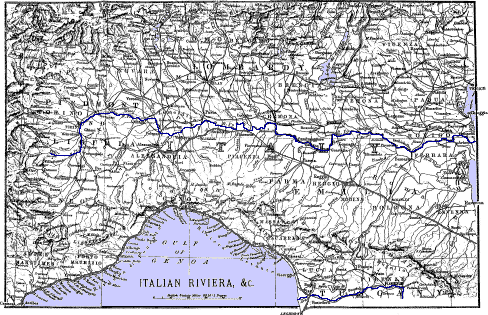
THE ITALIAN RIVIERA, or Menton to Genoa.
By Ventimiglia, Bordighera, San Remo, and Savona.
Distance 100½ miles. See accompanying Map.
GENOA 100½ MENTON. The road from Menton to Genoa crosses the frontier at the bridge of St. Louis, spanning a ravine 215 ft. deep.
6½ m. E. from Menton by the carriage-road, passing the village of Mortola, and traversing the Piano di Latte, is
MENTON GENOA 6¾ 93¾ VENTIMIGLIA, pop. 8500, on a hill at the mouth of the Roja. Inns: near station, the Hôtel Suisse; in the low town, the Hôtel Tornaghi. All the trains halt here ¾ of an hour, and luggage entering France or Italy is examined. The new station is commodious. At one end of the luggage-room is a clock with Paris time, and at the other one with the time of Rome, 47 minutes in advance of Paris. The waiting-rooms, “Sale d’Aspetto,” cloak-rooms, “Camerini di Toeletta,” and the refreshment rooms are all at the French end, as well as the way out to the train. The town is well seen from the station. The church occupies a prominent position; and close to it, in the Via Lascaris, are the post office, theatre, and the best café. The walk up this same Via to the town-gate shows the best part of the town, while the avenues in continuation beyond it lead up to the best sites for views. Not far from the station, on the right bank of the Nervia, on a large sandbank, are the remains of a theatre and of a cemetery, which probably mark the site of the ancient Albintemelium. What remains of the theatre is composed of large blocks of greenstone from the quarries of Mortola. The excavations have been carried on under the direction of the inspector of historic monuments in the province. Omnibus between Ventimiglia and Bordighera. Diligence once daily between Ventimiglia and Tenda, p. 183.
Bordighera.
MENTON GENOA 10 90½ BORDIGHERA, pop. 2800. The old town, the Bordighera di sopra, is compactly built on the summit of the eminence rising from the cape S. Ampeglio, whose sides are covered with olives and palms. Down below, on almost a level with the sea, is the low or new town, where most of the invalids reside, though it is doubtful if the site is well chosen. Hotels: the best is the ¹*H. Angleterre, a first-class house in a garden, near the station. Similarly situated is the
The great feature of Bordighera are its plantations of palms, whose tufted tops wave above the more lowly lemon trees laden with pale yellow fruit, while the whole of the background is crowded with vigorous olive trees. Some of the palms are 800 years old. The lemon, after the olive, is the most profitable tree.
To the Tower of Mostaccini, 1½ hr. there and back, by the Strada Romana, till near Pozzoforte, where ascend by path right hand. This tower, of Roman origin, and still in excellent preservation, served as an “avisium” or watch-tower in the Middle Ages. From it is obtained a delightful view of part of the coast.
Isola Buona.
2½ m. west from Bordighera is the commencement of the valley of the Nervia, 16 m. long from north to south, with a varying breadth of 1½ to 2½ m. A good carriage-road extends all the way up to Pigna, 11 m. from Bordighera. On this road, 1½ m. up the Nervia, or nearly 4 m. from Bordighera, is Campo-Rosso, on the Nervia, at its junction with the Cantarena, pop. about 250. It possesses two churches, both 12th cent. St. Pierre has frescoes, 15th cent., on principal entrance and on the sacristy, also some pictures attributed to Brea of Nice. The confessionals are in the gallery. From Campo-Rosso a bridle-path leads up to the top of the hill, on which is the chapel of Santa Croce, commanding an extensive view. About 2 m. farther up the valley is Dolce-Acqua, on both sides of the Nervia, crossed here by a stone bridge with a span of 108 ft. Over the village, consisting of houses crowded together and piled above each other, rises the imposing feudal castle of the Dorias, reduced to its present dilapidated condition by the Genoese in 1672. 2¼ m. from Dolce-Acqua, or 8½ m. from Bordighera, is Isola Buona, pop. 1200, with paper and olive mills, heath pipe manufactories, and cold sulphurous springs. From Isola, a little way up the Merdanio or Merdunzo, is Apricale, pop. 1000. South from Apricale is Perinaldo, the birthplace, 8th June 1625, of Giovanni Domenico Cassini, the most famous of a family distinguished as astronomers, who succeeded one another as directors of the observatory at Paris for four generations.
Pigna.
A little more than 11 m. from Bordighera is Pigna, on the Nervia,
The most pleasant of the drives is to San Remo, 6¾ m. N.E., by Ospedaletti. About a mile from the E. side of Cape S. Ampeglio is the hamlet of Ruota, with a small chapel containing a group in alabaster representing the Annunciation. A short way farther a path descends from the road to a house on the beach in a luxuriant garden of palm and lemon trees. At the inner end of this orchard, near the railway, is an excellent sulphurous spring, temp. 70° F. After this the Corniche road bends round to Ospedaletti (see below). On the hills behind Ospedaletti, about 2 m. N., is La Colla, 1000 ft. above the sea. In the Town Hall is a valuable collection of 120 paintings, mostly by great Italian masters, such as Frà Bartolomeo, I. Bassano, F. Barocci, A. Carracci, Caravaggio, Cortona, C. Dolci, Domenichino, Sasso Ferrati, Reni, Salvator Rosa, Andrea del Sarto, and Spagnoletti. In another room is the library. The pictures and books were collected by the Abbé Paolo Rambaldi during his long stay at Florence, who at his death (1864) bequeathed them to this his native city. In the sacristy of the parish church is a beautifully-carved ivory crucifix, bequeathed, along with some other articles, by the Prelate Stefano Rossi, also a native of this quarter. A coach with 2 horses from Bordighera to La Colla and back costs 20 frs.
La Colla is the native town of the sea-captain Bresca, who, contrary to the orders of Pope Sixtus V., broke the silence by calling aloud to “wet the ropes” when the obelisk was being raised in front of St. Peter’s. 2 m. E. from La Colla is San Remo, which is 3 m. from Ospedaletti.
The climate of Bordighera is similar to that of San Remo; but as a residence it is more rural and has fewer resources. The mistral at Bordighera, instead of being a north-westerly wind, deviates by the configuration of the coast into a west wind.
Bordighera supplies Rome with palm-leaves for the Easter ceremonies, as also the Israelites in Germany and Holland for the feast of Tabernacles.
Ospedaletti.
MENTON GENOA 13½ 87 OSPEDALETTI, pop. 1000, a small village with nearly a mile of frontage towards the sea, from which it is separated by the railway. In the village is the ²H. and P. Ospedaletti, room 40 frs. the month.
San Remo. Hotels.
MENTON GENOA 16½ 84 SAN REMO, 16¼ m. E. from Menton by the coach-road, pop. in winter 18,000. As Italy is entered it will be observed that the women, the maidens and their mothers, are the hewers of wood and drawers of water, and that to their lot falls the menial work of the most laborious trades.
Hotels.—Those with the figure ¹ are first-class houses, with ² second-class. The asterisk signifies that they are especially good of their class. Commencing at the railway station and going eastward by the principal street, the Via Vittorio Emanuele, we have the ¹G. H. de la Paix, close to the station and fronting the public garden. Then follow the ²H. and P. Nationale, 7 to 8 frs.; the ¹*H. San Remo; the ²P. Suisse; the Rubino Bank; the Squire-Pharmacy; the Asquasciate Bank; the Vicario Store; the ²P. Molinari, and the ²H. Bretagne, frequented principally by commercial travellers. Behind Squire’s is the Episcopal Chapel, and a little farther west, left hand, the Post Office.
On the Corso Garibaldi, the eastern continuation of Via Vittorio Emanuele, are the ¹H. Nice and the ¹*H. Angleterre. Near the Angleterre are the Pensions ²*Allemagne; ²Rossi; and ²Lindenhof; and the Home for invalid ladies of limited means. Twenty-five shillings the week; which, as at the similar institution at Menton, includes doctors’ fees, comfortable living, wine or beer, and everything except washing and fire in bedroom. For particulars apply to Messrs. Barnetts & Co., bankers, 62 Lombard Street, London.
At the end of the corso are two large houses in gardens, with one front to the sea and the other to the road—the ¹H. Méditerranée and the ¹*H. Victoria. Near the harbour, behind the Via V. Emanuele, are the ²*Beau-Séjour with garden, and the H. Bains.
At the west end of San Remo are some good houses, mostly on eminences in gardens. Taking them in the order from E. to W. we have the ²P. Anglo-Americaine; the Presbyterian Chapel; the ²P. Tatlock (German); ¹*Hôtel Royal; ¹*Belle-Vue; ¹Paradis; ¹*Londres; ¹Pavillon (moderate); ¹Anglais; ¹Palmieri; and the ¹*West-End, the most important hotel on this side of San Remo, and situated at the commencement of the pleasant walk by the Strada Berigo. In the first-class hotels the pension is from 9 to 18 frs., in the “pensions” from 7 to 11 frs.
Omnibuses run between the two ends of the town; also between San Remo and Bordighera; San Remo and Taggia by Bussana; San Remo and Dolce-Acqua; and San Remo and Ceriana, 6½ m. N. (see map, p. 165).
Cab Fares.—The course, 1 horse, 1 fr. during the day, and 1½
San Remo: Climate.
Old San Remo is built on two hills, and the modern town at the foot of these hills, on the Nice and Genoa road, called at this part the Via Vittorio Emanuele, where are now all the best hotels, restaurants, booksellers, confectioners, and dealers in inlaid woods. “The mean temperature is 49°.1 Fahr. (Sigmund), nearly as high as Dr. Bennet’s estimate of that of Menton; while it would appear, from a comparison of the thermometrical tables kept by Dr. Daubeny with those of Dr. Bennet for the same winter, that the range of temperature at Menton is nearly 3° more than at San Remo. The climate is warm and dry, but from the protecting ranges not rising precipitously as at Menton, the shelter from the northerly winds is less complete. At the same time the vast olive groves screen the locality from cold blasts and temper them into healthful breezes, imparting a pleasing freshness to the atmosphere, and removing sensations of lassitude often experienced in too well-protected spots. The size of the sheltered area gives patients a considerable choice of residences, which can be found either close to or at varying distances from the sea, according to the requirements of the case; while the numerous wooded valleys, abounding in exquisite wild flowers, provide plenty of donkey and foot excursions.” —Williams’ Winter Stations.
San Remo has many pleasant walks, in valleys full of lemon trees, as at Menton, or up mountains covered with olive trees, generally on terraces built up with low stone walls without plaster.
San Remo: Drives. Poggio. Madonna Della Guardia.
The best of the drives is to the Madonna della Guardia, on Cape San Martino, by the village of Poggio, and back by the coast-road. From the Hôtel Victoria the Corniche is continued till arriving at a part where the road divides into two; one descends, the other ascends; take the latter, which an inscription on a marble slab indicates to be the “Strada Consortile de San Remo à Ceriana.” This road ascends through olive trees to Poggio. Just before entering Poggio, the carriage-road to the Madonna strikes off to the right by the east side of the promontory, while a stony bridle-path goes right over the centre. The town seen on the opposite side of the valley is Bussana. Poggio, one of the many wretchedly poor villages, has two churches. The road, which has ascended all the way from San Remo to Poggio, still continues to ascend by the Ceriana valley to Ceriana. Inn: H. Etoile d’Italie, 6½ m. from San Remo, commanding ever-extending views, which, together with the profusion of wild flowers, form the principal Ceriana and back, 14 frs.; 2 horses, 20 frs., with ½ hr. rest. The Madonna road from Poggio is nearly level. The chapel, with a few tall cypresses, stands at the extremity of Cape San Martino. The prospect is extensive. To the east are, on the coast, Arma, Riva, San Stefano, and in the distance San Lorenzo. On the hills behind them are Bussana, Pompeiana, and Lingueglietta. Behind is Poggio. To the west are San Remo, La Colla, and Bordighera. Cab with 1 horse to the chapel and back, 7 frs.; 2 horses, 10 frs., with ½ hr. rest (see maps, pp. 163 and 199).
A good carriage-road, commencing near Cape Nero, leads up to La Colla, on one of the spurs of the Piano del Carparo, 1000 ft. above the sea, and 2 m. from San Remo, by the bridle-path. Cab with 1 horse, 8 frs.; 2 horses, 12 frs., with ½ hr. repose. See page 199.
San Romolo.
St. Romolo to Monte Bignone.
One of the most frequented excursions is to San Romolo, 1700 ft. above the sea, and 4 m. northwards, either from the Place St. Etienne, or the Place St. Sir. Donkey, there and back, 5 frs. San Romolo consists of some villas, an old convent, and a chapel, built over the cell which was inhabited by the hermit St. Romolo. It commands splendid views, and from it the ascent is made of the Piano del Ré, a ridge 3500 ft. above the sea, between Mounts Caggio or Cuggio and Bignone. To reach the ridge, descend a short way the Romolo road, then take the path to the left, and make for the corner next Monte Bignone, whence the bridle-path ascends to the summit, 4235 ft. above the sea, 5 hrs. from San Remo, or about half that time from San Romolo. “In making the ascent of Monte Bignone, it is always safest to be accompanied by a guide. For those who are strong the ascent on foot is the pleasantest, but the road is quite practicable for sure-footed donkeys, although in places it is somewhat trying for those whose nerves are not strong. The whole route is exceedingly beautiful, glorious prospects meeting the eye at almost every turn; the path sometimes traverses forests of fir trees, with amongst them innumerable bushes of the bright-leaved holly, at others it runs along the edges of steep ravines and precipices: many curious and rare wild flowers attracting the eye on the way; till at length, after an ascent of about two hours from San Romolo and four from San Remo, the broad sloping and grassy summit of the mountain is reached. Continue the ascent until its highest point, marked by a stone obelisk, is gained, and from which one of the most magnificent prospects imaginable Nervia, see p. 201, and map, p. 165.)
View from Monte Bignone.
“It is impossible to convey in words anything like a correct idea of the splendour of the prospect on a clear day from Monte Bignone; it must be seen to be appreciated; it has been described as one of the finest in Europe. The excursion is one which may be safely undertaken with ordinary precautions, and is within the compass of any person of fair health and strength. An additional charm consists in the number of rare and beautiful wild flowers, which are different from those found at a lower elevation. Amongst the most noticeable of these is the blue Hepatica, Anemone, Hepatica L., a pink variety of which is sometimes met with, the pink cyclamen-like flower, Erythronium Dens Canis L. with its trefoil-like and spotted leaves; in shady places the Primrose, Primula acaulis All.; everywhere over the summit San Remo and the Western Riviera, by Dr. Hassall.
San Remo to Taggia, there and back, cab, 1 horse, 8 frs.; 2 horses, 12 frs., with ½ hr. rest; by coach, 2 horses, for the day, 20 frs. Or from San Remo by rail to Arma, whence omnibus to Taggia, 10 sous. Donkey from Taggia to Lampedusa, 2 frs. The best place for refreshments in Taggia is the Albergo d’Italia, formerly the palace of the Marquis Spinola. The stream Taggia or Argentina is crossed by a long curved bridge of unequal arches. From the east end of this bridge a steep road leads up to the town of Castellar, whence a well-kept path ascends to the chapel of the Madonna di Lampedusa. From both places there are charming views. The Taggia road ascends the valley the length of Triora, by the village of Badalucco.
Taggia.
MENTON GENOA 21½ 79 TAGGIA, pop. 5000, on the Giabonte, 3 m. from the station. An omnibus awaits passengers (½ fr.) In Taggia it halts at the Locanda d’Italia, at the termination of the Via Curlo; whence commences the road to Castellar, situated upon a hill on the opposite side of the river, and about ½ hour’s walk from Taggia. Castellar is visited on account of the gaudy sanctuary and the view from the hill. Taggia, though a poor dirty town, with steep, narrow, and slippery streets, has two very fair churches. At No. 1 Via Soleri—the principal street in the town—is the habitation of Giovanni Ruffini (Dr. Antonio). To reach it, on entering the town, after having passed through the archway, take the street to the left, the Via Ruffini, then, first left, the Salita Eleonora. On the beach, near the Taggia station, is the little port of Arma, with the ruins of a fort built in the 15th cent. 2 m. farther east by rail is San Stefano, pop. 600, at the foot of Mont Colma, with a climate like that of San Remo.
Porto Maurizio. Oneglia.
MENTON GENOA 31 69½ PORTO MAURIZIO, pop. 8000. Hotels: France; Commerce.
Porto Oneglia, pop. 8000, H. Victoria, on the opposite sides of a small bay. The most important part of San Maurizio is the high town, Oneglia, about a mile distant, beautifully situated at the mouth of the Impero. This is the birthplace of Admiral Andrea Doria, 1466. After passing through a long tunnel we reach the Port of Diano Marina. The broad valley inland up the Piètro is covered with fine olive trees. Farther east is Cervo, on an eminence overlooking the station and the sea. Then Laigueglia, with gardens full of orange trees. From Laigueglia a fine smooth beach extends all the way to
Alassio.
Alassio, pop. 5000, a new winter station, 44½ m. east from Menton, and 56 m. west from Genoa, built along the beach, and nearly surrounded by a high wall, with at both ends a suburb beyond the walls. Hotels: H. et P. Suisse, opposite station, 6 to 9 frs. On the beach at the E. end, the *G. H. Alassio, 8 to 9 frs. On the beach at the W. end, the H. Méditerranée, 6 to 8 frs. Near the station, the Episcopal chapel.
Alassio and its neighbour Laigueglia are partially protected from some of the cold winds by low but compact mountains belonging to the chain of the Ligurian Alps. Pleasant walks and well-paved causeways extend up the hills, while along the coast are pretty drives to Loano and Ceriale, or up the valley westwards from Albenga. Around both towns are many large carouba and orange trees. Palms are less abundant. Between Alassio and the next station, Albenga, is the small island of Gallinaria, with a castle on the summit of the hill.
Albenga.
Albenga is 4 m. N. from Alassio, on the Caprianna, and at a little distance from the coast. Hotels: Hotel d’Albenga; Italia; Vittoria. Their omnibuses await passengers. This, the ancient Albium Ingaunum, the birthplace of the Emperor Proculus, is situated on low ground, in a broad valley watered by the Caprianna. Around Albenga are many deciduous trees, and here and there in the sheltered spots orange and lemon trees trained as espaliers. A good carriage-road
After Albenga follow Loano, pop. 3800, pleasantly situated on the beach at the foot of a gentle sloping hill, and Pietraligure, on the Isola, pop. 1000, a sheltered town, with abundance of palms, orange, and lemon trees, principally at the eastern end, round the cape.
Finalmarina. Noli.
MENTON GENOA 59½ 41 FINALMARINA, pop. 3500. Hotel: Garibaldi. The church of St. John the Baptist, after the design of Bernini, is richly ornamented with marbles of various hues, mingled with rich gilding and bright frescoes, presenting a grand combination of gorgeous colour. In Final Borgo is the church S. Biaggio, resplendent also with colour, but more subdued. The pulpit and altar display most delicate workmanship. There is a great deal of fine scenery in the neighbourhood, and pleasant walks in the valleys, and up the heights to the numerous dismantled forts (15th cent.), and to the Castello Gavone, a picturesque ruin. Five miles N. from Finalmarina is Noli, pop. 1000, Inn: Albergo del Sole, at the commencement of the arcade, fronting the beach. This curious town, formerly a republic under the protection of Genoa, is still partially surrounded by walls garnished with rectangular towers. It is pierced from E. to W. by narrow parallel streets, the best being the Via Emanuele II., which commences at the beach on E. side by the clock-tower, near the inn, and traverses the town to the W. side by the new church. The continuation, outside the town, the Via Monasterio, leads up to the mountains covered with vines, olives, and maritime pines. On the top of the hill are the ruins of Noli castle, with walls garnished with circular towers. The old church, 11th cent., is near the station. Fishing is the chief industry. A beautiful road, 2 m. N. by the coast, leads to Spotorno.
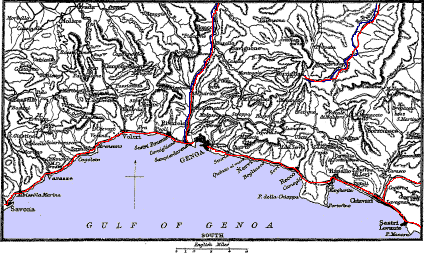
GENOA and SAVONA to SESTRI-LEVANTE
Savona.
MENTON GENOA 74 26½ SAVONA, pop. 17,000. Hotels: Suisse, a large house in the Piazza di Teatro; *Roma, under the Arcades; and the Italia, opposite the Suisse. In the ancient seaport of Savona, Mago the Carthaginian deposited his spoils after the capture of Genoa. The greater part of the town is now modern, consisting of handsome gardens, boulevards, and well-paved broad streets lined with massive arcades, and substantial houses built in enormous square blocks of from four to five stories high. The rock, the Rupe di S. Giorgio, on which the acropolis formerly stood, is occupied by the castle, and pierced by an elliptical tunnel. At both ends are small harbours with shallow water. The Cathedral, built in 1604, is, in the interior, entirely covered with ornamental designs in different shades of brown and orange, relieved here and there by stripes of gilding. The two large frescoes in the choir, and the other at the western end, are by V. Garrazino. In the last chapel, N. side nearest the altar, is a triptych by Brea, 1495. Near the Cathedral, in the Sistina chapel, is the tomb of the parents of Pope Sixtus IV., the uncle of Julius II. In the church of San Domenico there is in the first chapel, left on entering, a “Nativity” by A. Semini. The figure of the Virgin appears rather large, but the contour and expression of the others are admirable. In another chapel on the same side of the church is an “Adoration of the Magi” by Albert Durer, in the form of a triptych. In a small church, called the Capella di Christo, over the altar within a niche, is a wooden figure of our Lord, said to be 800 years old. In the sacristy are two reliefs in black marble from 400 to 500 years old. The Emperor Pertinax, and the Popes Gregory VII., Sixtus IV., and Julius II., were born in or in the neighbourhood of Savona. 4 m. from Savona by coach and rail is the sanctuary of Nostra Signora di Misericordia. The church, built in the 16th cent., is covered with precious marbles, and ornamented with paintings by Castello, the intimate friend of Tasso. At Savona junction with line to Turin, 91 m. northwards (see p. 183).
Albissóla.
MENTON GENOA 77 23½ ALBISSÓLA, pop. 2000, on the Sansobbia. This town is about a mile from the Port or Marina. 4½ m. farther eastwards by rail is Varazze, pop. 10,000, a pleasant town at the head of a large bay. A little shipbuilding is carried on here. Beautiful palm, lemon, and orange groves. This is the birthplace of Jacopo di Voragine, the author of the Golden Legend, the reading of which was the principal means of transforming Ignacio Loyola from an intrepid soldier into a zealous missionary. Between Varazze, 64 m. N.E. from San Remo, and Arenzano, 6¼ m. N.E. from Varazze, is another favoured part of the Riviera, sheltered by a ridge of most picturesque hills, of which Monte Grosso (1319 ft.) is the culminating point. The road here passes through firs, umbrella pines, carouba trees, cypresses, evergreen oaks, arbutus trees, and some fine shrubs of Phillyrea angustifolia, with here and there just enough olive trees to afford evidence of the comparative mildness of the climate. About half-way between Varazze and Cogoleto is the village of Inoria.
Cogoleto. Columbus.
MENTON GENOA 85 15½ COGOLETO, pop. 1000. From the station walk down to the town; and on reaching the main street, the Via Cristoforo Colombo, house of Columbus, with the following inscription:—
Hospes, siste gradum. Fuit hic lux prima Columbo; Orbe viro majori heu nimis arcta domus! Unus erat mundus. Duo sunt, ait iste. Fuere.
It consists of three stories, with one side fronting the sea, and the other the main street. The rooms are small, and with arched roofs. That in which Columbus was born (1435) is on the first story. Fronting the adjoining room is a large balcony overlooking the Mediterranean, where it is possible the boy Columbus learned to conceive the idea of a continent beyond the Atlantic by having been accustomed to gaze on this sea at his feet, with the knowledge that beyond it there lay the vast continent of Africa. Although his parents were in humble circumstances, they were descended from a family belonging to the most illustrious nobility of Piacenza, who had lost their estates during the wars of Lombardy. Boatbuilding and fishing are the principal industries of Cogoleto. Map, p. 199.
Arenzano. Pegli.
MENTON GENOA 87¼ 13¼ ARENZANO, pop. 5000. *H. Arenzano, 7 to 8 frs., near station. One of the cleanest towns on the Riviera, pleasantly situated in a picturesque country and commanding extensive views of the coast. The road between Arenzano and Cogoleto passes by Monte Grosso.
MENTON GENOA 91¾ 8¾ VOLTRI, and the next town, Pra, may be called one. Paper-making and shipbuilding are the principal industries. Map, p. 199.
MENTON GENOA 95 5½ PEGLI, pop. 1000. A winter station. The largest hotel is the *H. Pegli et de la Méditerranée, with one side to the sea and the other to the public garden and English chapel. Pension in winter, 9½ to 15 frs. On the beach the H. Gargini, second class. Pegli is a quiet little village, prettily situated on the sea, and among hills. It has constant communication by tram and rail with Genoa, and is visited on account of the grounds around the Villa Pallavicini, ornamented with statues of Roman divinities, temples, triumphal arches, huts, and an obelisk. But the remarkable object is the artificial cave, covered with large stalactites, in the midst of a lake 5 feet deep, surrounded by evergreen shrubs and trees so arranged as to produce wonderfully pretty vistas. At one part the edge of the lake seems to join the sea, although many miles distant. All this has been created on the formerly sterile side of a hill, where almost nothing would grow from the want of water and of soil. Water was brought from a great distance, and caused to tumble down the mountain in cascades
Sestri-Ponente. Cornigliano.
1¾ m. E. from Pegli and 3¾ W. from Genoa is Sestri-Ponente, pop. 10,800. Hotel: *G. H. Sestri, 8 to 12 frs., with commodious bathing establishment at the foot of the garden. The beach, composed of small pebbles, has a rapid slope. Good sea water can be brought to bedroom every morning. The station is near the hotel, and the trams pass by the gate. The interior of the parish church is superbly gilt and covered with frescoes. Just under the wide spanned roof are painted statues of the patriarchs and prophets. Sestri makes a better winter station than the next town, Cornigliano, *H. Rachel, 9 to 12 frs., with sheltered garden, 2½ m. W. from Genoa. Both of these towns are considered from 4° to 5° colder than Menton. The tram passes the garden gate of both hotels. After Cornigliano the tram and train traverse the populous suburb of Sampierdarena and arrive at Genoa. The principal railway station is at the W. end of Genoa. The Piazza Annunziata is the terminus of the Pegli, Sestri, and Cornigliano trams.
Genoa.
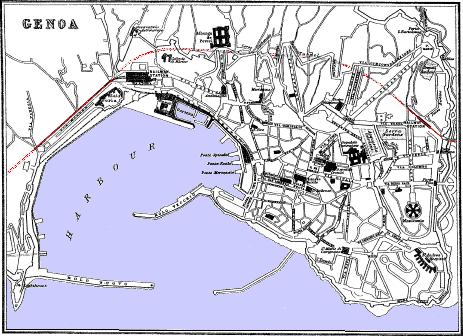
MENTON 100½ GENOA, pop. 145,000. The hotels most conveniently situated for visitors are the G. H. de Gènes, 9 to 15 frs., in the Piazza de Ferrari, opposite the theatre and the post office; the *G. H. Isotta, 10 to 15 frs., No. 7 Via di Roma, parallel to the glass arcade, and also near the post; the *Londres, 9 to 10 frs., near the station; the Victoria, in the Piazza Annunziata, and the H. Étrangers, No. 1 Via Nuovissima. The above are in a line with the palaces, and cost 8 to 10 frs. Down in the port in the Via Carlo Alberto, and most conveniently situated for those who have to embark, are—taking them in the order from W. to E.—the Croix de Malte, the H. de la Ville, the H. Smith, the *H. Trombetta, and the *France. They charge from 8 to 14 frs. By the side of the last two hotels is the Bourse, and in the neighbourhood of the Bourse are the best money-changers.
For Genoa to Turin, see p. 279.
Anglican church in the Via Goito, a small street leading northwards from the Acqua Sola Promenade. In the same neighbourhood is the broad street Via Assarotti, with at No. 37 the Valdensian and Presbyterian churches. Shops for filigree work in gold and silver in the Via degli Orefici by the side of the Bourse, and at the foot of the Sestiere
Genoa: Cafés. Cabs. Steamers.
Cafés.— *Café Roma, by the Teatro Carlo Felice; *Stabilimento delle Nazioni, Via Roma; *Concordia, Via Garibaldi. The principal sights are the church of the Annunziata, p. 212; the Cemetery approached by the Staglieno omnibus from the Piazza de Ferrari; the Palaces between the railway station and the Piazza Nuova. The church of Santa Maria in Carignano, approached by the Carignano omnibus from the Piazza de Ferrari, passing through the Acqua Sola Gardens, 138 ft. above the sea (p. 218). North from the Acqua Sola is the Villa Negro, containing the Museum of Natural History. The best of the drives is along the Via di Circonvallazione.
Florio-Rubattino have steamers to Bastia (Corsica), Cagliari, Civita-Vecchia, Leghorn, and Porto Torres, in the north of Sicily. Peirano, Danovaro, and Co. have steamers to Ancona, Brindisi, Catania, Gallipoli, Leghorn, Messina, Naples, and Triest. For the English steamers between Liverpool, London, and the ports of the Mediterranean, apply to Lertora Fratelli, No. 2 Via S. Lorenzo.
1-horse cabs—the course, 1 fr.; the hour, 1½ fr.; every successive ½ hour, 80 c. 2-horse cabs—the course, 1½ fr.; the hour, 2 frs.; every successive ½ hour, 1 fr. Boats to and from the steamers, 1 fr. each. Rail from Genoa to Turin, 104 m. N.W. (p. 279).
Post Office in the Galleria Mazzini. Telegraph Office in the Palazzo Ducale. Best money-changers near and around the Bourse.
Genoa is singularly constructed around a small bay on shelving ground, rising rapidly from the water’s edge to the height of from 500 to 600 feet. The old part of the town is a labyrinth of crooked streets from 6 to 12 feet wide, and frequently so steep that steps have to be cut in them. The most remarkable of the new streets is the Via di Circonvallazione, composed of a series of lofty terraced “corsos” skirting the face of the hills, commencing at the E. end from the Piazza Manin, 330 ft. above the sea, and extending westward in a zigzag form to the railway station by the Albergo dei Poveri. They are reached from the upper ends of the Vias Palestro, Mameli, Caffaro, and Brignone di Ferrari, by ramps and long stairs. The palaces, another feature of Genoa, are large gaunt mansions, all similar in style—gates 40 feet high, with marble columns—courts paved with various coloured marbles—broad staircases, all of marble—rooms 30 feet high with arched ceilings, and adorned with gilded columns, large mirrors, crystal lustres, and mosaic floors; the roofs panelled, and the panels
Genoa: Palaces. Palazzo Doria.
The visiting of the palaces is rather fatiguing, as the best works of art are preserved in the upper stories, reached by splendid but lofty staircases. The best two are close to each other, the Palazzo Durazzo Pallavicini, No. 1 Via Balbi, and the Palazzo Rosso, No. 18 Via Garibaldi. They contain specimens of everything for which the palaces are remarkable. A fee of 1 fr. is sufficient to leave with the keeper of the gallery. Most of the palaces have each of the rooms provided with a list of the pictures and frescoes it contains printed on a card, which makes the visitor quite independent of the servants and guides.
As there are so many places to visit between the railway station and the cathedral, the best plan is to do that portion on foot, and after having visited the cathedral, to take a cab from the stand at the foot of the Via S. Lorenzo, and drive by the Via Vittorio Emanuele, round by the ramparts, and up the Via Rivoli to the church of Sta. Maria di Carignano.
The only palace west from the station is the Palazzo Doria, reconstructed by Montorsoli, 1525, and decorated and embellished by Perino del Vaga, a pupil of Raphael’s, and a contributor to the paintings in the Vatican. Perino’s best works here are Jupiter defeating the Giants, in the principal hall, and the Triumph of Scipio, at the entrance. In the centre of the garden is a fountain representing Andrea Doria as Neptune, with his Sea-horses, by P. Carlone. In the garden, on the other side of the railway, are a colossal statue of Hercules, erected by Doria, and a monument to the memory of his dog Rolando, given him by the Emperor Charles, who conferred upon him the title of “Il Principe.” The tomb of Andrea Doria is in the church of San Matteo, and over the altar the sword presented to him by Paul III.
Genoa: Via Milano.
Adjoining the Doria palace is the Via Milano, a terraced promenade lining the western side of the harbour, as the less beautiful but more costly terrace by the Via Carlo Alberto lines the eastern front. Walking eastward from the station the first large building is the Royal Palace, No. 10 Via Balbi. This palace, formerly the property of the Durazzo family, was erected after the plans of P. F. Cantone and J. A. Falcone, while the staircases and terraces, which have been so greatly admired, were by the Chevalier Charles Fontane. The accommodation is extensive, but the rooms are small, excepting the principal
The Balbi Palace, No. 4 Via Balbi, built after the plans of B. Bianco, and improved by P. A. Corradi, contains a large collection of paintings—among others a Lucrecia, Cleopatra, and a St. Jerome, by Guido; St. Jerome, a Virgin, and Jesus scourged, by Tizziano; a St. George and St. Catherine; and the Infant Jesus, by Correggio.
Genoa: P. Durazzo Pallavicini.
No. 1 Via Balbi is the P. Durazzo Pallavicini, one of the most important to visit. The architect was B. Bianco, but the vestibule and staircases (considered the finest in Genoa) are by A. Tagliafico. The paintings are almost entirely by Italian masters, such as Molinaretti, Guercino, Franceschini, Leida, Carracci, Lanfranco, Procaccini, Cappuccino, Langetti, Castelli, Ferrari, Vercelli, Reni, Merone, Cogorano, Zanotti, and Merighi. In the first room there is a valuable triptych by A. Durer, and the gem of the collection, James I. of England and Family, by Van Dyck. In the reception room are other three choice works by the same master. The frescoes on the roofs are by Boni, Piola, Davolio, and Bazzani. In each room there are cards with the names of the artists and subject.
From the Via Balbi we pass into the Piazza dell’ Annunziata, with, on the left hand, the church of that name, the most sumptuous in Genoa, built in 1228 by the Monaci Umiliati, but altered and left in its present state by the Conventurati in 1587. The façade, supported on six stately marble columns, is unfinished. The interior is full of beauty, and resplendent with glowing colours harmoniously blended. Over the entrance is Procaccino’s masterpiece, the Last Supper. The frescoes on the cupola are by A. Ansaldi, those on the choir by J. Benzo, and the remainder principally by the Carloni. Among the other beautiful things are the angels supporting an altar, the spiral pillars in the apse, and the elegant columns of the nave. In front of this church trams start for Cornigliano, Sestri Ponente, and Pegli every 10 minutes.
We now pass along the Via Nuovissima, and at No. 6 descend to San Siro, which was the cathedral church of Genoa till 985. The high altar is by Puget. The fresco on the roof by G. B. Carlone. The marble columns are all of one piece. Near San Siro, in the confined little square No. 6 Piazza Pellicceria, is the Palazzo Spinola, with many beautiful paintings, such as the Martyrdom of St. Barthélemy and St. Laurent by Ribera, the Four Seasons by Bassano, Virgin and Child by Guercino, a Magdalene by Guido, St. Anne and the Virgin
Genoa: Palazzo Rosso.
In the Via Garibaldi, No. 18, is the Palazzo Rosso (Galleria Brignoli), with a small but valuable collection of pictures by Italian masters, distributed among the rooms denominated Spring, Summer, Autumn, and Winter. The frescoes on the roofs are by Toila, Ferrari, and Carloni. It contains also a good library.
No. 9 Via Garibaldi is the Municipicio or City Chambers, a splendid building, entirely of marble, and covered with frescoes representing incidents in the history of Genoa. All the rooms and galleries are open to the public excepting the council-chamber, the Sala Rossa, and the Sala Verde. In the first hall (the council-chamber) is a portrait of Columbus in mosaic, and on the roof a fresco representing him in the presence of Ferdinand and Isabella. In the second, among other paintings, is a triptych ascribed to A. Durer, and in the third (the Sala Verde) a beautiful bust of Columbus. The architect was Rocco Lugaro, the ornaments and figures over the windows are by G. T. Carlone, and the frescoes by Pavarone, Paganelli, Passano, and M. Canzio.
Genoa: Palazzo Serra.
At No. 12 Via Nuova is the P. Serra, built, like most of the other palaces in this street, about the year 1552, by the celebrated architect Galeazzo Alessi. The size and distribution of the principal apartments are excellent, and many are beautifully ornamented in fresco by the brothers Semini, particularly the ceiling in the first antechamber, representing the funeral games instituted by Æneas in honour of Anchises. The dining-room was the work of the famous Genoese architect Tagliafico, and is greatly admired for its simplicity and good taste. But the greatest object of attraction in this palace is the grand salon, shining with gold. Along each side are columns of marble gilt, alternating with lofty mirrors reaching from the floor to the roof. The architraves and panels are curiously carved and gilt. The fresco on the roof is by Leon, and represents the triumph of Spinola over the Turks. The roof of the next room was painted by A. Semini.
The Palazzo Adorno, No. 8 Via Garibaldi, contains a good though smaller display of paintings and frescoes. The same may be said of No. 5 in this same street, the P. Spinola.
At No. 6 Via Garibaldi is the P. Doria, with a handsome portico and splendid halls containing a choice collection of paintings by
The second street left from the P. de Ferrari leads to S. Matteo, built in 1278, but altered in 1530 by G. A. Montorsoli at the request of Andrea Doria, relating to whose family are the numerous inscriptions on the church. Over the altar is his sword. The “palaces” in front of the church belonged to the Doria family.
Genoa: S. Ambrogio. Cathedral.
In the Piazza Nuova is S. Ambrogio, entirely covered with beautiful marbles and adorned in much the same style as the church of the Annunziata. Among other paintings it contains a large picture of the Assumption by G. Reni, third chapel right; St. Ignatius healing one possessed of devils, by Rubens; and over the high altar, by the same master, the Circumcision. The frescoes in the cupolas are by Carloni and Galeotto. The large building to the right is the former Ducal Palace, now the government house. The grand reception room up stairs is ornamented with 54 columns of Brocatello marble, with bases of Siena marble. From the windows is seen the tower of the Embriarci, constructed by Guglielmo Embriarco, the inventor of the movable wooden towers used by Godfrey de Bouillon in his attacks upon Jerusalem.
On the other side of the Ducal Palace is the Cathedral, built in the 11th cent., but repeatedly restored. The exterior and interior are of black and white marble in alternate bands. The façade consists of three large portals resting on spiral, plain, and twisted columns. The arch of the centre porch has an immense span, bordered by bold fascicled work, while over the doorway is the Martyrdom of St. Laurence in relief. In the interior there is a strange mixture of styles. The nave is separated from the aisles by sombre coloured pillars supporting pointed arches, over which runs a series of round-headed arches. The roof of the choir has frescoes by Teverone. The marquetry of the stalls was executed in the 16th cent. The leading feature, however, in this church is the chapel of St. John the Baptist, in the centre of the left aisle. It was built in 1490, and ornamented with statues by G. Porta and M. Civitali, of which the best are those representing Zacharias in his official robes, Elizabeth, and Habakkuk. Under a canopy supported by four porphyry columns is the shrine by D. Terrano (1437), said to contain the ashes of John the Baptist, brought from Mirra in
Below the cathedral at the foot of the Via S. Lorenzo is a cab-stand, whence drive by the church of Carignano and the Acqua Sola Gardens to the Via di Circonvallazione, commanding a series of beautiful views of Genoa. From the P. de Ferrari an omnibus runs to Carignano, passing through the Acqua Sola Gardens, 30 c.
Genoa: S. Maria. Campo Santo, or Cemetery.
S. Maria in Carignano, built 1555-1603 after designs of Galeazzo Alessi, is 165 ft. square, and 174 ft. above the sea. The statues above the entrance, of Mary, Peter, and Paul, are by David. Of the four colossal statues below the dome, St. Sebastian and Bishop Sauli are by Puget; the other two are by Parodi and David. The best of the paintings (covered) are—St. Francis by Guercino, Mary with Sts. Francis and Charles by Procaccini, St. Peter by Piola, and a Descent from the Cross by Cambiaso. But better than all the pictures is the view from the highest gallery on the dome, 368 ft. above the sea, ascended by an excellent stair of 249 steps, fee 25 c. each. The omnibus in the square goes to the Acqua Sola Gardens. From the top of the little wooded hill at the N.W. extremity of the Splanata della Acqua Sola is another fine view.
About 2 m. from Genoa by the western side of the Bisagno is the Campo Santo, the Staglieno cemetery, approached by omnibus every ½ hour from the Piazza de Ferrari. The greater part of the road runs parallel to the Genoa aqueduct arches, which follow the sinuosities and inequalities of the mountain sides for nearly 15 miles.
The front portion of the cemetery is rectangular, 656 ft. wide and 820 ft. long, surrounded by a double arcade of marble arches with a span of 21 ft., and 18½ ft. high. Each arch can contain seven tiers of three coffins each, the end space of each narrow cell allowing just room enough to label the date of the death and the name of the occupant. The poorest people are buried in the ordinary way, in the ground surrounded by the arches. The richest have a whole arch to themselves, where all that money can command in talented sculpture is made to Genoa: Albergo dei Poveri. At the N.W. end of Genoa, above the Annunziata, is the workhouse, Albergo dei Poveri, 318 ft. above the sea, on the Via di Circonvallazione, founded in the 17th cent., and containing accommodation for 1300 poor. At the E. end of the city is a large establishment for the insane, called the Regio Manicomio.
The Riviera di Levante; or, Genoa to Pisa.
Distance 102½ miles, time 4½ hours by “direct” train. See Maps, pages 199 and 211.
PISA 102½ GENOA.—The best winter stations on the Italian Riviera are, with the exception of Bordighera and S. Remo, those situated between Nervi and Rapallo. The coast is exceedingly picturesque and sheltered from the N. winds by precipitous mountains, covered at the base with vineyards, orange and lemon trees, and on the higher zones with olive, peach, and fig trees. Lord Carnarvon has been the first to take advantage of the superior beauties of this part of the Riviera in the choice of a site for a villa on Cape Portofino. Map, p. 211.
Nervi.
GENOA PISA 7½ 95 NERVI, pop. 8000. *H. et P. Anglais, E. from the station, with large garden, 8 to 15 frs. H. et P. Victoria, on the W. side of station, 9 to 12 frs. On the face of the mountain, about 100 ft. above the H. et P. Anglais, the *H. et P. Belle-Vue, 8 to 9 frs., including wine; admirably situated. In the Piazza, near the station, and at the terminus of the Genoa and Nervi trams, is the *P. Suisse, 6 to 8 frs. Opposite, the H. et P. Nervi, 9 to 12 frs. English doctors. Episcopalian service.
Nervi, with the neighbouring town of Bogliasco, forms one continuous narrow street 2 m. long, hemmed in between houses and Santa Margherita Ligure, pop. 5000. *H. et P. Belle-Vue, 7 to 10 frs. A charmingly situated town at the head of a sheltered tiny bay. In the neighbourhood is the sumptuous villa Spinola, in the midst of beautiful gardens. The prettiest walk is by the road skirting the beach to the village and promontory of Portofino, 3 m. S. To the right or N. is the villa Castello di Pagi, and on the fourth hill from the end of the promontory the villa of Lord Carnarvon overlooking the little fishing village of Portofino, and commanding a glorious view.
GENOA PISA 18½ 84 RAPALLO, pop. 6000. H. et P. Europe, 8 to 10 frs. At the head of a small bay. A good deal of lace and olive oil is made here. Among the many pretty walks is the one to S. Margherita, 2 m. N., by the low road skirting the beach. The high road is more beautiful, and a trifle longer.