PART I.—PARIS TO MARSEILLES. (continued 7)
Reading edition
Chiávari.
GENOA PISA 24¼ 78¼ CHIÁVARI, pop. 12,000, at the mouth of the Entella. Inns: Albergo della Fenicé; Locanda Nazionale; Caffé Ristorante Priario. One of the best towns on the coast, with well-paved and arcaded streets, substantial houses, and handsome churches containing a few valuable pictures. The most profusely ornamented is, close to the station, the church of the Virgin of Orta, whose “sacred” picture hangs over the high altar. Chiávari manufactures lace and chairs of light wood with twisted straw seats, plain and coloured, called Sedié di Chiávari. Many of the organ-grinders are said to hail from this town. 4½ m. from Chiávari, across the Lavagnaro, is Sestri Levante, pop. 8000. Hotels: Grand Hotel, with palm-garden; Italia. Trains halt a few minutes at this pleasant place, the Segeste of the Romans. Sestri is situated on a bay terminating with a promontory, on which is a garden commanding a grand view. Shortly after passing Riomaggiore, 51½ miles from Genoa, the Gulf of Spezia comes into view, with the promontory of Porto Venere and the island of Palmaria on the right, and in front numerous capes, the chief of which is Cape Corvo. From Sestri to Spezia by carriage and pair, 45 frs.
Spezia.
GENOA PISA 56½ 46 SPEZIA, pop. 11,500, 1 m. from station. Spezia, although near good scenery, has nothing attractive itself; neither does it make a suitable winter residence. It has some excellent hotels bordering the spacious corso along the beach, the best being the “Croce di Malta,” a large and handsome building, 10 to 15 frs. Then follow the H.
“To the N.W. and W. of Spezia is a chain of mountains, of which Monte Bergamo, 2109 ft., is the most distant. It may be ascended from the Genoa road, which runs under its N.E. flank. Nearer to Spezia is Monte Parodi with a carriage-road to the top, whence there is a grand panoramic view of the surrounding country. Near this is the village of Biassa, whose inhabitants are supposed to be of Moorish origin. While the N.W. coast of the Gulf of Spezia is rugged and hilly, the northern and eastern portion for about three miles is comparatively level, which renders it a good walking place for invalids. The valleys of the Migliarini, at the northern extremity of the eastern half of the Spezia valley, are also excellently adapted for invalids, especially at that time of the day when the sea-breeze is blowing freshly. A favourite excursion from Spezia by water is to Lerici and San Terenzo, about 6 m. S.E. The steamer sails at noon, and returns at 4. Lerici is in a most sheltered situation, and remains in sunshine an hour after the sun has set at Spezia. The house, a square old-fashioned Italian villa, which Shelley occupied in 1822, is on the shore close to the sea, near the village.” —The Riviera, by Dr. Sparks. After Spezia, the train crosses the Magra, the ancient boundary between Italy and Liguria, and arrives at
Sarzana.
GENOA PISA 67¾ 34¾ SARZANA, pop. 11,200. Hotels: New York; Londres. This ancient town, with the picturesque fortress of Sarzanella, formerly belonged to the Grand Duke of Tuscany, who, in the 15th century, ceded it to the Genoese in exchange for Leghorn, at that time a mere village. Sarzana was the birthplace of Tommaso Parentucelli, who, from a simple monk, was in 1447 elected pope under the title of Nicholas V., and who constituted his native place into a bishopric. He was a great patron of learning and founder of the Vatican library.
The Bonaparte family lived in this town till 1612, when they removed
Avenza. Carrara.
GENOA PISA 74 31 AVENZA. Station for Carrara, 3¼ miles N.E. by branch line. Gigs also for Carrara await passengers at the station. Fare, 5 fr.
Carrara (pop. 14,000), situated on the Carrione, formed by the union of the Torano, Fantiscritti and Colonnata streams, descending valleys with valuable marble strata. Hotels: The Nazionale, close to the theatre; The Posta, adjoining the Post-office and close to the Accademia. Near the Nazionale is the Italian Protestant chapel. At the station great blocks of marble meet the eye. Passing them and crossing the bridge by Walton’s marble works, walk up the Corso Vittorio Emanuele to the Piazza Alberica, with a statue of Maria Beatrice and a short arcade. Near the right side of this piazza are the two hotels. The road to the left leads up the Carrione to the valley of the stream Torano, and the village of the same name, ¾ of a mile from Carrara. The valley now becomes narrower, the road worse, and the heavily laden bullock-carts more numerous, carrying and dragging blocks of marble. To the left rises Mount Crestola, and immediately opposite Poggio Silvestro, Polvaccio di Betogli, and the Mossa del Zampone, from all of which the Romans procured statuary marble, and which still continue to yield some of the finest quality. All the quarries (cavé), of which there are 400, employing 6000 men, are a good way up the face of the mountains. The ascent to them is over steep slippery marble debris. The nearest and the easiest “cavé” to visit are on Mt. Crestola. The other quarries are in the valleys of the Colonnata and of its affluent the Fantiscritti. In the Fantiscritti mines Roman relics have been found. Any boy will do to show the way to the rivers Carrione and Torano, and when there it is impossible to go wrong; but to visit any particular mines a guide is necessary. Fee 4 fr. Besides the common road there is a railway for the conveyance of marble blocks from the valley of the Torano to the Marina or Port of Carrara. Many antique Roman statues are of marble from Carrara, anciently called Luni. The marble of which the Greek statues are made is from Paros, and from Mount Pentelicon, near Athens. Carrara is a healthy and busy town, not troubled in the least with mosquitoes in winter and spring. The great business of the town is the transporting and dressing of marble; and the principal establishments the studios of the artists, where statues, monuments, chimney-pieces, and ornaments are sculptured and exposed for sale. Admission readily granted.
The churches present nothing remarkable; the marble of the exterior walls of the cathedral has become brown, while that of the interior is
GENOA PISA 78¼ 26¾ MASSA is about a mile from the railway, by a good road, at the foot of Mt. Castagnola, which, with the still loftier peaks in the rear, Mts. Tambura and Rotondo, protect it from the northerly and easterly winds, so that it may be considered one of the winter stations on the Mediterranean. The climate is mild, as the vigorous orange trees in the gardens testify. In the neighbourhood are many pleasant walks, both on the plain and up the valleys. The Hotel Giappone in the Piazza Aranci, although a plain house, is clean, and is kept by kindly people. The town is quiet; there are a few workers and dealers in marble, but the principal occupation is agricultural. The ducal palace in the square was once the residence of Elisa Bacciocchi, Napoleon’s sister. Valuable marble quarries. Pop. 5000.
GENOA PISA 84¼ 20¾ PIETRASANTA, pop. 1000. Inn: Europa. A poor town, with marble works near the station outside of the walls, where baths are chiefly made. On the first large house, right hand of square, a tablet informs us that in it Michael Angelo Buonarrotti, on the 27th April 1518, “strinse nuovi contratti per la facciata di S. Lorenzo in Firenze.” S. Martino (13th cent.) has a fine wheel window, of the kind found in nearly all the churches in this neighbourhood. At the entrance opposite the Campanile (1380) is a font about the same period. In the interior of the church are handsome marble columns, confessionals, pulpit, and font. The domes and semidomes are painted in fresco. Next is the Uffizio Municipale, with, in front, a statue to Leopold II., 1848. Then follows St. Agostino (14th cent.), all within a few yards of each other. In the neighbourhood are quicksilver and argentiferous mines and the Quarceta marble quarries.
Viareggio.
GENOA PISA 90¾ 14¼ VIAREGGIO, pop. 20,000. Hotels: Russie; Pension Anglo-Americaine; Commercio. A favourite sea-bathing station of the inhabitants of Pisa and Florence. On the 22d of July 1882 the body of Shelley was found cast on this beach. A few miles eastward, towards Lucca, is Lake Massaciuccoli, and the Roman ruins called the Bagni di Nerone, about 6 m. W. from Lucca in a beautiful country.
Pisa.
Pisa: Piazza del Duomo. Cathedral.
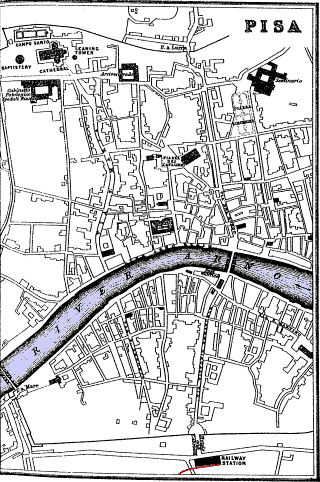
GENOA 105 PISA, pop. 26,300. Hotels: On right bank of the Arno, in the Lung’ Arno Regio, the *Grand Hotel; *Bretagna; *Nettuno; Londra. Close to station, right hand, the *Minerva et de la Ville; Washington; Fares.—From the station to the cathedral, with from one to two passengers, 1 fr.; from three to four, 1 fr. 15 sous. The hour, 2 fr. From the station go straight up the Via Vittorio Emanuele to the Arno, where cross the bridge and walk down the river to the fifth street right, the Via Santa Maria, crossed by an arch at the commencement. The Via Santa Maria leads directly to the Piazza del Duomo, containing, in a row, the Leaning Tower, the Cathedral, and the Baptistery, and immediately behind, the Campo Santo, with frescoes considerably effaced, yet valuable as specimens of the Tuscan school of the 14th and 15th centuries. Fee for the Campo Santo 25 cents each.
The Cathedral, commenced in 1063 by the Greek architect Buschetto, was completed in 1092. The exterior is adorned with a range of blind arches decorated with party-coloured marble. Four open arcades, similarly constructed, rise over the western entrance, with the beautiful bronze doors of John of Bologna, as well as over those at the southern entrance by Bonano. Both doors are covered with a profusion of figures in delicately wrought iron, representing saints, prophets, and various other objects, enclosed in an elegant border of birds, foliage, fruits, and flowers. The internal length of the church is 311½ ft., and of the transepts 252 ft. The roof of the nave is 109 ft. high. A double row of columns runs up the nave, and a single row along the transepts and choir. Sixty of them are of oriental granite, and the rest (14) of fine marble, and each of one piece. The arches resting on them are semicircular, and are mostly in alternate layers of white and black marble. The roof is covered with richly gilt panelling. The altars are by Michael Angelo, and are arranged in pairs, each couple opposite each other being alike, excepting the two at the opposite ends of the transepts, which, however, are similar in design. One represents the fall by woman, and the other the reconciliation by woman in the ascension of the Virgin. Over the high altar, on the semidome, is a colossal Mosaic by G. Gaddi, in 1325. Among the best of the paintings are four of saints by A. del Sarto, near the bishops’ chairs. Here also are paintings of Moses and Aaron, St. Luke and St. John, by Beccafumi, and the Sacrifice of Abraham and the Entombment by Sodoma. Upon a pier of the right transept is a St. Agnes by A. del Sarto, and on the corresponding pier of the left transept a Madonna by Perino del Vaga. In the right
Pisa: Leaning Tower. Baptistery.
The Campanile or leaning tower is a cylindrical edifice built of square blocks of compact marble, and consisting of a well-designed solid basement, 159 ft. in circumference, with walls 13 ft. thick, above which rise six open arcaded galleries, supported by 200 granite and marble columns. Over the sixth arcade rises a round tower 27 ft. high. The entire height is 183 ft., the mean diameter of the main portion 52 ft., and the deflection from the perpendicular 11 ft. 2 inches, exclusive of the cornice, which projects 32 inches more. It was commenced in 1174, and finished 1350. The ascent is very easy, by a stair 3 ft. wide, formed in the wall; but not fewer than three are allowed to visit the top at the same time. Fee for the party, 1 fr. The keeper lives in one of the small houses (No. 14) nearly opposite.
The Baptistery is a circular building, 361½ feet in circumference, surmounted by a dome 180 feet high, and constructed after the designs of Diotisalvi. It was commenced in 1153 and finished towards the end of the 14th cent. Above the third storey rises the dome, intersected by long lines of very prominent fretwork, meeting in a cornice near the top, and terminating in a small dome crowned with a statue of St. John the Baptist, the titular saint of all such edifices. In the interior eight large Sardinian granite columns and four marble piers support twelve arches, over which rises the tier of piers and arches which support the cupola, within conical, but externally hemispherical. In the centre stands an octagon marble font for the baptism of adults, with four circular compartments at opposite sides for the baptism of infants. The beautiful pulpit by Niccolo da Pisa (1260) is ornamented with bas-reliefs, and supported on seven columns. Pisa: Cemetery. Behind the Baptistery is the Campo Santo, founded about the year 1189 by the Archbishop Ubaldo. It is a rectangle 424 feet long by 145 broad, and surrounded by a broad gallery with a plain wall to the exterior, and 62 mullioned arches with quatrefoil tracery towards the interior. The inner side of the wall is covered with paintings in fresco, begun about the year 1300, and continued till 1670. Immediately to the left on entering is the Pisa: S. Maria della Spina. Among the other churches may be mentioned Santa Maria della Spina, on the bank of the Arno (a low square church)—an excellent specimen of the Moorish-Gothic introduced into Italy in the 11th cent. The churches of St. Matteo, St. Pierino, St. Michele in Borgo, St. Andrea, and St. Francisco, contain a few curious and some good paintings, with other antiquities. The church of St. Stephano is reputed to contain the bones of St. Stephen. The palaces of the Cavaliers, Lanfreducci, Seta, and Casa Mecherini, are worthy of notice.
Near the Grand Hotel is the Sapienza or University, founded by the Emperor Henry VII. The quays and bridges of Pisa are extensive, and well-constructed. Four miles from Pisa are the baths of St. Julian, considered beneficial for diseases of the liver and gout (see next page).
Leghorn.
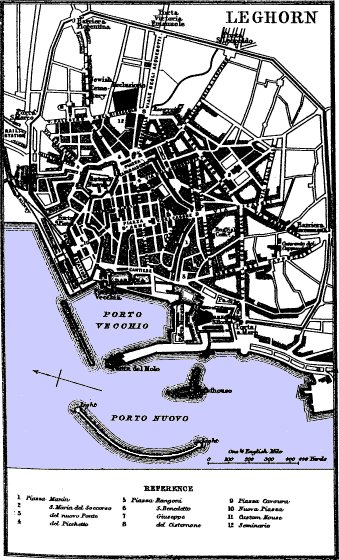
Between Pisa and Leghorn there are trains nearly every hour, distance 11¼ miles. Leghorn (pop. 90,000). Hotels: In the Piazza del Cantiere, the Nord, fronting the harbour; and close by, in the Via Vittorio Emanuele, the Bretagne; New York; France; and at No. 59 of the same street, Il Giappone. Anglican church in the Scala degli Hollandesi. Presbyterian church, No. 3 Via degli Elisi. Cabs per hour, 1½ fr. Boat from the hotel to the steamer, 2 fr. Leghorn has many handsome and well-paved streets; among the best of them is the Leghorn: Steamers for Corsica. Steam-boats every week for Bastia in Corsica, for Porto Torres in Sardinia, and for Marseilles and Genoa.
Pisa to Florence by Lucca and Pistoja.
Distance 62 miles east. See Map of Turin to Florence, page 199.
FLORENCE 62 PISA. The direct line to Florence is by Pontedera Empoli. Distance, 49 miles. Time, 2 hours and 10 minutes. The first station by the Lucca route is San Giuliano, with its thermal springs, temp. 109° and 84° Fahr., rising from a calcareous rock at the foot of the wooded Monti Pisani. The waters “are used internally in chronic hepatic complaints, in gravel, and some renal affections; in dysentery, and dyspepsia attended with pain and vomiting.” —Madden’s Health Resorts. After Giuliano, we reach the Rigoli station, whence the line extends along the left side of the Serchio, enclosed within its bed by expensive embankments.
PISA FLORENCE 15 47 LUCCA (pop. 22,000). Each portmanteau taken from the station to the cab, 6 sous; bag, 2 sous. Cabs await passengers, 1 fr.; portmanteau, 4 sous.
Sights.—A walk on the ramparts, 3 miles in circumference, and a visit to the Duomo and to the Picture-Gallery. To the south of Lucca, near the station, is an ancient aqueduct of 459 arches.
Hotels: Universo, between the Duomo and the Piazza Napoleone, a first class-hotel; Croce di Malta, near the Piazza Napoleone; and the Corona, near the Piazza also, but towards the church of St. Michele. Diligence to the Baths of Lucca start from a court opposite the H. Corona. Distance, 17 miles. Fare, 3 fr. Carriage, 15 fr. Money-changer in the Piazza dell’Erba, off the P. Napoleone. Lucca is one of the most ancient cities in Italy. Originally it belonged to Lucca: Palazzo Ducale. Picture-Gallery. Cathedral. One entire side of the Piazza is occupied by the Palazzo Ducale, now the Palazzo Provinciale, a vast and substantial edifice, built in 1578, enclosing two large courts, and containing the prefecture, the post-office, the picture-gallery, and the government offices. The Picture-Gallery, open every day (except Mondays), between 10 and 2, although small, contains some precious works, in handsome halls. In the first room is a Madonna della Misericordia, and in the second, the Creator with Mary Magdalene and St. Catherine, both by Fra. Bartolommeo, in 1515 and 1509. Also pictures by Reni, Zucchero, and Tiziano. In the Sala da Ballo, painted in fresco by Luigi Adamolli Milanese in 1819, are a Madonna by Perugini; a full length portrait of Napoleon’s sister Elisa; and two ancient pictures on wood—a Nativity, and a Christ with Saints. The remainder of the pictures are in the rooms which were occupied by Maria Aloysia Borbonia (Marie Louise), whose monument by Bartolini (1843) stands in the centre of the square. Leaving the Piazza Napoleone, by the street at the end of the small avenue, we come to another open space containing San Giovanni and the Duomo, and between the two churches a house called the “Administrazione del opera della chiesa;” where, among other things, are preserved La Croce dei Pisani, an elaborately wrought gilt silver cross, by B. Baroni in 1350, and the gold lamp, weighing 24 lbs., which formerly hung in front of the Tempietto in the Duomo. They are shown at any time, but a fr. is expected. The Cathedral or Duomo of St. Martino was commenced by Anselmo Badagio, who, three years afterwards, as Pope Alexander II., blessed the enterprise of the Norman invader of England. The façade, with its three tiers of columned galleries, was built in 1204, the choir in 1308, and the triforium in 1400. The sculptures of the portico are subjects from the life of St. Martin. Over the door on the left is a Descent from the Cross, by Nicolo di Pisa, 1233.
Loftiness and simplicity, verging on plainness, characterise the interior of this church, as well as those of all the others in Lucca, with the exception of San Romano, which is profusely decorated. The windows are small and filled with modern glass, excepting the three at the eastern end, which are by P. Ugolino. All the pictures are covered, excepting on Sundays and feast-days, but the custodian can always be found in the sacristy, who shows the church for a franc. Commencing at the first altar, right hand from main entrance, Nativity, by Passignano; second, Adoration of the Magi, P. Zucchero; third, Last Supper, Tintoretto; fourth, Crucifixion, Passignano; fifth, Resurrection. In south transept, west side, is the monument to Pietro da Noceto, one of the many admirable works by Matteo Civitali, to whose genius the church owes its best sculpture, which he contributed during a period of nearly thirty years from 1472. The angels on the altar in the Chapel del Sagramento, opposite the monument, as well as the whole of the chaste white marble altar in the Chapel of St. Regulus, adjoining the sacramental chapel, are by him. On the left side of the high altar is the altar to “Christo Liberatori,” by G. Bologna, and adjoining, La Cappella del Santuario, where again we find the beautiful handiwork of Civitali displayed on the altar and reliquaries on both sides. The Madonna which forms the reredos of the altar is by Fra Bartolommeo. This picture and the Madonna by Ghirlandaio (1400), in the sacristy, are the two gems in the church. Just outside the Cappella del Santuario is a recumbent figure of Ilaria del Carretto by Jacopo della Quercia (1444), unfortunately slightly mutilated, yet a beautiful imitation of the repose of nature transferred to statuary. Lucca: The Tempietto. S. Giovanni. S. Frediano. In the north aisle is the Tempietto, a small octagonal chapel standing apart, in which is preserved the cedar wood crucifix, 8th or 9th cent., said to have been carved by Nicodemus with the assistance of an angel. The fresco on the left side of the main entrance into the Duomo represents him cutting it out. This cross is exhibited three times a year. The embroidery on the red curtain is an exact copy. The figure of S. Sebastian on the Tempietto, as well as the elegant pulpit opposite, are by Civitali. Opposite the cathedral is San Giovanni, founded in the 12th cent. The baldness of its great walls is partly relieved by the coloured panelled ceiling. Leaving the Piazza Napoleone by the western corner of the Palazzo Provinziale, we soon reach the Piazza and Church of San Michele, founded in the 8th cent., with a lofty façade composed of tiers of variously shaped columns. Continuing in the same direction towards the ramparts, we reach S. Frediano, of the
The Baths of Lucca.
The Baths of Lucca.
17 miles from Lucca. See Map, page 199.
The road ascends by the left bank of the river Serchio, through pleasing scenery, passing the town of Muriano, situated on the right side of the river. About 13 miles from Lucca is the curious bridge of the Maddalena, consisting of four arches, the arch next the village of Borgo being disproportionately large, and with a gradient from the bank to the centre of 60°. It is only 4 feet wide, and, although built in 1322, is the only bridge across the Serchio that withstood uninjured the great flood of 1836, when the Serchio attained in three hours a height till then unknown, and swept away with irresistible fury all the other bridges, and broke up the mounds, dikes, and embankments. The two villages (pop. 9500) which go under the name of the Baths of Lucca are Il Serraglio on the left bank, and Corsena on the right bank of the Lima, near its junction with the Serchio. On the hill behind Corsena are the springs and bathing establishments. By the side of the Lima is the Bagno Cardinali, close to the Casino; and about 100 feet above the Cardinali is the Bagno Bernabó. A short way westward, overlooking the valley of the Lima, is the Bagno Doccebasse, and immediately below it the Bagno dello Spedale-Demidoff, for the exclusive use of the poor. On the top of the hill, among some houses, is the Bagno Caldo, and a little to the east, standing by itself, the Bagno San Giovanni. Hotels: the best are Pagnini’s Hotel and Pension, next the Casino; and the America, nearer the bridge. On the opposite side of the river, in Il Serraglio, Bagno alla Villa, the most beautifully situated of the three. Hotels: At the entrance of the village, the H. and P. Queen Victoria. At the foot of the hill on which the bathing establishment is situated, the H. and P. du Pavilion and the Anglican chapel. Near them the H. and P. du Parc. The pension price in all, both here and at Corsena, is from 7 to 11 frs. Cabs: First hour, 2 fr.; afterwards 1½ fr. Numerous furnished houses to let. From 400 to 1000 fr. for six months.
The bathing establishments are fitted up with every modern appliance. The baths are rather small. Chemically the different springs are very similar, but in temperature they vary; the coolest is the Doccebasse, 85° Fahr., and the hottest the Bagno Caldo, 133° Fahr. The principal ingredients are sulphates and carbonates of lime, chlorides of soda and magnesia, and carbonate of iron. The total amount of saline matter being 15 grs. to the pint. On a tablet at the entrance to the baths of La Villa is inscribed a list of the diseases cured by the water; but their principal action is on the digestive organs, and through them sympathetically on the whole animal economy. Besides, a great deal of the beneficial effect said to be produced by the water ought with more reason to be ascribed to the delightful mountain air, and the charming walks, drives, and rides, which entice visitors to spend the greater part of the day in healthy rambles. The surrounding country is beautiful—steep mountains covered with vines, chestnuts and oaks rise on each side of the river; while well-made paths and roads wend their way up through these vineyards and forests to multitudes of points of various heights, commanding charming views. Season, May to October.
Pistoja. Cathedral. Baptistery.
PISA FLORENCE 40½ 21½ PISTOJA (pop. 13,600). Hotels: Globe et Londres; Inghilterra, both in the Piazza Cino. Cabs from the station to the hotels, 1 fr.; portmanteau, 20 c. Next the H. Inghilterra is the church of S. Giovanni, erected at the end of the 12th cent., in alternate layers of black and white marble. The sculptured pulpit, resting on lions, is supposed to be by Fra Guglielmo of Pisa, 1270. The centre of interest is in the Piazza Duomo, easily found from different parts of the town by means of the lofty Campanile, the “Torre del Podesta,” which rises above all the other buildings. By the side of it is the Duomo, a plain edifice, built in 1240. Over the central door is a Madonna, with angels, by A. della Robbia, and over the side-door frescoes by Balducci and Giovanni Christiani, 1369. To the right, on entering, is the monument to the jurist Cino (1336). In the upper tier he is represented addressing an assembly, accompanied by six other doctors, while below he is represented in his class-room lecturing to nine students. Baptistery, begun 1339 (by C. di Nese), an elegant octagonal structure, also in alternate layers of black and white marble, each corner terminating in a pinnacle. The font is quadrangular, of panelled marbles, and constructed in the 13th cent. Outside, near the door, is a beautiful stone pulpit. Adjoining is the Palazzo del Podestá (now the seat of the Tribunale Civile), constructed in 1367, and restored in 1864. The vaults and soffits of the massive arches are covered with the armorial bearings of the former mayors of the town; while, to the left of the entrance, are still the stone-seats and tables where they sat in judgment. Pistoja: Pal. Municipale. S. Andrea. Opposite is the Palazzo Municipale (14th cent.), and a little way down the street, the Ospedale del Ceppo (13th cent.), with a coloured terra-cotta frieze. Near the two hotels is the church of S. Maria dell’ Umilta, built in 1509 by Ventura Vitoni. In the vestibule are large frescoes by Vasari. Near it is S. Andrea (12th cent.), with quaint reliefs over the entrance door, and in the interior a precious marble pulpit, sculptured by Giovanni da Pisa, 1298-1301. The beadle, for a trifle, illuminates this piece of elaborate sculpture, when it is seen to still greater advantage. Between the two last churches is S. Filippo da Neri, with such a quantity of frescoes, representing angels and saints in glory, that even the visitor on entering feels himself among clouds also. In the Piazza Prato is S. Francesco, with some good frescoes and altar pieces. In the centre of the nave is the tomb of an Englishman, Thomas de Weston, Doctor Legum, 1408. The word pistol is said to be derived from the name of this town, as they have been manufactured here from a very early date. Catiline lost his life in a battle fought near Pistoia, B.C. 62, and the precise spot where he is said to have fallen is marked by a tower.
Passengers from Pisa to Florence have generally to change carriages at Pistoja.
11¼ m. from Florence and 50¼ m. from Pisa is Prato, pop. 13,100. Hotels: Giardinetto, Contrucci, surrounded by ancient walls, and defended by a castle built by the Ghibelines. The interior and exterior of the Cathedral are faced with white and green marble in bands. The nave has columns of serpentine. The elevated choir has good frescoes by Filippo Lippi, and in a chapel are others by Agnolo Gaddi (1365).
Florence.
61½ m. from Pisa by Lucca, or 49 m. by Empoli, is Florence, 357 m. from Turin, 82 m. from Bologna, 134 m. from Piacenza, 196 m. from Rome, and 60¼ m. from Leghorn.
Florence: Hotels and Pensions.
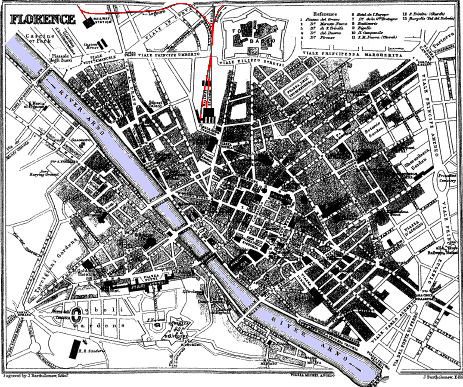
FLORENCE, on the Arno, pop. 169,000. Hotels and Apartments: On the right or north side of the Arno, the Grand Hôtel Royal de la Paix; de la Ville; Grand Hôtel d’Italie; Washington; Grand Hôtel Nueva York; Gran Bretagna; del Arno; and just behind the Paix, the Russie. All these hotels have a south exposure, and are greatly run after in winter. Charge from 10 to 16 frs. per day, according to the room. The following charge from 9 to 13 frs., and are situated in the new streets a little way back from the Arno, and near the Cascine or Park of Florence (north-west side of plan):—Hôtel and Pension Corona d’Italia, Via Montebello; Hôtel and Pension Iles Britanniques in No. 42; and Hôtel and Pension Venise in No. 33 Via della Scala. In the Iles Britanniques are also furnished apartments at from 250 frs. to 400 frs. per month. Hôtel and Pension Couronne d’Angleterre, Via Solferino; Hôtel and Pension Anglo-Americain, Via Garibaldi; and the Universo in the Corso Vitt. Emmanuele. In the busy parts of the town, and charging rather less than the above, the Hôtel Milan No. 12 Via Cerretani; Hôtel and Pension Angleterre, Via Panzani; and at No. 21 of same street, Hôtel Bonciani, with front also to the Piazza S. Maria Novella. Near the bridge La Santa Trinitá, and in the Via Tornabuoni are the Europe and Nord. In the Via Porta Rossa the Hôtel Porta Rossa; in the Via della Spada the Ville de Paris; in the Via Condotta, La Luna; in the Piazza S. Maria Novella (near the station) Hôtel Roma; Minerva; Bonciani, with furnished apartments; and by the side of the station, La Posta and Rebecchino. In the Piazza Maria Novella there are omnibuses for Sesto Fiorentino and a large cab-stand. Conveniently situated for visiting the sights, and not expensive (from 7 to 9 frs. per day), are the H. d’Espagne above the Restaurant Etruria and the Etoile d’Italie in the V. Calzaioli. Pension Suisse, Via Tornabuoni; Le Phœnix, Via dei Martelli; Lion Blanc (in which also single rooms are let), Via Vigna Nuova; Cavour, Via del Proconsolo; Commerce, Piazza di S. Maria Novella; Hôtel and Pension Rudolfo, Via della Scala. Furnished apartments all over the town. Just outside the Porta Romana, in the Viale Petrarcha, furnished apartments cost from 250 to 400 frs. the month. The most expensive as well as the most fashionable are those situated on the right bank of the Arno; but in the streets a little way back from the Arno apartments can be had for less. It is of very great importance in winter to have
Protestant Churches.—American Church, 17 Via dei Serragli; American Episcopal, 11 Piazza del Carmine; English Episcopal, 5 Via del Maglio; Scotch Church, 11 Lungarno Guicciardini.
Cab Tariff.—The course, 1 fr.; night (between 7 P.M. to 6 A.M.), 1 fr. 30 c. Time, first half-hour, 1 f. 30 c.; every successive half-hour, 70 c. Large trunks, 50 c.; portmanteau, 25 c. Omnibuses run between the Piazza della Signoria and the old city gates. Fare, 10 c.; Sundays, 15 c.
Florence: Hints and Directions.
Best maps of Italy and of the environs of Florence at the office of the Topografico Militare, No. 8 Via Sapienza, near the Annunziata. Best plans of the town published by Pineider, in the Piazza della Signoria, and Bettini, No. 12 Via Tornabuoni. They also publish excellent little guides to Florence, with complete catalogues of all the pictures and statues in the various museums and churches. Pineider’s is published in English likewise, and costs only a franc. They have a similar one for Rome. For the investigation and study of art in Florence, see the works, Walks in Florence by Susan and Joanna Horner, 2 vols., Isbister and Co., London, and volume 3 of Hare’s Cities of Italy.
It is fatiguing, and unwise in those who are not students, to wander into every part of Florence to gaze upon every picture and every figure by a great master. The best are all in a few places, which, fortunately, are near each other. For oil-paintings the combined galleries of the Uffizi and Pitti are sufficient. In them the most important room is the Tribuna (p. 238), containing the concentrated excellence of both galleries in painting and antique sculpture. Besides what are in the Tribuna, Raphael has eleven pictures in the Pitti, of which the most famous is No. 266 in the Stanza dell’ Educazione di Giove (see p. 244). Michael Angelo’s finest sculpture is in the new sacristy of San Lorenzo (see p. 265), but the best collection of his works is in the National Museum (see p. 261). His David is in the Accademia delle Belle Arti (see p. 272). In the National Museum is the best collection of sculpture by great Italian Artists, such as Michael Angelo, G. Bologna, Luca and Andrea della Robbia, Ghiberti; Brunelleschi, Donatello, Pisano, Brancacci chapel of Del Carmine (page 252). Best painting by Cimabue, a Madonna, executed in 1240, in the Rucellai chapel of S. Maria Novella (page 268). Best frescoes by D. Ghirlandaio on the chancel or recess occupied by the high altar in S. Maria Novella (page 268). Best frescoes of A. del Sarto in the narthex of the Annunziata (page 269). Best frescoes of Giotto in the first and second chapels of S. Croce (page 260). Of the palaces the best are the Palazzo Vecchio (page 274), Palazzo Strozzi (page 275), and the Palazzo Corsini (page 275). The best view of Florence is from the top of the dome; the ascent is very easy. The pleasantest drive, with views, is to the Piazza Michel Angiolo, by the Porta Romana and the Boulevards Machiavelli, Galileo, and Michel Angiolo (page 249), studded with handsome villas.
Florence: Piazza della Signoria. Loggia dell’ Orcagna.
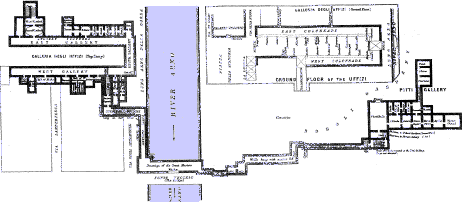
At Florence the Arno is crossed by six bridges. One of these, the Ponte Vecchio, differs from all the rest in having shops on each side. By referring to the plan it will be observed that the road to the Pitti Palace with the Boboli gardens, commences at the south end of this bridge; while, at the northern end, commences the Via Por S. Maria, leading to the Piazza della Signoria. From the north-west corner of the Piazza della Signoria a fine broad street, the Via Calzaioli, leads to the Piazza del Duomo; from the eastern corner the street called the Borgo de’ Greci leads into the Piazza Santa Croce. It is of great importance to understand the relative position of these three squares. The chief feature of the Piazza della Signoria is the Palazzo Vecchio, a fine specimen of the Florentine castles of the Middle Ages (page 274). On either side of the main entrance are the terminal statues of Baucis and Philemon, by Bandinelli, and in front the colossal group of Hercules and Cacus, also by him. Opposite is the spacious Gothic arcade called the Loggia dell’ Orcagna, from the name of the architect, or dei Lanzi, from the name of the watchman who formerly guarded the building. It was usual in the early period of the Republic to provide a space near the government-house where the people Florence: National Library. On the opposite side, at the second door from the end, is the entrance to the Galleria degli Uffizi, and six doors farther down, the entrance to the Biblioteca Nazionale, with about 250,000 vols. and 14,000 MSS. Open from 9 to 4. Any book may be had for consultation in the reading-room by writing the name on a slip of paper. The National Library was formed in 1864 by the union of the Palatine Library collected by the Medici with the Magliabecchian Library collected by Antonio Magliabechi in 1700. The arch at the S. end of the colonnade leads to the river Arno and the Ponte Vecchio.
PLAN of the UFFIZI & PITTI GALLERIES
Galleria degli Uffizi.
Open daily from 10 to 3. Fee, 1 fr. each. Sundays, free. W.C.’s near the portrait rooms; key with the keepers in the corner of the southern gallery. In the top storey of the Uffizi buildings is the famous collection of paintings, statues, and antiquities, united with a similar collection in the Pitti Palace, by long galleries which cross the Arno by the Ponte Vecchio, and extend along the street Via Guicciardini, by the tops of the houses. The payment of a franc admits to both collections, and the visitor may commence at either end; either from the second door left hand, under the Uffizi colonnade, or from the door at the N.E. corner of the Pitti Palace, next to the iron gate opening into the Boboli gardens. But the easiest plan is to commence with the Uffizi, and to descend towards the Pitti gallery by the stair at the top of the western gallery. The only part of the way in which it is possible to go wrong, is where (after having passed through the gallery of birds, fishes, and plants, admirably drawn in 1695 by Bart. Legozzi, and a small room with a few beautiful miniature paintings representing scenes in the life of our Lord,) we come to a common stone staircase, which, to enter the Pitti galleries, ascend, but to go out, descend. Downstairs, outside, are the Piazza Pitti and the entrance to the Boboli gardens.
Florence: Uffizi Gallery—Vestibules—Corridors.
Entering the Uffizi by the second doorway under the colonnade, those who wish to save themselves the fatigue of the 126 steps up to the galleries may, for a franc, be carried up in a lift. In the first vestibule are Roman statues and bas-reliefs representing festivals and sacrifices, and busts of Lorenzo the Magnificent, Cosmo I., Francis I., and of others of the Medici. Second vestibule, more Roman statuary, and an inimitable Greek figure of a wild boar; the whole expressing admirably the growling ire kindling in an irritated animal. Two exquisite wolf-dogs, bold, spirited, and true to nature. The horse, said to have belonged to the Niobes group, does not bear close examination.
We now enter the eastern corridor, 178 yards long, with the ceiling painted in arabesques by Poccetti. Ranged on both sides are valuable specimens of ancient statuary, and of Roman busts of emperors and members of the imperial family, Augusti et Augustæ. On the walls is hung a valuable and interesting series of pictures, beginning with the stiff gilded Byzantine style of the infancy of the art, as No. 1, a Madonna by Andrea Rico di Candia (1102), and advancing gradually by No. 2, St. Cecilia, by Cimabue, 130 years later. A marked improvement in colour and grouping is seen in No. 6, Christ in Gethsemane,
Florence: Uffizi Gallery.—Tuscan School.
From the two long sides of the gallery large doors open into halls where the pictures are arranged in schools; the first of these being, as is shown on the plan, the Scuola Toscana, contained in three rooms, and consisting of 165 paintings, by M. Albertinelli, A. and C. Allori, B. Angelico, M. A. Anselmi. B. Bandinelli, Fra. Bartolommeo, G. Biliverti, S. Botticelli, A. Bronzino. F. Cambi, J. Casentino, Cigoli, P. di Cosimo, L. di Credi, F. Curradi. C. Dolci. Empoli. P. Francesca, M. A. Franciabigio. A. L. Gentil, D. and R. Ghirlandaio, F. Giorgio, G. S. Giovanni, B. Gozzoli, F. Granacci. Ignoto (unknown). Fra F. Lippi. O. Marinari, Masaccio, T. Manzuoli, G. da Milano, F. Morandini. G. Pagani, M. Pasti, S. Pieri, A. Pollaiolo, Pontormo. G. Ramacciotti, Razzi, Il Rosso, G. F. Rustici. V. Salimbeni, C. Salviati, A. del Sarto, L. Signorelli. Fr. Ubertini. R. Vanni, O. Vannini, G. Vasari, Dom. Veneziano, A. Verrocchio, Leonardo da Vinci, Volterrano. F. Zucchero. The earliest painters are in the inner room. Among the most remarkable of them are, B. Angelico, 1294. A. Botticelli, 1286, a large picture, and 1289 and 1299. Fra. F. Lippi, 1307. D. Ghirlandaio, 1295 and 1297. G. da Milano, 1293, in ten compartments. A. Pollaiolo, 1301 and 1306; D. Veneziano, 1305.
In the middle hall—Albertinelli, 1259. Fra. Bartolommeo, 1265; Bronzini, 1271. Cigoli, 1276 his best work. F. Lippi, 1257 and 1268; Razzi, 1279, formerly a banner carried in processions. Leonardo da Vinci, 1252, an unfinished picture.
First hall—Albertinelli, 1259; Allori, 1165; Biliverti, 1261, one of his best works; Bronzino, 1271; Cigoli, 1276; Credi, 1168; Leonardo da Vinci, 1157 and 1159 remarkably fine.
Florence: Uffizi Gallery.—Tribuna.
Next to the rooms occupied by the Scuola Toscana is the Tribuna, a plain 8-sided hall, 30 ft. in diameter, designed by B. Buondelmonti, and painted and decorated by Poccetti. In this room are preserved five of the most famous antique statues in the world, and forty-two of the choicest pictures in the collection by Alfani, F. Barocci, Fra. Bartolommeo, A. and L. Caracci, Correggio, Domenichino, A. Durer, Guercino, L. Kranach, F. Francia, Lanfranco, B. Luini, Mantegna, Michael Angelo, L. d’Olanda, P. Perugino, Raphael, G. Reni, Giulio Romano, Rubens, A. del Sarto, Schidone, Spagnoletti, Tiziano, Van Dyck, P. Veronese, and D. Volterra. Facing the door is the Venus de Medici, 4 ft. 11 inches high, supposed to be by Cleomenes, son of Apollodorus, which, along Knife-Grinder, the bony square form, the squalid countenance, and the short neglected hair, express admirably the character of a slave, still more plainly written on his coarse hard hands and wrinkled brow. Among the paintings, six are by Raphael—all gems. 1120 Portrait of a Lady, painted when he was 20; 1123 the Fornarina, every hue as perfect as if transferred to the canvas by the sun—the expression is pert; 1125, the Madonna del Pozzo (Well), attributed also to Franciabigio, beautifully finished; 1127 St. John in the Desert, colouring tawny, but admirable light and shade; 1129 the Madonna del Cardellino (nightingale), one of Raphael’s best works, painted when he was 22; 1131 Portrait of Julius II., considered one of the finest portraits in the world. In the Hall of Saturn, in the Pitti Gallery, and in the National Gallery of London, are likewise portraits by Raphael of this impetuous and warlike pope. 1139 Holy Family by Michael Angelo. This picture, one of the few by him in oil, exhibits powerful drawing with dexterous execution. 1112 the Madonna between St. Francis and St. John, called also the Madonna delle Arpie, by Andrea del Sarto—rich but subdued colouring, very pleasing to the eye. 1117 the famous recumbent Venus, by Tiziano. 1118 the Rest in Egypt, by Correggio—wonderful colouring.
Florence: Uffizi Gallery.—The Italian School.
Six rooms follow in succession from the south side of the Tribuna, and contain respectively the Italian, Dutch, Flemish-German, and French schools, and the collection of gems. The Italian, or more properly the Lombardo-Venetian Schools contains 115 paintings by Albano, D. Ambrogi. Baroccio, J. Bassano, G. Bonatti. Cagnacci, Canaletto, A. Caracci, G. da Carpi, G. Carpioni, B. Castiglione, M. Cerquozzi, C. Cignani, Correggio. Domenichino, B. and D. Dossi. C. Ferri, D. Feti, L. Fontana. Garofalo, L. Giordano, Giorgione, F. Granacci, J. Guercino. J. Ligozzi, B. Luini. A. Magnasco, A. Mantegna, L. Massari, L. Mazzolini, Fr. Minzocchi, Moretto da Brescia. Palma (both), G. P. Pannini, Parmigianino, P. Piola, C. Procaccino, S. Pulzone. G. Reni, P. Reschi, S. Rosa. E. Savonazzi, J. Scarsellino, B. Schidone, F. Solimena. A. Tiarini, Tinelli, Tintoretto, Tiziano, A. Turchi. G. Vanvitelli, P. Veronese, A. Vicentino. B. Zelotti. S. Zugo. Of those, the most noteworthy are Guido Reni, 998 Madonna; Parmigianino, Correggio, 1016 Child’s Head; A. Mantegna, 1025 Virgin, with Child in her lap; Caravaggio, 1031 Medusa.
Florence: Uffizi Gallery.—The Dutch, Flemish, and French Schools.
The Dutch School contains 135 paintings, of which the best are by Berkeyden, Borch, G. Dow, Galle, Hemskerch, Metsu, Mieris, Netscher, O. Paulyn, Poelemburg; Rembrandt, 922 an Interior, with Holy Family. R. Ruysch, Ruysdael, Schalken, Stingelandt, Van Aelst, Van der Heyden, Van der Werf, Van Kessel.
The Flemish and German Schools, in two rooms, consist of 157 paintings, of which the best are by Cranach 822, Catherine Bore, wife of Luther; 838 Luther; 845 John and Frederick, Electors of Saxony; 847 Luther and Melancthon. C. Gellé or Claude Lorraine, 848 Landscape, considered the gem of this department. G. Dow, 786 Schoolmaster. A. Durer, 766 His father; 777 St. James; 851 Madonna. Holbein, 765 Richard Southwell. 784 Zwinglius, and 799 Sir Thomas More. Quintin Matsys, 779 St. Jerome. Rubens, 812 Venus and Adonis, but his best pictures are in the Sala della Niobe. Susterman, 699 and 709 Portraits. Teniers, 742 a Chemist, and 826 a Landscape. Van Dyck, 783 a Madonna.
The French School is represented by 47 paintings, of which the most noteworthy are by Fabres, 679 the poet Alfieri, and 689 the Countess of Albany, wife of, firstly, Prince Charles, the young Pretender, and afterwards of Alfieri. Gagneraux, 690 A Lion-hunt. Mignard, 670 Madame do Grignan and her Mother, and 688, Madame de Sévigné. N. Poussin, 680 Theseus before his Mother. Rigaud, 684 Portrait of Bossuet.
Florence: Uffizi Gallery.—Room of Gems.
The Room of Gems has six upright glass cases, in which are exposed to view statuettes, vases, cups, caskets, and a variety of ornaments made of lapis lazuli, rock crystal, jasper, agate, aqua marina, turquoise, and gold. In the second glass case is the most valuable article, a casket of rock crystal, with twenty-four events from the life of Christ engraved upon it by Valerio Belli, by order of Clement VII., who presented it to Catherine of Medicis as a wedding present. The Room of Gems opens into the south or connecting corridor, painted in fresco by Ulivelli, Chiavistelli, and Tonelli. The most remarkable sculptures here are 129 reliefs on a sarcophagus, representing the Fall of Phaeton into the Eridanus (the river Po), with the Transformation of his Sisters into Poplar Trees; and the races in the Circus Maximus of Rome; 137 Round altar with reliefs representing the Sacrifice of Iphigenia; 145 Youth extracting a Thorn, a replica of the more famous statue in the Vatican; 145 Venus Anadyomene; 146 Nymph. (The key of the W.Cs. is kept in the little office in the corner of this corridor).
Florence: Uffizi Gallery—The Venetian School.
West Corridor and rooms. Rows of Roman statues stand on both sides, and the walls are covered with Italian paintings of a much later date than those in the eastern corridor. The first two rooms contain the Venetian School, represented by 82 paintings, and the next four contain portraits of artists, nearly all by themselves. The room behind the Venetian school contains a collection of 80,000 medals and coins. The 82 pictures which illustrate the Venetian School are by twenty-five great masters, T. Bassano, G. Bellini, P. Bordone, C. Caliari, D. Campagnole, Giorgione, L. Lotto, A. Maganza, Moretto, Morone, G. Muziano, Padovanino, Palma (both), Pini, Porta, Savoldo, A. Schiavone, Tinelli, Tintoretto, Tiziano, P. Veneziano, C. Veronese, P. Veronese, A. Vicentino. At the head of all stands the immortal Tiziano. His finest portraits are those of the Duchess (599) and of the Duke of Urbino (605), Francesco della Rovere I.; of “Flora,” called his Mistress (626); of Giovanni, father of Cosimo I. (614); and of Sansovino (596). Also by Tiziano, 633, Holy Family; 609 Battle between the Venetians and Austrians; 648 Catherine Cornaro, Queen of Cyprus; and 618 Sketch of Virgin and Child for his celebrated picture in Sta. Maria at Venice. P. Veronese, 589 Martyrdom of St. Justina; 596 Esther before Ahasuerus, and 636 The Crucifixion. Tintoretto, 617 The Marriage in Cana. Florence: Uffizi Gallery— Portraits of Artists. In the next two rooms are Portraits of Artists of all nations, from the 15th cent. to the present time. In a niche is the statue (338) of Card. Leopoldo de’ Medici, and in the middle of the hall the celebrated Medici Vase (339), with the sacrifice of Iphigenia in relief, by a Greek sculptor. Cardinal Leopold, brother of the Grand Duke Ferdinand, founded this collection in the 17th cent., and left it with 200 portraits; now it has about 500. Among the most remarkable are—288 Raphael, by himself, in 1506, when 23; 225 Van Dyck; 228 Rubens; 232 Holbein; 292 Leonardo da Vinci; 384 Tiziano; 378 Tintoretto; 374, 384, and 459 Annibale Caracci; 368 Antonio Caracci; 403 Guido Reni; 546 Sir Joshua Reynolds; 465 Thomas Murray. The door adjoining the hall of portraits of painters opens into the long series of corridors and stairs leading to the Pitti Gallery. See page 243. Sala delle Iscrizione.—The walls are covered with Greek and Roman inscriptions, arranged in 12 divisions according to the subject. In this room are also some very interesting ancient sculptures. Among others (315) the Torso of a Faun. Cabinet of the Hermaphrodite.—The most important piece of sculpture here is 306 Hermaphrodite reclining on a lion’s skin, a valuable Greek work; 318 Bust of Alexander the Great in suffering. Cabinet of Cameos.—A very
Florence: Uffizi Gallery—The Hall of Niobe.
Sala del Baroccio.—Against the walls are beautiful tables in pietradura or Florentine mosaic, and one in the centre of the room by Jacopo Antella, in 1615, from designs of Ligozzi. This hall contains 172 pictures, chiefly by Italian artists. The great picture in size and merit is 169, by Baroccio, The Madonna del Popolo or “The Virgin interceding with her Son;” 163 is Susterman’s portrait of Galileo; 191, by Sassoferrato, a Madonna; 207, one of Carlo Dolce’s best works, “St. Galla Placida.” Sala della Niobe.—The hall of Niobe was built in 1774, by the Grand Duke Pietro Leopoldo, for the famous statues supposed to have been by Scopas or Praxiteles, and found near the Porta S. Paolo at Rome in 1583, representing Niobe and her children struck by thunderbolts from Apollo. They constitute one of the finest and most powerful groups in the world, but stationed as they are round the cold, flat, white wall of an oblong saloon, each on his separate pedestal, the illusion of design and composition is not only destroyed but individual criticism invited, a test all of them cannot bear. It is believed that originally they formed a group on the pediment of a temple. Niobe is rather large, nearly nine heads high, but the child she protects is without a fault in form. This group is of one piece of marble. All the others are in single figures. But the soul and source of all that is interesting in these statues is the wonderful figure of the wounded and dying youth, represented lying on his back, his legs just crossing each other, the left hand reclining on his breast, and his right arm slightly raised. As a statue, it commands the highest admiration, and as a chaste and powerful picture of death, the keenest sympathy. Behind the statue of Niobe is a very large picture by Rubens—Henri IV. at the battle of Ivry—a performance of wonderful spirit, but unfinished; and opposite it, 147 The entry of Henri IV. into Paris; 144 Van Dyck, a portrait; 152 Honthorst, Fortune-teller.
Florence: Uffizi Gallery—The Hall of Bronzes.
Sala dei Bronzi.—In two rooms; among these ancient bronzes the most remarkable are the bronze heads of Sophocles and Homer, and the Torso 428 found near Leghorn—a torso is the trunk of a statue that has lost the arms and legs; 426 The head of a horse; 424 The figure of a youth, 5 feet in height, called the Idolino, found at Pesaro in 1530. The pedestal is attributed to Ghiberti. A tablet containing a list of the Roman Decurions, dated A.D. 223. Galleria Feroni.—In this room are arranged the pictures bequeathed by the Marchese Leopoldo Feroni, of which the best are, an Angel with a Lily, by C.
Florence. The Way from the Uffizi to the Pitti Galleries.
The Connecting Galleries.
Between the Uffizi and Pitti Galleries is a series of passages and stairs finished in 1564, and opened on the occasion of the marriage of Francesco de’ Medici with Joanna of Austria, of whom the statue of “Abundance” in the Boboli gardens is supposed to be a likeness. The walls of the stairs and corridors on the Uffizi side of the Arno are covered with a rich and valuable collection of engravings, constituting a complete history of the art from the 15th cent. to the present time. The corridor on the Ponte Vecchio crossing the Arno is occupied with a glorious collection of drawings by the great masters. The first part of the corridor on the south side of the Arno contains numerous portraits of the Medicean family, and then follows (on the long passage behind the Via Guicciardini) a vast collection of tapestry, executed in the 16th and 17th cent. in Paris and Florence. The best are those representing the festivities at the marriages of Henry II. with Catherine de’ Medici, and of Henry IV. with Maria de’ Medici, executed in 1560 after designs by Orlay. From the tapestry gallery a short stair ascends to a room hung with pictures painted in chiaroscuro, or in one colour, by several of the old painters. From this another short stair leads to the long narrow gallery on the wall of the Boboli gardens. This gallery is hung with water-colour drawings, by Bartolommeo Ligozzi, in 1695, representing with wonderful truthfulness, figures of birds, fishes, and plants. To these illustrations of natural history succeeds a series of miniature paintings of scenes in the life of our Lord. Now we come to the common stone stair leading upwards to the Pitti Gallery, and downwards to the door fronting the Piazza Pitti, and next the gate leading into the Boboli gardens. At the top of the stair is a large vestibule, with a window looking into the gardens. The names of the Sale and Stanze (Halls and Rooms) are on the catalogues. Each room is provided with two of these catalogues, one in Italian and another in French. The halls are painted in fresco, and adorned with statuary and rich tables of Florentine mosaic.
Florence: Pitti Gallery. Halls of Saturn and Jupiter.
The Pitti Gallery.
The vestibule opens into the Sala dell’ Illiado, painted by Sabatelli in 1837, and having in the centre a statue of “Charity,” by Bartolini.
Sala di Saturno.—The frescoes on the ceiling are by Pietro da Cortona. The gems of this room may be considered:—151, Portrait of Pope Julius II.; and 165, the Madonna del Baldacchino, by Raphael. The others by Raphael are the Portraits of (158) Card. Bibbiena; and of (171) Inghirami and (174) the Vision of Ezekiel. 150, Charles I. of England and Henrietta Maria, by Van Dyck. 164, a Deposition, by Perugino.
Sala di Giove.—Ceiling painted by P. da Cortona. In the centre of the room statue of “Victory,” by Consani, and at the sides five Tables in Florentine mosaic. The most remarkable picture in this, the Saloon of Jupiter, is 113, the Three Parcæ, or Fates, by Michael Angelo. Then follow Nos. 118, Andrea del Sarto and Wife; and 124, an Annunciation, by A. del Sarto. No. 133 is a Battle-piece, by Salvator Rosa. In the lower corner, right hand, is his own Portrait, with the initials S. A. R. O. No. 140, an exquisitely finished Portrait of G. Benci, by Leonardo da Vinci. 139, Holy Family, by Rubens.
Florence: Pitti Gallery—Halls of Mars and Apollo.
Sala di Marte.—Frescoes and decorations by Cortona. Raphael, Rubens, Van Dyck, and A. del Sarto, have in this room some beautiful paintings. The gem is (79) the Madonna della Sedia (chair), by Raphael. 94 is a Holy Family, also by him—called the “Impannata” or cloth window. No. 81, Holy Family; and 87 and 88, Story of Joseph, by A. del Sarto. 82, Card. Bentivoglio, by Van Dyck. No. 86, Peace and War, by Rubens. 96, Judith, by C. Allori.
Sala di Prometeo.—The Mosaic Table in this room, by Giorgi, occupied him fourteen years. 338, Madonna, by Fra. Filippo Lippi.
Sala di Apollo.—Raphael has three portraits in this room:—59 and 61, M. and A. Doni; and 63, Leo X. Tiziano has some fine works:—No. 67, a Magdalene, shows his power in colour; and 54, Aretino, the poet, is one of his best portraits. 40, Madonna, by Murillo. 58, by
Sala di Venere (Venus).—Painted by Cortona. Nos. 4 and 15 are two most charming Sea-pieces, by Salvator Rosa. No. 18, La Bella Donna, by Tiziano. No. 27, Jesus appearing to Peter, by L. Cardi (Il Cigoli).
Galleria Poccetti.—Painted by Poccetti. Bust of Napoleon by Canova. Small corridor, or Corridor of the Columns, with two columns in oriental alabaster, and the walls hung with Florentine mosaics, and admirably executed miniatures in water-colours and oil, collected by Card. Leopold. No. 4, In glass cases are displayed valuable articles in ivory, amber, rock-crystal, and precious stones.
Stanza della Giustizia.—Painted by Fedi. The beautiful ebony cabinet was used by Card. Leopold. The most interesting picture in this room is 408, Portrait of Oliver Cromwell, painted from life by Sir Peter Lely, by request of Ferdinand II. of Tuscany.
Florence: Pitti Gallery—Rooms of Flora, Ullisse, Giove.
Stanza di Flora.—In the centre is the famous Venus by Canova, called also the Venus Italica from its having been intended to replace the Venus de’ Medici, when that still more famous statue was carried off to Paris, where it remained fifteen years. No. 415, Ferdinand II., by Sustermans. 416 and 421, Landscapes, by Poussin. 423, Adoration of the Shepherds, by Tiziano.
Stanza dei Putti.—Painted by Morini. No. 470 is a large picture by Sal. Rosa, called the Philosopher’s Forest—Diogenes throwing away his drinking-cup. No. 465, Landscape, by Ruysdael.
Stanza d’ Ullisse.—Painted by Martellini. No. 324 is a fine portrait by Rubens of the favourite of James I., George Villiers, Duke of Buckingham, assassinated by Felton in 1628. No. 289, Madonna, by Ligozzi. 297, Paul III., by Bordone. 306 and 312, Landscapes, by Sal. Rosa.
Stanza del Bagno.—This, the bath-room, is tastefully fitted up with a mosaic pavement. Four handsome columns in verd antique, and four marble statues, by Insom and Bongiovanni.
Stanza dell’ educazione di Giove.—Painted by Catani. 266, the Madonna del Granduca, by Raphael, is one of the finest pictures in the Pitti Gallery. 245 is attributed to Raphael. 243, Philip IV. of Spain by Velasquez. 248, a “Descent” by Tintoretto. 256, Holy Family by Fra. Bartolommeo.
Stanza della Stufa.—The frescoes on the walls, representing the Four Ages of Man, are by Cortona, from sketches by the nephew of Michael
Florence: Boboli Gardens.
The Boboli Gardens.
Now either return to the Uffizi by the very long galleries or descend to the foot of the stairs, and when outside, turn to the left and pass through the gate leading into the Boboli Gardens, open on Thursdays and feast-days. Permission to enter on other days is easily obtained at the office of the Minestero della Casa, under the south corner of the corridor. The gardens are laid out in a stiff style. Clumps of oleanders and oleasters among ilexes, laurels, pines, yews, and cypresses, encircled by tall myrtle hedges, make the grounds in many parts more like a labyrinth than a garden. Near the entrance is an artificial grotto, with, in front, a group by V. Rossi, and a Venus by G. Bologna; and in the four corners unfinished statues by Michael Angelo, intended for the monument of Julius II. at Rome, and presented to Cosmo I. by L. Buonarotti. Opposite the palace is the Amphitheatre; within the centre a granite obelisk and a large granite basin from Egypt, but brought to Florence from Rome. Beyond the palace, near the Porta Romana, is the Piazzale del Lago, with groups in marble by G. Bologna. In the flower-garden “del Cavaliere,” are two more fountains, with monkeys in bronze, by the same artist, and a small villa, from the top of which there is a fine view (entrance 25c.) On the highest part of the gardens, facing the palace, is a colossal statue of Dovizia (Abundance), commenced by Bologna, and finished by his pupil Dacca.
Florence: Pitti Palace.
THE PITTI PALACE was begun by Luca Pitti, a Florentine merchant, in 1436, from designs by Brunelleschi. In 1549 the still unfinished building was purchased by the Medici, who advanced it considerably, but not till quite recently was this vast pile finished. The façade is 659 feet in length, 148 feet in height, and the total surface occupied by the building 35,231 yards. Bart. Ammanati added the wings, and enclosed the beautiful court opposite the middle entrance with Doric, Ionic, and Corinthian columns, and placed at the extremity the pretty grotto covered in with Roman mosaic, supported on 16 columns, and ornamented with statues in marble and porphyry, and small trees and satyrs in bronze. To the right of the court is the Royal Collection of Plate by Benvenuto Cellini and Maso Finiguerra, and ivories by Bologna and Donatello. Zumbo, the famous artist in wax, has likewise some of his works here. The state apartments are sumptuously furnished.
Florence: Tribuna Galileo—Museum of Natural History.
Nearly opposite the Pitti palace, at No. 16 Via Guicciardini, is the house in which Machiavelli lived and died in 1527. A little farther up the Via Romana, in the house No. 19, is the
Museo di Storia Naturale,
in the second floor, and the Museo Galileo in the first floor. Both open on Thursdays and Saturdays, from 10 to nearly 3. In the vestibule is an old terrestrial globe, black with age, 3 feet in diameter, probably by Ignazio Dante, a famous astronomer, brought to Florence by Cosmo I. He died in 1586. Upstairs is the Museo, or Tribuna di Galileo.* Explanatory catalogues in Italian and French are on the table. The statue of him is by A. Costoli. In the niche to the right are his telescopes, of which the lower one was constructed by himself, and by which he discovered the satellites of Jupiter. In the niche on the left are his compasses and magnet. The other philosophical instruments belonged to the Accademia del Cimento, instituted in 1657 and dissolved in 1667. It held its meetings in the palace of Prince Leopold de’ Medici. All around are beautiful frescoes, illustrating scenes in the life of Galileo. Among the relics is the forefinger of Galileo, taken from the body when it was removed to its present resting-place in the church of Santa Croce. In the second storey is the excellent and comprehensive Museum of Natural History. The collections are admirably arranged, and in good condition. The botanical department contains the herbariums of Andrea Cesalpino, which he is supposed to have collected about the year 1563; of P. A. Micheli, collected about the year 1725; of Central Italy, by Parlatore, commenced in 1842; of Labillardière, who accompanied La Perouse in his expedition to New Holland; of R. Desfontaines, the master of De Candolle; and of the Englishman, P. B. Webb, who bequeathed his herbarium to this Florence: Anatomical Preparations in Wax. But the most wonderful objects in the museum are the anatomical preparations in wax, chiefly by Clemente Sasini and his assistants, under the direction of Tommaso Bonicoli, 1775 to 1791. Like the great works of the great painters, they are executed with the most minute care and truthfulness to nature, whether it be the magnified anatomy of the cuttle-fish or of the silkworm, or the life-like representation of the most delicate organs of the human body. They are contained in twelve rooms, entered from the shell department, by the door lettered “Ittiologia,” opening into the Zootomia.
Florence: House of Galileo.
The House of Galileo,
at the head of the Via Romana, is the Porta Romana, the city gate by which, in 1536, Charles V. and Pope Leo X. entered Florence. An omnibus runs between it and the Piazza del Duomo. At the outer side there is a cab stand, which is likewise the starting-place of the omnibus for the Certosa (see page 250). Immediately outside the Porta commence three broad roads—the lowest is called the Via Senese and leads to the Certosa; the centre one, bordered with tall cypresses, is the Via del Poggio Imperiale; while to the left is the Viale Machiaveli, the first of a series of magnificent boulevards (viali) leading to that noble terrace the Piazza Michelangiolo. Let us first ascend the Via del Poggio to the Royal Villa, formerly the property of the Medicis, now the Instituto della Annunziata, a boarding-school for girls. From it ascend by the Via del Pian di Giullari, and when at the top of it take the road to the right leading directly to the village of Arcetri, containing the house in which Galileo spent the last years of his life, and in which when blind, and 74 years of age, he was visited by Milton. Galileo was born in 1564, at Pisa, and died in 1642. The house, a plain building, is indicated by a bust and tablet on the wall towards the street. The steep little road to the left leads up to the farmhouse in which is the Tower (Torre del Gallo) from which Galileo made his astronomical observations. It contains several relics of the great astronomer—a telescope, table, and chairs, a bust of him taken after death (il piu antico che si conosca), a pen-and-ink sketch of him on marble by Salvatelli, a smaller portrait of him by P. Leoni, 1624. From the farmhouse
Florence: Piazzale Michelangiolo. San Miniato.
The Piazzale Michelangiolo.
There is no place about Florence which affords such an agreeable walk or drive as to the Piazzale Michelangiolo and the church of S. Miniato. They are situated on a hill on the left bank of the Arno, two bridges higher up the river than the Uffizi, and are distinctly seen from the Lung’ Arno. The nearest way to approach them on foot is, having crossed the Ponte alle Grazie (the first bridge above the Ponte Vecchio), walk up the left bank of the Arno, passing the Piazza containing the fine marble monument to Prince Nicholas Demidoff, by L. Bartolini, in 1835, and continue the walk up the river till arrival at a square tower in the Piazza della Molina, whence commence the ascent by the stairs and road the Viale dei Colli. Or approach it from the Porta Romana by the fine avenues the Viali Machiavelli and Galileo, bordered by trees and handsome villas, disclosing as they wind round the steep sides of the hills a succession of ever-varying views. The Piazzale Michelangiolo is a splendid terrace, 165 feet above the Arno, commanding a grand prospect, and adorned with five statues in bronze, copies by C. Papi of Michael Angelo’s famous works. To the right is the Viale Michelangiolo, the carriage road leading down to the Barriera San Niccolo, opposite the suspension-bridge (Ponte Sospenso). Above the Piazzale, by the convent church of San Salvatore del Monte (built in 1504 by Cronaca), is the Basilica of San Miniato, one of the earliest (1013) as well as one of the most perfect structures in the Byzantine style. Internally it is 165 feet long by 70 wide, and is divided longitudinally into aisles by pillars of classical design. The façade is faulty. The tower was erected in 1519. The floor of the nave is considerably under the level of the chancel, which terminates in a semi-dome, covered with mosaics executed in 1247, and of the same kind as those of St. Mark’s at Venice. Behind the altar are five small windows of thin slabs of Pavonazzo marble. Between the stairs leading up to the chancel is the chapel constructed in 1448 by Michelozzi. Here lie the remains of Gualberto, the founder of the church and of the order of Vallombrosa. In the centre of the north aisle is the chapel of Cardinal Ximenes (died 1459). The monument is by B. Rossellino, and the beautiful terra-cottas on the ceiling by Luca della Robbia. On the south side is the Sacristy (built in 1387), exquisitely painted in fresco by Spinello Aretino, representing scenes in the life of St. Benedict. In
Florence: The Certosa.
The Certosa.
From outside the Porta Romano a small diligence starts every hour, at the hour, passing by the Carthusian Monastery of the Certosa, 3¼ miles distant; fare, ½ fr. Passengers alight at the great wall enclosing the grounds at the commencement of the small by-road to the right, leading up to the top of the circular hill on which the convent is picturesquely situated. It was erected by Niccolo Acciaiola in the 14th cent., and is now the property of the State, who retain in it some twenty-three friars of the order to take charge of the church, chapels, and buildings. At the entrance-gate is the pharmacy, where the liqueurs made in the convent can be bought and tasted. Their Chartreuse cordial is not equal to that made in France, but the Alkermis is of good quality. Fee to see the convent, ½ fr. At the top of the stair leading up to the church is a fresco by Empoli. The church, paved with marble in the cinque-cento style, has some good stalls (1590), and over the marble altar a fresco by Poccetti. Right hand, chapel with frescoes by Masari on the walls, and on roof by Poccetti and his school. From S. aisle pass to chapel of S. Maria, in the shape of a Greek cross. Here is a curious Trinity of the Giotti school. Descend to the Cappella di Tobia, with the mausoleum of the founder, by Orcagna (1360), and three monumental slabs over the tombs of his father, sister, and son. Next, a narrow cloister with eight small windows, with vignette paintings by Udine, 1560; Cappella del Capitolo, having for the reredos a Crucifixion by Albertinelli, and in the centre of floor the mausoleum of Buonafede by Stogallo, 1545; then the Camere di Pio Sesto, his sitting-room, and bedroom. He was a prisoner here nine months. Beautiful views are obtained from various parts. In passing through the villages women may be seen plaiting straw—a standard occupation in Tuscany.
Florence: Bello Sguardo. Monte Oliveto.
Views.—From the Porta Romana commences also the road to the Bello Sguardo and to Monte Oliveto (about a mile distant), both commanding splendid views of the city, of the valley of the Arno, and of the surrounding mountains. Immediately outside the Porta turn to the right, and walk by the side of the city wall by the Via Petrarcha till the second road on the left, the Via de Casone, by which continue Monte Oliveto descend to the Via di Bello Sguardo, and from a house with a high railing turn to the right by the “Via di Monte Oliveto Per S. Vito,” and descend to a large gateway and house on the left hand. At this house ask for the key of the Monte Oliveto, then walk forward past the old convent, now a military hospital, to the top of the knoll crowned with cypresses, and behold the view. Now descend by the Via di Monte Oliveto, which, at the foot of the hill, enters the Via Pisana opposite house No. 82, near the Porta S. Frediano, whence an omnibus runs to the Piazza della Signoria. If preferred, the tour may be commenced at this end, taking the omnibus from the Piazza to the Porta.
Florence: Santo Spirito.
Santo Spirito and Santa Maria del Carmine.—By referring to the plan it will be observed that a very short way north from the Pitti Palace are two churches, the Santa Maria del Carmine, containing the famous frescoes of Masaccio (b. 1402, d. 1429), and of Filippino Lippi (b. 1457, d. 1504), and the church of Santo Spirito, in which Luther preached as an Augustinian friar when on his way to Rome. The present church of the S. Spirito was commenced in 1446 by F. Brunelleschi, destroyed by fire in 1470, and rebuilt in 1488 according to Brunelleschi’s design. The belfry, which is of admirable proportions, was erected by B. d’Agnolo. The church is 315 ft. long, and 191 at the transept, and is placed from south to north. The arches of the aisles rest on 47 pilasters and 35 columns, each of one piece of pietra-serena, brought from the quarries of Fiesole. Around the church are 38 semicircular chapels, ornamented with pictures by Alessandro Allori, Fra. Bartolommeo, Sandro Botticelli, Franciabigio, Raff. del Garbio, Rodolfo Ghirlandaio, Giotto, Filippino Lippi, Ant. Pollaiolo, and Cosimo Rosselli. Among the best of these are, in the choir, 12th chapel from entrance to church, a Madonna by Lippi. In left transept, 19th and 20th chapels, Martyrs, and The Adulteress, by Allori. 22d chapel, an Annunciation, by Botticelli. Among the sculptures the most remarkable work is in the 2d chapel, right hand on entering, a Pieta, by Baccio Bigio, a copy of the group by Michael Angelo in St. Peter’s, Rome. The proportions of the dead body of our Lord are admirable, and the ribs, loins, and pectoral muscles skilfully marked. Before the choir is a screen erected in 1599, composed of bronze and rich marbles, and although rather out of place, full of beautiful details.
Florence: Santa Maria del Carmine. Brancacci Chapel.
The church Del Carmine was erected in 1475, destroyed by fire in 1771, and rebuilt in 1788 by Ruggieri and Mannaconi. Among the parts which escaped destruction in 1771 was the Brancacci chapel, at the end of the western or right transept, covered with valuable frescoes, in 12 compartments, by Masaccio, Lippi, and Masolino da Panicale. The four principal subjects are (left wall) “Christ directing St. Peter to take a coin from a fish’s mouth to pay the tribute,” by Masaccio, whose portrait is given in the last apostle to the right; “the Restoration to Life of the Emperor’s Nephew,” painted by Filippino Lippi and Masaccio. On the right wall are— “St. Peter raising Tabitha,” by Masolino; “the Crucifixion of St. Peter;” and “St. Paul before the Proconsul,” by Filippino Lippi. These frescoes are said to have been studied by Perugino, Raffaelo, Leonardo da Vinci, and Michael Angelo. Of the eight small subjects, “The Expulsion of Adam and Eve,” and “St. Peter and St. John Healing the Sick by means of their Shadows,” on the left wall; “St. Peter Baptising,” and “St. Peter Distributing Alms,” on the right wall, are all by Masaccio. “The Visit of St. Paul to St. Peter in Prison,” on the left wall, and “the Deliverance of St. Peter from Prison,” on the right wall, are by Lippi. “Adam and Eve under the Tree of Knowledge,” and “St. Peter Healing the Cripple,” are ascribed by some to Masolino, by others to Masaccio. In the opposite arm of the transept is the Corsini chapel, with large marble alti-relievi by Foggini, and frescoes on the ceiling by Luca Giordano. In a chapel in the sacristy are some frescoes discovered in 1858, attributed to Spinello Aretino, but also, and with more probability, to Agnolo Gaddi, representing scenes in the life of St. Cecilia. The old church contained frescoes by Giotto, some fragments of which, removed the year before the fire, are now in the Royal Institution, Liverpool.
The Duomo, 252. The Campanile, 255. The Baptistery, 256. Il Bigallo, 257. San Michele, 257. Santa Croce, 258. The National Museum, 261. La Badia, 263. The House of Michael Angelo, 263.
Florence: Cathedral—Dome—Ascent.
The Duomo, or Cathedral Church of Santa Maria del Fiore was commenced by Arnolfo di Cambio, and the foundation-stone laid on dome, and completed it in all its essential parts before his death, which took place in 1446. In 1469 Andrea Verrochio added to the dome the copper ball and cross. The dome, built without timber centrings, consists of two vast vaults, an interior and an exterior, both supported by strong ribs at the right angles, and surrounded at the base by a strong iron chain. From the floor to the top of the dome the height is 300 feet, the lantern 52 more, and to the top of the cross other 35. The total height therefore is, from the floor to the top of the cross, 387 feet. The circumference of the dome is 466 feet. Three galleries are carried round the drum. The first is reached by 153 steps; the next by 62 steps more; and the third, which runs round the top of the drum and the base of the dome, by other 65 steps. The appearance of the church from the first and third galleries is most striking. Outside the third gallery commences the cornice gallery of the dome. From this part 180 steps (between the two vaults) lead to the top of the cupola. From the top of the cupola to the ball the ascent is made up through the lantern by 32 vertical bronze steps, and 13 steps in marble, and 23 in wood. The number of steps, therefore, from the floor into the ball is 528; the only difficult part being the vertical bronze bear-like ladder in the lantern, which is not worth ascending, as little can be seen (and that little with difficulty) from an aperture in the ball. But the view from the gallery at the top of the dome is truly magnificent. Florence and neighbourhood lie stretched out below like on a map, and as the clearness of the Italian air admits of the smallest objects being seen distinctly, the traveller should visit this gallery as early as possible, to gain, by the assistance of the plan (page 234), a practical acquaintance with the topography of the city. To the N.E., by the Piazza Cavour and the stream Mugnone, is Fiesole, 3 miles distant, on an eminence (see page 276). To the west of the town, on the Arno, is the Cascine or Park, and the small hill with the clump of trees, on the other side of the river, is the Monte Oliveto (page 250). To the S.E., on the other side of the Arno, are the Piazzale Michelangiolo and San Miniato (page 249), while a good piece beyond is the Torre del Gallo (page 248). West from the Piazzale are the Boboli Gardens and
The length of the cathedral is 556 feet, and of the transept 342 feet. The breadth, including the aisles, is 132½ feet, and the superficial area 84,802 feet, or about 6000 feet less than the area occupied by Cologne cathedral. In 1860 Victor Emmanuel laid the foundation-stone of the gorgeous new façade, coated, like the whole exterior of the church, with polished white marble, and dark magnesian serpentine disposed in chastely ornamented panelling, an arrangement often met with in the churches of Italy.
In the interior, four arches of enormous span run down each side of the nave to the choir, which expands with unrivalled majesty under the magnificent dome. Walk in and behold its beautiful proportions. Do not struggle to perceive by means of the dim light the few relatively unimportant statues and pictures, or the intricate designs on the marble pavement by Agnolo, San Gallo, and Michael Angelo, but go at once and stand below the second greatest dome in the world, shaped like the narrow end of an egg, or more correctly, in the form of an elongated octagonal elipsoid, resting on six massive piers ornamented with statues of eight of the apostles, by Bandini, Donatello, Bandinelli, and Sansovini. The octagonal balustrade is by Baccio d’Agnolo, and the reliefs on the panels by Bandinelli. The fresco on the roof represents the Judgment Day. The upper portion is by G. Vasari, in 1572, and the rest by Federigo Zucchero, known in England by his portraits of Queen Elizabeth. The drum of the dome is lighted by seven circular windows, which, as well as the three over the main entrance, and the twenty-seven long windows in the choir, were the work of Domenico Livi da Gambassi, Bernardo de’ Vetri, and others, from 1434 to 1460. Behind the altar is the last work of Michael Angelo (when eighty-one years of age), an unfinished Pieta, a heroic group, large but not colossal, composed of four figures, those of our Saviour, the Virgin Mary, Joseph, and an Angel. The interest of the piece lies in the melancholy but placid countenance of the Redeemer, and the inclination of the head lacerated by the crown of thorns. Florence: Michael Angelo’s last Work. The Mask, Michael Angelo’s first work, is in the sixth room of the National Museum, along with some other works of the great sculptor. His greatest productions are in the Sagrestia Nuova, see page 266. The reliefs in terra-cotta, over the elegant bronze gates of the sacristies, are considered amongst the best works of Lucca della Robbia. On the pier at the N.E. end of the nave is the statue of St. James, by Sansovino; and just behind it, on
Florence: Cathedral—Monuments—Campanile.
Among the most interesting monuments in the church are: at the main entrance, an equestrian portrait, by Uccello, of Sir John Hawkwood, a captain in the army of the Florentine Republic, who died at Florence in 1394. The mosaic, representing the coronation of the Virgin, is by Gaddo Gaddi. At the west end of the south aisle is the marble monument and portrait of Filippo Brunelleschi, by his pupil, And. Cavalcanti. The third monument from the door is to Giotto, by Majano. The beautiful water-stoup in front is by Giotto. Opposite the southern entrance, in front of the Casa dei Canonici, are the statues, in a sitting posture, of Arnolfo di Cambio and Brunelleschi, by Luigi Pampaloni, in 1830. To the right of Arnolfo’s statue, at house No. 29, is a stone in the wall, bearing the words “Sasso di Dante,” because on it the poet used to sit watching the progress of the cathedral from its commencement till 1301, when he was compelled to leave the city.
At the southern entrance is the Campanile del Duomo, designed and commenced by Giotto in 1334, and finished by Taddeo Gaddi. This dove-coloured marble gem of architecture, of admirable proportions and beautiful workmanship, towers 276 feet up into the air, by four storeys of elegant windows, and terminates in a grand square cornice projecting from the summit, from which, according to Giotto’s plan, a spire of 94½ feet was to have risen. The niches are peopled with statues of apostles, saints, and philosophers, and the panels with Scripture subjects in bold relief, by Donatello, Giovanni Bartolo, Andrea Pisano, Niccolo Aretino, Lucca della Robbia, Giottino and N. di Bartolo. Ascent by 414 steps. Fee, ½ franc each visitor.
Florence: The Baptistery—Gates.
Adjoining the cathedral is the church of San Giovanni, the baptistery of the city, founded in 6th cent., and repaired and restored in 1293 by Arnolfo di Cambio. It is an octagonal building, 94 ft. in diameter, covered by a cupola and lantern built in 1550. Three celebrated bronze gates, of admirable workmanship, give access to it. The gate on the S. side (fronting the Via Calzaioli) was modelled by And. Pisano, and, after twenty-two years of incessant labour, cast and gilt in 1330. The architrave, ornamented with foliage, was added by Lor. Ghiberti in 1446, and the group at the top, representing the Beheading of John, by V. Danti, in 1571—a work full of expression. The N. gate is by Lorenzo Ghiberti, commenced by him when twenty-one, and finished (modelled and cast) when forty-one, in the year 1424. It is in twenty compartments, representing scenes from the life of Christ. The three statues above, and the ornaments, are by Rustici, 1511, a fellow-pupil of Michael Angelo, and friend of L. da Vinci. At the eastern end, facing the cathedral, is the bronze gate which Michael Angelo said was worthy to form the entrance into Paradise. This marvel of art was commenced by Lorenzo Ghiberti in 1425, cast in 1439, and finished, with the exception of the lower reliefs, in 1456, when Ghiberti died, and left the remainder to be completed by his pupils, among whom were the brothers Pollaioli. It is in ten compartments, representing as many scenes from the Old Testament. In grouping, drawing, grace, and beauty, the figures are truly admirable. The perspective is well sustained; the distant objects being done in low, the nearer objects in middle, and those close upon the eye in high relief. Over the gate is the Baptism of Christ, by Sansovino, who, when he died, in 1529, had finished only the modelling; but Danti, in 1560, produced it in marble. The Angels, executed nearly a century afterwards, are by Spinazzi, also from Sansovino’s model.
Florence: The Baptistery—Altar.
The interior of the Baptistery rests on syenite columns and marble pilasters with gilded capitals. Above them is a triforium, with frescoes of saints on a gold ground painted on the panels. The roof and the soffit of the arch over the altar are covered with mosaics representing the Judgment Day, by Tafi, Torrita, and G. Gaddie, 13th cent. To the right of the altar is the monumental tomb of Pope John XXIII. (d. 1419), by Donatello and Michelozzi. To the left is the font, placed here in 1658, and attributed to G. Pisano. The silver altar of the Baptistery is kept in the “Uffizio del Comitate per la facciata del Duomo” (behind the east end of the cathedral), where it can be seen any day from 9 to 12, for 10 sous. It was constructed, during a long series of
Florence: The Bigallo. Or San Michele.
Opposite the Baptistery, at the corner of the Via Calzaioli, is the very beautiful little arcade or loggia of the Bigallo, attributed to Orcagna, enclosed with iron gates by F. Petrucci. The oratory contains an image of the Virgin by A. Arnoldo, 1359; and a predella, with paintings, by Ghirlandaio.
Or San Michele.
Nearly in the centre of the Via Calzaioli, between the Piazzas del Duomo and della Signoria, is the Or San Michele, built at first of undressed stone, by Arnolfo di Cambio in 1282, for a granary or horreum. Having been destroyed by fire in 1304, it was rebuilt in 1337 under the direction of Taddeo Gaddi, the chief architect of the commonwealth. To Gaddi succeeded And. Orcagna, who received orders to transform the lower part (the loggia) into a church. In 1569 the upper storey was converted into government offices. Round the building, in deep niches, are statues in simple attitudes and of noble dignified forms, the result of a decree that each trade should bear the expense of furnishing one statue, which should be the protector and supporter of its own profession. St. Luke, by John of Bologna (good specimen of his style), was executed at the expense of the lawyers. Our Lord and St. Thomas, by Verrochio, for the mercantile tribunal. John the Baptist, by L. Ghiberti, for the guild of foreign wool-merchants. St. Peter, by Donatello, for the butchers. John the Evangelist, by Montelupo, under a graceful canopy of Robbia-ware, for the silk manufacturers. St. George, by Donatello, his noblest work, for the armourers. St. James, by N. Banco, for the tanners and furriers. St. Mark, by Donatello, for the flax-dealers. West front, St. Eloy, by Banco, for the blacksmiths and farriers. St. Stephen, by L. Ghiberti, for the wool-merchants. St. Matthew, by L. Ghiberti and Michelozzo, for the stockbrokers and money-changers. Statues of four canonised sculptors, by Banco, for the builders and carpenters. St. Philip, by Banco, for the hosiers. And inside the church, to the left of the altar of St. Anne, a Madonna, by Simone da Fiesola, for the physicians and apothecaries. These statues are considered the finest works of the ancient Florentine school. Over the niches are the arms of the respective trades, under graceful canopies.
In the interior the most remarkable object is the canopied high altar, by Orcagna, otherwise called Cionis, with Ugolino’s sacred picture of the Madonna. Inscribed on the altar is “Andreas Cionis pictor Florentinus hujus oratorii archimagister extitit, 1359.” It is ornamented with Scripture histories in relief on marble, the different pieces being fixed together by pins of bronze run in with lead. The small but beautiful stained glass windows do not admit sufficient light into the church. Behind San Michele, in the Mercato Nuovo, is an admirable copy, by Pietro Tacca, of the celebrated Boar, adapted no less admirably to a Fountain.
Florence: Santa Croce.
Santa Croce.
South-east from the fountain, in the Piazza della Signoria, by the narrow street the Borgo dei Greci, is the Piazza Santa Croce, with, in the centre, the fine marble statue of Dante, 16½ feet high, by Enrico Pazzi. It and the new façade of the church were inaugurated in 1865, on the 600th anniversary of the birthday of the poet. The church of Santa Croce was commenced by Arnolfo di Cambio in 1297, to whom succeeded Giotto in 1344. The façade, although only recently finished, is according to the old design of S. Pollaiolo (d. 1509), and owes its erection in a very great measure to the liberality of an English gentleman, the late Francis Sloane, who died at Florence in 1871. The interior is divided into a nave and two aisles by seven acute Gothic arches. The pilasters, supporting columns as well as the roof, are of rude work, while the side chapels are not inclosed, but spread out on the walls of the aisles, an arrangement which greatly favours the display of the magnificent monuments erected in this church. The entire length from west to east is 385 feet, and from north to south at the transepts 128 feet.
Florence: Santa Croce—Michael Angelo—Dante—Macchiavelli.
Over the principal entrance, in the interior, is the statue of St. Louis, Bishop of Toulouse (d. 1297), the last work executed by Donatello. In the right or south aisle, commencing from the main entrance, after 1st altar, lies the monument and resting-place of Michael Angelo, who died at Rome in 1563, in his 89th year. The monument was designed by G. Vasari, and executed by three pupils of Michael Angelo. The bust, considered an excellent likeness, is by B. Lorenzione, one of the three. Next follows the great marble monument by S. Ricci, in 1828, to the memory of Dante, who died when in exile at Ravenna in 1321, in the 56th year of his age; and 3d, a monument to the poet Vit. Alfieri (d. 1803), by Canova, in 1809, and one of his best works. Opposite this monument is an elaborately wrought pulpit, by B. da Majano, in 1470. 4th. Macchiavelli (d. 1527), by Spinazzi, in 1778. The originator of this monument was Lord Cowper, who, in 1707, raised a subscription for the medallion. Then follow a fresco of St. John and St. Francis, by A. Castagno, and an Annunciation in stone by Donatello; Florence: Santa Croce—Ketterick— Countess of Albany. and opposite it, on the floor, is the tombstone of John Ketterick, Bishop of Exeter, who died at Florence in 1419, when on a mission from Henry V. of England to the Pope. Then follow the monument to L. Bruni (d. 1444), by B. Rossellini. The Virgin, above, is by A. Verrochio, the master of Leonardo da Vinci. The tomb of P. A. Micheli, and the mausoleum of Leop. Nobili, by Leop. Veneziani. Turning to the right by the monument to Neri Corsini (died in London, 1859), and a slab on the ground, with an inscription by Boccaccio, in honour of the poet Berberino (14th cent.), we enter the Chapel of the Castellani, with frescoes by Starnini (the ablest pupil of Giotto), and reredos by Vasari. Over the altar is a crucifix, by Giotto; at each side sarcophagi of the Castellani; and statues of St. Bernard and St. Francis, by L. della Robbia. To the left is the monument to the Countess of Albany, widow of the young Pretender, died at Florence January 29, 1824; age, 72 years, 4 months, and 9 days. After the chapel of the Countess of Albany follows the Baroncelli or Guigni chapel, with reredos painting by Giotto, frescoes by T. Gaddi, and a Pietà by Bandinelli.
A handsome door by the side of the Baroncelli chapel opens into the cloisters. In the cloister, the first door left hand opens into the sacristy, built by the Peruzzi family in the 14th cent. Separated from the sacristy by an iron railing is the Rinuccini chapel, with frescoes and altars by Giovanni da Milano (1379), a favourite pupil of T. Gaddi. The reredos painting is by T. Gaddi, 1375. At the extremity of the cloister is the Cappella del Noviziato. At the entrance is a shrine by Mino da Fiesole, and opposite it, and also over the altar, admirable specimens of L. Robbia’s terra-cotta work. The large relief is considered one of Robbia’s masterpieces. The small door to the right of the altar leads to the room where the remains of Galileo were kept many years after his death (in 1642). There are also two mausoleums—one to a young American girl, Fauveau; and another attributed to Donatello, both executed with much expression.
Florence: Santa Croce—Giotto’s Frescoes.
Returning to the church, we have, in the first chapel (right) frescoes of the Giotto school, and an Assumption by Allori. Second chapel, frescoes by Gio. da Giovanni. In the third, the Bonaparte chapel, is, to the left, the monument by Pampaloni, 1839, to the memory of the wife of Joseph Bonaparte; and, to the left, another to the memory of their daughter, Julie Clary Bonaparte (d. 1845). The fourth, or the first to the right of the high altar, is the Peruzzi chapel, with reredos Giotto’s best frescoes, representing the stories of St. John the Apostle and of John the Baptist. Fifth, the Bardi chapel. The painting on the altar, representing S. Francesco, is by Cimabue. The frescoes are by Giotto, and represent the life and death of San Francesco.
Chapels of the Choir.—Over the high altar, painting by Andrea Orcagna. The walls and ceiling are covered with frescoes by Agnolo Gaddi, representing the legend of the finding of the cross, and the life of St. Francis. The five following chapels are not of much importance, excepting the third, in the north transept, painted in fresco by Luigi Sabatelli. The sixth is the Niccolini chapel, with frescoes on the roof, painted in the 17th cent. by Baldassarre Franceschini, surnamed il Volterrano. This chapel contains five mediocre statues by Francavilla, and two large paintings on wood by Alessandro Allori, and is also richly decorated with beautiful marbles. In the adjoining chapel, belonging to the Bardi family, is a crucifix by Donatello, one of his earliest and best works, yet not equal to that of his rival Brunelleschi in S. Maria Novella (page 267). After the Bardi chapel follow the Zamoyska mausoleum, with a painted reredos by Ligozzi, and the monument to the composer Luigi Cherubini (d. 1842), by Fantacchiotti. Florence: Santa Croce—Galileo— Bartolini’s Last Work. Having arrived at the fine monument to Luigi, at the east corner of the north aisle, to avoid confusion it is better to return to the main entrance, and walk up the north aisle, commencing with the monument and resting-place of