PART II.—MODANE TO TURIN. (continued 2)
Reading edition
Many interesting mountain excursions may be taken from this town, of which the most important is to the Ecrin Group, by Vosc, 7½ m., St. Christophe 13 m., and La Berarde other 10½ m. Entire distance to La Berarde from Oisans, 23½ m. A few miles above Oisans we leave the narrow gorge of the Romanche and follow the course of the Venéon to the hamlet of Pont Ecofier, commanding a magnificent view of the whole valley of Oisans, confined in its mural precipices, terminated by the distant peaks of the Bella Donna. In the extreme distance a glacier summit rises in glorious perspective precisely in the Inn: Paquet, on an elevated slope, clothed with exquisite verdure and noble walnut woods, on the right bank of the Venéon. Exactly opposite Venose are the green pastures leading to the Col de la Muselle, 8300 ft. As the tributary valleys do not join the principal valley at common level, but are considerably higher, a waterfall, often of great beauty, almost invariably accompanies the meeting of the streams. In ascending the valley of St. Christophe the gorge soon becomes narrower, the rounded forms characterising the intruded lias are quickly left, and, the torrent having been passed on a substantial bridge, a very short distance brings us to a scene of sublime desolation. A mountain on the right hand has at some remote time crumbled into fragments and literally filled the valley from side to side with a colossal heap of ruins. Through and amongst these winds a narrow path practicable for mules, whilst the river dashes from rock to rock with excessive commotion, sometimes passing under the fragments which it was unable to displace. One huge slab of granite, wide enough for three carriages to pass abreast, forms a natural and ponderous bridge, harmonising with the desolation of the scene. On the right stands the romantic village of Enchastraye, a hamlet consisting of a few houses perched on a projecting rock in a tributary valley above one of the beautiful cascades. St. Christophe. La Berarde. Not much farther on, the road leaves the stream and leads up the face of a rough hill to St. Christophe, pop. 600, which gives its name to the valley. Just before reaching the hamlet a bridge crosses a very wild and narrow cleft, through which foams a wild glacier stream called the Torrent du Diable. 2 hrs. farther up the valley is the village of Les Etages, commanding one of the finest Alpine views which the admirers of Swiss scenery can desire, terminated by the Montagne d’Arsine, standing immediately above the hamlet of La Berarde. It presents a series of rocky pinnacles in manifold rows, between which the snow can scarcely adhere; and as seen from Les Etages, especially by the morning light, is comparable to the Aiguilles of Mont Blanc, while the valley which stretches beyond it to the foot of Mont Pelvoux may almost rival the scenery of the Allée Blanche. La Berarde, which is placed in the midst of this savage landscape, consists of a few poor houses, with a small chapel distinguished from the rest by a belfry. Cultivation ceases just at the village; a few stunted pines are found still higher up, but there is no wood worth mentioning in the valley above Venose. This excessive sterility peculiarly characterises the valleys of Dauphiné. The village of La Berarde is at a height of only 5710 ft., that of St. Christophe is 4825, and of Venose 3365, but the character of the scenery is, like that of Switzerland, at a greater elevation. The unbroken rocky surfaces deceive the eye to such an extent that it is difficult to realise the enormous scale of these mountains. To ascertain their height we must attempt to mount them, and even then the eye has some difficulty to submit to the testimony of the limbs. The ascent of the Pointe des Ecrins is made from La Berarde, but it is extremely dangerous. Mont Val Louise (see p. 333, and map p. 304).
Le Freney. La Grave.
Continuation of Road from Grenoble to Briançon.
After Le Bourg d’Oisans the road ascends by the side of the Romanche flowing several hundred feet below in a deep narrow ravine, by the side of La Combe de Malaval. 8 m. from Le Bourg and 37¼ from Grenoble is Le Freney, 3085 ft., pop. 900; Inn: H. Europe, with mines up in the mountains but of difficult access. It is in these mines that the crystals and the species of quartz containing gold are found, for which the Dauphiné is so celebrated among mineralogists.
2 m. farther, among masses of rocks, is the hamlet of Le Dauphin, with a small inn. From this place, until the summit of the Col de Lautaret is passed, every gap in the mountains shows a glittering glacier or a soaring peak. About 3½ m. farther up, near the hamlet of Les Freaux, a tributary of the Romanche pours its torrent over a precipice of granite, forming a beautiful cascade. 45 m. from Grenoble and 24 m. from Briançon is
La Grave, 5000 ft.; Inn: H. Juge; pop. 1500. Built on a slope rising from the road, with, behind, almost inaccessible cliffs containing copper mines, and opposite, on the other side of the river, the great glacier which streams from the summit of the Meije, 13,080 ft. To the E. of the Meije is the Bec de l’Homme, 11,372 ft., with a smaller glacier. The ridge called La Meije runs from E.S.E. to W.N.W., and is crowned by numerous aiguilles of tolerably equal elevation. The two highest are towards the eastern and western ends of the ridge, and are rather more than a mile apart. Any attempts to ascend the highest or western aiguille must be made from the northern side. The view of this mountain from the village of La Grave can hardly be praised too highly; it is one of the very finest road views in the Alps, and one cannot speak in exaggerated terms of its jagged ridges, torrential glaciers, and tremendous precipices. The perpendicular cliff, extending from the Glacier des Etançons to the summit of the Meije, is about 3200 ft. From La Grave the road leads through a bleak region and several tunnels to Villard d’Arene, 4½ m. from La Grave and 32 from Briançon, a miserable hamlet, considerably under the high road, at the foot of the Bec de l’Homme.
Col de Lautaret. Le Casset.
51¾ m. E. from Grenoble and 17¼ m. W. from Briançon is the Hospice of the Col de Lautaret, a very fair inn on the summit of Pass, 6791 ft., where refreshments are taken and the horses changed. The two diligences pass it daily. An iron plate on the house indicates that it is 11 kilomètres (6⅘ m.) from La Grave and 13 kilomètres (8 m.) from Le Monètier. The pass commands a grand view down the gorge of Malaval and towards the lofty towering Meije or Aiguille du Midi, 13,081 ft. above the sea. From one side of the pass the Romanche descends to Grenoble, and from the other the Guisanne to Briançon. From the Hospice the road traverses several galleries, and passes by a mine of anthracite coal not far from the village of Lauzet. Le Casset, at the foot of Mt. Vallon, 10,136 ft., at the entrance to the ravine of the Torrent Tabue, descending from the great glaciers which spread themselves over the eastern slopes of Mont Pelvoux. When the snow is melted the effect of the sun upon them is splendid. 60 m. from Grenoble and 9 from Briançon is
Le Monètier. Briançon.
Le Monètier de Briançon, 4898 ft. above the sea, surrounded with barley-fields, pop. 2600, on the Guisanne, near the foot of St. Marguerite, 8328 ft., which, like Mont Vallon, belongs to the Pelvoux group. Horses changed here. Inn: Alliey; mineral bath establishment, with hot sulphurous springs. Mines of anthracite. The road then passes the villages of Les Guibertes, 4689 ft.; La Salle, with cloth and night-cap manufactories; and St. Chaffrey, 3¼ m. from Briançon and 4299 ft. above the sea. 69 m. E. from Grenoble is
Briançon, 4335 ft., pop. 6000. Inn: H. de la Paix. Temple Protestant. The Brigantium of the Romans, and now a fortified town of the first class, with eight strong fortresses, which guard this important entrance into France from Italy. The town stands on the steep sides of an eminence rising vertically from the Durance, here a roaring mountain torrent hemmed in between the cliffs of the Mont Infernet, with strong forts on all the salient points up to the very summit, 7810 ft. above the sea. At this part the Durance is spanned by a bridge of one arch, 120 ft. wide and 108 ft. above the river, erected in 1734, in the reign of Louis XV. On the right side of the river, above the town, is the Fort du Château, and opposite, on the left side of the river, are the Trois Têtes, the largest of the forts. The views from them are very extensive, especially from the fort Pointe du Jour. Carriage up to it, 30 frs. Permission to visit the forts must be procured from the commandant. The large building down the Durance seen from the bridge, in the suburb called St. Catherine, is a manufactory where the waste of silk on cocoons is carded and prepared for spinning. About 800 people are employed. The women earn 14d. per day, working from 5 in the morning to 6 P.M., 1½ hr. allowed for meals. The longitudinal streets of Briançon are narrow and steep, little better than staircases, down the centre of each of which runs a stream of water in a marble gutter, with such an impulse that all manner of garbage thrown into it quickly disappears. At the foot of Briançon is the fertile valley formed by the union of the Guisanne with the Durance, surrounded by carefully-cultivated mountains studded with villages. All the Briançon coaches start from the Place du Temple, in front of the church. “The neighbourhood of Briançon abounds in rare plants. Amongst them may be mentioned Astragalus austriacus and A. vesicarius, Oxytropus Halleri, Prunus brigantiaca, Telephium Imperati, Brassica repanda, Berardia subacaulis, Rhaponticum heleniifolium, Crepis pygmæa, Androsace septentrionalis, and Bulbocodium vernum.” —Ball’s Western Alps.
Val Louise. Grand Pelvoux.
The great excursion from Briançon is the ascent of the Pelvoux group, whose highest peak is 12,975 ft. It can only be effected, however, in favourable weather and with experienced guides. A wheel-road extends by the village of La Bessée to Val Louise, 3780 ft., whence a path ascends by the hamlets of Claux and Aléfroide. The Ville de Val Louise lies near the union of the Valley des Entraigues with the principal branch of the Val Louise, called the Aléfroide, stretching up to the foot of the monarch of the group, the Grand Pelvoux itself, which, although at no great distance, cannot be seen from the village on account of the hill which rises immediately behind. (See p. 345, and map p. 304.)
Cesanne.
Briançon to Oulx, 17 m. N.E. by diligence, 4 hrs., 7 frs., by a beautiful road winding up fir-clad mountains disclosing charming views of the valley of the Durance and of the Mont Pelvoux group. On the summit of the Pass or of Mont Genèvre, the Mons Jovis of the Romans, is the village of Genèvre (pop. 400), with the French custom-house, 6476 ft. above the sea or 2141 ft. above Briançon, and 7 m. from it and 10 m. from Oulx. An iron plate indicates that it is 11 kilomètres from Briançon, 61 from Embrun, 10 from Cesanne, and 40 or almost 25 m. from Susa (p. 291). A few yards beyond is an obelisk which marks the boundary between France and Italy, and which commemorates in French, Latin, and Italian the opening of this road in 1807 under Napoleon I., and its restoration or rather repair in 1835. 5 m. farther is Cesanne, at the confluence of the Dora with the Ripa, 4420 ft., or nearly at the same height as Briançon. Italian custom-house. Inn: Croix Blanche, where the horses are changed. A post-road leads from Cesanne to Perosa, 28 m. E. (p. 307). 5 m. from Cesanne is Oulx, 3514 ft., with a good inn, the Dell’ Alpi Cozzié, close to the station. The diligence halts at and starts from the station. (See also p. 291. From Oulx rail to Turin, p. 291.) The road between Briançon and Oulx forms a pleasant and easy walking excursion, which can be considerably shortened on the French side by following the footpath.
Grenoble to Gap by diligence, 62 m. S. The Grenoble diligence goes only the length of Corps, where the Gap passengers enter the diligence for Gap.
Grenoble to Corps.
By diligence, 39½ m. S., 9 hrs., 9 frs., by a very beautiful road. From Grenoble the road extends nearly in a straight line between the railway and the Drac to Claix, 5 m. S. (pp. 328 and 345), and thence in another straight line between poplars to Vizille, 5½ m. farther. Coach from Vizille to La Motte les Bains. From Vizille the diligence takes nine horses, and having crossed the Romanche, ascends by the flanks of Mont Conex in 2 hrs. to the village of La Frey or Laffrey, 2000 ft. above, and 4½ m. from Vizille, and 15 from Grenoble, in a cold situation on the top of this pass, about 3000 ft. above the sea; the horses
La Mure. Corps.
23¾ m. S. from Grenoble and 38¼ m. N. from Gap is La Mure, 2860 ft., pop. 3800, the largest town on the road, with the ancient castle of Beaumont, nail manufactories, and the anthracite mines of Availlans, 3½ m. distant. Horses changed. Between La Mure and La Salle, the next village, is perhaps the grandest scenery, the road running along the edges of high cliffs or in the profound depths of the ravine of the Bonne, which it crosses by the Pont-Haut. The hamlet of La Salle is exactly half-way between Grenoble and Gap, 31 m. from each, and 8½ m. from Corps. The road, after passing the village of Quet and the gorge of La Salette, arrives at
Corps, 39½ m. from Grenoble, on a plateau 814 ft. above the confluence of the Drac with the Souloise, or 3156 ft. above the sea. Pop. 1500. Inns: *Poste; Palais; next each other. Mules for La Salette with man, 4½ frs. Vehicles, 5 frs. the seat, or 15 frs. the whole. La Salette is 5½ m. from Corps, and 2750 ft. above it, by a wheel-road. The ascent by mule takes 2½ hrs. It is better to descend on foot. The excursion to La Salette is very picturesque, and, like all the journeys among the mountains of the department of Isère, of great interest to the botanist and geologist. The inhabitants of these mountains wander in winter to distant parts selling their plants, bulbs, and seeds. From the aromatic varieties most justly famous liqueurs are distilled at the Chartreuse, La Salette, Grenoble, and elsewhere. The rocks produce nearly every kind of metal, one of the best cements, and many beautiful crystals and marbles, of which the black variety of Beaumont is the most celebrated.
La Salette. Church of Notre Dame de la Salette.
LA SALETTE.
This place, formerly a dreary and desolate mountain plateau, is now visited by thousands of pilgrims, especially on the great feast-day of Notre Dame de la Salette, sanctioned by Pio IX. himself. The church, a handsome and substantial edifice, built in 1860, of unpolished marble, is 146 ft. long and 49 ft. wide, and 60 ft. high, inside measure. Eighteen columns surround the nave and choir, while attached pillars support the walls, all covered with votive offerings. The pulpit was a gift from Belgian votaries. The façade, with three doorways, has on each corner a handsome square tower. The expenses, which were very great in a region of such difficult access, and where winter lasts six months, were defrayed by spontaneous contributions. Opposite the façade are well-executed colossal figures in bronze, the gift of a Spaniard, representing the events of the story. On the south side of the choir P.M., was seen by a girl and a boy in the place where the statue now is, a figure seated on a stone shedding tears so copiously that they caused a dried-up spring, about 2 ft. in diameter and 2½ ft. deep, a little to her left, to flow forth freely. Since then it has been fed by a pipe, and has been called the miraculous fountain. The girl’s name was Fraçoise-Melanie Calvat Mathieu, 15 years old, and the boy’s Pierre-Maximin Giraud, 11 years old, both employed as cowherds, and both so ignorant that they could neither read nor write. They understood only the patois, and had such frail memories that the girl had as yet been hardly able to remember a few lines of the catechism, while it had taken the boy three years to learn the Pater Noster and the Avé Maria. The statues of the children in the path between the railings indicate the place where they were standing when they first saw the figure. When the apparition became aware of their presence it arose, and calling them to her, said in French, shedding tears abundantly all the time, ‘If my people will not submit, I shall be obliged to let loose the arm of my son; it is so heavy and weighty that I cannot retain it any longer. You may pray and do what you like, you will never be able to recompense the labour I have taken for you. I have given you six days for work, and have reserved for myself the seventh, but they will not grant me it; it is that that makes the arm of my son so heavy. Those who drive carts cannot swear without using (inserting) the name of my son. These are the two things which make the arm of my son so burdensome.’ She continued a little longer in French till, observing the children did not understand her, she added in patois a long harangue in the same strain, a diatribe on the blasphemy of the age and the desecration of the Sabbath— ‘only some old women go to mass.’ After her speech, and having twice charged the children to make known her discourse, ‘a tout mon peuple,’ she glided up the path between the railings, followed by the children, to the eminence where the colossal statue stands with the statues of the children before it, and, having ascended 5 ft., she disappeared, looking to the S.E.” That this being was really Mary was acknowledged by Pio IX., who sanctioned the institution of a feast-day in her honour, and several plenary indulgences for pilgrimages and other acts of devotion, to Notre Dame de la Salette. On the 6th August 1867 the worship (culte) of her was publicly established in Rome. The first stone of the church, up on the mountain near the site where Mary appeared to the children,
The lad, Pierre Maximin, after serving his time in the army, kept a shop at Corps, upon which was written, “Objets de Piété vendus par Maximin Giraud.” He died about the year 1880. Melanie, the girl, was sent to a nunnery at Naples. A priest is said to have affirmed that the pretended Mary was an eccentric lady called Mlle. Lamerlière, born near Saint-Marcellin, Isère.
From Corps either return to Grenoble or take the diligence to Gap, 22½ m. S. (See p. 333, and map p. 304.)
Gières. Domene. Goncelin.
PARIS MODANE 398 78 GIÈRES. At this station omnibuses await passengers for the baths of Uriage, 4 m. N., and 1358 ft. Hotels: Grand Hôtel; Cercle; Ancien Hôtel; Des Bains; Du Rocher. The bathing establishment is comfortable and commodious, and is pleasantly situated in a narrow wooded valley, about 400 ft. higher than Grenoble. The water contains common salt, sulphates of magnesia and soda, and carbonate of lime, and rises in a deep valley at the junction of granite and lias, which is, however, concealed for some way by an immense mass of detritus, through which the spring forces itself. It is conveyed 700 yards in a subterraneous conduit to the establishment, whence it issues with a temp. of 71° Fahr.
PARIS MODANE 401 75 DOMENE, pop. 2000. Inn: Hôtel du Commerce. From this village is generally made the laborious ascent of the Pic de Belledonne, 9780 ft. above the sea-level. Guides necessary. The first night is generally spent at the village of Revel. Two days required.
PARIS MODANE 412 64 GONCELIN, pop. 1600. Station for Allevard-les Bains, 6¼ m. distant by an excellent road through a beautiful country, in comfortable omnibuses awaiting passengers at the station, fare 2 frs. Here also a coach awaits passengers for Tourettes, pop. 400, in the opposite direction, upon the right bank of the Isére.
Allevard on the Breda, 1837 ft. above the sea, pop. 4000. The
Allevard possesses also important ironworks, where the rich carbonate of iron ores from the neighbouring mountains are smelted.
Among the easiest of the many delightful walks around Allevard is the road that leads up the gorge of the Breda to what is called the “Fin du Monde,” 1 m. distant, where masses of rock render it impracticable to proceed farther. To reach it, walk up the left bank to a bridge at the upper ironworks. Do not cross it, but continue on the left bank and ascend the road to the right. Finger-posts indicate the rest of the way. At one part of the road travellers are requested to pay a toll of 10 sous.
The ascent of the Brame Farine, 3983 ft., takes 1¾ hr. It is an elevated point on the ridge between the valleys of the Breda and the Isère. 25 min. from Allevard is the Tour de Treuil, 10th cent., the remains of a castle belonging to the family of Crouy Chanel. From this a path ascends through a ravine planted with walnut trees to the hamlet of Crozet. Descend by sledge, 2 frs.
There are a great many other excursions into the valleys and up the mountains, either by carriage or on horseback, for which there is a tariff by the authorities of the place.
Sept Laux. Pontcharrá.
The most remarkable of these excursions, and at the same time the most difficult, is 9 m. up the valley of the Breda by the hamlet of La Ferrière, to the Sept Laux or Lakes, 7144 ft. above the sea-level, and the Glacier of Gleyzin, 9480 ft. above the sea-level. Time required to go, 14 hrs. constant walking, but to the lakes only, about half that time. This series of lakes, above 30 in all, lies in a wild gloomy ravine, shut in on all sides by low bare peaks. They are fed by springs, and are not accumulations of stagnant water derived from the melting snow. The banks are surrounded with fragments of rock, covered with snow nearly the whole year, while the highest of the lakes, Lake Blanc, is almost always frozen over. Some of them contain trout, and a sluggish frog inhabits the marshy margins.
PARIS MODANE 418 58 PONTCHARRÁ station. An omnibus awaits passengers for the village of Pontcharrá, pop. 2800, Inn: Domenjon, 1¼ m. distant. From Pontcharrá the coach proceeds 5 m. E. to the village of La
PARIS MODANE 426 50 LES MARCHES, a straggling village overlooked by a hill, on which stands the church of Notre Dame de Myans, with a colossal statue of the Virgin. Beyond are some small lakes and mounds formed by landslips from Mt. Granier, 6520 ft. 2½ m. from Les Marches is Montmélian, where passengers by this route for Modane and Turin change carriages and join the direct line. For the rest of the journey to Modane (53 miles), see from Montmélian, p. 289.
Marseilles to Grenoble,
190 m. N., by Gardanne, Aix, Pertuis, St. Auban, Veynes, and Clelles. Fare—first class, 36 frs. 70 c.; second, 27 frs. 55 c. Grenoble is 394 m. S.E. from Paris by Lyons (see p. 324).
GRENOBLE 190 MARSEILLES. There are two ways from Marseilles to Aix, either by Rognac 33 m., or by Gardanne 16¾ m. The Rognac route must be chosen by those who desire to visit the aqueduct of Roquefavour (see p. 77).
Gardanne. Pertuis.
MARSEILLES GRENOBLE 11 179 GARDANNE, pop. 3500, on the stream Jaret. Both here and at Septêmes are important coal-fields. Southwards, towards the Bouches du Rhône, are seen the chimneys of numerous tile, brick, and pottery works. From Gardanne a branch line extends to Carnoules, 52 m. S.E., on the line between Marseilles and Cannes (p. 142), on which the only towns of interest are Brignoles and St. Maximin.
MARSEILLES GRENOBLE 18½ 171½ AIX-en-provence (see p. 78). At Aix change carriages for Rognac. 5 m. N. from Aix is La Calade station, where a coach awaits passengers for St. Cannat, 5 m. N.W. (p. 80); and Lambesc, 3½ m. farther (p. 80). 5 m. S.W. from Lambesc is Pelissanne. 16 m. N. from Aix, or 34½ m. N. from Marseilles, is Meyrargues (see p. 79).
MARSEILLES GRENOBLE 38 152 PERTUIS, pop. 5800. Hotels: Reynaud; Thomas; both near each other. Their omnibuses await passengers at the station. Situated 2 m. from the Durance, at the junction of the branch line from Avignon, 48 m. W., passing Cavaillon, the station for Apt, and L’Isle, the station for Vaucluse (see pp. 64 and 66). The Marseilles canal from the Durance commences near Pertuis (p. 77). In the centre of Pertuis is the Tour d’Aigues, which was part of the old fortifications. From Pertuis the country becomes picturesque. 10 m. N. is the station of Mirabeau, pop. 800, with the castle in which Mirabeau spent his boyhood, and in which his father was born.
60 m. N. from Marseilles, and 130 m. S. from Grenoble, is Manosque, pop. 6200 (see pp. 166 and 168). 4½ m. N. from Manosque is Volx village and station, with beds of lignite. 69½ m. N. from Marseilles is La Brillanne, pop. 400, on the Oraison. 3½ m. N. from Brillanne is the station and village of Lurs, pop. 1000, on a hill overlooking the Durance. It contains the convent of Alaun, visited by pilgrims, and a Roman road called the Chemin-Seinet.
Peyruis.
MARSEILLES GRENOBLE 77½ 112½ PEYRUIS, pop. 1000; Inn: Latil; curiously situated on the Durance, at the base of cliffs of conglomerate more than 1000 ft. high, which by the action of water have been cut up into tall pinnacles.
MARSEILLES GRENOBLE 80½ 109½ ST. AUBAN, pop. 250, junction with line to Digne. (For Digne, see p. 166, and maps pp. 162 and 304.)
Digne to Barcelonnette by La Javie, Seyne, Le Lauzet, and Thuiles, 53 m. E., by coach; time, 11 hrs.; fare, 10 frs. 9 m. from Digne is La Javie, famous for plums; pop. 500; H. de France, at the junction of the Bléonne with the Arigeol. 2 m. beyond is Beaujeu, pop. 400, on the Combefère, whence a narrow valley leads to the Col de Labouret, 3990 ft. Thence descend to Le Vernet, pop. 300, on the Besse, with beds of gypsum, 19 m. from Digne and 33 from Barcelonnette. Near Le Vernet is commenced the ascent of the Col de Maure, 4708 ft.; from which descend to Seyne-les-Alpes, pop. 2800, on the flanks of a mountain, and half-way between Digne and Barcelonnette. It contains a church of the 11th and 12th cents. 18 m. from Barcelonnette, and 5 from Le Lauzet, is St. Vincent, pop. 600, situated on a grassy eminence overlooking the Ubaye. From Le Lauzet to Barcelonnette, see Gap to Barcelonnette, p. 341.
Colmars. Sisteron.
Digne to Barcelonnette by Draix, St. Thomas, Colmars, and Allos, 55 m. N.E. 10½ m. from Digne and 4 from La Javie is Draix, pop. 200, on a confluent of the Bléonne. 21¼ m. beyond is Colmars, pop. 1100, at the foot of Mts. Meunier and Draye, on the Sence at its junction with the Verdon. Excellent cheese, called Thorame. Cloth and saw mills. 5 m. beyond is Allos, pop. 1400, with a small inn, 18 m. from Barcelonnette. A short way from Allos by the hamlet Champ Richard, in one of the wildest and most sequestered valleys of the Alps, is Lake Allos, 7346 ft. above the sea, 4 m. in circumference, 140 ft. deep, containing capital trout, and surrounded by cliffs in some places 590 ft. high, over which tower bleak mountains, of which the most lofty is Mt. Pela, 8600 ft. The lake discharges its surplus water through a subterranean canal 1640 ft. long, whence it issues under the name of the torrent Chadoulin. From the village of Allos proceed to Barcelonnette by La Foux, pop. 150, with an interesting church, and Mourjouan, both on the Verdon, a tributary of the Ubaye. (For Barcelonnette, see p. 341. For Cannes and Grasse to Digne, see p. 165.)
MARSEILLES GRENOBLE 91 99 SISTERON, pop. 5000. Good resting-place. Hotels: Vassail; Negre; their omnibuses await passengers at station. Picturesquely Mison station, 2002 ft. above the sea, on the border of the Hautes-Alpes. 5 m. farther, Laragne station, 1883 ft. 34 m. N. from Laragne is Eyguians-Orpier station, 1979 ft.
Serres. Veynes.
MARSEILLES GRENOBLE 112½ 77½ SERRES, pop. 1200; Inns: *Alpes; Voyageurs; Commerce; consisting of dirty, steep, narrow streets, on the sloping side of a calcareous cliff rising from between the Buech and the Blême. Diligence to Nyons, 41 m. E., p. 51. 8 m. N. from Serres is Chabestan, 2411 ft.
MARSEILLES GRENOBLE 121½ 68½ VEYNES, 2614 ft. above the sea, pop. 1800. Inns: At station, H. and Rest, de la Gare; in town, H. Dousselin.
Junction with rail to Mont Dauphin-Guillestre, 51 m. N.E. This branch line extends to the passes leading to the roads which traverse the valleys of the Waldenses.
Gap. Le Lauzet.
On this branch line, 16¾ m. E. from Veynes and 34¼ m. S.W. from Mont Dauphin, is Gap, on the Luye, 2895 ft. above the sea, pop. 9300. Inns: Poste; Nord; Provence; France. This, the ancient Civitas Vappium, has a large Champ de Mars, extensive barracks, long avenues of walnut trees, and a handsome modern cathedral, built on the site of one of the 11th cent. In the Préfecture is the mausoleum of the Connetable Lesdiguières, originally one of the leaders of the Protestants. In the hamlet of Tareau, close to Gap, Guillaume Farel, a celebrated French reformer, was born in 1489. He died on the 13th Sept. 1565. The most remarkable features of his character were dauntlessness and untiring energy and zeal. He possessed a sonorous and tuneful voice, fluency of language, and passionate earnestness; yet, although seldom failing to arrest the attention of large audiences, he often, by imprudent torrents of denunciation, aroused against his doctrines unnecessary opposition.
Gap to Barcelonnette, coach daily; distance, 42 m.; fare, 8 frs.; time, 8 to 9 hrs. The road follows the Luye to its confluence with the Durance, 5 m. S. from Gap. From this point it ascends by the N. side Le Lauzet, pop. 1000, Inn: France, surrounded by great mountains, with narrow gorges and lofty waterfalls. In the neighbourhood is a lake abounding with trout. 3 m. higher up is the hamlet of Martinet, at the entrance to the beautiful valley of the Laverq, extending to the S. side of Mt. Siolane, on whose slopes the spire of the church of Meolans occupies a prominent position. From Martinet the road crosses to the right side of the Ubaye, whence, passing by Les Thuiles. 4½ m. from Barcelonnette, and St. Pons, 1½ m., arrives at Barcelonnette. St. Pons contains the ruins of a castle, a church said to be of the 7th cent., and a Via Crucis up a steep hill. The most curious part of the church is the S. portal, under a soffit, having pillars on each side. Above the pillars are small quaint figures of the apostles, and over the door one of J. C. On the tympanum is a fresco representing the presentation of the kings to the child Jesus. On N. side of chancel is a square tower with short spire, which seems to have served as a pattern to all the church towers in, the department of the Alps, the characteristics being that the height of the tower is proportionally great to the height of the spire.
Barcelonnette. St. Paul.
Barcelonnette, 3718 ft. above the sea, pop. 2100, Hotels: Nord; France; on the Ubaye, in the midst of meadows, surrounded by mountains clothed with walnut, larch, and fir trees. The present village was built in 1230 on ground given by Reymond Beranger, in honour of whose ancestors, the Counts of Barcelona in Spain, the newly-erected town received its name. The parish church, begun in 1230, was, on account of a conflagration, nearly rebuilt in the 16th and 17th cents. The tour de l’horloge at the corner of the “Place” is all that remains of the church of N. D. de Confort, built in 1290 and destroyed in 1789.
From Barcelonnette, besides the coaches daily to Gap and Digne, there is also one to the village of St. Paul, 4730 ft. above the sea, and 13½ m. N.E. from Barcelonnette, fare, 2½ frs.; time, 3 hrs., by the Maddalena road, the length of 2 m. above La Condamine, where it diverges 6½ m. N. up the narrow and picturesque gorge of the Ubaye. The wheel-road continues 10 m. beyond St. Paul to Maurin, 6565 ft. above the sea. From this a bridle-road enters Italy by the Col Longet, 8767 ft., and the hamlets of Chenal (Italian custom-house with a fair inn) and Château Dauphin and the river Vraita.
Jausiers.
Barcelonnette to Cuneo by the Col della Maddalena, Vinadio, Demonte, and Dalmazzo, 62 m. E., 12 hours’ walk to Vinadio; whence there is a diligence to Cuneo. Wheel-road all the way (see map, p. 304). Jausiers, pop. 1000, on the confluence of the Ubaye with the Sanières and the Verdon. Church of the 14th cent. The road, to avoid the narrow passage called the Pas de Grégoire, ascends to a considerable elevation, and then descends to the village of Condamine-Châtelard, 7 m. from Barcelonnette, under the fortress of Tournoux, with remarkable excavations and stairs. 2 m. beyond La Condamine the road divides into two. One goes northward up the valley of the Ubaye to St. Paul (see p. 341), the other goes to the Pass of La Maddalena. 7 m. beyond Chatelard, or 14¼ m. from Barcelonnette, is Larche, pop. 800, Inns: Alpes; Italie; 5570 ft., the last French village. 5 m. beyond, or 19 m. from Barcelonnette, is the culminating point of the Pass of the Maddalena or Argentière, 6548 ft. above the sea, between Mt. Mourre and the Punta della Signora, 7190 ft. The mule-path on the S.E. side now descends 850 ft. by the Lago della Maddalena, the source of the Stura, to the hamlets of Maddalena and Argentiera, 5596 ft., with an inn and Italian custom-house. Bersezio. A little distance farther, or about 7 m. from the Col and 24 from Barcelonnette, is Bersezio, with an inn situated amidst much fine wild scenery. 14 m. from Bersezio is Vinadio, with an inn. The Baths are up a steep glen, which ramifies southward from the Stura at the hamlet of Plancies, about 4 m. beyond the village of Vinadio. 8 m. from Vinadio is Demonte, near the junction of the Staura with the stream di Valcorera, descending from the pass of the Colle del Mulo, 8422 ft., leading over to the picturesque valley of the Grana, about 25 m. W. from Cuneo. 12 m. from Demonte, 5 from Cuneo, and 57 from Barcelonnette is S. Dalmazzo, whence steam tram to Cuneo. (For Cuneo, see pp. 182 and 279.)
Gap to Grenoble by Laye, Corps, and La Mure, 62 m. Diligence to Vizille, the remaining 8 m. by rail.
From Gap the diligence road extends 62 m. northwards to Grenoble, by Laye, 6½ m. N., where the Col de Bavard, 4088 ft., is traversed. On the summit is a house of refuge. 4½ m. beyond Laye is Les Barraques, Inn: H. Gentillon, near which is, at the mouth of the valley of the Drac, St. Bonnet, 3350 ft., pop. 2200, the birthplace of Lesdiguières, in a most fertile district. 23 m. from Gap is Corps (see p. 333).
La Mure. Chorges.
23¾ m. from Grenoble and 38¼ from Gap is La Mure, pop. 3800, and 2860 ft. above the sea-level. Inns: Pelloux; Commerce. A coach runs between La Mure and Grenoble by La Motte. Situated on the Jonche. There is a large trade carried on here in cattle and grain. 3½ m. distant are the anthracite mines of Availlans. 20½ m. from Grenoble is Pierre-Châtel, pop. 1200, to the E. of Mont Tabor, 7829 ft. 10 m. W. by a branch road is Motte-les-Bains. 16 m. from Grenoble is Laffrey (see p. 333).
26¾ m. from Veynes junction is Chorges, pop. 1900. Inn: H. de la Poste. This, the ancient capital of the Caturiges, occupies a marshy unhealthy situation. The parish church was originally a temple to Diana. In the “Place” is a marble pedestal with the name of Nero. In and around the town are fragments of Roman
Savines. Embrun.
34¼ m. from Veynes is Savines, pop. 1300. Inn: H. de la Poste, on the Réallon. This is the place to alight to visit the forest and valley of the Boscodon, with splendid gorges. The road extends all the way to the valley of the Ubaye, which it enters near Martinet and Meolan. 6¼ m. beyond Savines is
Embrun, 3014 ft. above the sea, pop. 4000. Inns: Thouard; Poste; 8¾ m. S.E. from Réallon and 12½ from Pruntères. This, the Ebrodunum of the Romans and one of their important military stations, is situated on an eminence in the midst of mountains on the Durance, and the S. side of Mont St. Guillaume, 5550 ft. above the town. In a conspicuous situation stands the church of Notre Dame, said to have been founded in the time of Charlemagne. The walls, pierced with small round-headed deep-set windows with sculptured arches resting on colonnettes, are supported by flat buttresses rising to the eaves. The façade or west end consists of a flat gable with a 4-storied spired tower rising from the N. side. Above the portal is a rose window with valuable old painted glass. The N. portal is within a portico on four columns. The two outer rest on lions; the two inner, each a cluster of four slender columns, rest on the shoulders of men in a sitting posture. The apse with its two apsidal chapels and part of the adjoining wall are probably the only parts of the church which date from the time of Charlemagne. The interior is about 60 yds. long and 25 wide. On each side of the nave are four wide spanned early pointed arches resting on massive rectangular piers. Above each arch is a small roundheaded deeply-recessed window within a corniced arch resting on colonnettes. Below in the aisles are their exact counterparts, only about double the size. The roof of the nave is quadripartite, and that of the aisle semicircular. The high altar and angels are of white marble. The organ and most of the ornaments date from the time of Louis XI., who frequently visited this church to pray to Notre Dame d’Embrun, that white marble image of the Virgin and Child over the altar fronting the northern entrance. On the inside of the northern doorway (left hand) are two horseshoes, not exactly of the same size. It is said that Lesdiguières, the Protestant leader, attempting to ride into the church to the altar of the image of Notre Dame, the horse reared, and the shoes of its hind hoofs sticking to the pavement, the animal could proceed no farther.
Behind the cathedral is the archbishop’s palace, now a barrack. In the centre rises a lofty square machicolated tower called the Tour Brune. 3 m. S. the road passes the village of Les Crottes.
After Embrun the rail passes Châteauroux, 3¾ m. N.E. from Embrun, with a bridge over the ravine of the Rabious, and St. Clement, 3¾ m. farther, near the Plan-de-Phazy, a poor village with a bathing establishment supplied by four hot mineral springs.
Mont Dauphin. Guillestre. Queyras.
51 m. N.E. from Veynes is Mont Dauphin, an isolated rock of coarse reddish conglomerate rising from the junction of the Guil with
2 m. from Mont Dauphin, up the Rioubel, an affluent of the Guil, is the village of Guillestre, 3116 ft., pop. 1000, with an inn and church of the 16th cent. The road now ascends the valley of the Guil, passing through La Gorge de Chapelue, bounded by precipices from 700 to 800 ft. high. At the hamlet of Veyr, 9 m. from Mont Dauphin, is a cascade. 3 m. farther up the Guil, at the upper end of the defile, are the fort and village of Queyras, 17 m. S. from Briançon and 14 m. N.E. from Mont Dauphin, with an inn. “In the valleys around Queyras Protestants are numerous, especially in the Val d’Arvieux, reached by a road branching off on the left about 1½ m. below Château Queyras; as well as in the Commune of Molines, and its hamlets, St. Veran, Pierre Grosse, and Fontgillarde. They have churches at Arvieux, St. Veran, and Fousillarde, in all of which service is performed once in three weeks by a pastor who resides alternately for a week in each parish” (see p. 304, and Murray, p. 216). Aiguilles. Abriés. A little higher up the left or S. bank of the Guil is the Ville-la-Vieille, with a church, 10th cent., and an inn. 18 m. from Mont Dauphin is Aiguilles, pop. 700, with an inn, on the right bank of the Guil. 21 m. from Mont Dauphin, and 5½ hrs. walk from the foot of Monte Viso, is Abriés, with an inn and Romanesque church, the highest village in the valley of the Guil. Although Abriés is a convenient halting-place, it is a most unattractive spot as headquarters. 4 m. S.E. from Abriés on the Guil is La Monta, with custom-house, where France is left.
For Perosa to Mont Dauphin, see p. 307; Torre-Pèllice to Mont Dauphin, p. 306; Saluzzo to Mont Dauphin, p. 308, and map p. 304.
Mont Dauphin to Saluzzo and Mont Viso, 65 m. E. From Mont Dauphin a good road extends 21 m. E. to Abriés, the highest village in the valley of the Guil, 5 hrs. walk from the foot of Monte Viso. From Abriés a mule-path leads over the Col de la Traversette, 9680 ft., on the S. flank of Monte Meidassa, 10,185 ft., to Crissolo, 7½ m. E. from the Col. 8 m. beyond by post-road is the village of Paesana, the chief town in the valley, and 1778 ft. above the sea. 5 m. farther E., on the road to Saluzzo, is Sanfront, whence a road strikes off, about 17 m. S., to Sampeyre, 3205 ft., the principal village in the valley of the Vraita. Saluzzo is 14 m. E. by coach from Paesana and 25 m. N.E. from Sampeyre (see p. 307, and map p. 304).
Mont Pelvoux.
45¼ m. N.E. from Gap, and 9½ m. N.E. from Mont Dauphin, is La Bessée, 3420 ft. above the sea, pop. 1000. Inn: H. de la Poste. Here passengers alight for Mont Pelvoux, and proceed to the village of Val Louise, about 6½ m. W. by the Col de la Batie, 3445 ft. (see p. 333). 10½ m. N. from La Bessée is Briançon (see p. 333). “Nearly opposite La Bessée to the N.W. opens out the Val Louise, which terminates in the glaciers and peaks of the Mont Pelvoux, whose top, rising 12,973 ft. above the sea-level, is visible from the road in clear weather. The Val Louise branches into two; that on the right leads to Mt. Pelvoux. Its summit, or Pic des Arcines, is a mass of ice. By the other branch there is a difficult pass, called Col de Celar, into the Val Godemar. Within the Val Louise was a cavern called Baume des Vaudois, from a number of these people having concealed themselves within it in 1488, carrying with them their children and as much food as they could collect, relying on its inaccessible position and the snows around for their defence. When the officer despatched by Charles VIII. arrived with his soldiers in the valley, none of its inhabitants could be found; but at length tracing out their hiding-place, he commanded a quantity of wood to be set fire to at the mouth of the cave to burn or smoke them out. Some were slain in attempting to escape, others threw themselves headlong on the rocks below, others were smothered; there were afterwards found within the caverns 400 infants stifled in the arms of their dead mothers. It is believed that 3000 [French Vaudois] perished on that occasion in this valley. The cavern has fallen, and is nearly buried in the débris. The present inhabitants are all Roman Catholics, and a miserable goitred race.” —Murray, p. 218.
MARSEILLES GRENOBLE 126 64 ASPRES, pop. 2000, 2493 ft. above the sea. Inn: Ferdinand. Junction with road to Livron, 68 m. W., on E. side of Rhône (see p. 46). The road after leaving Aspres crosses the Col de Cabres, and then proceeds westwards by the valley of the Drôme (see p. 47).
154½ 35½ CLELLES, 2400 ft., pop. 1000. Inn: Lion d’Or. Station to alight at to make the ascent of Mont Aiguille, a limestone rock 6880 ft. high, near Chichiliane, about 7 m. distant towards Die.
163 27 MONESTIER DE CLERMONT, pop. 1000. Inns: Europe; France. Cold acidulous spring for diseases of the kidneys and stomach.
Vif. Vizille.
MARSEILLES GRENOBLE 177 13 VIF, pop. 3000. At the foot of a calcareous ridge, which connects Mt. Moucherotte, 7454 ft., with Mt. Moucherolle, 7509 ft.
181 9 VIZILLE, pop. 4000. Inns: Terrat; Europe; Parc. Vizille, the Vigillia of the Romans, is an ill-built manufacturing town on the right bank of the Romanche, with a castle built by Lesdiguières, now restored and used as a manufactory (see p. 333).
185 5 PONT DE CLAIX, pop. 2500, at the foot of mountains from 5000 to 6000 ft. high (see p. 328).
190 GRENOBLE. (See p. 324.)
Paris to Lyons by St. Etienne.
See fly-leaf, and Map of the Rhône and Savoy, p. 27.
LYONS 349 PARIS. For time-tables, see under Paris, Roanne à Lyon par Saint Etienne. For the first 200 miles, between Paris and the important junction of St. Germain-des-Fossés, see pp. 351 to 358.
PARIS 220 129 ST. GERMAIN-DES-FOSSES. All the trains halt here.
231 118 LA PALISSE, pop. 3000, on the Bèbre. The ruined castle on the eminence overlooking the town was built in the 14th century.
235½ 113½ ARFEUILLES, pop. 3400, on the Barbenant. Fine waterfall, and castle of Montmorillon, 15th cent.
PARIS LYONS 262 87 ROANNE, pop. 20,000. Hotels: Centre; Commerce; *Nord. A busy, well-built, manufacturing town, on the Loire and the canal of Digoin, possessing many interesting Roman remains. Among the buildings the most noteworthy are—the church of St. Etienne, built in the 15th cent.; the ruins of the ancient feudal castle, and the college built by the Jesuit Cotton, the confessor of Henri IV. The cotton-mills employ 1200 workmen, and the annual value of the produce is £1,120,000. After Roanne, the line to St. Etienne and Le Puy passes through a picturesque country among the Cevennes and their offshoots.
PARIS LYONS 282 67 FEURS, pop. 4000, on the Loire. Inn: Poste. This, the ancient Forum Segusinorum, contains several antiquities, and a church partly of the 12th century. In the neighbourhood is a chalybeate spring, called La Fontaine des Quatre. Many Roman remains.
PARIS LYONS 297½ 51½ SAINT GALMIER, pop. 3100, on the Coise. Hotel: Poste. Springs of mineral water of great repute, called by the Romans Aquae Segestae. It is exported, and not utilised on the spot (see p. 348).
St. Etienne.
PARIS LYONS 312 37 SAINT ETIENNE, 1770 ft. above the sea, pop. 127,000. Hotels: Nord; France; both first-class. The Poste; Europe; Des Arts; Paris, are less expensive, and frequented by commercial travellers. From the Europe the diligences start for Annonay. In the Rue de la Paix is the Temple Protestant. East from the temple, in the Rue des Jardins, is the Palais de Justice, a large handsome building.
This great manufacturing town, cold and muddy in winter, and dusty in summer, was founded by the Romans B.C. 56, and from a very early period became famous for forges and the manufacture of cables, ribbons, firearms, and “faïence” or crockery. It is situated in the long narrow valley of the Furens, amidst productive coal-beds. One long street, bearing the names of the Rues de Roanne, Paris, Foy, St. Louis, and Annonay, extends from west to east, dividing the city into two nearly equal parts. Off this street are the principal squares or “Places.” In nearly the centre of this street, where it is intersected by the Rue des Jardins and the Rue Royale, leading northwards to the railway station, is the Hotel de Ville, with, at the west end, the Post
St. Etienne: Museums.
A little to the east, and also on the side of the hill, is the PALAIS DES ARTS, open from 10 to 12 and from 2 to 4. It contains The Picture Gallery, The Museum of Natural History, and complete collections of specimens of the manufactures of St. Etienne. On the ground-floor are the fire arms, labelled and ranged in rows. Under glass-cases are the separate pieces, from the smallest screw to the barrel; including locks, triggers, cartridges, percussion-caps, shot, and balls. The centre room upstairs contains the Picture Gallery, nearly all modern. The most striking is, “Nero beholding the effect of poison on slaves.” On one side of the Picture Gallery is the Natural History Museum, and on the other, collections of ancient tapestry, enamels, cabinets, and furniture. In a separate saloon is the faïence, consisting chiefly of plates. In the second storey is the MUSEE DE FABRIQUE. In the centre of the room are models of the ribbon-looms, and round the walls, under glass, specimens of the ribbons, which, from their small size and arrangement, do not show to advantage. Even the portraits, although most remarkable specimens of silk-weaving, are apt to be passed by, as simply very good engravings. Among them is a group in a sitting posture representing the Queen, Prince Albert, and the Prince of Wales, woven by Carquillat, who has several other works of art in this room. In the lower cases, in pattern books, are specimens of all the varied fabrics from the looms of St. Etienne. St. Etienne: Manufactures. The annual value of the silk manufactures is estimated at £3,300,000, employing 40,000 workmen and 280,000 spindles (broches), of which 165,000 work organzines and trames, and 114,000 work the silk intended for crapes and gauze ribbons. The number of looms has been estimated in all at 65,000 for weaving silks, and 80,000 for ribbons. The coalfields occupy nearly 85 square miles, employ 5000 miners, and produce on an average annually £1,600,000 worth of coal. At the west end of the long street, opposite the gas-works, are the Manufacture d’Armes of the Government, and adjoining their coal-pits (puits). This large establishment is under the superintendence of artillery officers of high rank, and employs about 2800 men. There are, besides, several private gun manufactories throughout the town, which turn out annually as many as 300,000 stand of arms, including pistols and revolvers. The Promenade of St. Etienne is the Cours Fauriel. It adjoins the Jardin des Plantes, and is north from the Place du Palais des Arts, by the straight street, the Rue de la Badouillière.
Rochetaillée.
Excursions.—Nearly 2 m. S. is Valbenoite, pop. 7000, with large hardware manufactories, and the great reservoir of the city called the Gouffre d’Enfer. 2½ m. farther by the same road is the village of Rochetaillée. This is also the road to take to ascend Mont Pilat. A carriage-road reaches the length of Bessat, 10 m. from St. Etienne. Thence a path leads to the farm of the Perdrix, 7 m. farther, where pass the night. Mont Pilat has two peaks—the Trois Dents, 4480 ft., and the Crête de la Perdrix, 4705 ft.
14½ m. by rail from St. Etienne is the St. Galmier station, 1260 ft. above the sea (see p. 346). An omnibus awaits passengers for the town, 1½ m. distant, on a hill 200 ft. above the station. It is a poor place with poor inns, the Commerce and Voyageurs. At the foot of the hill are the mineral springs and the establishments for bottling the water. The springs are at a considerable distance below the surface, reached by deep shafts, like the “Source Remy,” cased with masonry, and furnished with spiral staircases.
From Roannes (p. 346), on the St. Galmier branch line, an omnibus starts for St. Alban, 6¼ m. distant, with a hotel and bathing establishment possessing cold acidulous chalybeate springs.
Nearer St. Germains, at the station of St. Martin d’Estreaux, a coach awaits passengers for Sail-les-Bains, 3¼ m. from the station. The bath-house has a hotel of its own. The establishment is supplied by six springs containing bicarbonate of soda, sulphur, and iron.
St. Germains is the station for Vichy (p. 358).
Paris to Lyons by Tarare.
Distance, 318 miles. Time, 17½ hours.
LYONS 318 PARIS. This route is the same as the preceding as far as Roanne. For time-tables, see under “Paris, Tarare, et Lyon.” The route becomes picturesque after Roanne.
Roanne. Tarare.
PARIS LYONS 262 56 ROANNE. (See p. 346.) 5 m. S.E. is L’Hôpital, and 19 m. more the manufacturing town of Amplepuis, pop. 7000, at the foot of a hill 1525 ft. above the sea-level, producing considerable quantities of muslin, calico, cotton, and linen cloth. 3 m. from Amplepuis commences the tunnel, 3200 yards, which pierces the ridge that separates the basin of the Loire from the Rhône. The temperature of the Rhône basin in winter is rawer and colder than that of the Loire.
PARIS LYONS 288 30 TARARE, pop. 15,000. Hotel: Europe; an uninteresting and unattractive manufacturing town on the Turdine, surrounded by steep mountains, among which is Mont Chevrier, one of the highest summits of the Beaujolais range. At the low end of the town is the
PARIS LYONS 318 LYONS (see p. 29).
Lyons to Clermont-Ferrand,
121 m. W. by Givors-Canal, St. Etienne, Montbrison, and Thiers.
Montbrison.
At Givors-Canal passengers for stations on the west side of the Rhône change carriages. From Givors-Canal to St. Etienne the train passes towns with coal-mines and large smelting works and foundries. At St. Etienne (p. 346) a long halt is generally made. A little way up from the station will be found the steam tram, which, after traversing the best part of the town, returns to this terminus. 56½ m. W. from Lyons and 64½ m. E. from Clermont is Montbrison on the Vizezy, pop. 6700. Inn: H. Lion d’Or. An uninteresting town, whose public buildings occupy religious edifices, secularised after the revolution of 1793. Of these the most prominent is the Palais de Justice, in the convent and church of the nuns of “Sainte Marie.”
Behind the inn is the parish church of N. D. d’Esperance, founded in 1223, but recently repaired. The west portal (restored), with its heavy square tower and buttresses, was built in 1443 by order of Charles I. de Bourbon. The most interesting part is the five-sided apse, with in each side one long lancet window, and above it two small windows separated by an impost colonnette. To each corner is attached diagonally a long, narrow, slightly receding buttress. The church is 206 ft. long, and 62 ft. high from the pavement to the roof. At the E. end of the N. aisle is the mausoleum to Count “Fores and Niver, Guigo IV.,” who founded the church in MCCXXIII. Opposite is the monument to the jurist Vernato, d. MCCCLVIII.
Montbrison: Salle des Etats.
Fronting the E. end of the church is the Salle des Etats (house of Parliament) du Forez, built about the year 1300 by Jean I., Comte de Forez, and recently restored by the Duc de Persigny from plans by Violet-le-Duc. The name was afterwards changed into the Salle de la Diana (decana), from having been converted into the chapter-house of the church. It now contains the library of the Diana society, who also hold their meetings here. It is 64 ft. long, 26¼ ft. wide, and 26¼ ft. high. The roof is entirely covered with small painted representations of the escutcheons of the Counts of Forez, and of every family that has possessed land in the territory. The large end windows are modern
Less than ½ m. from the inn, by the Clermont road, is a cold mineral spring, containing bicarbonates of lime, magnesia, and soda, with free carbonic acid gas. It makes a refreshing drink, as well as a tonic and diuretic. A little farther, about a mile from the town, is the old untidy village of Moingt, with church 12th cent., and in front of it a ruined gateway and round tower 13th cent. Montbrison is 49¼ m. W. from Lyons by the Dombes railway. The Lyons terminus of the Dombes railway is the station of St. Paul (p. 30).
Between Montbrison and Thiers there is nothing remarkable till just after St. Remay, the station before Thiers, when the train passes by the gorge of the Durolle at an immense depth below. At this part the train traverses eight tunnels, and crosses the valley of the Durolle by a viaduct of seven arches. 24¼ m. E. from Clermont, 40½ m. W. from Montbrison, 60 m. W. from St. Etienne, and 96¾ m. W. from Lyons is
Thiers. Vertaizon. Billom.
Thiers, pop. 16,500, at first a small hamlet beside a fortress (Tigernum castrum) and a chapel dedicated to St. Symphorien (see p. 367).
Thiers is 72¼ m. N. from Darsac by coach, passing Olliergues, Vertolaye, Ambert, Marsac, Arlanc, and Chaise-Dieu (see p. 89).
Thiers makes a pleasant railway excursion either from Vichy or Clermont-Ferrand.
1¼ m. W. from Thiers and 23 m. E. from Clermont-Ferrand is
Courty. Junction with line to St. Germain des Fossés, 27½ m. W., passing Vichy, 21½ m. N.
13 m. W. from Courty and 10 m. E. from Clermont is Vertaizon, pop. 2200, situated 1¼ m. S. from the station. Junction with branch line to Billom, 5½ m. S., pop. 4300. Inns: Voyageurs; Commerce. A prettily situated town among hills crowned with ruins of castles from 12th to 16th cents. Church St. Cerneuf, 11th to 13th cents.
The train from Vertaizon takes 30 minutes to reach Clermont-Ferrand (see p. 369).
Paris to Marseilles by Clermont and Nîmes.
This Route conducts to the volcanic region of Central France; to the famous Spas of Vichy, Royat, Mont-Dore, Bourboule, and St. Nectaire; and to the best towns for studying the architecture of Auvergne. (See Maps, pp. 1 and 27.)
MARSEILLES 530 PARIS. Start from the station of the Chemins de Fer de Paris à Lyon, and request a ticket for Nîmes by Clermont-Ferrand. The first stations passed are Brunoy (p. 2), Melun (p. 2), and Fontainebleau (p. 3). At Moret, 42 m. S.E. from Paris, the rail to Marseilles by Nevers and Nîmes separates from the rail to Marseilles by Dijon and Lyon. (For Moret, see p. 10.)
PARIS MARSEILLES 73 457 MONTARGIS, pop. 10,000, on the Loing and the canal Briare. Inns: Poste; France. The principal street leads directly from the station to the Hôtel de la Poste at the opposite end of the town. The streets about the old castle are narrow and dirty, and some of them steep. This castle, rebuilt by Charles V., called formerly the “berceau des enfants de France,” became private property in 1809. A house has been built within the circle of the crumbling walls, of which a 14th cent, gateway still stands.
The parish church is of different epochs—the nave and the aisles belong to the 12th cent., and the chancel, which is four steps higher, to the 16th. It is supported on ten tall slender columns, from which the groining of the roof ramifies in all directions.
The town fairs are held in the promenade, called the Patis. In the adjoining forest, covering 21,030 acres, is the Dolmen of Paucourt. Montargis is a great railway junction on one of the main lines between Paris and the south of France.
10 m. S. by rail from Montargis is Nogent-sur-Vernisson, station for Châtillon-sur-Loing. Time, 75 minutes; fare, 1 fr. Admiral Coligny was born in 1516 in the old castle of this place, situated in the midst of the hereditary domain of the family.
PARIS MARSEILLES 96 434 GIEN, pop. 7600. Inns: Poste; Paris. An old town on the Loire, and an important railway junction. On the hill rising from the town is the church of St. Pierre, flanked by a square tower, 15th cent., commanding an admirable view. Adjoining is the château, a handsome edifice built in 1494 by Anne de Beaujeu, daughter of Louis XI. It is now occupied by the Préfecture. Below, in the town, is the church of St. Louis, 17th cent. 38 m. N.W. by branch line is Orleans (see pp. 148 and 151 in Black’s Normandy).
Briare. Cosne.
PARIS MARSEILLES 102½ 427½ BRIARE, pop. 5200. Inn: H. de la Poste. A pleasant town on the Loire, where large quantities of buttons are manufactured. 3 m. farther S. by rail is Châtillon-sur-Loire, pop. 3300. Inn: H. des Trois Rois; omnibus awaits passengers.
PARIS MARSEILLES 121 409 COSNE, pop. 7000. Inns: Grand Cerf; Belle Étoile. This little town, with ironworks of considerable importance, and still retaining parts of its old fortifications and castle, is situated on the Loire at its junction with the Nohain. The best of the churches is St. Aignan, of which the portal and apse are of the 11th cent.; the rest is modern. 6½ m. farther S. by rail is Sancerre on the Loire, pop. 3700. Inn: Pointe du Jour. With castle, 13th cent., on a hill 987 ft. above the sea. In the neighbourhood are important quarries.
PARIS MARSEILLES 138 392 POUILLY-SUR-LOIRE, pop. 3500. Inn: Écu. The surrounding vineyards produce a famous white wine, with a peculiar flavour. It is drinkable in the second year, and deteriorates after the 15th.
PARIS MARSEILLES 141 389 LA CHARITÉ, built on a hill sloping down from the railway to the Loire, crossed by both a stone and suspension bridge. Inns: Poste et G. Monarque; Dauphin; omnibuses await passengers. It has still part of its fortifications and towers of the 14th cent. Of the church St. Croix, consecrated in 1107 by Pope Pascal II., there remain a vast narthex, the choir, and a high and profusely ornamented tower. This church belonged to a Benedictine convent, whose deeds of charity gave to the town its name. The convent is now occupied by the order of the Visitandines (Visitation). In the treasury are the chasuble and mitre of St. François de Sales.
Pougues les Eaux. Fourchambault.
PARIS MARSEILLES 150 380 POUGUES LES EAUX, pop. 1400. Hotels: Near the station, the H. du Châlet. At the entrance into the avenue, the H. de l’Etablissement, and opposite the “Etablissement,” the Hôtel Thermal. Pougues, being a quiet place, can be recommended only to those in search of repose, whose stomach or other internal organs have become weak or deranged. The establishment, which has every kind of apparatus for administering the water, is situated in a park extending to the Loire, where fair rod-fishing may be had. The water, principally used internally, is cold, has a pungent taste, and contains a large amount of carbonic acid gas, both free and in combination with lime, soda, potash, magnesia, and iron, and is serviceable in the cure of dyspepsia, enlargement of the liver, gall-stones, and diseases of the kidneys. Douche baths of carbonic acid gas are employed.
PARIS MARSEILLES 154 376 FOURCHAMBAULT, pop. 6500. Inns: H. Bourges at station; in town, H. Berry. A town on the Loire full of large ironworks, employing above 5000 workmen. The Colonne de Juillet and the Pont du Carrousel were cast here. Omnibus at station.
Nevers.
PARIS MARSEILLES 158 372 NEVERS, pop. 20,400. Hotels: at the station, H. de la Paix; H. du Chemin de Fer. In the town the France, Europe, and Nièvre. A short distance N.W. from the station, or from the N.W. corner of the Park, is the nunnery of St. Giddard, containing the tomb of Bernadette Soubirous, to which establishment she was entrusted after her reported interviews with the “immaculately conceived one,” and where she died, after a lingering illness, caused, it is said, by the knowledge that the present pope had not the same implicit faith in her story as his predecessor Pio IX. entertained (see under Lourdes, in Black’s South France, West Half). In the garden of the convent, in a small chapel, is her grave, covered by a marble slab bearing the following inscription:— “Ici repose, dans la paix du Seigneur, Bernadette Soubirous, honorée à Lourdes en 1858 de plusieurs apparitions de la Très Sainte Vierge. En religion Sœur Marie Bernard, décédée à Nevers, à la Maison-Mère des Sœurs de la Charité, le 16 Avril 1879 dans le 35e année de son age et la 12me de sa profession religieuse. C’est ici le lieu. Psalm 131, v. 15.”
Julius Cæsar kept his military stores in Nevers; but after his defeat at Gergovia (p. 372) the inhabitants plundered his camp and massacred the soldiers. Of the old fortifications there remain the tower of the Loire, of which the lower part is of the 11th cent.; the tower of St. Eloi, 16th cent.; the tower Goguin, 12th cent.; and the Porte du Croux, a square tower of the 12th cent., but rebuilt in 1393, now containing an antiquarian museum. At the entrance into the town by the Paris road is a triumphal arch, erected in 1746 to commemorate the victory of Fontenoy, 12th May 1745, when the French defeated the Anglo-German and Dutch forces under the Duke of Cumberland. Nevers stands on the slope of a hill rising from the Loire in the midst of a flat country abounding with iron, giving employment to important ironworks. In the most elevated part is the Grande Place, with the Palais de Justice, formerly the Palais Ducal, a stately edifice built in 1475 by Jean de Clamecy, Comte de Nevers, but altered and enlarged during the 16th cent. by his successors, belonging to the families of Clèves and Gonzaga. It is in the form of a parallelogram, flanked with four towers, each containing Nevers: Faïence. In the Hôtel de Ville are the Library, the Picture Gallery, and an interesting collection of faïence, which has been manufactured at Nevers for eight centuries. Faïence is the French term for all descriptions of glazed earthenware, and corresponds nearly to the English word “crockery.” The manufacture of majolica or enamelled pottery was introduced into France by Catherine de Médicis and her kinsman Louis Gonzaga, who, by marriage with Henrietta of Clèves in 1565, became Duke of Nevers. There are still important pottery works in the town.
Nevers: Cassini.
Opposite the Palais de Justice is the Cathedral of St. Cyr, reconstructed in the 13th cent., with parts belonging to other epochs. The nave was rebuilt in 1188, the N. portal in 1240, the choir in the 14th cent., and the S. portal, which is flamboyant in style, adorned with complicated mouldings, in the 15th cent. In the interior we find a western and eastern apse; the former, 16th cent., covers a crypt of the 11 th cent. Statuettes like Caryatides sustain the columns of the triforium. On the floor of the western end is the meridian traced by the astronomer Cassini while engaged in the triangulation of France.
The church of St. Etienne, 1097, is in the Romanesque style. St. Père was built in 1512, St. Genest, now in ruins, in the 12th cent., and the chapel of the Visitandines in 1639.
32½ m. E. by rail is Cercy la Tour, where a coach awaits passengers for the comfortable bathing establishment of St. Honoré. The water is hot, and in chemical composition resembles very much the springs in the Pyrenees. Hotel at the establishment. (See map, p. 1.)
Varzy. Clamecy.
Junction with branch to La Roche, 108 m. N. on the direct line between Paris and Turin (see p. 14). On this branch line, 8¾ m. N. from Nevers, is Guerigny, pop. 3050, on the Nièvre, with the important ironworks called the Forges de la Chaussade, employing upwards of 1300 men. 24¼ m. farther by the same line is Varzy, pop. 2890; Inn: H. de la Poste; with a very beautiful church, St. Père, 13th and 14th cents., surmounted by two square towers. In the interior are an elegant triforium and a beautiful Flemish painting (1535) of the Martyrdom of St. Eugenie. 44 m. S. from La Roche and 64 m. N. from Nevers is Clamecy, pop. 5400 (p. 15); Inns: Boule d’Or; Univers; *Poste; on the junction of the Yonne with the Beuvron. On
22 m. N. from Clamecy is Cravant (p. 14), an important railway junction. Junction also at Nevers with line to Chagny, 178 m. E. (see p. 24). Branch to Le Creusot and Autun (see p. 24).
Saincaize. Moulins.
PARIS 154 SAINCAIZE, 600 ft. above sea; junction with line to Bourges, 38 m. W. (See Black’s South France, West Half.)
MARSEILLES 195 335 MOULINS, pop. 22,000. Hotels: At the station, H. du Chemin de Fer; in. the town, Dauphin, Paris, France, Allier. Omnibuses at the station. A cheerful town with extensive boulevards and pleasant walks along the banks of the Allier, crossed by a bridge built in 1763, of 13 arches, and 328 yards long. In the centre of the town is the Cathedral of Notre Dame, in the transition florid style of the 15th cent. The façade, over which rise two handsome spires, is of white sandstone, with colonnettes of dark Volvic lava. The tops of the buttresses are adorned with statues. The choir, which is seven steps higher than the nave, is lighted by windows containing valuable 16th cent. glass, and covered with a curious roof. In the chapel to the right of the altar is a small mausoleum with a recumbent figure illustrating the condition of even the fairest forms after death. Under the altar, in a little crypt, is an Entombment. In the first chapel, N. side of the choir, is an “Adoration of the Virgin” of considerable merit. Opposite the main entrance is a large square tower called “La tour mal coiffée,” 15th cent., now a prison, which, with the handsome portico of the Gendarmerie, formed part of the famous castle of the Dukes of Bourbon. The most interesting old houses are within and around the Place de l’Allier. In that square is also the church of St. Nicolas, built in the style of the 13th cent. In the chapel of the Lycée, No. 15 Rue de Paris, a little beyond the Palais de Justice, is the marble mausoleum, by Coustou, Anguier, Renaudan and Poipant, of Henri II., Duc de Montmorenci, godson of Henri IV., and one of the bravest marshals of France. He had the misfortune to draw upon himself the enmity of Cardinal Richelieu and the displeasure of Louis XIII., which
Duke of Berwick. Sterne’s Maria.
Lord Clarendon, while on his way from Montpellier to Rouen, stayed some time at Moulins, where he wrote a part of his History of the Rebellion, which he finished while resident in Rouen, where he died on the 9th of December 1674, after having appealed twice in vain to Charles II. to be allowed to return to England. James Fitz-James, Duke of Berwick, a marshal and peer of France, natural son of James Duke of York, afterwards James II., by Arabella Churchill, sister of the great Duke of Marlborough, was born at Moulins on the 21st of August 1670, and died 12th June 1734. Montesquieu said of him: “In the works of Plutarch I have seen at a distance what great men were; in Marshal Berwick I have seen what they are.” By the side of the Paris road, under a tree at the northern entrance into Moulins, the forlorn Maria, with her lute and her dog Sylvie, used to sit. Thwarted in love by the intrigues of the parish curate, she became the prey to a deep-seated melancholy. (See Sterne’s Sentimental Journey, “Maria.”)
Souvigny.
9 m. W. from Moulins by rail is Souvigny, pop. 4000. Hotel: Croix d’Or. At the end of the village farthest from the station is a beautiful basilica, commenced in the 10th cent and rebuilt and restored at various periods. It is 275 ft. long, 125 broad, and 56 high. In the Chapelle Vieille, to the right of the high altar, is the mausoleum of Louis II., Duc de Bourbon, and Anne his wife. On the other side is that of Duc Charles I. and Anne de Bourgogne his wife. Both chapels are enclosed in a stone screen with delicate flamboyant tracery. To the left of the principal entrance is an ancient column with the signs of the Zodiac sculptured on it. N. from the church, on the opposite side of the street, is the old castle of the Bourbons, occupied by people of humble rank. From the Souvigny station an omnibus runs 10 m. N. to Bourbon l’Archambault, passing at about half-way St. Menoux (Hôtel de l’Écu). It stops in front of the church just sufficient time to allow the traveller to cast a rapid glance over this map, p. 1.)
Bourbon-l’Archambault Baths.
Bourbon-l’Archambault, pop. 4500. Hotels: Close to the bathing establishment, the Hôtel Montespan, on the site of the house which used to be occupied by Madame de Montespan and Louis XIV. About 100 yds. distant the Hôtel de France. On a hill at the northern side of this ancient town are the ruins of the once strong feudal castle of Bourbon, commenced by Louis I. in 1321, and finished in the 15th cent, by Duc Pierre II. Four massive towers, built of stone, with projecting points, still remain of the twenty-four which it had originally. On a hill at the opposite side of the town is the parish church, commenced in the 12th cent., resembling the church of St. Menoux. In the centre of the town is the copious spring of mineral water which, besides supplying the bathing establishment, is largely used for drinking and domestic purposes. It is clear, inodorous, unctuous, easily digested, slightly saline and aperient, and 128° Fahr. One-sixth of its volume is free carbonic acid gas, besides the same acid in combination with lime, magnesia, and soda; and some salts of bromine, iodine, and iron. It is eminently diaphoretic, diuretic, and tonic, and excellent for rheumatism, rheumatic gout, and scrofula. Between the bathing establishment and the church is the cold water spring called the “Source de Jonas,” containing bicarbonates of lime and magnesia, chlorides of soda and magnesia, silicates of lime, alumina, and soda, the carbonate of iron and the oxide of manganese. The water is tonic and slightly laxative. St. Pardoux Spring. 9½ m. S. from Bourbon is St. Pardoux, in a wooded and hilly country, forming one of the best drives from Bourbon. There is here a spring of remarkably sparkling water, ⅚ths of its volume being free carbonic acid gas. It contains the bicarbonates of lime, magnesia, and soda, silicates of lime and alumina, and the oxide of iron. It is delightful to the taste, very pungent, and, owing to the presence of so much carbonic acid gas, slightly heady. It is an excellent tonic, highly diuretic, and stimulates the secretion of bile. It is sold in litre bottles at Bourbon at 3d. per bottle. Madame Montespan, when in the height of her power, used regularly to visit Bourbon to recruit her health, and here she died, in solitude, on the 25th of May 1707, cast off and deserted by Louis XIV. 33 m. W. from Souvigny by rail is Commentry (see map, p. 1).
From Moulins branch line extends 73 m. E. to Montchanin, passing, at 17½ m. E. from Moulins, Dompierre; at 23 m. E., Gilly, station for Bourbon-Lancy; 29¼ m. E., Saint Agnan; 35 m. E., Digoin; and 41½ m. E., Paray-le-Monial (see p. 27, and map, p. 1).
Dompierre-sur-Bebre, pop. 2230. Inns: Commerce; Lion d’Or. Coal and iron found in this neighbourhood. The country is undulating and well cultivated. Near the next station, Diou on the Loire, is the Cistercian abbey of Sept-Fonds, founded in 1132, rebuilt in the 17th cent., and now an agricultural school.
Gilly.
Gilly, station for Bourbon-Lancy, pop. 3300, 8¾ m. N. by the Loire. Coach awaits passengers at station, fare 1½ fr. Inn:: H. Trois Barbeaux, where carriages for drives can be had. The village, situated on an eminence, is full of old houses, of which the best are near the clock-tower, 15th cent. In the valley at the foot of the eminence is the suburb of St. Leger, with an excellent small Bathing Establishment, supplied by five alkaline springs, temp. 132° Fahrenheit, which flow into large basins in the court fronting the baths. The water contains free carbonic acid gas and 19 grains of the chloride of sodium to the pint. In lesser quantities the chlorides of calcium and magnesium, the sulphate of soda, the carbonates of lime and magnesia, and the oxide of iron. In Vichy the drinking of the water is the most important, but here it is the external application by baths and other means. They are very serviceable in the cure of nervous and cutaneous diseases, in neuralgia of the face, and in every form of rheumatism. The baths are of marble and easily entered, and furnished with ingenious contrivances to facilitate the application of the water to any particular part. Near the Casino, and standing by itself, is a swimming bath, 62 ft. long by 29½ wide and 5 deep, filled with the mineral water cooled down to 90° Fahr. The surplus water is still carried off by the underground channels constructed by the Romans. At intervals along their course perpendicular shafts are sunk down to the bed of the outlet.
On a height near the bathing establishment is a hospital built by M. and Mme. Aligre, and given by them to the town. A monument to their memory is in the Place of St. Leger, and a replica of the statue of Madame in silver is in the hospital. Inns: Opposite the establishment, the *Grand Hotel, 12 frs., and the G. H. des Termes, pension 8½ frs. A little farther, the G. H. des Bains, 7½ frs.; for a lady, 6 frs. Opposite, the H. Allier. The charge for the baths and Casino is very reasonable. For particulars write to M. Le Regisseur des Bains de Bourbon-Lancy. The surrounding country is of considerable interest, the Loire is within an easy walk, while several important cities are within a few hours by rail.
A little beyond Gilly is Saint Agnan on the Loire. Inn: H. de Marion. A small town in the midst of iron and coal mines. 6 m. farther is Digoin, pop. 3300. Inns: H. des Diligences, in the town; at the station, the H. de la Gare. Church of the llth cent. Suspension bridge across the Loire.
St. Germain-des-Fossés.
PARIS MARSEILLES 220 310 ST. GERMAIN-DES-FOSSES, 845 ft. above the sea. Large refreshment rooms. Always a great deal of traffic at this station. Change carriages for Vichy. Behind the station, on a little eminence, is the inn G. H. du Pare (bed 2 frs.), with garden. At the warehouse end of the station is the inn H. de la Gare. In the village, the Paix. 7 m. S. from St. Germain and 227 m. S. from Paris is
VICHY
on the Allier, pop. 7000, 8 hrs. by express from Paris. Hotels: The largest and best are around the Parc. Of them the most elegantly furnished are:—The Nouvel Hôtel, pension 25 frs.; the H. Parc, 12 to 20 frs.; Ambassadeurs, 12 to 20 frs.; Mombrun, 12 to 20 frs.; and the Grand Hôtel, 12 to 16 frs., all first-class.
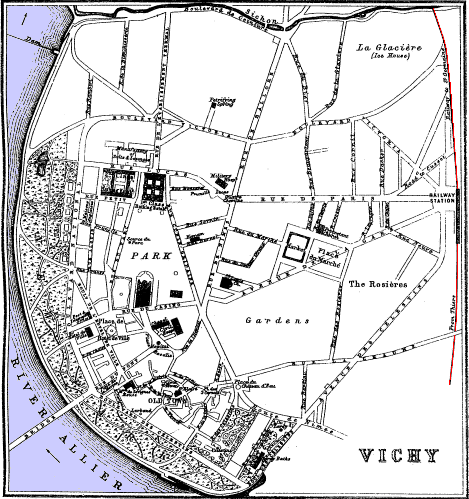
Vichy: Hotels and their Charges.
The following, also round the Parc, are equally comfortable, but the furniture is not so costly. The H. des Thermes, 10 to 12 frs., adjoining the Villa Strauss, in which Napoleon III. resided; Cherbourg, 9½ to 15½ frs.; the Princes, 9½ to 15½ frs.; the G. H. de la Paix, 12¾ to 15¾ frs.; the G. H. Velay et des Anglais, 9½ to 13½ frs.; Royal Hotel, Amirauté, 7½ to 10½ frs.; and H. de la Restauration. Almost adjoining the Ambassadeurs, the H. Moliere, 8½ to 12½ frs., a smaller house. In all the above hotels, excepting in the first three, servants are taken at the rate of 6 frs. per day. The above prices include everything except the charge of 1 fr. for candles at the end of the stay.
Adjoining the north corner of the Etablissement, near the Grande Grille, is the G. H. des Bains, 9 to 14 frs. Opposite the Etablissement, the H. Britannique, 7½ to 10 frs.; the Richelieu, 8½ to 10½ frs.; and behind it the H. Grande Grille, 8½ to 11½ frs., a more handsome house.
In the Rue Petit, near the Châlets in the Boulevard National, *H. d’Amerique, 9 to 10 frs., a clean quiet house, generally full.
In the Place de l’Hôtel de Ville at the south end of the Parc are the H. d’Espagne, 6½ to 10 frs., a small house served principally by the family; and the Deux-Mondes, 8½ to 10½ frs., fronting likewise the Place Rosalie. The fraction in the prices is for service.
In the Place Rosalie are the Source de l’Hôpital and the Banque de Vichy, where circular notes are cashed and money changed.
In the Rue de Nîmes, a busy street, separated from the Parc by a row of houses, is the H. de Nice, 8½ to 10 frs.; one side faces the church. On the other side of the church is the *H. Notre Dame, 9½ to 10½ frs. Then follow the G. H. du Centre, 7 to 10 frs.; H. Fénélon; H. du Regence, 8 to 9½ frs.; Orleans and Milan same price.
In the Rue de Paris, the street between the town and the railway station, are the G. H. du Louvre et de Reims, 7 to 10 frs., open all the year; Univers, 8 to 10 frs.; *Rome, 7½ to 9½ frs.; the Suisse; H. Dubessay; *Couronne, 8½ to 9½ frs.; Beaujolais; Brest, 7 to 8½ frs.; Cote d’Or, 7 to 7½ frs.; Globe, 7 frs., open all the year—all between the railway station and the Etablissement.
At the end of the Rue de Paris, in the Rue de Ballore, the G. Hôtel Maussant, 8 to 10 frs. In the Avenue Victoria, behind the military hospital, and in front of the petrifying spring, is the H. de Provence, 6 to 9 frs. In front of hospital, Hotel Lucas.
In the Rue de Nîmes, between the Parc and the Parc des Celestins, are the G. H. Palais, 7½ to 10 frs.; Genève; Milan; Bordeaux. Near
There are a great many maisons meublées, in which furnished rooms are let at prices varying from 4 to 8 frs., and ½ fr. for service. Lodgers can always have a breakfast prepared for them of coffee, bread, and eggs, without any extra charge, but the dinner is more troublesome. Among the maisons meublées are the Villa Sévigné (in which Madame resided) in the Boulevard National, near the Source Larbaud.
Travellers wishing to inspect the hotels and maisons meublées before deciding which to take should alight at one of the hotels in the Rue de Paris, as they are nearest the station, and sufficiently comfortable without being expensive.
Close to the principal establishment, in the Rue Lucas, is one of the best apothecary shops, the Pharmacie Durin, where information regarding the different doctors can be had.
Vichy, during the season, from 15th May till the end of September, forms a most enjoyable residence. It is full of comfortable hotels presided over by civil landlords, charging various prices from 6½ to 25 frs. per day, which includes wine, service, and everything else. The best situations are the Parc and in the contiguous streets. Tastefully-planned grounds, called the Neuf Parc, extend between the town and the Allier, crossed here by a handsome bridge, on the site where Caesar built his wooden bridge. On an eminence at the southern end of Vichy are the old town and the old parish church of St. Blaise, 13th and 14th cents. In works undertaken for the railway numerous coins have been dug up bearing the effigy of the Gallic chief Vercingetorix, as well as many Roman objects belonging to all the epochs of the empire. In 1402 Louis II., Duke of Bourbon, surrounded Vichy with a moat and fortified walls, within which he erected his castle; but of it all that remains is the great clock-tower or belfry.
Vichy: Mineral Water Establishment.
At the head of the Rue de Paris, on the north end of the Pare, is the Mineral Water Establishment, composed of two large buildings—1st, The “Grand Etablissement,” containing only first-class baths; a parallelogram 167 ft. long by 250 broad, provided with 100 cabinets with baths, and traversed by a gallery from N. to S., having on the western side the gentlemen’s baths, and on the eastern side the ladies’. At the extremity of this passage is an inhaling-room. Each bath costs 2½ frs., including service and linen. An hour and a quarter is allowed, including dressing. Below the baths are large reservoirs. In front of the entrance to the central gallery, near the spring Chomel, is the office for the taking down of the bathers’ names and for the sale of the bath tickets.
2d, Separated by a narrow street is a similar edifice in which second and third class baths are given, costing respectively 1½ frs. and 60 c. each. The difference in the price of the baths arises from the quality of the accommodation and the amount of linen and towels supplied. The baths themselves are the same, and are filled too from the same springs. The two buildings contain together 350 baths and 150 A.M. and continue till 5 P.M., but at one part of the season till even later. But it must always be remembered that the external application of the water is not nearly so important as the internal. Patients may visit Vichy, at any time; but the season suited to follow with success the course of treatment is from the 15th May till the beginning of October. The month of May is sometimes rainy. August and September are generally the driest months, and the most equable. The Vichy treatment lasts from 3 to 4 weeks. The waters are taken in the morning and during the day, and baths daily or every second day. For elderly people with sanguine and irritable temperaments and delicate constitutions the duration of the bath should not be more than 20 or even 15 minutes.
Vichy: Casino. The Vichy Springs.
At the south or opposite end of the Parc is the Casino, a handsome comfortably-furnished edifice. The ballroom is 60 ft. long by 38 wide and 45 high, and lighted by five large bay windows looking into the park. The decorations are of the period of Louis XIV., with elegantly-painted walls and ceiling. A gallery, running across the building in a lateral direction, separates the ballroom from the theatre, which occupies the centre of the Casino and contains seats for 800 persons. The remainder of the building is occupied by the reading, billiard, and gambling rooms, and a saloon for ladies. One entrance ticket, 2 frs.; a month, 25 frs. There is music every morning, a concert in the afternoon, and theatricals in the evening. A great quantity of journals and reviews are at the disposal of members; also books, pianos, and music. A professor of billiards is attached to the Casino.
The Vichy Springs.—The Vichy waters are stimulating, but not tonic. They are gaseous and alkaline, their principal constituents being carbonic acid and the bicarbonate of soda. They differ materially from each other only in temperature. They are easily digested and readily eliminated into the system, where they restore the vitality of the organs below the diaphragm. None of the springs possess any special specific property, the best for the patient being that which agrees best with him. Nevertheless, experience has detected certain peculiarities which may assist him to discover the most suitable spring. The maximum quantity which can be taken daily with advantage is from 24 to 28 oz. The usual dose is four glasses of 5 or 6 oz., taken at different times throughout the day, and not necessarily from the same spring. The water may with advantage be mixed with the wine taken at dinner. Carafes are filled at the springs without any charge. In the shops are sold graduated glasses of 150 to 180 grammes, divided into three equal parts. 30 grammes equal 1 oz.
The Springs and their peculiarities.—Under the vestibule of the principal establishment are three important springs—the Grande Grille, the Puits-Chomel, and the Mesdames (see plan).
Vichy: Grande-Grille, Chomel, Mesdames.
The Grande-Grille, 110° Fahr., is slightly aperient, and is employed
The Puits-Chomel, 113° Fahr. The water of this spring possesses marked anodyne properties, which render it very valuable whenever the weakened state of the constitution or its irritability requires to be moderately excited. Of all the Vichy waters it contains the least carbonic acid without being more difficult of digestion, and as, on the other hand, it is the most mineralised, it can in many cases profitably replace the other springs.
Mesdames, 61° Fahr., highly chalybeate, is beneficial in cases of chlorosis, amenorrhœa, and in debility following loss of blood. In cases where the constitution has been weakened without any evident derangement it stimulates the energy of the digestive functions so as to enable the patient to recover his usual strength.
The only other spring in the establishment is the Puits-Carré, 113° Fahr., which rises in the centre of the building, and is used for supplying the baths.
Vichy: Prunelle, Parc, Hôpital, Celestins.
About 100 yards E. from the principal establishment, in a building opposite the military hospital, is the Source Prunelle, a cold spring, recommended for diseases of the liver, gravel, and calculi. A little farther E. is the Source Lucas, 84° Fahr., principally employed in baths for diseases of the skin. As a drink it is beneficial where the organs are more disturbed than diseased. In the park, opposite the Hôtel de la Paix, is the Source du Parc, 71° Fahr., recommended for sluggish action of the digestive organs, atonic derangement of the intestines, and affections of the bronchial tube caused by chronic irritation or catarrh. At the N. end of the Casino, in front of the town hospital, is the Source de l’Hôpital or Rosalie, 89° Fahr., resembling very much the Grande Grille, but less exciting. It is recommended to those affected with diseases of the digestive organs, dyspepsia, gastritis, obstinate diarrhœa, and dysentery; and is particularly useful to literary men whose digestive functions are deranged from mental labour. It renders important service in ovarian tumours and other diseases of females.
A short way up the river by the Boulevard des Celestins are the five important springs, the Sources des Celestins, 54° and 58° Fahr., of which the nearest is under a handsome artificial grotto. They are largely exported, and have the same action, the only question being their respective degree of efficacy. Those who chiefly frequent these springs are invalids suffering from gout, gravel, and affections of the urinary organs, whose stomachs are sufficiently sound to be able to digest the water easily. Otherwise it is best to commence with either the “Hôpital” or the “Grande Grille” spring. In all cases the water of the Springs Celestins should be drunk moderately and with caution. Just beyond the Celestins, at the end of the Boulevard and near the Parc des Celestins, are the Lardy springs and establishment. The water, 77° Fahr., which rises from a depth of 620 ft., has a stimulating Dr. E. Lee.
Source Hauterive. Influence of Vichy Water.
3 m. S. from Vichy, on the W. bank of the Allier, is the Source Hauterive, 57° Fahr., used principally for exportation. In therapeutical qualities it resembles the Celestins.
The principal use of the Vichy waters is in the treatment of gout, and in chronic diseases of the stomach and abdominal viscera, such as dyspepsia, chronic hepatic disease, biliary calculi, fatty degeneration or cirrhosis, and in hæmorrhoidal affections, which are so often connected with congestion of the liver. They are equally serviceable in enlargements of the spleen and in many cases of hypochondriasis. Moreover, this spa is specially adapted for the cure of some of the chronic diseases of women connected with disordered menstruation, and for the anomalous “critical complaints” which often set in at the period of life when this function ceases. “The complaint for which nine-tenths of the English visitors drink these springs is gout; but it should be distinctly understood that Vichy water is not a specific for gout; it can only act on the gouty diathesis by improving the tone of the digestive organs, augmenting the secretions, and correcting the abnormally acid condition of the blood.” —Madden’s Health Resorts. “The Vichy waters do not cure gout. They have, however, a very beneficial effect when administered with caution in cases of either hereditary or acquired gout, whether articular or internal, acute or chronic. The proper time to use the waters is in the interval of attacks, and as far as possible from the last attack. If too near the last attack, a repetition is to be feared, and there is almost as much danger in provoking nature as in resisting its action in a crisis.” —Dr. Daumas. “We may then sum up the effects of a Vichy course, when judiciously prescribed, as restorative to the digestive and assimilative functions, and invigorative to the general health. The tone of the stomach is soon improved, digestion becomes easier and more rapid, pain and weight after food disappearing. The bile flows more freely. The bowels become regular. Diarrhœa, if previously present, ceases. The consequence of these changes is better assimilation, and therefore flesh is often gained. With the improvement in nutrition the colour returns to the cheeks and energy to the mind.” —Dr. P. James.
CHEMICAL ANALYSIS of the Principal Springs.
GG = Grande Grille. Ch = Chomel. Md = Mesdames. L = Lucas. P = Park. H = Hopital. Ce = Célestins. Hr = Hauterive.
Acids and Bases contained in each litre. NAMES OF THE SPRINGS.
GG Ch Md L P H Ce Hr
Carbonic Acid 4.418 4.429 5.029 5.348 5.071 4.719 4.705 5.640
Sulphuric „ .164 .164 .141 .164 .177 .164 .164 .164
Phosphoric „ .070 .038 traces .038 .076 .025 .050 .625