PART I.—PARIS TO MARSEILLES. (continued 2)
Reading edition
Lyons: Place Terreaux. Hôtel de Ville.
On the north side of the Place des Terreaux is the Hôtel de Ville, built in 1665 by Maupin, at the cost of £320,000. The facade, flanked by domed square pavilions, is 160 ft. wide, while the building itself is 1150 ft. long. The back part, fronting the theatre, is the Préfecture. From the centre rises the clock-tower, 157 ft. high. On the façade over the entrance is an equestrian statue of Henri IV. in bold relief. Within the vestibule, to the right and left, are colossal bronze groups, by the brothers Coustou, representing the Rhône and the Saône. They stood originally under the statue of Louis XIV. in the Place Bellecour.
In 1642 Cinq Mars and De Thou were executed, by order of Richelieu, in the Place des Terreaux. In 1794 the revolutionary tribunal, sitting in the Hôtel de Ville, guillotined so many people in this square that it became so flooded with blood as to render it necessary to send the executioners to Brotteaux, near the present railway station, to finish this wholesale slaughter of Frenchmen by Frenchmen.
Lyons: Condition des Soies. Library. Bourse. Silk Museum.
Behind the Hôtel de Ville, up the Rue de St. Polycarpe, house No. 7, is the establishment of the Condition des Soies, where the bales of silk brought to Lyons are sent to be dried. They are placed on an iron grating, and subjected for twenty-four hours to a temperature of from 64° to 72° Fahr., and are weighed both before and after this operation. The same is done to the wool. The sample drying room is in the first story, left hand. Any one may visit it. A little higher up are St. Polycarpe built in 1760, and St. Bruno built in 1688. At the opposite end of the bridge of St. Clair is the English church.
In the Rue de la République is the Bourse, a profusely ornamented edifice inaugurated in 1860. At the south end is St. Bonaventure, built in the 14th cent., and recently restored. At the north end is the Lycée with the public library, containing the great terrestrial globe made at Lyons in 1701, indicating the great African lakes, the rediscovery of which has been one of the events of the present century. There are 160,000 volumes and 2500 manuscripts,—about 600 of the printed works being incunabula, and 25 of the MSS. belonging to the Carlovingian period.
In the second story of the Bourse is the museum of the Art and Manufacture of silk. Open to the public on Sundays and Thursdays between 11 and 4. The great hall contains, in high glass cases, specimens of silk, satin, velvet, crape, and lace, arranged according to centuries from the 13th and 14th to the 19th. The 19th, which is by far the richest and most beautiful, is in two cases, representing the first and the latter half of the century. This collection is choice and highly artistic, displaying miniature portraits, superb embroidery, and lovely designs in charming colours, woven in the loom. At the entrance to the hall is a portrait (about 13 in. by 10) of Jacquard, in a sitting posture, woven in white and black silk, like those at St. Etienne. Also the Will of Louis XVI. In the next room are looms and models of looms from the time of Louis XI. The models are so perfect that each contains part of a web woven in it. Among them is the model of the famous loom made by Jacquard in 1804, by which a single workman was enabled to produce elaborate fabrics as easily as the plainest web, and by merely changing the “cartoons” to make the most different textures on the same loom. Near the loom is the first sewing machine. The inventor was B. Thimonier of Lyons in 1829, from which those now in use are improved copies.
The cases round the inmost room are devoted to the natural history of silk—displaying every variety of the silk butterfly, Bombyx mori, as well as of the allied species; cocoons of every kind and in every condition; eggs and caterpillars at every stage of their existence; and hanks of raw silk from every part of the world where it is produced. Adjoining is a room with drawings, many by the great masters.
Formerly Lyons manufactured only high-class silks, but the demand for these having been for some years on the decrease, the manufacturers, to hold their place in the market against especially their Créfeld rivals, have had to turn their attention to cheaper stuffs. This in some measure is owing to the rapid and violent changes of fashion,
In the street behind the east side of the Bourse are the large covered markets; where many of the fishes of the Rhone may be seen alive in tanks, and good Mont d’Or cheese be bought. It makes capital railway travelling provision. (See page 42.)
Lyons: City Hospital and Workhouse.
Farther down the street, with the principal facade to the Rhône, and the other, containing the entrance, to the Rue de l’Hôpital, is the Hôtel Dieu, or general hospital, with 1500 beds, founded in the 6th cent. by Childebert and Ultrogotha his queen. The present building is principally the work of Soufflet, the architect of the Pantheon in Paris. Of the beds, about 1300 are free, the remainder pay from 1¼ fr. to 12 frs. per day. The rooms are lofty and well ventilated. The principal female wards are arranged in the form of a cross, with an altar in the centre under the small dome, in such a position that all the patients can see it from their beds. From the large dome extends the principal ward of the men, containing 100 beds, and a smaller one on the other side. The sick are tended by nuns. The hospital has a house on the heights of the Croix-Rousse, near the terminus of the rope railway, and another at Oullins for incurables.
In the first court left of the large court, Dr. Young buried Mrs. Temple, the Narcissa of his Night Thoughts, who died in 1730 at Montpellier, but was there refused burial. At that time what is now a built-up court was a cemetery. Fifty years ago it was a garden, now it is covered with buildings. All trace of the grave has disappeared.
Near the entrance to the hospital is the church, 18th cent., richly decorated. In a chapel, left, is the enormous gilt shrine, in 5 stages, of Sainte Valentine.
Farther down the Rhône is the Hospice de la Charité, founded in 1531, on the occasion of a great famine. It receives the poor of both sexes who have reached 70; sick children under 15, and young women about to be mothers. The church was built in 1617.
Lyons: St. Martin d’Ainay.
North from the hospice or workhouse, near the bridge of Ainay across the Saône, is the church of St. Martin d’Ainay, which, with the monastery, was founded by St. Badulph during the reign of Constantine, on the site of a temple erected by the sixty nations of Gaul in honour of Cæsar Augustus. The first church having been destroyed by the Saracens, in the 8th cent., it was rebuilt in 1070, and consecrated in 1106 by Pope Pascal II. Since then it has been frequently repaired and altered. The style belongs to what is called modern Lyons. To the right is the sacristy or chapel of Saint Blandina, in which a short stair leads down to the crypt and the dungeons, one on each side, where Pothinus, first bishop of Lyons, and Blandina, a converted slave, were kept before being tortured and put to death in A.D. 177, during the persecution under Marcus Antoninus, the implacable enemy of Christianity. The crypt, about 12 ft. square, was, as well as the dungeons, about 10 feet deeper, but on account of the overflowing of the river the floors were filled up to their present level.
Lyons: Parc de la Tête-d’Or.
The Parc de la Tête-d’Or, or park of Lyons, is situated at the N.E. extremity of the city, between the Brotteaux railway station and the left bank of the Rhône. It measures 282 acres, and contains, besides an abundant supply of varied walks, a large and excellent botanic garden with hothouses, a lake with islands inhabited by aquatic birds, and a dairy farm, whose produce is sent every morning into town for sale. Adjoining the park are the rifle-butts and the racecourse. In the Boulevard du Nord is the Guimet Museum, containing a collection of objects from the extreme east, to facilitate the study of the history, religions, and customs of the inhabitants of that part of the world. The institution publishes essays and translations.
By the western side of the Brotteaux railway station are the large barracks of the Part-Dieu and the Fort des Brotteaux.
Lyons employs 70,000 looms and 140,000 weavers in the manufacture of silk; and here, as at St. Etienne, the work is principally performed on the domestic system in the dwellings of the master weavers, each of whom has usually from two to six or eight looms, which, with their fittings, are generally his own property. Himself and as many of his family as can work are employed on these looms, aided frequently by one or more compagnons, or journeymen, who inhabit chiefly the suburb of La Croix Rousse, to the north of the town, and that of Fourvières, on the Saône. The silk merchants supply the silk and patterns to the owners of looms, who are entrusted with the task of producing the web in a finished state. The mean annual value of the silk goods manufactured is estimated at £15,000,000.
The Dyeing of Silk—Origin of Lyons.
The dyeing of the silk is also an important branch of manufacture. Many experiments had been made to bring this art to perfection, and marrons de Lyon.
The earliest Gallic occupants of the territory at the confluence of the Rhône and the Saône were the Segusians. In 590 B.C. some Greek refugees from the banks of the Hérault, having obtained permission of the natives to establish themselves on the Croix Rousse, called their new town by the Gallic name Lugdunum; and in 43 B.C. Munatius Plancus brought a Roman colony to Fourvières from Vienne. This settlement soon acquired importance, and was made by Agrippa the starting-point of four great roads. Augustus, besides building aqueducts, temples, and a theatre, gave it a senate and made it the seat of an annual assembly of deputies from the sixty cities of Gallia Comata. Under the emperors the colony of Forum Vetus and the municipium of Lugdunum were united, receiving the jus senatus. The town, burnt by Nero in 59 A.D., was rebuilt by him in a much finer style, and adorned by Trajan, Adrian, and Antoninus.
Mont-d’Or.
Among the most interesting, and at the same time easiest excursions from Lyons is to Mont Ceindre, 4 m. from Lyons. Take the omnibus starting from the Rue de la Platière to the village of St. Cyr-au-Mont-d’Or, 3¼ m., time 1½ hr., by a road always ascending. Fare, ½ fr. The omnibus office at St. Cyr, the inn, and the café, are on a wide terrace commanding an extensive view. The village, pop. 2000, is poor and dirty, and built on the side of the hill. To ascend Mont Ceindre walk from the omnibus office up to the new church, whence ascend by the telegraph posts, and then turn to the right. The ascent Mont-d’Or, a group of mountains covered with vineyards and meadows. Cheese. The wine is thin, but the cheese is one of the best and most celebrated in France. They are soft, round, and flat, about 5 inches in diameter and half an inch thick, like round pancakes. They are made from a mixture of cow and goat’s milk, and are said to derive their peculiar flavour from the vine leaves on which the goats feed during a considerable portion of the year. The cheeses of Mont Dore (likewise famous) are thicker and smaller in diameter, and sold in small boxes. The coach, on its way from Lyons to St. Cyr, passes by Roche-Cardon, a favourite retreat of J. J. Rousseau. Another easy excursion is to the Ile Barbe. Take any of the mouches (penny boats) going up the Saône to Vaise station. Here change into the penny boat going to St. Rambert, a rather dirty little town on the right bank, 1½ m. above Vaise. Opposite, and connected by a bridge, is the town of Cuire. In the centre of the river is the Ile Barbe, across which the bridge passes. On the island there are a few uninviting country-houses, and the tower of a chapel (private property) of the 12th cent. The sail is the best part of the excursion, not the island.
For Lyons to Nîmes, by rail 172 m. south by the west bank of the Rhône, see p. 81; Paris to Lyons by Roanne and St. Etienne, p. 346; Paris to Lyons by Tarare, p. 348; Lyons to Clermont-Ferrand by St. Etienne, Montbrison, and Thiers, see p. 349, and map p. 27.
Vienne.
PARIS MARSEILLES 338 199 VIENNE, pop. 27,000. Hotels: Nord; Poste; Jacquet. In this, the capital of the first kingdom of Burgundy, there exist remains of important edifices, which indicate that the citizens inhabiting it in the days of Cicero were no strangers to the luxury and wealth preceding the Augustan age. The most interesting of these is the Maison Carrée, an oblong temple of the Corinthian order, dedicated to Augustus and his wife Livia, 55 ft. high, 88 long, and 80 broad, situated a little way north from the cathedral by the Rue St. Clementine. On a terrace fronting the chain bridge is St. Maurice, a beautiful Gothic cathedral commenced in the 12th cent., 315 ft. long, and the Ampuis (p. 81). 6 m. farther S. by rail is Le Péage-de-Roussillon. Roussillon, pop. 1500, is a straggling village among vineyards, less than a mile E. from the station. From the Château de Roussillon Charles IX. issued, in 1564, the decree that in future the year was to commence with the first of January.
> St. Rambert-d’Albon. Tain.
PARIS MARSEILLES 356½ 180½ ST. RAMBERT-D’ALBON, junction with line to Grenoble 57½ m. E., by Rives 35 m., and Voiron 42 m. E. Junction by bridge with Peyraud, 3¾ m. W., on the opposite side of the Rhône, whence rail to Annonay (see page 81, and map pages 26 and 46).
5 m. S. by rail from St. Rambert is St. Vallier, pop. 4000. Inn: Merle. On the junction of the Galaure with the Rhône. In the town is the restored castle of Anne de Poitiers, and up the valley of the Galaure are the pass of the Roche Taillée, the ruins of a château of the Dauphins, and the chapel of N. D. de Vals (see map, page 46).
PARIS MARSEILLES 368 169 TAIN, pop. 3000. Inns: H. Europe; Midi. A pleasant town on the Rhône, immediately opposite Tournon (page 82), and at the foot of the hill, whose vineyards produce the Hermitage wines. The red variety has a fine perfume, and is gratefully stomachic. The white is a luxurious wine, and will keep for a century, but the produce is small. Omnibus at station for Romans, 13 m. on the rail between Valence and Voiron (see map page 46), pop. 13,000. Inns: Europe; Midi. Situated at the confluence of the Isère with the Savasse, crossed by a bridge of 4 arches which unites it with Bourg-du-Péage, pop. 5000.
Valence.
PARIS MARSEILLES 384 153 VALENCE, pop. 24,000. Hotels: Louvre; Croix d’Or; France. The first the most expensive. Commodious Temple Protestant. Good Protestant schools. Suspension bridge across the Rhône. Omnibus to St. Péray, 2½ m. west. Coaches daily to Ardèche. Valence is a pleasant town on an eminence rising from the Rhône, surrounded by broad boulevards on the site of the old fortifications. The most handsome is the Place Championnet, on the site of the citadel, commenced by François. It commands an excellent view of the river and of the hills beyond. In the distance, to the right, on an arid rock, is the castle of Crussol. In this Place is the statue “au General Championnet, sorti des rangs du peuple. Hommage public de sa ville natale.” Died at Antibes 1800.
To the left of the statue is the cathedral St. Apollinaire, built in 1095, and restored in 1604 and 1730. The west portal and tower were rebuilt in 1880. The other parts of the exterior have a venerable appearance. The buttresses are shallow, and do not reach the eaves. A delicate dentil cornice runs round the building, bending over the round-headed windows and across the buttresses. Within, the church by restoration looks as if it were modern. Tall piers, with attached Corinthian columns and vaulting shafts, run up to the commencement of the arches of the aisles and of the vault of the roof, all of stone. From the semicircular chancel radiate 4 semicircular chapels, one being occupied by the organ. At the right or S. side of the altar is the bust by Canova of Pope Pius VI., who died at Valence in 1799. His remains were removed to Rome.
Outside, opposite the N. transept, is Le Pendentif, a sepulchral chapel (22 ft. square and 25 ft. high) of the Mistral family, built in 1548. On each side is a large round arch, over which rises a remarkably flat dome. Close to the “Place des Clercs” is the Maison des Têtes, built in 1531, covered with mutilated statues and medallions under canopy work. The medallions, bosses, and groining in the passage leading into the court are in a much better state of preservation. The windows in the court are square-headed, but most have lost their transoms. Among the other buildings are a Temple Protestant, 18th cent., and a picture gallery.
Vernoux. Coaches from Valence.
Rail to Grenoble, 62 m. N.E., and to Chambery, 40 m. farther. Omnibus daily to St. Péray (p. 82). Coach by St. Péray to Vernoux, 18 m. W. Vernoux 1920 ft. above the sea, pop. 3100. Inns: Nord; Verd. Temple Protestant. One of the nicest towns in Ardèche, situated in the midst of carefully-cultivated mountains and valleys. A large proportion of the inhabitants are Protestants.
Valence is one of the most convenient places for entering the Ardèche. Diligences from Valence to St. Laurent-du-Pape, St. Fortunat, Les Ollières, St. Sauveur, St. Pierreville, and Le Cheilard (see page 83). The diligences from Valence, Soyons, Charmes, Beauchastel, and La Voulte to St. Pierreville and Le Cheilard meet at St. Laurent-du-Pape; whence the passengers are conveyed in two diligences the length of St. Sauveur, by St. Fortunat and Ollières. At Ollières, H. du Pont, they meet and correspond with the diligence from Privas. From St. Sauveur one diligence runs westward by the Glaire to St. Pierreville and Marcols, the other northwards to Le Cheilard. Valence is 5 hrs. from St. Sauveur. Beauchastel and La Voulte, 4 hrs. St. Sauveur to Pierreville, 2½ hrs.; and to Le Cheilard, 3½ hrs. (see also pages 93 and 94). Coach from Valence to La Mastre, 21¼ m. W., passing by Champis, pop. 3380, at the foot of a mountain, which during a part of the day intercepts the rays of the sun.
ARDECHE its vineyards and Extinct Volcanoes.
For continuation northwards see map, page 167. For map of the Mountains of Ardeche see page 84. For continuation southwards see map, page 56.
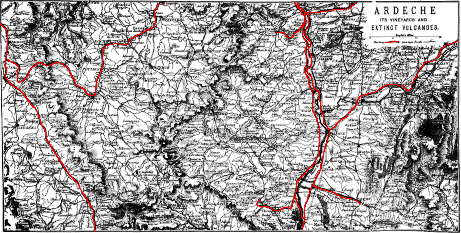
ARDÈCHE.
(See Map, page 46).
Ardèche should not be visited till June, and not later than September. In the villages and hamlets in the pastoral districts most of the best houses are inns or auberges, where a bed can be had, and abundance of fare, in the shape of fried potatoes, butter, milk, eggs, coffee, bread often of rye, and hard salt pork sausages. The national dish is potatoes sliced very thin and fried with butter. They make also a pleasant soup of herbs mixed with potatoes. The numerous inns are required for the accommodation of guests during the fairs, of which each hamlet has at least 2, while the larger villages and towns have from 4 to 8, besides market-days. One of the prettiest sights in Ardèche is to see the people flocking from every direction along the winding mountain roads to the village where the fair is being held—many on foot driving small parcels of pigs, sheep, goats, or cattle, or carrying baskets full of eggs, cheese, and butter, and often an old hen; others with carts loaded with potatoes; others travelling comfortably in their char-à-bancs; and others on horseback, the women as well as the men being astride.
Many of the inns, and even of the owners, are at first sight forbidding, but after a little kindly conversation the aspect of things improves rapidly. In the higher regions the agricultural products are potatoes and hay. In the next zone are wheat, chestnut, walnut, apple, pear, and cherry trees, cultivated on terraces supported by low stone walls of rough unhewn stones. Vineyards are in the lowest zone, on the sunny side of the mountains. The cattle are of a goodly size, mostly cream-coloured and light brown, with large bones and white horns generally tipped with black.
At the fairs, besides every kind of country produce, girls and grown-up women offer their hair for sale. The best do not yield above 8s., and many only 2s. 6d. or 3s. When the bargain is made a woman shears it off in the same way as sheep are shorn, leaving only
Among the remarkable sights in Ardèche are the volcanic rocks, Mont Mezenc and the Gerbier-de-Joncs, above the source of the Loire. The most central station of the diligences is Le Cheilard (see page 83).
After Valence the railway traverses some of the most picturesque parts of the valley of the Rhône. At Mornas, 44½ m. S. from Valence and 23½ m. N. from Avignon, begins the region of the olives.
Livron. Crest.
PARIS MARSEILLES 395 142 LIVRON, pop. 4500, on the Drôme, at some distance from the station. Restaurants at station. Inns in the town. On the other side of the Rhône, connected by railway bridge, is La Voulte, 1¼ m. W. (see p. 82). A highway, partly by rail and partly by diligence, extends from Livron, 68 m. east, to Aspres on the line between Grenoble and Marseilles. As far as the Pass de Cabres the road ascends the picturesque and well-cultivated valley of the Drôme, where there is a large Protestant population, nearly every village having its Temple Protestant (see maps, pages 26, 46, and 56).
11 miles E. from Livron by rail is Crest, pop. 6000. Hotels: Bonsans-Reboul, the best; opposite the France; and on the promenade, by the side of the river and the bridge, the inn Pont de la Drôme. The omnibuses of the two hotels await passengers. Crest is situated partly on the Drôme and partly on the steep sides of a high hill. At the foot, in the market-place, are the parish church and the Bibliothèque. Straight up from the bridge by the R. des Cordeliers, and a flight of 116 steps, is the entrance to the poor church of N. D. de la Garde, attached to the “Asile” for young children. A little higher up are the hospital and church. Above the “Asile” is the entrance to the enclosure, on which stands a huge structure, partly Roman and partly the remains of a castle which was added to it in the 13th cent. The highest side is 170 ft. above the ground, and the other three 148 ft., ascended by 260 steps. Although so high, the view is limited by the high side, into which visitors are not admitted. The concierge lives below in the town, near the hotel. The best way up the hill is by the first narrow street, left from the hotel, the Rue de la Carrière, which continue to a stone lettered “limite de l’Octroi,” whence ascend by the path, right, to the Calvary, where there is a splendid view of the valley of the Drôme.
Coaches daily from Crest to Montelimart, 22½ m. S.W. (see Index); also to Beaufort, 12 m. N.E., on the Geroanne. From the copious source of the Geroanne are occasionally thrown up blind trout. 3 miles from Beaufort is the picturesque gorge of Ombléze. Coach also to Bourdeaux, 16 m. S., passing Saou, 9 m. S. from Crest (see map, p. 56). Saou. Saou, pronounced Sou, pop. 1200, is a poor dirty village on the Vebre. Inn: H. Lattard. Mixed up with and built into the surrounding squalid houses are the remains of the abbey church and
Bourdeaux. Dieulefit.
Coach from Saou to Bourdeaux, 7 m. S. Bourdeaux, pop. 1800. Inns: Blanc; Petit; Temple Protestant. On both sides of the Roubion, 8 m. N. from Dieulefit. On the left side of the river is the old town, composed of squalid houses and execrably paved steep lanes, creeping up the hill, crowned with the ruins of a large castle founded in the 8th cent. Agriculture and the rearing of silkworms are the chief industries. Although Bourdeaux is hardly 8 m. from Dieulefit the courrier requires 2 hours to perform the journey, as a high mountain ridge, the Dieu-Grace, intervenes between the two places.
Dieulefit, pop. 5000. Inns: H. du Levant; Temple Protestant. On the Jabron at the foot of Mont de Dieu-Grace, 17½ m. E. from Montelimart, between which two towns several coaches run daily. In the town are silk, cotton, and cloth mills, and in the suburbs potteries where a coarse kitchen ware is made. The principal towns passed on the road to Montelimart are Poët-Lavat, 3⅛ m.; La Begude, 7½ m.; under Châteauneuf-de-Mazenc and Montboucher, situated on eminences at a considerable distance from the road (see map, page 56).
Die.
CREST TO ASPRES
(Maps, pp. 46 and 56).
Crest to Aspres, 57 miles east by Die.—The road as far as the Pass de Cabres follows the course of the Drôme. The first town passed is Saillans, 9½ m. E. from Crest, pop. 1800. Inns: Lambert; Latour. In a ravine of the Drôme, 6½ m. farther, is Pontaix, similarly situated. 23 m. E. from Crest, and 34 m. W. from Aspres, is Die, pop. 4000, the principal town in the valley of the Drôme, which here receives the Mérosse. Inns: St. Dominique; Alpes—the coach stops between them; Église Protestante. The Clairette de Die is a thin white wine, drank during its first year; small stones and grass; 5 hrs. required for the ascent. At the foot of the mountain is the rustic but not uncomfortable establishment of Sallières-les-Bains; pension per day, with baths, 9 frs. The treatment is called “Sudations résineuses.” The bath resembles a large oven, in which, after having been heated with resinous fir-wood, the patients sit as in a Turkish bath. Open from 15th June to 15th September. The landlord is likewise proprietor of a large part of Mt. Glandaz, whence he receives his supplies of fir-wood. On the top of a hill on the other side of the Drôme is a similar establishment, called the Martouret, pension 12 frs. The way to it strikes off the main road opposite the eminence, on which is the chapel of Notre Dame, commanding a very good view of the valley. At the entrance into Die from Crest, at one of the old gateways, a road strikes off to the left, which makes the tour of the ruins of the castle, amidst vines and mulberry trees. At the other end of the town, near the viaduct, is a much better gateway or Roman triumphal arch, fronting the “Place” St. Marcel. The parish church has been rebuilt, excepting the narthex.
Luc. Aspres.
From Die the road to Aspres is continued by another diligence, which changes horses at LUC en Diois, pop. 940. Inn: Du Levant; Église Protestante, 10½ m. S. from Die, or 23½ N.W. from Aspres. A poor town, among vineyards and walnut trees, on the Drôme, at the foot of high mountains. Nearly a mile up the river the narrow gorge becomes almost closed by huge fantastic masses of conglomerate which have fallen from the adjoining cliffs. 9½ m. farther up the valley is the village of Beaurières (Inn, where the coach changes horses). The ascent is now commenced by a beautiful and excellent road, of the Col de Cabres, 15 m. S. from Luc, and 4923 ft. high. On the pass, 2 m. from Beaurières, is La Baume, with the cave of Baumette, and a waterfall 195 ft. high. 4½ miles from Baume, and 3 from Aspres, is St. Pierre d’Argenson, with a sparkling acidulous chalybeate spring, grateful to the palate and invigorating to the system, and forming a refreshing mixture with the wine of Aspres, which is thin, and is at its best when 2 years old. Aspres, pop. 800, is situated on the railway, 126½ m. N. from Marseilles, and 77½ m. S. from Grenoble. The coach sets down passengers either at the station or at the inn H. Ferdinand. The church has been rebuilt, excepting the portal, which has on the tympanum a curious representation of the Trinity.
Montélimart.
PARIS MARSEILLES 412 125 MONTÉLIMART, pop. 12,000, situated at the confluence of the Roubion and Jabron with the Rhône. Hotels: near the station, the France; in the town the Poste; the Princes. The office of the coaches for Le Teil, on the W. side of the Rhône; for Grignan, p. 49; Dieulefit, p. 47; Bourdeaux, p. 47; and Nyons, p. 50; is near the hotels Poste and Princes. Up the Grande Rue is the principal Rochemaure, on the opposite side of the Rhône (see page 92, and map page 56).
Omnibuses to the sparkling chalybeate spring of Bondonneau, 2½ m. S.E. Two coaches daily to Grignan, 15 m. S.E. from Montelimart; one by Alan and Reauville, the other goes round by Donzère, 4½ m. longer. (See map, page 56.)
According to Mr. Murray (p. 109) in the village of Alan, half-way between Montelimart and Grignan, “there existed down to 1802 the first white mulberry tree planted in France. It was brought from Naples by Guy Pope de St. Auban, seigneur of Alan, one of the soldiers who accompanied Charles VIII. on his Italian campaign, in 1494.” The mulberry tree occupies a much wider zone in the south of France than the olive (see map, page 56).
Grignan. Marquise de Sévigné.
Grignan, pop. 1900; Inn: Sévigné, is built on the slopes of a hill on the top of which, 100 ft. above the “Place,” are the gardens and ugly half-ruined and half-inhabited castle where Mme. Sévigné died. The former Salle du Roi has been converted into a picture-gallery, containing upwards of 300 paintings, among which the most interesting are—the portraits of Madame and her daughter, by Mignard. About half-way up the hill is the church, commenced in the 12th cent. In front of the altar a white marble slab, 2½ ft. long by 1½ wide, bears the following inscription:— “Cy Git Marie de Rabutin Chantal, Marquise de Sévigné. Décédé le 18 Avril 1696.” Above the well, in the “Place,” is a bronze statue of her with corkscrew curls. About ½ m. from the town is what was one of her favourite walks to an overhanging ledge of sandstone called the Grotte de Roche-Courbière. To visit it, descend from the inn, then take the first byeroad right, by a row of poplars to a short stair. A coach runs from Grignan to Nyons, 20½ m. S.E. by Valréas and Taulignan. Valréas (pronounce the “s”), 8¼ m. from Nyons and 22 from Orange, pop. 950; Inn: H. du Nord, is partly surrounded with its old walls, garnished with square towers and pierced by narrow gateways. Taulignan, 17 m. N.W. Inn: H. du Commerce, pop. 1200, is also partly surrounded with its old walls.
PARIS MARSEILLES 420 117 DONZERE. H. du Commerce. Romanesque church with handsome spire. Four and a half miles south is Pierrelatte station, and the terminus of the unfinished railway to Nyons, 15 miles from Grignan. Coach from Pierrelatte to St. Paul-Trois-Châteaux, fare 6 sous, time 45 minutes. This, the Roman Augusta-Tricastinorum, contains an interesting cathedral of the 12th cent., restored. Many Roman relics have been found in the neighbourhood.
La Croisiere.
PARIS MARSEILLES 432 105 LA CROISIERE. Two small inns at station. Omnibus awaits passengers for Pont Saint-Esprit, H. de l’Europe, 3½ m. W. on the other side of the Rhône by an avenue of poplars. Fare, 40 c. The bridge is 2756 ft. long, has 20 arches, was commenced in 1265 and finished in 1309. Till 1865 it had 21 arches, when the two at the W. end were demolished and converted into one large iron arch for the convenience of the steamboat to pass through. (For Pont Saint-Esprit, see page 98).
Diligence at La Croisiere station for Nyons, 29½ m. E. by the valleys of the Lez and the Aigues, and the town of Bollène, pop. 6000. Inn: Croix Blanche, on the Lez, 4½ m. E. Manufactures of fire-bricks and clay-tubing. 7½ m. E., Suze-le-Rousse, pop. 2200. Coach here to Mansis. 12 m. E., Tulette, pop. 1300; Inn: Vigne. Horses changed here. 15¾ m. E., St. Maurice, pop. 1000; Inn: Lion d’Or. Near the village of Vinsobres a cross-road leads to the highway between Nyons and Vaison. At Nyons the coach stops in the “Place” in front of the H. du Louvre; whence the diligences start for Grignan and Montelimart (see map, page 56).
Nyons.
NYONS, on the Aigues, pop. 4000. Hotels: Louvre, in the Place; Voyageurs, in a corner. Temple Protestant next the hospital. Nyons, surrounded by high mountains, is famous for its mild springs, and therefore eminently fitted for those returning from the Riviera. The orange and palm do not grow here, but abundance of mulberry, almond, fig, peach, and pear trees. In the oak forests are remarkably fine truffles. Silk mills and the preserving of fruit and truffles supply the principal industries. The old town, called Les Forts, is built on an eminence partly surrounded with its old walls garnished with square towers, 14th cent. The vieux château, or centre tower, has been converted by the curate into a chapel surmounted with an image of the “immaculately conceived.” The part of the town below is called Les Halles, whose dirty streets are bordered with thick heavy arches. The rest of the town, extending to the Aigues, is called the Bourg. The bridge, built in 1341, is of one arch and considerably higher in the centre than at the ends.
The Pontias Breeze.
Behind the old town is the ridge called the Col-du-Divès, on which is the cavern, or rather hole, whence it is reported (most absurdly) that the night-breeze called the Pontias issues. In winter this wind is very P.M. to 9 A.M. In summer it is pleasant, and blows from 9 P.M. to 7 A.M. The peculiarity is, that the degree of force is constant, and never breaks out into gusts. To go to the cave, commence from the foot of the tower of the church and ascend by the Rue Pousterle, having on the left the old town-walls. Beyond the last tower a path strikes off to the right, which take, and ascend to a small chapel on the top of the ridge, passing at about half-way a pavilion. Or, if preferred, continue the road from the tower to the part of the ridge where there is a gap; whence take the path at the back of the ridge leading to the chapel. Those who have ascended by this latter way retrace their steps from the chapel by the same path for 116 yards; while those who have come by the other go 116 yards beyond the chapel. Then about 30 yards to the left of the path will be observed the thin ledge of a rock overlying a small cavity, which is the entrance to the Pontias hole, of great depth, but otherwise of insignificant dimension. Among the neighbouring calcareous strata are several crevices. The view of the valley of the Aigues from this hill is very beautiful. The ascent takes 35 minutes.
NYONS TO SERRES.
Nyons to Serres (see map, p. 56), 41 miles east by the valleys of the Aigues and Blème, bounded on both sides by high mountains. Time, 7 to 8 hours. Fare, 7½ frs. Most of the towns passed are at a considerable height above the road, and sometimes on account of the steepness of the banks cannot be seen from it. The first village passed is Les Piles, situated on the road 3¾ m. from Nyons, and 3½ m. from the gorge “Des 30 Pas,” one of the excursions from Nyons. A little farther E. is Curnier, on a hill on the S. side of the river, here crossed by a bridge. Then follows Sahune, also on a hill on the S. side of the river. The gorge now becomes very narrow and the mountains precipitous, and, having passed under Villeperdrix, the road crosses to the S. side of the river and arrives at the station for St. May, where there is an inn, H. Marius. St. May itself is high up on the opposite side of the river. The cemetery is on the point of a lofty precipitous rock. After St. May the diligence crosses the river to the village of Rémusat, 17 m. E. from Nyons on the Oule, at its junction with the Aigues. The diligence now returns to the S. side of the river, which it crosses for the last time at Verclause, 22 m. from Nyons, and then proceeds to Rosans, 3½ m. farther or 15½ m. from Serres. From Rosans commences the ascent of the low Col of Ribeyret, whence the road descends to Serres by the N. side of the Blème, passing the villages of Epine and Montclus. Serres, pop. 1200. Inns: Voyageurs; Alpes. On the railway, 112½ m. N. from Marseilles and 77½ S. from Grenoble (see p. 340).
Orange.
PARIS MARSEILLES 444 93 ORANGE, pop. 10,300. Inn: H. de la Poste et des Princes. This, the Arausio of the Romans, is situated on the slowly-running Meine. Close to the hotel is the Triumphal Arch supposed to have been erected in honour of Tiberius for his victory over Sacrovir and A.D. 21. It stands E. and W., is of a yellowish sandstone, 75 ft. high, 64 wide, 27½ deep, and consists of 3 arches, of which the centre one has a span of 17 ft. and each of the other two a span of 10 ft. The soffits are ornamented with six-sided sculptured panels. By the side of each arch is a grooved Corinthian column. Over the small arches are sculptured trophies in the shape of shields, boars, bulls, rostra, ropes, masts, dolphins, arrows, etc. Over the main arch, on each side, is a group representing a combat.
At the other end of the town are the cathedral and the Roman theatre at the foot of the hill, crowned with an image of Mary. The Cathedral of Notre Dame, 12th cent., is small, and resembles in style the churches of the S.W. of France, of which the cathedral of Perpignan is the great type. No transepts nor triforia. Lofty chapels between the buttresses, and over the arches diminutive clerestory windows. A plain and ugly square tower, in this case, at the east end. Adjoining is the Place de l’Hôtel de Ville, with a statue to “Raimbaud II., Comte d’Orange, vainqueur à Antioche et à Jérusalem en MXCIX.” In the promenade of the town, the Cours St. Martin, is a statue to the Comte de Gasparin, a writer on agriculture, and a native of Orange; where also he died in 1862. At the foot of the hill, overlooking the town, are the grand and imposing ruins of one of the most perfect Roman theatres. It is built in a semicircular form, has a façade 118 ft. high and 384 ft. wide. The wall is 13 ft. thick, composed of huge blocks of stone. The semicircular wall consists of five stages, and included accommodation for 6500 spectators. The building has recently been repaired and cleared of a quantity of rubbish.
Prince Of Orange and Orangemen.
In the 11th cent. Orange became an independent countship, probably under Raimbaud I., whose successor, Raimbaud II., has just been noticed. On the death of Philibert of Châlons, last of the third line of princes, the inheritance fell to his sister’s son Count René (Renatus) of Nassau-Dillenburg, who remaining childless chose as his successor his cousin William I., stadtholder of the United Netherlands. The title “Prince of Orange” was consequently borne by the stadtholders Maurice, Frederick-Henry, William I., William II., and William III. After the Revolution in Ireland of 1688, the English-Protestant party were designated Orangemen, from the title of their leader, William III., Prince of Orange. Louis XIV. seized the principality of Orange in 1672, but lost it by the peace of Ryswick. On the death of William III. there were two claimants—John William Friso of Nassau-Dietz, designated by William’s will, and Frederick I, King of dominium utile; and its finding was confirmed by the treaty of Utrecht (1713), which, however, left the title and coat of arms to the King of Prussia, who is still styled Prince of Orange (Prinz von Oranien). John William Friso, however, also took the title, and his successors the stadtholders and kings of the Netherlands have all been designated princes of Orange-Nassau. Vast numbers of silkworms are reared at Orange. Coach daily to Valréas 22 m. E., p. 49, and to Vaison 17½ m. N.E. (Map p. 56.)
Vaison. St. Quenin.
Vaison, pop. 3400. Inn: H. du Commerce. 5 m. N. from Malaucene, 17½ m. N. from Carpentras, 11¼ m. S. from Nyons, 13½ m. W. from Le Buis, and 4 m. S. from Villedieu. Old or high Vaison is on the left side of the Ouvèze, and new Vaison on the right. Both are connected by a Roman bridge of one arch of 48 ft. span, having at the left side a more elongated curve than at the right. The old town, with its squalid streets and poor houses, covers the sides of a hill crowned with the ruins of a castle built by Raymond VI., Count of Toulouse, in 1195. It is a plain rectangular edifice, 20 yards square, with a small square tower at one of the angles. A little below is the parish church with round and early pointed arches and square tower at S.E. end. The view from the terrace is beautiful.
The most ancient and most interesting buildings are in new Vaison, and very near each other. Take the Villedieu road to just without the town, where a byeway on the right leaves the main road at an acute angle. Continue this byeway to two arches, which indicate the site of the Roman theatre. The chapel seen to the N.W. is St. Quenin, while a little beyond is the cathedral. The amphitheatre, or “les arènes” as they call it, is built on the same plan, and in a similar position, as the theatre of Orange, but far less perfect. Besides the two arches, there exist still five tiers, but all the stone seats are gone, excepting those on the lowest stage. Now it has become a vineyard and an orchard. Beyond, by a narrow road, is St. Quenin, of which the east end is Roman, and may date from the 4th cent., but the rest belongs to the 10th. The east end, or apsidal termination, is in the form of an equilateral triangle, with an attached fluted Corinthian column at the apex, and also at each of the angles of the base. One of the pillars has figures on the capital. The neat little round-headed window on each side of the triangle is evidently a later addition. Bishop Quenin died in 578.
Of the Cathedral the best part is also the outside. Under the eaves of the roof of the nave run a dentil moulding, and a frieze of medallions connected by an undulating line of foliage. The walls are pierced by small round-headed windows resting on spiral colonnettes. p. 56.)
Sorgues. Carpentras.
PARIS MARSEILLES 455 82 SORGUES, pop. 4000, on the Sorgues, which rises at Vaucluse. Junction with line to Carpentras, 10½ m. eastwards. Carpentras, pop. 10,500, on an eminence surrounded by avenues, rising from the Auzon. Hotels: Universe; Orient, both good, and in the large “Place” opposite, the Hôtel-Dieu, built in 1760 by Bishop Malachie. In the Hôtel-Dieu are a portrait by Rigaud of the Abbot Rancé, and a handsome staircase. In the centre of the Place is a bronze statue of the benevolent Malachie d’Inguimbert. From this “Place,” up the narrow street, the first public building is the church of St. Siffrein, dating from 1405. The square tower, with octangular cupola, attached to the north side of the chancel, was part of a former church constructed in the time of Charlemagne. The stair (89 steps) up to the roof, whence there is a pleasing view, commences at the south side of the chancel, outside. Among the pictures in the interior of the church, the best is a “Salutation” by the Flemish painter Andreas Schoonjans. Behind the pulpit is a picture by Mignard representing Mary giving some of her milk to St. Bernard. At the commencement of the chancel, near the cupola, is the chapel in which the reliquaries are kept. Among them are the skull and bones of St Siffrein, and the nail that pierced the right hand of J. C. on the Cross. In the chancel is a “Coronation” of Mary painted on wood, 15th cent., and behind the altar another “Coronation” by P. Veronese. In the foreground are Saints Laurence and Siffrein. Adjoining is the Palais de Justice, 1640, with frescoes and a crucifix in the “salle des assises.” Within the court, right hand, is a Triumphal arch, erected by Diocletian between 284 and 305, 30 ft. high (but originally higher), 25½ ft. wide, 14½ ft deep, and 10 ft. span. On the N. side, between two attached fluted columns, is, in bold relief, a Latin cross with the arms at obtuse angles. On each side stands a prisoner, with his hands behind him, chained loosely to the cross. From the cross are suspended swords, horns, and pouches. On the south side is a similar cross, but not in
The continuation of the street from the church leads to the Porte d’Orange, surmounted by a square tower 120 ft. high, of which only three sides exist. It was built by Innocent VI., who also surrounded the town with the ramparts, which now form beautiful Boulevards. From the boulevard in front of the gate are seen to the left the canal aqueduct, to the right the town water aqueduct, and in the distance, between the two, beyond a smaller ridge, Mont Ventoux, extending from N.W. to S.E., with a slight bend. The aqueduct which brings water to Carpentras crosses the valley of the Auzon by 48 massive arches. The canal, which by irrigation fertilises the surrounding country, extends from the Durance to the Ouvèze, a distance of 43 miles, and cost £90,000. In the principal Boulevard, nearly opposite the manufactory of preserved fruits of Eysseric, is the building containing the library and museum. The library contains a valuable collection of manuscripts, explained in a printed 4to volume, several rare incunables, and above 4000 vols., for which there is not sufficient accommodation. Carpentras: Museum. In the “Musée” are a few good pictures, and Roman statuettes in bronze and marble, all from Vaison, excepting a small Apollo found at Carpentras. The gem of the antiquities is an Egyptian-Aramaic limestone slab, 4th or 3d cent. B.C., 19¼ in. long by 13½ wide and 1 thick, divided into three compartments by narrow borders. In the principal compartment stands a young woman with uplifted hands before Osiris, who is seated in front of a table on which are sacrifices. Behind Osiris stands Isis. Below, in the second compartment, is the embalmed body of the deceased, attended by the jackal-headed Anubis and the hawk-headed Horus. Below the body are the four customary funeral vases. Below this, in the third compartment, is an Aramaic inscription in four lines, of which the last two are injured. The first French opera was written in Carpentras by the Abbot Mailly in 1646. Truffles. Truffles or tuberous mushrooms are black, dark gray, violet-coloured, or white. The last variety, principally found in the N. of Italy, has the smell of garlic. About Carpentras, and in the department of Vaucluse, they are black, and are found from 4 inches to 1 foot below the ground, at the extremities of the fibrous roots, both of the common and of the evergreen oak. The season for gathering them is from November to the end of March, after which those which remain become soft and decompose. They are at their best in January, when the rind is black, hard, and rough, and the inside mottled black and white. In size and shape the best resemble small round potatoes, of which the largest may weigh ½ lb., although few are of that size. They are sought by means of dogs and swine, both of a peculiar breed; the sow being the more dexterous of the two, and continues efficient for its duty for upwards of 21 years. It scoops out the earth with its powerful snout in a masterly manner faster than any dog can do. When just about to seize the truffle, the attendant thrusts a stick between its jaws, picks up the truffle himself, and throws to the sow instead two
Ortolans.
The ortolans, which breed about the hills and woods of Carpentras, migrate in autumn. While on the wing they are allured down to nets laid for them by ortolans singing in cages. Those caught are put into dark rooms, where they are fattened. In about a month’s time they become so plump as hardly to be able to fly, when they are killed and sold, excepting a few kept for alluring the others next year. The singing time of these is transferred from spring to August, by pulling out the large feathers of the tail and wings in April, and keeping them in a dark apartment till August.
Carpentras is also famous for its preserved fruits and “berlingots,” a sweetmeat made of the syrup of a mixture of fruits, not unlike barley sugar, but cut into pieces 1 in. square. The best maker is Eysseric.
Carpentras is a good halting-place for delicate people returning from the Riviera—the hotels are comfortable and the prices moderate—excellent public library, pleasant walks, and in the vicinity of many interesting places connected by roomy diligences.
Coach daily from Carpentras to Nyons 28½ m. N., by Vacqueyras 6½ m., and Vaison 17½ m. Also to Nyons 26 m., by Malaucene 10 m. N.E., and Vaison 15 m. by this way. Coach to Buis-les-Baronnies 23 m. N.E., passing through Malaucene. Coach from Buis to Nyons 19 m. N.W. by Mollans. Courrier from Vaison to Buisson 7½ m. N. on the Aigues. Coach to Sault 28½ m. E.
Omnibus several times daily to St. Didier 4½ m. S.E. Coach daily to L’Ile 10½ m. S., convenient for visiting the fountain of Vaucluse. Coach on market-days from Carpentras to Apt 28½ m. S.E., by Venasque 7¼ m. S.E. (For these places see Index, and maps pages 56 and 66.)
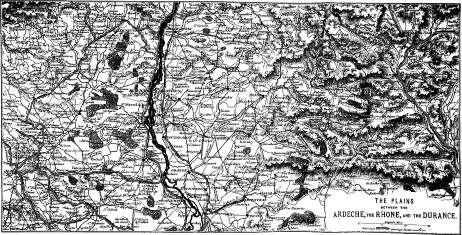
THE PLAINS between the ARDECHE, the RHONE and the DURANCE.
[West End] For continuation northwards see map, page 46. [East End] For continuation northwards see map, page 327. For continuation eastwards see map, page 327. [West End] For continuation southwards see map, page 66. [East End] For continuation southwards see map, page 163.
Bedoin. Mont Ventoux.
Coach daily to Bedoin 8¾ m. N.E., 900 ft. above the sea, pop. 1300. Inn: Hôtel de Mont Ventoux. Station to ascend Mont Ventoux, 6274 ft., by a good road from the south end of the ridge. The base is about 2 m. from the village and the top 10 m. by the easy southern slope. Time to ascend, from 5 to 6 hours. Mule, 10 frs. No guide necessary. Before commencing the ascent, go to the top of the hill by the side of the church and take a general survey of the land. The road extending to the right, under those mulberry trees, is the one to take. A little distance along it, at a well with a cistern, a narrow road strikes off to the left and ascends the mountain by a steeper and shorter way. The mountain offers a splendid field for botanists. To see the sun rise from the top, travellers generally start at 11 P.M., and await the appearance of the glorious luminary in the chapel of Ste. Croix, on the summit. Mont Ventoux is the culminating point of the Lure range, an offshoot from the Alps. Among the minerals it has quartz in every form and colour, in nodules and in strata. Also beautiful jasper and fossils such as ammonites and belemnites. The kaoline clay, “terre de Bedouin,” is found in the plain between Bedoin and Crillon, a village 2¾ m. N.E. At different parts in this
Resin Baths. Malaucene.
Four and a half m. S. by omnibus from Carpentras is the village of St. Didier, with a good hydropathic establishment in an old château. Rooms from 1½ fr. to 3 frs. Servants’ rooms, 1 fr. Meat, breakfast and dinner, both with wine, 5 frs. Coffee in the mornings, ½ fr. Meat, breakfast and dinner, for children and servants, 3 frs. Service, ½ fr. First consultation, 10 frs. Every other consultation in the study gratis; but in the guests’ room 1 fr. each time. The baths are in the style of the Turkish baths, with the addition that the heated air is impregnated with resin or is turpentinised (térébenthiné). It has a beneficial effect on the lungs and muscular rheumatism. St. Didier is 2¾ m. W. from Venasque and 2 m. from Le Beaucet (map p. 56).
Two coaches daily from Carpentras to Buis-les-Baronnies, 23 m. N.E., by Malaucene 10 m. N.E. The road from Carpentras, in crossing the N.W. extremity of the Ventoux chain, passes by the village of Le Barroux on a hill crowned with the ruins of a castle, 15th cent. At the foot of Mont Ventoux, 5 m. S. from Vaison and 13 m. S.W. from Buis, is Malaucene, 1000 ft. above the sea, pop. 3000. Inn: Hôtel de Cours, in a picturesque neighbourhood, of which there is a good view from the calvary on an eminence in the town. At about ½ m. from the inn is the spring Groseau, gushing forth from the base of a lofty calcareous cliff, crowned with the ruins of the chapel of Groseaux, 11th cent. The stream that issues from the spring is soon strong enough to set in motion the machinery of paper, silk, and flour mills. Any one may visit the silk mills. In 1345 Petrarch ascended Mont Ventoux from Malaucene. The ascent from this place is more difficult, but more picturesque than from Bedoin and requires 2 hours more. On the side of the mountain are the springs—Angel, 3826 ft.; Puits de Mont-Serein, 4774 ft.; and Font Filiole, 5866 ft.
The road from Malaucene to Buis follows the picturesque valley of the Ouvèze. The most important village passed on the way is Mollans, with, in the neighbourhood, a great cave, beyond which is a deep lake. Shortly before arriving at Le Buis are seen, on an eminence, the bronze statue of Bishop Trophime, and beyond, the cliff of St. Julien. No public vehicle goes farther than Le Buis, although the road is good the length of the railway between Marseilles and Grenoble, passing St. Euphemie 7 m. E., St. Auban 10 m. E., Montguers 11¼ m. E., Lacombe 13¼ m. E., and Laborel 27 m. E., after which the road descends to the railway by the valley of the Céans.
Le Buis.
LE BUIS, pop. 2000; Inns: Luxembourg; Commerce; is situated in a hollow on the Ouvèze surrounded by mountains covered with olive, mulberry, fig, peach, and cherry trees. Schistose and shingle strata cover some parts; at others there are calcareous rocks in every form, either in gigantic cliffs or in countless strata of various thickness and at different angles. To go to the statue of St. Trophime and to the top of St. Julien, having crossed the bridge, ascend by the winding road to the valley, right hand, which continue to the next
Avignon.
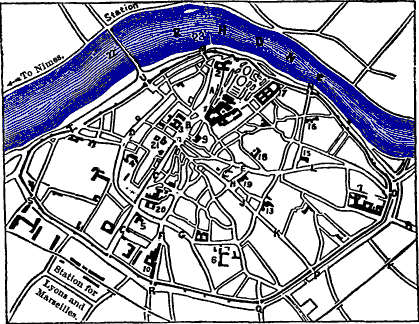
SKETCH PLAN OF AVIGNON.
1. Palace of the Popes: the small building opposite is the Consistoire de Musique; by the side of the palace is the church of Notre-Dame Des Doms, and by the side of the church, on the top of the hill, the beautiful promenade des Doms; whence a stair leads down to the Rhone, near 23, the old bridge Bénézet. Below the promenade is, 2, formerly an archbishop’s palace, now a seminary. Below the Pope’s Palace is B, the Place de l’Hotel de Ville, with the H. de Ville and theatre. The street C C, extending southward to the principal station, is called the R. de la Republique or Rue Petrarque, its original name. Just behind, 3, the Hotel de Ville is the church of St. Agricol, and a little farther S.W. is the Rue Calade, with, at 4, the Musée Calvet, and at 5, across the Rue de la Republique, the Musée Requien, a museum of natural history. Farther east is, 6, St. Joseph’s College, with all that remains of the Church of the Cordeliers, where Laura was buried. That large building at the east corner of the town, 7, is the Hotel-Dieu or hospital; the gate, O, beside it, is the Porte St. Lazare; while 8 indicates the road to the cemetery. A short way E. from the Place de l’Hotel de Ville is, 9, the church of St. Pierre. No. 10, not far from the station, is the Penitentiary, formerly the Convent of the Celestins, founded by Clement VII. in 1879; entrance from the Place du Corps-Saint. No. 13, Convent du St. Sacrement. 14. Chapel Bénézet on bridge. 15. St. Symphorien. 16. Sacré-Cœur. 17. Prison. 18. Mont-de-Piété. 19. Court-house. 20. Lyceum. 21. Prefecture. 22. Suspension Bridge. 23. Bénézet Bridge. A, Place du Palais. B, Place de l’Hôtel de Ville. C, Rue de la République. D, Rue Calade. F, Place du Corps Saint. G, Rue des Lices. H, Place Pie. J, Vieux Septier. K, Rue du Saule. L, Rue Carréterie. M, Porte du Rhône. N, Porte de la Ligne. O, Porte St. Lazarus. Q, Porte L’Imbert. R, Porte St. Michael. S, Porte St. Roche. T, Porte de l’Oulle.
PARIS MARSEILLES 461 76 AVIGNON, pop. 39,000, surrounded with strong embrasured walls, garnished with 39 towers, and pierced with 9 gates, is situated on the Rhône, 2 m. above its junction with the Durance, and 20 m. N.E. from Nîmes by the railway passing the Pont d’Avignon and Remoulins. Hotels: *Europe, near the Pont; *Luxembourg; Louvre; St. Yves, in the centre of the town, near the Place Pie, the great market-place. Temple Protestant in the R. Dorée, near the Préfecture. Cabstands at station and in the Place de l’Hôtel de Ville, 2 frs. per hour. From the station, a beautiful avenue, the Cours de la République, leads up to the Place de l’Hôtel de Ville, with statue “au brave Crillon,” the friend of Henri IV., “Louis des Balbes-Berton duc de Crillon et Lieutenant-colonel de l’infanterie française,” died at Avignon in 1615. To the right is the road leading up to the *Palace of the Popes, the church of *N. D. des Domes, and the promenade, *“au Rochers des Doms;” which, with the ramparts, compose the principal sights of Avignon. The concierge of the palace lives just within the entrance. Fee for party, 1 fr. Opposite gate is the Conservatoire de Musique, built in 1610 for a mint. The churches are closed between 12 and 2. The Musées are open to the public on Sundays between 12 and 4.
Avignon Palace.
The present Palace, commenced by Benedict XII. in 1336, and finished by Gregory XI. in 1370, is an ugly huge structure, consisting of plain walls 100 ft. high and 14 thick, strengthened by long ungainly buttresses. Above the entrance, composed of a low archway, are the arms of Clement VI.; and higher up, on two oriel turrets, the balcony from which the Popes blessed the people. Within the gate is the Cour d’Honneur, a vast quadrangular space between flat walls, pierced by from 3 to 4 stories of windows, not on the same level nor of the same size. From the court ascend the Escalier d’Honneur, a groined staircase, of which the steps were formerly of marble, to the Salle Consistoriale d’Hiver, with an elegantly-groined roof. Before this hall was divided into two, it was 52 ft. high, 65½ wide, and 170 long. From it we enter the Salle d’Armes, with mural paintings by Simone Memmi of Sienna. Ascending higher the grand staircase, we pass on the left the small window for the Spies, and then go along a narrow lobby tunnelled in the wall, to a succession of large bare halls, the Galerie de Conclave, the Salle des Gardes, the Salle de Reception, and then enter the Tour St. Jean, containing the Chapelle du Saint-Office, Inquisition, with mural paintings. In the story immediately below is the chapel of the Popes. From the Tour St. Jean, after passing through a large hall, we enter an octagonal room, gradually narrowing towards the centre, till it forms a chimney-tower, called the Tour Strapade. Some say this was the torture room; but it is evidently more suited for a kitchen, which in all probability it was. Adjoining is the Glacière, into whose underground cellars, now built up, the democrats of 1791 flung the bodies of 60 men and women they had murdered. From this we enter again the Place d’Honneur by the Tour Trouillas, in which Rienzi was imprisoned five years, bound to a chain fixed to the roof of his cell. During the time of the Popes, from 1305 to 1234, and till 1793, the half of Avignon was occupied by ecclesiastical edifices, which tolled daily 300 bells, and had among them a daily succession of religious processions.
Avignon: Rocher des Doms. Cathedral.
From the palace the road leads up to the highest part of the town, the Rocher des Doms; commanding a magnificent view, and laid out as a public garden, with in the centre a statue of Jean Althen, who introduced, in 1766, the culture of the “garance,” the Rubia tinctoria, now superseded, for the dyeing of red. From this terrace a stair leads down to the Rhône near the Bridge Bénézet (see page 63). In the middle of the river is the Ile de Barthelasse, and on the other side are the Tour de Philippe le Bel, the town of Villeneuve, and above it the Fort St. André. On the promenade is the Cathedral Notre-Dame-des-Doms, 194 feet above the Rhône, approached by a stair called the Pater, because originally it had as many steps as there are words in the Lord’s Prayer. This church has undergone many changes, and belongs to various periods. The portal and lower part of the tower are of the 10th cent., and are due to Fulcherius. The nave is two centuries later. The apse was added in 1671. The most remarkable part of the structure is the cupola, terminating in an octagonal lantern, and supported on pendentive arches. It bears traces of frescoes painted in 1672. In the sanctuary is the marble throne used by the Popes, in the sacristy the Gothic mausoleum of Jean XXII., and in one of the side chapels the tomb of Benoit XII. In the third chapel (right hand) is a Madonna in white marble, by Pradier. The sacristan is generally in the small room next the main entrance. Fee, ½ fr. for showing the church and the tomb.
Now return to the Place de l’Hôtel de Ville. At the foot or south end a tram-car leaves every ¼ to the Pont d’Avignon station on the other side of the Rhône, 2 sous; and another to St. Lazare at the
Avignon: St. Agricol. Musée Calvet.
In the “Place” the principal edifice is the Hôtel de Ville, built in 1862, on the site of the Palais Colonna, 14th cent, of which all that remains is the handsome belfry called Jacquemard and his wife, from the two figures which strike the hours. Next the Hôtel de Ville is the theatre, built in 1847. Behind is the church of St. Agricol, 1340, the patron saint of Avignon. To the right on entering is the tomb of the painter Pierre Mignard, d. 4th April 1725, aged 86, and third chapel on same side is a virgin and child in wood by Coysevox. To the left of the entrance is an ancient and elegant marble baptismal font. At the foot of the short street St. Agricol, in the Rue Calade, is the Oratoire, built in 1730. At No. 65 of the Rue Calade is the Musée Calvet, containing a valuable collection of art treasures open to the public on Sundays from 12 to 4, and a library and reading-room open every day except Sunday. Against the wall of the inner court is the tomb of the donor of this museum, Claud François Calvet, d. 25th July 1810, in his 82d year. On the right is the monument erected by Sir Charles Kelsall in 1823 to Laura de Sade, dead of smallpox in 1348, and buried in the church of the Cordeliers (see p. 62). On the other side is the tomb of the military strategist Folard, a native of Avignon. In the outer court, and in the rooms and passages on the ground-floor, are Roman altars, monuments, milestones, torses, amphoræ, and 170 Latin inscriptions, found in the neighbourhood, but chiefly from Orange and Vaison (p. 53). Among the sculptures in relief, one represents a Roman chariot drawn by two horses with their hoofs shod. There are 27 Greek inscriptions, 3d or 4th cent., from Venice. The statuary and sculpture of the Middle Ages and the Renaissance have been gathered principally from the suppressed churches and convents. The most noticeable are: the mausoleums of Pope Urbain V., of Cardinals Lagrange and Brancas, and of Marshal Palice. Within railings are: Cassandra by Pradier, a faun by Brian, and a bather by Esparcieux, all in the finest white marble. Upstairs is a valuable collection of Roman glass and bronzes, and 20,000 coins and medals, including a complete set of the seals and medals of the Popes during their residence at Avignon, and the seal used by the Inquisition while here. There are nearly 500 pictures, and a collection of drawings, including the original sketches of Horace Vernet. Most of the pictures have the artists’ names affixed. Those Avignon: Musée Requien. Continuing down the R. Calade to the other side of the R. Petrarque or de la République, we have on the right the Museum of Natural History in the church St. Martial, 15th cent. The greater part of the specimens were bequeathed by M. Requien, d. 1851, and of them the most interesting are those connected with the neighbourhood, such as the flamingo and beaver of the Rhône, and the fossils from Aix. In the eastern continuation of the R. Calade, at No. 62 R. des Lices, is the Collége Saint Joseph, containing within its grounds all that remains (the belfry and piece of the north aisle) of the church of the Cordeliers; in which Laura was buried. The aisle has been repaired, and is now used as a chapel. Visitors are freely admitted. It is to the left of the entrance. Of the tomb there are no vestiges, having been destroyed along with the church by an infuriated mob in 1791. On the E. side of the R. Petrarque, by the narrow R. Prévot, is the church of St. Dedier, 1355, containing, in first chapel right from entrance, a relief in marble representing Christ bearing his cross, executed by Francesco in 1481 at the request of King René. Opposite, over second arch, 36 ft. above the floor, is a stone pulpit with a sculptured pendant. The grave of St. Bénézet is under a plain slab in the middle of the nave, in front of the high altar. Near St. Dedier is the Hôtel Crillon, 17th cent.; and to the east of the Place de l’Hôtel de Ville is the church of St. Pierre (9 in plan), 1520, with an elaborately-sculptured door and pulpit. The pictures about the high altar are by N. Mignard, J. and P. Parrocel, and Simon de Châlons. From the S.E. corner of the Place de l’Hôtel de Ville, the R. des Marchands and its continuation the Rues Saunerie and Carréterie, lead to the Porte St. Lazare, with, to the right, the town hospital (7 in plan), having a frontage of 192 yards, built in the last century on the site of Avignon: J. S. Mill. In a corner at the end of a short avenue of pine trees is the white marble monument to John Stuart Mill, b. 20th May 1806, d. 7th May 1873. In the same grave is interred Harriet Mill, his beloved wife, who died at Avignon in the Hôtel de l’Europe, Nov. 3, 1858. A touching epitaph, recounting her virtues, occupies the whole surface of the top slab. From the Porte St. Lazare, a walk may be taken between the ramparts and the Rhône down to the bridge built in 1184, partly in the style of the Pont-du-Gard, by the shepherd, saint, and architect, Bénézet, who before had constructed one over the Durance at Maupas. This bridge, which stood 100 years, was 2952 ft. long and 13 wide, on 19 arches, of which four still remain. On the second arch is the chapel of St. Nicolas, in which the relics of St. Bénézet were kept till removed to the church of St. Dedier.
Villeneuve-les-Avignon.
Avignon to Villeneuve.
Every ¼, a tram crosses the bridge for the Pont d’Avignon station, while every hour an omnibus crosses for Villeneuve-les-Avignon, pop. 3100, 2½ m. from the “Place,” or 1¼ m. from the Pont station. Near the parish church, 14th cent., is the Hospital, containing, in the chapel to the left, the mausoleum of Innocent VI., under a lofty elaborately-sculptured canopy, rising in pinnacles to the roof. Upstairs is the picture gallery, in two rooms. The most remarkable picture belongs to the 15th or 16th cent., painted on wood, and represents two subjects, Purgatory and the Judgment Day, apparently by two different artists. Although stiff, the design is admirable, and all the heads, even the smallest, are carefully executed. But the gem is the most charming and bewitching portrait by Mignard of Mme. de Ganges attired as a nun. She was born at Avignon in 1636, and when only 13 married the Marquis de Castellane, with whom she frequented the court of Louis XIV., where she was called La Belle Provençale. After her husband’s death she married the Marquis de Ganges, with whom she returned to Avignon, where her sorrows commenced, caused by the conduct of her two brothers-in-law, the Abbot and the Chevalier de Ganges, whose unlawful passion she steadfastly resisted. At last the exasperated abbot having made her drink poison, she threw herself out of the window, and while lying on the ground in the agony of death, the chevalier pierced her seven times with his sword. These two monsters were condemned by the parliament to be
Avignon is very much exposed to different winds, especially the Mistral, yet perhaps they are necessary, for, according to the adage, “Avenio ventosa, cum vento fastidiosa, sine vento venenosa,” the odours from the drains in some of the streets being very offensive.
Till July 26, 1793, Avignon belonged to the Papal See, when it was forcibly taken possession of by the Republican army under General Cartaux, who owed his victory to the skill of his captain of artillery, the young commandant Napoleon, who afterwards remained nearly a month in this town for the establishment of his health, in No. 65 Rue Calade, opposite the Musée Calvet, where he wrote “Le Souper de Beaucaire.”
Avignon to Nîmes.
Avignon to Nîmes.
Avignon is 1½ hour or 15½ miles N.E. from Nîmes by rail, starting from the Pont-d’Avignon station on the west side of the Rhône. Those wishing to visit the Pont-du-Gard on the way should take their tickets for the Pont-du-Gard station, changing carriages at Remoulins. If with luggage, it is better to take the tickets only to Remoulins; where, without loss of time on arriving, take other tickets to the Pont-du-Gard, leaving the luggage behind. Time will generally be saved by returning from the Pont to Remoulins on foot, about 3 m. by the road, but 5 m. by the rail. See Map, p. 56. For Nîmes see p. 101, and for the Pont-du-Gard see p. 104. Consult the “Indicateur des Chemins de Fer du Lyon” before starting.
L’Isle. Fontaine de Vaucluse.
Avignon to Vaucluse by L’Isle.
From Avignon the Fontaine de Vaucluse is 18 m. eastward, by the village of Isle, on the line to Cavaillon. L’Isle, pop. 7000, a village on the Sorgues, with decorated church rebuilt in the 17th cent. Handsome reredos over high altar and several good paintings. The Tour d’Argent dates from the 11th cent. At the station the omnibuses of the Isle hotels, Petrarque et Laure and St. Martin, await passengers and take them to Vaucluse and back for 4 frs. each. From the village of Vaucluse, pop. 600, take for the fountain the road on Fontaine de Vaucluse about 30 yards in diameter— “a mirror of blue-black water, so pure, so still, that where it laps the pebbles you can scarcely say where air begins and water ends.” During floods, however, the cavern being no longer able to contain the increased volume, the water rushes over in a cascade into the bed below. The poet’s modest house stood at the foot of the rock crowned by the ruins of the castle in which lived his friend Cardinal Philippe de Cabasole. Petrarch himself gives the following description of the site:— “On one side my garden is bounded by a deep river; on another by a rugged mountain, a barrier against the noon-day heats, and which never refuses, not even at mid-day, to lend me its friendly shade; but the sweet air reaches me through all obstacles. In the distance a surly wall makes me inaccessible to both man and beast. Figs, grapes, walnuts, almonds—these are my delights. My table is also graced with the fish that abound in my river; and it is one of my greatest pleasures to watch the fishermen draw their nets, and to draw them myself. All about me is changed. I once used to dress myself with care; now you would believe me a labourer or a shepherd. My house resembles that of Fabius or Cato. I have but a valet and a dog. The house of my servant adjoins my own. I call him when I want him, and when I have no more need of him he returns home.”
Avignon: Petrarch.
On the 6th of April 1327 Francesco Petrarca saw in a church of Avignon Laura the daughter of Audibert de Noves, for whom he conceived a romantic but hopeless attachment. Incessantly haunted with the beautiful vision of the fair Laura, he visited in succession the south of France, Paris, and the Netherlands, and after an exile of eight months returned to bury himself in the solitude of Vaucluse.
Vehicles are also hired at Avignon. Fare to Vaucluse and back, 12 to 18 frs.; time, 8 hours. Also for the Pont du Gard, same price.
20½ m. from Avignon by rail is Cavaillon (p. 66), whence a branch line extends 20 m. E. to Apt, another line 27 m. S.E. to Pertuis on the Marseilles and Grenoble line, and another 22½ m. S. to Miramas (p. 76), between Arles and Marseilles. (See map, p. 66.)
Apt.
AVIGNON TO MANOSQUE BY APT.
40½ m. E. by rail from Avignon, by Cavaillon, is Apt, pop. 7000, on the torrent Calavon, in a sheltered hollow surrounded by mountains and calcareous cliffs. Hotels: The *Louvre; des Alpes. The principal industries are agriculture, pottery, and the making of preserved fruits. Fruit to be glazed with sugar, as well as that on which the sugar is to be crystallised, is allowed to soak from 2 to 8 months in a strong solution of white sugar, in uncovered “terrines,” like small basins. Fruits with thick rinds, such as oranges, are pricked before being immersed. The best pottery (Bernard Croix) is near the station, to the left on descending the hill. The clay, gray and reddish, is in thick beds close to the establishment, and resembles that of Vallauris, near Cannes, in its power of resisting fire, and is therefore principally used for the manufacture of kitchen pottery. M. Croix has added artistic pottery and dinner and tea services, of which the prices are extremely low. Opposite is the establishment of L. A. Esbérard, who confines himself almost exclusively to kitchen pottery.
The parish church of St. Anne dates from the 11th cent. To the left on entering is the chapel of St. Anne, under a low octagonal domed tower. Below the altar is a crypt, 10th cent., said to contain the bones of the mother of Mary. Round about the town are pleasant walks, of which many are shaded with Oriental plane trees. Coach daily to Manosque (Hotel: Eymon), 26 m. E., passing Céreste, 5¼ m. E., and Reillanne, on the top of a hill, 5 m. farther. Manosque is on the rail between Marseilles and Grenoble. (See maps, pages 26 and 66.)
Cavaillon to Miramas, 22½ m. S. (see map, p. 66), across a fertile plain, with vineyards and groves of olive, almond, and apricot trees. Cavaillon (pop. 8000). Inns: Parrocel; Teston. Omnibus at station. Cavaillon is a pleasant town, intersected by avenues, and situated on the Durance at the base of great limestone cliffs. It possesses an ancient triumphal arch and a cathedral dating from the 12th and 13th cents., with a cloister of the 12th. Excellent melons are grown in the neighbourhood. 4¼ m. S. from Cavaillon is Orgon (pop. 3000. Inns: Paris; Poste), on the Durance. 11 m. farther S. is Salon (pop. 7100. Inns: Poste; Croix de Malte), on the canal Craponne. This town, dealing largely in first-class olive oil, has still remnants of its old ramparts: a church, St. Michel, of the 13th cent., another, St. Laurent, of the 14th, and a castle of the same date. In the town is a fountain to the memory of Adam de Craponne, the engineer of the canal. (For Miramas, see p. 75.)
Tarascon. Martha’s Tomb.
PARIS MARSEILLES 474 63 TARASCON, pop. 11,000. Hotels: At the foot of the station stairs, the Luxembourg; in the town, the Empereurs. Junction with branch to Nîmes, 17 m. W., and 31 m. farther Montpellier. Below the station is a large hospital for old men and orphans, founded in 1761 by Clerc Molière. Tarascon is an unimportant town on the Rhône, opposite Beaucaire, and connected with it by a chain bridge tomb of Martha, the sister of Lazarus, whose mortal remains are said to repose here under the peaceful-looking marble effigy which marks the spot. The tradition of the place says she had come with her maid from Aix, at the request of the inhabitants, to kill a terrible dragon with a body as thick as a bull’s, and having succeeded, the inhabitants, out of gratitude to her, after her death buried her in this place. A few steps from the church, by the side of the river, rises the massive strong square castle, begun in 1400 and finished by the Roi René, now used as a prison. On the opposite side of the river, overlooking Beaucaire, are the more picturesque ruins of the castle of Montmorency, whose adjoining garden forms one of the many promenades of the people of Beaucaire. Beaucaire is a poor town with poor houses. The formerly famous fair, commencing on July 1, has become now of little importance. It is held in the broad avenue between the castle and the Rhône.
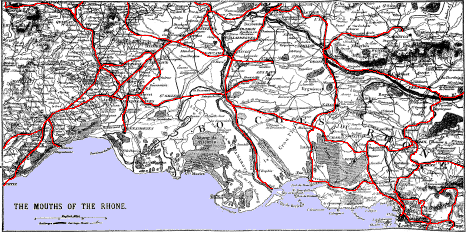
THE MOUTHS OF THE RHONE.
For continuation northwards see map, page 56. [West] For continuation see map, page 107. For continuation eastwards see map, page 123.
St. Remy. Les Baux.
9½ m. east from Tarascon by rail is St. Remy, pop. 6800. Inn: Hôtel du Cheval Blanc, a comfortable house, where carriages can be hired for Les Baux, 6 m. S.W., 10 frs. Also for Arles by Les Baux and Mont-Majour, 19 m. distant, 24 frs. A mile from the Hôtel Cheval Blanc, by the high road, stood the ancient Glanum, one of the commercial stations of the Phœnician traders from Marseilles, before it fell into the possession of the Romans, who have left here two remarkable monuments, of which the more perfect consists of an open square tower standing on a massive pedestal, and surmounted by a peristyle of ten columns surrounding two statues representing the parents of Sextus and Marius, of the family of the Julii, by whom it was erected. It is 50 ft. high; the faces of the statues look to the north. The sculpture on the north side of the pedestal represents a cavalry fight; the south, “sacrificing;” the west, a combat between infantry; and the east, which is the most dilapidated, “Victory crowning a wounded soldier.” Alongside stands a triumphal arch, of which the most perfect portions are the coffered panellings of the soffit.
6 m. S.W. from St. Remy is Les Baux, the ancient Castrum de Baucis, pop. 100. Inn: Monte Carlo. The castle town of Les Baux, commenced in 485, occupies a naked mountain of yellow sandstone, worn away by nature into bastions and buttresses, and coigns of vantage, sculptured by ancient art into palaces and chapels, battlements and dungeons. Now art and nature are confounded in one ruin. Blocks of masonry lie cheek-by-jowl with masses of the rough-hewn map, page 66).
Arles.
[East] [West] Scale of ¼ Mile
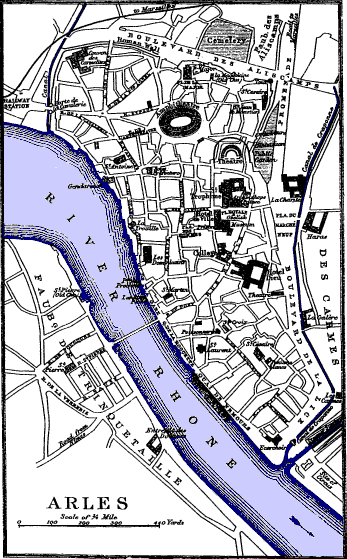
PARIS MARSEILLES 483 54 ARLES, pop. 26,000. Hotels: Nord; Forum; near each other in the Place du Forum. Arles is situated on the Rhône, near the Camargue, in a marshy place, as its original name, Arelas, from the Celtic words, “Ar lach,” damp place, indicates. It is said to have been founded 900 years before Marseilles, 700 years before Rome, and 1500 before the birth of Christ. The ramparts and walls rising from the public gardens and the Boulevard des Aliscamps are chiefly the work of the Emperor Constantine, who came to Arles with his family and mother, Saint Helena. He built by the side of the Rhône a superb palace, called afterwards “de la Trouille,” because opposite a ferry-boat, which was pulled or dragged from one side of the river to the other. Of this palace little more remains than the attached tower La Trouille, constructed of alternate layers of brick and stone. On the 7th August 312 his wife Faustina presented him with a son, Constantine II., who succeeded his father in May 357. He commenced the Forum, but was shortly after killed in battle defending himself against his brother Constance, who usurped the throne and finished the Forum. All that remains of this formerly splendid edifice are the two Corinthian columns, with part of the pediment encrusted into the wall of the Hôtel du Nord. It occupied the site of the Place du Forum, called also the Place des Hommes, because labourers and men-servants used to be hired in this “Place.”
In the Place de la République is the Hôtel de Ville, built in 1675 on the site of the Roman baths constructed by the Emperor Augustus. The spacious vaults under the Hôtel du Nord formed probably a part of these baths, although in later times they seem to have been used as an ossuary.
Almost adjoining the Hôtel de Ville is the church of St. Anne, Diis manibus. Also some of the long lead pipes, with the name of the plumber, “C. Canthius Porthinus fac.,” which helped to bring water from the fountain at the foot of the hill on which Baux stands. At the inner end, right hand, is a torse of Mithras of white Pharos marble, 3 ft. 2 inches high, found in 1598 on the site of the Roman Circus. A serpent is coiled round the body, and between the coils are the signs of the Zodiac. In the opposite corner is an altar in Carrara marble to the good goddess “Bonae-Deae,” found under the church La Major. On the front face is a garland of oak leaves and acorns, and 7 inches distant from each other two human ears. Near it is a good head of Augustus, and a mutilated one of Diana. About the centre of the room is a recumbent figure of Silenus, with a wine skin under his arm.
In the centre of the “Place” is the monolith obelisk, 49 ft. high, hewn by the Romans from the quarries of Esterel. It stood originally in the Circus at the S.W. corner of the town; but of it no vestiges remain.
Arles: St. Trophime.
Opposite St. Anne is the cathedral of St. Trophime, consecrated on the 17th May 626, and rebuilt in the 9th cent. The portal, erected in 1221, consists of a semicircular arch resting on six columns, behind which are statues of apostles and saints separated by pilasters. In the tympanum is Christ, the judge of the world, with the symbols of the Evangelists. In the interior the door on the S. side of the choir leads out to the cloister, of which the N. side belongs to the 9th, the south to the 16th, the east to the 13th, and the west to the 14th cent.
Passing from the cloister into the street, and turning to the left, we arrive at the Theatre, commenced during the dominion of the Greeks, and finished before the Christian era. In the centre of this grand ruin, originally 335 ft. in its greatest diameter, stand two Corinthian columns 30 ft. high, and the base of other two, which formed part of the proscenium. Opposite them is the semicircular space for the spectators, with still many of the stone seats. The Venus of Arles, one of the most valuable statues in the Louvre, was found here. The theatre is open to the public, but the keeper endeavours to attach himself to strangers.
Arles: Amphitheatre.
A short way N.E. is the far grander and more imposing Amphitheatre or Les Arènes, said to have been commenced by the father of Tiberius Nero, B.C. 46. It is elliptic, 459 ft. long and 132 wide, surrounded by a double wall 60 ft. high, each with two stages of
The Camargue or Delta of the Rhône, commencing at the outskirts of Arles, is a triangular plain of 180,000 acres extending to the Mediterranean, bounded on the west by the Petit Rhône, and on the east by the Grand Rhône. It contains small villages and large farms, with extensive vineyards and grazing ground for cattle, sheep, and horses. It is best visited by the steamboat sailing between Arles and Port St. Louis on the mouth of the great Rhône. (See p. 72, and map, p. 66.)
Arles: Elysei Campi. Trophimus.
S.E. above the Promenade is the church of St. Cesaire, 9th cent., on the site of a temple of Jupiter. From this to go to Alyscamps, walk down the Boulevard Alyscamps to the canal Craponne, where turn to the left. The first ruin passed is an old entrance into what was the domain of the monastery of St. Cesaire. The Avenue of Alyscamps is lined on each side by 33 large stone coffins with lids, and 120 smaller coffins without lids. This, the Elysei Campi, an ancient Roman cemetery, is now divested of all its valuables and statues, of which a few are in the museum. As J. C.Himself is said to have appeared during the consecration of the cemetery, it was believed that at the resurrection it would be especially favoured by Him; hence the efforts made by so many to bury their friends here. It is said that up to the 12th cent. coffins with their dead, and money for the funeral expenses, floated down the Rhône, of their own accord, to be buried in this privileged spot. At the end of the avenue is the church of St. Honorat, on the site of the chapel founded by Trophimus the Ephesian, one of St. Paul’s converts, who was sent to Arles to preach the gospel and to put an end to human sacrifices. Among the first things he is
Arles: Picture Gallery.
The Picture Gallery, or the Musée Reattu, is at No. 11 R. Grand Prieure, near the Tour Trouille. The house and pictures were bequeathed to the town by a cousin of the painter Reattu, b. at Arles 1760, d. 1833. On picture 119 are portraits of himself, wife, and two cousins. Next the picture gallery is the school of design.
Branch line from Arles to Fontvieille, 7 m. E., passing Mont-Majour 4 m. E. Fontvieille is 7 m. S.W. from Les Baux by a good road. Junction at Arles with line to Aigues-Mortes, 36 m. S.W., and to Montpellier, 58 m. S.W.; Cette is 17 m. farther. (See map, p. 66.)
Mont-Majour.
4 m. eastwards by rail from Arles are the ruins of the castle and abbey of Mont-Majour, all in a good state of preservation, excepting the domestic buildings, constructed in 1786. The concierge lives in a house near the station. Fee, 1 fr. He generally shows first the church, 11th cent., and the spacious crypt below, 9th cent. Adjoining the church are the cloisters, 11th cent., of the same kind as those of St. Trophime, but more interesting and more perfect, and containing the tombs of some of the counts of Anjou. Next is the beautiful square dungeon tower, nearly as perfect as when erected in 1374. It is 262 ft. high, is ascended by 137 steps, and commands a wide prospect. From this, a stair leads down the face of the hill to the chapel and cell of St. Trophimus, principally hewn in the soft limestone cliff. Standing apart at the base of the hill is St. Croix, dedicated in 1019,
Arles to Port Saint Louis, at the mouth of the Great Rhône, 25 m. S. by steamer on the Great Rhône. Time, 5 hrs. Fare, 2 frs. Railway unfinished (see map, p. 66). The steamboat passes by an important part of the Camargue with large vineyards, rendered very fertile by irrigation, the water being forced up from the river by steam engines. Cattle, sheep, and horses are reared on the tufts of coarse grass which cover the more arid portions. The population is so sparse that not a village is seen during the whole journey. (See also p. 70.)
Port Saint Louis.
Port Saint Louis (Hôtel Saint Louis), 6½ m. W. from Port Bouc, consists of a straggling village between the Rhône and the basin of the canal constructed to enable vessels to avoid the bar of the Rhône. This canal is 2½ m. long, 196 ft. wide, and 22 ft. deep. To understand the geography of this desolate flat region of land and water, exposed to every wind, it is necessary to ascend the “tour Saint Louis,” whence the plain, intersected by the Rhône and numerous canals, appears literally like a map. The only villages seen in the vast expanse are Fos, on a hill, and near it the Port Bouc.
Great expense has been incurred to make Port St. Louis a convenient place for shipping, and attract to it some of the commerce from Marseilles.
23 m. S.W. from Arles, and separated from Port St. Louis by the great Etang Valcarès, is the port called Les Saintes-Maries-de-la-Mer, or simply Les Saintes. The parish church, 12th cent., surrounded by fortifications, contains the tombs of the Maries and some good sculpture.
For Arles to Port Bouc, 29 m. S., see p. 76. The steamer sails from the S.W. corner of Arles (see map, page 66).
St. Gilles. Lunel.
11¼ m. W. by rail from Arles is St. Gilles, pop. 7000. Hôtel du Cheval-Blanc. A poor and ancient town on the canal of Aigues-Mortes, near the Petit Rhône. The abbey church, founded in 1116, is considered a good specimen of Byzantine architecture. The façade consists of a bald wall with a plain tower on each side. Between these towers are three semicircular recessed portals, below an entablature resting on two single and two double columns. The capitals are Corinthian, but the pedestals (considerably effaced) consist of lions and grotesque animals in uncouth positions. Behind them, on the piers of the arches of the portals, stand in bold relief statues of apostles and saints, separated from each other by pilasters. The interior, consisting of a nave and two aisles, is 290 ft. long, 88 wide, and 62 high. In the N. aisle a stair of 33 steps leads down to the lower church, with semicircular arches on short massive piers. From the centre 7 more steps descend to the tomb of St. Gilles. All the characteristics of this church are equally well represented in St. Trophime of Arles.
16¾ m. farther W., or 28 m. from Arles by rail, is Lunel, pop. Inns: Palais; Nord; Tapis-verd; none good. A town of narrow streets, with a park and promenade by the side of the canal. The church is constructed after the pattern of those of Carcassonne and Perpignan. On the surrounding plain an inferior wine is grown. The first-class vineyards, producing the generous white wines from 17° to 18°, are all on the neighbouring gravelly eminences.
Aigues-Mortes.
8 m. S. by rail from Lunel is the more interesting town of AIGUES-MORTES, “stagnant waters,” pop. 4300, 4 m. from the Mediterranean, and 4 ft. above it, and connected with it by a navigable canal. Inn: Saint Louis. It is of great historical interest, and is surrounded by the most perfect old embrasured wall in France, built in the form of a parallelogram, 596 yds. long by 149 yds. broad. It is 36 ft. high, and is flanked by 15 towers. On the western side rises the famous round tower of Constance, 96 ft. high and 72 in diameter, containing two vaulted superimposed circular chambers, used by Louis XIV. and Louis XV. as prisons for their Protestant subjects of both sexes, who here suffered such cruelties that the Dutch and Swiss Governments were roused to interfere in their behalf, and even Frederic the Great is said to have interceded for them, but in vain. From the platform at the top of this tower is the highly interesting view of the flat country at the mouth of the Rhône, whence the traveller may judge for himself whether the sea has, or has not, receded from the town since the time of Saint Louis—we think not. Both the tower of Constance and the walls are the work of Saint Louis, who had a predilection for Aigues-Mortes, as he considered it the most suitable place in his kingdom from which to embark for Palestine. On 25th August 1248, after having heard mass in the church Notre-Dame-des-Sablons (fronting his statue), he and his Queen Marguerite sailed from Aigues-Mortes on their first expedition to Palestine. On the 3d of July 1270 he again sailed from the same place; and on that same year, on the anniversary day of his first expedition, the 25th of August, he perished among the ruins of Carthage. 4 m. S. from Aigues-Mortes by omnibus, or steamer by the canal, is the bathing station of Port-Grau-du-Roi. Inns: Pommier; Dubois (see map, page 66).