SUMMARY HISTORY (continued 2)
Reading edition
Half a league short [south] of it is another small place, called the Pueblo de los Céres, inhabited by a squalid race of Indians who are said to indulge in constant habits of intemperance and to have lost the fire of the warrior. In its stead they manifest the sullen stupidity peculiar to those who, feeling themselves unfitted for companionship, strive to vent their pusillanimous rage upon objects the most helpless and unoffending, such as women, children, and dogs, who appear to be the chief victims of their revenge.141
His chief object in visiting Pitic was to obtain information concerning Tiburon, its natives, and its pearl-oyster beds; and he was rewarded with characteristic accounts of the ferocity of the tribesmen and their use of poisoned arrows, which he received with some incredulity.142
After examining the principal pearl fisheries of the western coast, Lieutenant Hardy reached the “Sal si Puedes” in the throat of the gulf, and, on August 9, “got aslant of wind, which carried us up to the northwest end of Tiburow island”143—i. e., apparently over the precise route sailed by Padre Ugarte in 1721. Anchoring on the island, he had the good fortune first to meet a native able to speak Spanish, and later to successfully treat the sick wife of the principal chief, after which he was treated with great consideration, and—unwittingly on his part—adopted into the tribe as a member of the chief clan by the ceremony of face painting, the symbol being that of the turtle totem, to judge from the superficial description. Taking slightly brackish water, just as Ugarte had done one hundred and five years before, and arming his crew, he spent the night near the rancheria (evidently in Bahia Agua Dulce). Next morning he “traveled over the greater part of the island” (!) in fruitless search for pearls and gold, and in the afternoon “got under weigh, and stood into a bay of the continent to the northeast of the island,” discovering and naming “Sargent’s Point”, together with “Cockle Harbour”, and “Bruja’s bay” in the lee of the point, and also “Arnold’s Island”; this island being apparently the present prominent cusp of Punta Sargent, now connected with the mainland by a continuous wave-built bar rising a little way above reach of tide. Anchoring in the bay named from his vessel (La Bruja), he examined the adjacent shore, ascertaining that “there is no fresh water near the spot, except during the rainy season, which only lasts about a month or six weeks”, nor “any vestige of Indians to be seen except a solitary hut erected by the Tiburons to serve them when they go there to fish”; and, noting the report that Padre Kino had visited this point, he quite appositely questioned the truth of the tradition, partly on the ground of the absence of fresh water, partly because “the Tepoca Indian establishment” mentioned in the tradition “is many leagues farther to the northward.” Awakened by an approaching storm, he was under way next morning at daylight, and, getting out of the “bad holding ground”, was caught by a gale and carried back to his “old anchorage in Freshwater Bay”, where he found the Indians rejoicing over the success of a ceremonial incantation to which they ascribed his return. The reconnaissance map is ill-drawn, locating “Fresh Water B.” on the mainland side and apparently combining “Sargent’s Point” and “Arnold’s Island” as “Sargents I.”; “San Miguel Pt.” is properly located, and idealized route lines traverse the “Canal peligroso de San Miguel” (El Infiernillo), which is of greatly exaggerated width. The careful itinerary shows, however, that Hardy scarcely entered this strait, and made but three or four anchorages in the vicinity—i. e., in Bahia Agua Dulce, in Bahia Bruja, probably in Cockle harbor (or “Cochla Inlet”), and finally off Isla Patos.
Hardy’s notes on the Indians are first hand, and hence of exceptional value. He says:
The Indians on the island of Tiburon are very stout, tall, and well-built fellows, exceedingly like the Twelchii tribe of Indians in Patagonia, and with a language so like theirs that I imagined I was transported back into those wild regions. They by no means look so ferocious as they are represented, and there is something peculiarly mild in the countenances of the females. Their dress is a sort of blanket, extending from the hips to the knees. But most of the old women have this part of the body covered with the skins of the eagle, having the feathers turned towards the flesh. The upper part of the body is entirely exposed, and their hair is dressed on the top of the head in a knot which greatly sets off the effect of their painted faces. The men use bows and stone-pointed arrows; but whether they are poisoned I do not know. They use likewise a sort of wooden mallet called Macána, for close quarters in war. They have a curious weapon which they employ for catching fish. It is a spear with a double point, forming an angle of about 5 degrees. The insides of these two points, which are 6 inches long, are jagged; so that when the body of a fish is forced between them it cannot get away on account of the teeth.144
He saw “about fifteen or twenty canoes made of three long bamboo bundles fastened together”, and observed that, when engaged in turtle fishing, the Indian “paddles himself from the shore on one of these by means of a long elastic pole of about 12 or 14 feet in length, the wood of which is the root of a thorn called mesquite, growing near the coast”, this pole serving also as a harpoon shaft, provided with a harpoon head and cord, such as those still in use. Respecting the invocatory appurtenances, he says:
My attention was directed by the old women to a pile of bushes outside the hut, which had a staff of about 5 feet in length sticking up through the center. From the upper end of the staff was suspended by a cord 12 or 14 inches long a round stone ball, and to this ball was fastened another string furnished with bits of cork, surrounded with small feathers stuck into them at the distance of about 3 inches apart: the only use of the stone ball being to prevent the wind from blowing out horizontally the string which was furnished with feathers.... Upon examining the bushy pile, I discovered a wooden figure with a carved hat, and others of different shapes and sizes, as well also as leathern bags, the contents of which I was not permitted to explore.145
He also mentions that “in their festivities the Indians wear the head (with the horns on)” of the bura or mule deer. He adds:
It is believed that the Céres Indians have discovered a method of poisoning their arrows, and that they do it in this way: They kill a cow and take from it its liver. They then collect a number of rattlesnakes, scorpions, centipedes, and tarantulas, which they confine in a hole with the liver. The next process is to beat them with sticks in order to enrage them, and being thus infuriated, they fasten their fangs and exhaust their venom upon each other and upon the liver. When the whole mass is in a high state of corruption the old women take the arrows and pass their points through it. They are then allowed to dry in the shade, and it is said that a wound inflicted by them will prove fatal. Others again say that the poison is obtained from the juice of the yerba de la flécha (arrow wort).146
He purchased some of the arrows, which were stone-tipped, and had “certainly had an unguent applied to them”.
He was impressed by indications of family affection, and noted the custom of having two wives. Concerning tribal relations he says:
These people have been always considered extremely ferocious, and there is little doubt, from their brave and warlike character, that they may formerly have devastated a great part of the country; but in modern days their feuds are nearly confined to a neighboring tribe of the same name as themselves (Céres), who speak the same language and in all probability originally descended from the same stock. They are said to be inferior to those of this island both in courage and stature, and they are never suffered to cross the channel. From what I was told * * * the Tiburow Céres have lately returned from a sanguinary war with the Tépoca Céres, in which the former were victorious.147
Later in his itinerary Hardy noted a typical Yaqui revolution, with a characteristic effort to secure the cooperation of the Seri.148 He defined the Seri habitat as “the island of Tiburow, the coast of Tépoca, and the pueblo of Los Céres, near Pitic”;149 and he estimated the population at “3,000 or 4,000 at the very utmost”,150 and quoted the estimate of Don José Maria Retio, viz., that the Seri population of Tiburon was 1,000 to 1,500.151
Like most of those visitors to the Seri who have returned to tell their tale, Hardy “praised the bridge that carried him over” and gave the tribe passable character—worse, of course, than that of any other, yet hardly so bad as painted at Pitic.
A noteworthy traveler in western America during 1840-1842 was M. Duflot de Mofras, an attache of the French legation in Mexico. He traversed the Californias and entered Sonora, and while he failed to see Seriland, he made a note on the tribe, valuable as a current estimate of the population:
At the gates of the city of Hermosillo is established a Mission which contains 500 Seri Indians; 1,000 of them, inhabit the coast to the north of Guaymas and Île du Requin (Isla del Tiburon).152
The next noteworthy episode in the external history of the Seri chronicled in the civil records of Sonora culminated in 1844. “The above-named Seris, although their number never became important, did not abandon their propensity to revolt, and, while they never rose en masse, made many factional uprisings. Ultimately ... they displayed such boldness, robbing ranchos, assassinating all they encountered, assaulting on the roads arrieros and other travelers”, that a considerable force was sent against them from Hermosillo under the direction of Captain Victor Araiza. It was planned to support this land force by a sea party from Guaymas, but delays and misunderstandings caused the practical abandonment of the plan. Tiring of the delay, Araiza “declared war on the Indians, surprising them on Punta del Carrizal, killing 11, including several innocent women and children”, and taking 4 captives of from 1 to 11 years in age; whereupon the army returned to Hermosillo.153
Disapproving of this undignified and inhuman crusade, the acting governor, General Francisco Ponce de Leon, planned a still more vigorous campaign by land and sea for the purpose of capturing the entire tribe and transporting them to Pueblo Seri, where a few of their kin were still harbored.154 The command was intrusted to Colonel Francisco Andrade, who took personal charge of the land force, including 160 infantry from Guaymas, 60 infantry and 30 cavalry from Hermosillo, and considerable corps from Horcasitas and Altar. The naval auxiliary, in charge of Don Tomás Espence,155 pilot, comprised a schooner of 12 tons; two launches, one carrying a 4-pound cannon and the other a 2-pound falconet; and one rowboat. On August 11, 1844, Espence sailed from Guaymas, and six days later cast anchor at the embarcadero (apparently a convenient place on the coast of Bahia Kino due west of Pozo Escalante—the Embarcadero Andrade of figure 1) opposite Tiburon. Andrade marched from Hermosillo August 13, reached Carrizal August 16, and had detachments at the coast to meet the squadron the next day. Both the vessels and this detachment were out of water, and next morning Espence, taking a few soldiers and an Indian guide, made his way to Tiburon in search of springs; but “on arriving it turned out that the Indian had deceived the party or did not wish to reveal the water.” Nevertheless they landed, and Espence hoisted the Mexican flag, “taking possession of the island in the name of the Mexican Government, as the first civilized person to touch the soil.” Afterward he divided his force, and he and the sailors wandered far, spending the entire day in vain search for water. Toward evening he “made the men wade into the sea up to their necks, and in this manner mitigated somewhat their burning thirst.” Meantime the soldiers had traveled inland some 6 or 8 miles, and found water at the head of an arroyo (apparently a temporary tinaja west of Punta Narragansett), but it was surrounded by Indians, who at once gave battle. Such was their thirst that the soldiers held their ground, drinking one at a time under the protection of their comrades. At length they killed two chiefs (one of whom wore a jacket taken from one Hijar, robbed on the Cienega road a few days before), and succeeded in withdrawing to a small eminence and sheltering themselves behind a rock. Later they effected a retreat without loss, and of course without water, so that they arrived at the shore even thirstier than the sailors. Making their way back to the mainland during the night, the party were relieved the following day by mule-loads of water sent over from Carrizal. On August 20 Colonel Andrade marched to the coast with most of his force, leaving a detachment to guard the route; and the next day Espence transported to the island 125 troops, 16 horses, and some mules and cattle, without other accident than the drowning of a mule and a steer “by the strength of the current”. Suffering much from thirst, the troops pressed inland to the watering-place already discovered, where they camped. The next day Colonel Andrade, with Lieutenant Jesus Garcia, worked northward, finding another watering-place (doubtless Tinaja Anita) 3½ leagues distant from the first; and this was made headquarters for the force. Several parties were sent out in search of water and Indians. A few watering-places were found, and a number of women and children with a few men were captured, though the journals indicate that the excursions were of limited extent only. Meantime Espence brought over the baggage and provisions; and on August 24, leaving a launch and a rowboat for the use of the troops, he sailed northward through the strait, and three days later, after passing many bars of sand, entered the bay at the extreme north (Bahia Agua Dulce), opposite Punta Tepopa, finding sharks swarming in thousands. Here he found fresh water 250 paces from the beach—the water which sustained Hardy eighteen years before, and Ugarte over a century earlier still. He found no Indians here, but a number of jacales and balsas (which he immediately burned), as well as bones and other remains of horses.156 On August 28 and 29 Espence skirted the abrupt and rocky coasts of Tiburon, west and south of the northern bay, without seeing trace of natives; on the 30th he reached the western bay, where he found huts and fresh tracks, and captured a woman disabled by snake-bite. Farther down the bay he encountered a considerable party, who first prepared to attack, and then, overawed by his bold front, sued for peace; whereupon he accepted their submission, and sent them with a letter to Colonel Andrade. This affair concluded, and escaping currents so contrary that he was nearly locoed (“por las corrientes encontradas que me volvian loco”),157 he coasted southward; and on September 1, at the southwestern point of the island, he found another rancheria, and made peaceful conquest of the occupants, whom he also sent with a letter to Andrade. Thence he coasted eastward, and, on September 3, returned to his starting point, “having navigated the island in the period of nine days, having in this time burned 64 huts and 97 balsas, and reduced to peace 104 Indians with their families.” The next day he transported the captives to the mainland, “their number, comprising men, women, and children, reaching 384, besides about 37 remaining at large on the island.”158 On September 5 the remaining troops were transferred to the mainland, with the exception of a small detachment, which remained for an unspecified, but evidently short period, in the vain hope of corralling the warriors, with the families to which they belonged, supposed (on grounds not given) to remain on the island. The troops and their captives immediately moved to Laguna de los Cercaditos (probably Laguna la Cruz) to rejoin the cavalry guard; thence, suffering much from thirst, they marched toward Hermosillo, arriving at that place September 12,159 where the troops and captives formed a triumphal procession, met on the highroad by the merchants and the civil and military authorities, and greeted by the ringing of bells and the firing of rockets, and with music and refreshments.
The captives were imprisoned over night in the mint, the children weeping, the women chattering angrily or humbly, and the men sulking. Next day the Hermosilleños began distributing the children among themselves, some families taking three and many two, while the adults were transferred to Pueblo Seri, placed in charge of a single keeper, and set to gathering fuel, etc. Naturally this unstable status did not long persist; “within two months they began to disappear, fleeing to their respective and native haunts, stealing and carrying with them the children from whom they had been separated”;160 and, according to Espence, they committed “many murders on the Pitic and Guaimas roads” as they returned to Tiburon.161
While the Tiburon captives were escaping, the campaigning continued; and, in November, 1844, several Seri families, comprising 63 men, women, and children, who had been scavengering Rancho del Burro (“manteniéndose allí á merced de los desperdicios de dicho rancho”),162 were captured and transported to the mint at Hermosillo, and soon afterward transferred to Pueblo Seri. During the same month a report came from Rancho del Pocito, on the Guaymas road, that Seri marauders (assumed to belong to the 16 families left on the island) had killed 10 head of stock; and a detachment of 15 cavalry was sent to inflict punishment. Early in December this party met a Seri force of over seventy warriors, including some of those captured on Tiburon and escaped from Pueblo Seri; after a battle of four hours the troops found their ammunition exhausted, several of their carbines out of order, and all but four or five of their horses winded; so that they were driven to parley with the Indians and to procure their surrender by pacific means—especially promises of good treatment.163 Subsequently a municipal commission from Hermosillo reminded the defeated Seri of their surrender, and “three, four, or eight” of them presented themselves (“presentándose tres, cuatro ú ocho hombres”), and were probably added to the colony at Pueblo Seri.
Espence’s journal clearly indicates a complete circumnavigation of Tiburon, the second in history (that of Ugarte in 1721 being the first); and naturally some of his notes are of ethnologic value:
The Ceris Indians are tall, well formed, not very corpulent; the women are remarkable for small breasts and feet and high insteps. At night they travel ill; this is to be attributed to the reflection of the sun on the sand, which is quite white, and as they all live on the shore where they gain sustenance, which is fish and plankton [marisco], they are daily exposed to a glare which injures their vision. Their favorite food is turtles and horses.... They are all in the most savage condition it is possible to conceive. Their language is guttural, and they are most filthy in their persons, as in their food, which is mostly eaten raw, or at the best half cooked; they endure a thousand miseries on the island, yet the love they have for it is incredible. They are always accompanied by innumerable dogs, ... which they have domesticated.164
Velasco adds:
The Ceris subsist on fish, the seeds of grass, and coastwise shrubs, as well as on the flesh of horses and deer, which they kill. There is no better proof of this fact than this—on approaching the said Ceris, one instantly perceives that their bodies exhale an intolerable stench, like that of a corpse of eight or more days, totally rotten, so that it is necessary to withdraw far as possible from them.165
Of all the Indian tribes known in Sonora, none are more barbarous and uncivilized than the Ceris. They are perverse to the limit, vicious beyond compare in drunkenness, infinitely filthy, the bitterest enemies of the whites, like the worst of the Indians.166
He adds also that the men wear a pelican-skin robe and a breechclout of cotton cloth, with most of the body uncovered; “they have their faces painted or barred with prominent black lines. They use no foot-gear of any kind, and many have the nasal septum pierced and adorned with pieces of greenstone or ordinary glass.” “They are robust in stature, tall and straight, generally with bright black eyes. The women are not uncomely, and of bronzy color [de color abronzado]. Their clothing is made of pelican skins fastened together, retaining the feathers; with this they are covered from the waist downward”, the remainder of the body being bare. The women of Hermosillo provide them with cast off garments when they approach the city, and these they wear, unwashed, until they fall to pieces. “The said tribe, in addition to being the vilest and most brutal known in the country, are preeminently treacherous and traitorous, so that forty of their outbreaks may be counted during the efforts to reduce them to civilized life.” At the time of the Cimarrones outbreak, the Seri of Tiburon and Tepoka numbered 2,000; “to day [about 1846 or 1847], counting the 259, which are all that inhabit Tiburon and the most that can be presented, including the Tepoka Seri [los Ceris Tepocas], who have always been much fewer, their whole number will not amount to 500 persons of all sexes and ages, and the warriors can not exceed 60 or 80 at the most.” The Seri are not polygamous, though apparently promiscuous (“se nota en sus matrimonios mucha tolerancia mútuamente”). They “adore the moon, which they venerate and respect as a deity; when they see the new moon, they kneel and make obeisance; they kiss the earth and make a thousand genuflections, beating their breasts.”167
The remarkably vigorous expedition of Andrade and Espence occurred within the memory of men still active, and naturally it lives in tradition at Hermosillo and Bacuache, and among the ranchos lying toward the border of Seriland; indeed, one of the two Mexicans accompanying the 1895 expedition, Don Ygnacio Lozania, retained shadowy impressions of participating in an invasion of the island, which could have been none other than that planned by Governor De Leon and executed by Colonel Andrade. Yet it is not uncharacteristic of Sonoran history that the wave of anti-Seri activity culminating in 1844 hardly outlasted its own breaking; certainly Escudero, writing less than five years later, declared of “la nacion Seri”: “During thirty-three years they have committed not a single act of hostility and live in peace and perfect harmony with the Sonorenses.” He added that they occupied the islands of Tiburon and Tepoca (sic) and the coasts of the gulf contiguous to Sonora and California, and from the most remote antiquity had been known by the names of “tiburones” or “seris”. Describing Pueblo Seri, he observed: “It now contains hardly a dozen aged Seris of both sexes”; and he forecast the early extinction of the tribe, since the people were incapable of abandoning their independent and solitary existence.168
Here ends, practically, the history of Pueblo Seri as a Seri settlement, for, although one of the tribe survived for half a century and a few others may have survived for a decade, the “aged Seris of both sexes” melted away so rapidly as to leave no later record, and were apparently never replaced by others. Briefly, the history of the pueblo began with the establishment of a presidio or military post in 1741 in the natural gateway and watering-place leading into the settled valleys of the Opodepe and upper Sonora, for the sole purpose of protecting the settlements against the wandering Seri, who used this typical Sonora watergap as a way-station on forays but never as a place of residence. The history grew definite when the Jesuits obtained the allotment of lands for the Seri and established for them a mission, which was at the same time a place of catechizing for Seri neophytes, a place of detention for Seri captives, a place of refuge for Seri weaklings, and a place of resort for Seri sneaks and spies. The history proceeded with many vicissitudes, as the presidio was alternately abandoned under Seri attacks and reoccupied when the attacks were repulsed, and as the neophytes alternately escaped and suffered recapture; the formal history waned in relative importance as the population and interests of Pitic and afterward of Hermosillo waxed, and as the lands originally allotted to the Seri were gradually taken and held by Mexican settlers, and ended when the Seri tenure was formally extinguished in 1844, as described by Cabrera and Velasco; and the general history dropped into unimportance with the escape of Andrade’s captives, after temporary quartering on the legally established landholders and householders of the Mexicanized pueblo. For a century and a half the name of the pueblo has continually raised and renewed the assumption that it marks a site of aboriginal Seri habitation or has played some other leading rôle in Seri history, and this assumption has shaped opinion past and present; yet its error is clearly shown by scrutiny of the historical records, as well as by collateral ethnologic and archeologic evidence.
Here may be said to end, too, the local chronicles of the Seri; for although the state archives are crowded with charges, petitions, commissions, reports, and other papers pertaining to the irrepressible Seri; although these materials have overflowed to Ciudad, Mexico, and even to Washington, in official documents both numerous and voluminous; although Dávila in 1894 increased Velasco’s forty Seri wars to fifty; and although the weightiest events in the internal history of the Seri have occurred since 1844, little attempt has latterly been made to reduce the abundant data to print.
The Mexican geographic knowledge of the time was surprisingly vague, as is shown by the current maps, for example, the Tanner maps which appeared in several editions: the 1846 edition recalls and evidently reflects the Humboldt map of the beginning of the century; “R. Ascencion” is represented as embouching through an estuary about 30° 20', with the “Seris Indians” north of its lower half-length and west of “Pitic” and “Ft. del Alter”; Ures is located 3 or 4 miles southeast of this fort, and “Racuach” (the Bacuachito of the present) is 20 miles farther southeastward. Neither Rio Sonora nor any of its important branches are indicated, while “Pitic” is placed several times too far from the coast and from Guaymas, in a featureless expanse of paper; “Rio Hiaqui” is shown as a branchless and conventional stream of a single crescentic curvature, embouching in about the right latitude. The coast of the gulf is distorted, and “Tiburon” is shown as an island much too large and nearly a degree too far north, separated from the mainland by a greatly exaggerated strait, with an elongated mesa (“Mt. del Picu”) skirting the mainland coast—in short, the cartography is largely traditional if not fanciful.169
The career of the Seri during the half century 1844-1894 is traceable by aid of (1) unpublished documents, (2) published results of scientific inquiries and surveys, and (3) personal reminiscences of men living on the Seri frontier; but in a summary touching only salient points the first-named source may be passed over.
One of the first foreign visitors to follow Baron Humboldt in systematic inquiries concerning the aborigines of northwestern Mexico was Henri Ternaux-Compans; his information, too, was secondhand and remote, yet he correctly recognized Isla Tiburon as “inhabited by the Seris, who have some huts also on the mainland”.170
Later came Eduard Mühlenpfordt, an attaché of a German commercial company and later a Mexican state official, who traveled extensively and wrote partly at first hand, though there is little indication of personal acquaintance with Seriland or the Seri: he described “Bahia de San Juan Bautista”, with “the small island San Augustin” lying before it (in such manner as to identify this islet with Isla Tassne), and located “the large island Tiburon farther northward, opposite a mountainous coast”.171 He added:
The waterless but cattle-stocked plains between the place Pitic and the coast, and thence up to the river Ascension, are inhabited by a meager remnant of the Seri tribe, while on Tiburon island, opposite this coast, the Tiburones dwell. The Seris were formerly very numerous, by far the fiercest of all the Indian tribes of northern Mexico, and very warlike. Through ceaseless war with the Tiburones and the troops from the Spanish presidios they are now nearly extinct.172
Elsewhere the Tiburones were characterized as enemies of the Seri,173 while the “Heris” tribe was enumerated as a branch of the “Pimas Bajas” people. Herr Mühlenpfordt’s characterization of the Seri and the Tiburon islanders as enemies would appear to be groundless, yet not wholly incomprehensible; in the first place, the earlier literature indicates that the term Seri (Seris, Ceris, Heris, etc.) was an alien designation of lax application,174 doubtless extended occasionally or habitually to marauding nomads, regardless of affinity; again there is conclusive evidence that in many instances Seri convert-captives attached to the missions and pueblos were often regarded as tribal apostates and outlaws whose lives were forfeit; and, moreover, the region in which Herr Mühlenpfordt gained his information was and still is one of abounding tale, whose frequent exaggeration and not infrequent invention conceal and distort the simple facts.
In 1850, Don Diego Lavandera transmitted to the Mexican Society of Geography and Statistics, through the hands of Señor José F. Ramirez, certain documents, accompanied by a note to the effect that “The tribe of the Seris speak Arabic, and it is understood by the Moors at the first interview”—this note merely expressing a prevailing current opinion. Undertaking to test the opinion, Señor Ramirez sent to Lavandera, in Sonora, a number of words in three Arabic dialects, at the same time asking for the Seri equivalents; and the inquiry yielded a Seri vocabulary (probably the first ever printed) of eleven words. Of these none show the slightest affinity with the Arabic dialects; at least four (horse, chamber, population, wine) express concepts alien to the Seri; and only three or four can be identified with Seri terms recorded in later vocabularies. No reference is made to Señor Lavandera’s aboriginal informant; but there is a strong presumption that it was the official interpreter at Hermosillo and Pueblo Seri—a presumption warranted by coincident historical records and statements of contemporaries still living, to the effect (1) that an official interpreter was there then and for a long time later, (2) that neither then nor later were there other Seri representatives able to furnish vocabularies at Hermosillo, Pueblo Seri, or other towns, and (3) that at that time (as at most others) the relations between the Seri and the whites were such as to prevent amicable communication through casual meeting or otherwise.
Proceeding with his discussion, Señor Ramirez sought to correct the allegation of Abbé Hervas that “in the mission of Belen live three nations, called Hiaqui, Seri, and Guaima, who speak three different languages.” After quoting a Jesuit manuscript of July, 1730, reporting that “the language of the Seris is the same as that of the Guaimas”, he added a significant statement contained in a manuscript report from the Bishop of Sonora, directed to Don José de Galvez, under date of September 20, 1784, concerning the mission of Belen: “Two nations of Indians, Pimas Bajos and Guaimas, live united, the latter having abandoned their pueblo under the continuous assaults of the Seris. The Pimas use their own language.... The Guaimas use their ancient language.” Summarizing the evidence (of course secondhand and derived from the observations and reports of the missionaries), Señor Ramirez held as proved, first, “the existence of two diverse languages at the mission of Belen—that of the Guaimas and that of the Pimas Bajos”; and second, that “the Guaimas and the Seri are the same”.175 It would appear that Señor Ramirez hardly appreciated the significance of the statement of sixty-four years before that the Guayma were still using their “ancient” language, with the implication that they were acquiring familiarity with the Piman tongue—a familiarity that may well have misled later inquirers.
It is just to say that scientific knowledge of the Seri began with the visit to Hermosillo of United States Boundary Commissioner John Russell Bartlett, on December 31, 1851. True, Commissioner Bartlett approached no nearer Seriland than Hermosillo and Guaymas, and saw but a single Seri; yet he obtained an excellent vocabulary and considerable collateral information from this Indian. According to this information—
The Ceris tribe of Indians, with the exception of those which are christianized and reside in the village near Hermosillo, occupy the island of Tiburon in the Gulf of California, north of Guaymas. Although believed not to number over 100 warriors, they have long been the dread of the Mexicans between Guaymas and Hermosillo, as well as the country to the north, on account of their continual depredations and murders. Their practice is to lie in wait near the traveled roads, and there surprise small and unprotected parties. Their place of abode being on an island or the shores adjacent, and their subsistence being chiefly gained by fishing, they have no desire to steal animals, which would be of no use to them; nor do they take any prisoners. To murder and plunder small parties of Mexicans seems to be their only aim, and every arrow or lance thrown by the Ceris that pierces the skin causes death, as all are poisoned. Many expeditions, fitted out at a great expense, have been sent against them; but, though commanded by competent officers, all have failed. The number being so small, they manage when pursued to conceal themselves where they can not be found. The island of Tiburon, as well as the mainland adjacent, is exceedingly barren and destitute of water; hence parties have suffered greatly in the campaigns against them, without accomplishing anything. I was told that the Government had already expended more than $1,000 for every male of the tribe. The last serious attack of these people was made upon a gentleman traveling to Guaymas in his carriage with his family and attendants, embracing 16 persons. They were surprised in an unfrequented place and every soul put to death.176
Commissioner Bartlett quoted Hardy’s description of the arrow poison, and, speaking of the Seri tongue, added:
I found it an extremely harsh language, very difficult to express with our letters, and totally different from any aboriginal tongue I had heard spoken; ... but it was impossible for me, without a close philological comparison with other Indian languages, to arrive at any correct conclusion as to whether this people are allied or not to other aboriginal tribes.
He also referred to a prevalent notion that “the Ceris were of Asiatic origin, in proof of which some statements were made too improbable to repeat. This idea seems to have originated from the resemblance between their name and that given by the ancients to the Chinese.”
In order to obtain a Seri vocabulary, Commissioner Bartlett had a messenger dispatched “to a pueblo or village of these Indians near Hermosillo. The person sent for made his appearance in a few hours”; he was “a good-looking man, about 30 years of age. His complexion was fair, and resembled that of an Asiatic rather than an American Indian. His cheek bones were high, and his head round and well formed, though the anterior portion was somewhat angular and prominent. His hair was short, straight, and black. He was a full-blooded Ceris, and came originally from the island of Tiburon. In about three hours I completed the vocabulary quite satisfactorily to myself.”177 The vocabulary was not printed with the narrative; nor were references made to the Seri population, either in the pueblo or in Seriland.
While the vocabulary was not published by Commissioner Bartlett, it was preserved and passed into the hands of George Gibbs, who made a systematic transcript;178 this came into possession of Dr Albert S. Gatschet, and a copy is preserved in the archives of the Bureau of American Ethnology. The name of the native informant is not recorded, but fortunately he was found still living, and was fully identified, during the expeditions of 1894 and 1895—especially toward the end of the latter, when, on January 4, 1896, he was employed as an informant. He was then a fine-looking man of noble stature and figure, and of notably dignified air and manner, dressed in conventional attire; his hair was luxuriant, iron-gray in color, and trimmed in Mexican fashion. His looks indicated an age of about 70, but in his own opinion (which was corroborated by that of Señor Pascual Encinas and other old acquaintances) he was at least 75. His movements were vigorous, his eyes clear and bright, his vision good, and, except for hardly perceptible imperfection of hearing, he was in full possession of normal faculties. He was in the employ of the state as a trustworthy attaché of the governor’s palacio, where his services were nominal; his real function was that of a Seri interpreter in case of need; and on the day specified he was temporarily assigned to the service of the expedition by His Excellency Governor Corral. By Mexican acquaintances he was commonly called Fernando, though he called himself Kolusio, sometimes using the former designation as a forename; he was also known as “El General” (= Chief), or “El General de los Seris”. He had a vague memory of Tiburon island, which he left in childhood (at about 6 years of age, according to his estimate) and had never revisited, though he had been on the Seri border so late as 1870. Except when temporarily at Rancho San Francisco de Costa Rica, he had lived in Pueblo Seri, usually reporting in Hermosillo daily for such duty as might be assigned to him at the palacio. He was aware that he was regarded as a tribal outlaw, and admitted that no consideration could induce him to approach Seriland, since he would be slain by his tribesmen more eagerly than any alien; indeed, he hardly dared venture so far westward as Molino del Encinas, in the outskirts of Hermosillo, and only did so in daylight or in company of others. His few kinsfolk in Pueblo Seri had died or deserted so long before that he had forgotten names and dates; and, as he remarked with half-realized pathos, he had been alone amid aliens for very many years (“muy muchos años”). The linguistic inquiries put to him reminded him of previous interrogations of the sort, and he voluntarily described the visit of a distinguished American who, a long time ago (more than 40 years, he thought), came down from Ures, with many books and papers, and spent New Year’s day in interrogating him about his language and his people. He was much impressed with the ability displayed by the “Gringo muy grande” in writing the terms and afterward repronouncing them properly; and he described the visitor as appearing very pale and sick (“muy palido y malo”), and under the necessity of frequently resting and taking medicine, and also as having wavy hair, worn so long as to hang down over the neck and shoulders. He could not recall that he had ever heard the American’s name; but his description pointed clearly to Commissioner Bartlett, who had risen from a sick-bed at Ures and was on his way to Guaymas to get the benefit of a sea voyage, and who wore his hair long during a part or all of his expedition (as was subsequently ascertained by extended inquiry). Kolusio also remembered “giving his language” (a bold if not sacrilegious act, according to his view) to two or three other persons, (one “not a Mexicano” though speaking Spanish, none “Americano”179); but the first-mentioned instance was the one most deeply impressed on his mind. At this time (1896) he retained a working knowledge of the Seri tongue, and was able to serve satisfactorily as a Spanish-Seri interpreter; yet careful test showed that he had forgotten numerous native terms, and sometimes inadvertently substituted other Indian (Yaqui, Papago, and probably Opata) and Spanish words; while he knew so little of the tribal customs and beliefs that inquiries pertaining to them were too nearly fruitless to be long pursued. Undoubtedly his knowledge of the Seri tongue was fresher and fuller in 1852; but since he was practically isolated from his tribe in early childhood, he probably never possessed much information concerning the esoteric characters of his people.
The next noteworthy scientific student of the Seri was Johann Carl Eduard Buschmann, who visited various Mexican tribes, but whose knowledge of the Seri was wholly secondhand. Quoting Villa-Señor and Arrecivita and other early writers, noting unfortunate passages from Bartlett, and magnifying Mühlenpfordt’s misapprehensions into positive error, he reduced knowledge of this and neighboring tribes to chaos. The “Guaymas” were separated from the “Seris (oder Seres)”, and these (at least by implication) from the “Tiburones”, while the “Piatos” were combined with the Seri, the traditional alliance with the Apache was greatly overdrawn, and the “Heri oder Heris” and the “Tepocas” were treated as distinct.180 No new facts were adduced, no use was made of local sources of information, and no notice was taken of other than literary data.
In 1857 the gigantic surveying enterprise of Jecker & Co. was undertaken, under a concession from the Government of Mexico, and the scientific surveys were intrusted to a commission headed by El Capitan Carlos Stone (General Charles Pomeroy Stone, U. S. A.). The commission headquartered at Guaymas, purchased vessels for the survey of the coast, and began operations also in the interior; Bahia Pinacati and George island (named by Hardy in 1826) were surveyed, as well as the entire Sonoran coast south of Guaymas, and “one hundred miles of coast near Tiburon”, besides many hundred square miles of valuable lands. At this stage friction developed between the progressive commission and the conservative Sonorenses, which ended in the expulsion of the scientific commission by the State government.181 By reason of the premature termination of the work, few of the observations and other results were ever published. General Stone himself traveled extensively in Sonora, and delved deeply in the historical records of northern Mexico; and, while there is no indication that he ever came in personal contact with the Seri, he collected and sifted current local information relating to the tribe with notable acumen. In certain “Notes” prepared in Washington in December, 1860, he wrote:
The Ceris are a peculiar tribe of Indians occupying the island of Tiburon and the neighboring coast. They are yet in a perfectly savage state, and live solely by fishing and hunting. Having been at war with the whites from the time of the first missions, they have become reduced in numbers to about 300, counting some 80 warriors. They are of large stature, well made, and athletic. In war and in the chase they make use of poisoned arrows, the wounds from which are almost always fatal. In preparing the poison, it is said they procure the liver of a deer or cow, and by irritating rattlesnakes and scorpions with it, cause it to be struck by a great many of these reptiles. They then hang up the mass to putrefy in a bag, and in the drippings of this bag they soak their arrowheads. I can not vouch for the truth of this statement, but it is current in Sonora. I was informed by a gentleman in Hermosillo that one of his servants, who was slightly shot by a Ceri’s arrow, died quickly from the effect of the wound (which mortified almost immediately) in spite of the best medical treatment. Their language is guttural, and very different from any other Indian idiom in Sonora. It is said that on one occasion some of these Indians passed by a shop in Guaymas, where some Welsh sailors were talking, and on hearing the Welsh language spoken, stopped, listened, and appeared much interested, declaring that those white men were their brothers, for they had a tongue like their own. They are very filthy in their habits, and are said to be worshipers of the moon.182
Another Mexican traveler of note who collected local and contemporary information concerning the Seri, though enjoying no more than slight inimical contact with them, was Herr Clemens A. Pajeken, of Bremen (for some time a resident of California). He classed as wild Indians (“Wilde Indianer, Indios broncos”) the Seri and Apache tribes. Of the former he wrote:
Ceris. This is a small tribe, their number not exceeding 400 souls, or rather head [dessen Seelenzahl oder besser Kopfzahl]; yet the government of the State could not restrain this little band of robbers and marauders that for more than twenty years have perpetrated their atrocities on travelers between the port of Guaymas and the city of Hermosillo, the metropolis of the State.... The Ceris appear not to grasp the idea that they are human. Like the prey-beasts of the wilderness, they go out to slay men and animals, sparing only their own kind. In many respects they are viler than the beasts, since they slay without need merely to satisfy a lust for slaughter. They are not only the stupidest and laziest of the Indians of Sonora, but also the most treacherous and deceitful. During the Spanish rule, from the time the first visit was made to lead them toward social life, they have rebelled more than forty times. Only a couple of families [ein paar Familien] still reside in the village [Pueblo Seri], where they make ollas and subsist on the offal of the shambles. The proper home of these barbarians is the island of Tiburon and the adjacent coasts, whither they return after their outbreaks, although it is an incredibly desert region. Thence they repair to the highways to kill travelers and arrieros, or to the ranges to steal cattle. They confine themselves to the bow and arrow, and the latter are poisoned, so that every wound made by them is deadly, or at best highly dangerous. On my second journey into the interior of the country my horse received an arrow in the hip; the arrow, which entered 4 inches, could not be withdrawn until the following day; and for seven months the wound suppurated.... Their chief food consists of oysters, mussels, snakes, with fish and other sea food, which they consume entirely raw and which surrounds them with an intolerable stench; though this may be partly due to their exceeding uncleanliness, since the process of washing is wholly unknown to them. Their clothing consists of a kilt of pelican skin. They tattoo their faces, and some pierce their noses to insert a certain green stone [obsidian]. They are of dark copper color, large and strongly built. Although in their faces no human sentiments can be discerned, yet they can not be called ugly. Their limbs are so beautifully proportioned that the Spanish ladies in Hermosillo view with envy the slender shapes and the comely hands and feet of the young Ceris maidens. They wear no headdresses, and as their coarse, shaggy hair is neither combed nor cleaned, it sticks out in tangled tufts in all directions like spines on a hedgehog; this alone gives them a forbidding appearance. Their speech is quite like their character; it is guttural, discordant, and meager, resembling more the howling of wild animals than human speech, wherefore it is difficult for a human to learn. They have no religion—at least, I do not deem the gambols and amusing capers in which they indulge at the new moon to be religious customs. The tribe is constantly diminishing in numbers, and it is hoped they may soon disappear from the earth by natural decrease—unless the State government sooner undertakes a war of extermination.183
Herr Pajeken’s record bears inherent evidence (at least to one familiar with the region) of reflecting the current local knowledge and opinion concerning the Seri with unsurpassed—indeed unequaled—fidelity; and it is also of value in that it indicates the approximate number of the tribe then surviving in Pueblo Seri, and in that it gives the contemporary estimate of the tribal population.
Among the more careful students of the Seri at second hand should be mentioned Buckingham Smith, an enthusiastic collector, translator, and publisher of rare Americana. In the introduction to an anonymous and dateless grammar of the Heve language he wrote in 1861:
The lower Pima are in the west of the province [of Sonora], having many towns extending to the frontier of the indomitable Seri, who live some 30 leagues to the north of the mouth of the Hiaqui, and have their farthest limit inland some dozen leagues from the sea, finding shelter among the ridges and in the neighboring island of Tiburon.
He added in a note:
The Guaima speak nearly the same language as the Seri, are few in number, and live among the Hiaqui in Belen and elsewhere, having retreated before the sanguinary fury of their conquerors.184
While the scientific knowledge of the Seri began with Bartlett’s visit, it assumed definite shape only through the classic researches of Don Francisco Pimentel (Count Herras) in the early sixties. His analysis and classification of the Seri tongue rest on a short vocabulary collected by Señor D. A. Tenochio and transmitted to the Mexican Society of Geography and Statistics. Noting the condition of the tribe at the time, Señor Pimentel wrote:
The Seris are now reduced to a few families only, inhabiting Sonora, especially the island of Tiburon, for which reason they are also known sometimes by the name Tiburones. The Indians called Salineros, who live on the borders of Pimeria Alta, and the Tepocas, who live toward the south, belong to the Seri nation. The Seris have always been notable for their ferocity and barbarism, preferring death in war against the whites to the adoption of civilization. They are dreaded and notorious for their arrows, poisoned with a most virulent venom [emponzoñadas con activísimo veneno]. They are tall and well formed, and their women are good-looking. By reason of their distrust of the whites, it has not been possible to ascertain their traditions, farther than that their ancestors came from distant lands of unknown direction. Of their religion it is known that they adore daily the rising sun.185
After brief discussion of the grammar, and extended comparison of some sixty out of the seventy vocables selected by Señor Tenochio, he concluded:
Although in the list of Seri words consulted the foregoing reveal analogies with those of the Mexican group, there are, without doubt, other terms belonging exclusively to the Seri or some other branch extraneous to the Mexican group; for this reason it would appear that the idiom represents a distinct family.186
The list of these distinct words was appended. Referring to the dialects, Señor Pimentel expressed the opinion, based on literary references, that the “Guayma” or “Gayama”, “Upanguaima”, and “Cocomaques” may be considered as belonging to the Seri family.187
While Señor Pimentel gave credit to his informant, Señor Tenochio, he did not indicate the original source of the vocabulary; but the source may be defined approximately by a process of elimination: there is hardly a possibility that the terms were obtained from any tribesmen in Seriland, since they were all inimical to the whites, and since very few of them have ever known enough of the Spanish tongue to permit communication with the Mexicans; accordingly, it is practically certain that the Seri interpreter must have been either (1) a resident of Pueblo Seri or (2) an attaché of rancho San Francisco de Costa Rica (of which more anon); and in either case it would seem certain that the native informant could have been none other than the standard Seri-Spanish interpreter of the last half century—Kolusio. Indeed, Kolusio was, at the time, the only Seri habitué of Pueblo Seri possessing sufficient knowledge of the Spanish and enough intelligence and independence to “give his language”, and was one of the two frequenters of the rancho similarly equipped.
Pimentel’s contemporary, Licenciate Manuel Orozco y Berra, contributed in important measure to systematic knowledge of the Seri, which he defined (apparently on the basis of the Tenochio vocabulary systemized and published by Pimentel) as a distinct linguistic family with two dialectic branches,188 viz.:
IX FAMILIA.—SÉRI.
XXXIII. Séri, por los séris, céris, tiburones, tepocas, salineros, en Sonora.
61. I. Upanguaima, por los upanguaimas, en Sonora.
62. II. Guaima, por los guaimas, guaymas, gayamas, cocomaques, en Sonora.
Orozco’s map assigns to the Seri family an immense area (recalling Villa-Señor’s “despoblado”) extending from just above the mouth of the Yaqui, northward to the thirtieth parallel on the coast, stretching inland nearly to Cucurpe, Opodepe, and Ures, and including Tiburon; the “Salineros” lying adjacent to the coast in the north, the “Tepocas” medially, and the “Guaymas” in the south, within this area. In elucidating the map he wrote, under the title “El séri.—El upanguaima.—El guaima”:
The Séris, a tribe inhabiting Sonora, forms, with its subtribes, a separate family. By their language, by their customs, and by their physiognomy, they are completely set apart from affiliation with the surrounding nations; and apparently they have lived in the district which they now occupy from times anterior to the establishment of the Pima race and its affines; their use of poisoned arrows recalls the Caribs of the islands, as well as of the continent, and it seems not unlikely, although very curious, that they are related to them. The Séris, known also as Tiburones, a name derived from the island of Tiburon in the Mar de Cortés, which serves them as a shelter, considered as parts of their tribe the Tepocas and the Salineros.
The “Upanguaima” (a very small tribe occupying the Seri border) and the “Guaimas”, as well as the “Cocomagues” were combined chiefly on the authority of Jesuit writers.189 In describing the State of Sonora he further wrote:
The Séris, bounded by the sea on the west, the Pimas Altos on the north, the Opatas and the Pimas Bajos on the east, and the pueblos of Rio Yaqui on the south, form the smallest nation of Sonora, but at the same time the most cruel and deceitful and the least capable of reduction to political organization. Hardly uniting with the smaller pueblos as at Populo and Belen, the rest of the nation engaged so constantly in cruel warfare that it was necessary to persecute and exterminate them.... Small as was the tribe, three divisions are known: the Salineros, extending to the confines of Pimeria Alta; south of them the Tepocas, nearest to the island of Tiburon; the Guaymas and Upanguaymas occupying the territory adjacent to the harbor of the same name, afterward added to the pueblo at Belen and blended with the Indians of Rio Yaqui. Ferocious and savage, they preferred to die in war against the whites rather than adopt their usages and customs; lazy and indolent, they so surrendered themselves to the passion of intoxication that mothers conveyed aguardiente from their mouths to the smallest babes. They are tall and well formed, the women not lacking in beauty. The poison with which they envenom their arrows is proverbial for deadly effect; they compound the venomous juice from a multitude of ingredients and fortify the compound by superstitious practices.190
The classifications by Pimentel and Orozco were widely accepted, and were given still wider currency by republication in standard works, such as the classic dictionary of the Nahuatl tongue by Rémi Siméon, in which is defined “La famille Seri, dans la Sonora, avec 3 idiomes: le Seri, le Guaima et l’Upanguaima.”191 In his ethnographic tableau of the nations and languages of Mexico, M. V. A. Malte-Brun followed Orozco almost literally, save that he emphasized the suggested Caribbean affiliation of the Seri, saying:
They make use of poisoned arrows, and when one studies their manners, their habits, their modes of life, one is tempted to find in them a strong affinity [grande affinité] with the Caribs of the continent and the islands.192
During the seventies Hubert Howe Bancroft was engaged in collecting material for his monumental series of works, and in arranging the ethnologic data for publication. Of the Seri he wrote:
East of the Opata and Pima bajo, on the shores of the Gulf of California, and thence for some distance inland, and also on the island of Tiburon, the Ceri language with its dialects, the Guaymi and Tepoca, is spoken. Few of the words are known, and the excuse given by travelers for not taking vocabularies is, that it was too difficult to catch the sound. It is represented as extremely harsh and guttural in its pronunciation and well suited to the people who speak it, who are described as wild and fierce. It is, so far as known, not related to any of the Mexican linguistic families.193
The only vocabulary of this language which Bancroft was able to find was added (without reference to the aboriginal source); it comprised the eleven words collected by Lavandera and discussed by Ramirez in 1850.194
The Seri, with their affines, the Tepoka, Salinero, Guayma, and Upanguayma, were included by Bancroft in his arbitrarily defined “Northern Mexican family”.195 The accompanying map (which is highly inaccurate) located the “Salineros” on the gulf coast, considerably north of the common embouchure of “R. de Horcasitas” and “Rio de Sonora”; while the “Seris” were more conspicuously represented about the broad estuary into which the rivers embouch, and the “Tepocas” were located still farther southward on both Tiburon and the mainland, the island being placed too far southward and the river much too far northward.196 Numerous data relating to the Seri were incorporated in his text; all were second-hand, though many were taken from unique or rare manuscripts. The coastwise natives of Sonora were said to “live on pulverized rush and straw, with fish caught at sea or in artificial enclosures”; mention was made of the allegation that “the Salineros sometimes eat their own excrement”; anthropophagy was noted, but as pertaining rather to the interior than to the coastwise tribes;197 and prominence was given to the Seri arrow poison, of which an early author wrote:
The poison with which they envenom the points of their arrows is the most active that has ever been known here.... It has not been possible to ascertain with certainty the deadly materials of which this pestilential compound is brewed. Many things are alleged, e. g., that it is made from the heads of vipers, irritated and decapitated at the moment of striking their teeth into a piece of lung or of half putrefied human flesh.
Reference was made also to the “magot” (probably the yerba mala of the modern Mexicans) as a source of arrow poison.198 The girls’ puberty feast was said to be kept up for several days among the Seri and Tepoka, and the former were said to “superstitiously celebrate the new moon, and bow reverentially to the rising and setting sun”, and also to “employ charms in their medical practice”.199 Finally, the constituent tribes were discriminated in a manner recalling the persistent assumption that the parasite-converts at the missions fairly represented the Seri:
The Tepocas and Tiburones are fierce, cruel, and treacherous, more warlike and courageous than the Ceris of the mainland, who are singularly devoid of good qualities, being sullenly stupid, lazy, inconstant, revengeful, depredating, and much given to intemperance. Their country even has become a refuge for evil doers. In former times they were warlike and brave, but even this quality they have lost, and have become as cowardly as they are cruel.200
It is evident that this characterization of “the Ceris of the mainland” was based on the degraded scavengers outlawed by the tribe and attached to the missions and pueblos during much of the historical period.
It was also during the seventies that the errors and uncertainties of three and a half centuries concerning the coasts of the Californian gulf were finally brought to an end through the surveys of Commander (now Admiral) George Dewey, U. S. N., and the officers of the United States ship Narragansett, under the direction of the Hydrographic Office of the United States. These surveys resulted in trustworthy and complete geodetic location of all coastwise features, in geographic placement of the entire coast-line, in soundings of such extent as to determine the bottom configuration, in tidal determinations, in recognition of the currents, in definition of harbors and anchorages, and eventually in a series of elegant and accurate charts (dated 1873-75) available for the cartographers and navigators of the world. As the largest island in the gulf, Tiburon received especial attention; its coast was accurately surveyed and mapped, while the interior was sketched in considerable detail, and the adjacent channels were carefully defined and sounded.
Naturally the surveyors came into contact with the Seri tribesmen. Of them Commander Dewey wrote:
During the greater part of the year Tiburon Island is resorted to by the Seris (or Ceres) tribe of Indians, who inhabit the adjacent mainland, and their huts and encampments may be seen in many places along the shore, principally on the eastern side of the island. They are reputed to be exceedingly hostile and to use poisoned arrows in opposing the landing of strangers on what they consider their domain, but during the stay of the Narragansett in the vicinity they were very friendly. At first they were shy and made threatening gestures, but soon finding that our intentions were peaceable, became friendly and returned our visits to the shore by frequent and lengthy calls on board ship. They are very expert in hunting with the bow and arrow and in catching fish and turtles, which abound in the surrounding waters. The canoes of these Indians deserve especial mention. They are made of long reeds, which are bound together with strings after the manner of fascines, three of which when fastened together ... have sufficient buoyancy to support one or two persons. They kneel in these canoes when paddling, the water being at the same level in the canoe as outside of it.201
Illustrations of the “Tiburon canoe” (or balsa), drawn by H. Von Bayer, were also introduced.202 In addition Mr Von Bayer succeeded in obtaining two photographs of Seri Indians, taken on shipboard; one of these is of special interest in that it illustrates the peculiar attitude of the Seri archer in the act of using his weapon.203
Unfortunately the surveys were confined to the coast, and the interior remained unmeasured and unmapped save on the basis of tradition and travelers’ tales, supplemented by a few vague itineraries and traverses. Except along the international boundary and the railway (Ferrocarril de Sonora), the locations of pueblos and ranches remained guesses, the delineation of mountains remained a work of imagination, and even the best cartographers continued to run in rivers at random or in such wise as to afford artistic effect.204
In 1879 M. Alphonse L. Pinart traveled extensively in northern Mexico and southwestern United States, and made considerable linguistic collections among various tribes. Desiring to obtain a Seri vocabulary, he planned a visit to the tribal territory; but on reaching Caborca in March he was met by the information that the Seri were on the warpath, and had recently devastated a hacienda on their frontier and slain more than a dozen white settlers.205 Thence he repaired to Pueblo Seri, and early in April obtained there a Seri-Spanish vocabulary of several hundred words, with a number of short phrases throwing some light on the grammatic construction. This record was transmitted to Dr Albert S. Gatschet. It comprises a title page inscribed “Vocabulario de la lengua Séri Interprete el GI. de los Seris y otro Indio. Pueblo de Seris 4 Abril 1879”; four foolscap sheets (written on both sides, thus making 16 pages) of vocabulary; and a final page bearing two short phrases and inscribed “Los Séris, me dice el general de ellos, son como doscientos hombres de llevar armas—viven todavia parte en la isla de Tiburon, parte en la costa.206 Pueblo de Seris, 4 Abril, 1879, Alph. Pinart.” A transcript of this invaluable vocabulary is preserved in the Bureau of American Ethnology. There is nothing either in the original vocabulary or in the known correspondence relating to it to identify the aboriginal informant, but the identification is made easy through the coincident testimony of living witnesses and the unmistakable implication of the historical records to the effect that there was at that time but a single Seri Indian207 resident at Pueblo Seri—i. e., the official interpreter, “El General” Kolusio. This identification is strengthened by the remarkable similarity between this vocabulary and that of Bartlett, a similarity made the more striking by the fact that one was recorded in English, the other in Spanish; the identification is supported, too, by Kolusio’s memory of “giving his language” to a stranger “not a Mexicano” yet familiar with the Spanish; and the identification is practically established by the considerable number of terms expressing concepts alien to the Seri (e. g., ax, adobe, house, horse, hog, field, irrigate, pigeon, thresh, tobacco, shirt, the names of the months, etc.), evidently acquired through long and intimate acquaintance with Mexican customs and domiciles and modes of thought—for all these concepts were familiar enough to Kolusio, yet to no other known Seri Indian of recent decades. Accordingly it may be deemed practically certain that M Pinart’s vocabulary, like that of Commissioner Bartlett, was obtained from Kolusio; and it is at least strongly probable that both the Lavandera-Ramirez and the Tenochio-Pimentel vocabularies were derived from the same aboriginal source—an indubitably excellent source, save for the occasional interjection of alien notions, and the infrequent substitution of foreign equivalents for forgotten terms.
Barred from Seriland by the current war craze, M Pinart was prevented from obtaining much collateral information concerning the Seri; but he concluded (on grounds not stated) that “the Tepoca spoken on the south of Rio del Altar is identical with the Seri”,208 and also that “the Guaymas were of the stock of the southern Pimas, or Nebomes”.209
While M Pinart failed to publish, his linguistic collections were compared, systemized, and made public by Dr Albert S. Gatschet in a notable memoir on “Der Yuma-Sprachstamm”, 1883. Comparing the Seri, as represented by the Pinart and Bartlett and Pimentel vocabularies, with the Yavapai, M’Mat, and incidentally with the Konino, Tonto, Cochimi, and other tongues, Dr Gatschet was led to adopt the suggestion of Professor Wilhelm Herzog210 that the Seri is a dialect of the Yuman stock. In the comparative vocabulary, which comprises about a hundred and forty Seri words (selected from the 611 terms in the Pinart collection), there are perhaps a dozen terms presenting some similarity to those of one or more Yuman dialects; among these are terms for ax, tree, split, tobacco, heaven, pigeon, dog, and others of presumptively or certainly alien character.211
Herzog’s suggested classification, with Gatschet’s indorsement, was accepted even more promptly and widely than the earlier classifications of Pimentel and Orozco. It was tacitly adopted by Director J. W. Powell in his classic arrangement of Indian linguistic families of America north of Mexico;212 it was explicitly approved by Adolph F. Bandelier in his “Final Report of Investigations”;213 and it was implicitly accepted and fortified by Dr Daniel G. Brinton in his work on “The American Race”.214 Brinton’s Seri words were “chiefly from the satisfactory vocabulary obtained by the late John Russell Bartlett”; of the 21 terms, about 8 (including that for the alien concept “house”) suggest affinity with the Yuman, chiefly in the Mohave dialect; the others are either wholly distinct or only superficially similar, e. g., in the concurrence of a consonant or two, or merely in the correspondence in number of syllables.215
Stated briefly, the scientific researches relating to Seriland and the Seri during the fifty years from the fourth decade of the century to the middle of the last decade resulted in (1) a satisfactory survey of the coast, (2) the collection of two excellent Seri vocabularies, with a few others of less extent, and (3) two discrepant linguistic classifications of the tribe, both widely quoted and accepted.
During the half century of historical silence from 1844 forward, and pending the progress of the desultory researches, the Seri suffered a succession of external shocks more serious in their internal effects than any of those of the three centuries preceding; indeed it is just to say that during this half century the Seri range was curtailed, the Seri customs were modified, and the Seri population was diminished more effectively than during the preceding sesquicentury of fairly definite record. The chief factor in this transformation was an intrepid pioneer, who pushed actual settlement toward the Seri frontier more vigorously than any predecessor—Señor Pascual Encinas, a son of Sonora.216
Born near Hermosillo in 1819, Don Pascual was in early maturity at the time of Colonel Andrade’s expedition, and was fully conversant with the later history of the Seri. Of adventurous disposition, and holding interests in Bacuachito, he was familiar with the Seri frontier; and in hunting deer and other large game over the vast delta plain of Rio Sonora he had perceived the agricultural possibilities of the region. During the struggle of 1844 he became impressed with the idea that the Seri might be controlled and gradually inducted into useful citizenship through a judicious combination of industrial, educational, and evangelical agencies; and before the end of the year he began the establishment of a rancho (the present Rancho San Francisco de Costa Rica) on the Seri borderland, with the double object of developing new resources and regulating the relations between tribesmen and settlers. Enlisting the aid of a corps of vaqueros, mechanics, and farmers, he excavated a deep well, erected corrals and adobe houses, cleared away the exceptionally luxuriant mesquite forests, fenced fields, and stocked the plains with horses, burros, and cattle. At the same time he sought Seri wanderers and treated them with such kindness and firmness as to gain their confidence; and while most of the tribe held aloof, some attached themselves to the rancho, and a few even were taught to labor; albeit in desultory fashion. In this stage, as for some years afterward, he was materially aided by his contemporary, Kolusio, then in his physical prime and still in good repute among his kinsmen. Meantime he obtained the assignment of two priests, who made it their chief duty still further to placate the tribesmen and their families and to induct them into religious observances and belief; and as the confidence of the Indians increased, he had two boys domiciled in the rancho and educated in the Spanish as well as in the faith, in the hope that they might pass into priesthood and so form a future bond with their kin. One of these neophytes disappeared in the troublous times of a later decade, though tradition indicates that he became a tribal outcast (like Kolusio still later) and slunk away to Pitiquito and Altar, and afterward to California; the other, christened Juan Estorga and nicknamed El Gran Pelado (“The Great Shorn”), survives as subchief Mashém, long since relapsed into his native savagery, save that he remembers the Spanish, affects a hat, cuts his hair to the neck (whence his nickname), and prefers footgear to the fashion of his fellows.
Industrially, Don Pascual’s venture proved successful; the fertile soil, periodically watered from below by the underflow of the semiannual freshets, yielded incredible crops; reveling in the exceptional floral wealth of the delta and tided over bad seasons by the artificial forage, the stock increased and multiplied beyond precedent; and so the rancho became a flourishing establishment, housing a score or more of families and harboring a hundred or two dependents, in addition to the thousands of half-wild horses and cattle. Meantime, the industrial lines ramifying from the rancho formed a drag net for Seri raiders, practically cutting off forays eastward toward Hermosillo and Horcasitas, and greatly reducing the sallies southeastward toward Guaymas and northeastward toward Bacuachito and Caborca; and Don Pascual began to receive recognition and state and federal concessions as a public benefactor. For a decade the industrial and evangelical influence and the effect of the bold kindness of El Patron extended and became felt throughout the tribe, and most of the families visited the rancho at least occasionally. Yet even the best of them remained averse to labor save in sporadic spurts, and indifferent to the religious teaching, save when sweetened by substantial largess; while all but the decrepit and the two carefully restrained neophytes came and went capriciously, and were much given to decamping incontinently by night to return shamefacedly one by one in the course of a week or two, without consistent or adequate excuse for their stampede—indeed the vaqueros habitually classed these nocturnal flights of the Seri and the reasonless stampedes of their stock in the same category. Ostensibly a few of the larger boys and girls and a still smaller number of the adults were helpers about the rancho; actually they were scavengers, consuming the waste of the shambles and the earth-mixed scatterings from the thrashing floors, and saving the rancheros the noisome duty of removing the carcasses of animals dead by disease or accident; and as their indolence increased under the easy régime, they grew into more and more open thievery. By no means deficient in shrewdness and cunning, they adopted numberless devices for imposing on the credulity of the majordomo and other officials of the rancho. When coin-like tokens of stamped copper were used in the transactions of the rancho as equivalents of labor, the Seri ingeniously obtained sheet copper by stealth or barter, systematically counterfeited the tokens, and exchanged them for supplies at the rancho store; it was a favorite trick to surreptitiously break the neck or a leg of a horse, cow, or burro, and report finding the dead or crippled animal, at the same time begging for the carcass; and, whenever opportunity offered, they slyly slaughtered a head of stock, consumed it to the hoofs and horns and larger bones, sucked up the blood stains, and buried the few remains in cactus thickets, impenetrable save by their own hardy limbs and bodies. Nor did any of the tribe except the two restrained neophytes ever really enter the collective life of the patriarchal group headed by Don Pascual; they attended no industrial or social or churchly function save in response to reminder and solicitation; they craved the white man’s medicines in slight disorders, but rejected them in extremis; and the dying or dead were spirited away to be inhumed and mourned, according to their wont, in their harsh but beloved motherland.
BUREAU OF AMERICAN ETHNOLOGY SEVENTEENTH ANNUAL REPORT PL. VII
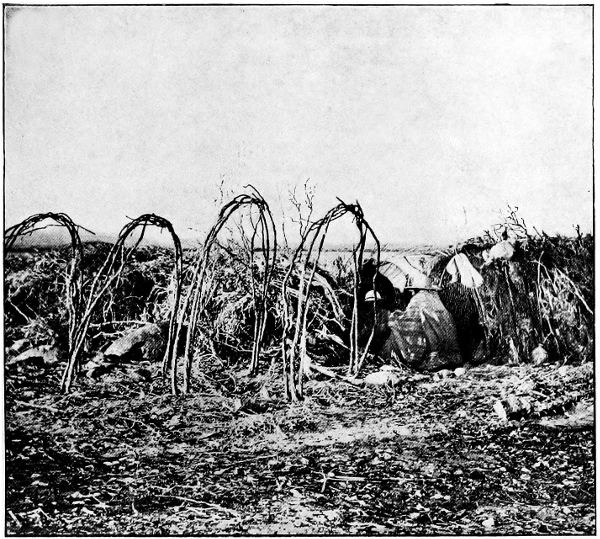
HOUSE FRAMEWORK, TIBURON ISLAND
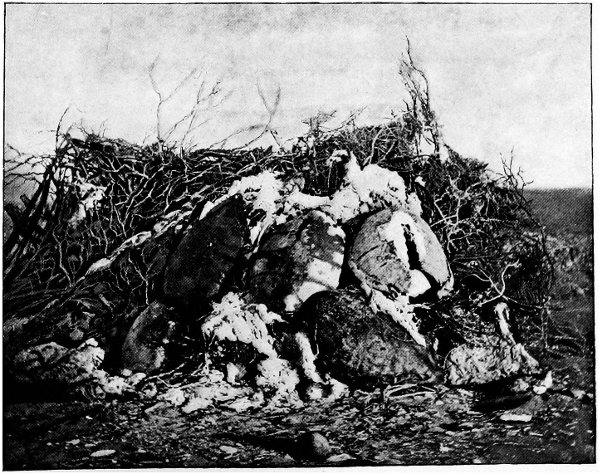
HOUSE COVERING, TIBURON ISLAND
During this period of mutual toleration the Seri were so deeply influenced by the white contact that, for probably the only time in their history, they voluntarily allowed an alien free entry into their territory; and Don Pascual explored the coast of Bahia Kino, projected a port, and even visited Isla Tiburon twice or thrice. In one of these visits he was ferried over Boca Infierno on a balsa, but, finding himself unable to keep pace with the swift-footed Seri on their hilly pathways, he returned for his saddle mule; halfway across, the poor animal swimming behind the balsa suddenly plunged and struggled, and, on landing, hobbled out on three legs—the fourth having being snapped by a shark. Warned by this incident, Don Pascual abandoned a half-formed plan of stocking the island, and afterward brought up a small vessel from Guaymas in which he carried across a dozen caballeros (including Don Ygnacio Lozania, who had visited the island with the Andrade expedition); and this party examined the southeastern quarter of the island, watering two or three times at Tinaja Anita, and pushing as far westward as Arroyo Carrizal. On this trip he studied the Seri house-building, and was the first to note the large use of turtle-shells and sponges in the process.217
About the middle fifties it became apparent that the Seri were dividing into a parasitical portion clustered about the rancho (as their forbears gathered about Populo and Pueblo Seri long before), and a more independent faction clinging to their rugged ranges and gale-swept fishing grounds; and it became evident, too, that the thievery of the dependent faction would soon ruin the rancho if not checked, or at least greatly diminished. Accordingly the passive policy was modified by introducing a more active police service. At first the penalties for theft and misdemeanors were light, and the system promised well—especially as even a slight punishment was equivalent to banishment, the criminal fleeing to Tiburon on his escape or immediately after the crime; yet the experience of a year or two proved that the escaped parasites seldom resumed the hard customs of their tribal life, but generally returned to the borderland and there preyed on the wandering stock from the rancho. Finally, driven to extremity, and supported by the state and federal authorities (themselves confessedly unable successfully to cope with the condition), Don Pascual reluctantly adopted a severer régime. Sending out as messengers several Seri still remaining at the rancho, he convened the leading chiefs and clanmothers of the tribe in a council, and announced that the stock-killing must cease, on pain of a Seri head for each head of stock thereafter slain. The Indians seemingly acquiesced, and separated; but within two days a group of Seri women “milled” a band of horses, caught and threw one in such wise as to break its neck, and immediately sucked its blood, gorged its intestines, and buried its quarters to “ripen”, after their former fashion. Thereupon a matron remaining near the rancho was sent to demand the delivery of the perpetrators; and, when she failed to return, the vaqueros were instructed to shoot the first Seri seen on the llano. Within two days more, the tribe were on the warpath for revenge—and the war raged for a decade.
During the early months of the Encinas war Don Pascual’s vaqueros sought merely to enforce the barbaric law of a head for a head; but, as they found themselves beset by ambush, assailed and wounded by night, despoiled of favorite animals, and kept constantly in that most nerve-trying state of eternal vigilance, their rancor rose to an intensity nearly equal to the savage passion for blood-vengeance; and thenceforth the Seri were hunted from the plain east of Desierto Encinas precisely as were the stealthy jaguar and sneaking coyote—and the ghastly details were better spared. There were few open battles; commonly the vaqueros rode in groups and guarded against ambuscades, and the Seri were picked off one by one; but once in the early sixties Don Pascual, at the head of some 30 vaqueros, fell into an ambush on the frontier, and several of his horses were killed and some of his men wounded, while 60 or 70 Seri warriors were left on the field. Don Pascual’s horse received a slight arrow wound, to which little attention was paid; next morning the gash was swollen and inflamed and the beast too stiff and logy for use; in the afternoon the glands under the jaw were swollen, and there was a purulent discharge from eyes and nostrils. On the second morning the animal was hardly able to move, its head was enormously swollen, there were fetid ulcers about the jaws and throat, and the swelling extended to the legs and abdomen. On the third morning there were suppurating ulcers on various parts of the body, while rags of putrefied flesh and stringy pus hung from the head and neck, and the animal was unapproachable because of the stench; during the day it dropped dead, and even the coyotes and buzzards shrank from the pestilential carcass. This and parallel incidents impressed Don Pascual with the dangers incident to Seri war; but fortunately the fact that he—the leader of the party, the first to fall into the ambush, and the target of most of the arrows—had escaped unscathed impressed still more deeply the surviving savages, and they soon sued for peace. Thenceforth he was revered as a shaman greater than those of the tribe, feared as an invulnerable fighter, and honored as a just lawgiver; and gradually the condition of mutual tolerance was restored, to rest on a firmer basis than before.
BUREAU OF AMERICAN ETHNOLOGY SEVENTEENTH ANNUAL REPORT PL. VIII
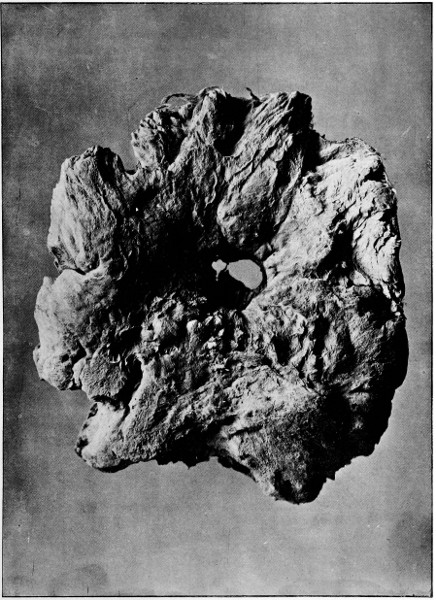
SPONGE USED FOR HOUSE COVERING, TIBURON ISLAND
Don Pascual estimates that during the dozen years of strife between his men and the Seri forces about half of the tribe were slain. The horror of the history of this period may be passed over; it may merely be noted as a casual fact that one of the two Mexicans accompanying the 1895 expedition was credited with 17 Seri heads. When he pointed out the site of his last exploit, a mile or two south of Rancho Libertad, and some incredulity was expressed, he immediately galloped to the spot and brought back a silent witness in the form of a bleached Seri skull.218
At the close of the war Don Pascual continued the industrial development of the plains lying east of the desert border of Seriland, received new concessions in recognition of his conquest, and developed the ranches of Santa Ana and Libertad; but the evangelical arm of his vigorous mission gradually withered. For a dozen years the Seri looked up to “El Patron” as a quasi ruler, whose approval was requisite for the ratification of chieftainship, and through him ran a slender thread of nominal fealty to the state and the republic; yet few parasites gathered about the rancho. Mashém had gone back to his clan; and when depredations were committed at Bacuachito or elsewhere and the criminals were caught, usually through Don Pascual’s instrumentality, they were sometimes haled to Hermosillo for trial, and Kolusio was kept there as the official interpreter of charges and evidence and findings. Sometime during the sixties a few Seri youths were coaxed to Pueblo Seri for education, but when they were instructed to cut their hair they slunk dejectedly to their temporary domicile, only to decamp during the ensuing night; again, in 1870, Kolusio was commissioned to bring in a few young people and a matron or two of the tribe, and succeeded in doing so just in time to encounter an epidemic of measles, from which some died, while the others shook the dust of the pueblo from their feet forever; and this last straw, added to his alien residence and his presence at the dreaded trials, broke down the tribal toleration of Kolusio and made him an outlaw forever.
In the later seventies Don Pascual’s energies began to wane, while the Seri population was waxing again; and, although the Encinas frontier was protected, raids began to recur toward Bacuachito, on the ranchos southwest of Caborca, and sometimes toward Guaymas; and the hostilities then engendered have never terminated. In the eighties Don Pascual suffered from cataract, gradually losing his sight, and his rule relaxed still further; Rancho Libertad was abandoned, and a condition of armed neutrality supervened at San Francisco de Costa Rica and Santa Ana; and this condition still persists, save as occasionally modified by a crude sort of diplomacy on the part of the Seri: when blood-feud is not burning (and it is usually extinguished by the killing of an alien on the coast or some remote part of the frontier), and when no stock have been slaughtered for some months, an aged woman may be seen skulking about the mesquite clumps in sight of the rancho; if her presence is tolerated for a day or two, she approaches to beg for water and food and to receive the cast-off rags hastily forced on her nakedness by the sensitive señoras; if she deem her welcome not too chill, she erects a jacal a few hundred yards away, and there she is usually found, a morning or two later, to be accompanied by a younger matron with a child or two; and if these are tolerated, the rancheria may grow to half a dozen jacales and half a hundred persons.219 The band may remain a fortnight or even a month; but in case of serious illness of any of their number, or of threat or punishment for petty peccadillos, or of an unusual storm, or of a brilliant meteor, or of any exceptional occurrence about the rancho, the rancheria is commonly found empty next morning. If the attachés of the rancho are indisposed to tolerate the first envoy, yet feel kindly rather than rancorous, she is merely dogged and stoned away like a depredating domestic animal from another hacienda; if the rancor of past encounters remains, the mercy accorded her is precisely that shown the predatory coyote or other feral animal from the fastnesses of the sierras—and the tribe take warning and doubtless rejoice that their loss is no greater.
Any recital of the common history of the peculiarly savage Seri and the whites necessarily conveys an exaggerated notion of intimacy and mutual influence, since it emphasizes the few positive interrelations scattered along the decades of neglected nonrelation; and this is true of the Encinas régime as of earlier centuries. The great fact is that throughout their recorded history the Seri have touched civilization so slightly and so seldom that the effect of each contact was largely lost before the next supervened; and the unprecedentedly intimate contact of the Encinas régime, especially during the initial period of abnormal toleration, serves less to indicate relationship in characteristics and sympathies than to measure the breadth of the chasm between the Seri and the Mexican—a chasm not exceeded, and probably not equaled, elsewhere in America. About the middle fifties, probably every Seri above infancy and below decrepitude had seen Don Pascual and some other habitués of the rancho; they yielded to the seductions of indolent scavengering apparently more numerously than ever before; they substituted cast-off rags and barter-bought manta (plain cotton cloth) for the products of their own primitive weaving; they ate cooked food when it fell in their way; they half-heartedly adopted metal cutting implements, and sought or stole nails and hoop-iron for arrowpoints; some of them acquired a smattering of Spanish, and many of them solicited and sported Spanish names, just as they begged and flaunted tawdry handkerchiefs and beads; and they generally enjoyed mildly the ecclesiastical fiestas, and took kindly to the cross as a symbol of peace and plenty and perhaps of deeper import. Yet even during this halcyon term no Seri save Kolusio and the Altar outlaw ever learned to live in a house; none but these and Mashém wore hats habitually; and, despite the fact that they often witnessed and sometimes playfully or perforce participated in the processes, no Seri ever really encompassed the idea of house-building or even of making adobe. Though surrounded by horses when near the rancho, they never learned to ride nor to use the animals otherwise than for immediate slaughter and consumption; though in frequent sight of skilful ropers, they never fully grasped the idea of the riata, preferring to seize their prey with hands and teeth; though familiar with the agricultural operations of the rancho, they never turned a sod nor planted a seed on their own account; though in frequent sight of cooking, they seldom began and never finished the process with their own food; though acquainted with firearms, they continued to regard them as thaumaturgic devices, and chose the bow and arrow for actual use; though submitting to apparel on the frontier, they commonly cast away the incumbrances on returning to their lairs; and no Mexican or other Caucasian ever saw within their esoteric life—their names remained unrevealed, their hair remained sacred, their mourning for the dead was unheard save at a distance, and no alien, even unto today, has ever seen the birth of their babes, the christening of their children, the burial of their dead, or the ceremonies of their shrines. The Seri and the whites were, indeed, mutually tolerant; but, so far as concerns mutual sympathy, the toleration was almost precisely on a par with that between the ranchero and the vulture-flock that scavengers his corrals—and when depredation began the toleration was of a piece with that between householders and their unwillingly domiciled rodents. It is not too much to say that the interracial mistrust and hatred of the Western Hemisphere culminates on the borders of Seriland; though the antipathy is commonly regarded by the alien tribesmen and the Mexicans as other than racial, since the Seri are felt to be hardly human—a feeling fully shared by the Seri, who undoubtedly deem themselves more closely akin to their deified bestial tutelaries than to the hated humans haunting their borders.
BUREAU OF AMERICAN ETHNOLOGY SEVENTEENTH ANNUAL REPORT PL. IX
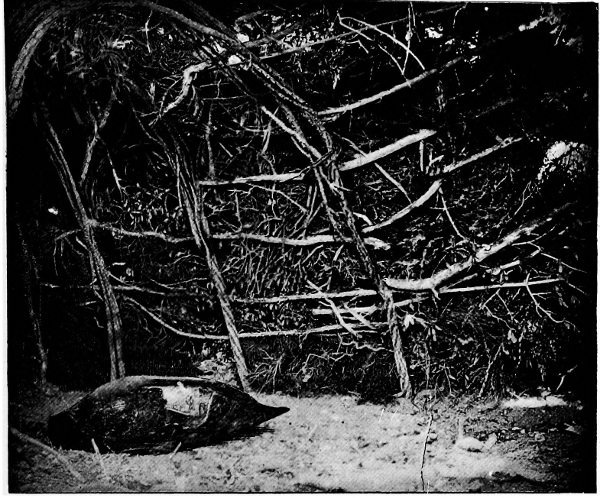
HOUSE SKELETON, TIBURON ISLAND.
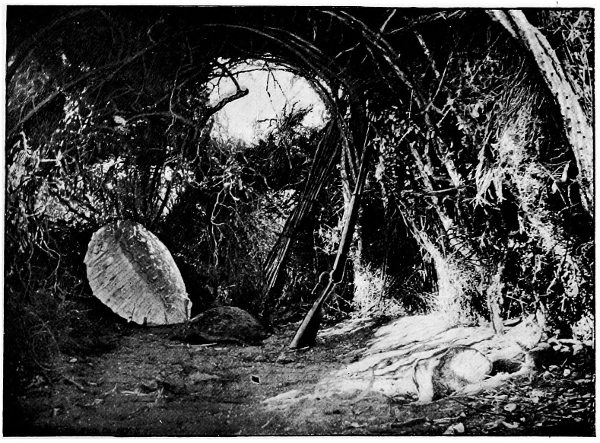
INTERIOR HOUSE STRUCTURE, TIBURON ISLAND.
Even during the Encinas régime the Seri came in occasional contact with aliens on other parts of the frontier: on Hacienda Serna, the somewhat remoter borderland outpost on the north, the relations between the landholders and the Seri were analogous to those on the Encinas plains, though less acute in the ratio of relative distance. Occasionally small parties of warriors journeyed to Guaymas220 on balsas or on foot to barter pelican-skin robes for Caucasian commodities, chiefly aguardiente and manta; still more rarely similar pilgrimages were made to the outskirts of Hermosillo; a few marauding raids were made to the ranches lying near Cieneguilla and Caborca; and a number of ill-advised prospecting parties, coming by land or water, paid the penalty of foolhardiness. Writing about 1864, Historian Velasco recurred to the Seri to say:
This handful of bandits, assassins, thieves, brutes [inhumanos], infinitely vile and cowardly, on February 28 last, on the Guaymas road, at the place called Huerfano, assassinated 4 unhappy women, including a girl of 9 years, and 7 men who were conducting them in a cart toward that port.
He bitterly denounced the apparent apathy of the state and federal authorities, adding:
When it is read in history fifty years hence that a handful of murderous Ceris, certainly not more than 80 of the tribe able to bear arms, was able to domineer in the midst of their crimes with unexampled audacity on account of the debility of the government and the inhabitants, it will be regarded as a romance or a fable; for it seems impossible that in the nineteenth century such a condition of things could exist to degrade the reason, the morality, and the dignity of civilized man.
Yet a final note, apparently added in press, recorded that—
In consequence of the last incident of the Ceris, the prefect of Guaymas, Don Cayetano Navarro, took the field, returning with 12 women and 16 children prisoners; also 2 striplings and a vieillard. He slew 9 among those who had no leader. This was on Isla Tiburon. The Indians fled thence, and are supposed to be at Tepococ.221
These may be considered as characteristic skirmishes attending the Encinas war. Other episodes followed, including the outbreaks of 1879, noted in part by M Pinart. Bacuachito suffered in various locally important events that will never be written: when Don Jesus Omada, a water-guide to the expedition of 1895, was asked about the Seri at Bacuachito, he answered with cumulative vehemence, “They killed my father. They killed my brother! They killed my brother’s wife!! They have killed half my friends!!!” As he spoke he was feverishly baring his breast; displaying a frightful scar over the clavicle, he exclaimed, “There struck a Seri arrow”; then he stripped his arm with a single sweep to reveal a ragged cicatrix extending nearly from shoulder to wrist, and added in a tone tremulous with pent bitterness, “The Seri have teeth!”
In the course of the half century from 1844 onward, the population of Sonora increased materially, and carried more than a proportionate increase in the development of agricultural and mineral resources; and, especially under the beneficent Diaz régime, the state passed from the condition of a remote frontier province into that of a well-governed commonwealth. Naturally this progress carried the Caucasian element, including that of blended blood, farther and farther away from the nonprogressive Seri; and thereby the horror and detestation awakened by the very utterance of the name of the lowly tribe were intensified beyond description or ready understanding. The traditions of arrow poisoning were kept alive, and, doubtless, growing; the recitals of carrion eating were repeated, and possibly—just possibly—magnified beyond the reality; the accounts of offense and defense by nails and teeth (such as that of Jesus Omada) passed from mouth to mouth until—incredible as it may seem—the more timid Sonorenses stood in greater dread of these natural weapons of the Seri than of their brutal clubs and swift-thrown missiles, or even of their poisoned arrows; while traditions of cannibalism came up and received such general credence that the current items of Seri outrages, both in local gossip and in the Mexican and American press, customarily recounted savage butcheries ending with gruesome feastings on the raw or slightly cooked flesh of the victims. The shuddering antipathy felt for the perpetrators of these inhumanities even a thousand miles away increased toward their frontier, as light toward its source; the dread was deepened by the failure of punitive expeditions sent out again and again only to be balked by waterless sand-wastes or wrecking tiderips; and in 1894 and 1895, at least, the horror of the Seri was a daily and nightly incubus on half the citizens of Hermosillo and the tributary pueblos and ranchos, and a thorn in the flesh of the state officials.
BUREAU OF AMERICAN ETHNOLOGY SEVENTEENTH ANNUAL REPORT PL. X
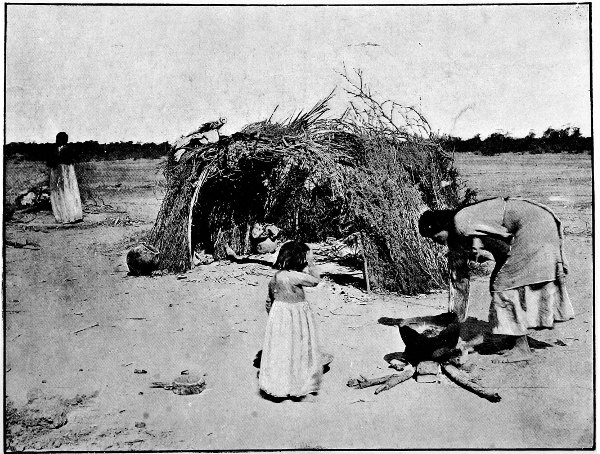
TYPICAL SERI HOUSE ON THE FRONTIER
The external history of the Seri since the spring of 1894 is fairly known, both through the direct researches and through press reports, and would seem to be typical. This era may be assumed to open with the arrival on Tiburon’s shores of the sloop Examiner, carrying two San Francisco newspaper writers, Robinson and Logan, with two assistants, Clark and Cowell. The to-have-been-expected happened duly, save that two of the party escaped, and on reaching Guaymas advertised the disaster through correspondence and the press. Several of the accounts indicated that the two victims were not only slain but eaten, and various plans were laid in California, Arizona, and Sonora for the recovery of the bones222—as if, forsooth, the omnivorous and strong-toothed Seri spared anything save scattered teeth and split sections of the longer shafts of skeletons the size of those of Homo sapiens. While in Guaymas the two survivors set up claims for indemnity, which initiated international correspondence and inquiry into the details of the affair. These details are indicated, in sufficient fulness for present purposes, in a formal communication incorporated in the international correspondence, viz.:
Smithsonian Institution, Bureau of American Ethnology, Washington, December 14, 1894.