DEMOTIC CHARACTERS
Reading edition
The Seri, like all other peoples, are characterized by various collective attributes which vastly transcend in interest and importance the somatic attributes exhibited by the individuals. These superorganic attributes are essentially activital—i. e., they represent what the people do rather than what they merely are; and in both collective and activital aspects they serve to distinguish the human realm from the organic realm, and to afford a basis for the classification of mankind—i. e., they combine to form demotic characters.
The demotic characters of the Seri, like those of other peoples, may be classed as (1) esthetic, (2) industrial, (3) institutional, (4) linguistic, and (5) sophic; and in this order the essentially human attributes of the tribe (except the last named) may be described. It is a matter of deep regret that the data concerning the demotic characters of the tribe are too meager to afford more than a mere outline of their activities, and that their suggestive mythology must be passed over for the present.
Symbolism and Decoration
FACE-PAINTING
One of the most conspicuous customs of the Seri is that of painting the face in designs by means of mineral pigments. Of the 55 members of the tribe shown in the group forming plate XIII, 28 (in the original photograph; a somewhat less number in the reproduction) exhibit face-painting more or less clearly, and this proportion may be regarded as typical; i. e., about half of the tribe are painted.
On noting the individual distribution of face-painting, it is found to be practically confined to the females, though male infants are sometimes marked with the devices pertaining to their mothers, as adult warriors are said to be on special occasions; and so far as observed all the females, from aged matrons to babes in arms, are painted, though sometimes the designs are too nearly obliterated by wear to be traceable. About 35 of the individuals shown in the group (plate XIII) are females; of these, fully four-fifths showed designs or definite traces of the paint, while the remaining fifth bore traces too faint to be caught by the camera; but none of the men or larger boys were painted. In the smaller group shown in plate XIV all of the females display paint, as does the small boy in the center also, while the man (husband of the middle-aged matron) reveals no trace of the symbol. The two pictures typify the prevalence and the distribution by sex of the painting.
BUREAU OF AMERICAN ETHNOLOGY SEVENTEENTH ANNUAL REPORT PL. XXIV
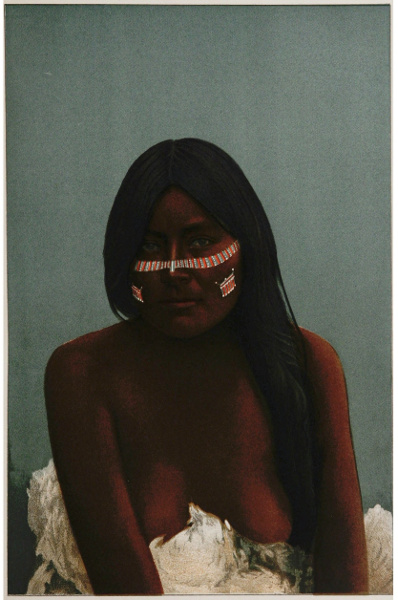
SERI BELLE
The painted designs vary among different individuals, but are fairly persistent for each. The prevailing design at Costa Rica in 1893 was that of the aged matron known as Juana Maria (plate XVIII), with variations in detail such as that exhibited by her unmarried daughter Candelaria (the Seri belle shown in plate XXIV); next in frequency were the designs, in white and red, exhibited by the matrons portrayed in plates XX and XXII. Other designs observed are indicated in plate XXVI. The variations in individual designs are apparently due either to varying care in the application of the paint or to the degree of obliteration by wear—e. g., the withered Juana Maria sometimes put on her design askew and was negligent of details, while the blooming Candelaria greatly elaborated the details of the pattern and carefully perfected the symmetry of the whole when preparing for her full-dress sitting before the camera (plate XXIV), so that her design was then gorgeous by contrast with the nearly obliterated blur of a half-hour before. The designs are renewed every few days, especially for ceremonious occasions, and hence are practically permanent.
When grouped in relation to their wearers, the designs are found to exhibit family connection. Thus, Juana Maria’s design is repeated, with greater elaboration of detail and with a pair of supplementary marks, in that of her daughter Candelaria; the winged symbol of the Seri matron portrayed in plate XX is repeated with minor variations in that of her daughter, the Seri maiden pictured in plate XXV; while the symbols of the mother and infant daughter depicted in plate XV are essentially alike. It is noticeable, too, that in the nearly spontaneous arrangement of individuals in the group shown in plate XIII there is a tendency toward subgrouping by symbols; and it was constantly observed that the family groups gathered about particular jacales (such as that shown in plate XIV) displayed corresponding designs, though there were frequent visitors from neighboring jacales bearing other designs. Briefly, all the observed facts, as well as the supplementary information gained by inquiry, indicate that the designs are hereditary in the female line, but are susceptible of slight modification both in elaborateness of detail and in the addition of minor supplementary features.
The principal apparatus and materials used in the face-painting are illustrated in plate XXVII. The chief pigments are ocher, gypsum, and the rare mineral dumortierite; the ocher yields various shades of red, ranging from pink to brown; the gypsum affords the white used in most of the designs; while the dumortierite is the source of the slightly varying tints of blue. So far as was observed, the pigments are not blended by mixing, though there is some blending due to overlapping in application. The ocher is commonly extracted and transported as lumps of ocherous clay or ocherous gypsum (plate XXVII, figures 1 and 5), though it is sometimes reduced to powder and transported in bits of skin or rag, or in cylinders of cane (plate XXVII, figures 3 and 4); and it is prepared by trituration with a pebble or rubbing with the fingers, usually in a shell cup. Sometimes the shell used for the purpose is the valve of a Cardium, which serves indiscriminately as cup, spoon, skin-scraper, etc.; but preference is apparently given to thick and strong shells, such as the wave-worn valve of Chama (?), shown in plate XXVII, figure 7, which are consecrated to the use and eventually buried with the user, together with a supply of the paint (like that illustrated in the cane cylinder—figure 4—which was a mortuary sacrifice). The gypsum is usually carried in natural slabs or other fragments, perhaps rounded by wear (plate XXVII, figures 6 and 8); it is prepared by wetting and rubbing two pieces together, the larger being reduced to metate shape by the operation. The dumortierite was observed only in the form of a pencil made by pulverizing the substance and mixing with sufficient clay to give consistency. The several pigments are applied wet by means of human-hair brushes kept for the purpose, the process occupying from half an hour to three or four hours for the more elaborate designs. So far as observed at Costa Rica in 1894, the paints were mixed in water only; but since painting outfits found on Tiburon island in 1895 were smeared with grease, it is probable that either water or fats may serve for menstrua, at the convenience of the artists. Commonly the process of painting is measurably cooperative. The matron usually depicts her device on the faces of her daughters up to the age of 12 or 15 years, when they learn to make the applications themselves; and frequently two or more women (usually those with similar devices) work together in preparing and applying the pigments, each laying the paint on her own face and apparently guiding her hand partly by the sense of feeling and partly by suggestions from her coworkers; but Candelaria and some other of the younger women at Costa Rica frequently worked alone, aided by a mirror in the form of a shallow bowl of water set in the shadow while the brilliant desert glare fell full on the face.
The mines yielding the pigments were not located. The geologic conditions are such that the ochers are undoubtedly abundant; but it is probable that the gypsum is uncommon and confined to a remote locality or two, and that the dumortierite is rare and scanty here as elsewhere. The care with which the paints are preserved, prepared, and applied, the fact that they are indispensable feminine appurtenances even on the longest journeys, and their sacred rôle in the mortuary customs, all combine to indicate that they are among the most highly prized possessions of the people and by far the most precious of their minerals.
The sematic functions of the designs are esoteric, yet an inkling of their meaning was obtained through Mashém, the interpreter at Costa Rica in 1894; from his expressions it appears that the designs are sacred insignia of totemic character, serving to denote the clans of which the tribe is composed. But three clans were identified, and these only with some uncertainty, viz., the Turtle clan,257 denoted by the symbols of Juana Maria (plate XVIII) and Candelaria (plate XXIV and the upper left figure in plate XXVI); the Pelican clan, denoted by the designs of two typical matrons (plates XX and XXII) and a typical maiden (plate XXV), and probably also by those of the medio-lateral figures in plate XXVI; and (still less certainly) the Rattlesnake clan, denoted by the symbol of the lower left figure in this plate. The special sematic values of the colors also are esoteric, and were not ascertained; even in the case of the simple pelican design, the difference in meaning between the solid red pattern of one group and the similar pattern of white in another group was successfully concealed. So, too, the significance of the various subordinate or supplementary devices—the distinct border-line shown in plate XX, the lower cheek devices in plate XXIV, the separate chin mark in plate XXV, the fetish-like symbols on the lower cheeks in the lower left figure of plate XXVI, etc.—eluded inquiry; while some of the minor features of both form and color were sufficiently variable in the devices borne by different faces of the same family, and even in successive paintings of the same face, to suggest some individual freedom in carrying out the detail of the generally uniform designs.
BUREAU OF AMERICAN ETHNOLOGY SEVENTEENTH ANNUAL REPORT PL. XXV
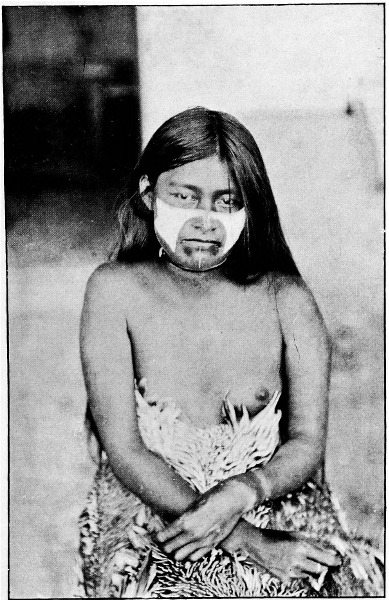
SERI MAIDEN
The telic functions, or ultimate purposes, of the face-painting are also esoteric, though not beyond the reach of inference from the sematic functions, coupled with general facts of zoic and primitive human customs. Even at first sight the painted devices bring to mind the directive markings of lower animals defined by Professor Todd258 and interpreted by Ernest Seton-Thompson;259 and in view of the implacably militant habit of the Seri it would seem evident that the artificial devices are, at least in their primary aspect, analogous to the natural markings. On analyzing the directive markings of animals, it is convenient to divide them into two classes, distinguished by special function, usual placement, and general relation to animal economy: the first class serve primarily to guide flight in such manner as to permit ready reassembling of the flock; they are usually posterior, as in rabbit, white-tail deer, antelope, and various birds; and they primarily signify inimical relations to alien organisms, with functional exercise under stress of fear. The second class of markings serve primarily for mutual identification of approaching individuals; as comports with this function, they are usually facial, or at least anterior; and their functional exercise is normally connected with peaceful association—though the strongly emphasized facial symbols of the males doubtless blazon forth the alternative meanings of preference for peace or readiness for strife, like the calumet tomahawk of the Sioux warrior (as interpreted by Cushing). So the directive markings of the first class are substantially beacons of danger and fear, while those of the second are just as essentially standards of safety and confidence; and they may properly be designated as beacon-markings and standard-markings, respectively.260 On seriating the two classes in terms of development, it is at once found that the beacon-markings are in large measure connected with excursive movement and are centrifugal in effect, while the standard-markings are connected mainly with incursive movement and are centripetal in effect; at the same time the latter express not only the higher intelligence, but also the greater degree of that conjustment which forms the basis of collective organization; so that the latter unquestionably represents the higher developmental stage. Now, the primary functions of these directive markings of the higher grade—signalization (or attentionization) and identification—correspond precisely with paramount needs of the alien-hating and clan-loving Seri; so that careful analysis would seem fully to justify the casual impression of functional similitude between the Seri face-painting and the directive markings of social animals.
While the first survey establishes a certain analogy between the primitive face-painting and the standard-markings of animals, an important disparity is noted when the survey is extended to individuals; for among beasts and birds the standards are usually the more conspicuously displayed by the males, while the paint devices of the Seri are confined to the females. A suggestion pointing toward explanation of this disparity is readily found in the seriation of developmental stages marked by (1) the fear-born beacon-markings, (2) the confidence-speaking standard-markings, and (3) the painted symbols; for the artificial devices coincide with an immeasurably advanced mental development, with concomitant advance in safety and peace on the one hand and in artificializing weapons on the other hand. This suggestion alone fails to explain the disparity fully, yet it raises another, growing out of the great social advancement connected with the mental development—i. e., the effect of the distinctively demotic organization of the human genus as represented by the Seri people. On considering this organization, it is found strictly maternal: the tribe is made up of clans defined by consanguinity reckoned only in the female line; each clan is headed by an elderwoman, and comprises a hierarchy of daughters, granddaughters, and (sometimes) great-granddaughters, collectively incarnating that purity of uncontaminated blood which is the pride of the tribe; and this female element is supplemented by a masculine element in the persons of brothers, who may be war-chiefs or shamans, and may hence dominate the movements of groups, but whose blood counts as nothing in the establishment and maintenance of the clan organization. Thus the females alone are the blood-carriers of the clans; they alone require ready and certain identification in order that their institutional theory and practice may be maintained; and hence they alone need to become bearers of the sacred blood-standards. The warriors belong to the tribe, and are distinguished by luxuriantly flowing hair, by the up-stepping movement from which the people derive their appellation, by their unique archery attitude, and by their dark skin-color; the boys count for little until they enter the warrior class; but on the females devolves the duty of defining and maintaining the several streams of blood on which the rigidly guarded tribal integrity depends.261 Undoubtedly the blood-markings play an important rôle in courtship and marriage, but too little is known of the esoteric life of the tribe to permit this rôle to be traced.
BUREAU OF AMERICAN ETHNOLOGY SEVENTEENTH ANNUAL REPORT PL XXVI
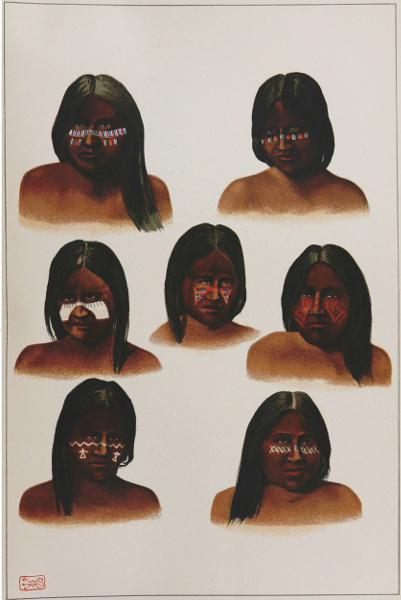
CHARACTERISTIC FACE PAINTING.
In brief, the Seri face-painting would seem to be essentially zoosematic, or symbolic of zoic tutelaries, and to signify subspecific (or subvarietal) characteristics maintained by the clan organization and kept prominent by the militant habit of the tribe; at the same time it is noteworthy that the purely symbolic motive is accompanied by a nascent decorative tendency, displayed by the individual refinement of form and color in the symbol proper to each of the groups.
DECORATION IN GENERAL
Aside from the face-painting there is a conspicuous dearth of decoration or tangible symbolism among the Seri.
The symbolic or decorative modification of the physique would seem to be limited to two classes of mutilations, of which one was observed at Costa Rica in 1894 while the other is apparently obsolete. The observed corporeal modification is the absence of medial superior incisors of the females, in consequence of forcible removal at a period not definitely ascertained. The interpreter at Costa Rica was uncommunicative on the subject; Don Pascual opined that the mutilation formed part of an elaborate puberty ceremonial, and this opinion would seem to be corroborated by the condition of the cranium of an immature female examined by Dr Hrdlička; but since the half-dozen adult maidens at the rancho in 1894 were free from the mutilation while all the wives bore its gruesome trace, it would seem more probable that the custom is connected with marriage. Whatever the period of the infliction, Mashém’s guarded expressions seemed to indicate that it was a mark of physical inferiority; and this suggestion, interpreted in the light of the Seri use of teeth as weapons of offense and defense, would seem to indicate that the mutilation is at once the badge of corporeal inferiority and a means of maintaining the physical superiority of the males—of course in that theoretically fiducial but actually forceful way characteristic of primitive culture.
The second mutilation was the only corporeal modification noted by early missionaries and explorers—it was the perforation of the nasal septum for the insertion of a skewer, perhaps of polished stone (though doubtless more commonly of bone), to which swinging objects were attached. One of the most useful records is that of the Jesuit, Padre Joseph Och, who described the nasal attachment as a small, colored stone suspended by cords from the perforated septum, and guarded with such jealous veneration that “one must give them at least a horse or a cow for one” (ante, p. 78); while according to Hardy’s record, the nasal fetish is “a small, round, white bone, 5 inches in length, tapering off at both ends, and rigged something like a cross-jack yard.”262 The custom is apparently obsolete, and nothing is known directly of details or motives.
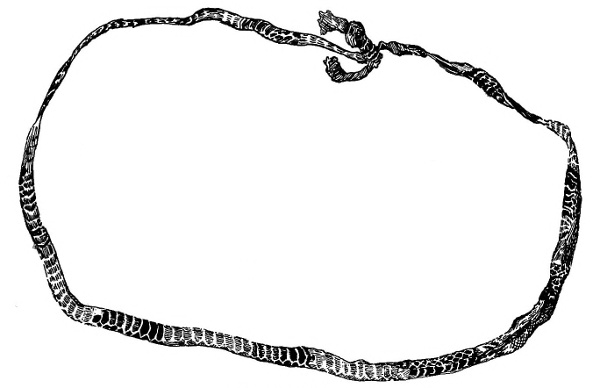
Fig. 7—Snake-skin belt.
Excepting these mutilations the corporeal decoration of the Seri is apparently limited to the face-painting: among the 60 individuals at Costa Rica in 1894 there was no trace of tattooing or scarification of face, limbs, or body; there were no labrets or earrings, and neither lips nor ears were pierced, nor were nasal septa observed to be perforated in accordance with the reputed ancient custom; the teeth were neither filed nor drilled; no indications of amputation or other maiming (save the removal of the incisors) were observed—indeed, the instinct for physical markings of symbolic or decorative character, which seems to be normal to primitive men, was apparently satisfied by the prevalent and persistent face-painting among the females.
The extra-corporeal decorative devices are of a meagerness and poverty even transcending the poor apparel, flimsy habitations, and generally ill-developed artifacts of the lowly tribe.
BUREAU OF AMERICAN ETHNOLOGY SEVENTEENTH ANNUAL REPORT PL XXVII
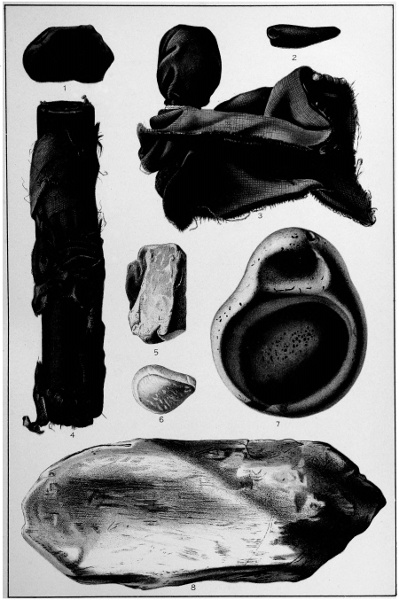
SERI FACE PAINTING PARAPHERNALIA.
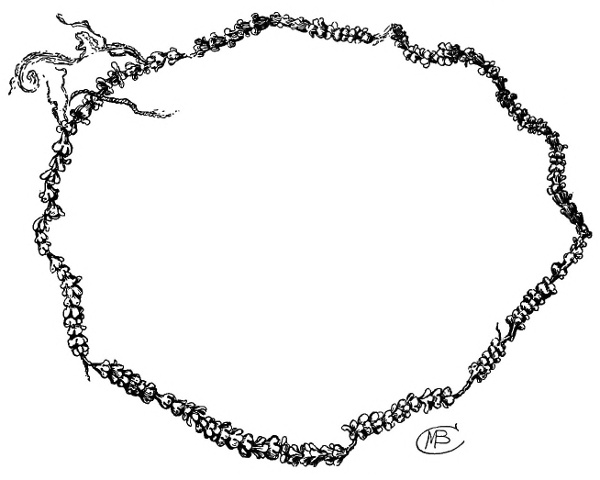
Fig. 8—Dried flower necklace.
The most prominent personal possession is the pelican-skin robe; it is usually made of six skins, slightly dressed and in full plumage, sewed together with sinew in a conventional pattern of such sort as to give the greatest possible expanse consistent with the irregular outlines of the individual skins, and at the same time to display a conventional color pattern on the feathered side, the colors ranging from the dorsal slate to the ventral white of the fowl (as indicated in plate XXIII); sometimes there are only four skins and rarely there are eight, but the conventional arrangement is maintained. Before the beginning of a fairly regular barter at Rancho de Costa Rica, and hence before the introduction of manta and other stuffs, the pelican-skin robes were supplemented by kilts made of mesquite root or other fibers, spun and twisted in the fingers and woven probably on some primitive device no longer in use; but so far as is known these native fabrics were devoid of decorative patterns in color or weave. Less habitually a short wammus or shirt, with long sleeves, made of a material similar to that of the kilt, was worn; but it, too, was without ornamentation, so far as can be ascertained. The remaining article of utilitarian apparel is the belt, usually consisting of a strip of skin (of deer, rabbit, peccary, etc.), slightly dressed with the hair on; frequently this is replaced by a cord or braided band of human hair, while the favorite belt of some of the young warriors is a snake skin (such as that illustrated in figure 7); but so far as was seen the belts are not extended into tassels, decorative appendages, or even flowing ends.
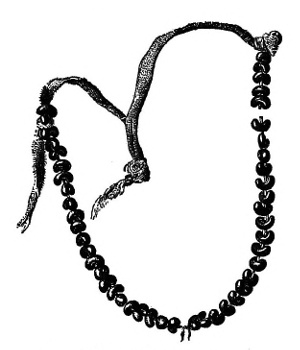
Fig. 9—Seed necklace.
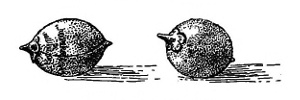
Fig. 10—Nut pendants.
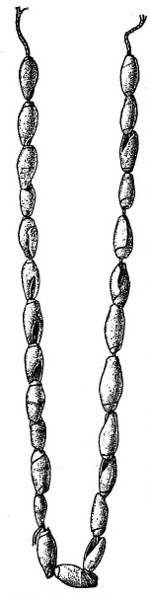
Fig. 11—Shell beads.
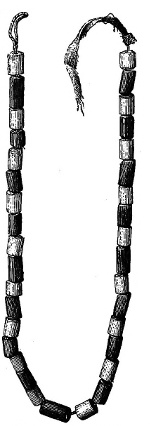
Fig. 12—Wooden beads.
The presumptively decorative costumery observed is limited to necklaces, usually of strung seeds, shells, and beads of wood or bone (figures 8, 9, 10, 11, 12, and 13), though animal appendages, such as hoofs, teeth, etc., are sometimes worn. The most highly prized necklace found at Costa Rica was a human-hair cord with nine crotalus rattles attached (figure 14), worn by a young warrior of the Rattlesnake (?) clan. Not the slightest indication of headdresses was seen (though deer and lion masks are said by Hardy to have been worn on occasions); there were no bracelets, leg-bands, or rings of any description, and the cheap jewelry given to many of the women and youths at Costa Rica was either strung about the neck or concealed; while it is significant that even the showiest jewelry was less appreciated than bits of manta or lumps of sugar. When it is remembered that the Seri have been in occasional contact with Caucasians for over three and a half centuries, the fact that not a single glass bead was found among them becomes significant; and the significance of the simple fact is increased by the virtual absence of that persistent desire and protean use for beads—or bead-sense—so prominent among most primitive tribes.
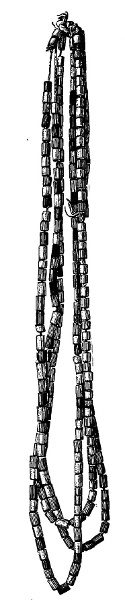
Fig. 13—Necklace of wooden beads.
Naturally the conditions at Costa Rica were unfavorable to the study of native ideas concerning apparel. The women and some of the children were arrayed chiefly in cast-off habiliments of the rancheras or in nondescript rags, while the men either aped Mexican fashions, like Mashém, or shamefacedly sweltered under the unaccustomed burden of tatterdemalion gear; yet there was a meaningful absence of that desire for finery so prominent among primitive peoples—a fact quite as eloquent in itself as the absence of bracelets and bangles, tassels and trappings. It is probable that the shamans and mystery-hedged crones in the depths of Seriland enhance their influence by the aid of symbolic paraphernalia (indeed, some inkling of such customs is found in the meager records of earlier visitors);263 yet the conspicuous feature of Seri costumery is the dearth of decorative devices.
The habitations of the tribe are the simplest of jacales—mere bowers, affording partial protection from sun and wind, but not designed to shed rain or bar cold. Half a dozen of these were examined at Costa Rica in 1894 and probably a hundred more, in various stages of habitability, in Seriland proper in 1895, yet not the slightest trace of decoration was observed—the structures are plainly and barrenly utilitarian in every feature. The same may be said of the balsas in which the Seri navigate their stormy waters; for the peculiarly graceful curves of the craft evidently stand for nothing more than the mechanical solution of a complex problem in balanced forces, wrought out through the experience of generations, while the simple reed bundles are absolutely devoid of paint, of superfluous cord, of fetishistic appendages or markings, of tritons, nereids, or other votive symbols at bow or stern, and of industrially superfluous features or attachments in general—indeed, the only appendages discovered were one or two simple wooden marlinspikes (shown in figure 26), thrust among the reeds to be at hand in case of need for repairs.
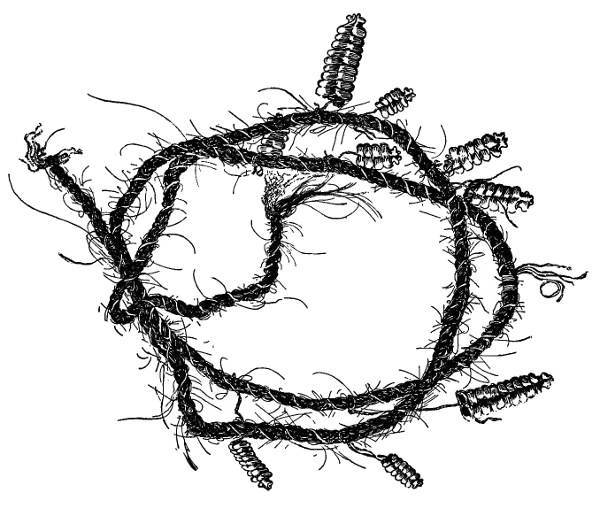
Fig. 14—Rattlesnake necklace.
Among the utensils employed in the primitive householdry of the Seri the most conspicuous and at the same time the most essential is the olla, or water-jar. Its technical features are described elsewhere; but it may here be noted that the olla is the central artifact about which the very life of the tribe rotates: since the clans never reside and rarely camp nearer than 3 to 15 miles from the aguaje, a large part of the water consumed must be transported great distances in these vessels; since the region is one of extreme aridity, the lives of small parties often depend on the integrity of the olla and on the care with which the fragile vessel is protected from shock or overturning; and hence the utensil must occupy a large if not a dominant place in everyday thought—indeed, the fact that it does so is attested by constant custom and also by its employment as the most conspicuous among the mortuary sacrifices. Thus, the relation of the Seri olla to its makers and users is parallel with that of the ever-present earthen pot to the Pueblo people, or that of the cooking basket to the acorn-eaters of California, save that its relative importance is enhanced by the fewness of activital lines and motives in Seri life. Moreover, this most characteristic utensil is established and hallowed in Seri thought by immemorial associations: its sherds are sown over the hundred thousand square miles of ancient “despoblado” from Tiburon to Caborca, Magdalena, Rio Opodepe, and Cerro Prieto, and are scattered through the 90 feet of shells forming Punta Antigualla (perhaps the oldest shell mound of America); and all the sherds from the range and the shell-strata are so like and so different from any other fictile ware as to be distinguished at a glance. Hence it would seem manifest that the Seri olla must constitute a normal nucleus for the Seri esthetic; yet even here the field is practically barren, as is shown by the study of a score of usable and mortuary specimens and of thousands of sherds. The most ornate specimen seen is that depicted in plate XXXII. Its form, like that of the balsa, is a mechanical equation of forces and materials; its body-color is that of the clay, blotched and blackened irregularly by the smoke of the firing; and its decoration is limited to 17 faint lines or bands radiating downward from the ill-shaped neck. The radial bands were evidently drawn by a finger dipped in clayey water after the vessel was otherwise finished for the firing; they are irregular in placement, width, length, and direction; they generally run in pairs, two straight lines alternating with two zigzag lines, though the circuit is completed by two zigzags drawn wide apart and separated by a single straight line. The meaning of the device (if meaning there be) was not directly ascertained; but it is suggestive that its maker and owner was the mother of the youthful warrior from whom the rattlesnake necklace was obtained (her face-symbol is that shown in the lower left figure of plate XXVI), and that the vessel was surrendered more reluctantly than any other article obtained from the tribe.
Another utensil of some importance to the tribe is a basket of the type illustrated in figure 24. It is manufactured with much skill and is used for various domestic purposes, being practically water-tight and unbreakable, and materially lighter than even the unparalleledly light fictile ware of the Seri. In form and size and weave the half dozen examples seen correspond with widespread southwestern types; yet it is noteworthy that while otherwise similar baskets are habitually decorated by other basket-making tribes, the Seri specimens were absolutely devoid of decorative devices.
Practically the only remaining artifacts available for decoration are those connected with archery; and it suffices to say that while the bows are skilfully made and the arrows constructed with exceeding pains, not a single specimen seen showed the slightest trace of symbolism or of nonutilitarian motive.
Summarily, the Seri are characterized by extreme esthetic poverty. This has been noted by the early missionaries and by the few other travelers who have approached their haunts, as well as by the vaqueros on the Encinas and Serna and other ranchos bordering their range, who know them as “los pobrecitos”. All observers have been struck with their destitution and squalor; yet when the impressions are particularized they are seen to denote absence of the poor luxuries, rather than the bare necessities, of primitive life. The people are pathetically poor in the industrial sense; their equipment in artifacts—implements, weapons, utensils, habitations, apparel—is meager almost, if not quite, beyond parallel in America; yet their esthetic equipment, practically limited as it is to a single line of symbolic portrayal, is still more abjectly meager.
Any comparison of the Seri esthetic with that of other Amerind tribes serves only to emphasize its paucity: the tribes of the plains, with their eagle-feather headdresses, elaborately arranged scalp-locks, widely varied face-painting, and ritualistic camp circles; the Pueblo peoples, with their ornate masks, elaborate altars, figured stuffs, and painted pottery; the denizens of the eastern woods, with their feather-decked peace-pipes, divinatory games, fringe-bordered garments, and prayer-inscribed arrows; the coastwise peoples of the upper Pacific, with their labrets and tattoo-marks, totem-poles and carved house-fronts, painted canoes and prodigal potlatches; the neighboring desert tribes, with their festal footraces, decorated pottery and basketry, pendent scarfs and garters, and well-wrought caskets for family fetishes; even the timid acorn-eaters of California, with their sacramental baskets, artistically befringed kilts, bead-strings of far-traveled nacre, and patiently wrought fabrics of rare feathers—all of these seem rich in esthetic motives when contrasted with “los pobrecitos” of arid Seriland. And the contrast is only intensified when the economic motives of the various tribes are compared: the industrial motives of the Seri are fairly numerous and diverse; they are skilful huntsmen, successful fishermen, capable navigators, and competent warriors (as attested by the protection of their principality for centuries), so that despite the absence of agriculture and the avoidance of commerce, their industrial range is not very far below the aboriginal average; and while they are deficient in thrift, this shortcoming is balanced by a peculiarly developed vital economy whereby they are delicately adjusted to their environment, as has been already shown. On the whole, it would appear that the Seri are not only lower in esthetic development than the contemporary tribes thus far studied, but also that they stand at the bottom of the scale in the ratio of esthetic to industrial motives.
THE SIGNIFICANCE OF DECORATION
Largely through recent researches among the American aborigines, it has been shown that decorative and many if not all other esthetic concepts normally arise in symbolism, gradually expand in conventionism, and eventually mature in a realism which is itself the source of ever-extending esthetic motives; and the observations on the lowly Seri afford opportunity for somewhat extending the generalizations based on higher tribes.
When peoples of unequal cultural development are compared, it is commonly found that the higher are the more independent in action and thought: thus, advanced peoples make conquest of nature for their own behoof, while primitive peoples are largely creatures of environment; Caucasian citizens are self-conscious lawmakers, while Amerind tribesmen are semiconsciously dominated by mysteries fearsomely interpreted by their shamans; and, in general, enlightened men think and speak freely, come and go as they like, and discard the badges of conventionism, while savages are constrained by customs carrying the power of law, controlled by precedent, and clothed in hierarchic regalia. So, too, when a particular series of tribes are compared, it is found that those of higher culture (or wider knowledge) are the more independent, the more given to essays in social and industrial and other lines of activity, and hence the more varied in esthetic and economic motives: thus, the several Iroquoian tribes integrated the knowledge proper to each, and thus made themselves an intellectual and physical power able to eliminate or assimilate the isolated tribes on their borders; the sages of the Siouan stock induced the warriors of their leading tribes to combine in a circle of seven council fires, which grew into the great Dakota confederacy and soon gained strength to dominate the entire northern plains; but while these and other federations were pushing forward on the way leading to feudalism and thence to national organization, the self-centered California tribes consecrated their tongues to their own kindred, thereby stifling culture at its source and virtually leashing themselves unto the acorn-bearing oaks of their respective glades. Still more striking are the differences in independence revealed by a comparison of human and subhuman organisms; for the humans are immeasurably freer and more spontaneous in thought and action than even the highest beasts: thus, the Seri blood-bearer applies, renews, and elaborates her face-mark at will, while the antelope and the raccoon unconsciously develop their standard-marks through the tedious operation of vital processes regulated under the cruel law of survival; men make their beds according to the dictates of judgment, while the half-artificialized dog lies down in accordance with a hereditary custom which has been needless for a hundred generations; and the very essence of human activity is volitional choice (or artificial selection), while the keynote of merely organic agency is the nonvolitional chance of natural selection. No less striking are the differences found on comparing other realms of nature, in which the higher are invariably characterized by the greater independence; the animal realm is distinguished from the vegetal realm mainly by the possession of volitional motility; while the vegetal is distinguished from the mineral realm chiefly by those better selective powers exemplified in vital growth. The several comparisons seem to define that course of volitional development arising in the chemical and mechanical affinities of the mineral realm, burgeoning in simple vitality, multiplying in the motility of animal life, greatly expanding in the collective activity of demotic organization, and culminating in the conquest of nature through the mind-guided powers of enlightened mankind. Expressed briefly, this course of development may be characterized as the progressive passage from automacy to autonomy.
The volitional development thus seriated may be divided, somewhat arbitrarily yet none the less safely, into its esthetic and economic factors; and, for convenience, the latter maybe considered to comprise the industrial, institutional, linguistic, and sophic constituents—i. e., the esthetic activities may be juxtaposed against the several other activities of demotic life. When this division is made, it at once becomes manifest that the esthetic activities are the freest and most spontaneous of the series, and hence lead the way to that autonomy which marks the highest development. This significant relation has been glimpsed by various artists and poets, scholars and naturalists; it was at least partly caught by Goethe when he taught that knowledge begins in wonder; it was loosely seized by Schiller, and later by Spencer, in the surplus-energy theory of play; it was grasped by Groos in his prophecy theory of play,264 and still more firmly (although less conspicuously) by Seton-Thompson in his analysis of animal conduct and motives. The relation has for some years been recognized as one of the principles underlying the American ethnologic researches; yet it is not so well understood as to obviate the need for further consideration. Accordingly it may be pointed out that while the human activities and the agencies of lower nature rest alike on a mechanical foundation, the mechanical element diminishes in relative magnitude in passing from the lower to the higher realms of nature: in the mineral realm the agencies may be deemed mechanical in character and individual in effect; in the vegetal realm vitality is superadded, and the effects are carried forward through heredity; in the animal realm motility is added in turn, and instinct arises to shape the individual and hereditary and motile attributes; the social realm may be considered to be marked by the accession of conjustment, with its multifarious and beneficent effects on individuals, generations, movements, and groups; while the rational realm maybe defined as that arising with the accession of reason as a guide to action, and with the development of nature-conquest as its most characteristic effect—though it is to be noted that the several transitions are progressive rather than saltatory. Thus each realm is characterized by the attributes of each and all of those lower in the scale, plus its own distinctive attribute. It may also be pointed out that each new attribute defining a higher realm is freer and more spontaneous than those of lower realms; for vitality is freer than mere affinity, self-movement than mere growth, and cooperation than mere movement, while reason-led action is freest of all. Accordingly each realm (as already implied) is characterized by a larger autonomy than any of those lower in the scale; i. e., by all the factors of autonomy in the lower realms, plus its own distinctive factor.
It may be pointed out farther that, in the higher realms at least, the action normal to each realm tends to generate that characteristic of the next higher realm: the self-movement of the animal realm is, under favorable conditions, constrained through vital economy to fall into the conjustment of the social realm; and the organization of the social realm, involving as it does a hierarchic arrangement of organisms according to mentality,265 habituates the higher individuals of the organizations to that control of lower individuals which buds in agriculture, blossoms in civil rule, and fruits in nature-conquest. Thus the factors of each realm are prophetic of the distinctive factor of the next higher—and the prophecy is not merely passive, but is, rather, an actual step in causal sequence.
It may be pointed out still further that, in the higher realms at least, spontaneous action necessarily precedes maturely developed function: in the vegetal realm the tree shoots upward before its form is shaped and its tissue textured by wind and sun and environing organisms; in the animal realm youthful play presages the prosaic performances normal to adult life; in the social realm men behave before framing laws of behavior; and in the rational realm fortuitous discovery paves the road for sure-footed invention. Thus natural initiative arises in spontaneous action, while mechanical action is mainly consequential.
It may be pointed out finally that the field of spontaneous action is relatively increased with the endless multiplications of action accompanying the passage from the lower realms to the higher—indeed the relations may be likened unto those of exogenous growth, which is largely withdrawn from the irresponsive and stable interior structures and gathered into the responsive and spontaneously active peripheral structures; so that spontaneous activity attending natural development is relatively more important in the higher stages than in the lower.266
Now, on combining the several indications it is found clear (1) that the more spontaneous developmental factor in all normal growth corresponds with the esthetic factor in demotic activity; (2) that this is the initiatory factor and the chief determinant of the rate and course of development; (3) that it is of relatively enlarged prominence in the higher stages; and hence (4) that the esthetic activities afford a means of measuring developmental status or the relative positions in terms of development of races and tribes.
On applying these principles to the Seri tribe, in the light of their meager industrial motives and still poorer esthetic motives, it would appear that they stand well at the bottom of the scale in demotic development. Their somatic characteristics are suggestively primitive, as already shown; and the testimony of these characteristics is fully corroborated by that of their esthetic status as interpreted in the light of the laws of growth.
Industries and Industrial Products
The pacific vocations of the Seri are few. They are totally without agriculture, and even devoid of agricultural sense, though they consume certain fruits and seeds in season; they are without domestic animals, though they live in cotoleration with half-wild dogs, and perhaps with pelicans; and they are without commerce, save that primitive and inimical interchange commonly classed as pillage and robbery. Accordingly, their pacific industries are limited to those connected with (1) sustentation, chiefly by means of fishing and the chase; (2) navigation and carrying, (3) house-building, (4) appareling, and (5) manufacturing their simple implements and utensils; and these constructive industries are balanced and conditioned by the destructive avocation of (6) nearly continuous warfare.
FOOD AND FOOD-GETTING
The primary resource of Seriland is raised to the first place in realized importance only by its rarity, viz., potable water—a commodity so abundant in most regions as to divert conscious attention from its paramount role in physiologic function as well as in industrial economy. The overwhelming importance of this food-source is worthy of closer attention than it usually receives. Classed by function, human foods are (1) nutrients, including animal and vegetal substances which are largely assimilated and absorbed into the system; (2) assimilants, including condiments, etc., which promote alimentation and apparently aid metabolism; (3) paratriptics, or waste preventers, including alcohol and other stimulants, which in some little-understood way retard the waste of tissue and consequent dissipation of vital energy; and (4) diluents, which modify the consistency of solid foods and thereby facilitate assimilation, besides maintaining the water of the system. Classed by chemic constitution, the foods may be divided into (1) proteids, or nitrogenous substances, including the more complex animal and vegetal compounds; (2) fats, or nonnitrogenous substances in which the ratio of hydrogen and oxygen is unlike that of water, and which are second in complexity among animal and vegetal compounds; (3) carbohydrates, or nonnitrogenous compounds of carbon with hydrogen and oxygen in the proportions required to form water, which are among the simpler vegetal and animal compounds; and (4) minerals, chiefly water, with relatively minute quantities of various salts. Both classifications are somewhat indefinite, largely because most articles of food combine two or more of the classes; yet they are useful in that they indicate the high place of the simple mineral water among food substances. Quantitatively this constituent stands far in the lead among foods; the human adult consumes a daily mean of about 4½ pounds of simple liquids and 2½ pounds of nominally solid, but actually more than half watery, food; so that the average man daily ingests nearly 6 pounds of water and but little over 1 pound of actually solid nutrients. Thus the ratio of the consumption of liquid food to that of solids is (naturally, in view of that readier elimination of the liquid constituent so characteristic especially of arid regions) somewhat larger than the ratio of water to solids in the human system, the ratios being nearly 6:1 and 4:1, respectively.267 This analysis serves measurably to explain the peculiarly developed water-sense of all desert peoples, a sense finding expression in the first tenets of faith among the Pueblos, in the fundamental law of the Papago, and in the strongest instinct of the Seri; for among folk habituated to thirst through terrible (albeit occasional) experience, water is the central nucleus of thought about which all other ideas revolve in appropriate orbits—it is an ultimate standard of things incomparably more stable and exalted than the gold of civilized commerce, the constantly remembered basis of life itself.
The potable water of Seriland is scanty in the extreme. The aggregate daily quantity available during ten months of the average year (excluding the eight wettest weeks of the two moist seasons) can hardly exceed 0.1 or 0.2 of a second-foot, or 60,000 to 125,000 gallons per day, of living water, i. e., less than the mean supply for each thousand residents of a modern city, or about that consumed in a single hotel or apartment house. Probably two-thirds of this meager supply is confined to a single rivulet (Arroyo Carrizal) in the interior of Tiburon, far from the food-yielding coasts, while the remainder is distributed over the 1,500 square miles of Seriland in a few widely separated aguajes, of which only two or three can be considered permanent; and this normal supply is supplemented by the brackish seepage in storm-cut runnels, as at Barranca Salina, or in shallow wells, as at Pozo Escalante and Pozo Hardy, which is fairly fresh and abundant for a few weeks after each moist season, but bitterly briny if not entirely gone before the beginning of the next. The scanty aggregate serves not only for the human but for the bestial residents of the Seri principality; and its distribution is such that the mean distance to the nearest aguaje throughout the entire region is 8 or 10 miles, while the extreme distances are thrice greater.
The paucity of potable water and the remoteness of its sources naturally affect the habits of the folk; and the effect is intensified by a curious custom, not fully understood, though doubtless connected with militant instincts fixed (like the habits of primitive men generally) by abounding faith and persistent ritualistic practice—i. e., the avoidance of living waters in selecting sites for habitations or even temporary camps. Thus the principal rancherias on Tiburon island, about Rada Ballena, are some 4 miles from Tinaja Anita, the nearest aguaje; the extensive rancherias near Punta Narragansett measure 10 miles by trail from the same aguaje; the half dozen jacales about Campo Navidad are separated by some 15 miles of stony and hilly pathway from the alternative watering places of Tinaja Anita and Arroyo Carrizal;268 and the huts crowning the great shell-heap of Punta Antigualla—one of the most striking records of immemorial occupancy in America—are nearly or quite 10 miles by trail from Pozo Escalante, and still further from Aguaje Parilla, the nearest sources of potable water. These are but typical instances; and while there are ruined huts (evidently regarded as temporales) near the dead waters of Barranca Salina and Pozo Escalante, they tell the tribal policy of locating habitations in places surprisingly remote from running water. Like other desert folk, the Seri have learned to economize in water-carrying by swigging incredible quantities on their occasional visits to the aguajes; it is probable, too, that their systems are inured, somewhat as are those of the desert animals that survive deprivation of water for days or months, to prolonged abstinence from liquid food; yet it seems safe to assume that at least half of the water required in their vital economy (say 2 or 3 pounds apiece daily, on an average) is consumed after transportation over distances ordinarily ranging from 4 to 12 miles. Under these conditions the Seri have naturally produced a highly developed water industry; they are essentially and primarily water-carriers, and all their other industries are subordinated to this function.
Concordantly with their customs, the Seri have a highly differentiated aquarian device in the form of a distinctive type of olla, which is remarkable for the thinness and fragility of the ware, i. e., for largeness of capacity in proportion to weight. Representative specimens are illustrated in plates XXXII and XXXIII (the former painted, as already described). The dimensions of the two vessels are as follows: painted olla, height 34 cm. (13⅜ inches), mean diameter 32.5 cm. (12¾ inches); plain olla, height 32 cm. (12⅝ inches), mean diameter 32 cm. In both specimens the walls are slightly thickened at the brim, those of the painted vessel measuring about 4 mm. and those of the plain vessel about 4.5 to 5 mm. in thickness. Below the brim the walls are thinned to about 3 mm., as is shown in the fractured neck of the painted specimen. The capacity of these Seri vessels in proportion to their weight, compared with that of typical examples of ware produced by other desert peoples, is shown in the accompanying table.
Comparison of the mean ratios indicates that the Seri ware is almost exactly twice as economical as that of the Pueblos—i. e., that its capacity is twice as great in proportion to the weight of the vessel; and that even the ware of the wide-wandering Papago is more extravagant than that of the Seri in the ratio of 100 to 54. It is noteworthy, too, that the typical Seri ware is much more uniform than that of the other tribes; the various specimens seen in use at Costa Rica, and nearly entire in various parts of Seriland, were closely similar in form and nearly alike in dimensions; while the innumerable smaller fragments scattered over Seriland and the neighboring “despoblado” or buried amid the shells of Punta Antigualla correspond precisely in thickness, in curvature, in material, and in finish with the ware observed in use.
Ratio of capacity to weight among Indian ollas269
Capacity Weight Ratio Mean ratio
Seri: Liters Kilograms
Plain 15.14 1.91 0.126 0.137
Painted 15.61 2.30 .147
Papago:
No. 1 17.03 4.08 .239 .253
No. 2 8.51 2.38 .279
Sia 15.14 3.82 .252 .271
Zuñi 12.30 3.18 .258
Acoma 15.61 4.31 .276
Hopi 13.72 4.06 .295
Neither the manufacture of the ware nor the sources of material have been observed by Caucasians. Examination of the specimens indicates that the material is a fine and somewhat micaceous clay, apparently an adobe derived from granitoid rocks; and such material might be obtained in various parts of Seriland. The structure of the ware reveals no trace of coiling or other building process, nor does the texture clearly attest the beating process employed by the Papago potters; but there is a well-defined lamellar structure, and the surfaces (especially inner) are striated circumferentially or spirally in such manner as to suggest a process of rubbing under considerable pressure. All the specimens are so asymmetric as to indicate the absence of mechanical devices approaching the potter’s wheel, while the necks are of such size as to admit the hand and forearm of an adult female but not of a warrior. Some suggestion of the manufacturing process is afforded by miniature fetishistic and mortuary specimens, such as those depicted in figures 17 and 18, and the larger specimens shown in figure 39, which were evidently shaped from lumps of suitable clay first hollowed and then gradually expanded by manipulation with the fingers, with little if any aid from implements of any sort. On putting the various indications together it would seem probable that the ware is made by the women, and that each piece is shaped from a lump of tempered and well-kneaded clay of suitable size, first hollowed and rudely shaped over one hand, and gradually expanded by spiral rubbing, kneading, and pressure between the hands of the maker. The burning is incomplete and variable, suggesting a little outdoor fire in a shallow pit adapted to a single vessel. The ware is without glaze or slip or other surficial treatment save that the lamellar texture is best developed toward the surfaces; hence it is so porous that the filled vessel is moist even in the sun.
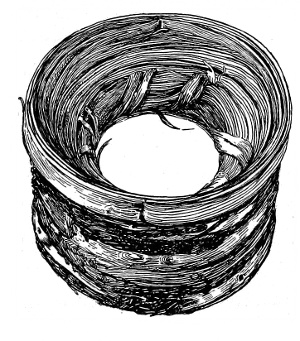
Fig. 15—Seri olla ring.
Ordinarily women are the water-bearers, each carrying an olla balanced on the head with the aid of a slightly elastic annular cushion, usually fashioned of yucca fiber (plate XXXII and figure 15), though in some cases two ollas are slung in nets at the ends of a yoke (figure 16) after the Chinese coolie fashion (this device being apparently accultural).

Fig. 16—Water-bearer’s yoke.
The function of the conventional Seri olla is exclusively that of a canteen or water-carrying vessel, and its form is suited to no other use; while its lines, like its thinness of wall, are adapted to the stresses of internal and external pressure in such wise as to give maximum strength with minimum weight. It is by reason of this remarkably delicate adaptation of materials to purposes that the plain olla figured in plate XXXIII, weighing an ounce or two more than 10 pounds in dry air, holds and safely carries three and one-third times its weight of water. When such ollas are broken, the larger pieces may be used as cups or dishes, or even as kettles, in the rare culinary operations of the tribe (as shown in plate X); but the entire vessels appear to be religiously devoted to their primary purpose.
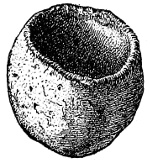
Fig. 17—Symbolic mortuary olla.
While some three-fourths of the observed fictile ware of the Seri and a still larger proportion of the scattered sherds represent conventional ollas, there are a few erratic forms. The most conspicuous of these is a smaller, thicker-walled, and larger-necked type, of which three or four examples were observed; two of these were in use (one is represented lying at the left of the jacal in plate X), and another was found cracked and abandoned on the desert east of Playa Noriega. The vessels of this type are used primarily as kettles and only incidentally as canteens. In both form and function they suggest accultural origin; but the ware is much like that of the conventional type. Another erratic type takes the form of a deep dish or shallow bowl, of rather thick walls and clumsy form, which may be accultural; a single example was observed in use (it is shown in plate XIV). There are also mortuary forms, including a miniature olla (figure 39) and bowl (figure 41), and such still smaller examples as those illustrated in figures 17 and 18. In addition to the utensils a few fictile figurines were found. Most of these were crude or distorted animal effigies, and one (broken) was a rudely shaped and strongly caricatured female figure some 2 inches high, with exaggerated breasts and pudenda. Analogy with neighboring tribes suggests that the very small vessels and the figurines are fetishistic appurtenances to the manufacture of the pottery; e. g., that the fetish is molded at the same time and from the same material as the olla, and is then burned with it, theoretically as an invocation against cracking or other injury, but practically as a “draw-piece” for testing the progress of the firing.
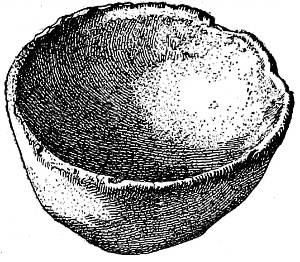
Fig. 18—Symbolic mortuary dish.
By far the most numerous of the utensils connected with potable water are drinking-cups and small bowls or dishes; but these are merely molluscan shells of convenient size, picked up alongshore, used once or oftener, and either discarded or carried habitually without other treatment than the natural wear of use (an example is illustrated in figure 19). Larger bowls or trays are improvised from entire carapaces of the tortoise (probably Gopherus agassizii), which are carried considerable distances; and still larger emergency water-vessels consist of carapaces of the green turtle (Chelonia agassizii), laid inverted in the jacales; these shells also being used in natural condition. No wrought shells, molluscan or chelonian, were observed in use or found either in the jacales or on the hundreds of abandoned sites; but the vicinage of the rancherias, the abandoned camps and house sites, and the more frequented paths are bestrewn with slightly worn shells, evidently used for a time and then lost or discarded. The relative abundance of the fictile ware and this natural shell ware in actual use is about 1:3; i. e., each adult female usually possesses a single olla of the conventional type, and there may be one or two extra ollas and two or three clay dishes in each band or clan, while each matron or marriageable maid is usually supplied with two to four shell-cups and each little girl with one or two; and there are twice as many carapace trays as clay dishes. The disproportion of pottery and shell about the abandoned sites is naturally much greater; for the former is the most highly prized industrial possession of the women, while the shells are easily gained and lightly lost.
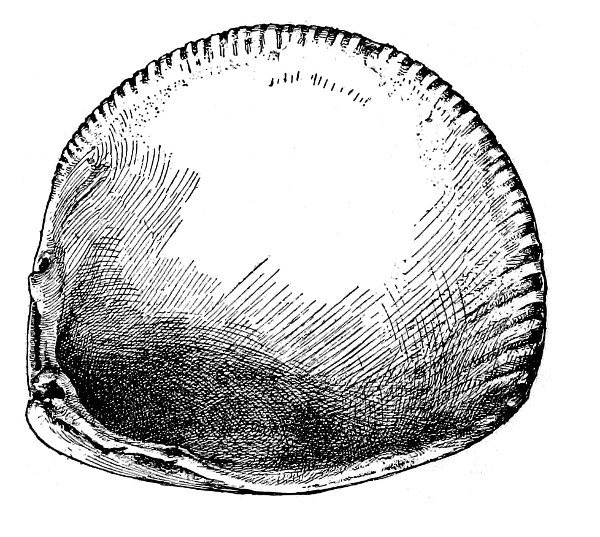
Fig. 19—Shell-cup.
With respect to solid food the Seri may be deemed omnivorous though their adjustment to habitat is such that they are practically carnivorous.
The most conspicuous single article in the dietary of the tribe is the local green turtle. This chelonian is remarkably abundant throughout Gulf of California; but its optimum habitat and breeding-place would appear to be El Infiernillo, whose sandy beaches are probably better adapted to egg laying and hatching than any other part of the coast. Here it has been followed by the Seri; perhaps half of the aggregate life of the tribe is spent within easy reach of its feeding and breeding grounds, and tribesman and turtle have entered into an inimical commonalty something like that of Siouan Indian and buffalo in olden time, whereby both may benefit and whereby the more intelligent communal certainly profits greatly. The flesh of the turtle yields food; some of its bones yield implements; its carapace yields a house covering, a convenient substitute for umbrella or dog-tent, a temporary buckler, and an emergency tray or cistern, as well as a comfortable cradle at the beginning of life and the conventional coffin at its end; while the only native foot-gear known is a sandal made from the integument of a turtle-flipper.
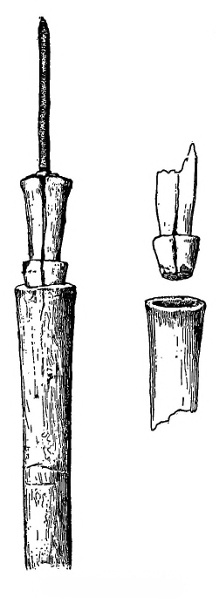
Fig. 20—Turtle-harpoon.
Doubtless the eggs and newly hatched young of the turtle are eaten, and analogy with other peoples indicates that the females are sometimes captured at the laying grounds or on their way back to water; but observation is limited to the taking of the adult animal at sea by means of a specialized harpoon. A typical specimen of this apparatus, as constructed since the introduction of flotsam iron, is illustrated in figure 20. It comprises a point 3 or 4 inches long, made from a nail or bit of stout wire, rudely sharpened by hammering the tip (cold) between cobbles, and dislodging the loosened scales and splinters by thrusts and twirlings in the ground; this is set firmly and cemented with mesquite gum into a foreshaft of hard wood, usually 4 or 5 inches long, notched to receive a cord and rounded at the proximal end; the rounded end of this foreshaft fits into a socket of the main shaft, which may be either a cane-stalk (as shown in the figure) or a section of mesquite root; while a stout cord is firmly knotted about the foreshaft and either attached to the distal portion of the main shaft or carried along it to the hand of the user. The main shaft is usually 10 or 12 feet long, with the harpoon socket in the larger end, and is manipulated by a fisherman sitting or standing on his balsa. On catching sight of a turtle lying in the water, he approaches stealthily, preferably from the rear yet in such wise as not to cast a frightening shadow, sets the foreshaft in place, guides the point close to the carapace, and then by a quick thrust drives the metal through the shell. The frictional resistance between the chitin and the metal holds the point in place, and although the foreshaft is jerked out at the first movement of the transfixed animal the cord prevents escape; and after partial tiring the turtle is either drowned or driven ashore, or else lifted on the craft.270 Immediately on landing the quarry, the plastron is broken loose by blows of the hupf271 and torn off by vigorous wrenches of the warriors and their strong-taloned spouses in the impetuous fury of a fierce blood-craze like that of carnivorous beasts; the blood and entrails and all soft parts are at once devoured, and the firmer flesh follows at a rate depending on the antecedent hunger, both men and women crushing integument and tendon and bone with the hupf, tearing other tissues with teeth and nails, mouthing shreds from the shells, and gorging the whole ravenously if well ahungered, but stopping to singe and smoke or even half roast the larger pieces if nearer satiety. If the quarry is too large for immediate consumption and not too far from a rancheria the remnants (including head and flippers and shells) are hoisted to the top of the jacal immediately over the open end—the conventional Seri larder—to soften in the sun for hours or days; and on these tough and gamey tidbits the home-stayers, especially the youths, chew luxuriously whenever other occupations fail. In times of plenty, such sun-ripened fragments of reeking feasts are rather generally appropriated first to the children and afterward to the coyote-dogs; and it is a favorite pastime of the toddlers to gather about an inverted carapace on hands and knees, crowding their heads into its noisome depths, displacing the rare scavenger beetles and blowflies of this arid province, mumbling at the cartilaginous processes, and sucking and swallowing again and again the tendonous strings from the muscular attachments, until, overcome by fulness and rank effluvias, they fall asleep with their heads in the trough—to be stealthily nudged aside by the cringing curs attached to the rancheria. Commonly the carapace and the longer bones from the flippers of the larger specimens are preserved entire for other uses, and are cleaned only by teeth and talons and tongues, aided by time but not by fire; but the plastron, unless broken up and consumed immediately, is subjected to a cooking process in which it serves at once as skillet and cutlet—it is laid on the fire, flesh side up, and at intervals the shriveling tissues are clawed off and devoured, while at last the scorched or charred scutes themselves are carried away to be eaten at leisure.272
Perhaps the most significant fact connected with the Seri turtle-fishing is the excellent adaptation of means to ends. The graceful and effective balsa is in large measure an appurtenance of the industry; the harpoon is hardly heavier and is much simpler than a trout-fishing tackle, yet serves for the certain capture of a 200-pound turtle; and the art of fishing for a quarry so shy and elusive that Caucasians may spend weeks on the shores without seeing a specimen is reduced to a perfection even transcending that of such artifacts as the light harpoon and fragile olla. Hardly less significant is the nonuse of that nearly universal implement, the knife, in every stage of the taking and consumption of the characteristic tribal prey; for it may fairly be inferred that the comparative inutility of the knife in dissevering the hard and horny chelonian derm, and the comparative effectiveness of the shell-breaking and bone-crushing hupf, have reacted cumulatively on the instincts of the tribe to retard the adoption of cutting devices. Of much significance, too, is the limited cooking process; for the habitual consumption of raw flesh betokens a fireless ancestry at no remote stage, while the crude cooking of (and in) that portion of the shell not consecrated to other uses might well form the germ of broiling or boiling on the one hand and of culinary utensils on the other hand. On the whole, the Seri turtle industry indicates a delicate adjustment of both vital and activital processes to a distinctive environment, in which the abundant chelonian fauna ranks as a prime factor.
Analogy with other primitive peoples would indicate that the flesh of the turtle is probably tabu to the Turtle clan, that the consumption of the quarry is preceded by an oblation, and that there are seasonal or other ceremonial rites connected with turtle-fishing; but no information has been obtained on any of these points save a few vague and unwilling suggestions from Mashém tending to establish the analogy.
Flotsam and stolen metal have played a rôle in the industries of Seriland so long that it is difficult to learn much of the turtle-fishing during premetal times; but an intimation from Mashém that the old men thought it much better to take the turtle with the teeth of an “animal that goes in the water”, and the similarity in terms for “harpoon” (or arrow) and “teeth” both suggest that the aboriginal point may have been a sea-lion tooth, and that the foreshaft itself may have been a larger tooth of seal or cetacean. While the modern harpoon is shaped with the aid of metal (hoop-iron, etc.), the forms are quite evidently vestigial of knifeless manufacture, in which a naturally rounded or abraded or fire-shaped foreshaft was fitted into the natural socket afforded by a cane-stalk broken at its weakest point—i. e., just below the joint; and both function and socket arrangement (as well as the linguistic evidence) strongly suggest the cylindrical tooth as the germ of the apparatus.
It is probable that water-fowl, considered collectively, stand second in importance as Seri prey; and the foremost fowl is undoubtedly the pelican, which serves not only as a fruitful food-supply but as the chief source of apparel.
The principal haunt and only known breeding ground of the pelican in the Gulf of California is Isla Tassne, an integral part of Seriland; and while the great birds are doubtless taken occasionally in Bahia Kunkaak, El Infiernillo, Bahia Tepoka, and other Seri waters, this island is the principal pelican hunting ground. According to Mashém’s account, the chase of the pelican here is a well-organized collective process: at certain seasons, or at least at times deemed propitious by the shamans, pelican harvests are planned; and after some days of preparation a large party assemble at a certain convenient point (presumably Punta Antigualla) and await a still evening in the dark of the moon. When all conditions are favorable they set out for the island at late twilight, in order that it may be reached after dark; on approaching the shore the balsas are left in charge of the women, while the warriors and the larger boys, armed only with clubs, rush on the roosting fowls and slaughter them in great numbers—the favorite coup de grâce being a blow on the neck. The butchery is followed by a gluttonous feast, in which the half-famished families gorge the tenderer parts in the darkness, and noisily carouse in the carnage until overcome by slumber. Next day the matrons select the carcasses of least injured plumage and carefully remove the skins, the requisite incisions being made either with the edge of a shell-cup or with a sharp sliver of cane-stalk taken from an injured arrow or a broken balsa-cane. The feast holds for several days, or until the last bones are picked and the whole party sated, when the clans scatter at will, laden with skins and lethargic from the fortnight’s food with which each maw is crammed.
Mashém’s recital gave no indication as to whether the Pelican clan participate in the hunting orgies, though it clearly implies that the chase and feast are at least measurably ceremonial in character; and this implication was strengthened by the interest and comparative vivacity awakened in the Seri bystanders by their spokesman’s frequent interlocutions with them during the recital. Unfortunately the account was not clear as to the seasons selected, though the expressions indicated that the feasts are fixed for times at which the young are fully fledged. It would seem inconceivable that the Seri, with their insatiate appetite for eggs and tender young, should consciously respect a breeding time or establish a closed season to perpetuate any game; yet it is probable that the pelican is somehow protected in such wise that it is not only not exterminated or exiled, but actually fostered and cultivated. It is certain that the mythical Ancient of Pelicans is the chief creative deity of Seri legend, and its living representative the chief tutelary of one of the clans; it is certain, too, that this fleshly fowl, sluggish and defenseless as it is on its sleeping grounds, would be the easiest source of Seri food if it were hunted indiscriminately; and it is no less certain that the omnivorous tribesmen would quickly extinguish the local stock if they were to make its kind, including eggs and young, their chief diet; yet it survives in literal thousands to patrol the waters of all Seriland in far-stretching files and vees seldom out of sight in suitable weather. On the whole, it would seem evident that an interadjustment has grown up between the tribesmen and their fish-eating tutelary during the centuries, whereby the fowl is protected, albeit subconsciously only, during the breeding seasons; and in view of other characteristics of the tribe it would seem equally evident that the protection is in some way effected by means of ceremonies and tabus.
Somewhat analogous, though apparently less ceremonial, expeditions are made to Isla Patos and other points in search of ducks, and to Isla San Esteban, and still more distant islands in search of eggs (preferably near the hatching point) and nestlings; while the abundant waterfowl of the region are sought in Rada Ballena and other sheltered bays, as well as in such landlocked lagoons as those of Punta Miguel and Punta Arena. This hunting involves the use of bows and arrows, though the archery of the tribe pertains rather to the chase of larger land game, and apparently attains its highest development in connection with warfare. No specialized fowling devices have been observed among the Seri; and their autonomous recitals, the facies of their artifacts, and the observed habits of the tribe (especially the youth) with respect to birds, all indicate that ordinary fowling holds a subordinate place in Seri craft—i. e., that it is a fortuitous and emergency avocation, rather than an organized art like turtle-fishing and water-carrying. Concordantly, culinary processes are not normally employed in connection with waterfowl, and the customary implements used for incising the skin and severing other tissues are the shell-cup, which is carried habitually for other purposes, the cane-splint, which appears to be improvised on occasion, and never carried habitually, and the ubiquitous hupf.
Probably second in importance among Seri prey, as a food-source merely, stand the multifarious fishes with which the waters of Seriland teem, particularly if the class be held to comprise the cetaceans and seals and selachians ranked as leaders of the fish fauna in Seri lore.
Naturally, whales lie outside the ordinary range of Seri game, yet they are not without place in the tribal economy. During the visit to the Seri rancheria near Costa Rica in 1894, it was noted that various events—births, deaths, journeys, etc.—were referred to “The Time of the Big Fish”; and it was estimated from apparent ages of children and the like that this chronologic datum might be correlated roughly with the year 1887. The era-marking event was memorable to Mashém, to the elderwomen of the Turtle clan, and to other mature members of the group, because they had been enabled thereby to dispense with hunting and fishing for an agreeably long time, and because they had moved their houses; but the providential occurrence was not interpreted at the time. On visiting Isla Tiburon in 1895, the interpretation became clear; along the western shore of Rada Ballena, near the first sand-spit north of the bight, lay the larger bones of a whale, estimated from the length of the mandibles and the dimensions of the vertebræ to have been 75 or 80 feet long. It was evident that the animal had gone into the shoal water at exceptionally high tide and had stranded during the ebb; while the condition of the bones suggested an exposure to the weather of perhaps half a dozen years. On the shrubby bank above the beach, hard by the bleaching skeleton, stood the new rancheria, the most extensive seen in Seriland, comprising some fifteen or twenty habitable jacales; and fragments of ribs and other huge bones about and within the huts273 attested transportation thither after the building, while the shallowness of the trails and the limited trampling of the fog shrubbery gave an air of freshness to the site and surroundings. The traditions and the relics together made it manifest that “The Time of the Big Fish” had indeed marked an epoch in Seri life; that when the leviathan landed (whether through accident or partly through efforts of balsa-men) it was quickly recognized as a vast contribution to the Seri larder; and that some of the clans, if not the entire tribe, gathered to gorge first flesh and blubber, next sun-softened cartilage and chitin, and then epiphyses and the fatter bones. Some of the ribs were splintered and crushed, evidently by blows of the hupf, in order to give access to the cancellate interiors; several of the vertebræ were battered and split, and nearly all of the bones bore marks of hupf blows, aimed to loosen cartilaginous attachments, start epiphyses, or remove spongy and greasy processes. Little trace of fire was found; in one case a mandible was partly scorched, though the burning appeared to be fortuitous and long subsequent to the removal of the flesh; and a bit of charred and gnawed epiphysis, much resembling the fragments of half-cooked turtle plastron scattered over Seriland, was picked up in one of the huts. The condition of the remains and the various indications connected with the rancheria corroborated the tradition that the great creature had afforded unlimited and acceptable food for many moons; and various expressions of the tradition indicated that the event, though the most memorable of its class, was not unique in Seri lore.
A few bones and fragments of skin of the seal were found in and about the rancherias on Isla Tiburon, and an old basket rebottomed with sealskin was picked up in a recently abandoned jacal on Rada Ballena; a few bones provisionally identified with the porpoise (which haunts Boco Infierno in shoals) were also found amid the refuse about the old rancheria at the base of the long sand-spit terminating in Punta Tormenta; but nothing was learned specifically concerning the chase and consumption either of these animals or of the abundant sharks from which the island is named.
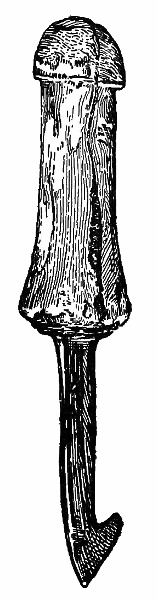
Fig. 21—Fish-spearhead.
Among the exceedingly limited food supplies brought from the coast by the Seri group at Costa Rica in 1894, were rank remnants of partly desiccated fish, usually gnawed down to heads and tails; and Mashém and others spoke of fish as a habitual food, while Señor Encinas regarded it as the principal element of the tribal dietary. The harder bones and heavier scales of several varieties of fish were also found abundantly among the middens of both mainland and Tiburon shores in 1895. None of the remains bore noticeable traces of fire; and all observations, including those of Señor Encinas, indicate that the smaller varieties of fish are habitually eaten raw, either fresh or partially dried, according to the state of appetite at the time of taking—or the condition of finding when picked up as beach flotsam. But a single piscatorial device was observed, i. e., the barbed point and foreshaft, shown in figure 21—the iron point being, of course, accultural, and probably obtained surreptitiously. This harpoon, which measures 6 inches in length over all, is designed for use in connection with the main shaft of a turtle-catching tackle; and it is evidently intended for the larger varieties, perhaps porpoises or sharks. In 1827 Hardy observed a related device:
They have a curious weapon which they employ for catching fish. It is a spear with a double point, forming an angle of about 5°. The insides of these two points, which are 6 inches long, are jagged, so that when the body of a fish is forced between them, it can not get away on account of the teeth.274
Don Andrés Noriega, of Costa Rica, described repeatedly and circumstantially a method of obtaining fish by aid of pelicans, in which a young or crippled fowl was roped to a shrub or stone, to be fed by his fellows; when at intervals a youth stole out to rob the captive’s pouch. At first blush this device would seem to rise above the normal industrial plane of the Seri and to lie within the lower stages of zooculture, like the cormorant fishing of China if not the hawking of medieval Europe; yet on the whole it may be deemed fairly consistent with that cruel yet mutually beneficial toleration between tribesmen and pelicans attested by the preservation of the avian communal, as already noted. Moreover, Don Andrés observations are in accord with early notes of the exceedingly primitive aborigines of California, from whom the Seri have undoubtedly borrowed various cultural suggestions; thus Venegas quotes Padre Torquemada as saying:
I accidentally found a gull tied with a string and one of his wings broke. Around this maimed bird lay heaps of excellent pilchards, brought thither by its companions; and this, I found, was a stratagem practiced by the Indians to procure themselves a dish of fish; for they lie concealed while the gulls bring these charitable supplies, and when they think that little more is to be expected they seize upon the contributions.
The padre says also of these gulls that “they have a vast craw, which in some hangs down like the leather bottles used in Peru for carrying water, and in it they put their captures to carry them to their young ones”—from which it is evident that he refers to the pelican. Venegas adds, “Such are the mysterious ways of Providence for the support of his creatures!”275 And in the margin of his accompanying “Mapa de la California”, he introduces a vigorous picture of a captive fowl, its free fellow, and the mess of fish, the cut being headed “Alcatrazes” (pelicans).
Despite these devices, the dearth of fishing-tackle among the Seri is evidently extreme. Save in the single specimen figured, no piscatorial apparatus of any sort was found among the squalid but protean possessions at the Costa Rica rancheria; neither nets nor hooks nor rods nor lines nor any other device suitable for taking the finny game were found in the scores of jacales containing other artifacts on Tiburon; while Señor Encinas was conversant only with the simple method of taking fish by hand from the pools and shallows left by receding breakers or ebbing tides. This dearth of devices is significantly harmonious with other Seri characteristics: it accords with the leading place assigned the turtle in their industry and their lore; it is in harmony with that primitive and nonmechanical instinct which leads them to rely on bodily strength and skill and swiftness rather than on extra-corporeal artifacts in their crude and incomplete conquest of nature; and it is a manifest expression of relation with their distinctive physical environment—for the ever-thundering breakers of their gale-swept coast are abundant, albeit capricious, bringers of living grist, while the offshore gales at low tide lay bare hundreds of acres of shoaler bottoms literally writhing with fishes stranded among beds of mollusks and slimy with the abounding plankton of a fecund coast. The region is one of ample, albeit lowly, food supply, where every experience tends toward inert reliance on providential chance, and where the stimulus of consistently conscious necessity seldom stirs the inventive faculty.
Closely connected with fish as a Seri food-source are the various molluscan and crustacean forms collectively called shellfish; and these contribute a considerable share of the sustenance of the tribe.
Apparently the most important constituent of this class of foods is the Pacific coast clam, which abounds in the broad mud-flats bordering Laguna La Cruz and other lagoons of Seriland, and which was still more abundant during a subrecent geologic epoch, to judge from the immense accumulation of the shells in Punta Antigualla. The clams are usually taken at low tide, without specialized apparatus. They are located by feeling with the feet in shallow water, and caught either with toes or with fingers, to be tossed into any convenient receptacle. When the water is entirely withdrawn from the flats, they are located by means of their holes, and are extricated either with a shell-cup or with some other improvised implement. Frequently the entire mess is thrown into a fire until the shells open, when they are withdrawn and the mollusks devoured practically raw; perhaps more commonly the shells are opened by blows of the hupf, and eaten without semblance of cooking; and, except on the surface, no trace of roasting was found among the vast accumulations of shells in Punta Antigualla.
Perhaps second to the clam in frequency of use is the local oyster, which abounds about the more sheltered shores of Tiburon. It is gathered with the hands, aided perhaps by a stone or stick for dislodging the shells either from the extended offshore beds at extreme low water, or from the roots of a mangrove-like shrub at a medium stage. The shells, like those of the clam, are frequently opened by partial roasting; and shells, sometimes scorched, are extensively scattered over the interior, indicating that the oyster is a favorite portable food. The popularity of this bivalve is shared by the Noah’s-ark (Arca), to which some mystical significance is apparently ascribed; and the abundant limpets and bivalves and other mollusks are eaten indiscriminately, to judge from the abundance of their shells in the middens. The ordinary crab, too, is a favorite article of food, and its claws are numerous in camp and house refuse; while the lobster-like deep-water crab is introduced into the menu whenever brought to the surface by storms, as shown by its massive remains in the middens.
On the whole, shellfish form a conspicuous factor in Seri economy by reason of the considerable consumption of this class of food; but, viewed in the broader industrial aspect, the produce is notably primitive, and significant chiefly as indicating the dearth of mechanical and culinary devices.
While by far the larger share of Seri sustenance is drawn from the sea, a not inconsiderable portion is derived from the land; for the warriors and striplings and even the women are more skilful hunters than fishers.
The larger objects of the feral chase are deer of two or three species (the bura, or mule-deer, being most conspicuous and easiest taken), antelope, and mountain sheep; to which the puma, the jaguar, and perhaps two or three other carnivores might be added. The conventional method of taking the bura and other deer is a combination of stalking and coursing, usually conducted by five of the younger warriors, though three or four may serve in emergency; any excess over five being regarded as superfluous, or as a confession of inferiority. The chase is conducted in a distinctly ceremonial and probably ritualistic fashion, even when the finding of the game is casual, or incidental to a journey: at sight of the quarry, the five huntsmen scatter stealthily in such manner as partially to surround it; when it takes fright one after the other strives to show himself above the shrubbery or dunes in order to break its line of flight into a series of zigzags; and whether successful in this effort or not they keep approximate pace with it until it tires, then gradually surround it, and finally rush in to either seize it in their hands or cripple it with clubs—though the latter procedure is deemed undignified, if not wrong, and hardly less disreputable than complete failure. When practicable the course is laid toward the rancheria or camp; and in any event the ideal finish is to bring the animal alive into the family group, where it maybe dissected by the women, and where the weaklings may receive due share of the much-prized blood and entrails. The dissection is merely a ravenous rending of skin and flesh, primarily with the teeth (perhaps after oblique bruising or tearing by blows with the hupf over strongly flexed joints), largely with hands and fingers aided anon by a foot planted on the carcass, and partly with some improvised device, such as a horn or tooth of the victim itself, the serrated edge of a shell-cup, or perhaps a sharp-edged cane-splint from a broken arrow carried for emergency’s sake. Commonly the entire animal, save skin and harder bones, is gulped at a sitting in which the zeal of the devotee and the frenzy of the carnivore blend; but in case the group is small and the quarry large, the sitting is extended by naps or prolonged slumberings, and the more energetic squaws may even trouble to kindle a fire and partially cook the larger joints, thereby inciting palled appetite to new efforts. Finally the leg bones are split for the marrow and their ends preserved for awls; the horns are retained by the successful huntsmen as talisman-trophies; while the skin is stretched in the desert sun, scratched and gnawed free of superfluous tissue, rubbed into partial pliability, and kept for bedding or robe or kilt.
The chase of the hare is closely parallel to that of the deer save that it is conducted by striplings, who thereby serve apprenticeship in hunting and at the same time enrich the tribal larder with a game beneath the dignity of the warriors; while still smaller boys similarly chase the rabbit, which is commonly scorned by the striplings. The conventional hare-hunting party is three, and it is deemed disreputable to increase this number greatly. The youths spread at sight of the game and seek to surround it, taking ingenious and constant advantage of the habit of the hare to run obliquely or in zigzags to survey more readily the source of its fright; for some time they startle it but slightly by successive appearances at a distance, but gradually increase its harassment until it bounds hither and thither in terror, when they rapidly close in and seize it, the entire chase commonly lasting but a few minutes. The quarry is customarily taken alive to camp, where it is quickly rent to fragments and the entrails and flesh and most of the bones consumed; the skin usually passes into possession of a matron for use as infantile clothing or cradle bedding, while the ears are kept by the youth who first seized the game until his feat is eclipsed by some other event—unless chance hunger sooner tempts him to transmute his trophy into pottage.
While the collective, semiceremonial style of chase alone is thoroughly good form in Seri custom, it is often rendered impracticable by the scattering of the tribe in separate families or small bands, in which case the bura and its associates, like the larger carnivores customarily, are taken by strategy rather than by strength. This form of chase is largely individual; in it archery plays a leading rôle; and in it, too, ambuscade, stealthy lying in wait, and covert assault attain high development. It is closely analogous with the warfare typical of the tribe; and it is especially noteworthy as one of the most effective stimuli to intellectual activity, and hence to the development of invention—if the term may be applied to industrial products so lowly as those of the Seri.
The chief artifact produced by the strategic chase on land would seem to be the analogue of the harpoon used at sea, i. e., the arrow. This weapon is one of the three or four most highly differentiated and thoroughly perfected of the Seri artifacts, ranking with canteen-olla and balsa, and perhaps outranking the turtle-harpoon. It is fabricated with great care and high skill, and with striking uniformity in details of material and construction. A typical example is 25 inches in length and consists of three pieces—point, foreshaft, and main shaft (feathered toward the nock). The foreshaft is 8½ inches long, of hard wood carefully ground by rubbing with quartzite or pumice into cylindrical form, about three-eighths of an inch in diameter at the larger end and tapering slightly toward the point; the larger end is extended by careful grinding into a tang which is fitted into the main shaft, the joint being neatly wrapped with sinew. This main shaft is a cane-stalk (Phragmites communis?) 15 or 16 inches long, carefully selected for size and well straightened and smoothed; it is feathered with three equidistantly-placed wing-feathers of hawk or falcon, neatly prepared by removing a thin strip of the rachis bearing the wider vexillum and attaching it by sinew wrappings at both ends, the feathers being about 5½ inches in length. The nock is a simple rounded notch, placed just below a joint and supported by the sinew ferrule; there is no foot-plug. The favorite point is a bit of flotsam hoop-iron, ground into elongate triangular shape with projecting barbs, and a short tang or shank fitted into a shallow notch in the foreshaft, cemented there with mesquite gum, and finally fixed firmly with sinew wrappings. A typical iron-point arrow, with bow and quiver, is depicted in plate XXX. Alternative points are of rudely chipped stone (two examples are illustrated in figure 37) somewhat clumsily attached to the foreshaft by mesquite gum and sinew wrapping; while the arrows used by boys and hunters of small game are usually pointless, the tip of the foreshaft being sharpened and hardened by slight charring. In some of the arrows, especially those designed for use in war, the foreshaft is notched, or else loosely attached to the main shaft, in order that it may be detached from the main shaft and remain in the body of enemy or prey. The foreshaft is commonly painted some bright color (red is prevalent), while the points and attachments of the “poisoned” specimens are smeared with some greasy substance.
The aboriginal Seri arrow has undoubtedly been modified during the centuries since the coming of Cortés and Mendoza with their metal-armed troopers; yet certain inferences as to the indigenous form of the weapon are easily drawn from its construction and the homologies of its parts.
The first feature of the artifact to attract attention is the relative clumsiness of attachment and frequent absence of points. The chipped-stone points are so rude as to be quite out of harmony with the otherwise delicately wrought and graceful arrow, while the attachment is strikingly rude; and it is still more noteworthy that the very name for stone arrowpoint was little understood at Costa Rica, and was obtained only after extended inquiry and repeated conferences among the older informants. Even the attachment of the effective points made from hoop-iron is bad constructionally; the sinew wrapping is carried around the entire blade in such manner as to sheathe the sharply ground edges and itself be cut on contact with firm tissue; and the fitting and wrapping are so rude as to be incongruous with the rest of the apparatus. On the whole the suggestion is strong that the arrowpoint is accultural—and this suggestion is further strengthened by the very existence of the practically functionless, and hence manifestly vestigial, hard-wood foreshaft. Turning to the structural homologies, the observer is at once struck with the parallelism running through the three most conspicuous compound artifacts found among the Seri, i. e., the harpoon, the fire-drill, and the arrow. All of these alike consist of two essential parts, main shaft and foreshaft; all are akin in function even in the superficial view of the Caucasian, and are much more closely related in primitive thought—indeed the fire-drill is but a featherless and nockless arrow, with the foreshaft charred at its fire-giving tip; and all are closely linked in language and allied with other terms in such wise as practically to establish identity among them in the thinking of their lowly makers (though unfortunately the incomplete vocabularies extant are insufficient for full study of the linguistic homologies). Briefly the indications are that the harpoon was the primary device, and that its foreshaft was a tooth of an aquatic fish-eater like the seal, or perchance in some cases an os penis; that its lineal successor was a loose-head lance for use on sea and land, at first with the unaided hand and later with the atlatl, or throwing-stick (the lance being now extinct, though recorded by early visitors to Seriland); that the next artifact-generation in the direct line was represented by the arrow, foreshafted with hard wood or tooth, made light and graceful and loose-headed or not, according to needs, and by the substitution of bow for atlatl; and that a somewhat aberrant line was marked by the taming of fire, its reproduction by the modified arrow, and the differentiation of fire-stick from arrow and either atlatl or bow.
In tracing these stages in technologic growth, it is to be remembered that the Seri are so primitive as to betray some of the very beginnings of activital concepts; that to them zoic potencies are the paramount powers of the cosmos; that in their simple thought fire is a bestial rather than a physical phenomenon; that in their naive philosophy the production of devouring flame is of a kind with vital birth and a similitude of sexual reproduction; and that according to their notions the conquest of quarry, including fire, is made practicable only by aid of the mystical potencies of beasts and flames gained through invocatory use of symbols or actual organs.
In the Seri tongue the term “fire-drill” is kaak, an indefinite generic meaning “kind” or “strong kind”, with an egocentric connotation (“Our-Strong-Kind”), as in the proper tribal designation Kun-kaak or Km-kaak; while the term for the nether fire-stick or hearth is either maam (“woman”, or more properly “mother”), or else (and more commonly) kaak-maam, which may be rendered “Kind-Mother”—the “Kind”, as among primitive folk generally, comprising both men and tutelary beasts, and in this case fire as the most mysterious of the beasts; there is thus a suggestive analogy between the designation for the fire-producing apparatus and that for the tribe itself. It should be noted that the zoic concept of fire is widespread among the more primitive peoples of various provinces, and sometimes persists in recognizable form in higher culture (witness the fire-breathing dragons of various mythologies, the “Red Flower” notion gathered in India by Kipling, etc.); also that the ascription of sex to the fire-sticks is prevalent among North American tribes, and at once helps to interpret the development of the fire-drill, fire-syringe, and other primitive devices, such, for example, as those so fully described by Hough,276 and serves to explain the otherwise obscure genesis of the fire-sense, which must have accompanied and shaped that most significant of all steps in human progress, the conquest of fire.
The modern coordinate of the Seri arrow is the bow, made preferably from a straight and slender branch of the palo blanco. A typical specimen is illustrated in plate XXX; it is 4 feet 9½ inches long, with the outer face convex and the inner face flat; greatest width 1¾ inches, narrowed to 1⅛ inches at the hand-hold; thickness at the hand-hold 1 inch, thinning to five-eighths inch at 8 inches from this point; tapering gradually in both dimensions toward the extremities, which are rudely notched to receive the cord (of mesquite-root fiber). The specimen illustrated has been cracked and repaired in two places; in one place the repair was effected by a rough wrapping of sinew, and in the other by slipping over the wood a natural sheath of rawhide from the leg of a deer. The specimen is of added interest in that it combines bow and nether fire-stick (“Strong-Kind-Mother”), one of the friction holes being worn out to the notched margin, and the other remaining in usable condition, as shown in the enlarged marginal drawing.277
Compared with the delicately finished and graceful arrow, the typical bow is a rude and clumsy device; it displays little skill in the selection and shaping of material, and evidently involves little labor in manufacture—indeed, the indications are that more actual labor is spent in the construction of a single arrow than in the making of a bow, while the arrow-making is expert work, betokening craft of a high order, and the bow-making little more than simple handiwork of the lowest order. The comparison affords some indication of the genesis of Seri archery, and at the same time corroborates the independent suggestion that the arrow is of so much greater antiquity than the bow as to represent a distinct stage in cultural development—though the precise cultural significance of the bow is not easily ascertained.
Efforts were made to have different Seri warriors at Costa Rica in 1894 assume the normal archery attitude, with but moderate success, the best pose obtained (illustrated in plate XXVIII) being manifestly unnatural and a mere reflection of the attitude in the mind of the Caucasian poser; while the results of inquiries served only to indicate that the normal archery attitude was purposely avoided for reasons not ascertained. Fortunately another observer was more successful: in the course of the United States hydrographic surveys in 1873, Commander (now Admiral) Dewey received several visits from Seri warriors on board the Narragansett; and on the occasion of one of these visits, Mr Hector von Bayer, of the hydrographic party, caught a photograph of an archer in the act of drawing his bow. The negative was accidentally shattered, and no prints are known to have been made from it; but the fragments were carefully joined, and were kindly transferred to the Bureau by Mr Von Bayer in 1897, and from them plate XXIX was carefully drawn. The posture (partly concealed by the drapery) is extraordinary, being quite beyond the reach of the average human, and impossible of maintenance for any considerable interval even by the well-wonted Seri. The posture itself partly explains the difficulty of inducing the warriors at Costa Rica to assume it, since it is essentially a fleeting one, and indeed but a part of a continuous and stressful action—it is no less difficult to assume, or to catch in the camera, than the typical attitude of a baseball pitcher in action. The posture thus fortunately caught is quite in accord with the accounts of Seri archery from the esoteric side given by Mashém, and with the exoteric observations of Señor Encinas, Don Andrés, and others; for all accounts agree in indicating that the archer commonly rests inert and moveless as the watching feline up to a critical instant, then springs into movement as swiftly as the leaping jaguar, and hurls, rather than shoots, one, two, or three arrows before rushing in to the death or skulking to cover as the issue may require.