SUMMARY HISTORY (continued 3)
Reading edition
Sir: Early in November I visited the Seri tribe of Indians, inhabiting Tiburon island in the Gulf of California and an area of several thousand square miles of the adjacent mainland in Sonora, Mexico. The visit was for the purpose of making collections under your authority as Secretary of the Smithsonian Institution; but I availed myself of the opportunity for obtaining additional information relating to the customs, habits, and history of the tribe. In addition to my own party I was accompanied by Señor Pascual Encinas, a prominent citizen of Hermosillo, and owner of several ranchos adjacent to, and one within, the territory claimed by the Seri Indians; also by Señor A. Alvemar-Leon of Hermosillo, a young Mexican gentleman educated in the United States. For Señor Encinas the Seri Indians have the highest regard, and his kindly motive in accompanying the party was to facilitate friendly intercourse with the Indians; Señor Alvemar-Leon acted as Spanish-English interpreter, and one of the tribe who speaks Spanish [Mashém] acted as the Seri interpreter.
One of the subjects of inquiry of the Indians related to the alleged killing of two Americans by the Seri Indians on Tiburon island during last spring at a date not definitely known either to the Indians or to myself. At first the Indians were indisposed to convey information on the subject, but after receiving presents from Señor Encinas and myself, and friendly assurances from the former, the interpreter for the tribe confessed the crime and detailed the circumstances, denying, however, that any of the Indians present at the place of conference (Rancho de San Francisco de Costa Rica, 17 leagues west-southwest of Hermosillo and near the coast) participated.
According to the first account given through the Indian interpreter, the Indians on the island saw a small vessel approach the shores of the island, and saw four men land therefrom in a small boat. The spokesman among the strangers made inquiry, chiefly by signs, as to whether game was abundant in the interior of the island, and was by signs answered in the affirmative by the chief of the tribe, who displayed a letter of authority from the state officials at Hermosillo. Then the strangers divided, two remaining on the shore by the small boat, while the spokesman and another, accompanied by several Indians, started toward the interior of the island. When they were some distance away—the account continues—some of the Indians remaining on shore indicated by signs a desire to borrow the rifle of one of the two men on the beach, and after some parley the rifle was turned over to them; then the Indians desired also to borrow the small boat in which the party of white men had landed, and after one of the two men remaining on the shore was put aboard the vessel, this, too, was placed in the hands of the Indians. Thereupon several of the Indians entered the small boat, carrying the white man’s rifle, and rowed around a headland a short distance away. Passing this point they landed and a part of them ran quickly into the interior in such direction as to intercept the course of the white men. There they lay in wait until the strangers appeared, when they shot the spokesman, killing him almost instantly. On this the second white man cried out for help, whereupon he too was shot and wounded, and then (according to the first account) ran away and concealed himself in the bushes and was seen no more. The Indians who had borrowed the boat then went back to the shore, and reentered the boat with the intention of returning and capturing the fine vessel of the strangers; but as they approached the vessel, being at the time quite near the shore, the man on board arose suddenly with a gun pointed toward them and shouted, whereupon they dropped the borrowed gun and, leaping from the boat, ran away among the mesquite bushes, all escaping unhurt. The white man on the beach then, as the account ran, leaped into the boat, and, recovering his gun, rowed to the vessel and got aboard, when the two men at once made sail and escaped down the bay.
The foregoing account was given to Señor Encinas alone by the Indians through their interpreter, and was afterward conveyed to me through Señor Alvemar-Leon. Both of us recognized the incongruity with the character of the Seri Indians of that part of the narrative relating to the wounding and escape of the second man, and Señores Encinas and Leon and myself sought to impress the improbability of the account on the interpreter. Subsequently the Indians, through their interpreter, conveyed to Señor Encinas a modification of the account (after adhering to the first version for twenty-four hours), which agreed in all essential respects with the first, excepting the supplementary statement that some of the Indians (but neither the party who accompanied the white men nor those who followed in the boat) ran after the wounded man, caught him, shot him again—whereupon he again cried out—and then killed him with stones. This modified account, also, Señor Encinas duly conveyed to me.
BUREAU OF AMERICAN ETHNOLOGY SEVENTEENTH ANNUAL REPORT PL. XI
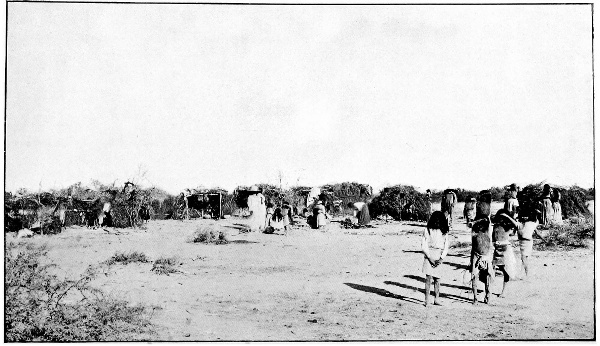
OCCUPIED RANCHERIA ON THE FRONTIER
Still later, in collecting linguistic material through the Seri interpreter with the assistance of Señor Alvemar-Leon, I recurred to the subject incidentally (or at least ostensibly so) on two or three occasions, partly with the view of verifying or disproving the current report that the men were eaten by the Indians; and since the first distrust on the part of the interpreter and the companions (by whom he was commonly surrounded) had worn off, the questions were answered freely and with apparent truth. In brief, the information gained in this way was a repetition in general terms of the statement of the killing of both men; but the responses indicated (1) that the Indians are not cannibals, (2) that they do not eat any portion or portions of the body of an enemy slain in war, (3) that they do not eat human flesh in a sacrificial way, and (4), specifically, that they did not eat the flesh of the two white men killed last spring. I am disposed to give credence to all of these statements.
Señor Encinas informed me that for a long time after the reputed killing of the two Americans on the island the Seri were exceptionally shy and were seldom seen on the mainland; that the first representatives of the tribe to appear were one or two old women who came to his rancho with much trepidation; that these representatives being not ill-treated, a man appeared, who was also well treated, and that still later other members of the tribe appeared, though it was only a few days before our visit that any considerable body of the Seri Indians showed themselves at their favorite mainland haunt on his rancho. It was his first communication with the Indians since the killing, and, both he and they agreed, the first confession of the crime outside of their own tribe.
While in Sonora various conflicting accounts of the affair were given me. One, to which I was disposed to attach credence by reason of the character of my informant and his explanation of the circumstances under which the information was gained, was given me (just before the visit referred to above) by ex-Consul Forbes, of Guaymas. This account corresponds in all essential details with that conveyed to my party by the Indians, except that, according to Mr Forbes’ account, the survivors were altogether unarmed after the borrowing of the rifle by the Indians, and that when the man in the boat arose suddenly and shouted he pointed at the Indians not a gun but a stick, in the hope of deceiving them thereby, as he was fortunate enough to do.
It may be added that the Seri Indians are at the same time the most primitive and the most bloodthirsty and treacherous of the Indians of North America, so far as my knowledge extends; also that their character is well known throughout Sonora, and indeed generally throughout Mexico, Arizona, and the southern part of California. I was assured by the acting governor of Sonora and by the prefect of Hermosillo that it would be little short of suicide for even a Mexican official to visit these Indians or land on their island without an armed guard. Through conference with the Indians, also, I learned that any white man, Mexican, or Indian of another tribe coming in contact with them is killed without the slightest compunction, unless they are restrained by fear. Accordingly I am satisfied that the character of the Seri Indians is quite as bad as the unsavory reputation they have acquired throughout the Southwest.
It should be observed that while the Indians were unable to give the names of the men killed, their description of men and vessel agreed exactly with those of the newspaper correspondent Robinson and his companion, and with the sloop Examiner; and Mr Forbes’ information was obtained direct from the survivors of the expedition of which Mr Robinson had charge. There can thus be no doubt that it was Mr Robinson and his companion who were killed by these Indians, and whose killing was confessed by them, as set forth above.
With great respect, your obedient servant,
W J McGee, Ethnologist in charge.
Honorable S. P. Langley, Secretary of the Smithsonian Institution.
On first learning of the incident, months before the diplomatic correspondence began, the state and federal authorities promptly adopted vigorous punitive measures. A vessel carrying a force of federal troops was dispatched from Guaymas and a body of state troops were sent from Hermosillo with instructions to meet on the coast and capture the criminals at any cost, even to the extermination of the tribe if resistance was offered. But like so many others, the expedition failed; the horses of the land party were stalled in the sands and burrow-riddled plains, the vessel was harassed by storms and tidal currents, and the landing boats were swamped by the surf, while the Indians merely fled at sight of the invaders toward inaccessible lairs or remote parts of their territory; and when the water was gone and men and animals were at point of famishing, the forces retired without so much as seeing a single Seri.
During the ensuing autumn the tribe, having quenched their blood-feud in alien blood, turned toward peace, and sent a matron of the Turtle clan, known as Juana Maria, to Costa Rica—i. e., Rancho de San Francisco de Costa Rica—where she was gradually followed by younger matrons and children, then by youths, and finally by warriors (after the fashion of Seri diplomacy) to the aggregate number of about sixty. Here they were found by the first expedition of the Bureau of American Ethnology, in November, 1894; and here, under the still strong influence of the venerable Don Pascual, supplemented by small gifts and persistent pressure, they gradually “gave their language”, submitted to extensive photographing, confessed specifically to the Robinson killing, and yielded up nearly the whole of their portable possessions in the way of domestic implements and utensils, face-painting material, pelican-skin robes, snake-skin necklaces, etc.
With the return of the Bureau party to Hermosillo the Indians became restive and soon withdrew beyond the desert. In the course of the ensuing winter a group returned to the neighborhood of Costa Rica, where, by aid of strategy, seven warriors (including some of those seen at the rancho in the preceding November) with the families of four, were arrested, taken to Hermosillo, tried, and, according to oral accounts, banished. Irritated by this action, and connecting with it the visit of Don Pascual and the strangers desiring their language and sacred things, the clans resumed the warpath, displaying special animosity toward the residents of Costa Rica. There were a few minor skirmishes; then, at the instance of the state officials, a number of Papago Indians, who are feared by the Seri beyond all other enemies, were domiciled at the rancho, where their mere presence proved a sufficient protection. Meantime, according to apparently trustworthy press accounts, two small exploring parties entered Seriland; the first consisted of seven prospectors, who kept well together until about to leave the territory, when one of their number fell behind—and his companions saw him no more, though they carefully retraced their trail beyond the point at which he had stopped; the other was a German naturalist-prospector with two mozos (servant-companions), purporting to hail from Chihuahua, who started across the delta-plain of Rio Bacuache and Desierto Encinas with saddle animals, and never reappeared.
BUREAU OF AMERICAN ETHNOLOGY SEVENTEENTH ANNUAL REPORT PL. XII
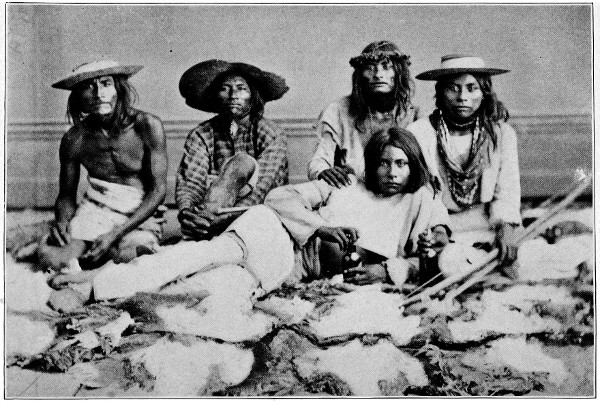
GROUP OF SERI INDIANS ON TRADING EXCURSION
Then came the second expedition of the Bureau of American Ethnology, to which several Papago domiciled at Costa Rica were attached as guards. While the party were at the rancho the day before the first entrada into Seriland via Barranca Salina, a party of vaqueros from Rancho Santa Ana tended a herd of stock to the barranca for water; one of the animals strayed behind a dune, and the vaqueros, following its trail, came on a small band of Seri already devouring the entrails, and attacked them so vigorously that they escaped only by outrunning the horses, leaving behind all their unattached possessions, including a bow and quiver of arrows and an ancient and nonusable army rifle. This incident, albeit typical, was untimely, and doubtless aided in rendering the Indians too wild to permit communication with the aliens during the ensuing weeks spent in their territory.
After the withdrawal of this expedition the Seri resumed their range over the borderland plain, with the evident intention of avenging the insult of the invasion. There were a number of skirmishes, in which some of the Papago guards of the 1895 expedition were wounded and had horses killed under them, though they did customary execution on the worse-armed Seri; and extensively published press items indicate that, toward the end of January, 1896, a party of five gold prospectors landed on Tiburon, whence one escaped.
A well-attested episode ensued toward the end of 1896: Captain George Porter and Sailor John Johnson spent the later part of the summer in cruising the coasts of the Gulf, collecting shells, feathers, and other curios in the small sloop World. About the end of October they apparently anchored in Rada Ballena; and a day or two later Captain Martin Mendez, of Guaymas, in charge of the schooner Otila, being driven up the gulf and into Bahia Kunkaak by storms, came on a horde of Seri looting Porter’s vessel. The episode received publicity on Mendez’s return to Guaymas; United States Consular Agent Crocker instituted inquiries, and Governor Corral sent a force to Costa Rica, where, after some delay, a parley was held with a strong band of Seri under the chiefship of “a seven-foot warrior named El Mudo (The Mute), ... so called for his reticence of speech.”223 The testimony obtained at the parley and from Captain Mendez indicates that Porter and Johnson landed, or at least approached the shore, probably in a small boat; that they were met by a shower of arrows, under which Johnson immediately fell, while Porter defended himself with a shotgun, slaying five of the Seri before he was himself transfixed; that the vessel was then looted, and that Mendez and his crew were prevented from landing and apparently driven off by the Seri force. In the course of the parley the state officials “demanded the surrender of the ringleaders in the massacre”, with the alternative of “regarding the whole tribe as guilty and punishing them accordingly”; but El Mudo, evidently holding the invasion of the island as the initial transgression and deeming the loss of the tribe under Porter’s marksmanship as more than commensurate with the Caucasian loss, peremptorily ended the conference and returned to the island. Vigorous efforts were made to pursue the tribesmen beyond their practically impassable frontier, with the usual product of ruined horses and famished riders. Then the episode died away in an armed neutrality strained somewhat beyond the normal. Meantime the Papago guards remained at Costa Rica. “They are continuously on the lookout for these Seris, and once or twice have killed a stray one or two.”224
Both before and after the Porter-Johnson episode schemes were devised by various parties, chiefly Californians, for obtaining concessions covering Tiburon and its resources, most of these schemes involving plans for the extermination of the Seri; and press accounts indicate that a concession covering the islands of the gulf above the latitude of 29° (i. e., including about half of Isla Tiburon) was granted to an American company of much distinction. It would appear from numerous news items that representatives of the company sought to land on Tiburon, where they were first cajoled with offerings of food, afterward found to be poisonous, and later driven off by an enlarged force of naked archers. A recent publication bearing some official sanction announces that “Mr W. J. Lyons, of Hermosillo, Sonora, has secured a concession for the exploration of the island and in November of this year will fit out an expedition for that purpose.”225 The various movements are significant as indices of current opinion and official policy with respect to the tribe.
On the whole, the later episodes are natural sequels of the eventful and striking earlier history of the Seri; and they can only be interpreted as pointing to early extinction of one of the most strongly marked and distinctive of aboriginal tribes.